Form 10-K for the year ended December 31, 2011
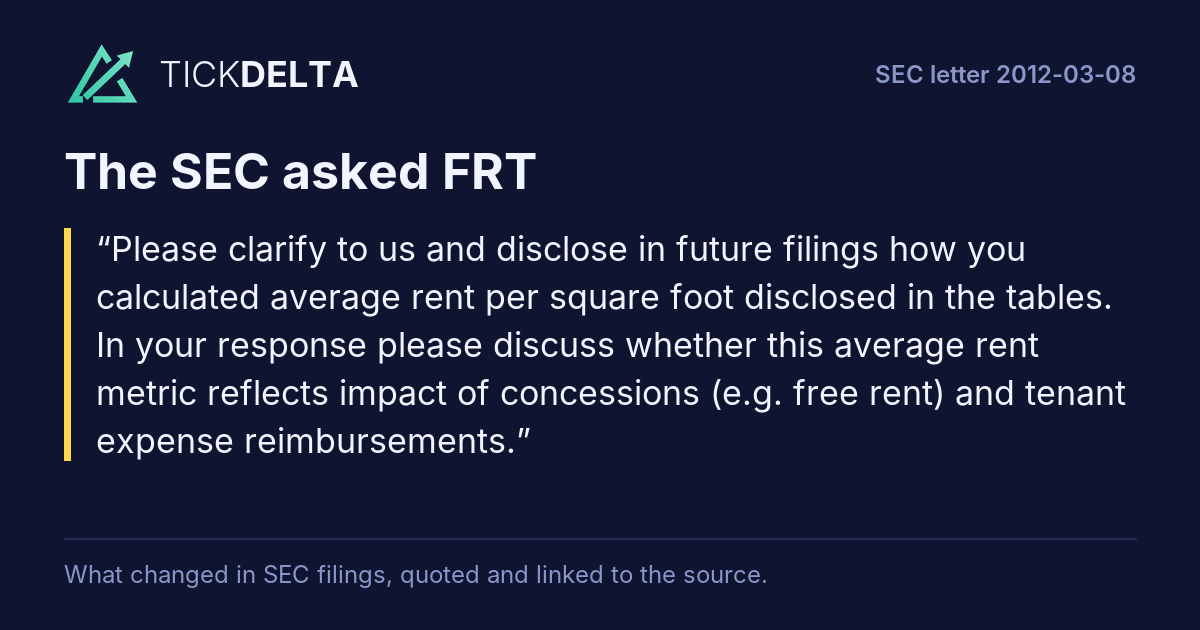
Please clarify to us and disclose in future filings how you calculated average rent per square foot disclosed in the tables. In your response please discuss whether this average rent metric reflects impact of concessions (e.g. free rent) and tenant expense reimbursements.
Average base rent is calculated as the aggregate, annualized in-place contractual (cash basis) minimum rent for all occupied spaces divided by the aggregate gross leasable area of all occupied spaces. The disclosure does not include tenant expense reimbursements but does include concessions.
In future filings, we will disclose the following: “Average base rent is calculated as the aggregate, annualized in-place contractual (defined as cash basis including adjustments for concessions) minimum rent for all occupied spaces divided by the aggregate GLA of all occupied spaces.” Read in the reply ↗
First report after the company's reply of 2012-03-20: 10-Q filed 2012-05-07 ↗, against the 10-Q filed 2011-11-03 ↗.
Tickdelta does not hold the text of both reports, so they are not compared here.
We note your use of same-center property operating income within your earnings release. Please tell us whether you consider this metric to be a key performance indicator. If not, please tell us the basis for your conclusion.Rest of the question
If so, in future periodic filings, please disclose same-center property operating income and include the following: A reconciliation between same center property operating income and property operating income on a consolidated basis. To the extent there are differences beyond non-same center property operating income, please discuss the difference and your basis for such difference. The number of properties designated as same center properties, redevelopment and expansion properties. Please highlight the number of properties removed from or added to the same center designation from the prior year. Expand upon your existing definition of same-center to discuss at what point in the redevelopment or expansion process do you include and exclude them from your same center designation. Include in your same center disclosures occupancy and average rent trends, as adjusted for leasing incentives if any.
Management does not rely on same center property operating income (POI) as a primary metric to analyze performance or manage the business. While we believe same-center POI is one indicator of operational performance, we do not believe it is a key performance indicator. Same-center POI growth is one metric utilized by investors to assess trends in our core operations and the growth metric is included in our earnings release, however, our property operating income is impacted by other areas including acquisitions, dispositions, redevelopments and developments.Read in the reply ↗Rest of the answer
All of these components are critical aspects of our business which must be evaluated in totality to fully understand the Company and our operating portfolio. We do not believe componentizing any one of these POI metrics is imperative for an investor to evaluate our financial results. Additionally, while same-center POI is used in the real estate industry, it is not consistently defined and the calculation can vary significantly amongst our peers, thus, not providing an adequate basis for comparison.
Separately, in our MD&A disclosures, we explain changes in our financial statement line items using same-center terminology, however, this is to provide a user-friendly way for investors to understand changes in our 87 properties but we do not believe a net metric of same-center POI is necessary nor should it be considered a key financial metric.
First report after the company's reply of 2012-03-20: 10-Q filed 2012-05-07 ↗, against the 10-Q filed 2011-11-03 ↗.
Tickdelta does not hold the text of both reports, so they are not compared here.
Please tell us your basis for recording earnings one quarter in arrears, especially given the $11.8 million gain deferred from the sale of its entire portfolio. In addition, please tell us how you calculated the gain.
Our partner in Taurus Newbury Street JV II Limited Partnership was the managing member of the partnership and kept the books and records. Our partner was not a public company and was not regularly required to account for information under U.S. GAAP. Given this, we were not able to obtain U.S. GAAP financial statements on a quarterly basis in a sufficiently timely manner to apply the equity method of accounting using current information.Read in the reply ↗Rest of the answer
We utilized the guidance in ASC 323-10-35-6 which provides equity method investees the ability to report earnings in a lag if current information is not available, however, this lag reporting must be consistent from period to period. While ASC 323-10-35 does not contain specific guidance on an allowable timeframe, Regulation S-X Rule 3A-02 (b) permits a 93 day lag for consolidated subsidiaries which we believe to be an appropriate analogy to unconsolidated subsidiaries. Therefore, we made an accounting policy decision for this equity method investment to record our earnings one quarter in arrears due to our inability to receive U.S. GAAP basis financial statements in a timely manner. This fact has been disclosed each quarter in our periodic filings since entering into the venture in May 2010.
When the properties were sold early in the fourth quarter 2011, we evaluated whether it was appropriate to make a preferential accounting policy change to eliminate the lag in reporting. We determined this was not an allowable policy change by using the guidance in ASC 250-10-45-12 as the entity was terminating and we had consistently reported earnings one quarter in arrears. However, given the magnitude of the expected gain, we felt this information was important to provide to our investors to ensure the financial statements were not misleading. In order to calculate an estimate of the gain on sale, we utilized our investment balance at December 31, 2011, net of the cash we received at closing as part of the sale.
The Company acknowledges that:
— the Company is responsible for the adequacy and accuracy of the disclosure in the filings;
Staff comments or changes to disclosure in response to Staff comments do not foreclose the Commission from taking any action with respect to the filing; and the Company may not assert Staff comments as a defense in any proceeding initiated by the Commission or any person under the federal securities laws of the United States.
If you have any further questions or require additional information, please do not hesitate to contact me at (301) 998-8166.
First report after the company's reply of 2012-03-20: 10-Q filed 2012-05-07 ↗, against the 10-Q filed 2011-11-03 ↗.
Tickdelta does not hold the text of both reports, so they are not compared here.
We have considered your response to comment two and note your utilization of samecenter terminology to provide a user-friendly way for investors to understand changes in your properties. In the interest of expanding upon your user-friendly use of same-center terminology, please revise future periodic filings to include the following.Rest of the question
o Disclosure of the number of properties designated as same center properties, redevelopment and expansion properties. o Disclosure of the number of properties removed from and added to the samecenter designation from the prior year. o Expand upon your existing definition of same-center to discuss at what point in the redevelopment or expansion process you include and exclude them from your same-center designation.
We will include the above disclosures in future periodic filings. Read in the reply ↗
We have considered your response to comment three and note that you calculate an estimate of the gain on sale by utilizing the investment balance at December 31, 2011, net of the cash you received at closing as part of the sale. Please provide us your calculation of the estimated gain and clarify how the repayment of the $11.8 million loans you provided to the joint venture factored into your calculation.
At closing of the sale, we received $34.6 million comprised of $11.8 million to repay the outstanding loans we made to the joint venture and $22.8 million as our remaining share of the proceeds. The full $11.8 million principal balance on the loans was repaid and therefore, did not impact the gain calculation.Read in the reply ↗Rest of the answer
The $11.8 million estimated gain on sale was calculated as follows:
Sale proceeds after repayment of the loans of $22.8 million less our net equity investment in the joint venture (after repayment of the loans) of $11.0 million for an estimated gain on sale of $11.8 million.
The Company acknowledges that:
— the Company is responsible for the adequacy and accuracy of the disclosure in the filings;
Staff comments or changes to disclosure in response to Staff comments do not foreclose the Commission from taking any action with respect to the filing; and the Company may not assert Staff comments as a defense in any proceeding initiated by the Commission or any person under the federal securities laws of the United States.
If you have any further questions or require additional information, please do not hesitate to contact me at (301) 998-8166.
First report after the company's reply of 2012-03-30: 10-Q filed 2012-05-07 ↗, against the 10-Q filed 2011-11-03 ↗.
Tickdelta does not hold the text of both reports, so they are not compared here.
Also in this review: closing letter, 2012-04-06