Paragraph 251 · 50% changed
Every version of it
Screener
/
SEC EDGAR
/CIK 0001422183
/10-K filed Feb 25, 2026, compared with Feb 26, 2025
/Numbers from the XBRL of the 10-Ks
The 10-K against last year's
199 changes: 72 added, 28 removed, 93 reworded, 6 quiet changes
10-K Feb 25, 2026 vs Feb 26, 2025
Risk Factors
23.2%
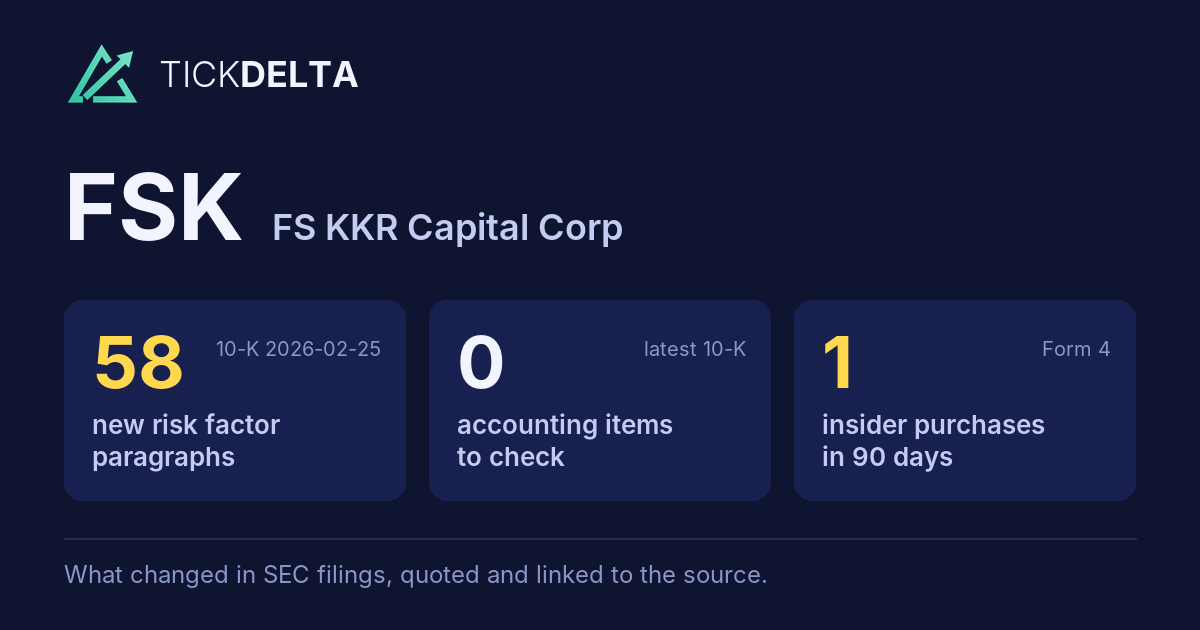
of the text changed · 32,240 words now · 58 new paragraphs, 24 gone
MD&A
17.2%
of the text changed · 10,439 words now · 14 new paragraphs, 4 gone
Legal Proceedings
35.0%
of the text changed · 1,464 words now
Accounting Policies
7.4%
of the text changed · 3,529 words now
10-K 0001628280-26-011734 (Feb 25, 2026) vs 10-K 0001628280-25-008175 (Feb 26, 2025)
Every paragraph, and how much of it changed
One bar per paragraph, in the order of the 10-K. Height and colour show the share of its words not in the closest paragraph a year earlier; the tallest bars are new paragraphs.
Risk Factors
345 paragraphs · 58 new · 111 reworded · 24 gone · 10-K Feb 25, 2026 against Feb 26, 2025
New paragraph
Reworded (5% of its words or more)
Same or nearly
Paragraph 70 · 49% changed
Every version of it
Cybersecurity refers to the combination of technologies, processes, and procedures established to protect information technology systems and data from unauthorized access, attack, or damage. We, our affiliates and our and their respective third-party service providers are subject to cybersecurity risks. Our business operations rely upon secure information technology systems for data processing, storage and reporting. We depend on the effectiveness of the information and cybersecurity policies, procedures and capabilities maintained by our affiliates and our and their respective third-party service providers to protect their computer and telecommunications systems and the data that reside on or are transmitted through them. Cybersecurity risks have significantly increased in recent years and, while we have not experienced any material losses relating to cyber-attacks or other information security breaches, we could suffer such losses There has been an increase in the future. Our, frequency and sophistication of the cyber and security threats faced, with attacks ranging from those common to businesses to those that are more advanced and persistent, which may target us or our affiliates service providers because we or our service providers hold a significant amount of confidential and our sensitive information about investors, portfolio companies or obligors (as applicable) and their respective third-party service providers’ computer systems, software and networks may be vulnerable to unauthorized access, computer viruses or other malicious code and other events that could have potential investments. As a result, there is a heightened risk of a security impact, as well as cyber-attacks that do not have a security impact but may nonetheless cause harm, such as causing denial-of-service attacks (i.e., efforts breach or disruption with respect to make network services unavailable to intended users) on websites, servers or other online systems. If one or more of such events occur, it potentially could jeopardize confidential and other information, including nonpublic personal information and sensitive business data, processed and stored in, and transmitted through, computer systems and networks, or otherwise cause interruptions or malfunctions in our operations or the operations of our affiliates and our and their respective third-party service providers. This could result in significant losses, reputational damage, litigation, regulatory fines or penalties, or otherwise adversely affect our business, financial condition or results of operations. this information.
Paragraph 102 · 49% changed
Every version of it
We may be obligated to pay the Adviser incentive compensation on income that even if we have not received. incur a net loss due to a decline in the value of our portfolio.
Paragraph 130 · 44% changed
Every version of it
Investments in Asset-Based Finance Opportunities. We may invest in asset-based opportunities finance investments through joint ventures, investment platforms, private investment funds or other business entities that provide one or more of the following services: origination or sourcing of potential investment opportunities, due diligence and negotiation of potential investment opportunities and/or servicing, development and management (including turnaround) and disposition of investments. Such investments may be in or alongside existing or newly formed operators, consultants and/or managers that pursue such opportunities and may or may not include capital and/or assets contributed by third party investors. Such investments may include opportunities to direct-finance physical assets, such as airplanes and ships, and/or operating assets, such as financial service entities, as opposed to investment securities, or to invest in origination and/or servicing platforms directly. In valuing our investments, we rely primarily on information provided by operators, consultants and/or managers. Valuations of illiquid securities involve various judgments and consideration of factors that may be subjective. There is a risk that inaccurate valuations could adversely affect the value of our common stock. We may not be able to promptly withdraw our investment in these asset-based opportunities, which may result in a loss to us and adversely affect our investment returns.
Paragraph 109 · 44% changed
Every version of it
Neither the Adviser, nor persons providing services to us on behalf of the Adviser, are prohibited from raising money capital for and managing another other investment entity entities that makes make the same types of investments as those we target. As a result, the time and resources that these individuals may devote to us may be diverted. In addition, we may compete with any such investment entity for the same investors and investment opportunities. We may participate in certain transactions originated by the Adviser or its affiliates under the Co-Investment Exemptive Order, which will permit us, subject to the satisfaction of certain conditions, to co-invest in certain privately negotiated investment transactions, including investments originated and directly negotiated by the Adviser or KKR Credit, with our co-investment affiliates. To the extent the Company makes co-investments with investment accounts managed by the Adviser or its affiliates, these co-investment opportunities may give rise to conflicts of interest or perceived conflicts of interest among the Company and the other participating accounts. In addition, conflicts of interest or perceived conflicts of interest may also arise in determining which investment opportunities should be presented to the Company and other participating accounts. While the terms of the Co-Investment Exemptive Order require that the Adviser will be given the opportunity to cause us to participate in certain transactions originated by affiliates of the Adviser, the Adviser may determine that we not participate in those transactions and for certain other transactions (as set forth in guidelines approved by the Board of Directors) the Adviser may not have the opportunity to cause us to participate.
Paragraph 321 · 43% changed
Every version of it
Paragraph 47 · 42% changed
Every version of it
and liquidity for leveraged loans. Any further disruption in the credit and other financial markets could have substantial negative effects on general economic conditions, the availability of required capital for companies and the operating performance of such companies. These conditions also could result in increased default rates and credit downgrades, and affect the liquidity and pricing of the investments made by us. Conversely, periods of economic stability and increased competition among capital providers could increase the difficulty of locating investments that are desirable for us.
Paragraph 139 · 39% changed
Every version of it
Paragraph 251 · 50% changed
Every version of it
10-K Feb 26, 2025Because we incur indebtedness to make investments, our net investment income is dependent, in part, upon the difference between the rate at which we borrow funds or pay interest on outstanding debt securities and the rate at which we invest these funds. The recent increases in interest rates have made it more expensive to use debt to finance our investments and to refinance our current financing arrangements. In addition, certain of our financing arrangements provide for adjustments in the loan interest rate along with changes in market interest rates. Therefore, in periods of rising interest rates, our cost of funds will increase, which could materially reduce our net investment income. Any reduction in the level of interest rates on new investments relative to interest rates on our current investments could also adversely impact our net investment income.
10-K Feb 25, 2026
Since we use debt to finance a portion of our investments, our net investment income depends, in part, upon the difference between the rate at which we borrow funds and the rate at which we invest those funds. As a result, we can offer no assurance that a significant change in market interest rates will not have a material adverse effect on our net investment income. In periods of rising interest rates when we have debt outstanding, our cost of funds will increase, which could reduce our net investment income. Any reduction in the level of interest rates on new investments relative to interest rates on our current investments could also adversely impact our net investment income. We expect that our long-term fixed-rate investments will be financed primarily with equity and long-term debt. We may use interest rate risk management techniques in an effort to limit our exposure to interest rate fluctuations. These techniques may include various interest rate hedging activities to the extent permitted by the 1940 Act. These activities may limit our ability to participate in the benefits of lower interest rates with respect to the hedged portfolio. Adverse developments resulting from changes in interest rates or hedging transactions could have a material adverse effect on our business, financial condition and results of operations. Also, we have limited experience in entering into hedging transactions, and we will initially have to purchase or develop such expertise.
Paragraph 70 · 49% changed
Every version of it
10-K Feb 26, 2025
Cybersecurity refers to the combination of technologies, processes, and procedures established to protect information technology systems and data from unauthorized access, attack, or damage. We, our affiliates and our and their respective third-party service providers are subject to cybersecurity risks. Our business operations rely upon secure information technology systems for data processing, storage and reporting. We depend on the effectiveness of the information and cybersecurity policies, procedures and capabilities maintained by our affiliates and our and their respective third-party service providers to protect their computer and telecommunications systems and the data that reside on or are transmitted through them. Cybersecurity risks have significantly increased in recent years and, while we have not experienced any material losses relating to cyber-attacks or other information security breaches, we could suffer such losses in the future. Our, our affiliates and our and their respective third-party service providers’ computer systems, software and networks may be vulnerable to unauthorized access, computer viruses or other malicious code and other events that could have a security impact, as well as cyber-attacks that do not have a security impact but may nonetheless cause harm, such as causing denial-of-service attacks (i.e., efforts to make network services unavailable to intended users) on websites, servers or other online systems. If one or more of such events occur, it potentially could jeopardize confidential and other information, including nonpublic personal information and sensitive business data, processed and stored in, and transmitted through, computer systems and networks, or otherwise cause interruptions or malfunctions in our operations or the operations of our affiliates and our and their respective third-party service providers. This could result in significant losses, reputational damage, litigation, regulatory fines or penalties, or otherwise adversely affect our business, financial condition or results of operations.
10-K Feb 25, 2026
Cybersecurity refers to the combination of technologies, processes, and procedures established to protect information technology systems and data from unauthorized access, attack, or damage. We, our affiliates and our and their respective third-party service providers are subject to cybersecurity risks. Our business operations rely upon secure information technology systems for data processing, storage and reporting. We depend on the effectiveness of the information and cybersecurity policies, procedures and capabilities maintained by our affiliates and our and their respective third-party service providers to protect their computer and telecommunications systems and the data that reside on or are transmitted through them. There has been an increase in the frequency and sophistication of the cyber and security threats faced, with attacks ranging from those common to businesses to those that are more advanced and persistent, which may target us or our service providers because we or our service providers hold a significant amount of confidential and sensitive information about investors, portfolio companies or obligors (as applicable) and potential investments. As a result, there is a heightened risk of a security breach or disruption with respect to this information.
Paragraph 102 · 49% changed
Every version of it
10-K Feb 26, 2025
We may be obligated to pay the Adviser incentive compensation on income that we have not received.
10-K Feb 25, 2026
We may be obligated to pay the Adviser incentive compensation even if we incur a net loss due to a decline in the value of our portfolio.
Paragraph 130 · 44% changed
Every version of it
10-K Feb 26, 2025
Investments in Asset-Based Opportunities. We may invest in asset-based opportunities through joint ventures, investment platforms, private investment funds or other business entities that provide one or more of the following services: origination or sourcing of potential investment opportunities, due diligence and negotiation of potential investment opportunities and/or servicing, development and management (including turnaround) and disposition of investments. Such investments may be in or alongside existing or newly formed operators, consultants and/or managers that pursue such opportunities and may or may not include capital and/or assets contributed by third party investors. Such investments may include opportunities to direct-finance physical assets, such as airplanes and ships, and/or operating assets, such as financial service entities, as opposed to investment securities, or to invest in origination and/or servicing platforms directly. In valuing our investments, we rely primarily on information provided by operators, consultants and/or managers. Valuations of illiquid securities involve various judgments and consideration of factors that may be subjective. There is a risk that inaccurate valuations could adversely affect the value of our common stock. We may not be able to promptly withdraw our investment in these asset-based opportunities, which may result in a loss to us and adversely affect our investment returns.
10-K Feb 25, 2026
Investments in Asset-Based Finance Opportunities. We may invest in asset-based finance investments through joint ventures, investment platforms, private investment funds or other business entities that provide one or more of the following services: origination or sourcing of potential investment opportunities, due diligence and negotiation of potential investment opportunities and/or servicing, development and management (including turnaround) and disposition of investments. Such investments may be in or
Paragraph 109 · 44% changed
Every version of it
10-K Feb 26, 2025
Neither the Adviser, nor persons providing services to us on behalf of the Adviser, are prohibited from raising money for and managing another investment entity that makes the same types of investments as those we target. As a result, the time and resources that these individuals may devote to us may be diverted. In addition, we may compete with any such investment entity for the same investors and investment opportunities.
10-K Feb 25, 2026
Neither the Adviser, nor persons providing services to us on behalf of the Adviser, are prohibited from raising capital for and managing other investment entities that make the same types of investments as those we target. As a result, the time and resources that these individuals may devote to us may be diverted. In addition, we may compete with any such investment entity for the same investors and investment opportunities. We may participate in certain transactions originated by the Adviser or its affiliates under the Co-Investment Exemptive Order, which will permit us, subject to the satisfaction of certain conditions, to co-invest in certain privately negotiated investment transactions, including investments originated and directly negotiated by the Adviser or KKR Credit, with our co-investment affiliates. To the extent the Company makes co-investments with investment accounts managed by the Adviser or its affiliates, these co-investment opportunities may give rise to conflicts of interest or perceived conflicts of interest among the Company and the other participating accounts. In addition, conflicts of interest or perceived conflicts of interest may also arise in determining which investment opportunities should be presented to the Company and other participating accounts. While the terms of the Co-Investment Exemptive Order require that the Adviser will be given the opportunity to cause us to participate in certain transactions originated by affiliates of the Adviser, the Adviser may determine that we not participate in those transactions and for certain other transactions (as set forth in guidelines approved by the Board of Directors) the Adviser may not have the opportunity to cause us to participate.
Paragraph 321 · 43% changed
Every version of it
10-K Feb 26, 2025any, could be inadequate to completely or even partially cover any loss of revenues or investments, any increases in operating and maintenance expenses, or any replacements or rehabilitation of property. Certain events causing catastrophic loss could be either uninsurable, or insurable at such high rates as to adversely impact the Company, the Adviser, or portfolio companies, as applicable. Force majeure events that are incapable of or are too costly to cure could have permanent adverse effects. Certain force majeure events (such as war or an outbreak of an infectious disease) could have a broader negative impact on the world economy and international business activity generally, or in any of the countries in which the Company invests or its portfolio companies operate specifically. Such force majeure events could result in or coincide with: increased volatility in the global securities, derivatives and currency markets; a decrease in the reliability of market prices and difficulty in valuing assets; greater fluctuations in currency exchange rates; increased risk of default (by both government and private issuers); further social, economic, and political instability; nationalization of private enterprise; greater governmental involvement in the economy or in social factors that impact the economy; less governmental regulation and supervision of the securities markets and market participants and decreased monitoring of the markets by governments or self-regulatory organizations and reduced enforcement of regulations; limited, or limitations on, the activities of investors in such markets; controls or restrictions on foreign investment, capital controls and limitations on repatriation of invested capital; inability to purchase and sell investments or otherwise settle security or derivative transactions (i.e., a market freeze); unavailability of currency hedging techniques; substantial, and in some periods extremely high, rates of inflation, which can last many years and have substantial negative effects on credit and securities markets as well as the economy as a whole; recessions; and difficulties in obtaining and/or enforcing legal judgments.
10-K Feb 25, 2026
or self-regulatory organizations and reduced enforcement of regulations; limited, or limitations on, the activities of investors in such markets; controls or restrictions on foreign investment, capital controls and limitations on repatriation of invested capital; inability to purchase and sell investments or otherwise settle security or derivative transactions (i.e., a market freeze); unavailability of currency hedging techniques; substantial, and in some periods extremely high, rates of inflation, which can last many years and have substantial negative effects on credit and securities markets as well as the economy as a whole; recessions; and difficulties in obtaining and/or enforcing legal judgments.
Paragraph 47 · 42% changed
Every version of it
10-K Feb 26, 2025
the investments made by us. Conversely, periods of economic stability and increased competition among capital providers could increase the difficulty of locating investments that are desirable for us.
10-K Feb 25, 2026
and liquidity for leveraged loans. Any further disruption in the credit and other financial markets could have substantial negative effects on general economic conditions, the availability of required capital for companies and the operating performance of such companies. These conditions also could result in increased default rates and credit downgrades, and affect the liquidity and pricing of the investments made by us. Conversely, periods of economic stability and increased competition among capital providers could increase the difficulty of locating investments that are desirable for us.
Paragraph 139 · 39% changed
Every version of it
10-K Feb 26, 2025Derivatives. We may invest from time to time in derivatives, including total return swaps, interest rate swaps, credit default swaps and foreign currency forward contracts. Derivative investments have risks, including: the imperfect correlation between the value of such instruments and our underlying assets, which creates the possibility that the loss on such instruments may be greater than the gain in the value of the underlying assets in our portfolio; the loss of principal; the possible default of the other party to the transaction; and illiquidity of the derivative investments. If a counterparty becomes bankrupt or otherwise fails to perform its obligations under a derivative contract due to financial difficulties, we may experience significant delays in obtaining any recovery under the derivative contract in a bankruptcy or other reorganization proceeding, or may not recover at all. In addition, in the event of the insolvency of a counterparty to a derivative transaction, the derivative contract would typically be terminated at its fair market
10-K Feb 25, 2026
Derivatives and Other Similar Investments. We may invest from time to time in derivatives and other similar instruments (referred to collectively in this section as “derivatives”), including total return swaps, interest rate swaps, credit default swaps and foreign currency forward contracts. Derivative investments have risks, including but not limited to: the imperfect correlation between the value of such instruments and our underlying assets, which creates the possibility that the loss on such instruments may be greater than the gain in the value of the underlying assets in our portfolio; the loss of principal; the risk from potential adverse market movements in relation to our derivatives positions, or the risk that markets could experience a change in volatility that adversely impacts our portfolio returns and our obligations and exposures; the possible default of the counterparty to the transaction; and illiquidity of the derivative investments. If a counterparty becomes bankrupt or otherwise fails to perform its obligations under a derivative contract due to financial difficulties, we may experience significant delays in obtaining any recovery under the derivative contract in a bankruptcy or other reorganization proceeding, or may not recover at all. In addition, in the event of the insolvency of a counterparty to a derivative transaction, the derivative contract would typically be terminated at its fair market value. If we are owed this fair market value in the termination of the derivative contract and our claim is unsecured, we will be treated as a general creditor of such counterparty and will not have any claim with respect to the underlying security. Counterparty risk also refers to the related risks of having concentrated exposure to such a counterparty. Derivative investments in which we may invest may, in certain circumstances, give rise to a form of financial leverage, which may magnify the risk of loss. The ability to successfully use derivative investments depends on the ability of the Adviser to predict pertinent market movements, which cannot be assured. In addition, amounts paid by us as premiums and cash or other assets held in margin accounts with respect to our derivative investments would not be available to it for other investment purposes, which may result in lost opportunities for gain. Changes in the value of a derivative may also create margin delivery or settlement payment obligations. Derivative investments are also subject to operational and legal risks. Operational risk generally refers to risk related to potential operational issues, including documentation issues, settlement issues, system failures, inadequate controls, and human errors. Legal risk generally refers to insufficient documentation, insufficient capacity or authority of counterparty, or legality or enforceability of a contract.
MD&A
149 paragraphs · 14 new · 52 reworded · 4 gone · 10-K Feb 25, 2026 against Feb 26, 2025
New paragraph
Reworded (5% of its words or more)
Same or nearly
Paragraph 135 · 49% changed
Paragraph 75 · 46% changed
The decrease in combined interest and PIK income during the year ended December 31, 2024 2025 compared to the year ended December 31, 2023 can 2024 is primarily be attributed attributable to a decline in yields during the year ended December 31, 2025 compared to the lower interest rate environment, year ended December 31, 2024 and the repayment of higher yielding investments, the renegotiation of certain investments to lower rates, and lower average debt utilization. Additionally, Company placing certain assets either were restructured or placed on non-accrual status during the year ended December 31, 2024, which also contributed to the reduction in combined interest and PIK income. 2025.
Paragraph 141 · 38% changed
Our equity interests in portfolio companies for which there is no liquid public market are valued at fair value. Generally, the value of our equity interests in public companies for which market quotations are readily available is based upon the most recent closing public market price. Portfolio securities that carry certain restrictions on sale are typically valued at a discount from the public market value of the security. The Adviser will normally use pricing data for domestic or foreign equity securities received shortly after the close of the primary securities exchange on which such securities trade and does not normally take into account trading, clearances or settlements that take place after the close of the exchange.
Paragraph 92 · 35% changed
During the year ended December 31, 2025, we recorded a net realized loss from the extinguishment of debt of $(7). See Note 9 to our audited consolidated financial statements included herein for additional information regarding our financing arrangements.
Paragraph 108 · 28% changed
Paragraph 96 · 27% changed
Paragraph 28 · 26% changed
Paragraph 120 · 26% changed
Our financial statements are prepared in conformity with GAAP, which requires us to make estimates and assumptions that affect the reported amounts of assets and liabilities at the date of the financial statements and the reported amounts of revenues and expenses during the reporting periods. Management has utilized utilizes available information, including our past history, industry standards and the current economic environment, among other factors, in forming the estimates and judgments, giving due consideration to materiality. Actual results may differ from these estimates. In addition, other companies may utilize different estimates, which may impact the comparability of our results of operations to those of companies in similar businesses. Understanding our accounting policies and the extent to which we use management judgment and estimates in applying these policies is integral to understanding our financial statements. We describe our most significant accounting policies in “Note 2. Summary of Significant Accounting Policies” in our consolidated financial statements. Critical accounting policies are those that require the application of management’s most difficult, subjective or complex judgments, often because of the need to make estimates about the effect of matters that are inherently uncertain and that may change in subsequent periods. We evaluate our critical accounting estimates and judgments required by our policies on an ongoing basis and update them as necessary based on changing conditions. We have identified one of our accounting policies, valuation of portfolio investments, specifically the valuation of Level 3 investments, as critical because it involves significant judgments and assumptions about highly complex and inherently uncertain matters, and the use of reasonably different estimates and assumptions could have a material impact on our reported results of operations or financial condition. As we execute our operating plans, we will describe additional critical accounting policies in the notes to our future financial statements in addition to those discussed below.
Paragraph 135 · 49% changed
10-K Feb 26, 2025Determination of fair value involves subjective judgments and estimates. Accordingly, the notes to our consolidated financial statements refer to the uncertainty with respect to the possible effect of such valuations and any change in such valuations on our consolidated financial statements. In making its determination of fair value, the Adviser may use any independent third-party pricing or valuation services for which it has performed the appropriate level of due diligence. However, the Adviser is not required to determine fair value in accordance with the valuation provided by any single source, and may use any relevant data, including information sourced by the Adviser or provided by any independent third-party valuation or pricing service that the Adviser deems to be reliable in determining fair value under the circumstances. Below is a description of factors that the Adviser and any independent third-party valuation services may consider when determining the fair value of our investments.
10-K Feb 25, 2026
be reliable in determining fair value under the circumstances. Below is a description of factors that the Adviser and any independent third-party valuation services may consider when determining the fair value of our investments.
Paragraph 75 · 46% changed
10-K Feb 26, 2025
The decrease in combined interest and PIK income during the year ended December 31, 2024 compared to the year ended December 31, 2023 can primarily be attributed to the lower interest rate environment, the repayment of higher yielding investments, the renegotiation of certain investments to lower rates, and lower average debt utilization. Additionally, certain assets either were restructured or placed on non-accrual status during the year ended December 31, 2024, which also contributed to the reduction in combined interest and PIK income.
10-K Feb 25, 2026
The decrease in combined interest and PIK income during the year ended December 31, 2025 compared to the year ended December 31, 2024 is primarily attributable to a decline in yields during the year ended December 31, 2025 compared to the year ended December 31, 2024 and the Company placing certain assets on non-accrual status during the year ended December 31, 2025.
Paragraph 141 · 38% changed
10-K Feb 26, 2025
Our equity interests in portfolio companies for which there is no liquid public market are valued at fair value. Generally, the value of our equity interests in public companies for which market quotations are readily available is based upon the most recent closing public market price.
10-K Feb 25, 2026
Our equity interests in portfolio companies for which there is no liquid public market are valued at fair value. Generally, the value of our equity interests in public companies for which market quotations are readily available is based upon the most recent closing public market price. Portfolio securities that carry certain restrictions on sale are typically valued at a discount from the public market value of the security. The Adviser will normally use pricing data for domestic or foreign equity securities received shortly after the close of the primary securities exchange on which such securities trade and does not normally take into account trading, clearances or settlements that take place after the close of the exchange.
Paragraph 92 · 35% changed
10-K Feb 26, 2025
See Note 9 to our consolidated financial statements included herein for additional information regarding our financing arrangements.
10-K Feb 25, 2026
During the year ended December 31, 2025, we recorded a net realized loss from the extinguishment of debt of $(7). See Note 9 to our audited consolidated financial statements included herein for additional information regarding our financing arrangements.
Paragraph 108 · 28% changed
10-K Feb 26, 2025(9)As of December 31, 2024, there were $161.8 of Class A-1R notes outstanding at SOFR+1.85%, $20.5 of Class A-2R notes outstanding at SOFR+2.25%, $32.4 of Class B-1R notes outstanding at SOFR+2.60% and $17.4 of Class B-2R notes outstanding at 3.011%.
10-K Feb 25, 2026
(10)As of December 31, 2025, there were $125.5 of Class A-1 Notes outstanding at SOFR+1.47%, $150.0 of Class A-1 Senior Floating Rate Loans outstanding at SOFR+1.47%, $19.0 of Class A-2 notes outstanding at SOFR+1.65%, $35.6 of Class B notes outstanding at SOFR+1.80% and $33.2 of Class C notes outstanding at SOFR+2.10%.
Paragraph 96 · 27% changed
10-K Feb 26, 2025We currently generate cash primarily from cash flows from fees, interest and dividends earned from our investments, as well as principal repayments and proceeds from sales of our investments. To seek to enhance our returns, we also employ leverage as market conditions permit and at the discretion of the Adviser, but in no event will leverage employed exceed the maximum amount permitted by the 1940 Act. Prior to June 14, 2019, in accordance with the 1940 Act, we were allowed to borrow amounts such that our asset coverage, calculated pursuant to the 1940 Act, was at least 200% after such borrowing. Effective June 15, 2019, our asset coverage requirement applicable to senior securities was reduced from 200% to 150%. As of December 31, 2024, the aggregate amount outstanding of the senior securities issued by us was $7.4 billion. As of December 31, 2024, our asset coverage was 190%. See “—Financing Arrangements.”
10-K Feb 25, 2026
To seek to enhance our returns, we also employ leverage as market conditions permit and at the discretion of the Adviser, but in no event will leverage employed exceed the maximum amount permitted by the 1940 Act. Prior to June 14, 2019, in accordance with the 1940 Act, we were allowed to borrow amounts such that our asset coverage, calculated pursuant to the 1940 Act, was at least 200% after such borrowing. Effective June 15, 2019, our asset coverage requirement applicable to senior securities was reduced from 200% to 150%. For purposes of the 1940 Act, “asset coverage” means the ratio of (1) the total assets of a BDC, less all liabilities and indebtedness not represented by senior securities, to (2) the aggregate amount of senior securities representing indebtedness (plus, in the case of senior securities represented by preferred stock, the aggregate involuntary liquidation preference of such BDC’s preferred stock). As of December 31, 2025, the aggregate amount outstanding of the senior securities issued by us was $7.6 billion. As of December 31, 2025, our asset coverage was 177%. See Note 9 for a discussion of the Company’s financing arrangements.
Paragraph 28 · 26% changed
10-K Feb 26, 2025Our portfolio is comprised primarily of investments in senior secured loans and second lien secured loans of private middle market U.S. companies and, to a lesser extent, subordinated loans and certain asset-based financing loans of private U.S. companies. Although we do not expect a significant portion of our portfolio to be comprised of subordinated loans, there is no limit on the amount of such loans in which we may invest. We may purchase interests in loans or make other debt investments, including investments in senior secured bonds, through secondary market transactions in the OTC market or directly from our target companies as primary market or directly originated investments. In connection with our debt investments, we may on occasion receive equity interests such as warrants or options as additional consideration. We may also purchase or otherwise acquire interests in the form of common or preferred equity or equity-related securities, such as rights and warrants that may be converted into or exchanged for common stock or other equity or the cash value of common stock or other equity, including through a co-investment with a financial sponsor or possibly the restructuring of an investment. In addition, a portion of our portfolio may be comprised of corporate bonds, structured products, other debt securities and derivatives, including total return swaps and credit default swaps. The Adviser will seek to tailor our investment focus as market conditions evolve. Depending on market conditions, we may increase or decrease our exposure to less senior portions of the capital structures of our portfolio companies or otherwise make opportunistic investments, such as where the market price of loans, bonds or other securities reflects a lower value than deemed warranted by the Adviser’s fundamental analysis. Such investment opportunities may occur due to general dislocations in the markets, a misunderstanding by the market of a particular company or an industry being out of favor with the broader investment community and may include event driven investments, anchor orders and structured products.
10-K Feb 25, 2026
the restructuring of an investment. In addition, a portion of our portfolio may be comprised of corporate bonds, structured products, other debt securities and derivatives, including total return swaps and credit default swaps. The Adviser will seek to tailor our investment focus as market conditions evolve. Depending on market conditions, we may increase or decrease our exposure to less senior portions of the capital structures of our portfolio companies or otherwise make opportunistic investments, such as where the market price of loans, bonds or other securities reflects a lower value than deemed warranted by the Adviser’s fundamental analysis. Such investment opportunities may occur due to general dislocations in the markets, a misunderstanding by the market of a particular company or an industry being out of favor with the broader investment community and may include event driven investments, anchor orders and structured products.
Paragraph 120 · 26% changed
10-K Feb 26, 2025
Our financial statements are prepared in conformity with GAAP, which requires us to make estimates and assumptions that affect the reported amounts of assets and liabilities at the date of the financial statements and the reported amounts of revenues and expenses during the reporting periods. Management has utilized available information, including our past history, industry standards and the current economic environment, among other factors, in forming the estimates and judgments, giving due consideration to materiality. Actual results may differ from these estimates. In addition, other companies may utilize different estimates, which may impact the comparability of our results of operations to those of companies in similar businesses. Understanding our accounting policies and the extent to which we use management judgment and estimates in applying these policies is integral to understanding our financial statements. We describe our most significant accounting policies in “Note 2. Summary of Significant Accounting Policies” in our consolidated financial statements. Critical accounting policies are those that require the application of management’s most difficult, subjective or complex judgments, often because of the need to make estimates about the effect of matters that are inherently uncertain and that may change in subsequent periods. We evaluate our critical accounting estimates and judgments required by our policies on an ongoing basis and update them as necessary based on changing conditions. We have identified one of our accounting policies, valuation of portfolio investments, specifically the valuation of Level 3 investments, as critical because it involves significant judgments and assumptions about highly complex and inherently uncertain matters, and the use of reasonably different estimates and assumptions could have a material impact on our reported results of operations or financial condition. As we execute our operating plans, we will describe additional critical accounting policies in the notes to our future financial statements in addition to those discussed below.
10-K Feb 25, 2026
Our financial statements are prepared in conformity with GAAP, which requires us to make estimates and assumptions that affect the reported amounts of assets and liabilities at the date of the financial statements and the reported amounts of revenues and expenses during the reporting periods. Management utilizes available information, including our past history, industry standards and the current economic environment, among other factors, in forming the estimates and judgments, giving due consideration to materiality. Actual results may differ from these estimates. In addition, other companies may utilize different estimates, which may impact the comparability of our results of operations to those of companies in similar businesses. Understanding our accounting policies and the extent to which we use management judgment and estimates in applying these policies is integral to understanding our financial statements. We describe our most significant accounting policies in “Note 2. Summary of Significant Accounting Policies” in our consolidated financial statements.
A paragraph is matched with the one last year that shares the most of its words; under half in common makes it new. The paragraphs shown are the 8 reworded the most in each section.
The paragraph that changed most in each section
The redline
Marked against last year's 10-K: cut words struck through, new words highlighted.
Risk Factors283 words changed in this paragraph; it is 52% similar to last year's version.
Source: Item 1A, 10-K 0001628280-26-011734 vs Item 1A, 10-K 0001628280-25-008175
Legal Proceedings239 words changed in this paragraph; it is 39% similar to last year's version.
Category / Company(1) Commitment Amount Higginbotham Insurance Agency Inc $ 1.0 Highgate Hotels Inc 4.2 Highgate Hotels Inc 3.9 HM Dunn Co Inc 6.0 Homrich & Berg Inc 0.7 Horizon CTS Buyer LLC 15.2 Horizon CTS Buyer LLC 2.2 Inhabit IQ 3.6 Inhabit IQ 2.2 iNova Pharmaceuticals (Australia) Pty Limited 2.5 Insight Global LLC 36.6 Insightsoftware.Com Inc 25.8 Insightsoftware.Com Inc 3.4 Integrity Marketing Group LLC 0.1 Integrity Marketing Group LLC 0.7 J S Held LLC 6.9 J S Held LLC 10.8 Jeppesen Holdings LLC 2.4 Keystone Agency Partners LLC 8.5 Keystone Agency Partners LLC 3.8 Laboratoires Vivacy SAS 0.6 Lazer Logistics Inc 1.9 Lazer Logistics Inc 5.7 2.3 Learning Experience Corp/The 3.5 Legends Hospitality LLC 12.4 9.3 Legends Hospitality LLC 6.9 Lexitas Inc 7.1 Lexitas Inc 28.6 1.2 Lloyd's Register Quality Assurance Ltd 2.1 Lloyd's Register Quality Assurance Ltd 12.7 5.6 Magna Legal Services LLC 2.2 Magna Legal Services LLC 8.9 MAI Capital Management LLC 4.6 2.7 MAI Capital Management LLC 2.2 4.3 MB2 Dental Solutions LLC 38.5 23.2 MB2 Dental Solutions LLC 10.7 8.8 Med-Metrix 7.8 37.2 Med-Metrix 34.1 Mercer Advisors Inc 25.8 Misys Ltd 0.6 4.5 Model N Inc 6.1 Model N Inc 3.2 NAVEX Global Inc 0.3 NAVEX Global Inc 6.7 NeoGov Newt Holdco Inc 1.1 NeoGov Newt Holdco Inc 2.4 NeoGov Newt Holdco Inc 4.9 Net Documents 2.6 3.6 Netsmart Technologies Inc 6.2 Netsmart Technologies Inc 6.3 Nordic Climate Group Holding AB 5.2 NovaTaste Austria GmbH 1.1 OEConnection LLC 10.3 OEConnection LLC 6.4 OEConnection LLC 6.3 Oxford Global Resources LLC 7.6 PartsSource Inc 1.4 PartsSource Inc 16.9 PSC Group 0.7 PSC Group 3.3 Radwell International LLC 5.5 Radwell International LLC 61.6 Reliant Rehab Hospital Cincinnati LLC 2.1 Revere Superior Holdings Inc 3.8 Rialto Capital Management LLC 0.5 Rockefeller Capital Management LP 6.9 RSC Insurance Brokerage Inc 14.9 RSC Insurance Brokerage Inc 9.6 Safe-Guard Products International LLC 8.8 SAMBA Safety Inc 1.4 Service Express Inc 7.5 Service Express Inc 3.6 Shaw Development LLC 3.4
Source: Item 3, via Note 10 – Commitments and Contingencies, 10-K 0001628280-26-011734 vs Item 3, via Note 10 – Commitments and Contingencies, 10-K 0001628280-25-008175
MD&A154 words changed in this paragraph; it is 66% similar to last year's version.
Our financial statements are prepared in conformity with GAAP, which requires us to make estimates and assumptions that affect the reported amounts of assets and liabilities at the date of the financial statements and the reported amounts of revenues and expenses during the reporting periods. Management has utilized utilizes available information, including our past history, industry standards and the current economic environment, among other factors, in forming the estimates and judgments, giving due consideration to materiality. Actual results may differ from these estimates. In addition, other companies may utilize different estimates, which may impact the comparability of our results of operations to those of companies in similar businesses. Understanding our accounting policies and the extent to which we use management judgment and estimates in applying these policies is integral to understanding our financial statements. We describe our most significant accounting policies in “Note 2. Summary of Significant Accounting Policies” in our consolidated financial statements. Critical accounting policies are those that require the application of management’s most difficult, subjective or complex judgments, often because of the need to make estimates about the effect of matters that are inherently uncertain and that may change in subsequent periods. We evaluate our critical accounting estimates and judgments required by our policies on an ongoing basis and update them as necessary based on changing conditions. We have identified one of our accounting policies, valuation of portfolio investments, specifically the valuation of Level 3 investments, as critical because it involves significant judgments and assumptions about highly complex and inherently uncertain matters, and the use of reasonably different estimates and assumptions could have a material impact on our reported results of operations or financial condition. As we execute our operating plans, we will describe additional critical accounting policies in the notes to our future financial statements in addition to those discussed below.
Source: Item 7, 10-K 0001628280-26-011734 vs Item 7, 10-K 0001628280-25-008175
Accounting Policies47 words changed in this paragraph; it is 92% similar to last year's version.
Income Taxes: The Company has elected to be treated for U.S. federal income tax purposes, treated, and intends to qualify annually, as a RIC for U.S. federal income tax purposes under Subchapter M of the Code. To qualify for and maintain qualification as a RIC, RIC for U.S. federal income tax purposes, the Company must, among other things, meet certain source-of-income and asset diversification requirements, as well as distribute to its stockholders, for each tax year, at least 90% of its “investment company taxable income,” which is generally the Company’s net ordinary income plus the excess, if any, of realized net short-term capital gains over realized net long-term capital losses, determined without regard to any deduction for distributions paid. As a RIC, the Company will not have to pay corporate-level U.S. federal income taxes on any income that it distributes to its stockholders. The Company intends to make distributions in an amount sufficient to qualify for and maintain its RIC tax status each tax year and to not pay any U.S. federal income taxes on income so distributed. The Company is also subject to nondeductible federal excise taxes if it does not distribute in respect of each calendar year an amount at least equal to the sum of 98% of net ordinary income, income of that calendar year, 98.2% of any capital gain net income, income for the one-year period ending October 31 of that calendar year, if any, and any recognized and undistributed income from prior years for which it paid no U.S. federal income taxes. The Company accrued $23, $22, $23 and $22 and $19 in estimated excise taxes payable in respect of income received during the years ended December 31, 2024, 2023 2025, 2024 and 2022, 2023, respectively. During the years ended December 31, 2025, 2024, and 2023, and 2022, the Company paid $27, $20 $25, $27 and $15, $20, respectively, in excise and other taxes.
Source: Item 8, Note 2 – Summary of Significant Accounting Policies, 10-K 0001628280-26-011734 vs Item 8, Note 2 – Summary of Significant Accounting Policies, 10-K 0001628280-25-008175
Sentences and paragraphs added, removed or reworded
Every change, by type
Sentences and paragraphs of FSK's Risk Factors and MD&A, 10-K Feb 25, 2026 against 10-K Feb 26, 2025. Each links to the text at sec.gov.
Quiet changes are sentences kept from last year with one to four words changed, at least one of them a hedge, a modal or a qualifier (may, could, will, not, significant, material…). A year or date rolling forward is not counted.
The full word list
adverse, adversely, all, although, anticipate, anticipates, any, approximately, believe, believes, can, cannot, certain, could, expect, expects, generally, however, if, intend, intends, largely, likely, many, material, materially, may, might, most, must, never, no, not, possible, primarily, probable, should, significant, significantly, some, substantial, substantially, unlikely, will, would
AddedRisk Factors
Any failure by the Adviser to manage and support our investment process may hinder the achievement of our investment objectives.
Read it in 10-K Feb 25, 2026 at sec.gov
AddedRisk Factors
The Adviser is an investment adviser jointly operated by KKR Credit and by an affiliate of Future Standard. The 1940 Act and the Code impose numerous constraints on the operations of BDCs that do not apply to other investment vehicles. KKR Credit’s and Future Standard’s individual track records and achievements are not necessarily indicative of the future results they will achieve as a joint investment adviser to the Company. Accordingly, we can offer no assurance that we will replicate the historical performance of other investment companies with which KKR Credit and Future Standard have been affiliated, and we caution that our investment returns could be lower than the returns achieved by such other companies, including any other BDCs.
Read it in 10-K Feb 25, 2026 at sec.gov
AddedRisk Factors
In the current period of technological and commercial innovation, startup and other companies have found success disrupting traditional approaches to industry or market practices, and the frequency of such disruptions is expected to increase. Such disruptions could negatively impact us and our investments, alter market practices on which our investment strategy depends to create investment returns, significantly disrupt the market in which we operate, or subject us to increased competition.
Read it in 10-K Feb 25, 2026 at sec.gov
AddedRisk Factors
In addition, the Adviser’s and its affiliates’ business is subject to extensive regulation, legislative focus and regulatory scrutiny, and their respective compliance with laws and regulations is subject to frequent examinations, inquiries and investigations by U.S. federal and state as well as non-U.S. governmental agencies and regulators and self-regulatory organizations in the various jurisdictions in which the Adviser and/or its affiliates operate around the world.
Read it in 10-K Feb 25, 2026 at sec.gov
AddedRisk Factors
Any of these governmental and regulatory authorities may challenge the Adviser’s, its affiliates’ and their respective employees’ compliance with any applicable laws and regulations, and the Adviser, its affiliates and its employees could become subject to civil or criminal proceedings or other sanctions brought by them for such noncompliance.
Read it in 10-K Feb 25, 2026 at sec.gov
AddedRisk Factors
For instance, on January 14, 2025, the Antitrust Division of the U.S. Department of Justice, or the DOJ, filed a civil antitrust complaint, or the DOJ Complaint, in the U.S. District Court for the Southern District of New York against KKR & Co. and various KKR-sponsored investment entities, or the KKR Defendants, alleging violations of the Hart-Scott-Rodino Antitrust Improvements Act of 1976, or the HSR Act. The DOJ Complaint requests various relief for the alleged violations of the HSR Act by the KKR Defendants, including civil penalties in an amount to be determined and various equitable relief, including disgorgement and enjoining future violations of the HSR Act. On January 14, 2025, KKR & Co. and its subsidiaries filed a complaint, or the KKR Complaint, in the U.S. District Court for the District of Columbia against Doha Mekki in her official capacity as Acting Assistant Attorney General of the United States for the Antitrust Division, the DOJ, the Federal Trade Commission, or the FTC, and the United States of America pertaining to the HSR-related investigations conducted by the DOJ. On January 16, 2025, KKR & Co. voluntarily dismissed the KKR Complaint filed in the U.S. District Court for the District of Columbia and re-filed it in the U.S. District Court for the Southern District of New York as related to the DOJ Complaint. The KKR Complaint requests various forms of relief, including declaratory judgments that: (i) KKR & Co. did not violate the HSR Act; (ii) the DOJ’s and FTC’s interpretations of the HSR Act are unconstitutionally vague; and (iii) the DOJ seeks an excessive fine in violation of the U.S. Constitution. KKR & Co. intends to vigorously defend against the DOJ Complaint and filed a motion to dismiss the DOJ Complaint on April 17, 2025. The DOJ filed its motion to dismiss the KKR Complaint on April 23, 2025, and KKR & Co. and the DOJ agreed to dismiss one count of the KKR Complaint and to stay the rest of the DOJ’s motion to dismiss pending resolution of KKR & Co.’s motion to dismiss the DOJ Complaint. The DOJ has continued its investigations into certain of KKR & Co.’s past HSR filings, and KKR & Co. continues to cooperate in connection with these investigations. The DOJ may initiate additional civil or criminal proceedings or take other actions against KKR & Co., its employees or portfolio companies, which could include further antitrust investigations into past HSR filings or transactions or other purported violations of law. There can be no certainty as to the possible outcome of the DOJ Complaint, the KKR Complaint, the DOJ’s investigations, or such other proceedings or other actions, any of which could result in a range of adverse financial and non-financial consequences to KKR & Co. Even in the event that the parties are able to settle the pending litigation, it is possible that any such settlement could involve significant monetary penalties and/or other possible remedial measures.
Read it in 10-K Feb 25, 2026 at sec.gov
AddedRisk Factors
Any resolution of claims brought by a governmental and regulatory authority may also require an admission of wrongdoing or result in adverse limitations or prohibitions on the Adviser’s ability to conduct its business. In addition, the adverse publicity, costs relating to legal defenses, and reputational harm relating to the regulatory activity or imposition of these sanctions could be significant.
Read it in 10-K Feb 25, 2026 at sec.gov
AddedRisk Factors
Because the effectiveness of the judicial systems in the countries in which the Company may invest varies, the Company (or any portfolio company) may have difficulty in foreclosing or successfully pursuing claims in the courts of such countries, as compared to the United States or other countries. Further, to the extent the Company or a portfolio company may obtain a judgment but is required to seek its enforcement in the courts of one of these countries in which the Company invests, there can be no assurance that such courts will enforce such judgment. The laws of other countries often lack the sophistication and consistency found in the United States with respect to foreclosure, bankruptcy, corporate reorganization or creditors’ rights.
Read it in 10-K Feb 25, 2026 at sec.gov
Show the other 62
AddedRisk Factors
Any unrealized losses we experience on our portfolio may be an indication of future realized losses, which could reduce our income available for distribution.
Read it in 10-K Feb 25, 2026 at sec.gov
AddedRisk Factors
As a BDC, we are required to carry our investments at market value or, if no market value is ascertainable, at the fair value as determined pursuant to policies adopted by the Adviser and subject to the oversight of our Board of Directors. Decreases in the market value or fair value of our investments relative to amortized cost are and will be recorded as unrealized depreciation. Any unrealized losses in our portfolio could be an indication of a portfolio company’s inability to meet its repayment obligations to us with respect to the affected loans. This could result in realized losses in the future and ultimately in reductions of our income available for distribution in future periods. In addition, decreases in the market value or fair value of our investments will reduce our NAV.
Read it in 10-K Feb 25, 2026 at sec.gov
AddedRisk Factors
We may be required to obtain various state licenses in order to, among other things, originate commercial loans. Applying for and obtaining required licenses can be costly and take several months. There is no assurance that we will obtain all of the licenses that we need on a timely basis. Furthermore, we are and will be subject to various information and other requirements in order to obtain and maintain these licenses, and there is no assurance that we will satisfy those requirements. Our failure to obtain or maintain licenses might restrict investment options and have other adverse consequences.
Read it in 10-K Feb 25, 2026 at sec.gov
AddedRisk Factors
The sustainability information used to evaluate sustainability-related risks may be provided by third-party sources and is based on backward-looking analysis. The subjective nature of non-financial sustainability criteria means a wide variety of outcomes are
Read it in 10-K Feb 25, 2026 at sec.gov
RemovedRisk Factors
RemovedRisk Factors
RemovedRisk Factors
RemovedRisk Factors
RemovedRisk Factors
RemovedRisk Factors
RemovedRisk Factors
RemovedRisk Factors
RemovedRisk Factors
RemovedRisk Factors
RemovedRisk Factors
RemovedRisk Factors
RewordedRisk Factors
We have agreed to indemnify, defend and protect the Adviser and its officers, managers, partners, members (and their members, including the owners of their members), agents, employees, controlling persons and any other person or entity affiliated with, or acting on behalf of, the Adviser with respect to all damages, liabilities, costs and expenses resulting from acts of the Adviser not arising out of willful misfeasance, bad faith or gross negligence in the performance of their duties under the investment advisory agreement or the administration agreement, as applicable.
Read it in 10-K Feb 25, 2026 at sec.gov
RewordedRisk Factors
Derivative investments have risks, including: including but not limited to: the imperfect correlation between the value of such instruments and our underlying assets, which creates the possibility that the loss on such instruments may be greater than the gain in the value of the underlying assets in our portfolio; the loss of principal; the risk from potential adverse market movements in relation to our derivatives positions, or the risk that markets could experience a change in volatility that adversely impacts our portfolio returns and our obligations and exposures; the possible default of the other party counterparty to the transaction; and illiquidity of the derivative investments.
Read it in 10-K Feb 25, 2026 at sec.gov
RewordedRisk Factors
For example, we cannot be certain as to the timing of the completion of our Sarbanes-Oxley mandated evaluations, testings and remediation actions, if any, or the impact of the same on our operations, and we may not be able to ensure that the process is effective or that our internal control over financial reporting are or will be deemed effective in the future.
Read it in 10-K Feb 25, 2026 at sec.gov
RewordedRisk Factors
In certain circumstances, these rules also could require us to recognize taxable income or gains where we do not receive a corresponding payment in cash and, unless the income and gains are related to our business of investing in stocks and securities, all or a portion of such taxable income and gains may not be considered qualifying income for purposes of the 90% Income Test.
Read it in 10-K Feb 25, 2026 at sec.gov
RewordedRisk Factors
RewordedRisk Factors
While the Adviser does not currently use AI to make investment recommendations, the use of AI could also exacerbate or create new and unpredictable risks to our business, the Adviser’s business, and the business of our portfolio companies, including by potentially significantly disrupting the markets in which we and our portfolio companies operate or subjecting us, our portfolio companies and the Adviser to increased competition and regulation, which could materially and adversely affect the business, financial condition or results of operations of us, our portfolio companies and the Adviser.
Read it in 10-K Feb 25, 2026 at sec.gov
RewordedRisk Factors
It will not be possible to insure against all such events, and insurance proceeds received, if any, could be inadequate to completely or even partially cover any loss of revenues or investments, any increases in operating and maintenance expenses, or any replacements or rehabilitation of property.
Read it in 10-K Feb 25, 2026 at sec.gov
RewordedRisk Factors
Failure to comply with these covenants could result in a default which, if we and our subsidiaries were unable to obtain a waiver, consent or amendment from the debt holders, could accelerate repayment under any or all of our and their debt instruments and thereby force us to liquidate investments at a disadvantageous time and/or at a price which could result in losses, or allow our lenders to sell assume control of the disposition of assets pledged as collateral under our or our subsidiaries’ financing arrangements arrangements, including the selection of such assets to be disposed and the timing of such disposition, in order to satisfy amounts due thereunder.
Read it in 10-K Feb 25, 2026 at sec.gov
RewordedRisk Factors
RewordedRisk Factors
If the Adviser or its broader organization fails to maintain its their existing relationships with private equity sponsors, investment banks and commercial banks on which it relies to provide us with potential investment opportunities, or develop new relationships with other sponsors or sources of investment opportunities, we may not be able to grow our investment portfolio.
Read it in 10-K Feb 25, 2026 at sec.gov
RewordedRisk Factors
Structured products may be highly levered and therefore, the junior debt and equity tranches that we may invest in are subject to a higher risk of total loss and deferral or nonpayment of interest than the more senior tranches to which they are subordinated.
Read it in 10-K Feb 25, 2026 at sec.gov
RewordedRisk Factors
In addition, the purchase of the shares of some private investment funds requires the payment of sales loads and (in the case of closed-end investment companies) sometimes substantial premiums above the value of such investment companies’ portfolio securities.
Read it in 10-K Feb 25, 2026 at sec.gov
Quiet changesRisk Factors
Quiet changesRisk Factors
In addition, we intend to invest in securities that are rated below investment grade by rating agencies or that would be rated below investment grade if they were rated.
Read it in 10-K Feb 25, 2026 at sec.gov
Quiet changesRisk Factors
If any such senior securities are outstanding, we are may be prohibited from paying distributions to holders of shares of our common stock unless we meet the applicable asset coverage ratios at the time of distribution.
Read it in 10-K Feb 25, 2026 at sec.gov
Quiet changesRisk Factors
Although we believe that we are currently considered a publicly offered regulated investment company, as defined in the Code, there can be no assurance, however, assurance that we will be considered a publicly offered regulated investment company in the future.
Read it in 10-K Feb 25, 2026 at sec.gov
Quiet changesRisk Factors
For example, concerns over the United States’ debt ceiling and budget-deficit have driven could drive downgrades by rating agencies to the U.S. government’s credit rating.
Read it in 10-K Feb 25, 2026 at sec.gov
AddedMD&A
All dollar amounts (except per share amounts) in this Management’s Discussion and Analysis of Financial Condition and Results of Operations are presented in millions unless otherwise noted.
Read it in 10-K Feb 25, 2026 at sec.gov
AddedMD&A
Set forth below is a comparison of the results of operations for the years ended December 31, 2025 and December 2024. The comparison of the fiscal years ended December 31, 2024 and December 31, 2023 can be found within “Item 7. Management’s Discussion and Analysis of Financial Condition and Results of Operations” included in Part II of our Annual Report on Form 10-K for the fiscal year ended December 31, 2024, which is incorporated herein by reference.
Read it in 10-K Feb 25, 2026 at sec.gov
AddedMD&A
Our investment income for the years ended December 31, 2025 and 2024 was as follows: Year Ended December 31, 2025 2024 Amount Percentage of Total Income Amount Percentage of Total Income Interest income $ 917 60.4% $ 1,172 68.1% Paid-in-kind interest income 224 14.7% 211 12.2% Fee income 36 2.4% 63 3.7% Dividend income 342 22.5% 275 16.0% Total investment income(1) $ 1,519 100.0% $ 1,721 100.0%
Read it in 10-K Feb 25, 2026 at sec.gov
AddedMD&A
We currently generate cash primarily from cash flows from fees, interest and dividends earned from our investments, as well as principal repayments and proceeds from sales of our investments. We may also fund a portion of our investments through borrowings from banks and issuances of senior securities or other financing transactions. Our primary use of cash is investments in portfolio companies, payments of our expenses, including management fees, incentive fees and cost of any borrowings or other financing arrangements, including interest expenses, and the payment of cash distributions to our shareholders.
Read it in 10-K Feb 25, 2026 at sec.gov
AddedMD&A
On May 9, 2025, we entered into separate equity distribution agreements, or the Equity Distribution Agreements, with each of Truist Securities, Inc., RBC Capital Markets, LLC, KKR Capital Markets LLC, and SMBC Nikko Securities America, Inc., pursuant to which we may, from time to time, issue and sell up to an aggregate gross amount of $750 million in shares of our common stock
Read it in 10-K Feb 25, 2026 at sec.gov
AddedMD&A
through public or at-the-market offerings, or the ATM Program. During the year ended December 31, 2025, the Company did not issue or sell shares of its common stock under the ATM Program. For further details regarding the ATM Program and the Equity Distribution Agreements, see “At the Market” Offering” in Note 3 to our consolidated financial statements included herein.
Read it in 10-K Feb 25, 2026 at sec.gov
AddedMD&A
On February 23, 2026, the Company sold $189 million of its equity interests in COPJV to SCRS. In connection therewith, SCRS increased its capital commitment by a net amount of $175 million. Giving effect to the transaction, COPJV had total capital commitments of $2.975 billion, $2.45 billion of which was from us and the remaining $525 million of which was from SCRS. Based on current funded capital, SCRS’ ownership percentage of COPJV increased from 12.5% to 21.1% and the Company’s ownership percentage decreased from 87.5% to 78.9%.
Read it in 10-K Feb 25, 2026 at sec.gov
AddedMD&A
As of December 31, 2025, our investment portfolio, valued at fair value in accordance with our Board-approved valuation policy, represented 94.76% of our total assets, as compared to 96.87% of our total assets as of December 31, 2024.
Read it in 10-K Feb 25, 2026 at sec.gov
AddedMD&A
Domestic and foreign fixed-income instruments and non-exchange traded derivatives are normally valued on the basis of quotes obtained from brokers and dealers or pricing services using data reflecting the earlier closing of the principal markets for those securities. Bank loans, including senior secured floating rate and fixed-rate loans, are valued by using readily available market quotations or another commercially reasonable method selected by an independent, third-party pricing service that has been engaged by the Adviser, or, if such independent, third-party valuations are not available, by using broker quotations. Senior secured adjustable, variable or floating rate loans for which an active secondary market exists to a reliable degree will be valued at the bid price in the market for such loans, as provided by a loan pricing service. Directly originated loans are valued on an individual loan level. In doing so, the Adviser may engage an independent, third-party valuation agent, and fair valuation of such loans will be performed using inputs that incorporate borrower level data, including significant events affecting the issuer or collateral and market developments. Prices obtained from independent pricing services use information provided by market makers or estimates of market values obtained from yield data relating to investments or securities with similar characteristics. Exchange traded options, futures and options on futures are valued at the settlement price determined by the relevant exchange. The value of swaps, including credit default swaps, total return swaps and interest rate swaps will be determined by obtaining at least one dealer quotation (including information from counterparties) or valuations from third-party pricing services. If no quotations or valuations are available, or if such quotations or valuations are believed to be unreliable, swaps will be fair valued pursuant to procedures adopted by the Adviser and overseen by the Board.
Read it in 10-K Feb 25, 2026 at sec.gov
AddedMD&A
included herein for a discussion of these agreements and for the amount of fees and expenses accrued under these agreements during the years ended December 31, 2025, 2024 and 2023.
Read it in 10-K Feb 25, 2026 at sec.gov
AddedMD&A
If any of our contractual obligations are terminated, our costs may increase under any new agreements that we enter into as replacements. We would also likely incur expenses in locating alternative parties to provide the services we expect to receive under our Advisory Agreement and our Administration Agreement.
Read it in 10-K Feb 25, 2026 at sec.gov
AddedMD&A
We may become a party to financial instruments with off-balance sheet risk in the normal course of our business to meet the financial needs of our portfolio companies. These instruments may include commitments to extend credit, including unfunded commitments, and involve, to varying degrees, elements of liquidity and credit risk in excess of the amount recognized in the balance sheet.
Read it in 10-K Feb 25, 2026 at sec.gov
RemovedMD&A
RemovedMD&A
RemovedMD&A
RemovedMD&A
RewordedMD&A
As of December 31, 2024 2025 Arrangement Type of Arrangement Rate Amount Amount Maturity Date Outstanding Available 6.125% Notes due 2029(7)(8) Unsecured Notes 6.13% 700 — January 15, 2030 CLO-1 CLO-2 Notes(2)(9) Collateralized Loan Obligation 3.01% SOFR+1.48% - SOFR+1.85%(1) 232 2.15%(1) 380 — April 15, 2037 CLO-3 Notes(2)(10) Collateralized Loan Obligation SOFR+1.47% - 2.10%(1) 363 — January 15, 2031 Ambler 2038 Callowhill Credit Facility(2) Revolving Credit Facility SOFR+2.25%(1) $ 133 $ 67 November 13, 2029 SOFR+1.75%(1) 284 116 June 2, 2030 CCT Tokyo Funding Credit Facility(2) Revolving Credit Facility SOFR+1.90% - 2.05%(1)(3) 147 45 — June 2, 2026 Darby Creek Credit Facility(2) Revolving Credit Facility SOFR+2.65%(1) 500 250 February 26, 2027 Meadowbrook Run Credit Facility(2) Revolving Credit Facility SOFR+2.70%(1) 200 100 SOFR+1.95%(1) 265 35 November 22, 2026 2028 Senior Secured Revolving Credit Facility(2) Revolving Credit Facility SOFR+1.75% - 1.88%(1)(4) 628(5) 3,946(6) October 31, 2028 4.125% Notes due 2025(7) Unsecured Notes 4.13% 470 — February 1, 2025 4.250% Notes due 2025(7) Unsecured Notes 4.25% 475 — February 14, 2025 8.625% Notes due 2025(7) Unsecured Notes 8.63% 250 — May 15, 2025 1,533(5) 3,117(6) July 16, 2030 3.400% Notes due 2026(7) Unsecured Notes 3.40% 1,000 — January 15, 2026 2.625% Notes due 2027(7) Unsecured Notes 2.63% 400 — January 15, 2027 3.250% Notes due 2027(7) Unsecured Notes 3.25% 500 — July 15, 2027 3.125% Notes due 2028(7) Unsecured Notes 3.13% 750 — October 12, 2028 7.875% Notes due 2029(7) Unsecured Notes 7.88% 400 — January 15, 2029 6.875% Notes due 2029(7)(8) Unsecured Notes 6.88% 600 — August 15, 2029 6.125% Notes due 2030(7)(8) Unsecured Notes 6.13% 700 — January 15, 2030 6.125% Notes due 2031(7)(8) Unsecured Notes 6.13% 400 — January 15, 2031 Total $ 7,385 7,620 $ 4,363 3,268
Read it in 10-K Feb 25, 2026 at sec.gov
RewordedMD&A
The following tables present certain selected information regarding our portfolio investment activity for the years ended December 31, 2024 2025 and 2023:For 2024:For the Year Ended Net Investment Activity December 31, 2024 2025 December 31, 2023 2024 Purchases $ 5,638 $ 4,731 $ 1,817 Sales and Repayments (5,874) (5,974) (2,570) Net Portfolio Activity $ (236) $ (1,243) $ (753) For the Year Ended December 31, 2024 2025 December 31, 2023 2024 New Investment Activity by Asset Class Purchases Percentage Sales and Repayments Percentage Purchases Percentage Sales and Repayments Percentage Senior Secured Loans—First Lien $ 3,878 69% $ (3,859) 66 % $ 3,572 75% 75 % $ (4,237) 71 % $ 1,220 67 % $ (1,981) 77% 71% Senior Secured Loans—Second Lien — — (54) 1 % 46 1% 1 % (398) 7 % 6 0 % (132) 5% 7% Other Senior Secured Debt 25 1% — — 21 1 % (32) 1% Subordinated Debt 30 1% (149) 22 0% (114) 2 % 26 2 25 1 % — — Subordinated Debt 142 3% (238) 4 % 30 1 % (149) 2% Asset Based Finance 897 16% (1,343) 23 % 1,046 22% 22 % (1,058) 18 % 511 28 % (321) 13% 18% Credit Opportunities Partners JV, LLC — — 630 11% — — — — — — Equity/Other(1) 69 1% (266) 4 % 12 0% 0 % (132) 2 % 33 2 % (104) 4% 2% Total $ 4,731 5,638 100% $ (5,974) (5,874) 100 % $ 1,817 4,731 100 % $ (2,570) (5,974) 100% (1) Equity/Other includes investments in preferred equity investments.
Read it in 10-K Feb 25, 2026 at sec.gov
RewordedMD&A
December 31, 2025 December 31, 2024 December 31, 2023 Industry Classification Fair Percentage of Fair Percentage of Value Portfolio Value Portfolio Automobiles & Components $ 4 0.0% — — $ 4 0.0% Banks — — 5 0.0% 8 0.1% Capital Goods 1,542 11.9% 1,712 12.7% 1,970 13.5% Commercial & Professional Services 1,726 13.3% 1,733 12.8% 1,826 12.5% Consumer Discretionary Distribution & Retail 60 0.5% 174 1.3% 259 1.8% Consumer Durables & Apparel 306 2.4% 229 1.7% 185 1.3% Consumer Services 263 2.0% 244 1.8% 240 1.6% Consumer Staples Distribution & Retail 99 0.8% 102 0.8% 105 0.7% Credit Opportunities Partners JV, LLC 1,968 15.1% 1,363 10.1% 1,397 9.5% Energy 24 0.2% 89 0.7% 162 1.1% Equity Real Estate Investment Trusts (REITs) 264 2.0% 278 2.1% 293 2.0% Financial Services 836 6.4% 998 7.4% 986 6.7% Food, Beverage & Tobacco 56 0.4% 113 0.8% 181 1.2% Health Care Equipment & Services 1,668 12.8% 1,667 12.4% 1,709 11.7% Household & Personal Products 112 0.9% 134 1.0% 166 1.1% Insurance 547 4.2% 735 5.4% 839 5.7% Materials 276 2.1% 334 2.5% 228 1.6% Media & Entertainment 508 3.9% 699 5.2% 717 4.9% Pharmaceuticals, Biotechnology & Life Sciences 217 1.7% 298 2.2% 286 2.0% Real Estate Management & Development 1 0.0% 27 0.2% 79 0.5% Software & Services 2,134 16.4% 2,187 16.2% 2,472 16.9% Technology Hardware & Equipment 2 0.0% 4 2 0.0% Telecommunication Services 109 0.8% 69 0.5% 79 0.5% Transportation 291 2.2% 294 2.2% 454 3.1% Total $ 13,009 100.0% $ 13,490 100.0% $ 14,649 100.0%
Read it in 10-K Feb 25, 2026 at sec.gov
RewordedMD&A
December 31, 2025 December 31, 2024 December 31, 2023 Amortized Fair Value Percentage Amortized Fair Value Percentage Cost(1) of Portfolio Cost(1) of Portfolio Senior Secured Loans—First Lien $ 7,819 $ 7,523 57.8 % $ 7,995 $ 7,795 57.8 % $ 8,890 $ 8,529 58.2% 57.8% Senior Secured Loans—Second Lien 598 539 4.2 % 690 693 5.1 % 1,158 1,090 7.5% 5.1% Other Senior Secured Debt 65 55 0.4 % 130 123 0.9 % 106 99 0.7% 0.9% Subordinated Debt 122 126 1.0 % 214 233 1.7 % 308 323 2.2% 1.7% Asset Based Finance 1,831 1,694 13.0 % 2,232 2,102 15.6 % 2,237 2,077 14.2% 15.6% Credit Opportunities Partners JV, LLC 2,202 1,968 15.1 % 1,572 1,363 10.1 10.1% Equity/Other(2) 1,104 1,104 8.5 % 1,572 1,397 9.5% Equity/Other(2) 1,211 1,181 8.8 8.8% Total $ 13,741 $ 13,009 100.0 % 1,149 1,134 7.7% Total $ 14,044 $ 13,490 100.0 % $ 15,420 $ 14,649 100.0% (1) Amortized costs represent the original cost adjusted for the amortization of premiums and/or accretion of discounts and PIK interest or dividends, as applicable, on investments.
Read it in 10-K Feb 25, 2026 at sec.gov
RewordedMD&A
(7)As of December 31, 2024, 2025, the fair value of the 4.125% notes, the 4.250% notes, the 8.625% notes, the 3.400% notes, Notes due 2026, the 2.625% notes, Notes due 2027, the 3.250% notes, Notes due 2027, the 3.125% notes, Notes due 2028, the 7.875% notes, Notes due 2029, the 6.875% notes Notes due 2029, the 6.125% Notes due 2030 and the 6.125% notes Notes due 2031 was approximately $469, $474, $251, $981, $379, $474, $680, $426, $615 $1,000, $389, $483, $692, $414, $624, $732 and $700 $403, respectively.
Read it in 10-K Feb 25, 2026 at sec.gov
RewordedMD&A
Year Ended December 31, 2025 2024 2023 2022 Management fees $ 206 $ 216 $ 226 $ 245 Subordinated income incentive fees 136 167 181 159 Administrative services expenses 10 12 15 10 Accounting and administrative fees 4 4 5 Interest expense 464 465 467 365 Other expenses 23 26 22 23 Total operating expenses $ 843 $ 885 $ 916 $ 811 Incentive fee waiver — — (60) Net operating expenses before taxes 885 916 751 Excise taxes 22 23 22 19 Total net expenses, including excise taxes $ 865 $ 908 $ 938 $ 770
Read it in 10-K Feb 25, 2026 at sec.gov
RewordedMD&A
RewordedMD&A
(9)As of December 31, 2024, 2025, there were $161.8 $160.0 of Class A-1R A-1 notes outstanding at SOFR+1.85%, $20.5 SOFR+1.48%, $100.0 of Class A-2R A-1L notes outstanding at SOFR+2.25%, $32.4 SOFR+1.48%, $30.0 of Class B-1R A-1W notes outstanding at SOFR+2.60% and $17.4 SOFR+1.48%, $20.0 of Class B-2R A-2L notes outstanding at 3.011%. SOFR+1.60%, $30.0 of Class B notes outstanding at SOFR+1.75% and $40.0 of Class C notes outstanding at SOFR+2.15%.
Read it in 10-K Feb 25, 2026 at sec.gov
RewordedMD&A
Year Ended December 31, 2025 2024 2023 2022 Ratio of operating expenses and excise taxes to average net assets 13.52% 13.29% 13.32% 10.96% Ratio of incentive fee waiver to average net assets(1) — — (0.79)% Ratio of net operating expenses to average net assets 13.29% 13.32% 10.17% Ratio of incentive fees, interest expense and excise taxes to average net assets(1) 9.72% 9.59% 9.51% 6.38% Ratio of net operating expenses, excluding certain expenses, to average net assets 3.80% 3.70% 3.81% 3.79%
Read it in 10-K Feb 25, 2026 at sec.gov
RewordedMD&A
(1)We sold investments and received principal repayments, respectively, of $2,929 and $2,414 during the year ended December 31, 2025 and $1,892 and $4,082 during the year ended December 31, 2024, $1,659 and $911 during the year ended December, 31, 2023 and $2,076 and $2,665 during the year ended December 31, 2022. 2024.
Read it in 10-K Feb 25, 2026 at sec.gov
RewordedMD&A
Our primary operating expenses include the payment of management and incentive fees and other expenses under the investment advisory agreement Advisory Agreement and the administration agreement, agreement dated as of April 9, 2018 between us and our Adviser, or the Administration Agreement, interest expense from financing arrangements and other indebtedness, and other expenses necessary for our operations.
Read it in 10-K Feb 25, 2026 at sec.gov
RewordedMD&A
The increase in dividend income during the year ended December 31, 2023 2025 compared to the year ended December 31, 2022 2024 can be primarily attributed to higher dividends on certain asset based finance investments and the increase in dividends paid in respect to our investment in COPJV. COPJV during the year ended December 31, 2025.
Read it in 10-K Feb 25, 2026 at sec.gov
Quiet changesMD&A
If we issue senior securities, we will may be prohibited from making distributions if doing so causes us to fail to maintain the asset coverage ratios stipulated by the 1940 Act or if distributions are limited by the terms of any of our borrowings.
Read it in 10-K Feb 25, 2026 at sec.gov
Sources
The two latest 10-Ks on EDGAR, section by section. Each change links to the text at sec.gov.
Also
New risk factors: paragraphs with nothing like them last year, quoted in full.
Work with it
Excel workbook · CSV. Google Sheet that stays up to date: paste =IMPORTDATA("https://tickdelta.com/company/FSK/export.csv") into a cell.