tickdelta
Sign in

Tickdelta is free for now. Sign up and get Pro free

← Screener

FSLRFirst Solar

Technology · Semiconductors · Nasdaq
Compare with peers → Embed
The 10-K against last year's

164 changes: 20 added, 20 removed, 116 reworded, 8 quiet changes

10-K Feb 24, 2026 vs Feb 25, 2025
Risk FactorsRedline ↓
15.0%
of the text changed · 18,166 words now
36.2%
of the text changed · 10,906 words now
Legal ProceedingsRedline ↓
36.3%
of the text changed · 2,216 words now
Accounting PoliciesRedline ↓
10.8%
of the text changed · 5,083 words now

10-K 0001274494-26-000021 (2026-02-24) vs 10-K 0001274494-25-000010 (2025-02-25)

The redline

The paragraph that changed most in each section

Marked against last year's 10-K: cut words struck through, new words highlighted and underlined.

MD&A 288 words changed in this paragraph; it is 32% similar to last year's version.
•India. The ALMM was introduced in 2021 as •United States. In April 2024, the American Alliance for Solar Manufacturing Trade Committee, which includes First Solar, filed a non-tariff barrier set of AD/CVD petitions with the USDOC and the USITC to incentivize domestic manufacturing of PV modules by approving the list of models impose duties on certain unfairly traded solar products from Cambodia, Malaysia, Thailand, and manufacturers who can participate in certain solar development projects. The ALMM is approved Vietnam. Following final affirmative determinations by the MNRE, USDOC and any modifications USITC that identified final subsidy rates of 534.67% to 3,403.96% for Cambodia, 14.64% to 168.8% for Malaysia, 263.74% to 799.55% for Thailand, and 68.15% to 542.64% for Vietnam, AD/CVD orders, including the ALMM assessment of countervailing duties and its application may affect future investments in suspension of liquidation of such products, were issued on June 9, 2025. On July 17, 2025, the Alliance for American Solar Manufacturing and Trade filed another set of AD/CVD petitions with the USDOC and the USITC to impose duties on unfairly traded crystalline silicon solar module manufacturing in India. For example, in December 2024, products from India, Indonesia, and Laos. In addition to a range of alleged illegal subsidies, the ALMM was amended petitioners identified dumping margins of 213.96% for India, 89.65% for Indonesia, and 245.79 to require nearly all solar development projects to use PV modules that contain domestically manufactured solar cells, which is expected to be effective 249.09% for such projects completed on or after June 2026. Laos. For more information about the ALMM, this development, see Item 1A. “Risk Factors – The modification, reduction, elimination, or expiration of government subsidies, economic incentives, eligibility limitations, tax incentives, renewable energy targets, and other support for on-grid solar electricity applications, or the impact of other public policies, such as tariffs or other trade remedies imposed on solar cells and modules or related raw materials or equipment, have, and in the future could, negatively impact demand and/or price levels for our solar modules and limit our growth or lead to a reduction in our net sales or increase our costs, thereby adversely impacting our operating results.”

Source: Item 7, 10-K 0001274494-26-000021 vs Item 7, 10-K 0001274494-25-000010

Legal Proceedings 247 words changed in this paragraph; it is 33% similar to last year's version.
We have During the year ended December 31, 2024, we identified manufacturing issues affecting certain Series 7 modules manufactured in 2023 and 2024 that may cause the modules to experience premature power loss once installed in the field. The ultimate loss Subsequently, we will incur for identified the causes of these manufacturing issues will depend and compiled and evaluated data on the extent of the premature power loss that is experienced in relation to the obligations under our limited product warranties, as well as any potential additional commitments we expected impact such issues may make to remediate the affected modules. Based have on currently available information and certain assumptions and estimates, we believe a reasonable estimate of the aggregate losses related to these manufacturing issues will range from approximately $ 56 million to $ 100 million. At this time, no individual amount within that range is a better estimate than any other amount. Accordingly, as of December 31, 2024, we increased our product warranty liability by the low end of the range, which we recorded as a reduction to revenue. The estimated range set forth above was based on our evaluation of the currently available information, performance, including select collecting samples of module performance data from several locations, locations. During the year ended December 31, 2025, we settled certain of our obligations related to these issues and continued to engage in settlement discussions with various additional customers. Based on such settlement experience, the estimated number of affected modules, and projections of probable costs to remediate the issues. As additional information becomes available to us, our issues, we believe a reasonable estimate of the aggregate potential future losses related will range from approximately $ 35 million to these manufacturing issues may change, and any change in estimate may also result in a change to our product warranty liability. $ 75 million.

Source: Item 3, via Note 14 – Commitments and Contingencies, 10-K 0001274494-26-000021 vs Item 3, via Note 14 – Commitments and Contingencies, 10-K 0001274494-25-000010

Risk Factors 224 words changed in this paragraph; it is 40% similar to last year's version.
•United States — Antidumping and Countervailing Duties on Certain Traded Solar Products. In April 2024, the American Alliance for Solar Manufacturing Trade Committee, which includes First Solar, filed a set of AD/CVD petitions with the USDOC and the USITC U.S. International Trade Commission (“USITC”) to impose duties on certain unfairly traded solar products from Cambodia, Malaysia, Thailand, and Vietnam. The investigations could potentially lead On April 21, 2025, the USDOC announced final determinations in the AD/CVD investigations. Final AD/CVD rates ranged from de minimis to over 3,400%, depending on the imposition particular foreign producer. On June 9, 2025, the USITC notified USDOC of its final affirmative determinations in the AD/CVD investigations. AD/CVD orders, including the assessment of AD/CVDs and suspension of liquidation of such products, were issued on June 9, 2025. On July 17, 2025, the Alliance for American Solar Manufacturing and Trade filed another set of AD/CVD orders petitions with the USDOC and the USITC to impose duties on such unfairly traded crystalline silicon solar products. products from India, Indonesia, and Laos. In June 2024, August 2025, the USITC issued affirmative preliminary determinations. In October 2024, the USDOC announced preliminary affirmative determinations in the CVD investigations, finding that silicon solar cells and panels from Cambodia, Malaysia, Thailand, and Vietnam are unfairly subsidized at rates ranging from de minimis to nearly 300%, depending on the particular foreign producer. The USDOC has imposed provisional CVDs accordingly. In November 2024, the USDOC announced preliminary affirmative determinations in the AD investigations, providing for certain preliminary dumping rates applicable to solar cells from Cambodia, Malaysia, Thailand, and Vietnam ranging from de minimis to approximately 270%, depending on the particular foreign producer. The USDOC is expected to announce final issue its preliminary countervailing duty determinations in June 2025. February 2026 and preliminary antidumping duty determinations in April 2026.

Source: Item 1A, 10-K 0001274494-26-000021 vs Item 1A, 10-K 0001274494-25-000010

Accounting Policies 124 words changed in this paragraph; it is 45% similar to last year's version.
Government Grants. We account for government assistance that is not subject to the scope of ASC 740 using a grant accounting model, by analogy to International Accounting Standards 20, Accounting for Government Grants and Disclosure of Government Assistance, and recognize such grants when we have reasonable assurance that we will comply with the grant’s conditions and that the grant will be received. Government grants whose primary condition is the purchase, construction, or acquisition of a long-lived asset are considered asset-based grants and are recognized as a reduction to such asset’s cost basis, which reduces future depreciation. Other government grants not related to long-lived assets are considered income-based grants and are recognized as a reduction to the related cost of activities that generated the benefit. We recognize grants expected to be received directly from a government entity at their stated value. When we expect to transfer grants to a third party, we recognize the grants at, or adjust their carrying value to, the amount expected to be received from the transaction. Proceeds received from asset-based

Source: 10-K text, Note 2 – Summary of Significant Accounting Policies, 10-K 0001274494-26-000021 vs 10-K text, Note 2 – Summary of Significant Accounting Policies, 10-K 0001274494-25-000010
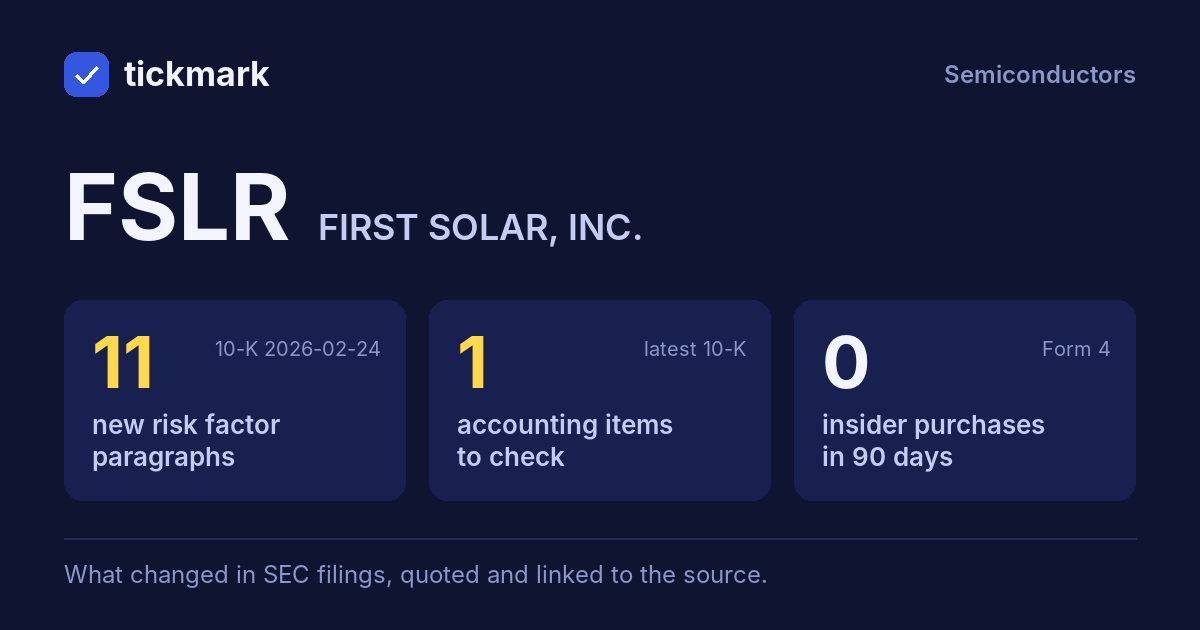
Every change, by type

Sentences and paragraphs added, removed or reworded

Sentences and paragraphs of FSLR's Risk Factors and MD&A, 10-K 2026-02-24 against 10-K 2025-02-25. Each links to the text at sec.gov.

AddedRisk Factors
Application of trade laws may also adversely impact, either directly or indirectly, our operating results; for example, by impacting our customers’ project costs, profitability, and their demand for our modules; or by impacting our own costs or disrupting our manufacturing or supply chains, and consequently negatively impacting demand and/or price levels for our solar modules, reducing our net sales, or affecting potential profitability of fulfilling customer contracts. We are therefore potentially subject to various risks, which include the following:

Read it in 10-K 2026-02-24 at sec.gov ↗

AddedRisk Factors
•any tariffs that reduce the profitability of contracts, whereby the cost of tariffs exceeds the amount able to be, or willing to be, absorbed by either us or the customer under the provisions of the contract and may lead to us or the customer cancelling such contract, potentially resulting in the reduction of future revenue, the loss of the contractual right to a termination payment from the customer, and potentially the required return of a previously received customer down payment;

Read it in 10-K 2026-02-24 at sec.gov ↗

AddedRisk Factors
•any reciprocal or other tariffs may place burdens on our customers’ supply chains exclusive of module import costs, including through increased costs of trackers, inverters, transformers, and other imported equipment, which are often heavily dependent on Chinese supply chains. These and other costs could result in an inability for certain projects to generate profitable returns, and may lead to the delay or abandonment of such projects, thereby reducing or removing demand for currently contracted PV module sales; and

Read it in 10-K 2026-02-24 at sec.gov ↗

AddedRisk Factors
•any reduction in our ability to profitably import modules from our international manufacturing locations as a result of tariffs or other trade laws could lead to us significantly reducing capacity utilization at certain international manufacturing facilities. Such underutilization may lead to potential impairment of certain international equipment and facilities and may also increase our selling costs and reduce our competitiveness in the market, thereby reducing demand for our modules.

Read it in 10-K 2026-02-24 at sec.gov ↗

AddedRisk Factors
•United States — IEEPA Tariffs. In 2025, the U.S. President imposed a series of tariffs on nearly all U.S. trading partners pursuant to the International Emergency Economic Powers Act of 1977 (“IEEPA”). As it pertains to the countries where we manufacture solar modules, IEEPA tariffs applied to Vietnam (20%), India (25%), and Malaysia (19%). In August 2025, the U.S. President had imposed an additional 25% tariff

Read it in 10-K 2026-02-24 at sec.gov ↗

AddedRisk Factors
on India over its purchases of Russian oil, resulting in an overall rate of 50%. On February 20, 2026, the U.S. Supreme Court ruled the IEEPA tariffs unlawful. President Trump responded immediately by revoking the IEEPA tariff actions and imposing new global tariffs pursuant to Section 122 of the Trade Act of 1974 (“Section 122”), which provides for tariffs up to 15% for a period of no more than 150 days. The additional, higher tariffs on imports from these countries has increased the costs of our solar modules manufactured in these countries with respect to our U.S. market. Further, such circumstances have and may continue to impact our ability to sell certain modules into the United States and therefore have and may continue to also impact the operational status of certain of our international manufacturing facilities. As a result, our operating results have and may continue to be adversely impacted by these tariffs.

Read it in 10-K 2026-02-24 at sec.gov ↗

AddedRisk Factors
•United States — Port Fees on Certain Chinese Vessel Operators and Chinese Vessel Owners. On April 17, 2025, the Office of the U.S. Trade Representative published a notice of final action based on an investigation under Section 301 of the Trade Act of 1974 into China’s targeting of the maritime, logistics, and shipbuilding sectors for dominance. The action imposes new port fees on Chinese vessel operators and/or Chinese vessel owners as well as on non-Chinese operators of Chinese-origin vessels beginning on October 14, 2025. The level of fees is on a sliding scale per net ton or, in the case of non-Chinese operators, the higher of a net ton or container-based fee. Effective November 10, 2025, however, the United States suspended implementation of such action for one year. Once implemented, such fees may impact our logistics services and consequently impact our profitability and results of operations.

Read it in 10-K 2026-02-24 at sec.gov ↗

AddedRisk Factors
•United States — Potential Tariffs on Processed Critical Minerals and Derivative Products, Polysilicon, Robotics and Industrial Machinery. On April 22, 2025, the U.S. Secretary of Commerce initiated an investigation to determine the effects on the national security of imports of processed critical minerals, as well as their derivative products, under Section 232; on July 1, 2025, the U.S. Secretary of Commerce initiated a Section 232 investigation to determine whether imports of polysilicon and its derivatives impair U.S. national security; and on September 2, 2025, the U.S. Secretary of Commerce initiated an investigation to determine the effects on the national security of imports of robotics and industrial machinery under Section 232. The scope of these investigations is potentially broad and may cover materials and equipment used in solar module manufacturing. These investigations may result in the imposition of tariffs or import restrictions, or may remove barriers on the imports of competitor products and materials, all of which could negatively impact demand and/or price levels for our solar modules and limit our growth, lead to a reduction in our net sales, or increase our costs, thereby adversely impacting our operating results.

Read it in 10-K 2026-02-24 at sec.gov ↗

Show the other 12
AddedRisk Factors
Our operations involve the use, handling, generation, processing, storage, transportation, and disposal of hazardous materials and are subject to extensive environmental laws and regulations at the national, state, local, and international levels. These environmental laws and regulations include those governing the discharge of pollutants

Read it in 10-K 2026-02-24 at sec.gov ↗

AddedRisk Factors
adequately address privacy and security concerns, even if unfounded, or comply with applicable privacy and data security laws, regulations, and policies, could result in additional fines, costs, and liabilities to us, damage our reputation, inhibit sales, and adversely affect our business.

Read it in 10-K 2026-02-24 at sec.gov ↗

AddedMD&A
•During 2025, we terminated various master supply agreements with BP Solar Holding LLC and its affiliate Lightsource Renewable Energy Trading, LLC due to the customers’ failure to cure several breaches of their contractual obligations. These terminations triggered certain contractual termination payment provisions amounting to $384.6 million, of which we recognized $61.0 million as revenue for advance payments previously received from the customer. In September 2025, we filed a complaint with the Supreme Court of the State of New York seeking relief and demanding payment from these customers for the remaining termination payments along with certain other receivables for solar modules previously delivered.

Read it in 10-K 2026-02-24 at sec.gov ↗

AddedMD&A
•Perovskite. We continue to research and develop our thin-film semiconductor technology, with a focus on the use of perovskite thin films. Perovskites have the potential to significantly increase the efficiency and reduce the cost of PV solar modules either through single-junction or potentially multi-junction devices. Supported by the associates at our California and European Technology Centers, we continue to advance our work on improving both the efficiency and stability of this technology in developing a commercially scalable perovskite product. Our investment in this technology also includes the construction of a dedicated perovskite development line at our Ohio facility.

Read it in 10-K 2026-02-24 at sec.gov ↗

AddedMD&A
•China. In February 2025, China announced that it would tighten export controls for five key minerals, including products containing tellurium, which is one of the main components of our CdTe modules. Although tellurium and products containing tellurium are sourced globally, China is a major global producer of tellurium and products containing tellurium. Exporters of tellurium and related products are generally required to obtain a license from the Chinese Ministry of Commerce. In October 2025, China expanded its rare earths export controls, adding new minerals to its restricted list and requiring foreign entities to obtain a license to export any products containing over 0.1% of rare earths from China or manufactured using China’s extraction, refining, magnet-making, or recycling technology. In November 2025, China announced it would delay imposition of the October 2025 export controls for one year. In February 2026, the U.S. President announced the creation of an approximately $12 billion stockpile of

Read it in 10-K 2026-02-24 at sec.gov ↗

AddedMD&A
While our contracts with customers typically have certain firm purchase commitments and may require our customers to make payments to us if a contract is terminated in certain circumstances, those contract terms have in the past and may in the future be breached by our customers or subject to renegotiation. Among other things, these contract breaches and renegotiations have reduced, and may continue to reduce, the volume of modules sold under the relevant contracts and/or the extent of anticipated price adjustments for future module technology improvements, thereby reducing future sales of solar modules. Furthermore, our ability to subsequently resell solar modules sold under terminated and/or renegotiated contracts may be constrained by the project lead times of our customers, their required module specifications, or other factors. For example, on September 30, 2025, First Solar filed a complaint in the Supreme Court of the State of New York asserting that BP Solar Holding LLC and its affiliate Lightsource Renewable Energy Trading, LLC breached their contractual obligations with First Solar, having entered into various master supply agreements to purchase solar modules from First Solar and then refusing to pay the amounts owed under the purchase orders. For more information about this development, see Part I. Item 3. “Legal Proceedings.”

Read it in 10-K 2026-02-24 at sec.gov ↗

AddedMD&A
Foreign currency loss for the year ended December 31, 2025 increased compared to the prior year primarily due to differences between our economic hedge positions and the underlying currency exposures and higher costs associated with hedging activities related to our subsidiaries in India.

Read it in 10-K 2026-02-24 at sec.gov ↗

AddedMD&A
Interest expense, net during 2025 increased compared to 2024 primarily due to factoring certain trade receivables with recourse, which were accounted for as secured borrowings.

Read it in 10-K 2026-02-24 at sec.gov ↗

AddedMD&A
effects of tax law associated with the IRA, partially offset by a lower relative benefit from the long-term tax holiday in Malaysia and higher pretax income in the current year.

Read it in 10-K 2026-02-24 at sec.gov ↗

AddedMD&A
periods). Additionally, for certain strategic suppliers, we have made, and may in the future be required to make, certain advance payments to secure the raw materials necessary for our module manufacturing.

Read it in 10-K 2026-02-24 at sec.gov ↗

Next Related parties →