RemovedRisk Factors
The 10-K against last year's
164 changes: 20 added, 20 removed, 116 reworded, 8 quiet changes
10-K 0001274494-26-000021 (2026-02-24) vs 10-K 0001274494-25-000010 (2025-02-25)
The redline
The paragraph that changed most in each section
Marked against last year's 10-K:
cut words struck through, new words highlighted and underlined.
MD&A 288 words changed in this paragraph; it is 32% similar to last year's version.
Source: Item 7, 10-K 0001274494-26-000021 vs Item 7, 10-K 0001274494-25-000010
Legal Proceedings 247 words changed in this paragraph; it is 33% similar to last year's version.
Source: Item 3, via Note 14 – Commitments and Contingencies, 10-K 0001274494-26-000021 vs Item 3, via Note 14 – Commitments and Contingencies, 10-K 0001274494-25-000010
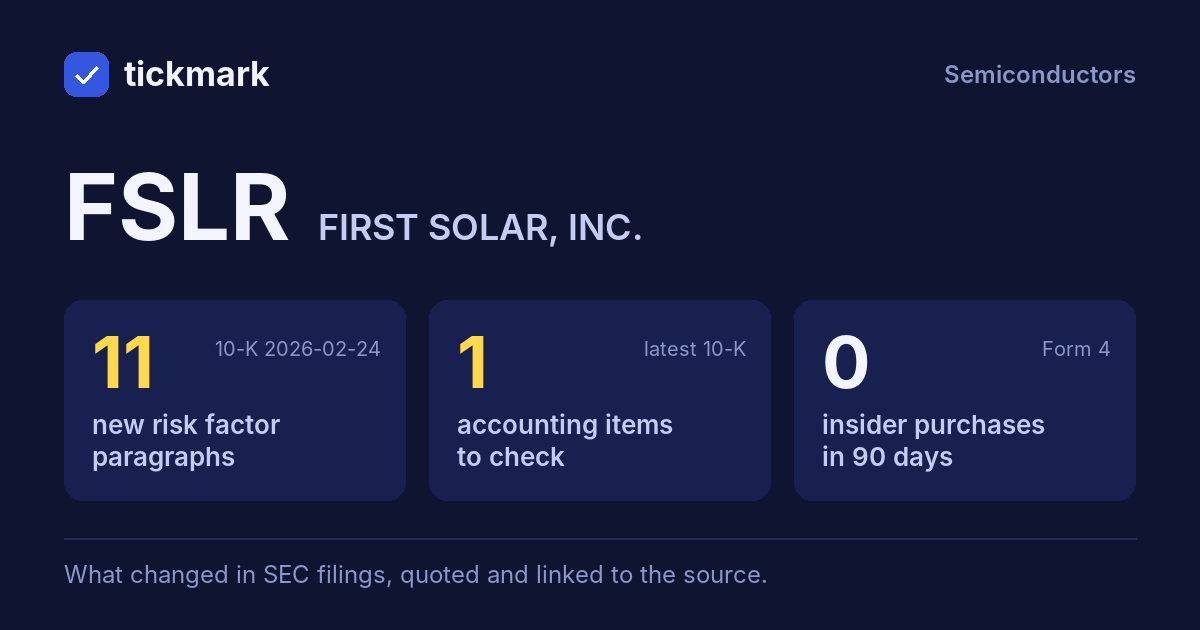
Risk Factors 224 words changed in this paragraph; it is 40% similar to last year's version.
•United States — Antidumping and Countervailing Duties on Certain Traded Solar Products. In April 2024, the American Alliance for Solar Manufacturing Trade Committee, which includes First Solar, filed a set of AD/CVD petitions with the USDOC and the USITC U.S. International Trade Commission (“USITC”) to impose duties on certain unfairly traded solar products from Cambodia, Malaysia, Thailand, and Vietnam. The investigations could potentially lead On April 21, 2025, the USDOC announced final determinations in the AD/CVD investigations. Final AD/CVD rates ranged from de minimis to over 3,400%, depending on the imposition particular foreign producer. On June 9, 2025, the USITC notified USDOC of its final affirmative determinations in the AD/CVD investigations. AD/CVD orders, including the assessment of AD/CVDs and suspension of liquidation of such products, were issued on June 9, 2025. On July 17, 2025, the Alliance for American Solar Manufacturing and Trade filed another set of AD/CVD orders petitions with the USDOC and the USITC to impose duties on such unfairly traded crystalline silicon solar products. products from India, Indonesia, and Laos. In June 2024, August 2025, the USITC issued affirmative preliminary determinations. In October 2024, the USDOC announced preliminary affirmative determinations in the CVD investigations, finding that silicon solar cells and panels from Cambodia, Malaysia, Thailand, and Vietnam are unfairly subsidized at rates ranging from de minimis to nearly 300%, depending on the particular foreign producer. The USDOC has imposed provisional CVDs accordingly. In November 2024, the USDOC announced preliminary affirmative determinations in the AD investigations, providing for certain preliminary dumping rates applicable to solar cells from Cambodia, Malaysia, Thailand, and Vietnam ranging from de minimis to approximately 270%, depending on the particular foreign producer. The USDOC is expected to announce final issue its preliminary countervailing duty determinations in June 2025. February 2026 and preliminary antidumping duty determinations in April 2026.
Source: Item 1A, 10-K 0001274494-26-000021 vs Item 1A, 10-K 0001274494-25-000010
Accounting Policies 124 words changed in this paragraph; it is 45% similar to last year's version.
Government Grants. We account for government assistance that is not subject to the scope of ASC 740 using a grant accounting model, by analogy to International Accounting Standards 20, Accounting for Government Grants and Disclosure of Government Assistance, and recognize such grants when we have reasonable assurance that we will comply with the grant’s conditions and that the grant will be received. Government grants whose primary condition is the purchase, construction, or acquisition of a long-lived asset are considered asset-based grants and are recognized as a reduction to such asset’s cost basis, which reduces future depreciation. Other government grants not related to long-lived assets are considered income-based grants and are recognized as a reduction to the related cost of activities that generated the benefit. We recognize grants expected to be received directly from a government entity at their stated value. When we expect to transfer grants to a third party, we recognize the grants at, or adjust their carrying value to, the amount expected to be received from the transaction. Proceeds received from asset-based
Source: 10-K text, Note 2 – Summary of Significant Accounting Policies, 10-K 0001274494-26-000021 vs 10-K text, Note 2 – Summary of Significant Accounting Policies, 10-K 0001274494-25-000010
Every change, by type
Sentences and paragraphs added, removed or reworded
Sentences and paragraphs of FSLR's Risk Factors and MD&A, 10-K 2026-02-24 against 10-K 2025-02-25. Each links to the text at sec.gov.
RemovedRisk Factors
RemovedRisk Factors
RemovedRisk Factors
RemovedRisk Factors
RemovedRisk Factors
RemovedRisk Factors
RemovedMD&A
Show the other 11
RemovedMD&A
RemovedMD&A
RemovedMD&A
RemovedMD&A
RemovedMD&A
RemovedMD&A
RemovedMD&A
RemovedMD&A
RemovedMD&A
RemovedMD&A
RemovedMD&A