Form 10-K for the Fiscal Year Ended December 31, 2023
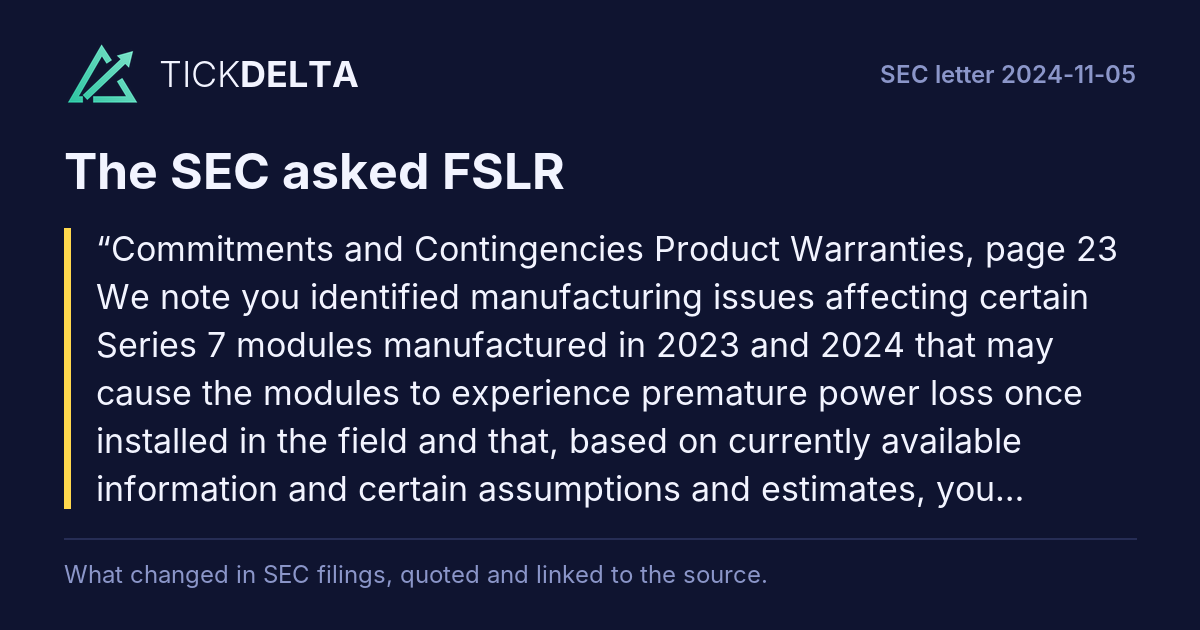
Commitments and Contingencies Product Warranties, page 23 We note you identified manufacturing issues affecting certain Series 7 modules manufactured in 2023 and 2024 that may cause the modules to experience premature power loss once installed in the field and that, based on currently available information and certain assumptions and estimates, you believe a reasonable estimate of aggregate losses related to theseRest of the question
manufacturing issues will range from approximately $50 million to $100 million. We also note as of September 30, 2024, you increased your product warranty liability by the low end of the range, which you recorded as a reduction to revenue. Please address the following: More fully explain your basis for recording the increase in your product warranty • 1. liability that resulted from this change in estimate as a reduction to revenue and explain where and how prior period changes in estimates were recorded as well as where and how product warranties are recorded when products are sold. Address the apparent inconsistency between recording the current period increase as a reduction to revenue with disclosures in MD&A that indicate “cost of sales also includes depreciation of manufacturing plant and equipment, facility-related expenses, environmental health and safety costs, and costs associated with shipping, warranties, and solar module collection and recycling”. • More fully explain how you determined the range of reasonably possible losses noted above, including the material underlying assumptions. Revise future filings to disclose and discuss the facts and circumstances related to this change in estimate and the material assumptions underlying it and provide a sensitivity analysis to disclose the potential impact that changes in these assumptions could have on your financial statements under Critical Accounting Estimates in MD&A. Revise future filings to also address the expected timeframe over which the additional information related to these manufacturing issues are expected to become available that could result in changes in this estimate related to the product warranty liability.
We respectfully acknowledge the Staff’s comment and advise the Staff that we apply the guidance in ASC 460-10 for our assurance-type product warranties. The Financial Accounting Standards Board stated in paragraph BC376 of ASU 2014-09 that an assurance-type warranty is one in which the entity expects to “replace or repair a defective product.” Our product warranties either require or permit the replacement or repair of modules when a customer makes a valid warranty claim; some newer warranties may also allow for claims to be settled in cash, at the option of the Company.Read in the reply ↗Rest of the answer
In recent years, substantially all of our warranty claims have been due to breakage or workmanship issues in the early part of a module’s life and have resulted in the replacement of the affected modules.
In following ASC 460-10, when we believe it is probable we will incur a loss under our warranty programs, and when we expect to use inventory to replace affected modules, we record the estimated expense as an increase to cost of sales. Therefore, we have historically disclosed that our warranty-related expenses, including any changes in estimates, have been classified as cost of sales.
The manufacturing issues identified during the three months ended September 30, 2024 and discussed in Note 10 to our condensed consolidated financial statements for this period related to a discrete matter that had not been previously observed as part of our accrued warranty liabilities. Our resolution of warranty claims for such manufacturing issues is not expected to result in the replacement or repair of affected modules given the nature of the issues and the estimated number of modules affected; instead, we currently expect to make cash payments to affected customers to settle their warranty claims.
Such cash payments are not accounted for as an assurance-type product warranty and instead represent consideration payable to a customer as the settlement of the associated warranty claims do not result in the replacement or repair of any modules. Accordingly, the payments are subject to the guidance in ASC 606-10-32-25 through ASC 606-10-32-27, which requires the consideration to be recorded as a reduction of the transaction price and, consequently, as a reduction to revenue. We therefore disclosed in Note 10 to our condensed consolidated financial statements that the warranty expense related to the discretely identified manufacturing issues reduced revenue.
The classification of our warranty costs will depend on the anticipated mode of settlement (i.e., product replacement or cash). As substantially all of our historical warranty claims since the adoption of ASU 2014-09 have been settled via the replacement of the defective modules, we have not presented the associated costs as a reduction of revenue. Accordingly, future warranty claims expected to be settled by the repair or replacement of modules will continue to be recorded as an increase to cost of sales, whereas future warranty claims expected to be settled by cash payment will be recorded as a reduction to revenue. We will clarify this classification within Note 2. “Summary of Significant Accounting Policies” to our consolidated financial statements in future filings.
•More fully explain how you determined the range of reasonably possible losses noted above, including the material underlying assumptions. Revise future filings to disclose and discuss the facts and circumstances related to this change in estimate and the material assumptions underlying it and provide a sensitivity analysis to disclose the potential impact that changes in these assumptions could have on your financial statements under Critical Accounting Estimates in MD&A. Revise future filings to also address the expected timeframe over which the additional information related to these manufacturing issues are expected to become available that could result in changes in this estimate related to the product warranty liability.
We respectfully acknowledge the Staff’s comment and advise the Staff that the range of reasonably possible losses was primarily based on our evaluation of the following material assumptions.
•As of September 30, 2024, we had sold nearly 4.7 gigawatts or approximately 8.8 million Series 7 modules from various facilities in the United States and India. As part of our monitoring of module performance through certain field installation sites, we tested approximately 80 Series 7 modules and noted that some modules may experience premature power loss once installed in the field. Such samples provided a preliminary view of potential levels of underperformance related to our initial production of Series 7 modules.
•We then estimated what subset of the entire population of Series 7 modules identified in the paragraph above were affected by the manufacturing issues as not all Series 7 modules exhibited the variability in the production process that may lead to the identified underperformance. Accordingly, in arriving at the range of reasonably possible losses, we estimated that approximately 80% of Series 7 modules sold as of September 30, 2024 may have been impacted, based on the Series 7 production schedule and the dates of when the underlying manufacturing issues were addressed at each affected facility.
•The low end of the range of reasonably possible losses reflected performance data from select samples of Series 7 modules compared to warranted levels of performance along with expectations of favorable Series 7 module energy performance attributes, such as a superior temperature coefficient and spectral response, that may partially offset underperformance from the identified issues. Such estimate of potential net underperformance was multiplied by the average selling price per watt of Series 7 modules to determine the low end of the expected costs to commercially settle warranty claims. The high end of the range of reasonably possible losses excluded any such favorable energy performance expectations from our advanced module technology and included an estimate of incremental module underperformance beyond that exhibited in our samples of module performance data.
Given the inherent limitations of sampling combined with the variability of module performance at different field installation sites, no individual amount within the range represented a better estimate than any other amount. Accordingly, as of September 30, 2024, we increased our product warranty liability by the low end of the range.
We plan to revise future filings to disclose additional details related to the material underlying assumptions and to provide a sensitivity analysis related to changes in certain assumptions. In addition, we plan to further disclose the expected timeframe over which we expect to obtain additional information and settle the associated warranty claims.
First report after the company's reply of 2024-11-19: 10-K filed 2025-02-25 ↗, against the 10-K filed 2024-02-27 ↗.
Tickdelta does not hold the text of both reports, so they are not compared here.
Also in this review: closing letter, 2024-12-11