Reworded10-Q Nov 5, 2026 vs 10-K Feb 26, 2026
The selected risks described below, however, in our 2025 Form 10-K are not the only risks we face.
Each branch is a paragraph in Risk Factors with nothing like it in the 10-K filed Feb 27, 2025. A box jumps to the paragraph as filed, below.
9 paragraphs in Risk Factors of the 10-K filed Feb 26, 2026 with nothing like them in the 10-K filed Feb 27, 2025. Quoted exactly. Paragraphs that were only edited are under 10-K change.
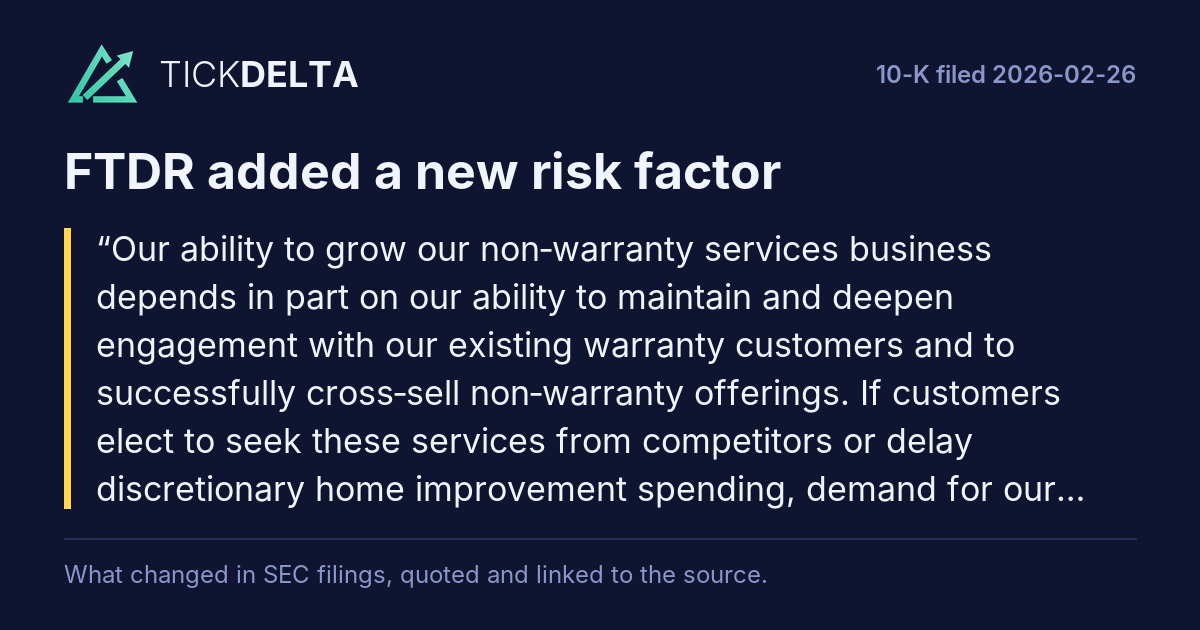
Our ability to grow our non‑warranty services business depends in part on our ability to maintain and deepen engagement with our existing warranty customers and to successfully cross‑sell non‑warranty offerings. If customers elect to seek these services from competitors or delay discretionary home improvement spending, demand for our non‑warranty services may decline.
In addition, certain non‑warranty services rely on strategic third‑party relationships, including partnerships with product manufacturers such as Moen, as well as our network of independent, licensed contractors who perform installation and maintenance services. Any deterioration in these relationships, inability to attract or retain qualified independent contractors, failure to maintain service quality or consistency, or disruption in partner‑provided products or programs could adversely affect customer satisfaction, our reputation, and demand for our non‑warranty services.
If we are unable to effectively manage these risks or adapt our non‑warranty offerings, pricing, or delivery model in response to these risks, our non‑warranty services business may not grow as expected, which could have a material adverse impact on our business, financial position, results of operations and cash flows.
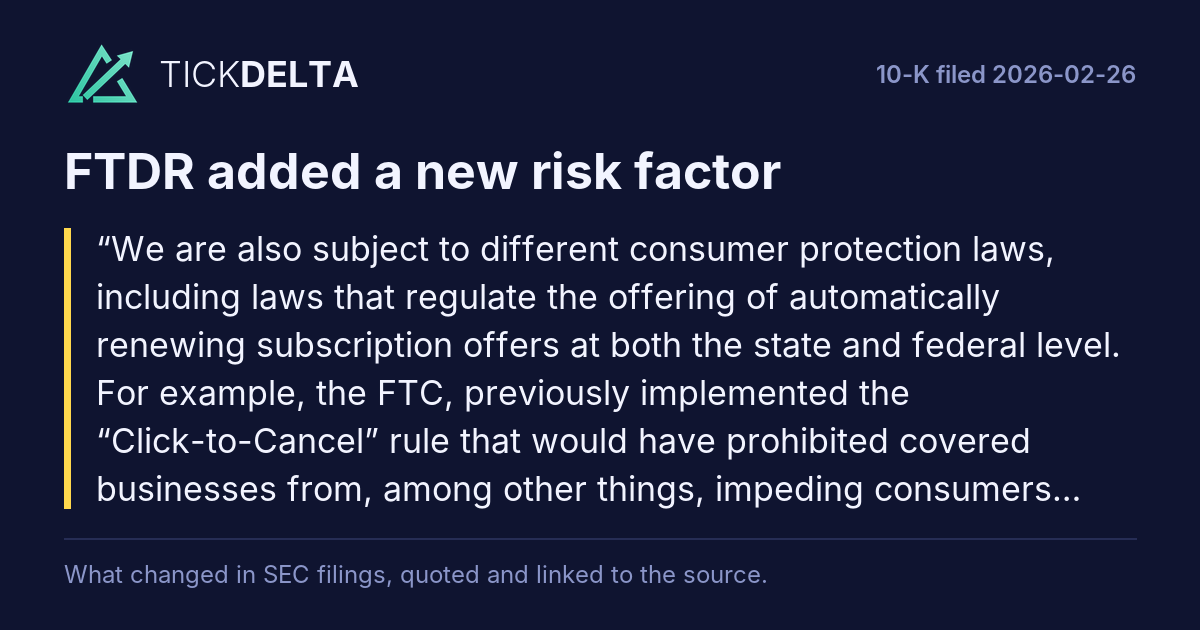
We are also subject to different consumer protection laws, including laws that regulate the offering of automatically renewing subscription offers at both the state and federal level. For example, the FTC, previously implemented the “Click-to-Cancel” rule that would have prohibited covered businesses from, among other things, impeding consumers from canceling recurring subscriptions and memberships. While the U.S. Court of Appeals for the Eight Circuit vacated the entirety of the “Click-to-Cancel” rule on July 8, 2025 due to a finding of flaws in the FTC’s rulemaking process, it is possible that the FTC may propose similar rules in the future.
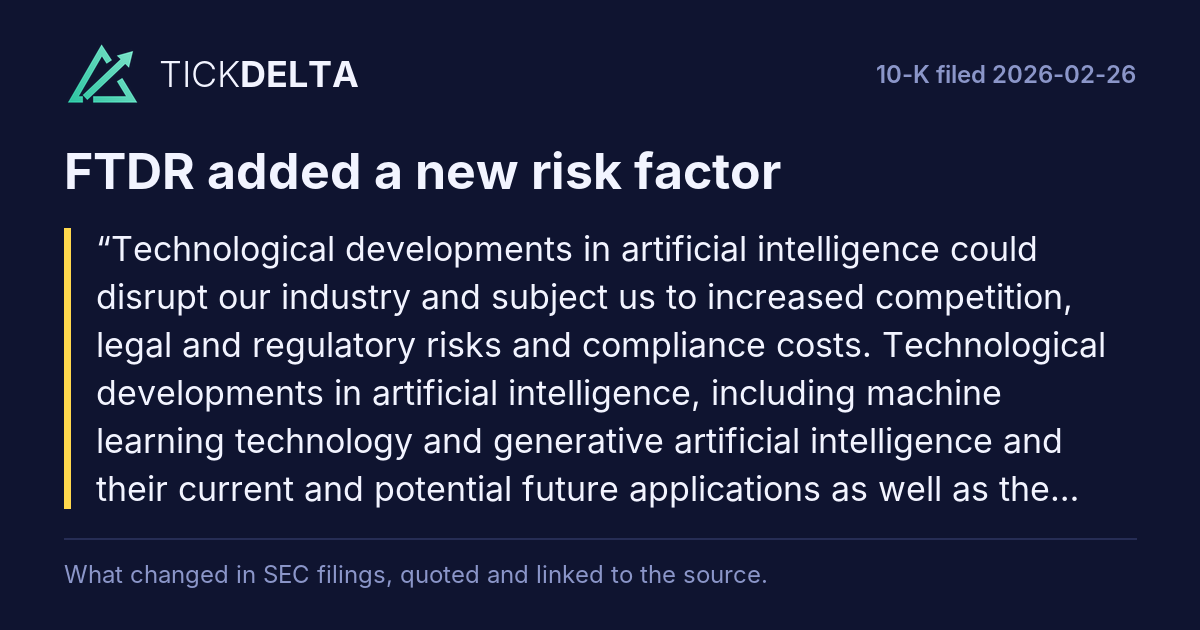
Technological developments in artificial intelligence could disrupt our industry and subject us to increased competition, legal and regulatory risks and compliance costs.
Technological developments in artificial intelligence, including machine learning technology and generative artificial intelligence and their current and potential future applications as well as the legal and regulatory frameworks within which they operate, are rapidly evolving. The full extent of current or future risks related thereto is not possible to predict and we may not be able to anticipate, prevent, mitigate or remediate all of the potential risks, challenges or impacts of such changes. Artificial intelligence could significantly disrupt our industry and subject us to increased competition, legal and regulatory risks and compliance costs, which could have a material adverse effect on our business, financial condition and results of operations. Some of our competitors may be more successful than us in the development and implementation of new technologies, including services, platforms and marketing efforts based on artificial intelligence, to address consumer demands or improve operations. If we are unable to adequately advance our capabilities in these areas, or do so at a slower pace than others in our industry, we may be at a competitive disadvantage.
Through our use of artificial intelligence, we intend to avail ourselves of the potential benefits, insights and efficiencies resulting from these technologies. However, these technologies also present a number of potential risks that cannot be fully mitigated. If the data we, or third parties whose services we rely on, use in connection with the possible development or deployment of artificial intelligence is incomplete, inadequate or biased in some way, the performance of our products, services, and businesses could suffer. The volume and reliance on data and algorithms also make artificial intelligence, and in turn, us, more susceptible to cybersecurity threats. We could be exposed to risks to the extent third-party service providers, or any counterparties, use artificial intelligence in their business activities. There is also a risk that artificial intelligence may be misused or misappropriated by our employees and/or third parties engaged by us. In addition, we may not be able to control how third-party artificial intelligence that we choose to use is developed or maintained, or how data we input is used or disclosed, even where we have sought contractual protections with respect to these matters. We may be subject to legal and regulatory investigations and/or actions related to our use of artificial intelligence, including as related to alleged misuse or misappropriation of our data. This could also have an adverse impact on our reputation.
Regulations related to artificial intelligence may also impose on us certain obligations and costs related to monitoring and compliance. Regulators are increasing scrutiny and considering, and in some cases enacting, regulation of the use of artificial intelligence. The use of artificial intelligence by us and others may require compliance with legal and regulatory frameworks that are not fully developed or tested, and we may face litigation and regulatory actions related to our use of artificial intelligence.
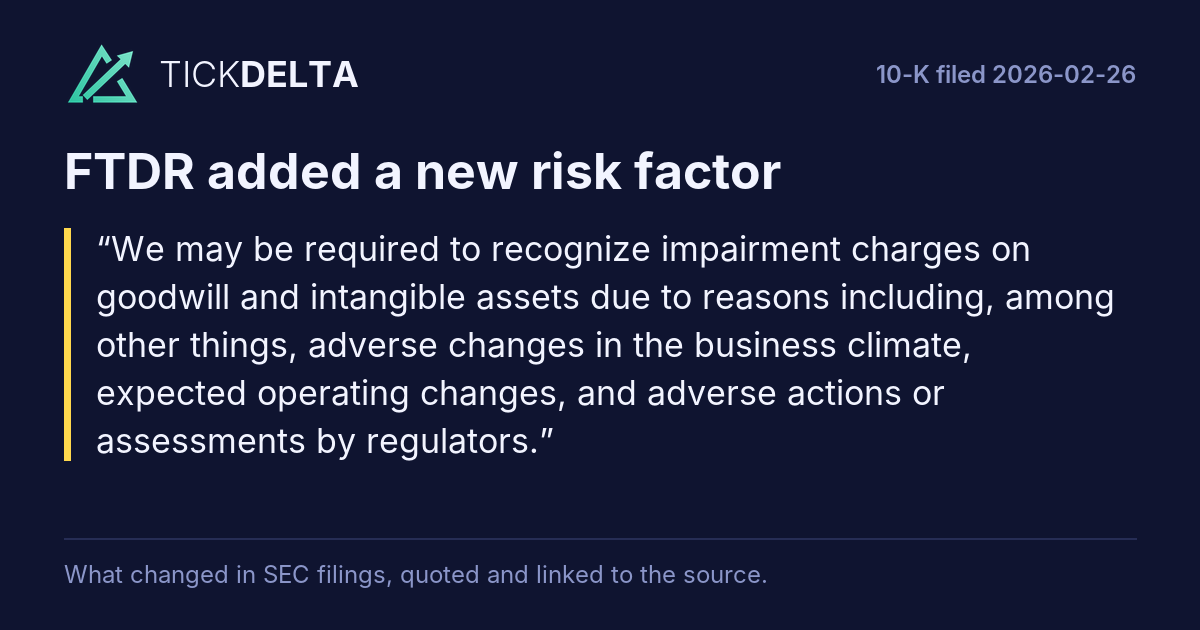
We may be required to recognize impairment charges on goodwill and intangible assets due to reasons including, among other things, adverse changes in the business climate, expected operating changes, and adverse actions or assessments by regulators.
New in the latest 10-Q
11 paragraphs in the 10-Q filed Nov 5, 2026 with nothing like them in the 10-Q filed Aug 6, 2026 (at least half the words must differ; new numbers alone do not count). Quoted exactly, grouped by the item heading above them. This is text that changed, not a judgement of how serious it is.
Three Months Ended September 30, 2026 Compared to Three Months Ended September 30, 2025
Read in the 10-Q
Nine Months Ended September 30, 2026 Compared to Nine Months Ended September 30, 2025
Read in the 10-Q
Three Months Ended September 30, 2026 Compared to Three Months Ended September 30, 2025
Read in the 10-Q
Nine Months Ended September 30, 2026 Compared to Nine Months Ended September 30, 2025
Read in the 10-Q
Three Months Ended September 30, 2026 Compared to Three Months Ended September 30, 2025
Read in the 10-Q
Nine Months Ended September 30, 2026 Compared to Nine Months Ended September 30, 2025
Read in the 10-Q
Three Months Ended September 30, 2026 Compared to Three Months Ended September 30, 2025
Read in the 10-Q
Nine Months Ended September 30, 2026 Compared to Nine Months Ended September 30, 2025
Read in the 10-Q
Three Months Ended September 30, 2026 Compared to Three Months Ended September 30, 2025
Read in the 10-Q
Nine Months Ended September 30, 2026 Compared to Nine Months Ended September 30, 2025
Read in the 10-Q
Rule 10b5-1 Trading Arrangements On August 10, 2026, William C. Cobb, our Chief Executive Officer and Chairman of the Board of Directors, adopted a “Rule 10b5-1 trading arrangement,” as defined in Item 408(c) of Regulation S-K, which is intended to satisfy the affirmative defense of Rule 10b5-1(c) under the Exchange Act. Such trading plan provides for an aggregate sale of up to 208,747 shares of the Company’s Common Stock that Mr. Cobb has an option to purchase. Mr. Cobb’s trading plan provides for sales from November 10, 2026 to August 10, 2027, subject to early termination if all transactions under the trading plan are completed or upon certain specified events set forth therein. Mr. Cobb is expected to continue to satisfy the Company’s Stock Ownership Guidelines following the sale of the maximum number of shares and options contemplated under his trading plan. During the three months ended September 30, 2026, none of the Company’s other directors or officers (as defined in Rule 16a-1(f) of the Exchange Act) adopted or terminated a Rule 10b5-1 trading arrangement or non-Rule 10b5-1 trading arrangement (as such terms are defined in Item 408 of Regulation S-K).
Read in the 10-Q
Item 1A of the 10-Q filed Nov 5, 2026 against Item 1A of the 10-K filed Feb 26, 2026.
A 10-Q repeats only the risks that changed, so a 10-K paragraph that is missing from it is not counted as removed.
Added is a paragraph with nothing like it in the 10-K, Reworded a sentence that is in both with several words changed,
Quiet changes a sentence in both where one to four words changed and one is a hedge or a modal
(cut words struck through, new words highlighted).
Text on the page, not a score; each links to the filing at sec.gov.
Two-word phrases in Risk Factors of the 10-K filed Feb 26, 2026 that are in none of the 1 earlier 10-Ks stored, back to Feb 27, 2025
Used at least twice, small words left out. Counted, not picked: a phrase can be new because the company renamed something.
3 paragraphs of last year's Risk Factors with nothing like them now. The longest are quoted.
Item 1A of each 10-K and 10-Q on EDGAR, quoted exactly. Each paragraph links to the filing at sec.gov.
10-K change: what was reworded or cut, section by section.
Excel workbook · CSV. Google Sheet that stays up to date: paste =IMPORTDATA("https://tickdelta.com/company/FTDR/export.csv") into a cell.