TechnipFMC plc FTI
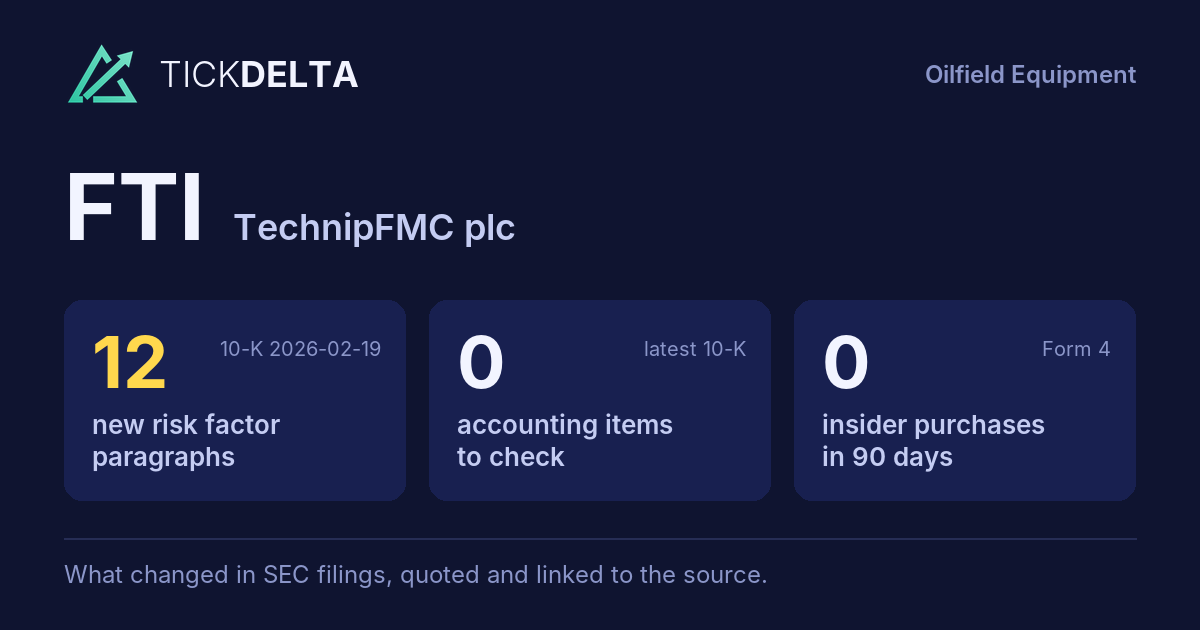
New risk paragraphs, branching off last year
Each branch is a paragraph in Risk Factors with nothing like it in the 10-K filed Feb 27, 2025. A box jumps to the paragraph as filed, below.
Paragraphs with nothing like them in last year's 10-K
12 paragraphs in Risk Factors of the 10-K filed Feb 19, 2026 with nothing like them in the 10-K filed Feb 27, 2025. Quoted exactly. Paragraphs that were only edited are under 10-K change.
•We may use artificial intelligence, machine learning, and data science in our business, and challenges with managing such technologies could adversely affect our business and results of operations.
•political and economic uncertainty, socio-political unrest, and geopolitical conflicts, such as unrest in the Middle East and developments in Venezuela;
have on pricing, capital spending by our customers, our selling strategies, our competitive position, our ability to retain customers, or our ability to negotiate favorable agreements with our customers and suppliers.
•unexpected geopolitical events, armed conflicts and terrorism threats, and the resulting sanctions, embargoes, nationalizations and assets seizures, supply chain disruptions, and foreign exchange control and currency fluctuations;
guidance and/or reform that could cause interest rates under our current or future debt agreements to perform differently than in the past or cause other unanticipated consequences.
Show the other 4
While we at times engage in voluntary initiatives (such as voluntary disclosures, certifications, or goals, among others) to improve the sustainability profile of our company and/or products or respond to stakeholder concerns,
We may use artificial intelligence, machine learning, data science and similar technologies in our business, and challenges with properly managing such technologies could result in reputational harm, competitive harm, and legal liability, and adversely affect our business, financial condition and results of operations.
Artificial intelligence, machine learning, data science, and similar technologies (collectively, "AI"), including third-party AI tools, may be enabled by, or integrated into, some of our business processes and solutions. As with many developing technologies, AI presents risks and challenges that could affect its further development, adoption, and use, and therefore, our business. AI algorithms may be flawed or biased. Datasets used to train or develop AI systems may be insufficient, of inferior quality, or contain biased, incorrect, or incomplete information. The utilization of AI may increase our risk and liability exposure relating to confidentiality, intellectual property infringement, and client use restrictions. Our AI governance review process and safeguards may not be adequate to protect against these risks and challenges.
Advances in AI, such as deepfakes, automated attack tools, and adaptive offensive models, increase cybersecurity, operational, legal, and reputational risks. Threat actors can now use generative AI to create highly realistic synthetic communications, conduct targeted social‑engineering campaigns, develop detection‑evading malware, and more. If we are unable to effectively develop, deploy, or govern AI technologies, our business, financial condition, and results of operations could be adversely affected.
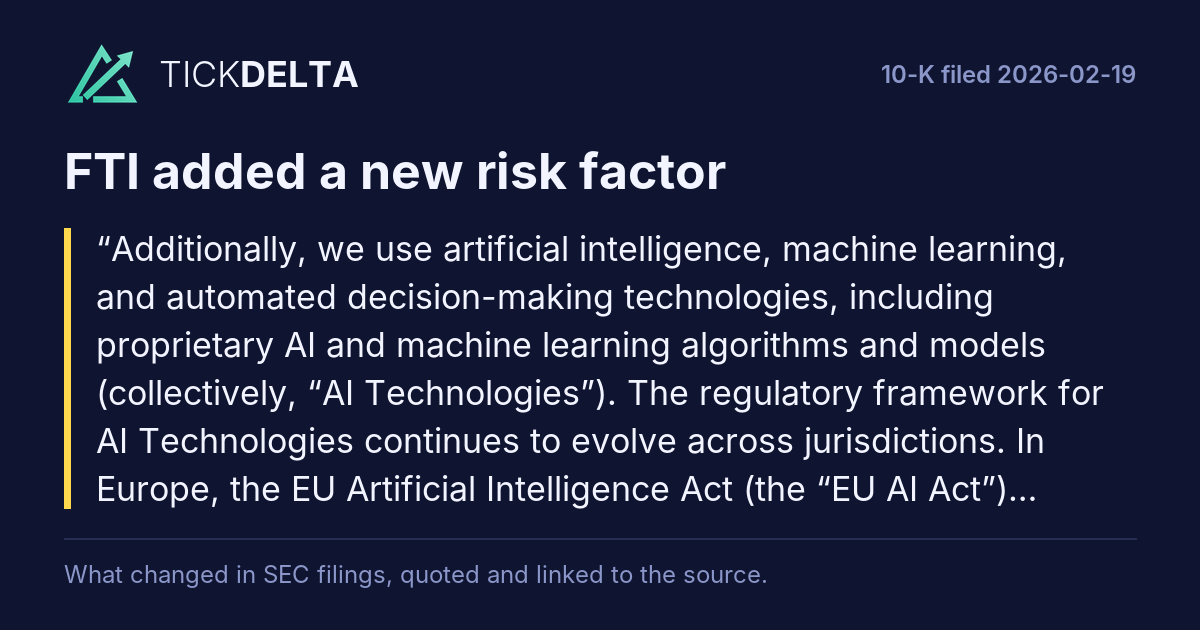
Additionally, we use artificial intelligence, machine learning, and automated decision-making technologies, including proprietary AI and machine learning algorithms and models (collectively, “AI Technologies”). The regulatory framework for AI Technologies continues to evolve across jurisdictions. In Europe, the EU Artificial Intelligence Act (the “EU AI Act”) establishes a comprehensive, risk-based governance framework for AI in the EU market, with the majority of the substantive requirements applying from August 2, 2026. Applicable requirements depend on the
specific AI use case (such as requirements around transparency, conformity assessments and monitoring, risk assessments, human oversight, security, accuracy, general purpose AI and foundation models). The EU AI Act together with developing guidance and/or decisions in this area, may affect our use of AI Technologies and our ability to provide, improve or commercialize our services, require additional compliance measures and changes to our operations and processes, result in increased compliance costs and potential increases in civil claims against us, and could adversely affect our business, financial condition, and results of operations.
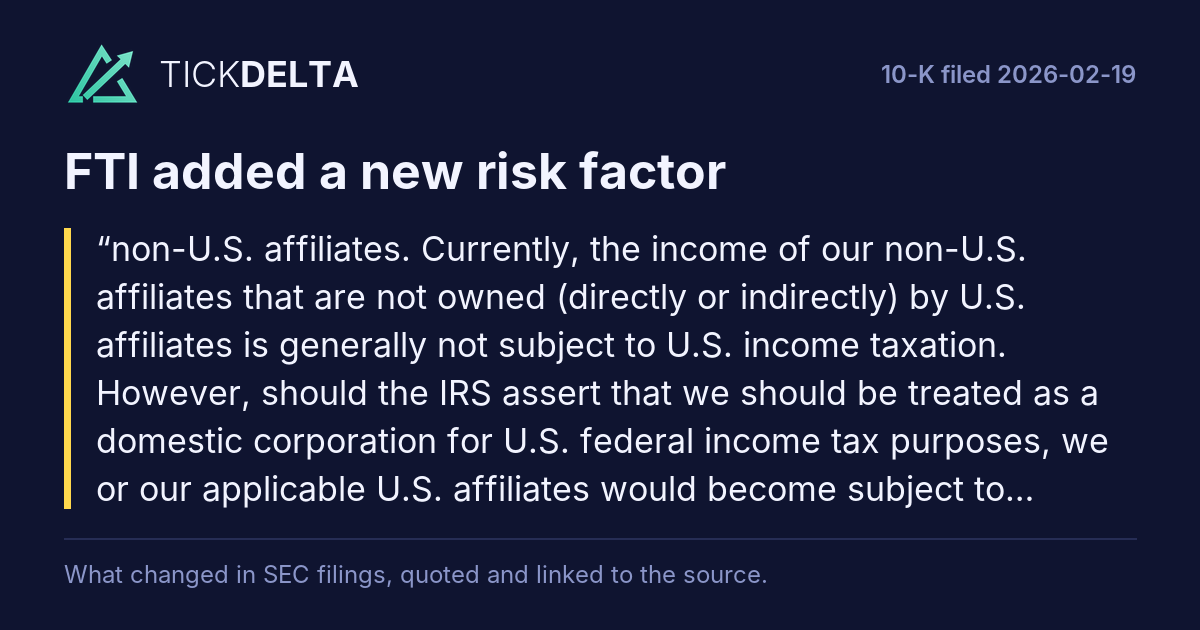
non-U.S. affiliates. Currently, the income of our non-U.S. affiliates that are not owned (directly or indirectly) by U.S. affiliates is generally not subject to U.S. income taxation. However, should the IRS assert that we should be treated as a domestic corporation for U.S. federal income tax purposes, we or our applicable U.S. affiliates would become subject to taxation on the income of our non-U.S. affiliates under the “controlled foreign corporation” U.S. tax rules.
Paragraphs in the 10-Q filed Oct 29, 2026 that were not in the one before
New in the latest 10-Q
0 paragraphs in the 10-Q filed Oct 29, 2026 with nothing like them in the 10-Q filed Jul 30, 2026 (at least half the words must differ; new numbers alone do not count). Quoted exactly, grouped by the item heading above them. This is text that changed, not a judgement of how serious it is.
Nothing in the latest 10-Q is new compared with the one before it.
The 10-Q's risk factors against the 10-K
Item 1A of the 10-Q filed Oct 29, 2026 against Item 1A of the 10-K filed Feb 19, 2026.
A 10-Q repeats only the risks that changed, so a 10-K paragraph that is missing from it is not counted as removed.
Added is a paragraph with nothing like it in the 10-K, Reworded a sentence that is in both with several words changed,
Quiet changes a sentence in both where one to four words changed and one is a hedge or a modal
(cut words struck through, new words highlighted).
Text on the page, not a score; each links to the filing at sec.gov.
What the 10-Q itself says about its risk factors:As of the date of this filing, there have been no material changes or updates to our risk factors that were previously disclosed in Part I, Item 1A of our Annual Report on Form 10-K for the year ended December 31, 2025.
Read in the 10-Q
1 paragraph in the 10-Q's Item 1A, and none of them adds, rewords or quietly edits a paragraph of the 10-K's.
Phrases used for the first time
Two-word phrases in Risk Factors of the 10-K filed Feb 19, 2026 that are in none of the 1 earlier 10-Ks stored, back to Feb 27, 2025
Where each one is used
- intelligence machine: •We may use artificial intelligence, machine learning, and data science in our business, and challenges with managing such technologies could adversely affect our business and results of operations.
- data science: •We may use artificial intelligence, machine learning, and data science in our business, and challenges with managing such technologies could adversely affect our business and results of operations.
- non-u affiliates: non-U.S. affiliates. Currently, the income of our non-U.S. affiliates that are not owned (directly or indirectly) by U.S. affiliates is generally not subject to U.S. income taxation. However, should the IRS assert that we should be treated as a domestic corporation for U.S. federal income tax purposes, we or our...
- customers alliances: •Cumulative loss of several major contracts, customers, alliances, or business disruptions may have an adverse effect on us.
- learning data: We may use artificial intelligence, machine learning, data science and similar technologies in our business, and challenges with properly managing such technologies could result in reputational harm, competitive harm, and legal liability, and adversely affect our business, financial condition and results of operations.
- similar technologies: We may use artificial intelligence, machine learning, data science and similar technologies in our business, and challenges with properly managing such technologies could result in reputational harm, competitive harm, and legal liability, and adversely affect our business, financial condition and results of operations.
- new oecd: Many EU member states, including France, have now incorporated Pillar Two into domestic law. Similarly, the United Kingdom enacted legislation under the Finance (No. 2) Act 2023, introducing a Pillar Two Income Inclusion Rule (“IIR”) and Multinational Top-up Tax (“MTT”), effective for accounting periods starting on...
- oecd package: Many EU member states, including France, have now incorporated Pillar Two into domestic law. Similarly, the United Kingdom enacted legislation under the Finance (No. 2) Act 2023, introducing a Pillar Two Income Inclusion Rule (“IIR”) and Multinational Top-up Tax (“MTT”), effective for accounting periods starting on...
Used at least twice, small words left out. Counted, not picked: a phrase can be new because the company renamed something.
What was taken out
13 paragraphs of last year's Risk Factors with nothing like them now. The longest are quoted.
Sources
Item 1A of each 10-K and 10-Q on EDGAR, quoted exactly. Each paragraph links to the filing at sec.gov.
Also
10-K change: what was reworded or cut, section by section.
Work with it
Excel workbook · CSV. Google Sheet that stays up to date: paste =IMPORTDATA("https://tickdelta.com/company/FTI/export.csv") into a cell.