Screener / SEC EDGAR /CIK 0000039368 /10-K filed Jan 22, 2026, compared with Jan 23, 2025 /Numbers from the XBRL of the 10-Ks
NYSE Materials · Adhesives & Sealants

Fuller H B Co FUL

Compare with peers Embed
The 10-K against last year's

131 changes: 15 added, 9 removed, 106 reworded, 1 quiet changes

10-K Jan 22, 2026 vs Jan 23, 2025

10-K 0001437749-26-001767 (Jan 22, 2026) vs 10-K 0001437749-25-001699 (Jan 23, 2025)

Every paragraph, and how much of it changed

One bar per paragraph, in the order of the 10-K. Height and colour show the share of its words not in the closest paragraph a year earlier; the tallest bars are new paragraphs.

Risk Factors

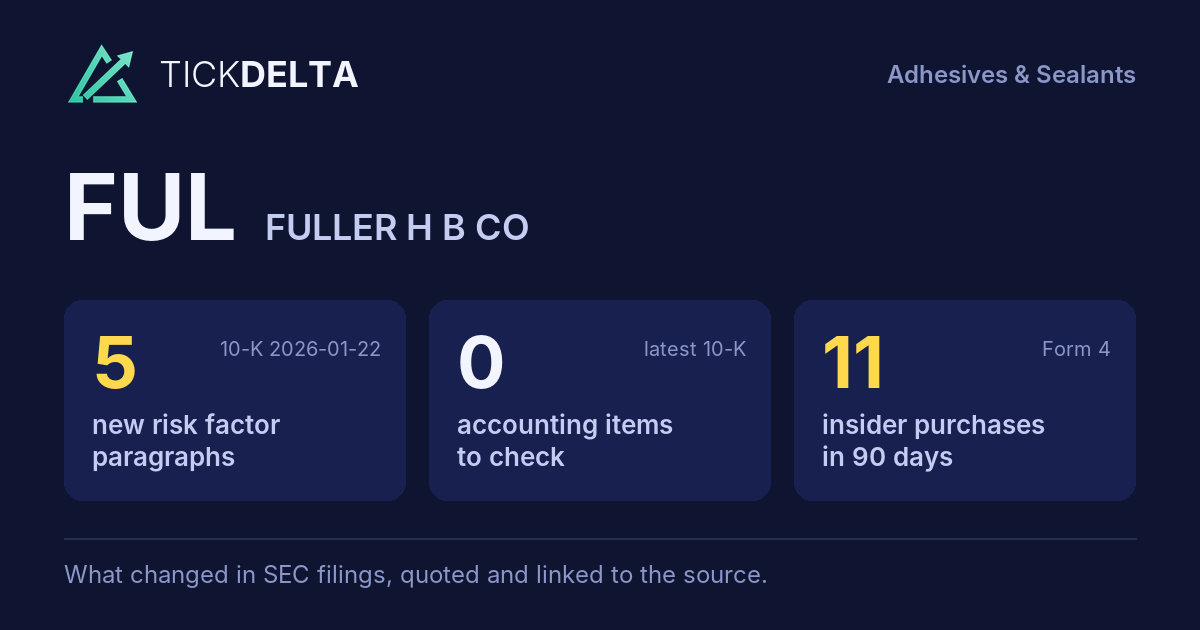
65 paragraphs · 5 new · 10 reworded · 4 gone · 10-K Jan 22, 2026 against Jan 23, 2025
New paragraph Reworded (5% of its words or more) Same or nearly
Paragraph 27 · 36% changed Every version of it
Distressed financial markets may result in dramatic deflation of financial asset valuations and high interest rates may disrupt disruption to the availability of capital.
Paragraph 30 · 17% changed Every version of it
The military conflicts between Military conflicts, including the Russia and Ukraine and in the Middle East, conflict, and the global response to these events, could adversely impact our revenues, gross margins and financial results.
Paragraph 22 · 10% changed Every version of it
In addition, our profitability is dependent on our ability to drive sustainable productivity improvements such as cost savings through organizational restructuring. restructuring, including our Quantum Leap global supply chain restructuring initiative. Delays or unexpected costs may prevent us from realizing the full operational and financial benefits of such restructuring initiatives and may potentially disrupt our operations.
Paragraph 12 · 7% changed Every version of it
Ongoing innovation and product development are important factors in our competitiveness, as is acquisition of new technologies. Failure to create and/or acquire new products and generate new ideas ideas, including with the effective use of artificial intelligence, could negatively impact our ability to grow and deliver strong financial results. We may face difficulties marketing products produced using new technologies including, but not limited to, sustainable adhesives, which may adversely impact our sales and financial results. Failure of our products to work as predicted could lead to liability and damage to our reputation.
Paragraph 5 · 6% changed Every version of it
Increasingly, companies are subject to a wide variety of attacks on their networks on an ongoing basis. In addition to traditional computer “hackers,” malicious code (such as viruses and worms), phishing attempts, ransomware, employee theft or misuse, and denial of service attacks, sophisticated nation-state and nation-state supported actors engage in intrusions and attacks (including advanced persistent threat intrusions) and add to the risks to internal networks, cloud deployed enterprise and customer-facing environments and the information they store and process. In addition, new technologies such as artificial intelligence and quantum computing may increase the frequency and magnitude of cyber-attacks. Despite significant efforts to create security barriers to such threats, it is virtually impossible for us to entirely mitigate these risks. We, and our third-party software and service providers, have experienced and will continue to experience security threats and attacks from a variety of sources.
Paragraph 17 · 5% changed Every version of it
We are in the process of implementing a global Enterprise Resource Planning (“ERP”) system, including the upgrade to SAP S/4HANA® at the beginning of fiscal 2025, that we refer to as Project ONE, which will upgrade and standardize our information system. Implementation of Project ONE began in our North America adhesives business in 2014 and, through 2024, 2025, we completed implementation of this system in various parts of our business including Latin America (except Brazil), Australia and various other businesses in North America and Europe, India, Middle East and Africa (EIMEA). During 2025 2026 and beyond, we will continue implementation in North America; Europe, India, the Middle East and Africa ("EIMEA"); Brazil and Asia Pacific.

MD&A

123 paragraphs · 10 new · 61 reworded · 5 gone · 10-K Jan 22, 2026 against Jan 23, 2025
New paragraph Reworded (5% of its words or more) Same or nearly
Paragraph 10 · 49% changed
Gross profit in 2024 increased 5.3 percent and gross profit margin increased 110 basis points compared to 2023. The increase 31.1 percent in gross profit margin was primarily 2025 from 29.8 percent in 2024, due to a 210 basis points decrease in higher product pricing, lower raw materials offset by a 100 basis point increase in other manufacturing costs. cost, the impact of acquisitions/divestitures and restructuring actions.
Paragraph 63 · 48% changed
We have three reportable segments: Hygiene, Health and Consumable Adhesives, Engineering Adhesives and Construction Adhesives. The tables below provide certain information regarding the net revenue revenue, Adjusted EBITDA and operating income Adjusted EBITDA margin of each of our operating segments. Adjusted EBITDA margin is defined as Adjusted EBITDA divided by net revenue for each operating segment. Corporate Unallocated includes amounts include business acquisition and integration costs, organizational restructuring charges and project costs related associated with implementing a global Enterprise Resource Planning (“ERP”) system that we refer to the implementation of as Project ONE. As a result of the change in operating segments and the sale of our North America Flooring business, we have retrospectively moved the results of our divested North America Flooring business to Corporate Unallocated for prior periods.
Paragraph 74 · 40% changed
Corporate Unallocated includes acquisition and integration-related charges, restructuring-related charges and costs related to the implementation of Project ONE. As a result of the change in operating segments and the sale of our North America Flooring business, we have retrospectively moved the results of our divested North America Flooring business to Corporate Unallocated for prior periods.
Paragraph 11 · 36% changed
Net income attributable to H.B. Fuller was increased to $152.0 in 2025 from $130.3 million in 2024 compared 2024, due to $144.9 million in 2023. Diluted higher gross profit, increased pension and other postretirement plan income partially offset by higher compensation expense. In 2025, our diluted earnings per share were was $2.75 compared to $2.30 per share in 2024 and $2.59 per share in 2023. 2024.
Paragraph 61 · 35% changed
We are required to report segment information in the same way that we internally organize our business for assessing performance and making decisions regarding allocation of resources. For segment evaluation Revenue and Adjusted EBITDA of each of our segments are regularly reviewed by the our chief executive officer, who acts as our chief operating decision maker, segment operating income to make decisions about resources to be allocated to the segments and assess their performance. Adjusted EBITDA is defined as gross profit less SG&A expenses. Inter-segment revenues net income before interest, income taxes, depreciation and amortization and foreign currency gain/loss, adjusted for other items within a relevant period which are recorded at cost plus a markup for administrative costs. not reflective of the segment’s operating performance in the period. Corporate expenses, other than those included in Corporate Unallocated, are allocated to each operating segment.
Paragraph 53 · 33% changed
Interest expense was $133.3 million and $133.1 million in 2025 and $134.6 million in 2024 and 2023, respectively, and was lower primarily due to lower interest rates, partially offset by higher debt balances. 2024, respectively. We capitalized $1.9 $0.6 million and $1.8 $1.9 million of interest expense in 2024 2025 and 2023, 2024, respectively.
Paragraph 100 · 29% changed
4 Trade accounts payable multiplied by 91 (13 weeks) and divided by the net revenue for the quarter. cost of sales.
Paragraph 2 · 27% changed
H.B. Fuller Company is a global formulator, manufacturer and marketer of adhesives and other specialty chemical products. We have three reportable segments: Hygiene, Health and Consumable Adhesives, Engineering Adhesives and Construction Adhesives. Building Adhesive Solutions. See Operating Segment Results for further discussion of changes to our operating segments in fiscal 2025.

A paragraph is matched with the one last year that shares the most of its words; under half in common makes it new. The paragraphs shown are the 6 reworded the most in each section.

The paragraph that changed most in each section

The redline

Marked against last year's 10-K: cut words struck through, new words highlighted.

Legal ProceedingsNew paragraph this year (259 words), with no similar paragraph last year.
In February 2024, the named plaintiffs in Rouse et al. v. H.B. Fuller Company et al. filed a third amended complaint in their lawsuit against the Company and one of its subsidiaries, which was initiated in September 2022. The suit is pending in the federal District of Minnesota and seeks damages arising from property damage attributed to alleged defects in grout sold by the Company’s divested North America Flooring business. As previously disclosed, the court ordered the parties and their insurers to attend a meditation session on October 21 and 22, 2025. At that mediation session, the Company and the plaintiffs agreed in principle to settle this matter for up to $75.0 million. Under the proposed settlement, in lieu of funding the maximum settlement amount, the Company’s payment obligations will be limited to validly submitted claims, settlement administration costs, service awards, and plaintiffs’ attorneys’ fees and expenses. The terms of a definitive settlement agreement are being negotiated and will be subject to court approval. In light of these developments, the Company concluded that a loss is probable and reasonably estimable and recorded an accrual in anticipation of the settlement of $34.8 million ($26.3 million after tax) based on a range of possible outcomes. This accrual is included in other accrued expenses in the Consolidated Balance Sheets as of November 29, 2025. The Company believes that it is entitled to reimbursement from its insurers for a substantial portion of the potential settlement amount as well as legal fees already incurred and paid and is actively pursuing reimbursement from its insurers.

Source: Item 3, 10-K 0001437749-26-001767 vs Item 3, 10-K 0001437749-25-001699

Risk Factors189 words changed in this paragraph; it is 37% similar to last year's version.
Climate change resulting from increased concentrations of carbon dioxide We are subject to various financial and other greenhouse gases regulatory reporting requirements imposed by governments and organizations in the atmosphere could present risks to our future operations from natural disasters U.S., EU, and extreme weather conditions, such as hurricanes, tornadoes, earthquakes, wildfires or flooding. Such extreme weather conditions could pose physical risks to our facilities and disrupt operation of our supply chain and may increase operational costs. The impacts of climate change on global water resources may result in water scarcity, which could in across the future impact our ability to access sufficient quantities of water in certain locations and result in increased costs. Concern over climate change continues to result in new legal or regulatory requirements designed to mitigate globe, including the effects of climate change on the environment, such as the EU's EU’s CSRD, California’s Climate Corporate Data Accountability Act and Climate Related Financial Risk Act, the SEC's Enhancement and Standardization of Climate-Related Disclosures for Investors, and other new and proposed regulatory frameworks. We are experiencing increased compliance burdens and costs to meet the regulatory obligations obligations, and these regulatory obligations may adversely affect raw material sourcing, manufacturing operations operations, and the distribution of our products. Failure to comply with expanding regulatory requirements may result in fines, penalties, and increased compliance costs, impacting our financial results. Deficiencies in our regulatory reporting may also reduce customer confidence or otherwise negatively impact our reputation.

Source: Item 1A, 10-K 0001437749-26-001767 vs Item 1A, 10-K 0001437749-25-001699

MD&A182 words changed in this paragraph; it is 61% similar to last year's version.
Contributions to our pension and other postretirement benefit plans were $3.3 million and $2.9 million in 2025 and $4.3 million in 2024 and 2023, 2024, respectively. Income taxes payable resulted in a $6.1 million and a $23.1 million use of cash in 2025 and a $41.2 million source of cash in 2024 and 2023, 2024, respectively. Other assets resulted in a $17.5 $28.7 million and a $7.9 $17.5 million use of cash in 2024 2025 and 2023, 2024, respectively. The higher use of cash in 2024 2025 compared to 2023 2024 is primarily driven by short-term investments and other taxes partially offset by a higher increase decrease in pension and post-retirement other long-term prepaid assets related to the year-end pension valuation in 2025 compared to the prior year. 2024. Other accrued expenses resulted in a $35.3 million and $6.0 million source of cash in 2025 and 2024, respectively. The large source of cash in 2025 compared to 2024 is primarily due to a liability for a loss contingency associated with ongoing litigation. Accrued compensation was resulted in a $4.9 million and a $12.7 million source of cash in 2025 and a $13.8 million use of cash in 2024 and 2023, 2024, respectively, relating to higher lower overall compensation accruals for our employee incentive plans in at the end of 2025 compared to 2024. Other liabilities resulted in a $31.3 $34.9 million source of cash and a $30.3 million use of cash in 2025 and a $22.9 million 2024, respectively. The source of cash in 2024 and 2023, respectively. The 2025 compared to use of cash in 2024 compared to source of cash in 2023 was due to a decrease an increase in hedging liabilities from interest rate swap activity of $55.3 million in 2024 2025 compared to an increase a decrease of $6.2 million in the prior year. In 2024, we also recorded a $47.3 million loss on the impairment of assets held for sale. Non-cash foreign currency remeasurement was a positive $9.7 million in 2024 compared to a negative $28.0 million in 2023.

Source: Item 7, 10-K 0001437749-26-001767 vs Item 7, 10-K 0001437749-25-001699

Accounting Policies37 words changed in this paragraph; it is 78% similar to last year's version.
In November 2023, the FASB issued ASU No. 2023-07, Segment Reporting (Topic 280): Improvements to Reportable Segment Disclosures. This ASU requires enhanced disclosures regarding significant segment expenses and other segment items. The guidance requires public entities to provide in interim periods all disclosures about a reportable segment's profit or loss and assets that are currently required annually. Our effective date of this ASU is We adopted the standard retrospectively beginning with our fiscal year ending November 29, 2025. We are evaluating the effect that this guidance will have Refer to Note 15, Segments, for further information on our Consolidated Financial Statements. segment reporting.

Source: Item 8, Note 1 – Nature of Business and Summary of Significant Accounting Policies, 10-K 0001437749-26-001767 vs Item 8, Note 1 – Nature of Business and Summary of Significant Accounting Policies, 10-K 0001437749-25-001699

Sentences and paragraphs added, removed or reworded

Every change, by type

Sentences and paragraphs of FUL's Risk Factors and MD&A, 10-K Jan 22, 2026 against 10-K Jan 23, 2025. Each links to the text at sec.gov.

Quiet changes are sentences kept from last year with one to four words changed, at least one of them a hedge, a modal or a qualifier (may, could, will, not, significant, material…). A year or date rolling forward is not counted.

The full word list

adverse, adversely, all, although, anticipate, anticipates, any, approximately, believe, believes, can, cannot, certain, could, expect, expects, generally, however, if, intend, intends, largely, likely, many, material, materially, may, might, most, must, never, no, not, possible, primarily, probable, should, significant, significantly, some, substantial, substantially, unlikely, will, would

AddedRisk Factors
We are subject to various financial and other regulatory reporting requirements imposed by governments and organizations in the U.S., EU, and across the globe, including the EU’s CSRD, California’s Climate Corporate Data Accountability Act and Climate Related Financial Risk Act, and other new and proposed regulatory frameworks. We are experiencing increased compliance burdens and costs to meet the regulatory obligations, and these obligations may adversely affect raw material sourcing, manufacturing operations, and the distribution of our products. Failure to comply with expanding regulatory requirements may result in fines, penalties, and increased compliance costs, impacting our financial results. Deficiencies in our regulatory reporting may also reduce customer confidence or otherwise negatively impact our reputation.
Read it in 10-K Jan 22, 2026 at sec.gov
AddedRisk Factors
While the Company expects to qualify for transitional safe harbor relief in many jurisdictions, there remains uncertainty regarding the interpretation and application of the rules, especially in jurisdictions where safe harbor relief is not available or where local implementation deviates from OECD guidance. The Company may be subject to additional tax liabilities, including top-up taxes under the Global Anti-Base Erosion (GloBE) rules and Qualified Domestic Minimum Top-up Taxes (QDMTTs).
Read it in 10-K Jan 22, 2026 at sec.gov
AddedRisk Factors
In addition, the enactment of the One Big Beautiful Bill Act (OBBBA) in the United States introduced significant changes to U.S. international tax provisions. These changes may interact with Pillar Two in complex ways. While recent G7 statements suggest a potential “side-by-side” framework that could exempt certain U.S.-parented groups from these rules, the final outcome remains uncertain. The evolving nature of these reforms may impact our tax planning strategies, increase compliance costs, and create additional risks of double taxation or inconsistent treatment across jurisdictions.
Read it in 10-K Jan 22, 2026 at sec.gov
RemovedRisk Factors
Epidemics, pandemics, outbreaks of novel diseases and other adverse public health developments in countries and states where we operate may arise at any time. Such developments, including the COVID-19 pandemic, have had, and in the future may have, an adverse effect on our business, financial condition and results of operations. These effects include a potentially negative impact on the availability of our key personnel, labor shortages and increased turnover, temporary closures of our facilities or facilities of our business partners, customers, suppliers, third-party service providers or other vendors, and interruption of domestic and global supply chains, distribution channels and liquidity and capital or financial markets. In particular, restrictions on or disruptions of transportation, port closures or increased border controls or closures, or other impacts on domestic and global supply chains or distribution channels, could increase our costs for raw materials and commodity costs, increase demand for raw materials and commodities from competing purchasers, limit our ability to meet customer demand or otherwise have a material adverse effect on our business, financial condition and results of operations or cash flows. Precautionary measures that we may take in the future intended to limit the impact of any epidemic, pandemic, disease outbreak or other public health development, may result in additional costs. In addition, such epidemics, pandemics, disease outbreaks or other public health developments may adversely affect economies and financial markets throughout the world, such as the effect that COVID-19 has had on world economies and financial markets, which may affect our ability to obtain additional financing for our businesses and demand for our products and services. The extent to which major public health issues impact our business and our financial results in the future will depend on future developments, which are highly uncertain and cannot be predicted. As a result, it is not possible to predict the overall future impact of major public health issues on our business, liquidity, capital resources and financial results.
Read it in 10-K Jan 23, 2025 at sec.gov
Show the other 36
RemovedRisk Factors
Climate change resulting from increased concentrations of carbon dioxide and other greenhouse gases in the atmosphere could present risks to our future operations from natural disasters and extreme weather conditions, such as hurricanes, tornadoes, earthquakes, wildfires or flooding. Such extreme weather conditions could pose physical risks to our facilities and disrupt operation of our supply chain and may increase operational costs. The impacts of climate change on global water resources may result in water scarcity, which could in the future impact our ability to access sufficient quantities of water in certain locations and result in increased costs. Concern over climate change continues to result in new legal or regulatory requirements designed to mitigate the effects of climate change on the environment, such as the EU's CSRD, California’s Climate Corporate Data Accountability Act and Climate Related Financial Risk Act, the SEC's Enhancement and Standardization of Climate-Related Disclosures for Investors, and other new and proposed regulatory frameworks. We are experiencing increased compliance burdens and costs to meet the regulatory obligations and these regulatory obligations may adversely affect raw material sourcing, manufacturing operations and the distribution of our products.
Read it in 10-K Jan 23, 2025 at sec.gov
RewordedRisk Factors
The military conflicts between Military conflicts, including the Russia and Ukraine and in the Middle East, conflict, and the global response to these events, could adversely impact our revenues, gross margins and financial results.
Read it in 10-K Jan 22, 2026 at sec.gov
RewordedRisk Factors
We are in the process of implementing a global Enterprise Resource Planning (“ERP”) system, including the upgrade to SAP S/4HANA® at the beginning of fiscal 2025, that we refer to as Project ONE, which will upgrade and standardize our information system.
Read it in 10-K Jan 22, 2026 at sec.gov
RewordedRisk Factors
In addition, our profitability is dependent on our ability to drive sustainable productivity improvements such as cost savings through organizational restructuring. restructuring, including our Quantum Leap global supply chain restructuring initiative.
Read it in 10-K Jan 22, 2026 at sec.gov
RewordedRisk Factors
Failure to create and/or acquire new products and generate new ideas ideas, including with the effective use of artificial intelligence, could negatively impact our ability to grow and deliver strong financial results.
Read it in 10-K Jan 22, 2026 at sec.gov
RewordedRisk Factors
It is not possible to predict the broader or longer-term consequences of that conflict or the ongoing conflict in the Middle East, other military conflicts, which could include further sanctions, embargoes, regional instability, energy shortages, geopolitical shifts and adverse effects on macroeconomic conditions, security conditions, currency exchange rates and financial markets.
Read it in 10-K Jan 22, 2026 at sec.gov
AddedMD&A
Adjusted EBITDA is a non-GAAP financial measure and should not be construed as an alternative to the reported results determined in accordance with U.S. GAAP. For a reconciliation of Adjusted EBITDA to net income attributable to H.B. Fuller as reflected in the audited consolidated statements of income, see “Non-GAAP Measures” below.
Read it in 10-K Jan 22, 2026 at sec.gov
AddedMD&A
Adjusted EBITDA for H.B. Fuller was $620.7 million in 2025 compared to $593.9 million in 2024. Adjusted EBITDA as a percentage of net revenue increased 130 basis points in 2025 compared to 2024 due to higher net income and depreciation and amortization expense. For a reconciliation of Adjusted EBITDA to net income attributable to H.B. Fuller as reflected in the audited consolidated statements of income see “Non-GAAP Measures” below.
Read it in 10-K Jan 22, 2026 at sec.gov
AddedMD&A
As of November 30, 2024, our three operating segments consisted of Hygiene, Health and Consumable Adhesives, Engineering Adhesives and Construction Adhesives. As of the beginning of fiscal 2025, we reorganized our operating segments by selling our North America Flooring business, previously part of the Construction Adhesives operating segment, and combining our Insulated Glass, Woodworking and Composite businesses, previously part of the Engineering Adhesives operating segment, with Construction Adhesives Roofing and Building Envelope and Infrastructure businesses to form the Building Adhesive Solutions operating segment. All financial results related to North America Flooring have been moved to our Corporate Unallocated segment. Prior period segment information has been recast retrospectively to reflect the realignment.
Read it in 10-K Jan 22, 2026 at sec.gov
AddedMD&A
We use both GAAP and non-GAAP financial measures for operational and financial decision making, and to assess Company and segment business performance. Our non-GAAP measures include Adjusted EBITDA and Free Cash Flow. Our calculation of these non-GAAP measures may not be comparable to similarly titled measures of other companies due to potential differences between companies in the method of calculation. As a result, the use of these non-GAAP measures has limitations and should not be considered superior to, in isolation from, or as a substitute for, related U.S. GAAP measures.
Read it in 10-K Jan 22, 2026 at sec.gov
AddedMD&A
These non-GAAP measures allow management and investors to view operating trends, perform analytical comparisons and benchmark performance between periods and among geographic regions to understand operating performance without regard to items we do not consider a component of our core operating performance. Furthermore, these non-GAAP measures allow investors the opportunity to measure and monitor our performance against our externally communicated targets and evaluate the investment decisions being made by management to improve Adjusted EBITDA. Management uses these measures in its financial, investment and operational decision-making processes, for internal reporting and as part of its forecasting and budgeting processes. Further, our Board of Directors uses certain of these and other measures as key metrics to determine management performance under our performance-based compensation plans. For these reasons, we believe these non-GAAP measures are useful for our investors.
Read it in 10-K Jan 22, 2026 at sec.gov
AddedMD&A
Adjusted EBITDA is presented net of noncontrolling interests and is used by management and can be used by investors to review our consolidated operating results because it excludes depreciation, amortization, interest income, interest expense and income taxes as well as certain additional adjustments that are not considered part of our core operations. Examples of adjustments to EBITDA include, but are not limited to, costs for acquisition projects, organizational realignment, Project One, business divestitures, discrete taxes, and the income tax effect on these adjustments. For Adjusted EBITDA, once we have made an adjustment in the current period for an item, we will also adjust the related non-GAAP measure in future periods in which there is an impact from the item. The following table reflects the manner in which Adjusted EBITDA is determined and provides a reconciliation of Adjusted EBITDA to Net income attributable to H.B. Fuller, the most directly comparable financial measure calculated and reported in accordance with U.S. GAAP.
Read it in 10-K Jan 22, 2026 at sec.gov
AddedMD&A
1 Other includes losses associated with ongoing litigation and product claims related to a divested business and costs associated with the exit of a product line for the year ended November 29, 2025.
Read it in 10-K Jan 22, 2026 at sec.gov
RemovedMD&A
The following table provides a reconciliation of segment operating income to income before income taxes and income from equity method investments, as reported in the Consolidated Statements of Income.
Read it in 10-K Jan 23, 2025 at sec.gov
RemovedMD&A
($ in millions) 2024 2023 Segment operating income $ 348.2 $ 355.1 Other (expense) income, net (37.1) 9.8 Interest expense (133.1) (134.6) Interest income 4.7 3.9 Income before income taxes and income from equity method investments $ 182.7 $ 234.2
Read it in 10-K Jan 23, 2025 at sec.gov
RemovedMD&A
Segment operating loss increased 7.9 percent in 2024 compared to 2023 due to higher restructuring costs, partially offset by lower acquisition project costs and a gain on insurance claims.
Read it in 10-K Jan 23, 2025 at sec.gov
RemovedMD&A
1 TTM = trailing 12 months 2 The Maximum Secured Leverage Ratio prior to June 1, 2024, shall be 4.75 to 1.00 and will step down to 4.50 to 1.00 with respect to quarters ending after June 1, 2024
Read it in 10-K Jan 23, 2025 at sec.gov
RewordedMD&A
Net revenue increased 1.6 decreased 2.7 percent from 2023 2024 primarily driven by a 3.6 2.1 percent increase decrease due to acquisitions and acquisitions/divestitures, a 1.7 percent increase in sales volume, partially offset by a 2.7 0.8 percent decrease in product pricing sales volume and a 1.0 0.6 percent decrease due to currency fluctuations. fluctuations partially offset by a 0.8 percent increase in product pricing.
Read it in 10-K Jan 22, 2026 at sec.gov
RewordedMD&A
The higher use of cash in 2024 2025 compared to 2023 2024 is primarily driven by short-term investments and other taxes partially offset by a higher increase decrease in pension and post-retirement other long-term prepaid assets related to the year-end pension valuation in 2025 compared to the prior year. 2024.
Read it in 10-K Jan 22, 2026 at sec.gov
RewordedMD&A
The source of cash in 2025 compared to use of cash in 2024 compared to source of cash in 2023 was due to a decrease an increase in hedging liabilities from interest rate swap activity of $55.3 million in 2024 2025 compared to an increase a decrease of $6.2 million in the prior year.
Read it in 10-K Jan 22, 2026 at sec.gov
RewordedMD&A
Our total year organic revenue growth, which we define as the combined variances from sales volume and product pricing, decreased 1.0 percent was flat for 2024 2025 compared to 2023 2024 due to an increase in product pricing offset by a decrease in product pricing, partially offset by an increase in sales volume.
Read it in 10-K Jan 22, 2026 at sec.gov
RewordedMD&A
Organic revenue in 2024 2025 compared to 2023 decreased 1.0 percent 2024 was flat and consisted of a 9.5 0.7 percent increase in Construction Engineering Adhesives, a 4.0 0.1 percent decrease increase in Hygiene, Health and Consumable Adhesives and a 1.0 1.3 percent decrease in Engineering Adhesives. Building Adhesive Solutions.
Read it in 10-K Jan 22, 2026 at sec.gov
RewordedMD&A
The increase in gross profit margin as a percentage of net revenue was primarily due to a 210 basis points decrease in higher pricing, lower raw materials offset by cost and a 100 basis point increase decrease in other manufacturing costs.
Read it in 10-K Jan 22, 2026 at sec.gov
RewordedMD&A
Changes in net working capital (trade receivables, inventory and trade payables) accounted for a use of cash of $51.9 million compared to a source of cash of $29.6 million compared to a use of cash of $103.2 $28.6 million in 2024 2025 and 2023, 2024, respectively.
Read it in 10-K Jan 22, 2026 at sec.gov
RewordedMD&A
The Construction Adhesives Building Adhesive Solutions operating segment manufactures and provides specialty adhesives, sealants, tapes, mortars, grouts, tapes and application devices for commercial building roofing systems, heavy infrastructure projects, road/highway/airport road/highway transportation applications, telecom/5G utilities, industrial LNG plants, building envelope applications, HVAC insulation systems, performance woodworking and for both residential and commercial flooring underlayment solutions. insulating glass.
Read it in 10-K Jan 22, 2026 at sec.gov
RewordedMD&A
Other manufacturing costs as a percentage of net revenue increased 140 20 basis points due to the impact of lower product pricing and the impact of acquisitions, partially offset by increased sales volume. points.
Read it in 10-K Jan 22, 2026 at sec.gov
RewordedMD&A
The lower use of cash in 2025 compared to source of cash in 2024 compared was due to 2023 was related to lower collections less cash collected on trade receivables in the current year compared to the prior year.
Read it in 10-K Jan 22, 2026 at sec.gov
RewordedMD&A
Trade Payables – Changes in trade payables resulted in a $38.2 million use of cash in 2025 compared to a $47.9 million source of cash in 2024 compared to a $57.8 million use of cash in 2023. 2024.
Read it in 10-K Jan 22, 2026 at sec.gov
RewordedMD&A
Corporate Unallocated includes amounts include business acquisition and integration costs, organizational restructuring charges and project costs related associated with implementing a global Enterprise Resource Planning (“ERP”) system that we refer to the implementation of as Project ONE.
Read it in 10-K Jan 22, 2026 at sec.gov
Quiet changesMD&A
For cases in which insurance coverage is available, the gross amount of the estimated liabilities is accrued, and a receivable is recorded for any probable estimated realizable insurance recoveries.
Read it in 10-K Jan 22, 2026 at sec.gov

Sources

The two latest 10-Ks on EDGAR, section by section. Each change links to the text at sec.gov.

Also

New risk factors: paragraphs with nothing like them last year, quoted in full.

Work with it

Excel workbook · CSV. Google Sheet that stays up to date: paste =IMPORTDATA("https://tickdelta.com/company/FUL/export.csv") into a cell.

Next:Related parties
Esc

Type a ticker such as AAPL, a name, an investor such as Buffett, or a topic such as tariffs. ↑ ↓ to move, Enter to open.