Liberty Media Corp FWONA
New risk paragraphs, branching off last year
Each branch is a paragraph in Risk Factors with nothing like it in the 10-K filed Feb 27, 2025. A box jumps to the paragraph as filed, below.
Paragraphs with nothing like them in last year's 10-K
23 paragraphs in Risk Factors of the 10-K filed Feb 26, 2026 with nothing like them in the 10-K filed Feb 27, 2025. Quoted exactly. Paragraphs that were only edited are under 10-K change.
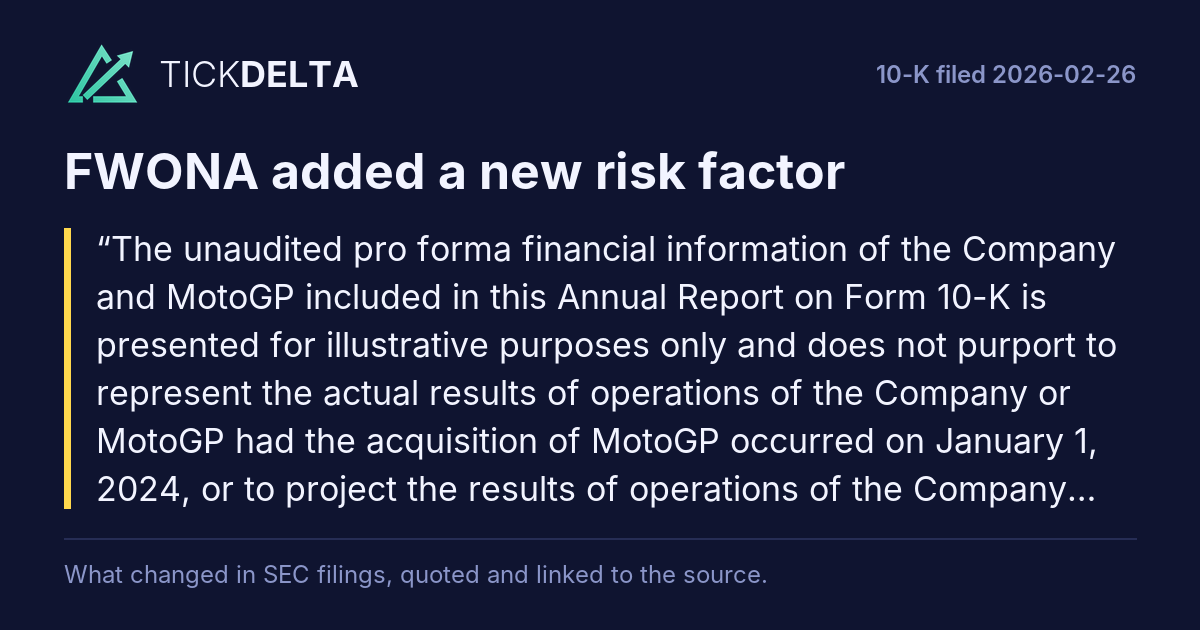
The unaudited pro forma financial information of the Company and MotoGP included in this Annual Report on Form 10-K is presented for illustrative purposes only and does not purport to represent the actual results of operations of the Company or MotoGP had the acquisition of MotoGP occurred on January 1, 2024, or to project the results of operations of the Company for any future periods.
The unaudited pro forma financial information of the Company and MotoGP included in this Annual Report on Form 10-K is presented for illustrative purposes only and does not purport to represent the actual results of operations of the Company or MotoGP had the acquisition of MotoGP occurred on January 1, 2024, or to project the results of operations of the Company for any future periods. The pro forma financial information was prepared based on historical financial information of MotoGP assuming the acquisition of MotoGP took place on January 1, 2024 and includes certain adjustments based on preliminary allocations. Additionally, the pro forma adjustments are based on available information and certain assumptions that our management believes are reasonable. The pro forma adjustments are directly attributable to the acquisition and are expected to have a continuing impact on the results of operations of the Company. The pro forma information is not representative of the Company’s future results of operations nor does it reflect what the Company’s results of operations would have been if the acquisition of MotoGP had occurred previously and the Company consolidated MotoGP during the periods presented. In addition, future results may differ significantly from those reflected in such pro forma financial information, which does not give effect to the potential impact of current financial conditions, or any anticipated revenue enhancements, cost savings or operating synergies that may result from the acquisition of MotoGP. Further, the assumptions used in preparing the pro forma financial information may not prove to be accurate, and other factors, including those risks described below, may affect the Company’s and MotoGP’s financial condition or results of operations.
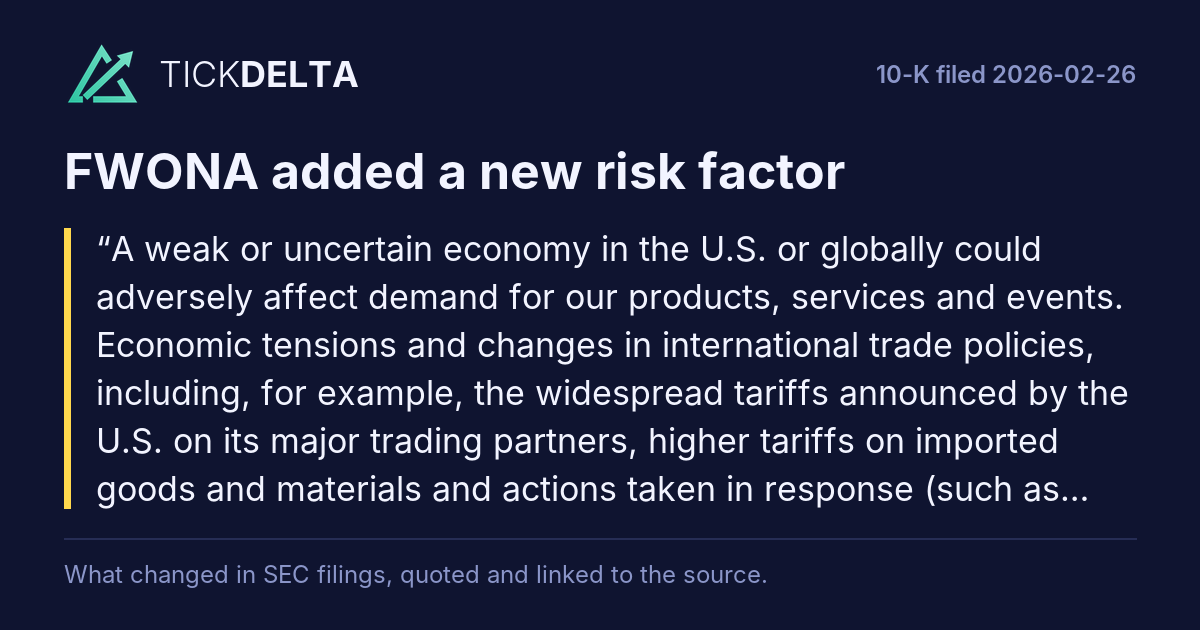
A weak or uncertain economy in the U.S. or globally could adversely affect demand for our products, services and events. Economic tensions and changes in international trade policies, including, for example, the widespread tariffs announced by the U.S. on its major trading partners, higher tariffs on imported goods and materials and actions taken in response (such as retaliatory tariffs or other trade protectionist measures or the renegotiation of free trade agreements), have increased inflationary cost pressures and recessionary fears. A substantial portion of our revenue is derived from
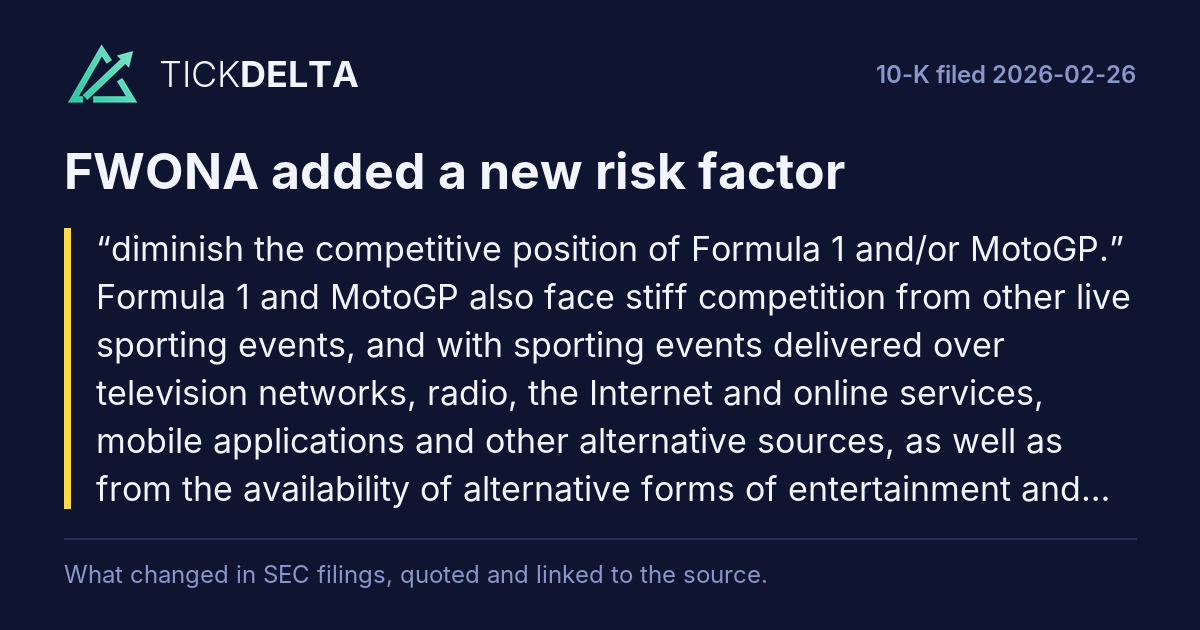
diminish the competitive position of Formula 1 and/or MotoGP.” Formula 1 and MotoGP also face stiff competition from other live sporting events, and with sporting events delivered over television networks, radio, the Internet and online services, mobile applications and other alternative sources, as well as from the availability of alternative forms of entertainment and leisure activities. Formula 1 and MotoGP each compete for attendance, viewership and advertising with a wide range of alternatives. As a result of the large number of options available, Formula 1 and MotoGP face strong competition for the attention of sports fans.
Formula 1’s ability to effectively stage the F1 Championship depends on the ongoing involvement of its participants. Pursuant to the 2026 Concorde Commercial Agreement, each of the current 11 Formula 1 Teams have
The FIM is the governing body of the MotoGP Championship. In its capacity as the governing body of the MotoGP Championship. The FIM and MotoGP must mutually agree on changes to the MotoGP Championship. As a result, the FIM may not agree to take actions with respect to the MotoGP Championship that MotoGP, as the commercial rights holder of the MotoGP Championship, feels are in the interest of the commercial aspects of the sport, such as changes to regulations to enhance the appeal of the MotoGP Championship to fans. The FIM could also take actions, such as withholding approval for the homologation of a circuit or approval of MotoGP’s proposed season calendar. Failure to consent to proposed changes to the MotoGP Championship, other actions by the FIM, may conflict with MotoGP’s interests and may materially and adversely impact MotoGP’s operations and revenue, and in turn may materially and adversely affect the Company.
Formula 1 and MotoGP may be subject to enforcement actions under competition laws.
Show the other 10
In June 2025, the U.S. reached an understanding with the other G7 members that the U.S. would remove a proposed retaliatory tax from the One Big Beautiful Bill Act, which was enacted into law on July 4, 2025, in exchange for an exclusion of U.S. parented groups from certain aspects of the second pillar. This understanding was non-binding and included only the G7 states. However, the OECD released significant administrative guidance on January 5, 2026, which is intended to resolve uncertainty about how the second pillar will apply to U.S. parented groups. A new safe harbor introduced by the administrative guidance should effectively deem the U.S. tax system to be compliant with the second pillar and exempt U.S. parented groups from the scope of certain taxes, which should simplify ongoing compliance for affected enterprises.
and experience to obtain all the necessary FIA or FIM, governmental and sporting approvals and successfully stage an Event. Events in new markets also require significant investments in circuit infrastructure and other administrative costs by Formula 1’s or MotoGP’s respective race promoters which may not be recouped and may generate fees below those received from Events staged in more developed markets.
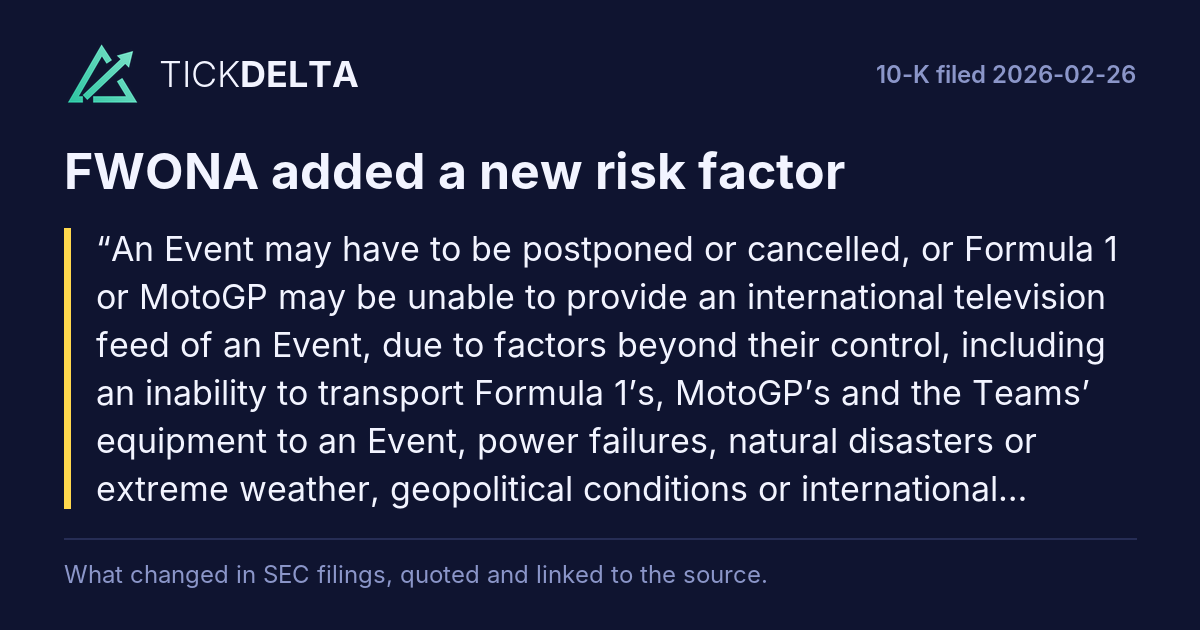
An Event may have to be postponed or cancelled, or Formula 1 or MotoGP may be unable to provide an international television feed of an Event, due to factors beyond their control, including an inability to transport Formula 1’s, MotoGP’s and the Teams’ equipment to an Event, power failures, natural disasters or extreme weather, geopolitical conditions or international conflicts, parties to Formula 1 or MotoGP race promotion contracts terminating those contracts, embargoes or sanctions, homologation issues, cancellation of large-scale public events by a competent authority due to a
Formula 1 and MotoGP depend on trademarks, copyrights and intellectual property.
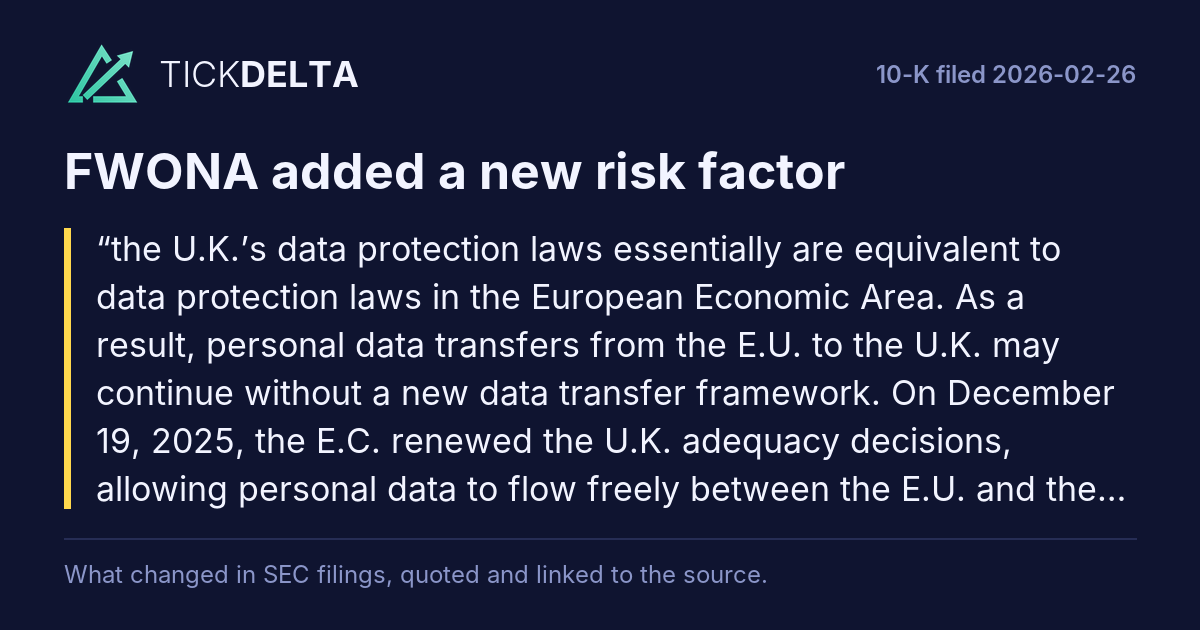
the U.K.’s data protection laws essentially are equivalent to data protection laws in the European Economic Area. As a result, personal data transfers from the E.U. to the U.K. may continue without a new data transfer framework. On December 19, 2025, the E.C. renewed the U.K. adequacy decisions, allowing personal data to flow freely between the E.U. and the U.K. until December 27, 2031. At present, digital activities involving user tracking, such as through cookies and similar technologies, are governed by a fragmented and evolving legal landscape across the E.U., U.K., and U.S. In the U.S., there has been a notable rise in consumer class action lawsuits under state-level wiretapping laws and the federal Video Privacy Protection Act, particularly targeting the unauthorized sharing of user data with third parties. Meanwhile, in the E.U., digital regulation is advancing through enforcement of existing regulatory frameworks and the timeline for the adoption of a single, unified ePrivacy Regulation, which aims to introduce stricter rules on cookies and other tracking technologies, remains uncertain. Other than GDPR and U.K. GDPR, similar stringent data privacy laws have been enacted across a number of countries, including Brazil, China, Japan, South Korea, India, United Arab Emirates, Saudi Arabia and Qatar. There is also an increasing trend of countries restricting cross-border data flows, requiring closer scrutiny on how this may impact Formula 1’s and/or MotoGP’s ability to collect and transfer personal information
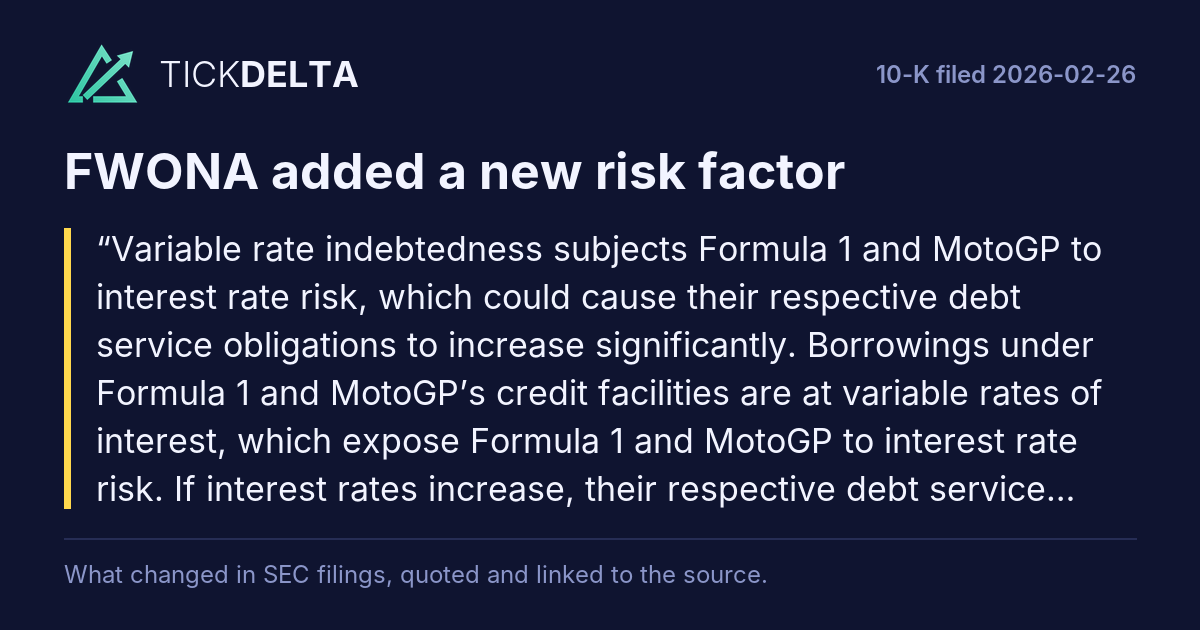
Variable rate indebtedness subjects Formula 1 and MotoGP to interest rate risk, which could cause their respective debt service obligations to increase significantly.
Borrowings under Formula 1 and MotoGP’s credit facilities are at variable rates of interest, which expose Formula 1 and MotoGP to interest rate risk. If interest rates increase, their respective debt service obligations on any variable rate
indebtedness could increase even though the amount borrowed remained the same, and net income and cash flow could decrease.
In order to manage Formula 1 and MotoGP’s exposure to interest rate risk, they have and may in the future enter into derivative financial instruments, typically interest rate swaps and caps, involving the exchange of floating for fixed rate interest payments. If Formula 1 or MotoGP are unable to enter into interest rate swaps, it may adversely affect their cash flow and may impact Formula 1 and/or MotoGP’s ability to make required principal and interest payments on their respective indebtedness. Even if Formula 1 and MotoGP use these instruments to selectively manage risks, there can be no assurance that they will be fully protected against material interest rate fluctuations.
Our multi-series structure may depress the trading price of the shares of our common stock.
Our multi-series structure may result in a lower or more volatile market price of the shares of our common stock or in adverse publicity or other adverse consequences. Several stockholder advisory firms have announced their opposition to the use of multiple-class structures. As a result, the multi-series structure of our common stock may cause stockholder advisory firms to publish negative commentary about our corporate governance practices or otherwise seek to cause us to
change our capital structure. Any actions or publications by stockholder advisory firms critical of our corporate governance practices or capital structure could also adversely affect the value of the shares of our common stock.
The market price of our common stock may fluctuate significantly due to a number of factors (none of which can be guaranteed to occur), some of which may be beyond our control, including:
We do not presently intend to pay cash dividends on our common stock for the foreseeable future. The payment of dividends on our common stock will depend on our earnings, financial condition and other business and economic factors affecting us at such time as our Board of Directors may consider relevant. If we do not pay dividends, capital appreciation, if any, of our common stock will be your sole source of gain for the foreseeable future.
As of January 31, 2026, Mr. Malone beneficially owns shares representing the power to direct approximately 49% of the aggregate voting power in our Company, due to his beneficial ownership of approximately 97% of the outstanding shares of our Series B common stock and Mr. Malone continues to be in a position to influence significant corporate actions, including corporate transactions such as mergers, business combinations or dispositions of assets. This concentration of ownership could discourage others from initiating any potential merger, takeover or other change of control transaction that may otherwise be beneficial to our stockholders.
In July 2021, our Company entered into an exchange agreement (the “Exchange Agreement”) with Mr. Malone and a revocable trust of which Mr. Malone is the sole trustee and beneficiary (the “JM Trust”), providing for exchanges by our Company and Mr. Malone or the JM Trust of shares of Series B common stock for shares of Series C common stock so as to maintain Mr. Malone’s voting power as close as possible to, but without exceeding, 49% (the “Target Voting Power”) plus 0.5% (under certain circumstances), in connection with certain events. However, at this time, and as a result of his resignation from the board of the Company, no further exchanges to maintain the Target Voting Power are expected to be completed under the Exchange Agreement. As a result, Mr. Malone’s voting power could exceed the Target Voting Power, including as to more than a majority of our outstanding voting power. The Exchange Agreement also provides that Mr. Malone or the JM Trust, in the event of certain extraordinary transactions, is entitled to receive the number of shares of Series B common stock previously surrendered for exchange under the Exchange Agreement (in exchange for the equivalent number of Series C common stock delivered in exchange therefor) or the applicable consideration that would be otherwise due to the holders of such shares of Series B common stock in such transaction. No assurance can be given that Mr. Malone will not ultimately acquire more than a majority of our outstanding voting power, which would enable Mr. Malone to control the outcome of certain shareholder votes, including certain extraordinary transactions.
Paragraphs in the 10-Q filed Nov 5, 2026 that were not in the one before
New in the latest 10-Q
24 paragraphs in the 10-Q filed Nov 5, 2026 with nothing like them in the 10-Q filed Aug 6, 2026 (at least half the words must differ; new numbers alone do not count). Quoted exactly, grouped by the item heading above them. This is text that changed, not a judgement of how serious it is.
10-Q
(a) The Company elected to account for its convertible notes (as described in note 7) using the fair value option. Changes in the fair value of the convertible notes recognized in the condensed consolidated statements of operations are due to market factors primarily driven by changes in the fair value of the underlying shares into which the debt is convertible. The Company isolates the portion of the unrealized gain (loss) attributable to changes in the instrument specific credit risk and re...
Read in the 10-Q
On November 4, 2026, the Company entered into an Exchange Agreement (the “Exchange Agreement”) with John C. Malone, a significant stockholder of the Company, and certain related entities (the “Malone Holders”). Pursuant to the Exchange Agreement, the Malone Holders transferred to the Company an aggregate of 2,316,537 shares of Series B common stock, and, in exchange therefor (the “Exchange”), the Company issued to the Malone Holders an aggregate of 602,302 shares of Series A common stock and 5,420,699 shares of Series C common stock. The shares of Series B common stock transferred to the Company in the Exchange were cancelled and retired. Immediately following the Exchange, the Company issued to a revocable trust of which Dr. Malone is the sole trustee and beneficiary (the “JM Trust”) an additional 12,298 shares of Series A common stock and 63,378 shares of Series C common stock (collectively, the “Adjustment Shares”) with respect to the 47,297 shares of Series C common stock held by the JM Trust that were exchangeable into Series B common stock in certain circumstances under the Existing Exchange Agreement (as defined below). Those 47,297 shares of Series C common stock remain outstanding and were retained by the JM Trust. The Exchange and the issuance of the Adjustment Shares were completed concurrently with execution of the Exchange Agreement.
Read in the 10-Q
The Exchange Agreement and the transactions contemplated thereby were approved by a special committee (the “Special Committee”) of the Company’s Board of Directors consisting solely of disinterested and independent directors for purposes of Nevada law, advised by its own independent financial and legal advisors.
Read in the 10-Q
The Exchange Agreement contains representations and warranties of certain parties thereto that are customary for a transaction of this type. The Exchange Agreement also provides for, among other things, (i) a commitment by the Company to provide, for five years following the closing of the Exchange, certain specified benefits to Dr. Malone and, as applicable, his spouse and eligible dependents, (ii) subject to specified exceptions and limitations, indemnification by the Company of each of the Malone Holders and certain related persons for certain losses to the extent arising out of the Exchange Agreement, the Exchange or the issuance of the Adjustment Shares, and (iii) a mutual release of claims to the extent arising out of the Exchange Agreement, the Exchange or the issuance of the Adjustment Shares. Effective immediately following the Exchange, the issuance of the Adjustment Shares and the termination of the Existing Exchange Agreement, Dr. Malone
Read in the 10-Q
ceased to hold the title of Chairman Emeritus of the Company, and his employment agreement was amended to provide that he will serve the Company as Senior Advisor. Except as so amended, his employment agreement remains in effect.
Read in the 10-Q
Show the other 19
The Exchange Agreement, dated as of July 28, 2021, by and among the Company, John C. Malone and the JM Trust (the “Existing Exchange Agreement”) was terminated immediately following the issuance of the Adjustment Shares at the closing thereof, other than certain provisions that survive in accordance with the terms of the Exchange Agreement.
Read in the 10-Q
The Company is currently evaluating the accounting for the Exchange and the issuance of the Adjustment Shares.
Read in the 10-Q
On November 4, 2026, the Company entered into a Stock Option Award and Settlement Agreement (the “Option Agreement”) with Robert R. Bennett, Chairman of the Board of Directors of the Company. Under the Option Agreement, effective on the date specified therein (the “Grant Date”), (i) each of Mr. Bennett’s outstanding stock options to purchase Series B common stock will vest in full and be cancelled in exchange for a cash payment equal to the excess, if any, of the fair market value of a share of Series B common stock on the Grant Date over the applicable exercise price, and (ii) the Company will grant Mr. Bennett nonqualified stock options under the Company’s 2022 Omnibus Incentive Plan to purchase 600,000 shares of Series A common stock and 60,000 shares of Series C common stock, with each such option having an exercise price equal to the fair market value of a share of the applicable series on the Grant Date. The new options will vest 20% on the Grant Date and 20% on each of the first four anniversaries thereof.
Read in the 10-Q
the potential for stockholder activism, proxy contests or unsolicited acquisition proposals following the reduction in Dr. Malone’s voting power;
Read in the 10-Q
On November 4, 2026, the Company entered into an Exchange Agreement (the “Exchange Agreement”) with John C. Malone, a significant stockholder of the Company, and certain related entities (the “Malone Holders”). Pursuant to the Exchange Agreement, the Malone Holders transferred to the Company an aggregate of 2,316,537 shares of Series B common stock, and, in exchange therefor (the “Exchange”), the Company issued to the Malone Holders an aggregate of 602,302 shares of Series A common stock, and 5,420,699 shares of Series C common stock. The shares of Series B common stock transferred to the Company in the Exchange were cancelled and retired. Immediately following the Exchange, the Company issued to a revocable trust of which Dr. Malone is the sole trustee and beneficiary (the “JM Trust”) an additional 12,298 shares of Series A common stock and 63,378 shares of Series C common stock (collectively, the “Adjustment Shares”) with respect to the 47,297 shares of Series C common stock held by the JM Trust that were exchangeable into Series B common stock in certain circumstances under the Existing Exchange Agreement (as defined below). Those 47,297 shares of Series C common stock remain outstanding and were retained by the JM Trust. The Exchange and the issuance of the Adjustment Shares were completed concurrently with execution of the Exchange Agreement.
Read in the 10-Q
The Exchange Agreement and the transactions contemplated thereby were approved by a special committee (the “Special Committee”) of the Company’s Board of Directors consisting solely of disinterested and independent directors for purposes of Nevada law, advised by its own independent financial and legal advisors.
Read in the 10-Q
The Exchange Agreement contains representations and warranties of certain parties thereto that are customary for a transaction of this type. The Exchange Agreement also provides for, among other things, (i) a commitment by the Company to provide, for five years following the closing of the Exchange, certain specified benefits to Dr. Malone and, as applicable, his spouse and eligible dependents, (ii) subject to specified exceptions and limitations, indemnification by the Company of each of the Malone Holders and certain related persons for certain losses to the extent arising out of the Exchange Agreement, the Exchange or the issuance of the Adjustment Shares, and (iii) a mutual release of claims to the extent arising out of the Exchange Agreement, the Exchange or the issuance of the Adjustment Shares. Effective immediately following the Exchange, the issuance of the Adjustment Shares and the termination of the Existing Exchange Agreement (as defined below), Dr. Malone ceased to hold the title of Chairman Emeritus of the Company, and his employment agreement was
Read in the 10-Q
amended to provide that he will serve the Company as Senior Advisor. Except as so amended, his employment agreement remains in effect.
Read in the 10-Q
The Exchange Agreement, dated as of July 28, 2021, by and among the Company, John C. Malone and the JM Trust (the “Existing Exchange Agreement”) was terminated immediately following the issuance of the Adjustment Shares at the closing thereof, other than certain provisions that survive in accordance with the terms of the Exchange Agreement.
Read in the 10-Q
in fees. Sponsorship revenue increased due to contractual increases in fees and revenue from new sponsors, despite recognizing revenue from two fewer Formula 1 Events during the current year period.
Read in the 10-Q
investors to better understand MotoGP’s underlying performance without the effects of currency exchange rate fluctuations.
Read in the 10-Q
Risk Factors
The reduction in the concentration of our voting power as a result of the Exchange (as defined below) may subject us to increased stockholder activism, potential proxy contests and unsolicited acquisition proposals.
Read in the 10-Q
On November 4, 2026, the Company entered into an Exchange Agreement (the “Exchange Agreement”) with John C. Malone, a significant stockholder of the Company, and certain related entities (the “Malone Holders”). Pursuant to the Exchange Agreement, the Malone Holders transferred to the Company an aggregate of 2,316,537 shares of Series B common stock of the Company, par value $0.01 per share, and, in exchange therefor (the “Exchange”), the Company issued to the Malone Holders an aggregate of 602,302 shares of Series A common stock of the Company, par value $0.01 per share, and 5,420,699 shares of Series C common stock of the Company, par value $0.01 per share.
Read in the 10-Q
Following the Exchange, our voting power is now more widely distributed among our public stockholders. This transition may make us more susceptible to stockholder activism, proxy contests, and unsolicited takeover proposals. Responding to activist campaigns can be costly and time-consuming, disrupt our operations, and divert the attention of management and our employees. Furthermore, perceived uncertainties as to our future strategic direction resulting from this change in voting control could result in the loss of potential business opportunities and cause volatility in our stock price.
Read in the 10-Q
Our capital structure may limit the ability of certain of our stockholders to influence corporate matters.
Read in the 10-Q
Our capital structure may limit the ability of certain of our stockholders to influence corporate matters. Holders of our Series B common stock are entitled to ten votes per share, holders of our Series A common stock are entitled to one vote per share and holders of our Series C common stock are entitled to no voting rights except as otherwise required by Nevada law. Although holders of our Series B common stock and holders of our Series A common stock own a minority of the outstanding shares of our common stock, they collectively have the ability to control the Company through this ownership position and are able to determine all matters requiring stockholder approval. For example, the holders of our Series B common stock and the holders of our Series A common stock are able to collectively control elections of directors, amendments of our organizational documents or approval of any merger, sale of assets or other major corporate transaction, and the interests of such stockholders may not always coincide with the interests of holders of our Series C common stock.
Read in the 10-Q
In addition, the Company entered into a Rights Agreement dated as of November 4, 2026 (as the same may be amended from time to time, the “Rights Agreement”), between the Company and Broadridge Corporate Issuer Solutions, LLC, as Rights Agent. The Rights Agreement could make it more difficult for a third-party to acquire large amounts of the Company’s stock as of November 4, 2026, the effective date, or could discourage a third-party from doing so. This may adversely affect the marketability of our equity by discouraging existing or potential investors from acquiring our stock or additional shares of our stock.
Read in the 10-Q
Sales of, or hedging transactions such as collars relating to, shares of our common stock by any of our directors or executive officers could cause a perception in the marketplace that the stock price of our common stock has peaked or that adverse events or trends have occurred or may be occurring at the Company. This perception can result notwithstanding any personal financial motivation for these transactions. As a result, insider transactions could depress the market price for our common stock.
Read in the 10-Q
Item 6
LIBERTY MEDIA CORPORATION Date: November 5, 2026 By: /s/ DEREK CHANG Derek Chang
Read in the 10-Q
The 10-Q's risk factors against the 10-K
Item 1A of the 10-Q filed Nov 5, 2026 against Item 1A of the 10-K filed Feb 26, 2026.
A 10-Q repeats only the risks that changed, so a 10-K paragraph that is missing from it is not counted as removed.
Added is a paragraph with nothing like it in the 10-K, Reworded a sentence that is in both with several words changed,
Quiet changes a sentence in both where one to four words changed and one is a hedge or a modal
(cut words struck through, new words highlighted).
Text on the page, not a score; each links to the filing at sec.gov.
What the 10-Q itself says about its risk factors:Except as discussed below and in Part II, Item 1A. Risk Factors of our Quarterly Report on Form 10-Q for the quarter ended March 31, 2026, there have been no material changes in our risk factors from those disclosed in Part 1, Item 1A of our Annual Report on Form 10-K for the year ended December 31, 2025, which Risk Factors are incorporated by reference into this Quarterly Report on Form 10-Q.
Read in the 10-Q
Show the other 4
Phrases used for the first time
Two-word phrases in Risk Factors of the 10-K filed Feb 26, 2026 that are in none of the 1 earlier 10-Ks stored, back to Feb 27, 2025
Where each one is used
- motogp’s respective: The success of Formula 1 and MotoGP’s businesses and their ability to profitably renew or enter into beneficial new commercial arrangements, including race promotion, media rights and sponsorship contracts, is largely dependent upon the continued popularity of the F1 Championship and the MotoGP Championship,...
- motogp championship: There could be a decline in the popularity of Formula 1 or MotoGP, which may have a material adverse effect on Formula 1 or MotoGP’s ability to exploit its commercial rights to the F1 Championship or the MotoGP Championship, respectively.
- formula teams: The success of Formula 1 and MotoGP’s businesses and their ability to profitably renew or enter into beneficial new commercial arrangements, including race promotion, media rights and sponsorship contracts, is largely dependent upon the continued popularity of the F1 Championship and the MotoGP Championship,...
- broadband gci: Our Company has overlapping directors with QVC Group, Liberty Broadband, GCI Liberty and Liberty Live and overlapping management with Liberty Broadband, GCI Liberty and Liberty Live, which may lead to conflicting interests.
- gci liberty: Our Company has overlapping directors with QVC Group, Liberty Broadband, GCI Liberty and Liberty Live and overlapping management with Liberty Broadband, GCI Liberty and Liberty Live, which may lead to conflicting interests.
- live holdings: In connection with the Liberty Sirius XM Holdings Split-Off and the Liberty Live Split-Off, we received opinions of our tax counsel to the effect that, for U.S. federal income tax purposes, each of the Liberty Sirius XM Holdings Split-Off and the Liberty Live Split-Off will qualify as a generally tax-free...
- respective counterparties: Formula 1’s race promotion, media rights and sponsorship contracts typically have terms of three to seven years, three to five years and three to five years, respectively, but may on occasion be of longer duration. MotoGP’s race promotion, media rights and sponsorship agreements typically have terms of three to...
- motogp’s ability: There could be a decline in the popularity of Formula 1 or MotoGP, which may have a material adverse effect on Formula 1 or MotoGP’s ability to exploit its commercial rights to the F1 Championship or the MotoGP Championship, respectively.
Used at least twice, small words left out. Counted, not picked: a phrase can be new because the company renamed something.
What was taken out
120 paragraphs of last year's Risk Factors with nothing like them now. The longest are quoted.
Sources
Item 1A of each 10-K and 10-Q on EDGAR, quoted exactly. Each paragraph links to the filing at sec.gov.
Also
10-K change: what was reworded or cut, section by section.
Work with it
Excel workbook · CSV. Google Sheet that stays up to date: paste =IMPORTDATA("https://tickdelta.com/company/FWONA/export.csv") into a cell.