Screener / SEC EDGAR /CIK 0001398659 /10-K filed Feb 26, 2026, compared with Mar 3, 2025 /Numbers from the XBRL of the 10-Ks
NYSE Industrials · Management Consulting Services

Genpact LTD G

Compare with peers Embed
New in the 10-K 14 paragraphs with nothing like them in the 10-K filed Mar 3, 2025 New in the 10-Q 39 paragraphs not in the 10-Q filed Aug 7, 2026 10-Q against the 10-K 22 risk factor paragraphs and sentences added or reworded

New risk paragraphs, branching off last year

Each branch is a paragraph in Risk Factors with nothing like it in the 10-K filed Mar 3, 2025. A box jumps to the paragraph as filed, below.

14 new

Paragraphs with nothing like them in last year's 10-K

Quoted exactly

14 paragraphs in Risk Factors of the 10-K filed Feb 26, 2026 with nothing like them in the 10-K filed Mar 3, 2025. Quoted exactly. Paragraphs that were only edited are under 10-K change.

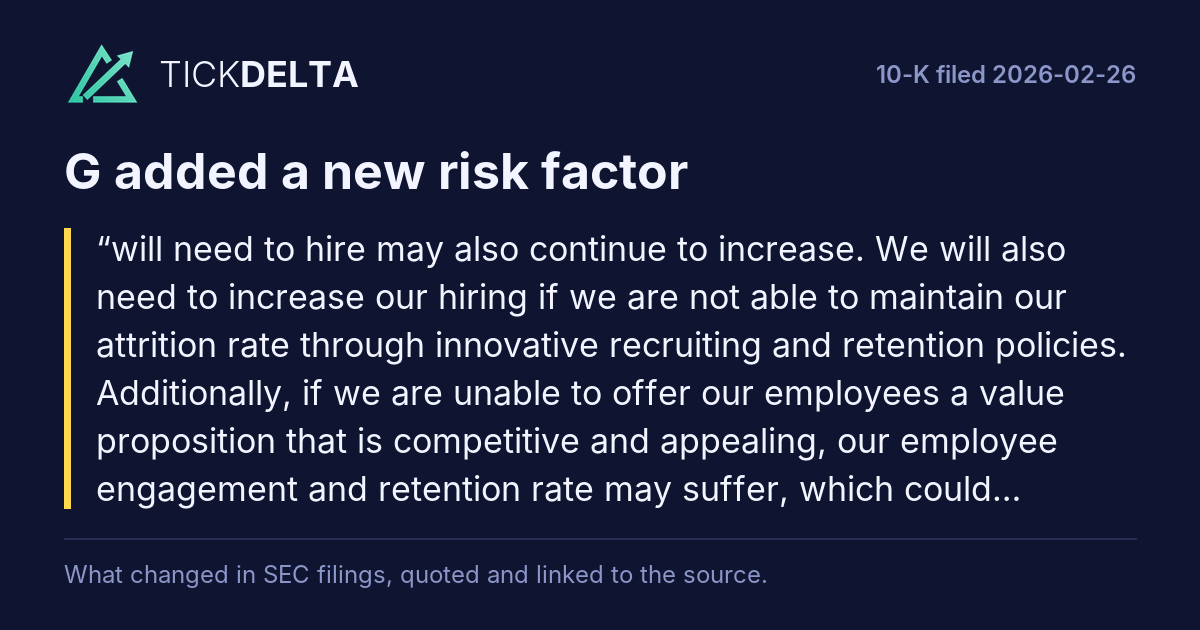
will need to hire may also continue to increase. We will also need to increase our hiring if we are not able to maintain our attrition rate through innovative recruiting and retention policies. Additionally, if we are unable to offer our employees a value proposition that is competitive and appealing, our employee engagement and retention rate may suffer, which could materially adversely affect our business.

Read in the 10-K

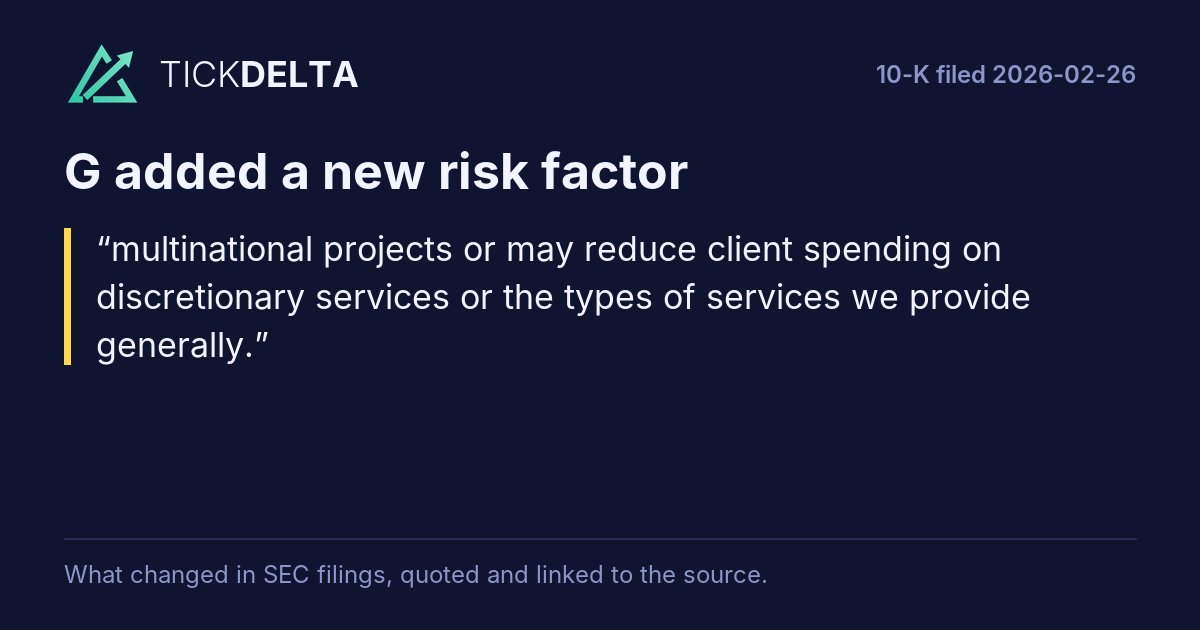
multinational projects or may reduce client spending on discretionary services or the types of services we provide generally.

Read in the 10-K

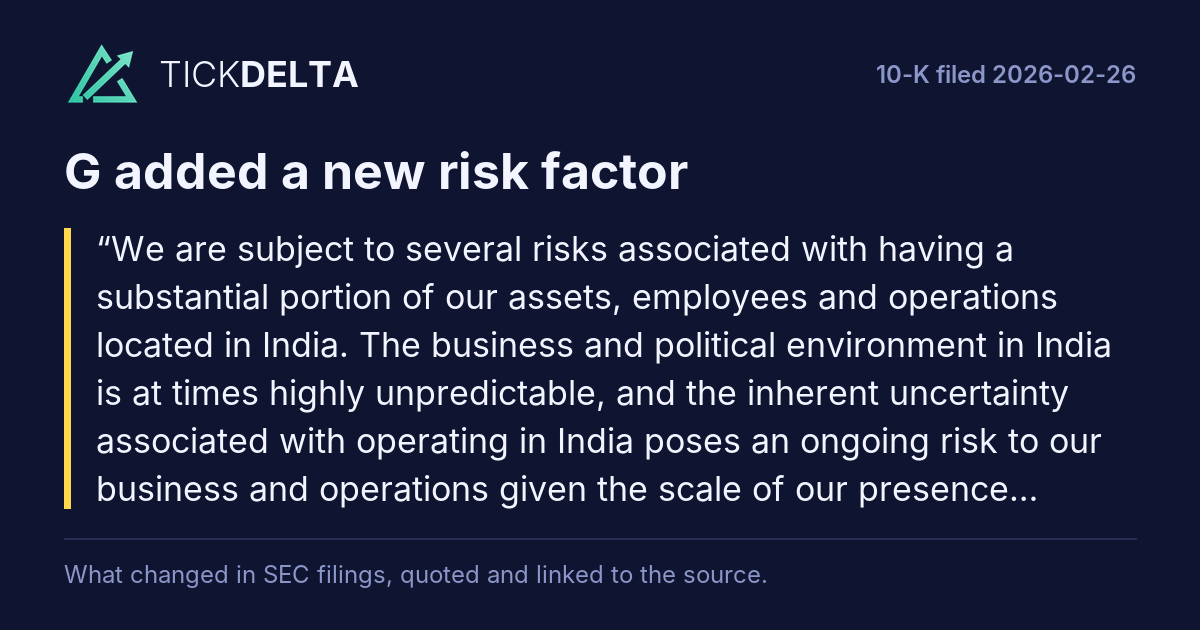
We are subject to several risks associated with having a substantial portion of our assets, employees and operations located in India. The business and political environment in India is at times highly unpredictable, and the inherent uncertainty associated with operating in India poses an ongoing risk to our business and operations given the scale of our presence there. Navigating the legal, regulatory and tax regimes in India is also challenging due to a complex, rapidly evolving, and often ambiguous regulatory and legal environment. Inconsistent application of rules by authorities and, at times, inconsistent judicial interpretations of rules, create uncertainty. Compliance requires managing layers of federal and state-specific laws, particularly in the areas of tax and labor law, with high risks of non-compliance due to the complexity of the regulatory and enforcement regime.

Read in the 10-K

Additionally, we are currently subject to an investigation by the India Enforcement Directorate (“ED”) relating to certain intercompany debt created as part of a 2015 restructuring transaction undertaken by the Company. On February 3, 2026, the ED issued an order relating to this investigation in connection with which a lien was placed on a building owned by us in Gurgaon, India. We are in the process of taking appropriate steps in relation to this order. We have not received any demand from the ED in relation to this matter. If the ED issues a demand and ultimately prevails in this matter, it would likely have a material adverse effect on our results of operations and financial condition.

Read in the 10-K

Additionally, the Government of India implemented labor law reforms effective November 21, 2025, including the Code on Social Security, 2020, which we expect to modestly increase our defined benefit costs prospectively. Certain aspects of the Labor Code rely on the issuance of rules and regulations. Additionally, the Government of India is in the process of clarifying certain aspects of the Labor Code. The issuance of rules and regulations as well as the outcome of these clarifications could increase new employment obligations, create operational and administrative burdens, trigger higher compliance penalties, and enforcement uncertainties during the transition period, which may result in increased costs in 2026 and future years due to expanded social security and employment coverage. Any of the foregoing could adversely affect our profitability, results of operations and financial condition.

Read in the 10-K
Show the other 5

The successful execution of our growth strategy also depends on our ability to effectively manage and develop our strategic partnerships and alliances. We may not be successful in maintaining or growing our existing alliances with partners whose capabilities complement our own, and our partners may have strategic priorities and objectives that differ from or conflict with our interests. In addition, certain of our partners may also be our clients or suppliers, which may create conflicts of interest. Any failure to successfully manage these relationships, or any misalignment of priorities with our partners, could adversely affect our business, results of operations and financial condition.

Additionally, our partners could decide to establish preferred or exclusive arrangements with our competitors, which could limit our access to key technologies, reduce our competitive position in the market and adversely affect our ability to deliver solutions to our clients. We may not be able to prevent or mitigate the effects of such competitive dynamics.

Our ability to remain competitive depends in part on our success in identifying and forming partnerships with providers of new and emerging technologies. We may fail to anticipate technological shifts or to establish meaningful alliances with emerging technology providers early enough in their life cycles to gain a competitive advantage. Furthermore, we may not develop a sufficient number of personnel with the skills and certifications necessary to deliver services related to new technologies offered by our partners. Any such failures could limit our ability to offer innovative solutions to our clients and could materially adversely affect our competitive position and business.

Our alliance partners may be adversely affected by global events, macroeconomic changes, geopolitical instability or other factors beyond our or their control, which could impair their operations and their ability to perform under their arrangements with us. Rapid changes in demand could also affect our partners’ ability to deliver the required products or services to us within expected timeframes or at anticipated prices or could lead to reduced demand for our related solutions and services.

Read in the 10-K

competitiveness, cause us to fail to satisfy our client obligations and harm our reputation, which would materially adversely affect our business and results of operations.

Read in the 10-K

A portion of our business depends on the ability of our employees to obtain the necessary visas and work or entry permits to travel to and do business in the countries where our clients and, in some cases, our delivery centers, are located. In recent years, in response to terrorist attacks, geopolitical tensions, and political developments, immigration authorities, particularly in the United States, have increased scrutiny in granting, extending, and renewing visas. The current U.S. presidential administration's immigration agenda has created increased uncertainty surrounding U.S. immigration policy. Recent executive orders impose a $100,000 fee on certain new H-1B entries, expand travel restrictions, intensify Department of Labor investigations, and eliminate automatic employment authorization extensions. Our operating subsidiaries in the U.S. use skilled workers holding H-1B and L-1 visas, and it has become more expensive, time-consuming, and legally complex to utilize existing U.S. visa programs. Additional executive or legislative action restricting the use of foreign personnel could materially increase our operating expenses, restrict our access to qualified workers, adversely affect our ability to recruit and retain critical talent, and place us at a competitive disadvantage relative to companies with greater resources. Visa processing delays or further restrictions could also disrupt our ability to staff client engagements, delay key projects, and reduce operational efficiency. Overall, ongoing changes in immigration laws and enforcement priorities have created significant uncertainty that makes workforce planning more difficult and could have a material adverse effect on our business and results of operations.

Read in the 10-K

Although we do not believe that our solutions or services infringe the intellectual property rights of others, claims may nonetheless be successfully asserted against us in the future. Our use of AI and generative AI technologies may expose us to intellectual property claims related to the data used to train AI models incorporated into our solutions and services. We may face claims that AI models we use were trained on copyrighted materials without authorization, or that outputs from our solutions or services infringe third-party copyrights or other intellectual property rights. The complexity and limited transparency of many AI models may make it difficult to fully understand AI system behavior or anticipate unintended infringement. Our development and deployment of agentic AI systems present novel intellectual property risks. The autonomous nature of these systems may result in outputs or actions that infringe third-party IP rights in ways that are difficult to predict or prevent, and liability frameworks for autonomous AI-generated infringement remain unclear. The costs of defending any infringement claims could be significant, and any successful claim may require us to modify, discontinue or rename any of our services.

Additionally, if commercially available AI technologies become unavailable or more costly due to changing law or litigation, or if competitors develop more effective IP strategies for their AI technologies, obtain broader IP protection, or more successfully navigate the evolving IP landscape for AI-generated content, our competitive position may be materially harmed. The costs of developing, implementing, and defending our AI-related intellectual property portfolio may be substantial and may not yield anticipated returns. Any liability arising from unintentional infringement, or the costs of developing an IP strategy that sufficiently addresses the IP-related risks of our advanced technology solutions, could have a material adverse effect on our business, reputation, results of operations and financial condition.

Read in the 10-K

effect on our share price and/or the market for our services. Furthermore, if India or bordering countries were to become engaged in armed hostilities, particularly hostilities that were protracted or involved the threat or use of nuclear weapons, we might not be able to continue our operations. We generally do not have insurance for losses and interruptions caused by terrorist attacks, military conflicts and wars, and our business continuity planning may not adequately address all potential scenarios arising from such regional instability or conflicts.

Read in the 10-K

Paragraphs in the 10-Q filed Nov 6, 2026 that were not in the one before

New in the latest 10-Q

39 paragraphs in the 10-Q filed Nov 6, 2026 with nothing like them in the 10-Q filed Aug 7, 2026 (at least half the words must differ; new numbers alone do not count). Quoted exactly, grouped by the item heading above them. This is text that changed, not a judgement of how serious it is.

Financial statements and notes

No portion of the purchase consideration is outstanding as of September 30, 2026.

Read in the 10-Q

Net gains (losses) reclassified into statement of income on completion of hedged transactions (20,374) 5,328 (15,046) (4,202) 1,211 (2,991)

Read in the 10-Q

Changes in fair value of effective portion of outstanding derivatives, net (16,804) 3,766 (13,038) (61,945) 14,814 (47,131)

Read in the 10-Q

Net gains (losses) reclassified into statement of income on completion of hedged transactions (51,745) 13,686 (38,059) (10,123) 2,732 (7,391)

Read in the 10-Q

Changes in fair value of effective portion of outstanding derivatives, net (76,787) 19,320 (57,467) (47,888) 12,741 (35,147)

Read in the 10-Q
Show the other 34

• the approval, timing and effects of the Domestication (as defined below), including whether our shareholders approve the Domestication, whether the Board exercises its discretion to effect, defer or abandon it, its tax treatment and the risk that shareholders may recognize gain or other income with respect to their shares at the effective time of the Domestication (as a result of the application of Section 367(b) of the Internal Revenue Code of 1986, as amended (the “Code”) or the passive foreign investment company rules or otherwise);

Read in the 10-Q

• our ability to develop and successfully execute our business strategies, including our Agentic Operations strategy and our transition away from engagements that are not aligned with that strategy;

Read in the 10-Q

As previously announced, we are seeking shareholder approval to grant the Board discretionary authority to change the Company’s jurisdiction of incorporation from Bermuda to Delaware in the United States by discontinuing as an exempted company limited by shares in Bermuda and continuing and domesticating as a corporation incorporated under the laws of the State of Delaware (the “Domestication”). If our shareholders approve this proposal, the Board will have the sole discretion, until the 2028 Annual General Meeting of Shareholders, to effectuate the Domestication. The Board has unanimously approved effectuating the Domestication, subject to approval by our shareholders and final approval by the Board. If the Domestication is approved and effected, on its effective date, currently expected to be on or around March 1, 2027, our common shares (including fractions of common shares, as the case may be) issued and outstanding immediately prior to the effective time of the Domestication will automatically convert by operation of law into an equivalent number of shares of common stock (or fractions of shares of common stock, as the case may be) of the Company after it is domesticated under the laws of Delaware (“Genpact Delaware”). Our name after the Domestication will remain “Genpact Limited.” For more information about the Domestication, please see our proxy statement/prospectus filed with the SEC on October 7, 2026 (the “Domestication Proxy Statement/Prospectus”), which is available on the SEC’s website at www.sec.gov.

Read in the 10-Q

Risk Factors

Currently, your rights as a shareholder of the Company arise under Bermuda law as well as the memorandum of association and the bye-laws of the Company (the “Bermuda Memorandum” and the “Bermuda Bye-Laws,” respectively). Upon effectiveness of the Domestication, your rights as a stockholder of the Company will arise under Delaware law as well as the certificate of incorporation and the bylaws of Genpact Delaware (the “Delaware Certificate” and the “Delaware Bylaws,” respectively), in each case, to be effective immediately following the Domestication, in the form attached as an annex to the Domestication Proxy Statement/Prospectus. For a summary description of your rights as a stockholder of Genpact Delaware and how they differ or may differ from your rights as a shareholder of the Company as it currently exists as a company organized under the laws of Bermuda (“Genpact Bermuda”), please see the Domestication Proxy Statement/Prospectus.

Read in the 10-Q

We expect to incur transaction costs in connection with the completion of the Domestication and related transactions, some of which will be incurred whether or not the Domestication is completed.

Read in the 10-Q

We expect to incur significant transaction costs in connection with the Domestication and related transactions. The substantial majority of these costs will be incurred regardless of whether the Domestication is completed and prior to the shareholder vote to approve the Domestication.

Read in the 10-Q

We may not realize the benefits we anticipate from the Domestication, particularly as the achievement of the benefits is in many important respects subject to factors that we do not and cannot control, including the reaction of third parties with whom we enter into contracts and do business and the reaction of investors. Our failure to realize those benefits could have a material and adverse effect on our business, results of operations, cash flows or financial condition. Please see the section of the Domestication Proxy Statement/Prospectus entitled “Proposal No. 1 - Domestication Proposal - Reasons for the Domestication.”

Read in the 10-Q

The market for the Genpact Delaware common stock may differ from the market for the Genpact Bermuda common shares and the market price of Genpact Delaware common stock may as a result be subject to volatility.

Read in the 10-Q

We expect that the Genpact Delaware common stock will trade on the New York Stock Exchange under the symbol “G,” the same trading symbol as the Genpact Bermuda common shares. The market price, trading volume or volatility, or potential investor pool of the Genpact Delaware common stock may be different from those of the Genpact Bermuda common shares.

Read in the 10-Q

While we currently expect the Domestication to be completed effective on or around March 1, 2027, our Board may decide to defer or abandon the Domestication, at any time or for any reason, prior to the completion of the Domestication. No assurance can be provided that the Domestication will be completed on a timely basis, or at all.

Read in the 10-Q

Following the Domestication, Genpact Delaware will be subject to U.S. tax on its income, and the combined effective tax rate with respect to Genpact Delaware and our direct and indirect subsidiaries (the “Effective Tax Rate”) may change significantly. Any such changes to our Effective Tax Rate could materially impact our financial results, including our earnings and cash flow, and reduce the amount of cash available for dividends for periods after the Domestication.

Read in the 10-Q

The Effective Tax Rate, which may fluctuate significantly from period to period, is based upon applicable income tax laws and regulations and judicial and administrative interpretations of these income tax laws and regulations in various jurisdictions, including many jurisdictions outside where we are organized and domiciled. The Effective Tax Rate may, however, vary significantly from the statutory rates under which we operate (including the U.S. statutory rate that would apply after the Domestication) because of, among other things, temporary differences that impact the timing in the recognition of income and expense for U.S. GAAP and tax purposes. We are unable to predict with certainty the impact of the Domestication on the Effective Tax Rate. In addition, the tax laws of the United States and other jurisdictions could change in the future, and those changes could cause a material increase in our Effective Tax Rate. The tax laws of the United States significantly limit our ability to redomicile outside of the United States once the Domestication has occurred. Accordingly, if our Effective Tax Rate were to increase as a result of the Domestication, our business and financial performance could be adversely affected.

Read in the 10-Q

If the Domestication does not qualify as an F Reorganization, U.S. Holders of Genpact Bermuda Stock would generally recognize taxable gain or loss as a result of the Domestication.

Read in the 10-Q

As discussed more fully in the section of the Domestication Proxy Statement/Prospectus entitled “Material U.S. Federal Income Tax Consequences of the Domestication,” it is expected that the Domestication should constitute a reorganization within the meaning of Section 368(a)(1)(F) of the Code (an “F Reorganization”). However, your tax advisor may not agree with our intended tax treatment and the IRS may assert, or a court may sustain, a contrary position. If the Domestication does not qualify as an F Reorganization within the meaning of Section 368(a) of the Code, U.S. Holders (as defined in such section of the Domestication Proxy Statement/Prospectus) of Genpact Bermuda Stock (as defined in such section of the Domestication Proxy Statement/Prospectus) would generally recognize taxable gain or loss pursuant to the Domestication.

Read in the 10-Q

Even if the Domestication qualifies as an F Reorganization, certain U.S. Holders of Genpact Bermuda Stock may be required to recognize gain for U.S. federal income tax purposes as a result of the Domestication.

Read in the 10-Q

As noted above and discussed more fully in the section of the Domestication Proxy Statement/Prospectus entitled “Material U.S. Federal Income Tax Consequences of the Domestication,” it is expected that the Domestication should constitute an F Reorganization. Assuming that the Domestication so qualifies, U.S. Holders (as defined in such section of the Domestication Proxy Statement/Prospectus) of Genpact Bermuda Stock (as defined in such section of the Domestication Proxy Statement/Prospectus) will be subject to Section 367(b) of the Code and subject to the discussion below concerning the application of the passive foreign investment company (“PFIC”) rules to the Domestication:

Read in the 10-Q

• A U.S. Holder of Genpact Bermuda Stock whose shares have a fair market value of $50,000 or more, but who is not a 10% Shareholder (as defined in the following bullet point) will generally recognize gain (but not loss) on the deemed receipt of Genpact Stock (as defined in the section of the Domestication Proxy Statement/Prospectus entitled “Material U.S. Federal Income Tax Consequences of the Domestication”) in the Domestication. As an alternative to recognizing gain, such U.S. Holder may file an election to include in income, as a dividend, the “all earnings and profits amount” attributable to its Genpact Bermuda Stock, provided certain other requirements are satisfied.

Read in the 10-Q

• A U.S. Holder of Genpact Bermuda Stock who on the date of the Domestication directly, indirectly or constructively owns (i) 10% or more of the total combined voting power of all classes of Genpact Bermuda shares entitled to vote or (ii) 10% or more of the total value of all classes of Genpact Bermuda shares (a “10% Shareholder”) will generally be required to include in income, as a dividend, the “all earnings and profits amount” attributable to its Genpact Bermuda Stock, provided certain other requirements are satisfied.

Read in the 10-Q

• A U.S. Holder of Genpact Bermuda Stock whose stock has a fair market value of less than $50,000 on the date of the Domestication and who is not a 10% Shareholder will not recognize any gain or loss and will not be required to include any part of Genpact Bermuda’s earnings in income.

Read in the 10-Q

As discussed further under the section of the Domestication Proxy Statement/Prospectus entitled “Material U.S. Federal Income Tax Consequences of the Domestication,” Genpact Bermuda believes that it is not, and has not been, a PFIC for U.S. federal income tax purposes. In the event that Genpact Bermuda is (or, in some cases, has been) treated as a PFIC, proposed Treasury Regulations (which have a retroactive effective date), if finalized in their current form, generally would require a U.S. Holder to recognize gain as a result of the Domestication unless the U.S. Holder makes (or has made) certain elections.

Read in the 10-Q

THE TAX CONSEQUENCES OF THE DOMESTICATION ARE COMPLEX AND WILL DEPEND ON A HOLDER’S PARTICULAR CIRCUMSTANCES. ALL HOLDERS ARE STRONGLY URGED TO CONSULT THEIR OWN TAX ADVISOR FOR A FULL DESCRIPTION AND UNDERSTANDING OF THE TAX CONSEQUENCES OF THE DOMESTICATION, INCLUDING THE APPLICABILITY AND EFFECT OF THE U.S. FEDERAL, STATE, LOCAL AND FOREIGN INCOME AND OTHER TAX LAWS. FOR A DISCUSSION OF THE MATERIAL U.S. FEDERAL INCOME TAX CONSEQUENCES OF THE DOMESTICATION, SEE THE SECTION OF THE DOMESTICATION PROXY STATEMENT/PROSPECTUS ENTITLED “MATERIAL U.S. FEDERAL INCOME TAX CONSEQUENCES OF THE DOMESTICATION.”

Read in the 10-Q

Other information

Name (Title) Action Taken (Date of Action) Type of Trading Arrangement Nature of Trading Arrangement Duration of Trading Arrangement Aggregate Number of Securities Sydney Schaub (Senior Vice President, Chief Legal Officer and Corporate Secretary) Adoption (September 15, 2026) Rule 10b5-1 trading arrangement Sale Until June 15, 2027, or such earlier date upon which all transactions are completed Up to 22,748 common shares(1) Sameer Dewan (Senior Vice President, Global Business Leader, Financial Services) Adoption (September 11, 2026) Rule 10b5-1 trading arrangement Sale Until February 5, 2027, or such earlier date upon which all transactions are completed Up to 28,086 common shares(1)

Read in the 10-Q

(1) Includes shares underlying restricted share unit awards that have not yet vested. The actual number of shares to be sold under this arrangement will be net of the number of shares withheld to satisfy tax withholding obligations upon the vesting of such awards and is not yet determinable.

Read in the 10-Q

Item 6

3.1 Memorandum of Association of the Registrant (incorporated by reference to Exhibit 3.1 to Amendment No. 2 of the Registrant’s Registration Statement on Form S-1 (File No. 333-142875) filed with the SEC on July 16, 2007).

Read in the 10-Q

3.2 Bye-laws of the Registrant (incorporated by reference to Exhibit 3.3 to Amendment No. 4 of the Registrant’s Registration Statement on Form S-1 (File No. 333-142875) filed with the SEC on August 1, 2007).

Read in the 10-Q

10.1† Employment Agreement between the Company and Sumita Pandit, dated September 3, 2026 (incorporated by reference to Exhibit 10.1 to the Company's Current Report on Form 8-K (File No. 001-33626) filed with the SEC on September 8, 2026).

Read in the 10-Q

10.2† Separation Agreement and General Release, dated as of September 15, 2026, by and between the Company and Michael Weiner (incorporated by reference to Exhibit 10.1 to the Company's Current Report on Form 8-K/A (File No. 001-33626) filed with the SEC on September 18, 2026).

Read in the 10-Q

22.1 List of Issuers and Guarantor Subsidiaries (incorporated by reference to Exhibit 22.1 to the Company's Quarterly Report on Form 10-Q (File No. 001-33626) filed with the SEC on August 7, 2026).

Read in the 10-Q

31.1* Certification of the Chief Executive Officer pursuant to Rule 13a-14(a) or 15d-14(a) of the Securities Exchange Act of 1934, as adopted pursuant to Section 302 of the Sarbanes-Oxley Act of 2002.

Read in the 10-Q

31.2* Certification of the Chief Financial Officer pursuant to Rule 13a-14(a) or 15d-14(a) of the Securities Exchange Act of 1934, as adopted pursuant to Section 302 of the Sarbanes-Oxley Act of 2002.

Read in the 10-Q

32.1* Certification of the Chief Executive Officer pursuant to 18 U.S.C. Section 1350, as adopted pursuant to Section 906 of the Sarbanes-Oxley Act of 2002.

Read in the 10-Q

32.2* Certification of the Chief Financial Officer pursuant to 18 U.S.C. Section 1350, as adopted pursuant to Section 906 of the Sarbanes-Oxley Act of 2002.

Read in the 10-Q

101. INS* Inline XBRL Instance Document — the instance document does not appear in the Interactive Data File because its XBRL tags are embedded within the Inline XBRL document.

Read in the 10-Q

104* Cover Page Interactive Data File (formatted as Inline XBRL and contained in Exhibit 101)

Read in the 10-Q

The 10-Q's risk factors against the 10-K

Item 1A of the 10-Q filed Nov 6, 2026 against Item 1A of the 10-K filed Feb 26, 2026. A 10-Q repeats only the risks that changed, so a 10-K paragraph that is missing from it is not counted as removed. Added is a paragraph with nothing like it in the 10-K, Reworded a sentence that is in both with several words changed, Quiet changes a sentence in both where one to four words changed and one is a hedge or a modal (cut words struck through, new words highlighted). Text on the page, not a score; each links to the filing at sec.gov.

Added10-Q Nov 6, 2026 vs 10-K Feb 26, 2026
We have disclosed under the heading “Risk Factors” in our Annual Report on Form 10-K for the year ended December 31, 2025 risk factors that materially affect our business, financial condition, results of operations or cash flows. There have been no material changes to the risk factors previously disclosed in our Annual Report on Form 10-K for the year ended December 31, 2025, except as set forth below. You should carefully consider the risk factors set forth below and the risk factors set forth in our Annual Report on Form 10-K for the year ended December 31, 2025 as well as the other information that appears elsewhere in this Quarterly Report on Form 10-Q and our Annual Report on Form 10-K for the year ended December 31, 2025. You should be aware that these risk factors and other information may not describe every risk facing our Company. Additional risks and uncertainties not currently known to us may also materially adversely affect our business, financial condition and/or results of operations.

Read it in the 10-Q at sec.gov

Added10-Q Nov 6, 2026 vs 10-K Feb 26, 2026
Currently, your rights as a shareholder of the Company arise under Bermuda law as well as the memorandum of association and the bye-laws of the Company (the “Bermuda Memorandum” and the “Bermuda Bye-Laws,” respectively). Upon effectiveness of the Domestication, your rights as a stockholder of the Company will arise under Delaware law as well as the certificate of incorporation and the bylaws of Genpact Delaware (the “Delaware Certificate” and the “Delaware Bylaws,” respectively), in each case, to be effective immediately following the Domestication, in the form attached as an annex to the Domestication Proxy Statement/Prospectus. For a summary description of your rights as a stockholder of Genpact Delaware and how they differ or may differ from your rights as a shareholder of the Company as it currently exists as a company organized under the laws of Bermuda (“Genpact Bermuda”), please see the Domestication Proxy Statement/Prospectus.

Read it in the 10-Q at sec.gov

Added10-Q Nov 6, 2026 vs 10-K Feb 26, 2026
We expect to incur transaction costs in connection with the completion of the Domestication and related transactions, some of which will be incurred whether or not the Domestication is completed.

Read it in the 10-Q at sec.gov

Added10-Q Nov 6, 2026 vs 10-K Feb 26, 2026
We expect to incur significant transaction costs in connection with the Domestication and related transactions. The substantial majority of these costs will be incurred regardless of whether the Domestication is completed and prior to the shareholder vote to approve the Domestication.

Read it in the 10-Q at sec.gov

Added10-Q Nov 6, 2026 vs 10-K Feb 26, 2026
We may not realize the benefits we anticipate from the Domestication, particularly as the achievement of the benefits is in many important respects subject to factors that we do not and cannot control, including the reaction of third parties with whom we enter into contracts and do business and the reaction of investors. Our failure to realize those benefits could have a material and adverse effect on our business, results of operations, cash flows or financial condition. Please see the section of the Domestication Proxy Statement/Prospectus entitled “Proposal No. 1 - Domestication Proposal - Reasons for the Domestication.”

Read it in the 10-Q at sec.gov

Show the other 7
Added10-Q Nov 6, 2026 vs 10-K Feb 26, 2026
We expect that the Genpact Delaware common stock will trade on the New York Stock Exchange under the symbol “G,” the same trading symbol as the Genpact Bermuda common shares. The market price, trading volume or volatility, or potential investor pool of the Genpact Delaware common stock may be different from those of the Genpact Bermuda common shares.

Read it in the 10-Q at sec.gov

Added10-Q Nov 6, 2026 vs 10-K Feb 26, 2026
While we currently expect the Domestication to be completed effective on or around March 1, 2027, our Board may decide to defer or abandon the Domestication, at any time or for any reason, prior to the completion of the Domestication. No assurance can be provided that the Domestication will be completed on a timely basis, or at all.

Read it in the 10-Q at sec.gov

Added10-Q Nov 6, 2026 vs 10-K Feb 26, 2026
Following the Domestication, Genpact Delaware will be subject to U.S. tax on its income, and the combined effective tax rate with respect to Genpact Delaware and our direct and indirect subsidiaries (the “Effective Tax Rate”) may change significantly. Any such changes to our Effective Tax Rate could materially impact our financial results, including our earnings and cash flow, and reduce the amount of cash available for dividends for periods after the Domestication.

Read it in the 10-Q at sec.gov

Added10-Q Nov 6, 2026 vs 10-K Feb 26, 2026
The Effective Tax Rate, which may fluctuate significantly from period to period, is based upon applicable income tax laws and regulations and judicial and administrative interpretations of these income tax laws and regulations in various jurisdictions, including many jurisdictions outside where we are organized and domiciled. The Effective Tax Rate may, however, vary significantly from the statutory rates under which we operate (including the U.S. statutory rate that would apply after the Domestication) because of, among other things, temporary differences that impact the timing in the recognition of income and expense for U.S. GAAP and tax purposes. We are unable to predict with certainty the impact of the Domestication on the Effective Tax Rate. In addition, the tax laws of the United States and other jurisdictions could change in the future, and those changes could cause a material increase in our Effective Tax Rate. The tax laws of the United States significantly limit our ability to redomicile outside of the United States once the Domestication has occurred. Accordingly, if our Effective Tax Rate were to increase as a result of the Domestication, our business and financial performance could be adversely affected.

Read it in the 10-Q at sec.gov

Added10-Q Nov 6, 2026 vs 10-K Feb 26, 2026
If the Domestication does not qualify as an F Reorganization, U.S. Holders of Genpact Bermuda Stock would generally recognize taxable gain or loss as a result of the Domestication.

Read it in the 10-Q at sec.gov

Added10-Q Nov 6, 2026 vs 10-K Feb 26, 2026
As discussed more fully in the section of the Domestication Proxy Statement/Prospectus entitled “Material U.S. Federal Income Tax Consequences of the Domestication,” it is expected that the Domestication should constitute a reorganization within the meaning of Section 368(a)(1)(F) of the Code (an “F Reorganization”). However, your tax advisor may not agree with our intended tax treatment and the IRS may assert, or a court may sustain, a contrary position. If the Domestication does not qualify as an F Reorganization within the meaning of Section 368(a) of the Code, U.S. Holders (as defined in such section of the Domestication Proxy Statement/Prospectus) of Genpact Bermuda Stock (as defined in such section of the Domestication Proxy Statement/Prospectus) would generally recognize taxable gain or loss pursuant to the Domestication.

Read it in the 10-Q at sec.gov

Added10-Q Nov 6, 2026 vs 10-K Feb 26, 2026
Even if the Domestication qualifies as an F Reorganization, certain U.S. Holders of Genpact Bermuda Stock may be required to recognize gain for U.S. federal income tax purposes as a result of the Domestication.

Read it in the 10-Q at sec.gov

The first 12 of 22 are shown (at most 12 of each type).

Phrases used for the first time

Two-word phrases in Risk Factors of the 10-K filed Feb 26, 2026 that are in none of the 1 earlier 10-Ks stored, back to Mar 3, 2025

ai-enabled solutions ×3notes notes ×3cloud software ×2increased regulatory ×2remediation costs ×2non-compliance due ×2competitive dynamics ×2clients industries ×2client spending ×2labor law ×2sbs package ×2safe harbor ×2social security ×2labor code ×2required products ×2ongoing regulatory ×2
Where each one is used
  • ai-enabled solutions: The market for AI and other advanced technology and services is highly competitive and rapidly evolving. We face significant competition from our traditional competitors as well as other third parties, including those that are new to the market or our industry, as well as our own clients, who may develop their own...
  • notes notes: The 2026 Notes and 2029 Notes were issued by, and are senior unsecured indebtedness of, Genpact Luxembourg S.à r.l. and Genpact USA, Inc., and are guaranteed on a senior unsecured basis by Genpact Limited and Genpact UK Finco plc, a wholly-owned subsidiary of the Company (“Genpact UK”). The 2030 Notes were issued...
  • cloud software: AI technology and services require access to high-quality datasets, foundation models, and other AI system components. We currently rely, in part, on third parties to provide these components. In the future, we may face difficulties acquiring the necessary rights from third parties due to market competition and...
  • increased regulatory: In addition, the legal and regulatory landscape surrounding AI technologies is rapidly evolving, uncertain and varies significantly by jurisdiction, including in the areas of intellectual property, cybersecurity, employment, privacy and data protection. Authorities where we operate are applying, or considering...
  • remediation costs: Our clients, suppliers, subcontractors, and other third parties with whom we do business, including in particular cloud service providers and software vendors, generally face similar or greater cybersecurity threats, and we must rely on the safeguards adopted by these third parties. We and our clients rely on...
  • non-compliance due: Additionally, our hybrid working model, which includes a high number of employees working remotely, has reduced our ability to enforce physical security controls and monitor employee conduct and has increased the risk that our employees will engage in impermissible or careless conduct, which could give rise to...
  • competitive dynamics: Our business is particularly susceptible to economic and political conditions in the markets where our clients or operations are concentrated. A material portion of our revenues is derived from our clients in North America — in particular the United States — and Europe, and weak or changing demand, or any other...
  • clients industries: Our business is particularly susceptible to economic and political conditions in the markets where our clients or operations are concentrated. A material portion of our revenues is derived from our clients in North America — in particular the United States — and Europe, and weak or changing demand, or any other...

The 10-K at sec.gov

Used at least twice, small words left out. Counted, not picked: a phrase can be new because the company renamed something.

What was taken out

8 paragraphs of last year's Risk Factors with nothing like them now. The longest are quoted.

Across all companies
A portion of our business depends on the ability of our employees to obtain the necessary visas and work or entry permits to travel to and do business in the countries where our clients and, in some cases, our delivery centers, are located. In response to events such as terrorist attacks, the COVID-19 pandemic, global unrest and political rhetoric, immigration authorities generally, and those in the United States in particular, have increased the level of scrutiny in granting and extending or renewing visas. If further terrorist attacks occur, global unrest intensifies, or nationalistic...
In the 10-K filed Mar 3, 2025
Additionally, labor codes enacted by the Government of India in 2019 will, once made effective, change the definition of wages for purposes of determining employer contributions under the provident fund and other statutory benefit schemes, including the Indian gratuity plan. As a result of this legislation, our compensation cost in India may increase, which could adversely affect our profitability, results of operations and financial condition.
In the 10-K filed Mar 3, 2025
and implement new solutions, our results of operations may also be negatively impacted if we are unable to introduce new pricing or commercial models that appropriately capture the value our services are generating for our clients or if our clients demand savings that we are unable to deliver or do not properly account for in pricing these new solutions.
In the 10-K filed Mar 3, 2025
Our results of operations have been adversely affected and could be further adversely affected by certain movements in exchange rates, particularly if the Indian rupee or other currencies in which we incur expenses appreciate against the U.S. dollar or if, as has occurred over the past year, the currencies in which we receive revenues, such as the euro,
In the 10-K filed Mar 3, 2025

Sources

Item 1A of each 10-K and 10-Q on EDGAR, quoted exactly. Each paragraph links to the filing at sec.gov.

Also

10-K change: what was reworded or cut, section by section.

Work with it

Excel workbook · CSV. Google Sheet that stays up to date: paste =IMPORTDATA("https://tickdelta.com/company/G/export.csv") into a cell.

Next:10-K change
Esc

Type a ticker such as AAPL, a name, an investor such as Buffett, or a topic such as tariffs. ↑ ↓ to move, Enter to open.