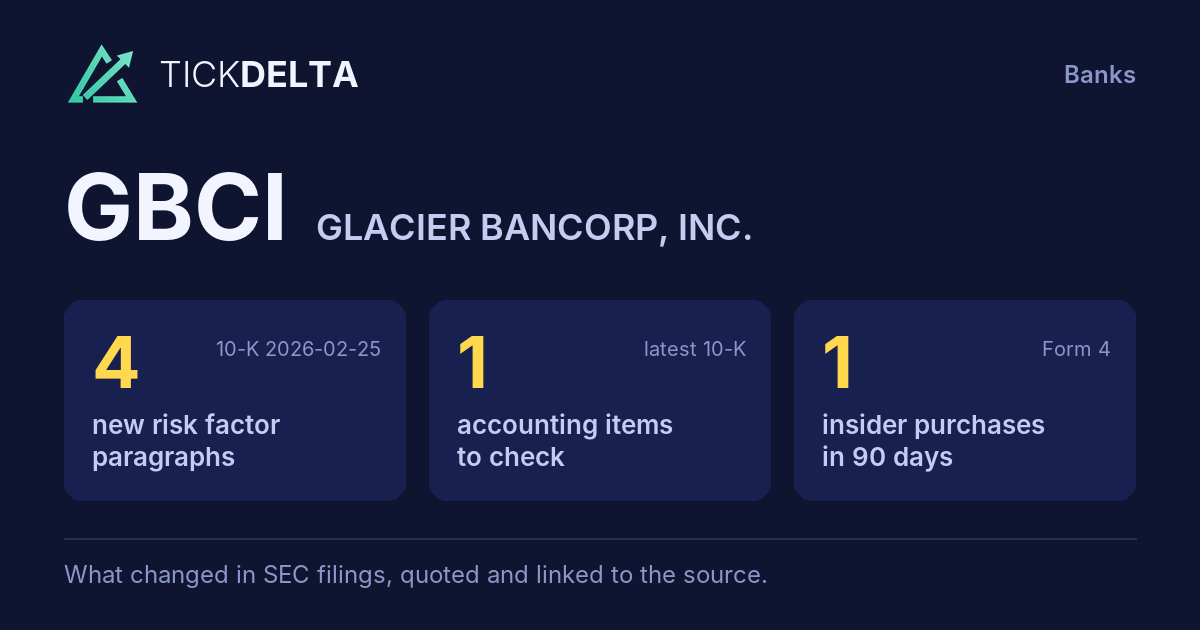
Screener / SEC EDGAR /CIK 0000868671 /10-K filed Feb 25, 2026, compared with Feb 25, 2025 /Numbers from the XBRL of the 10-Ks
NYSE Financials · Banks

Glacier Bancorp, Inc. GBCI

Compare with peers Embed
The 10-K against last year's

114 changes: 7 added, 8 removed, 98 reworded, 1 quiet changes

10-K Feb 25, 2026 vs Feb 25, 2025

10-K 0000868671-26-000023 (Feb 25, 2026) vs 10-K 0000868671-25-000046 (Feb 25, 2025) Not compared: Legal Proceedings.

Every paragraph, and how much of it changed

One bar per paragraph, in the order of the 10-K. Height and colour show the share of its words not in the closest paragraph a year earlier; the tallest bars are new paragraphs.

Risk Factors

75 paragraphs · 4 new · 38 reworded · 1 gone · 10-K Feb 25, 2026 against Feb 25, 2025
New paragraph Reworded (5% of its words or more) Same or nearly
Paragraph 62 · 48% changed Every version of it
Our business is impacted by factors such as economic, political and market conditions, broad trends in industry and finance, changes in government monetary and fiscal policies, inflation, and financial market volatility, all of which are beyond our control. National and global economies are constantly in flux, as evidenced flux and are affected by recent market volatility resulting from, among geopolitical instability, including the war in Ukraine, conflicts in the Middle East, and potential for future conflicts or disruptions in other things, the bank failures involving Silicon Valley Bank and Signature Bank in 2023, the effects of inflation, and the ever-changing landscape parts of the energy world. In recent years, supply chain constraints, labor shortages, tariffs, and medical industries. monetary and fiscal policies have affected inflation. Although inflationary pressures seemed to ease further during 2025, with the annual inflation rate in the United States at 2.7% as of December 2025, as reported by the U.S. Bureau of Labor Statistics, inflation remained slightly elevated. Our business may be further impacted by periods of high inflation in the future.
Paragraph 66 · 41% changed Every version of it
Significant changes or developments in U.S. laws and policies can materially adversely affect our business. There are uncertainties around The policies enacted by the legal current presidential administration (including trade, fiscal, foreign, and regulatory approach that will be taken under monetary policy), the Executive branch Administration, uncertainty surrounding the U.S. debt ceiling, government shutdowns, and we administrative agencies such as the CFPB and the Federal Reserve could affect the national and global economy. We cannot predict the likelihood, nature or extent of changes in law law, government regulations, or government regulations operations that may arise from future legislation or administrative or executive action, either in the United States or abroad. We also cannot predict the impact such factors may have on the national and global economy or the magnitude of their impact on our business.
Paragraph 57 · 41% changed Every version of it
The Patriot Act and BSA require financial institutions to develop programs to prevent financial institutions from being used for money laundering and terrorist activities. Failure to comply with these regulations could result in fines or sanctions and limit our ability to get regulatory approval of acquisitions. While we have developed policies and procedures designed to assist in compliance with these laws and regulations, no assurance can be given that these policies and procedures will be effective in preventing violations of these laws and regulations. Failure to maintain and implement adequate programs to combat money laundering and terrorist financing could also have serious reputational consequences for us. Any of these results could have a material adverse effect on our business, financial condition, results of operations and growth prospects.
Paragraph 19 · 38% changed Every version of it
The Bank maintains an allowance for credit losses (“ACL” or “allowance”) in an amount that it believes is adequate to provide for losses in the loan portfolio. While the Bank strives to carefully manage and monitor credit quality and to identify loans that may become non-performing, at any time there are loans included in the portfolio that will result in losses, but that have not been identified as non-performing or potential problem loans. With respect to real estate loans and property taken in satisfaction of such loans (“other real estate owned” or “OREO”), the Bank can be required to recognize significant declines in the value of the underlying real estate collateral quite suddenly as values are updated through appraisals and evaluations (new or updated) performed in the normal course of monitoring the credit quality of the loans. There are many factors that can cause the value of real estate to decline, including declines in the general real estate market, changes in methodology applied by appraisers, and/or using a different appraiser than was used for the prior appraisal or evaluation. The Bank’s ability to recover on real estate loans by selling or disposing of the underlying real estate collateral is adversely impacted by declining values, which increases the likelihood the Bank will suffer losses on defaulted loans beyond the amounts provided for in the ACL. This, in turn, could require material increases in the Bank’s provision for credit losses and ACL. By closely monitoring credit quality, the Bank attempts to identify deteriorating loans before they become non-performing assets and adjust the ACL accordingly. However, because future events are uncertain, and if difficult economic conditions occur, there may be loans that deteriorate to a non-performing status in an accelerated time frame. As a result, future additions to the ACL may be necessary beyond the levels commensurate with any loan growth. Because the loan portfolio contains a number of loans with relatively large balances, the deterioration of one or a few of these loans may cause a significant increase in non-performing loans, requiring an increase to the ACL. Additionally, future significant additions to the ACL may be required based on changes in the mix of loans comprising the portfolio, and changes in the financial condition of borrowers, which may result from changes in economic conditions, or changes in the assumptions used in determining the ACL. Additionally, federal and state banking regulators, as an integral part of their supervisory function, periodically review the Bank’s loan portfolio and the adequacy of the ACL. These regulatory authorities may require the Bank to recognize further provision for credit losses or charge-offs based upon on their judgments, which may be different from the Bank’s judgments. Any increase in the ACL could have an adverse effect, which could be material, on our business, financial condition, and results of operations.
Paragraph 48 · 32% changed Every version of it
The regulatory landscape surrounding AI technologies is also evolving, and the ways in which these technologies will be regulated by governmental authorities, federal, state, and local governments, self-regulatory institutions, bodies, or other regulatory authorities remains uncertain and may be inconsistent from jurisdiction to jurisdiction. Certain jurisdictions in which we operate are considering Some states within our market areas have enacted or have proposed or enacted legislation and policies regulating AI with a focus on consumer rights, bias, transparency and non-personal data, such as the recent Executive Order on AI. misuse. The president has responded by issuing an executive order seeking to centralize AI policies and to identify and challenge inconsistent state laws. Such AI regulations may result in operational costs to modify, maintain, or align our business practices, practices with the rapidly evolving, potentially unclear, or conflicting regulatory regimes, or constrain our ability to develop, deploy, or maintain these technologies.
Paragraph 43 · 31% changed Every version of it
Additionally, the Bank faces the risk of operational disruption, failure, termination or capacity constraints of any of the third parties that facilitate its business activities, including third-party service providers, vendors, exchanges, clearing agents, clearing houses or other financial intermediaries. Such parties could also be the source of an attack on, or breach of, the Bank’s operational systems. Our operational controls and third-party management programs may not always provide adequate oversight and control over these parties. Inadequate performance by third parties can adversely affect our ability to deliver products and services to our customers and conduct our business. Replacing or finding alternatives for underperforming vendors can be difficult and costly, potentially adversely impacting our customers and operations.
Paragraph 70 · 30% changed Every version of it
We use models and strategies to forecast losses, project revenue, and measure and assess capital requirements for various credit, market, operational and strategic risks. These models require oversight, ongoing monitoring, and periodic reassessment. Models are subject to inherent limitations due to the use of historical trends and simplifying assumptions, uncertainty regarding economic and financial outcomes, and emerging risks from the use of applications that may rely on artificial intelligence. Our models and strategies may not be adequate due to limited historical data and shocks caused by extreme or unanticipated market changes, especially during severe market downturns or stress events. Regardless of the steps we take to ensure effective controls, governance, monitoring and testing, and implement new risk management tools, we could suffer operational, reputational and financial harm if our models and strategies and other risk management tools fail to properly anticipate and manage the current and evolving risks we face.
Paragraph 44 · 30% changed Every version of it
Any failures, interruptions or security breaches in our information systems operational or security systems, or those of our third-party service providers, including as a result of cyberattacks, could damage our reputation, result in a loss of customer disrupt business, result in the disclosure or misuse of confidential or proprietary information or a violation of privacy or other laws, or expose us to civil litigation, regulatory fines or losses not covered by insurance. insurance, and increase costs.

MD&A

172 paragraphs · 3 new · 64 reworded · 7 gone · 10-K Feb 25, 2026 against Feb 25, 2025
New paragraph Reworded (5% of its words or more) Same or nearly
Paragraph 21 · 50% changed
Additional factors that could cause actual results to differ materially from those expressed in the forward-looking statements are discussed in “Item 1A. Risk Factors.” Please take into account that forward-looking statements speak only as of the date of this Annual Report on Form 10-K (or documents incorporated by reference, if applicable). Given the described uncertainties and risks, the Company cannot guarantee its future performance or results of operations and you should not place undue reliance on these forward-looking statements. The Company does not undertake any obligation to publicly correct, revise, or update any forward-looking statement if it later becomes aware that actual results are likely to differ materially from those expressed in such forward-looking statement, except as may be required under federal securities laws.
Paragraph 165 · 50% changed
The preparation of the consolidated financial statements in conformity with GAAP often requires management to use significant judgments as well as subjective and/or complex measurements in making make estimates and assumptions that affect the reported amounts of assets, liabilities, income income, and expenses. The Company considers its related disclosures. Certain accounting policies for involve significant judgment and are particularly important to the ACL, goodwill portrayal of our financial condition and fair value measurements to be results of operations. These policies, and the related estimates, are described below as critical accounting policies. The application of these policies has a significant impact on the Company’s consolidated and critical accounting estimates because changes in assumptions or judgments could materially affect our financial statements and financial results could differ significantly if different judgments or estimates were applied. The following describes why the estimates are subject to uncertainty, the estimated change in the reported periods, and the sensitivity of the reported amounts to the methods, assumptions, and estimates underlying the calculation. statements.
Paragraph 60 · 39% changed
The Company focuses its lending activities primarily on the following types of loans: 1) first-mortgage, conventional loans secured by residential properties, particularly single-family; 2) commercial lending, including agriculture and public entities; and 3) installment lending for consumer purposes (e.g., home equity, automobile, etc.). Supplemental information regarding the Company’s loan portfolio and credit quality based on regulatory classification is provided in the section captioned “Loans by Regulatory Classification” included in “Part II. Item 7. Management’s Discussion and Analysis of Financial Condition and Results of Operations.” The regulatory classification of loans is based primarily on the type of collateral for the loans. Loan information included in “Part II. Item 7. Management’s Discussion and Analysis of Financial Condition and Results of Operations” is based on the Company’s loan segments, which are based on the purpose of the loan, unless otherwise noted as a regulatory classification. The following table summarizes the Company’s loan portfolio as of the dates indicated:
Paragraph 162 · 38% changed
Net interest income (tax-equivalent) increased $13.3 million for the year ended December 31, 2024 compared to prior year end. The increase in interest income was primarily attributable to an increase in interest rates with additional benefit from the increase in the loan portfolio, which more than outpaced the increase in interest expense which was primarily driven by an increase in interest rates.
Paragraph 78 · 37% changed
Due to the recent trends in the banking industry, there has been increased risk associated with commercial real estate loans, including with respect to the higher vulnerability of these credits to pressure as interest rates remain elevated and market conditions in many large metropolitan areas continue to show signs of stress. The Company has limited exposure to the office building sector in central business districts as the office portfolio is generally diversified in suburban and rural markets with strong occupancy levels. The Company maintains a practice of regular and ongoing loan reviews, stress tests, and sensitivity analyses to assess the level of risk in the loan portfolio. Loan reviews include monitoring past due rates, non-performing trends, concentrations, LTV’s, among other qualitative factors. Loan policies are robust and are updated as needed to meet the strategic and risk mitigation goals of the company.
Paragraph 169 · 36% changed
Fair value measurement estimates are used for certain recorded and disclosed financial instruments on a recurring and non-recurring basis. Such estimates utilize a variety of assumptions which are subject to uncertainty. Certain fair value measurements, particularly those involving unobservable inputs, require significant judgment and are highly sensitive to changes in assumptions. These measurements have a higher degree may include valuation of sensitivity of financial instruments classified as Level 3 within the reported amount to the methods, fair value hierarchy, where valuation is based on internally developed models. Changes in assumptions and estimates underlying the calculation. such as discount rates, credit spreads, or expected cash flows could result in materially different fair value estimates. For information on fair value measurements and the estimated changes during the reporting periods, see Note 21 to the Consolidated Financial Statements in “Item 8. Financial Statements and Supplementary Data.”
Paragraph 43 · 35% changed
Non-interest income of $128 $141 million for 2024 2025 increased $10.4 $12.9 million, or 9 10 percent, over the prior year. Service charges and other fees of $85.1 million for 2025 increased $6.2 million, or 8 percent, over the prior year. Gain on sale of residential loans of $16.9 $18.2 million for 2024 2025 increased by $4.7 $1.4 million, or 38 8 percent, over the prior year, pimarily due to the increase in volume of loans sold. year. Other income of $14.0 $17.7 million for 2024 2025 increased $1.7 million, or 14 percent, $3.7 million over the same period last year and was primarily driven by a $1.2 million gain on the sale of repossessed property during the current prior year. Included in the 2023 gain on sale of securities current year other income was $1.7 $2.8 million of gain on the sale of all of the Company’s Visa class B shares. income related to bank owned life insurance proceeds.
Paragraph 49 · 34% changed
The Company’s investment securities primarily consist of debt securities classified as either available-for-sale (“AFS”) or held-to-maturity. Non-marketable equity held-to-maturity (“HTM”). Equity securities primarily consist of capital stock issued by the FHLB of Des Moines. For additional information on debt and equity securities, see Notes 1 and 2 to the Consolidated Financial Statements in “Item 8. Financial Statements and Supplementary Data.”

A paragraph is matched with the one last year that shares the most of its words; under half in common makes it new. The paragraphs shown are the 8 reworded the most in each section.

The paragraph that changed most in each section

The redline

Marked against last year's 10-K: cut words struck through, new words highlighted.

Accounting Policies221 words changed in this paragraph; it is 38% similar to last year's version.
The fair value hedges and cash flow hedges were are recognized as other assets or other liabilities on the Company’s statements of financial condition and were are measured at fair value. For the Earnings on fair value hedges, the gain or loss on the derivative, as well as the offsetting loss or gain on the hedged item attributable to the hedged risk, hedges and cash flow hedges are recognized in current earnings as fair values change. For a cash flow hedge, the gain or loss on the derivative is reported in other comprehensive income and is reclassified into earnings in the same periods during which income statement line item that is used to present the earnings effect of the hedged transaction affects earnings. item. Cash flows resulting from the fair value hedges and cash flow hedges were are classified in the Company’s cash flow statement in the same category as the cash flows of the items being hedged. For a fair value hedge, the gain or loss on the derivative included in the effectiveness testing, as well as the offsetting gain or loss on the hedged item attributable to the hedged risk, are recognized in earnings as fair value changes. The Company has elected for a fair value hedge, and the fair value of the amounts excluded from the initial assessment of effectiveness will be amortized in earnings using a systematic and rational method with any difference between the change in fair value of the excluded component and amounts recognized in earnings to be recognized in OCI. For a cash flow hedge, the gain or loss on the derivative is reported in OCI and is reclassified into earnings in the same periods during which the hedged transaction affects earnings.

Source: Item 8, Note 1 – Nature of Operations and Summary of Significant Accounting Policies, 10-K 0000868671-26-000023 vs Item 8, Note 1 – Nature of Operations and Summary of Significant Accounting Policies, 10-K 0000868671-25-000046

Risk Factors174 words changed in this paragraph; it is 77% similar to last year's version.
The Bank maintains an allowance for credit losses (“ACL” or “allowance”) in an amount that it believes is adequate to provide for losses in the loan portfolio. While the Bank strives to carefully manage and monitor credit quality and to identify loans that may become non-performing, at any time there are loans included in the portfolio that will result in losses, but that have not been identified as non-performing or potential problem loans. With respect to real estate loans and property taken in satisfaction of such loans (“other real estate owned” or “OREO”), the Bank can be required to recognize significant declines in the value of the underlying real estate collateral quite suddenly as values are updated through appraisals and evaluations (new or updated) performed in the normal course of monitoring the credit quality of the loans. There are many factors that can cause the value of real estate to decline, including declines in the general real estate market, changes in methodology applied by appraisers, and/or using a different appraiser than was used for the prior appraisal or evaluation. The Bank’s ability to recover on real estate loans by selling or disposing of the underlying real estate collateral is adversely impacted by declining values, which increases the likelihood the Bank will suffer losses on defaulted loans beyond the amounts provided for in the ACL. This, in turn, could require material increases in the Bank’s provision for credit losses and ACL. By closely monitoring credit quality, the Bank attempts to identify deteriorating loans before they become non-performing assets and adjust adjusts the ACL accordingly. However, because future events are uncertain, and if difficult economic conditions occur, there may be loans that deteriorate to a non-performing status in an accelerated time frame. As a result, future additions to the ACL may be necessary beyond the levels commensurate with any loan growth. Because the loan portfolio contains a number of loans with relatively large balances, the deterioration of one or a few of these loans may cause a significant increase in non-performing loans, requiring an increase to the ACL. Additionally, future significant additions to the ACL may be required based on changes in the mix of loans comprising the portfolio, and changes in the financial condition of borrowers, which may result from changes in economic conditions, or changes in the assumptions used in determining the ACL. Additionally, federal and state banking regulators, as an integral part of their supervisory function, periodically review the Bank’s loan portfolio and the adequacy of the ACL. These regulatory authorities may require the Bank to recognize further provision for credit losses or charge-offs based upon their judgments, which may be different from the Bank’s judgments. Any increase in the ACL could have an adverse effect, which could be material, on our business, financial condition, and results of operations.

Source: Item 1A, 10-K 0000868671-26-000023 vs Item 1A, 10-K 0000868671-25-000046

MD&A134 words changed in this paragraph; it is 33% similar to last year's version.
The preparation of the consolidated financial statements in conformity with GAAP often requires management to use significant judgments as well as subjective and/or complex measurements in making make estimates and assumptions that affect the reported amounts of assets, liabilities, income income, and expenses. The Company considers its related disclosures. Certain accounting policies for involve significant judgment and are particularly important to the ACL, goodwill portrayal of our financial condition and fair value measurements to be results of operations. These policies, and the related estimates, are described below as critical accounting policies. The application of these policies has a significant impact on the Company’s consolidated and critical accounting estimates because changes in assumptions or judgments could materially affect our financial statements and financial results could differ significantly if different judgments or estimates were applied. The following describes why the estimates are subject to uncertainty, the estimated change in the reported periods, and the sensitivity of the reported amounts to the methods, assumptions, and estimates underlying the calculation. statements.

Source: Item 7, 10-K 0000868671-26-000023 vs Item 7, 10-K 0000868671-25-000046

Sentences and paragraphs added, removed or reworded

Every change, by type

Sentences and paragraphs of GBCI's Risk Factors and MD&A, 10-K Feb 25, 2026 against 10-K Feb 25, 2025. Each links to the text at sec.gov.

Quiet changes are sentences kept from last year with one to four words changed, at least one of them a hedge, a modal or a qualifier (may, could, will, not, significant, material…). A year or date rolling forward is not counted.

The full word list

adverse, adversely, all, although, anticipate, anticipates, any, approximately, believe, believes, can, cannot, certain, could, expect, expects, generally, however, if, intend, intends, largely, likely, many, material, materially, may, might, most, must, never, no, not, possible, primarily, probable, should, significant, significantly, some, substantial, substantially, unlikely, will, would

AddedRisk Factors
The financial services industry continues to experience rapid technological changes with frequent introductions of new technology-driven products and services by both other regulated entities and by companies that are not subject to the extensive regulations
Read it in 10-K Feb 25, 2026 at sec.gov
AddedRisk Factors
We are subject to the income tax laws of the United States, the states within our footprint, and other jurisdictions where we conduct business. These laws are complex and subject to different interpretations. In determining the provision for income taxes, management makes judgments and estimates about the application of these inherently complex laws, related regulations, and case law. In the process of preparing our tax returns, management attempts to make reasonable interpretations of the tax laws. These interpretations are subject to challenge by the tax authorities upon audit or to reinterpretation based on management’s ongoing assessment of facts and evolving case law. Changes in tax laws, regulations, or case law may result in an adverse impact to our effective tax rate, tax obligations, and financial results. Additionally, challenges made by tax authorities during an audit may result in adjustments to our tax return filings, resulting in similar adverse impacts to our financial position.
Read it in 10-K Feb 25, 2026 at sec.gov
RemovedRisk Factors
We cannot accurately predict the full effects of recent legislation or the various other governmental, regulatory, monetary and fiscal initiatives which have been and may be enacted. The terms and costs of these activities, or the failure of these actions to help stabilize the financial markets, asset prices, market liquidity and a continuation or worsening of current financial market and economic conditions could materially and adversely affect our business, financial condition, results of operations, and the trading price of our common stock.
Read it in 10-K Feb 25, 2025 at sec.gov
RewordedRisk Factors
Any failures, interruptions or security breaches in our information systems operational or security systems, or those of our third-party service providers, including as a result of cyberattacks, could damage our reputation, result in a loss of customer disrupt business, result in the disclosure or misuse of confidential or proprietary information or a violation of privacy or other laws, or expose us to civil litigation, regulatory fines or losses not covered by insurance. insurance, and increase costs.
Read it in 10-K Feb 25, 2026 at sec.gov
RewordedRisk Factors
The Federal Reserve has communicated that the economic outlook continues to be uncertain, and while it has stated that rates may continue to decrease in 2025, there can be no assurance of the timing or amount of any future adjustments to the federal funds rate adjustments. will depend on incoming data.
Read it in 10-K Feb 25, 2026 at sec.gov
RewordedRisk Factors
Emerging technologies and advances and growing market acceptance of e-commerce have lowered geographic and monetary barriers to other financial institutions, made it easier for non-depository institutions to offer products and services that traditionally were banking products and services, and allowed non-traditional financial service providers and technology companies to compete with traditional financial service companies in providing electronic and internet-based financial solutions and services, including marketplace lending, financial data aggregation and payment processing, including through real-time payment platforms and electronic securities trading. companies.
Read it in 10-K Feb 25, 2026 at sec.gov
Show the other 32
RewordedRisk Factors
The Federal Reserve has communicated that the economic outlook continues to be uncertain, and while it has stated that rates may continue to decrease in 2025, there There can be no assurance of the timing or amount of any future rate adjustments.
Read it in 10-K Feb 25, 2026 at sec.gov
RewordedRisk Factors
There are uncertainties around the legal and regulatory approach that will be taken under the Executive branch Administration, and we We cannot predict the likelihood, nature or extent of changes in law law, government regulations, or government regulations operations that may arise from future legislation or administrative or executive action, either in the United States or abroad.
Read it in 10-K Feb 25, 2026 at sec.gov
RewordedRisk Factors
Downturns in the stock market and the market price of our stock, changes in our capital position, heightened a return to a regulatory scrutiny, and changes in our regulatory standing could each have a negative impact on our ability to complete future acquisitions. environment with
Read it in 10-K Feb 25, 2026 at sec.gov
RewordedRisk Factors
In addition to the carrying costs to maintain OREO, the management and resolution of non-performing assets increases the Bank’s loan administration costs generally, generally and requires significant commitments of time from management and our directors, which reduces is time-consuming, reducing the time they have management has to focus on profitably growing our business.
Read it in 10-K Feb 25, 2026 at sec.gov
RewordedRisk Factors
In addition, the use of AI by bad actors presents increasingly complex and sophisticated security threats to our data and the confidential customer, employee, data of our customers and Company data, and we must make additional efforts to maintain network security. employees.
Read it in 10-K Feb 25, 2026 at sec.gov
RewordedRisk Factors
While we believe that the terms of our debt securities have been kept relatively short, and although interest rates have fallen in recent years, we are remain subject to elevated interest rate risk exposure in the current elevated rate environment as compared to recent years. environment.
Read it in 10-K Feb 25, 2026 at sec.gov
RewordedRisk Factors
Increased The resulting increases in competition from these developments or other technological changes may negatively affect our earnings by creating pressure to lower prices or credit standards on our products and services services, requiring additional investment to improve the quality and delivery of our technology technology, and/or reducing our market share, or affecting the willingness of our clients to do business with us.
Read it in 10-K Feb 25, 2026 at sec.gov
RewordedRisk Factors
Among the impacts to on the Bank could be a drop in demand for our products and services, particularly in certain sectors. sectors, depending on the Bank’s response to climate change legislation and regulations.
Read it in 10-K Feb 25, 2026 at sec.gov
RewordedRisk Factors
Substantially all of the Bank’s loans are to businesses and individuals in Montana, Idaho, Utah, Washington, Wyoming, Colorado, Arizona Arizona, Nevada, and Nevada, now Texas, and adverse economic conditions in these market areas could have a material adverse effect on our business, financial condition, results of operations and prospects.
Read it in 10-K Feb 25, 2026 at sec.gov
Quiet changesRisk Factors
If As market and regulatory conditions continue to change, we may be unable to grow organically or successfully compete for, complete, and integrate potential future acquisitions at the same pace as we have achieved in recent years, or at all.
Read it in 10-K Feb 25, 2026 at sec.gov
AddedMD&A
•risks to the Company’s business and the business of the Company’s customers arising from current or future tariffs or other trade restrictions, labor or supply chain issues, changes in labor force, or geopolitical instability, including the war in Ukraine, conflicts in the Middle East, and the potential for future conflicts or disruptions in other parts of the world;
Read it in 10-K Feb 25, 2026 at sec.gov
AddedMD&A
The Company experienced a strong performance year with an overall increase in net income of 26 percent over the prior year. The year also included two strategic acquisitions with a total of $4.7 billion in assets. The acquisitions expanded the Company’s footprint in existing and new market areas, including its first entrance into the state of Texas. The Company’s total assets exceeded $30 billion at year end which was a milestone for the Company.
Read it in 10-K Feb 25, 2026 at sec.gov
AddedMD&A
Federal Home Loan Bank (“FHLB”) advances of $440 million decreased $1.360 billion, or 76 percent, from the prior year end. Subordinated debentures of $187 million increased $54.4 million, or 41 percent, from the prior year and included an increase of $23.8 million and $39.6 million from the acquisitions of BOID and Guaranty, respectively.
Read it in 10-K Feb 25, 2026 at sec.gov
RemovedMD&A
The Company continued to experience pressure during 2024 from the historic interest rate increases during 2023. While the Company experienced an overall decline in net income during the current year, the increase in the net interest margin for each quarter of 2024 combined with its two acquisitions in 2024 has provided a solid foundation for improved financial performance.
Read it in 10-K Feb 25, 2025 at sec.gov
RemovedMD&A
Upon maturity in the first quarter of 2024, the Company paid off its $2.740 billion BTFP borrowings with a combination of $2.140 billion in FHLB borrowings and cash. The Company’s liquidity position remains strong with solid core deposit customer relationships, excess cash, debt securities, and access to diversified borrowing sources. At December, 31, 2024, the Company had available liquidity of $14.3 billion including cash, borrowing capacity from the FHLB, unpledged securities, brokered deposits, and other sources.
Read it in 10-K Feb 25, 2025 at sec.gov
RemovedMD&A
(Dollars in thousands, except per share data) December 31, 2024 December 31, 2023 $ Change % Change Common equity $ 3,533,150 $ 3,394,394 $138,756 4 Accumulated other comprehensive loss (309,296) (374,113) 64,817 (17 Total stockholders’ equity 3,223,854 3,020,281 203,573 7 Goodwill and core deposit intangible, net (1,102,500) (1,017,263) (85,237) 8 Tangible stockholders’ equity $ 2,121,354 $ 2,003,018 $118,336 6 Stockholders’ equity to total assets 11.55 % 10.89 % Tangible stockholders’ equity to total tangible assets 7.92 % 7.49 % Book value per common share $ 28.43 $ 27.24 $1.19 4 Tangible book value per common share $ 18.71 $ 18.06 $0.65 4
Read it in 10-K Feb 25, 2025 at sec.gov
RemovedMD&A
Non-marketable equity securities primarily consist of capital stock issued by the FHLB of Des Moines and are carried at cost less impairment. The Company also has an insignificant amount of equity securities that are included in other assets on the Company’s statements of financial condition.
Read it in 10-K Feb 25, 2025 at sec.gov
RemovedMD&A
Non-marketable equity securities and equity securities without readily determinable fair values are evaluated for impairment whenever events or circumstances suggest the carrying value may not be recoverable. Based on the Company’s evaluation of its investments in non-marketable equity securities and equity securities without readily determinable fair values as of December 31, 2024, the Company determined that none of such securities were impaired.
Read it in 10-K Feb 25, 2025 at sec.gov
RemovedMD&A
On January 1, 2020, the Company adopted the current expected credit losses (“CECL”) accounting standard that requires management’s estimate of credit losses over the expected contractual lives of the Company's relevant financial assets. On March 27, 2020, federal banking regulators issued an interim final rule to delay for two years the initial adoption impact of CECL on regulatory capital, followed by a three-year transition period to phase out the aggregate amount of the capital benefit provided during 2020 and 2021 (i.e., a five-year transition period). The Company has elected to utilize the five-year transition period. During the two-year delay, the Company added back to Common Tier 1 capital 100 percent of the initial adoption impact of CECL plus 25 percent of the cumulative quarterly changes in ACL (i.e., quarterly transitional amounts). Starting on January 1, 2022, the quarterly transitional amounts along with the initial adoption impact of CECL were phased out of Common Tier 1 capital evenly over the three-year period ending at the end of 2024.
Read it in 10-K Feb 25, 2025 at sec.gov
RewordedMD&A
Financial HighlightsAt or for the Years ended (Dollars in thousands, except per share and market data) December 31, December 31, 2025 2024 2023 Operating results Net income $ 239,028 190,144 222,927 Basic earnings per share $ 2.00 1.68 2.01 Diluted earnings per share $ 1.99 1.68 2.01 Dividends declared per share $ 1.32 1.32 Market value per share Closing $ 44.05 50.22 41.32 High $ 52.81 60.67 50.03 Low $ 36.76 34.35 26.77 Selected ratios and other data Number of common stock shares outstanding 129,971,712 113,401,955 110,888,942 Average outstanding shares - basic 119,753,227 113,170,157 110,864,501 Average outstanding shares - diluted 119,935,056 113,243,427 110,890,447 Return on average assets 0.81 % 0.68 % 0.81 % Return on average equity 6.59 % 6.02 % 7.64 % Efficiency ratio 62.50 % 66.71 % 62.85 % Dividend payout ratio 66.00 % 78.57 % 65.67 % Loan to deposit ratio 85.26 % 84.17 % 81.36 % Number of full time equivalent employees 4,087 3,441 3,294 Number of locations 281 227 221 Number of ATMs automated teller machines (“ATMs”) 337 285 275
Read it in 10-K Feb 25, 2026 at sec.gov
RewordedMD&A
(Dollars in thousands) December 31, December 31, 2025 2024 2023 FHLB advances Borrowing capacity $ 4,872,433 4,355,976 4,444,588 Amount utilized (440,000) (1,800,000) — Letters of credit and other pledged collateral (10,224) (6,165) (2,327) Amount available $ 4,422,209 2,549,811 4,442,261 FRB discount window Borrowing capacity $ 2,048,309 1,860,932 1,916,312 Amount utilized — — Amount available $ 2,048,309 1,860,932 1,916,312 FRB Bank Term Funding Program Borrowing capacity $ — 2,853,209 Amount utilized — (2,740,000) Amount available $ — 113,209 Unsecured lines of credit available $ 530,000 525,000 565,000 Unencumbered debt securities U.S. government and federal agency $ 90,783 608,979 473,084 U.S. government sponsored enterprises 13,758 301,990 — State and local governments 929,248 907,832 998,923 Corporate bonds 33,949 14,503 26,253 Residential mortgage-backed securities 160,623 615,310 127,328 Commercial mortgage-backed securities 794,427 837,169 183,048 Total unencumbered debt securities 1 $ 2,022,788 3,285,783 1,808,636
Read it in 10-K Feb 25, 2026 at sec.gov
RewordedMD&A
The Company's net interest margin for 2024 2025 was 2.77 3.32 percent, a 4 55 basis points increase from the net interest margin of 2.73 2.77 percent from 2023, 2024, which was primarily driven by the increase increased loan yields and decreased funding costs combined with a shift in earning asset yields which outpaced the increase mix to higher yielding loans and a shift in funding cost. liabilities to lower cost deposits.
Read it in 10-K Feb 25, 2026 at sec.gov
RewordedMD&A
Tangible stockholders’ equity of $2.730 billion at December 31, 2024 2025 increased $118 $609 million, or 6 29 percent, compared to the prior year end and was primarily due to $92.4 the $759 million of Company common stock issued for in connection with the acquisition acquisitions of Wheatland BOID and Guaranty and a $142 million decrease of $67.9 million in unrealized loss on the available-for-sale securities portfolio. other comprehensive loss.
Read it in 10-K Feb 25, 2026 at sec.gov
RewordedMD&A
The increase in interest income was primarily attributable to an increase in interest rates with additional benefit from the increase in the loan portfolio, which more than outpaced the increase income and a decrease in interest expense which was primarily driven by an increase in interest rates. expense.
Read it in 10-K Feb 25, 2026 at sec.gov
RewordedMD&A
The Company does not undertake any obligation to publicly correct, revise, or update any forward-looking statement if it later becomes aware that actual results are likely to differ materially from those expressed in such forward-looking statement, except as may be required under federal securities laws.
Read it in 10-K Feb 25, 2026 at sec.gov
RewordedMD&A
The increase in interest income was primarily attributable to an increase in interest rates with additional benefit from the increase in the loan portfolio, which more than outpaced the increase in interest expense which was primarily driven by portfolio and an increase in interest rates. loan yields.
Read it in 10-K Feb 25, 2026 at sec.gov
RewordedMD&A
The provision for credit loss expense was $28.3 $71.4 million for 2024, 2025, an increase of $13.5 $43.1 million, or 91 152 percent, over the same period in the prior year and was primarily attributable to $9.7 million from the acquisitions of Wheatland and RMB. year.
Read it in 10-K Feb 25, 2026 at sec.gov
RewordedMD&A
The Company’s credit risk quality remains strong, at historically low levels, ending the current year with $27.8 $68.9 million in non-performing assets assets, or 0.22 percent of subsidiary assets, compared to $25.6 million $27.8 million, or 0.10 percent of subsidiary assets, at prior year end.
Read it in 10-K Feb 25, 2026 at sec.gov
RewordedMD&A
The total funding Deposit cost (including non-interest bearing deposits) was 1.25 percent for 2024 was 1.79 percent, 2025, which was an increase a decrease of 44 9 basis points over from the prior year funding cost deposit costs of 1.35 1.34 percent.
Read it in 10-K Feb 25, 2026 at sec.gov
RewordedMD&A
The increase improvement from the prior year was primarily attributable to increased non-interest expense, including costs associated with the acquisitions of Wheatland and RMB, which outpaced the increase in net interest income. income that outpaced the increase in non-interest expense.
Read it in 10-K Feb 25, 2026 at sec.gov
RewordedMD&A
At or for the Years ended (Dollars in thousands) December 31, December 31, December 31, 2025 2024 2023 2022 Other real estate owned and foreclosed assets $ 411 1,164 1,503 32 Accruing loans 90 days or more past due 5,997 6,177 3,312 1,559 Non-accrual loans 62,487 20,445 20,816 31,151 Total non-performing assets $ 68,895 27,786 25,631 32,742 Non-performing assets as a percentage of subsidiary assets 0.22 % 0.10 % 0.09 % 0.12 % ACL as a percentage of non-performing loans 373 % 774 % 799 % 557 % Accruing loans 30-89 days past due $ 78,826 32,228 49,967 20,967 U.S. government guarantees on loans included in $ 8,733 748 1,503 2,312 non-performing assets Interest income 1 $ 3,669 1,142 1,085 1,450
Read it in 10-K Feb 25, 2026 at sec.gov

Sources

The two latest 10-Ks on EDGAR, section by section. Each change links to the text at sec.gov.

Also

New risk factors: paragraphs with nothing like them last year, quoted in full.

Work with it

Excel workbook · CSV. Google Sheet that stays up to date: paste =IMPORTDATA("https://tickdelta.com/company/GBCI/export.csv") into a cell.

Next:Related parties
Esc

Type a ticker such as AAPL, a name, an investor such as Buffett, or a topic such as tariffs. ↑ ↓ to move, Enter to open.