Greenbrier Companies Inc GBX
New risk paragraphs, branching off last year
Each branch is a paragraph in Risk Factors with nothing like it in the 10-K filed Oct 28, 2025. A box jumps to the paragraph as filed, below.
Paragraphs with nothing like them in last year's 10-K
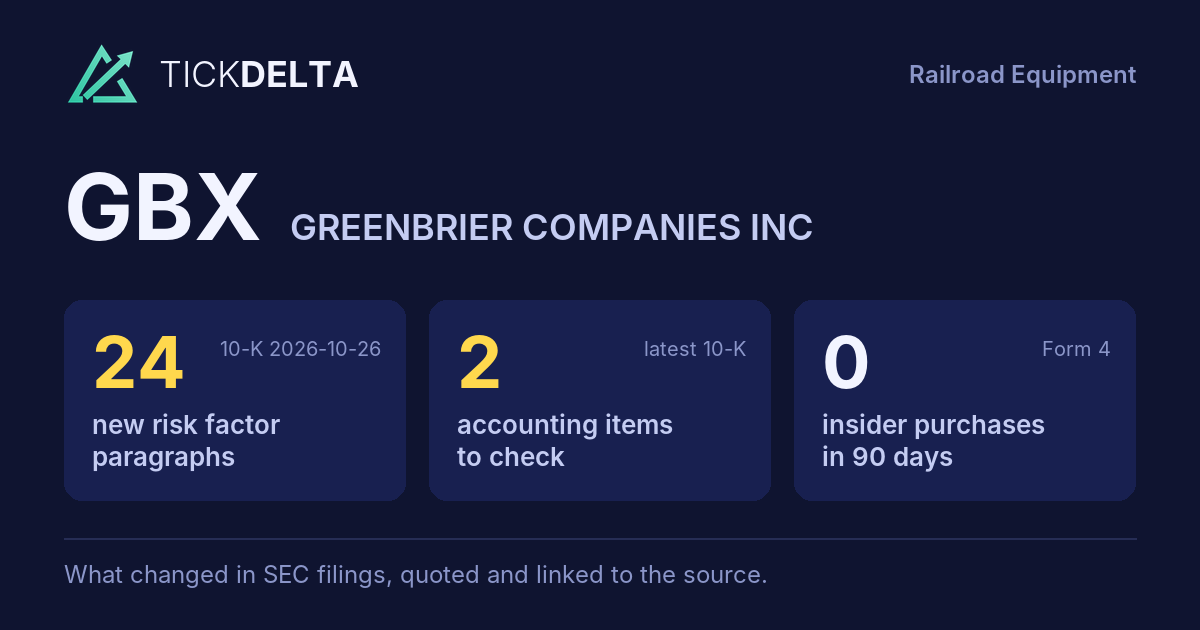
24 paragraphs in Risk Factors of the 10-K filed Oct 26, 2026 with nothing like them in the 10-K filed Oct 28, 2025. Quoted exactly. Paragraphs that were only edited are under 10-K change.
Changes in global trade policies, including the imposition of tariffs under Section 232 of the U.S. Trade Expansion Act of 1962, anti-dumping duties under the U.S. Tariff Act of 1930, and uncertainty regarding the future of the United States Mexico Canada Agreement (USMCA), have increased and may continue to increase our costs, reduce demand for our products and adversely affect our financial condition or results of operations.
In April 2026, the U.S. expanded Section 232 tariffs on steel, aluminum and copper to cover freight rail tank cars and a broad range of rail components, including couplers, axles, air brakes and wheels. These tariffs have caused a material increase in the price of our tank cars to our customers in the U.S.
In May 2026, the CBP issued a Notice of Determination (the Determination) that we evaded antidumping and countervailing duties (AD/CVD) on certain duty orders (the Orders) of certain freight rail couplers (FRCs) attached to newly built railcars during the period of investigation dating to April 2024. The Determination ordered us to rectify any noncompliance with provisions of admission of railcars to which FRCs subject to the Orders were affixed and to henceforth require us to file formal consumption entries for FRCs subject to the Orders. We filed an administrative appeal of the Determination. In September 2026, the CBP affirmed the Determination on administrative review. As a result, the CBP has directed that applicable AD/CVD duties be assessed with respect to covered FRCs dating back to April 2024 and that formal consumption entries be made for covered FRCs going forward. In October 2026, we appealed the Determination to the U.S. Court of International Trade. We intend to vigorously pursue our challenge to the Determination and believe that we have substantial legal defenses. We are fully cooperating with CBP on this matter.
Based on information currently available, we estimate that the range of reasonably possible loss with respect toAD/CVD duties associated with covered FRCs subject to the Determination is from zero to approximately $110 million, based on covered FRCs identified from April 24, 2024 through September 30, 2026. This estimate remainssubject to refinement as we continue to validate historical information regarding covered FRCs and does not includepotential interest, penalties or other additional assessments.
We could also be subject to additional penalties and future assessments of additional duties or tariffs with respect to imports beyond those presently included in the Determination. The amount of any such penalties, duties orother assessments, or any interest thereon, cannot currently be reasonably estimated. The outcome and costs of these matters could be significant and may have a material adverse effect on our consolidated results of operations, financial position, or liquidity. Based on the facts and circumstances currently available, including our assessment of the merits of our legal position and pending appeal, we do not believe that a loss is probable. Accordingly, no loss accrual has been recorded in the accompanying consolidated financial statements. Ongoing uncertainty in these areas, including the administration of trade policy in North America, has adversely affected and may continue to adversely affect North American industry-wide demand for new railcars, and therefore, our results of operations. Furthermore, as a result of
the Determination, our competitors may be less exposed to tariff impacts, including the Section 232 tariffs, or in a better position to mitigate the increased costs of tariffs.
Additionally, from time to time, businesses in the U.S. petition the Department of Commerce under the U.S. Tariff Act of 1930 to impose anti-dumping duties on products. It is possible that new anti-dumping duties could be imposed on products manufactured or utilized by us and such duties would impose additional compliance risk and costs on our manufacturing process. On September 30, 2026, an antidumping and countervailing duty petition was filed with the U.S. Department of Commerce by a competitor and the U.S. International Trade Commission concerning certain railway tank cars from Mexico. The petitions allege that tank cars produced in Mexico, including at our Mexican manufacturing facilities, are being sold in the United States at less than normal value and benefit from countervailable subsidies provided by the government of Mexico. If antidumping and/or countervailing duties are ultimately imposed on tank cars imported from Mexico, and we are unable to pass through such costs to our customers, the outcome of this matter could be significant and may have an adverse effect on our consolidated results of operations, financial position, or liquidity.
The impact of the tariffs could heighten the other risk factors and uncertainties discussed in this Item 1A, or in other reports we periodically file with the SEC, and negatively impact our financial condition or results of operations.
We use natural gas, electricity and other energy sources at our manufacturing and repair facilities in North America, Europe and Brazil. Armed conflict, including the conflict involving Iran and the disruption of shipping through the Strait of Hormuz, has caused, and could continue to cause, significant increases in and volatility of the price of oil, natural gas and liquefied natural gas, particularly in Europe, where natural gas storage levels entering 2026 were below recent years. Extreme weather, natural disasters, regulatory restrictions on the production or transportation of energy, and speculative trading could also limit energy availability or increase energy costs. Higher energy costs could increase our manufacturing and transportation costs, which we may be unable to pass on to our customers, and could reduce demand from customers whose businesses are sensitive to energy prices.
technology infrastructure also includes products and services provided by third parties, and these providers can experience breaches of their systems and products that affect the security of our systems and our proprietary or confidential information.
Our backlog is not necessarily indicative of the level of our future revenues or results of operations.
Show the other 10
We face significant competition in the markets and geographies in which we operate based on factors including price, quality, delivery performance, product innovation and customer service. Competitive pressures could reduce our revenues and margins, increase our expenses or limit our ability to grow.
Failure to successfully manage the transition associated with the appointment of our new CEO could have an adverse impact on our business.
On August 31, 2026, we announced the pending retirement of our CEO and President, Lorie Tekorius, effective January 6, 2027. The Board appointed Brian Comstock, currently our Executive Vice President and President, The Americas, as our new CEO and President, effective January 6, 2027. CEO transitions can be inherently difficult to manage and may cause disruption to our business due to, among other things, diverting management’s attention away from our financial and operational goals during the transition or causing a deterioration in morale. During the transition period, there may be uncertainty among investors, customers and other third parties concerning our future direction and performance. It may also be more difficult for us to recruit and retain other personnel during the transition. Our business and stock price may suffer if the CEO transition is not perceived well by the investor community, customers and employees, or is otherwise unsuccessful.
Armed conflicts, including the conflict involving Iran and the broader Middle East and the war in Ukraine, and related sanctions and geopolitical instability, have adversely affected and may continue to adversely affect our business.
We have acquired businesses and invested in or entered into joint ventures in past periods. We may in the future acquire other businesses or invest in or enter into other joint ventures. Our failure to identify future acquisition or joint
Acquisitions, joint ventures, restructurings and divestitures may also have unanticipated tax consequences, including the loss of anticipated tax benefits, additional tax liabilities or challenges by taxing authorities regarding the tax treatment or valuation of a transaction.
Operations outside the U.S. also expose us to risks including nationalization or expropriation, difficulty enforcing contracts, collecting receivables or protecting intellectual property, anti-corruption laws, customs and trade restrictions, economic sanctions and unfamiliar business practices or legal processes. Failure to comply with applicable laws or successfully manage these risks could result in penalties, reputational harm and adverse effects on our results of operations, financial condition, liquidity and cash flows.
The profitability of our railcar leasing business depends on our ability to lease railcars at satisfactory rates, sell railcars with sufficiently profitable leases to investors, and to remarket, sell or scrap railcars we own or manage upon the
We are subject to income and other taxes in the U.S. and numerous foreign jurisdictions. Our tax provision and cash tax obligations are affected by tax laws and regulations, interpretations of those laws, and significant judgments and estimates. Changes in U.S. or foreign tax laws, including rules governing the taxation of multinational companies and
global minimum taxes, could increase our effective tax rate, cash tax obligations or compliance costs and could affect the tax consequences of our business operations, financing arrangements and cross-border transactions.
We have taken, and may in the future take, tax positions that the Internal Revenue Service or other U.S. or foreign tax authorities may challenge. These positions may relate to, among other matters, transfer pricing, intercompany financing, the allocation of income among jurisdictions, the valuation or characterization of cross-border transactions, the deductibility of expenses and other matters arising from our multinational operations. Tax authorities may disagree with our interpretation or application of tax laws or with the pricing or terms of transactions between our affiliated entities. If a tax authority successfully challenges a position we have taken, we could be required to pay additional taxes, interest or penalties, which could adversely affect our results of operations, financial condition or cash flows. Tax audits, disputes and litigation may also require significant management attention and result in substantial costs regardless of their ultimate outcome.
The use of artificial intelligence technologies could adversely affect our business and competitive position.
We may increasingly evaluate and use artificial intelligence technologies in our business, and difficulties in implementing or using these technologies could result in operational issues, increased costs, reputational harm or legal liability. In addition, if artificial intelligence technologies create opportunities to improve operational efficiency and we do not successfully identify or implement relevant applications, we may fail to realize potential efficiencies or could be placed at a competitive disadvantage. These risks could adversely affect our business, financial condition and results of operations.
Paragraphs in the 10-Q filed Jul 1, 2026 that were not in the one before
New in the latest 10-Q
18 paragraphs in the 10-Q filed Jul 1, 2026 with nothing like them in the 10-Q filed Apr 7, 2026 (at least half the words must differ; new numbers alone do not count). Quoted exactly, grouped by the item heading above them. This is text that changed, not a judgement of how serious it is.
Financial statements and notes
Contingently redeemable noncontrolling interest - Greenbrier-Astra Rail B.V. is controlled by the Company with an approximate 75% interest and the remaining noncontrolling interest is held by Astra Holding GmbH (Astra). Astra holds a put option to sell its entire noncontrolling interest to Greenbrier at an exercise price equal to the higher of the fair value or a defined earnings before interest, taxes, depreciation and amortization multiple as measured on the exercise date (the put purchase price). The option was exercisable 30 business days prior to and up until June 1, 2026. During the third quarter of 2026, the option was extended to be exercisable within 20 business days after Astra has received written determination of the put purchase price. The put purchase price has not been determined through the date of this filing.
Read in the 10-Q
The goodwill balance is comprised of the following balances within the Manufacturing segment:
Read in the 10-Q
The Leasing senior term debt was amended in May 2026 on similar terms, providing for an additional $125.0 million available under a delayed draw facility through November 2026 and extending the maturity date from August 2027 to May 2032. The Leasing senior term debt bears interest at a rate of SOFR plus 1.625%, with principal of $2.6 million paid quarterly in arrears and a balloon payment of $237.0 million due upon maturity. Interest rate swap agreements cover nearly 100% of the principal balance to swap the floating interest rate to fixed rates.
Read in the 10-Q
Note 14 - Commitments and Contingencies Portland Harbor Superfund Site The Company has been identified as a potentially responsible party (PRP) by the U.S. Environmental Protection Agency (EPA) in connection with the Company’s former Portland, Oregon manufacturing facility (Portland Property), which is within the boundary of the Portland Harbor Superfund Site. The Company sold the Portland Property in May 2023. The EPA’s January 6, 2017 record of decision (ROD) for the Portland Harbor Superfund Site identifies a cleanup remedy that the EPA estimates will take 13 years of active remediation, followed by 30 years of monitoring with an estimated undiscounted cost of $1.7 billion. The EPA typically expects its cost estimates to be accurate within a range of -30% to +50%, but this ROD states that changes in costs are likely to occur. Multiple PRPs and the EPA have been conducting remedial design studies for several years and the work continues. Remedial action will follow remedial design.
Read in the 10-Q
Approximately 100 parties, including the State of Oregon and the federal government, are participating in a non-judicial, mediated allocation process to try to allocate costs associated with remediation of the Portland Harbor Superfund Site. Some allocation participants that have received a Special Notice Letter from the EPA, including the Company, are discussing remedial action consent decree terms with the EPA and the U.S. Department of Justice.
Read in the 10-Q
Show the other 13
A suit filed by the Company and other PRPs against 69 other parties for cost recovery, Arkema Inc. et al v. A & C Foundry Products, Inc. et al, U.S. District Court for the District of Oregon, Case #3:09-cv-453-PK, has been stayed by the court to allow the allocation to proceed, currently through January 14, 2028.
Read in the 10-Q
In May 2026, CBP issued a Notice of Determination (the Determination) that the Company evaded antidumping and countervailing duties (AD/CVD) on certain freight rail couplers (FRCs) attached to newly-built railcars during the Period of Investigation (POI) dating to April 2024. The Determination ordered the Company to rectify any noncompliance with provisions of admission of railcars to which FRCs subject to the Orders were affixed and to henceforth require the Company to file formal consumption entries for FRCs subject to the Orders. CBP did not specify any amount of Company liability for FRCs subject to the Orders admitted into the United States as part of the Company’s movement of newly-built railcars from the start of the POI to the Determination. Greenbrier is fully cooperating with CBP on this matter. The Company has filed an administrative appeal of the Determination. At this time, the Company is unable to estimate a potential loss, and the likelihood of loss is not probable.
Read in the 10-Q
We are monitoring developments related to tariffs and trade policies, including those imposed under Section 232 of the Trade Expansion Act of 1962 on steel and aluminum, the impact of the recent Notice of Determination on freight couplers from the U.S. Customs and Border Protection and the administration of trade policy in North America. Uncertainty in these areas has adversely affected, and may continue to adversely affect, North American industry-wide demand for new railcars, including demand for our products, and therefore, our results of operations. We remain focused on managing and, to the extent possible, mitigating the potential impacts of these evolving conditions on our business.
Read in the 10-Q
Our Leasing senior term debt was amended in May 2026 on similar terms, providing for an additional $125.0 million available under a delayed draw facility through November 2026 and extending the maturity date from August 2027 to
Read in the 10-Q
May 2032. The Leasing senior term debt bears interest at a rate of SOFR plus 1.625%, with principal of $2.6 million paid quarterly in arrears and a balloon payment of $237.0 million due upon maturity. Interest rate swap agreements cover nearly 100% of the principal balance to swap the floating interest rate to fixed rates.
Read in the 10-Q
Risk Factors
Changes in global trade policies, including imposed and threatened tariffs by the U.S. and reciprocal tariffs by its trading partners, remain uncertain and could impact our financial condition or results of operations.
Read in the 10-Q
The current U.S. presidential administration has announced a wide range of tariffs on imports from many countries. In response to these tariffs, certain of the impacted countries have announced, and in some cases imposed, counter tariffs on goods that are imported from the U.S. The imposition of such tariffs have resulted in increased costs. We are continuing to monitor the rapidly evolving tariff and global trade policies and are working with our suppliers to mitigate potential impacts on our business. The extent and duration of the tariffs and the resulting impact on general economic conditions and on our business are uncertain and depend on various factors, such as recent legal challenges to the U.S.'s imposition of tariffs, negotiations between the U.S. and affected countries, the responses of other countries or regions, relief that may be granted, availability and cost of alternative sources of supply and demand for our products in affected markets.
Read in the 10-Q
The uncertainty of the tariffs, including a potential increase in costs and decrease in demand for our products, could heighten the other risks factors and uncertainties discussed in this Item 1A, or in other reports we periodically file with the SEC, and impact our financial condition or results of operations.
Read in the 10-Q
In May 2026, the U.S. Customs and Border Protection issued a Notice of Determination (the Determination) that the Company evaded antidumping and countervailing duties (AD/CVD) on certain duty orders (the Orders) of certain freight rail couplers (FRCs) attached to newly-built railcars during the Period of Investigation dating to April 2024. The Determination ordered the Company to rectify any noncompliance with provisions of admission of railcars to which FRCs subject to the Orders were affixed and to henceforth require the Company to file formal consumption entries for FRCs subject to the Orders. The Company has filed an administrative appeal of the Determination. Because matters of this nature are subject to inherent uncertainties, and unfavorable rulings or developments, there can be no certainty that the Company will prevail in our administrative appeal or that we may not ultimately incur charges attributable to AD/CVD on FRC dating back to April 2024 that are not currently recorded as liabilities. In addition, the Company could also be subject to future assessments of additional duties or tariffs owed in respect of other imports beyond what is presently included in the Determination. The outcome and costs of these matters cannot be predicted with certainty and may have a material adverse effect on our consolidated results of operations, financial position, or liquidity.
Read in the 10-Q
In April 2026, tariffs were imposed on freight rail tank cars that make entry into the U.S. under Section 232 of the Trade Expansion Act of 1962 on steel and aluminum. Ongoing uncertainty in these areas, including the administration of trade policy in North America, has adversely affected and may continue to adversely affect North American industry-wide demand for new railcars, and therefore, our results of operations. Furthermore, our competitors may be less exposed to tariff impacts or in a better position to mitigate the increased costs of tariffs.
Read in the 10-Q
Item 6
3.1 Amended and Restated Bylaws of The Greenbrier Companies, Inc., dated March 31, 2026, is incorporated herein by reference to Exhibit 3.1 to the Registrant’s Form 8-K filed April 1, 2026.
Read in the 10-Q
10.1 Third Amendment to Amended and Restated Credit Agreement, dated as of May 5, 2026, by and among Greenbrier Leasing Company, LLC, an Oregon limited liability company, lenders party thereto, and Bank of America, N.A., as Administrative Agent.
Read in the 10-Q
10.2 Sixth Amendment to the Fourth Amended and Restated Credit Agreement, dated as of May 5, 2026, by and among The Greenbrier Companies, Inc., the guarantors and lenders party thereto, and Bank of America, N.A., as Administrative Agent.
Read in the 10-Q
The 10-Q's risk factors against the 10-K
Item 1A of the 10-Q filed Jul 1, 2026 against Item 1A of the 10-K filed Oct 28, 2025.
A 10-Q repeats only the risks that changed, so a 10-K paragraph that is missing from it is not counted as removed.
Added is a paragraph with nothing like it in the 10-K, Reworded a sentence that is in both with several words changed,
Quiet changes a sentence in both where one to four words changed and one is a hedge or a modal
(cut words struck through, new words highlighted).
Text on the page, not a score; each links to the filing at sec.gov.
What the 10-Q itself says about its risk factors:This Form 10-Q should be read in conjunction with Part I Item 1A “Risk Factors” in our Annual Report on Form 10-K for the year ended August 31, 2025. Except as set forth below, there have been no material changes in the risk factors described in our Annual Report on Form 10-K for the year ended August 31, 2025.
Read in the 10-Q
Phrases used for the first time
Two-word phrases in Risk Factors of the 10-K filed Oct 26, 2026 that are in none of the 1 earlier 10-Ks stored, back to Oct 28, 2025
Where each one is used
- tank cars: In April 2026, the U.S. expanded Section 232 tariffs on steel, aluminum and copper to cover freight rail tank cars and a broad range of rail components, including couplers, axles, air brakes and wheels. These tariffs have caused a material increase in the price of our tank cars to our customers in the U.S.
- covered frcs: In May 2026, the CBP issued a Notice of Determination (the Determination) that we evaded antidumping and countervailing duties (AD/CVD) on certain duty orders (the Orders) of certain freight rail couplers (FRCs) attached to newly built railcars during the period of investigation dating to April 2024. The...
- natural gas: We use natural gas, electricity and other energy sources at our manufacturing and repair facilities in North America, Europe and Brazil. Armed conflict, including the conflict involving Iran and the disruption of shipping through the Strait of Hormuz, has caused, and could continue to cause, significant increases...
- artificial intelligence: The theft, loss, or misuse of third-party data collected, used, stored, or transferred by us to run our business, and our attempts to address cybersecurity threats and incidents, whether or not successful, could result in our incurring significant costs related to, for example, disruptions in our operations,...
- middle east: Armed conflicts, including the conflict involving Iran and the broader Middle East and the war in Ukraine, and related sanctions and geopolitical instability, have adversely affected and may continue to adversely affect our business.
- tax laws: We are subject to income and other taxes in the U.S. and numerous foreign jurisdictions. Our tax provision and cash tax obligations are affected by tax laws and regulations, interpretations of those laws, and significant judgments and estimates. Changes in U.S. or foreign tax laws, including rules governing the...
- anti-dumping duties: Changes in global trade policies, including the imposition of tariffs under Section 232 of the U.S. Trade Expansion Act of 1962, anti-dumping duties under the U.S. Tariff Act of 1930, and uncertainty regarding the future of the United States Mexico Canada Agreement (USMCA), have increased and may continue to...
- reduce demand: Changes in global trade policies, including the imposition of tariffs under Section 232 of the U.S. Trade Expansion Act of 1962, anti-dumping duties under the U.S. Tariff Act of 1930, and uncertainty regarding the future of the United States Mexico Canada Agreement (USMCA), have increased and may continue to...
Used at least twice, small words left out. Counted, not picked: a phrase can be new because the company renamed something.
What was taken out
11 paragraphs of last year's Risk Factors with nothing like them now. The longest are quoted.
Sources
Item 1A of each 10-K and 10-Q on EDGAR, quoted exactly. Each paragraph links to the filing at sec.gov.
Also
10-K change: what was reworded or cut, section by section.
Work with it
Excel workbook · CSV. Google Sheet that stays up to date: paste =IMPORTDATA("https://tickdelta.com/company/GBX/export.csv") into a cell.