Added10-Q 2026-08-13 vs 10-K 2026-03-31
• our ability to attract, maintain, and grow our user base and engage our users;
Tickdelta is free for now. Sign up and get Pro free
Our mission is to build the bridge to the future of money and markets. 10-K, Item 1
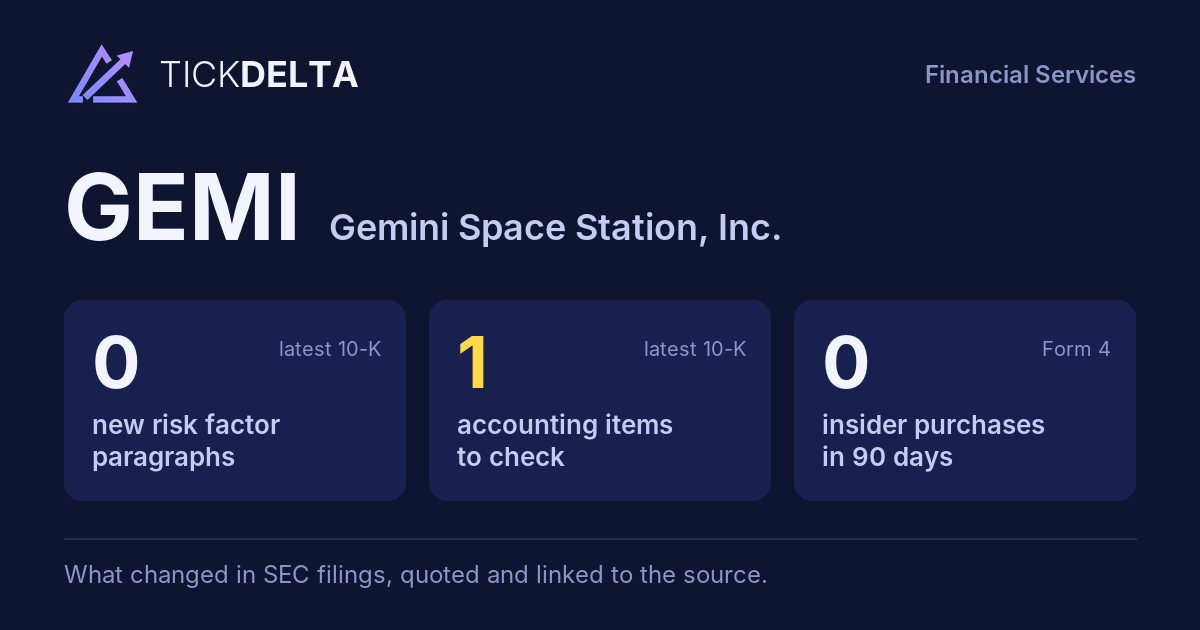
No new paragraphs in Risk Factors, or fewer than two 10-Ks to compare.
51 paragraphs in the 10-Q filed Aug 13, 2026 with nothing like them in the 10-Q filed May 15, 2026 (at least half the words must differ; new numbers alone do not count). Quoted exactly, grouped by the item heading above them. This is text that changed, not a judgement of how serious it is.
Certain reclassifications have been made to prior-period amounts to conform to the current-period presentation. These reclassifications were not material to the presentation of the unaudited condensed consolidated financial statements and had no impact on previously reported total assets, total liabilities or net loss.
Read in the 10-Q ↗
The following tables present the aging analysis of our credit card receivables for the periods presented and the delinquency aging includes all past due principal on credit card receivables (in thousands):
Read in the 10-Q ↗
During the three months ended June 30, 2026, the Company received approximately 1,258 bitcoin as consideration for the issuance of Class A common stock in a private placement (the “Private Placement”). The bitcoin received was initially recognized at its fair value on the transaction date, which established its cost basis. A portion of the bitcoin was subsequently sold during the three months ended June 30, 2026, to fund operating activities. As of June 30, 2026, the Company held 988 bitcoin with a fair value of $ 57.9 million. See Notes 17. Stockholders' Equity and 21. Related Party Transactions, for additional information regarding the private placement.
Read in the 10-Q ↗
On March 18, 2026, the Company entered into a lending agreement with WCF to obtain bitcoin used as collateral under the previous NYDIG Master Repurchase Agreement in connection with margin requirements. The related bitcoin borrowing was repaid during the second quarter of 2026 upon the repayment and termination of the NYDIG Master Repurchase Agreement.
Read in the 10-Q ↗
On June 30, 2026, the Company repurchased the bitcoin transferred under the agreement and repaid all outstanding amounts, including accrued interest, under the repurchase agreement. In connection with the repayment and termination of the agreement, all collateral pledged under the agreement was released to the Company. Concurrently, the Company entered into a new secured bitcoin-collateralized financing arrangement with Galaxy Digital LLC. Accordingly, no amounts remained outstanding under the NYDIG repurchase agreement as of June 30, 2026.
Read in the 10-Q ↗
all outstanding debts and other liabilities and the payment of liquidation preferences, if any, on any outstanding preferred stock.
Read in the 10-Q ↗
stock and per share data as if the conversion of Common Units into common stock had occurred at the beginning of all periods presented.
Read in the 10-Q ↗
Our wholly-owned subsidiary, Gemini Trust Company, LLC ("GTC"), was the subject of a lawsuit that the CFTC filed in the U.S. District Court for the Southern District of New York ("SDNY") on June 2, 2022. GTC and the CFTC settled the matter by means of a consent order that was filed on January 6, 2025. In material part, the consent order stated that GTC violated Section 6(c)(2) of the Commodity Exchange Act by making certain statements to CFTC staff that GTC reasonably should have known were false or misleading, and GTC also failed to disclose certain facts needed to make its statements not false or misleading. Without admitting or denying liability, GTC agreed via a consent order to pay a $ 5.0 million civil monetary penalty, and to be permanently enjoined from making false or misleading statements or omitting to state material facts to the CFTC. On May 27, 2026, GTC and the CFTC filed a joint motion under Federal Rule 60(b) to vacate the consent order.
Read in the 10-Q ↗
On April 21, 2026, the New York Attorney General filed a petition against Gemini Titan, LLC ("Gemini Titan"), a wholly-owned subsidiary of the Company, in the Supreme Court of the State of New York alleging that
Read in the 10-Q ↗
On July 7, 2026, the Company launched stock trading, offering commission-free trading of certain U.S. stocks for certain customers in the United States through our broker-dealer affiliate, Gemini Galactic Markets, LLC. The service enables customers to buy and sell U.S. exchange-listed equity securities and exchange-traded funds on
Read in the 10-Q ↗
the Gemini platform, with real-time market data provided by Nasdaq and clearing and custody services provided by Apex Clearing Corporation.
Read in the 10-Q ↗
On August 12, 2026, the Company reduced the required bitcoin collateral under its surety bond program with Indemnity National Insurance Company ("INIC") from 60 % to 25 %, effectively freeing up 163.7 bitcoin valued at $ 10.7 million originally held as collateral. The previously pledged collateral was returned to the Company for general business purposes of the Company and its wholly-owned subsidiaries.
Read in the 10-Q ↗
including our efforts to acquire new retail and institutional users and broaden the number and type of crypto assets supported on our platform.
Read in the 10-Q ↗
if these competitive pressures emerge more rapidly than we anticipate, our operating results may be adversely affected.
Read in the 10-Q ↗
Retail revenue declined primarily as a result of lower retail trading volumes reflecting softer crypto market conditions. Retail revenue decreased 53.3% and 39.4% for the three and six months ended June 30, 2026, respectively, reducing revenue by approximately $10.1 million and $16.3 million. Retail revenue was also negatively impacted by lower withdrawal fee revenue of approximately $0.3 million and $0.6 million, respectively. These decreases were partially offset by fee optimization initiatives and improved take rates, which increased revenue by approximately $2.4 million and $1.3 million for the three and six month periods, respectively.
Read in the 10-Q ↗
Institutional revenue increased primarily due to improved take rates and lower market maker incentive credits, which more than offset the impact of lower institutional trading volumes.
Read in the 10-Q ↗
Staking revenue increased by $1.3 million, or 50%, and $0.4 million, or 6%, for the three and six months ended June 30, 2026, respectively. The increase for the three-month period was driven by one-time revenue recognized following the implementation of a new staking platform including building out our in-house validator capabilities, as well as the launch of Monad (“MON”) staking in the fourth quarter of 2025. The increase for the six-month period primarily reflects the launch of MON, partially offset by lower staked asset balances and declines in crypto asset prices across supported staking tokens.
Read in the 10-Q ↗
Custodial fee revenue decreased $1.3 million, or 67%, and $1.3 million, or 34%, for the three and six months ended June 30, 2026, respectively, due to declining crypto asset prices during the period and net customer asset outflows, which reduced the value of assets under custody, and consequently, custodial fee revenue.
Read in the 10-Q ↗
Other changes included higher real estate related expenses of $0.7 million and $1.5 million, respectively, from new lease arrangements, and a $0.7 million increase in credit card issuance costs for the six months ended June 30, 2026 from the production and distribution of physical cards.
Read in the 10-Q ↗
General and administrative expenses also benefited from lower discretionary corporate spending, including reduced travel and entertainment expenses reflecting lower headcount, ongoing cost optimization initiatives, and elevated IPO roadshow-related travel incurred in the prior-year period.
Read in the 10-Q ↗
result, while sales and marketing expense declined during the three-month period, the year-to-date increase reflects higher credit card rewards expense more than offsetting reductions in discretionary marketing spend.
Read in the 10-Q ↗
Realized and unrealized gain (loss) on crypto assets and receivable, crypto assets pledged changed from a net gain in the prior-year periods to a net loss in the current-year periods. The change was primarily driven by realized losses recognized upon the repayment of bitcoin-denominated loan obligations, which required the return of borrowed crypto assets that had appreciated in value. The change also reflects approximately $22.1 million of realized and unrealized losses on bitcoin received as consideration in the May 2026 private placement as bitcoin prices declined following issuance.
Read in the 10-Q ↗
legacy financing agreements with Galaxy, which incurred $3.2 million and $6.5 million of interest expense for the three and six months ended June 30, 2025, respectively, and were repaid in full during the fourth quarter of 2025.
Read in the 10-Q ↗
On June 30, 2026, we repaid all outstanding amounts under the NYDIG MRA, and the agreement was terminated. In connection with the repayment, NYDIG released 2,097 bitcoin pledged as collateral under the NYDIG MRA to us, which we subsequently returned to WCF, from which the bitcoin had originally been borrowed.
Read in the 10-Q ↗
In March 2023, we entered into a Master Digital Currency Loan Agreement with Galaxy Digital LLC (“Galaxy”), an unrelated third party, that was amended and restated in April 2023 (as amended and restated, the “Galaxy MLA”). The Galaxy Lending Agreement permits us to make lending requests of various types to Galaxy Digital to borrow digital currency or U.S. dollars. Individual lending transactions may be structured as either term or open transactions. Under open transactions, either party may terminate all or a portion of the outstanding borrowing upon notice in accordance with the terms of the applicable lending transaction. All lending requests are subject to providing collateral (defined as a percentage of the value of the borrowed asset) as well as paying borrow fees and late fees. In certain circumstances, if the value of a borrowed asset changes relative to the collateral provided, we may be required to provide additional collateral to Galaxy Digital.
Read in the 10-Q ↗
On June 30, 2026, we entered into an open lending transaction with Galaxy to borrow $75.0 million at an annual borrow fee of 7.5% per annum. The borrowing is collateralized by bitcoin. As of June 30, 2026, $75.0 million was outstanding under the Galaxy MLA. The proceeds from the borrowing were used to refinance our obligations under the NYDIG MRA, which was repaid and terminated on June 30, 2026.
Read in the 10-Q ↗
purchased but not yet settled in cash were $20.5 million and $12.8 million as of June 30, 2026 and December 31, 2025, respectively. See Note 12. Accrued Expenses and Other Current Liabilities for additional details.
Read in the 10-Q ↗
transactions, which could negatively impact us and market perception of the effectiveness of our security measures and technology infrastructure.
Read in the 10-Q ↗
incidents could expose us to significant financial and legal liabilities, including regulatory fines, penalties, litigation, and remediation costs.
Read in the 10-Q ↗
foregoing operational failures could lead to non-compliance with laws, loss of operating licenses or other authorizations, or loss of bank relationships that could substantially impair or even suspend company operations.
Read in the 10-Q ↗
result in increased fixed obligations and could also include covenants or other restrictions that would impede our ability to manage our operations.
Read in the 10-Q ↗
fraud losses borne by us as a result of litigation, and would significantly adversely affect our business, operating results, and financial condition.
Read in the 10-Q ↗
which may arise as a result of any of the foregoing. As a result, the challenges presented with our use of AI could adversely affect our business, operating results, and financial condition.
Read in the 10-Q ↗
Earlier this year, we identified a fraud event affecting a cohort of Gemini Credit Card accounts, and, as our investigation progressed, identified additional fraud patterns and affected accounts associated with the same origination cohort. Although we believe we have identified the affected cohort and our allowance for expected credit
Read in the 10-Q ↗
losses reflects our current estimate of expected losses associated with this activity, our assessment is based on information currently available to us, and we may identify additional affected accounts or fraud patterns or otherwise determine that actual losses exceed our current estimates.
Read in the 10-Q ↗
In December 2025, we launched Gemini Predictions, a CFTC-regulated prediction market platform offered through our affiliate, Gemini Titan, which holds a DCM license. More recently, in July 2026, we launched Gemini Stocks, zero commission stock trading for certain customers in the United States through our affiliate, Gemini Galactic, which holds a broker-dealer license from FINRA and is registered as an introducing broker.
Read in the 10-Q ↗
Prediction markets, including the manner in which they are marketed and promoted, may also attract scrutiny from regulators, legislators and other governmental authorities, which could result in investigations or inquiries, new or additional legal or regulatory requirements, restrictions on our marketing practices or other changes to how we offer or promote Gemini Predictions.
Read in the 10-Q ↗
registrations. The CFTC has previously brought enforcement actions against entities engaged in retail commodity transactions without appropriate registrations, as well as recent enforcement settled orders against developers of decentralized platforms.
Read in the 10-Q ↗
adds further complexity and operational costs, and evolving regulatory guidance or enforcement actions may increase these burdens over time.
Read in the 10-Q ↗
Our products and services are complex and involve new and evolving technologies, and it is therefore difficult to ensure they meet regulatory requirements across different jurisdictions. Before deciding whether to offer
Read in the 10-Q ↗
above. The complex and evolving requirements of privacy regulations applicable to our credit card business further increase our compliance burden and potential exposure in the event of any security incidents involving personal or payment-related data. Any of the foregoing could have an adverse effect on our business, reputation, operating results, and financial condition.
Read in the 10-Q ↗
compliance therewith may require us to modify our data processing practices and policies incurring costs and expense. Further, to the extent multiple state-level laws are introduced with inconsistent or conflicting standards, it may require costly and difficult efforts to achieve compliance with such laws. Our failure or perceived failure to comply with the CCPA, CDPA, CPA, TDPSA, OCPA, or other similar laws or regulations passed in the future could have a material adverse effect on our business, including how we use personal information, our business, operating results, and financial condition.
Read in the 10-Q ↗
We rely on agreements with third parties to offer certain of our product and service offerings. If our relationship with these third parties were to deteriorate or terminate, our ability to continue to offer such product or service offerings may be affected, which may adversely impact our business, results of operation, and financial condition.
Read in the 10-Q ↗
We rely on agreements with certain third parties to offer certain products and service offerings. For example, we offer the Gemini Credit Card through an agreement with WebBank, our bank partner, and we offer Gemini Stocks through an agreement with Apex Clearing Corporation ("Apex"), a wholly owned subsidiary of Apex Fintech Solutions Inc., which acts as the custodian and clearing broker.
Read in the 10-Q ↗
Our long-term success will depend to some degree on our ability to protect the proprietary technology that we have developed or may develop or acquire in the future. While our patents may offer some protection, our
Read in the 10-Q ↗
source software against companies that incorporate open source software into their solutions. As a result, we could be subject to lawsuits by parties claiming ownership of what we believe to be licensed to us free of charge as open source software.
Read in the 10-Q ↗
Employee or service provider misconduct or error could subject us to legal liability, financial losses, and regulatory sanctions and could seriously harm our reputation and negatively affect our business. Such misconduct
Read in the 10-Q ↗
management effort toward ensuring compliance with the auditor attestation requirements of Section 404 of the Sarbanes-Oxley Act if we lose our status as an emerging growth company.
Read in the 10-Q ↗
to implement or maintain other effective control systems required of public companies, could also restrict our future access to the capital markets.
Read in the 10-Q ↗
During the three months ended June 30, 2026, we did not issue or sell any unregistered securities that were not otherwise previously disclosed in a Current Report on Form 8-K.
Read in the 10-Q ↗
On May 18, 2026, the Company adopted an automatic sell-to-cover policy (the “Automatic Sell-to-Cover Policy”) that is intended to satisfy the affirmative defense conditions of Rule 10b5-1(c) under the Exchange Act. The Automatic Sell-to-Cover Policy applies to all employees - including Section 16 officers - for whom the Company can legally and administratively satisfy applicable tax withholding obligations through automatic sell-to-cover transactions and provides for the mandatory sale of shares of Class A common stock otherwise issuable upon the vesting and settlement of equity grants made under the Company’s 2025 Omnibus Incentive Plan (as may be amended from time to time, and any successor plan or plans providing for the grant of equity awards to service providers to the Company or any subsidiary) in an amount sufficient to cover the federal, state, local and foreign tax withholding obligations incurred in connection with such vesting and settlement. The actual number of shares to be sold will vary based on futures events, including applicable tax withholding rates and the market price of the Class A common stock. The Automatic Sell-to-Cover Policy has no durational limit.
Read in the 10-Q ↗
Item 1A of the 10-Q filed Aug 13, 2026 against Item 1A of the 10-K filed Mar 31, 2026.
A 10-Q repeats only the risks that changed, so a 10-K paragraph that is missing from it is not counted as removed.
Added is a paragraph with nothing like it in the 10-K, Reworded a sentence that is in both with several words changed,
Quiet changes a sentence in both where one to four words changed and one is a hedge or a modal
(cut words struck through, new words highlighted and underlined).
Text on the page, not a score; each links to the filing at sec.gov.
The first 26 of 125 are shown (at most 12 of each type).
Work on GEMI in a spreadsheet:
Excel workbook (a sheet per section, ten years by column, charts, links to the filings) ·
CSV.
For a Google Sheet that stays up to date, paste =IMPORTDATA("https://tickdelta.com/company/GEMI/export.csv") into a cell.