29 paragraphs in Risk Factors of the 10-K filed May 21, 2026
with nothing like them in the 10-K filed May 15, 2025. Quoted exactly.
Paragraphs that were only edited are under 10-K change.
Compared with the Risk Factors in the latest 10-K of the other 74 Technology companies:
a paragraph with at least half its words the same at another company is called similar, and the companies are listed under it.
A paragraph most of them have is marked boilerplate. No line means no other company has one like it.
This counts text; it does not say how serious a risk is.
Our cyber safety and financial wellness businesses compete with a broad range of companies, including established security software vendors, operating system and platform providers, companies who specialize in a niche segment of the cyber safety market and which are expanding their portfolios into competing cyber safety products, traditional banks and credit unions, licensed and non-bank digital financial service providers, specialty finance companies, digital wealth management and brokerage platforms, embedded finance providers, financial marketplaces, and other technology companies. Many of these competitors have longer operating histories, greater brand recognition, larger customer bases, and significantly greater financial, technical, and marketing resources than we do. They may be able to offer more competitive pricing or terms, bundle products more effectively, introduce new, enhanced, broader or more specialized offerings more quickly (including for free), or respond more rapidly to technological and consumer trends. We expect our competition to continue to increase, as there are generally no substantial barriers to entry into the markets we serve.
In addition, operating system and platform providers increasingly incorporate native security, privacy, and financial features into their products, often at no additional cost, which may reduce demand for our offerings or diminish their differentiation. We also depend on strategic distribution and bundling relationships, and partners have in the past replaced, and may in the future replace, our solutions with competing or internally developed offerings, promote competing products more favorably, or limit interoperability. Industry consolidation, vertical integration, and the introduction of new or alternative technologies may further intensify competition.
Read in the 10-K ↗
Issues in the development and deployment of AI, including generative AI and emerging AI-enabled cyber threats, could expose us to regulatory, privacy, IP, cybersecurity, operational and reputational risks.
We have incorporated, and are continuing to develop and deploy, AI, including Gen AI, into many of our products, solutions and services. AI systems, including AI internally developed and AI present in third party solutions, may be flawed, contain errors or vulnerabilities, reflect unintended bias, or produce inaccurate, misleading or “hallucinatory” outputs, and such deficiencies may not be easily detectable. Customers may rely on AI-generated outputs in making financial, security or other significant decisions. If AI-enabled features in our products produce incorrect, incomplete or biased outputs, we could face claims of misrepresentation, negligence, product liability or other legal theories, as well as customer dissatisfaction, reputational harm and loss of business. Furthermore, we may face allegations of misrepresentations or “AI washing” if our disclosures about our AI capabilities or our AI-related governance are deemed to be exaggerated or misleading, which could result in enforcement actions, litigation or reputational harm.
Read in the 10-K ↗
operational inefficiencies, competitive harm, legal liability, brand or reputational harm, or other adverse impacts on our business and financial results.
Read in the 10-K ↗
A significant portion of our revenue is generated through indirect sales and distribution channels, including distributors, resellers, telecom service providers and strategic partners that bundle or incorporate our products into their offerings. In our MoneyLion business specifically, we also depend on channel partners that provide access to consumers – such as news sites, content publishers, product comparison sites and financial institutions – and on product partners that offer financial products through our marketplace platform.
Our channel and partner agreements are generally nonexclusive, impose no minimum sales or marketing commitments and may be terminated or renegotiated at any time, potentially on less favorable terms. Many of our partners frequently offer competing products or services and may prioritize those offerings based on pricing, promotional support, incentives, economics or strategic considerations.
Read in the 10-K ↗
We have limited control over our partners’ business practices, and any misconduct, regulatory or legal noncompliance, financial distress, reputational harm or failure to perform involving a partner could negatively affect our brand, customer relationships and operations. If a partner fails to perform its obligations or comply with applicable requirements, our operations and financial results could be negatively impacted.
Consolidation among retailers, online platforms, financial institutions or other distribution intermediaries may increase their negotiating leverage, reduce available distribution channels for us and negatively affect pricing and margins. In our MoneyLion business, changes in product partners’ underwriting standards, marketing budgets, financial condition or strategic priorities could reduce the availability of financial products on our platform, decrease marketing and advertising revenue, delay payments or otherwise negatively affect our results.
Read in the 10-K ↗
•Multiple and possibly overlapping tax regimes, which may increase our tax exposure and compliance burden.
Read in the 10-K ↗
and the erosion of trust from our customers, which could negatively impact our results of operations, brand and reputation, and require us to take steps to reduce fraud risk, which could increase our costs.
Read in the 10-K ↗
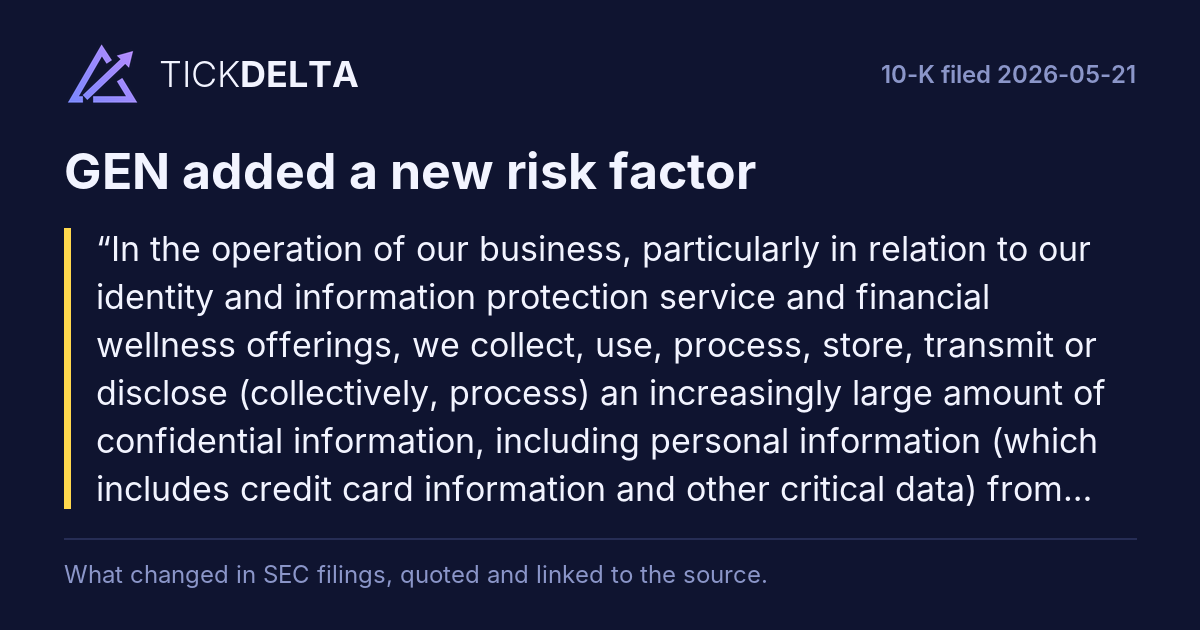
In the operation of our business, particularly in relation to our identity and information protection service and financial wellness offerings, we collect, use, process, store, transmit or disclose (collectively, process) an increasingly large amount of confidential information, including personal information (which includes credit card information and other critical data) from
employees and customers in multiple jurisdictions. This information is subject to a rapidly evolving and increasingly complex framework of federal, state and foreign privacy, data protection and data security laws, as well as contractual obligations.
At the federal level, the Gramm-Leach-Bliley (the GLBA) (along with its implementing regulations) requires disclosures to consumers about our handling of their nonpublic personal information and provides consumers with certain rights to restrict information sharing. Additionally, our investment adviser and broker-dealer subsidiaries are subject to SEC Regulation S-P, which mandates policies and procedures designed to safeguard customer information.
At the state level, the California Consumer Privacy Act of 2018, as amended by the California Privacy Rights Act of 2020 (CCPA), and similar comprehensive privacy laws enacted in multiple other U.S. states, provide consumers with rights to access, correct, delete and restrict the use, sale or sharing of their personal information and impose disclosure, governance and data protection obligations on covered businesses. These state laws provide civil penalties for violations, as well as private rights of action for certain data breaches. Additional states continue to enact comprehensive privacy legislation, creating a fragmented and evolving compliance environment that increases operational complexity and costs.
Read in the 10-K ↗
7 more
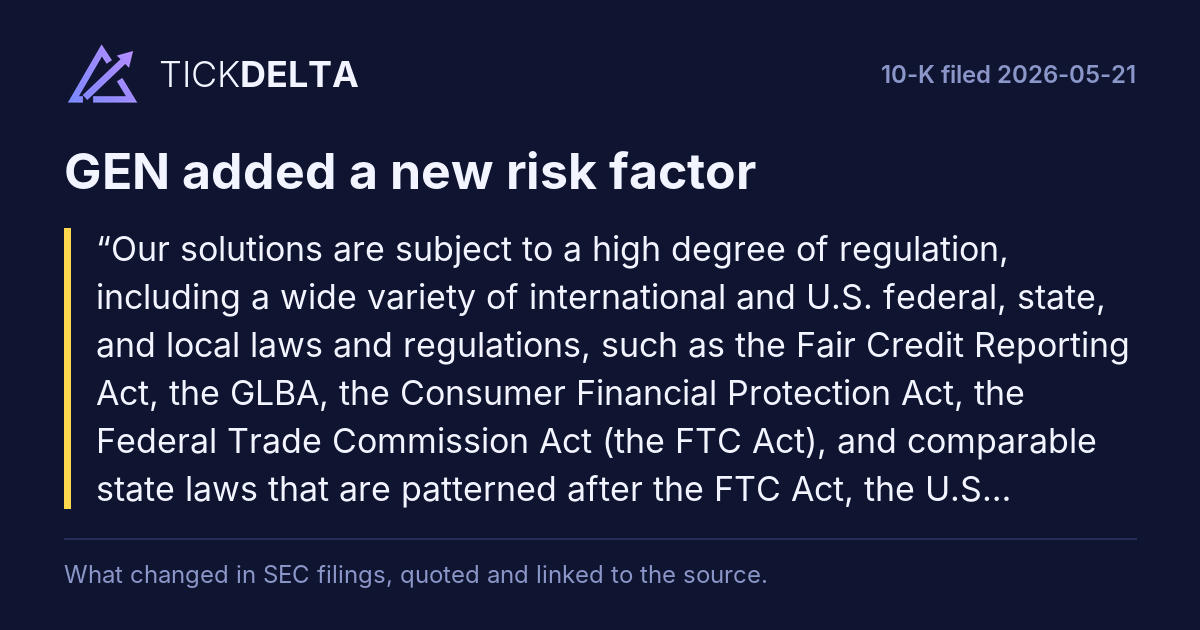
Our solutions are subject to a high degree of regulation, including a wide variety of international and U.S. federal, state, and local laws and regulations, such as the Fair Credit Reporting Act, the GLBA, the Consumer Financial Protection Act, the Federal Trade Commission Act (the FTC Act), and comparable state laws that are patterned after the FTC Act, the U.S. Foreign Corrupt Practices Act of 1977, U.S. domestic bribery laws, U.S. consumer protection, consumer financial services and banking laws, and U.S. and foreign anti-corruption laws.
Read in the 10-K ↗
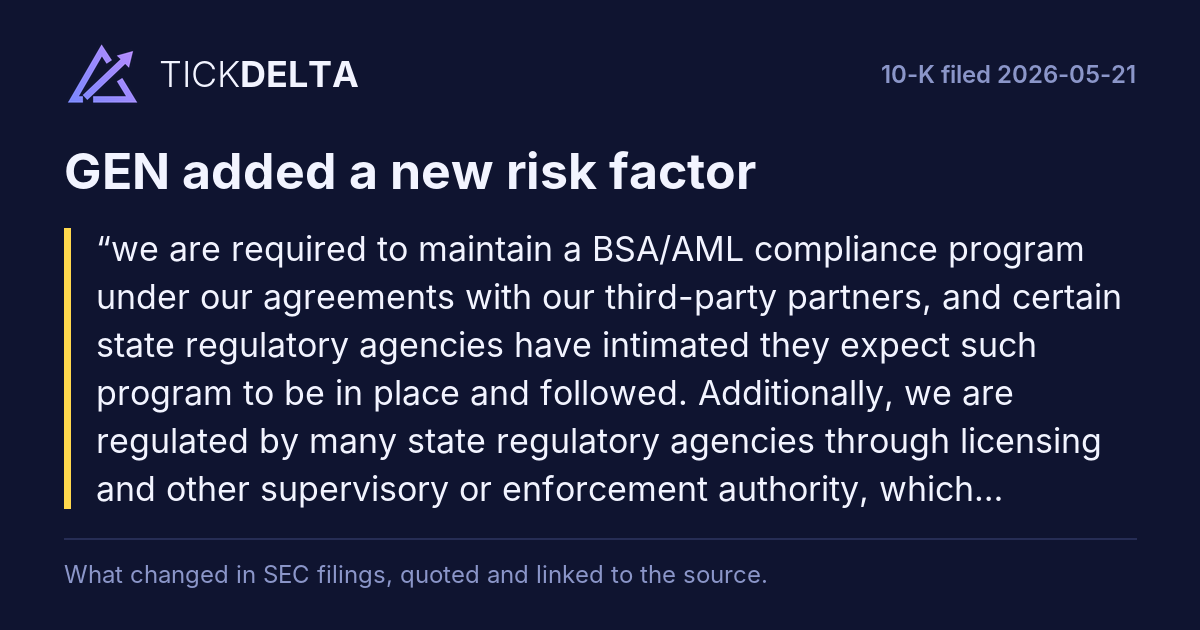
we are required to maintain a BSA/AML compliance program under our agreements with our third-party partners, and certain state regulatory agencies have intimated they expect such program to be in place and followed.
Additionally, we are regulated by many state regulatory agencies through licensing and other supervisory or enforcement authority, which includes regular examination by state governmental authorities. For a more detailed description of licensing, see “-- If we fail to operate in compliance with state or local licensing requirements, it could adversely affect our business, financial condition, results of operations and cash flows.”
Our wholly-owned subsidiary, ML Wealth, is registered as an investment adviser under the Investment Advisers Act of 1940 (the Advisers Act) and is subject to regulation by the SEC. The Advisers Act, together with related regulations and interpretations of the SEC, impose numerous obligations and restrictions on investment advisers, including requirements relating to the safekeeping of client funds and securities, limitations on advertising, disclosure and reporting obligations, prohibitions on fraudulent activities, restrictions on agency cross and principal transactions between an adviser and its advisory clients and other detailed operating requirements, as well as general fiduciary obligations.
Read in the 10-K ↗
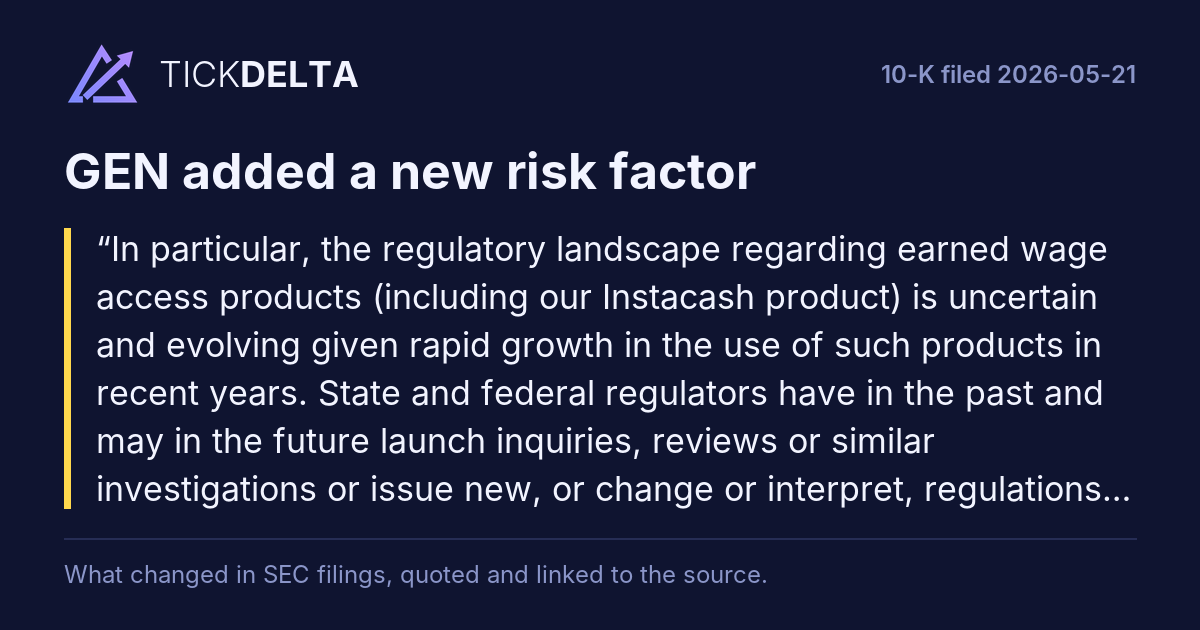
In particular, the regulatory landscape regarding earned wage access products (including our Instacash product) is uncertain and evolving given rapid growth in the use of such products in recent years. State and federal regulators have in the past and may in the future launch inquiries, reviews or similar investigations or issue new, or change or interpret, regulations or rules relating to earned wage access products, which could result in additional compliance requirements and other risks relating to our current and past business activities as described herein, including with respect to whether such products constitute extensions of credit, fee disclosures, tipping practices, or other consumer protection considerations. These developments may not only result in additional compliance requirements but may also be cited by private plaintiffs or plaintiffs’ attorneys as a basis for litigation, including putative class actions, alleging violations of federal or state consumer protection, lending, or unfair or deceptive acts or practices laws. Additionally, proposals to change the statutes affecting financial services companies are frequently introduced in Congress and state legislatures that, if enacted, could affect our operating environment in substantial and unpredictable ways and may further increase the risk of private litigation or enforcement. We cannot determine with any degree of certainty whether any such legislative or regulatory proposals will be enacted and, if enacted, the ultimate impact that any such potential legislation or implemented regulations, or any such potential regulatory actions by federal or state regulators, would have upon our business or our operating environment. As a result, we could be forced, as we have in the past, to temporarily pause, limit or
permanently cease to offer our earned wage access product in certain states depending on state regulatory regimes. These changes and uncertainties make our business planning more difficult and could result in changes to our business model, impair our ability to offer our existing or planned features, products and services or increase our cost of doing business.
Read in the 10-K ↗
Certain states and localities have adopted laws regulating and requiring licensing, registration, notice filing or other approval by parties that engage in certain activity regarding consumer financial services products such as loans and earned wage access services, life insurance and mortgage transactions, as well as brokering, facilitating and assisting such transactions in certain circumstances, and we currently hold certain state or local licenses. However, the application of some licensing laws to our platform and activities is uncertain and subject to evolving regulatory interpretations including, in particular, as the regulatory landscape regarding earned wage access products develops, as well as increased licensing requirements and regulation of parties engaged in loan solicitation activities.
If we were found to be in violation of applicable state licensing requirements by a court or a state, federal or local enforcement agency, or agree to resolve such concerns by voluntary agreement, we could be subject to or agree to pay fines, damages, injunctive relief (including required modification or discontinuation of our business in certain areas), criminal penalties and other penalties or consequences.
If we expand or modify our business activities, we may be required to obtain additional licenses, and regulators may determine that such licenses were required at an earlier time, potentially resulting in penalties or restrictions. In addition, states that currently impose limited regulation may adopt new licensing or regulatory requirements, including with respect to earned wage access or loan solicitation activities. We may not be able to obtain or maintain all required licenses on acceptable terms, or at all, which could require us to limit or discontinue certain activities. The failure to satisfy those and other regulatory requirements could materially and adversely impact our business.
Certain states may also impose licensing requirements relating to blockchain technologies and digital assets. Although we are not directly involved in the custody, trading or exchange of digital assets and instead rely on a third-party provider, regulatory frameworks governing digital assets continue to evolve and may subject us to additional licensing or compliance obligations.
Because we do not custody digital assets directly and do not maintain insurance covering such assets—and our third-party provider does not maintain separate insurance coverage for customer digital assets—customers transacting in digital assets through our platform may suffer uninsured losses with limited recourse. Any regulatory action, licensing deficiency or customer losses associated with digital asset activities could result in enforcement actions, litigation, reputational harm and adverse impacts on our business.
Read in the 10-K ↗
From time to time, we are involved in litigation, investigations, examinations and other legal or administrative proceedings initiated by governmental agencies or private parties. These matters may involve, among other things, labor and employment, discrimination and harassment, commercial disputes, class actions, general contract and tort claims, defamation, data privacy rights, antitrust, fraud, securities (including “blue sky” laws) violations, consumer protection laws, and other regulatory or
Read in the 10-K ↗
Our substantial indebtedness and related debt obligations could limit our financial and operating flexibility and increase our vulnerability to adverse business and economic conditions.
Similar paragraph at 1 of 74 other Technology companies:
MU
We continue to assess the overall impact of these potential changes as developments occur and will reflect the impact of such changes in future financial statements as appropriate.
Read in the 10-K ↗
New in the latest 10-Q
9 paragraphs in the 10-Q filed Oct 29, 2026 with nothing like
them in the 10-Q filed Aug 7, 2026 (at least half the words must differ; new numbers alone do not count).
Quoted exactly, grouped by the item heading above them. This is text that changed, not a judgement of how serious it is.
Financial statements and notes
We did not have any stock repurchases during the three months ended October 3, 2025.
Read in the 10-Q ↗
Three Months Ended October 2, 2026 Compared with Three Months Ended October 3, 2025
Read in the 10-Q ↗
Three Months Ended October 2, 2026 Compared with Three Months Ended October 3, 2025
Read in the 10-Q ↗
Three Months Ended October 2, 2026 Compared with Three Months Ended October 3, 2025
Read in the 10-Q ↗
Research and development expense increased $12 million, primarily due to increases in infrastructure expenses, headcount costs and stock-based compensation expense.
Read in the 10-Q ↗
General and administrative expense increased $6 million, primarily due to stock-based compensation expense.
Read in the 10-Q ↗
General and administrative expense increased $12 million, primarily due to a $17 million increase in litigation settlement expense and a $9 million increase in occupancy and IT costs, partially offset by a $13 million decrease in headcount costs.
Read in the 10-Q ↗
Three Months Ended October 2, 2026 Compared with Three Months Ended October 3, 2025
Read in the 10-Q ↗
Share sales and buybacks
Stock repurchases during the three months ended October 2, 2026 were as follows:
Read in the 10-Q ↗
The 10-Q's risk factors against the 10-K
Item 1A of the 10-Q filed Oct 29, 2026 against Item 1A of the 10-K filed May 21, 2026.
A 10-Q repeats only the risks that changed, so a 10-K paragraph that is missing from it is not counted as removed.
Added is a paragraph with nothing like it in the 10-K, Reworded a sentence that is in both with several words changed,
Quiet changes a sentence in both where one to four words changed and one is a hedge or a modal
(cut words struck through, new words highlighted and underlined).
Text on the page, not a score; each links to the filing at sec.gov.
Added10-Q 2026-10-29 vs 10-K 2026-05-21
We are subject to a number of risks that, if realized, could materially and adversely affect our business, financial condition, results of operations, and cash flows and our ability to make distributions to our stockholders. Some of our more significant challenges and risks include, but are not limited to, the following, which are described in greater detail below:
Read it in the 10-Q at sec.gov ↗
Added10-Q 2026-10-29 vs 10-K 2026-05-21
• We may be required to issue shares under our contingent value rights agreement.
Read it in the 10-Q at sec.gov ↗
Added10-Q 2026-10-29 vs 10-K 2026-05-21
The above list is not exhaustive, and we face additional challenges and risks. Please carefully consider all of the information in this Quarterly Report on Form 10-Q, including the matters set forth below.
Read it in the 10-Q at sec.gov ↗
Added10-Q 2026-10-29 vs 10-K 2026-05-21
• Difficulties in staffing, managing and operating our international operations;
Read it in the 10-Q at sec.gov ↗
Added10-Q 2026-10-29 vs 10-K 2026-05-21
or other unanticipated problems without adequate notice, which in turn, could result in lengthy interruptions in the delivery of our products and services and negatively impact our sales and operating results.
Read it in the 10-Q at sec.gov ↗
Reworded10-Q 2026-10-29 vs 10-K 2026-05-21
The number and rate at which new customers purchase our products and services depends depend on a number of factors, including those outside of our control, such as customers’ perceived need for our solutions and products, competition, general economic conditions, market transitions, product obsolescence, technological change, public awareness of security threats to IT systems,
Read it in the 10-Q at sec.gov ↗ · The 10-K sentence ↗
Reworded10-Q 2026-10-29 vs 10-K 2026-05-21
The occurrence of a natural disaster, an act of terrorism, state-sponsored attacks, a pandemic, geopolitical tensions or armed conflicts, and similar events could result in facility closures or other unanticipated problems without adequate notice, which in turn, could result in lengthy interruptions in the delivery of our products and services and negatively impact our sales and operating results.
Read it in the 10-Q at sec.gov ↗ · The 10-K sentence ↗
Reworded10-Q 2026-10-29 vs 10-K 2026-05-21
We may not be able to recoup funds associated with our first-party products and services made in connection with inaccurate statements, omissions of fact or fraud, in which case our revenue, results of operations, profitability and cash flows will be harmed.
Read it in the 10-Q at sec.gov ↗ · The 10-K sentence ↗
Reworded10-Q 2026-10-29 vs 10-K 2026-05-21
The Organisation for Economic Co-operation and Development (“OECD”) OECD has proposed certain tax reforms, which, among other things, (1) shift taxing rights to the jurisdiction of the consumer (“Pillar One”) (Pillar One) and (2) establish a global minimum tax rate of 15% for multinational companies (“Pillar Two”). (Pillar Two).
Read it in the 10-Q at sec.gov ↗ · The 10-K sentence ↗
Reworded10-Q 2026-10-29 vs 10-K 2026-05-21
For additional information regarding risks related to the use of AI, see "--Issues “--Issues in the development and deployment of AI, including generative AI, AI and emerging AI-enabled cyber threats, could expose us to regulatory, privacy, IP, cybersecurity, operational and reputational risks.” risks. ”
Read it in the 10-Q at sec.gov ↗ · The 10-K sentence ↗
Reworded10-Q 2026-10-29 vs 10-K 2026-05-21
Additionally, proposals to change the statutes affecting financial services companies are frequently introduced in Congress and state legislatures that, if enacted, could affect our operating environment in substantial and unpredictable ways and may further increase the risk of private litigation or enforcement.
Read it in the 10-Q at sec.gov ↗ · The 10-K sentence ↗
Reworded10-Q 2026-10-29 vs 10-K 2026-05-21
The development and integration of new technologies — - including generative AI (“Gen AI”) (Gen AI) and machine learning — - is complex, time-consuming, and subject to significant risks.
Read it in the 10-Q at sec.gov ↗ · The 10-K sentence ↗
Reworded10-Q 2026-10-29 vs 10-K 2026-05-21
Because we do not custody digital assets directly and do not maintain insurance covering such assets—and assets - and our third-party provider does not maintain separate insurance coverage for customer digital assets—customers assets - customers transacting in digital assets through our platform may suffer uninsured losses with limited recourse.
Read it in the 10-Q at sec.gov ↗ · The 10-K sentence ↗
Reworded10-Q 2026-10-29 vs 10-K 2026-05-21
For a discussion of specific legal and regulatory proceedings, inquiries and investigations to which we are currently subject, see Note 18 15 of the Notes to the Condensed Consolidated Financial Statements included in this Annual Quarterly Report on Form 10-K. 10-Q.
Read it in the 10-Q at sec.gov ↗ · The 10-K sentence ↗
Reworded10-Q 2026-10-29 vs 10-K 2026-05-21
Refer to Note 18 15 of the Notes to the Condensed Consolidated Financial Statements included in this Annual Quarterly Report on Form 10-K. 10-Q.
Read it in the 10-Q at sec.gov ↗ · The 10-K sentence ↗
Reworded10-Q 2026-10-29 vs 10-K 2026-05-21
For additional information on such claims, please refer to Note 18 15 of the Notes to the Condensed Consolidated Financial Statements included in this Annual Quarterly Report on Form 10-K. 10-Q.
Read it in the 10-Q at sec.gov ↗ · The 10-K sentence ↗
Reworded10-Q 2026-10-29 vs 10-K 2026-05-21
See Note 10 8 of the Notes to the Condensed Consolidated Financial Statements included in this Annual Quarterly Report on Form 10-K 10-Q for further information on our outstanding debt.
Read it in the 10-Q at sec.gov ↗ · The 10-K sentence ↗
The first 17 of 20 are shown (at most 12 of each type).