Screener / SEC EDGAR /CIK 0000104889 /10-K filed Feb 25, 2026, compared with Feb 26, 2025 /Numbers from the XBRL of the 10-Ks
NYSE Consumer discretionary · Educational Services

Graham Holdings Co GHC

Compare with peers Embed
SEC comment letters, last 20 years

10 reviews of GHC's filings by SEC staff

UPLOAD and CORRESP
Reviews 10 latest letter Sep 19, 2024
Questions asked 27 each answered in the company's own letter
No closing letter 0 reviews without a letter saying the staff completed it

When the SEC's staff reviews a filing, it writes to the company with numbered questions, and the company answers each one in a letter. SEC publishes the exchange once the review is over, at least 20 business days later. A question is not an accusation; most reviews end with the company adding detail to its next filing.

How the reviews went

Every review on EDGAR, from the first staff letter to the letter that closes it

  1. 1. Staff letters 13 UPLOAD
  2. 2. Questions in them 27 numbered comments
  3. 3. Company replies 17 CORRESP
  4. 4. Reviews closed 10 of 10 closing letter

Half the closed reviews took 51 days or less from the first letter to the closing letter.

Form 10-K for the Year Ended December 31, 2023

2024-09-19 to 2024-11-07 · 1 question · 1 letter from the SEC, 1 from the company
Review closed 2024-11-07
Executive pay
Item 11. Executive Compensation, page 46
SEC asked
From the disclosure incorporated by reference from page 18 of the Definitive Proxy Statement filed on March 26, 2024, it appears that you have not provided your disclosure about your recovery analysis in an Interactive Data File in accordance with Rule 405 of Regulation S-T and the EDGAR Filer Manual. In future filings where you conduct a recovery analysis, please also include the interactive data.
GHC answered
The Company respectfully acknowledges the Staff’s comment. The interactive data for the recovery analysis was inadvertently excluded. The Company agrees and has noted for future filings that the interactive data for a recovery analysis will be included in accordance with Rule 405 of Regulation S-T.
Read in the reply
In its next report

First report after the company's reply of Sep 23, 2024: 10-Q filed Oct 30, 2024 ↗, against the 10-Q filed Jul 31, 2024 ↗.

Tickdelta does not hold the text of both reports, so they are not compared here.

Also in this review: closing letter, 2024-11-07

Form 10-K

2022-12-12 to 2023-01-20 · 1 question · 1 letter from the SEC, 1 from the company
Review closed 2023-01-20
Non-GAAP measures
After reviewing your response to this comment, we may have additional comments. Exhibit 99.1, page 14
SEC asked
We note the non-GAAP adjustments to eliminate net losses (gains) on marketable equity securities and net interest expense related to the fair value adjustment of the mandatorily redeemable noncontrolling interest appear to be changing the basis of accounting applied under U.S. GAAP.
Rest of the question

Please tell us how you considered whether these adjustments substitute individually tailored recognition and measurement methods, which could violate Rule 100(b) of Regulation G. Refer to Question 100.04 of the Compliance and Disclosure Interpretations on Non-GAAP Financial Measures.

GHC answered
The Company respectfully acknowledges the Staff’s comment and believes that its adjustments to eliminate losses (gains) on marketable equity securities and net interest expense related to fair value adjustments of the mandatorily redeemable noncontrolling interest do not substitute individually tailored recognition and measurement methods that violate Rule 100(b) of Regulation G and thus is not prohibited under the Staff’s guidance in Question 100.04 of the Division of Corporation Finance’s Non-GAAP Financial Measures Compliance and Disclosure Interpretations (“CDI 100.04”).
Rest of the answer

The Company believes the adjusted net income, after taking into account these adjustments, does not contain an untrue statement of material fact; nor does it omit to state a material fact that would make the presentation of the adjusted net income misleading when taken together with the information accompanying these adjustments.

The Company believes that providing the non-GAAP financial measure, adjusted net income, enhances the investors’ ability to evaluate the financial performance of our core business operations on a comparable basis from period to period. This non-GAAP financial measure is provided as supplemental information to the financial measures that are calculated and presented in accordance with accounting principles generally accepted in the United States of America (“GAAP”).

When determining the nature of items to be excluded from net income in determining adjusted net income, the Company identifies items that it believes neither relate to the ordinary course of the Company’s business nor reflect the Company’s underlying performance of its businesses. The Company believes that excluding items of this nature provide the Company’s investors with a better understanding of our underlying business performance and enables investors to compare our underlying business performance from period to period. These items are also excluded from incentive and compensation arrangements and debt covenant calculations.

The Company believes that including adjustments for (i) losses (gains) on marketable equity securities, and (ii) net interest expense related to fair value adjustments of the mandatorily redeemable noncontrolling interest are consistent with the objectives of the Company’s non-GAAP financial measures described above and is not misleading when viewed in context with the information that accompanies those measures.

The Company owns a large portfolio of equity securities and considers these investments as a source of liquidity to finance working capital requirements, capital expenditures, interest payments, potential acquisitions and strategic investments, and dividends and stock repurchases. High volatility in stock prices results in significant fluctuations in the fair value of the marketable equity securities from period to period and the resulting gains and losses included in the reported net income in accordance with GAAP. The volatility in stock prices resulted in the Company recording losses of $172.9 million in the first nine months of 2022 compared to gains of $177.0 million recorded in the first nine months of 2021. These gains and losses for any particular period are not part of the core business operations of the Company or indicative of the underlying business performance, and the Company believes they distort the comparability of the Company’s financial performance from one period to the next for investors.

The mandatorily redeemable noncontrolling interest represents the ownership portion of a group of minority shareholders in a subsidiary of the Company’s Healthcare business. The Company measures the redemption value of this minority ownership on a quarterly basis with changes in the fair value recorded as interest expense or income, which is included in net income for the period. The change in fair value for any particular period is not part of the core business operations of the Company or indicative of the underlying business performance, and the Company believes this distorts the comparability of the Company’s financial performance from one period to the next for investors. Furthermore, the Company believes the change in fair value distorts the actual amount of interest the Company pays on its borrowings, which creates challenges for investors when evaluating the cost of financing from one period to the next.

The adjustments to eliminate losses (gains) on marketable equity securities and net interest expense related to fair value adjustments of the mandatorily redeemable noncontrolling interest are not individually tailored recognition and measurement methods as these adjustments (i) do not shift the measure from an accrual basis of accounting to a cash or modified basis of accounting, (ii) do not include transactions that are also reportable in another company’s financial statements, (iii) do not reflect only part of an accounting concept, and (iv) do not render the measurement inconsistent with the underlying economics or ignore certain aspects of the economics. The Company adjusts the entire amount related to losses (gains) on marketable equity securities and net interest expense related to fair value adjustments of the mandatorily redeemable noncontrolling interest calculated in accordance with GAAP and does not substitute an alternative recognition or measurement method for these amounts. The Company does not adjust for timing differences, increase/decrease the GAAP amount included in the financial statements or change the nature of the transaction. These adjustments do not directly relate to the core performance or revenue generating activities of the Company’s business operations. The Company has applied this methodology on a consistent basis when determining adjusted net income.

The Board of Directors uses non-GAAP diluted Earnings per Share (“EPS”) as a basis for determining executive compensation. The annual bonus plan for executive officers approved by the Board of Directors adjusts the non-GAAP diluted EPS to eliminate losses (gains) on marketable equity securities and net interest expense related to fair value adjustments of the mandatorily redeemable noncontrolling interest. The long-term cash incentive compensation plan for executives also excludes the effect of these adjustments when measuring the performance of the Company’s respective businesses in determining the compensation paid to the executive officers. The Company believes presenting non-GAAP measures that are used by management and the board of directors to evaluate the performance of the Company for making compensation decisions provides their investors with valuable information.

The Company’s debt covenant also makes adjustments to net income for these two items. The financial covenants of the Company’s revolving credit facility specifically adjusts Consolidated Net Income (defined as net income in accordance with GAAP) for the following items in calculating Consolidated EBITDA (Defined in Section 1.01 of Second Amended and Restated Five Year Credit Agreement filed as an exhibit to From 10-Q for the Quarterly Period Ended June 30, 2022):

i.Consolidated Interest Expense of the Company and its Subsidiaries (in accordance with GAAP), and ii.any unrealized losses and gains of the Company and its Subsidiaries for such period attributable to the application of “mark to market” accounting in respect of marketable equity securities and hedging agreements.

The Consolidated EBITDA is used to compute the “Total Net Leverage Ratio” and “Consolidated Interest Coverage Ratio” per section 1.03 of Article V of the Second Amended and Restated Five Year Credit Agreement. While the debt covenant requires an adjustment for all interest expense to arrive at Consolidated EBITDA, the Company believes it is more informative to investors to present the measure “adjusted net income” since it does not add back the interest expense on debt necessary to operate the Company's core business operations.

The Company believes it is informative for investors to have the same information available to them that the Company uses to understand our results, determine executive compensation and calculate our financial debt covenants, which information excludes the effect of losses (gains) on marketable equity securities and net interest expense related to fair value adjustments of the mandatorily redeemable noncontrolling interest as a supplement to our GAAP results. Accordingly, excluding these adjustments enhances the comparability and consistency of the Company’s key financial measures from period to period and helps investors analyze the core performance of the Company’s business operations.

Based on the Company’s evaluation of Rule 100(b) of Regulation G and Question 100.04 of the Compliance and Disclosure Interpretations on Non-GAAP Financial Measures, the Company believes that excluding the effect of losses (gains) on marketable equity securities and net interest expense related to fair value adjustments of the mandatorily redeemable noncontrolling interest from adjusted net income does not constitute an individually tailored recognition or measurement method. The Company is not substituting an alternative recognition or measurement method for the losses (gains) on marketable equity securities and net interest expense related to fair value adjustments of the mandatorily redeemable noncontrolling interest. Rather, the Company is removing the entire amounts related to the effect of losses (gains) on marketable equity securities and net interest expense related to fair value adjustments of the mandatorily redeemable noncontrolling interest, which is calculated in accordance with GAAP, when determining adjusted net income. The full amount of the effect of losses (gains) on marketable equity securities and net interest expense related to fair value adjustments of the mandatorily redeemable noncontrolling interest continue to be reflected in our results in accordance with GAAP in the same periods in which the non-GAAP adjustments are reflected.

Notwithstanding the foregoing, in future filings, the Company will enhance our existing disclosure regarding our exclusion of the effect of losses (gains) on marketable equity securities and net interest expense related to fair value adjustments of the mandatorily redeemable noncontrolling interest from our applicable non-GAAP financial measures. The Company plans to include the following supplemental disclosure in future filings:

“The gains and losses on marketable equity securities relate to the change in the fair value (quoted prices) of its portfolio of equity securities. The mandatorily redeemable noncontrolling interest represents the ownership portion of a group of minority shareholders at a subsidiary of the Company's Healthcare business. The Company measures the redemption value of this minority ownership on a quarterly basis with changes in the fair value recorded as interest expense or income, which is included in net income for the period. The effect of gains and losses on marketable equity securities and net interest expense related to fair value adjustments of the mandatorily redeemable noncontrolling interest are not directly related to the core performance of the Company’s business operations since these items do not directly relate to the sale of the Company’s services or products. The accounting principles generally accepted in the United States (“GAAP”) require that the Company include the gains and losses on marketable equity securities and net interest expense related to fair value adjustments of the mandatorily redeemable noncontrolling interest in net income on the Statement of Operations. The Company excludes the gains and losses on marketable equity securities and net interest expense related to fair value adjustments of the mandatorily redeemable noncontrolling interest from the non-GAAP adjusted net income because these items are independent of our core operations and not indicative of the performance of our business operations.”

* * * *

The Company acknowledges that (1) the Company is responsible for the adequacy and accuracy of the disclosure in its filings, (2) Staff comments or changes to disclosure in response to Staff comments do not foreclose the Commission from taking any action with respect to the filings, and (3) the Company may not assert Staff comments as a defense in any proceeding initiated by the Commission or any person under the Federal securities laws of the United States.

Read in the reply
In its next report

First report after the company's reply of Jan 4, 2023: 10-K filed Feb 24, 2023 ↗, against the 10-K filed Feb 25, 2022 ↗.

Tickdelta does not hold the text of both reports, so they are not compared here.

Also in this review: closing letter, 2023-01-20

Form 10-K for the Fiscal Year Ended December 31, 2019

2020-09-11 to 2020-10-13 · 1 question · 1 letter from the SEC, 1 from the company
Review closed 2020-10-13
Non-GAAP measuresSegmentsGoodwill and impairment
Notes to Consolidated Financial Statements
SEC asked
Business Segments, page 110 1. We note you evaluate segment performance based on operating income before amortization of intangible assets and impairment of goodwill and other long-lived assets. We were not able to locate disclosure of this measure. Please explain how you considered the guidance in ASC 280-10-50-22 and 50-27.
Rest of the question

See also Compliance and Disclosure Interpretations on Non-GAAP Financial Measures, Question 104.02. Notes to Condensed Consolidated Financial Statements 6. Goodwill and Other Intangible Assets, page 11 2. We note as a result of the uncertainty and challenging operating environment created by the COVID-19 pandemic you completed an interim impairment review of the goodwill and other long-lived assets of the Clydes Restaurant Group and your automotive dealership reporting units. We note the pandemic also adversely impacted your Education, Television Broadcasting, Manufacturing, and Socialcode divisions and there has been a substantial decline in your market capitalization. Furthermore, you disclose you expect the results for most of your divisions will continue to be adversely impacted by the pandemic for the remainder of 2020. Please explain why an interim impairment review was not triggered for your other reporting units. Reference is made to ASC 350-20-35-3 and 35-30 and ASC 350-30-35-18.

GHC answered
The Company will revise the segment disclosure in the notes to the consolidated financial statements to provide the operating income before amortization of intangible assets and impairment of goodwill and other long-lived assets for each reportable segment in its Quarterly Report on Form 10-Q for the Period Ended September 30, 2020 and in future filings.

Notes to Condensed Consolidated Financial Statements

6.
Rest of the answer

Goodwill and Other Intangible Assets, page 11

2.We note as a result of the uncertainty and challenging operating environment created by the COVID-19 pandemic you completed an interim impairment review of the goodwill and other long-lived assets of the Clydes Restaurant Group and your automotive dealership reporting units. We note the pandemic also adversely impacted your Education, Television Broadcasting, Manufacturing, and SocialCode divisions and there has been a substantial decline in your market capitalization. Furthermore, you disclose you expect the results for most of your divisions will continue to be adversely impacted by the pandemic for the remainder of 2020. Please explain why an interim impairment review was not triggered for your other reporting units. Reference is made to ASC 350-20-35-3 and 35-30 and ASC 350-30-35-18.

Company Response:

In its most recent annual goodwill impairment test, as of November 30, 2019, the Company proceeded directly to a quantitative assessment for each of its reporting units rather than electing to initially conduct a qualitative assessment, in accordance with ASC 350-20-35-3B. The goodwill at the Company’s nine reporting units within the education, television broadcasting, manufacturing and SocialCode divisions was deemed to be recoverable, with fair values in excess of carrying values ranging from 21% to more than 100% at the date of the annual impairment test.

As a result of the uncertainty and challenging operating environment created by the COVID-19 pandemic (the “pandemic”), the Company evaluated the qualitative factors described in ASC 350-20-35-3C for each of its reporting units for the second quarter of 2020 to determine whether it was more likely than not that the fair value of the reporting unit was less than the carrying value such that an interim impairment test should be performed. The Company considered the nature and magnitude of the impact of the pandemic on each of its reporting units and also performed a sensitivity analysis on key assumptions used in the annual quantitative impairment analyses, where appropriate, as part of the evaluation of the qualitative factors in ASC 350-20-35-3C. In performing this evaluation, the Company focused on the events and circumstances that were most likely to impact the fair value of its reporting units and indicate a possible impairment, which included the following:

•Deterioration in business environment, demand for our products and services, and impact of restrictions imposed by governments and regulators in response to the pandemic on our businesses (industry and market considerations):

While the pandemic adversely impacted our ability to serve students and customers due to government imposed travel restrictions, shelter in place orders and mandatory closures, resulted in reduced spending by customers and caused supply chain disruptions, and will continue to adversely impact some of our businesses in the second half of 2020, the Company believes the impact to largely be temporary. The Company expects demand for its products and services to return to pre-pandemic levels over time as governments ease restrictions on travel, school, plant closures and capacity limitations at other facilities, and as the economy generally recovers from the recessionary environment. The Company also believes that most of its businesses have not fundamentally changed as a result of the pandemic, and that the introduction of a vaccine and/or other treatments will contribute to the normalization of the business environment and the resumption of demand for its products and services to prior levels.

•Actual operating results against internal forecasts (overall financial performance):

The Company’s businesses have taken a variety of measures to reduce costs and capital expenditures, including employee salary and work-hour reductions, temporary furlough and other employee reductions, reduced discretionary spending, and facility restructurings. These measures mitigated the financial impact the pandemic had on the demand for the Company’s products and services, and the Company’s businesses will continue to benefit from these measures in the future. Our evaluation of each reporting unit’s performance relative to forecasted results indicated that the short-term forecasts at some of the reporting units were adversely impacted when compared to the amounts included in the annual quantitative impairment analyses, while the medium to long-term projections did not vary significantly. However, the Clyde’s Restaurant Group and automotive reporting units faced substantial declines in revenue and operating results at the onset of the pandemic in March 2020 resulting in a significant variance between the actual short-term results compared to previous forecasts.

•Changes in market-based interest rates and equity risk premiums (macroeconomic conditions):

Market-based interest rates, which impact the discount rates utilized in the quantitative assessment, have declined significantly since the start of the pandemic, which was offset by an increase in the equity risk premiums of traded shares. Where appropriate, the Company assessed these changes through sensitivity analyses, which indicated that it was not more likely than not that the change in discount rates would result in the fair value of the Company’s reporting units being less than their respective carrying values.

•Volatility in the Company’s share price (share price):

The Company’s market capitalization exceeded the total common stockholders’ equity at the time of the last annual impairment review. The Company believes most of its businesses have not fundamentally changed and the volatility of its share price is primarily influenced by the uncertainty created by the pandemic. The Company does not believe that its share price has experienced a sustained decline (as contemplated by ASC 350-20-35-3C(g)) that would indicate that it was more likely than not that the fair values of the Company’s reporting units are less than their respective carrying values.

The Company considered the impact of the above qualitative factors on each of its reporting units at June 30, 2020. In the first quarter of 2020, the Company determined that it should perform an interim impairment review at the Clyde’s Restaurant Group and automotive reporting units, which resulted in the recording of $16.4 million in goodwill and indefinite-lived intangible asset impairment charges. The pandemic severely disrupted these two businesses resulting in a significant variance between the actual short-term results compared to previous forecasts. Also, the amount by which the fair values of these reporting units exceeded their respective carrying values at the date of the annual impairment review was relatively small because the Company had acquired these businesses in 2019.

Education Division

The Company’s education division comprised $804.9 million or 56% of the Company’s goodwill balance as of June 30, 2020. The fair value of each of the four reporting units included in the education division exceeded their carrying values by more than 100% at the time of the Company’s last annual impairment review. The overall financial performance at the Higher Education reporting unit was in line with previous forecasts used in the annual quantitative impairment analyses through the end of the second quarter of 2020, and the Company concluded it was not more likely than not that the fair value of the Higher Education reporting unit was less than its carrying value given the amount of headroom available at the time of the annual impairment review.

The Company evaluated the magnitude and duration of the pandemic’s impact on the other businesses within the education division and concluded that the demand for its education products and services is expected to return to pre-pandemic levels when travel restrictions and government imposed school closures are lifted, and licensing bodies and administrators resume scheduling of examinations. Additionally, the education division has taken a variety of measures to mitigate the impact from reduced demand by reducing costs and capital expenditures through employee salary and work-hour reductions, temporary furlough and other employee reductions, reduced discretionary spending, and facility restructurings. Although the pandemic adversely impacted the actual short-term cash flows at the other three reporting units (Kaplan International, Test Preparation and Professional (U.S.)) compared to the amounts included in the annual quantitative impairment analyses, the Company’s estimate of the medium to long-term cash flows remained consistent with previous forecasts after considering the expected lifting of restrictions and cost measures taken to mitigate the impact of the pandemic. The Company believes that most of the businesses in the education division have not fundamentally changed as a result of the pandemic. The Company concluded that it was not more likely than not that the fair values of these three reporting units were less than their respective carrying values as a result of the impact of the changes in the short-term cash flows, primarily due to the significant amount by which the fair values of the reporting units exceeded their respective carrying values at the time of the last annual quantitative impairment reviews (excess greater than 100% for each reporting unit).

In evaluating the macroeconomic considerations, the Company performed sensitivity analyses to evaluate the effect that changes in the discount rate and long-term growth rate would have on the fair value of each of the reporting units determined during the annual quantitative impairment reviews. The Company adjusted both the discount rate and long-term growth rate at the same time to determine how sensitive the fair values of each reporting unit were to changes in these assumptions. The discount rate was adjusted to reflect changes in market based interest rates and equity risk premiums (up to 2% increase in discount rate), and the long-term growth rate adjusted downwards at the reporting units. Each of the education division’s reporting units’ fair value determined during the annual quantitative impairment review still exceeded its carrying value by more than 75% after adjusting for the discount rate and long-term growth rate.

After evaluating all qualitative factors, including the impact on short-term cash flows and the results of the sensitivity analyses, the Company concluded that it was not more likely than not that the fair values of the reporting units in the education division were less than their carrying values based on the significant headroom available at the time of the annual quantitative impairment review.

Television Broadcasting Division

The Company’s television broadcasting division comprised $190.8 million or 13% of the Company’s goodwill balance as of June 30, 2020. The fair value of the television broadcasting reporting unit exceeded its carrying value by more than 100% at the time of the Company’s last annual impairment review. As part of the qualitative assessment, the Company considered the impact the pandemic had on the television broadcasting industry by assessing the magnitude of the decline in market capitalization and enterprise value observed at the publicly traded peer group of the television broadcasting division. At June 30, 2020, the market value and enterprise value of the television broadcasting reporting unit’s publicly traded peer group declined by approximately 35% and 13%, respectively, since the date of the Company’s last annual impairment review. After evaluating all qualitative factors, including the decline in value observed at the publicly traded peer group, the Company concluded that it was not more likely than not that the fair value of the television broadcasting reporting unit was less than its carrying value based on the significant headroom available at the time of the annual quantitative impairment review.

Manufacturing Division

The Company’s manufacturing division comprised $227.4 million or 16% of the Company’s goodwill balance as of June 30, 2020. The fair value of the three reporting units (Hoover, Dekko and Joyce/Dayton) with goodwill balances included in the manufacturing division exceeded their carrying values by margins ranging from 21% to 46% at the time of the Company’s last annual impairment review. The overall financial performance of the Hoover and Joyce/Dayton reporting units through the end of the second quarter of 2020 were in line with previous forecasts used in the annual quantitative impairment analyses. The reduced demand for their products was offset by reduced operating costs at both reporting units and higher wood prices at Hoover resulting in higher margins from wood sales. The Company also considered the impact of the change in interest rates and the equity risk premium as part of the qualitative assessment using a sensitivity analysis. The evaluation of the qualitative factors, including the change in discount rates, indicated that it was not more likely than not that the fair values of the Hoover and Joyce/Dayton reporting units were less than their respective carrying values.

The Dekko reporting unit experienced a more significant reduction in product demand in the second quarter of 2020 resulting in a decline in operating results. The operating results were also negatively impacted due to certain plants operating at reduced levels resulting from limitations on employee capacity in certain jurisdictions. The Company expects the demand for Dekko’s products will return to pre-pandemic levels in the medium to long-term. The fair value of the Dekko reporting unit exceeded its carrying value by 46% at the time of the Company’s last annual impairment review. The Company considered the impact of observed changes in short-term cash flows, discount rates and long-term growth rates on the estimated fair value of the Dekko reporting unit determined during the annual impairment review through multiple scenarios, as part of the qualitative assessment using a sensitivity analysis. Considering all the qualitative factors, including the sensitivity analysis, the Company concluded that it was not more likely than not that the fair value of the Dekko reporting unit was less than its carrying value at June 30, 2020 given the amount of headroom available at the time of the annual quantitative impairment review.

SocialCode Division

The Company’s SocialCode reporting unit comprised $15.9 million or 1% of the Company’s goodwill balance as of June 30, 2020. The fair value of the reporting unit exceeded its carrying value by more than 25% at the time of the Company’s last annual impairment review. As part of the qualitative assessment, the Company evaluated the impact of the changes in the cash flows resulting from reduced marketing spend and brand boycotts, as well as other qualitative factors, and concluded that it was not more likely than not that the fair value of the SocialCode reporting unit was less than its carrying value based on the amount of headroom available at the time of the last annual impairment review.

When considering all the factors in ASC 350-20-35-3C, the Company concluded that none of the factors identified and analyzed, individually and in aggregate, indicated that it was more likely than not that the fair value of the Company’s reporting units at the education, television broadcasting, manufacturing and SocialCode divisions was less than their respective carrying values. Therefore, the Company concluded that it did not need to perform an interim goodwill impairment test.

The Company will continue to evaluate the impact of the pandemic on the fair value of its reporting units in the third quarter and through the date of its next scheduled annual impairment review on

November 30, 2020. The Company will perform an interim impairment review if, after evaluating the qualitative factors described in ASC 350-20-35-3C, there is an indication that an event occurred or circumstances changed that would more likely than not reduce the fair value of a reporting unit below its carrying amount.
Read in the reply

Also in this review: closing letter, 2020-10-13

Form 10-K

2017-04-06 to 2017-04-27 · 1 question · 1 letter from the SEC, 1 from the company
Review closed 2017-04-27
Non-GAAP measuresIncome taxes
Form 8-K Filed on February 24, 2017 · Exhibit 99.1
SEC asked
Please revise your reconciliation of the Non GAAP financial measure on page 13 to present the income tax effects related to Non-GAAP adjustments to arrive at adjusted income from continuing operations. See Question 102.11 of the updated Non-GAAP Compliance and Disclosure Interpretations issued on May 17, 2016.
GHC answered
The Company will revise the reconciliation of the Non-GAAP measure included in its First Quarter Earnings Release for 2017 and in future filings to present the income tax effects related to the Non-GAAP adjustments to arrive at adjusted income from operations. The Non-GAAP reconciliation for the twelve months ended December 31, 2016 is included in the table below to illustrate the revision:

The following table reconciles the non-GAAP financial measures to the most directly comparable GAAP measures:

Twelve Months Ended

December 31, 2016

(in thousands, except per share amounts)

Income from
Rest of the answer

operations before income taxes

Provision for income taxes

Net income

Amounts Attributable to Graham Holdings Company Common Stockholders

As reported

$

250,658

81,200

169,458

Attributable to noncontrolling interests

(868

)

Attributable to Graham Holdings Company common stockholders

168,590

Adjustments:

Settlement gain related to bulk lump sum pension offering

(17,993

(7,197

(10,796

Restructuring charges

11,852

4,148

7,704

Net gain from the sales of land and marketable securities

(32,193

(12,233

(19,960

Write-downs of cost method and equity method investments

37,592

13,533

24,059

Net gains from the sale of businesses, an investment and the formation of a joint venture

(22,163

(8,582

(13,581

Foreign currency loss

39,890

14,360

25,530

Nonrecurring deferred tax benefit

—

8,286

(8,286

Favorable out of period deferred tax adjustment

5,631

(5,631

Adjusted (non-GAAP)

167,629

Per Share Information Attributable to Graham Holdings Company Common Stockholders

Diluted net income per common share, as reported

29.80

(1.92)

1.36

(3.52)

4.27

(2.37)

4.51

(1.47)

(1.00)

Diluted net income per common share, adjusted (non-GAAP)

29.66

The adjusted diluted per share amounts may not compute due to rounding.

* * * *

The Company acknowledges that (1) the Company is responsible for the adequacy and accuracy of the disclosure in its filings, (2) Staff comments or changes to disclosure in response to Staff comments do not foreclose the Commission from taking any action with respect to the filings, and (3) the Company may not assert Staff comments as a defense in any proceeding initiated by the Commission or any person under the Federal securities laws of the United States.

Read in the reply
In its next report

First report after the company's reply of Apr 19, 2017: 10-Q filed May 3, 2017 ↗, against the 10-Q filed Nov 2, 2016 ↗.

Tickdelta does not hold the text of both reports, so they are not compared here.

Also in this review: closing letter, 2017-04-27

Form 10-K for the Year Ended December 31, 2013

2014-08-21 to 2014-10-21 · 7 questions · 1 letter from the SEC, 1 from the company
Review closed 2014-10-21
RevenueLiquidity and cash
Note 2. Significant Accounting Policies · Restricted Cash, page 63
SEC asked (1)
We note that restricted cash includes amounts held for students that were received from U.S. Federal and state governments under various aid grant and loan programs. Please refer to Rule 5-02 of Regulation S-X and expand your disclosure to clearly describe the terms of the restrictions imposed by the U.S.
Rest of the question

Department of Education and other similar regulations on funds held on behalf of students to provide your reader with an understanding of the nature of restricted cash.

GHC answered
As of December 31, 2013 and 2012, the Company’s restricted cash balance of $83.8 million and $28.5 million was comprised of the following:

Percentage of Restricted Cash

2013

2012

Restricted Federal financial aid program funds

53.4%

17.2%

Other government related funding (State, Perkins, etc.)

2.7%

6.4%

Student credit balances

United States

34.5%

51.5%

International

7.6%

24.9%

Other

1.8%

—

Total

100.0%

Most of the restricted cash balance as of December 31, 2013 and 2012, represents restricted funds held for students of Kaplan University (“KU”) and Kaplan Higher Education
Rest of the answer

Campuses (“KHEC”) that were received from U.S. financial aid programs established by Title IV of the Higher Education Act and regulations promulgated thereunder (“Title IV”). The restricted Federal financial aid program funds represent amounts received from the U.S. Federal government that remain in the bank account for up to three days before it is applied to student receivable balances due for eligible tuition charges by KU and KHEC. Restricted cash balances are also held for student credit balances in accordance with the regulations promulgated under Title IV and primarily represent (i) financial aid related funds received in advance of when students are billed for eligible tuition charges by KU and KHEC, and (ii) refunds to the U.S. Federal government and students not yet returned.

The Company proposes to include the following disclosure in its summary of significant accounting policies for the quarterly period ended September 30, 2014:

Summary of Significant Accounting Policies

Restricted Cash. Restricted cash represents amounts held for students that were received from U.S. Federal and state governments under various aid grant and loan programs, such as Title IV of the U.S. Federal Higher Education Act of 1965 (Higher Education Act), as amended, that the Company is required to maintain pursuant to U.S. Department of Education (ED) and other regulations. Federal regulations stipulate that the Company has a fiduciary responsibility to segregate Federal funds from all other funds to ensure the funds are only used for the benefit of eligible students. The regulations further indicate that funds received under Federal aid programs are held in trust for the intended student beneficiary and the ED, and as trustee of these funds, the Company may not use the funds for any other purpose until the funds are applied to eligible student charges, which occurs within three days of the receipt of the funds. Restricted cash also includes (i) certain funds that the Company may be required to return if a student who receives Title IV program funds withdraws from a program and (ii) funds required to be held by non-U.S. higher education institutions for prepaid tuition.

Read in the reply
In its next report

First report after the company's reply of Sep 19, 2014: 10-Q filed Nov 5, 2014 ↗, against the 10-Q filed Aug 6, 2014 ↗.

Tickdelta does not hold the text of both reports, so they are not compared here.

Note 2. Significant Accounting Policies · Restricted Cash, page 63
SEC asked (2)
Please revise to present changes in restricted cash as a separate line item in your Consolidated Statements of Cash Flows.
GHC answered
The Company excludes the restricted cash balances from cash and cash equivalents in its statement of cash flows because it doesn’t meet the definition of cash as defined in Financial Accounting Standards Board (“FASB”) Accounting Standards Codification (“ASC”) paragraph 305-10-20. The Company doesn’t have the ability to “withdraw funds at any time without prior notice or penalty.”

The Company includes the changes in restricted cash in the “Other” line item within cash flows from operating activities on its Consolidated Statements of Cash Flows.
Rest of the answer

The Company determined the appropriate classification of restricted cash activity on its statements of cash flows principally based on the nature of the restricted cash and the source of the associated cash flows. The restricted funds represent a core activity of the Company’s higher education operating segment’s operations and the principal source of payment for their tuition services.

The Company will present the changes in restricted cash as a separate line item within cash flows from operating activities in its Consolidated Statements of Cash Flows going forward, starting with the Form 10-Q filing for the quarterly period ended September 30, 2014.

Read in the reply
In its next report

First report after the company's reply of Sep 19, 2014: 10-Q filed Nov 5, 2014 ↗, against the 10-Q filed Aug 6, 2014 ↗.

Tickdelta does not hold the text of both reports, so they are not compared here.

Allowance for Doubtful Accounts, page 64
SEC asked (3)
Please disclose the company’s policy for charging off uncollectible accounts receivable in accordance with ASC 310-10-50-4A.
GHC answered

No numbered answer found in the reply. Read the reply ↗

In its next report

First report after the company's reply of Sep 19, 2014: 10-Q filed Nov 5, 2014 ↗, against the 10-Q filed Aug 6, 2014 ↗.

Tickdelta does not hold the text of both reports, so they are not compared here.

Allowance for Doubtful Accounts, page 64
SEC asked (4)
Revise to disclose the policy for determining past due or delinquency status of accounts receivable in accordance with ASC 310-10-50-6.
GHC answered
The Company’s operations are widely diversified with interest in U.S. and foreign higher education services, test preparation services, cable systems, television broadcasting stations, online media properties, home healthcare and hospice services, and some manufacturing entities. The policies for determining when students and customer accounts become past due or delinquent varies significantly between the various businesses. Generally, an account is viewed as past due or delinquent when a student or customer misses a scheduled payment.
Rest of the answer

The Company pursues collection of the past due or delinquent accounts through internal processes or in some instances by handing the accounts over for collection to an outside collection agency. Uncollectible student and customer balances are charged off against the allowance for doubtful accounts when the business deems the account uncollectible, which could be based on specific facts and circumstances pertaining to the outstanding receivable, the passage of a specified time period or when the account is handed over for collection to an outside collection agency.

The U.S. higher education student receivables represent 14.0% of the total gross receivable balance of the Company as of December 31, 2013. The U.S. higher education allowance for doubtful accounts represents 65.8% of the total allowance for doubtful accounts of the Company as of December 31, 2013. A student account is considered past due or delinquent when a scheduled payment is missed. In most instances, the Company writes-off an inactive student balance after a period of 120 days has passed since the last day of class attendance and a period of 135 days has passed since receipt of the last payment.

The Company proposes to include the following disclosure in its summary of significant accounting policies for the quarterly period ended September 30, 2014:

Allowance for Doubtful Accounts. Accounts receivable have been reduced by an allowance for amounts that may be uncollectible in the future. This estimated allowance is based primarily on the aging category, historical collection experience and management’s evaluation of the financial condition of the customer. The Company generally considers an account past due or delinquent when a student or customer misses a scheduled payment. The Company writes off accounts receivable balances deemed uncollectible against the allowance for doubtful accounts following the passage of a certain period of time, or generally when the account is turned over for collection to an outside collection agency.

Read in the reply
In its next report

First report after the company's reply of Sep 19, 2014: 10-Q filed Nov 5, 2014 ↗, against the 10-Q filed Aug 6, 2014 ↗.

Tickdelta does not hold the text of both reports, so they are not compared here.

Allowance for Doubtful Accounts, page 64
SEC asked (5)
Please tell us about the composition of your accounts receivable at December 31, 2013 and your historical experience collecting accounts receivable from students who have withdrawn from your educational institutions.
GHC answered
As of December 31, 2013, the Company’s accounts receivable consisted of the following:

Trade Receivables

Gross

Allowance

Net

Education

Higher education

$

60,295

(22,252

)

38,043

Test preparation

51,187

(2,909)

48,278

Kaplan international

128,047

(2,724)

123,323

Kaplan corporate

1,939

(16)

1,923

Cable

8,199

(1,207)

6,992

Television broadcasting

77,669

(1,225)

76,444

Other businesses

104,132

(1,121)

103,011

Corporate

380

(380)

Total Trade Receivables

431,848

(33,834

398,014

Other *

30,639

428,653

* Other includes receivables for network
Rest of the answer

retransmission fees, amounts owed by former subsidiaries following their disposition, and other immaterial receivables.

As of December 31, 2013, the higher education segment’s student balances represented the following percentage of the gross accounts receivable of Kaplan Higher Education (“KHE”):

Percentage of

Gross Accounts Receivable

Active student balances

50.0%

Inactive student balances

40.4%

9.6%

KHE has historically collected approximately 20% of student receivable balances after students have withdrawn from its educational institutions. The majority of KHE students fund their education with

FSA and following withdrawal from the institution, they generally lose their entitlement to any further Title IV funds. Students that have not completed 60% of the term are only entitled to Title IV funding for the portion of the term they attended classes. In many instances, the tuition KHE is entitled to charge the student in terms of the enrollment agreements exceeds the Title IV funding the student is entitled to receive.

KHE reduces the student receivables with an allowance for amounts that may be uncollectible in the future. This estimated allowance is based primarily on the risk profile (active vs inactive student), aging category, historical collection experience and management’s evaluation of the financial condition of the customer. KHE groups their student receivable balances by their enrollment status (active and inactive students) to account for the significant difference in collection risk between the two categories. The collection risk of withdrawn (inactive) students is significantly higher. KHE uses its historical collection experience for each group and applies the applicable percentage to each category (active and inactive students). The result is that a substantial portion of the gross receivable balance for inactive students is reserved for in the allowance for doubtful accounts. A substantial majority of the allowance for doubtful accounts at KHE is represented by balances of students who have withdrawn from the institution.

Historically, KHE has collected more than 95% of all amounts billed to students for tuition and other charges. KHE continuously monitors its historical collections to identify potential trends that may impact its determination that collectability of revenue is reasonably assured. KHE’s bad debt expense as a percentage of its revenue was 4.4%, 3.2%, and 3.2% for the years ended December 31, 2013, 2012, and 2011, respectively. KHE’s bad debt expense as a percentage of the Company’s consolidated revenue was 1.4%, 1.1%, and 1.3% for the years ended December 31, 2013, 2012, and 2011, respectively.

Read in the reply
In its next report

First report after the company's reply of Sep 19, 2014: 10-Q filed Nov 5, 2014 ↗, against the 10-Q filed Aug 6, 2014 ↗.

Tickdelta does not hold the text of both reports, so they are not compared here.

Revenue Recognition, page 65
SEC asked (6)
Revise to disclose your refund policy for all services provided.
GHC answered
As described above, the Company is widely diversified with interests in various businesses. The refund policy of the Company differs significantly amongst these businesses depending on specific industry practices, laws and regulations. It is generally not customary for the Company to provide refunds to its customers, with the exception of the education and cable businesses.
Rest of the answer

Refunds provided within the other businesses are generally insignificant.

KU and KHEC are required by Federal law to return to the ED a portion of funds received as Federal financial aid if the student withdraws from the institution prior to completing 60% of the payment period (as defined under Title IV regulations) or term. The amount of the funds required by Federal law to return to the ED is the difference between the amounts of Federal financial aid disbursed during the payment period less the amount of Federal financial aid earned by the student during the payment period. The percentage of Federal financial aid earned represents the number of calendar days the student completed divided by the total number of calendar days in the payment period.

KU and KHEC’s refund policy includes the percentage of tuition they are eligible to charge the student following withdrawal from the institution. KU generally is entitled to 100% of the tuition after a student has exceeded 50% academic attendance. This refund policy applies to students in most, but not all states, as some states require different policies. The refund policy provides a chart that sets out the percentage of tuition KU is entitled to charge a student based on their percentage of completion of the course. For example, when a student withdraws from KU after completing more than 10% but not more than 25% of the term, the institution is entitled to 50% of the tuition. KHEC is generally entitled to the tuition for the portion of the course the student attended, which tuition is determined on a pro-rata basis of the course completed as a percentage of the total term. For example, if a student has attended four weeks out of a ten-week course prior to withdrawing, KHEC is entitled to 40% of the tuition.

Cable’s customers generally prepay their subscriptions in the month preceding the delivery of the service. Customers receive a refund when they cancel their cable subscription for the portion of the service that has not been delivered.

The Company proposes to include the following disclosure in its summary of significant accounting policies for the quarterly period ended September 30, 2014:

Revenue Recognition.

Education revenues. KHE’s refund policy may permit students who do not complete a course to be eligible for a refund for the portion of the course they did not attend. The amount of the refund differs by school, program, and state, as some states require different policies. Refunds generally result in a reduction in deferred revenue during the period that a student drops or withdraws from a class because the associated tuition revenue is recognized daily over the period of instruction as the services are delivered.

Read in the reply
In its next report

First report after the company's reply of Sep 19, 2014: 10-Q filed Nov 5, 2014 ↗, against the 10-Q filed Aug 6, 2014 ↗.

Tickdelta does not hold the text of both reports, so they are not compared here.

Revenue Recognition, page 65
SEC asked (7)
With respect to the education services provided by Kaplan Higher Education, please provide us with the following information:  tell us about the academic terms for online and campus-based institutions and if classes are taken simultaneously or consecutively;  tell us how you define a “payment period” or “period of enrollment” for purposes of the return of Title IV funds;  tell us how you assess whether collection
Rest of the question

of tuition and related fees is reasonably assured in accordance with SAB Topic 13 before a student begins taking a class;  tell us how you are notified when a student withdraws from a course and/or the institution and how you determine that a student has officially withdrawn from the institution;  tell us if you reassess collectability of tuition and fees after a student withdraws from a course, the institution, or otherwise loses Title IV eligibility;  tell us how revenue is recognized for a particular course if a student withdraws from the institution before and after the institution’s refund period elapses, if any; and the institution before earning 100% of the Federal Student Aid funds he or she was scheduled to receive during the period.

GHC answered
Kaplan Higher Education (“KHE”), comprised of KU and KHEC, offers programs to students that are structured and taught on either a term or non-term based academic model. KU programs are generally structured on the term based delivery model, which generally consists of a series of ten-week terms. KU students generally enroll in multiple courses ranging from one to four courses simultaneously during an academic term depending on the requirements of the degree. KHEC programs are structured on either a term or non-term based model.
Rest of the answer

The KHEC term based programs are structured similarly to the KU programs. The non-term based programs encompass a series of courses taken simultaneously or consecutively over the length of the program.

Students that plan to utilize FSA to fund their tuition complete an application for FSA. The information from this application is reviewed as part of the enrollment process by KHE to ensure the student meets the eligibility requirements for Title IV funds. Students are permitted to begin a course before Title IV funds are disbursed as long as basic eligibility requirements are met. The amount of FSA that KHE receives for a student is paid in equal disbursements by payment period as determined by the Title IV regulations. The disbursement of the Title IV funds is based on the academic program’s structure (i.e. term or non-term based academic model). Term based programs receive Title IV funding at the start of every term, whereas non-term based programs receive Title IV funding in two installments during a student’s academic year. The first non-term based disbursement is received at inception of the academic year and the second when the student has completed at least 50% of the academic year’s instructional hours and credits. Each disbursement period is defined as the “payment period.” KHE does not use “period of enrollment” as defined under Title IV in its FSA process. KHE’s programs are structured in such a way that students generally don’t take multiple classes in excess of the Title IV funds they are entitled to during a payment period. In 2013, less than 0.1% of the KHE enrolled student population had a course load exceeding the norm.

The Title IV funds received in a payment period are earned by the student based on the student's academic attendance. Title IV funds earned represent the pro-rata percentage of days of class attendance divided by the total number of days in the payment period. After a student has exceeded 60% attendance, the Title IV funds are deemed 100% earned by the student in terms of the Title IV regulations. KHE collects the Title IV funds on behalf of the student and applies it to the student’s tuition. A student’s continued eligibility for Title IV funds into the next payment period is dependent on the student achieving satisfactory academic progress. The student must achieve a sufficient minimum GPA for the terms completed at a completion rate that will allow the student to meet the minimum requirements for successfully completing the program within a 150% timeframe for the program.

KHE recognizes revenue on a course-by-course basis over the period of instruction (e.g. over ten weeks for a ten-week course) as services are delivered to the student, while students earn their Title IV funds as they attend class for courses during their payment period in accordance with Title IV regulations. KHE performs an initial assessment to determine if collectability is reasonably assured, which assessment considers the sources of funding. After KHE concludes that collection is reasonably assured from the student, it will start to recognize revenue based upon attendance as described above. The recognition of revenue takes place independently from the disbursement of Title IV funds.

KHE evaluates collectability of its revenues in accordance with FASB ASC 605, “Revenue recognition,” (Section 605-10-S99) prior to the student attending a class. A student completes an enrollment agreement that states the primary funding source for payment of tuition and fees. The enrollment agreement also states that the student is financially responsible for all charges regardless of the student’s funding sources. An initial assessment of collectability is made by KHE at enrollment considering all potential sources of funds available to the student to pay for their enrolled courses. During 2013, funds received under Title IV programs accounted for approximately 76% of total KHE revenues. The balance of the 2013 KHE revenues are funded through direct student payments, funds received under various state and agency grant programs, and corporate reimbursements under tuition assistance programs. Students that plan to utilize FSA to fund their tuition complete an application for FSA. The information from this application is reviewed as part of the enrollment process by KHE to ensure the student meets the eligibility requirements for Title IV funds. KHE also reviews the relevant funding materials to determine if the non-Title IV funding sources are reliable and would result in the collection of tuition and other charges billed to students. Historically, KHE has collected more than 95% of all amounts billed to students for tuition and other charges. KHE continuously monitors its historical collections to identify potential trends that may impact its determination that collectability of revenue is reasonably assured. KHE’s bad debt expense as a percentage of its revenue was 4.4%, 3.2%, and 3.2% for the years ended December 31, 2013, 2012, and 2011, respectively. KHE’s bad debt expense as a percentage of the Company’s consolidated revenue was 1.4%, 1.1%, and 1.3% for the years ended December 31, 2013, 2012, and 2011, respectively.

KHE offers a conditional acceptance program (“Kaplan Commitment”) to eligible new students attending their first term with the institution. Under the Kaplan Commitment, a student can drop the course with no financial responsibility (tuition is fully refundable) up until day one of week four. No revenue or student receivable is recorded in the first three weeks. KHE records a cumulative catch up of revenue in the 4th week for services delivered to date, and recognizes the remaining tuition revenue ratably over the remaining period of instruction for the course. Tuition revenue for the student subsequent to the Kaplan Commitment term is recognized ratably over the period of instruction as services are delivered to the student. If a student withdraws after completion of the Kaplan Commitment risk-free trial period, student refunds are provided based on KU and KHEC’s standard refund policy as set out in the student enrollment agreement.

KU generally provides refunds to eligible students who attend 50% or less of a course for the portion of the course they did not attend. This refund policy applies to students in most, but not all states, as some states require different policies. The refund policy provides a chart that sets out the percentage of refund a student is eligible for based on their percentage of completion of the course. For example, a student that withdraws from KU that completed more than 10% of the term but no more than 25% of the term is eligible for a 50% tuition refund. KHEC generally provides refunds to eligible students for the portion of the course not attended, which refund is determined on a pro-rata basis of the course completed as a percentage of the total term. For example, if a student has attended four weeks out of a ten-week course prior to withdrawing, the student is entitled to a tuition refund of 60%.

KHE categorizes student withdrawals as either official or unofficial for Title IV purposes. An official withdrawal occurs when a student notifies the institution of their intention to withdraw immediately or at a future date. Students dismissed for academic or disciplinary reasons are also classified as an official withdrawal for Title IV purposes. The withdrawal date is either immediate upon notification, determination of academic or discipline decisions, or at the future date indicated by the student. An unofficial withdrawal occurs when a student is administratively dismissed from the institution as a result of non-attendance in scheduled courses. KU and KHEC monitor classroom attendance electronically. Students are administratively dismissed from KHEC and KU when they fail to attend scheduled classes for a period exceeding fourteen or twenty-one consecutive calendar days, respectively. The majority of student withdrawals from the institution are unofficial withdrawals.

KU and KHEC recognize revenue on a daily basis ratably over the period of instruction as services are delivered to the student. When a student withdraws from the institution, KU and KHEC determine the amount of tuition they are entitled to under the terms of the enrollment agreement with the student. At the time a withdrawal is processed, KU and KHEC record an adjustment to recognize the revenue they are entitled to collect from the student in terms of his or her enrollment agreement. With KHEC, refunds generally equal the amount of unrecognized revenue because its refunds are determined on a pro-rata basis of the course completed as a percentage of the total term. Therefore, the KHEC revenue recognized to date should generally agree with the amount of tuition charges the institution is entitled to in terms of its refund policy. In general, the amount of refund to which a student is entitled will not exceed the unearned portion remaining in deferred revenue. KU is generally entitled to more revenue than the amount recognized through the time of withdrawal from the institution, which right to collect from the student is defined by the respective State laws and regulations. For example, KU is entitled to 75% of the tuition charges for a student that has completed 40% of the term prior to withdrawing from the institution. KU recognizes the additional 35% of revenue when the student withdraws from the institution. However, in the second quarter of 2014, KHE revised its accounting methodology to reassess collectability upon student withdrawal from the institution, as discussed below.

As noted above, the majority of student withdrawals from KU and KHEC are as a result of unofficial withdrawals. KU and KHEC are notified of these withdrawals after the non-attendance period passed during which time they continued to recognize revenue. KU and KHEC process the withdrawal after receipt of the withdrawal notification, resulting in the recognition of revenue up to the amount KHE is entitled to collect from the student. The primary driver of the amount of revenue recognized is the amount KU and KHEC are entitled to in accordance with the refund terms of the student’s enrollment agreement, which terms are generally dictated by the applicable State’s laws and regulations.

The return of Title IV funds to the Federal government or student does not directly impact KHE’s revenue recognition. KHE recognizes revenue ratably over the period of instruction as services are delivered to students and accounts for student withdrawals as discussed above. The Title IV rules determine if KHE is required to return a portion of Title IV funds to the Federal government when a student receiving Title IV funds withdraws from the institution. All students complete an enrollment agreement prior to enrolling with KU or KHEC, which sets forth the student’s responsibility for payment of all tuition and charges irrespective of the source of funding. A student that is required to return his or her Title IV funds before the date at which the student has earned 100% of the Title IV funds may owe KHE for a residual unpaid balance after the final tuition owed is calculated. KHE must then pursue collection of the outstanding student receivable balance directly from the student after withdrawal from the institution. KHE’s bad debt expense as a percentage of its revenue was 4.4%, 3.2%, and 3.2% for the years ended December 31, 2013, 2012, and 2011, respectively. KHE’s bad debt expense as a percentage of the Company’s consolidated revenue was 1.4%, 1.1%, and 1.3% for the years ended December 31, 2013, 2012, and 2011, respectively.

As described in Question 5 above, KHE records an allowance for doubtful accounts for amounts that may be uncollectible in the future. KHE segregates their student receivable balances by the students’ enrollment status (active and inactive students) and applies a percentage to each category that represents the historical collection experience of each category. The percentage applied is updated on a quarterly basis to account for any changes in the historical collection experience for each student population. The quarterly change in the allowance for doubtful accounts is recorded as an operating expense. As a result, at the time a student withdraws from the institution, a significant portion of his or her unpaid receivable balance is reserved as an allowance for doubtful accounts.

In the second quarter of 2014, KHE reviewed its accounting methodology for evaluating amounts due from students upon withdrawal. Following this review, KHE changed its accounting policy to reassess the collectability of student tuition and fees after a student withdraws from the institution, effectively resulting in the recognition of revenue on a cash basis thereafter. Prior to the second quarter of 2014, KHE did not reassess the collectability of student tuition and fees after the student withdrew from the institution. As a result, KHE assessed the impact this change would have had on revenues and income from continuing operations before income taxes for the years ended December 31, 2013, 2012 and 2011, assuming the reassessment of collectability occurred during these financial years. Given KHE’s practice of reserving for student balances based on historical collection experience, the impact to the Company’s financial statements was immaterial as follows:

For the year ended December 31,

2011

The Company

-Revenues

(0.3%)

(0.1%)

-Income from continuing operations before income taxes

(0.2%)

KHE

(0.8%)

(0.4%)

(0.7%)

(1.5%)

The Company concluded that the impact is quantitatively and qualitatively immaterial to its consolidated financial statements for the relevant periods.

* * * *

The Company acknowledges that (1) the Company is responsible for the adequacy and accuracy of the disclosure in its filings, (2) Staff comments or changes to disclosure in response to Staff comments do not foreclose the Commission from taking any action with respect to the filings, and (3) the Company may not assert Staff comments as a defense in any proceeding initiated by the Commission or any person under the Federal securities laws of the United States.

Read in the reply
In its next report

First report after the company's reply of Sep 19, 2014: 10-Q filed Nov 5, 2014 ↗, against the 10-Q filed Aug 6, 2014 ↗.

Tickdelta does not hold the text of both reports, so they are not compared here.

Also in this review: request for more time, Sep 5, 2014, closing letter, 2014-10-21

Form 10-K for the Year Ended January 2, 2011

2011-04-06 to 2011-05-04 · 2 questions · 1 letter from the SEC, 1 from the company
Review closed 2011-05-04
Results discussion (MD&A)Liquidity and cashGoodwill and impairmentLegal and contingencies
Form 10-K for the year ended January 2, 2011
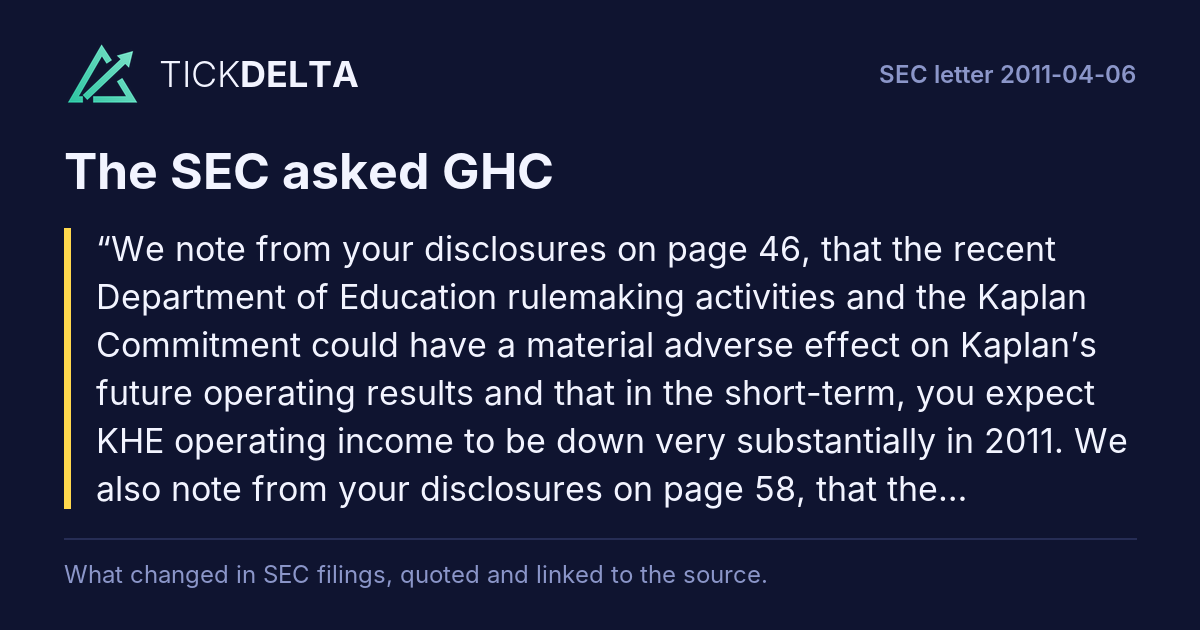
SEC asked (1)
We note from your disclosures on page 46, that the recent Department of Education rulemaking activities and the Kaplan Commitment could have a material adverse effect on Kaplan’s future operating results and that in the short-term, you expect KHE operating income to be down very substantially in 2011.
Rest of the question

We also note from your disclosures on page 58, that the discounted cash flow analyses you used to determine the fair value of your reporting units includes an estimate for the possible impact of newly enacted and proposed “for-profit” education regulations. Item 303 of Regulations S-K and the interpretive guidance found in Release 33-8350 regarding Management's Discussion and Analysis of Financial Condition and Results of Operations states that one of the principal objectives of MD&A is to provide information about the quality and potential variability of a company's earnings and cash flow, so that readers can ascertain the likelihood that past performance is indicative of future performance. Ascertaining this indicative value depends to a significant degree on the quality of disclosure about the facts and circumstances surrounding known material trends and uncertainties in MD&A. In order to help your investors better understand management’s statement that the possible impact of the newly enacted and proposed “forprofit” education regulations could have a material adverse effect on your future operating results in the short-term, please revise to explain in more detail how the changes in the education rules and the impact of the Kaplan Commitment are expected to directly affect your results of operations and cash flows. Quantification of the material effects of known material trends should be considered and may be required to the extent material if quantitative information is reasonably available.

GHC answered
to 1:

At the time of the Company’s 10-K filing, there were many items disclosed that were impacting Kaplan Higher Education’s (KHE) current results, and that were expected to collectively impact KHE’s future results significantly. These factors don’t function independently, but rather interact with each other to influence student demand, enrollment and retention, as well as overall KHE financial results and operations. The following are some of the more important factors cited:

•

The Kaplan Commitment: The program was very new, having been phased in during the fourth quarter of 2010.
Rest of the answer

The Company disclosed an estimate of the reduced revenues that would have occurred had the program been in effect for all of 2010, as well as the attrition rate experienced to-date during the risk-free period associated with the Kaplan Commitment.

With respect to the “program integrity rules” enacted in October 2010, the Company disclosed that it was not able to predict the impact that these rules would have on future operating results. Also, these rules aren’t effective until July 1, 2011.

The Company highlighted the Department of Education’s proposed “gainful employment” rule in its 10-K filing, noting that if the rule were enacted as proposed, it would significantly impact Kaplan’s operating results. The Company further disclosed that some of the data needed to compute program eligibility under the proposed rule was not available to the institutions.

Changes in marketing and admissions practices, and overall weaker demand.

Severance costs associated with a workforce reduction and increased regulatory compliance costs.

In its 10-Q for the first quarter of 2011, the Company expects to provide, to the extent possible, updated disclosures related to the following:

Results-to-date for the Kaplan Commitment program.

An updated discussion of the program integrity rules, including the Department of Education’s recent interpretive application guidance.

Status of the “gainful employment” proposal, which has not been finalized as of the date of this letter.

As the Company disclosed in its 10-K filing, KHE has implemented a number of marketing and admission changes and in the fourth quarter of

2010, new student enrollments were down due to these changes and overall weaker demand. Additionally, KHE incurred severance costs and increased regulatory compliance costs in the fourth quarter of 2010. As noted above, there are many factors in play beyond the Kaplan Commitment and newly enacted and proposed regulations that will impact KHE new student enrollments and related revenues, operating costs and cash flows. As a result, the Company will also continue to update new student enrollment information, and other initiatives undertaken in its 10-Q for the first quarter of 2011. Although the Company expects the downward trend in KHE revenue, operating income and cash flows to continue in the short-term, the number of interrelated contributing factors and the uncertain impact of those factors currently precludes the Company from reasonably quantifying the impact. For example, one of the key contributing factors is the Department of Education’s proposed “gainful employment” rule, which the Department of Education has stated will be modified in its final form and is expected to be effective on July 1,

2012.

While the Company prepared a discounted cash flow analysis for KHE in the fourth quarter of 2010, taking into account the possible impact of newly enacted and proposed for-profit education regulations, this was completed for purposes of performing its annual goodwill impairment review, and the estimated fair value of the KHE reporting unit exceeded its carrying value by a margin well in excess of 25% for purposes of this test.

In future filings, the Company will continue to assess and report on the impact of the Kaplan Commitment, enacted and proposed Department of Education regulations, and other factors impacting KHE future revenue, operating income and cash flows.

Read in the reply
Note P. Contingencies and Losses, page 85
SEC asked (2)
We note that you are involved in a number of litigation and legal matters where the extent of your exposure to future losses is not clear. For example, it is not clear if you are subject to any exposure above the amounts already accrued in your financial statements in the class action lawsuit served on February 6, 2008.
Rest of the question

If it is reasonably possible that the outcome of these matters may result in a liability that materially exceeds the amount already accrued, paragraphs 3-5 of ASC 450-20-50 require disclosure of the range of reasonably possible loss or a clear statement that a range cannot be estimated. If you cannot estimate the range, please disclose the reasons for your belief that the range cannot be estimated. Please clarify and revise the disclosures regarding these uncertainties to conform to the requirements of ASC 450, or explain why no modification is necessary. Please file all correspondence over EDGAR. We urge all persons who are responsible for the accuracy and adequacy of the disclosure in the filing to be certain that the filing includes the information the Securities Exchange Act of 1934 and all applicable Exchange Act rules require. Since the company and its management are in possession of all facts relating to a company’s disclosure, they are responsible for the accuracy and adequacy of the disclosures they have made. In responding to our comments, please provide a written statement from the company acknowledging that: • the company is responsible for the adequacy and accuracy of the disclosure in the filing; • staff comments or changes to disclosure in response to staff comments do not foreclose the Commission from taking any action with respect to the filing; and • the company may not assert staff comments as a defense in any proceeding initiated by the Commission or any person under the federal securities laws of the United States.

GHC answered
to 2:

The Company and its subsidiaries are involved in various legal proceedings that have arisen in the ordinary course of their businesses. Although the outcome of the claims and proceedings against the

Company cannot be predicted with certainty, based on information available at the time of the 10-K filing, management believed that there were no existing claims or proceedings that were likely to have a material effect on the Company’s business, financial condition, results of operations or cash flows.

Also, based on information available at the time of the

10-K filing, management was
Rest of the answer

of the opinion that the exposure to future material losses was not reasonably possible, as defined in ASC 450-20-20, or that future material losses in excess of the amounts accrued were not reasonably possible. Therefore, the Company did not provide a range of its exposure to future losses in its 10-K filing.

The Company will include updates to this information in its Form 10-Q filing for the first quarter of 2011 and in its subsequent filings.

* * * *

The Company acknowledges that (1) the Company is responsible for the adequacy and accuracy of the disclosure in its filings,

(2) Staff comments or changes to disclosure in response to Staff comments do not foreclose the Commission from taking any action with respect to the filings, and (3) the Company may not assert Staff comments as a defense in any proceeding initiated by the Commission or any person under the federal securities laws of the United States.

Read in the reply
In its next report

First report after the company's reply of Apr 21, 2011: 10-Q filed May 11, 2011 ↗, against the 10-Q filed Nov 10, 2010 ↗.

Tickdelta does not hold the text of both reports, so they are not compared here.

Also in this review: request for more time, Apr 20, 2011, closing letter, 2011-05-04

Form 10-K for the year ended December 31, 2009

2010-04-20 to 2010-06-10 · 6 questions · 2 letters from the SEC, 2 from the company
Review closed 2010-06-10
Goodwill and impairmentPensionsLiquidity and cashCritical estimatesResults discussion (MD&A)SegmentsExecutive pay
Critical Accounting Policies and Estimates · Goodwill and Other Intangible Assets, page 49
SEC asked (1)
We note from the disclosures on page 60, that you review the carrying value of your indefinite-lived intangible assets utilizing a discounted cash flow model, and, where appropriate, a market value approach. Revise your critical accounting policy disclosures to provide a description of the key assumptions that drive fair value in your discounted cash flow methodology.
Rest of the question

Addressing ASC Topic 805-20-S99-3, describe the method you used to isolate the cash flows associated with the intangible asset. If you used a hypothetical buildup or start method, describe qualitatively and quantitatively the significant estimates and assumptions used in your valuation method to determine the fair value of each unit of accounting in your performance analysis. Please provide us with the proposed disclosures you intend to include in your next 10-Q filing in response to this comment.

GHC answered
The Company’s intangible assets with an indefinite life are principally from franchise agreements at its cable television division.

The franchise agreements represent 92% of the $540 million of indefinite-lived intangible assets of the Company as of January 3, 2010. The Company determines the estimated fair value of its franchise agreements by utilizing a discounted cash flow model. The discounted cash flow model valuation is based on the premise that the only assets an unbuilt start-up cable television system would possess are its various franchise rights agreements.
Rest of the answer

This is also known as a “green field” approach. Other system assets are all obtained or developed after system operations commence.

The Company grouped the recorded values of its various cable franchise agreements into regional cable television systems or units of account. The Company makes estimates and assumptions regarding the initial capital investment required to construct the cable television systems, future cash flows, discount rates, long-term growth rates, and other operating variables to determine the franchise agreements’ estimated fair value.

The assumptions about future cash flows and growth rates were based on forecasts and long-term business plans of each cable television system. Such assumptions take into account numerous factors including historical experience, anticipated economic conditions, changes in the cable television systems’ cost structures, homes in each region’s service area, number of subscribers based on penetration of homes passed by the systems, and expected revenues per subscriber.

The discount rate assumption took into account the Company’s assessment of the risks inherent in the future cash flows of the respective cable television systems based on the weighted-average cost of capital of market participants in the cable television industry.

The Company proposes to disclose the information below in its critical accounting policies and estimates for the quarterly period ended April 4, 2010.

Goodwill and Other Intangible Assets

The Company reviews its indefinite-lived intangible assets annually as of November 30 for possible impairment or between annual tests if an event occurred or circumstances changed that would more likely than not reduce the fair value of the reporting unit below its carrying value. The Company uses a discounted cash flow model and in certain cases, a market value approach is also utilized to supplement the discounted cash flow model, to determine the estimated fair value of the indefinite-lived intangible assets. The Company makes estimates and assumptions regarding future cash flows, discount rates, long-term growth rates and other market values to determine estimated fair value of the indefinite-lived intangible assets.

The Company’s intangible assets with an indefinite life are principally from franchise agreements at its cable television division. These franchise agreements result from agreements the Company has with state and local governments that allow the Company to contract and operate a cable business within a specified geographic area. The

Company expects its cable franchise agreements to provide the Company with substantial benefit for a period that extends beyond the foreseeable horizon, and the Company’s cable television division historically has obtained renewals and extensions of such agreements for nominal costs and without material modifications to the agreements. The franchise agreements represent 93% of the $531.4 million of indefinite-lived intangible assets of the Company as of April 4, 2010.

The Company grouped the recorded values of its various cable franchise agreements into regional cable television systems or units of account.

The key assumptions used by the Company to determine the fair value of its franchise agreements as of November 30, 2009, the date of its last annual impairment review, were as follows:

•

Expected cash flows underlying the Company’s business plans for the periods 2010 through 2019, assuming the only assets the unbuilt start-up cable television systems possess are the various franchise agreements. The expected cash flows took into account the estimated initial capital investment in the system region’s physical plant and related start-up costs, revenues, operating margins and growth rates. These cash flows and growth rates were based on forecasts and long-term business plans and take into account numerous factors including historical experience, anticipated economic conditions, changes in the cable television systems’ cost structures, homes in each region’s service area, number of subscribers based on penetration of homes passed by the systems, and expected revenues per subscriber.

Cash flows beyond 2019 were projected to grow at a long-term growth rate, which the Company estimated by considering historical market growth trends, anticipated cable television system performance, and expected market conditions.

The Company used a discount rate of 8.3% to risk adjust the cash flow projections in determining the estimated fair value.

The estimated fair value of the Company’s franchise agreements exceeded their respective carrying values by a margin in excess of 50%. There is always a possibility that impairment charges could occur in the future given changes in the cable television market and U.S. economic environment, as well as the inherent variability in projecting future operating performance.

Read in the reply
In its next report

First report after the company's reply of May 4, 2010: 10-Q filed May 11, 2010 ↗, against the 10-Q filed Nov 6, 2009 ↗.

Tickdelta does not hold the text of both reports, so they are not compared here.

Pension Costs, Page 51
SEC asked (2)
You disclose that the actual return on plan assets for 2008 had a significant impact on the pension credit for 2009 and that you also expect the pension credit for 2010 to be affected by the actual returns for 2009.
Rest of the question

Please expand the disclosure to explain how you account for the differences between the expected long-term rate of return for plan assets and the actual experience and how this impacts pension costs reported in results of operations. Please provide us with the proposed disclosures you intend to include in your next 10-Q filing in response to this comment.

GHC answered

No numbered answer found in the reply. Read the reply ↗

In its next report

First report after the company's reply of May 4, 2010: 10-Q filed May 11, 2010 ↗, against the 10-Q filed Nov 6, 2009 ↗.

Tickdelta does not hold the text of both reports, so they are not compared here.

Pension Costs, Page 51
SEC asked (3)
We note that the recognized actuarial gain or loss recorded in pension costs in 2009 was less than the amounts recorded in 2008 and 2007, as disclosed in Note L at page 73. Please expand your disclosure to describe the types of items that generate actuarial gains and loss. Also describe the accounting treatment for these items and explain the impact pension costs.
Rest of the question

Please provide us with the proposed disclosures you intend to include in your next 10-Q filing in response to this comment.

GHC answered
to 2 and 3:

The Company proposes to include the following disclosure in its critical accounting policies and estimates for the quarterly period ended April 4, 2010.

Pension Costs

The Company’s net pension cost (credit) includes an expected return on plan assets component, calculated using the expected return on plan assets assumption applied to a market-related value of plan assets. The market-related value of plan assets is determined using a 5-year average market value method, which recognizes realized and unrealized appreciation and depreciation in market values over a 5-year period.
Rest of the answer

The value resulting from applying this method is adjusted, if necessary, such that it cannot be less than 80% or more than 120% of the market value of plan assets as of the relevant measurement date. As a result, year-to-year increases or decreases in the market-related value of plan assets impact the return on plan assets component of pension cost for the year.

At the end of each year, differences between the actual return on plan assets and the expected return on plan assets are combined with other differences in actual versus expected experience to form a net unamortized actuarial gain or loss in accumulated other comprehensive income. Only those net actuarial gains or losses in excess of the deferred realized and unrealized appreciation and depreciation are potentially subject to amortization. The types of items that generate actuarial gains and losses that may be subject to amortization in net periodic pension cost (credit) include:

Asset returns that are more or less than the expected return on plan assets for the year;

Actual participant demographic experience different from assumed (retirements, terminations and deaths during the year);

Actual salary increases different from assumed; and

Any changes in assumptions that are made to better reflect anticipated experience of the plan or to reflect current market conditions on the measurement date (discount rate, longevity increases, changes in expected participant behavior and expected return on plan assets).

Amortization of the unrecognized actuarial gain or loss is included as a component of expense for a year if the magnitude of the net unamortized gain or loss in accumulated other comprehensive income exceeds 10% of the greater of the benefit obligation or the market-related value of assets (10% corridor). The amortization component is equal to that excess divided by the average remaining service period of active employees expected to receive benefits under the plan. At the end of 2007, the Company had net unamortized actuarial gains in accumulated other comprehensive income potentially subject to amortization that were outside the 10% corridor that resulted in amortized gains of $6,168,000 being included in 2008 pension cost. Primarily as a result of the significant pension asset losses during 2008, increased life expectations and a decrease in the discount rate, the Company had net unamortized actuarial losses in accumulated other comprehensive income potentially subject to amortization that were outside the corridor that resulted in amortized losses of $40,000 being included in 2009 pension cost. During

2009, there were pension asset gains that were offset by the impact of an increase in the discount rate. The Company currently estimates that there will be no net unamortized actuarial gains or losses in accumulated other comprehensive income potentially subject to amortization outside the corridor and therefore, no amortized gain or loss amounts included in pension cost in 2010.

Read in the reply
In its next report

First report after the company's reply of May 4, 2010: 10-Q filed May 11, 2010 ↗, against the 10-Q filed Nov 6, 2009 ↗.

Tickdelta does not hold the text of both reports, so they are not compared here.

Notes to Consolidated Financial Statements · Note G. Goodwill and Other Intangible Assets, page 65
SEC asked (4)
We note that you recorded a goodwill impairment charge of $15.5 million in 2009 in your Kaplan Ventures segment as a result of the reorganization in your education division. We also note that you determined the fair value of the Kaplan Compliance Solutions unit using a cost approach.
Rest of the question

Please tell us if this approach was used to value goodwill and if so, why you believe that this approach is the most appropriate for this reporting unit, and if you also considered income and/or market approaches in your total analysis and if not, why. Please also tell us if you considered the market or cost approach in your determination of goodwill impairment for the Kaplan EduNeering reporting unit. * * * * Please respond to these comments through correspondence over EDGAR within 10 business days or tell us when you will provide us with a response. Please furnish a letter that keys your responses to our comments and provides any requested information. Detailed letters greatly facilitate our review. Please understand that we may have additional comments after reviewing your responses to our comments.

GHC answered
As per ASC 820, the Company considers the cost, market and income approaches in estimating the fair value of its reporting units.

The Kaplan Compliance Solutions reporting unit is not significant to the total estimated fair value and operations of the

Education division or Kaplan Ventures reporting segment and the goodwill balance following the impairment amounted to $109,000. The estimated fair value of the Kaplan Compliance Solutions reporting unit was estimated using a cost approach

(calculated as net current assets less debt free current liabilities).
Rest of the answer

The values indicated by the market and income approaches were significantly less than the net current assets due to the financial performance of the reporting unit and its significant working capital levels. As such, the Company determined that the cost approach rather than the market or income approaches was the best estimate of the fair value of the reporting unit.

The estimated fair value of the Kaplan EduNeering reporting unit was determined by utilizing an income approach. The Company also utilized a market approach to support the fair value determined under the income approach. The Company also considered the cost approach, but determined that is was not a reasonable estimate of the fair value of the Kaplan EduNeering reporting unit.

* * * *

The Company acknowledges that (1) the Company is responsible for the adequacy and accuracy of the disclosure in its filings,

(2) Staff comments or changes to disclosure in response to Staff comments do not foreclose the Commission from taking any action with respect to the filing, and (3) the Company may not assert Staff comments as a defense in any proceeding initiated by the Commission or any person under the federal securities laws of the United States.

Read in the reply
In its next report

First report after the company's reply of May 4, 2010: 10-Q filed May 11, 2010 ↗, against the 10-Q filed Nov 6, 2009 ↗.

Tickdelta does not hold the text of both reports, so they are not compared here.

Definitive Proxy Statement · General
SEC asked (1)
We note that you have not included any disclosure in response to Item 402(s) of Regulation S-K. Please advise us of the basis for your conclusion that disclosure is not necessary and describe the process you undertook to reach that conclusion.
GHC answered
We confirm that the Company considered whether its compensation policies and practices for its employees are reasonably likely to have a material adverse effect on the Company and concluded that they are not reasonably likely to have such an effect. We note that the Commission stated, when it adopted Item 402(s), that no affirmative statement is required when a company reaches the foregoing conclusion.

As part of its consideration of the issues addressed by Item 402(s), the Company completed an internal review process in which our Compensation Committee (the “Committee”), together with legal
Rest of the answer

counsel and human resources personnel, reviewed the compensation policies and practices for employees across the Company and considered how they relate to material risks facing the Company. In this review, management considered the different types of incentive compensation plans used across the Company in light of such risks, including those risks we identify in our reports filed with the Commission under the Securities Exchange Act of 1934. We also considered whether the design of these plans, which generally differ across many of the Company’s business units, together with other policies and practices of the Company, operate to mitigate the potential for excessive risk-taking. Among the situations considered were those noted in Item 402(s), including specifically the magnitude of the risk profile represented by different business units, deviations in risk incentives as between plans and profitability of different business units.

Based upon this review, management concluded, and the Committee concurred, that based on a combination of factors our compensation policies and practices do not incentivize excessive risk-taking that could have a material adverse effect on the Company, and we also concluded that in many instances our compensation policies mitigate the potential for excessive risk-taking. For example, our employee compensation plans and programs generally provide potential rewards based on a balanced combination of both the short-term and long-term goals of the Company, thereby mitigating the potential for rewarding short-term results that appear in isolation to be favorable, but that may in the longer term undermine execution of our business strategy and adversely affect shareholder value. Our compensation policies and arrangements also establish performance incentives that both encourage value creation and mitigate business risk.

As described in the Compensation Discussion and Analysis in the Proxy, compensation plans in effect throughout the Company employ a variety of division-specific performance goals selected to motivate performance without creating undue risk to the Company or its shareholders. For example, variable compensation plans in our Higher Education Division take into consideration meeting regulatory compliance requirements and achieving positive student outcomes at Kaplan, thus mitigating our educational regulatory and compliance risk. In addition, at levels below senior management, the relative importance of incentive pay to other non-variable elements of the pay package diminishes, which diminishes the potential for employees’ inclination to take excessive risks. Finally, the Committee also considered other controls and procedures that the Company has implemented to mitigate business risk, such as procedures relating to the Company’s overall ethics and compliance program.

Executive Compensation,

Read in the reply
Executive Compensation, page 22
SEC asked (2)
Please clarify whether the amounts in columns (e) and (f) of the Summary Compensation Table reflect the aggregate grant date fair value computed in accordance with ASC Topic 718. Please see Item 402(c)(2)(v) and (vi) of Regulation S-K. Please respond to these comments within 10 business days or tell us when you will provide us with a response.
Rest of the question

Please furnish a letter that keys your responses to our comments and provides any requested information. Detailed letters greatly facilitate our review. Please file your letter over EDGAR. Please understand that we may have additional comments after reviewing your responses to our comments.

GHC answered
The amounts in columns (d) (per telephone conversation with John

Zitko) and (e) of the Summary Compensation Table reflect the aggregate grant date fair value of the awards computed in accordance with ASC Topic 718.

* * *

The Company acknowledges that (1) the Company is responsible for the adequacy and accuracy of the disclosure in its filings,

(2) Staff comments or changes to disclosure in response to Staff comments do not foreclose the Commission from taking any action with respect to the filing, and (3) the Company may not assert Staff comments as a defense in any proceeding initiated
Rest of the answer

by the Commission or any person under the federal securities laws of the United States.

Read in the reply
In its next report

First report after the company's reply of Jun 3, 2010: 10-Q filed Aug 11, 2010 ↗, against the 10-Q filed Nov 6, 2009 ↗.

Tickdelta does not hold the text of both reports, so they are not compared here.

Also in this review: closing letter, 2010-06-10

Form 10-K for the Fiscal Year Ended December 28, 2008

2009-09-15 to 2009-11-09 · 2 questions · 2 letters from the SEC, 3 from the company
Review closed 2009-11-09
Goodwill and impairmentCritical estimatesRevenueSegmentsResults discussion (MD&A)Liquidity and cash
Critical Accounting Policies and Estimates · Goodwill and other intangible assets, page 52
SEC asked
We note that goodwill accounted for 27% of total assets as of December 31, 2008. We note that revenues, operating income and segment income have declined in recent quarters due to the negative impact of the current economic environment. As a result of your impairment test of your reporting units as of December 31, 2008, you determined that a portion of your goodwill balance was not impaired.
Rest of the question

In light of the significance of your goodwill balance and your impairment charge, we expect robust and comprehensive disclosure in your critical accounting policies regarding your impairment testing policy. This disclosure should provide investors with sufficient information about management's insights and assumptions with regard to the recoverability of goodwill. Specifically, we believe you should provide the following information: • Provide a more detailed description of the steps you perform to review goodwill for recoverability. • Disclose a breakdown of your goodwill balance as of December 31, 2008 by reporting unit. • Disclose any changes to your reporting units or allocations of goodwill by reporting unit and the reasons for such changes. • Describe the nature of the valuation techniques and the significant estimates and assumptions you employed to determine the fair value of your reporting units in your impairment analysis. For example, if you utilize the discounted cash flow approach, you should disclose the discount rates for each reporting unit and how those discount rates were determined, including your consideration of any market risk premiums. In addition, we believe your disclosure should address your estimates of future cash flows, as follows: o Provide a discussion of your historical cash flow growth rates and explain how your historical growth rates were considered when determining the growth rate to be utilized in your cash flow projections. o Disclose the growth rate you need to achieve in your cash flow projections in order to avoid having a goodwill impairment charge. o In view of the current economic environment, discuss how you considered the uncertainties inherent in your estimated future growth rates. For example, you should explain if and when you anticipated a recovery of the economy in your growth rates used in your cash flows analysis. • Describe changes to the assumptions and methodologies, if any, since your last annual impairment test. For further guidance, refer to Release No. 33-8350 "Interpretation: Commission Guidance Regarding Management's Discussion and Analysis of Financial Condition and Results of Operations." * * * * Please respond to these comments through correspondence over EDGAR within 10 business days or tell us when you will provide us with a response. Please furnish a letter that keys your responses to our comments and provides any requested information. Detail letters greatly facilitate our review. Please understand that we may have additional comments after reviewing your responses to our comments.

GHC answered
The Company has received your letter dated September 15, 2009 relating to the Annual Report on

Form 10-K for the Fiscal Year Ended December 28, 2008 of The Washington Post Company (the “Company”). Due to staffing conflicts, the Company needs additional time to complete our response, which we expect to finalize no later than October 9, 2009.
Read in the reply
In its next report

First report after the company's reply of Sep 29, 2009: 10-Q filed Nov 6, 2009 ↗, against the 10-Q filed Aug 4, 2009 ↗.

Tickdelta does not hold the text of both reports, so they are not compared here.

Critical Accounting Policies and Estimates · Goodwill and other intangible assets, page 52
SEC asked
We have reviewed your response to comment one from our letter dated September 15, 2009. We note on page 5 of your response letter that the fair value for the Kaplan Professional reporting unit exceeded its carrying value by only approximately 5%. Therefore, it appears that the Kaplan Professional reporting unit may be at risk of failing step one of the goodwill impairment test.
Rest of the question

Please disclose the following information for each reporting unit with material goodwill at risk of failing step one of the goodwill impairment test: • Description of the key assumptions used and how the key assumptions were determined; • Discussion of the degree of uncertainty associated with the key assumptions (The discussion regarding uncertainty should provide specifics to the extent possible, e.g., the valuation model assumes recovery from a business downturn within a defined period of time); and • Description of potential events and/or changes in circumstances that could reasonably be expected to negatively affect the key assumptions. * * * * Please respond to these comments through correspondence over EDGAR within 10 business days or tell us when you will provide us with a response. Please furnish a letter that keys your responses to our comments and provides any requested information. Detail letters greatly facilitate our review. Please understand that we may have additional comments after reviewing your responses to our comments.

GHC answered
The Company’s education division completed a reorganization of its operational and internal structure in the third quarter of 2009. As a result, the education division reorganized its operations for the purpose of making operating decisions and assessing performance into four operating segments: Higher Education, Test Prep, Kaplan International and Kaplan Ventures.
Rest of the answer

The operations of the former Kaplan Professional were moved to Test Prep, Kaplan

International and Kaplan Ventures as part of the reorganization, and resulted in the reallocation of goodwill to the new reporting units using a relative fair value approach.

The Company performed an interim review of the carrying value of goodwill at the education division for possible impairment on a pre-reorganization and post-reorganization basis. The Company will include disclosure of the reorganization as well as the results of the interim goodwill impairment review in its critical accounting policies and notes to the condensed consolidated financial statements for the quarterly period ended September 27, 2009 to be filed with the Commission on Form 10-Q.

The

Company believes the proposed disclosures are appropriate in light of the reorganization and that disclosures surrounding the 2008 Kaplan Professional reporting unit’s goodwill impairment test is no longer relevant for the following reasons:

The Kaplan Professional reporting unit does not exist subsequent to the reorganization of the education division. The goodwill at the Kaplan

Professional reporting unit was reassigned to the affected reporting units using a relative fair value approach.

The Company performed an interim review of the carrying value of goodwill at the education division for possible impairment on a pre-reorganization and post-reorganization basis. The results of these reviews and related assumptions are included in the proposed disclosures together with a sensitivity analysis for both the pre-reorganization and post-reorganization reviews.

The Company proposes to disclose the information below in its critical accounting policies for the quarterly period ended September 27, 2009. The applicable portion of the goodwill and other intangibles note for the period ended September 27, 2009 is included as an exhibit to this letter.

Goodwill and Other Intangible Assets

The education division completed a reorganization of its organizational and internal structure during the third quarter of 2009. As a result, the education division reorganized its operations for the purpose of making operating decisions and assessing performance into four operating segments: Higher Education, Test Prep, Kaplan International and Kaplan Ventures. The reorganization significantly changed the composition of the reporting units within the education division, and resulted in the reassignment of the goodwill to the affected reporting units using a relative fair value approach.

The fair value of the previous reporting units and components transferred were generally determined utilizing a discounted cash flow model and, where appropriate, a market value approach to supplement the discounted cash flow model. The Company made estimates and assumptions regarding future cash flows, discount rates, long-term growth rates and market values to determine each reporting unit and component’s estimated fair value.

The assumptions about future cash flows and growth rates were based on forecasts and long-term business plans of each reporting unit and component. Such assumptions took into account numerous factors including historical experience; anticipated economic conditions; changes in the reporting unit and component’s cost structures; cost savings from recent restructuring activities and other initiatives; and expected revenues from current and future enrollments at the universities, campuses and education centers.

The discount rate assumptions for each reporting unit and component took into account the Company’s assessment of the risks inherent in the future cash flows of the respective reporting unit and component and the weighted-average cost of capital of market participants in businesses similar to each reporting unit and component.

The key assumptions used by the

Company were as follows:

Expected cash flows underlying the education division’s business plans for the periods 2009 through 2013.

Cash flows beyond 2013 were projected to grow at a long-term growth rate, which the Company estimated between 3% and 6% for each reporting unit and component.

The Company used a discount rate of 10.5% to 20% to risk adjust the cash flow projections in determining the estimated fair value.

The effect of the reallocation of goodwill is included in Note 4, “Goodwill and Other Intangible

Assets”, of the condensed consolidated financial statements of the Company for the thirty-nine weeks ended September 27, 2009. Each post-reorganization reportable segment is also a reporting unit except for Kaplan Ventures, which consists of six reporting units.

As a result of the reassignment, the Company performed an interim review of the carrying value of goodwill at the education division for possible impairment on a pre-reorganization and post-reorganization basis. The fair value of the pre-reorganization reporting units each exceeded their respective carrying value by a margin in excess of 15%. On a post-reorganization basis, the estimated fair value of the reporting units within the education division with significant goodwill balances (Higher Education, Test Prep and Kaplan International) exceeded their respective carrying values by a margin in excess of 50%.

Following the reorganization, two reporting units (Kaplan EduNeering and Kaplan Compliance

Solutions, previously within Kaplan Professional) now included in the Kaplan Ventures operating segment failed step one of the interim goodwill impairment review and the Company performed a step two analysis. The Company recorded a goodwill and other long-lived assets impairment charge of $25.4 million related to these two reporting units. Following the impairment, the remaining goodwill balances at these two reporting units as of September 27, 2009 totaled $22.8 million.

In the fourth quarter of 2008, the Company recorded goodwill impairment charges at two reporting units as part of the annual goodwill impairment review completed as of November 30, 2008. The remaining goodwill balances at these two reporting units as of September 27, 2009 totaled $38.4 million.

Combined, the goodwill balance at these four reporting units totaling $61.2 million represents less than 5% of the Company’s total goodwill balance of $1,415.3 million as of September 27, 2009. There exists a reasonable possibility that a decrease in the projected cash flows or long-term growth rate, or an increase in the discount rate assumptions used in the discounted cash flow model of these reporting units could result in an additional goodwill and other impairment charge. The Company will perform its next annual goodwill impairment review as of November 30, 2009, at which time these assumptions will be reviewed and updated, as necessary. While less likely, additional impairment charges could occur in other reporting units as well given the inherent variability in projecting future operating performance.

* * * *

The Company acknowledges that (1) the Company is responsible for the adequacy and accuracy of the disclosure in its filings, (2) Staff comments or changes to disclosure in response to Staff comments do not foreclose the Commission from taking any action with respect to the filing, and (3) the Company may not assert

Staff comments as a defense in any proceeding initiated by the Commission or any person under the federal securities laws of the United States.

Read in the reply
In its next report

First report after the company's reply of Nov 2, 2009: 10-Q filed Nov 6, 2009 ↗, against the 10-Q filed Aug 4, 2009 ↗.

Tickdelta does not hold the text of both reports, so they are not compared here.

Also in this review: company letter, Oct 9, 2009, closing letter, 2009-11-09

Schedule 14A

2009-05-04 to 2009-08-24 · 1 question · 1 letter from the SEC, 3 from the company
Review closed 2009-08-24
Non-GAAP measuresExecutive pay
Definitive Proxy Statement filed on March 25, 2009 · Compensation Discussion and Analysis, page 23
SEC asked
We note that the company performance measure used to award annual bonuses was an earnings per share goal of $31.90, as adjusted to exclude certain unusual items based upon the provisions of the Incentive Compensation Plan and as adjusted in the discretion of the compensation committee to exclude certain gains and other unusual charges.
Rest of the question

As this measure is a non-GAAP measure, specifically disclose how the compensation committee calculated the measure from your audited financial statements based upon the provisions of the Plan and how and why it exercised its discretion to adjust the performance measure further. In this regard, we note that the company’s basis and diluted earnings per share amounts set forth in its financial statements were $6.89 per share and $6.87 per share, respectively. See Instruction 5 to Item 402(b). * * * * As appropriate, please amend your filing and respond to these comments through correspondence over EDGAR within 10 business days or tell us when you will provide us with a response. Please furnish a letter that keys your responses to our comments and provides any requested information. Detail letters greatly facilitate our review. Please understand that we may have additional comments after reviewing your responses to our comments.

GHC answered
The primary adjustments to the diluted earnings per share amount set forth in the

Company’s financial statements were attributable to unusual charges unrelated to the regular operating results that are customarily considered by the Compensation Committee in determining bonus amounts. The principal charges and other items were previously publicly disclosed (and therefore readily available to investors interested in reconciling the description in the Compensation Discussion and Analysis with the detailed financial information otherwise disclosed by the Company) in the Company’s Form 8-K filed
Rest of the answer

on February 25, 2009 (the “Earnings Release”). This information is also reported in the Company’s Annual Report on Form 10-K, filed on February 26, 2009. Specifically, page 86 lists these items under the heading “Impact from certain unusual items (after-tax and diluted EPS amounts)”. The primary adjustments include goodwill and other intangible asset write-downs, and charges related to early retirement programs at the Washington Post Newspaper, the corporate office and Newsweek, which constitute 93% of the net adjustments. The Compensation

Discussion and Analysis in our Proxy Statement, on page 22, clearly discloses that the Compensation Committee exercised its discretion to exclude certain gains and other unusual charges, in accordance with the terms of the Incentive Compensation

Plan.

As this information is already disclosed in the Earnings Release, Form 10-K and referred to in our Proxy Statement, and in light of the timing of our Annual Meeting of Shareholders to which the Proxy Statement relates, the Company believes that filing a report on Form 8-K that clarifies the nature and amount of adjustment by explicitly cross-referencing to the Earnings Release and the 10-K will adequately address any investor uncertainty relating to the determination of 2008 annual bonuses. The proposed additional disclosure in the Form 8-K will be as follows:

The Compensation Discussion and Analysis section of our Proxy Statement, filed on March 25, 2009, provides that “in 2008, the Company achieved approximately 86.7% of the earnings per share goal of $31.90, as adjusted to exclude certain unusual items based upon the provisions of the Plan, such as foreign exchange losses; the Compensation Committee also exercised its discretion to exclude certain gains and other unusual charges.” In determining the amounts payable to the Company’s named executive officers as annual incentive compensation awards for 2008, the Compensation Committee exercised its discretion to exclude certain unusual items from its calculation of the earnings per share goal, in accordance with the terms of the Incentive Compensation Plan. The primary adjustments include goodwill and other intangible asset write-downs, and charges related to early retirement programs at the Washington Post Newspaper, the corporate office and Newsweek. The Compensation Committee excluded these items as they are almost entirely non-cash charges (the early retirement programs are funded primarily from the assets of the Company’s pension plans) that did not relate to the regular operating results that are customarily considered by the Committee in determining bonus amounts. The exhibit to the Company’s Form 8-K filed on February 25, 2009 details these items, as does page 86 of the Company’s Annual Report on Form 10-K filed on February 26, 2009. Excluding these unusual charges and other items, the Company’s diluted earnings per share as adjusted for purposes of the bonus determination was $27.67, compared to diluted earnings per share of $6.87.

It is our intention to file the Form 8-K upon receiving confirmation from the staff that this will sufficiently address the staff’s concerns.

The Company acknowledges that (1) the

Company is responsible for the adequacy and accuracy of the disclosure in its filings, (2) Staff comments or changes to disclosure in response to Staff comments do not foreclose the Commission from taking any action with respect to the filing, and (3) the Company may not assert Staff comments as a defense in any proceeding initiated by the Commission or any person under the federal securities laws of the United States.

Read in the reply

Also in this review: company letter, Jun 19, 2009, company letter, Jul 16, 2009, closing letter, 2009-08-24

Form 10-K for the Year ended December 31, 2007

2008-09-19 to 2008-12-09 · 5 questions · 2 letters from the SEC, 3 from the company
Review closed 2008-12-09
Executive pay
Executive Compensation, page 14 · Compensation Discussion and Analysis, page 14
SEC asked (1)
It appears that you used the Towers Perrin Survey of Compensation and Media Executives for benchmarking purposes. If you use surveys for benchmarking purposes, you must identify the companies in the surveys. Please confirm in your response letter that you will comply with our comment in future filings where you use the surveys to benchmark elements of your named executive officers’ compensation.
Rest of the question

See Regulation S-K Item 402(b)(2)(xiv). For additional guidance, please refer to Question 118.05 of the Division of Corporation Finance’s compliance and disclosure interpretations regarding Regulation S-K, available on our website at http://www.sec.gov/divisions/corpfin/cfguidance.shtml#regs-k.

GHC answered
We do not utilize the Towers Perrin Survey of Compensation and Media Executives, or any other survey, for benchmarking purposes. We routinely review this survey to get a general understanding of the compensation structures maintained by similarly situated companies, but we do not target our executives’ compensation at a certain level or percentage based upon other companies’ compensation arrangements. We will revise our disclosure in the future to clarify that we do not engage in benchmarking.
Rest of the answer

We will also clarify in future filings how we do use the Towers Perrin Survey information and, to the extent that we do ever benchmark in the future, as that term is defined in the Staff guidance, we will disclose that information.

Read in the reply
In its next report

First report after the company's reply of Oct 15, 2008: 10-Q filed Nov 5, 2008 ↗, against the 10-Q filed Aug 6, 2008 ↗.

Tickdelta does not hold the text of both reports, so they are not compared here.

Elements of Compensation, page 15 · Performance-Based Incentive Compensation, page 16
SEC asked (2)
We note that annual bonuses and the payout on performance units are based upon achieving business unit and corporate performance goals. In future filings, please disclose the performance targets that must be reached for the payment of annual bonuses and for payouts on performance units. See Item 402(b)(2)(v) of Regulation SK.
Rest of the question

If you believe such disclosure would result in competitive harm such that the information could be omitted under Instruction 4 to Item 402(b), please provide in your response letter a detailed explanation for such conclusion. If you believe you have a sufficient basis to keep the information confidential, discuss in future filings how difficult it would be for the executive or how likely it would be for you to achieve the undisclosed performance target. Note that general statements regarding the level of difficulty or ease associated with achieving performance measures are not sufficient. In discussing how difficult it will be for an executive or how likely it will be for the company to achieve the target levels or other factors, provide as much detail as necessary without providing information that would result in competitive harm. For guidance, please refer to Question 118.04 of the Division of Corporation Finance’s compliance and disclosure interpretations regarding Regulation S-K.

GHC answered
Annual Incentive Plan

We will disclose the performance targets for each named executive officer under our Annual Incentive Plan for the applicable year in future filings.

Performance Unit Plan

We respectfully submit that additional information concerning the performance “targets” under the Performance Unit Plan is not required by Item 402(b) because this information is not material or necessary to an understanding of the compensation paid to the named executive officers under the Performance Unit Plan.

All named executive officers participate in our long-term Performance Unit Plan.
Rest of the answer

The amount of compensation payable to each named executive officer under the plan is determined by (i) a weighted combination of eight different factors that relate to individual business unit performance of the newspaper operations, principally The Washington Post (“The Post”), the ownership and operation of cable television systems (“CableOne”), magazine publishing, principally Newsweek (“Newsweek”), television broadcasting (“PNS”), and Kaplan Inc. (“Kaplan”) and (ii) the discretion of the Company’s Compensation Committee. Each of these five business units has its own range of performance-based goals. Performance goals for the business units generally are measured over four-year cycles; the exception to this is Newsweek, which measures performance on an annual basis. (Thus, the eight performance factors are one four-year performance factor each for The Post, CableOne, PNS and Kaplan, and four one-year performance factors for Newsweek.) Payout levels are based on achievement relative to the range of goals, and payout levels increase as overall achievement of the business units increases. The weighting of the factors is as follows: 65% of the total payout value of the performance units for the named executive officers is determined by the seven performance factors associated with The Post, CableOne, Newsweek and PNS, while 35% of the total payout is based on the performance factor associated with the Kaplan business unit.

In our view, disclosure of the specific performance goals for each business unit is not material or necessary to an understanding of our Performance Unit Plan because of the large number of performance measures taken into account for each named executive officer under the plan, each of which (other than the Kaplan performance factor) affects only a small portion (between about 4% and 16%) of the payment to that named executive officer. We specifically disclose that the performance measure taken into account for the Kaplan business unit is cumulative operating income (excluding certain charges, such as Kaplan stock-based compensation), for the 2007 – 2010 performance cycle. It is clear that if the specific performance goals are immaterial, then to the extent any business unit may have a particular target or targets within those goals, such targets are immaterial as well.

Further, certain of the business units have set ‘targets’ for performance that are not quantitative in nature, and would therefore not be useful to an investor trying to understand or predict the compensation payable under the plan. For example, two of the four business units other than Kaplan measure performance relative to a group of competitors. Disclosure of such targets is not meaningful to an understanding of the Company’s compensation programs, as it is impossible to predict in advance how the Company’s competitors will perform.

Additionally, the range of business goals and the targets, if any, within those ranges are not material to an investor’s understanding of the plan because payment under the plan is not solely reliant on the eight factors outlined above, much less the goals established within each of those eight factors. Performance is measured over four-year cycles, but the Compensation Committee has the power under the plan to change the range of goals and associated payouts in the middle of a cycle if they feel the metrics are no longer appropriate. Additionally, the Compensation Committee retains the discretion to modify the final payment to the named executive officers in the event the payment called for by the factors is considered to be unsuitable. Because of the discretion retained by the Compensation Committee to change or deviate from the formulas used to measure business unit performance, the individual metrics for business unit performance become even less important to an investor’s analysis of performance-based incentive compensation.

We also believe that to the extent any individual business unit may have a specific target or targeted range of performance, identifying such targets is not material or necessary to an investor’s ability to understand the degree of difficulty or ease of achieving a particular compensation level since under the plans there are a myriad of performance results that could dictate any given payout level. As disclosed, the nominal value of each performance unit is $100. There are virtually an infinite number of combinations of performance results that could result in a payout of $100. For example, a named executive officer could receive a payout of $100 per unit whether all five business units do well over a four-year cycle or half of the business units do exceptionally well and half do poorly because the average calculation at the end of the four-year cycle could be the same. As a result, an employee’s motivation to achieve any specific “targeted” level of performance is no different from his motivation to achieve any other level of good performance, and his return from achieving any targeted level of performance is in no sense special or indicative of the degree of difficulty of achieving any level of compensation under the plan as a whole.

It is also noteworthy that none of the eight factors under our Performance Unit Plan are based on corporate level results; the plan utilizes a “bottom-up” formula based on business unit performance. To the extent that certain of the business unit performance factors are quantitative in nature, they relate to financial results which investors would have no or limited ability to evaluate in regard to the degree of difficulty that they imply for achieving any given bonus payout amount.

Finally, we also believe that to the extent there are specific performance targets or goals, these goals are not only immaterial to an investor but will potentially be misleading for the following reasons. In his letter to shareholders printed in the 2006 Annual Report, Donald Graham, the Chairman of the Board and Chief Executive Officer of the Company, stated that the Company “will willingly take actions that produce poor published results in a quarter, a year or several years if those actions will build a more valuable company for our shareholders.” In furtherance of this fundamental strategic view, the Board of Directors periodically re-assesses the import of pre-established goals for the Company’s business units as circumstances change or opportunities arise in order to build long-term value in the Company. Consistent with this approach, the Company has a longstanding policy of not providing guidance to the investment community. For this reason, the Company and the Board of Directors have maintained a consistent policy of keeping any projections and goals that it may establish confidential, and believe that it is important to continue to do so. The Company’s investors are aware that the Company’s Board of Directors and management are focused on creating long-term growth for the Company. Additionally, the discretion allotted to the Committee under the Performance Unit Plan is designed to align the interests of the plan participants with those of the shareholders, and by doing so, to ensure that these individuals are motivated to work toward the long-term growth of the Company, even at the expense of targets for individual business units. In light of this background, we believe that disclosure of performance “targets” under our Performance Unit Plan would inevitably lead to a confused message about our basic compensation philosophy that stems from this strategic view.

For all of the foregoing reasons, it is our belief that disclosure of goals or targets for the various business units are immaterial to an understanding of the compensation for executives who participate in the Performance Unit Plan.

Read in the reply
In its next report

First report after the company's reply of Oct 15, 2008: 10-Q filed Nov 5, 2008 ↗, against the 10-Q filed Aug 6, 2008 ↗.

Tickdelta does not hold the text of both reports, so they are not compared here.

Elements of Compensation, page 15 · Performance-Based Incentive Compensation, page 16
SEC asked (3)
Please disclose the percentage of base salary that is the bonus target for each named executive officer under the annual incentive plan.
GHC answered
Our current disclosure provides the information for a shareholder to determine the percentage of base salary that is the bonus target for each named executive officer under our Annual Incentive Plan by simply referring to the Summary Compensation Table. However, we will revise our disclosure in future filings to specifically state the percentage for each named executive officer.
Read in the reply
In its next report

First report after the company's reply of Oct 15, 2008: 10-Q filed Nov 5, 2008 ↗, against the 10-Q filed Aug 6, 2008 ↗.

Tickdelta does not hold the text of both reports, so they are not compared here.

Elements of Compensation, page 15 · Performance-Based Incentive Compensation, page 16
SEC asked (4)
Please discuss the threshold, target and maximum levels of performance under the performance unit plans. Please respond to these comments within 10 business days or tell us when you will provide us with a response. Please furnish a letter that keys your responses to our comments and provides any requested information. Detailed letters greatly facilitate our review. Please file your letter over EDGAR.
Rest of the question

Please understand that we may have additional comments after reviewing your responses to our comments.

GHC answered
above.

***

The Company acknowledges that (1) the Company is responsible for the adequacy and accuracy of the disclosure in its filings, (2) Staff comments or changes to disclosure in response to Staff comments do not foreclose the Commission from taking any action with respect to the filing, and (3) the Company may not assert Staff comments as a defense in any proceeding initiated by the Commission or any person under the federal securities laws of the United States.
Read in the reply
In its next report

First report after the company's reply of Oct 15, 2008: 10-Q filed Nov 5, 2008 ↗, against the 10-Q filed Aug 6, 2008 ↗.

Tickdelta does not hold the text of both reports, so they are not compared here.

Executive Compensation. page 14 · Performance-Based Incentive Compensation. page 16
SEC asked
We note your responses to comments two and four from our letter dated September 19, 2008. In futue filings, please discuss with more specificity the maner in which the compensation committee determines and awards Performance Unit Plan, including the natue and number of performance targets considered for each business unt andhow the achievement of the range of performance-based goals counts toward the overall
Rest of the question

Performance Unit Plan award. To the extent that performance goals and payout levels are determined anually over the four-year cycle, disclose the extent to which the performance goals have been achieved for prior years in the cycle and the resulting payout to which a named executive offcer is entitled so far under the plan. Please do so for each plan discussed (e.g., the 2005-2008 plan and the 2007-2010 plan). Please respond to ths comment within 10 business days or tell us when you will provide us with a response. Please fuish a letter that keys your response to our comment and provides any requested information. Detailed letters greatly faciltate our review. Please file your letter over EDGAR. Please understand that we may have additional comments after reviewing your response to our comment. Please contact John Zitko, Staff Attorney, at (202) 551-3399, Kathleen Krebs, Special Counsel, at (202) 551-3810, or me at (202) 551-3810 with any other questions. Sincerely,

GHC answered
The Company agrees to provide the requested disclosure in future filings.

The Company acknowledges that (1) the Company is responsible for the adequacy and accuracy of the disclosure in its filings, (2) Staff comments or changes to disclosure in response to Staff comments do not foreclose the Commission from taking any action with respect to the filing, and (3) the Company may not assert Staff comments as a defense in any proceeding initiated by the Commission or any person under the federal securities laws of the United States.
Read in the reply
In its next report

First report after the company's reply of Dec 8, 2008: 10-K filed Feb 26, 2009 ↗, against the 10-K filed Feb 28, 2008 ↗.

Tickdelta does not hold the text of both reports, so they are not compared here.

Also in this review: company letter, Nov 7, 2008, closing letter, 2008-12-09

From the SEC's correspondence on EDGAR: staff letters (form UPLOAD) and company letters (form CORRESP), 42 letters filed since 2008-10-15. Questions and answers are matched by their numbers; topics come from words in each question. The reports are compared word for word (same form, before the first SEC letter against the first report after the company's reply). No AI.

Sources

The SEC's correspondence on EDGAR: staff letters (form UPLOAD) and company letters (form CORRESP), matched question by question. No AI.

Also

Filings: the letters in the filing list.

Work with it

Excel workbook · CSV. Google Sheet that stays up to date: paste =IMPORTDATA("https://tickdelta.com/company/GHC/export.csv") into a cell.

Next in Owners and insiders:Insider trades
Esc

Type a ticker such as AAPL, a name, an investor such as Buffett, or a topic such as tariffs. ↑ ↓ to move, Enter to open.