tickdelta
Sign in

Tickdelta is free for now. Sign up and get Pro free

← Screener

GISGeneral Mills

Consumer staples · Packaged Foods · NYSE
Compare with peers → Embed

When the SEC's staff reviews a filing, it writes to the company with numbered questions, and the company answers each one in a letter. SEC publishes the exchange once the review is over, at least 20 business days later. Below: what the staff asked GIS, and the company's answer to each question, quoted from the letters. A question is not an accusation; most reviews end with the company adding detail to its next filing.

Form 10-K for the Fiscal Year Ended May 30, 2021

2021-10-29 to 2021-11-10 · 1 question · 1 letter from the SEC, 1 from the company
Review closed 2021-11-10
Liquidity and cashDebt
Note 9. Debt · Long-Term Debt, page 69
SEC asked
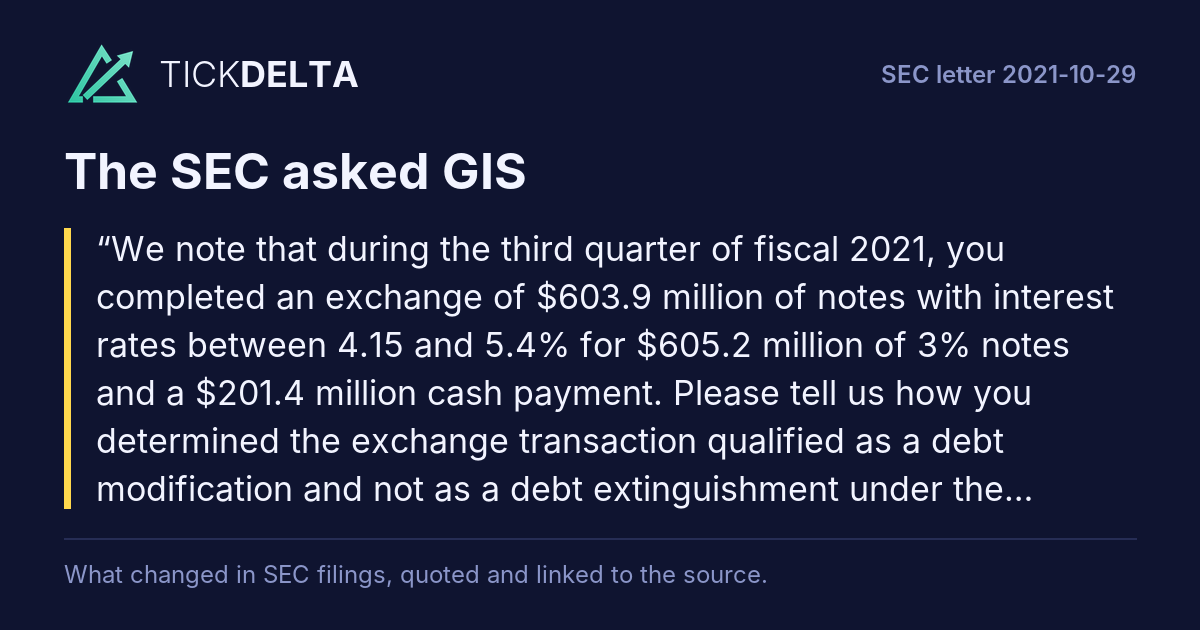
We note that during the third quarter of fiscal 2021, you completed an exchange of $603.9 million of notes with interest rates between 4.15 and 5.4% for $605.2 million of 3% notes and a $201.4 million cash payment. Please tell us how you determined the exchange transaction qualified as a debt modification and not as a debt extinguishment under the guidance in ASC 470-50-40-6 through -12.
Rest of the question

In doing so, provide us with your cash flow present value calculations for the original and new notes under ASC 470-50-40-12. In closing, we remind you that the company and its management are responsible for the accuracy and adequacy of their disclosures, notwithstanding any review, comments, action or absence of action by the staff.

GIS answered
In the third quarter of fiscal 2021, the Company completed an offer to exchange (the “Exchange Offer”) certain series of outstanding notes (the “Existing Note” or “Existing Notes”) for a combination of newly issued notes (the “New

Note” or “New Notes”) and cash. The Exchange Offer was available to all Existing Note holders who certified their status as either (a) a “qualified institutional buyer,” as that term is defined in Rule 144A under the

Securities Act of 1933, as amended (the “Securities Act”), or (b) outside the United States and a person other than a U.S.
Rest of the answer

person, as those terms are defined in Rule 902 under the Securities Act, and included a participation incentive

(the “Participation Incentive”) to Existing Note holders that tendered in the Exchange Offer equal to 3 percent of the principal amount of Existing Notes tendered. The Exchange Offer was not completed as a result of a troubled debt restructuring and was not a transaction among debt holders.

We analyzed the Exchange Offer in accordance with ASC 470-50-40-6 through -11 to determine whether the Exchange Offer qualified as a debt modification and not an extinguishment of the Existing Notes. In relevant part, ASC 470-50-40-6 provides that an exchange of debt instruments with a substantial modification of terms shall be accounted for like an extinguishment. To determine whether the terms of the New Notes were substantially different from the Existing Notes, we applied the guidance set forth in ASC 470-50-40-10. We first reviewed the terms of the Existing Notes and New Notes and confirmed that neither of the notes included a conversion option. We then determined the difference in the present value of the cash flows under the terms of the New Notes and present value of the remaining cash flows under the Existing Notes for the purposes of applying the 10 percent cash flow test set forth in ASC 470-50-40-10.

We calculated the net present value of the cash flows in accordance with ASC 470-50-40-12 as follows:

•

Included all cash flows specified by the terms of the New Notes including the Participation Incentive

Utilized the effective interest rate of the Existing Notes

Included the impact of the assumed exercise of an early call option date. Since the results indicated a change in present value of less than 10 percent, no further cash flow present value calculations were considered necessary as ASC

470-50-40-12c allows for the utilization of the cash flow assumptions that generate a smaller change in present value when the original debt instrument is callable or puttable.

The following table summarizes the key inputs and detailed calculation of the cash flow present values for the Existing Notes exchanged for the $605.2 million aggregate principal amount of New Notes (in millions):

Existing

Notes

Principal

New Notes

Principal (a)

Discount

Rate for

10%

Test (b)

Participation

Incentive

Present

Value of including

Difference

4.55% notes due April 17, 2038

$

217.6

218.0

4.6

%

62.0

225.1

217.2

3.6

5.4% notes due June 15, 2040

117.5

117.7

5.4

50.7

126.7

117.2

8.1

4.15% notes due February 15, 2043

65.1

65.2

4.2

15.8

68.0

64.7

5.1

4.7% notes due April 17, 2048

203.8

204.3

4.7

72.9

221.7

203.4

9.0

(a)

3.0 percent notes due February 1, 2051

(b)

Effective interest rate of Existing Notes

The differences in net present values of the cash flows of the Existing Notes compared to the New Notes were below the 10 percent threshold. Accordingly, we concluded that the terms of the New Notes were not substantially different from the Existing Notes and that the Exchange Offer qualified as a debt modification and not as a debt extinguishment.

We also concluded that the 10 percent cash flow test set forth in ASC 470-50-40-10 performed at the lender level was not necessary. No combination of Existing Notes exchanged by an individual lender would have had a change greater than 10 percent since each of the lenders were subject to the same terms in the Exchange Offer and each of the four Existing Notes exchanged individually passed the 10 percent cash flow test.

We hope that our letter has addressed your comments. If you have questions regarding our responses, please contact Trevor Gunderson at (763) 764-5324.

Read in the reply ↗
In its next report

First report after the company's reply of 2021-11-08: 10-Q filed 2021-12-21 ↗, against the 10-Q filed 2021-09-22 ↗.

Tickdelta does not hold the text of both reports, so they are not compared here.
Also in this review: closing letter, 2021-11-10
Form 10-K for the Fiscal Year Ended May 26, 2019

2020-02-26 to 2020-04-02 · 4 questions · 1 letter from the SEC, 2 from the company
Review closed 2020-04-02
Non-GAAP measuresRevenueInventoryAcquisitionsIncome taxesDebt
Non-GAAP Measures · Adjusted Diluted EPS and Related Constant-currency Growth Rate, page 40
SEC asked (1)
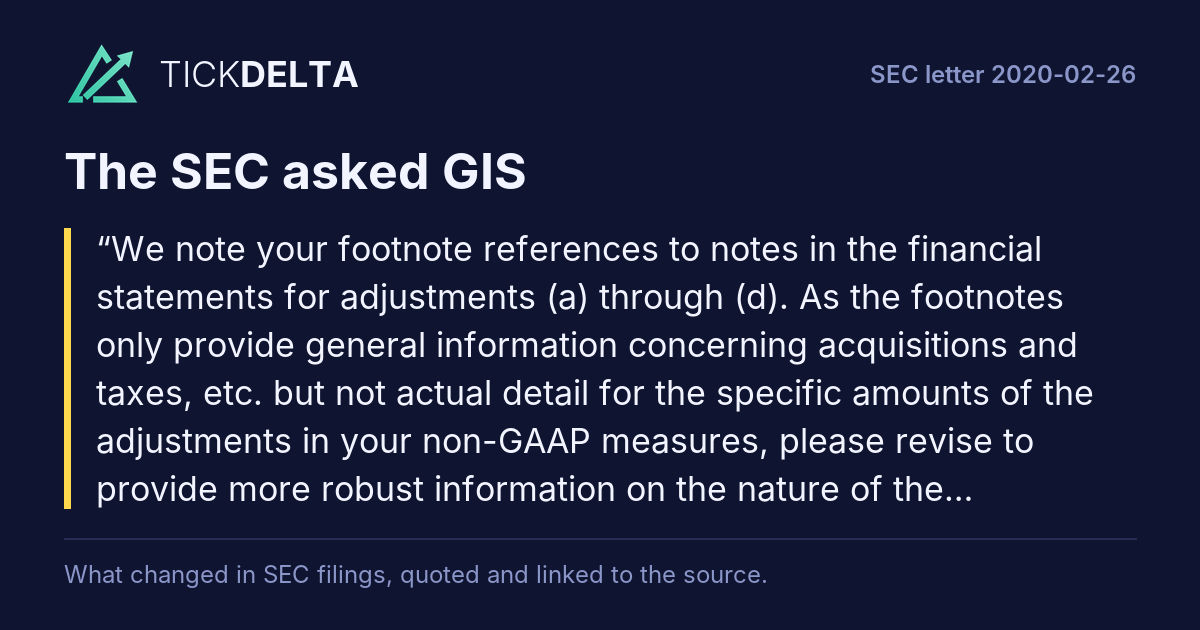
We note your footnote references to notes in the financial statements for adjustments (a) through (d). As the footnotes only provide general information concerning acquisitions and taxes, etc. but not actual detail for the specific amounts of the adjustments in your non-GAAP measures, please revise to provide more robust information on the nature of the adjustments and how such adjustments were determined.
Rest of the question

All non-GAAP measures with footnotes referencing the financial statement footnotes should be similarly revised.

GIS answered
In future filings, we will revise the explanatory footnotes to include additional information, including a description of such adjustment, and a reference to the respective financial statement footnote, if applicable. The information included within the referenced financial statement note disclosures will provide further information as to the nature of the adjustments and how such adjustments were determined. Read in the reply ↗
In its next report

First report after the company's reply of 2020-03-25: 10-K filed 2020-07-02 ↗, against the 10-K filed 2019-06-28 ↗.

Tickdelta does not hold the text of both reports, so they are not compared here.

Net Debt-to-Adjusted Earnings before Net Interest, Income Taxes, Depreciation and · Amortization (EBITDA) Ratio, page 46
SEC asked (2)
We note that your reconciliation of EBITDA contains adjustments for net earnings attributable to redeemable and noncontrolling interests and after-tax earnings from joint ventures. Please note that EBITDA, by definition, should only reflect adjustments for interest, taxes, depreciation and amortization.
Rest of the question

In this regard, please revise to remove these other adjustments from your calculation of EBITDA or alternatively, you may include such adjustments in your calculation of Adjusted EBITDA. Please refer to Question 103.01 of our Compliance and Disclosure Interpretations for Non-GAAP Measures dated April 4, 2018.

GIS answered
In future filings where we include an EBITDA measure, we will calculate and present EBITDA to reflect adjustments for only interest, taxes, depreciation and amortization. Any additional adjustments will be reflected in our calculation of Adjusted EBITDA. Read in the reply ↗
In its next report

First report after the company's reply of 2020-03-25: 10-K filed 2020-07-02 ↗, against the 10-K filed 2019-06-28 ↗.

Tickdelta does not hold the text of both reports, so they are not compared here.

Note 2. Summary of Significant Accounting Policies · Inventories, page 58
SEC asked (3)
We note your disclosure that your inventories in the United States other than grain are carried at the lower of cost, using the last-in, first-out (LIFO) method or market value. Please tell us how this is consistent with ASC 330-10-35-1B, which indicates that inventories should be valued at the lower of cost or net realizable value. Revenue Recognition, page 60
GIS answered
We account for our inventories in the United States, other than grain, at the lower of cost, using the last-in-first-out (LIFO) method, or market. Per ASC 330-10-35-1A, “The subsequent measurement of inventory depends on the cost method, and is different for the following:…b) Inventory measured using LIFO or the retail inventory method (see paragraphs ASC 330-10-35-1C through 35-7)…” Since we utilize LIFO as our cost method for inventories in the United States, other than grain, we apply ASC 330-10-35-1C which states, “A departure from the cost basis of pricing inventory measured using LIFO…
Rest of the answer

is required when the utility of the goods is no longer as great as their cost… This is generally accomplished by stating such goods at a lower level commonly designated as market.” Further, per ASC

330-10-35-2, “The measurement of such losses for inventory measured using LIFO… shall be accomplished by applying the rule of pricing inventories at the lower of cost or market…” We therefore note in our policy that our inventories in the United States other than grain are carried at the lower of cost, using the last-in, first-out (LIFO) method or market value as prescribed in this guidance.

We disclose in our policy that inventories outside of the United States are generally valued at the lower of cost, using the first-in, first-out (FIFO) method, or net realizable value as prescribed by ASC 330-10-35-1B.

We believe that our accounting for inventories and related disclosures in Note 2. Summary of Significant Accounting Policies in our Form 10-K for the Fiscal Year Ended May 26, 2019 are consistent with the guidance prescribed in ASC 330.

Read in the reply ↗
In its next report

First report after the company's reply of 2020-03-25: 10-K filed 2020-07-02 ↗, against the 10-K filed 2019-06-28 ↗.

Tickdelta does not hold the text of both reports, so they are not compared here.

Note 2. Summary of Significant Accounting Policies · Inventories, page 58
SEC asked (4)
We note from page 5 of your Form 10-K that you have multiple licensing arrangements. To the extent material, please tell us, and revise to disclose your revenue recognition policies with regards to licensing and royalties. Refer to the licensing literature in ASC 606 beginning at 606-10-55-54 and advise.
GIS answered
We receive royalties pursuant to certain sales-based licensing arrangements for the use of our intellectual property. Such arrangements are accounted for under the prescribed guidance of ASC 606. Annual royalties related to these licensing arrangements are less than one percent of our consolidated net sales and are immaterial to our Consolidated Financial Statements. As such, our revenue recognition policies related to these licensing arrangements are not disclosed in Note 2.
Rest of the answer

Summary of Significant

Accounting Policies in our Form 10-K for the Fiscal Year Ended May 26, 2019.

We hope that our letter has addressed each of your comments. If you have questions regarding our responses, please contact Trevor Gunderson at (763) 764-5324.

Read in the reply ↗
In its next report

First report after the company's reply of 2020-03-25: 10-K filed 2020-07-02 ↗, against the 10-K filed 2019-06-28 ↗.

Tickdelta does not hold the text of both reports, so they are not compared here.

Also in this review: company letter, 2020-03-18, closing letter, 2020-04-02

2 other letters: notices that a filing will not be reviewed, requests to declare a registration effective, and the like

From the SEC's correspondence on EDGAR: staff letters (form UPLOAD) and company letters (form CORRESP), 9 letters filed since 2020-02-26. Questions and answers are matched by their numbers; topics come from words in each question. The reports are compared word for word (same form, before the first SEC letter against the first report after the company's reply). No AI.

Next in Owners and insiders Insider trades →

Work on GIS in a spreadsheet: Excel workbook (a sheet per section, ten years by column, charts, links to the filings) · CSV. For a Google Sheet that stays up to date, paste =IMPORTDATA("https://tickdelta.com/company/GIS/export.csv") into a cell.