Form 10-K for the Fiscal Year Ended May 26, 2019
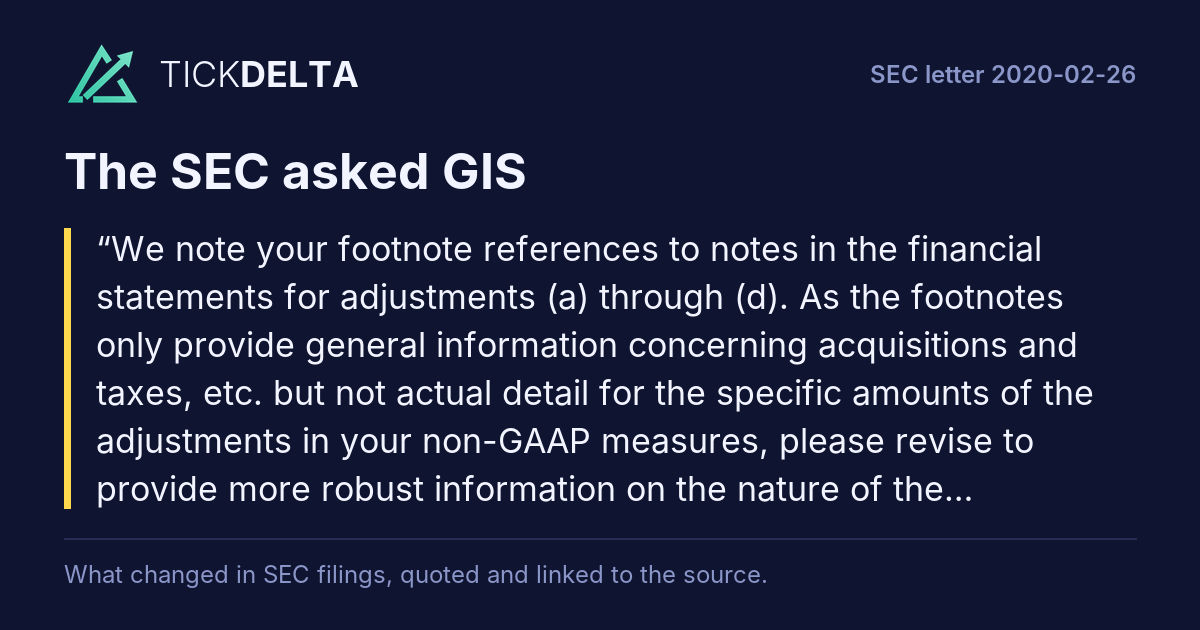
We note your footnote references to notes in the financial statements for adjustments (a) through (d). As the footnotes only provide general information concerning acquisitions and taxes, etc. but not actual detail for the specific amounts of the adjustments in your non-GAAP measures, please revise to provide more robust information on the nature of the adjustments and how such adjustments were determined.Rest of the question
All non-GAAP measures with footnotes referencing the financial statement footnotes should be similarly revised.
In future filings, we will revise the explanatory footnotes to include additional information, including a description of such adjustment, and a reference to the respective financial statement footnote, if applicable. The information included within the referenced financial statement note disclosures will provide further information as to the nature of the adjustments and how such adjustments were determined. Read in the reply ↗
First report after the company's reply of 2020-03-25: 10-K filed 2020-07-02 ↗, against the 10-K filed 2019-06-28 ↗.
Tickdelta does not hold the text of both reports, so they are not compared here.
We note that your reconciliation of EBITDA contains adjustments for net earnings attributable to redeemable and noncontrolling interests and after-tax earnings from joint ventures. Please note that EBITDA, by definition, should only reflect adjustments for interest, taxes, depreciation and amortization.Rest of the question
In this regard, please revise to remove these other adjustments from your calculation of EBITDA or alternatively, you may include such adjustments in your calculation of Adjusted EBITDA. Please refer to Question 103.01 of our Compliance and Disclosure Interpretations for Non-GAAP Measures dated April 4, 2018.
In future filings where we include an EBITDA measure, we will calculate and present EBITDA to reflect adjustments for only interest, taxes, depreciation and amortization. Any additional adjustments will be reflected in our calculation of Adjusted EBITDA. Read in the reply ↗
First report after the company's reply of 2020-03-25: 10-K filed 2020-07-02 ↗, against the 10-K filed 2019-06-28 ↗.
Tickdelta does not hold the text of both reports, so they are not compared here.
We note your disclosure that your inventories in the United States other than grain are carried at the lower of cost, using the last-in, first-out (LIFO) method or market value. Please tell us how this is consistent with ASC 330-10-35-1B, which indicates that inventories should be valued at the lower of cost or net realizable value. Revenue Recognition, page 60
We account for our inventories in the United States, other than grain, at the lower of cost, using the last-in-first-out (LIFO) method, or market. Per ASC 330-10-35-1A, “The subsequent measurement of inventory depends on the cost method, and is different for the following:…b) Inventory measured using LIFO or the retail inventory method (see paragraphs ASC 330-10-35-1C through 35-7)…” Since we utilize LIFO as our cost method for inventories in the United States, other than grain, we apply ASC 330-10-35-1C which states, “A departure from the cost basis of pricing inventory measured using LIFO…Read in the reply ↗Rest of the answer
is required when the utility of the goods is no longer as great as their cost… This is generally accomplished by stating such goods at a lower level commonly designated as market.” Further, per ASC
330-10-35-2, “The measurement of such losses for inventory measured using LIFO… shall be accomplished by applying the rule of pricing inventories at the lower of cost or market…” We therefore note in our policy that our inventories in the United States other than grain are carried at the lower of cost, using the last-in, first-out (LIFO) method or market value as prescribed in this guidance.
We disclose in our policy that inventories outside of the United States are generally valued at the lower of cost, using the first-in, first-out (FIFO) method, or net realizable value as prescribed by ASC 330-10-35-1B.
We believe that our accounting for inventories and related disclosures in Note 2. Summary of Significant Accounting Policies in our Form 10-K for the Fiscal Year Ended May 26, 2019 are consistent with the guidance prescribed in ASC 330.
First report after the company's reply of 2020-03-25: 10-K filed 2020-07-02 ↗, against the 10-K filed 2019-06-28 ↗.
Tickdelta does not hold the text of both reports, so they are not compared here.
We note from page 5 of your Form 10-K that you have multiple licensing arrangements. To the extent material, please tell us, and revise to disclose your revenue recognition policies with regards to licensing and royalties. Refer to the licensing literature in ASC 606 beginning at 606-10-55-54 and advise.
We receive royalties pursuant to certain sales-based licensing arrangements for the use of our intellectual property. Such arrangements are accounted for under the prescribed guidance of ASC 606. Annual royalties related to these licensing arrangements are less than one percent of our consolidated net sales and are immaterial to our Consolidated Financial Statements. As such, our revenue recognition policies related to these licensing arrangements are not disclosed in Note 2.Read in the reply ↗Rest of the answer
Summary of Significant
Accounting Policies in our Form 10-K for the Fiscal Year Ended May 26, 2019.
We hope that our letter has addressed each of your comments. If you have questions regarding our responses, please contact Trevor Gunderson at (763) 764-5324.
First report after the company's reply of 2020-03-25: 10-K filed 2020-07-02 ↗, against the 10-K filed 2019-06-28 ↗.
Tickdelta does not hold the text of both reports, so they are not compared here.
Also in this review: company letter, 2020-03-18, closing letter, 2020-04-02