Added10-Q Oct 28, 2026 vs 10-K Feb 23, 2026
We do not believe there are any material changes from the risk factors previously disclosed in the Quarterly Report.
Each branch is a paragraph in Risk Factors with nothing like it in the 10-K filed Feb 25, 2025. A box jumps to the paragraph as filed, below.
11 paragraphs in Risk Factors of the 10-K filed Feb 23, 2026 with nothing like them in the 10-K filed Feb 25, 2025. Quoted exactly. Paragraphs that were only edited are under 10-K change.
Additionally, U.S. government shutdowns, including the shutdown that occurred in the fourth quarter of 2025, have impacted and could in the future impact certain regulatory agencies relevant to us, such as the U.S. FDA. Significant changes to operations at or the funding of such regulatory agencies could cause decreases in staff or changes in policy and enforcement priorities. Hospitals, ambulatory surgery centers and other health care providers may not purchase our products if reductions in agency staffing results in inadequate reimbursement from third-party payers for procedures using our products. If a government shutdown continues for a prolonged period of time, or if a widespread freeze on federal funding occurs, it could significantly impact the ability of the FDA to timely review and process our regulatory submissions or negatively affect sales of our products.
with an adequate supply of components or products, could cause delay in the manufacture of our products, thereby impairing our ability to meet the demand of our customers and causing significant harm to our business. Any disruption of this nature or increased expense could harm our commercialization efforts and adversely affect our operating results.
operating results may continue and could generate volatility in the price of our common stock. Comparisons of our past financial results should not be relied upon as an indication of our future performance.
We have and may continue to enter into acquisitions, collaborations, in-licensing agreements, joint ventures and partnerships in order to retain our competitive position within the marketplace, develop new products or expand into new markets. Examples include our acquisitions of Mobius Therapeutics, LLC, DOSE Medical, and Avedro, as well as our licensing of Santen’s PRESERFLO® Microshunt® (Preserflo MicroShunt), and the Attillaps, iVeena, Ripple and Stuart pharmaceutical compounds. However, we cannot assure you that we will be able to successfully
Our enterprise resource planning (ERP) system is integral to our ability to accurately and efficiently maintain our books and records, record transactions, and prepare our financial statements. Any disruptions or
We have incorporated and continue to further incorporate artificial intelligence into our internal operations. Implementation of artificial intelligence and machine learning technologies may result in legal and regulatory risks, reputational harm, or other adverse consequences to our business.
We have and are continuing to incorporate artificial intelligence (AI), including machine learning and independent algorithms, in certain of our business processes, including for research and development purposes. As with many innovations, AI presents risks and challenges that could undermine or slow its adoption, and therefore harm our business to the extent we increase our reliance on AI in the future. Moreover, our competitors may introduce AI technologies and features into their operations that result in greater efficiencies or other competitive advantages over us. Additionally, AI algorithms may be flawed or datasets may be insufficient or contain biased information resulting in perceived or actual negative outcomes. If the output that AI algorithms assist in producing are or are alleged to be inaccurate, deficient, or biased, our business, financial condition, and results of operations may be adversely affected. The use of AI could pose security and other risks to our confidential or proprietary information, including personal, customer or patient information, or could expose us to legal liability and reputational harm in the event AI output includes third party proprietary information. Issues relating to the use of new and evolving technologies such as AI that we integrate into our operations may cause us to experience brand or reputational harm, competitive harm, legal liability, new or enhanced governmental or regulatory scrutiny, and to incur additional costs to resolve such issues.
Several laws have been enacted at the U.S. state level that regulate the development and deployment of AI platforms and systems. Federal agencies in the U.S. are applying existing laws to address AI-related risks. An Executive Order issued in December 2025 seeks to establish uniform federal standards and challenge state laws that regulate AI. As with data privacy laws, these state laws and possible federal regulation could have significant effects on us and require us to change our AI practices and incur substantial costs and expenses in order to comply. Additionally, many countries and regions, including the EU, have proposed or passed new and evolving regulations related to the use of AI and machine learning technologies. The regulations may impose onerous obligations and may require us to unexpectedly rework or reevaluate improvements to be compliant. In particular, the EU Artificial Intelligence Act, which was adopted on June 13, 2024, may affect our use of AI technologies, may require additional compliance measures and changes to our operations and processes, and expose us to increased risk of regulatory enforcement and litigation. Furthermore, some of the AI features involve the processing of personal data and may be subject to laws, policies, legal obligations, and codes of conduct related to privacy and data protection, and could subject us to competitive harm, regulatory enforcement, increased cyber risks, reputational harm, and legal liability.
Additionally, the U.S. government recently announced changes to its trade policies, including increasing tariffs on imports, in some cases significantly, and potentially negotiating or terminating existing trade agreements. The current tariff environment is dynamic and uncertain, as the U.S. government has imposed, modified and paused tariffs multiple times since the beginning of 2025, and on February 20, 2026, the U.S. Supreme Court struck down the international tariffs imposed by President Trump in 2025, and President Trump subsequently expressed his intent to reinstate the tariffs through other means which have not yet been disclosed. Changes to tariffs and other trade restrictions can be announced at any time with little or no notice. We cannot predict with certainty the future trade policy of the U.S. or other countries or the impact of the recent developments discussed above, however, we believe our exposure to the current tariff environment is limited as we primarily source products and product components from the U.S. Nevertheless, such tariffs, or uncertainty regarding tariff policy, may cause (i) increases in manufacturing costs, (ii) disruptions or delays to our supply chain, (iii) limitations on our ability to sell our products domestically or abroad, and (iv) reductions in sales volumes and gross margins for our products, any of which could negatively affect our business, results of operations and financial condition.
facility fee payment rates, which had an adverse impact on procedural iStent family product volumes and our revenues and net income.
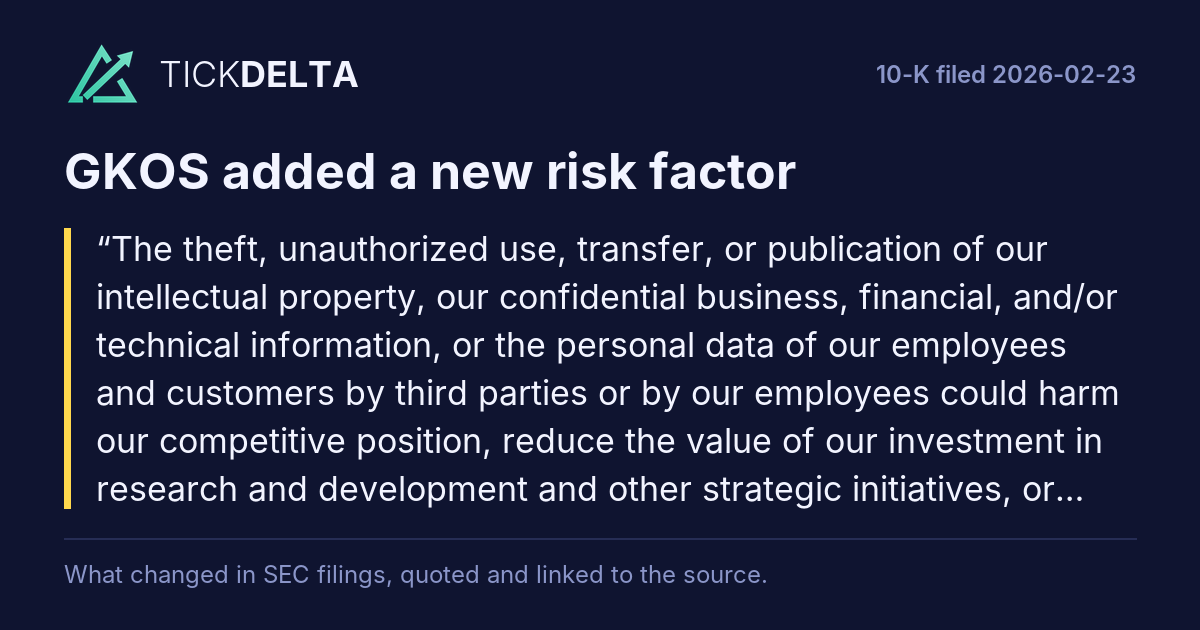
The theft, unauthorized use, transfer, or publication of our intellectual property, our confidential business, financial, and/or technical information, or the personal data of our employees and customers by third parties or by our employees could harm our competitive position, reduce the value of our investment in research and development and other strategic initiatives, or otherwise adversely affect our business. Despite our efforts, we cannot guarantee that we will be able to adequately protect our proprietary rights, which could substantially impair our ability to compete. Our patents may be challenged and held invalid or we may be unable to extend the protection on products
New in the latest 10-Q
13 paragraphs in the 10-Q filed Oct 28, 2026 with nothing like them in the 10-Q filed Jul 29, 2026 (at least half the words must differ; new numbers alone do not count). Quoted exactly, grouped by the item heading above them. This is text that changed, not a judgement of how serious it is.
Revenue is recognized at an amount that reflects the consideration the Company expects to be entitled to in exchange for goods or services, and substantially all of the Company’s net sales for the three and nine months ended September 30, 2026 and 2025 are considered revenue from contracts with customers.
Read in the 10-Q
OBBBA within the provision for income taxes and the deferred tax balances as of September 30, 2026. The OBBBA did not materially impact the Company's effective tax rate for the three and nine months ended September 30, 2026.
Read in the 10-Q
On October 2, 2026, the Company entered into a development agreement and related lease agreement for a new research and development (R&D) and manufacturing facility in Huntsville, Alabama (Huntsville Facility). The Huntsville Facility is expected to contain approximately 259,000 square feet situated on approximately 25 acres of land, and will include office, cleanroom, laboratory, warehouse and manufacturing space, which is anticipated to result in approximately $42.0 million in project costs over the multi-year project. The Company expects construction to begin in the fourth quarter of 2026.
Read in the 10-Q
On October 8, 2026, the Company announced it had entered into an exclusive license agreement with RevOpsis Therapeutics, Inc. (RevOpsis) for the rights to research, develop, manufacture and commercialize a multi-specific biologic molecule, as well as up to four additional retinal products, utilizing RevOpsis’ proprietary platform.
Read in the 10-Q
Under the agreement, the Company paid a non-refundable upfront license fee of $10.0 million. The Company may also be required to make development and regulatory milestone payments of up to $165.0 million for the licensed biologic molecule, and license fee and milestone payments of up to $175.0 million for each of the four additional products it has the right to license, for a total of $875.0 million in potential milestone payments in the event the Company licenses, develops and commercializes all five products. RevOpsis is also eligible to receive tiered royalties ranging from 3% to 8% on annual net sales of licensed products, and the Company has the right to designate one Company representative to serve on the RevOpsis board of directors.
Read in the 10-Q
Effective as of October 21, 2026, the Company entered into agreement to acquire certain real property consisting of an approximately 40,000 square foot, two-story building, located in Aliso Viejo, California (the Aliso Building) and adjacent to the Company's existing Aliso Viejo, California corporate headquarters. The transaction is not expected to close until mid- to late-2027 and remains subject to certain closing conditions. The Aliso Building provides the Company with future expansion opportunities and potentially reduces future capital expenditures associated with construction of an additional building as part of the Company's corporate headquarters. The purchase price for the Aliso Building will be $15.2 million.
Read in the 10-Q
On October 21, 2026, we entered into agreement to acquire certain real property consisting of an approximately 40,000 square foot, two-story building, located in Aliso Viejo, California (the Aliso Building) and adjacent to our existing Aliso Viejo, California corporate headquarters. The transaction is not expected to close until mid- to late-2027 and remains subject to certain closing conditions. The Aliso Building provides us with future expansion opportunities and potentially reduces future capital expenditures associated with construction of an additional building as part of our corporate headquarters. The purchase price for the Aliso Building will be $15.2 million.
Read in the 10-Q
On October 8, 2026, we announced that we entered into an exclusive license agreement with RevOpsis Therapeutics, Inc. (RevOpsis) for the rights to research, develop, manufacture and commercialize a multi-specific biologic molecule, as well as up to four additional retinal products, utilizing RevOpsis’ proprietary platform. Under the agreement, we paid a non-refundable upfront license fee of $10.0 million. We may also be required to make development and regulatory milestone payments of up to $165.0 million for the licensed biologic molecule, and license fee and milestone payments of up to $175.0 million for each of the four additional licensed products, for a total of $875.0 million in potential milestone payments in the event the Company licenses, develops and commercializes all five products. RevOpsis is also eligible to receive tiered royalties ranging from 3% to 8% on annual net sales of licensed products, and the Company has the right to designate one Company representative to serve on the RevOpsis board of directors.
Read in the 10-Q
On September 29, 2026, the Company entered into a resolution agreement (the Resolution Agreement) with the Regents of the University of California (the Regents) to resolve the final payment relating to certain U.S. patents under the December 2014 UC-Glaukos Agreement. Pursuant to the Resolution Agreement, we agreed to pay the Regents $14.1 million, a portion of which will be directed to the Gavin Herbert Eye Institute and other recipients to develop innovative technologies to diagnose and treat ophthalmic and other diseases and disorders (the resolution amount), in exchange for a release of all claims relating to the December 2014 agreement and the specified patents, including claims for past or future payments under the December 2014 agreement.
Read in the 10-Q
We do not believe there are any material changes from the risk factors previously disclosed in the Quarterly Report.
Read in the 10-Q
suppliers, or their inability to provide us with an adequate supply of components or products, could cause delay in the manufacture of our products, thereby impairing our ability to meet the demand of our customers and causing significant harm to our business. Any disruption of this nature or increased expense could harm our commercialization efforts and adversely affect our operating results.
Read in the 10-Q
overhead costs, product shortages, or loss or misuse of intellectual property or data, including proprietary, confidential, sensitive or personal information, all of which could have a material adverse effect on our reputation, business, financial condition and operating results or result in investigations, claims and administrative penalties by regulators.
Read in the 10-Q
domestically or abroad, and (iv) reductions in sales volumes and gross margins for our products, any of which could negatively affect our business, results of operations and financial condition.
Read in the 10-Q
Item 1A of the 10-Q filed Oct 28, 2026 against Item 1A of the 10-K filed Feb 23, 2026.
A 10-Q repeats only the risks that changed, so a 10-K paragraph that is missing from it is not counted as removed.
Added is a paragraph with nothing like it in the 10-K, Reworded a sentence that is in both with several words changed,
Quiet changes a sentence in both where one to four words changed and one is a hedge or a modal
(cut words struck through, new words highlighted).
Text on the page, not a score; each links to the filing at sec.gov.
The first 15 of 30 are shown (at most 12 of each type).
Two-word phrases in Risk Factors of the 10-K filed Feb 23, 2026 that are in none of the 1 earlier 10-Ks stored, back to Feb 25, 2025
Used at least twice, small words left out. Counted, not picked: a phrase can be new because the company renamed something.
10 paragraphs of last year's Risk Factors with nothing like them now. The longest are quoted.
Item 1A of each 10-K and 10-Q on EDGAR, quoted exactly. Each paragraph links to the filing at sec.gov.
10-K change: what was reworded or cut, section by section.
Excel workbook · CSV. Google Sheet that stays up to date: paste =IMPORTDATA("https://tickdelta.com/company/GKOS/export.csv") into a cell.