Screener / SEC EDGAR /CIK 0001222333 /10-K filed Nov 25, 2025, compared with Nov 25, 2024 /Numbers from the XBRL of the 10-Ks
NYSE Financials · Commodity Contracts Brokers & Dealers

Spdr Gold Trust GLD

Compare with peers Embed
SEC comment letters, last 20 years

6 reviews of GLD's filings by SEC staff

UPLOAD and CORRESP
Reviews 6 latest letter Mar 29, 2016
Questions asked 15 each answered in the company's own letter
No closing letter 0 reviews without a letter saying the staff completed it

When the SEC's staff reviews a filing, it writes to the company with numbered questions, and the company answers each one in a letter. SEC publishes the exchange once the review is over, at least 20 business days later. A question is not an accusation; most reviews end with the company adding detail to its next filing.

How the reviews went

Every review on EDGAR, from the first staff letter to the letter that closes it

  1. 1. Staff letters 7 UPLOAD
  2. 2. Questions in them 15 numbered comments
  3. 3. Company replies 5 CORRESP
  4. 4. Reviews closed 6 of 6 closing letter

Half the closed reviews took 39 days or less from the first letter to the closing letter.

Form 10-K

2016-03-29 to 2016-05-11 · 1 question · 1 letter from the SEC, 1 from the company
Review closed 2016-05-11
Custody of the Trust’s Gold, page 17
SEC asked
We understand that the Custodian may appoint one or more subcustodians to hold the Trust’s gold and that the Custodian currently uses a number of subcustodians, identified on page 18. You also outline risks that may arise in connection with the use of subcustodians. In future Exchange Act periodic reports, to the extent material, please disclose the amount of the Trust’s assets that are held by subcustodians.
GLD answered
We will, to the extent material, disclose in future periodic reports the amount of the Trust’s assets that are held by subcustodians.

Please be advised that during fiscal 2015, no gold was held by subcustodians on behalf of Trust.

The Sponsor on behalf of the Trust hereby acknowledges that:

• the Trust is responsible for the adequacy and accuracy of the disclosure in the filing;

staff comments or changes to disclosure in response to staff comments do not foreclose the Commission from taking any action with respect to the filing; and the Trust may not assert staff comments as a defense in
Rest of the answer

any proceeding initiated by the Commission or any person under the federal securities laws of the United States.

If you have any further questions, please do not hesitate to contact our counsel, Mr. Steven Glusband of Carter Ledyard &

Milburn LLP at 212-238-8605.

Read in the reply
In its next report

First report after the company's reply of Mar 30, 2016: 10-Q filed Apr 29, 2016 ↗, against the 10-Q filed Jan 29, 2016 ↗.

Tickdelta does not hold the text of both reports, so they are not compared here.
Also in this review: closing letter, 2016-05-11
Schedule 14A

2014-04-24 to 2014-05-23 · 1 question · 1 letter from the SEC, 0 from the company
Review closed 2014-05-23
SEC letter of Apr 24, 2014 ↗ no reply letter on EDGAR (the company may have answered in an amended filing)
General
SEC asked
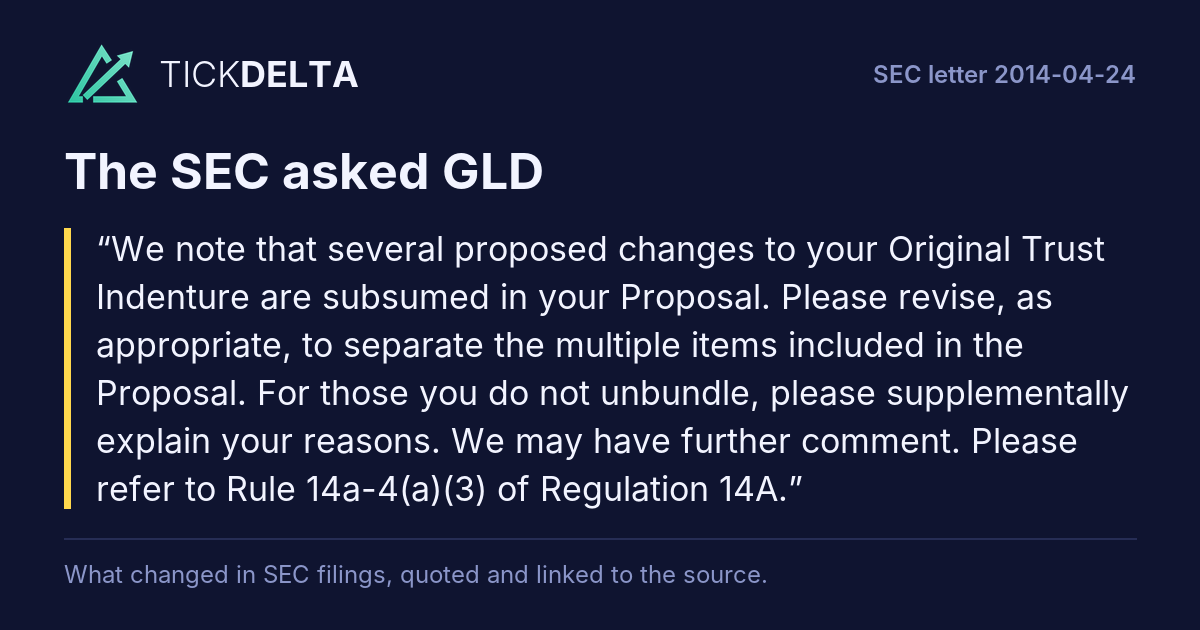
We note that several proposed changes to your Original Trust Indenture are subsumed in your Proposal. Please revise, as appropriate, to separate the multiple items included in the Proposal. For those you do not unbundle, please supplementally explain your reasons. We may have further comment. Please refer to Rule 14a-4(a)(3) of Regulation 14A.
GLD answered

No reply letter found.

Also in this review: closing letter, 2014-05-23

Form 10-K for the fiscal year ended September 30, 2013

2014-03-12 to 2014-04-04 · 2 questions · 1 letter from the SEC, 1 from the company
Review closed 2014-04-04
Item 10. Directors, Executive Officers and Corporation Governance, page 49
SEC asked (1)
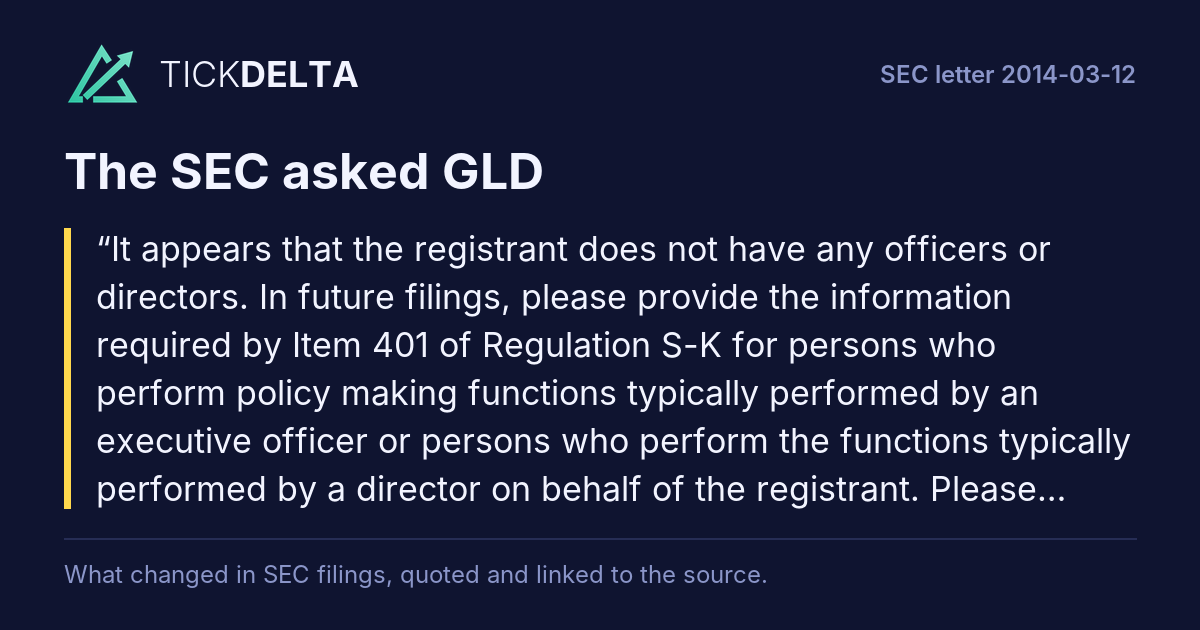
It appears that the registrant does not have any officers or directors. In future filings, please provide the information required by Item 401 of Regulation S-K for persons who perform policy making functions typically performed by an executive officer or persons who perform the functions typically performed by a director on behalf of the registrant. Please see Rule 405 of Regulation C.
GLD answered
As requested by the Staff, future Annual Reports on Form 10-K will include the information required by Item 401 of Regulation S-K with respect to any person who, during the period covered by the report, performed with respect to the registrant any policy-making functions typically performed by an executive officer, or any functions typically performed by a director.
Read in the reply
In its next report

First report after the company's reply of Apr 1, 2014: 10-Q filed May 9, 2014 ↗, against the 10-Q filed Feb 7, 2014 ↗.

Tickdelta does not hold the text of both reports, so they are not compared here.

Item 10. Directors, Executive Officers and Corporation Governance, page 49
SEC asked (2)
In future filings, to the extent applicable, please provide the information required by Item 404 of Regulation S-K.
GLD answered
As requested by the Staff, future Annual Reports on Form 10-K will include the information required by Item 404 of Regulation S-K, if applicable.

--

The Sponsor on behalf of the Trust hereby acknowledges that:

· the Trust is responsible for the adequacy and accuracy of the disclosure in the filing;

staff comments or changes to disclosure in response to staff comments do not foreclose the Commission from taking any action with respect to the filing; and the Trust may not assert staff comments as a defense in any proceeding initiated by the Commission or any person under the federal
Rest of the answer

securities laws of the United States,

If you have any further questions, please do not hesitate to contact our counsel, Mr. Steven Glusband of Carter Ledyard & Milburn LLP at 212-238-8605.

Read in the reply
In its next report

First report after the company's reply of Apr 1, 2014: 10-Q filed May 9, 2014 ↗, against the 10-Q filed Feb 7, 2014 ↗.

Tickdelta does not hold the text of both reports, so they are not compared here.

Also in this review: closing letter, 2014-04-04

Form 10-K for the fiscal year ended September 30, 2012

2013-02-12 to 2013-04-18 · 5 questions · 2 letters from the SEC, 2 from the company
Review closed 2013-04-18
Risk factorsDerivatives and hedgingDebt
Item 1. Business · The Trustee, page 15
SEC asked (1)
We note your disclosure on page 15 that the Trustee may visit the premises of the Custodian up to twice a year. In future Exchange Act periodic reports, please disclose whether during the reporting period the Trustee visited the premises of the Custodian and examined the Trust’s gold and records.
GLD answered
We note your disclosure on page 15 that the Trustee may visit the premises of the Custodian up to twice a year. In future Exchange Act periodic reports, please disclose whether during the reporting period the Trustee visited the premises of the Custodian and examined the Trust's gold and records.

The Sponsor on behalf of the Trust has noted the Staff’s comment and will disclose in its future Exchange Act periodic reports whether, during the reporting period, the Trustee visited the premises of the Custodian and examined the Trust's gold and records.
Read in the reply
In its next report

First report after the company's reply of Mar 8, 2013: 10-Q filed May 8, 2013 ↗, against the 10-Q filed Feb 5, 2013 ↗.

Tickdelta does not hold the text of both reports, so they are not compared here.

Item 1. Business · The Trustee, page 15
SEC asked (2)
We note your disclosure on page 15 that the Trustee has no right to visit the premises of any sub-custodian for the purposes of examining the Trust’s gold and related records. We also note your disclosure on page 31 that neither the Trustee nor the Custodian monitors or oversees the activities of any sub-custodian who may temporarily hold the Trust’s gold bars.
Rest of the question

In future Exchange Act periodic reports, please discuss whether the Custodian has the right to visit the premises of any sub-custodian for the purposes of examining the Trust’s gold.

GLD answered
We note your disclosure on page 15 that the Trustee has no right to visit the premises of any sub-custodian for the purposes of examining the Trust's gold and related records. We also note your disclosure on page 31 that neither the Trustee nor the Custodian monitors or oversees the activities of any sub-custodian who may temporarily hold the Trust's gold bars.
Rest of the answer

In future Exchange Act periodic reports, please discuss whether the Custodian has the right to visit the premises of any sub-custodian for the purposes of examining the Trust's gold.

The Sponsor on behalf of the Trust has noted the Staff’s comment. As previously disclosed and to date, the Custodian has not utilized sub-custodians on behalf of the Trust during the three years ended September 30, 2012. If sub-custodians are utilized in the future, the use of subcustodians will be discussed in its future Exchange Act periodic reports along with whether the Custodian has the right to visit the premises of any sub-custodian for the purposes of examining the Trust's gold.

Read in the reply
In its next report

First report after the company's reply of Mar 8, 2013: 10-Q filed May 8, 2013 ↗, against the 10-Q filed Feb 5, 2013 ↗.

Tickdelta does not hold the text of both reports, so they are not compared here.

Item 1A. Risk Factors · “The Share may trade at a price which is at, above or below the NAV . . . ,” page 27
SEC asked (3)
In future Exchange Act periodic reports, please discuss, if applicable, any material fluctuations between the trading price and NAV per share.
GLD answered
In future Exchange Act periodic reports, please discuss, if applicable, any material fluctuations between the trading price and NAV per share.

The Sponsor on behalf of the Trust has noted the Staff’s comment. Please be advised that the Sponsor believes that the price of the Trust’s shares accurately track the NAV per share at the time the NAV is set. As such, we do not believe that there are any material fluctuations between the trading price and the NAV per share at that time.
Rest of the answer

As indicated in the risk factor, subsequent to the time that the NAV is set, the share price may fluctuate during the remainder of the trading day, tracking changes in the spot gold market.

Read in the reply
In its next report

First report after the company's reply of Mar 8, 2013: 10-Q filed May 8, 2013 ↗, against the 10-Q filed Feb 5, 2013 ↗.

Tickdelta does not hold the text of both reports, so they are not compared here.

Note 2.1 – Valuation of Gold, page F-8
SEC asked (4)
We note that gold is valued, for financial statement purposes, at the lower of cost or market. Please clarify whether this policy also applies to gold held in your unallocated gold account. To the extent it does, please clarify your basis in GAAP for applying this policy to your unallocated gold.
Rest of the question

We urge all who are responsible for the accu racy and adequacy of the disclosure in the filing to be certain that the filing includes the information the Securities Exchange Act of 1934 and all applicable Exchange Act rules require. Since the company and its management are in possession of all facts relating to a company’s disclosure, they are responsible for the accuracy and adequacy of the disclosures they have made. In responding to our comments, please provide a written statement from the company acknowledging that:  the company is responsible for the adequacy and accuracy of the disclosure in the filing;  staff comments or changes to disclosure in response to staff comments do not foreclose the Commission from taking any action with respect to the filing; and  the company may not assert staff comments as a defense in any proceeding initiated by the Commission or any person under the federal securities laws of the United States.

GLD answered
Both allocated and unallocated gold bullion are held at lower of average cost or market value for financial statement reporting purposes. There are no differentiation factors under US GAAP which would require a different accounting policy between allocated and unallocated bullion. The Trust’s accounting policy has historically been, for financial statement purposes, to value all of the gold held by the Custodian, both allocated and unallocated, on behalf of Trust at the lower of average cost or market value.
Rest of the answer

This accounting policy is stated in the Trust’s quarterly and annual filings with the Commission.

As requested, the Sponsor on behalf of the Trust hereby acknowledges that:

· the Trust is responsible for the adequacy and accuracy of the disclosure in the filing;

staff comments or changes to disclosure in response to staff comments do not foreclose the Commission from taking any action with respect to the filing; and the Trust may not assert staff comments as a defense in any proceeding initiated by the Commission or any person under the federal securities laws of the United States.

If you have any further questions, please do not hesitate to contact our counsel, Mr. Steven Glusband of Carter Ledyard & Milburn LLP at 212-238-8605.

Read in the reply
In its next report

First report after the company's reply of Mar 8, 2013: 10-Q filed May 8, 2013 ↗, against the 10-Q filed Feb 5, 2013 ↗.

Tickdelta does not hold the text of both reports, so they are not compared here.

Form 10-K for the Fiscal Year Ended September 30, 2012 · Note 2.1 – Valuation of Gold, page F-8
SEC asked
We have considered your response to comment four. We note from disclosures on page 9 that you indicated gold held in unallocated accounts are not segregated from the Custodian’s assets and therefore the account holder has no ownership interest in any specific bars of gold that the bullion dealer holds or owns.
Rest of the question

Given that “unallocated” gold is not ownership of physical gold, please expand your analysis to further describe your rationale for applying the same accounting to both allocated and unallocated gold bullion. Your response should also address your consideration of whether unallocated gold represented a hybrid instrument composed of a debt host with an embedded gold derivative that required bifurcation. Reference is made to Topic 815-15 of the Accounting Standards Codification.

GLD answered
As indicated in our conference call, the Trust does not hold derivative or hybrid instruments in either its allocated or unallocated bullion accounts. The gold held in both the Trust's allocated account and in its unallocated account is owned by the Trust. The gold in the Trust’s allocated account is identified by bars with specific bar numbers and the Trust publishes a list of these numbers every business day.
Rest of the answer

The gold in the Trust’s unallocated account is not identified by bars with specific bar numbers.

Whether the gold is held in in its allocated account or its unallocated account, the Trust does not trade, lease or loan the gold under any circumstances.

As previously indicated both allocated gold bullion and unallocated gold bullion are held at lower of average cost or market value for financial statement reporting purposes. We continue to believe that under the circumstances there are no differentiation factors under US GAAP which would require a different accounting policy between the Trust’s allocated and unallocated bullion.

As such, Topic 815-15 of the Accounting Standards Codification does not apply to the Trust’s allocated or unallocated bullion accounts since there are no derivative or hybrid instruments held by the Trust.

The Trust's unallocated account is only used for the transfer of gold bullion to and from the Trust's allocated account. Transfers to or from the Trust’s unallocated account are made only in connection with creations or redemptions of Baskets by Authorized Participants or selling gold to pay Trust expenses. Such transfers are made by crediting or debiting to the unallocated account the number of ounces of gold being deposited or withdrawn.

We think it may be helpful to review the procedures discussed in the Trust’s Form 10-K on pages 11 to 12 under which gold moves to and from the Trust’s unallocated account maintained by the Custodian for the Trust.

On any business day, an Authorized Participant of the Trust may place an order with the Trustee to create one or more Baskets. By placing a purchase order, an Authorized Participant agrees to deposit gold with the Trust, or a combination of gold and cash. The Authorized Participant who places a purchase order is responsible for crediting its unallocated account that is maintained with the Trust’s Custodian with the required gold deposit amount by the end of the second business day in London following the purchase order date. Upon receipt of the gold deposit amount, the Custodian, after receiving appropriate instructions from the Authorized Participant and the Trustee, will transfer on the third business day following the purchase order date the gold deposit amount from the Authorized Participant’s unallocated account to the Trust’s unallocated account. At that time, the Trustee will direct DTC to credit the number of Baskets ordered to the Authorized Participant’s DTC account. The expense and risk of delivery, ownership and safekeeping of gold until such gold has been received by the Trust is borne solely by the Authorized Participant.

Acting on standing instructions given by the Trustee, the Custodian will transfer the gold deposit amount from the Trust’s unallocated account to the Trust’s allocated account by allocating to the Trust’s allocated account specific bars of gold from unallocated bars which the Custodian holds. The gold bars in the Trust’s allocated gold account are specific to the account and are identified by a list which shows, for each gold bar, the refiner, assay or fineness, serial number and gross and fine weight.

The procedures by which an Authorized Participant can redeem one or more Baskets mirror the procedures for the creation of Baskets. On any business day, an Authorized Participant may place an order with the Trustee to redeem one or more Baskets. A redemption order so received is effective on the date it is received in satisfactory form by the Trustee. The redemption distribution from the Trust consists of a credit to the unallocated account maintained by the Authorized Participant with the Custodian representing the amount of the gold held by the Trust evidenced by the Shares being redeemed plus, or minus, the cash redemption amount. In the ordinary course of the Trust’s operations there are no cash distributions made to Authorized Participants upon redemptions.

The Custodian transfers the redemption gold amount from the Trust’s allocated account to the Trust’s unallocated account on the third business day following the redemption order date and, thereafter, to the redeeming Authorized Participant’s unallocated account. The gold credited to the Trust's unallocated account is the property of the Trust until it is transferred to the redeeming Authorized Participant.

The Sponsor on behalf of the Trust hereby acknowledges that:

· the Trust is responsible for the adequacy and accuracy of the disclosure in the filing;

staff comments or changes to disclosure in response to staff comments do not foreclose the Commission from taking any action with respect to the filing; and the Trust may not assert staff comments as a defense in any proceeding initiated by the Commission or any person under the federal securities laws of the United States.

If you have any further questions, please do not hesitate to contact our counsel, Mr. Steven Glusband of Carter Ledyard & Milburn LLP at 212-238-8605.

Read in the reply
In its next report

First report after the company's reply of Apr 16, 2013: 10-Q filed May 8, 2013 ↗, against the 10-Q filed Feb 5, 2013 ↗.

Tickdelta does not hold the text of both reports, so they are not compared here.

Also in this review: closing letter, 2013-04-18

Form 10-K for the Fiscal Year Ended September 30, 2011

2012-03-19 to 2012-04-10 · 3 questions · 1 letter from the SEC, 1 from the company
Review closed 2012-04-10
Risk factors
General
SEC asked (1)
In future Exchange Act periodic reports, please disclose your Authorized Participants.
GLD answered
The Sponsor on behalf of the Trust has noted the Staff’s comment and will indicate the names of its Authorized

Participants in its future Exchange Act periodic reports.
Read in the reply
General
SEC asked (2)
In future Exchange Act periodic reports, please discuss in greater detail the specific regulatory oversight of the custodian and the warehousing of the trust’s gold. Please include any related risk factors, if necessary.
GLD answered
We have reviewed this comment with representatives of HSBC Bank USA London Branch, the custodian. They have confirmed that HSBC Bank USA London Branch is subject to prudential regulation on a consolidated basis with HSBC Bank USA N.A. by U.S. regulators and is regulated in relation to conduct of business by the FSA in the U.K. They indicated that the FSA is not solely a banking regulator; it regulates most financial services activity in the U.K.
Rest of the answer

To act as a custodian in relation to a regulated investment product requires specific permission from the FSA and that HSBC Bank USA London Branch holds this permission in relation to certain investment products as detailed on the FSA register.

However, gold bullion is not designated as an investment product under the

UK Financial Services & Markets Act (2000) and is therefore not directly regulated by the FSA. Gold bullion, in addition to cash deposits and spot FX (amongst other products), are subject to the Bank of England’s

“Non-Investment Products Code”, or NIPS Code. This is a voluntary code, but has been widely adopted and endorsed by UK trade associations, such as the British Banking Association and the London Bullion Market Association. The code mirrors many of the obligations set out in the FSA rules. HSBC Bank USA, London Branch refers to the provisions of the NIPS code in its legal documentation.

HSBC Bank USA London Branch is a Market-Making Member of the London Bullion Market Association (LBMA). The LBMA sets out good practice for participants in the bullion market but is not an official regulatory body.

Based on the foregoing and our conversations with you, we intend to include the following risk factor in the Trust’s Annual Report on Form 10-K and in its soon to be filed Registration Statement on Form S-3:

The custody operations of the Custodian are not subject to specific governmental regulatory supervision.

The Custodian is responsible for the safekeeping of the Trust’s gold bullion, that the Custodian allocates to the Trust in connection with the creation of Baskets by Authorized Participants. The Custodian also facilitates the transfer of gold in and out of the Trust through unallocated gold accounts it maintains for Authorized Participants and the Trust. Although the Custodian is a market maker, clearer and approved weigher under the rules of the LBMA, which sets out good practices for participants in the bullion market, the LBMA is not an official or governmental regulatory body. In addition, while the Custodian is subject to general banking regulations by U.S. regulators and is generally regulated in the U.K. by the FSA, such regulatory provisions do not directly cover the Custodian’s custody operations in the U.K. Accordingly, the Trust is dependent on the

Custodian to comply with the best practices of the LBMA and to implement satisfactory internal controls for its custody operations in order to keep the Trust’s gold secure.

Read in the reply
General
SEC asked (3)
In future Exchange Act periodic reports, please discuss in greater detail any affiliations between your various service providers and with your service providers and the Authorized Participants. If there are any conflicts of interest, please discuss and include any applicable risk factors.
GLD answered
The Trust has noted the Staff’s comment and has contacted its service providers to determine whether any affiliations exist between them and the Authorized Participants. We are unaware of any conflicts of interest and the only affiliation known to us between the Trust’s service providers and Authorized Participants is that HSBC Securities Inc.
Rest of the answer

is an affiliate of the Trust’s custodian.

As requested, the Sponsor on behalf of the Trust hereby acknowledges that:

•

The Trust is responsible for the adequacy and accuracy of the disclosure in the filing;

Staff comments or changes to disclosure in response to staff comments do not foreclose the Commission from taking any action with respect to the filing; and

The Trust may not assert staff comments as a defense in any proceeding initiated by the Commission or any person under the federal securities laws of the United States.

If you have any further questions, please do not hesitate to contact our counsel,

Mr. Steven Glusband of Carter Ledyard & Milburn LLP at 212-238-8605.

Read in the reply

Also in this review: closing letter, 2012-04-10

Form 10-K

2008-09-29 to 2008-11-07 · 3 questions · 1 letter from the SEC, 0 from the company
Review closed 2008-11-07
SEC letter of Sep 29, 2008 ↗ no reply letter on EDGAR
Form 10-K filed November 23, 2007 · General
SEC asked (1)
At each place that you refer to the seven year fee reduction period, revise to disclose the actual date of termination or expiration.
GLD answered

No reply letter found.

Exhibits
SEC asked (2)
We refer you to Instruction 1 to Item 601 of Regulation S-K. It appears that you endeavor to incorporate by reference a number of exhibits that were filed in incomplete form in prior filings with the Commission. As Instruction 1 makes clear, you may not incorporate by reference such incomplete versions of the documents.
Rest of the question

Accordingly, please amend to file the final, complete version of each such exhibit that is incomplete.

GLD answered

No reply letter found.

Exhibits
SEC asked (3)
We note your disclosure on page 43 regarding United States Federal Tax Consequences and the statement that the conclusions presented are the opinion of Carter Ledyard & Milburn LLP. To the extent the Form 10-K serves as a Section 10(a)(3) update to your previously filed registration statements, or if you otherwise incorporate it by reference in other filings which require the filing of consents as exhibits, please
Rest of the question

include counsel’s consent as an exhibit to the Form 10-K. Closing Comments Please respond to these comments within 10 business days or tell us when you will provide us with a response. Please furnish a letter that keys your responses to our comments and provides any requested information. Detailed letters greatly facilitate our review. Please understand that we may have additional comments after reviewing your responses to our comments.

GLD answered

No reply letter found.

Also in this review: closing letter, 2008-11-07

Letters without questions

Other letters

UPLOAD and CORRESP
2 other letters: notices that a filing will not be reviewed, requests to declare a registration effective, and the like
  • Sep 28, 2022 · GLD: letter to the SEC · SPDR® Gold Trust · Registration Statement on Form S-3 · Filed September 20, 2022 ·...
  • Sep 26, 2022 · SEC: will not review the filing · SPDR Gold Trust · Registration Statement on Form S-3 · Filed September 20, 2022 · File...

From the SEC's correspondence on EDGAR: staff letters (form UPLOAD) and company letters (form CORRESP), 20 letters filed since 2008-09-29. Questions and answers are matched by their numbers; topics come from words in each question. The reports are compared word for word (same form, before the first SEC letter against the first report after the company's reply). No AI.

Sources

The SEC's correspondence on EDGAR: staff letters (form UPLOAD) and company letters (form CORRESP), matched question by question. No AI.

Also

Filings: the letters in the filing list.

Work with it

Excel workbook · CSV. Google Sheet that stays up to date: paste =IMPORTDATA("https://tickdelta.com/company/GLD/export.csv") into a cell.

Next in Owners and insiders:Insider trades
Esc

Type a ticker such as AAPL, a name, an investor such as Buffett, or a topic such as tariffs. ↑ ↓ to move, Enter to open.