Form 10-Q for the Period Ended March 31, 2025
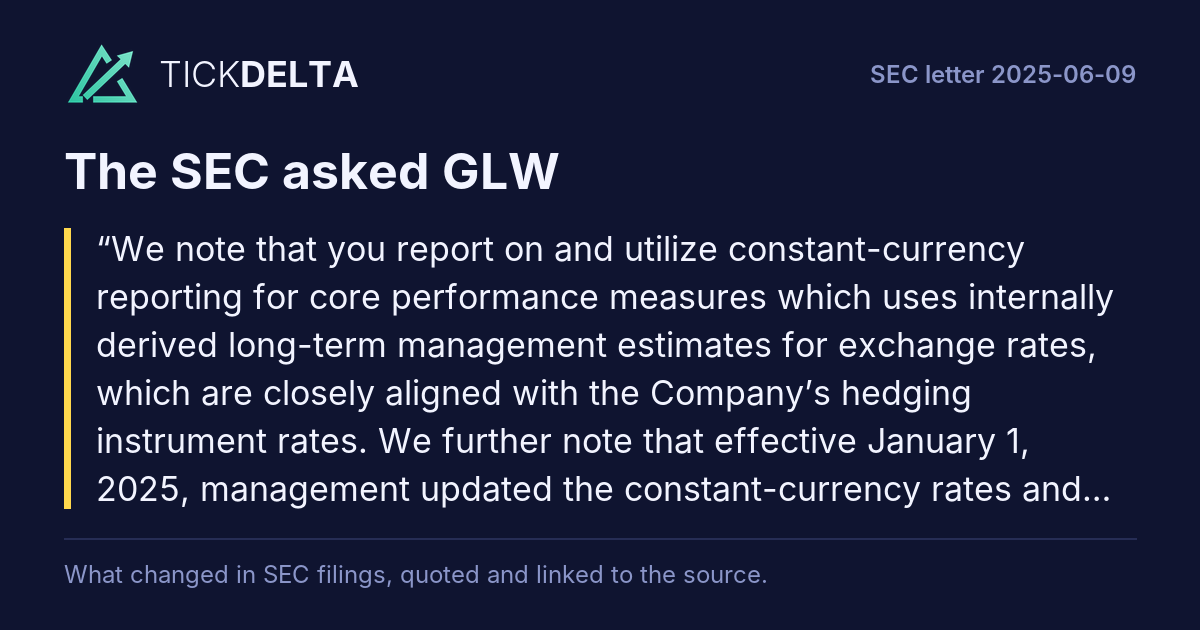
We note that you report on and utilize constant-currency reporting for core performance measures which uses internally derived long-term management estimates for exchange rates, which are closely aligned with the Company’s hedging instrument rates.Rest of the question
We further note that effective January 1, 2025, management updated the constant-currency rates and the updated rates were applied prospectively beginning with reporting periods in 2025. Please explain to us why you believe using internal exchange rates rather than the actual difference between the exchange rates during the periods presented is more appropriate and quantify the difference between the rate you used and the actual rates. Additionally, describe for us in more detail your policy for determining the reasonableness of such rates and tell us historically how often you have updated your estimated constant-currency rates.
appreciate the Staff’s question regarding our constant-currency exchange rates for our core performance measures. Corning operates globally, with significant exposure to foreign currency fluctuations. To mitigate this exposure and stabilize the economic impact of currency volatility on our operations, we have implemented a robust hedging program utilizing hedging instruments, including, but not limited to, foreign exchange forward or option contracts and foreign denominated debt.
Aligned with this hedging program, Corning utilizes constant-currency reporting for its core performanceRead in the reply ↗Rest of the answer
measures. For constant-currency reporting, we use internally derived long-term management-determined rates (referred to as our “core rates”) which are based on the exchange rates of our hedging instruments on a blended basis (referred to as our “hedge rates”). By using our hedge rates rather than spot rates when presenting core performance metrics, we aim to present financial results that reflect the economic impact of our hedging actions and remove the volatility associated with currency fluctuations. Importantly, this approach provides stakeholders with insight into the way that management assesses performance and allocates resources, including employee, financial and/or capital resources. Core performance measures also serve as a basis for a portion of management’s annual and long-term compensation, further demonstrating their importance in evaluating our operations. We believe that sharing these measures, calculated using our core rates, offers investors a clearer and more comparable representation of our operating results, and over a longer term. In contrast, constant-currency reporting using actual spot rates typically focuses on short-term comparisons and would not incorporate the economic substance of our hedging program. We also believe that this methodology provides investors with added transparency into how Corning manages the impact of foreign currency exchange rate volatility.
The following table presents the difference between our 2025 core rates as compared to the average spot rates for the three months ended
March 31, 2025.
Currency
Japanese yen
South
Korean won
Chinese yuan
New
Taiwan dollar
Euro
Mexican peso
Q1
2025 Core rate
¥120
₩1,250
¥6.9
NT$31
€0.88
MX$21
Actual
Q1 2025 average spot rate
¥149.1
₩1,458.3
¥7.25
NT$32.99
€0.93
MX$20.25
Difference
¥29.1
₩208.3
¥0.35
NT$1.99
€0.05
MX($0.75)
%
24.3%
16.7%
5.1%
6.4%
5.7%
(3.6%)
(b) Additionally, describe for us in more detail your policy for determining the reasonableness of such rates and tell us historically how often you have updated your estimated constant-currency rates.
Our policy is to set our core rates to align with the hedge rates calculated from the hedging instruments we have in place. We believe it is reasonable to use rates derived from our hedging instruments.
Since first utilizing this approach to constant-currency reporting in 2013, we have updated our core rates effective January 1, 2015 and January
1, 2018, as well as our most recent update, effective January 1, 2025.
In future filings, we will enhance our disclosures regarding our core rates used in our constant-currency reporting to clarify how we determine our core rates. Specifically, we will include the following in future filings that contain constant-currency adjustments:
“The constant-currency rates established for core performance measures are internally derived long-term management-determined rates, primarily based on the exchange rates of our hedging instruments, on a blended basis, used to mitigate foreign currency exchange exposure. These hedging instruments may include, but are not limited to, foreign exchange forward or option contracts and foreign denominated debt.”
We note your response to our prior comment 1. Please address the following: • Describe specifically the calculation of your core rates, including any actual inputs using your hedging instrument exchange rates and any estimated factors used therein and define what you describe as a blended basis • Describe in more detail, management's review process for setting and approving the core rates and why it was not deemedRest of the question
necessary to update your rates more frequently
As noted in our response letter to you dated June
20, 2025, Corning operates globally, with significant exposure to foreign currency fluctuations. To mitigate this exposure and stabilize the economic impact of currency volatility on our operations, we utilize a portfolio of hedging instruments, including, but not limited to, foreign exchange forwards, option contracts and foreign denominated debt.Read in the reply ↗Rest of the answer
These hedging instruments allow us to secure a specific exchange rate for select currencies for a set period of time (referred to as a contractual hedge rate) and provide exchange rate certainty for that set period. Our hedging instruments are negotiated and entered into on a rolling basis and provide protection for a multi-year period, typically at least two years. This allows us to continuously hedge against adverse foreign exchange rate movements over a long-term period.
When we previously referenced our “blended” hedge rates, we were referring to the weighted average of the contractual hedge rates from our hedging instruments in place for a given period (per hedged currency). The formula for our weighted average calculation is as follows:
∑ (contractual hedge rate of each instrument
× the USD value of such instrument)
∑ (USD value of all instruments)
There are no estimated factors included in this calculation.
Once we determine our contractual hedge rates utilizing this formula, management reviews the weighted average of the contractual hedge rates in place for the forthcoming calendar years and selects a corresponding core rate utilizing the review process described further in Section (b) below. This is what we refer to as our "core rate" for constant currency reporting. The table below summarizes the selected core rates effective January 1, 2025 presented in our Quarterly Report on Form 10-Q for the quarterly period ended March 31, 2025, as compared to the weighted average contractual hedge rates for calendar years 2025 and 2026.
Currency*
Japanese yen
South
Korean won
Chinese yuan
New
Taiwan dollar
Euro
Mexican peso
Core rate effective
January 1, 2025
¥120
₩1,250
¥6.9
NT$31
€0.88
MX$21
2025 hedging instrument weighted average (as of
December 2024)
¥120.1
₩1,241.1
MX$19.0
2026 hedging
¥120.0
₩1,268.9
NT$30.8
MX$20.7
* The rates set forth for each currency in the table above are shown relative to $1.
(b)
Describe in more detail, management's review process for setting and approving the core rates and why it was not deemed necessary to update your rates more frequently
Management regularly monitors our hedging program, including reviews performed at least quarterly by key members of senior management, including the Corporate Controller, Treasurer and other senior executives. As part of this monitoring process, management evaluates the weighted average of our contractual hedge rates for the current and future periods relative to our core rates. Based on this review, if management identifies that the weighted average of the contractual hedge rates that have been negotiated and entered into for future years will no longer align with the related core rates, management will select and implement new core rates that better align with those weighted average hedge rates. The new core rates are expected to remain in place for so long as they remain aligned with the weighted average hedge rates of our hedging instruments. For example, in preparation for 2025, management reviewed our core rates relative to our contractual hedge rates for calendar years 2025 and 2026. As shown in the table above, the weighted average contractual hedge rates of the Japanese yen in place for 2025 and 2026 were not aligned with our core rate of ¥107 then in effect. Accordingly, management determined that an update was appropriate beginning in 2025 and selected a new rate of ¥120 to better align with our forthcoming contractual hedge rates. Changes to core rates are approved by the Corporate
Controller and communicated to the Company’s Audit Committee.
As noted in our prior response letter, since adopting this approach to constant-currency reporting in 2013, we have updated our core rates effective January 1, 2015, January 1, 2018, and January 1, 2025. During the periods between these updates, management, utilizing the review process described above, determined the weighted average of the contractual hedge rates then in place were appropriately aligned with the effective core rates, and therefore determined that updates to the core rates were not necessary. We believe maintaining these extended periods of consistent core rates has appropriately reflected our hedges and is beneficial to both management and investors by providing a more comparable representation of our operating results over a longer term.
First report after the company's reply of 2025-07-14: 10-Q filed 2025-08-01 ↗, against the 10-Q filed 2025-05-02 ↗.
Tickdelta does not hold the text of both reports, so they are not compared here.
We note your response to our prior comment 1. Please address the following: • Specifically describe for us how each specific constant-currency adjustment is calculated for each of your non-GAAP measures (Core net sales, (loss) income before income taxes, net (loss) income attributable to Corning Incorporated, etc.).Rest of the question
Please provide to us the specific amounts included in the calculations for the years ended December 31, 2024 and 2023, where these amounts are derived from and whether those amounts can be gleaned from the audited numbers presented in your audited financial statements. Previously you described for us the exchange rates used and how they are determined but provided few details of the remaining component(s) of the computation. Within your response, please address whether the constant-currency adjustment, translation gain on Japanese yen-denominated debt, net and translated earnings contract gain, net are interrelated. 1. • Within your June 20 response, management provided a general statement regarding its intent to “reflect the economic impact of our hedging actions and remove the volatility associated with the currency fluctuations.” Please provide us with more detail regarding management’s intent and how the constant-currency adjustment achieves that intent. As part of your response, address your disclosure stating that constant-currency rates are applied to all periods presented and to all foreign exchange exposures during the period, with the exception of the Mexican peso, even though you may be less than 100% hedged. • Lastly, please clarify the calculation of item (2) translation of Japanese yendenominated debt, net. For example, describe if the gains or losses are realized and/or unrealized and if the amounts reflect any adjustments regarding any interest component.
Ms. Gilmore and Mr. Woody:
This letter confirms the telephone conversation between our Corporate Secretary, Melissa Gambol, and Mr. Woody on September 11, 2025 regarding
Corning Incorporated’s request for an extension of time to respond to the comment letter dated August 27, 2025 from the Staff of the Division of Corporation Finance, Office of Manufacturing.
As discussed, the Company requires additional time to prepare its response and currently expects to respond on or about September 25, 2025. Read in the reply ↗
First report after the company's reply of 2025-09-11: 10-Q filed 2025-10-31 ↗, against the 10-Q filed 2025-05-02 ↗.
Tickdelta does not hold the text of both reports, so they are not compared here.
Also in this review: company letter, 2025-09-25