Form 10-K for the Year Ended December 31, 2022
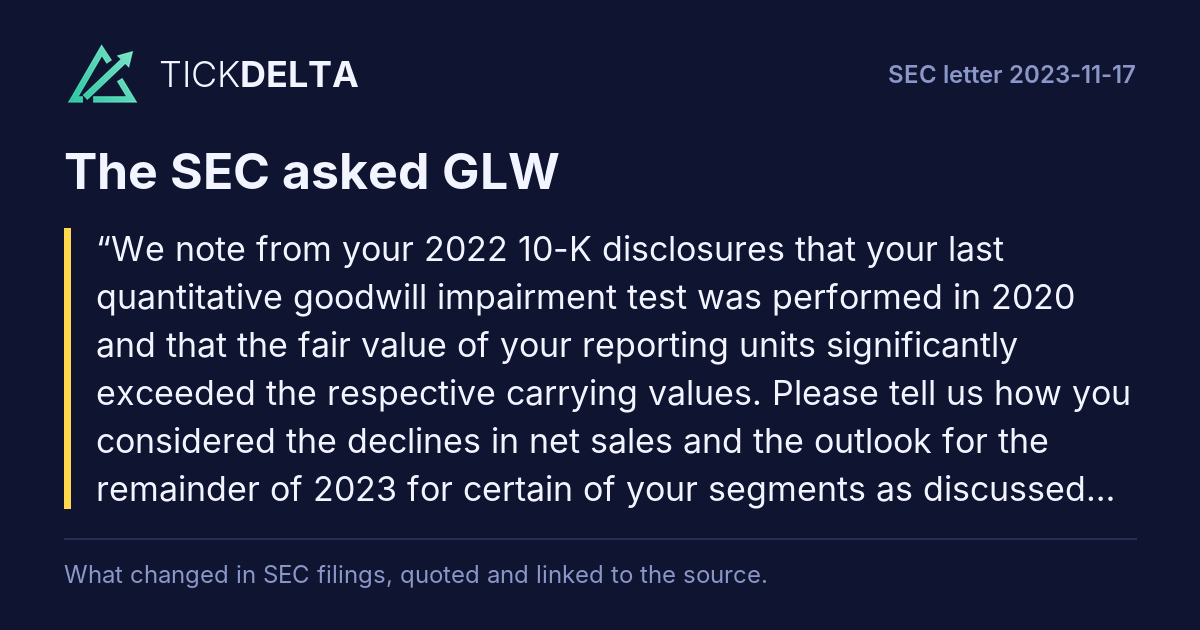
We note from your 2022 10-K disclosures that your last quantitative goodwill impairment test was performed in 2020 and that the fair value of your reporting units significantly exceeded the respective carrying values.Rest of the question
Please tell us how you considered the declines in net sales and the outlook for the remainder of 2023 for certain of your segments as discussed on your third quarter earnings call in determining that an interim impairment test was not required in 2023. Please refer to ASC 350-20-35-3C.
The Company acknowledges the Staff’s comment.
The Company performs an annual goodwill impairment assessment and, in addition to its annual assessment, the Company also performs a quarterly evaluation of whether it is more likely than not that the fair value of its reporting units is less than its respective carrying amount pursuant to ASC 350-20-35-3A.Read in the reply ↗Rest of the answer
As noted by the Staff and disclosed in the Company’s 2022 Form 10-K, the Company also performs a detailed quantitative impairment test every three years in accordance with ASC 350-20-35-3B, even if no impairment indicators are identified by any qualitative assessment. When the Company last performed its quantitative goodwill impairment test in 2020, its estimation of the fair value of each of its reporting units exceeded its respective carrying value in terms of percentages and dollar amounts ranging from 50% to 294% and $554 million to $7.0 billion, respectively.
For each quarterly assessment performed in 2023, the Company considered relevant events, including expectations for the long-term growth of the business, forecasted future cash flows and those set forth in ASC 350-20-35-3C, as well as the Company’s actual results and outlook. The Company acknowledges that during its third quarter earnings call, the Company discussed a decrease in net sales and the negative outlook for the remainder of 2023 in certain of its segments. The Company also discussed how it expects the market downturn to be transitory, the markets to rebound and its businesses to return to long-term growth. In addition, the Company’s results in the quarter illustrated that it continues to make progress on the programs it put in place to increase price, improve productivity and reduce inventory. These initiatives have led to improved gross margin percentage and cash flow despite lower net sales.
As part of its third quarter assessment, the
Company considered the declines in net sales for certain of its segments, the improvements achieved in gross margin percentage and cash flows during 2023 and its expectation to return to long-term growth, among other factors and conditions as described in ASC 350-20-35-3C.
Additionally, we considered guidance set forth in ASC 350-20-35-3F related to weighting events and circumstances that most affect the fair values and carrying values of reporting units. Given the significant excess of fair value over carrying value for each of the Company’s reporting units based on the 2020 quantitative impairment test as noted above, the Company concluded that, for the quarter ended September
30, 2023 there were no events or circumstances that would more likely than not reduce the fair value of any of its reporting units below its respective carrying value. Accordingly, the Company concluded that it was not necessary to perform an interim quantitative goodwill impairment test for any of its reporting units.
First report after the company's reply of 2023-12-01: 10-K filed 2024-02-12 ↗, against the 10-K filed 2023-02-13 ↗.
Tickdelta does not hold the text of both reports, so they are not compared here.
The bullet points on page 1 present core gross margin, core operating margin, and free cash flow without the most directly comparable GAAP measures. Please revise to present the most directly comparable measures prior to the non-GAAP measures in accordance with Item 10(e)(1)(i)(A) to prevent undue prominence.
The Company acknowledges the Staff's comment. In future earnings releases furnished on Form 8-K, the Company will present the most directly comparable GAAP measures prior to the non-GAAP measures in accordance with Item 10(e)(1)(i)(A) to prevent undue prominence. Specifically, on the measures referred to by the Staff in the Staff's comment, the Company will disclose gross margin, operating margin and cash flows from operating activities prior to core gross margin, core operating margin and adjusted free cash flow, respectively. Read in the reply ↗
First report after the company's reply of 2023-12-01: 10-K filed 2024-02-12 ↗, against the 10-K filed 2023-02-13 ↗.
Tickdelta does not hold the text of both reports, so they are not compared here.
In a related matter, we note that your reconciliation of free cash flow on page 16 differs from the typical calculation of cash flows from operating activities less capital expenditures considering it also adjusts for realized gains on translated earnings contracts and translation losses on cash balances.Rest of the question
In order to avoid potential confusion, please revise the title to adjusted free cash flow or a similar description. Refer to Question 102.07 of the Compliance and Disclosure Interpretations on Non-GAAP Financial Measures.
The Company acknowledges the Staff’s comment, and in future filings, the title of the non-GAAP financial measure referred to by the Staff in the Staff’s comment will be revised to adjusted free cash flow. Read in the reply ↗
First report after the company's reply of 2023-12-01: 10-K filed 2024-02-12 ↗, against the 10-K filed 2023-02-13 ↗.
Tickdelta does not hold the text of both reports, so they are not compared here.
We note your response and your conclusion that at September 30, 2023, after evaluating expectations for the long-term growth of the business, forecasted future cash flows and those set forth in ASC 350-20-35-3C, as well as your actual results and outlook, that it was not more likely than not that the fair values of your goodwill were less than their respective carrying values and, therefore, you did not have anyRest of the question
impairment. Given the deterioration in your operating results (i.e., decreases in net sales and net income) and cash flows from operations, please refer to Item 303(b)(3) of Regulation S-K and expand your disclosures in future filings to address the following: • describe the potential events and/or changes in circumstances that could result in additional impairment charges; and • disclose the percentage by which your estimated fair value exceeds your carrying value as of the date of your most recent impairment test.
The Company acknowledges the Staff’s comment.
Pursuant to Item 303(b)(3), as well as the interpretations included within the Division of Corporation Finance’s Financial Reporting
Manual, if the Company determines in its impairment testing for fiscal 2023 (or in future periods) that, for a reporting unit with material goodwill, the reporting unit’s estimated fair value does not substantially exceed its carrying value, the Company will disclose:
(i) the reporting unit and quantification of the amount of goodwill allocated to
Confidential - Corning (L3) the reporting unit; (ii) theRead in the reply ↗Rest of the answer
percentage by which the estimated fair value exceeds the carrying value as of the date of the most recent impairment test; (iii) the specific key assumptions used in the fair value determination; (iv) the degree of uncertainty associated with the key assumptions and how changes in key assumptions could impact the fair value determination; and (v) the potential events and/or changes in circumstances that could reasonably be expected to negatively affect key assumptions and that could result in additional impairment charges.
We note your response from prior comment 1 from our letter dated November 17, 2023 and from your 10-K disclosures that you perform a detailed quantitative impairment test every three years and that the last test performed was in 2020.Rest of the question
Please tell us the date of your annual assessment completed in 2023 and tell us the percentage by which your estimated fair value exceeded its carrying value for each reporting unit and the specific key assumptions used in the the fair value determination.
We are writing in response to your letter dated January 4, 2024 (the “Comment
Letter”) relating to the above-referenced filings.
As discussed on our call with Ms. Clark, on January 8, 2024, we are working expeditiously to respond to the Comment Letter. Due to time constraints associated with the Company’s year-end process and filing of Form 10-K for our fiscal year ended December 31, 2023, we are requesting that our response date be extended to February 12, 2024.
We are grateful for the Staff’s accommodation in this matter.Read in the reply ↗Rest of the answer
Should you have any further questions, please do not hesitate to call me at (607) 974-5843
First report after the company's reply of 2024-01-08: 10-K filed 2024-02-12 ↗, against the 10-K filed 2023-02-13 ↗.
Tickdelta does not hold the text of both reports, so they are not compared here.
Also in this review: company letter, 2024-02-12, closing letter, 2024-02-15