Form S-4
We note that you refer to your solicitation of proxies from GDHL Shareholders as a "Management Circular." Please revise throughout to clarify that this document is a proxy statement, or advise.
No reply letter found.
We note your disclosure under the heading "Government Regulation," beginning on page 252. Regarding your and BitGo's trading, asset management, investment banking, mining, principal investments, liquidity, custody and security solutions related to digital assets and cryptocurrencies, please provide us with your legal analysis as to how you conclude that the digital assets you or BitGo transact in on your or yourRest of the question
customers' behalf, and others that may be transacted in the future are not securities and, therefore, you and BitGo are not facilitating, or causing you to engage in, transactions in unregistered securities. In your response, please specifically address the policies and procedures you and BitGo have in place to ensure you are not engaging in or facilitating transactions in unregistered securities and whether and how your policies and procedures allow you to reach this conclusion. In preparing your response, you may find useful the letter sent by the SEC’s Strategic Hub for Innovation and Financial Technology to The New York State Department of Financial Services on January 27, 2020, available at https://www.sec.gov/files/staff-comments-to%20nysdfs-1-27-20.pdf. Further, clearly describe the regulatory risks associated with your particular policies and procedures for determining the characterization of digital assets and cryptocurrencies, including the limitations of any such policies and procedures.
No reply letter found.
We note that you are attempting to register shares of Galaxy Digital Inc. Class A common stock estimated to be available for offer and sale from time to time following the consummation of the Reorganization and the Reorganization Merger, pursuant to the Resale Prospectus contained in this registration statement, by certain selling stockholders who are also holders of limited partnership units of GDH LP, upon theRest of the question
redemption or exchange by such selling stockholders of LP Units for an equivalent number of shares of Galaxy Digital Inc. Class A common stock. Please tell us how you are able to register these shares for resale at this time, as it is not clear when the GDH LP reorganization will be completed.
No reply letter found.
We note that you are registering both the issuance and exercisability of the warrants. Please tell us whether you've considered that you will have to keep the Form S-4 current, and tell us how you plan to address this.
No reply letter found.
We note your disclosure that Michael Novogratz, the Chief Executive Officer and Founder of GDHL, who currently controls the general partnership interests of GDH LP, will transfer control of the general partnership interests of GDH LP to Pubco. If true, expand to disclose the Mr. Novogratz will continue to control Galaxy Digital Inc.Rest of the question
following the proposed transactions and identify his ownership interests as expected immediately following the transactions. Further, expand on the cover page to Annex I—Alternate Pages For Consent Solicitation Statement/Prospectus to disclose the approximate total voting power of Galaxy Digital Inc.'s outstanding common stock that former BitGo stockholders will hold immediately following the BitGo merger.
No reply letter found.
Please tell us why it is appropriate to not provide audited financial statements of Galaxy Digital Inc. (Pubco) as disclosed in the first full paragraph on page ii and reference for us the authoritative guidance you rely upon to support your position. Otherwise, provide the required audited financial statements of this registrant.
No reply letter found.
You state that you do not know all of the assumptions regarding general economic conditions or growth that were used in preparing the forecasts from the sources relied upon or cited in your prospectus. Please note that you are responsible for the entire content of the registration statement.Rest of the question
Please revise your disclosure to remove any implication that you are not responsible for assessing the reasonableness and soundness of the market data and industry statistics included in your disclosures.
No reply letter found.
We note your disclosure on page 6 that the Reorganization Merger is not required to be, and will not be, submitted to a vote of GDHL shareholders. Since the Reorganization Merger is planned to take place following the Domestication, please revise to clarify whether the Reorganization Merger is required to be, or will be, submitted to a vote of GDH Delaware shareholders.Rest of the question
Please make conforming revisions to related disclosure elsewhere in the registration statement, including on pages 39, 151 and C-9. Please make similar revisions related to whether the Second (BitGo) Merger is required to be, or will be, submitted to a vote of Galaxy Digital Inc. shareholders.
No reply letter found.
We note your discussion about the evolution, growth and positive aspects of the digital assets ecosystem, including digital assets, cryptocurrencies and blockchain technology. Please revise the forefront of your Summary section to provide balance and context to your disclosure by describing the material challenges, obstacles and risks that you face.Rest of the question
Please make similar revisions to your Information About Galaxy Digital, Information About BitGo and MD&A sections. In addition, please revise to disclose costs associated with participating in this sector each as an investor, consumer and provider of goods and services. Further, expand to provide context of your competitive position and stage of development within the sector overall and within each of your business segments individually.
No reply letter found.
Please expand your disclosure here and, as applicable, in the discussion of your business that begins on page 231 and the discussion of BitGo's business that begins on page 262 to clearly describe the following: • How you generate revenues; • Your key products, services, product families and their markets and customers; • Distribution methods of the products or services; • Status of any publicly announced newRest of the question
product or service; • Your competitive position in the industry and methods of competition; • Dependence on one or a few major customers; • Need for any government approval of principal products or services; and • Any other information material to understanding your business and business activities.
No reply letter found.
Please expand to provide a diagram clearly illustrating your corporate structure immediately before and immediately following the proposed transactions. The diagram should include the name and domicile, as applicable, of each entity and disclose the economic and voting interests in each entity held by parent(s) and/or significant groups of security holders.Rest of the question
Please make conforming changes to the diagrams on pages 133, 135 and 136.
No reply letter found.
With reference to Rule 14a-4(a)(3), please identify clearly and impartially each separate matter intended to be acted upon with respect to each proposal for which you are soliciting shareholders. For instance, and without limitation, we note it is not clear whether GDHL shareholders are being asked to consider only the issuance and terms of Class B ordinary shares in the Governing Documents Amendment, that GDHLRest of the question
shareholders are being asked in the Domestication Charter and Bylaws Amendment to consider redomestication of the company and the adoption of a proposed new certificate of incorporation and proposed new bylaws, both or either of which may contain provisions that differ materially from corresponding provisions in the existing organization documents of GDHL, and that as part of the proposed BitGo merger a new article will be added to the certificate of incorporation of Galaxy Digital Inc. to require a stockholder vote to approve certain acts or transactions. For additional guidance, please refer to the interpretations available at: https://www.sec.gov/divisions/corpfin/guidance/14a- interps.htm and https://www.sec.gov/divisions/corpfin/guidance/exchange-act-rule-14a4a3.htm. Additionally, describe the number of Class B ordinary shares of GDHL that will be authorized and issued in connection with the Governing Documents Amendment. Please make corresponding changes throughout the document as applicable. Further, file the form of proxy and form of written consent that will be used in relation to the solicitation of shareholders of GDHL and BitGo, respectively. We are highly dependent on our Founder, which exposes stockholders to material and unpredictable "key man" risk, page 56
No reply letter found.
Noting your disclosure on pages 33 and 248 that the addition of BitGo technologist, Mike Belshe, would significantly increase your ability to build innovative products and services, please expand your risk factor disclosure to address all key personnel upon whom your business as described in this proxy statement/prospectus is materially dependent.
No reply letter found.
In the fourth item of uncertainty considered by the Special Committee you state that PCAOB guidance requires digital assets to be accounted for as intangible assets. Please revise your disclosure to remove the implication that the PCAOB is an accounting standard setter.
No reply letter found.
Refer to your disclosure on page 164, please expand to describe the material terms of (i) the all-cash offer for a proposed acquisition of BitGo by Company A disclosed in the first full paragraph and (ii) the material terms of the non-binding letter of intent that Galaxy provided to BitGo’s chief executive officer on February 12, 2021.Rest of the question
Further, disclose the material terms of the letter of intent that were subject to the negotiations between Galaxy and BitGo following February 12, 2021. Without limitation, your disclosure should identify the initial valuation of the business combination and explain if and why it changed during the course of the negotiations.
No reply letter found.
We note BitGo engaged Qatalyst Partners LLC to serve as financial advisor to BitGo in connection with a potential business combination. Please disclose whether Qatalyst prepared an analysis of the proposed merger with Galaxy for the BitGo board.
No reply letter found.
We note your disclosure in the last bullet on page 166 that Galaxy has a history as an investor in BitGo. Please expand your disclosure in this section to describe Galaxy's interest in BitGo.
No reply letter found.
We note your disclosure that the implied aggregate transaction value of the BitGo merger is approximately $1.2 billion based on GDHL’s closing share price on May 4, 2021, and that it will be $[•] based on GDHL’s closing share price on [•]. Please revise to disclose GDHL's per share closing price as of the dates referenced.Rest of the question
Please make conforming disclosure elsewhere in the document where the aggregate transaction value of the BitGo merger is similarly discussed.
No reply letter found.
Please revise to identify conditions to the closing of the merger that are subject to waiver and identify the party who has the right to waive such condition.
No reply letter found.
We note that the five businesses you identify here are consistent with your reportable segments as disclosed in Note 20 beginning on page F-49. Please tell us your consideration for separately discussing the operating results, liquidity and capital resources of each reportable segment in addition to discussing these items on a consolidated basis as contemplated in Item 303(b) of Regulation S-K.
No reply letter found.
Regarding your presentation of non-GAAP adjusted net income, you state that the net adjustment for the period to mark net digital assets to market takes into account the lower digital assets sales costs from the impaired assets that were held at the beginning of the period and sold during the period, compared to the impaired assets at the end of the period.Rest of the question
Please clarify what you mean by this statement and what this adjustment represents. For example, tell us whether the adjustment relates to fair value adjustments that were actually recorded during the periods presented or if they are adjustments that would have been recorded had you accounted for the related digital assets at fair value, rather than cost less impairment. In addition, tell us how this adjustment relates to (if at all) the fair value adjustment included in non-GAAP net digital assets at fair value. BitGo
No reply letter found.
You disclose that the $2.0 billion charge for the change in fair value of embedded derivative during 2020 is primarily a result of the difference in the subsequent measurement of the recognized asset and liability for BitGo's WBTC product.Rest of the question
As it is apparent from disclosures on pages 213 and 214 that you record the bitcoin received under your Wrapped Bitcoins (WBTC) product as digital intangible assets - restricted at fair value on the date of receipt and record a corresponding obligation to exchange digital intangible assets along with the embedded derivative associated with the fair value of the bitcoin that must be returned, please demonstrate to us the reasonableness of the embedded derivative liability amount recorded. In your response, tell us the average duration of WBTCs outstanding at December 31, 2020 noting the significant run-up in the value of bitcoin at the end of 2020.
No reply letter found.
In your digital asset price risk disclosure you discuss the impact of a 20% market price reduction. In your derivatives disclosure you discuss the impact of a 10% increase or decrease in the fair value of your derivative positions.Rest of the question
As Instruction 2 to paragraph 305(a) or Regulation S-K requires the hypothetical market changes to reflect reasonably possible near-term changes, please tell us how these identified changes are both reasonably possible when your derivative holdings appear to be indexed to digital assets. Otherwise, revise your disclosure to present reasonably possible near-term changes for these items. In any regard, revise your disclosure to identify the changes you discuss as being reasonably possible near-term changes.
No reply letter found.
We note your disclosure that you engage in trading, investing, mining and will engage in wallet or custodial services related to digital assets. Please provide us with your analysis as to your potential status as an investment company under the Investment Company Act of 1940 or as an investment adviser under the Investment Advisers Act of 1940.Rest of the question
Please also expand your risk factor and regulatory disclosures accordingly to address the basis for your status determination.
No reply letter found.
Please tell us what you do with the digital assets of which you have custody by virtue of your mining, wallet or other services.
No reply letter found.
We note that you recently acquired Blue Fire Capital, a proprietary trading firm specializing in providing two-sided liquidity for digital assets, that you are willing to make markets across numerous cryptocurrencies and digital assets and that your proprietary trading platform facilitates these services.Rest of the question
Please provide us with your legal analysis of whether you are providing exchange services or operating a trading system for digital securities.
No reply letter found.
We note your disclosure that Galaxy Digital Trading engages in a number of activities, on behalf of your customers and for your own account, around the buying, selling, lending and borrowing of cryptocurrencies and other digital assets. Please expand your disclosure to provide greater details surrounding your lending and borrowing of cryptocurrencies and digital assets.Rest of the question
For example purposes only, please revise your next amendment to: • Clarify if you originate unsecured, secured and cryptocurrency-denominated loans and, if so, disclose any limits on the amount of these loans that you may originate; • Quantify your loans; • Quantify your borrowing of cryptocurrencies and other digital assets and disclose any limits on the amount you may borrow; • Explain how you determine how much cryptocurrency to issue (e.g., based on fair value on the date of issuance); • Explain whether the loaned cryptocurrency comes from the digital assets that you own or from customer collateral; and • Disclose whether there are any limits or parameters surrounding the digital assets that you buy, sell, lend, borrow or otherwise engage in activities with.
No reply letter found.
We note your disclosure that Galaxy Digital Trading provides clients and counterparties access to over 100 globally traded cryptocurrencies. Please revise your disclosure to identify all of the digital assets that you provide access to across your businesses and identify all of the digital asset services that you provide for each digital asset across your businesses. Please provide similar information for BitGo.Rest of the question
Please consider using a table or a chart to show the various digital assets and digital services.
No reply letter found.
Please revise your disclosure to explain what you mean by your statement that "GDT is a diversified revenue stream that can have varied and/or little correlation with cryptocurrency and digital asset market prices."
No reply letter found.
Please revise to provide greater disclosure regarding the "proprietary trading platform" that you have built and "continue to enhance," including whether clients must register with your platform to engage with each of your five operating businesses. Investment Banking, page 234
No reply letter found.
We note your disclosure that GDIB has "won numerous mandates." Please revise to be more specific or remove this disclosure.
No reply letter found.
Please revise your disclosure to clarify if Galaxy Digital Mining is only engaged in mining Bitcoin or whether there are other digital assets or cryptocurrencies that are mined at present or intended to be mined in the future.
No reply letter found.
Please ensure that you identify the natural persons who are the beneficial owners of the shares held by the 5% or greater stockholder identified in your table.
No reply letter found.
Please revise to include a tax opinion covering the material tax consequences of the domestication, reorganization merger and BitGo merger. With reference to your disclosure on pages 320, 325 and 328 concerning how the domestication, reorganization merger and BitGo merger are intended to qualify, please revise to express the opinion of counsel as to the expected tax treatment of each event.Rest of the question
For guidance concerning assumptions and opinions subject to uncertainty, please refer to Staff Legal Bulletin No. 19. Revise the Q&A and Summary sections accordingly.
No reply letter found.
We note the statements on pages 320 and 326 beginning, "THE FOLLOWING IS FOR INFORMATIONAL PURPOSES ONLY..." These statements appear to be inappropriate disclaimers as investors are entitled to rely on the opinions expressed. Please remove the statements or advise. Refer to Staff Legal Bulletin No. 19, Part III.D.1 for guidance.
No reply letter found.
We note your disclosure that you have entered into an employment agreement with Michael Belshe, BitGo’s Chief Executive Officer, pursuant to which Mr. Belshe is expected to become a member of Galaxy Digital Inc.’s board of directors and serve as Deputy Chief Executive Officer of Galaxy Digital Inc. following the closing of the BitGo acquisition.Rest of the question
Please file as exhibits to the registration statement: • Your employment agreement with Mr. Belshe; and • Mr. Belshe's written consent to be named as about to become a director. Refer to Rule 438 of the Securities Act for guidance.
No reply letter found.
Please expand your disclosure in the third bullet point to describe the material terms of the employment agreements members of BitGo’s key management team entered into with GDS LLC and file the agreements as exhibits to your registration statement, or advise.
No reply letter found.
You provide two years of audited financial statements for BitGo Holdings, Inc. Please provide us your analysis supporting why three years of audited financial statements are not provided. In this regard, we note that Instruction 3 to Item 17(b)(7) of Form S-4 requires a third year of financial statements in certain circumstances and that your draft registration statement is filed on both Forms S-4 and S-1.
No reply letter found.
You indicate that you record revenue recognized on the sales of digital assets that are accounted for as indefinite-lived intangible assets gross as a principal while the sale of digital assets that qualify as financial instruments are recorded net.Rest of the question
Please provide us your analysis that supports your differing accounting for these two types of digital asset sales and that references the authoritative literature you rely upon to support your accounting.
No reply letter found.
You disclose that you record performance fees when the performance target is met and a significant reversal of such fees is not probable. Please tell us why it is appropriate to wait until the performance target is actually met to record revenue when ASC 606-10-32-3 and 32-5 require an estimate of variable consideration to be included in the transaction price.Rest of the question
In your response describe the types of performance fees you can earn, when they are triggered and explain why you effectively fully constrain these fees until the target is met. Reference for us the authoritative literature you rely upon to support your accounting.
No reply letter found.
You disclose on page F-14 that stablecoins represent the contractual right to cash and that you account for them under the fair value option. Please tell us how stablecoins represent a contractual right to cash and therefore qualify as financial assets and reference the authoritative literature you rely upon to support your characterization.Rest of the question
In your response tell us who is obligated to pay cash to the holder of stablecoin and explain how it differs from other forms of digital assets.
No reply letter found.
Please revise to provide a rollforward of each of your major categories of digital assets for the periods presented. As applicable, your disclosure should include but not be limited to purchases, sales, gains/losses, collateral held, impairments and changes in fair value. In addition, describe the various types of digital assets that you hold (e.g. BTC, ETH, USDC etc.) and or transact in.Rest of the question
If there are material concentrations, disclose that fact.
No reply letter found.
Please revise to disclose the specific types of digital asset collateral that you accept from counterparties to secure borrowed assets and U.S. dollar loans.
No reply letter found.
You state that in situations where you are a lender of digital assets, you may require the counterparty to post collateral to secure the borrowed assets. Where you have the ability to control the collateral received it is recognized as part of Digital assets. You also recognize a corresponding obligation to return the collateral received as part of Collateral payable.Rest of the question
Collateral that cannot be rehypothecated is not recognized. Please provide us your accounting analysis, along with citations to the authoritative guidance you used, to support your accounting treatment. Your analysis should address, but not be limited to: • How you determine whether you control the digital asset collateral received (from both a legal and GAAP perspective). Tell us if borrowers deposit the collateral into designated custody wallets that are under your control. In addition, clarify whether you believe the ability to rehypothecate such collateral gives you control or if you believe control is transferred to you upon rehypothecation of the borrower collateral; • How the collateral asset and payable are measured (e.g. cost less impairment, fair value etc.) and if they re-measured and the relevant GAAP supporting such measurements; and • Whether your accounting for borrower collateral is the same in situations where you lend U.S. dollars to digital asset owners who collateralize the loan with their digital assets, as described on page F-17 under Loans receivable, fiat. If not, explain why.
No reply letter found.
In situations where you borrowed digital assets, you state that the borrowings are accounted for as hybrid instruments, with a liability host contract that contains an embedded derivative based on the changes in the fair value of the underlying digital asset. Please revise to disclose: • The specific digital assets you borrowed; • The nature of the host contract (i.e.Rest of the question
debt or equity) and additional detail to support your conclusion; and • How you determine the fair value of the underlying digital assets for purposes of marking the embedded derivative to market, including the specific exchange or principal market you use.
No reply letter found.
We note that you classify gains on disposal of digital intangible assets, change in fair value of embedded derivatives and the impairment of digital intangible assets as other gains/losses outside of loss from operations.Rest of the question
As these items appear to be directly related to your liquidity and prime trading, prime lending and or settlement services please tell us why these items are excluded from your operating income/loss. Reference for us the authoritative literature you rely upon to support your classification.
No reply letter found.
You state that customer digital assets are not your assets and therefore, are not recognized on your consolidated financial statements. As a digital asset custodian, you are responsible for the safeguarding of customer digital assets. Please provide us your accounting analysis, along with citations to the authoritative guidance you used, to support your accounting treatment.Rest of the question
Your response should include, but not be limited to, discussion of the following: • Quantification of the value of digital assets held in custody and not recognized for each period presented; • Identification of who has legal ownership of the digital assets; • Discuss if the customer is constrained from selling or pledging the digital assets which are held in custody; • Discuss if the customer is constrained in any way, or at any time, from transferring its digital assets from your wallets to their own wallet; • Discuss whether the terms and conditions your contract with the customer, or state regulation, prevent you from directing the use of and obtaining substantially all of the remaining benefits from the digital assets held in custody for customers; and • Discuss if the terms and conditions make it clear that you are not executing customer transactions.
No reply letter found.
Please provide us your analysis supporting recognition of an embedded derivative associated with your obligation to exchange or return digital intangible assets. Reference for us the authoritative literature you rely upon to support your accounting.Rest of the question
In your response, specifically address the following: • Tell us the nature of the host contract and why the obligation to return bitcoin in your WBTC product is not clearly and closely related to the host contract. • As the bitcoin underlying your WBTC contract is restricted, tell us how you can net settle the contract. In your response tell us whether a specific bitcoin transaction hash is associated with each WBTC and therefore whether each WBTC is settled gross.
No reply letter found.
Assuming you substantiate embedded derivative accounting for your obligation to exchange digital intangible assets from the preceding comment, please revise your disclosure in management's discussion and analysis to: • Clearly explain the mismatch of accounting between your liability and embedded derivative reflected at fair value while the associated restricted bitcoin intangible asset is recorded at WBTCRest of the question
transaction initiation date fair value less any impairment; • Indicate that in times of rising bitcoin prices an embedded derivative liability will be recorded that will result in future gains when the WBTC obligation to exchange digital intangible assets and its associated embedded derivative are settled by the return of restricted digital intangible assets that have a lower historical cost basis; and • Clarify that as the obligation to settle WBTC contracts involves the return of bitcoin held on your balance sheet, there is no impact on your liquidity.
No reply letter found.
Please revise your policy disclosure in 2020 to remove reference to the existence of a derivative asset presented in "other assets" on your balance sheet as it is apparent that you have a significant liability at December 31, 2020. To the extent applicable, this comment also applies to your policy disclosure on page F-63 for the embedded derivative related to the obligation to return digital intangible assets.
No reply letter found.
You disclose that your wallet service revenue includes fees for both minting and burning WBTCs. Please revise your disclosure to indicate how you allocate transaction price to these two apparent performance obligations.
No reply letter found.
In the last paragraph of this policy on page F-67 you indicate both that you revalue the fair value and expense related to the unvested portion of options issued to nonemployees and that you measure the fair value of these options at the grant date and recognize the expense over the service period.Rest of the question
Please confirm that you account for your option grants to nonemployees under the latter policy consistent with the guidance under ASU 201807 and revise your policy accordingly or tell us how your accounting complies with this guidance.
No reply letter found.
Please revise your disclosure to indicate the amount of incremental compensation cost associated with your June 23, 2020 option modification as required by ASC 718-10-502h2. Otherwise, tell us why no incremental compensation exists under ASC 718-20-35-3.
No reply letter found.
Please expand your disclosure to furnish the date of each sale and identify the name the persons or the class of persons to whom the securities were sold. Refer to Item 701(b) of Regulation S-K for guidance.
No reply letter found.
We note your response to prior comment 1 that you do not believe GDHL is subject to the U.S. federal proxy rules under Section 14(a) of the Securities Exchange Act of 1934 because GDHL’s ordinary shares are not currently registered under Section 12 of the Exchange Act. Please provide us with your legal analysis supporting your conclusion that GDHL will not be subject to the U.S.Rest of the question
federal proxy rules at the time GDHL shareholders will vote given you state the Domestication and related corporate reorganization transactions and amendments will occur following the effectiveness of this registration statement.
No reply letter found.
We note your response to prior comment 2. In an appropriate section of your prospectus, please describe in greater detail the procedures you follow to avoid impermissibly engaging in or facilitating transactions in unregistered securities.Rest of the question
In addition, please address the specific risks inherent in your business model, including those associated with your policies and procedures for determining that digital assets and other products you currently offer or may offer in the future are not securities. Please describe the limitations of any policies and procedures you have in this regard, and state that these are risk-based judgments by the company and are not a legal standard or determination binding on any regulatory body. Please also describe the specific potential consequences if any of the digital assets or other products that you currently offer or may offer in the future are determined to be securities under U.S. law.
No reply letter found.
We note your response to comment 3. It does not appear that you may register such shares for resale at this time because the GDH LP reorganization will not be effected until after the effective date of the registration statement. For similar reasons, we do not agree with the analogy to a PIPE transaction. Please revise accordingly.
No reply letter found.
We note your response to comment 24 and we reissue our comment as you do not appear to have addressed your equity investments in your response. We note your disclosure that you engage in trading, investing, mining and will engage in wallet or custodial services related to digital assets.Rest of the question
Please provide us with your analysis as to your potential status as an investment company under the Investment Company Act of 1940 or as an investment adviser under the Investment Advisers Act of 1940. Please also expand your risk factor and regulatory disclosures accordingly to address the basis for your status determination.
No reply letter found.
We note your response to comment 26 and we reissue our comment in part. We note that you recently acquired Blue Fire Capital, a proprietary trading firm specializing in providing two-sided liquidity for digital assets, that you are willing to make markets across numerous cryptocurrencies and digital assets and that your proprietary trading platform facilities these services.Rest of the question
In the appropriate section of your prospectus, please describe in greater detail the procedures you follow to avoid providing exchange services and a trading system for digital securities. Please also revise your risk factor disclosure to describe related risks and the limitations of any policies and procedures you have in this regard.
No reply letter found.
We note your disclosure on page 34 that you actively participated in the research and development of applications with strong adoption signals, such as non-fungible tokens ("NFTs"). We also note your disclosure on page 316 that Galaxy Digital Holding LP cofounded Candy Digital, Inc., a sports NFT company that is working with Major League Baseball to create an ecosystem to buy, trade and share officially licensedRest of the question
baseball content NFTs. Please provide disclosure regarding Candy Digital in your summary section and revise your disclosure to provide: • A complete description of the NFTs you or Candy Digital have developed or are developing; and • Your legal analysis explaining whether the NFTs you or Candy Digital develop are securities as defined in Section 2(a)(1) of the Securities Act. Your analysis should specifically address the distinct characteristics of each NFT you or Candy Digital have developed, or are developing, and how those characteristics affect your conclusions, as well as secondary trading and the larger ecosystem. In responding to this comment, please also address Gary Plastic Packaging Corp. v. Merrill Lynch, Pierce, Fenner & Smith, Inc., 756 F.2d 230 (2d Cir. 1985) and Abrahamson v. Fleschner, 586 F.2d 862 (2d Cir. 1977).
No reply letter found.
Please revise to provide greater disclosure regarding the business conducted by the companies that you have acquired, including DrawBridge Lending, Blue Fire Capital and Vision Hill Group. Please revise to disclose the specific products offered by each business, provide a description of each product and explain how each product works.Rest of the question
To this end, we note that DrawBridge Lending appears to have several "Digital Investing" and "Digital Lending" products.
No reply letter found.
We note you refer to the "Reorganization" throughout the registration statement. Please define this term where it is first used in your prospectus.
No reply letter found.
We acknowledge your response to prior comment 6. As it appears that Galaxy Digital, Inc. was formed in part to complete your redomicile from the Cayman Islands to Delaware and to complete your reorganization of entities under common control as well as to complete the acquisition of BitGo Holdings, Inc.Rest of the question
it cannot have been formed solely for the completion of a business combination and does not meet the definition of a Business Combination Related Shell Company as stipulated in Rule 305 of Regulation C. As a result, please provide audited financial statements of Galaxy Digital, Inc. and revise this disclosure accordingly in your next amended submission.
No reply letter found.
We note the changes made in response to prior comment 7, including the statement that investors "are cautioned not to give undue weight" to industry and market data that you present. Please revise to clarify that you are liable for all the information you include in your registration statement.
No reply letter found.
Please revise your summary to disclose the nature of Galaxy and BitGo's custody services and use of segregated accounts and disclose the crypto assets under custody at the end of each reporting period. In addition, please tell us the maximum amount of crypto assets held in custody for Galaxy and BitGo's customers during each reporting period.
No reply letter found.
We note your disclosure under the heading "Government Regulation," beginning on page 268, describing the regulatory regimes to which Galaxy is subject. Please revise your summary to summarize the extensive regulatory regimes to which Galaxy and BitGo are subject to and the risks and uncertainties inherent in your business.
No reply letter found.
We note the revisions made in response to prior comment 11. Please revise to ensure that the form of ownership or control is identified for every direct relationship illustrated on the diagrams. Please also revise your chart to disclose the existing Galaxy operating subsidiaries. Please make conforming changes where the diagrams are presented elsewhere in the registration statement.
No reply letter found.
We are still assessing your response to prior comment 12 and may have further comments at a later date.
No reply letter found.
Please revise your custody-related risk factors in this section to provide risk factor disclosure regarding the impact an evolving regulatory landscape related to custody of customers’ crypto assets may have on your operations and financial statements.
No reply letter found.
Please expand your risk factor disclosure with respect to Galaxy and BitGo's custodying of customers’ crypto assets to include quantification of digital assets under custody, types of storage utilized (hot or cold) and related risks, level of insurance coverage for theft or loss, and risk associated with transferring assets.
No reply letter found.
Please provide us a detailed analysis how your KYC and onboarding processes are designed to prevent offers and sales of some digital assets or other products and services in the United States or to U.S. persons. Please specifically address steps you are taking to ensure that persons in the U.S. cannot circumvent your restrictions. Please also describe in a separate risk factor the specific risks if U.S.Rest of the question
customers circumvent your KYC and other restrictions.
No reply letter found.
We note your response to prior comment 15 regarding the material terms of the all-cash offer for a proposed acquisition of BitGo by Company A. We may have further comment based on disclosure you include in a subsequent submission.
No reply letter found.
We note your response to prior comment 19. If any of the conditions listed are not permitted to be waived by applicable law, please revise to specifically identify such conditions. In this regard, we note without limitation that conditions to completion of the Transaction include obtaining certain shareholder approvals and the effectiveness of the
No reply letter found.
Please disclose the business risks and challenges related to your digital asset mining operations, including any known trends or uncertainties that are reasonably expected to have a material impact on your results of operation or financial condition. Please also revise your Risk Factors section by describing the attendant risks.
No reply letter found.
We are still assessing your response to prior comment 21 and may have further comments
No reply letter found.
We note your response to prior comment 27 regarding your activities related to lending and borrowing of cryptocurrencies and digital assets. Please expand your disclosure on page 245 to address the following: • Describe the purpose of the digital assets loans you originate and your borrowings, including how the lent or borrowed digital assets are used; • Describe the general terms of the loans you originate and yourRest of the question
borrowings, including without limitation any restrictions on the use of the lent or borrowed digital assets; • Disclose whether you limit the amount of the loans that you may originate for both unsecured and secured digital assets loans and, if so, describe such limits; • Disaggregate the amount of your digital assets on loan and your digital assets borrowed by whether the loan is secured or unsecured, or advise; • Explain the reason for the increases in the amount of digital assets on loan and digital assets borrowed from December 31, 2019 to December 31, 2020, and disclose the amount of digital assets on loan and digital assets borrowed as of the latest most practicable date; and • Further describe the limits you place on the amount of digital assets borrowed and lent based on average daily volume depending on the loan-to-value of the loans and based on market events or catalysts.
No reply letter found.
We note your revised disclosure in response to comment 29 that the correlation of GDT’s results to the values of cryptocurrencies and digital assets can vary significantly and that GDT’s counterparty-facing trading activities, while impacted at times by the underlying values of cryptocurrencies and digital assets, can also result in profitmaking during periods of elevated volatility that would drive prices higher orRest of the question
lower. In an effort to balance your disclosure, please revise to clarify that GDT's counterparty-facing trading activities can result in losses.
No reply letter found.
We note your response to prior comment 30. Please expand to disclose the number of trading counterparties and institutional clients who access or use your trading platform.
No reply letter found.
We note your response to prior comment 32 that you may in the future engage in staking mining, or other validation activities for other cryptocurrencies. Please ensure that you describe all the material business activities in which you engage in or intend to engage in your Business section or its equivalent.
No reply letter found.
We note your disclosure that you are engaged in bitcoin mining operations, and your response to comment 32 that Galaxy may in the future engage in staking mining, or other validation activities for other cryptocurrencies. Please clarify what digital assets you mine and how you hold, store, and maintain custody of mined digital assets, as well as whether you intend to hold or monetize the mined digital assets.
No reply letter found.
We note the revisions you have made in response to prior comments 34 and 35. Please make conforming changes to the disclosure in the Management Circular and elsewhere in your registration statement as appropriate.
No reply letter found.
We acknowledge your response to prior comment 38. Please confirm that BitGo security holders were provided financial statements prepared under GAAP for the year ended December 31, 2018 as appears to be implied by your response.Rest of the question
If so, please provide those financial statements as required by Item 17(b)(7)(i) of Form S-4 or formally request a waiver of the required financial statements from the Division of Corporation Finance's Office of Chief Accountant by emailing your request to DCAOLetters@sec.gov.
No reply letter found.
We note disclosure in the penultimate paragraph on page 244 that your team spends extensive time to electronically integrate access and information flow with centralized exchanges that are approved as your trading counterparties and platforms. Please more fully describe for us the parties to your trading platform and identify which ones are customers under ASC 606 and explain why or why not.Rest of the question
In addition, provide more information on how your platform works by explaining the flow of digital assets in a typical sale transaction. As part of your response provide your principal versus agent analysis under ASC 606 supporting your assertion that you control digital assets that are accounted for as intangible assets before they are transferred to the customer and your evaluation of the related indicators. We are still assessing the remainder of your response to prior comment 39 and may have further comments at a later date.
No reply letter found.
We are still assessing your response to prior comment 41 and may have further comments
No reply letter found.
Please address the following comments regarding the rollforwards you added in response to prior comment 42: • Revise the column headings for the beginning and end of period balances to indicate that the amounts presented are your carrying values not necessarily the fair value.Rest of the question
In this regard, we note that the amounts presented tie to your balance sheets and indefinite-lived intangible assets are not carried at fair value. • Revise your disclosure to explain how your sales of indefinite-lived intangible assets is presented and how this reconciles to your statement of operations. In this regard, for example, it is apparent from your statement of operations for 2020 that your gross profit on digital asset sales is $715,144,000 ($9,559,690,000 in revenues minus $8,844,546,000 in cost), yet this amount does not agree with the $745,219,000 gain reflected in the "Change in Fair Value" column of the rollforward. In your response, explain why apparently $30,075,000 of the $260,231,000 net gain on digital assets presented in your 2020 statement of operations results from indefinite-lived intangible assets.
No reply letter found.
We are still assessing your response to prior comment 44 and may have further comments
No reply letter found.
On page 250 you indicate that your mining operations work in partnership with third-party data center providers to host your proprietary bitcoin mining equipment. Please tell us whether you are a mining pool operator or participate in mining pools with these data centers or others.Rest of the question
Separately tell us how you intend to account for the revenues to be earned and expenses to be incurred in these operations and reference for us the authoritative literature you rely upon to support your accounting.
No reply letter found.
We are still assessing your response to prior comment 47 and may have further comments
No reply letter found.
In your response to prior comment 46 you indicate that when you lend digital intangible assets that you borrowed, you are unable to derecognize the digital intangible assets from your balance sheet. In this policy note you disclose that you retain legal ownership title to the loaned assets and that derecognition criteria have not been met.Rest of the question
Please provide us your analysis supporting retention of the indefinite-lived intangible assets underlying your loans on your balance sheet and reference for us the authoritative literature you rely upon to support your accounting. In your response: • Tell us why retention of legal title appears to be the sole determinative factor as to whether control of the underlying digital assets has been retained. • Tell us why your debtors would enter into loan agreements whereby they do not control the digital asset borrowed and apparently cannot enjoy the benefits associated with the right to use the underlying assets.
No reply letter found.
We note that you indicate in footnote 1 of your response to prior comment 4 that your analysis under the Investment Company Act presumes the completion of the reorganization and reorganization and merger with BitGo. Please provide a revised analysis as applied to the current facts.
Galaxy Digital Inc. and Galaxy Digital Holdings Ltd. request that the information contained in this letter, marked by
“[***]”, be treated as confidential information pursuant to 17 C.F.R. § 200.83.
U.S. Securities and Exchange
Commission
The Company respectfully submits the following revised analysis of the Company under the Investment Company Act of 1940, as amended (the “Investment Company Act”).Read in the reply ↗Rest of the answer
As requested, the following analysis under the Investment Company Act does not give effect to the acquisition of BitGo.1 In addition, the analysis below incorporates responses to portions of comments 2–5.
As noted in our prior response, the Company monitors the overall composition of its assets, including its equity investments and digital asset holdings, to ensure that it does not become an investment company.
In particular, as discussed below, even if the Company’s equity investments, and holdings in digital assets other than Bitcoin and Ethereum,2 were treated as investment securities, they would not cause the Company to be an investment company.
An entity will be deemed to be an “investment company” under Section 3(a)(1) of the Investment Company Act if it:
· [Section 3(a)(1)(A)]
“is or holds itself out as being engaged primarily, or proposes to engage primarily, in the business of investing, reinvesting or trading in securities”;
· [Section 3(a)(1)(B)]
“is engaged or proposes to engage in the business of issuing face-amount certificates of installment type, or has been engaged in such business and has any such certificate outstanding”3;
or
· [Section 3(a)(1)(C)]
“is engaged or proposes to engage in the business of investing, reinvesting, owning, holding, or trading in securities, and owns or proposes to acquire investment securities
[as defined in Section 3(a)(2) of the Investment Company Act4] having a value [as defined in Section 2(a)(41) of the Investment Company Act (“Value”)] exceeding 40% of the [V]alue of [its] total assets (exclusive of [U.S. government] securities and cash items) on an unconsolidated basis.”5
As described below, the Company is not an investment company under either Section 3(a)(1)(A) or 3(a)(1)(C). As the determination of the Company’s status under Section 3(a)(1) depends in part on the status of its operating subsidiaries, the following discussion also includes detailed descriptions of the investment company status of the Company’s majority-owned operating subsidiaries that are relevant to the Company’s own status.
The Company currently has no material assets or operations. In order to provide a comprehensive response to comment 1, the revised analysis is based on the Company’s structure as it will exist at the time the Company succeeds to the businesses of GDHL and commences operations as the issuer and registrant under the Registration Statement.
As noted in footnote 4 of our prior response, for purposes of applying the Investment Company Act tests discussed herein, the Company has deemed its equity investments and any digital assets other than Bitcoin or Ethereum to be investment securities for purposes of the
Investment Company Act. The Company notes that there are arguments why many such digital assets are not investment securities, but in order to conduct a conservative Investment Company Act analysis, the Company has assumed that such digital assets would be investment securities for Investment Company Act purposes. For example, in the future, given the similarities with cash, the Company may treat as
“cash items” certain stablecoins, such as USD Coin, the Company holds in connection with the Company’s operating businesses and not for investment purposes.
Neither the Company nor any of its subsidiaries issues face-amount certificates of the installment type and thus none is an investment company on the basis of Section 3(a)(1)(B). As such, Section 3(a)(1)(B) is not further discussed herein.
Under Section 3(a)(2), investment securities are defined as “all securities except (A) Government securities . . . and (C) securities issued by majority-owned subsidiaries of the owner which (i) are not investment companies, and (ii) are not relying on the exception from the definition of investment company in paragraph (1) or (7) of subsection (c).”
5 For purposes of this response, Values as of December
31, 2021 have been used, unless otherwise indicated. In addition, the Values of certain assets held by the Operating Subsidiaries
(as defined below) that are not investment securities have been calculated based on the audited book values in accordance with IFRS
(i.e., the accounting standard applicable to GDHL’s December 31, 2021 financials). Such book values may not necessarily be the same as the fair value contemplated in the Investment Company Act. However, as such assets are not investment securities, the
Company believes that using book values for such assets (which would generally be the same as or lower than their fair value) does not overstate the extent by which the Company passes the Section 3(a)(1)(C) test.
GLXY-2
A. The Company
1. The Company is not primarily engaged in investing, reinvesting or trading in securities and is therefore not an investment company under Section 3(a)(1)(A).
a. The Company’s Primary Business Lines Are Not Investment
Company Activities.
With respect to Section 3(a)(1)(A), the Company is primarily engaged, principally through the Operating Subsidiaries (as defined below), in the business of providing technology-driven diversified financial services, focused on digital asset trading (including market intermediary services for digital asset lending and borrowing), digital asset mining operations, asset management and investment banking (the “Primary Company Business”), and not in investing, reinvesting or trading in securities.
In that regard, as described in detail in the Registration Statement, the Company has five primary business lines: (1) trading, (2) asset management, (3) investment banking, (4) mining and (5) principal investments. While the fifth business line, principal investments, does involve investing in securities in some cases, the other business lines, as described below, do not primarily involve investment company activity:
1) Trading. In this business line, the Company, through its subsidiaries, primarily provides spot, derivative and financing liquidity to institutional clients, counterparties and venues that transact in cryptocurrencies and other digital assets. Although the Company does transact in the trading business line in certain digital assets that could potentially be considered investment securities under the Investment Company Act,6 this business line is not primarily engaged in investment company activity.
In particular, this business line is primarily conducted through Galaxy
Digital LP (“GD LP”), Galaxy Digital LLC (“GD LLC”) and Galaxy Blue Fire Holdings, LLC (“GBFH
LLC” and together with GD LLC, the “Trading Entities”) and certain of their respective subsidiaries. As described in more detail below, none of GD LP or the Trading Entities is an investment company (or would be but for Section 3(c)(1) or 3(c)(7)).
Instead, GD LP is primarily engaged, principally through the Operating Subsidiaries, in the Primary Company Business, and is not an investment company under Section 3(a)(1)(C) as its primary assets are majority interests in the Operating Subsidiaries. GD LLC is primarily engaged in acting as a market intermediary to provide financing liquidity for digital assets and is therefore not an investment company under
Section 3(c)(2), as discussed in more detail below. The primary assets of GBFH LLC, which engages in trading digital assets and digital asset futures, are Bitcoin and Ethereum. Thus, GBFH LLC is not an investment company because it does not hold significant amounts of investment securities (also as discussed further below).
In terms of the day-to-day business activities of the trading business line, exempt market intermediary activities and trading in Bitcoin and Ethereum constitute the largest portion of transactions conducted in the business line by notional value. Although certain wholly-owned entities involved in the trading business line do hold other digital assets,7 trading in Bitcoin and Ethereum accounted for approximately 90% of the notional value of all non-market intermediary trading activity (i.e., client-facing trading, quantitative trading and macro trading) conducted in the trading business line throughout 2021.8
6 As discussed in the Registration Statement, trading in such digital assets are generally conducted as offshore transactions.
7 See n. 18 below for further information regarding such entities.
8 This percentage does not reflect certain hedging transactions undertaken in connection with the client-facing trading activity. Nonetheless, as such hedging transactions would generally be in the same underlying digital assets as the primary trades (or derivatives on them), the Company expects that the percentage of trades in Bitcoin and Ethereum would not be materially different if such hedging transactions were included.
In addition, this percentage does not reflect the exempt market intermediary business activity conducted in the trading business line through GD LLC. The percentage of transactions for the trading business line, by notional value, that is either exempt market intermediary activity or trading in Bitcoin or Ethereum should be at least as high as the percentage indicated above.
GLXY-3
As such, the trading business line does not involve primarily investment company business.
We note that you indicate in response to prior comment 4 that the Company is engaged primarily in non-investment company businesses related to digital assets through its majority-owned subsidiaries. Please explain how these are "non-investment company businesses." Please further explain which digital assets the Company is engaged in, and approximate amounts of the businesses that relate to the different digitalRest of the question
assets.
Asset Management. In this business line, the Company, through its subsidiaries, manages capital on behalf of third parties in exchange for management fees and performance-based compensation, which is not investment company activity. This business line is primarily conducted by Galaxy Digital Capital Management LP (“GDCM LP”), a registered investment adviser.Read in the reply ↗Rest of the answer
Several other wholly-owned subsidiaries of the Company serve as the general partners for GDCM LP’s funds that are organized as limited partnerships, including Galaxy Bitcoin Fund GP LLC, Galaxy Institutional Bitcoin Fund GP LLC, Galaxy Ethereum
Liquidity Fund GP LLC and Galaxy Interactive Fund I GP LLC (the “GP Entities” and, together with GDCM LP, the “Asset Management Entities”), among others.
The Asset Management Entities are not investment companies (and do not need to rely on Section
3(c)(1) or Section 3(c)(7)) because they do not hold significant amounts of investment securities, as further discussed below.
We note that you indicate in response to prior comment 4 that the Company has five business lines, and that it does not emphasize one business line over the other. Please revise your disclosure to explain which business line came first, and the order of evolution among the business lines. In addition, please revise to disclose how officers and directors allocate time among business lines.Rest of the question
Please also disclose how income compares across the business lines over time.
Investment Banking. In this business line, the Company, primarily through Galaxy Digital Partners, LLC (“GDP LLC”), a registered broker-dealer, provides financial and strategic advisory services for the digital asset, cryptocurrency and blockchain technology sector. This also is not investment company activity and, as described below in more detail, GDP LLC is not an investment company (and does not need to rely on
Section 3(c)(1) or Section 3(c)(7)). Read in the reply ↗
We note that you state in your response to prior comment 4 that GD LLC is not an investment company because it meets the definition of a market intermediary under section 3(c)(2) of the Investment Company Act. Please supplementally discuss (both in quantitative and qualitative terms) how GD LLC meets the market intermediary definition, including the following: • Explain how the financial contracts are individuallyRest of the question
negotiated; • Explain which aspects of the financial contract are individually negotiated; • Provide a breakdown of the various assets held by GD LLC; • Provide a breakdown of the percentage of transactions which are individually negotiated; • Provide a breakdown of the percentage of transactions entered into on one side of the market as compared to the other; • Explain how GD LLC holds out its business to the public and its customers; • Explain whether GD LLC "regularly engages" in transactions on both sides of the market, and if so, how often transactions are entered into (hourly, daily, monthly, etc.); and • Explain what criteria GD LLC uses to determine which transactions to enter into.
Mining. This business line primarily involves the ownership and operation of the Company’s Bitcoin mining equipment, which are also not investment company activities. This business line is primarily conducted through Galaxy Digital Mining
LLC (“GDM LLC”) and Galaxy Digital Qualified Opportunity Fund, LP (the
“Mining Qualified Opportunity Zone Entity” and together with GDM LLC, the “Mining Entities”) neither of which, as described in more detail below, is an investment company (or would be but for Section 3(c)(1) or 3(c)(7)). Read in the reply ↗
We note your response to prior comment 4. Please provide additional information about the holdings of GBFH LLC. Please also provide additional details about the holdings of each of the subsidiaries of GBFH LLC (and any of their subsidiaries). Please also supplementally explain which assets specifically are included in "digital assets" in response to prior comment 4 with respect to GBFH LLC.
Principal Investing. In this business line, which is currently operated primarily through Galaxy Digital Ventures LLC (“Ventures LLC”) and certain other affiliates, the Company holds a portfolio of investments across the digital assets industry. The Company makes its principal investments in part for the purpose of developing the crypto ecosystem, and promoting future commercial relationships with companies in adjacent businesses, and to facilitate the advancement of the Company’s overall operation of its Primary Company Business.
b.Read in the reply ↗Rest of the answer
The Company Is Not Primarily Engaged in the Principal Investing
Business Line.
Although the principal investing business line does involve investing in securities,9 it does not cause the Company to be primarily engaged in such activity. In particular, it is just one of five business lines – the other four do not primarily involve investment company activity as described above – and the Company does not hold out its principal investing business line as more important than the others. It is described last among the five business lines in the Registration Statement.
9 As previously noted, the Company treats these investments as investment securities for purposes of its Investment Company Act testing.
GLXY-4
Moreover, an analysis of the overall circumstances, including the considerations set out in Tonopah Mining Co. (26 S.E.C. 426 (1947)), demonstrates that the Company is not primarily engaged in the principal investments business line. Under Tonopah Mining, being “primarily engaged” in a business or businesses other than that of investing, reinvesting, owning, holding or trading in securities was interpreted under the Investment Company Act to depend on a facts and circumstances review, including the following principal factors: (1) an issuer’s historical development,
(2) its public representations of policy, (3) the activities of its officers and directors and, most importantly, (4) the nature of its present assets and (5) the sources of its present income. Any one factor is not determinative, and as interpreted by the courts, the overarching objective of the Tonopah Mining analysis is to determine whether reasonable investors would view an issuer “as an operating company rather than a competitor with a closed-end mutual fund.”10
Applying such factors to the Company, it is clear that the Company is not primarily engaged in the principal investing business line:
1) The development of the Company’s business lines (including under
GDHL)11 supports the historical development factor, as it has been primarily engaged in the Primary Company Business since GDHL’s establishment in 2018 (other than the digital asset mining business, which was launched in 2020) and the Company does not expect to change its primary business in the future. GDHL was established in 2018 as part of an arrangement among Bradmer Pharmaceutical Inc., First Coin Capital Corp and GD LP with the intention of forming a full-service, institutional merchant banking business in the cryptocurrency and blockchain space. At the time of its establishment, GDHL’s business lines consisted of digital asset trading, asset management, investment banking and principal investing.
During the course of 2018 and 2019, GDHL further developed its digital asset trading, asset management and investment banking businesses with the expansion of its OTC counterparty network and trading infrastructure; additional regulatory licenses to support such business lines, such as registration of GDCM LP as an investment adviser, and expansion of FINRA-approved business activities for its broker-dealer entity to include acting as underwriter in US public securities offerings; and the launch of GDCM LP’s crypto index and Bitcoin funds for third-party investors. In 2020 and 2021, GDHL further expanded its non-investment company business lines by launching its digital mining business; acquiring two leading digital asset trading firms, including Blue Fire Capital, a digital asset trading firm specializing in providing two-sided liquidity for spot and derivative digital asset trading ; and enhancing its asset management business through the launch of multiple digital asset funds for third party investors and the acquisition of Vision Hill, an asset manager in the digital asset sector.
The Company’s historical development has thus not emphasized principal investments. If anything, the Company’s development to date has been marked by a significant growth in all of the Company’s non-investment company business lines.
10 SEC v. National Presto Industries, Inc. (486 F.3d 305, 315 (2007)): “. . . the Commission thought in Tonopah that what principally matters is the beliefs the company is likely to induce in investors. Will its portfolio and activities lead investors to treat a firm as an investment vehicle or as an operating enterprise?”
11 As noted above, the Company will succeed to GDHL’s business, so the discussion of this factor includes a discussion of the development of the business under GDHL.
GLXY-5
2)
In terms of the public representation factor, since GDHL’s establishment in 2018, GDHL has consistently described itself as a financial services company, operating multiple lines of business. For example, GDHL’s public Annual Information Forms since 2018 have included extensive discussions of its trading, asset management, investment banking and, with its launch in 2020, mining businesses, in addition to principal investing, with the “General Development of the Business” section highlighting the historical expansion of its non-investment company business lines (as outlined above in the historical development factor). The most recent public financial statements for GDHL refer to the business firstly as a “technology-driven financial services and investment management firm that provides institutions and direct clients with a full suite of financial solutions spanning the digital assets ecosystem,”12 highlighting its five business segments, with principal investments listed last. Thus, in public descriptions of its business, the Company holds itself out primarily as a provider of financial and investment management services, rather than primarily engaged in making investments for its principal investments segment.
Similarly, as noted above, the Registration Statement does not emphasize the principal investments business line; instead, it lists it last among the Company’s business lines.
In addition, GDHL generally does not issue press releases to announce new investments or dispositions of investments for the principal investments business line, whereas GDHL does issue press releases to announce the launch of new initiatives and projects in its non-investment company businesses, such as launches of certain of its funds and its digital asset mining business. Of the approximately 150 press releases issued by GDHL since its establishment in 2018, only one such press release focused on a principal investment, and was issued solely to meet certain
Canadian disclosure requirements regarding a material gain. As such, the Company does not emphasize principal investment activities in its communications to the public regarding developments that are significant to its overall business.
3) The allocation of the Company’s officers’ and directors’ time supports the activities factor. Four of the Company’s six most senior executive officers spend approximately 95% or more of their time on general corporate matters and the development and management of the Company’s four non-investment company business lines, and 5% or less of their time on matters related to the principal investments business line.
The remaining two executive officers spend approximately 20% and 15%, respectively, on matters related to the principal investments business line, and 80% or more of their time on general corporate matters and the development and management of the Company’s four non-investment company business lines.
In addition, since the establishment of the Company’s operations in 2018 (under GDHL), the Company has hired professionals with significant experience in each of its business lines and its operations, with primary focus on the Primary Company Business, as compared to its principal investment activity. As of March 31, 2022, the Company had approximately 348 employees, of which only 10 employees, outside of the two executive officers described above, are regularly engaged in the investment decision-making function for the Company’s principal investments. As such, 97% of the Company’s employees are dedicated to the Company’s non-investment company business lines and general support services for the corporate group, and only
3% of the Company’s employees are responsible for the investment decision-making process for the Company’s principal investments.
The Company’s 348 employees include:
12 Galaxy Digital Holdings Ltd.,
Annual Information Form for the Fiscal Year Ended December 31, 2021. “Direct clients” generally refers to high net worth individuals.
GLXY-6
· approximately 62 employees in the trading business that joined the Company to build out its trading systems and lending business;
· approximately 45 employees in the asset management business with responsibility for portfolio management, trading, sales, operations, client service and asset management operations.
· approximately 13 employees in the investment banking business supporting securities offering underwriting and advisory operations;
· approximately 6 employees in the mining business
· approximately 10 employees in the principal investments business with responsibility for originating and managing strategically relevant private investments for the Company across the blockchain and digital asset verticals.
· approximately 5 employees that focus exclusively on research and 4 employees that focus exclusively on risk.
· approximately
203 employees dedicated to corporate support activities, such as legal, finance, technology, operations and other support areas.
4) In terms of the assets factor, as discussed in detail below, the Company is not an investment company under Section 3(a)(1)(C)’s assets-based test. Thus the composition of the Company’s assets also demonstrates that it is not primarily engaged in the principal investments business.
5) In terms of the income factor, for the four fiscal quarters ended December 31, 2021,13 the Company’s net income derived from its trading business line constituted approximately
$985.3 million or 57% of its total net income, and net income from its principal investments constituted $954.9 million or 56% of its total net income for the same period.14
While income from principal investments was significant for the Company, it does not demonstrate that the Company is primarily engaged in the principal investments business line. In particular, the percentage of the Company’s 2021 total net income that is attributable to principal investments is less than the percentage attributable to the Company’s trading business line. Moreover, more than half of the $954.9 million of net income from the Company’s principal investments for the 2021 fiscal year is attributable to unrealized mark-to-market gains caused by the significant increases in market values experienced in the digital asset industry over recent periods. As such, this income does not reflect a high level of activity by the Company in the principal investments business line.
In addition, the portion of the Company’s net income represented by principal investments has fluctuated over time, and is expected to decline over the long term. Indeed, GDHL stated in its 2021 annual disclosure statement to investors that:
13 Please also refer to n.22 regarding the effect of certain intercompany transfer pricing receivables and payables which, for the reasons discussed in such note, are not given effect in these calculations.
14 The Company’s net income derived from its other business lines for the same period constituted: (a) asset management: a $9.7 million loss; (b) investment banking: less than $100,000 or 0.003% of its total net income; and (c) digital asset mining: $7.8 million or 0.46% of its total net income. Historically, for the fiscal years ended
December 31, 2019 and 2020, net income from the trading business line constituted 201% (such percentage exceeding 100% due to net losses in other business lines) and 82%, respectively, of the Company’s total net income, and net income from principal investments constituted
74% and 28%, respectively, of the Company’s total net income, with the remainder split among the other business lines. (The sum of the percentages of net income from each business line is greater than 100% because they do not reflect certain corporate expenses that are not allocated to specific business lines.)
GLXY-7
The Company also anticipates that as its business grows, the principal investments business may become less significant to its overall operations and as a result the impact and materiality of its results from those operations may become less significant.15
Moreover, the Company’s principal investments business supports its non-investment company business lines and is not conducted solely for the purpose of earning investment returns. In particular, these investments are often undertaken to facilitate the development of businesses within the digital assets industry, in order to help provide business and growth opportunities for the Company’s other businesses. This further demonstrates that the principal investment business line is secondary to the Company’s main operating businesses.
As Tonopah Mining makes clear, whether an issuer is primarily engaged in investing in securities depends on all of the facts and circumstances. While the Company’s principal investing business did generate significant income for the Company, the other Tonopah Mining factors outweigh that factor and demonstrate that the
Company is not primarily engaged in the principal investments business lines. In the words of the National Presto court, it is difficult to believe that a reasonable investor would “treat [the Company] as an investment vehicle [instead of] an operating enterprise.”16
The Company is thus primarily engaged in its non-investment company business lines and is not an investment company under Section 3(a)(1)(A).
2. Less than 40% of the Value of the Company’s Adjusted Total
Assets Constitute Investment Securities and therefore the Company Is Not an Investment Company under Section 3(a)(1)(C).
As discussed above, the Company primarily operates through its majority-owned subsidiaries, including the Trading Entities, the Asset Management Entities, GDP LLC (which conducts the investment banking business), the Mining Entities and the Qualified Opportunity Zone Entities (as defined below)17
(collectively, the “Operating Subsidiaries”). The determination of the Company’s status under Section 3(a)(1)(C) thus depends significantly on the status of the Operating Subsidiaries. As described below in detail, the Operating Subsidiaries are not investment companies and therefore the Company is not an investment company under Section 3(a)(1)(C).18
In particular, on an unconsolidated basis, approximately $3.5 billion or 100% of the Value of the Company’s assets (exclusive of U.S. government securities and cash items) is attributable to its interests in its indirect majority-owned subsidiary GD LP,19 which is the holding company for the Company’s Operating Subsidiaries. For the reasons described below, GD LP is not an investment company (or relying on Section 3(c)(1) or 3(c)(7) of the Investment Company Act), and the interests in GD LP are therefore not investment securities for purposes of Section 3(a)(1)(C). Therefore, the Company is not an investment company under
Section 3(a)(1)(C).
Galaxy Digital Holdings Ltd Annual Information Form for the Fiscal Year Ended December 31, 2021.
SEC v. National Presto Industries, Inc. (486 F.3d 305, 315 (2007)).
The Qualified Opportunity Zone Entities were established in late 2021
(and the Mining Qualified Opportunity Zone Entity was established in June 2021) for the purpose of exploring ways to operate cryptocurrency- and blockchain-related activities located in qualified opportunity zones. The qualified opportunity zone program is a program established by Congress under the Tax Cuts and Jobs Act of 2017 to encourage long-term investments in low-income urban and rural communities nationwide and through which taxpayers may defer eligible capital gains provided they meet the program’s requirements.
Certain other subsidiaries of the Company hold digital assets other than Bitcoin and Ethereum that are attributable to the trading or principal investing business lines. As noted in n. 2 above, the Company treats digital assets other than Bitcoin or Ethereum as investment securities, to be conservative, for purposes of the Investment Company Act. For purposes of its Investment Company Act testing, the Company also conservatively treats the entities whose assets consist primarily of such digital assets other than
Bitcoin or Ethereum as subsidiaries that rely on Section 3(c)(1) or 3(c)(7), even though such entities may have other exemptions available to them, such as Section 3(b)(1) or 3(b)(3), given that they are wholly-owned subsidiaries in a larger non-investment-company corporate group. As discussed herein, the Company passes the Section 3(a)((1)(C) test even when treating these subsidiaries as relying on Section 3(c)(1) or 3(c)(7) (and thus treating the interests in such subsidiaries as investment securities for purposes of Section 3(a)(1)(C)).
As a technical matter, on the unconsolidated basis used under Section 3(a)(1)(C), the Company holds its interests in GD LP through a chain of majority-owned subsidiaries. For ease of discussion, these subsidiaries have not been described here. Nonetheless, as the primary asset of each of these intermediate subsidiaries is its interest in the majority-owned subsidiary underneath it, they do not affect the Company’s
Investment Company Act status. Instead, the Company’s interest in this chain of intermediate subsidiaries will not be an investment security for purposes of Section 3(a)(1)(C) as long as GD LP is not an investment company, and for the reasons discussed herein it is not.
GLXY-8 a. GD LP
As with the Company, each of GD LP (principally through the Operating
Subsidiaries) and each Operating Subsidiary is primarily engaged in the Primary Company Business as discussed above. Thus, GD LP and the
Operating Subsidiaries are not investment companies under Section 3(a)(1)(A).
In terms of Section 3(a)(1)(C), GD LP’s primary assets on an unconsolidated basis are its interests in the Operating Subsidiaries, which are its majority-owned subsidiaries, and various other assets that are not investment securities.20 In particular, on an unconsolidated basis, at least approximately $2.7 billion or at least 63.5%21 of the Value of GD LP’s assets (exclusive of U.S. government securities and cash items), consists of its interests in the Operating
Subsidiaries and other assets that are not investment securities.22
As each Operating Subsidiary is a majority-owned subsidiary of GD LP that is not, for the reasons discussed below, an investment company
(or relying on Section 3(c)(1) or 3(c)(7)), GD LP’s interests in such Operating Subsidiaries are not investment securities.23
As such, GD LP is not an investment company under Section 3(a)(1)(C).
As noted in footnote 4 of our prior response, these other non-investment security assets primarily consist of both direct holdings of Bitcoin and Ethereum and inter-company receivables representing Bitcoin and Ethereum that GD LP has placed with certain of its majority-owned subsidiaries so that they can trade them on behalf of the Company, as well as various intangibles related to the
Operating Subsidiaries. Bitcoin and Ethereum are themselves not investment securities, see n. 28 below, and these inter-company receivables are also not investment securities, because they are not securities as defined in the Investment Company Act, but rather simply represent non-security assets that GD LP has placed with its majority-owned subsidiaries so that they may trade them on behalf of the Company, such as where the subsidiary is a member of the exchange on which the Company wishes to trade the asset.
As mentioned above, the Company monitors the composition of its assets to ensure that it does not fall within the definition of an investment company, and if the Company determined that it would likely fail the Section 3(a)(1)(C) test, it would take measures to come into compliance with the Investment Company Act, such as by selling or acquiring certain assets.
The calculations herein do not give effect to certain intercompany transfer pricing receivables (and corresponding payables) that are booked from time to time generally at the end of a financial period between certain wholly-owned US and non-US subsidiaries of the Company and Galaxy Digital Services LLC (“Services LLC”). Services LLC is a direct wholly-owned subsidiary of
GD LP that was formed as an administrative entity to provide corporate services and serve as the nominal employer of certain personnel of the Company. The intercompany transfer pricing receivables (and payables) booked to Services LLC and these subsidiaries represent amounts owed to Services LLC for the use of such personnel by these US and non-US subsidiaries of the Company. Such intercompany transfer pricing receivables (and payables) are booked to Services LLC and these subsidiaries temporarily for tax planning purposes, and are not expected to be held by Services LLC for the long term. The Company believes that applying the Section
3(a)(1)(C) test without giving effect to these intercompany transfer pricing receivables (and payables) is more reflective of the
Company’s ongoing asset composition because such receivables (and payables) are intercompany only, are temporary tax management tools, and are expected to be extinguished after being booked to Services LLC and these subsidiaries. Nonetheless, even if the calculations gave effect to such intercompany transfer pricing receivables (and payables), GD LP and the Company would still pass the Section 3(a)(1)(C) assets test.
23 GD LP directly owns 100% of the outstanding voting securities of GD LLC, GBFH LLC, GDM LLC, the GP Entities and GDP LLC and therefore, each is a majority-owned subsidiary of GD LP. GD LP directly owns 100% of the limited partner interests in GDCM LP, and 100% of the equity interests in Galaxy Digital Capital Management
GP LLC, the sole general partner of GDCM LP. Therefore, GDCM LP is a majority-owned subsidiary of GD LP. Similarly, GD LP directly owns
100% of the limited partner interests in each Qualified Opportunity Zone Entity and the Mining Qualified Opportunity Zone Entity, and
100% of the equity interests in Galaxy Digital Qualified Opportunity Fund GP, LLC, the sole general partner of each Qualified Opportunity
Zone Entity and the Mining Qualified Opportunity Zone Entity. Therefore, each Qualified Opportunity Zone Entity and the Mining Qualified
Opportunity Zone Entity is a majority-owned subsidiary of GD LP.
GLXY-9
Operating Subsidiaries:
1) GD LLC
GD LLC is the primary Operating Subsidiary through which the Company conducts its business of providing financing liquidity for digital assets. GD LLC is primarily engaged in, and holds itself out as, transacting on both sides of the market for digital assets loans – i.e., GD LLC acts as both lender and borrower under individually negotiated loans of digital currency and loans of fiat currency secured by digital assets (the “Digital Asset Loans”).
GD LLC is not, as noted above, an investment company (or relying on Section 3(c)(1) or 3(c)(7)), because it is excluded from the definition of investment company by Section 3(c)(2) of the Investment Company Act.24
Section 3(c)(2) provides an exclusion for issuers that are
“primarily engaged” in the business of, among other things, acting as a market intermediary, “whose gross income normally is derived principally from such business and related activities.” The business of acting as a market intermediary for purposes of Section 3(c)(2) is defined as being “regularly engaged in [. . .] entering into transactions on both sides of the market” for a “financial contract,” and holding oneself out as being willing contemporaneously to enter into such transactions. As discussed below, GD LLC satisfies each element of Section 3(c)(2) with respect to the exemption for market intermediaries.
“Financial Contract”
A “financial contract” is defined in Section
3(c)(2)(B)(ii) of the Investment Company Act as any arrangement that:
I. “Takes the form of an individually negotiated contract, agreement or option to buy, sell, lend, swap or repurchase, or other similar individually negotiated transaction commonly entered into by participants in the financial markets;
II. “Is in respect of securities, commodities, currencies, interest or other rates, other measures of value, or any other financial or economic interest similar in purpose or function to any of the foregoing; and
III. “Is entered into in response to a request from a counter party for a quotation, or is otherwise entered into and structured to accommodate the objectives of the counter party to such arrangement.”
GD LLC’s Digital Asset Loans are contracts to lend or borrow currencies or commodities that are individually negotiated, and therefore, meet the first two prongs of the “financial contract” definition above. GD LLC enters into Digital Asset Loans as both lender and borrower only with sophisticated counterparties that qualify as Eligible Contract Participants (as defined in the Commodities Exchange Act), and does not enter into lending transactions with retail customers.
100% of the Digital Asset Loans that GD LLC enters into as borrower or lender are individually negotiated with its counterparties. GD LLC enters into Master Lending Contracts with respect to each Digital Asset Loan it enters into with a counterparty, whether as borrower or lender, which are reviewed and negotiated between GD LLC’s in-house legal counsel and the counterparty’s in-house or outside counsel. The terms of such
Master Lending Contracts that are typically negotiated include, among other things: fee calculation methodologies, permissible collateral types, margin call timing, necessary representations and warranties, loan covenants, termination rights, events of default, governing law and confidentiality terms. After signing a Master Lending Contract on mutually acceptable terms, GD LLC and its counterparty would negotiate the relevant economic terms for each individual Digital Asset Loan that is entered into under such agreed upon Master Lending Contract. GD LLC and its counterparties negotiate the relevant economic terms for each loan such as, among other things: the amount borrowed or lent, applicable fees, the acceptable collateral for the loan, the initial collateral required, the rate at which additional collateral may be required, the applicable interest rate and the maturity date.
While the Company intends to operate GD LLC in conformance with Section 3(c)(2), there may also be other reasons why GD LLC is not an investment company.
GLXY-10
GD LLC’s Digital Asset Loans are entered into at the request of GD LLC’s counterparties or are otherwise structured to accommodate the counterparties’ objectives, and therefore meet the third prong of the “financial contract” definition above. Counterparties for GD LLC’s Digital
Asset Loans are typically market participants with lending and borrowing needs relating to their trading activity or inventory in digital assets, and GD LLC works with its counterparties to help accommodate and achieve their objectives. For example, as a borrower from GD LLC, a counterparty’s objectives may include hedging exposures; facilitating arbitrage strategies; providing inventory for such counterparty’s digital asset trading desk, market making activity or trade settlement obligations; or servicing their other liquidity and financing needs. As lender to GD LLC, a counterparty negotiates and structures bespoke lending transactions with GD LLC to meet the counterparty’s specific digital asset needs and objectives, such as to diversify their exposure to certain digital assets in their current inventory, to earn additional yield on assets that are not being actively traded, or to obtain digital assets as collateral for re-hypothecation. As such, the Digital Asset Loans satisfy all three prongs of the “financial contract” definition above.
“Regularly engaged in [. . .] entering into transactions on both sides of the market” and holding oneself out as being willing contemporaneously to enter into such transactions
GD LLC enters into Digital Asset Loan transactions on both sides of the market on a regular basis. (Please refer to Item (a) in Annex I for additional information on the number and percentage (based on
USD value) of Digital Asset Loans entered into by GD LLC as lender or borrower.) GD LLC typically enters into a new Digital Asset Loan transaction every few days, and is therefore regularly engaged in negotiating and structuring such loans on an ongoing basis.
In public descriptions of GD LLC’s Digital Asset Loan business, GD LLC holds itself out as an institutional borrower and lender, willing to enter into bespoke lending and borrowing transactions only with Eligible Contract Participants. GD LLC does not engage in broad public advertising of its lending and borrowing business, as it does not seek to enter into Digital Asset Loans with retail customers. Instead, GD LLC builds its customer base for Digital Asset Loans primarily through one-on-one marketing tailored for prospective counterparties. GD LLC seeks a selective group of counterparties for its
Digital Asset Loan business, based on the counterparties’ credit profile, track record and risk management expertise. In deciding whether to enter into Digital Asset Loan transactions with a counterparty, GD LLC will consider such criteria as, among other things:
the creditworthiness of the counterparty, the type of collateral utilized for the loan, applicable interest rates and payment terms, time periods for requested loans, loan-to-value ratios, the asset being loaned or borrowed, existing inventory of applicable assets, and current cash demands.
As outlined above, GD LLC is regularly engaged in entering into Digital Asset Loans on both sides of the market, and regularly holds itself out as such.
“Primarily engaged in the business of [. . .] acting as a market intermediary [. . .] whose gross income normally is derived principally from such business and related activities”
GD LLC’s primary engagement in the business of acting as a market intermediary for Digital Asset Loans is demonstrated both by the composition of its assets and the sources of its income. In particular, the Value of (a) loan receivables related to Digital Asset Loans and (b) inventory of digital assets25 held for use in GD LLC’s Digital Asset Loan business constitute the primary component of the Value of GD LLC’s total unconsolidated assets.26 In addition, income generated by GD LLC’s Digital Asset Loan business constituted the majority of GD LLC’s total unconsolidated gross income for the last four fiscal quarters combined, thus satisfying the requirement under Section 3(c)(2) that its “gross income normally [be] derived principally from such business and related activities.” (Please refer to Item
(b) in Annex I for further information.)
GD LLC’s inventory of digital assets consists primarily of USD
Coin, Solana, Bitcoin, Cardano and Ethereum. GD LLC’s remaining assets are a mix of other assets, including its interests in various majority-owned subsidiaries. For purposes of its Investment Company Act testing, the Company does not treat these other assets as being part of GD LLC’s market intermediary business.
26 Section 3(c)(2) does not specify a numeric asset standard for determining primary engagement and, in applying Section 3(c)(2) in the Federated Capital Management Associates no-action letter, the Staff looked to the company’s gross income as opposed to its assets. SEC No-Action letter (Jul. 2, 1975). Nonetheless, in interpreting other exclusions under Section 3(c) that require primary engagement in a specified activity the Staff has employed a 55%-of-assets threshold.
See, e.g., B.C. Ziegler and Co., SEC No-Action Letter (Sept. 11, 1991) (noting that “[t]he staff has granted no-action relief under Section 3(c)(5)(A) where a company invested at least 55% of its assets in notes, open accounts receivable or other obligations representing part or all of the sales price of merchandise”); Econo Lodges of America, Inc., SEC No-Action Letter (Dec.
22, 1989). In terms of income, Section 3(c)(2) expressly requires that an entity’s “gross income normally [be] derived principally from such business and related activities.”
GLXY-11
Based on the factors above, GD LLC satisfies each element of the exemption for market intermediaries under Section 3(c)(2) and is therefore excluded from the definition of investment company27
As such, GD LP’s interests in GD LLC are not investment securities for purposes of the assets test under Section 3(a)(1)(C).
2) GBFH LLC
GBFH LLC is not an investment company because it does not come within the definition of investment company under Section 3(a)(1)(A) for the reasons discussed above or Section
3(a)(1)(C).
With respect to Section 3(a)(1)(C), on an unconsolidated basis, approximately 100% of the Value of GBFH LLC’s assets (exclusive of U.S. government securities and cash items), consists of its interest in Blue Fire Capital Europe Coöperatief U.A. (“BFC Europe”), its majority-owned subsidiary. Approximately
71% of the Value of BFC Europe’s assets (exclusive of U.S. government securities and cash items) consists of direct holdings of
Bitcoin and Ethereum, which are not investment securities. 28 As such, BFC Europe is not itself an investment company (or relying on Section 3(c)(1) or 3(c)(7)), and therefore GBFH LLC’s interest in such subsidiary is not an investment security. Accordingly,
GBFH LLC is not an investment company under Section 3(a)(1)(C) of the Investment Company Act, and GD LP’s interests in GBFH LLC are not investment securities. 29
We note the recent enforcement action against BlockFi Lending LLC and the Commission’s position that BlockFi Lending LLC did not satisfy the market intermediary exemption under Section 3(c)(2). In the Matter of BlockFi Lending LLC, Release No. 11029 (Feb.
14, 2022). The issues raised by the Commission with respect to BlockFi’s reliance on Section 3(c)(2) are not present here because as discussed above: (i) GD LLC does not borrow from retail investors in transactions that are not negotiated; (ii) GD LLC regularly enters into financial contracts on both sides of the market with institutional counterparties on a frequent basis, as opposed to only “intermittently” and (iii) GD LLC regularly enters into such financial contracts at the initiation of its counterparties, or on terms structured to accommodate the counterparties’ objectives.
See, e.g., William Hinman, Director, Division of Corporation Finance, SEC, Remarks at the Yahoo Finance All Markets Summit: Digital Asset
Transactions: When Howey Met Gary (Plastic) (Jun. 14, 2018), available at: https://www.sec.gov/news/speech/speech-hinman-061418.
29 In addition to Bitcoin and Ethereum, other digital assets referred to in our prior response regarding GBFH LLC include primarily Tether, Ripple and USD Coin, which together with Bitcoin and Ethereum constitute approximately 95% of the digital asset holdings of BFC Europe. GBFH LLC also holds an interest in Blue Fire Capital LLC, its majority-owned subsidiary, which holds minimal assets consisting of cash and intercompany receivables. GBFH LLC’s interest in Blue
Fire Capital LLC is not material to GBFH LLC’s investment company status.
GLXY-12
3) Mining Entities: GDM LLC and the Mining Qualified Opportunity Zone Entity
Each of the Mining Entities is not an investment company because it does not come within the definition of investment company under Section 3(a)(1)(A) for the reasons discussed above or Section basis, approximately $53.1 million or 99% of the Value of GDM LLC’s assets (exclusive of U.S. government securities and cash items), consists of direct holdings of Bitcoin, and Bitcoin mining equipment (such as computer hardware) and prepaid assets with respect to Bitcoin mining equipment, which are not investment securities.30
As such, GDM LLC is not an investment company under Section 3(a)(1)(C) of the Investment Company Act and GD LP’s interests in GDM
LLC are not investment securities.
The Mining Qualified Opportunity Zone Entity holds only cash and prepaid assets with respect to cryptocurrency mining equipment, which are not investment securities. As such, the Mining Qualified Opportunity
Zone Entity is not an investment company under Section 3(a)(1)(C) of the Investment Company Act and GD LP’s interests in such Mining
Qualified Opportunity Zone Entity are not investment securities.
4) GDCM LP
GDCM LP is not an investment company because it does not come within the definition of investment company under Section 3(a)(1)(A) for the reasons discussed above or Section 3(a)(1)(C).
basis, approximately $730,000 or 100% of the Value of GDCM LP’s assets (exclusive of U.S. government securities and cash items), consists of (a) management fee receivables; and (b) prepaid expenses, none of which are investment securities. Accordingly, GDCM LP is not an investment company as defined in Section 3(a)(1)(C) of the Investment Company Act and GD LP’s interests in GDCM LP are not investment securities.
5) GP Entities
Each of the GP Entities is not an investment company because it does not come within the definition of investment company under Section 3(a)(1)(A) as discussed above or Section 3(a)(1)(C).
basis, at least 60% of the Value of each GP Entity’s assets (exclusive of U.S. government securities and cash items), consists of its interest as sole general partner of the relevant underlying limited partnership, 31 which is not an investment security. 32
Accordingly, each GP Entity is not an investment company as defined in Section 3(a)(1)(C) of the Investment Company Act and GD LP’s interests in such GP Entities are not investment securities.
If in the future GDM LLC’s engagement in the business of financing customer purchases of mining equipment becomes more significant, the Company expects that GDM LLC will be able to comply with the exemptions provided in Section 3(c)(5) or Section 3(c)(6) of the Investment
Company Act.
To be conservative, the Company has treated the portion, if any, of a GP Entity’s general partner interest in an underlying partnership that exceeds 7.5% of the capital of such underlying partnership as an investment security for purposes of the Section 3(a)(1)(C) asset test.
32 See, e.g., Williamson v. Tucker, 645 F.2d 404
(5th Cir.), cert. denied, 454 U.S. 897 (1981); Oppenheimer Capital, L.P., SEC No-Action Letter (July 29, 1987); Albert
M. Zlotnick, SEC No-Action Letter (June 9, 1986); Colony Realty Partners, SEC No-Action Letter (Apr. 27, 1988).
Please provide an analysis as to the potential status as an investment company under the Investment Company Act of 1940 or as an investment adviser under the Investment Advisers Act of 1940 for the following entities: Galaxy Digital Asset Management, Galaxy Fund Management, Galaxy Interactive, Galaxy Digital Prime Services LLC, Galaxy Digital Principal Investments, and Galaxy Digital Partners LLC.
GDP LLC is not an investment company because it does not come within the definition of investment company under Section 3(a)(1)(A) for the reasons discussed above or Section 3(a)(1)(C).
basis, approximately $3 million or 99% of the Value of GDP LLC’s assets (exclusive of U.S. government securities and cash items), consists of service fee receivables, which are not investment securities. Accordingly, GDP LLC is not an investment company as defined in Section 3(a)(1)(C) of the Investment Company Act and GD LP’s interests in GDP LLC are not investment securities. Read in the reply ↗
Please explain if Galaxy Digital Principal Investments or Galaxy Digital Partners LLC use the advisory services of GDCM LP, and if so how.
Qualified Opportunity Zone Entities
Galaxy Digital Qualified Opportunity Fund II, LP, Galaxy
Digital Qualified Opportunity Fund III, LP and Galaxy Digital Qualified Opportunity Fund IV, LP (the “Qualified Opportunity Zone
Entities”) are not an investment companies because they do not come within the definition of investment company under Section
3(a)(1)(A) or Section 3(a)(1)(C).Read in the reply ↗Rest of the answer
With respect to Section 3(a)(1)(A), the Qualified Opportunity Zone Entities have not yet launched their businesses, but the Company currently intends to be engaged primarily in a staking business through one such entity, and other potential non-investment company businesses through the other two entities (although those businesses have not yet been determined). As such, the
Qualified Opportunity Zone Entities do not propose to engage primarily in the business of investing, reinvesting or trading in securities.
With respect to Section 3(a)(1)(C), the Qualified Opportunity
Zone Entities do not own any investment securities, and it is expected that when the staking and other non-investment company businesses are developed as intended, less than 40% of the Value of each Qualified Opportunity Zone Entity’s assets (exclusive of U.S. government securities and cash items) will consist of investment securities. As such, the Qualified Opportunity Zone Entities are not (and do not propose to be) investment companies under Section 3(a)(1)(C) of the Investment Company Act and GD LP’s interests in such Qualified
Opportunity Zone Entities are not investment securities.
B. Conclusion
As outlined above, the Company is primarily engaged in the Primary
Company Business through its Operating Subsidiaries and, even if its equity investments and holdings in digital assets other than Bitcoin and Ethereum are considered investment securities, the Company is not an investment company as defined in Section 3(a)(1) of the Investment
2. We note that you indicate in response to prior comment 4 that the Company is engaged primarily in non-investment company businesses related to digital assets through its majority-owned subsidiaries. Please explain how these are “non-investment company businesses.”
Please further explain which digital assets the Company is engaged in, and approximate amounts of the businesses that relate to the different digital assets.
A. Primary Company Business
Please see our response to comment 1 regarding the Company’s business lines.
GLXY-14
B. Digital Assets by Business Line
Please see Item (c) in Annex I.
3. We note that you indicate in response to prior comment 4 that the Company has five business lines, and that it does not emphasize one business line over the other. Please revise your disclosure to explain which business line came first, and the order of evolution among the business lines. In addition, please revise to disclose how officers and directors allocate time among business lines.
Please also disclose how income compares across the business lines over time.
Please refer to our response to comment 1 above. We will also update the disclosure in the Registration Statement accordingly.
4. We note that you state in your response to prior comment 4 that GD LLC is not an investment company because it meets the definition of a market intermediary under section 3(c)(2) of the Investment Company Act.
Please supplementally discuss (both in quantitative and qualitative terms) how GD LLC meets the market intermediary definition, including the following:
· Explain how the financial contracts are individually negotiated;
which aspects of the financial contract are individually negotiated;
· Provide a breakdown of the various assets held by GD LLC;
a breakdown of the percentage of transactions which are individually negotiated;
a breakdown of the percentage of transactions entered into on one side of the market as compared to the other;
how GD LLC holds out its business to the public and its customers;
whether GD LLC “regularly engages” in transactions on both sides of the market, and if so, how often transactions are entered into (hourly, daily, monthly, etc.); and what criteria GD LLC uses to determine which transactions to enter into.
Please see the discussion of GD LLC and Section 3(c)(2) in section
A.2.a.1 – “GD LLC” of our response to comment 1 above.
5. We note your response to prior comment 4. Please provide additional information about the holdings of GBFH LLC. Please also provide additional details about the holdings of each of the subsidiaries of GBFH LLC (and any of their subsidiaries). Please also supplementally explain which assets specifically are included in “digital assets” in response to prior comment 4 with respect to GBFH LLC.
Please see the discussion of GBFH LLC and Section
3(a)(1)(C) in section A.2.a.2 -- “ GBFH LLC” of our response to comment 1 above.
GLXY-15
6. Please provide an analysis as to the potential status as an investment company under the Investment Company Act of 1940 or as an investment adviser under the Investment Advisers Act of 1940 for the following entities:
Galaxy Digital Asset Management, Galaxy Fund Management, Galaxy Interactive, Galaxy Digital
Prime Services LLC, Galaxy Digital Principal Investments, and Galaxy Digital Partners LLC.
Galaxy Digital Asset Management is the trade name for the Company’s asset management business, which includes the diversified, cryptocurrency fund management business conducted under the trade name Galaxy
Fund Management, and the venture capital fund management business conducted under the trade name Galaxy Interactive. The primary legal entity through which the Galaxy Digital Asset Management, Galaxy Fund Management and Galaxy Interactive businesses are conducted is GDCM
LP, which is a registered investment adviser under the Investment Advisers Act of 1940, as amended (“Advisers Act”).
In terms of GDCM LP’s status as an investment company under the Investment Company Act, GDCM LP is not an investment company as described in section A.2.a.4 – “GDCM LP” of our response to comment 1 above. Other legal entities that are part of the Galaxy Digital Asset Management business include the GP Entities, discussed in section A.2.a.5 – “GP Entities” of our response to comment 1 above, and other general partner entities and Galaxy Vision Hill Asset Management, LLC, a relying adviser of GDCM LP, which are not material to the Investment Company Act analysis of the Company or the Operating Subsidiaries.
Galaxy Digital Prime Services, LLC is a FinCEN registered money services business that has not fully launched its business and is not material to the Investment Company Act analysis of the Company as a whole.
Galaxy Digital Prime Services, LLC does not (and will not when it fully launches) provide investment advice and therefore is not an investment adviser under the Advisers Act.
Galaxy Digital Principal Investments is the trade name for the Company’s principal investments business, which is operated primarily through Ventures LLC and certain other affiliates. Ventures LLC is an indirect wholly-owned subsidiary of the Company, and holds various debt and equity investments made by the Company as part of its principal investments business. For purposes of its Investment Company Act testing, the Company assumes that such investments would be considered investment securities for purposes of the Investment Company Act, and to be conservative, the Company treats Ventures LLC as a subsidiary that relies on Section 3(c)(1) or 3(c)(7), although other exemptions under the Investment Company Act may be available to it, such as Section 3(b)(1) or Section 3(b)(3), given that it is a wholly-owned subsidiary in a larger non-investment-company corporate group. As a wholly-owned vehicle for holding certain of the Company’s principal investments, Ventures LLC does not have third-party investors and does not provide investment advisory services. As discussed in our response to comment 9 below, the Company’s operation of Ventures
LLC does not cause the Company (or Ventures LLC) to be an investment adviser for purposes of the Advisers Act.
GDP LLC is not an investment company as described in section A.2.a.6
– “GDP LLC” of our response to comment 1 above. GDP LLC is a registered broker-dealer that provides M&A and financing advisory services to companies in the digital assets industry, and does not provide investment advice. It is therefore not an investment adviser under the Advisers Act.33
GLXY-16
7. Please explain if Galaxy
Digital Principal Investments or Galaxy Digital Partners LLC use the advisory services of
GDCM LP, and if so how.
Galaxy Digital Principal Investments and Galaxy Digital Partners LLC do not use the advisory services of GDCM LP.
In your response to prior comment 4 about the investment adviser status of the Company, you state that the Company holds equity investments. Please further describe which equity investments this refers to, and who, either within the Company or outside of the Company, makes decisions about these equity investments.
to prior comment 4 referred to the equity investments made as part of the Company’s principal investments business. As discussed in our response to comment 6 above, such equity investments are often held in Ventures LLC. Such equity investments include, among other things, investments in companies that are expected to contribute to the development of the crypto ecosystem, and companies in adjacent businesses as the Company, made in part to facilitate the advancement of the Company’s Primary Company Business.Read in the reply ↗Rest of the answer
The following senior officers of the Company are primarily responsible for making investment decisions regarding such equity investments: Michael
Novogratz, Christopher Ferraro and Damien Vanderwilt.
In footnote 7 to your response to comment 4, you reference several no-action letters to support the proposition that an operating company's management of its own assets does not constitute the provision of advice to others. Several of these letters relate to insurance companies. Please explain why it is appropriate to apply these letters in this context for who is considered the "other."
We respectfully submit that the Advisers Act analysis of “advising others” in the cited no-action letters is not limited to insurance companies. Furthermore, other no-action letters in the same line of no-action letters based on not “advising others” do not involve insurance companies, as further discussed below.
Unlike other Advisers Act exemptions that are limited to certain types of businesses, such as the exemption under Section 203(b)(2) for entities advising only insurance companies, the “advising others” element in Section 202(a)(11) applies equally to any entity, regardless of theRead in the reply ↗Rest of the answer
industry in which it engages. In the no-action letters cited in our prior response relating to insurance companies, the Staff’s reply did not discuss insurance company activities as a basis for its conclusion, or draw on the policy rationale for exempting advice to insurance company clients under Section 203(b)(2).
Rather, the Staff’s conclusion was based on factors that focused on the fact that a wholly-owned subsidiary was providing investment advice solely with respect to assets that were ultimately 100% owned by its parent.34
Indeed, in one such no-action letter relating to an insurance company, the initial inquiry letter stated that the subsidiary in question provided investment advice to insurance company subsidiaries of its parent, and “[i]n the future, [. . .] may advise additional subsidiaries of [the parent] which are engaged in different business activities.”35
The Staff concluded that the subsidiary was not in the business of “advising others” and, in its reply, did not object to the fact that the subsidiary might in the future advise affiliates engaged in businesses other than insurance.
33 We note that the Staff has taken the position that investment banking services with respect to advising issuers on the structuring, timing and terms of financing transactions are not subject to the
Advisers Act: “The Division believes [. . .] that Congress generally did not intend to apply the Advisers Act to any person who merely advises issuers concerning the structuring of their financings.” Division of Investment Management Staff Legal Bulletin
No. 11 (Financial Advisers to Municipal Issuers), (Sept. 19, 2000). See also L. Loss & J. Seligman, Securities Regulation, at
3345-46 (1991 ed.) (“[T]here is nothing to indicate that Congress intended that the Advisers Act should regulate investment banking functions.”)
34 Allianz of America Inc., SEC No-Action Letter (May 25,
2012); MEAG MUNICH ERGO, SEC No-Action Letter (Feb. 14, 2014).
GLXY-17
Moreover, a similar analysis regarding not “advising others” has been applied in no-action letters for companies that were not insurance companies. For example, in Lockheed Martin Investment
Management Co., SEC No-Action Letter (June 5, 2006), a wholly-owned subsidiary of Lockheed Martin Corporation, an aerospace and technology company, was not required to register as an investment adviser to provide advice solely to employee benefit plans of Lockheed Martin
Corporation and its affiliates.36 The Staff’s conclusion was based on factors similar to those outlined in the insurance company no-action letters we cited in our prior response, including the fact that the plans “consist solely of Lockheed assets.”
Indeed, interpreting these no-action letters to apply only to insurance companies would suggest that non-insurance operating companies that invest their own assets from time to time would be required to register as investment advisers. Under this interpretation almost all public companies, which make investments in securities in the ordinary course of operating their businesses, such as short-term investment of working capital or strategic proprietary investments,37 would be required to register as investment advisers. Such a result would clearly be contrary to the Advisers Act and to common practice among public companies.
We note your revisions in response to comment 2. Please revise your risk factor disclosure to clarify, if true, that your policies and procedures are intended to enable you to make risk-based assessments regarding the likelihood that a particular digital asset could be deemed a security under applicable laws, and are not legal determinations as to whether a particular digital asset is a security under the federalRest of the question
securities laws.
No numbered answer found in the reply. Read the reply ↗
We note your disclosure throughout that you provide institutions and direct clients with a full suite of financial solutions spanning the digital assets ecosystem. Please define the term "direct clients" on first use and revise to clarify whether any of your clients are retail investors.Rest of the question
In addition, we note your disclosure throughout that GDT provides access to over 100 globally traded cryptocurrencies to over 690 unique clients and counterparties across a full suite of service offerings. Please revise your disclosure to explain what you mean by "unique clients."
No numbered answer found in the reply. Read the reply ↗
In an appropriate section of your prospectus, please describe in greater detail the procedures that BitGo follows to avoid impermissibly engaging in or facilitating transactions in unregistered securities. In addition, please address the specific risks inherent in BitGo's business model, including those associated with their policies and procedures for determining that digital assets and other products that BitGoRest of the question
currently offers or may offer in the future are not securities. Please describe the limitations of any policies and procedures BitGo has in this regard, and state that these are risk-based judgments by the company and are not a legal standard or determination binding on any regulatory body. Please also describe the specific potential consequences if any of the digital assets or other products that BitGo currently offers or may offer in the future are determined to be securities under U.S. law.
No numbered answer found in the reply. Read the reply ↗
We note your disclosure in the risk factor at the bottom of page 140 that BitGo engages in activities with Wrapped Bitcoin ("WBTC"). Please provide a detailed description of: • The token, including the mechanics of minting and redemption, including whether upon redemption any Bitcoin can be delivered or if the same Bitcoin that was deposited to mint a particular WBTC is delivered; • The valuation of WBTC and howRest of the question
such valuation is related to the underlying Bitcoin; and • The manner in which the underlying Bitcoin is reserved, including how the Bitcoin is held in custody (e.g., whether it is pooled), how the Bitcoin keys are secured, and what the custodian can do with the reserved Bitcoin. Additionally, please expand your disclosure under the section "Information About BitGo" to describe BitGo's WBTC activities.
No numbered answer found in the reply. Read the reply ↗
With respect to BitGo's WBTC activities, please expand to provide risk factor disclosure addressing issues related to a backed digital asset. Without limitation, your disclosure should address the risk of loss associated with the Bitcoin held in reserve, whether due to hacking or some other reason.
No numbered answer found in the reply. Read the reply ↗
With respect to BitGo's WBTC activities, please provide the following: • Your legal analysis as to whether the WBTC token is a security under Section 2(a)(1) of the Securities Act; • Your legal analysis as to whether the token, if it is not a security, is a swap under the Commodity Exchange Act; and • Your legal analysis as to whether BitGo engages in money services business activities as part of its WBTC business.
No numbered answer found in the reply. Read the reply ↗
We note throughout that you refer to both "digital asset trading platforms" and "digital asset exchanges." Please revise to clarify whether each of these terms carries a different definition. If the terms are used interchangeably, please consider revising to refer just to "digital asset trading platforms."
No numbered answer found in the reply. Read the reply ↗
Please revise to clarify whether GDAM is currently a custodian of digital assets. If so, please explain how they custody such assets.
No numbered answer found in the reply. Read the reply ↗
Please revise to clarify whether Portum Capital LLC has been approved by FINRA to do a digital assets business. Additionally, please clarify what role Portum currently serves for BitGo. Further, if it trades digital assets, please identify such assets.
No numbered answer found in the reply. Read the reply ↗
Please revise to clarify whether, as part of its CMA in 2019, or otherwise, Galaxy Digital Partners LLC was approved by FINRA to do a digital assets business. Additionally, please disclose the types of assets it currently trades. Further, if it trades digital assets, please identify such assets.
No numbered answer found in the reply. Read the reply ↗
Please revise to clarify whether GDPI is currently a registered as a broker-dealer.
No numbered answer found in the reply. Read the reply ↗
We note your response to comment 6. Please provide us with a materially complete description of how the secondary marketplace will operate. Please also expand your legal analysis to address the operation of the secondary marketplace.
No numbered answer found in the reply. Read the reply ↗
We note your disclosure that Michael Novogratz is expected to own approximately 62.3% of Pubco's voting power immediately following the reorganization and the reorganization merger (or 56.5%, if the BitGo Acquisition is consummated). Please revise to disclose whether you intend to rely on Nasdaq listing standards for a "controlled company."
No numbered answer found in the reply. Read the reply ↗
We note your response to prior comment 9. Although it is clear that your proposed acquisition of BitGo is contingent upon the completion of your Reorganization and Reorganization Merger, as defined in your submission, it is also clear from disclosure in the last paragraph on page 3 that your Reorganization and Reorganization Merger transactions are not conditioned on the the completion of your acquisition of BitGo.Rest of the question
In addition, you disclose in the second paragraph on page ii that Galaxy Digital Inc. was formed primarily for the purpose of consummating the Reorganization and Reorganization Merger and facilitating the BitGo Acquisition, not solely for the purpose of completing the BitGo Acquisition. Please tell us whether you and your board of directors are required to complete your Reorganization and Reorganization Merger if approved by shareholders even if the BitGo shareholders do not approve the sale to you. If you must complete the Reorganization and Reorganization Merger transactions, if approved by shareholders, regardless of the outcome the BitGo shareholder vote, we find it difficult to conclude that Galaxy Digital, Inc. was formed solely for the purpose of completing the BitGo Acquisition. Depending on your answer to this question either: • Provide the audited financial statements of Galaxy Digital Inc. as previously requested; or • Revise your disclosure on page ii to clarify how Galaxy Digital Inc. is formed solely for the purpose of completing your acquisition of BitGo.
No numbered answer found in the reply. Read the reply ↗
We note that you have included a letter from your founder in the forepart of the prospectus. Please revise your disclosure in the letter to ensure that it provides a balanced view of Galaxy Digital and its business.Rest of the question
For example purposes only, please address the most material challenges, obstacles and risks to your business and financial condition, and the impact of those risks to investors, including regulatory uncertainty surrounding digital assets and the likelihood of additional regulatory and legislative action in this regard.
No numbered answer found in the reply. Read the reply ↗
We note the revisions you made on page 24 in response to prior comment 11. Please revise to address the following: • Describe how GDPS holds digital assets in omnibus accounts for the benefit of its clients. Your disclosure should address, without limitation, how ownership of these digital assets is recorded on and/or off the blockchain; • Disaggregate the amount of digital assets held in custody by (i) that heldRest of the question
for Galaxy (including GDPS) customers, (ii) that held for BitGo customers, (iii) that held for your own account, (iv) that held in omnibus accounts and (v) that held in custodial wallets; and • Clarify whether the maximum amount of digital assets held in custody for BitGo's customers for the nine month period ended September 30, 2021 was $35.5 billion, as disclosed on page 24, or $45.3 billion as stated in your January 4, 2022 response letter.
No numbered answer found in the reply. Read the reply ↗
On pages 28 and 282, you present four illustrative examples of non-fungible tokens (NFTs) owned by Galaxy Digital and its related parties. Your disclosure suggests that each of the NFTs pictured have been sold. If true, please tell us why you believe it is appropriate to depict assets currently owned by others in your prospectus.Rest of the question
Please also identify who the related parties are, the nature of your relationship with them, and how that relationship is reflected in your financial statements.
No numbered answer found in the reply. Read the reply ↗
Please tell us how you account for the NFTs you own and reference for us the authoritative literature you rely upon to support your accounting. In your response, tell us: • The nature of these NFTs; • Describe the technology underlying them and how it works; and • Explain how the technology serves to provide you both control and the benefit of an asset.
No numbered answer found in the reply. Read the reply ↗
As a follow-up to the preceding comment, please tell us how you are accounting for your minority investment in Candy Digital as identified on page 27, whether that accounting results in Candy Digital's NFT activities being reflected in your financial statements, and if reflected, whether your accounting for the investment depicts their NFT activities in a manner consistent with your accounting policies for NFTs youRest of the question
own.
No numbered answer found in the reply. Read the reply ↗
We note the revisions you made beginning on page 288 to prior comment 7. Please revise to provide similar disclosure regarding the business conducted by the companies that you have acquired in the Prospectus Summary.
No numbered answer found in the reply. Read the reply ↗
We note your disclosure on page 211 that GDH LP closed a private offering of $500.0 million of its 3.00% Senior Exchangeable Notes in December 2021. Please expand your disclosure to indicate the exemption from registration claimed and disclose the terms of conversion or exercise of the securities. Please make similar changes elsewhere in the registration statement where this disclosure appears.
No numbered answer found in the reply. Read the reply ↗
We note your disclosure that Michael Novogratz, the Chief Executive Officer and Founder of GDHL, will hold 56.5% of the combined voting power of Pubco's common stock. We note that your chart on page 41 discloses that GGI, which is controlled by Mr. Novogratz, will hold 56.3% of the voting interests. Please revise this discrepancy or explain.
No numbered answer found in the reply. Read the reply ↗
We note your response to prior comment 17 that where you identify an inconsistency in a customer's status as a non-U.S. person or detect potentially suspicious activity based on the customer's trading activity, you may cease trading with a customer while the customer's status is investigated. Please tell us under what conditions you would continue trading with a customer under such circumstances.Rest of the question
A determination that a digital asset is a security for purposes of the federal securities laws could adversely..., page 67
No numbered answer found in the reply. Read the reply ↗
We note your disclosure that "the SEC staff has provided informal assurances to a handful of promoters that their digital assets are not securities." Please delete this statement, as we are unaware what this refers to. If this refers to no-action letters, please consider clarifying accordingly.
No numbered answer found in the reply. Read the reply ↗
In the risk factors relating to borrowing and lending of digital assets on pages 90 and 91, please expand to disclose that borrowing and lending operations may also be subject to regulatory risk. If the BitGo Acquisition is consummated, we will be subject to material risks and uncertainties associated with custodying cryptocurrencies., page 139
No numbered answer found in the reply. Read the reply ↗
We note your disclosure on page 140 that "BitGo Trust Company, Inc. and BitGo New York Trust Company LLC custody fiat currency in an omnibus account, utilizing an FDIC insured sub custodian, Silvergate Bank." Please revise to clarify whether the omnibus account is subject to FDIC insurance. If not, please consider removing the reference to "FDIC-insured."
No numbered answer found in the reply. Read the reply ↗
We note your response to prior comment 18. Please expand to disclose the valuations of BitGo contemplated in the indications of interest and proposals that BitGo received from Companies A, B and C as referenced in the second paragraph on page 180.
No numbered answer found in the reply. Read the reply ↗
Please tell us which digital assets are included for the purposes of the financial highlights. For instance, does it include all of the digital assets listed beginning on page 272? Additionally, please tell us if it includes any NFTs.
No numbered answer found in the reply. Read the reply ↗
Please revise your submission to remove your non-GAAP net digital asset measure. Reflecting the components at fair value is a tailored measurement principle consistent with the guidance in Question 100.04 of the Compliance and Disclosure Interpretations, or CDIs, on Non-GAAP Financial Measures.Rest of the question
In addition, we note that your non-GAAP net digital asset measure is not reconciled to the most directly comparable financial measure under GAAP as required by Item 10(e)(1)(i)(B) of Regulation S-K and that there is no such GAAP measure.
No numbered answer found in the reply. Read the reply ↗
Regarding your non-GAAP adjusted net income, please address the following: • Revise your submission to remove your adjustments for net digital assets being reflected at fair value as these adjustments are the result of tailored measurement principles under Question 100.04 of the CDIs on Non-GAAP Financial Measures.Rest of the question
• Tell us why it is appropriate to remove the change in fair value of your warranty liability and substantiate why these adjustments are also not the result of a tailored measurement principle.
No numbered answer found in the reply. Read the reply ↗
Please revise your disclosure here or in liquidity and capital resources to disclose your hedging program effective October 1, 2021 as indicated in your response to prior comment 31. In your revised disclosure indicate the anticipated impact of this program on future results of operations and liquidity.
No numbered answer found in the reply. Read the reply ↗
Please expand to clarify which entity is being referred to in the context of the lending operations discussed here. Additionally, clarify whether the nature of the collateral provided by digital asset borrowers here is the same as that described on the top of page 271, where you state that GDT "limit[s] the types of collateral it will accept, which typically includes a limited list of the most liquid and largestRest of the question
market capital digital assets such as BTC, ETH and USDC as well as U.S. dollars and fiat."
No numbered answer found in the reply. Read the reply ↗
We note your disclosure that you post risk margin with cryptocurrency exchanges to participate in activities within the exchange. Please expand to describe the activities referred to here. Additionally, clarify whether the exchanges referred to are located within the U.S. or elsewhere.
No numbered answer found in the reply. Read the reply ↗
In the penultimate paragraph on page 250 you indicate that the reorganization is reflected as a transaction under common control or common ownership under ASC 805-50. From the ownership table beginning at the bottom of page 359 now populated, it is apparent that Michael Novogratz beneficially owns less than one percent of Galaxy Digital Holdings Limited and therefore does not control it.Rest of the question
In addition the sections of ASC 805-50 devoted to transactions between entities under common control do not consider mere common ownership. As a result, please tell us why it is appropriate to reflect the reorganization transaction with Galaxy Digital Holdings Limited at book value and reference for us the authoritative literature you rely upon to support your accounting. In your response, specifically tell us how you considered the guidance in ASC 805-50-30-5.
No numbered answer found in the reply. Read the reply ↗
In order to help us further evaluate your reclassification adjustment DD in Note 2, please clarify for us the components of your digital asset borrowing activity included within revenue and provide your supporting accounting analysis for why you believe such presentation is appropriate. In your analysis, reconcile for us your conclusion with that described in your November 12, 2021 response to comment 46.Rest of the question
In addition, consider the need to disaggregate on the face of your historical statement of comprehensive income the various revenue streams within net gain (loss) on digital assets, to use more appropriate and insightful line item descriptors, and to include in a single location within your historical financial statement Note 2 descriptions of the components of each revenue line item.
No numbered answer found in the reply. Read the reply ↗
In adjustment 4(c) on page 261 you indicate that after the Reorganization and Reorganization Merger you will own approximately 30.1% of GDH LP and the remaining economic interest of approximately 69.9% is held by noncontrolling interest holders.Rest of the question
Please revise your disclosure to clarify why noncontrolling interests on your pro forma balance sheet reflecting the Reorganization and Reorganization Merger transactions represents approximately 76.7% of total equity and not 69.9%. This comment also applies to your adjustments 7b, 8b, and 9d in your pro forma statements of operations where the income/expense allocation does not appear to agree with the disclosed ownership percentages.
No numbered answer found in the reply. Read the reply ↗
In adjustment 6(g) you present a $26,086,000 deferred tax liability related to the step up in book basis in acquired assets and liabilities from the BitGo acquisition over the carryover basis of those assets and liabilities. You also indicate that this deferred tax liability was reduced by a BitGo valuation allowance.Rest of the question
As valuation allowances reduce deferred tax assets and not deferred tax liabilities, please provide us your calculation of the $26.1 million deferred tax liability. To the extent that you reverse the BitGo valuation allowance in your acquisition accounting and the resulting deferred tax assets offset the deferred tax liability related to the step up in book basis, revise your disclosure accordingly. Reference for us the authoritative literature you rely upon to support your presentation. Finally, in your response and revised disclosure clarify whether the goodwill recognized is tax deductible.
No numbered answer found in the reply. Read the reply ↗
In adjustment 7(a) you indicate that there is no pro forma tax expense in 2020 as Pubco's current taxable income was offset with net operating loss carryforwards generated in historical periods and there is a full valuation allowance against Pubco's remaining deferred tax assets.Rest of the question
Please tell us the differences between the tax bases and the reported amounts in the financial statements of Galaxay Digital Holding LP (GDH LP) at September 30, 2021 and revise the historical financial statements to disclose the net basis difference as required by ASC 740-10-50-16. In addition, tell us why a full valuation allowance against the net operating loss carryforwards on a pro forma basis at Pubco before the BitGo acquisition is appropriate given your apparent historic operating income at your predecessor, GDH LP, and therefore why no pro forma tax provision in 2020 is also appropriate. Reference for us the authoritative literature you rely upon to support your presentation.
No numbered answer found in the reply. Read the reply ↗
In adjustment 9(c) you disclose that you present no pro forma tax adjustment in the 2021 interim period because BitGo's current taxable income was offset with historical net operating loss carryforwards and that there is a full valuation allowance against BitGo's remaining deferred tax assets.Rest of the question
Please revise your disclosure to clarify why/how BitGo has current taxable income in 2021 when it reflects a significant pre-tax loss. In addition, revise your disclosure in the 2020 period to clarify why the pro forma tax benefit reflected is significantly in excess of the combined state and federal 24% statutory rate you disclose on adjustments 9(a) and 9(b).
No numbered answer found in the reply. Read the reply ↗
Please revise your disclosure regarding Note 10 to clarify how you determined the "historic" weighted average number of common shares outstanding used in your pro forma loss per share computation. In your disclosure clarify how you determined the number of common shares issued in the Reorganization and Reorganization Merger versus those issued in the BitGo Acquistion.
No numbered answer found in the reply. Read the reply ↗
On page 343 you disclose the existence Tax Receivable Agreements (TRAs) that will be amended to reflect the Reorganization. Please tell us how you accounted for these TRAs historically and your consideration for reflecting them in your pro forma financial statements.
No numbered answer found in the reply. Read the reply ↗
We note your response to prior comment 22. We further note your disclosure in the last paragraph on page 271 that the digital assets you lend and borrow are restricted to digital assets approved for transacting by your internal policies and procedures. If either your lending or borrowing is concentrated among one or more digital assets, please expand to describe such concentrations.
No numbered answer found in the reply. Read the reply ↗
We note your response to prior comment 26. Please expand your disclosure to address the following: • Disclose whether you currently hold or monetize the bitcoin you mine, as well as your intentions in this regard; • Clarify what you mean by the disclosure that "GDM receives regular reports regarding the operations of its accounts;" and • Explain your miner finance business activity.Rest of the question
Without limitation, your disclosure should discuss the financial tools you provide to miners, the "state of the art credit underwriting" you provide and how you select miners.
No numbered answer found in the reply. Read the reply ↗
With regard to your mining operations, please revise to address the following: • Disclose the location of your mining facility; • Describe your relationship with the third-party data center providers and your right to use the colocation facility; • Disclose whether you own or lease the hardware and software you use to mine and your practices for replacing and/or upgrading such equipment; and • Discuss your access toRest of the question
required energy sources, including clean energy sources. Further, identify the sources of energy comprising what you refer to as sustainable power and provide estimates of your sustainable power mix for at least two other comparable points in time.
No numbered answer found in the reply. Read the reply ↗
We note your disclosure throughout that GDH, LP holds a minority interest in Candy Digital. Please revise to disclose the percentage of ownership held.
No numbered answer found in the reply. Read the reply ↗
In the last paragraph on page 280 you disclose that stablecoins are digital assets pegged to a unit of another currency. You also disclose that stablecoins allow fiat currencies to transact on a blockchain, combining the features of a digital asset with the stability of an underlying fiat currency.Rest of the question
In your glossary definition on page 405 you indicate that stablecoins are tokens designed to track an off-chain asset, most commonly U.S. dollars. Please address the following: • Revise your disclosure to clarify what you mean by stablecoins being "pegged to a unit of another currency." • Revise your glossary definition to clarify what you mean by stablecoins being "designed to track an off-chain asset." • To the extent the stability of stablecoins results from assets held in the issuers' segregated accounts backing those stablecoins, revise your disclosure to so state. Quantify and describe the nature of the assets held in the issuers' segregated accounts and indicate the discretion the issuers may have to change the composition and amounts of those assets. Otherwise tell us why such disclosure is not warranted.
No numbered answer found in the reply. Read the reply ↗
Please revise to describe the difference between DrawBridge's lending operations and those of Galaxy Digital Trading.
No numbered answer found in the reply. Read the reply ↗
If true, please disclose here that GDIB and Portum have not been approved by FINRA to transact in digital asset securities.
No numbered answer found in the reply. Read the reply ↗
We note Section 18(c) of Exhibit 4.1, Form of Warrant to purchase ordinary shares of GDHL, provides that parties to the warrant agreement waive their right to a jury trial with respect to any action based upon or arising out of the warrant certificate. Please expand your disclosure to describe this provision.Rest of the question
Your description should include, without limitation, disclosing whether the provision extends to federal securities law claims and, if it does, a statement that investors cannot waive compliance with the federal securities laws and the rules and regulations promulgated thereunder. If this provision does not extend to claims under the federal securities laws, please also ensure that the provision in the warrant agreement states this clearly, or tell us how you will inform investors in future filings that the provision does not extend to claims under the federal securities laws. Additionally, please address any uncertainty as to enforceability and disclose whether or not the provision applies to purchasers in secondary transactions. Further, provide related risk factor disclosure, including the risk that these provisions can discourage claims or limit shareholders' ability to bring a claim in a manner that they find favorable. Exclusive forum, page 358
No numbered answer found in the reply. Read the reply ↗
We note that your forum selection provision identifies the Court of Chancery of the State of Delaware as the exclusive forum for certain litigation, including any "derivative action." Please disclose whether this provision applies to actions arising under the Exchange Act.Rest of the question
In that regard, we note that Section 27 of the Exchange Act creates exclusive federal jurisdiction over all suits brought to enforce any duty or liability created by the Exchange Act or the rules and regulations thereunder. If this provision does not apply to actions arising under the Exchange Act, please also ensure that the exclusive forum provision in the governing documents states this clearly, or tell us how you will inform investors in future filings that the provision does not apply to any actions arising under the Exchange Act. Please make conforming revisions where this disclosure appears elsewhere in the registration statement. In this regard, we note your disclosure that nothing in your "Proposed Charter precludes stockholders that assert claims under the Exchange Act from bringing such claims in any court, subject to applicable law."
No numbered answer found in the reply. Read the reply ↗
Please ensure that you identify the natural persons who are the beneficial owners of the shares held by the 5% or greater stockholders identified in your table. Change in Auditors, page 401
No numbered answer found in the reply. Read the reply ↗
Please tell us whether BitGo had any disagreements or reportable events, as identified in Item 304(a)(1)(v) of Regulation S-K, with Deloitte & Touche LLP during the periods it audited in the filing through the date of your response. If so, provide the disclosures required by Item 304(b) of S-K and Part I.C., Item 17(b)(6) of Form S-4.
No numbered answer found in the reply. Read the reply ↗
Please revise your disclosure to quantify the amount of staked digital assets at the end of all reporting periods. In addition, provide us your accounting analysis for your staking activities, including from staking activities performed on your own account and any performed on behalf of your customers.Rest of the question
Ensure this accounting analysis includes: • Sufficient background about how the staking procedure works for each blockchain on which you stake (including what is on blockchain versus off-blockchain); • Discussion of control of the digital assets used as a part or the staking process; and • An evaluation of the contractual rights that govern your staking activities.
No numbered answer found in the reply. Read the reply ↗
From the first rollforward on page F-13 it is apparent that your stablecoins holdings had increased significantly to $226.6 million at September 30, 2021 or about 6.2% of total assets at that date. It also appears that intangible assets exceed 5% of total assets.Rest of the question
Further, while you include parenthetical disclosure on the face quantifying digital assets carried at fair value, the character of the assets as either intangible assets or financial assets does not appear to be evident from your presentation. Please revise your presentation to comply with the guidance in Rules 5-02.15, 5-02.8 and 5-02.17 of Regulation S-X.
No numbered answer found in the reply. Read the reply ↗
We note that mining is one of the five complementary businesses you disclose, a reportable segment, and that you anticipate that this revenue stream will be an area of growth over the coming years. Accordingly, please disclose your revenue recognition policy for mining and provide incremental analysis to that provided in response to prior comment 33.
No numbered answer found in the reply. Read the reply ↗
In order to help us further evaluate your response to prior comment 33, please address the following additional comments and reference, where applicable, the authoritative literature you rely upon to support your accounting: • We are unable to reconcile your presentation of mining pool revenues and expenses within "other (expense)/income, net" with the following disclosure that indicates that mining is part of yourRest of the question
ordinary activities and as such appear to be revenues and cost of revenues: page 276 that mining is one of your products and services and your statement on page 268, "We operate in the following businesses that complement each other: trading, asset management, investment banking, mining and principal investments." Please revise or advise. • Reconcile your segment reporting which depicts $2.1 million of operating expenses in the mining segment in the table on page F-40 with your response that your mining revenues and expenses are recorded net in "other (expense)/income, net."
No numbered answer found in the reply. Read the reply ↗
Please tell us why digital assets sales revenue, net gain on digital assets, digital assets sales cost and impairment of digital assets in 2020 changed from the amounts previously presented. In your response: • Tell us whether the changes made are related to the material weaknesses in internal controls over financial reporting identified on page 128 and elsewhere in your submission; and • Provide the errorRest of the question
correction disclosures required by ASC 250-10-50-7 through 50-9, including labeling the 2020 column as restated, or tell us why these disclosures are not required.
No numbered answer found in the reply. Read the reply ↗
Please clarify in your disclosure what the line item "digital assets cost of sales adjustment" represents.
No numbered answer found in the reply. Read the reply ↗
Please explain the difference between the "digital asset receivable" line item presented as an operating activities reconciling item and that presented as a supplemental non-cash activity. In your response, clarify why digital assets receivable is needed as an operating activity reconciling item if they are settled by the receipt of a token or coin and not by the receipt of cash.Rest of the question
In addition, tell us whether your disclosed non-cash activity for digital assets receivables includes any coin for coin trading activity.
No numbered answer found in the reply. Read the reply ↗
We note that your supplemental disclosure of noncash investing and financing activities includes payables and receivables related to digital asset trades and that no cash proceeds from such trades are depicted in investing activities.Rest of the question
Please clarify for us, and consider the need for revised disclosure indicating, whether digital assets trades are operating or investing activities for purposes of the statement of cash flows and explain to us the basis for your conclusion.
No numbered answer found in the reply. Read the reply ↗
We note that the change in digital assets sold short is a reconciling item in your operating activities section while proceeds and purchases of investments sold short are included in investing activities. Please explain to us, and consider the need for revised disclosure indicating the basis for your presentation and provide an accounting analysis citing authoritative guidance in support of your conclusion.Rest of the question
In addition, please revise the captions proceeds and purchase of investments sold short in your interim cash flow statements on page F-6 as they appear to be inverted. In this regard, the purchases amount is reflected as a cash inflow and the proceeds amount is reflected as a cash outflow.
No numbered answer found in the reply. Read the reply ↗
Refer to prior comment 29. Please describe the timing of the settlement of trading transactions relative to the acceptance of the customer's order. For example, explain whether sales are settled immediately or at a later point in time after acceptance of the customer order.Rest of the question
Clarify whether the timing is included in your terms and conditions and, provide us your accounting analysis, to what extent, if at all, the timing impacts your accounting for the transactions and your conclusion as to whether between acceptance and settlement you have entered into a contract that meets the definition of a derivative instrument provided in ASC 815-10-15-83, and if so whether you believe an applicable scope exception in Topic 815 exists.
No numbered answer found in the reply. Read the reply ↗
Refer to prior comment 30 and your response to comment 41 from our November 5, 2021 letter. Please tell us whether your contract with the counterparty provides that the counterparty may not be required to fulfill a request by you to redeem stablecoins for cash. Consider the need to disclose any such circumstance and provide us citation to the specific contractual provision separately for both USDC and USTC.Rest of the question
For each such provision clarify whether the decision to redeem is solely within the control of the counterparty. If the counterparty has an unconditional right not to redeem or to redeem for assets other than cash, tell us how you considered those rights in reaching your conclusion that USDC and USDT are financial assets.
No numbered answer found in the reply. Read the reply ↗
Please provide us with the following additional information regarding your investments in new blockchain companies. Revise your disclosure accordingly. In your response: • Clarify whether you transfer cash, digital assets, or both to the investee; • Describe the rights granted to you upon such an investment and whether they represent an equity investment in the investee; • Your policy disclosure here states thatRest of the question
your rights to future digital assets that meet the definition of a derivative are recorded at fair value with changes in fair value recorded in your statement of operations. Disclose when you believe your digital assets receivable meet the definition of a derivative, clarifying what factors would cause some arrangements to meet the definition of a derivative while others would not; • State the amount of assets related to such investments at September 30, 2021, December 31, 2020 and December 31, 2019 and where these assets are recorded on your balance sheets; and • Tell us what accounting literature you considered when determining that your investment should be reclassified to a digital asset receivable. In this regard, provide us with the journal entries you record at the outset of an investment through when, and if, you receive any tokens. Reference for us the authoritative literature you rely upon to support your accounting.
No numbered answer found in the reply. Read the reply ↗
Please tell us why it is appropriate to recognize the cost of digital assets sold on a first-in, first-out basis in two separate pools and reference for us the authoritative literature you rely upon to support your accounting. In your response, specifically tell us your consideration of the guidance in ASC 610-20-32-2.
No numbered answer found in the reply. Read the reply ↗
We acknowledge your response to prior comment 31 and, upon further consideration, please revise your rollforwards to: • Replace the gross sales proceeds column with one that reflects the carrying value of digital assets sold (e.g., cos to sales for your indefinite-lived digital intangible assets) and indicate in a footnote to the column, if true, that the amounts presented for your digital assets at fair value andRest of the question
stablecoins also represent the gross sales proceeds for each line item or otherwise disclose the gross sales proceeds if not presented elsewhere. In this regard, when digital assets are sold, it is the carrying value of the digital asset that is credited to your digital asset accounts not the sales proceeds. • Revise the title of the "change in carrying value" column to more accurately reflect the character of the amounts depicted and consider the need to revise the amounts depicted in the column. In this regard, as the general purpose of a rollforward is to explain and reconcile the change in carrying value, a reconciling column titled "change in carrying value" with amounts depicted that reflect the portion of the changes not explained through other reconciling columns does not achieve this objective. • Revise footnote 1 to the rollforwards to explain and quantify any differences between amounts depicted in the rollforwards and those on your statements of operations.
No numbered answer found in the reply. Read the reply ↗
Refer to prior comment 32 and your response to comment 44 from our November 5, 2021 letter. Please provide us a description of the material terms of your borrowing and lending transactions and associated collateral requirements and a comprehensive analysis of your accounting for them that includes citation to the authoritative literature you rely upon to support your accounting.Rest of the question
In your analysis describe the specific contractual terms of each type of transaction and tell us any accounting alternatives you considered and rejected. To the extent your accounting conclusions are derived from legal conclusions you reached, state those conclusions, summarize your legal analysis supporting them, and clarify whether each such conclusion has been addressed by a court of law in the applicable jurisdiction. Finally, consider the need to clarifying disclosure; for example, it is unclear what you mean when you disclose that the borrowing fee is recognized on an accrual basis. BitGo Holdings, Inc.
No numbered answer found in the reply. Read the reply ↗
Please revise your submission to include comparable financial statements for nine-month period ended September 30, 2020 as stipulated in Item 17(b)(8) of Form S-4 and reference to Part I of Form 10-Q.
No numbered answer found in the reply. Read the reply ↗
Please revise MD&A to explain and analyze why BitGo's trading platform revenues and associated costs increased dramatically in 2021 and clarify within its financial statement disclosure where BitGo classified these items in prior financial statements.Rest of the question
Also address in your response, and consider the need for revised disclosure describing: • How BitGo's platform works by explaining the flow of digital assets in a typical sale transaction and the extent to which it involves accounts that are on blockchain or off blockchain; • The parties to transactions on BitGo's trading platform and identify which ones are customers under ASC 606; • Why BitGo believes it is the principal in these transactions including, but not limited to, how many parties there are in the transaction and how BitGo controls the digital assets before they are transferred to the customer; and • How BitGo manages its digital asset holdings for any particular digital asset.
No numbered answer found in the reply. Read the reply ↗
Please describe the timing of the settlement of trading transactions relative to the acceptance of the customer's order. For example, explain whether sales are settled immediately or at a later point in time after acceptance of the customer order.Rest of the question
Clarify whether the timing is included in your terms and conditions and, provide us BitGo's accounting analysis, to what extent, if at all, the timing impacts its accounting for the transactions and its conclusion as to whether between acceptance and settlement it has entered into a contract that meets the definition of a derivative instrument provided in ASC 815-10-15-83, and if so whether it believes an applicable scope exception in Topic 815 exists.
No numbered answer found in the reply. Read the reply ↗
We note your disclosure that the intrinsic values at September 30, 2021 in the tables at the bottom of page F-114 and the top of page F-115 are based on your latest 409A value of $0.57 per share. As this value is significantly below the effective share price derived from the total consideration to be paid by Galaxy as depicted in Note 3 of the pro forma financial statements on page 260, please revise your disclosureRest of the question
to provide more meaningful aggregate intrinsic values at September 30, 2021 for these two tables.
No numbered answer found in the reply. Read the reply ↗
Please tell us whether BitGo has granted any additional stock options or other equitylinked awards or instruments after September 30, 2021. If so, tell us the amount of such awards and, if material, revise your subsequent event note to disclose such issuances.
No numbered answer found in the reply. Read the reply ↗
Refer to prior comment 34 and your response to comment 47 from our November 5, 2021 letter. Please clarify for us whether BitGo believes the custodied digital assets are isolated and not part of its bankruptcy estate. Please explain the basis for BitGo's belief, summarize its legal analysis supporting this belief, and clarify whether that analysis has been addressed by a court of law in the applicable jurisdiction.Rest of the question
Please also tell us who bears the risk of loss if BitGo is unable to retrieve the custodied digital assets due to, for example, security breach, hack, theft, fraud or loss of requisite keys.
No numbered answer found in the reply. Read the reply ↗
BitGo discloses that it tests digital assets that are indefinite-lived intangible assets for impairment annually or when evidence of impairment exists. It goes on to indicate that impairment losses are recorded when the carrying value of the digital asset exceeds the estimated fair value based on the closing price of an exchange during the fiscal year.Rest of the question
Please tell us how BitGo’s policy complies with the guidance in ASC 350-30-35-18 and 35-19. In your response specifically explain why the closing price on an exchange is apparently more relevant than the lowest price on the applicable exchange for the specific digital asset. Similarly, please reconcile BitGo's impairment policy on page F104 to the policy and guidance above.
No numbered answer found in the reply. Read the reply ↗
In order to help us further evaluate your response to prior comment 35, please tell us the material contractual terms of each of BitGo's lending and borrowing transactions, including discussion of collateral provisions.
No numbered answer found in the reply. Read the reply ↗
Please expand your discussion of BitGo's accounting for lending transactions under ASC 606 from your response to prior comment 35 to identify the consideration that causes the counterparty to meet the definition of a customer and include your analysis of the repurchase agreement guidance beginning at ASC 606-10-55-66, including, but not limited to, ASC 606-10-55-68. Also, consider the need for revised disclosure.
No numbered answer found in the reply. Read the reply ↗
Please more fully describe BitGo's "WBTC service business" and the "merchant issuers of WBTC," both of which are referenced in risk factor disclosure about legal, tax, and regulatory risks on page 141, and reconcile for us this characterization with your November 12, 2021 response to comment 48 of our November 5, 2021 letter that minting a Wrapped Bitcoin is akin to a digital asset borrowing transaction.Rest of the question
As part of your reply, address the following and consider the need for revised disclosure about this business (e.g., in the Information About BitGo): • Summarize the material terms of the WBTC services agreement referenced in your risk factor disclosure on page 141 and provide us a copy of that agreement. • Describe the nature of the restrictions on the bitcoin BitGo received under the Wrapped Bitcoins product and provide accounting analysis supporting BitGo's determination that it should recognize the bitcoin on its balance sheet in light of these restrictions. Clarify for us how this analysis considers the page 141 risk factor disclosure that BitGo holds the Bitcoin underlying WBTC in trust for merchant issuers of WBTC and does not consider itself to be the beneficial owner of such underlying Bitcoin for U.S. federal income tax purposes, but rather to be acting as a custodian, depositary or in a similar capacity with respect to such Bitcoin. • Explain who bears risk of loss for the bitcoin BitGo receives and more fully describe whether the insurance requirement underlying the Merger Agreement covenant of cooperation with respect to the insurance policy relating to the minting and burning of wrapped bitcoins ("WBTC insurance policy") described on page 202 is meant to mitigate this risk of loss and/or to what extent it relates to the insurance coverage described on page 141 that is intended to protect against a portion of the risk that the IRS or another tax authority could take a different position than BitGo.
No numbered answer found in the reply. Read the reply ↗
In your November 12, 2021 response to comment 48 of our November 5, 2021 letter you indicate that the embedded put option in Wrapped Bitcoins meets the net settlement criteria because the notional amounts of the BTC to be settled by BitGo's counterparties could be liquidated on a digital asset exchange over a reasonable period of time without significantly affecting the price.Rest of the question
Please clarify what you mean by a reasonable period of time and provide citation to the specific guidance related to readily convertible to cash on which you relied to reach your conclusion.
No numbered answer found in the reply. Read the reply ↗
Please provide us a comprehensive analysis of BitGo's accounting for its borrowing transactions and associated collateral requirements that includes citation to the authoritative literature it relies upon to support its accounting. In this analysis, describe the specific contractual terms of each type of transaction.
No numbered answer found in the reply. Read the reply ↗
It is our understanding that BitGo performs staking for its own benefit and that it is working on a future product to stake on behalf of customers. On a shareholder conference call on November 15, 2021 your chief information officer indicated that BitGo offers staking itself and in partnership with external partners.Rest of the question
Please clarify for us whether BitGo currently stakes on behalf of others in addition to staking for its own benefit. Regardless, revise BitGo's accounting policies to indicate its accounting policies for staking activities, including how and when it recognizes staking revenue.
No numbered answer found in the reply. Read the reply ↗
As a follow-up to the preceding comment, please provide us BitGo's accounting analysis for its staking activities, including from staking activities performed on its own account and any performed on behalf of its customers.Rest of the question
Ensure this accounting analysis includes: which BitGo stakes (including what is on blockchain versus off-blockchain); • An evaluation of the contractual rights that govern BitGo's staking activities.
No numbered answer found in the reply. Read the reply ↗
Please revise to address the following: • Disclose the percentage of Pubco capital stock, and aggregate voting power, that BitGo's public shareholders and existing shareholders of Galaxy Digital Inc. are expected to hold immediately following the closing of the merger; and • Disclose whether Galaxy Digital Inc. is expected to be a controlled company immediately following the closing of the merger.Rest of the question
If so, disclose the controlling shareholder, the percentage of capital stock and aggregate voting power held by such shareholder and state whether the company plans to rely on Nasdaq listing standards for a "controlled company."
No numbered answer found in the reply. Read the reply ↗
Please revise your prospectus summary to specifically address the risks and potential consequences to your business, financial condition and results of operations that you describe in the risk factor on page 52 regarding transactions with digital assets that are securities.
Galaxy has revised the disclosure on page 30 in response to the Staff’s comment. Read in the reply ↗
We note your disclosure in the "Securities Regulation Generally" section in which you describe your process and procedures for determining the federal securities law status of digital assets. Please revise to discuss how often you update or reconsider your analysis of each digital asset with which you transact, whether in connection with your policies and procedures or in response to judicial or regulatoryRest of the question
developments, including a discussion of whether and to what extent any of your determinations have changed over time.
Galaxy has revised the disclosure on pages 240 – 241 and provided additional information in Annex I in response to the Staff’s comment. Read in the reply ↗
We note your disclosure in the first risk factor on page 78, and under the Government Regulation discussion on page 237, that Galaxy Bahamas Ltd., which will serve as extensions of your trading business under Galaxy Trading ("GT") and your custody and money services operation under GalaxyOne Prime LLC ("GPL"), will also offer market making and staking services.Rest of the question
We further note your disclosure on page 24 that you are acquiring the assets of GK8, an institutional digital asset self-custody platform, and that GK8's website markets its staking services as letting customers earn interest on digital assets by using them to securely validate blockchain transactions. Please expand your disclosure to describe your current and planned activities with respect to staking in greater detail. Without limitation, your disclosure should address program features, whose crypto assets are being staked and who is eligible to participate. Additionally, please provide us with your analysis as to how your staking program is, and will be, executed in compliance with the federal securities laws and provide related risk factor disclosure.
Galaxy has revised the disclosure throughout the Registration Statement to reflect that it does not currently offer staking services to its customers. Galaxy's trading business, formerly referred to as “Galaxy Trading” or “GT”, does not currently hold or custody assets for the benefit of, or on behalf of, its counterparties or third parties, nor does it provide staking services. Galaxy trading's supplemental businesses, GPL and Galaxy Bahamas Ltd., may hold client assets with third-party custodians, but do not currently offer staking services.Read in the reply ↗Rest of the answer
Galaxy’s self-custody technology solution, which it operates through GDS Crypto Technologies Israel Ltd comprising the assets of GK8 acquired in February 2023, licenses self-custody software technology to customers that allows customers to generate and store the private keys to their digital assets in a secure cold storage vault. For those blockchain protocols that support delegated staking, this software also provides users with the technological ability to delegate their digital assets to third-party validator nodes who provide staking services with respect to such digital assets, while maintaining those digital assets in self-custody. Galaxy advises the Staff that its self-custody software technology does not itself provide a staking service; any such staking services are offered by the validator nodes on the blockchain protocols to which users may elect to delegate their digital assets, and any economic incentives that users may receive for electing to delegate their digital assets in this manner are provided to such users by the validator nodes, not Galaxy or GK8. Galaxy further advises the Staff that it has reviewed GK8’s website to ensure that it accurately describes the functionality of Galaxy’s self-custody software technology solution.
Galaxy advises the Staff that, while it does not currently have a framework in place to offer staking services to its customers, it is currently exploring ways to offer staking services in the future in compliance
GLXY-2
Galaxy Digital Inc. and Galaxy Digital Holdings Ltd. request that the information contained in this letter, marked by “[***]”, be treated as confidential information pursuant to 17 C.F.R. § 200.83.
with applicable securities laws. To this end, Galaxy is currently engaging with outside legal counsel to evaluate one or more structures through which it may in the future legally offer staking services to its customers, taking into account any relevant regulatory enforcement actions, judicial decisions and other developments. Galaxy would intend to structure any such staking services so as to either (i) not constitute securities transactions, or (ii) to the extent they did constitute securities transactions, be structured so as to be exempt from registration under the Securities Act. Galaxy further advises the Staff that, to the extent any such plans to offer staking services to customers are solidified prior to the effectiveness of the Registration Statement, it will revise its disclosure in the Registration Statement to more fully describe any planned staking services, including program features, whose digital assets are being staked, who is eligible to participate and the risks to Galaxy related to offering the services, and will provide the Staff with its analysis as to how any such staking program will be executed in compliance with the federal securities laws at such time.
As part of your response to prior comment 1, you state the following: "Trading. In this business line, the Company, through its subsidiaries, primarily provides spot, derivative and financing liquidity to institutional clients, counterparties and venues that transact in cryptocurrencies and other digital assets.Rest of the question
Although the Company does transact in the trading business line in certain digital assets that could potentially be considered investment securities under the Investment Company Act, this business line is not primarily engaged in investment company activity." Please explain further how GD LP does not meet the definition of an investment company under section 3(a)(1)(A) of the Investment Company Act, particularly as it is engaged in the business of trading assets that are potentially securities.
Galaxy respectfully submits that while GD LP engages in trading with respect to digital assets, including digital assets that could potentially be considered securities for Investment Company Act testing purposes, as well as bitcoin and ether which are not investment securities,1GD LP is not primarily engaged in the business of investing, reinvesting or trading in securities.Read in the reply ↗Rest of the answer
GD LP is the holding company for all of the Company’s subsidiaries and therefore, like the Company, GD LP is primarily engaged in all of the Company’s primary business lines, in addition to the Trading business.2 Thus, for the same reasons outlined in our response to prior comment 1 with respect to the Company and the five Tonopah Mining factors—i.e., the historical development of the Company’s business, public representations of the Company’s primary business as a diversified financial services company, activities of its officers and directors, nature of its assets and its sources of income—GD LP is not primarily engaged in the business of investing, reinvesting or trading in securities under Section 3(a)(1)(A).
Furthermore, while the Trading business line involves some trading in digital assets that are potentially securities for Investment Company Act purposes, such trading in securities (in terms of notional value) is primarily attributable to its exempt market intermediary business under Section 3(c)(2) and is otherwise a relatively small portion of GD LP’s overall activities in the Trading business line. In terms of the day-to-day business activities of GD LP and its wholly-owned subsidiaries in the Trading business line throughout 2022, 90% of transactions by notional value were attributable to exempt market intermediary activities under Section 3(c)(2) and trading in bitcoin and ether, which are not securities.3 In addition, trading in bitcoin and ether accounted for approximately 90% of the notional value of trading activity that is not exempt market intermediary activity under Section 3(c)(2) (i.e., client-facing trading, quantitative trading a
1See, e.g., William Hinman, Director, Division of Corporation Finance, SEC, Remarks at the Yahoo Finance All Markets Summit: Digital Asset Transactions: When Howey Met Gary (Plastic) (Jun. 14, 2018), available at: https://www.sec.gov/news/speech/speech-hinman-061418. See also n.11.
2 The Company currently has no material assets or operations. Consistent with our response to prior comment 1, the Investment Company Act analysis set out below is based on the Company’s structure as it will exist at the time the Company succeeds to the businesses of GDHL and commences operations as the issuer and registrant under the Registration Statement.
3 See n.1.
GLXY-3
Galaxy Digital Inc. and Galaxy Digital Holdings Ltd. request that the information contained in this letter, marked by “[***]”, be treated as confidential information pursuant to 17 C.F.R. § 200.83.
nd macro trading) within the Trading business conducted by GD LP and its wholly-owned subsidiaries throughout 2022.4 As such, GD LP’s engagement in the Trading business line, directly and through its wholly owned subsidiaries, is primarily attributable to exempt market intermediary activities under Section 3(c)(2) and assets that are not securities. Thus, GD LP is not and does not hold itself out as being engaged primarily, and does not propose to engage primarily, in the business of investing, reinvesting or trading in securities and therefore is not an investment company under Section 3(a)(1)(A).
We note that starting in the first quarter of 2023, the Company re-segmented its primary business lines into three operating business segments for reporting purposes to be consistent with changes in its operations, from organic growth and recent acquisitions, and its management structure. The new segment structure does not change the fundamental nature of the Company’s primary business activities as described in our response to prior comment 1, which continue to consist of:
1.the Trading and Investment Banking business lines, which are now combined under the Galaxy Global Markets segment;
2.the Asset Management business line, which is under the Galaxy Asset Management segment; and
3.the Mining business line, which is under the Galaxy Digital Infrastructure Solutions segment along with other newly acquired infrastructure services businesses (e.g., GK8).
The Company’s balance sheet venture investments, formerly referred to as the Principal Investments business line, no longer exists as a standalone business line, which more accurately reflects the Company’s focus on its three primary operating segments. For segment reporting purposes, the Company’s balance sheet venture investments now fall under the Galaxy Asset Management segment or within the business segment that is strategically aligned with the particular investment. This re-segmenting of business lines further underscores that the Company is not an investment company under Section 3(a)(1)(A), as it further demonstrates that the Company's principal investments are not its primary business.
Please describe the ownership interest of the Company and its affiliates in the funds and other investment vehicles managed by the Asset Management Entities.
Galaxy advises the Staff that it has provided its response within Annex II hereto. Read in the reply ↗
You define Primary Company Business as "the business of providing technology-driven diversified financial services, focused on digital asset trading (including market intermediary services for digital asset lending and borrowing), digital asset mining operations, asset management and investment banking…" Given that the Company is "focused on digital asset trading," and is treating digital assets other than BTC orRest of the question
ETH as securities, please provide additional support for your conclusion that the historical development and public representations of the Company weigh in favor of the Company not falling within the investment company definition under section 3(a)(1)(A).
Galaxy respectfully submits that, as discussed in our response to comment 4 above, the Company is primarily engaged in the Investment Banking, Asset Management and Mining business lines, as well as the Trading business line. The Company’s primary business lines are not investment company activities for the reasons discussed in our response to prior comment 1, including in terms of the five Tonopah Mining factors: i.e., the historical development of the Company’s business, public representations of the Company’s primary business as a diversified financial services company, activities of itsRead in the reply ↗Rest of the answer
officers and directors, nature of its assets and its sources of income. Historically, in public representations of the
4 This percentage does not reflect certain hedging transactions undertaken in connection with the client-facing trading activity. Nonetheless, as such hedging transactions would generally be in the same underlying digital assets as the primary trades (or derivatives on them), the Company expects that the percentage of trades in bitcoin and ether would not be materially different if such hedging transactions were included.
GLXY-4
Galaxy Digital Inc. and Galaxy Digital Holdings Ltd. request that the information contained in this letter, marked by “[***]”, be treated as confidential information pursuant to 17 C.F.R. § 200.83.
Company’s business, digital asset trading activity in its Trading business line has been described as part of the Company’s primary business since its establishment in 2018. However, the Company’s engagement in the digital asset trading market does not necessarily suggest that the Company is primarily engaged in trading in securities, as a large portion of the market since its establishment has involved trading in bitcoin, the most well-established digital asset, and ether, both of which are not investment securities.5 For example, at the time of its establishment in 2018, the Company’s predecessor, Bradmer Pharmaceuticals Inc., in its Management’s Discussion and Analysis of Financial Condition and Results of Operations (as of April 3, 2018), highlighted the Company’s historical expertise in Bitcoin and Ethereum in particular, and its intention to leverage such expertise in its primary business going forward:
Going forward, the [Galaxy Digital LP] intends to capitalize on market opportunities made possible by the ongoing evolution of the digital assets space, through four primary business lines: trading, principal investing, asset management, and advisory. Galaxy Digital will leverage its deep ties into Bitcoin, Ethereum and other protocol communities to drive returns from [these] four core business segments . . .”6
As such, the historical development of the Company's Trading business line, and the Company's public descriptions of it, are entirely consistent with the Company not being an investment company under Section 3(a)(1)(A). Moreover, as discussed above in response to comment 4, the Company's actual operation of the Trading business line also supports the conclusion that the Company is not an investment company under Section 3(a)(1)(A) because such activity is primarily attributable to market intermediary activity that is exempt under Section 3(c)(2) and to trading in bitcoin and ether which are not securities.7
We note that, as discussed above in our response to comment 4, in terms of the Company’s public representations of its primary businesses, starting in the first quarter of 2023, the Company re-segmented its primary business lines into three operating business segments for reporting purposes to be consistent with changes in its operations, from organic growth and recent acquisitions, and its management structure. The new segment structure does not change the nature of the Company’s primary business lines noted above and, in fact, eliminating principal investing as a separate, standalone business line further underscores that the Company is not an investment company.
As part of your response to prior comment 1, you state that Galaxy Digital Holdings Ltd. ("GDHL") was established with the intention of forming a full-service, institutional merchant banking business in the cryptocurrency and blockchain space. Please explain how this is consistent with the Primary Company Business, which includes activities that generally are not associated with merchant banking.Rest of the question
Please reconcile that difference.
Galaxy respectfully submits that at the time it was established in 2018, Galaxy intended to form an institutional merchant banking business, which it described at such time as operating through the same business lines as Galaxy’s current primary business lines described above in our response to comment 4 (except for the mining business, which was launched in 2020).Read in the reply ↗Rest of the answer
In the Management Information Circular dated May 14, 2018 distributed to the shareholders of Galaxy's predecessor, Bradmer Pharmaceuticals Inc., for approval of the transactions that ultimately formed Galaxy, Galaxy described its intended full-service merchant banking business as operating “through four primary business lines: trading, principal investing, asset management, and advisory.”8 Galaxy initially referred to its intended business as a full-service merchant banking business to distinguish such business from a traditional retail or commercial bank, and to highlight the fact that Galaxy intended to offer a diverse set of financial services. As Galaxy’s businesses have evolved since 2018, Galaxy no longer refers to its business as a full-service merchant
5 See n.1.
6 See Bradmer Pharmaceuticals Inc. Management's Discussion and Analysis of Financial Condition and Results of Operations for the Years ended December 31, 2017 and 2016, at p. 4. [Information_Circular.pdf (q4cdn.com)]
7 See n.1.
8 See Notice of Annual General and Special Meeting of Shareholders of Bradmer Pharmaceuticals Inc. to be held on June 11, 2018 and Management Information Circular, at p. 42. [Information_Circular.pdf (q4cdn.com)]
GLXY-5
Galaxy Digital Inc. and Galaxy Digital Holdings Ltd. request that the information contained in this letter, marked by “[***]”, be treated as confidential information pursuant to 17 C.F.R. § 200.83.
banking business and has not included references to "merchant banking" in its public filings since Q3 ’22 where the phrase was used to describe the origin of Galaxy. Since its establishment in 2018, Galaxy’s business lines have evolved such that principal investing is no longer a stand-alone business line (as discussed in the response to comment 4), the advisory business (which is now referred to as the investment banking business line) has been combined with the trading business under a new segment Galaxy Global Markets, and Galaxy’s mining business is under a new segment for digital infrastructure solutions.
Please explain whether the two digital trading firms that GDHL acquired in 2020 and 2021 are involved in trading securities.
Galaxy acquired BF Holdings I, LLC and its subsidiaries including Blue Fire Capital Europe Cooperatief U.A. ("BFC Europe"), in November 2020. BFC Europe engages in our quantitative trading activity with respect to digital assets that are potentially securities for Investment Company Act purposes, but is primarily engaged in trading activity with respect to bitcoin and ether, which are not securities.9 In particular, as of March 31, 2023, over 63% of the Value (as defined in the response to comment 9) of BFC Europe’s total unconsolidated assets (excluding U.S.Read in the reply ↗Rest of the answer
government securities and cash items) consists of direct holdings of bitcoin and ether. In addition, trading in bitcoin and ether accounted for approximately 90% of the notional value of BFC Europe's total trading activity in 2022. After bitcoin and ether, Tether is one of BFC Europe's largest holdings as of March 31, 2023, representing approximately 28% of the value of BFC Europe’s total unconsolidated assets (excluding U.S. government securities and cash items), which is largely used to collateralize derivative transactions on certain crypto-native trading venues, which act as a hedge for the primary spot assets that BFC Europe trades. This largely accounts for the difference between the approximately 63% of BFC Europe's assets being represented by bitcoin and ether holdings and the 90% of notional trading being conducted in these assets.
The Company acquired Drawbridge Lending, LLC, rebranded as Galaxy DBL LLC (“DBL”), in November 2020. DBL is a CFTC-regulated commodity trading advisor and commodity pool operator and a member of the National Futures Association, and is primarily engaged in the business of providing commodity pool products relating in cryptocurrencies. Galaxy's lending activities are conducted primarily through GD LLC, but Galaxy may use DBL to originate loans in states in which GD LLC does not hold the necessary license to engage in lending activity. As such, DBL is involved in trading digital assets that may be considered securities for Investment Company Act purposes, and conducts lending activities, but its relatively small value10 is not material to the overall Section 3(a)(1)(A) or 3(a)(1)(C) analysis of the Company.
Please provide the unconsolidated financial statements that formed the basis for your calculation of assets for purposes of Section 3(a)(1)(C) of the Investment Company Act. Please provide such information as of a more recent date than December 31, 2022.
As discussed above, the Company primarily operates through its majority-owned subsidiaries, including the Operating Subsidiaries (as defined below). While the Company does not prepare unconsolidated financial statements for its subsidiaries in the ordinary course, to respond to this request, the Company has prepared statements of assets as of March 31, 2023 (attached as Annexes III – XII), for its majority-owned subsidiaries that are necessary to demonstrate the Company's analysis under Section 3(a)(1)(C).Read in the reply ↗Rest of the answer
As discussed in our response to prior comment 1, the Company’s analysis depends on the status of its majority-owned holding company subsidiary, Galaxy Digital LP (“GD LP”), and its majority-owned operating subsidiaries listed below (collectively, the “Operating Subsidiaries”). As described in more detail
9 See n.1.
10 The Value of the Company’s equity interest in DBL is less than $100,000.
GLXY-6
Galaxy Digital Inc. and Galaxy Digital Holdings Ltd. request that the information contained in this letter, marked by “[***]”, be treated as confidential information pursuant to 17 C.F.R. § 200.83.
below, the Operating Subsidiaries are not investment companies and therefore the Company is not an investment company under Section 3(a)(1)(C).11
Statements of assets as of March 31, 2023 have been attached as Annexes for the following entities:12
•GD LP – Annex III
•Galaxy Digital LLC (“GD LLC”) – Annex IV
•Galaxy Blue Fire Holdings LLC (“GBFH LLC”) (including a statement of assets for GBFH LLC’s majority-owned subsidiary, Blue Fire Capital Europe Coöperatief U.A. (“BFC Europe”)) – Annex V
•Galaxy Strategic Opportunities LLC (the “Staking Qualified Opportunity Zone Entity”) – Annex VI
•Galaxy Digital Mining LLC (“GDM LLC”) – Annex VII
•Galaxy Digital Qualified Opportunity Zone Business, LLC (the “Mining Qualified Opportunity Zone Entity”) (including a statement of assets for the Mining Qualified Opportunity Zone Entity’s majority-owned subsidiary, Galaxy Power LLC) – Annex VIII
•Galaxy Digital Capital Management LP (“GDCM LP”) – Annex IX
•Galaxy Bitcoin Fund GP LLC, Galaxy Institutional Bitcoin Fund GP LLC, Galaxy EOS VC Fund GP LLC, Galaxy Interactive Fund I GP LLC (collectively, the “GP Entities”) – Annex X
•Galaxy Digital Partners LLC (“GDP LLC”) – Annex XI
•Galaxy Digital Trading LLC ("GDT LLC") - Annex XII
As of March 31, 2023, on an unconsolidated basis, approximately $2.1 billion or 100% of the value (as defined in Section 2(a)(41) of the Investment Company Act (“Value”)13 of the Company’s assets (exclusive of U.S. government securities and cash items) is attributable to its interests in its indirect majority-owned subsidiary GD LP,14 which is the holding company for the Company’s Operating Subsidiaries. For the reasons described below, GD LP is not an investment company (or relying on Section 3(c)(1) or 3(c)(7) of the Investment Company Act), and the interests in GD LP are therefore not investment securities for purposes of Section 3(a)(1)(C). Therefore, the Company is not an investment company under Section 3(a)(1)(C).
GD LP – See Annex III
As with the Company, each of GD LP (principally through the Operating Subsidiaries) and each Operating Subsidiary is primarily engaged in the Primary Company Business as discussed in our response to comment 4 above, and in our response to prior comment 1. Thus, GD LP and the Operating Subsidiaries are not investment companies under Section 3(a)(1)(A).
In terms of Section 3(a)(1)(C), GD LP’s primary assets, on an unconsolidated basis, are its interests in the Operating Subsidiaries, which are its majority-owned subsidiaries, and various other assets that are not
11 For Investment Company Act testing purposes, the Company treats digital assets other than bitcoin, ether and USDC as investment securities, to be conservative and also conservatively treats the entities whose assets consist primarily of such digital assets other than bitcoin, ether or USDC as subsidiaries that rely on Section 3(c)(1) or 3(c)(7), even though such entities may have other exemptions available to them, such as Section 3(b)(1) or 3(b)(3), given that they are wholly-owned subsidiaries in a larger non-investment-company corporate group. As discussed herein, the Company passes the Section 3(a)(1)(C) test even when treating these subsidiaries as relying on Section 3(c)(1) or 3(c)(7) (and thus treating the interests in such subsidiaries as investment securities for purposes of Section 3(a)(1)(C)).
12 The "Treatment" column of the Annexes noted below provides an explanation as to how the assets or income of the specific entity are treated with respect to the applicable Investment Company Act exemption.
13 For purposes of this response, Values as of March 31, 2023 have been used, unless otherwise indicated. In addition, the Values of certain assets held by the Operating Subsidiaries (as defined below) that are not investment securities have been calculated based on the book values in accordance with IFRS (i.e., the accounting standard applicable to GDHL’s March 31, 2023 financials). Such book values may not necessarily be the same as the fair value contemplated in the Investment Company Act. However, as such assets are not investment securities, the Company believes that using book values for such assets (which would generally be the same as or lower than their fair value) does not overstate the extent by which the Company passes the Section 3(a)(1)(C) test.
14 As a technical matter, on the unconsolidated basis used under Section 3(a)(1)(C), the Company holds its interests in GD LP through a chain of majority-owned subsidiaries. For ease of discussion, these subsidiaries have not been described here. Nonetheless, as the primary asset of each of these intermediate subsidiaries is its interest in the majority-owned subsidiary underneath it, they do not affect the Company’s Investment Company Act status. Instead, the Company’s interest in this chain of intermediate subsidiaries will not be an investment security for purposes of Section 3(a)(1)(C) as long as GD LP is not an investment company, and for the reasons discussed herein it is not.
GLXY-7
Galaxy Digital Inc. and Galaxy Digital Holdings Ltd. request that the information contained in this letter, marked by “[***]”, be treated as confidential information pursuant to 17 C.F.R. § 200.83.
investment securities.15 In particular, on an unconsolidated basis, at least approximately $1.7 billion or at least 73.7%16 of the Value of GD LP’s assets (exclusive of U.S. government securities and cash items), consists of its interests in, or loans to, the Operating Subsidiaries and other assets that are not investment securities.17 As each Operating Subsidiary is a majority-owned subsidiary of GD LP that is not, for the reasons discussed below, an investment company (or relying on Section 3(c)(1) or 3(c)(7)), GD LP’s interests in such Operating Subsidiaries are not investment securities.18 As such, GD LP is not an investment company under Section 3(a)(1)(C).
Operating Subsidiaries:
1.GD LLC -- See Annex IV
GD LLC is the primary Operating Subsidiary through which the Company conducts its business of providing financing liquidity for digital assets. GD LLC is primarily engaged in, and holds itself out as, transacting on both sides of the market for digital assets loans – i.e., GD LLC acts as both lender and borrower under individually negotiated loans of digital currency and loans of fiat currency secured by digital assets (the “Digital Asset Loans”). GD LLC is not an investment company (or relying on Section 3(c)(1) or 3(c)(7)), because it is excluded from the definition of investment company by Section 3(c)(2) of the Investment Company Act.19
Section 3(c)(2) provides an exclusion for issuers that are “primarily engaged” in the business of, among other things, acting as a market intermediary, “whose gross income normally is derived principally from such business and related activities.” The business of acting as a market intermediary for purposes of Section 3(c)(2) is defined as being “regularly engaged in [. . .] entering into transactions on both sides of the market” for a “financial contract,” and holding oneself out as being willing contemporaneously to enter into such transactions. As discussed in greater detail in our response to prior comment 1, GD LLC satisfies each element of Section 3(c)(2) with respect to the exemption for market intermediaries because:
15 As noted in footnote 20 of our prior response, these other non-investment security assets primarily consist of both direct holdings of bitcoin and ether and inter-company receivables representing bitcoin and ether that GD LP has placed with certain of its majority-owned subsidiaries so that they can trade them on behalf of the Company, as well as various intangibles related to the Operating Subsidiaries. Bitcoin and ether are themselves not investment securities, see n.1, and these inter-company receivables are also not investment securities, because they are not securities as defined in the Investment Company Act, but rather simply represent non-security assets that GD LP has placed with its majority-owned subsidiaries so that they may trade them on behalf of the Company, such as where the subsidiary is a member of the exchange on which the Company wishes to trade the asset.
16 The Company monitors the composition of its assets to ensure that it does not fall within the definition of an investment company, and if the Company determined that it would likely fail the Section 3(a)(1)(C) test, it would take measures to come into compliance with the Investment Company Act, such as by selling or acquiring certain assets.
17 The calculations herein treat certain intercompany receivables arising from internal cash management transactions and cash collateral as cash items, and the calculations eliminate the impact of certain transfer pricing receivables (and corresponding payables) that are booked from time to time generally at the end of a financial period between certain wholly-owned US and non-US subsidiaries of the Company and Galaxy Digital Services LLC (“Services LLC”). Services LLC is a direct wholly-owned subsidiary of GD LP that was formed as an administrative entity to provide corporate services and serve as the nominal employer of certain personnel of the Company. The intercompany transfer pricing receivables (and payables) booked to Services LLC and these subsidiaries represent amounts owed to Services LLC for the use of such personnel by these US and non-US subsidiaries of the Company. Such intercompany transfer pricing receivables (and payables) are booked to Services LLC and these subsidiaries temporarily for tax planning purposes, and are not expected to be held by Services LLC for the long term. The Company believes that applying the Section 3(a)(1)(C) test without giving effect to these intercompany transfer pricing receivables (and payables) is more reflective of the Company’s ongoing asset composition because such receivables (and payables) are intercompany only, are temporary tax management tools, and are expected to be extinguished after being booked to Services LLC and these subsidiaries. Similarly, to maintain the equity capitalization of its subsidiaries after giving effect to these tax-related transfer pricing receivables (and corresponding payables), the Company will notionally distribute and contribute capital between Services LLC and various subsidiaries. In accordance with accounting practice, the Company does not treat these notional, intercompany, transactions as giving rise to income or revenue, including for purposes of its Investment Company Act testing. The Company believes this more accurately reflects its activities as these notional transactions do not reflect the movement of any cash or other assets among such subsidiaries.
18 GD LP directly owns 100% of the outstanding voting securities of GD LLC, GBFH LLC, GDM LLC, the GP Entities, GDP LLC and GDT LLC and therefore, each is a majority-owned subsidiary of GD LP. GD LP directly owns 100% of the limited partner interests in GDCM LP and 100% of the equity interests in Galaxy Digital Capital Management GP LLC, the sole general partner of GDCM LP. Therefore, GDCM LP is a majority-owned subsidiary of GD LP. GD LP holds 100% of the outstanding voting securities of the Staking Qualified Opportunity Zone Entity and the Mining Qualified Opportunity Zone Entity indirectly through GD LP’s wholly-owned subsidiaries which do not own any material assets other than their interests in the Staking Qualified Opportunity Zone Entity and Mining Qualified Opportunity Zone Entity. As such, the Staking Qualified Opportunity Zone Entity and the Mining Qualified Opportunity Zone Entity are both majority-owned subsidiaries of GD LP.
19 While the Company intends to operate GD LLC in conformance with Section 3(c)(2), there may also be other reasons why GD LLC is not an investment company.
GLXY-8
Galaxy Digital Inc. and Galaxy Digital Holdings Ltd. request that the information contained in this letter, marked by “[***]”, be treated as confidential information pursuant to 17 C.F.R. § 200.83.
a.GD LLC is primarily engaged in the business of acting as a marketing intermediary, i.e., regularly engaging in entering into Digital Asset Loans that are “financial contracts” as defined in Section 3(c)(2), on both sides of the market, and regularly holding itself out as such; and b.GD LLC’s gross income normally is derived principally from such business and related activities.
GD LLC’s primary engagement in the business of acting as a market intermediary for Digital Asset Loans is demonstrated both by the composition of its assets and the sources of its income. In particular, the Value of (a) loan receivables related to Digital Asset Loans and (b) inventory of cash and digital assets20 held for use in GD LLC’s Digital Asset Loan business constitute the primary component (approximately 78%) of the Value of GD LLC’s total unconsolidated assets.21 In addition, income generated by the assets related to GD LLC’s Digital Asset Loan business constituted the majority of GD LLC’s total unconsolidated gross income for the last four fiscal quarters combined, thus satisfying the requirement under Section 3(c)(2) that its “gross income normally [be] derived principally from such business and related activities.” Please refer to Annex IVa for further information on GD LLC’s assets and Annex IVb and our response to comment 15 for further information on GD LLC's gross income.
As discussed above and in our response to prior comment 1, GD LLC satisfies each element of the exemption for market intermediaries under Section 3(c)(2) and is therefore excluded from the definition of investment company22 As such, GD LP’s interests in GD LLC are not investment securities for purposes of the assets test under Section 3(a)(1)(C).
2.GBFH LLC -- See Annex V
GBFH LLC is not an investment company because it does not come within the definition of investment company under Section 3(a)(1)(A) or Section 3(a)(1)(C). GBFH LLC is primarily engaged through its majority-owned subsidiary, BFC Europe (as defined below), in the business of trading digital assets and digital asset futures, mainly bitcoin and ether, and therefore, as discussed in our prior response, GBFH LLC is not an investment company under Section 3(a)(1)(A).
With respect to Section 3(a)(1)(C), on an unconsolidated basis, over 99% of the Value of GBFH LLC’s assets (exclusive of U.S. government securities and cash items), consists of its interest in Blue Fire Capital Europe Coöperatief U.A. (“BFC Europe”), its majority-owned subsidiary.
Approximately 63% of the Value of BFC Europe’s assets (exclusive of U.S. government securities and cash items) consists of direct holdings of bitcoin and ether, which are not investment securities.23 As such, BFC Europe is not itself an investment company (or relying on Section 3(c)(1) or 3(c)(7)), and, therefore GBFH LLC’s interest in such subsidiary is not an investment security. Accordingly, GBFH LLC is not an in
20 GD LLC’s inventory of digital assets consists primarily of bitcoin, ether, USDC and Tether. GD LLC also owns interests in various majority-owned subsidiaries which account for approximately 22% of GD LLC’s unconsolidated assets. For purposes of its Investment Company Act testing, the Company does not treat GD LLC's interests in such subsidiaries as being part of GD LLC’s market intermediary business.
21 Section 3(c)(2) does not specify a numeric asset standard for determining primary engagement and, in applying Section 3(c)(2) in the Federated Capital Management Associates no-action letter, the Staff looked to the company’s gross income as opposed to its assets. SEC No-Action letter (Jul. 2, 1975). Nonetheless, in interpreting other exclusions under Section 3(c) that require primary engagement in a specified activity the Staff has employed a 55%-of-assets threshold. See, e.g., B.C. Ziegler and Co., SEC No-Action Letter (Sept. 11, 1991) (noting that “[t]he staff has granted no-action relief under Section 3(c)(5)(A) where a company invested at least 55% of its assets in notes, open accounts receivable or other obligations representing part or all of the sales price of merchandise”); Econo Lodges of America, Inc., SEC No-Action Letter (Dec. 22, 1989). In terms of income, Section 3(c)(2) expressly requires that an entity’s “gross income normally [be] derived principally from such business and related activities.”
22 We note the enforcement action against BlockFi Lending LLC and the Commission’s position that BlockFi Lending LLC did not satisfy the market intermediary exemption under Section 3(c)(2). In the Matter of BlockFi Lending LLC, Release No. 11029 (Feb. 14, 2022). The issues raised by the Commission with respect to BlockFi’s reliance on Section 3(c)(2) are not present here because as discussed in our response to prior comment 1: (i) GD LLC does not borrow from retail investors in transactions that are not negotiated; (ii) GD LLC regularly enters into financial contracts on both sides of the market with institutional counterparties on a frequent basis, as opposed to only “intermittently” and (iii) GD LLC regularly enters into such financial contracts at the initiation of its counterparties, or on terms structured to accommodate the counterparties’ objectives.
23 See n.1.
GLXY-9
Galaxy Digital Inc. and Galaxy Digital Holdings Ltd. request that the information contained in this letter, marked by “[***]”, be treated as confidential information pursuant to 17 C.F.R. § 200.83.
vestment company under Section 3(a)(1)(C) (or relying on Section 3(c)(1) or 3(c)(7)) of the Investment Company Act, and GD LP’s interests in GBFH LLC are not investment securities.24
3.Staking Qualified Opportunity Zone Entity -- See Annex VI
The Staking Qualified Opportunity Zone Entity is not an investment company because it does not come within the definition of investment company under Section 3(a)(1)(A) or Section 3(a)(1)(C). The Staking Qualified Opportunity Zone Entity is primarily engaged in the staking business and, therefore, the Staking Qualified Opportunity Zone Entity is not an investment company under Section 3(a)(1)(A).
With respect to Section 3(a)(1)(C), on an unconsolidated basis, approximately $43.7 million or 99% of the Value of the Staking Qualified Opportunity Zone Entity’s assets (exclusive of U.S. government securities and cash items), consists of ether, which is not an investment security. As such, the Staking Qualified Opportunity Zone Entity is not an investment company under Section 3(a)(1)(C) (or relying on Section 3(c)(1) or 3(c)(7)) and, therefore, GD LP’s interest in the Staking Qualified Opportunity Zone Entity, held indirectly through GD LP’s wholly-owned subsidiaries,25 is not an investment security.
4.GDM LLC and the Mining Qualified Opportunity Zone Entity -- See Annexes VII and VIII
Each of GDM LLC and the Mining Qualified Opportunity Zone Entity is not an investment company because it does not come within the definition of investment company under Section 3(a)(1)(A) or Section 3(a)(1)(C). Each of GDM LLC and the Mining Qualified Opportunity Zone Entity is primarily engaged in the business of owning and operating bitcoin mining equipment, and, therefore, each of GDM LLC and the Mining Qualified Opportunity Zone Entity is not an investment company under Section 3(a)(1)(A).
With respect to Section 3(a)(1)(C) and GDM LLC, on an unconsolidated basis, approximately $14 million or 66% of the Value of GDM LLC’s assets (exclusive of U.S. government securities and cash items), consists of direct holdings of bitcoin, bitcoin mining equipment (such as computer hardware) and prepaid assets with respect to bitcoin mining equipment, which are not investment securities. As such, GDM LLC is not an investment company under Section 3(a)(1)(C) of the Investment Company Act and GD LP’s interests in GDM LLC are not investment securities.
With respect to Section 3(a)(1)(C) and the Mining Qualified Opportunity Zone Entity, on an unconsolidated basis, approximately $211.8 million or 68% of the Value of the Mining Qualified Opportunity Zone Entity’s assets (exclusive of U.S. government securities and cash items), consists of bitcoin mining equipment, direct holdings of bitcoin, and its interest in Galaxy Power LLC, its majority-owned subsidiary. On an unconsolidated basis, approximately $93.5 million or 100% of the Value of Galaxy Power LLC’s assets (exclusive of U.S. government securities and cash items), consists of fixed assets related to its bitcoin mining facility, accounts receivables and prepaid assets. As such, Galaxy Power LLC is not an investment company under Section 3(a)(1)(C) (or relying on Section 3(c)(1) or 3(c)(7))26 and, therefore, the Mining Qualified Opportunity Zone Entity’s interest in Galaxy Power LLC is not an investment security. Accordingly, the Mining Qualified Opportunity Zone Entity is not an investment company under Section 3(a)(1)(C) (or relying on Section 3(c)(1) or 3(c)(7)), and GD LP’s interest in the Mining Qualified Opportunity Zone Entity, held indirectly through GD LP’s wholly-owned subsidiaries,27 is not an investment security.
24 In addition to bitcoin and ether, other digital assets referred to in our prior response regarding GBFH LLC include primarily Tether and USDC, which together with bitcoin and ether constitute approximately 95% of the digital asset holdings of BFC Europe. GBFH LLC also holds an interest in Blue Fire Capital LLC, its majority-owned subsidiary, which holds minimal assets consisting of cash and intercompany receivables. GBFH LLC’s interest in Blue Fire Capital LLC is not material to GBFH LLC’s investment company status.
25 See n.18.
26 Galaxy Power is primarily engaged in the business of owning and operating bitcoin mining equipment, and therefore, is not an investment company under Section 3(a)(1)(A).
27 See n.18.
GLXY-10
Galaxy Digital Inc. and Galaxy Digital Holdings Ltd. request that the information contained in this letter, marked by “[***]”, be treated as confidential information pursuant to 17 C.F.R. § 200.83.
5.GDCM LP -- See Annex IX
GDCM LP is not an investment company because it does not come within the definition of investment company under Section 3(a)(1)(A) or Section 3(a)(1)(C). GDCM LP is a registered investment adviser primarily engaged in the business of managing capital on behalf of third parties in exchange for management fees and performance-based compensation, and, therefore, as discussed in our prior response, GDCM LP is not an investment company under Section 3(a)(1)(A).
With respect to Section 3(a)(1)(C), on an unconsolidated basis, approximately $3.2 million or 100% of the Value of GDCM LP’s assets (exclusive of U.S. government securities and cash items), consists of management fee receivables which are not investment securities. Accordingly, GDCM LP is not an investment company as defined in Section 3(a)(1)(C) of the Investment Company Act and GD LP’s interests in GDCM LP are not investment securities.
6.GP Entities -- See Annex X
Each of the GP Entities is not an investment company because it does not come within the definition of investment company under Section 3(a)(1)(A) or Section 3(a)(1)(C). Each of the GP Entities is primarily engaged in the business of acting as the general partner for the funds managed by GDCM LP that are organized as limited partnerships, and therefore, as discussed in our prior response, each of the GP Entities is not an investment company under Section 3(a)(1)(A).
With respect to Section 3(a)(1)(C), on an unconsolidated basis, at least 60% of the Value of each GP Entity’s assets (exclusive of U.S. government securities and cash items), consists of its interest as sole general partner of the relevant underlying limited partnership,28 which is not an investment security.29 Accordingly, each GP Entity is not an investment company as defined in Section 3(a)(1)(C) of the Investment Company Act and GD LP’s interests in such GP Entities are not investment securities.
7.GDP LLC -- See Annex XI
GDP LLC is a FINRA registered broker-dealer through which the Company conducts its investment banking business. GDP LLC is primarily engaged in, and holds itself out as, providing financial and strategic advisory services for digital assets, Web3 and the blockchain technology sector, such as: helping clients execute transactions, including M&A and divestitures; providing restructuring advisory services; and offering equity and debt capital markets services. GDP LLC is not an investment company (or relying on Section 3(c)(1) or 3(c)(7)), because it is excluded from the definition of investment company by Section 3(c)(2) of the Investment Company Act.30
Section 3(c)(2) provides an exclusion for issuers that are “primarily engaged” in the business of, among other things, “underwriting and distributing securities issued by other persons, selling securities to customers, acting as broker . . . or any one or more of such activities, whose gross income normally is derived principally from such business and related activities.”
GDP LLC’s primary engagement in the Section 3(c)(2) businesses described above is demonstrated both by the composition of its assets and the sources of its income. In particular, on an unconsolidated basis, approximately $18.7 million or 100% of the Value of GDP LLC’s assets consists of assets related to compensation for advisory services provided as a registered broker-dealer to companies or original capital contributions, of which $17.7 million is in cash. In addition, income generated by GDP LLC’s
28 To be conservative, the Company has treated the portion, if any, of a GP Entity’s general partner interest in an underlying partnership that exceeds 7.5% of the capital of such underlying partnership as an investment security for purposes of the Section 3(a)(1)(C) asset test.
29 See, e.g., Williamson v. Tucker, 645 F.2d 404 (5th Cir.), cert. denied, 454 U.S. 897 (1981); Oppenheimer Capital, L.P., SEC No-Action Letter (July 29, 1987); Albert M. Zlotnick, SEC No-Action Letter (June 9, 1986); Colony Realty Partners, SEC No-Action Letter (Apr. 27, 1988).
30 While the Company intends to operate GDP LLC in conformance with Section 3(c)(2), there may also be other reasons why GDP LLC is not an investment company.
GLXY-11
Galaxy Digital Inc. and Galaxy Digital Holdings Ltd. request that the information contained in this letter, marked by “[***]”, be treated as confidential information pursuant to 17 C.F.R. § 200.83.
financial advisory business constituted all of GDP LLC’s total unconsolidated gross income for the last four fiscal quarters combined, thus satisfying the requirement under Section 3(c)(2) that its “gross income normally [be] derived principally from such business and related activities.” Please refer to Annexes XIa and XIb for further information on GDP LLC’s assets and income, respectively.
Accordingly, GDP LLC is not an investment company (or relying on Section 3(c)(1) or 3(c)(7)), because it is excluded from the definition of investment company by Section 3(c)(2) of the Investment Company Act and, therefore, GD LP's interests in GDP LLC are not investment securities.
8.GDT LLC -- See Annex XII
GDT LLC is not an investment company because it does not come within the definition of investment company under Section 3(a)(1)(A) or Section 3(a)(1)(C). GDT LLC is primarily engaged in the business of holding intellectual property related to the Company's self-custody technology solution, and therefore, GDT LLC is not an investment company under Section 3(a)(1)(A).
With respect to Section 3(a)(1)(C), on an unconsolidated basis, approximately $42.8 million or over 99% of the Value of GDT LLC’s assets (exclusive of U.S. government securities and cash items), consists of goodwill and intangible assets from the purchase of substantially all of the assets of GK8, which are not securities. As such, GDT LLC is not an investment company under Section 3(a)(1)(C) (or relying on Section 3(c)(1) or 3(c)(7)) of the Investment Company Act and GD LP’s interests in GDT LLC are not investment securities.
As outlined above, the Company is primarily engaged in the Primary Company Business through its Operating Subsidiaries and, even if its principal investments and holdings in digital assets other than bitcoin, ether and USDC, and its ownership of Galaxy Digital Ventures LLC are considered investment securities, the Company is not an investment company as defined in Section 3(a)(1) of the Investment Company Act.
As part of your response to prior comment 1, you state the following: "In terms of the income factor, for the four fiscal quarters ended December 31, 2021, the Company’s net income derived from its trading business line constituted approximately $985.3 million or 57% of its total net income, and net income from its principal investments constituted $954.9 million or 56% of its total net income for the same period."Rest of the question
(Emphasis added). Please describe what is included in the income calculation for the trading business line.
Please describe what is included in the income calculation for the trading business line. For example, does this consist mostly of transaction fees, spreads, or from the disposition of assets?
Galaxy advises the Staff that in terms of what is included in income for the trading business line, the Company typically acts as principal in its trading transactions with counterparties, therefore, income for the trading business line primarily includes income from the disposition of assets as well as income from the market intermediary digital asset lending business, such as interest. Read in the reply ↗
As part of your response to prior comment 1, you state that the Company's net income from the principal investments business line represented 74%, 28%, and 56% of its total net income for the fiscal years 2019, 2020, and 2021, respectively. Please provide gross income figures for each period, and gross and net income figures for fiscal year 2022.
Galaxy advises the Staff that it has provided its response within Annex XIII hereto.
GLXY-12
Galaxy Digital Inc. and Galaxy Digital Holdings Ltd. request that the information contained in this letter, marked by “[***]”, be treated as confidential information pursuant to 17 C.F.R. § 200.83. Read in the reply ↗
Please explain how Galaxy Digital LLC ("GD LLC") identifies interested Eligible Contract Participants willing to engage in financial transactions.
Galaxy advises the Staff that GD LLC does not engage in broad public advertising of its lending and borrowing business, as it does not seek to enter into Digital Asset Loans with retail customers. Instead, GD LLC identifies interested Eligible Contract Participants primarily by developing one-on-one relationships with prospective Eligible Contract Participants. GD LLC seeks to develop relationships with both existing Galaxy customers and new customers.Read in the reply ↗Rest of the answer
For example, GD LLC identifies prospective Eligible Contract Participants among the relationships Galaxy’s other operating businesses have developed as active industry participants in the cryptoeconomy. In addition, GD LLC personnel seek to develop contacts by attending industry conferences and through other professional networking opportunities. Once prospective Eligible Contract Participants have been identified, GD LLC seeks to build on such contacts with one-on-one tailored marketing efforts, and prior to onboarding such prospects as potential counterparties, GD LLC obtains standard representations regarding their status as Eligible Contract Participants, as defined in the Commodity Exchange Act.
In your response letter, please expand on the information provided in Annex I to provide details about the loans that GD LLC has entered into, including the number of loans and their USD value, during 2021 and since February 2022.
Galaxy advises the Staff that it has provided its response within Annex XIV hereto. Read in the reply ↗
Footnote 25 of your response letter dated April 18, 2022 states that "GD LLC’s inventory of digital assets consists primarily of USD Coin, Solana, Bitcoin, Cardano and Ethereum.
Footnote 25 of your response letter dated April 18, 2022 states that “GD LLC’s inventory of digital assets consists primarily of USD Coin, Solana, Bitcoin, Cardano and Ethereum. GD LLC’s remaining assets are a mix of other assets, including its interests in various majority-owned subsidiaries.” Please tell us what percentage of GD LLC’s total assets is comprised of “remaining assets,” and what are those assets?Read in the reply ↗Rest of the answer
Additionally, tell us how much of GD LLC’s gross income is derived from these “remaining assets?”
Galaxy advises the Staff that, as of March 31, 2023, on an unconsolidated basis, GD LLC's Digital Asset Loans constituted approximately 66% of its total assets. Its primary digital asset holdings consist of USDC, bitcoin, ether and Tether, which in the aggregate represent approximately 12% of GD LLC's total assets. As of March 31, 2023, the remaining holdings of digital assets are spread across over 40 different assets with an average balance of less than $5,000 (in aggregate representing less than 1% of GD LLC's assets by Value) and the gross income derived from such other digital assets is not material. GD LLC’s remaining assets, which are largely made up of its interests in majority-owned subsidiaries, represent 22% of GD LLC’s total assets. See our response to comment 15 below for a discussion of GD LLC’s income.
As part of your response to prior comment 1, you note the following: "In addition, income generated by GD LLC’s Digital Asset Loan business constituted the majority of GD LLC’s total unconsolidated gross income for the last four fiscal quarters combined, thus satisfying the requirement under Section 3(c)(2) that its 'gross income normally [be] derived principally from such business and related activities.'" PleaseRest of the question
provide a gross income breakdown of GD LLC for each of the last four quarters, including specification of different types of income sources.
Galaxy advises the Staff that it has provided its response within Annex IVb hereto. Annex IVb shows that approximately 100% of GD LLC’s gross income/loss is derived from gains/losses related to its market intermediary business. Such income/loss comprises interest income, income from staking GD LLC's inventory, income from derivative transactions associated with Digital Asset Loans, as well as realized/unrealized gains/losses from its inventory of digital assets.
GLXY-13
Galaxy Digital Inc. and Galaxy Digital Holdings Ltd.Read in the reply ↗Rest of the answer
request that the information contained in this letter, marked by “[***]”, be treated as confidential information pursuant to 17 C.F.R. § 200.83.
Please provide separate investment company status analyses for Galaxy Digital Principal Investments and all subsidiaries that fall within this business line.
Galaxy respectfully submits that Galaxy Digital Principal Investments refers to a former business line which no longer exists as a stand-alone business line of the Company. The investment assets that were formerly attributable to the Principal Investments business line now fall under the Asset Management business segment, or the segment that is strategically aligned with the business of the particular investment.Read in the reply ↗Rest of the answer
While the former Principal Investments business line was not a separate legal entity, most of its assets were and still are held in Galaxy Digital Ventures LLC (“GDV LLC”), which is a majority-owned subsidiary of GD LP. With respect to Section 3(a)(1)(C), on an unconsolidated basis, approximately $472.0 million or 99% of the Value of GDV LLC’s assets (exclusive of U.S. government securities and cash items), consists of equity investments in companies within the digital asset and/or crypto ecosystem. Certain of these investments may qualify as primary control interests or joint venture interests, which would not be considered investment securities for purposes of Rule 3a-1 or Section 3(a)(1)(C) of the Investment Company Act. However, to be conservative, the Company treats GD LP’s interest in GDV LLC as an investment security for purposes of determining the Company’s and GD LP’s status under Section 3(a)(1)(C).31
Please confirm supplementally that the amended registration statement incorporates the disclosure set forth in response to our prior comment 3.
Galaxy confirms to the Staff that Amendment No. 2 incorporates the disclosure set forth in response to prior comment 3, as updated for Galaxy’s more recent fiscal periods presented in Amendment No. 2. Galaxy has revised the disclosure on pages 203, 234, F-37 – F-38, and F-98 – F-100 in response to the Staff’s prior comment. Read in the reply ↗
We note your definition of "stablecoin" in your glossary on page 317 and discussion of stablecoins in your Prospectus Summary, Risk Factors, MD&A and Information About Galaxy. Please revise your definition and related disclosures to clarify which stablecoins are collateralized or backed by reserves and discuss how such reserves are held.Rest of the question
Also discuss a stablecoin holders’ rights to such collateral in the event of the bankruptcy or insolvency of the issuer or in the event the value of the stablecoin becomes unpegged to the value of the underlying currency or commodity. Additionally, balance your disclosure by discussing the relative stability stablecoins offer in light of recent events in the markets for stablecoins. Further, update the current value of circulating U.S. dollar stablecoins on page 20 as of the latest most practicable date, or advise.
Galaxy has revised the disclosures on pages 20, 81 – 82, 167 – 168, 216 and 332 in response to the Staff’s comment. Read in the reply ↗
Please revise where appropriate to discuss any material impacts of the domestication on you current business relationships. As a non-exclusive example, clarify whether the domestication will have a material effect on your ability to transact with any persons or entities outside the U.S., including offshore crypto platforms.
Galaxy advises the Staff that it does not expect the domestication to have any material impact on its current business relationships, including Galaxy’s ability to transact with any persons or entities outside the U.S., such as offshore digital asset trading platforms. Michael Novogratz, a U.S. person, is and will remain the ultimate beneficial owner of GDH LP both prior to and immediately following the domestication. Any transactions that Galaxy currently undertakes with persons or entities outside of the U.S. via one or more of its non-U.S.Read in the reply ↗Rest of the answer
affiliates would continue to be undertaken by such non-U.S. affiliates following the domestication.
31 To be conservative, the Company treats GDV LLC as a subsidiary that relies on Section 3(c)(1) or 3(c)(7), although other exemptions under the Investment Company Act may be available to it, such as Section 3(b)(1) or Section 3(b)(3), given that it is a wholly-owned subsidiary in a larger non-investment-company corporate group.
GLXY-14
Galaxy Digital Inc. and Galaxy Digital Holdings Ltd. request that the information contained in this letter, marked by “[***]”, be treated as confidential information pursuant to 17 C.F.R. § 200.83.
We note your response to prior comment 24. Please expand to provide support for your
We note your response to prior comment 24. Please expand to provide support for your statement in the second to last paragraph on page vi that, “the entrance of institutions and human capital into the space continues unabated.”
Galaxy has revised the disclosure on page vii to remove the reference to "unabated."
Galaxy advises the staff that the entrance of institutions and human capital into the space is supported by, among other developments and sources:
1.BNY Mellon's launch of a digital asset custody platform in October 2022
2.Fidelity Investment's 401(k) bitcoin investments optionRead in the reply ↗Rest of the answer
announcement in April 2022
3.Charles Schwab October 2022 report, 2022 401(k) Participant Study - Gen Z/Millennial Focus, which notes that of Gen Z, Millennials, Gen X and Boomers surveyed 43%, 47%, 33% and 4%, respectively, hold cryptocurrencies as investments outside of their 401(k)s. - page 3 https://content.schwab.com/web/retail/public/about-schwab/schwab_2022_401k_participant_survey_genz_millennials_deck.pdf
4.Fidelity October 2022 report, Institutional Investor Digital Assets Study: Key Findings - https://www.fidelitydigitalassets.com/sites/default/files/documents/2022_Institutional_Investor_Digital_Assets_Study.pdf
We note the revisions you made on pages 17 and 18 in response to prior comment 25. Please expand to address the following: • Identify the specific third party custodians and trading platforms where GPL's and GPL customers' digital assets are held; • Disclose who holds the private key to the custodial wallets where GPL customers' digital assets are held; • Disaggregate the amount of GPL's and GPL customers' digitalRest of the question
assets held in omnibus accounts and those held in custodial wallets; and • Discuss the implications, if any, for GPL customers' digital assets held in omnibus accounts versus those held in custodial wallets in the event of a bankruptcy or other claim upon the assets by creditors of yours. Consider specific risk factor disclosure as applicable. Our Opportunity Asset Prices, Investment Trends, and Adoption Milestones Point to Strong Secular Tailwinds,
Galaxy has revised the disclosure on pages 16 – 17 in response to the Staff’s comment. Galaxy advises the Staff that its business model has evolved since its Registration Statement was last filed, such that GalaxyOne customer digital assets will now only be held in custodian omnibus accounts. In light of recent bankruptcy events in the crypto industry, Galaxy no longer retains customer assets on trading platforms. Read in the reply ↗
Please update the trailing five-year compounded annual growth rate in Bitcoin and blockchain investment as of the latest most practicable date.
Galaxy has revised the disclosure on page 26 in response to the Staff’s comment.
GLXY-15
Galaxy Digital Inc. and Galaxy Digital Holdings Ltd. request that the information contained in this letter, marked by “[***]”, be treated as confidential information pursuant to 17 C.F.R. § 200.83. Read in the reply ↗
We note your disclosure at the top of page 29 that "[a] key question that we face in virtually all of our business lines is whether the digital assets we transact in are 'securities' under the federal securities laws. As a general matter, any transaction in securities, including purchases and sales for principal investment, would be subject to the SEC’s anti-fraud and anti-manipulation authority under the U.S.Rest of the question
Securities Act and the Exchange Act. In addition, offers and sales of securities may require registration under the Securities Act or, alternatively, compliance with various rules and regulations for exemptions from registration." Please also note that Galaxy’s involvement in such a transaction could have additional adverse regulatory consequences, as described on pages 52-53.
No numbered answer found in the reply. Read the reply ↗
We note your disclosure in the first full bullet on page 29 that "Galaxy Digital Partners LLC is registered as a broker-dealer in 53 U.S. states and territories." Please revise to also note that Galaxy Digital Partners LLC is registered as a broker-dealer with the Commission and is a member of FINRA.Rest of the question
This paragraph also provides that "we are subject to regulation, examination, investigation, and disciplinary action by the SEC, FINRA, and state securities regulators, as well as other governmental authorities and self- regulatory organizations with which they are registered or licensed or of which they are a member" (emphasis added). Is "they" intended to refer to Galaxy Digital Partners LLC? Please clarify or revise.
No numbered answer found in the reply. Read the reply ↗
We note your disclosure in the second to last bullet on page 29 and on page 232 that "GDH LP may apply for a New York BitLicense in order to effect aspects of its trading business." Please tell us whether this refers to GDH LP or one of its subsidiaries. Please also revise to clarify whether any Galaxy entity currently has a BitLicense.
Galaxy has revised the disclosures on pages 31 and 244 in response to the Staff’s comment. Read in the reply ↗
To the extent material, describe any gaps your board or management have identified with respect to risk management processes and policies in light of current crypto asset market conditions as well as any changes they have made to address those gaps.
Galaxy advises the Staff that Galaxy continually assesses its risk profile and risk management processes across the firm to identify opportunities for improvement as well as innovation.
Having reviewed its risk management processes in light of recent events, Galaxy concluded that the vast majority of such processes did not require material improvement.Read in the reply ↗Rest of the answer
Certain components of Galaxy's counterparty, credit, liquidity, and risk assessment processes were adjusted to address issues that were identified in Galaxy's review; certain of these adjustments and other enhancements are described below.
Credit risk:
Galaxy has an established credit risk management process that governs exposure to both counterparties and trading platforms. The process includes intensive due diligence and analysis to assess credit worthiness. The credit risk team uses the information acquired from the diligence to complete a proprietary scorecard to produce an internal credit rating, which is used to inform decisions on limits and guidelines on exposure. In response to recent market events, Galaxy enhanced both the due diligence
GLXY-16
Galaxy Digital Inc. and Galaxy Digital Holdings Ltd. request that the information contained in this letter, marked by “[***]”, be treated as confidential information pursuant to 17 C.F.R. § 200.83.
questions and internal proprietary scorecards to incorporate additional areas of risk. The following topics were added and/or enhanced:
1.Business operations and Affiliate activity - to gain further insight into the company structure and any activity with affiliates
2. Executive management - to gather further information on those responsible for overseeing technology, security, and risk
3. Controls - to determine if there are documented controls in place around segregations of duties, bank management, settlement, etc.
4. Independent governance - to determine if there is an internal audit / enterprise risk function, annual external audit, and/or Board of Directors
5. Auditability/Proof of reserves – to assess if there is third party verification of assets, the balance sheet and/or other information provided
6. Intracompany borrows and loan – to gain information on whether there were any internal loans to/from the entities Galaxy faces.
Additionally, Galaxy reviewed existing counterparty metrics including utilization, trade history, and credit extended to reduce unutilized credit.
Finally, Galaxy has taken a renewed approach in assessing the correlation of collateral provided by counterparties with: (1) their business and other borrowing relationships, (2) other assets provided to Galaxy as collateral, and (3) Galaxy's portfolio as a whole. As an additional risk mitigation measure, GalaxyOne customer digital assets will now only be held in custodian omnibus accounts. In light of recent bankruptcy events in the crypto industry, Galaxy no longer retains customer assets on trading platforms.
Liquidity risk:
Galaxy had an existing liquidity risk management process in which Galaxy monitored cash flows, balances and Galaxy's ability to meet current liabilities. In response to the failure of FTX, Galaxy identified an increased risk of asset concentration, and implemented a monitoring process to identify and manage concentration of Galaxy's assets at a single location (trading platforms, banks, custodians, etc.) outside of Galaxy's risk tolerance.
While Galaxy maintained redundant banking relationships prior to the recent banking crisis, Galaxy has continued to diversify and expand those relationships to further mitigate the risk of unavailability of funds.
Risk Assessment:
While various targeted risk assessments were performed at Galaxy prior to these events, an enterprise-wide risk assessment had not been performed. Subsequently, an enterprise risk assessment has been initiated and is currently in the process of being completed.
Risks Related to Our Operations
A determination that a digital asset is a “security”, or that an activity in which we engage involves a “security” transaction..., page 52
We note your disclosure in the second bullet that "[a] person that facilitates clearing and
We note your disclosure in the second bullet that “[a] person that facilitates clearing and settlement of securities may be subject to registration with the SEC as a clearing agency.” Please revise to add “or that acts as a securities depository” after “facilitates clearing and settlement of securities.”
Galaxy has revised the disclosure on page 55 in response to the Staff’s comment.
GLXY-17
Galaxy Digital Inc. and Galaxy Digital Holdings Ltd. request that the information contained in this letter, marked by “[***]”, be treated as confidential information pursuant to 17 C.F.R.Read in the reply ↗Rest of the answer
§ 200.83.
Our process for analyzing whether or not a particular digital asset is a security for purposes of the federal securities laws..., page 53
We note your response to prior comment 10. Please expand your risk factor to discuss who within your company makes the determination as to whether a particular digital asset that you transact in or develop is a security under the federal securities laws, how that determination is made, the factors you examine, and what standard(s) is applied in making the determination.Rest of the question
Additionally, discuss the risks inherent to your particular decision- making framework and procedures here. Further, disclose whether all digital assets you transact in have been re-examined under your current procedures or whether procedures you implement are prospective only, and discuss related risks as applicable. DeFi protocols and digital assets used in DeFi protocols pose heightened regulatory concerns...,
Galaxy has revised the disclosure on pages 56 – 57 in response to the Staff’s comment. Read in the reply ↗
Please revise this risk factor to address the possibility that DeFi activities may, in themselves, implicate federal securities laws.
Galaxy has revised the disclosure on pages 90 – 91 in response to the Staff’s comment. Read in the reply ↗
We note your disclosure regarding your policies related to know-your-customer, anti- money laundering, and safeguarding of your and your customers' crypto assets. Please revise here to describe any material risks to your business and financial condition if your policies and procedures surrounding the safeguarding of crypto assets, conflicts of interest, or comingling of assets are not effective.Rest of the question
In addition, where appropriate, for each of your business lines, provide a discussion of the applicability of those policies and discuss how they are implemented.
Galaxy has revised the disclosure on pages 98 – 99 in response to the Staff’s comment. Read in the reply ↗
We note your disclosure in the third paragraph of this risk factor that your "subsidiary Galaxy DBL LLC is a commodity pool operator registered with the CFTC and is a member of the National Futures Association (the 'NFA')." Please revise to also note that Galaxy DBL LLC is registered as a commodity trading advisor, as indicated on page 231, or advise.
Galaxy has revised the disclosure on page 96 in response to the Staff’s comment. Read in the reply ↗
We note your disclosure in the last paragraph of this risk factor that "[f]uture expansions or material changes to Galaxy Digital Partners LLC’s CMA will require additional approvals that may be difficult to obtain." Please change "CMA" to "business," since we understand that the referenced CMA has already been approved.
Galaxy has revised the disclosure on page 102 in response to the Staff’s comment.
GLXY-18
Galaxy Digital Inc. and Galaxy Digital Holdings Ltd. request that the information contained in this letter, marked by “[***]”, be treated as confidential information pursuant to 17 C.F.R. § 200.83. Read in the reply ↗
We note your disclosure in the third paragraph of this risk factor that "we are subject to potential regulatory risk arising out of any failure to accurately report swap transactions to registered swap data repositories where we are the reporting party for such transactions." Please also refer to "security-based swap transactions" and "registered security-based swap data repositories" in this sentence.
Galaxy has revised the disclosure on pages 103 – 104 in response to the Staff’s comment. Read in the reply ↗
Please revise this risk factor to provide a more complete discussion of security-based swaps and the risks faced by the company in that regard.
Management’s Discussion and Analysis of Financial Condition and Results of Operations Financial Highlights, page 159 Read in the reply ↗
Please revise your disclosure of your Exchangeable Notes on page 160 to either properly disclose the $496.5 million aggregate principal outstanding on September 30, 2022 as disclosed on page F-13 or identify the $425.6 million amount disclosed here as being the carrying amount.
Galaxy has revised the disclosures on page 166 and throughout the draft registration statement in response to the Staff’s comment. Read in the reply ↗
To the extent material, revise here and in risk factors to discuss whether recent bankruptcies in the industry have impacted or may impact your business, financial condition, customers, and counterparties, either directly or indirectly. Clarify whether you have material assets that may not be recovered due to the bankruptcies or may otherwise be lost or misappropriated.
Galaxy has revised the disclosure on page 169 in response to the Staff’s comment. Galaxy advises the Staff that various risk factors discuss the impact of recent bankruptcies on its business and the industry, for example:
1) Its risk factor on page 58 notes the impact of recent bankruptcies in the industry on reputational and brand risk.
2) Its risk factor on pages 61 – 62 notes that the unregulated nature and risk of transparency surrounding operations of digital asset trading platforms could result in fraud, security failures or operational problems which could impact the value of itsRead in the reply ↗Rest of the answer
investments and Class A common stock. The insolvency of FTX in November 2022 is referenced as an example of a digital asset trading platform which was revealed to have been misusing customer assets.
3) Its risk factor on page 65 notes its risk of loss due to its concentration of assets in a particular asset class referencing its 2022 exposure to the FTX bankruptcy.
4) Its risk factor on pages 82 – 83 notes that negative perception, a lack of stability and standardized regulation in the cryptoeconomy, and the closure or temporary shutdown of digital asset trading platforms due to fraud, business failure, hackers or malware, or government mandated regulation, and associated losses suffered by customers may reduce confidence in the cryptoeconomy and result in greater volatility of the prices of assets, including significant depreciation in value. The FTX bankruptcy is referenced as a driver of the negative perception of digital asset trading platforms.
GLXY-19
Galaxy Digital Inc. and Galaxy Digital Holdings Ltd. request that the information contained in this letter, marked by “[***]”, be treated as confidential information pursuant to 17 C.F.R. § 200.83.
5) Its risk factor on pages 99 – 100 notes that regulatory changes or actions may adversely affect its business. The FTX bankruptcy is referenced as a catalyst for legislative proposals.
We note that your critical accounting estimates disclosures are essentially word-for-word duplicates of your accounting policies in your annual financial statements. Please revise your disclosures to provide qualitative and quantitative information necessary to understand the estimation uncertainty and the impact the critical accounting estimate has had or is reasonably likely to have on your financial condition orRest of the question
results of operations. Disclose why each critical accounting estimate is subject to uncertainty and, to the extent the information is material and reasonably available, how much each estimate and/or assumption has changed over a relevant period, and the sensitivity of the reported amount to the methods, assumptions and estimates underlying its calculation. See Item 303(b)(3) of Regulation S-K and Instruction 3 to Item 303(b).
Galaxy has revised the disclosure on pages 175 – 176 in response to the Staff’s comment.
Results of Operations
Nine Months Ended September 30, 2022 Compared to Nine Months Ended September 30, 2021 Operating Expenses, page 174 Read in the reply ↗
Please revise your disclosure to discuss your mining related impairment loss. Include discussion of both the mining equipment impairment and the prepaid mining expenses impairment, including discussion of the nature of the prepaid mining expenses and why they were impaired.
Galaxy has revised the disclosure on page 184 in response to the Staff’s comment to discuss the mining equipment related impairment loss. Galaxy advises the Staff that the prepaid mining expenses were impaired as of September 30, 2022 because our counterparty was experiencing financial difficulty, and Galaxy's right to receive future goods and services was unsecured. In December 2022, Galaxy and the counterparty settled the original arrangement and entered into a loan agreement secured by substantially all of the tangible assets of the counterparty.Read in the reply ↗Rest of the answer
The prepaid mining expenses were derecognized, and the loan receivable was recognized at face value, reflecting the value of the collateral security. The gain recognized upon recognition of the loan receivable offset the recognized impairment of the prepaid mining expenses, and as such these arrangements with the counterparty were insignificant to the increase in general and administrative costs for the fiscal year ended December 31, 2022.
Please revise to quantify as of a recent date the total amount of collateral posted at the digital asset trading platforms identified in this section, and the amount for any specific platform that would be material on an individual basis.
Galaxy has revised the disclosure on page 190 in response to the Staff’s comment. Read in the reply ↗
We acknowledge your response to prior comment 43. As Galaxy Digital Holdings Limited is a part of your reorganization transactions and it is apparent that Michael Novogratz does not control Galaxy Digital Holdings Limited, please tell us how you will account for the acquisition of Galaxy Digital Holdings Limited by Galaxy Digital Holdings LP.Rest of the question
In your response, provide us the following, and reference the authoritative literature you rely upon to support your positions: • Tell us why your pro forma financial statements do not present a separate column for the historical financial statements of Galaxy Digital Holdings Limited and reflect the necessary adjustments for its acquisition by Galaxy Digital Holdings LP. • As the IFRS financial statements of Galaxy Digital Holdings Ltd. provided on your website at both September 30, 2022 and December 31, 2021 appear to have balances and activity other than its equity method investment in Galaxy Digital Holdings LP, tell us why separate GAAP financial statements are not required in this filing as an accounting acquiree notwithstanding your disclosure on page ii that Galaxy Digital Holdings Ltd is not a predecessor to Galaxy Digital, Inc. • Tell us your accounting for each of the assets, liabilities and equity on the September 30, 2022 statement of financial position of Galaxy Digital Holdings Ltd. and how they are reflected in your pro forma financial statements. • If true, clarify for us why the assets and liabilities on the September 30, 2022 statement of financial position of Galaxy Digital Holdings Ltd. are not stepped up and no goodwill is reflected related to the fair value of the effective consideration paid by Galaxy Digital Holdings LP for the acquisition of Galaxy Digital Holdings Ltd.
Galaxy Digital Inc. and Galaxy Digital Holdings Ltd. request that the information contained in this letter, marked by “[***]”, be treated as confidential information pursuant to 17 C.F.R. § 200.83.
Digital Holdings Limited by Galaxy Digital Holdings LP. In your response, provide us the following, and reference the authoritative literature you rely upon to support your positions:
•Tell us why your pro forma financial statements do not present a separate column for the historical financial statements of Galaxy Digital Holdings Limited and reflect the necessary adjustments for its acquisitionRead in the reply ↗Rest of the answer
by Galaxy Digital Holdings LP.
•As the IFRS financial statements of Galaxy Digital Holdings Ltd. provided on your website at both September 30, 2022 and December 31, 2021 appear to have balances and activity other than its equity method investment in Galaxy Digital Holdings LP, tell us why separate GAAP financial statements are not required in this filing as an accounting acquiree notwithstanding your disclosure on page ii that Galaxy Digital Holdings Ltd is not a predecessor to Galaxy Digital, Inc.
•Tell us your accounting for each of the assets, liabilities and equity on the September 30, 2022 statement of financial position of Galaxy Digital Holdings Ltd. and how they are reflected in your pro forma financial statements.
•If true, clarify for us why the assets and liabilities on the September 30, 2022 statement of financial position of Galaxy Digital Holdings Ltd. are not stepped up and no goodwill is reflected related to the fair value of the effective consideration paid by Galaxy Digital Holdings LP for the acquisition of Galaxy Digital Holdings Ltd.
Galaxy notes that prior to the Reorganization and Reorganization Merger, the operating entity of Galaxy, Galaxy Digital Holdings LP ("GDH LP") is controlled by Michael Novogratz, who indirectly owns approximately 64% of GDH LP's outstanding equity as of March 31, 2023. Galaxy Digital Holdings Ltd. ("GDH LTD") owns approximately 33% of GDH LP. GDH LTD does not have a controlling financial interest in GDH LP. As noted by the Staff, GDH LP and GDH LTD do not share common ownership.
In accordance with the Reorganization and Reorganization Merger plan, GDH LTD will merge with its wholly-owned subsidiary and, together with GDH LP, will be consolidated by Galaxy Digital Inc. ("GDI"). GDI is a business combination related shell company established solely for the purpose of effecting the Reorganization and Reorganization Merger and has no operating business. Upon the completion of the Reorganization and Reorganization Merger, GDI will obtain a controlling voting interest in GDH LP through its ownership of the General Partnership interest and consolidate GDH LP.
Galaxy notes that GDH LTD was set up as an entity to facilitate public investors' investment in GDH LP. While GDH LTD has its own board of directors, it has no employees or other investments besides its interest in GDH LP. All of GDH LTD's operating expenses, which entirely comprise costs that are
GLXY-21
Galaxy Digital Inc. and Galaxy Digital Holdings Ltd. request that the information contained in this letter, marked by “[***]”, be treated as confidential information pursuant to 17 C.F.R. § 200.83.
necessary to maintain its publicly listed status in Canada, are reimbursed by GDH LP. The following is a summary of GDH LTD's assets and liabilities as of March 31, 2023:
(USD in thousands) Balance as of March 31, 2023 Notes
Accounts receivable $ 123 Receivable from exercise of share options
Receivable from associate 55,829 Related party loan with GDH LP
Taxes receivable 23,306 Anticipated corporate tax refund
Other receivable 653 Excess cash from share buy back due from broker
Investment in associate 361,684 Investment in GDH LP
Deferred tax asset 52,705 Deferred corporate income tax asset
Total assets $ 494,300
Taxes payable $ 58,514 Current corporate income tax liability
Tax receivable agreement liability 38,115 Liability stemming from exchanges of LP units to GDH LTD shares by GDH LP's unit holders
Total liabilities $ 96,629
As noted above, other than its investment in GDH LP, GDH LTD's only other activities are related to share transactions (i.e., option exercises, share buy backs), and amounts related to its tax attributes stemming from the investment in GDH LP. There are no other substantive operations at GDH LTD. As such, GDH LTD does not meet the definition of a business under ASC 805-10-55-3A through 55-9.
Upon completion of the Reorganization and Reorganization Merger, all related party balances between GDI (which will include its wholly-owned subsidiary GDH LTD) and GDH LP will eliminate on consolidation. GDI, as the new public company, will have its own tax attributes and inherit the tax receivable agreement with the associated liability. GDI will also inherit the tax attributes of GHD LTD (i.e., be taxed as a corporation rather than a partnership). The tax effect of the Reorganization and Reorganization Merger is reflected in the pro forma statements.
Given that neither GDI nor GDH LTD meet the definition of a business under Topic 805, the Reorganization and Reorganization Merger is accounted for as a reverse acquisition of GDH LTD and GDI by GDH LP. Since the acquirees are not businesses, no goodwill is recognized. All intercompany balances currently held at GDH LTD noted above will eliminate as part of the Reorganization and Reorganization Merger.
Determination of Predecessor and Financial Statement Requirements
Galaxy notes that in the Reorganization and Reorganization Merger, GDH LTD will merge into GDI, and GDI will obtain control of GDH LP. GDI becomes the successor entity, with GDH LP and GDH LTD are potential predecessor entities.
In order to assess whether one or both of GDH LP and GDH LTD are the predecessor entity, Galaxy considered the guidance provided by the Staff at the AICPA conference in 2019. At this AICPA conference, the Staff discussed interpretations of the SEC rules defining the predecessor entity. Specifically, the Staff noted that there may be situations in which there is more than one predecessor to the registrant successor entity and that identifying the predecessor(s) is a balance between providing the history of the business and providing information on the specific operations of the registrant. Several criteria were highlighted that registrants should consider when identifying their predecessors, including:
GLXY-22
Galaxy Digital Inc. and Galaxy Digital Holdings Ltd. request that the information contained in this letter, marked by “[***]”, be treated as confidential information pursuant to 17 C.F.R. § 200.83.
1.The order in which the entities were acquired
2.The size of the entities
3.The fair value of the entities, and
4.The historical and ongoing management structure
It was also encouraged that registrants evaluate their determination of predecessors in light of how management intends to discuss its business in the registration statement as well as whether financial information in its subsequent Forms 10-K would provide sufficient information to investors.
Galaxy considered the factors above as follows:
Indicators of Predecessor Entity
Indicator
The order in which the entities are acquired
Indeterminate factor. GDI was created in order to effect the Reorganization and Reorganization Merger. The steps of the Reorganization and Reorganization Merger are to be completed within minutes of each other.
The size of the entities
Indicator of GDH LP as sole predecessor. GDH LP’s assets include Cash and cash equivalents, Accounts receivable, Digital assets, Investments, Prepaid expenses and other assets, Assets posted as collateral, Current Assets, Right of use asset and Property and equipment. GDH LP has established stand-alone operations.
As noted above, GDH LTD’s assets primarily include its equity method investment in GDH LP; GDH LTD does not have stand-alone operations.
The fair value of the entities
Indicator of GDH LP as sole predecessor. The market capitalization of GDH LTD as of June 30, 2023 is approximately $0.5 billion. As GDH LTD’s only material asset is its equity method investment in GDH LP, Galaxy estimated the market capitalization of GDH LP to be approximately $1.5 billion.
The historical and ongoing management structure
Indeterminate factor. Preand post-reorganization, Mike Novogratz, through his role as the CEO of Galaxy Digital Holdings GP LLC, and subsequently the CEO of GDI, effectively manages the operations of GDH LP. Additionally, former management of GDH LP will continue to run its daily operations.
How management intends to discuss its business in registration statements and other financial information
Indicator of GDH LP as sole predecessor. As a newly formed public holding company, GDI will become the general partner and manage the operations of GDH LP (its operating company). GDI discusses the operations of GDH LP within its registration statement, and going forward intends to do so in its earnings releases and analyst calls as part of the consolidated group.
Based on the cumulative factors assessed above, Galaxy concluded that GDH LP was the sole predecessor. As such, Galaxy has presented within the registration statement the financial statements of GDI as successor/registrant and GDH LP as predecessor. Additionally, as GDH LTD is not a predecessor, Galaxy did not include the GDH LTD financial results in the pro forma statements as they would be subsequently eliminated as part of the transaction adjustments, and as such offer no additional informational value to a GDH LTD shareholder evaluating the merits of the proposed transactions. All relevant disclosures that stem from GDH LTD, such as balances related to the tax receivable agreement or earnings per share, are separately disclosed as part of pro forma adjustments.
Although you indicate in your response to prior comment 43 that you revised your disclosure on page 191 to indicate that the Reorganization and Reorganization Merger was accounted for as a reverse acquisition with no step-up in basis of the assets and liabilities of Galaxy Digital Holdings LP, you continue to refer to a transaction between entities under common control or common ownership in the fifth paragraph onRest of the question
page 184. Please revise your disclosure to remove this inconsistency.
Galaxy Digital Inc. and Galaxy Digital Holdings Ltd. request that the information contained in this letter, marked by “[***]”, be treated as confidential information pursuant to 17 C.F.R. § 200.83.
LP, you continue to refer to a transaction between entities under common control or common ownership in the fifth paragraph on page 184. Please revise your disclosure to remove this inconsistency.
Galaxy has revised the disclosure on page 192 in response to the Staff’s comment. Read in the reply ↗
In adjustment 2(e) you indicate that after the Reorganization and Reorganization Merger transactions the embedded derivative associated with the conversion feature of your Exchangeable Notes meets the clearly and closely related criterion and is no longer bifurcated.Rest of the question
Please tell us how an equity-related embedded conversion feature can be clearly and closely related to a debt host or otherwise tell us why continued bifurcation of the embedded conversion feature is no longer warranted. To the extent that after the pro forma transactions the embedded derivative meets a derivative scope exception, revise your disclosure to clarify. Reference for us the authoritative literature you rely upon to support your anticipated accounting.
Galaxy advises the Staff that upon the completion of the Reorganization and Reorganization merger, the conversion feature that is an embedded derivative in the Exchangeable Notes will meet the scope exception in 815-10-15-74 and 815-40-15-5 through 15-8 as an instrument indexed on the entity's own stock. Galaxy has revised the disclosure on pages 199 and 200 to clarify. Read in the reply ↗
Assuming you can substantiate reclassification of the embedded derivative associated with your Exchangeable Notes to equity upon the Reorganization and Reorganization Merger transactions in the preceding comment, please revise your pro forma financial statements as follows: • Revise pro forma statement of financial position adjustment 2(e) to limit the adjustment to the reclassification of the $2,310,000 embeddedRest of the question
derivative liability at September 30, 2022 as disclosed on page F-13 to additional paid-in capital. Otherwise tell us why it is appropriate to remove the balance of the unamortized debt discount associated with the initial recognition of the embedded derivative when the pro forma transactions do not change the initial accounting. Reference for us the authoritative literature relied upon to support your accounting. • Revise your pro forma statements of operations to remove the unrealized gains on the embedded derivative on the Exchangeable Notes as the pro forma statements of operations assume that the pro forma transactions occurred on January 1, 2021. As a result, there would be no embedded derivative on January 1, 2021 and no gains or losses associated with the change in fair value of the embedded derivative.
Galaxy has revised the disclosure on pages 199 and 200 in response to the Staff’s comment. Galaxy further advises the Staff that the amounts related to the Exchangeable Notes presented in the pro forma statements were updated to reflect the balances as of January 1, 2022, which would result in the reversal of the net gain associated with the embedded derivative that was recognized in 2022. Read in the reply ↗
We acknowledge your response to prior comments 47 and 50 and your disclosure associated with adjustment 3(a). Please revise adjustment 3(a) to separately present the impact of recording pro forma income tax provisions at the statutory rate and the impact of the Tax Receivable Agreement.
Galaxy has revised the disclosure on page 200 in response to the Staff’s comment. Galaxy further advises the Staff that the amounts related to the impact of recording pro forma income tax provisions at the statutory rate and the impact of the Tax Receivable Agreement presented in the pro forma statements have been updated to reflect the balances as of January 1, 2022 and March 31, 2023.
GLXY-24
Galaxy Digital Inc. and Galaxy Digital Holdings Ltd. request that the information contained in this letter, marked by “[***]”, be treated as confidential information pursuant to 17 C.F.R. § 200.83. Read in the reply ↗
If material to an understanding of your business, describe any policies and procedures that are in place to prevent self-dealing and other potential conflicts of interest. Describe any policies and procedures you have regarding the commingling of assets, including customer assets, your assets, and those of affiliates or others.Rest of the question
Identify what material changes, if any, have been made to your processes in light of the current crypto asset market disruption.
Galaxy has revised the disclosure on pages 235 – 236 in response to the Staff’s comment. Galaxy has determined that no material changes to its policies and procedures, including the processes governing conflicts of interest and treatment of customer funds, were necessary in light of the current crypto asset market disruption; however, Galaxy advises the Staff that it continually reevaluates its policies and procedures to take into account relevant case law, new information and regulatory and other developments in the digital assets industry.
Galaxy further advises the Staff that it isRead in the reply ↗Rest of the answer
currently subject to Canadian securities laws and the rules and regulations of the Canadian securities administrators and the Toronto Stock Exchange, including those relating to potential conflicts of interest and related party transactions. GDHL is a reporting issuer (i.e. public company) in all provinces and territories of Canada and, accordingly, is subject to applicable securities laws of such provinces and territories. Additionally, the securities regulatory authorities in the province of Ontario have adopted Multilateral Instrument 61-101 – Protection of Minority Security Holders in Special Transactions (“MI 61-101”) which regulates transactions that raise the potential for conflicts of interest, including issuer bids, insider bids, related party transactions and business combinations. MI 61-101 is intended to regulate certain transactions to ensure equality of treatment among security holders, generally requiring enhanced disclosure, approval by a majority of security holders excluding interested parties and/or, in certain instances, independent valuations and approval and oversight of the transaction by a special committee of independent directors.
Disclose whether you have experienced excessive redemptions or withdrawals, or have suspended redemptions or withdrawals, of crypto assets and explain the potential effects on your financial condition and liquidity.
Galaxy has revised the disclosure on page 206 in response to the Staff’s comment. Read in the reply ↗
We note your response to prior comment 53 that you are reassessing your energy sources and sustainable energy mix in light of the Helios acquisition and associated increased mining capacity. Please expand your disclosure to discuss the historical energy consumption, average cost of electricity, and mix of energy sources, including clean energy sources for both you and Helios.Rest of the question
Additionally, discuss the current energy infrastructure that serves or will serve your proprietary mining facilities, including the total capacity relative to your current and projected needs and the sources of such capacity. To the extent such information is not known or available, so state.
Galaxy advises the Staff that in light of the Helios acquisition, migration of the majority of its mining equipment from third party hosting services providers to Helios, and its resegmentation in the first quarter of 2023, Galaxy has revised the disclosure pertaining to its mining operation on page 213. Galaxy further advises the Staff that prior to the Helios acquisition, Galaxy relied solely on third parties to provide hosting services, and has limited information on the sources of energy and the associated costs. Galaxy's hosting
GLXY-25
Galaxy Digital Inc.Read in the reply ↗Rest of the answer
and Galaxy Digital Holdings Ltd. request that the information contained in this letter, marked by “[***]”, be treated as confidential information pursuant to 17 C.F.R. § 200.83.
providers informed Galaxy that it utilized an estimated 79.5 GWh of electricity during 2022, at an average all-in hosting cost of approximately $50 per MWh. Galaxy did not disclose this information in the amended registration statement as Galaxy believes this historical data is not representative of its current operations in light of the aforementioned changes.
We note your disclosure that you will have a low-cost basis for mining Bitcoin. Please revise your disclosure to provide your breakeven analysis of the cost of inputs to mine one Bitcoin with the price of Bitcoin as of the most recent practicable date.Rest of the question
In addition, with regards to your Bitcoin mining operations, revise to discuss any known trends related to those operations, including the cost of electricity, miner efficiency, profitability, and any other material indicators of performance.
Galaxy has revised the disclosure on page 214 to provide its breakeven analysis in response to the Staff’s comment. Given the volatile nature of Bitcoin mining profitability (e.g. network hashrate, price of Bitcoin, and cost of electricity), Galaxy does not believe that it can provide trends or performance indicators that would be meaningful for readers. Read in the reply ↗
We note the revisions you made on page 206 in response to prior comment 54 reflecting that Galaxy directly or indirectly held a total investment of approximately 16.15% in Candy Digital as of September 30, 2022. We further note your response that Galaxy increased its direct investment in Candy Digital in January 2023 and, as of that date, Galaxy directly held 32.9% of voting securities in addition to the 4.2% ofRest of the question
voting securities indirectly held through Galaxy Interactive. Please revise to disclose the aggregate percentage ownership Galaxy holds in Candy Digital, by virtue of securities it holds either directly or indirectly, as of the latest most practicable date. Additionally, please discuss Galaxy's ability to control Candy Digital.
Galaxy has revised the disclosure on page 218 in response to the Staff’s comment. Galaxy advises the Staff that Galaxy holds two of the five board seats at Candy Digital. The other three seats on the board of Candy Digital are independent of Galaxy. Galaxy does not have a controlling financial interest in Candy Digital, though it can exert significant influence through its voting rights on the board. Read in the reply ↗
We acknowledge your response to prior comment 27. Please tell us your expectations for the growth of your NFT holdings in the near term and whether it will become a more substantial component of your statement of financial position relative to those presented historically.
Galaxy advises the Staff that its NFT position has not changed since its prior response. Galaxy does not expect NFTs to become a more substantial component of its operations or represent a material balance on its statement of financial position. Read in the reply ↗
We note your disclosure on page 210 that in October 2022 Galaxy released an NFT project, The Explorer Collection, in collaboration with TIMEPieces, consisting of 3,210 unique "Explorers," which are derived from your logo and feature generative artwork created by your artist partners. Please describe your products and services with respect to NFTs under the section Our Products and Services, or advise.Rest of the question
Additionally, expand your disclosure related to your NFTs to describe, without limitation, how the NFTs are created, the platform they are created on, how they are marketed, who they are offered and sold to, and how they are sold or transferred.
Galaxy has revised the disclosure on page 217 in response to the Staff’s comment. Galaxy advises the Staff that Galaxy has not and does not plan to sell any NFTs in the Explorer Collection. These NFTs were created by artists that Galaxy commissioned, and gifted to our employees, certain clients and investors for no investment of money or other consideration. While the recipients are permitted to sell or transfer
GLXY-26
Galaxy Digital Inc. and Galaxy Digital Holdings Ltd.Read in the reply ↗Rest of the answer
request that the information contained in this letter, marked by “[***]”, be treated as confidential information pursuant to 17 C.F.R. § 200.83.
the NFTs from the Explorer Collection, Galaxy does not market the NFTs or take part in or otherwise facilitate any subsequent sales or purchases of the NFTs.
We acknowledge your response to prior comment 55, the revised disclosure here and in your glossary definition on page 317, and the added risk factor disclosure on pages 76 and 77. Please address the following and, where we ask for revised disclosure, consider revising in each of the three identified locations and elsewhere where appropriate: • In the first paragraph on page 209 you disclose that stablecoins areRest of the question
designed to track the price of an underlying asset and identify an exchange-traded commodity as an example of such an asset.o Please tell us what stablecoins you are referring to with regards to tracking exchange-traded commodities and tell us whether you hold or transact in these stablecoins. o If so, tell us your consideration for disclosing these stablecoins. If not, revise your disclosure to indicate that you do not transact in these stablecoins. • Please revise your disclosures indicating that stablecoins are designed to "track" an underlying asset to provide some other descriptor of the intent. In this regard, tracking by common definition has a connotation of following something that has already happened or changed. Although fiat currencies may fluctuate in value relative to other fiat currencies, a single fiat currency does not fluctuate in terms of itself and therefore there appears to be nothing to "track." • In the second paragraph on page 209, you disclose that a stablecoin's issuer typically receives a deposit of fiat currency from a customer and that the holder of a stablecoin can redeem the stablecoin from the issuer for underlying collateral. Please revise your disclosure to remove discussion of deposits and collateral as the issuers are not taking deposits and the assets they designate to support the value of the stablecoin are not likely legal collateral or bankruptcy remote. Otherwise tell us why your use of the terms deposits and collateral are appropriate. • In the second paragraph on page 209, you disclose that the stability of a fiat-backed stablecoin results from the underlying assets backing the stablecoins that are held in segregated accounts of the issuer. For the significant stablecoins you own, please revise your discussion of stability to discuss the types of segregated assets and the chain of counterparties holding those assets including, but not limited to, banks and affiliates and the extent to which those assets are insured by a government. • In the penultimate sentence in the second paragraph on page 209 you indicate that the stablecoins identified in the preceding sentences are algorithmic stablecoins. Although those sentences could describe multiple stablecoins, they appear to describe Tether which we believe is not an algorithmic stablecoin. Please revise your disclosure to clarify. • In the first sentence of your stablecoins glossary definition on page 317 you appear to imply that the U.S. dollar is an exchange-traded commodity. Please revise your disclosure accordingly. • In the second sentence of your stablecoins glossary definition on page 317 you discuss a stablecoin's convertibility into other assets. We are unaware of any conversion rights associated with stablecoins. If your intent is to indicate that stablecoins may be sold or exchanged for other assets, please revise your disclosure accordingly. • Tell us whether you hold or transact in algorithmic stablecoins. If so, revise your disclosures to discuss the design flaws and inherent risks in these stablecoins consistent with your risk factor disclosure on page 77. If not, tell us why this disclosure is relevant to investors. • Please revise your risk factor disclosure to discuss recent events including the significant drop in price of USD Coin and the underlying risks that caused the drop in price.
to the first bullet, Galaxy advises the Staff that it was referring to stablecoins such as those backed by precious or industrial metals when Galaxy referred to stablecoins tracking exchange-traded commodities. Examples of such stablecoins include PaxG (Pax Gold), DGX (Digix Gold), DGD (Digix DAO), and Gold (Gold Mint). PaxG has been internally approved by Galaxy for trading with "No Restrictions" and lending. As of March 31, 2023, Galaxy did not hold any PaxG on its consolidated statement of financial position.Read in the reply ↗Rest of the answer
Galaxy's holdings of any such stablecoins have been de minimis and as such, have not been disclosed.
Galaxy further advises the Staff that DAI, an algorithmic stablecoin, has been internally approved by Galaxy for trading with "No Restrictions" and lending. As of March 31, 2023, Galaxy held $0.4 million of DAI on its consolidated statement of financial position. Galaxy's holdings of and transactions involving algorithmic stablecoins have been de minimis. Therefore, risk factor disclosure has been deemed immaterial to a reader and removed from the Registration Statement.
Please provide a more detailed discussion of the transactions or types of transactions you currently conduct or intend to conduct as part of your DeFi activities. As non-exclusive examples, discuss whether you participate in liquidity pools or "yield farming," or if your customers are able to do so, and whether you have an interest in any liquidity pools, such as through liquidity pool tokens.
Galaxy has revised the disclosure on pages 220 – 221 in response to the Staff’s comment. Galaxy advises the staff that our DeFi activity has not been material in any of the historical periods presented. Read in the reply ↗
We note your disclosure that you "utilize the Fireblocks platform to maintain custody, transfer, and secure a material portion of our digital assets associated with our trading businesses." Please revise to quantify the portion of the digital assets associated with your trading business that Fireblocks manages and discuss the material terms of your agreement with Fireblocks.Rest of the question
Finally, file the agreement as an exhibit, or tell us why it is not required.
Galaxy has revised the disclosure on pages 236 – 237 in response to the Staff’s comment.
GLXY-28
Galaxy Digital Inc. and Galaxy Digital Holdings Ltd. request that the information contained in this letter, marked by “[***]”, be treated as confidential information pursuant to 17 C.F.R. § 200.83. Read in the reply ↗
Please revise to discuss the extent to which NFA Compliance Rule 2-51 ("Requirements for Members and Associates Engaged in Activities Involving Digital Asset Commodities") will apply to and have any impact on Galaxy DBL LLC or other Galaxy entities, or advise. Annex B—Proposed Charter 15. Forum, page B-13
Galaxy has revised the disclosure on page 244 in response to the Staff’s comment.
Annex B—Proposed Charter
15. Forum, page B-13 Read in the reply ↗
We note your response to prior comment 59 and the related revisions you made on pages 126 and 286. However, we also note that paragraph 15.2 of your Proposed Charter (page B-13), and the related descriptions of this provision on pages 36 and 146 of your prospectus, are silent as to the application of the forum provision to actions arising under the Exchange Act, and that you state on pages 35 and 142 that "in theRest of the question
Reorganization Merger, the certificate of incorporation and bylaws of Pubco will be amended and restated to be substantively identical to the Proposed Organizational Documents." In light of this, we reissue the comment. Please disclose whether section 15.2 of your Proposed Charter is intended to apply to actions arising under the Exchange Act. In that regard, we note that Section 27 of the Exchange Act creates exclusive federal jurisdiction over all suits brought to enforce any duty or liability created by the Exchange Act or the rules and regulations thereunder. If this provision does not apply to actions arising under the Exchange Act, please also ensure that the exclusive forum provision in the Proposed Charter states this clearly, or tell us how you will inform investors in future filings that the provision does not apply to any actions arising under the Exchange Act. Please make conforming revisions where this disclosure appears elsewhere in the registration statement.
Galaxy submits to the Staff that it revised its Proposed Charter in Annex B-14 to state that paragraph 15.2 of its Proposed Charter applies to actions arising under the Securities Act, the Exchange Act or other federal securities laws for which there is exclusive federal or concurrent federal and state jurisdiction.Read in the reply ↗Rest of the answer
Galaxy has further revised the disclosure throughout the Registration Statement to clearly state that the exclusive forum provision in paragraph 15.1 of its Proposed Charter that designates a state or federal court located within the State of Delaware as the exclusive forum for substantially all disputes between Galaxy and its shareholders does not apply to actions arising under either the Securities Act, the Exchange Act or other federal securities laws for which there is exclusive federal or concurrent federal and state jurisdiction.
We note that you incurred a $10.1 million provision for credit losses related to a loan with Three Arrows Capital during the nine months ended September 30, 2022 as disclosed here and on page 174, but it is unclear whether it is carried as an allowance at September 30, 2022 or actually provided for and written-off during the period.Rest of the question
Please address the following: • Revise your disclosure to clarify whether or not you have allowances recorded at each period end and discuss any activity in the allowance. • Tell us and revise your disclosure to explain why the provision was needed given your collateral requirements and apparent over-collateralization. In your response, separately tell us:o The amount of the loan in terms of the type and amount of digital assets; o The fair value of those digital assets on the date of the loan; o The fair value of those digital assets on the date of the loss; o The collateral terms called for in the contract, including when you were entitled to request additional collateral from the borrower; o The value of any collateral ultimately realized; and o Any other factors driving the need for the provision for credit losses.
Galaxy Digital Inc. and Galaxy Digital Holdings Ltd. request that the information contained in this letter, marked by “[***]”, be treated as confidential information pursuant to 17 C.F.R. § 200.83.
◦The fair value of those digital assets on the date of the loan;
◦The fair value of those digital assets on the date of the loss;
◦The collateral terms called for in the contract, including when you were entitled to request additional collateral from the borrower;
◦The value of any collateral ultimately realized; and
◦Any other factors driving the need for the provision for creditRead in the reply ↗Rest of the answer
losses.
Galaxy has revised the disclosures on pages F-12 and F-70 in response to the Staff’s comment. Galaxy advises the Staff that the loan with Three Arrows Capital ("3AC") was for USDC of $100 million. Such loan was in line with Galaxy's lending and credit policies as well as the relevant loan agreements. The loan was over-collateralized at its inception by a combination of bitcoin and ether, which at the time was valued at $110.2 million. Subsequent to the inception of the loan, 3AC replaced the ether collateral posted with an equivalent fair value of bitcoin, maintaining the necessary loan to value ratio. During June 2022, bitcoin experienced a rapid decline in market value in a very short amount of time, and Galaxy requested additional collateral to be provided in accordance with the relevant loan documents. Galaxy was entitled to request additional collateral from the borrower once the fair value of the collateral dropped below 102.5%. When 3AC did not provide additional collateral within the contractually stipulated timeframe, Galaxy liquidated the collateral for $90.3 million to satisfy a portion of the outstanding loan obligation. After all collateral was liquidated, a $10.1 million shortfall remained on the loan comprising a principal balance of $9.8 million and accrued interest of $0.3 million. As this amount was no longer collateralized and 3AC is in bankruptcy proceedings, an allowance for expected credit losses on the loan representing 100% of the remaining loan balance was recognized in June 2022. Although Galaxy is still seeking recovery of the remaining balance through the bankruptcy process, the allowance was charged off in January 2023, in line with Galaxy's policies.
From your response to prior comment 72, you concluded that USD Coin is a digital financial asset. Please tell us why your disclosed holdings of this single digital financial asset at September 20, 2022 of $194,055,000 is greater than the $191,292,000 total of digital financial assets presented on your statement of financial condition.
Galaxy advises the Staff that its USDC balances at March 31, 2023, December 31, 2022 and December 31, 2021 make up the majority of its Digital financial asset balance on the statements of financial position. The USDC disclosed holdings in Note 4 of the consolidated financial statements of GDH LP included in the Registration Statement filed with this response letter are equal to or less than the total digital financial assets presented on the associated statements of financial position.Read in the reply ↗Rest of the answer
The USDC balance as of September 30, 2022 disclosed on page F-12 of the previously filed Registration Statement was overstated. Given the fact that Galaxy will not disclose a statement of financial position as of September 30, 2022 in the future, no further action has been taken.
Please tell us the holdings of each of the four additional digital financial assets identified in your response to prior comment 72 (i.e., Pax Dollar, Gemini Dollar, Binance USD and Huobi USD) or any other additional digital financial assets at each of December 31, 2022 and 2021 and September 30, 2022.Rest of the question
Tell us how you use these additional digital financial assets and your assessment as to whether your use and holdings of these or new digital financial assets will increase substantially in the near term.
Galaxy advises the Staff that its holdings of the respective additional digital assets were as follows:
GLXY-30
Galaxy Digital Inc. and Galaxy Digital Holdings Ltd. request that the information contained in this letter, marked by “[***]”, be treated as confidential information pursuant to 17 C.F.R. § 200.83.
in USD March 31, 2023 December 31, 2022 September 30, 2022 December 31, 2021
USDP $ — $ 152,328 $ 1,448 $ 893
BUSD 206,050 791 17,029,283 37,738
GUSD 16 31 410,831 21
HUSD — — 1,568 584,269
Galaxy advises the Staff that these assets are held primarily to intermediate trades ofRead in the reply ↗Rest of the answer
other digital assets. As of the date of this response, Galaxy notes that its holdings of each of these digital assets is immaterial, and does not anticipate a significant increase in the use of these digital assets in the near term.
Please tell us your consideration for separately disclosing your litigation with BitGo Holdings, Inc.
Galaxy advises the Staff that, as of February 9, 2023, it considered the relevant guidance in ASC Topic 450 and based on discussion with its legal counsel, Galaxy determined that its litigation with BitGo Holdings, Inc. had a remote probability of resulting in a financial outflow to the Company. In June 2023, the Delaware Court of Chancery granted Galaxy's motion to dismiss the litigation with BitGo. Although BitGo has appealed the decision, Galaxy continues to believe that there is a remote probability of a financial outflow. As such, Galaxy does not believe that disclosure is required. Read in the reply ↗
You disclose in the last paragraph that after September 30, 2022 you deconsolidated your sponsored investment funds as a result of a reduction of ownership percentages or amendments to the underlying partnership agreements.Rest of the question
As it appears from disclosure in Notes 16 to your interim and annual financial statements that you consolidate these entities as the primary beneficiaries of these variable interest entities, please tell us why a reduction of ownership percentages is relevant in the determination to deconsolidate. If deconsolidation is solely dependent on changes to the underlying partnership agreements, revise your disclosure to remove reference to ownership percentage changes. Also, separately tell us what amendments were made to the partnership agreements and explain why they result in deconsolidation. Reference for us the authoritative literature you rely upon to support your accounting.
Galaxy advises the Staff that prior to September 30, 2022, certain sponsored investment funds were determined to be variable interest entities, and Galaxy consolidated them as the primary beneficiary. For these particular sponsored investment funds, Galaxy advises the Staff that the relevant governance documents were updated in the fourth quarter of 2022 to provide the limited partners not affiliated with Galaxy with substantive liquidation rights, which are considered kick-out rights as noted in BC49 of ASU 2015-02.Read in the reply ↗Rest of the answer
These updates were made in order to attract additional funding from limited partners. Prior to these amendments, the funds were variable interest entities per ASC 810-10-15-14b.1.ii as the limited partners were not able to exercise kick-out rights or substantive participating rights over the general partner. The amendments were considered a substantive change in the design of the entity where the equity-at-risk investors obtain the characteristics of a controlling financial interest, thus triggering reassessment of variable interest model under ASC 810-10-35-4(e).
For certain other sponsored investment funds, Galaxy determined them to be variable interest entities, and Galaxy consolidated them as the primary beneficiary. Those particular sponsored investment funds, the funds issued additional equity interests where Galaxy’s ownership percentage was reduced to where
GLXY-31
Galaxy Digital Inc. and Galaxy Digital Holdings Ltd. request that the information contained in this letter, marked by “[***]”, be treated as confidential information pursuant to 17 C.F.R. § 200.83.
it no longer has a significant variable interest in the funds, and thus deconsolidated because it was no longer the primary beneficiary.
We acknowledge your response to prior comment 67. As all impairment charges for digital assets are noncash charges, please tell us why your revised presentation does not depict all such impairment charges as an adjustment to net income.Rest of the question
In your response, specifically tell us where/how the $2,291,813,000 difference between the $9,295,551,000 impairment charge on your statement of operations for 2021 and the $7,003,738,000 amount presented on your statement of cash flows is presented in your statement of cash flows.
Galaxy advises the Staff that Galaxy prepares its statements of cash flows using the indirect method described in ASC 230-10-45-28, which requires Galaxy to reconcile the net income to cash flows from operating activities by adjusting for both deferrals of payments of working capital balances as well as non-cash operating activities.
In Galaxy's ordinary course of business, Galaxy often exchanges its digital assets for other digital assets, for example a sale of BTC for ETH. In such transactions, revenue and cost of sale is recorded with no changes in cash to the Company.Read in the reply ↗Rest of the answer
In Galaxy's statements of cash flows, Galaxy has reversed the non-cash revenue and cost of sale as a result of these types of non-cash transactions under ASC 230-10-45-28b, since they are not deferrals of balances but non-cash activities that are not expected to be reversed. By contrast, a portion of Galaxy's digital assets are sold for cash, and these cash sales are included in the net income in the statements of cash flows.
When an impaired digital asset is sold in a non-cash manner, the non-cash proceeds are shown in the Digital assets sales revenue line on the statements of cash flows. When a digital asset is acquired in a non-cash manner, the associated non-cash cost of purchase is initially included in the Net change in digital assets line. When such an asset is sold and derecognized, the associated non-cash acquisition cost is reversed in the Digital assets sales cost line on the statements of cash flows.
The impairment charge on the statements of operations are non-cash charges that relate both to digital assets that are held on the balance sheet as of period end, and those digital assets that were sold and derecognized during the period. Galaxy observes that impairment expense and cost of revenue related to digital assets acquired in a non-cash transaction are effectively identical in nature, as such, when deriving the net cash from operating activities, Galaxy used its trade data to allocate the impairment charges between the captions of Digital assets sales cost, which includes impairment of digital assets sold ($2.3 billion for year ended December 31, 2021), and Impairment of digital assets, which includes impairment of the digital assets that were still held on balance sheet as of period end ($7.0 billion for year ended December 31, 2021).
Galaxy notes that given the unusual nature of its operations, where a substantial portion of its trading digital assets are acquired in non-cash transactions, Galaxy considered the different approaches of presenting the statement of cash flows using the indirect method, and concluded that separating the non-cash impairment charges into these line items most closely aligns with Galaxy's understanding of the requirements of Topic 230 and operations of Galaxy's business.
We acknowledge your response to prior comment 69. We do not believe your statement that "cash flows from operating activities are generally the cash effects of transaction and other events that enter into the determination of net income" provides sufficient basis to support the determination of whether such cash flows are operating or investing cash flows.Rest of the question
Further, it appears your reference to ASC 230-10-45-22 relates to a single sentence in this paragraph taken out of context. Please provide us a comprehensive accounting analysis with specific citation to authoritative literature that supports your classification within operating activities and your determination that cash outflows for the acquisition of digital assets and cash inflows from the sale of digital assets are not investing activities.
Galaxy Digital Inc. and Galaxy Digital Holdings Ltd. request that the information contained in this letter, marked by “[***]”, be treated as confidential information pursuant to 17 C.F.R. § 200.83.
appears your reference to ASC 230-10-45-22 relates to a single sentence in this paragraph taken out of context.Read in the reply ↗Rest of the answer
Please provide us a comprehensive accounting analysis with specific citation to authoritative literature that supports your classification within operating activities and your determination that cash outflows for the acquisition of digital assets and cash inflows from the sale of digital assets are not investing activities.
Galaxy advises the Staff that substantially all of its digital assets are purchased and sold for trading purposes as part of its Global Markets segment. Given the lack of authoritative guidance on cash flow presentation for digital asset trades, Galaxy analyzed Topic 230 and determined how it could apply to the Company's fact pattern.
Topic 230 provides definitions of investing and financing activities in the statement of cash flows, and provides examples of activities that should be included in the operating cash flows in paragraphs 230-10-45-12 through 45-15. Galaxy evaluated whether its purchases and sales of digital assets for cash meet the definition of investing or financing activities, and notes that:
•Investing activities include cash outflows for purchases of productive assets such as property and equipment, loans, and debt or equity instruments. Similarly, cash inflows from investing activities include cash received from sale of such productive assets, loans, or equity instruments whose purchases were deemed to be investing cash outflows.
•Financing activities include transactions with owners or creditors to finance the operations of the company.
•Galaxy does not purchase or sell digital assets from/to its owners or long-term creditors. As such, trades of digital assets do not meet the definition of financing activities.
•The digital assets Galaxy trades do not in themselves produce income and do not meet the definition of a productive asset32.
•Additionally, investing activities exclude certain assets, such as material that form part of an entity's inventory or financial assets purchased specifically for resale.
•Although digital assets are not raw materials processed into inventory, and the majority of Galaxy's digital assets do not meet the definition of financial assets such as debt or equity securities, Galaxy purchases these assets with the specific objective of reselling them as part of its Global Markets segment.
•As such, Galaxy applied the guidance in ASC 230-10-45-17a and 45-21 to its actively traded digital asset portfolio and presents such assets in operating activities on the statements of cash flows.
Additionally, Galaxy advises the Staff that where Galaxy makes long-term investments in digital assets that are not held for trading, the associated cash activities are included within the investing section of the statements of cash flows.
We are unable to locate the accounting analysis citing authoritative literature supporting your cash flow classification that we requested in prior comment 70 and therefore we reissue that request. To the extent you continue to believe ASC 230-10-45-20 applies, your analysis should comprehensively explain why.Rest of the question
For example, ASC 230 includes that paragraph under the subheading Acquisitions and Sales of Certain Securities and Loans and also references a trading account, for which incremental guidance is provided, however your response provides no analysis supporting the applicability of this guidance to your facts and circumstances.
32 The Company notes that GAAP does not define a productive asset. The Company deems an asset that is capable of generating cash flows independently or can be used to produce another asset to be a productive asset.
GLXY-33
Galaxy Digital Inc. and Galaxy Digital Holdings Ltd. request that the information contained in this letter, marked by “[***]”, be treated as confidential information pursuant to 17 C.F.R.Read in the reply ↗Rest of the answer
§ 200.83.
account, for which incremental guidance is provided, however your response provides no analysis supporting the applicability of this guidance to your facts and circumstances.
Galaxy advises the Staff that in its Global Markets segment, which manages Galaxy's actively traded portfolio of investments and digital assets, Galaxy takes trading positions on certain digital assets and equity securities that results in a short exposure to these assets.
These activities represent a core operating activity of the Global Markets segment. Similar to the analysis in comment 63, these activities do not meet the definition of investing or financing activities discussed in Topic 230.
While Topic 230 provides examples of cash flows from operating activities, ASC 230-10-45-16(c) and ASC 230-10-45-17(f) require that activities that do not meet the definition of investing or financing activities be included in cash flows from operations.
As a follow-up to the preceding comment, we note your disclosure in the risk factor at the bottom of page 80 that you typically effect short sales of digital assets through borrowing the sold digital asset from a third party.Rest of the question
Please more fully describe the various ways in which you sell digital assets short and the steps involved and provide a comprehensive accounting analysis with citation to authoritative literature for your accounting for short sales. Also, tell us the following: • Whether you account for the sale portion of a short sale differently from any other sale on your platform or the borrowing portion of the short sale differently from your other digital asset borrowings. • Why you apparently only have a liability for digital assets sold short at December 31, 2020 as disclosed in the table at the bottom of page F-79 and an embedded derivative associated with digital assets sold short as disclosed in the table at the top of page F- 77. • Why there do not appear to be similar accounts on your statements of financial position at December 30, 2021 or September 30, 2022. • Why the embedded derivative asset of $7,298,000 at December 31, 2020 is greater than the $5,278,000 liability at that date. • How you determined the absolute notional for the embedded derivative - digital assets sold short, of $14,153,000 as of December 31, 2020. • Why the embedded derivatives - digital assets sold short fair value of $7,298,000 at December 31, 2020 is not included in the fair value measurement table in Note 9 on page F-78.
Galaxy advises the Staff that in a typical short sale of a digital asset, Galaxy seeks to borrow the specific type of digital asset through various venues. This portion of the transaction is accounted for as a digital asset borrowing transaction as further discussed in response to comment 77. A liability is recognized in the digital asset loans payable on Galaxy's balance sheet.
Once Galaxy takes possession of the borrowed digital assets, Galaxy proceeds to sell the assets through trading channels such as over-the-counter transactions or digital asset trading platforms.Read in the reply ↗Rest of the answer
This is accounted for as a sale of digital assets as further discussed in response to comment 66. Selling the borrowed digital assets economically creates a short position in that digital asset.
GLXY-34
Galaxy Digital Inc. and Galaxy Digital Holdings Ltd. request that the information contained in this letter, marked by “[***]”, be treated as confidential information pursuant to 17 C.F.R. § 200.83.
Galaxy further advises the Staff that the digital asset sold short at December 31, 2020 related to a portion of digital asset loans Galaxy acquired with the acquisition of Blue Fire Capital that were not covered by Blue Fire Capital's digital assets on hand (i.e., in order to return the loaned assets, Blue Fire Capital would have to buy the digital assets on the open market). Upon integration of Blue Fire Capital's operations into the consolidated Galaxy operations, all digital asset borrowing transactions, regardless if they are for a short sale or not, are included in the digital asset loans payable balance on the statements of financial position.
Regarding the embedded derivative disclosure, the derivative asset is greater than the balance sheet liability at December 31, 2020 as the net decrease in the fair value of Galaxy's borrow obligation (based on the $14.2 million notional at the borrow and subsequent sale date) was greater than the fair value of the obligation at the end of the period. The absolute notional of $14.2 million is the cost basis of the borrowed digital assets, based on the fair value on the date of the borrow. Given that Galaxy no longer discloses a statement of financial position as of December 31, 2020, this applicable disclosure was not included in the Registration Statement.
Galaxy notes that the digital assets sold short should have been included in the fair value measurement table in Note 9. However, as Galaxy no longer presents fiscal year 2020 balances, Galaxy did not reflect the change in the Registration Statement. Digital asset loans payable are included in the fair value measurement table in Note 9.
We acknowledge your response to prior comment 71. Please provide us a comprehensive accounting analysis supporting recognition of digital intangible asset sales revenues and related cost of sales on the trade date that encompasses all prior related responses and references the authoritative literature you rely upon to support your accounting.Rest of the question
In your response ensure you address the following: • Regarding ASC 606 sale accounting:o Describe the settlement timeline and the parties involved, identifying for each step in the timeline whether the step occurs onor off-blockchain and explaining what causes settlement to take up to a few weeks in light of your assertion that the settlement process is well-established and does not require significant effort by either party to complete. Also, provide us data indicating the time periods in which your transactions actually settled (e.g., on the same day, the next day, within several days, within several weeks) and whether any transactions have failed to settle and, if so, the reasons why and how many. o Clarify what you mean by the statement that your counterparty cannot withdraw the assets off your platform until settlement and how this does not preclude the transfer of control to your customer and thus completion of your performance obligation. o If your customer cannot withdraw the assets off your platform, tell us your consideration as to whether you have actually loaned the related digital intangible asset to your customer until the settlement date. • Regarding derivative accounting between order acceptance and settlement:o Support your assertion that no exceptions to derivative accounting exist by specifically telling us your consideration of each of the derivative scope exceptions in ASC 815-10-15-13. o If it is appropriate to record digital asset sales revenue on the trade date, tell us whether you derecognize the related digital asset as a cost of revenue and, if so, tell us why it is appropriate to: Record a derivative if the associated digital asset is derecognized; and Classify any such derivative with digital intangible assets on your statements of financial position if the associated asset is derecognized. o Clarify for us and consider the need to revise financial statement disclosure to describe the situations when you have recorded a derivative versus those when you have not. o Your response discusses sales of digital assets for cash. Expand your accounting analysis to address sales of digital asset for another digital asset, including your evaluation of whether there is another embedded derivative.
Galaxy Digital Inc. and Galaxy Digital Holdings Ltd. request that the information contained in this letter, marked by “[***]”, be treated as confidential information pursuant to 17 C.F.R. § 200.83.
•Regarding derivative accounting between order acceptance and settlement:
◦Support your assertion that no exceptions to derivative accounting exist by specifically telling us your consideration of each of the derivative scope exceptions in ASC 815-10-15-13.
◦If it is appropriate to record digital asset sales revenue on the trade date, tell us whether you derecognize the related digital asset asRead in the reply ↗Rest of the answer
a cost of revenue and, if so, tell us why it is appropriate to:
▪Record a derivative if the associated digital asset is derecognized; and
▪Classify any such derivative with digital intangible assets on your statements of financial position if the associated asset is derecognized.
◦Clarify for us and consider the need to revise financial statement disclosure to describe the situations when you have recorded a derivative versus those when you have not.
◦Your response discusses sales of digital assets for cash. Expand your accounting analysis to address sales of digital asset for another digital asset, including your evaluation of whether there is another embedded derivative.
Galaxy advises the Staff that it has provided its response within Annex XV hereto.
We acknowledge your response to prior comment 62 and your disclosures on pages F-10 and F-73 that the amount of staking rewards received are not material in any of the periods presented. Please revise your disclosure to clarify where these rewards are recorded in your statements of operations and in what segment(s).Rest of the question
To the extent you record staking rewards received in return for providing validation services for customers in the same line item as staking rewards earned on your own staked digital assets, separately tell us why the same classification is warranted and reference for us the authoritative literature you rely upon to support your accounting. Finally, we note that the location of your staking income on your staked assets indicated in the fourth paragraph on page 43 of your unredacted response is not a separate line item on your statements of operations. Please clarify.
Galaxy has revised the disclosure on pages F-10 and F-68 in response to the Staff’s comment. Galaxy advises the Staff that Galaxy intended to reference Income from lending and staking (previously referred to as Income from lending) when Galaxy referenced interest income in the fourth paragraph on page 43 of Galaxy's unredacted response to the Staff's previous comment letter.
Galaxy also advises the Staff that fees earned from Foundations for running validator nodes and commissions earned by Galaxy on third party digital assets delegated to Galaxy-run validator nodes are included in FeeRead in the reply ↗Rest of the answer
income in the consolidated statements of operations in the Digital Infrastructure Solutions segment. Galaxy notes these fees have historically been de minimis.
GLXY-36
Galaxy Digital Inc. and Galaxy Digital Holdings Ltd. request that the information contained in this letter, marked by “[***]”, be treated as confidential information pursuant to 17 C.F.R. § 200.83.
We acknowledge your response to prior comment 63. Please tell us why it is appropriate to classify all your digital intangible assets and digital financial assets as current assets. Reference for us the authoritative literature you rely upon to support your classification.
Galaxy advises the Staff that Galaxy classifies digital intangible assets and digital financial assets as current assets based on the general definition of current assets in Topic 210.
Galaxy's normal operating cycle is 12 months, and given the volume of trading and lending activity Galaxy engages in, Galaxy's digital assets are generally expected to turn over multiple times within each operating cycle. In the year ended December 31, 2022, Galaxy had digital asset sales revenue of approximately $120 billion, and an opening digital asset balance of approximately $2 billion.Read in the reply ↗Rest of the answer
As such, Galaxy's digital assets are "reasonably expected to be realized for cash, or sold or consumed during the normal operating cycle of the business," which is consistent with the definition of current assets in Topic 210.
Please tell us and revise your accounting policy statement to clarify whether you recognize impairment of digital intangible assets whenever fair value of a digital asset is below its carrying value. In this regard, we note that your disclosure on pages F-11 and F- 73, which references impairment at the "time of measurement," appears to be inconsistent with the requirement in ASC 350-30-35-19, as well as your riskRest of the question
factor disclosure on page 119 and digital asset price risk disclosure on page 181 that state that an impairment exists if at any time the carrying value exceeds the lowest price quoted on an active digital asset trading platform. In addition, revise your disclosure on pages F-11 and F-73 regarding "time of measurement" accordingly.
Galaxy has revised the disclosure on pages F-10 and F-68 in response to the Staff’s comment. Galaxy advises the Staff that impairment on digital intangible assets is recognized whenever their fair value is below their carrying amount. Read in the reply ↗
Please tell us why you believe it is appropriate to classify digital asset impairment as a cost of revenue. Reference for us any authoritative literature relied upon to support your position.
Galaxy advises the Staff that it accounts for digital intangible assets under Subtopic 350-30, and ASC 350-30-45-2 requires impairment losses for intangible assets to be presented in income statement line items within continuing operations as deemed appropriate for each entity. In the absence of comprehensive authoritative guidance that applies to cost of revenue, Galaxy exercised judgement in presenting the digital intangible asset related impairment charges as part of cost of revenues as opposed to as part of operating expenses.
Both digital asset sales cost and Impairment of digitalRead in the reply ↗Rest of the answer
assets represent the recognition of an expense related to the cost of purchased intangible digital assets, and the cost of purchased intangible digital assets is a cost that Galaxy must necessarily incur to generate Digital assets sales revenue. If Impairment of digital assets were excluded from the calculation of cost of revenues, it would present misleading gross profit amounts, which are not consistent with how Galaxy measures its performance.
We acknowledge your response to prior comment 74. It is unclear why you analogize to inventory accounting when there appears to be directly applicable literature in ASC 610- 20. Further, we note your response makes an assertion of compliance with ASC 610-20- 32-2 without explaining how separate FIFO pools achieves such compliance.Rest of the question
Please provide us a comprehensive accounting analysis specifying how your use of separate FIFO pools complies with the ASC 610-20-32-2 requirement to evaluate whether you meet the criteria to derecognize a distinct nonfinancial asset and, if so, recognize a gain or loss for the difference between the amount of consideration measured and allocated to that distinct asset in accordance with ASC 610-20-32-3 through 32-6 and the carrying amount of the distinct asset. In your response, clarify whether there are multiple legal entities that hold digital intangible assets in your FIFO pool not for high-frequency trading. If so, clarify how, for example, the disposal of a specific digital intangible asset by subsidiary A has a distinct cost for that entity if the oldest unit cost for the FIFO pool comes from a purchase by subsidiary B.
Galaxy Digital Inc. and Galaxy Digital Holdings Ltd. request that the information contained in this letter, marked by “[***]”, be treated as confidential information pursuant to 17 C.F.R. § 200.83.
consideration measured and allocated to that distinct asset in accordance with ASC 610-20-32-3 through 32-6 and the carrying amount of the distinct asset. In your response, clarify whether there are multiple legal entities that hold digital intangible assets in your FIFO pool not for high-frequency trading.Read in the reply ↗Rest of the answer
If so, clarify how, for example, the disposal of a specific digital intangible asset by subsidiary A has a distinct cost for that entity if the oldest unit cost for the FIFO pool comes from a purchase by subsidiary B.
Galaxy advises the Staff that all of its trading counterparties are customers for accounting purposes. Subtopic 610-20 does not apply to transactions with counterparties that are customers, therefore it is not applicable to Galaxy's trading business. Nonetheless, Galaxy acknowledges that Topic 606, which covers transactions with customers, does not provide guidance on recognition of cost of revenue. As such, further consideration under Subtopic 610-20 is given to the method which Galaxy uses to determine the cost basis of digital assets sold.
ASC 610-20-32-2 requires an entity to measure gain or loss on sale of nonfinancial assets as the difference between the amount of consideration received and the carrying amount of the asset. The Subtopic does not prescribe a specific method to measure the carrying amount of sold nonfinancial assets in situations where the reporting entity has recognized multiple fungible nonfinancial assets and only a portion of which are sold in a particular transaction. As such, Galaxy determined that it was necessary to establish an accounting policy defining a systematic approach to be applied consistently across periods and different types of digital assets to meet the measurement objectives of the Subtopic.
As discussed in Galaxy's response to prior comment 74, the issue of establishing an accounting policy to determine the amount of cost to be derecognized when a fungible asset is sold is addressed in other areas of GAAP such as Topic 330. To determine the specific carrying amount of individual assets traded, Galaxy chose the FIFO method as the systematic approach to consistently allocate cost across the company.
Until December 31, 2022, Galaxy operated two digital asset pools as noted in Galaxy's previous response. One pool contained the digital assets traded by Galaxy's Quantitative Proprietary Trading ("QPT") group, which engages in high frequency trading across multiple digital asset trading platforms, and a second pool contained the remaining digital assets of the company. The QPT group was acquired in November 2020 as part of the Blue Fire Capital acquisition. Upon its acquisition, QPT operated using its separate financial operations infrastructure that tracked the purchases and sales of digital assets across the various trading venues it operates. Over the past two years, Galaxy has created a set of new processes and infrastructure that has allowed Galaxy to successfully integrate QPT with the rest of Galaxy's operations, allowing Galaxy to operate a single digital asset pool as of and since January 1, 2023.
Although there are multiple consolidated subsidiaries (legal entities) that hold digital intangible assets, for Galaxy’s consolidated financial statements, Galaxy does not establish separate FIFO pools based on separate legal entities. This is because in practice, Galaxy has the practical ability to, and often does, source digital assets from different consolidated subsidiaries to meet its external counterparty obligations. For example, digital assets mined by Mining could be sold to a trading counterparty. Galaxy facilitates such internal transfers using intercompany accounts that eliminate upon consolidation, although the digital asset may or may not be transferred between different Galaxy wallets prior to its external sale. A fundamental principle in US GAAP is that intercompany transactions should be eliminated in consolidation and should not affect the consolidated financial statements. If in the consolidated financial statements Galaxy had established separate FIFO pools for each legal entity, Galaxy would still have had to unwind the effects of having separate FIFO pools in consolidation (e.g., a step up in cost basis when a digital
GLXY-38
Galaxy Digital Inc. and Galaxy Digital Holdings Ltd. request that the information contained in this letter, marked by “[***]”, be treated as confidential information pursuant to 17 C.F.R. § 200.83.
asset is sold from one subsidiary to another), which would result in consolidated financial results that are consistent with having a single FIFO pool.
We acknowledge your response to prior comment 62. Please tell us your expectations for the growth of your staking activities in the near term and whether it will become a more substantial component of your operations relative to those presented historically.
Galaxy advises the Staff that with the transition of the Ethereum blockchain from a proof of work to a proof of stake consensus mechanism, Galaxy anticipates that its proprietary staking activities will become a more substantial component of its operations relative to those presented historically, as there is a substantially larger opportunity to participate in such staking activities.Read in the reply ↗Rest of the answer
At this time, Galaxy does not offer staking services and does not have a framework in place to offer staking services to its customers, however, Galaxy is currently exploring ways to properly offer staking services in a manner that complies with all applicable securities laws.
We are continuing to evaluate your response to prior comment 64 and may have further comments. In the interim, please tell us your expectations for the growth of your mining business in the near term and whether it will become a more substantial component of your operations relative to those presented historically.Rest of the question
In your response: • Provide us a breakdown of your historical mining revenues for each period presented in your filing between mining pool participation rewards and transaction fees, mining equipment leasing, and any other mining consulting services; • Tell us the mining rewards and transaction fees revenues recognized by Helios in 2022; • Clarify how much of your near term expectations for mining rewards and transaction fees are due to the increased mining capacity provided by Helios; and • Tell us whether your expectations are based on current levels of digital asset prices or whether they contemplate significant future increases in such prices.
Galaxy advises the Staff that since the acquisition of Helios on December 28, 2022, Galaxy has received permission to further expand the capacity of the site up to 800 MW (from the current 200 MW approved electrical infrastructure capacity). As such, Galaxy expects its Bitcoin mining activity to increase in size relative to historical operations.
The following table provides a breakdown of Galaxy's historical mining revenues.Read in the reply ↗Rest of the answer
As Galaxy only acquired Helios in late December 2022, the amount of mining rewards and other hosting revenue generated by the Helios site were de minimis for the year ended December 31, 2022.
Three months ended Year ended
March 31, 2023 December 31, 2022 December 31, 2021 Income statement caption
Mining rewards 2,417 30,756 10,922 Income from mining
Hosting fee 6,268 — — Fee income
Leasing income 1,246 3,322 14,186 Fee income
Total $ 9,931 $ 34,078 $ 25,108
GLXY-39
Galaxy Digital Inc. and Galaxy Digital Holdings Ltd. request that the information contained in this letter, marked by “[***]”, be treated as confidential information pursuant to 17 C.F.R. § 200.83.
The majority of Galaxy's anticipated increase in mining rewards and hosting fee income will be derived from the Helios operations, from both bringing current capacity on-line and building out additional capacity. Although Helios has been approved for additional capacity as noted above, Galaxy has not yet utilized the existing capacity to the fullest extent. As such, Galaxy expects any mining revenue in 2023 to be derived predominantly from existing capacity at Helios. In estimating Galaxy's future mining related cash flows, Galaxy uses the current digital asset prices and network hash rate with no significant future increase in such inputs. The projected increase in activities are a result of an anticipated build out of the Helios site for both proprietary and hosted bitcoin mining activities which will result in a higher maximum hash rate which the site can generate.
Although you disclose that you lend both digital financial assets and digital intangible assets in the second paragraph of this policy note, it is unclear whether your stated accounting applies to both types of digital assets. If the same accounting applies, revise your accounting policy disclosure to clarify. If it does not, provide us an accounting analysis supporting the differences in accounting for each type.
Galaxy advises the Staff that the same policy applies to both digital intangible asset loans and digital financial asset loans. Galaxy has revised the disclosure on page F-56 in response to the Staff’s comment. Read in the reply ↗
On page 33 of your response to prior comment 76 you indicate that additional fees may be collected on your digital asset loans in the form of upfront fees and/or origination fees. Please revise your accounting policy disclosure to indicate how you account for these fees. For your Open Ended Loans, provide your supporting accounting analysis with reference to the authoritative literature you rely upon.Rest of the question
This comment also applies to your digital assets borrowed policy on page F-58 as it appears from your response that you may also pay upfront fees and/or origination fees on digital assets borrowed.
Galaxy advises the Staff that while the additional fees are defined in its master lending agreements, Galaxy has never charged such fees on either open ended or term loans. Galaxy has had some instances of being charged an upfront fee for digital asset loans payable. The amount of the fees was immaterial and was recognized as part of the Cost of borrowing at the time of payment. Galaxy expects that such fees, both as a lender and a borrower, will be inconsequential to Galaxy's financial statements and Galaxy will continue to record them as incurred.Read in the reply ↗Rest of the answer
Galaxy has revised the disclosures on page F-56 in response to the Staff’s comment.
We acknowledge the collateral portion of your response to prior comment 76. Please provide us a complete accounting analysis with citations to the authoritative literature supporting your accounting for collateral received in lending transactions, including when you would need a SAB 121 safeguarding liability and corresponding safeguarding asset.Rest of the question
As part of your analysis, help us understand in situations where collateral can be rehypothecated how your analysis differs from your accounting for digital asset borrowing agreements, and if so, explain why.
Galaxy advises the Staff that as part of its lending operation, Galaxy receives digital asset collateral from counterparties as security for the loan receivable. Galaxy has the right to rehypothecate the collateral in most cases. Despite the contractual requirement to return the collateral, Galaxy has concluded based on its assessment of control under Topic 606, that given the fungible nature of digital assets, the party with rehypothecation rights obtains control of the collateral asset.Read in the reply ↗Rest of the answer
Upon receipt of such collateral, the digital intangible assets are added to Galaxy’s digital asset inventory pool and measured at cost less
GLXY-40
Galaxy Digital Inc. and Galaxy Digital Holdings Ltd. request that the information contained in this letter, marked by “[***]”, be treated as confidential information pursuant to 17 C.F.R. § 200.83.
accumulated impairment charges. Digital financial assets received as collateral are measured at fair value in accordance with Galaxy's accounting policy.
The corresponding obligation to return the collateral to Galaxy's lending counterparty represents a liability that is economically similar to borrowing of digital assets by Galaxy. As further discussed in the response to comment 77 below, this liability contains an embedded derivative and is accounted for at fair value on Galaxy's statements of financial position.
Occasionally, Galaxy may receive digital asset collateral from counterparties where Galaxy does not have the right to rehypothecate. In such instances, Galaxy segregates the counterparty collateral from the rest of its proprietary digital assets and accounts for the digital assets as safeguarding assets under SAB 121 with an associated safeguarding liability to return the digital assets. Galaxy advises the Staff that, although Galaxy does not operate a platform that allows its customers to transact in digital assets, the nature of its obligation to hold the collateral asset without the ability to sell, trade, pledge, or otherwise encumber the specific assets is similar to that obligation of a custodian as described in SAB 121. As such, Galaxy believes that the application of SAB 121 is appropriate for collateral assets that Galaxy is contractually restricted from controlling.
We acknowledge the borrowing portion of your response to prior comment 76. As Question 26 of the AICPA Digital Assets Working Group Practice Aid is non- authoritative, please provide us a complete analysis with citation to the authoritative literature you rely upon to support your accounting for digital assets borrowed.Rest of the question
In your response, specifically explain why you believe an embedded derivative exists and provide an illustrative example of how it is measured.
Galaxy advises the Staff that, upon receipt of borrowed digital assets, Galaxy evaluates whether it has obtained control of the digital asset using the control framework outlined in Topic 606. Specifically, Galaxy considers its ability to sell, transfer, pledge, loan, or encumber the digital asset received. Although Galaxy is required to return the same quantity of digital assets to the lender at the termination of the digital asset loan, there is no requirement for Galaxy to return the specific assets that it initially borrowed.Read in the reply ↗Rest of the answer
Indeed, given the fungible nature of digital assets, there is no technological mechanism to enforce the return of specific assets once they are transferred to a wallet controlled by Galaxy.
Galaxy has concluded that all of its digital asset borrowing arrangements allow it to obtain control of the digital assets. As such, borrowed digital assets are accounted for in the same way as other digital assets that Galaxy controls. These digital assets are included in Galaxy's inventory pool and derecognized on a first-in-first-out basis.
The lending arrangement includes a put and call option by either party to terminate the loan. This option meets the definition of a derivative under ASC 815-10-15-83, as:
1.The contract contains an underlying, which is the units of digital assets borrowed;
2.The contract requires no initial net investment; and
3.The underlying digital assets can be readily converted to cash and meet the net settlement criterion.
Galaxy also notes that none of the derivative scope exceptions in ASC 815-10-15-13 are met for the lending contracts. Economically, the borrowing arrangements are similar to an obligation to deliver a fixed number of shares in a debt host contract, as described in ASC 815-10-55-76. As such, the lending contracts contain an embedded derivative for the obligation to return the borrowed assets. Additionally,
GLXY-41
Galaxy Digital Inc. and Galaxy Digital Holdings Ltd. request that the information contained in this letter, marked by “[***]”, be treated as confidential information pursuant to 17 C.F.R. § 200.83.
the host contract has characteristics of a debt host as it contains stated interest rate that is denominated in digital assets, an obligation to return the principal balance with no other equity-like features or economic characteristics afforded to the lender.
Galaxy further notes that the embedded derivative is separated from the host contract per ASC 815-15-25-1 as:
1.It is not clearly and closely related to the host contract, as its value depends on the fair value of the underlying digital assets and not the host contract;
2.The host contract cannot be otherwise measured at fair value under GAAP; and
3.The standalone put and call features meet the definition of a derivative as described above.
As such, Galaxy records a liability for the obligation to return the underlying digital asset pursuant to ASC 815-15-25-4, and measures the liability to return the underlying digital asset at fair value.
Interest is paid in kind using the underlying digital assets, and is accrued to the digital asset loans payable balance. Accrued interest also represents a debt host with an embedded derivative similar to the principal balance discussed above.
To illustrate Galaxy's accounting for a typical digital asset borrowing transaction, consider the following fact pattern:
1.Galaxy borrows 100 BTC on 1/1. BTC is valued at $20,000 per BTC.
2.The interest rate on the loan is 12% per annum, or 1 BTC per month.
3.Galaxy repays the loan and accrued interest on 1/31, when BTC is valued at $30,000 per BTC.
4.The average value of BTC for the month of January is $25,000 per BTC.
5.Assuming Galaxy acquired 1 BTC to make interest payment on the loan at the average market price of $25,000.
6.Assuming no other digital asset transactions occurred, and no impairment was recognized on digital intangible assets.
The journal entries associated with the illustrative example above is as follows:
Date Account Dr. Cr.
Jan 1 Digital intangible assets $ 2,000,000
Digital asset loans payable $ 2,000,000
Record the receipt of 100 BTC at $20,000, with the associated loan liability
Jan 31 Interest expense $ 25,000
Other current liabilities $ 25,000
Record the accrued interest expense under the digital asset loan for 1 BTC at average price of $25,000
Jan 31 Net gain/loss on digital assets $ 1,000,000
Digital asset loans payable $ 1,000,000
Record the increase in value of the digital asset loan liability from $20,000 to $30,000
Jan 31 Digital asset loans payable $ 3,000,000
GLXY-42
Galaxy Digital Inc. and Galaxy Digital Holdings Ltd. request that the information contained in this letter, marked by “[***]”, be treated as confidential information pursuant to 17 C.F.R. § 200.83.
We acknowledge the collateral portion of your response to prior comment 76. Please supporting your accounting for collateral pledged or posted in borrowing transactions. As part of your analysis, help us understand the difference between pledging and posting and whether your accounting differs and, if so, explain why.Rest of the question
Finally, explain whether your analysis differs from your accounting for digital asset lending agreements (including whether ASC 326 applies) and, if so, explain why.
Galaxy advises the Staff that collateral requirements vary depending on the specific counterparty. Generally, OTC counterparties require Galaxy to send collateral to a designated digital asset wallet. Galaxy's accounting for the collateral posted depends on the rights that Galaxy's counterparty has to the collateral assets.
If the counterparty has the ability to rehypothecate the digital asset collateral, Galaxy would derecognize the digital assets following the same control assessment discussed in response to comment 66.Read in the reply ↗Rest of the answer
Galaxy recognizes a receivable that represents the right for Galaxy to receive the collateral assets when the loan is repaid. This receivable is economically similar to a digital asset loan receivable that Galaxy measures at fair value. This receivable is presented as Assets posted as collateral on Galaxy's statements of financial position. As such, Galaxy follows the same accounting for digital asset loans receivable.
If a counterparty does not obtain control of Galaxy's collateral assets, Galaxy does not derecognize the assets and continues to hold them at cost less accumulated impairment in its Digital intangible assets or Digital financial assets balances.
As Galaxy is exposed to counterparty credit risk when posting collateral assets, Galaxy evaluates collateral assets for expected credit losses using the same methodology that Galaxy applies to fiat and digital asset loans receivables further discussed in response to comment 86 below.
We acknowledge your responses to prior comments 44 and 76. Please address the • Tell us why it is appropriate to classify changes in fair value of the embedded derivative associated with the obligation to return borrowed digital assets and any gain or loss on the return of those digital assets as a component of revenue.Rest of the question
Also tell us why it is appropriate to classify changes in fair value of digital assets that you post as collateral for digital assets borrowed that can be rehypothecated by the lender and any gain or loss on the posting of that collateral as a component of revenue. In your response, explain your consideration as to whether these gains or losses and fair value movements are a component of your borrowing costs and reference for us the authoritative literature you rely upon to support your classification. • In your response to prior comment 44 you indicate that when you sell digital assets borrowed in third-party transactions you realize a gain or loss associated with the difference between the value of the liability plus the associated embedded derivative and the carrying value of the digital assets. Please tell us why any gain or loss on the sale of borrowed digital assets is predicated on the liability to return the borrowed digital assets plus the associated embedded derivative as it appears they would still exist after the sale.
Galaxy Digital Inc. and Galaxy Digital Holdings Ltd. request that the information contained in this letter, marked by “[***]”, be treated as confidential information pursuant to 17 C.F.R. § 200.83.
borrowed digital assets is predicated on the liability to return the borrowed digital assets plus the associated embedded derivative as it appears they would still exist after the sale.
Galaxy advises the Staff that in evaluating the presentation of net gain or loss on digital asset loans and collateral, Galaxy evaluated the nature of the arrangement and determined that including these amounts asRead in the reply ↗Rest of the answer
a component of revenue is appropriate given the following factors:
•As noted in prior responses, Galaxy concluded that Galaxy’s obligation to return the digital assets borrowed contains an embedded derivative that requires bifurcation from the host instrument. Topic 815 does not provide guidance on where the changes in fair value of an embedded derivative is to be presented on the statements of operations.
•Galaxy borrows digital assets not as a means to fund its corporate functions, but primarily to meet counterparty obligations or to take trading positions on a given digital asset. These activities would be considered part of Galaxy's ordinary activities. In other words, Galaxy is exposed to pricing risk associated with the underlying digital assets in a manner similar to its proprietary digital asset holdings.
•Galaxy also notes that other diversified banks in the traditional finance sector present changes of fair value of their assets and liabilities that are subject to fair value accounting as a component of revenue.
•Galaxy considered whether the changes in fair value of the embedded derivative should be presented as a component of its borrowing cost, and noted that doing so would not be in line with the requirements of ASC 835-30-35-2 to apply a constant rate of interest to a loan.
•Additionally, Galaxy notes that the separation of the fair value changes of the embedded derivative from the interest expense is consistent with the accounting for its Exchangeable Notes, which also contain an embedded derivative that is bifurcated from the host contract.
Galaxy would like to clarify its response to comment 44 on the previous comment letter from the Staff. As described in the response to comment 77, when Galaxy borrows digital assets, the borrowed asset is added to its digital asset pool when Galaxy obtains control of the asset. The digital asset loans payable associated with the borrowing is only derecognized when the loan is repaid. A gain or loss is only recognized when the fair value of the digital asset loans payable changes, or when it is repaid. Separately if Galaxy sells the borrowed digital asset, a cost of sale is recognized using the FIFO method, which results in recognition of net income or loss depending on the cost of sale assigned to the digital assets sold. This amount is not recognized in the Net gain/loss on digital assets on the statements of operations.
We acknowledge your response to prior comment 73. Given that your investments in start-up blockchain projects are executory contracts and not equity investments, please revise the classification of those investments to be grouped with other assets not investments in equity securities.
to the Staff's comment, Galaxy has reclassified executory contracts out of the "Investments" financial statement line item to "Other non-current assets". The profit and loss impact associated with these executory contracts is also reclassified out of Net gains/loss on investments. Given the immateriality of the balances, Galaxy did not highlight these changes in its basis of presentation footnote (Note 1).
GLXY-44
Galaxy Digital Inc. and Galaxy Digital Holdings Ltd.Read in the reply ↗Rest of the answer
request that the information contained in this letter, marked by “[***]”, be treated as confidential information pursuant to 17 C.F.R. § 200.83.
Please tell us why the amounts of digital assets receivable on your statements of financial position at September 30, 2022 and December 31, 2021 and 2020 do not agree with the amounts presented in your response to prior comment 73.
Galaxy advises the Staff that the digital assets receivable presented in Galaxy's response to prior comment 73 represents both the current and non-current balance digital assets receivable balances on its statements of financial position at September 30, 2022 and December 31, 2021 and 2020. Read in the reply ↗
Please revise your policy disclosure to indicate how you measure collateral payable after initial recognition and where you record the change in fair value.
Galaxy has revised the disclosure on page F-58 in response to the Staff’s comment. Read in the reply ↗
You disclose in the penultimate sentence of this policy note that ASU 2016-13 impacts only those financial instruments that you carry at amortized cost, including digital assets loan receivable. As digital assets loans receivable with underlying indefinite-lived intangible assets are not financial instruments and no digital assets loans receivable are carried at amortized costs, please revise your disclosure toRest of the question
remove this implication and clarify that you apply the ASU 2016-13 model to digital assets loans receivable balances by analogy.
Galaxy has revised the disclosure on page F-64 in response to the Staff’s comment. Read in the reply ↗
We acknowledge your response to prior comments 68 and 73. Please tell us the amounts of pre-network launch investments you made in each of 2020, 2021 and 2022. In addition tell us how much of the digital assets receivable on your statements of financial position at September 30, 2022 and December 30, 2021 and 2020 were initially pre-network launch investments.Rest of the question
Finally tell us whether you anticipate significant increases in the level of these investments in the near future.
Galaxy advises the Staff that Galaxy invested $0.002 million, $3.1 million, $8.9 million and $1.2 million in pre-network launch investments in the three months ended March 31, 2023 and the years ended December 31, 2022, 2021 and 2020, respectively. As of March 31, 2023, and December 31, 2022, 2021 and 2020, 25.2%, 26.2%, 88.2% and 57.0%, respectively, of the digital assets receivable on Galaxy's statements of financial position were pre-network launch investments.Read in the reply ↗Rest of the answer
The remainder of the digital assets receivable balances represent bilateral contracts between Galaxy and foundations for tokens post network launch.
Galaxy opportunistically invests in pre-network launch investments for the purpose of developing the crypto ecosystem and promoting future commercial relationships with companies in adjacent businesses. However, Galaxy does not anticipate a significant increase in the level of these investments in the near future.
We note your disclosure at the bottom of page 17 indicating that GalaxyOne Prime LLC "holds digital assets either in omnibus accounts for the benefit of its clients at one or more digital asset custodians, or in custodial wallets at one or more digital asset trading platforms, as agreed with each customer.Rest of the question
Galaxy does not itself hold digital assets in custody." We also note that SAB 121 applies to agents and other third parties that hold cryptographic keys on behalf of a registrant. Please provide us a comprehensive accounting analysis of the applicability of SAB 121 to these circumstances.
Galaxy Digital Inc. and Galaxy Digital Holdings Ltd. request that the information contained in this letter, marked by “[***]”, be treated as confidential information pursuant to 17 C.F.R. § 200.83.
custodians, or in custodial wallets at one or more digital asset trading platforms, as agreed with each customer. Galaxy does not itself hold digital assets in custody.” We also note that SAB 121 applies to agents and other third parties that hold cryptographic keys on behalf of a registrant.Read in the reply ↗Rest of the answer
Please provide us a comprehensive accounting analysis of the applicability of SAB 121 to these circumstances.
Galaxy advises the Staff that its business model has evolved since its Registration Statement was last filed, such that GalaxyOne customer digital assets will now only be held in custodian omnibus accounts. In light of recent bankruptcy events in the crypto industry, Galaxy no longer retains customer assets on trading platforms. Galaxy advises the Staff that digital assets held in a custodian account on behalf of customers of GalaxyOne Prime LLC meet the definition of safeguarding assets under SAB 121 and are included as SAB 121 assets and liabilities in the consolidated financial statements of Galaxy. As the Staff noted, Galaxy evaluates its contractual arrangements with each counterparty and concludes whether Galaxy is the principal in the transaction. For customers of GalaxyOne Prime LLC, Galaxy has concluded that Galaxy is a principal and provides custody services as described in SAB 121.
We note your disclosure at the top of page F-58 that you recorded no credit-related impairment to digital assets loan receivable in the years ended December 31, 2021, 2020, and 2019. We also note your disclosures at the bottom of page F-57 relating to the collateral provisions that are typical for your loans, as well as that the allowance for credit losses on digital assets loan receivable under the current expectedRest of the question
credit loss ("CECL") model reflects management’s estimate of credit losses over the remaining expected life of the loans and also considers forecasts of future economic conditions. Please address the • Your disclosure states that the majority of your digital assets loan receivable is secured by liquid collateral that is typically 110% to 140% of the principal balance. For each statement of financial position presented, please quantify for us the amount and number of loans which are:o not secured by any collateral; o secured by collateral that is not liquid; and o secured by collateral that is below 100% of the principal balance of the digital assets loan receivable. • Your disclosure states that you are entitled to request additional collateral from the borrower if the fair value of the collateral associated with a given loan drops below a predefined threshold, typically 110% of the fair value of the digital assets on loan. For each statement of financial position presented, please quantify for us the dollar amount and number of loans which are not subject to this particular threshold. • Your disclosure states that if the borrower fails to provide additional collateral upon request, you are entitled to liquidate the collateral held and close out the associated digital asset loan(s). Please disclose the time period the borrower has to post the additional collateral prior to you becoming entitled to liquidate the collateral. • Your disclosure states that the quality and amount of collateral is a key input to your determination of expected credit losses on your loan portfolio. Please explain, to what extent, if any, your policy is based on the guidance in ASC 326-20-50-6. • Tell us in specific detail how your CECL model considers forecasts of future economic conditions, and describe the specific assumptions used, and the different economic factors utilized in your model. • Your disclosure on page 197 states that in certain circumstances, such as where there are asymmetric risk profiles that favor you, you will consider lending at LTV's up to 100%. Please explain in more detail the situations where there would be asymmetric risk profiles that favor you, and how you ensure that the asymmetric risk profiles would not change depending on future events/economic conditions.
Galaxy Digital Inc. and Galaxy Digital Holdings Ltd. request that the information contained in this letter, marked by “[***]”, be treated as confidential information pursuant to 17 C.F.R. § 200.83.
•Tell us in specific detail how your CECL model considers forecasts of future economic conditions, and describe the specific assumptions used, and the different economic factors utilized in your model.
•Your disclosure on page 197 states that in certain circumstances, such as where there are asymmetric risk profiles that favor you, you will consider lending at LTV’s up to 100%.Read in the reply ↗Rest of the answer
Please explain in more detail the situations where there would be asymmetric risk profiles that favor you, and how you ensure that the asymmetric risk profiles would not change depending on future events/economic conditions.
Galaxy advises the staff regarding the uncollateralized loans, liquidity of collateral, and collateral margins as follows:
•As of March 31, 2023, December 31, 2022 and December 31, 2021, Galaxy had 0, 4, and 13 of underor un-collateralized digital asset loans with counterparties, representing receivable balances, net of allowance, of $0, $3.7 million and $54.2 million, respectively.
◦For each statement of financial position presented, no collateral posted by counterparties in association with digital assets loan receivable was considered illiquid. See below for the types of collateral held at each period end. All of the digital assets held as collateral had market capitalization of over $1 billion at the respective balance sheet dates.
•March 31, 2023: Bitcoin, Ether, and USD
•December 31, 2022: Bitcoin, Ether and USD
•December 31, 2021: Bitcoin, Ether, USDC, Solana, Polkadot, and USD
◦For each statement of financial position presented, except for the uncollateralized positions noted above, none of Galaxy's digital assets loan receivable had a collateral margin of less than 100%. As of March 31, 2023, December 31, 2022 and December 31, 2021, $5.0 million, $22.2 million and $4.0 million of outstanding loans were secured by collateral valued between 110% and 100% of the loan value (all loans of stablecoin). All other loans outstanding were secured by collateral valued at greater than 110%.
•The terms vary from contract to contract in regards to the time period in which a counterparty is able to respond to a request for additional collateral. However, the standard term is 18 hours to provide additional collateral as requested, and if / when that window lapses, the loan is deemed to be in default and Galaxy has the right to liquidate the associated collateral.
•Galaxy applies the practical expedient in ASC 326-20-35-6, and limits its expected credit loss to the amount of shortfall between the collateral held and the amortized cost of the loan receivable.
•As described above, a limited number of counterparties were approved in the past for relatively low or no collateral lending based on credit risk analysis conducted by Galaxy's credit risk team. These counterparties are institutions with long-term footprints in traditional finance, robust risk management processes, reputations to uphold and large balance sheets to cover their obligations under the contracts with Galaxy. Galaxy considers the risk profiles of these institutions to be materially different from those counterparties which are newer entities or those with a high concentration in the digital asset industry. Given the relatively low or no collateral nature of these loans, Galaxy is able to charge these counterparties higher interest rates than Galaxy otherwise would, or onboard the counterparty as a client to multiple Galaxy offerings. Additionally, similar to
GLXY-47
Galaxy Digital Inc. and Galaxy Digital Holdings Ltd. request that the information contained in this letter, marked by “[***]”, be treated as confidential information pursuant to 17 C.F.R. § 200.83.
the majority of its other digital asset loans, Galaxy retains the ability to call the loan on demand, limiting its ultimate losses in an event of default.
Please tell us whether you have any past due digital assets loan receivables at any statement of financial position date and your consideration for disclosing affirmatively the status of past due loans.
Galaxy advises the Staff that Galaxy did not have any past due digital asset loan receivables at any statement of financial position date. Galaxy has added an affirmative statement to footnote 10 of the consolidated financial statements on pages F-19, F-20, F-77 and F-78 to clarify this fact. Read in the reply ↗
Please revise to provide an updated opinion of counsel that reflects only the transactions currently contemplated and being registered on this registration statement.
to the Staff’s comment, Galaxy has filed an updated opinion of counsel as exhibit 5.1.
* * *
GLXY-48
Galaxy Digital Inc. and Galaxy Digital Holdings Ltd. request that the information contained in this letter, marked by “[***]”, be treated as confidential information pursuant to 17 C.F.R. § 200.83. Read in the reply ↗
We note your response to comment 9 that Blue Fire Capital Europe Cooperatief U.A., now rebranded to Quantitative Principal Trading, engages in your "quantitative trading activity with respect to digital assets that are potentially securities" and that it is primarily engaged in trading activity with respect to bitcoin and ether. Please revise your disclosure
Galaxy has revised the disclosure on page 27 in response to the Staff’s comment. Read in the reply ↗
We continue to evaluate your responses to comments 50, 59, 72 and 84 and may have further comments.
Galaxy acknowledges the Staff's comment. Read in the reply ↗
We note your response to comment 20 and re-issue in part. Please expand to provide recent support for your statement that the entrance of institutions and human capital into the space continues.
Galaxy has revised the disclosure on page vii to remove the reference to "the entrance of institutions and human capital into the space continues."
Galaxy advises the Staff that "the entrance of institutions and human capital into the space continues" is supported by the following, among other developments and sources:
A.Institutional adoption examples:
1.The 2023 Institutional Investor Digital Asset Outlook commissioned by Coinbase noted (1) 64% of current crypto investors surveyed expect to increase allocation in next 3 years and (2) 45% of institutional investors surveyed currentlyRead in the reply ↗Rest of the answer
without crypto allocations expect to allocate in the next 3 years. (https://www.coinbase.com/institutional/research-insights/resources/education/2023-institutional-investor-digital-assets-outlook-survey)
2.Franklin Templeton filed for spot bitcoin ETF in September 2023 (https://www.coindesk.com/business/2023/09/12/franklin-templeton-joins-bitcoin-etf-race/)
3.BlackRock filed for a spot ethereum ETF in November 2023 (https://www.reuters.com/business/finance/blackrock-woos-investors-ethereum-trust-further-crypto-push-2023-11-16/)
Please refer to comment 12 of our letter dated November 5, 2021. Please revise to disclose the number of Class B ordinary shares of GDHL that will be issued in connection with the Governing Documents Amendment. Please make corresponding changes throughout the document as applicable. Further, file the form of proxy and form of written consent that will be used in relation to the solicitation of GDHL shareholders.
Commerzbank obtained a German crypto custody license in November 2023 (https://www.reuters.com/technology/commerzbank-receives-crypto-custody-licence-germany-2023-11-15/) Read in the reply ↗
We note your response to comment 21. Please revise your disclosure to address the following: • Discuss the material terms of any agreements you have with third-party custodians; • Describe the terms and provisions of any insurance policies that will cover the customer digital assets that are held by third-party custodians, including the amount of coverage, term, termination provisions, renewal options andRest of the question
limitations on coverage. To the extent there are none, please revise your disclosure to so clarify and expand your risk factor disclosure as appropriate; and • Clarify the usage of private keys and your statement that Galaxy may hold a shard of the private key, in light of your disclosure and response that in accordance with your customer agreements, GalaxyOne customer digital assets will now only be held in custodian omnibus accounts.
JP Morgan and Apollo's successful "proof of concept" tokenizing asset management funds (https://www.coindesk.com/tech/2023/11/15/jpmorgan-apollo-tokenize-funds-in-proof-of-concept-with-axelar-oasis-provenance/)
GLXY-2
Galaxy Digital Inc. and Galaxy Digital Holdings Ltd. request that the information contained in this letter, marked by “[***]”, be treated as confidential information pursuant to 17 C.F.R. § 200.83. Read in the reply ↗
Please revise to provide support for your statements that "Ethereum is home to the largest share of newer application categories" and "bitcoin and ether together account for more
JP Morgan October 2023 research report attributing bitcoin’s performance to institutional demand (https://www.coindesk.com/markets/2023/10/26/bitcoins-recent-outperformance-fueled-by-institutional-demand-jpmorgan-says/) Read in the reply ↗
Please explain if Galaxy Digital Partners LLC uses the advisory services of GDCM LP, and if so how.
Citibank's September 2023 announcement of new digital asset capabilities for institutional clients (https://www.citigroup.com/global/news/press-release/2023/citi-develops-new-digital-asset-capabilities-for-institutional-clients) Read in the reply ↗
We note your statement that “GDH LP’s diversified asset management firm dedicated to the cryptocurrency and blockchain sectors intends, in the future, to register or file for a registration exemption in Canada to sell or distribute securities, or to advise with respect to investments in securities, or to act as an investment fund manager, if required.” Please identify the firm you are referring to here.
Fidelity filed for spot ethereum ETF in November 2023 (https://decrypt.co/206579/fidelity-ethereum-fund-spot-eth-etf) Read in the reply ↗
We note your response to comment 26 in which you state that “[c]ertain components of Galaxy’s counterparty, credit, liquidity, and risk assessment processes were adjusted” in light of recent crypto asset market conditions.Rest of the question
To the extent material, please revise your disclosure to describe any gaps your board or management have identified with respect to risk management processes and policies in light of recent crypto asset market conditions as well as any changes they have made to address those gaps.
Deutsche Bank's September 2023 announcement of new service offerings including digital asset custody and tokenization (https://decrypt.co/156670/deutsche-bank-to-offer-crypto-custody-with-swiss-fintech-taurus) Read in the reply ↗
We note your disclosure regarding the lawsuits against Coinbase and Binance and your reference to “a number of digital assets that the SEC alleges to be unregistered securities.” Please revise to clarify that your business supports certain of the assets identified in those complaints, disclose the particular digital assets in those complaints that you support and discuss the impact this may have on your business,Rest of the question
financial condition and results of operations. Please also revise this risk factor to summarize the disclosure you have included in the second paragraph of the Legal Proceedings section in order to provide appropriate context for the risks you discuss.
British multinational bank Standard Chartered's September announcement of staking service offering (https://decrypt.co/197895/standard-chartered-zodia-custody-crypto-yield-staking) Read in the reply ↗
We note your response to comment 28 and re-issue in part. Please disclose whether all digital assets you transact in have been re-examined under your current procedures or whether procedures you implement are prospective only, and discuss related risks as applicable.Rest of the question
Please also revise to discuss the policies and procedures that will apply, including what actions you will take, if you determine that one of your products or services supports an asset that is deemed to be a security.
PayPal's August 2023 launch of a US dollar denominated stablecoin (https://newsroom.paypal-corp.com/2023-08-07-PayPal-Launches-U-S-Dollar-Stablecoin)
B.Human capital entrance examples:
1.Coinbase received over 30,000 applicants for their full-time internship program. (https://www.coinbase.com/blog/talent-density-at-coinbase)
2.Solana's new product competition held September through October of 2023 reached all-time highs in terms of teams submitting projects (907) and applicants (7000+) (https://solana.com/news/solana-hyperdrive-hackathon-winners)
3.Crypto developer counts are up 92% as ofRead in the reply ↗Rest of the answer
June 1, 2023 verses June 1, 2020 according to Electric Capital Developer Report (https://www.developerreport.com/blog/newsletter-20230706)
4.Canada’s Blockchain Futurist August 2023 conference attracted record-breaking attendance. (https://finance.yahoo.com/news/blockchain-futurist-conference-launches-today-120000501.html?guccounter=1)
5.The 2023 Global Crypto Adoption Index released by Chainalysis in September 2023 noted grassroots adoption is recovering from post-FTX lows, especially in lower middle income countries which account for 40% of the global population. (https://www.chainalysis.com/blog/2023-global-crypto-adoption-index/)
Questions and Answers about the Proposed Transactions
General Questions and Answers for GDHL Shareholders, page 1
4. Please refer to comment 12 of our letter dated November 5, 2021. Please revise to disclose the number of Class B ordinary shares of GDHL that will be issued in connection with the Governing Documents Amendment. Please make corresponding changes throughout the document as applicable. Further, file the form of proxy and form of written consent that will be used in relation to the solicitation of GDHL shareholders.
GLXY-3
Galaxy Digital Inc. and Galaxy Digital Holdings Ltd. request that the information contained in this letter, marked by “[***]”, be treated as confidential information pursuant to 17 C.F.R. § 200.83.
Galaxy has filed the form of proxy as Exhibit 99.2 of Amendment No. 3. Galaxy submits to the Staff that no Class B ordinary shares will be issued in connection with the Governing Documents Amendment. Galaxy further advises the Staff that the Class B ordinary share structure is created through the Domestication Charter and Bylaws Amendment, prior to GDHL's domestication from the Cayman Islands to Delaware, but no Class B ordinary shares will be issued thereby. Following the Domestication, GDH Delaware will have a dual-class capital structure including both Class A Common Stock and Class B Common Stock. The number of shares of Class B Common Stock issued will equal the number of Class B Units of GDH LP outstanding at such time, as the Class B Common Stock will be issued on a 1:1 basis with Class B LP Unit holders.
Further, Galaxy has not filed a form of written consent as there is no requirement to collect a written consent under Canadian securities law or Cayman securities law. GDHL shareholders will receive a copy of the Management Circular/Prospectus and the form of proxy in connection with the solicitation of and vote of proxies at the Meeting.
Prospectus Summary
Information About Galaxy
Our Products and Services, page 16
5. We note your response to comment 21. Please revise your disclosure to address the following:
•Discuss the material terms of any agreements you have with third-party custodians;
•Describe the terms and provisions of any insurance policies that will cover the customer digital assets that are held by third-party custodians, including the amount of coverage, term, termination provisions, renewal options and limitations on coverage. To the extent there are none, please revise your disclosure to so clarify and expand your risk factor disclosure as appropriate; and
•Clarify the usage of private keys and your statement that Galaxy may hold a shard of the private key, in light of your disclosure and response that in accordance with your customer agreements, GalaxyOne customer digital assets will now only be held in custodian omnibus accounts.
Galaxy has revised the disclosure on pages 17-18 and 215-216 in response to the Staff’s comment.
The Cryptoeconomy, page 18
6. Please revise to provide support for your statements that "Ethereum is home to the largest share of newer application categories" and "bitcoin and ether together account for more than 65% of the asset class’s market capitalization today." Please revise to provide support for your statement that "[t]he number of world wide individual cryptocurrency users was 425 million as of January 2023, up from 295 million in January 2022."
Galaxy has revised the disclosures on pages 25-26 and 28 inserting footnotes to reference source data in response to the Staff’s comment.
Government Regulation
United States, page 30
7. Please explain if Galaxy Digital Partners LLC uses the advisory services of GDCM LP, and if so how.
Galaxy advises the Staff that Galaxy Digital Partners LLC does not use the advisory services of GDCM LP.
GLXY-4
Galaxy Digital Inc. and Galaxy Digital Holdings Ltd. request that the information contained in this letter, marked by “[***]”, be treated as confidential information pursuant to 17 C.F.R. § 200.83.
Canada and other jurisdictions, page 31
8. We note your statement that “GDH LP’s diversified asset management firm dedicated to the cryptocurrency and blockchain sectors intends, in the future, to register or file for a registration exemption in Canada to sell or distribute securities, or to advise with respect to investments in securities, or to act as an investment fund manager, if required.” Please identify the firm you are referring to here.
Galaxy has revised the disclosure on page 33 to remove this statement. Galaxy submits to the Staff that this language was included simply to acknowledge the applicable Canadian law (National Instrument 31-103) and Galaxy’s intention to comply with the regime in the event that it applies to GDH LP in the future.
Risk Factors, page 49
9. We note your response to comment 26 in which you state that “[c]ertain components of Galaxy’s counterparty, credit, liquidity, and risk assessment processes were adjusted” in light of recent crypto asset market conditions. To the extent material, please revise your disclosure to describe any gaps your board or management have identified with respect to risk management processes and policies in light of recent crypto asset market conditions as well as any changes they have made to address those gaps.
Galaxy has revised the disclosure on page 69 to describe its ongoing assessment of risk management processes and results related to recent market events in response to the Staff’s comment. Galaxy further advises the Staff that, while Galaxy has identified opportunities for improvement, its ongoing assessment of risk management processes and policies did not identify any gaps that were material, individually or in the aggregate, as result of recent crypto asset market events.
Risks Related to Our Operations
A determination that a digital asset is a "security", page 52
10. We note your disclosure regarding the lawsuits against Coinbase and Binance and your reference to “a number of digital assets that the SEC alleges to be unregistered securities.” Please revise to clarify that your business supports certain of the assets identified in those complaints, disclose the particular digital assets in those complaints that you support and discuss the impact this may have on your business, financial condition and results of operations. Please also revise this risk factor to summarize the disclosure you have included in the second paragraph of the Legal Proceedings section in order to provide appropriate context for the risks you discuss.
Galaxy has revised the disclosure on page 55 and provided additional information in Annex I in response to the Staff’s comment.
Our process for analyzing whether or not a particular digital asset is a security, page 56
11. We note your response to comment 28 and re-issue in part. Please disclose whether all digital assets you transact in have been re-examined under your current procedures or whether procedures you implement are prospective only, and discuss related risks as applicable. Please also revise to discuss the policies and procedures that will apply, including what actions you will take, if you determine that one of your products or services supports an asset that is deemed to be a security.
GLXY-5
Galaxy Digital Inc. and Galaxy Digital Holdings Ltd. request that the information contained in this letter, marked by “[***]”, be treated as confidential information pursuant to 17 C.F.R. § 200.83.
Galaxy has revised the disclosure on page 59 in response to the Staff’s comment and provided additional information in Annex I in response to the Staff’s comment.
Please describe who, either within the Company or outside of the Company, makes decisions about your equity investments in portfolio companies. Risks Related to Cryptocurrencies and Digital Assets The continuing development and acceptance of digital assets and distributed ledger technology,
Galaxy advises the Staff that with respect to the equity investments held directly on the Company's balance sheet, a component of Crypto Ventures, the Company has an Investment Committee consisting of the Chief Investment Officer, co-heads of Crypto Ventures, the General Counsel and CFO. With respect to equity investments held across two global, multi-manager venture funds, also a part of Crypto Ventures, the Company has an Investment Committee consisting of the Co-Chief Investment Officers of Vision Hill, the Global Head of Asset Management, the Company’s Chief Investment Officer and the VPRead in the reply ↗Rest of the answer
of Vision Hill. With respect to equity investments in Interactive Ventures, the Company has an Investment Committee consisting of the Co-portfolio managers of the Interactive Funds, the Company’s Chief Investment Officer and an external advisor. The Investment Committees’ decisions are generally based on written investment memos prepared by the Company's investment professionals based on their due diligence. The Investment Committees meet regularly to discuss and approve proposed investments (including subsequent rounds of funding in the same portfolio company). Sales of equity investments in portfolio companies are proposed by the portfolio managers and approved by the Company’s Chief Investment Officer. The above Committees do not make determinations with respect to the Company’s strategic acquisitions or investments.
We note your response to comment 3 that you do not currently have a framework in place to offer staking services to customers, and are currently exploring ways to offer staking services in the future in compliance with applicable securities laws. Please revise to disclose the expected timeline and associated costs and risks related to the development and operation of a staking program.Rest of the question
To the extent that you may offer staking to your customers but do not have a timeline related to the development of the staking program, please disclose the factors you will consider in determining whether and when to offer a staking program to your customers.
Galaxy advises the Staff that it will revise its disclosure in the Registration Statement in a subsequent amendment prior to requesting effectiveness. Read in the reply ↗
Please revise to discuss the IRS’ recent proposed regulations relating to the reporting of crypto asset transactions by brokers.
Galaxy has revised the disclosure on page 87 in response to the Staff’s comment. Read in the reply ↗
Please expand to disclose the regulatory risks to which borrowing operations may be subject.
Galaxy has revised the disclosure on pages 57 and 88 in response to the Staff’s comment.
GLXY-6
Galaxy Digital Inc. and Galaxy Digital Holdings Ltd. request that the information contained in this letter, marked by “[***]”, be treated as confidential information pursuant to 17 C.F.R. § 200.83. Read in the reply ↗
We note your response to comment 30 and re-issue in part. Please revise to discuss the applicability of your policies related to know-your-customer, anti-money laundering, and safeguarding of assets for each of your business lines, and discuss how they are implemented.
Galaxy has revised the disclosure on pages 101 and 245 in response to the Staff’s comment.
Regulatory changes or actions by the U.S. Congress or any U.S. federal or state agencies, Read in the reply ↗
Please revise to update this risk factor for recent legislative developments. As an example, the Lummis-Gillibrand Responsible Financial Innovation Act was re-introduced in the Senate in July 2023 and the digital asset market structure bill initially released as a discussion draft has since been introduced into the House and has advanced out of the House Financial Services and Agriculture Committees.
Galaxy has revised the disclosure on page 103 in response to the Staff’s comment.
Management's Discussion and Analysis of Financial Condition and Results of Operations Our Businesses, page 170 Read in the reply ↗
Please tell us which crypto assets are included in your different lines of businesses, including without limitation, whether each line of business deals with all of the crypto assets listed beginning on page 207, and whether each line of business deals with NFTs.
Galaxy advises the Staff that the digital assets listed beginning on page 212 (the "Disclosed Assets") are limited to those internally approved for trading and lending with clients and counterparties. This list does not include digital assets that Galaxy may trade on exchange exclusively for proprietary purposes. As of the date of this letter, NFTs have only been traded by Galaxy for proprietary purposes or acquired and held by a non-consolidated sponsored funds, and as such these assets are not included within the Disclosed Assets.Read in the reply ↗Rest of the answer
Galaxy has included a list of digital assets and NFTs held or traded for customers of GalaxyOne and investors of Galaxy Asset Management funds in Annex III.
We note your disclosure on pages 17, 171, and 213 that you provide "critical network validator services." Please tell us, and revise future filings as applicable, to describe in detail the critical network validator services you provide and revenues recognized in association with these services in the periods presented.
Galaxy has revised the disclosures on the services we provide on pages 20, 176, 211 and 220, our accounting policy on page F-10 and the revenue recognized on page F-24 in response to the Staff’s comment.
Galaxy advises the Staff that the Company expanded its proprietary staking operations on the Ethereum network during the second and third quarters of 2023. Substantially all of staking revenue generated by Galaxy in 2023 was from proprietary ETH bonded to Galaxy operated validators. The Company does not currently offer ETH staking to third parties.Read in the reply ↗Rest of the answer
The Company also operates validators for the SUI, AKT, AXL, AKT, EVMOS, DVPN, NEAR, XPRT and SHYFT protocols. Third parties delegate their digital assets to these Galaxy operated validators to earn staking rewards, and Galaxy earns a commission for providing this service to counterparties. To a limited extent, Galaxy also stakes proprietary digital assets on a
GLXY-7
Galaxy Digital Inc. and Galaxy Digital Holdings Ltd. request that the information contained in this letter, marked by “[***]”, be treated as confidential information pursuant to 17 C.F.R. § 200.83.
number of these validators. Digital asset staking revenue from proprietary digital assets is included in the Lending and staking revenue in the Global Markets segment, and commission fees earned by operating validators to which third parties delegate digital assets are included in Fee revenue in the Digital Infrastructure Solutions segment. Prior to 2023, the Company participated in digital asset staking activities primarily by utilizing third-party staking services. Commission fees earned by Galaxy for operating validators have been de minimus to date. Therefore, it has not been referenced in the footnotes to the financial statements.
Please revise your next amendment to discuss, in more fulsome detail, the reasons for material changes in Statement of Operations line items from period-to-period. For example, we noted material changes to line items such as digital assets sales revenue, net gain/(loss) on digital assets, net gain/(loss) on investments, digital assets sales cost, and impairment of digital assets in the periods presented thatRest of the question
included very limited discussion in the narrative section, such as your analysis on page 183 that, "net revenues were $120.5 billion, a decrease of $15.6 billion, or 11%, for the year ended December 31, 2022, compared to the year ended December 31, 2021. This was driven by decreased digital assets sales revenue." Please enhance with a narrative explanation of your financial statements that enables investors to see the company through the eyes of management, and provide the context within which financial information should be analyzed. Refer to Item 303 of Regulation S-K and SEC Release 33-8350.
Galaxy has revised the disclosure starting on page 184 and throughout the "Management's Discussion & Analysis of Financial Condition and Results of Operations" in response to the Staff’s comment. Read in the reply ↗
We note that you had assets under management (AUM) of $2.4 billion at March 31, 2023. Please revise your next amendment to provide a rollforward of AUM showing the beginning balance, gross inflows, gross outflows and market appreciation/depreciation to arrive at an ending AUM balance.
Galaxy has revised the disclosure on page 176 in response to the Staff’s comment. Read in the reply ↗
We note that your discussion of net income/loss on pages 181, 184, and 187 appears to be related to net income/loss attributed to unit holders and not GAAP net income that includes income/loss attributable to noncontrolling interests. Please revise your disclosure to properly identify this income and discuss the impact of noncontrolling interests on total net income/loss.
Galaxy has revised the disclosures on pages 185, 188 and 191 in response to the Staff’s comment. Read in the reply ↗
Please revise to clarify the nature of the collateral provided by digital asset borrowers, including without limitation, whether permissible collateral includes all the digital assets listed beginning on page 207.
Galaxy has revised the disclosure on page 194 in response to the Staff’s comment. Read in the reply ↗
We note your disclosure that you participate in "lending and posting risk margin with trading exchanges and platforms," and that you post risk margin with digital asset trading platforms to participate in activities within the trading platform.Rest of the question
Please clarify whether "trading exchange" and "trading platform" carry different definitions, and if so, whether you post risk margin with trading exchanges in addition to trading platforms. Please also expand to describe the activities referred to here. Additionally, clarify whether the trading exchanges and/or platforms referred to are located within the U.S. or elsewhere.
Galaxy Digital Inc. and Galaxy Digital Holdings Ltd. request that the information contained in this letter, marked by “[***]”, be treated as confidential information pursuant to 17 C.F.R. § 200.83.
"trading platform" carry different definitions, and if so, whether you post risk margin with trading exchanges in addition to trading platforms. Please also expand to describe the activities referred to here. Additionally, clarify whether the trading exchanges and/or platforms referred to are located within the U.S.Read in the reply ↗Rest of the answer
or elsewhere.
Galaxy advises the Staff that "trading exchanges" and "platform" do not carry different definitions. Galaxy has removed the reference to "exchanges" on page 194 in response to the Staff’s comment.
We note your disclosure here and on pages 16 and 236 that “Galaxy holds its customers’ cash balances in omnibus client custodial accounts…To the extent that client cash balances are subject to lending arrangements with Galaxy where Galaxy has the right to rehypothecate, the cash for the loaned balances is moved into Galaxy’s accounts with one or more banks that are members of the FDIC.” Please revise to clarify theRest of the question
extent to which these balances are FDIC-insured (e.g., whether customers receive pass-through coverage). In addition, for the cash balances where Galaxy has the right to rehypothecate, please revise to clarify whether the loaned balances are moved to and remain in Galaxy’s bank accounts, or if those funds may subsequently be used by Galaxy for other purposes.
Galaxy has revised the disclosure on page 17-18 and 215 in response to the Staff’s comment. Read in the reply ↗
We note your response to comment 47 and re-issue in part. Please revise to include your response that historical data are not representative of your current operations.
Galaxy has revised the disclosure on page 220 in response to the Staff’s comment. Read in the reply ↗
We note your response to comment 48 and re-issue in part. Please expand your disclosure to: • Discuss the risks posed by the volatile nature of Bitcoin mining profitability and effects on material indicators of performance, including without limitation, cost of electricity, miner efficiency and profitability; and • Provide the breakeven analysis of the cost of inputs to mine one Bitcoin with the price of Bitcoin asRest of the question
of the most recent practicable date, or provide a cross reference to the relevant section in “Management’s Discussion and Analysis of Financial Condition and Results of Operations” that includes such analysis.
Galaxy has revised the disclosures on page 220 in response to the Staff’s comment to discuss the material indicators affecting its mining business. Additionally, the break-even analysis was updated to include year-to-date information as of September 30, 2023. Read in the reply ↗
We note your disclosure here and on page 19 that “[t]he advantage of blockchains is the ability to launch and operate a marketplace without the need for an intermediary” and the decentralized nature of blockchains “allow for new types of business models without intermediaries that operate globally.” We also note your disclosure on pages 21 and 220 that “[t]hroughout the failures of centralized digital asset tradingRest of the question
platforms and lenders in 2022, DeFi applications performed admirably and without disruption, highlighting the benefits of financial applications devoid of human administrators.” Please revise to qualify these statements, as it is not clear that digital asset trading platforms and DeFi applications are operated entirely without intermediaries or human administrators, or that all DeFi applications “performed admirably and without disruption” in 2022.
Galaxy Digital Inc. and Galaxy Digital Holdings Ltd. request that the information contained in this letter, marked by “[***]”, be treated as confidential information pursuant to 17 C.F.R. § 200.83.
admirably and without disruption, highlighting the benefits of financial applications devoid of human administrators.” Please revise to qualify these statements, as it is not clear that digital asset trading platforms and DeFi applications are operated entirely without intermediaries or human administrators, or that all DeFi applications “performed admirably and without disruption” inRead in the reply ↗Rest of the answer
2022.
Galaxy has revised the disclosures on pages 20 - 21, 23, 221, and 227 in response to the Staff’s comment.
We note your response to comment 53. Please revise to provide a more detailed discussion of how liquidity pools operate, what yield farming entails, and how rewards are earned. As part of your disclosure, be sure to include discussion of the automated market makers and decentralized exchanges and any interest you hold in them. In addition, disclose any risks associated with yield farming and liquidity pools.
Galaxy has revised the disclosure on pages 227-228 in response to the Staff’s comment. Galaxy has also provided additional disclosure in its financial statements regarding the Company's interests in such decentralized protocols. Read in the reply ↗
We note your response to comment 2 and re-issue in part. Please revise to discuss how often you update or reconsider your analysis of each digital asset with which you transact, whether in connection with your policies and procedures or in response to judicial or regulatory developments.
Galaxy has revised the disclosure on page 249 in response to the Staff’s comment and provided additional information in Annexes I and II in response to the Staff’s comment. Read in the reply ↗
We note your disclosure at the top of page F-12 that "other digital assets included in the above tables are accounted for as indefinite-lived intangible assets and presented at cost less accumulated depreciation." Given that this balance includes some digital financial assets measured at fair value, please revise your next amendment to clarify your disclosures.
Galaxy has revised the disclosure on page F-25 of the interim financial statements in response to the Staff’s comment. A similar update will be incorporated into the audited financial statements for the year ended December 31, 2023 once issued. Read in the reply ↗
We acknowledge your response to comment 61. As the power to direct the activities that most significantly impact the economic performance of a variable interest entity (VIE) typically is not vested in an entity that has an insignificant economic interest in that VIE, please address the following: • Tell us the number of entities at March 31, 2023 and December 31, 2022 that you deconsolidated because you no longerRest of the question
have a significant variable interest in the funds. • Tell us the assets, liabilities and the noncontrolling interest that would be recorded on your balance sheet at March 31, 2023 and December 31, 2022 if you consolidated the entities in the preceding bullet. • Tell us in detail why it is appropriate to deconsolidate these entities at March 31, 2023 and December 31, 2022 and cite for us the specific paragraphs in the authoritative guidance supporting your accounting.
Galaxy Digital Inc. and Galaxy Digital Holdings Ltd. request that the information contained in this letter, marked by “[***]”, be treated as confidential information pursuant to 17 C.F.R. § 200.83.
vested in an entity that has an insignificant economic interest in that VIE, please address the following:
•Tell us the number of entities at March 31, 2023 and December 31, 2022 that you deconsolidated because you no longer have a significant variable interest in the funds.
•Tell us the assets, liabilities and the noncontrolling interest that would be recorded on your balance sheet at March 31,Read in the reply ↗Rest of the answer
2023 and December 31, 2022 if you consolidated the entities in the preceding bullet.
•Tell us in detail why it is appropriate to deconsolidate these entities at March 31, 2023 and December 31, 2022 and cite for us the specific paragraphs in the authoritative guidance supporting your accounting.
Galaxy advises the Staff that in the year ended December 31, 2022, three entities in the Galaxy Bitcoin Fund and Galaxy Institutional Bitcoin Fund families, were deconsolidated by Galaxy, as Galaxy no longer has a significant variable interest. Since December 31, 2022, no additional entities were deconsolidated on this basis. The assets, liabilities and noncontrolling interest for these entities would have been as follows:
(in millions) September 30, 2023 December 31, 2022
Total assets $ 156.1 $ 103.0
Total liabilities $ 4.0 $ 4.8
Redeemable noncontrolling interests $ (148.8) $ (96.1)
Galaxy advises the Staff that as the general partner of these entities, Galaxy provided the seed capital to launch the investment funds at their inception.
At the inception of these investments, Galaxy held 100% of the variable interests in these entities. As there were no other variable interest holders, Galaxy consolidated the entity by default. Upon admission of other investors to the entities, Galaxy's relative variable interest decreased proportionally. However, as long as Galaxy met the conditions in ASC 810-10-05-8, it continued to consolidate the entities. Galaxy, in its capacity as the general partner, had the power to direct the activities of the entities that most significantly impact the entities' economic performance (i.e., investment decisions), and as the holder of the majority of the variable interest, Galaxy's obligation to absorb losses and right to receive economic benefit of the entities could potentially have been significant.
This was no longer the case once the external limited partners acquired a sufficiently large amount of the limited partner interest in the entities, which reduced Galaxy's obligation to absorb losses and right to receive economic benefit to a sufficiently small amount (i.e., less than 10%). At such point in time, Galaxy determined that it no longer had a variable interest in the entities and therefore no longer had a controlling financial interest in the entities.
Please provide supporting accounting analysis for the inclusion of net gain on derivative trading and net gain/(loss) on investments within the subtotal “net revenues.” We observe that by definition gains and losses are not revenue. As part of your analysis, clarify why there is no corresponding cost of revenue for each of these “net revenues” line items.
Galaxy has revised the consolidated interim statements of operations on page F-2 to label net gain on derivative trading and net gain/(loss) on investments as other gains from operations in response to the
GLXY-11
Galaxy Digital Inc. and Galaxy Digital Holdings Ltd. request that the information contained in this letter, marked by “[***]”, be treated as confidential information pursuant to 17 C.F.R. § 200.83.
Staff's comments. A similar update will be incorporated into the audited financial statements for the year ended December 31, 2023 once issued.Read in the reply ↗Rest of the answer
Galaxy advises the Staff that as further discussed in the responses to comments 42 and 52 below, it considers the performance of its derivative and actively managed investment portfolio as part of its core operations and performance results. As these gains and losses are presented outside of revenue, Galaxy did not include a corresponding cost of revenue associated with these activities.
Please address the following additional comments about your basic presentation and reference, where appropriate, the authoritative literature you rely upon to support your accounting: • Tell us whether your digital assets sales costs include all costs directly and indirectly related to these sales, including, at a minimum, compensation and benefits expenses and technology expenses.Rest of the question
If not, revise your accounting to include all direct and an allocation of indirect expenses or tell us why your accounting is appropriate. • Tell us why you have no cost of revenues for lending and staking income and fee income as required by Rule 5-03(b)2(e) of Regulation S-X. • Tell us why you include notes interest expense as an operating expense when Rule 5- 03(b)8 shows interest expense with non-operating income and non-operating expenses. In your response, clarify why you reflect the related unrealized gain on your notes payable derivative with other income/(expense).
Galaxy advises the Staff that in determining the appropriate presentation of its statements of operations, Galaxy considered Regulation S-X, presentation guidance in U.S. GAAP, the nature of its operations and business activities, as well as other entities operating in both the traditional finance and digital asset industries.
As noted throughout our Registration Statement, Galaxy operates across multiple sub-sectors within the digital asset industry.Read in the reply ↗Rest of the answer
Galaxy notes that parts of its operations, such as its Global Markets segment that engages in trading of digital assets, closely mirrors that of a commodity trading business. Galaxy observes that such entities present commodity trading revenue and cost of sale separately from other operating costs, such as compensation and benefit or technology expenses. Additionally, Galaxy notes that other entities, such as retailers, presenting financial statements under Article 5 of Regulation S-X, only include direct costs in their cost of revenues and do not further allocate compensation or other operational overheads, even if they could feasibly be associated with individual sales (e.g., store-level costs).
Galaxy further notes that many of Galaxy's services and core operations closely mirror that of a bank or an asset manager in the financial services industry. Galaxy notes that such entities operating in the financial services sector would ordinarily present their income statements under Article 9 of Regulation S-X or as an investment company under ASC 946, which do not require separate identification of cost of revenue/services. Instead, the operating expenses include all necessary costs to operate the business. Galaxy separately presents interest and similar income along with the borrowing costs in its revenues and cost of revenues sections on its statements of operations.
Similarly, the notes interest expense related to the exchangeable notes is part of the operating expenses in the same way that any interest cost is part of the operations of a financial institution. Galaxy acknowledges that it is not a bank holding company. However, as noted in Staff Accounting Bulletin Topic 11.K, Application Of Article 9 And Guide 3, an entity with material amounts of lending and deposits could look to Article 9 for guidance if such presentation provides relevant and useful information. As noted above, a material portion of Galaxy's operation involves lending and borrowing activities, which are funded with fungible cash from both short and long-term loans. Galaxy believes that presenting all interest costs as part of its operating expenses is more relevant to the assessment of its performance. The unrealized gain/loss associated with the exchangeable notes are presented outside of operating
GLXY-12
Galaxy Digital Inc. and Galaxy Digital Holdings Ltd. request that the information contained in this letter, marked by “[***]”, be treated as confidential information pursuant to 17 C.F.R. § 200.83.
expenses as this gain/loss stems entirely from the changes in the share price of the Company's Canadian-listed minority investor. The Company considers this gain/loss to be outside of its core operating activities.
We note your response to prior comment 62. As all impairments of digital assets are noncash charges, please reconsider the use of footnote 1 on this line item. Also, revise your adjustment for impairment of digital assets in each period presented to equal the amounts presented in your statements of operations.Rest of the question
To the extent you wish to separately identify the portion of the impairment you associate with digital assets sold/disposed versus the portion of the impairment you associate with those still held on your balance sheet, those quantified amounts could be presented as part of a subtotal for total impairment or provided either parenthetically or in a footnote to the statements, provided you also separately disclose how you made such allocations.
Galaxy advises the Staff that it has disclosed additional information about its accounting policies for the statement of cash flows on page F-11 of the interim financial statements and as a consequence also discontinued the use of footnote 1 on the statement of cash flows on page F5 of the interim financial statements in response to the Staff’s comment.Read in the reply ↗Rest of the answer
Similar updates will be incorporated into the audited financial statements for the year ended December 31, 2023 once issued.
Galaxy desires to revise and clarify its response to prior comment 62 to explain why its adjustment for impairment of digital assets on the statement of cash flows in each period presented does not equal the amounts presented in the statement of operations.
We respectfully ask the Staff to consider the following illustrative example:
Opening Balance Sheet:
Cash: $100
Intangible digital assets: 0
Transactions during the period:
• Purchase $100 of intangible digital assets
• Recognize $10 of impairment on those purchased digital assets
• Sell all of the intangible digital assets for $105
Closing Balance Sheet:
Cash: $105
Income Statement:
Digital asset sales revenue: $105
Digital asset sales cost: (90)
Impairment of digital assets: (10)
Net income: 5
GLXY-13
Galaxy Digital Inc. and Galaxy Digital Holdings Ltd. request that the information contained in this letter, marked by “[***]”, be treated as confidential information pursuant to 17 C.F.R. § 200.83.
Applying the direct method for cash flow statement:
Sales of digital assets: $105
Purchases of digital assets: (100)
Operating cash flows: 5
Applying the indirect method for cash flow statement – Alternative 1:
Net income $5
Adjustments for:
Impairment of digital assets -
Changes in operating assets:
Digital assets -
Operating cash flows 5
ASC 230-10-45-28 states that entities that choose not to apply the direct method “shall determine and report the same amount for net cash flow from operating activities indirectly by adjusting net income of a business entity […] to reconcile it to net cash flow from operating activities.” Galaxy respectively observes that in the case where impairment is recognized during the period on intangible digital assets that are subsequently sold during the period for cash that no adjustment is needed to reconcile net income to operating cash flows when applying the indirect method. The impairment recognized during the period gives rise to an increase in the gross margin recognized on the sale of the digital assets for cash, and no adjustment is needed for the gross margin associated with sales of intangible digital assets for cash.
To further illustrate, consider the same facts as above but an alternative approach to the indirect method cash flow statement where an adjustment is made for impairment of digital assets that equals the amount on the income statement:
Indirect method cash flow statement – Alternative 2:
Impairment of digital assets (10)
Digital assets 10
Galaxy observes that an adjustment cannot be made for impairment of digital assets that equals the amount on the income statement in isolation – otherwise the operating cash flows would incorrectly be determined to be negative (5) when they are objectively positive 5 in this example. The introduction of a reconciling adjustment to net income for impairment would therefore necessitate another reconciling adjustment in order to correctly show operating cash flows of positive 5. But in this simple illustrative example, the only other line a second reconciling adjustment could go is in the change in digital assets line. However, presenting a change in digital assets of 10 (to unwind the adjustment made for impairment of digital assets) causes the change in digital assets line item to not reflect the economic reality of what occurred during the period. That is, during the period there was no change in digital assets on the balance sheet (i.e., it started at zero and ended at zero) and there was no net cash investment in digital assets during the period.
Galaxy believes that Alternative 1 is consistent with the requirements of GAAP and results in more decision useful information to investors because it allows the change in digital assets line item on the cash flow statement to inform an investor about sources and uses of cash with respect to changes in the
GLXY-14
Galaxy Digital Inc. and Galaxy Digital Holdings Ltd. request that the information contained in this letter, marked by “[***]”, be treated as confidential information pursuant to 17 C.F.R. § 200.83.
balance of digital assets on the balance sheet. While Alternative 2 has the adjustment for impairment of digital assets that matches the income statement, such an adjustment is not an actual reconciling item between net income and cash flows from operations and creates a need for what one may consider to be a “plug” that could cause the adjustment for the change in digital assets to be confusing to investors. That is, the change in digital assets line item would no longer represent to an investor the sources or uses of operating cash flows related to net cash investments in digital assets recognized on the balance sheet during the period.
Galaxy observes the cash flows statements from other registrants where the adjustment for impairment of digital assets equals the amount presented on the income statement. However, Galaxy also observes that some registrants’ business models appear to involve buying and holding digital assets (i.e., where an adjustment for impairment would be necessary to reconcile net income to operating cash flows).
Galaxy’s operations involve the sale of tens of billions of dollars of digital assets each year, and those digital assets have given rise to billions of dollars of impairment during the year before they are sold. If Galaxy is required to present a reconciling item between net income and operating cash flows equal to the total amount of impairment on the income statement then the distortive effect of such a presentation would be large.
Please tell us why you reclassified changes in payables to customers from operating activities to financing activities on your consolidated statements of cash flows. In your response, tell us the nature of these payables and how they qualify for financing activities classification under ASC 230-10-45-14.
Galaxy advises the Staff that the material portion of the “Payable to customers” liability in 2021 related to customer funds that had been received by GalaxyOne Prime LLC (“GalaxyOne”).
When Galaxy originally determined the classification of changes in “Payable to customers” on the statement of cash flows for the year ended December 31, 2021 and the nine-month period ending September 30, 2022, Galaxy considered GalaxyOne's core business and the nature of the activity. GalaxyOne’s core business is providing prime brokerage services for digital assets to its customers.Read in the reply ↗Rest of the answer
The nature of its activities was to provide its customers with prefunded trading credit whereby Galaxy may have the contractual right to use the funds at its discretion in the conduct of its business. A customer cash account is a necessary component of a prime brokerage offering; it permits, for example, a customer to enter into contracts with and through the prime broker that require the customer to pay cash. Galaxy considered that the AICPA Accounting and Auditing Guide for Brokers and Dealers in Securities presents the changes in the Net receivable/payable from/to customers within operating activities in the illustrative statement of cash flows in Exhibit 6-7. Galaxy also considered industry practice for broker-dealers, financial institutions, and other entities with similar operations whereby certain cash flows such as those related to repurchase agreements and reverse repurchase agreements, or cash flows related to securities-lending arrangements, may be classified as cash flows from operating activities if the transactions are entered into in connection with entity’s principal activities.
In addition, Galaxy considered the fact that there were other public companies that trade digital assets with customers that presented changes in customer cash within the operating activities.
The decision to reclassify changes in "Payables to customers" from operating activities to financing activities was based on a number of factors including changes in industry practice and expectations of the
GLXY-15
Galaxy Digital Inc. and Galaxy Digital Holdings Ltd. request that the information contained in this letter, marked by “[***]”, be treated as confidential information pursuant to 17 C.F.R. § 200.83.
future development of GalaxyOne's business. While preparing its 2022 financial statements, Galaxy identified that a major competitor had disclosed a change in its presentation of customer cash liabilities in its 10-K filing that included the competitor's audited financial statements. The competitor's changed in presentation was to reclassify changes in customer cash liabilities from operating activities to financing activities on a retrospective basis.
Galaxy did not observe a consistent approach within the industry. While Galaxy observed that some competitors continued to include changes in customer cash within operating cash flows, Galaxy also noted that another competitor that allows its customers to transfer US Dollars and then purchase and hold bitcoin in their customer accounts classifies changes in customer cash in financing activities, which is arguably a similar (but much more limited) service offering to GalaxyOne’s.
Galaxy then considered that continued presentation of changes in customer cash within operating activities could potentially be distortive to operating cash flows and result in sub-optimal financial reporting for users of the financial statements. This is because a single customer could transfer in or withdraw a relatively large amount of funds and cause a significant change in operating cash flow, diminishing the usefulness of net cash provided by operating activities as a measure of the cash generating ability of Galaxy’s core operations. In 2021 GalaxyOne was a startup operation, Galaxy had no historical data to model customer behavior with respect to customer cash and had relatively low trading activity. After observing actual customer behavior and related cash flows for 2021 and 2022, Galaxy recognizes how just one customer’s decisions to transfer in or withdraw cash with GalaxyOne could have a potentially distortive effect on the Galaxy’s operating cash flows.
Relatedly, Galaxy notes that “financing activities” as defined in ASC 230-10-20 include “borrowing money and repaying amounts borrowed, or otherwise setting the obligation; and obtaining and paying for other resources obtained from creditors on long-term credit.” ASC 230-10-45-14(c) states that “[p]roceeds from issuing bonds, mortgages, notes, and from other shortor long-term borrowing” are cash inflows from financing activities. A customer transferring cash to GalaxyOne creates a borrower/creditor relationship contemplated by ASC 230-10-45-14(b), resulting in classification within financing activities by GalaxyOne.
Finally, Galaxy also considered the classification of certain transactions in other industries that arguably have some similarities to the cash flows related to GalaxyOne’s payables to customers. Changes in bank deposits are generally classified as financing activities a bank because they represent borrowings, within the scope of ASC 230-10-45-14(b). Up-front (i.e., advance) payments that are expected to be refunded to a customer that represent a deposit that is expected to be refunded to the customer in cash at a future date (i.e., refund liability) are also generally classified as cash flows from financing activities. In addition, funds held for others (e.g. mortgage servicers, payroll service providers) have also been viewed as appropriately classified within financing activities because the contractual obligation to spend the funds on behalf of customers represents a borrowing that is settled as funds are disbursed.
Therefore, given the lack of authoritative US GAAP guidance specific to customer cash balances associated with digital asset prime brokerage businesses, the ongoing diversity in practice, expectations about the future development of GalaxyOne’s business, and the improvement in financial reporting, Galaxy concluded that it was a reasonable application of US GAAP to change its presentation to financing activities for 2022.
We note your response to prior comment 73. Please address the following: • Tell us the names of the mining pools in which you participate. • Tell us whether you and the mining pool operator can terminate the agreement at any time, for any reason, and without penalty. Tell us why or why not. • Tell us your consideration of whether each mining pool arrangement is a contract that is continually renewed.Rest of the question
• Tell us the payment mechanism under each contract/terms of service. • Tell us the time period underlying the payment determination and explain when each pool operator provides that computation and related payment. • You disclose that you value noncash consideration at contract inception, tell us when each contract is incepted and the timing of the price you use to value digital assets mined. • Tell us your consideration for disclosing your performance obligation as the provision of hash calculation services to the pool operator.
Galaxy Digital Inc. and Galaxy Digital Holdings Ltd. request that the information contained in this letter, marked by “[***]”, be treated as confidential information pursuant to 17 C.F.R. § 200.83.
•Tell us whether you and the mining pool operator can terminate the agreement at any time, for any reason, and without penalty.Read in the reply ↗Rest of the answer
Tell us why or why not.
•Tell us your consideration of whether each mining pool arrangement is a contract that is continually renewed.
•Tell us the payment mechanism under each contract/terms of service.
•Tell us the time period underlying the payment determination and explain when each pool operator provides that computation and related payment.
•You disclose that you value noncash consideration at contract inception, tell us when each contract is incepted and the timing of the price you use to value digital assets mined.
•Tell us your consideration for disclosing your performance obligation as the provision of hash calculation services to the pool operator.
Galaxy advises the Staff as follows:
•.Since the acquisition of Helios and commencement of Galaxy's proprietary mining operations, Galaxy has only participated in the mining pool operated by Luxor. Prior to the Helios acquisition, Galaxy used to participate in the Braiins mining pool.
•.Galaxy has a service agreement with Luxor that stipulates the fees and other commercial terms not described in the mining pool terms of services. The service agreement together with the terms of service for the mining pool form the contract with our customer, Luxor. The nature of the arrangement with Luxor is such that they purchase computing power denominated in hash rate (i.e., number of calculations per second) from Galaxy, and pay Galaxy a portion of the mining rewards that is commensurate with the hash rate provided based on a contractually specified formula. The agreement does not specify a minimum hash rate, as such Galaxy can terminate the agreement at any time simply by ceasing to provide hash rate. By virtue of being permitted to terminate the operation of the mining pool at any time without prior notice and without penalty (per its terms of services), Luxor can also terminate its arrangement with Galaxy at any time, without prior notice and without penalty.
•.Considering ASC 606-10-25-3 and 25-4, a contract only exists insofar as Galaxy has provided its hash rate and Luxor has an obligation to pay for that contributed hash rate. As outlined in the preceding bullet, Galaxy can terminate its provision of hash rate and Luxor its operation of a mining pool at any time for any or no reason and without penalty. Therefore, the contract with Luxor is one which automatically renews with each incremental hash rate provided by Galaxy to the mining pool that Luxor continues to operate. For practical purposes, Galaxy uses each day that Galaxy provides hash rate as the start of a new contract period.
•.Per the terms of the service agreement with Luxor, Galaxy is paid for hash rate using a Full Pay Per Share ("FPPS") payment methodology, defined as the expected value of both block reward and block transaction fees, calculated on a look-back basis across 144 previous blocks. The formula works as follows:
(1) Block subsidy (currently 6.25 BTC)
(2) Average of the last 144 blocks’ transaction fees, also denominated in BTC
As an example, the amount of BTC Galaxy is expected to receive is calculated as follows:
Galaxy reward (paid in BTC) = (6.25) + (average of block “n - 144, n - 143, n - 142 … n - 1” transaction fees) * (Galaxy hashrate / network hashrate) * (1 – Luxor fees)
GLXY-17
Galaxy Digital Inc. and Galaxy Digital Holdings Ltd. request that the information contained in this letter, marked by “[***]”, be treated as confidential information pursuant to 17 C.F.R. § 200.83.
•.The service agreement provides a Luxor fee schedule that varies based on the amount of hash rate provided (i.e., the higher Galaxy's contributed hash rate, the lower Luxor's fee rate). Because Galaxy recognizes mining revenue net of the fees retained by Luxor, the lower Luxor's fee rate, the greater Galaxy's net mining revenue.
•.Luxor computes the amount of payment on a rolling basis with each new block that is mined on the Bitcoin network, which is approximately every 10 minutes. As the computation uses a 144-block look-back period, it effectively captures the average amount of mining rewards over approximately a full day (i.e. 144 blocks ÷ 6 blocks per hour = 24 hours). Mining rewards generated are available to be transferred to Galaxy on an hourly basis, however to minimize transaction fees, Galaxy typically requests and receives the accrued mining rewards on a daily basis.
•.As both Galaxy and Luxor can terminate the contract at any time without penalty (see above), and Galaxy is entitled to rewards for all hash rate provided, Galaxy considers contract inception to occur/recur with each additional unit of computing power Galaxy provides to the mining pool. Galaxy notes that due to the nature of Bitcoin mining, Luxor does not successfully win mining rewards with each block that is mined on the network. Statistically, its probability of mining the next block is proportional to the total amount of hash rate that Luxor pool contributes relative to all miners on the network. Since GAAP requires non-cash consideration to be measured at contract inception, from an accounting policy perspective, Galaxy would estimate its revenue based on its own measure of the amount of hash rate contributed, multiplied by the estimated mining rewards and the prevailing price of Bitcoin each second that additional hash rate continues to be provided. Galaxy would not constrain the variable non-cash BTC to which it is entitled because it can reasonably estimate the amount of BTC to be received without risk of any clawback or refund. These estimates would then be trued up each hour based on the actual quantity of BTC awarded and available to be transferred to Galaxy. However, from an operational perspective, Galaxy only records revenue once a day based on the actual BTC earned and the observable price of BTC, in its principal market determined at 23:59:59 UTC. Galaxy monitors this non-GAAP operational policy and conducts an analysis each period to ensure that its effect is clearly inconsequential.
•.Per the terms of the service agreement and Luxor terms of services, Galaxy's performance obligation is the provision of hash rate to the mining pool. Providing hash rate is the culmination of many underlying activities, such as procurement and maintenance of mining equipment, facilities, and electric power. Consistent with the discussion in ASU 2016.10-BC10 and Revenue Recognition TRG Agenda Paper No. 12 (paragraph 15), Galaxy views these as fulfillment activities – i.e. necessary to fulfill the promised service (of providing hash rate) to Galaxy’s mining pool operator customer (Luxor).
We note your response to prior comment 73 that indicates leasing fee income from mining is included in fee income on the Statements of Operations. However, we note your disclosure in Note 12 on page F-81 that, "revenue associated with mining leases is recognized within Income from mining in the Company's consolidated statements of operations." Please revise your next amendment to provide consistent disclosure, orRest of the question
advise otherwise.
Galaxy has revised the disclosure on page F-37 updating Income from mining to Fee revenue in response to the Staff’s comment. Read in the reply ↗
Please revise your disclosure in the last paragraph of this accounting policy note to clarify why your digital assets placed with exchanges and trading platforms to satisfy risk margin requirements from open trading positions and your digital assets staked with third party validator nodes do not qualify for derecognition.Rest of the question
In your revised disclosure: • Describe the risk margin requirements imposed by the exchanges and trading platforms. • Explain why the digital asses do not qualify for derecognition, including how you continue to control theses digital assets. For example, do you have the exclusive right and ability to use the digital assets at your sole discretion, including the ability to sell or pledge the digital assets to third parties? • To the extent these digital assets are restricted in use in any way, disclose the nature of the restrictions and consider the need to present restricted digital assets on a separate balance sheet line item.
Galaxy Digital Inc. and Galaxy Digital Holdings Ltd. request that the information contained in this letter, marked by “[***]”, be treated as confidential information pursuant to 17 C.F.R. § 200.83.
requirements from open trading positions and your digital assets staked with third party validator nodes do not qualify for derecognition. In your revised disclosure:
•Describe the risk margin requirements imposed by the exchanges and trading platforms.
•Explain why the digital asses do not qualify for derecognition, including how you continue to control theses digital assets.Read in the reply ↗Rest of the answer
For example, do you have the exclusive right and ability to use the digital assets at your sole discretion, including the ability to sell or pledge the digital assets to third parties?
•To the extent these digital assets are restricted in use in any way, disclose the nature of the restrictions and consider the need to present restricted digital assets on a separate balance sheet line item.
Galaxy has revised the disclosure on page F-12 of the interim financial statements in response to the Staff’s comment. Similar updates will be incorporated into the audited financial statements for the year ended December 31, 2023 once issued. Galaxy notes that any restrictions on its digital assets are typically temporary in nature, for example, having to wait for a few days to access digital assets staked on a validator. Galaxy believes its disclosure in Note 4 adequately describes the nature of restrictions and amount of such assets.
We note your response to prior comment 74. For digital assets loan receivable, please tell us, and revise your accounting policy in your next amendment, to indicate the following: • Clarify whether at conclusion of the loan, the borrower is required to return the same type and quantity of digital assets to Galaxy; and • Clarify whether while the loan is outstanding the borrower has the right and ability to use theRest of the question
digital assets at its sole discretion, including the ability to sell or pledge the borrowed digital assets to third parties.
Galaxy has revised the disclosure on pages F-12 - F-13 of the interim financial statements in response to the Staff’s comment. Similar updates will be incorporated into the audited financial statements for the year ended December 31, 2023 once issued.
Galaxy advises the Staff that at the conclusion of a loan, the loan agreements require the borrower to return the same type and quantity of digital assets to Galaxy.Read in the reply ↗Rest of the answer
The only exception is if the market for the borrowed digital asset is determined to be illiquid and Galaxy determines that it has become commercially infeasible for the borrower to return the digital assets originally provided. In cases such as this, Galaxy's standard Master Digital Currency Loan Agreement allows the borrower to repay the loan in USD at an illiquid market spot rate as defined in the relevant agreement. This illiquid market option has never been invoked and Galaxy seeks to only lend digital assets for which there are liquid markets. Other than the illiquid market option, on a case by case basis, the contract may be modified by mutual agreement to allow the settlement of the loan with another asset, typically via voluntary liquidation of the collateral that the borrower has posted. Galaxy also advises the Staff that while the loan is outstanding the borrower has the right and the ability to use the digital assets at its sole discretion, including the ability to sell or pledge the borrowed digital assets to third parties. Given the illiquid market option has never been exercised and exists only to establish a means of settling the commercial arrangement in contingent circumstances that Galaxy believes are remote, Galaxy has not amended its accounting policy.
We note your response to prior comment 74. We note your disclosure on page F-56 that, upon funding of digital asset loans, the Company "reclassifies" the lent digital assets into digital assets loan receivable. Please tell us, and revise your next amendment if appropriate, to confirm if you "derecognize" the lent digital assets upon funding of digital asset loans and separately recognize a digital assets loanRest of the question
receivable.
Galaxy Digital Inc. and Galaxy Digital Holdings Ltd. request that the information contained in this letter, marked by “[***]”, be treated as confidential information pursuant to 17 C.F.R. § 200.83.
Galaxy has revised the disclosure on page F-13 of the interim financial statements in response to the Staff’s comment. Similar updates will be incorporated into the audited financial statements for the year ended December 31, 2023 once issued.Read in the reply ↗Rest of the answer
Galaxy advises the Staff that digital assets are derecognized upon funding of digital asset loans, and separately recognized as a digital asset loan receivable.
Please provide the analysis underlying your inclusion of the gain or loss from initial derecognition of lent digital assets and the gains and losses from remeasurement of the digital assets loan receivable over the life of the loan within a subtotal entitled “net revenue.” In this regard, we note that your compensation for your digital asset lending activities is a fee equal to a percentage of the quantity ofRest of the question
digital assets lent over the course of the loan, which is included in “net revenue.” However, we are unable to discern how revenue is generated from either the initial transfer of the digital asset or the remeasurement of the receivable.
Galaxy advises the Staff that in evaluating the presentation of net gains and/or losses on digital asset loans and collateral associated with digital asset borrowing arrangements, Galaxy considered the nature of the arrangement from which such gains and/or losses result. Generally, the Company believes that “revenue” should be distinguished from other types of income that does not arise from the sale of goods or provision of services that are part of a reporting entity’s ongoing major or central activities.Read in the reply ↗Rest of the answer
This is consistent with the ASC Master Glossary definition of “revenue”, which is defined as “inflows or other enhancements of assets of an entity or settlements of its liabilities (or a combination of both) from delivering or producing goods, rendering services, or other activities that constitute the entity's ongoing major or central operations.” Further, the Company considered the definition of “revenues”, “gains”, and “losses” included in the FASB’s, Statement of Financial Accounting Concepts No. 8 (“CON 8”), Chapter 4, Elements of Financial Statements, paragraph E80. However, Galaxy observes that the definition of such elements of comprehensive income included in CON 8 are broad in their descriptions. Given the lack of more specific guidance, the Company believes that the distinction between revenue and other types of income, such as gains (or losses), requires judgment and should be evaluated based on the substance of the activities.
Galaxy advises the Staff that the Company only enters into digital asset borrowing arrangements to acquire digital assets that will be lent to another counterparty through a lending arrangement, utilized as collateral for certain trading positions, or otherwise used for proprietary trading activities. These transactions with borrowed digital assets are income generating activities that are part of the Company’s ongoing major and central operations. Further, the Company notes that unlike corporate borrowing activities denominated in cash, which is fungible and can be used in many parts of an entity’s cost structure, the Company manages each of its digital asset positions discretely. That is, each digital asset borrowing contributes to the net position (i.e., the sum of all open trading positions) in a particular digital asset. The Company manages its net position in a particular digital asset through borrowing, lending, trading or other revenue-generating activities as part of a single inventory pool.
We acknowledge that, in isolation, the borrowing and receipt of digital assets itself is not a revenue-generating activity. However, the change in fair value associated with the underlying digital asset borrowed, is directly related to managing the net position of such digital asset. Accordingly, the Company elected to present the fair value change associated with the bifurcated embedded derivative for digital assets loans payable in “Net gain on digital assets” in the consolidated statements of operations. This financial statement line item also includes changes in the fair value for the digital asset loans receivable, and other revenue-generating activities for which the net change in the fair value of digital assets are recorded. The Company believes that the inclusion of changes in the fair value of the embedded derivative for digital assets borrowed in “Net gain on digital assets” provides clearer information and more faithfully represents how the Company is managing its digital asset positions as part of its ordinary activities to generate revenues. In making this assessment, the Company considered the principles in CON 8, Chapter 3, Qualitative Characteristics of Useful Financial Information.
GLXY-20
Galaxy Digital Inc. and Galaxy Digital Holdings Ltd. request that the information contained in this letter, marked by “[***]”, be treated as confidential information pursuant to 17 C.F.R. § 200.83.
However, Galaxy acknowledges that a significant portion of its revenue stem from transactions with counterparties that are customers under ASC 606. Galaxy has revised the interim consolidated statements of operations to clarify which revenues are from contracts with customers, and present other revenues, including net gains / (losses) from digital assets separately from such customer revenue in response to the Staff’s comment. Similar updates will be incorporated into the audited financial statements for the year ended December 31, 2023 once issued. Galaxy determined that including the gains or losses stemming from digital asset loan originations and subsequent remeasurement, which form part of Galaxy's core operating results, as part of its revenues and other gains from operations provides the most relevant and meaningful information to the users of its financial statements.
You disclose in the first paragraph of this policy that for digital assets you lend to others the underlying loans are repayable at your option or the option of the borrower without penalty; however, for fixed term loans the borrower may prepay but you cannot accelerate the repayment of the loan.Rest of the question
Please address the following: • In your February 9, 2023 response to comment 76 in our February 11, 2022 letter you indicate that as of December 2022 you updated the standard Master Lending Agreement to remove the borrower’s prepayment option for Term Deal loans. Reconcile the apparent discrepancy between that response and your current policy disclosure for fixed term loans. • Tell us whether the borrower’s ability to prepay the loan (if applicable) and your ability to accelerate the repayment of the loan are the put and call options, respectively, that you discuss in your response to comment 77 regarding digital assets that you borrow from others. If so, address the following:o Revise your disclosure to clarify that these options are puts and calls, respectively. o Clarify for us why these options for your lending transactions do not result in bifurcated embedded derivatives while similar options in your borrowing transactions result in bifurcated embedded derivatives. • Tell us and revise the third paragraph of your accounting policy on page F-56 to
•Tell us and revise the third paragraph of your accounting policy on page F-56 to clarify to what the phrase “liquid collateral” means in the statement “The majority of the Company’s digital assets loan receivable is secured by liquid collateral.”
Galaxy has revised the disclosures on page F-12 - F-13 of the interim financial statements in response to the Staff’s comment.Read in the reply ↗Rest of the answer
Similar updates will be incorporated into the audited financial statements for the year ended December 31, 2023 once issued.
Galaxy advises the Staff that as of December 2022 the Company had updated the standard Master Lending Agreement to remove the borrower's prepayment option for Term Deal loans. Galaxy's policy disclosure for fixed term loans continues to reference the borrower's prepayment option as the policy and is applicable to the financial years ended December 2020, December 2021 and December 2022 during which loans with this option were extended to borrowers. As of December 31, 2022, certain open fixed term loans originated prior to December 2022 included this option.
Galaxy further advises the Staff that the early repayment options which allow the Company (as the lender) to put or the borrower to call the digital asset loan receivable prior to maturity, without a penalty or premium, are respectively put and call options that are embedded in the digital asset loan receivable for loans that have no prespecified maturity date. For the fixed term loans originated prior to the aforementioned modification to the standard terms, the Company did not have a put option for the digital asset loan receivable; however, the borrower has a call option that would allow it to repay the loan prior to its stated maturity. Exercising such a call option typically required a make-whole payment, which was for the unpaid interest for the remaining term of the loan.
In evaluating the accounting for the options embedded in the Company’s various lending arrangements, Galaxy first considered the measurement basis for digital asset loan receivables. Galaxy acknowledges
GLXY-21
Galaxy Digital Inc. and Galaxy Digital Holdings Ltd. request that the information contained in this letter, marked by “[***]”, be treated as confidential information pursuant to 17 C.F.R. § 200.83.
the comments made by the Staff at the AICPA & Certified Investment Management Analyst Conference on current SEC and Public Company Accounting Oversight Board Developments in Washington, D.C. in December 2022, specifically, where the Staff, in contemplation of a fact pattern that mirrors that of Galaxy’s lending arrangements, indicated that they would not object to the derecognition of the digital assets lent to counterparties when various indicators of control of the digital assets transferring to the borrower are present. Further, the Staff indicated that the lender would recognize a receivable equal to the fair value of the digital assets to be received upon extinguishment of the loan.
Galaxy believes that absent the Staff’s specific measurement guidance for digital asset loans receivable, the put and call features embedded in digital asset loans receivable would be analyzed similarly to such options in our lending transactions, resulting in bifurcated embedded derivatives. However, given that the digital asset loan receivable is measured at the fair value of the underlying digital assets to be received upon extinguishment, bifurcating and measuring such options separately result in double counting of the value of those puts and calls that results from their indexation to the price of the underlying digital asset. Galaxy considered by analogy the guidance in ASC 815-10-15-63 and 15-64 under which derivatives are not separately recognized and accounted for if such accounting would result in“counting the same thing twice”on the balance sheet. Accordingly, Galaxy does not record or disclose such embedded derivatives for digital asset loan receivables.
Galaxy advises the Staff that the term "liquid collateral" in the statement "The majority of the Company's digital assets loan receivable is secured by liquid collateral." referred to digital assets that are readily convertible to cash.
Please tell us to what the parenthetical phrase “…(market intermediary services for digital asset lending and borrowing)…” refers, and what accounting policy applies to it, in the following statement on page 203, “Galaxy is primarily engaged in the business of providing technology-driven diversified financial services, focused on digital asset trading (including market intermediary services for digital asset lendingRest of the question
and borrowing), digital asset mining operations, asset management and investment banking, and not in investing,
Galaxy has revised the disclosure on page 208 to remove the reference to market intermediary services. Galaxy advises the Staff that, in its digital asset borrowing and lending operations, Galaxy has concluded that it acts as a principal to both the borrowers and the lenders. Galaxy borrows to fund and finance its trading operations. Each borrowing and lending transaction is entered into separately with the respective counterparties.Read in the reply ↗Rest of the answer
As such, separate accounting policies apply to digital asset borrowing and lending as described in Galaxy's significant accounting policy note to its consolidated financial statements.
The sentence denoting market intermediary services for digital asset lending and borrowing was included in the "Information about Galaxy" section to use terminology similar to that which Galaxy used in its discussion of our analysis under the Investment Company Act of 1940.
We note your response to prior comment 86 regarding your allowance for credit losses methodology for your digital assets loan receivable, as well as your disclosure on page F- 56 where you state you maintain processes and controls to ensure adequate collateral is held for all your digital asset loans, including processes that monitor market prices and liquidity of the assets that are held as collateral.Rest of the question
Please respond to the following: • Disclose the frequency that you evaluate the sufficiency of collateral for your digital assets loan receivable (i.e., daily, weekly, monthly, etc.) and confirm that you have the contractual ability to require replenishment of the collateral at least as frequently as your internal policies are to evaluate the sufficiency of the collateral; • In your disclosure on page F-56, you state that you are “entitled” to request additional collateral from the borrow if the fair value of the collateral associated with a given loan drops below a predefined threshold. Tell us whether in all cases you request the additional collateral from the borrower. If not, please quantify how frequently you do not actually enforce your contractual rights and clarify the factors that you evaluate in deciding not to require the additional collateral to be posted; and • ASC 326-20-35-6 states that an entity may determine that the expectation of nonpayment of the amortized cost basis is zero if the fair value of the collateral is equal to or exceeds the amortized cost if the entity reasonably expects the borrower to continue to replenish the collateral as necessary to meet the requirements of the contract. Please describe the processes you perform to determine that you “reasonably expect” the borrowers to continue to replenish the collateral.
Galaxy Digital Inc. and Galaxy Digital Holdings Ltd. request that the information contained in this letter, marked by “[***]”, be treated as confidential information pursuant to 17 C.F.R. § 200.83.
from the borrower. If not, please quantify how frequently you do not actually enforce your contractual rights and clarify the factors that you evaluate in deciding not to require the additional collateral to be posted; and
•ASC 326-20-35-6 states that an entity may determine that the expectation of nonpayment of the amortized cost basis is zero if the fair value of the collateral is equal to orRead in the reply ↗Rest of the answer
exceeds the amortized cost if the entity reasonably expects the borrower to continue to replenish the collateral as necessary to meet the requirements of the contract. Please describe the processes you perform to determine that you “reasonably expect” the borrowers to continue to replenish the collateral.
Galaxy has revised the disclosure on page F-13 of the interim financial statements in response to the Staff’s comment. A similar update will be incorporated into the audited financial statements for the year ended December 31, 2023 once issued. Galaxy further advises the Staff as follows:
•Galaxy monitors the sufficiency of collateral levels throughout each day using automated tools, which have the ability to automatically request additional collateral within a minute of when the collateral value drops below the threshold specified in the contract. The borrower has the contractual obligation to provide additional collateral, typically within 18 hours of Galaxy's request.
•Galaxy has always requested additional collateral as per the guidelines outlined in the lending agreements.
•Galaxy bases its determination of whether it reasonably expects the borrower to continue to replenish the collateral as necessary to meet the requirements of the contract via careful monitoring of:
•Counterparty equity or net asset value, as a material decline in size could be a sign of deterioration in credit quality.
•Negative news that could affect counterparties' ability to replenish collateral.
•Counterparty responsiveness to margin calls and other requests as delays can be an early warning indicator of default. If counterparties do not provide additional collateral within the time period specified in the contract, Galaxy can and has in the past liquidated the collateral held at that point in time.
Tell us and revise your disclosure to clarify whether while the loan is outstanding you, as borrower, have the right and ability to use the digital assets at your sole discretion, including the ability to sell or pledge the borrowed digital assets to third parties, and whether you are required at the conclusion of the loan to return the same type and quantity of digital assets borrowed to the lender.
Galaxy has revised the disclosure on page F-13 - F-14 of the interim financial statements in response to the Staff’s comment. Similar updates will be incorporated into the audited financial statements for the year ended December 31, 2023 once issued. Galaxy advises the Staff that while a digital asset loan is outstanding, Galaxy has the right and ability to use the borrowed digital assets in its sole discretion, including to sell or pledge such assets. At the conclusion of the loan, Galaxy is obligated to return the same type and quantity of the borrowed digital assets.Read in the reply ↗Rest of the answer
Similar to the illiquid market terms described in response to comment 40, loans where Galaxy is a borrower also have provisions allowing Galaxy to repay the loan in USD at an illiquid market spot rate as defined in the relevant agreement. Given the illiquid market option has never been exercised and exists only to establish a means of settling the commercial arrangement in contingent circumstances that Galaxy believes are remote, Galaxy has not amended its disclosure.
GLXY-23
Galaxy Digital Inc. and Galaxy Digital Holdings Ltd. request that the information contained in this letter, marked by “[***]”, be treated as confidential information pursuant to 17 C.F.R. § 200.83.
Please revise the first paragraph of your accounting policy note on page F-57 to clearly
Please revise the first paragraph of your accounting policy note on page F-57 to clearly disclose the put and call options identified in your response to prior comment 77. Further revise the third paragraph to clarify whether the put and call options are the “embedded derivative” and “embedded derivative features” to which the third paragraph refers and to more clearly describe what you mean when you state the host contract is the “digital asset borrowing agreement.”
Galaxy has revised the disclosure on page F-13 - F-14 of the interim financial statements in response to the Staff’s comment.Read in the reply ↗Rest of the answer
Similar updates will be incorporated into the audited financial statements for the year ended December 31, 2023 once issued.
We note your response to prior comment 77. As it relates to your analysis of ASC 815- 15-25-1, please address the following: • Provide a more complete analysis explaining why the put and call options you identify are not clearly and closely related to the economic characteristics and risks of the host contract including, if applicable, your evaluation of ASC 815-15-25-41 to 15-43.Rest of the question
• Clarify for us and revise your disclosure to indicate why “the units” (i.e. quantity) of digital assets borrowed represent an underlying. Tell us whether you identified any other underlyings, including your consideration of the variability in the fair value of a unit of the borrowed digital asset. • Identify for us and revise your disclosure to clarify which crypto assets you borrow and the basis for your assertion that they are readily convertible to cash. In this regard, we note that your disclosure in Note 5 on page F-71 discloses only the three largest digital assets borrowed as of December 31, 2022 and 2021 and does not provide information about your borrowings during the periods in your financial statements. • Reconcile your response, which indicates that you elected the fair value option (i.e., see ASC 815-15-25-4) for the hybrid instrument, to the third paragraph of your accounting policy on page F-57, which indicates that you have an embedded derivative that is bifurcated and separately accounted for at fair value. Explain why you believe ASC 815-15-25-4, which relates to financial instruments, applies to your digital intangible assets. • To the extent you account for the embedded derivative separately at fair value as indicated in your accounting policy on page F-57, revise your presentation of digital assets borrowed on your consolidated statements of financial position to parenthetically disclose the fair value of the embedded derivatives that are included in the presented liability amount at each balance sheet date.
Galaxy has revised its disclosures on page F-13 - F-14 of the interim financial statements. Similar updates will be incorporated into the audited financial statements for the year ended December 31, 2023 once issued.
•.The host contract is a fixed rate dollar-denominated debt instrument with a notional amount equal to the initial fair value of the digital assets borrowed.Read in the reply ↗Rest of the answer
The host contract is a debt host as it (1) has a stated rate of interest indexed to the quantity of the digital assets borrowed and is not discretionary or based on earnings and (2) does not provide the borrower with voting, conversion rights or other participatory rights. The economic characteristics of the host contract are interest rate risk and credit risk. The put and call option on the loaned digital assets effectively settles the liability (i.e., there are no other possible forms of repayment). ASC 815-15-25-42 provides guidance as to whether put options that can accelerate the settlement of debt instruments shall be considered to be clearly and closely related to the debt host contract. The four-step decision sequence in this guidance suggests that if the amount paid upon settlement adjusts based on changes to an underlying other than interest rates or credit risk, the embedded feature is not
GLXY-24
Galaxy Digital Inc. and Galaxy Digital Holdings Ltd. request that the information contained in this letter, marked by “[***]”, be treated as confidential information pursuant to 17 C.F.R. § 200.83.
clearly and closely related to the debt host contract. As such, the put and call option that gives rise to the obligation to deliver the digital assets in the future is not clearly and closely related to the host contract.
•.The underlying is the price of the digital asset to be given upon settlement, and not the units of digital assets borrowed. There were no additional underlyings identified.
•.Galaxy's material borrowings of digital assets historically consist of a combination of, bitcoin, Ether, Solana, PolkaDot, tether and USD Coin. Galaxy has revised its disclosure on page F-13 to disclose this information. In determining whether the assets borrowed are readily convertible to cash, Galaxy compares (1) the quantity of digital assets that Galaxy is expected to pay or receive upon the termination of the loan, to (2) the average daily trading volume of the digital asset over the trailing three-month period. As noted in the Company’s updated disclosure on page F-14, the borrowed digital assets are readily convertible to cash if there is sufficient trading volume such that the Company has the ability to convert the digital assets to cash in within a few days and is not in a position that is substantially different from net settlement.
•.Galaxy has not elected the fair value option for hybrid financial instruments for its digital asset borrowing arrangements, given that the Company’s borrowings predominantly relate to digital assets that are classified as nonfinancial assets. The hybrid instrument contains a forward element that is an embedded derivative under ASC 815-15-25-1 and is remeasured at fair value each reporting period. The embedded derivative is presented within the same financial statement line item as the borrowing.
•.Galaxy advises the Staff that it believes that users of the financial statements would be able to understand the effect of the changes in fair value associated with the hybrid instrument and embedded derivative without disclosing parenthetical information in its consolidated statements of financial position. As noted in the response above, the Company did not elect to measure the hybrid instrument under ASC 815-15-25-4, nor has the Company measured the hybrid instrument under the election or practicability exception under ASC 815-15-30-1. As such, the Company does not believe that the disclosure requirements in ASC 815-15-45-1 and ASC 815-15-45-2 would be applicable to the hybrid instrument. Further, the Company notes that the embedded derivative asset and liability are disclosed as a part of the recurring fair value measurement table in Note 10, Fair value measurement on page F-31. Lastly, as the bifurcated embedded derivative only represents the change in the fair value of the digital assets borrowed following the inception of the borrowing arrangement, including such information as a parenthetical disclosure without further explanation may be confusing to users of the financial statements.
Refer to the example provided in your response 77. Tell us, and provide an accounting analysis with citation to authoritative accounting guidance explaining, why interest expense and the related accrual in other current liabilities in your example is measured based on the average BTC price during the loan period.Rest of the question
As part of your analysis, tell us the alternatives you considered and rejected, such as measuring at the fair value of the digital asset on the date you transfer control of such assets to the lender, and the reasons why.
Galaxy advises the Staff that the example included in the prior response to question 77 was illustrative in nature and did not fully capture the Company’s accounting policy associated with interest payable on its borrowing obligations. Interest is accrued based on the stated interest rates included in the borrowing arrangement. As noted, interest payments are denominated and paid in digital assets that fluctuate in dollar-equivalent value. Typically, interest payments are payable on a monthly basis.Read in the reply ↗Rest of the answer
As interest accrues continuously, absent any other adjustments, the interest expense when denominated in US Dollar terms,
GLXY-25
Galaxy Digital Inc. and Galaxy Digital Holdings Ltd. request that the information contained in this letter, marked by “[***]”, be treated as confidential information pursuant to 17 C.F.R. § 200.83.
would equate to the average exchange rate multiplied by the quantity of digital assets paid for interest during the loan term.
Notwithstanding, the Company recognizes that the dollar-equivalent value of the accrued interest will vary given the changing price of the underlying digital asset for which interest expense is denominated in. Accruals for unpaid digital asset interest payments effectively represent forward payment arrangements that the Company evaluated as an embedded derivative in accordance with ASC 815-15-25-1. The Company determined that the accrued digital asset interest payable meet the criteria to be recognized as an embedded derivative that is bifurcated and separately accounted for at fair value, with any changes in fair value recorded as part of the borrowing cost line on the income statement. Thus, as of any period end, the unpaid digital asset interest payable represents the fair value of the notional amount of digital assets accrued to be transferred at settlement (i.e., at the end of the monthly interest period). Borrowing costs (i.e., interest expense) are recognized in the Consolidated Statements of Operations using the fair value of the notional amount of digital assets transferred to satisfy the required interest payment.
In your response to comment 78, you indicate that you account for digital asset collateral the lender can rehypothecate in the same way that you account for digital asset lending. Please revise the last paragraph of your Digital Assets Borrowed accounting policy on page F-57 to more clearly articulate this accounting policy, including addressing the • Revise the reference to “similar to” your lending arrangements toRest of the question
be more precise. • Remove the reference to “reclassify” if in fact you derecognize. • Explain why “Assets posted as collateral that can be rehypothecated by the counterparty are measured at fair value,” differentiating between the derecognized asset and the receivable. Also, revise to clarify your consideration of credit risk. • More clearly articulate the meaning of the phrase “impaired value.”
Galaxy has revised the disclosure on page F-14 of the interim financial statements in response to the Staff’s comment. Similar updates will be incorporated into the audited financial statements for the year ended December 31, 2023 once issued. Read in the reply ↗
Refer to your response to comment 78 and the balance sheet line item “Assets posted as collateral.” Please address the following: • Explain your authoritative basis for presenting on the same balance sheet line item digital assets you control and receivables.Rest of the question
If such presentation is appropriate, disclose parenthetically on the face of the balance sheet the nature and amount of assets measured at fair value within this line item. • Consider the need to revise this balance sheet descriptor to clarify that it relates to your digital asset borrowings.
Galaxy advises the Staff that, as noted in the response to previous comment 78, the receivables representing the assets posted as collateral are recognized within the balance sheet item "Assets posted as collateral" which only contains cash and digital assets that Galaxy has posted as collateral with counterparties where those counterparties have obtained control based on the control assessment described in the response to the previous comment 66. Digital assets Galaxy controls are not presented in the same balance sheet line item as receivables.Read in the reply ↗Rest of the answer
Where Galaxy has posted collateral with counterparties and those counterparties do not obtain control of the collateral assets, such digital assets are retained in the balance sheet item "Digital intangible assets" or "Digital financial assets".
Galaxy also advises the Staff that the balance sheet item "Assets posted as collateral" reflects receivables related to digital asset borrowings, open derivative positions and fiat borrowings. Management believes the current balance sheet caption, "Assets posted as collateral" is appropriate given it does not solely relate to digital asset loans payable, and the updated disclosure in the significant
GLXY-26
Galaxy Digital Inc. and Galaxy Digital Holdings Ltd. request that the information contained in this letter, marked by “[***]”, be treated as confidential information pursuant to 17 C.F.R. § 200.83.
accounting policies note and Note 6 of the interim consolidated financial statements and Note 5 of the annual consolidated financial statements provide the necessary detail. As all assets posted as collateral are cash or receivable measured at fair value of the digital asset to be received, Galaxy did not include parenthetical disclosure on its balance sheet.
In order to help us further evaluate your response to the first bullet of comment 79, tell us whether you have additional authoritative support for presenting the changes in measurements associated with borrowings described in comment 79 as net revenues.Rest of the question
For example, neither the absence of guidance in ASC 815 nor the measurement guidance in ASC 835 appear to support presenting such borrowing measurements as net revenues. Similarly, gains and losses by definition are not revenue, the borrowing itself is not revenue, and the outflow necessary to fulfill counterparty obligations also does not appear to be revenue. Further, your observation about banks does not appear to have relevance in light of the fact that Galaxy is not a bank. We also observe that the related guidance for banks in Article 9 of Regulation S-X does not include revenue, cost of revenues or gross profit/loss subtotals.
Galaxy advises the Staff that for the reasons as described in the response to comment 42 above, Galaxy believes that it is appropriate to present net gains of digital assets as part of its core operating activities.
Additionally, while Galaxy is not a bank, the Company acknowledges that there are many similarities between the types of digital asset transactions in which Galaxy engages and transactions traditional financial institutions engage with proprietary positions in financial assets.Read in the reply ↗Rest of the answer
Galaxy also looked to the financial statement presentation of other registrants engaging in both commercial and financial services activities, such as conglomerates with a material financial services operation or equipment manufacturers and resellers that also provide financing. Galaxy observes that such entities often include their financing activities in the revenue section of their statements of operations despite not applying Article 9 of Regulation S-X.
We acknowledge your response to prior comment 85. Please revise your disclosure to identify each significant digital asset underlying your counterparty digital assets and obligations. See Question 2 of SAB 121.
Galaxy has revised the disclosure on page F-15 of the interim financial statements] in response to the Staff’s comment. A similar update will be incorporated into the audited financial statements for the year ended December 31, 2023 once issued. Read in the reply ↗
You disclose in this policy note that included in your counterparty digital assets and obligations is digital asset collateral received under your trading and derivative arrangements where you hold the cryptographic key information and do not have the ability to repledge the collateral.Rest of the question
Please revise your disclosure to indicate the collateral requirements for these arrangements and any impact on your accounting for the underlying trading and derivative arrangements.
Galaxy has revised the disclosure on page F-15 of the interim financial statements to indicate the margin requirements in response to the Staff's comments. Similar updates will be incorporated into the audited financial statements for the year ended December 31, 2023 once issued. Galaxy notes that the customer digital assets are held as collateral to satisfy any potential shortfall from customer trading activities or price movement on open derivative contracts where Galaxy is exposed to counterparty credit risk.Read in the reply ↗Rest of the answer
The margin requirement mitigates Galaxy's credit risk on such derivative and trading positions but does not otherwise impact Galaxy's accounting conclusions.
GLXY-27
Galaxy Digital Inc. and Galaxy Digital Holdings Ltd. request that the information contained in this letter, marked by “[***]”, be treated as confidential information pursuant to 17 C.F.R. § 200.83.
We note your disclosure that loans receivable are U.S. dollar loans to digital asset owners and that you apply the collateral maintenance practical expedient under ASC 326 in estimating credit losses. We also note your disclosure on page F-20 that the allowance for credit losses for loans receivable is not material to your financial statements as of March 31, 2023 or December 31, 2022 due to the collateralizedRest of the question
nature of the loan receivables and /or their short-term maturity. Please respond to the following: • Clarify if the contractual terms regarding your ability to require replenishment of collateral are similar to the terms contained in your digital asset loan receivable agreements. If not, please describe all the key differences and the provisions that are contained in your loan receivable agreements; • Tell us whether in all cases you request the additional collateral from the borrower if the fair value of the collateral drops below the predefined threshold. If not, please quantify how frequently you do not actually enforce your contractual rights under your loan receivable agreements and clarify the factors that you evaluate in deciding not to require the additional collateral to be posted; and • We note your disclosure on page F-20 that the loan with Argo is secured by, amongst other assets, the mining equipment of Argo that is physically located in the Helios facility and the Blockstream loan is secured by substantially all of the physical assets of Blockstream. We also note that both loans make up a material portion of your loan receivable balance as of March 31, 2023 and December 31, 2022. Given the nature of the collateral for these loans receivable, please tell us how you concluded that the collateral maintenance practical expedient in ASC 326-20-35-6 applied for these loan receivables.
Galaxy has revised its disclosure on page F-19 of the Company's interim financial statements in response to the Staff's comment. Similar updates will be incorporated into the audited financial statements for the year ended December 31, 2023 once issued.
•Galaxy's U.S. dollar loans that are secured by digital asset collateral contain a provision requiring the counterparty to maintain a collateral level of a minimum loan to value ratio similar to the collateral requirements of digital asset loan receivables, as disclosed in Note 22 of the consolidated financial statements.
•Galaxy furtherRead in the reply ↗Rest of the answer
notes that it has never not enforced such a contractual right. There has only been one instance where the counterparty failed to provide the requested collateral, and Galaxy had to liquidate the collateral held to satisfy the counterparty's loan obligations.
•Galaxy notes that the loans receivable from Argo and Blockstream are not supported by digital asset collateral and do not contain the same collateral maintenance requirement. Galaxy has the ability to foreclose on the underlying property and equipment that secure both these loans in an event of default. As of September 30, 2023, both Argo and Blockstream are performing under their respective loan agreements. In assessing the credit risk for these loans, Galaxy considered the possibility of a foreclosure of the underlying assets, which are estimated to have a fair value less cost to sell that is significantly in excess of the outstanding principal and interest on the loans. Considering the payment history, ongoing engagement and communications with the borrowers, and the fair value of the underlying collateral assets, Galaxy concluded that the credit loss allowance on these loans is not material to any of the periods presented.
GLXY-28
Galaxy Digital Inc. and Galaxy Digital Holdings Ltd. request that the information contained in this letter, marked by “[***]”, be treated as confidential information pursuant to 17 C.F.R. § 200.83.
We acknowledge your response to prior comment 83. Please revise your disclosure to also indicate that you apply CECL by analogy to digital asset collateral you post on digital asset borrowing that you expect to get back at the end of the loan period.
Galaxy has revised the disclosure on page F-21 of the interim financial statements in response to the Staff’s comment. A similar update will be incorporated into the audited financial statements for the year ended December 31, 2023 once issued. Read in the reply ↗
We note your response to prior comment 87 and your reference to added disclosures on pages F-19, F-20, F-77, and F-78. These disclosures relate to fiat loans receivable. Please tell us, and revise your next amendment, to disclose if you have any past due digital assets loan receivables at any statement of financial position date and the age of these past due receivables, if applicable.
Galaxy has revised the disclosures on pages F-26 in response to the Staff’s comment. A similar update will be incorporated into the audited financial statements for the year ended December 31, 2023 once issued. Galaxy advises the staff that no digital assets loan receivables were past due as of September 30, 2023 and December 31, 2021. One digital asset loan receivable was past due as of December 31, 2022, for which Galaxy recorded a full allowance during the second quarter of 2022 and subsequently wrote off in the first quarter of 2023.Read in the reply ↗Rest of the answer
The digital assets loan receivable balance presented at December 31, 2022 was net of this allowance.
GLXY-29
Galaxy Digital Inc. and Galaxy Digital Holdings Ltd. request that the information contained in this letter, marked by “[***]”, be treated as confidential information pursuant to 17 C.F.R. § 200.83.
We continue to evaluate the issues underlying prior comments 2, 19, 42, 48, 49, and 52 and may have further comments.
Galaxy acknowledges the Staff's comment. Read in the reply ↗
We note your revised disclosure in response to comment 1 that "[w]hile QPT engages in quantitative trading activity with respect to digital assets that could be determined to be 'securities' under the federal securities laws, it is primarily engaged in trading activity with respect to bitcoin and ether." Please revise to disclose all of the crypto assets that QPT engages in trading activity with.
Galaxy advises the Staff that it wound down Quantitative Principal Trading in 2023. Galaxy has revised the disclosure on pages 25 and 231 in response to the Staff’s comment. Read in the reply ↗
We note your response to prior comment 12 but are unable to locate revised disclosure. Please revise your disclosure to describe who, either within the Company or outside of the Company, makes decisions about your equity investments in portfolio companies.
Galaxy has revised the disclosure on page 216 in response to the Staff’s comment. Read in the reply ↗
We note your response to comment 13 and await your revisions in a future amendment to the registration statement.
Galaxy participates in staking activities using its proprietary assets as well as providing non-custodial digital asset staking services, to a limited group of institutional customers that qualify as “accredited investors” within the meaning of Rule 501 of Regulation D under the Securities Act of 1933 (“Regulation D”).Read in the reply ↗Rest of the answer
These institutional customers are limited to Galaxy affiliates (collectively, “Delegators”) that delegate certain staking validation rights with respect to various tokens that they hold—without giving Galaxy custody of the tokens—so that Galaxy can use its proprietary computer hardware, systems and software to facilitate validation and staking processes on certain blockchain protocols (namely, “Delegated Staking”). In performing Delegated Staking, Galaxy merely provides technological infrastructure and administrative support to carry out ministerial aspects of the staking process for Delegators, and never owns or takes custody of any of the staked tokens. For these services, Galaxy receives a percentage of any staking rewards paid to the Delegators by the blockchain protocols on a programmatic basis for validating blockchain transactions through the staking process. Galaxy does not guarantee any particular quantum of staking rewards or rate of return to Delegators and does not hold itself out as offering Delegators a yield or return on their staked tokens. Galaxy receives written representations from all Delegators that they are accredited investors under Regulation D. In light of the foregoing, Galaxy does not believe that its participation in Delegated Staking services constitutes an offer or sale of “securities” under the federal securities laws. In the event such activities were deemed to involve an offer or sale of “securities,” Galaxy believes that its activities would be exempt from the registration requirements of the Securities Act pursuant to Regulation D and other exemptions.
GLXY-2
Galaxy advises the Staff that it has revised the disclosure on pages 25 to reference the staking services initiated in the second quarter of 2024 in response to the Staff’s comment.
Management's Discussion and Analysis of Financial Condition and Results of Operations Results of Operations
Nine Months Ended September 30, 2023 Compared to Nine Months Ended September 30, 2022 Revenues and gains from operations, page 184
You disclose that digital assets sales revenue decreased 56% for the nine months ended September 30, 2023 versus the comparable prior year period due to reduced digital asset prices and that you reduced the scope and size of your high frequency trading business, resulting in reduced volumes.Rest of the question
You also disclose a 13.5% increase over the same period in lending and staking income driven by a larger loan book and higher rates on new loans. Please tell us your consideration for quantifying the price changes versus volume changes as stipulated in Item 303(b)(2)(iii) of Regulation S-K. Regarding your digital assets sales revenue, specifically tell us whether you have a universal metric to track sales volume by units of digital assets and related prices for all digital assets in which you trade. If not, tell us whether a disproportionally small number of assets account for a significant portion of your sales revenue and your consideration for disclosing information about those assets, either individually or as a group.
Galaxy advises the Staff that Galaxy does not employ a universal metric to track sales volume by unit of digital assets. Given the significant disparity between relative value of different digital assets for a given quantity, an analysis by Galaxy of changes in quantity on an aggregate basis would not be meaningful.
Galaxy notes that the majority of its sales revenue is driven by a small number of digital assets, specifically, BTC, ETH, and USDT.Read in the reply ↗Rest of the answer
Galaxy has revised its disclosure on pages 185 and 190 to separately discuss the impact of BTC and ETH on the revenue amounts in response to the Staff’s comment. As USDT is a stablecoin with relatively stable value, Galaxy uses it as a proxy for cash.
Given the magnitude of your net gain on digital assets to your overall profitability and its various components (including, but not limited to, the sale of digital financial assets, day one gains/losses on the derecognition of lent digital assets, change in fair value of digital assets loans receivable, change in fair value of the embedded derivative to return digital assets borrowed and collateral received onRest of the question
digital assets lent, etc.), please revise your disclosure to present and discuss the period over period changes at a more granular level.
Galaxy advises the Staff that with the adoption of ASU 2023-08, the net gain on digital asset is no longer comparable between the year ended December 31, 2023 and 2022. Galaxy has revised the disclosure on pages 186 and 190 in response to the Staff’s comment to provide additional detail on the main drivers that comprises the net gain on digital assets in each period. Read in the reply ↗
Given the magnitude of your net gain on derivatives trading to your overall profitability, please revise your disclosure to present and discuss the period over period changes at a more granular level. In this regard, disclose by type of derivative disclosed in Note 7 on page F-28: • Your gains/losses from settled derivative trades; • Your gains/losses on open derivatives; and • Any hedging impact included in thisRest of the question
line item.
Galaxy has revised the disclosure on pages 186 - 187, and page 191 in response to the Staff’s comment. Galaxy further advises the Staff that Galaxy has revised its derivative disclosure in Note 8 (formerly Note 7) to aggregate the derivative instruments by the nature of the underlying. Additionally, while Galaxy does not apply hedge accounting, derivative instruments are used to provide an economic hedge against
GLXY-3 certain long-dated restricted digital assets and digital asset receivables.Read in the reply ↗Rest of the answer
Galaxy has revised its disclosure to identify the portion of derivative gains/(losses) related to such economic hedges.
We note your response to prior comment 24 and re-issue in part. We note your disclosure that you participate in "lending and posting risk margin with trading exchanges and platforms," and that you post risk margin with digital asset trading platforms to participate in activities within the trading platform. Please revise to clarify whether the trading platforms referred to are located within the U.S. or elsewhere.
Galaxy advises the Staff that it has included the location of the referenced trading platforms in the column entitled “Entity Domicile” in the table on page 196 in response to the Staff’s comment. Read in the reply ↗
Please revise your chart starting on page 212 to include a column that indicates which digital assets are held or traded for customers of GalaxyOne.
Galaxy has revised the disclosure on page 210 in response to the Staff’s comment. Read in the reply ↗
We note your response to prior comment 29 and we re-issue our comment in part. Please revise to: • Provide a materially complete description of the mechanics of liquidity pools, including but not limited to material terms and policies, and the role of AMMs.Rest of the question
In this regard, we note that the liquidity pools facilitate various operations such as borrowing, lending, and trading on decentralized trading platforms; • Identify the tokens or pairs of tokens that will be available in the liquidity pools. In this regard, we note that the smart contracts allow participants/liquidity providers to contribute assets to these pools and receive pool specific receipt tokens in return; • Clarify whether and to what extent you are affiliated with or have any material relationships with any of the liquidity providers; • Provide a materially complete description of the mechanics of yield farming, including but not limited to material terms and policies, and how rewards are calculated and distributed. In this regard, we note that liquidity providers earn rewards via distributions of liquidity pool profit from trading margins, interest income and staking rewards; • Discuss whether you hold any interest in the AMMs and decentralized exchanges; and • Update your risk factor disclosure to address risks associated with yield farming, liquidity pools and AMMs.
Galaxy has revised the disclosure on pages 98 - 99 and starting on page 224 in response to the Staff’s comment. Galaxy further advises the Staff that Galaxy has not identified tokens or pairs of tokens that will be available in the liquidity pools because there are practically infinite possible combinations. However, in the revised disclosure, Galaxy has provided an example of a typical pairing of tokens.Read in the reply ↗Rest of the answer
Additionally, Galaxy
GLXY-4 has not included a discussion of liquid staking in the revised disclosure because, despite the name, liquid staking does not involve liquidity pools or the use of automated market making.
Please revise to discuss the Digital Financial Assets Law recently enacted in California and the potential impact to your business. To the extent material, please also discuss its potential impact in your risk factors section.
Galaxy has revised the disclosure on page 251 and throughout in response to the Staff’s comment.
Galaxy Digital Holdings LP Unaudited Interim Condensed Consolidated Financial Statements Condensed Consolidated Interim Statements of Operations, page F-2 Read in the reply ↗
We acknowledge your response to prior comments 33 and 34. It is unclear to us how you can present a gross profit without fully costing each revenue and net gain item included in that subtotal. As a result, revise your presentation to provide a fully-costed cost of revenue for each revenue and net gain line item and tell us how you derived the fully-costed amounts.Rest of the question
Otherwise, please revise your presentation to address the following: • Remove the “total cost of revenues” and “gross profit/(loss)” subtotals; and • Present each cost of revenue as an operating expense.
Galaxy has revised its presentation on page F5 in response to the Staff’s comment. Read in the reply ↗
We note the balance of Digital Financial Assets was $103.8 million on the Statement of Financial Position at September 30, 2023, but the balance of USDC was $123.2 million in Note 4 on page F-25 at September 30, 2023. Please revise in your next amendment, or advise otherwise.
Galaxy advises the Staff that in providing the summary of significant assets as of September 30, 2023, Galaxy included digital assets that were deposited on decentralized finance protocols. The USDC balance as of September 30, 2023 included approximately $20 million of cUSDC tokens that represented USDC tokens deposited on the Compound decentralized protocol.Read in the reply ↗Rest of the answer
These decentralized finance protocol tokens were reflected in the Digital assets receivable from decentralized protocols on Galaxy’s statement of financial position within its interim consolidated financial statements as of September 30, 2023. Galaxy does not hold any financial assets on decentralized finance protocols as of December 31, 2023.
Galaxy has revised its significant digital asset holdings disclosure to align with the requirements of ASU 2023-08 as of December 31, 2023. Because Galaxy concluded that decentralized finance protocol tokens are not in the scope of ASU 2023-08, they are now included in a separate table in the significant digital asset holdings disclosure. Galaxy has also revised the disclosure on page F-31 to indicate that the significant digital asset holdings in the comparative period included digital assets that are wrapped versions of the digital assets presented.
We note your response to prior comment 37. Please respond to the following: • Revise your disclosure to clarify, consistent with your response, that you have entered into arrangements with mining pool operators and that these operators are your customer. In addition, if true, disclose that the provision of computing power, or more precisely hash calculation services, is an output of your ordinary activities.Rest of the question
• Your disclosure indicates that your single performance obligation is to provide computing power to the mining pool operator and your response indicates that your performance obligation is the provision of hash rate to the mining pool. We believe your disclosure requires a more precise description of your promise and single performance obligation. Please tell us whether a more accurate description of your promise and single performance obligation is a service to perform hash calculations for the pool operator, and if so, revise your disclosure to clarify. • Your disclosure indicates that your enforceable rights and obligations last as long as computing power is provided to the mining pool operator. Revise this sentence, if true, to clarify that you decide when to provide services under the contract and that your enforceable right to compensation begins when, and continues as long as, services are provided. • Your response indicates that your contracts are terminable by either party "at any time, without prior notice and without penalty." Please make corresponding revisions to your accounting policy to disclose these termination provisions. • Given that your mining pool operator possesses the ability to terminate the contract at any time and you indicate that the contract automatically renews with each incremental hash, tell us whether Luxor's renewal right is a material right under ASC 606-10-55-42. For example, clarify whether the terms, conditions, and compensation amounts of the renewal right are at the then-current market rates. If so, tell us whether you have concluded that the customer’s renewal option is not a material right and whether the continuously renewed contract has a duration of less than 24 hours. Make corresponding revisions to your accounting policy and related disclosures to the extent necessary. • Revise your accounting policy to disclose the payout methodology discussed in your response - specifically addressing the Full Pay Per Share (FPPS) payout model - and compensation earned equal to the sum of your share of (a) network block subsidies and (b) network transaction fees less (c) pool operating fees. As you disclose that the computation is performed hourly, disclose the frequency of payment (i.e., daily, consistent with your response) and indicate the period covered by each payment. • You disclose that you value noncash consideration at the inception of the contract. Tell us whether the 23:59:59 UTC used to value bitcoin revenue is on the same day that control of the contracted services transfers to Luxor and is the same day as contract inception as ASC 606-10-32-21 requires noncash consideration to be valued at contract inception (that is, the date at which the criteria in ASC 606-10-25-1 are met). Revise your accounting policy to describe how the measurement date relates to both the date of contract inception and the date you transfer control of the service under the contract. Disclose the specific time consistently used to value bitcoin mining pool revenue.
Galaxy has revised its disclosure on page F-13 in response to the Staff’s comment. Additionally, Galaxy advises the Staff that:
•A more accurate description of the Company’s single performance obligation is a service to perform hash calculations.
•Galaxy considered the guidance in ASC 606-10-55-42 through 55-44, and concluded that the customer’s ability to renew the contract (by not terminating) does not represent a material right because: 1) the customer does not, in fact, have the unilateral right (option) to renew Galaxy’s services; Galaxy can elect whether to continue to participate inRead in the reply ↗Rest of the answer
the mining pool and 2) even if one assesses this under a material right lens, the variable consideration to which Galaxy is entitled under the contract for all present and future hash rate computation services is based upon the
GLXY-6 same proportional formula (i.e., there is no discount on future services – e.g., a more favorable rate for the pool operator).
•Galaxy records revenue each day at the fair value, as of the end of day UTC, of the bitcoin received. This is for operational practicality and a non-GAAP policy that Galaxy has concluded does not result in a material difference, as compared to applying the GAAP requirements under ASC 606-10-25-23 and ASC 606-10-32-21 to recognize revenue as the service is provided, rather than when the consideration earned is received, and measure noncash consideration as of contract inception. Bitcoin earned is received by Galaxy generally within hours (no more than one day, but generally less than that) of the related services having been provided. As noted above, the contractual rights and obligations are only established as and when Galaxy provides hash rate computation services to the customer. As such, the contract is continuously renewed as services continue to be provided such that a new contract inception occurs continuously. Thus, under ASC 606-10-32-21, Galaxy would – in lieu of its operational policy to measure the bitcoin received each day as of the end of that day UTC – measure the noncash consideration using the average price of bitcoin for the duration of the service period. Galaxy has updated the disclosure to reflect this immaterial non-GAAP policy.
We acknowledge your response to prior comment 39. Please address the following: • Your revised disclosure indicates that both digital assets placed on trading platforms to satisfy risk margin requirements and those staked with third-party validator nodes are not derecognized. Tell us why/how you continue to control these digital assets.Rest of the question
Explain to us what authoritative literature you use to support your control of these assets. In your response, specifically tell us who controls the private cryptographic keys. • Regarding your determination that digital assets staked with third-party validator nodes are restricted only if you expect withdrawal to take more than a few days, tell us how you determined "a few days" as being the appropriate threshold to characterize a staked digital asset as restricted. Reference for us the authoritative literature you rely upon to support your position. • Confirm for us that your disclosure in footnote (1) to the table on page F-23 about restricted digital intangible assets includes restrictions for both digital assets:o Placed on trading platforms to cover minimum balance requirements and margin loans outstanding; and o Staked with third-party validator nodes where you expect withdrawal to take more than a few days.
Galaxy advises the Staff as follows:
•Certain digital asset trading platforms allow institutional customers such as Galaxy to trade using a margin loan. This is a similar feature to those offered by securities brokers where the customer holds marginable securities in their account. The cryptographic keys securing the digital assets placed on such trading platforms are held by the platforms, and Galaxy’s digital assets are commingled with those of other customers of such trading platforms.
•While Galaxy is not able to withdraw the margined digital assets from the trading platforms while theRead in the reply ↗Rest of the answer
margin loan is outstanding, the trading platforms are only entitled to access or sell Galaxy’s digital assets in an event of default.
•Galaxy considered whether control of such assets transferred to the digital asset trading platforms upon the origination of the margin loan. Galaxy concluded that while the physical
GLXY-7 custody of the digital assets rests with the counterparty, the indicators of transfer of control in ASC 606-10-25-25 were not met. Specifically, Galaxy retains the economic benefit and exposure to the margined digital assets. If Galaxy were to default on its margin loan, and the value of the digital assets were not sufficient to cover its liabilities, Galaxy would still be liable to the counterparty for the difference in value.
•Additionally, while the margin loan is outstanding, Galaxy is able to trade the margined digital assets on the trading platform, as long as Galaxy’s account on the platform holds sufficient value of marginable digital assets or cash to satisfy its margin loan obligations. This further supports the view that Galaxy retains control of the margined digital assets despite the withdrawal restriction.
•In order to enhance transparency and relevance of our disclosure, Galaxy has separately identified the amount of digital assets that are posted as collateral with counterparties for which Galaxy retains accounting/economic control in Note 4 of the financial statements.
•Galaxy participates in digital asset staking activity across multiple blockchains. The majority of blockchains implement non-custodial staking where the validator node operator is not able to access the staked digital assets. The cryptographic keys for the staked digital assets that operate on non-custodial staking blockchains remain with Galaxy.
•Galaxy evaluates whether it transfers control of staked assets using the same criteria outlined in ASC 606-10-25-25 for digital asset sales and digital asset loans receivable. For the majority of the blockchains on which we stake, control of staked digital assets remains with Galaxy as Galaxy can withdraw (unstake) its digital assets at any time, regardless of whether (a) the digital assets are held in a wallet for which Galaxy controls the private key, (b) the digital assets are held in a wallet on a third-party's platform for which the third party controls the private key, or (c) the digital assets are bonded to a validator operated by a third-party for which the third party controls the validator private key.
•As it pertains to determination of whether staked digital assets are restricted, Galaxy considers the specific features of each blockchain that uses a proof of stake security mechanism. While digital assets are bonded to a validator, regardless if it is a third-party validator or one operated by Galaxy, the digital assets cannot be sold or transferred to another wallet unless they are first unbonded or unstaked. Staking and unstaking digital assets requires a special transaction to be recorded on the blockchain. Most blockchains implement a limit to how many unstaking transactions can be processed within a single block1. As a result, there could potentially be a significant delay between the time Galaxy initiates the unstaking to the time Galaxy is able to sell or transfer the digital assets.
•Additionally, once Galaxy initiates the staking transaction, it must wait for the assets to be staked before it can then initiate an unstaking transaction. As such, the total length of time the digital asset is restricted from transfer is the combined duration of staking and unstaking for such in-flight assets.
•Galaxy notes that there is little guidance in US GAAP related to presentation and disclosure of assets as restricted. While staked digital assets are subject to temporary unbonding delay before they can be sold, this differs from a contractual sale restriction. In the revised disclosure where Galaxy also early-adopted ASC 350-60, which requires additional disclosure of restricted digital assets, Galaxy has separately disclosed the nature, amount, and any unbonding delays related to staked digital assets from other digital assets subject to contractual sale restrictions. As both
1 For a description of the withdrawal process on Ethereum, see https://ethereum.org/en/staking/withdrawals/#how-do-withdrawals-work
GLXY-8 forms of restrictions are separately disclosed, Galaxy removed references to “more than a few days” in its disclosure.
•Galaxy notes that balances held on trading platforms for risk margin are not considered to be restricted as Galaxy is able to sell those digital assets for cash at any time. Balances held on trading platforms for risk margin were included in the balance denoted as “Held on trading platforms”. Galaxy has revised its disclosure on page F-29 in response to the Staff’s comment.
We note your response to the first bullet of prior comment 43 where you indicate that you did not disclose the December 2022 change in your fixed term loan to remove the borrower's prepayment option because the prior policy is applicable to the financial statements for 2020 through 2022.Rest of the question
As your loans in 2023 include the revised provision, please clarify why you have not disclosed the change in your loan terms in your interim financial statements through September 30, 2023. To the extent material, separately disclose the amount of loans outstanding that have the previous terms versus those with updated terms.
Galaxy has revised the disclosure on page F-17 in response to the Staff’s comment. Galaxy advises the Staff that as of December 31, 2023, no fixed term loans contain a prepayment option for the borrowers with no make-whole penalty. Read in the reply ↗
We note your response to prior comment 45, specifically that the borrower has the contractual obligation to provide additional collateral “typically within 18 hours.” Please tell us, and revise your next amendment to disclose in your accounting policies, what you mean by “typically within 18 hours" and discuss the maximum range that the borrower has the ability to provide additional collateral, i.e., in no case moreRest of the question
than x hours.
Galaxy advises the Staff that Galaxy’s standard Master Lending Agreement stipulates an 18-hour window for borrowers to provide the additional collateral requested by Galaxy. Galaxy has the ability to request additional collateral as soon as the value of collateral falls below a contractually stipulated threshold. On a case by case basis, Galaxy has negotiated a different timeframe for certain borrowers, but in no case does the borrower have more than one business day to provide additional collateral.
Galaxy has revised the disclosure on page F-17 in response to the Staff’s comment. Read in the reply ↗
Please provide us with an analysis detailing how you have applied the guidance in ASC Topic 860 in situations where you’ve either posted or received USDC as collateral, or loaned or borrowed USDC to determine whether you should derecognize or recognize USDC for which you were either the transferor or transferee.Rest of the question
In your response, please tell us in which ways your accounting policy for transfers of USDC differs from the guidance in ASC 860 and the reasons for these differences.
Galaxy advises the Staff that Galaxy applies the guidance in ASC 860 when assessing transfer of control of digital financial assets such as USDC.
When Galaxy lends USDC (or posts USDC as collateral), Galaxy concluded that it does not meet the derecognition criterion in ASC 860-10-40-5(a) and 40-5(c). USDC loaned or posted as collateral therefore is not derecognized.Read in the reply ↗Rest of the answer
However, as physical possession of such assets transfers to the customer, and Galaxy is exposed to counterparty credit risk, it reclassifies the USDC from digital financial assets to digital asset loans receivable or assets posted as collateral captions on the statements of financial position as necessary. Galaxy notes that it has not posted USDC as collateral and there is only an
GLXY-9 immaterial amount of digital financial asset loans receivable in any of the periods presented in our Form S-4 registration statement.
When Galaxy receives USDC, either as a form of noncash collateral or borrowing, Galaxy considered the guidance in ASC 860-30-25-5(b) and records a liability to return the collateral asset upon the sale of the collateral (i.e., USDC). This liability is presented as either digital asset loans payable or collateral payable depending on the nature of the underlying arrangement.
As one of the main liquidity tools of the digital asset industry, Galaxy regularly trades USDC as part of its business activities, as a result, any USDC received as collateral or from borrowing is typically sold within days of its receipt.
Given the short time difference between the receipt of the USDC as collateral or a loan and the recognition of liability under ASC 860-30-25-5, Galaxy effectively recognizes a liability to return the USDC to the counterparty for each such USDC collateral or loan proceeds. All digital financial assets received from counterparties as part of collateral or a borrowing were sold prior to any of the balance sheet dates included in our registration statement.
Galaxy has revised its accounting policy on page F-18 to better describe its accounting for digital financial assets under ASC 860.
Your policy indicates that your counterparty digital assets and obligations represent your obligation to return the digital asset collateral received under your lending, trading and derivative arrangements where you hold the cryptographic keys and do not have the ability to repledge the collateral.Rest of the question
Please revise this policy to also include the counterparty digital assets and obligations custodied by agents for GalaxyOne Prime LLC customers as disclosed on page 18 and as indicated in your August 11, 2023 response to comment 85 in our May 12, 2023 letter.
Galaxy has revised the disclosure on page F-19 in response to the Staff’s comment. Read in the reply ↗
Please revise your next amendment to quantify the individually material components of footnote (1) for purchases and receipts in the digital assets rollforward on page F-24. We note that this amount was $3.1 billion and $2.2 billion in the nine months ended September 30, 2023 and the year ended December 31, 2022, respectively.Rest of the question
Quantify by loan interest, pre-launch investments and other investment distributions, including any individually-material components of other investment distributions. In your response and revised disclosure, describe the nature of any material amounts previously included within other investment distributions.
Galaxy has revised the disclosure on page F-30 in response to the Staff’s comment.
Galaxy further advises the Staff that the majority of these additions stem from receipt of digital assets from counterparties that are not associated with a revenue transaction. For example, when counterparties return a digital asset loan or upon settlement of a digital asset derivative contract. Additionally, certain digital assets operate on multiple blockchains and can be swapped from one blockchain to another (e.g. USDT on Ethereum versus USDT on Solana).Read in the reply ↗Rest of the answer
Such swaps also result in a receipt of a new digital asset that is not associated with a revenue transaction.
Please note that we continue to consider your accounting policies and disclosure detailed in your prior responses and may have further comments.
Galaxy notes the Staff’s comment and is prepared to provide any additional information or clarification that may be required. Read in the reply ↗
We note your response to prior comment 12. We note your removal of Gross Profit (Loss) throughout the document except in the Summary of Historical Financial Data. Please remove from your next amendment, or advise otherwise.
Galaxy has removed mentions of Gross Profit (Loss) on page 45 in response to the Staff’s comment. Read in the reply ↗
Please revise your disclosure to discuss the geographic locations of your mining operations, any State-specific regulatory requirements in those areas, and any material impacts of these regulations on your operations.
Galaxy has revised its disclosure on page 264 to discuss the geographic location of our mining operations which are currently concentrated in Texas. Galaxy advises the Staff that it has included a discussion of Texas state-specific regulatory requirements and their impact on our mining operations. Read in the reply ↗
We note that you have in the past held accounts at Silvergate Bank and Signature Bank. Please revise to discuss any material impacts of these past accounts and banking relationships on your operations or financial condition.
Galaxy Digital Inc. and Galaxy Digital Holdings Ltd. request that the information contained in this letter, marked by “[***]”, be treated as confidential information pursuant to 17 C.F.R. § 200.83.
Galaxy advises the Staff that Galaxy had and was able to expand banking relationships with other financial institutions and did not experience any losses or other material impact from the collapse of Silvergate Bank and Signature Bank. Accordingly, Galaxy does not believe that any disclosure on this topic would be material to investors. Read in the reply ↗
From disclosure in Note 11 beginning on page F-37 we note a 114% increase in Level 3 investments from $170.5 million at December 31, 2022 to $364.6 million at December 31, 2023. We also note that at December 31, 2023 these investments represent 10% of total assets and that you added disclosure in your policy note on page F-20 that your reported fair value estimates could vary materially if different unobservableRest of the question
pricing inputs and other assumptions were used. Please revise your critical accounting policy estimates disclosure to provide a sensitivity analysis for depicting the impact of applying reasonably likely changes in pricing inputs and other assumptions. Otherwise tell us why such disclosure is not required in light of your added policy note disclosure referred to above. See Item 303(b)(3) of Regulation S-K and Section V of Release No. 33-8350.
Galaxy advises the Staff that Galaxy holds a large number of Level 3 investments that are valued based on a wide range of inputs as disclosed on page F-34. The majority of the investments are early-stage startup companies with no free cash flows. This necessitates a different valuation approach for each investment with no single valuation model or input that can be used to provide a meaningful sensitivity analysis.Read in the reply ↗Rest of the answer
Galaxy has revised its critical accounting policies on page 185 to highlight this fact and reference the correlations between Galaxy’s Level 3 investments and the broader digital asset market capitalization.
We acknowledge your response to prior comment 5 and your revised disclosure on page 185. Please revise your disclosure to explain why you wound down the operations of Quantitative Principal Trading during the fourth quarter of 2023 or tell us where you disclosed the reason in your filing.Rest of the question
We acknowledge your response and revised disclosure related to prior comment 6 and believe that the lack of comparability between 2023 and 2022 due to the adoption of ASU 2023-08 in 2023 necessitates more, not less, granular discussion as previously requested. In addition, your 2022 versus 2021 discussion, which is on a comparable basis, would benefit from more granular disclosure. Your current disclosure of percentage changes in bitcoin and ether prices does not provide investors with information regarding the components of the gains/losses recorded. As a result, please revise your disclosure to detail your gains/losses by business activity (for example, change in fair value of digital intangible assets under ASC 2023-08 in 2023, change in fair value and realized gains/losses on sale of digital financial assets, gains/losses associated with lending activities, gains/losses associated with borrowing activities, gains/losses on posting in DeFi transactions, etc.) and discuss the causes for significant variations considering the 7. price versus volume guidance in Item 303(b)(2)(iii) of Regulation S-K. Information About Galaxy Our Products and Services Global Markets, page 207 8. We note your revised disclosure that "GPL customers may be approved to trade additional digital assets so long as those digital assets are approved with “No Restrictions” for Galaxy’s broader Trading counterparties." Please revise your disclosure to clarify under what circumstances GPL customers may be approved to trade additional digital assets and if any GPL customers have been approved to trade crypto assets other than those identified in the "GPL" column in the chart beginning on page 210. Expansion of Cryptocurrency Universe, page 220 9. Please revise the narrative discussion regarding the charts on pages 222, 224 and 225 to balance the disclosure, including by discussing the decrease since 2022. The Cryptoeconomy Transaction on DeFi, page 225 10. We note your response to prior comment 10 and re-issue in part. Please revise your disclosure to: • Describe "liquid staking"; • Discuss whether you hold any interest in the AMMs and decentralized exchanges; and • Quantify your aggregate transactions on DeFi protocols. In this regard, we note that you limit your exposure to individual liquidity pools to a defined percentage of the liquidity pool TVL. Our Business Model DrawBridge Lending, page 232 11. We note your response to prior comment 4. Please revise your disclosure to include your response, and disclose the costs and risks related to the operation of a staking program, and whether the CPO participates in staking of tokens other than Solana. ESG Program Oversight, page 236 12. Please revise your chart on page 237 to enlarge the footnotes so they are legible. Please make similar changes throughout as applicable. Notes to Consolidated Financial Statements Note 2. Significant Accounting Policies Revenues and Gains / (Losses) from Operations Hosting fees, page F-13 We note that your hosting arrangements have a variable fee component and that this component is dependent upon the amount of bitcoin mined by the customers' mining equipment and any power curtailment credit shared with the customer. Please summarize for us the significant terms of your hosting arrangements including, but not limited to: 13. • how variable consideration is derived; • whether this variable consideration is paid in cash or bitcoin; and • who determines on which mining pool(s) to mine, when that determination is first made and when/how often it can be changed. In your response, tell us the components of the $24.3 million of hosting fee revenue in 2023 as disclosed on page 185 between fixed fees, variable fees attributed to bitcoin mined and variable fees associated with power curtailment credits. Proprietary mining, page F-13 14. We note your response to prior comment 14. Please address the following: • We note your statement in the second bullet of your response that "the customer does not, in fact, have the unilateral right (option) to renew Galaxy's services." This statement appears inconsistent with your policy disclosure that the arrangement with the mining pool operator can be terminated by either party without penalty or prior notice. If the pool operator can terminate the arrangement without penalty and without notice, tell us why it does not have the unilateral right to renew your services. See Question 8 of the FASB Revenue Recognition Implementation Q&As (Q&A 8) which indicates that the customer's termination rights can be similar to renewal options. • Assuming you conclude that the customer has the right to terminate the contract at any time without penalty and that this termination right results in a contract that the customer continually renews, revise your disclosure to specifically indicate that the customer's renewal right does not represent a material right because, consistent with your response, the contract renews at fair value (i.e., there is no discount) and link this statement to your conclusion that you have only one performance obligation. Also, specifically indicate that the contract term is less than 24 hours. Otherwise, consistent with the guidance in Q&A 8, tell us why your contract for accounting purposes is not longer than a day and tell us the date of contract inception for purposes of valuing all your bitcoin received under ASC 606-10-32-21. • As the date of receipt of bitcoin appears to be the day after you performed services under a continuously renewed contract and as ASC 606-10-32-21 requires noncash consideration to be valued on the date of contract inception and as you represent that the difference is immaterial, please revise your accounting policy to one that is GAAP compliant. In this regard, going forward, select a single spot price or daily average price on the date of contract inception that is consistently applied. • Revise your policy note, if true, to indicate that revenue is recognized on the same day that control of the contracted service transfers to the mining pool operator, which is the same date as contract inception. Digital Assets, page F-15 At the top of page F-16 you disclose that some stablecoins meet the scope requirement of ASC 350-60 and are digital intangible assets measured at fair value. For these stablecoins, please tell us: • which stablecoins you account for as ASC 350-60 assets; 15. • the amount of each such stablecoin held at adoption of ASC 350-60 and on December 31, 2023; and • why each such stablecoin does not represent an enforceable right to or claim on other assets as stipulated in ASC 350-60-15-1b. Digital assets associated with decentralized finance protocols, page F-16 16. On page F-17 you disclose that protocol-specific digital assets from decentralized finance protocols do not meet the scope requirements of ASC 350-60 and are measured at cost less accumulated impairment. Please revise your disclosure to indicate that you do not apply ASC 350-60, in part, because these assets provide you with enforceable rights to or claims on other assets. See ASC 235-10-50-3 that requires the disclosure of important judgments regarding the application of accounting policies. Digital Assets Loan Receivable, page F-17 17. We note that your policy states on page F-18 that “The borrowing fee is recognized over the life of the loan and is included in Revenue in the Company’s consolidated statements of operations.” Please explain to us what authoritative literature you use to recognize such fees, including specifically the literature used to support recognition of borrowing fees over the life of the loans. In your response, please discuss your determination of the life of loans with no prespecified maturity date and when borrowing fee income is recognized and measured for such loans. Note 4. Digital Assets, page F-27 18. We acknowledge your response to prior comment 15 and your disclosure in footnote (2) to the table on page F-28. Please address the following: • Tell us why you include third party lenders in footnote (2) when it appears that: o collateral posted with counterparties that have the right to rehypothecate are included in digital assets posted as collateral and are not included in the table; o collateral posted with counterparties that do not have the right to rehypothecate are presented as separate line item in the table and are accompanied only by footnote (3). • Although individual assets underlying digital assets held on trading platforms may not be restricted from sale if there are sufficient assets on the platform to support borrowings, the overall encumbrance of assets on these platforms is unclear, In this regard, it is unclear whether margin loans must be supported by qualifying assets on a one-for-one basis or some other basis. Tell us your consideration for separately disclosing the overall encumbrances for each of assets held on trading platforms and receipt tokens from decentralized finance protocols in addition to the amounts of borrowings that these assets support. On page F-29 you indicate that some of the $39.8 million of other digital assets associated with decentralized finance protocols at December 31, 2023 represent digital assets in smart contracts that do not issue receipt tokens and that you maintain control of the "unwrapped" token. Regarding these unwrapped tokens, please tell us: 19. • how much of the $39.8 million represents unwrapped tokens; • the average volume of these tokens held during each period presented in your financial statements; and • the amount of any revenue associated with these tokens during each period presented in your financial statements. 20. We note your added footnote to the table depicting significant digital asset holdings at December 31, 2022 on page F-31. Please tell us the amount of wrapped tokens included in the amounts shown for each of bitcoin, USDC, USDT and ether.
Galaxy Digital Inc. and Galaxy Digital Holdings Ltd. request that the information contained in this letter, marked by “[***]”, be treated as confidential information pursuant to 17 C.F.R. § 200.83.
Galaxy has revised its disclosure on page 188 to describe the reason for the changes in its business operations. Read in the reply ↗
We note your response to prior comment 4. Please revise your disclosure to include your response and state, if true, that you did not experience any losses or other material impact from your past accounts at and banking relationships with Silvergate Bank and Signature Bank. Glossary, page 352 We note your response to prior comment 10 and definitions of "liquid staking" and "restaking." Please revise to clarify: 2.Rest of the question
• How a user of liquid staking uses the receipt token to provide "liquidity and flexibility to [its] staked assets;" • How restaking (where holders use representations of the original staked tokens as "collateral to participate in additional staking activities on secondary blockchains" and "to validate transactions or provide security on secondary networks") differs from liquid staking (where users use the "receipt token that represents their staked assets" in other decentralized finance applications); and • Your role and participation in restaking protocols. Notes to Condensed Consolidated Interim Financial Statements Note 2: Significant Accounting Policies Fees Hosting fees, page F-10 3. We acknowledge your response to prior comment 13. Please address the following: • Tell us whether you, as host, or your customer is the miner of record with the relevant mining pool operator. In your response, clarify: o Whether you or your customer has the contract with the mining pool operator; and o Whether the mining pool operator distributes the relevant share of bitcoin compensation to your wallet or to a wallet of your hosted customer. • For the portion of your cash consideration related to bitcoin received from the mining pool operator, tell us the range of percentages of bitcoin and the weightedaverage percentage for each period presented in your updated amended filing. • Please tell us whether you or your customers have any other substantive rights (e.g., ability to unconditionally start and stop running hash computations) related to hosted mining machines. Proprietary mining, page F-10 We acknowledge your response to prior comment 14. Please address the following: Paragraph BC391 of ASU 2014-09 contemplates that a renewal option could be described as a cancellation option with a longer contract. In addition, Question 7 of the FASB Revenue Recognition Implementation Q&As discusses that "the periods covered by the termination provisions would be assessed in the same manner as renewal options (that is, whether the renewal options provide the customer a material right)." As Question 7 contemplates a termination option that can be exercised by either party, it is unclear why that termination option must be a unilateral option in order to be evaluated (in the same manner as a renewal option) as to whether it is a performance obligation in accordance with paragraph BC391 of ASU 2014-09 and ASC 606-10-55-42. As a result, please provide us your assessment as to whether the customer's termination/renewal option contains a material right and, if not, revise your disclosure to indicate that: o your contracts continuously renew; o therefore they have a duration of less than 24 hours; the customer's termination/renewal option is not a material right and the o • 4. reason therefor; and o as there is no material right, you have one single performance obligation. • Notwithstanding your representation that you will revise the disclosure in your audited financial statements for the year ended December 31, 2024 once they are issued, please revise the policy in your annual financial statements to reflect the revisions made to this policy note and any revisions resulting from the preceding bullet. Blockchain rewards, page F-11 5. You disclose blockchain rewards of $13.2 million for the quarter ended March 31, 2024 on page F-23 and $6.7 million for the year ended December 31, 2023. On page F-26, you disclose that the majority of your staked digital assets are bonded to nodes that you operate. You also disclose on page 18 and elsewhere that you run validator nodes on the Ethereum, Solana, Celestia, Akash and Sui blockchains. Please address the following, anticipating an update of the financial information in your filing and note we may have additional comments after we see your response: • Confirm for us that you reflect income from DeFi protocols in blockchain rewards. If not, tell us where you reflect income from DeFi protocols in your financial statements, including whether this income is recorded in multiple categories. • Provide us with a disaggregated schedule of your blockchain rewards for the most recent financial period included in your amendment and the year ended December 31, 2023 which reconcile to the total disclosed in your revenue footnote. In your disaggregated schedule, please include the amounts that represent: o self-staking on your own behalf; o staking you controlled for others (including staking validator node back-end support for the Lido platform as disclosed on page 229); o staking you conducted through others, separately identifying any mining through DeFi protocols; and o income (other than staking) from DeFi protocols (if applicable). • For each of the three staking categories in the preceding bullet, quantify for us the blockchain rewards earned by network (e.g., Ethereum, Solana, Celestia, etc.). Digital Assets Digital assets associated with decentralized finance protcols, page F-13 We acknowledge your revised disclosure provided in response to prior comment 16. Please provide us an analysis for each material asset supporting your assertion that the protocol-specific digital assets you receive upon transferring digital assets to the relevant smart contract represent enforceable rights to or claims on the underlying digital assets that were transferred. In your response, explain how each protocol/smart contract is governed, how it functions, whether the protocol/smart contract is a legal contract, and if and how your rights or claims are legally enforceable. In addition, please tell us how you considered the need to expand your disclosure to discuss why you believe protocol-specific digital assets provide you with enforceable rights or 6. claims on the underlying digital assets deposited to the decentralized protocols. In your response, tell us whether you believe this is an area of significant judgment that should be disclosed in accordance with ASC 235-10-50-3. Finally, please update the policy disclosure in your financial statements for the year ended December 31, 2023 consistent with disclosure changes made to your interim financial statements. Digital Assets Borrowed, page F-15 7. Please tell us whether the description you provided of your borrowing arrangements includes a description of your borrowings from DeFi platforms and expand your disclosure accordingly. 8. We note that you describe your digital asset borrowings as hybrid instruments, with a liability host contract and an embedded forward element that meets the definition of a derivative on a standalone basis. Please tell us whether the embedded derivative that you bifurcate and recognize changes in fair value in your Net gain / (loss) on digital assets line item includes changes in the fair value of the forward obligation within your borrowing arrangements to settle borrowing costs in digital assets. If not, please explain why with reference to the authoritative literature you relied upon and clarify if the change in fair value of the forward obligation related to the borrowing fee component is recorded in the borrowing costs component of transaction expenses and not net gain / (loss) on digital assets. Note 4: Revenues, page F-23 9. Please tell us whether all of the revenues depicted in the table are from contracts with customers and your consideration of the guidance in ASC 606-10-50-4a. To the extent you determine that some of the revenue reflected in this table is not derived from contracts with customers, revise your disclosure to separately identify the income streams that are derived from contracts with customers. In this regard, we note from your response to prior comment 19 that you do not consider at least some DeFi protocols to be customers as defined in ASC 606. Note 6: Digital Assets, page F-23 We acknowledge your revised disclosure in response to prior comment 18. Please address the following: • Tell us why you removed the footnote (2) reference from the "total held on trading platforms" subtotals from the tables on pages F-24 and F-25 and removed inclusion of trading platforms from the text of the footnote, yet did not change the amount of borrowings supported by assets held on platforms at December 31, 2023 from the $123.0 million amount previously presented. In this regard, we note from policy disclosure on pages F-13 and F-69 and from your May 13, 2024 response to comment 15 from our April 16, 2024 letter that assets on trading platforms support margin loans on those platforms. Revise the disclosure in the table in Note 4 of your annual financial statements on page F-82 to reflect the revisions made in the interim financial statements in response to prior comment 18 and in response to the preceding bullet, if appropriate, notwithstanding your representation that you will revise the 10. disclosure in your audited financial statements for the year ended December 31, 2024 once they are issued. Digital Intangible Assets Associated with Decentralized Finance Protocols, page F-25 11. We acknowledge your response to prior comment 19. Please address the following: • Provide us a detailed listing of the digital assets and related protocol that comprise the "other digital assets associated with decentralized finance protocols" in the tables on pages F-24 and F-25 as of December 31, 2023 and the most recent period when you update your financial statements. • In your response you indicate that you do not consider DeFi protocols that do not issue receipt tokens, such as Maker and Compound V3, to be your customer under GAAP and that your interactions with these protocols do not impact your revenues. Tell us why you would deposit digital assets to these DeFi protocols if you apparently will not make a return on those assets. In your response, tell us: o whether the deposited assets are used as collateral to support borrowings from those DeFi protocols as indicated in your policy notes on pages F-14 and F-70; and o whether you recharacterize the deposited assets as another asset in your listings of DeFi protocol assets on pages F-27 and F-85. For example, clarify whether any wrapped bitcoin deposited in the Maker DeFi Protocol would be characterized as MakerDAO assets in those tables. If not, tell us what MakerDAO represents, noting that the Maker governance token is quoted as MKR and that the native token of the Maker protocol appears to be DAI, the token mentioned in your response to prior comment 15. 12. Tell us how you transact with each of the Eigenlayer, Spark and MakerDAO DeFi protocols. In your response, for each protocol, please address the following: • Explain generally how each protocol works, including, but not limited to, whether it is a lending protocol, trading protocol, staking protocol, or some other protocol. • Tell us the types of assets you deposit to these protocols. • Tell us whether or not you received receipt tokens in return. • Tell us what the protocol does with your deposited assets. • Explain whether and, if so, how yield is earned and when it is distributed. Significant Digital Asset Holdings, page F-27 13. Please tell us why the cost basis exceeds fair value for your digital assets not measured at fair value at both March 31, 2024 and December 31, 2023. In this regard, for digital intangible assets carried at cost less impairment, we note that ASC 350-3035-19 indicates that after an impairment loss is recognized, the adjusted carrying amount becomes the new accounting basis.
Galaxy advises the Staff that it has updated the disclosure on page 100 in response to the Staff’s comment. Read in the reply ↗
Please revise to identify which crypto assets listed in the chart beginning on page 223 have been identified by the SEC in various complaints as offered and sold as "securities."
Galaxy advises the Staff that it has updated the disclosure on pages 219 through 222 in response to the Staff’s comment. Read in the reply ↗
We note recent news articles about your plans to tokenize your shares. Please describe for us the timeline for these plans and tell us what consideration you have given to updating or revising your disclosure in light of these plans.
Pursuant to Rule 461 under the Securities Act of 1933, as amended, Galaxy Digital Inc., a Delaware corporation, hereby requests that the Securities and Exchange Commission accelerate the effective date of their Registration Statement on Form S-1 (File No. 333-287605) (the “Registration Statement”) and declare the Registration Statement effective as of May 29, 2025 at 4:00 P.M., Washington, D.C. time, or as soon thereafter as practicable. Read in the reply ↗
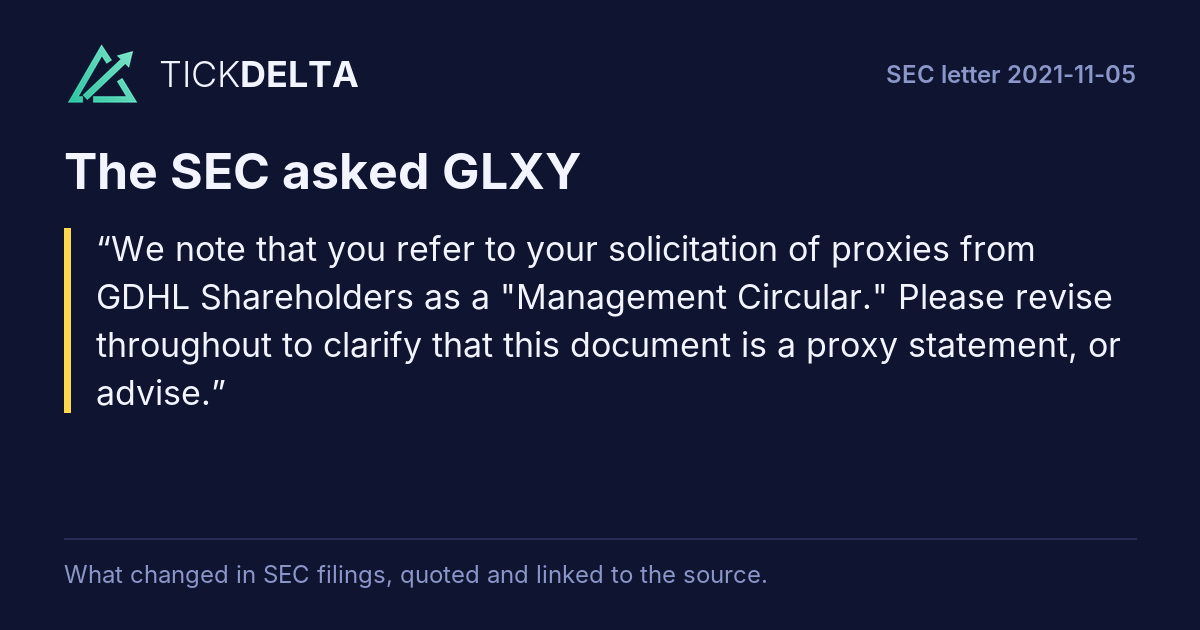
Also in this review: company letter, 2023-02-09, company letter, 2025-04-03, company letter, 2025-05-27, company letter, 2025-05-27, company letter, 2025-05-27