tickdelta
Sign in

Tickdelta is free for now. Sign up and get Pro free

← Screener

GLXYGalaxy Digital

Crypto · Brokers & Investment Banks · Nasdaq
Compare with peers → Embed
Risk factors in the latest filings

45 new in the latest 10-Q

New in the 10-KRead ↓
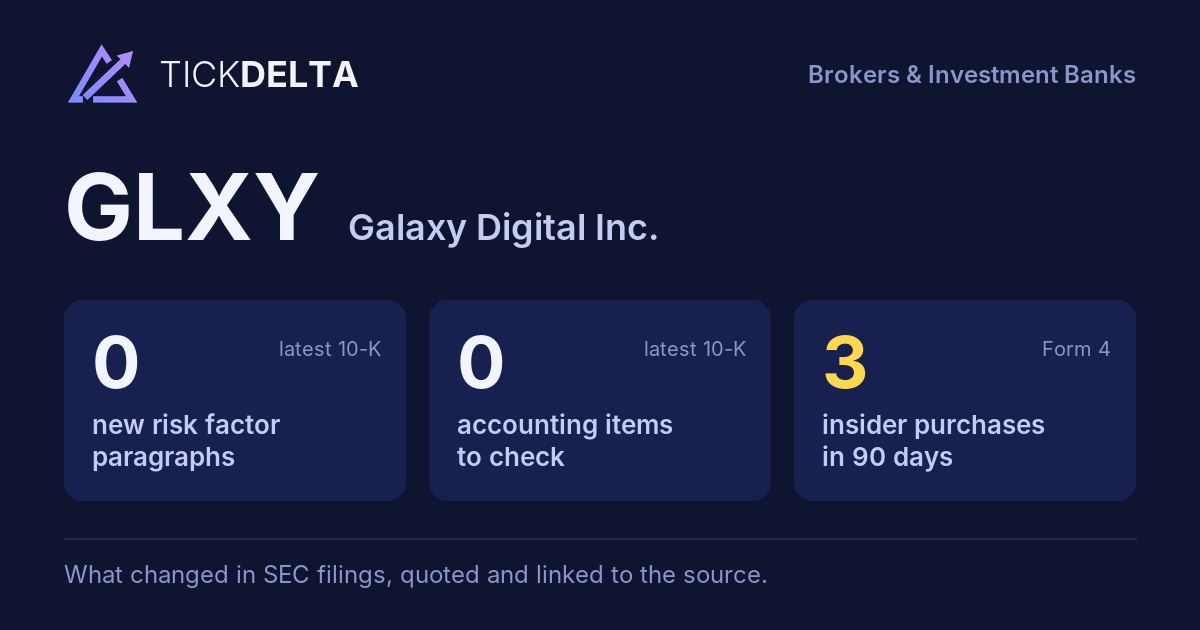
0
fewer than two 10-Ks to compare
New in the 10-QRead ↓
45
paragraphs not in the 10-Q filed Aug 10, 2026
10-Q against the 10-KRead ↓
146
risk factor paragraphs and sentences added or reworded
New in the 10-K

Paragraphs with nothing like them in last year's 10-K

No new paragraphs in Risk Factors, or fewer than two 10-Ks to compare.

New in the latest 10-Q

Paragraphs in the 10-Q filed Nov 9, 2026 that were not in the one before

45 paragraphs in the 10-Q filed Nov 9, 2026 with nothing like them in the 10-Q filed Aug 10, 2026 (at least half the words must differ; new numbers alone do not count). Quoted exactly, grouped by the item heading above them. This is text that changed, not a judgement of how serious it is.

Financial statements and notes

Notes interest expense, which was previously presented within Operating expenses, is presented within Other income / (expense) in the Company's condensed consolidated interim statements of operations. Prior period amounts have been reclassified to conform to the current period presentation, resulting in the reclassification of $ 14.4 million and $ 42.7 million of notes interest expense from Operating expenses to Other income / (expense) for the three and nine months ended September 30, 2025, respectively. Segment information in Note 20 has been recast accordingly. The reclassification had no impact on previously reported Income / (loss) before income taxes, Net income / (loss), equity or cash flows.

Read in the 10-Q ↗

Power and operating services that constitute separate non-lease components are accounted for under ASC Topic 606, with revenue recognized as the services are transferred to customers. The Company evaluates whether it controls each specified service before transfer to determine whether it acts as principal or agent. Consideration is presented gross within Revenues (presented as Data centers operator revenue in Note 20, Reportable Segments) when the Company acts as principal, with associated costs included in Transaction expenses (presented as Data centers operating cost in Note 20). When the Company acts as agent, revenue is limited to the fee or commission retained for arranging the service.

Read in the 10-Q ↗

Reimbursements of lessor ownership costs that do not transfer a separate good or service are not treated as separate non-lease components and are accounted for under the applicable lease guidance.

Read in the 10-Q ↗

Cash, stablecoins, and U.S. Treasuries represents the aggregate of cash and short-term investments included in Cash and cash equivalents, stablecoins included in Digital assets, and U.S. Treasuries included in Investments, current and Investments, non-current, in the Company's condensed consolidated balance sheets. This aggregate measure is presented to provide additional information regarding the Company's financial resources and is not equivalent to cash and cash equivalents under U.S. GAAP. As of September 30, 2026, Cash and cash equivalents included $ 366.3 million of U.S. Treasuries with original maturities of three months or less, which are classified as available-for-sale debt securities and are excluded from the U.S. Treasuries line in the table below. Refer to Note 7, Investments.

Read in the 10-Q ↗

In September 2026, the FASB issued ASU 2026-03, Investment Companies with Equity Securities Subject to Contractual Sale Restrictions. The amendments require investment companies within ASC Topic 946 to incorporate qualifying contractual sale restrictions into the fair value of equity securities and disclose the associated discount. The guidance is effective for annual periods beginning after December 15, 2027, including interim periods. Early adoption is permitted. Application is prospective, with adoption adjustments recognized in earnings. The Company is currently evaluating the impact of the amendments on its consolidated financial statements and disclosures.

Read in the 10-Q ↗
Show the other 40

In November 2024, the FASB issued ASU 2024-03, Income Statement - Reporting Comprehensive Income - Expense Disaggregation Disclosures (Subtopic 220-40): Disaggregation of Income Statement Expenses ("DISE"). The amendments require public business entities to disclose, in a tabular format in the notes to the financial statements, specified natural expense categories included in each relevant expense caption within continuing operations. These categories include purchases of inventory, employee compensation, depreciation, intangible asset amortization and, where applicable, depletion. The amendments also require certain existing GAAP disclosures to be included in the same tables, qualitative descriptions of amounts remaining in relevant expense captions that are not separately disaggregated, and disclosure of total selling expenses in annual and interim periods and the definition of selling expenses in annual periods. The amendments affect disclosure requirements and do not change the recognition or measurement of expenses.

Read in the 10-Q ↗

In January 2025, the FASB issued ASU 2025-01 to clarify the effective date of the DISE requirements. The amendments are effective for annual reporting periods beginning after December 15, 2026, and interim reporting periods within annual reporting periods beginning after December 15, 2027. Accordingly, the requirements are effective for the Company for the year ending December 31, 2027, and interim periods beginning in 2028. Early adoption is permitted, and the amendments may be applied prospectively or retrospectively to any or all prior periods presented. The Company is currently evaluating the impact of the amendments on its financial statement disclosures.

Read in the 10-Q ↗

In September 2025, the FASB issued ASU 2025-06, Intangibles - Goodwill and Other - Internal-Use Software (Subtopic 350-40): Targeted Improvements to the Accounting for Internal-Use Software. The amendments remove development-stage references and require capitalization of eligible internal-use software costs when management has authorized and committed to funding the project and it is probable that the project will be completed and the software will be used to perform its intended function. The amendments also require consideration of significant development uncertainty in assessing whether the capitalization criteria have been met. The guidance is effective for annual reporting periods beginning after December 15, 2027, including interim reporting periods, with early adoption permitted as of the beginning of an annual reporting period. The Company early adopted the guidance effective January 1, 2026. Adoption did not have a material impact on the Company’s consolidated financial statements.

Read in the 10-Q ↗

The Company's investments in U.S. Treasuries are classified as available-for-sale ("AFS") and are included in Cash and cash equivalents, Investments, current and Investments, non-current in the Company's condensed consolidated interim statements of financial position. These securities were purchased with proceeds from the issuance of the 9.875 % Senior Secured Notes due 2031 (the “2031 Secured Notes”), which are described in Note 16. The following table summarizes the Company's AFS debt securities as of September 30, 2026:

Read in the 10-Q ↗

The following table summarizes the amortized cost and fair value of the Company's AFS debt securities by contractual maturity as of September 30, 2026:

Read in the 10-Q ↗

As of September 30, 2026, substantially all of the Company’s AFS debt securities, which had a total fair value of $ 3,122 million, were in an unrealized loss position, all of which had been in a continuous unrealized loss position for less than 12 months. The unrealized losses are attributable to changes in interest rates. The Company does not intend to sell these securities, and it is not more likely than not that the Company will be required to sell them, before recovery of their amortized cost basis. As the securities are direct obligations of the U.S. government, the Company does not expect any credit losses, and no allowance for credit losses has been recorded. There were no realized gains or losses on AFS debt securities for the three and nine months ended September 30, 2026. The Company did not hold any AFS debt securities as of December 31, 2025.

Read in the 10-Q ↗

payments for these indemnifications is remote. As of September 30, 2026 and December 31, 2025, there was no liability accrued under these arrangements.

Read in the 10-Q ↗

In connection with the Credit Agreement, GDH LP provided a completion guarantee in favor of the collateral agent, for the benefit of the secured parties, with respect to the construction of the data center project financed by the Credit Agreement. As the guarantee is provided by GDH LP on behalf of a consolidated subsidiary, no separate liability has been recognized in the Company’s condensed consolidated interim financial statements.

Read in the 10-Q ↗

The Company is required to use the proceeds from the 2031 Secured Notes to finance a portion of the development and construction of two buildings containing eight data halls, with a combined 400 megawatts (“MW”) of utility capacity and 260 MW of critical IT capacity on a property in Dickens County, Texas and to fund debt service reserves. In connection with the issuance of the 2031 Secured Notes, GDH LP provided a completion guarantee with respect to the construction of the data center buildings financed by the 2031 Secured Notes. The guarantee addresses construction completion risk, is not limited in amount and does not guarantee repayment of the 2031 Secured Notes. As the guarantee is provided by GDH LP on behalf of a consolidated subsidiary, no separate liability has been recognized in the Company's condensed consolidated interim financial statements.

Read in the 10-Q ↗

On February 6, 2026, the Company’s board of directors authorized a program to repurchase up to $ 200 million of its Class A common stock (the “Initial Share Repurchase Program”). During the three and nine months ended September 30, 2026, the Company repurchased 3,721,820 and 6,927,051 shares of Class A common stock, respectively, in open-market transactions for an aggregate purchase price of $ 79.3 million and $ 144.4 million, respectively, excluding broker commissions and other costs of execution. These amounts exclude shares withheld in connection with employee equity award settlements. See Note 24 for the subsequent share repurchase program approved in October 2026.

Read in the 10-Q ↗

We have expanded our data center development pipeline in Texas. At our Helios campus, we have submitted a 1 GW load request, which remains subject to ERCOT’s interconnection process and approval, and have identified the potential for an additional 1 GW of expansion. We also acquired two additional sites, Caspian and Selene, with potential power capacity of approximately 700 MW and 900 MW, respectively, subject to ERCOT’s interconnection process. In addition, we entered into a development agreement with the city of McGregor, Texas, to acquire approximately 500 acres in the McGregor Industrial Park for the development of our Merlin campus, for which we have secured an agreement for approximately 74 MW of capacity in the initial phase, with the potential to expand to approximately 500 MW as the utility upgrades transmission infrastructure. Including the potential expansion at Helios and these sites, our total potential power pipeline exceeds 5.7 GW.

Read in the 10-Q ↗

Investment banking fees were $2.1 million and $6.2 million for the three and nine months ended September 30, 2026, respectively, compared to $85.2 million and $90.0 million in the corresponding periods in 2025, attributed to the Forward Industries, Inc. transaction completed in the third quarter of 2025. Lower investment banking fees contributed to the year-over-year decreases in fee revenue.

Read in the 10-Q ↗

decrease of $0.6 million and $14.1 million, or 4% and 24%, respectively. Legal and compliance fees were lower in both current year periods, which were offset by increases in professional fees associated with Data Centers operations.

Read in the 10-Q ↗

Income tax expense was $21.5 million for the three months ended September 30, 2026, compared to $40.1 million for the three months ended September 30, 2025, a decrease of $18.6 million. For the nine months ended September 30, 2026, we recognized an income tax benefit of $39.6 million, compared to an expense of $45.5 million for the nine months ended September 30, 2025, an $85.1 million change. The year-to-date benefit included certain investment tax credits related to the Data Centers segment recognized in the second quarter of 2026.

Read in the 10-Q ↗

On July 28, 2026, Galaxy Helios Data Centers II LLC (“Galaxy Helios II”), an indirect wholly owned subsidiary of GDH LP, issued $3.5 billion aggregate principal amount of 9.875% Senior Secured Notes due 2031 (the “2031 Secured Notes”) in a private offering. The 2031 Secured Notes were issued at a price equal to 99.500% of their principal amount, resulting in an aggregate discount of $17.5 million. On initial recognition of the 2031 Secured Notes, debt issuance costs of $34.0 million were recognized as a reduction of Notes payable, and are being expensed over the term of the debt. The unamortized debt issuance cost as of September 30, 2026 was $32.8 million. Galaxy is required to use the proceeds from the issuance of the 2031 Secured Notes to finance a portion of the development and construction of two data center buildings at the Helios campus, and to fund debt service reserves. Total notes payable, including current and noncurrent portions and net of unamortized discounts and issuance costs, was $6.7 billion at September 30, 2026, compared to $2.9 billion at December 31, 2025. This project financing and related cash and Treasury holdings should be considered together with construction commitments, debt-service requirements and limitations on distributions from project subsidiaries when assessing liquidity available for general corporate purposes.

Read in the 10-Q ↗

Our contractual commitments and obligations, including unfunded investment commitments and the project completion guarantees provided by GDH LP in connection with the Credit Agreement and the issuance of the 2031 Secured Notes, are described in Notes 8, 15 and 16 to the condensed consolidated interim financial statements. See also “Contractual Obligations and Commitments” below.

Read in the 10-Q ↗

(4) The notes payable amounts represent contractual principal and exclude unamortized discounts and debt issuance costs. Scheduled amortization of the 2031 Secured Notes is based on the anticipated rent commencement date under the related data center lease and may change if that date changes.

Read in the 10-Q ↗

The table above excludes our liability under the tax receivable agreement of $154.8 million as of September 30, 2026, of which $83.8 million is payable to related parties, which is included in Other non-current liabilities. The amount and timing of payments under the tax receivable agreement are dependent on future events, including the timing of exchanges of LP Units and Class B common stock and our generation of sufficient taxable income. See Note 19 to the condensed consolidated interim financial statements.

Read in the 10-Q ↗

Lessor Accounting for Data Center Leases. During 2026, we commenced recognizing revenue under our long-term data center lease agreements at the Helios campus, which are classified as operating leases. Determining the lease commencement date, the lease term (including the evaluation of renewal and termination options), lease classification, and the allocation of consideration between lease and non-lease components requires significant judgment. Fixed lease payments, including amounts received in advance, are recognized on a straight-line basis over the lease term. Changes in

Read in the 10-Q ↗

Capitalized Interest. We capitalize interest cost on qualifying assets under construction at the Helios campus. Determining qualifying expenditures, the capitalization period (including when construction is substantially complete) and the capitalization rate requires judgment. We capitalized $20.7 million and $62.8 million of interest cost for the three and nine months ended September 30, 2026, respectively.

Read in the 10-Q ↗

Market risk

Our exposure to changes in interest rates relates primarily to our investments in U.S. Treasuries and cash equivalents, and to our variable-rate borrowings. As of September 30, 2026, we held $3.1 billion of U.S. Treasuries, which are measured at fair value, with changes in fair value recognized in other comprehensive income. Due to their short duration, management's estimate of the effect of a hypothetical +/- 100 basis point change in interest rates on the fair value of our U.S. Treasuries, with all other variables held constant, was approximately +/- $16 million as of September 30, 2026. Changes in interest rates would also affect the interest income we earn on these holdings and on our cash and cash equivalents.

Read in the 10-Q ↗

Borrowings under the Credit Agreement bear interest at SOFR plus an applicable margin of 4.75%, subject to a floor of 2.5%, and $1.3 billion was outstanding as of September 30, 2026. We utilize interest rate caps to mitigate our exposure to increases in SOFR. A hypothetical 100 basis point increase in SOFR would have a negligible impact on our annual interest cost on the Credit Agreement, net of the effect of interest rate caps. Our Exchangeable Notes and 2031 Secured Notes bear interest at fixed rates, and changes in interest rates therefore do not affect the interest expense on those instruments.

Read in the 10-Q ↗

As of September 30, 2026, the total amount of digital assets and collateral held on digital asset trading platforms was $1.8 billion, of which $452.9 million was held at Binance, and $186.8 million was held at Protocol Pool. No other individual venue held more than 10% of such assets. Amounts held with third-party trading platforms, custodians, counterparties and decentralized finance protocols represent point-in-time balances. These amounts may fluctuate materially from day to day as a result of trading activity, settlements, collateral and margin movements, borrowings and repayments, asset transfers, and changes in the market value of digital assets.

Read in the 10-Q ↗

Risk Factors

On August 18, 2026, the SEC proposed Regulation Crypto Assets, which if adopted would create tailored exemptions from the Securities Act’s Section 5 registration requirements for certain covered investment contracts and a conditional safe harbor from the term “investment contract” in the Securities Act and Exchange Act definitions of “security.” The proposed safe harbor would apply only if its conditions were satisfied, and the SEC could challenge whether an issuer has satisfied those conditions. It remains to be seen if the proposal will be finalized and in what form, and there is, therefore, regulatory risk and uncertainty as to how any such final rulemaking may impact the digital asset markets and our business.

Read in the 10-Q ↗

We operate in relatively new industries that are not widely understood and requires highly skilled and technical personnel. We believe that our future success is highly dependent on the talents and contributions of our senior

Read in the 10-Q ↗

acquisitions. Moreover, the anticipated benefits of any acquisition or investment might not be realized, the acquisition or investment might not perform in accordance with expectations, and we might be exposed to unknown liabilities or risks.

Read in the 10-Q ↗

and open-source contributors are unable or unwilling to address the issues adequately or in a timely manner, such digital asset networks, and any corresponding digital assets held may be adversely affected.

Read in the 10-Q ↗

our hot or cold wallets may be compromised and our technical infrastructure may be affected, all of which could adversely impact the success of our business, financial condition and results of operations.

Read in the 10-Q ↗

In some cases, smart contracts can be controlled by one or more “admin keys” or users with special privileges, or “super users.” These users have the ability to unilaterally make changes to the smart contract, enable or disable features on

Read in the 10-Q ↗

protocol or liquidity pool can trigger a cascading effect across multiple platforms, causing widespread selling activity and further exacerbating volatility.

Read in the 10-Q ↗

discontinue or reduce their use of our and our third-party service providers’ products and services, and result in significant penalties and fines and additional restrictions, which could adversely impact our business, operating results, and financial condition.

Read in the 10-Q ↗

party service providers, including cloud vendors, could prove inadequate. If an actual or perceived breach of any of our digital asset accounts occurs, the market perception of our effectiveness could be harmed.

Read in the 10-Q ↗

that result in the loss of personal information. Over a third of other U.S. states have enacted, and many others are also in the process of enacting or considering, comprehensive state-level data privacy and security laws.

Read in the 10-Q ↗

and requires appropriate transfer mechanisms and, in some cases, transfer impact assessments and supplementary measures.

Read in the 10-Q ↗

• the performance and financial condition of our major customers, including their ability to meet their contractual obligations;

Read in the 10-Q ↗

Furthermore, GDH LP issued $500 million aggregate principal amount of 3.00% Exchangeable Senior Notes due 2026 (the “2026 Exchangeable Notes”) on December 9, 2021, $402.5 million aggregate principal amount of 2.500%

Read in the 10-Q ↗

GLXY may also be subject to smart-contract, custody, cybersecurity, sanctions-screening, and chain-level risks (such as forks, network outages, or MEV) that do not apply to Traditional GLXY.

Read in the 10-Q ↗

On September 17, 2026, the SEC issued an order providing temporary conditional exemptions, from the definition of an “exchange” under the Exchange Act, for certain onchain trading venues for tokenized NMS stocks (each venue a “tokenized securities venue” or “TSV”) and, from the definition of a “dealer” under the Exchange Act, for certain liquidity providers. The SEC order is referred to as the “Innovation Exemption.” The Innovation Exemption does not otherwise exempt participants or their other activities from applicable securities-law requirements, does not provide relief to the person that tokenizes a stock, does not address transfer agent or clearing agency status, and does not extend to trading outside TSVs. It expires on September 17, 2031 unless extended, and the SEC may modify it at any time. We have received notice from Formation Securities LLC (“Formation”) that it intends to operate as a TSV under the Innovation Exemption and make Tokenized GLXY available on the Formation TSV. Any trading of Tokenized GLXY relying on this relief depends on the TSV’s ability to satisfy the conditions of the Innovation Exemption, including applicable symbol and trading-volume limitations, and trading could be interrupted or restricted, including through mandatory trading pauses, if those conditions are not satisfied or if Nasdaq halts or suspends trading in our Class A common stock. Because Tokenized GLXY is tokenized by us, the relief does not require TSVs, including the Formation TSV, to notify us or permit us to object before making Tokenized GLXY available for trading, and our ability to limit where Tokenized GLXY trades may depend on the restrictions maintained through our digital transfer agent’s Allowlist. In addition, the Innovation Exemption contemplates that third parties unaffiliated with us may separately tokenize our Class A common stock, which can then be made available for trading on a TSV unless we object in writing within 30 calendar days after we receive notice from that TSV. We would need to evaluate and respond to each notice separately, a failure to object within that period would permit trading to begin and could not later be withdrawn, and the TSV would publicly disclose our objection. Any such third-party tokens may compete with Tokenized GLXY or trade at prices that diverge from our Class A common stock. Such restrictions and developments could impair liquidity and price discovery for Tokenized GLXY and adversely affect the market for our Class A common stock.

Read in the 10-Q ↗

have a fixed expiration date, may be suspended or discontinued at any time and does not obligate us to acquire any amount of common stock. There is no assurance how many shares of Class A common stock we will repurchase, if any, or at what prices any purchases will be made.

Read in the 10-Q ↗

Share sales and buybacks

(1) Represents repurchases and/or remaining amounts under the Initial Share Repurchase Program, previously announced on February 6, 2026. As of October 15, 2026, the Initial Share Repurchase Program had been completed, with all $200 million of authorized capacity repurchased.

Read in the 10-Q ↗
10-Q against the 10-K

The 10-Q's risk factors against the 10-K

Item 1A of the 10-Q filed Nov 9, 2026 against Item 1A of the 10-K filed Feb 26, 2026. A 10-Q repeats only the risks that changed, so a 10-K paragraph that is missing from it is not counted as removed. Added is a paragraph with nothing like it in the 10-K, Reworded a sentence that is in both with several words changed, Quiet changes a sentence in both where one to four words changed and one is a hedge or a modal (cut words struck through, new words highlighted and underlined). Text on the page, not a score; each links to the filing at sec.gov.

Added10-Q 2026-11-09 vs 10-K 2026-02-26
On March 17, 2026, the SEC, joined by the CFTC, issued an interpretation clarifying its views on the application of the federal securities laws to certain types of digital assets and transactions involving digital assets (the “Interpretive Release”). The Interpretive Release classifies digital assets into five categories based on their characteristics, uses, and functions: digital commodities, digital collectibles, digital tools, stablecoins and digital securities. Applying the traditional Howey Test, the Interpretive Release explains that, in the SEC’s interpretation, digital commodities, digital collectibles, digital tools, and stablecoins will generally not be considered securities so long as they are not the subject of an “investment contract,” which is defined as any contract, transaction, or scheme whereby a person invests money in a common enterprise and reasonably expects profits to be derived from the efforts of others. Under the Interpretive Release, the SEC identified specific examples of digital commodities including but not limited to Bitcoin, Ethereum, Solana and Dogecoin. The Interpretive Release also addresses several types of digital asset activities, including protocol mining and staking, and indicated in the SEC’s view these activities, when conducted in the manner specified in the Interpretive Release, will not require the registration of transactions under the Securities Act as the miners and stakers contribute their own efforts in exchange for programmatically issued crypto asset rewards.

Read it in the 10-Q at sec.gov ↗

Added10-Q 2026-11-09 vs 10-K 2026-02-26
While the Interpretive Release provides comfort that the SEC does not view Bitcoin and certain other digital assets as securities in and of themselves, certain transactions in such non-security digital assets may nonetheless be considered investment contracts, and thus securities for purposes of the federal securities laws. Moreover, the Interpretive Release does not discuss all digital asset-related activities and transactions that we may undertake, and it is possible that certain of those activities or transactions could still be determined to involve an investment contract, and thus, the holding, offer or sale of a security by us for purposes of federal securities laws. Moreover, the Interpretive Release represents the interpretation of the SEC only and thus is not binding on any other person (including private litigants) nor dispositive of how a court applying the U.S. federal securities laws may evaluate the regulatory characterization of any particular digital asset. Accordingly, although it provides improved comfort and clarity, the Interpretive Release is not dispositive and there remains regulatory risk and uncertainty regarding the U.S. regulatory treatment of digital assets, including Bitcoin.

Read it in the 10-Q at sec.gov ↗

Added10-Q 2026-11-09 vs 10-K 2026-02-26
On August 18, 2026, the SEC proposed Regulation Crypto Assets, which if adopted would create tailored exemptions from the Securities Act’s Section 5 registration requirements for certain covered investment contracts and a conditional safe harbor from the term “investment contract” in the Securities Act and Exchange Act definitions of “security.” The proposed safe harbor would apply only if its conditions were satisfied, and the SEC could challenge whether an issuer has satisfied those conditions. It remains to be seen if the proposal will be finalized and in what form, and there is, therefore, regulatory risk and uncertainty as to how any such final rulemaking may impact the digital asset markets and our business.

Read it in the 10-Q at sec.gov ↗

Added10-Q 2026-11-09 vs 10-K 2026-02-26
In addition, we currently require, or may in the future require, approval from ERCOT for the use of additional power at certain of our existing data center sites or new power as a result of our expansion to new sites. Specifically, in August 2026, the Governor of Texas directed the Public Utility Commission of Texas (“PUCT”) and ERCOT to conduct a comprehensive verification and audit of all data centers advancing through ERCOT’s interconnection process, and PUCT and ERCOT must complete this audit before any data center project moves forward. This review may impact the power approval timelines for certain of our data center sites. Further, if we are unable to obtain the necessary approvals, or we experience significant delays obtaining such approvals, this could result in adverse consequences to our business, financial condition and results of operations.

Read it in the 10-Q at sec.gov ↗

Added10-Q 2026-11-09 vs 10-K 2026-02-26
We currently stake certain digital assets and operate validator nodes on blockchain networks through our blockchain infrastructure operations. Some PoS networks require the digital assets to be transferred on the underlying blockchain networks into smart contracts which are not under our or, in certain circumstances, anyone’s control, or to a validator node directly, to participate in staking. Other PoS networks enable users to delegate certain rights or powers associated with the

Read it in the 10-Q at sec.gov ↗

Show the other 29
Added10-Q 2026-11-09 vs 10-K 2026-02-26
We operate in relatively new industries that are not widely understood and requires highly skilled and technical personnel. We believe that our future success is highly dependent on the talents and contributions of our senior

Read it in the 10-Q at sec.gov ↗

Added10-Q 2026-11-09 vs 10-K 2026-02-26
DeFi protocols present additional and distinct risks that are not addressed by SOC evaluations or by the regulatory frameworks applicable to centralized digital asset trading platforms. Because DeFi protocols operate through self-executing smart contracts, administrative permissions and oracle price feeds, they are susceptible to exploits that have no direct analog in traditional financial markets, including smart contract coding errors, price oracle manipulation (in which an attacker artificially inflates or distorts the reported price of an asset used as collateral), flash loan attacks, the compromise or social engineering of administrative or multi-signature “governance” keys, the elimination or absence of timelocks and other circuit-breaker controls, and the introduction of malicious or fraudulent collateral into a protocol. Even protocols that have undergone one or more third-party security audits, including audits by reputable firms, have suffered material exploits, and an audit cannot be relied upon as an assurance against loss. In addition, because DeFi protocols are highly composable and interconnected, an exploit at a single protocol can cascade across other protocols that integrate with, custody assets at, or rely on liquidity, vaults or price data sourced from the affected protocol. For example, on April 1, 2026, attackers drained approximately $285 million from Drift Protocol, then the largest decentralized perpetual futures exchange on the Solana blockchain; more than 20 other protocols with exposure to Drift reported subsequent disruptions, pauses or losses, and security firms have publicly attributed the attack to state-affiliated threat actors associated with the Democratic People’s Republic of Korea. Less than three weeks later, on April 19, 2026, attackers reportedly exploited the Kelp DAO bridge for an additional approximately $292 million, contributing to over $605 million in losses to the digital asset ecosystem in less than 20 days. We may have engaged, and may in the future engage, with protocols that have suffered, or that subsequently suffer, similar exploits, and we may not be able to recover any digital assets lost as a result of such an exploit. The frequency, sophistication and aggregate value of such exploits has increased materially in recent periods, and the loss of digital assets through a DeFi protocol exploit - whether held by us directly, through a vault or strategy, or by a counterparty with which we transact - could be material and is generally not insured.

Read it in the 10-Q at sec.gov ↗

Added10-Q 2026-11-09 vs 10-K 2026-02-26
acquisitions. Moreover, the anticipated benefits of any acquisition or investment might not be realized, the acquisition or investment might not perform in accordance with expectations, and we might be exposed to unknown liabilities or risks.

Read it in the 10-Q at sec.gov ↗

Added10-Q 2026-11-09 vs 10-K 2026-02-26
Claims asserted against us may not be resolved in our favor. Unfavorable rulings in our legal proceedings could result in material liability to us or have a negative impact on our reputation or relations with our employees or third parties. Furthermore, the outcome of litigation is inherently uncertain and is difficult to assess or quantify. If we are unable to resolve these or other matters favorably, our business, operating results, and our financial condition may be adversely affected.

Read it in the 10-Q at sec.gov ↗

Added10-Q 2026-11-09 vs 10-K 2026-02-26
In addition, our ability to operate depends on access to traditional banking, payment, settlement, fiat on- and off-ramp, and credit services from a limited number of financial institutions willing to serve digital asset businesses. Although the U.S. federal banking agencies have rescinded prior guidance that discouraged banks from engaging with digital asset clients, banks and payment providers may continue to limit, condition, or terminate services to us or our clients, counterparties or affiliates due to perceived regulatory, reputational, AML/sanctions or capital considerations. The loss, suspension, or material change in terms of any such relationship - including correspondent banking, USD wire and ACH access, custody of fiat reserves, stablecoin issuance and redemption rails, or credit lines - could disrupt our trading, asset management, lending and AI/HPC data center infrastructure operations, increase our costs, limit our ability to settle client activity on a timely basis, and have a material adverse effect on our business, financial condition and results of operations.

Read it in the 10-Q at sec.gov ↗

Added10-Q 2026-11-09 vs 10-K 2026-02-26
contract referencing spot bitcoin on a designated contract market and issued a related policy statement confirming its view that a case‑by‑case review process under CFTC Rule 40.3 is appropriate for such contracts. That same day, the CFTC also issued a staff advisory outlining operational expectations for market participants engaged in 24/7 trading, clearing, and settlement across derivatives asset classes. Together, these developments may expand the regulated markets in which our Digital Assets segment participates and introduce new operational and compliance expectations for market participants engaged in continuous trading, clearing, and settlement of digital asset derivatives.

Read it in the 10-Q at sec.gov ↗

Added10-Q 2026-11-09 vs 10-K 2026-02-26
and open-source contributors are unable or unwilling to address the issues adequately or in a timely manner, such digital asset networks, and any corresponding digital assets held may be adversely affected.

Read it in the 10-Q at sec.gov ↗

Reworded10-Q 2026-11-09 vs 10-K 2026-02-26
In February On October 26, 2026, having fully utilized our initial $200 million share repurchase authorization under the Initial Share Repurchase Program, our board of directors authorized approved a share new repurchase program pursuant to which we announced our intention to repurchase up to an additional $200 million of our outstanding shares of Class A common stock (the “Share Repurchase Program”) from time to time, using a variety of methods, time through open market purchases, pre-paid puts or in privately negotiated transactions, or by other means, including through the use of trading plans intended to qualify under Rule 10b5-1 plans, under the Exchange Act in compliance accordance with the rules of the SEC applicable securities laws, stock exchange requirements and other applicable legal requirements. restrictions.

Read it in the 10-Q at sec.gov ↗ · The 10-K sentence ↗

Reworded10-Q 2026-11-09 vs 10-K 2026-02-26
Furthermore, GDH LP issued $500 million aggregate principal amount of 3.00% Exchangeable Senior Notes due 2026 (the “2026 Exchangeable Notes”) on December 9, 2021, $402.5 million aggregate principal amount of 2.500% Exchangeable Senior Notes due 2029 (the “2029 Exchangeable Notes”) on November 25, 2024 and $1.30 billion aggregate principal amount of 0.50% Exchangeable Senior Notes due 2031 (the “2031 Exchangeable Notes” and, together with the 2026 Exchangeable Notes and the 2029 Exchangeable Notes, the “Exchangeable Notes”) on October 30, 2025.

Read it in the 10-Q at sec.gov ↗ · The 10-K sentence ↗

Reworded10-Q 2026-11-09 vs 10-K 2026-02-26
As digital assets have grown in both popularity and market size, various U.S. federal, state, and local and foreign governmental organizations, consumer agencies and public advocacy groups have been examining the operations of cryptocurrency networks, users and platforms, with a focus on how digital assets can be used to launder the proceeds of illegal activities, fund criminal or terrorist enterprises in the United States, and the safety and soundness of platforms and other service providers that hold digital assets for users.

Read it in the 10-Q at sec.gov ↗ · The 10-K sentence ↗

Reworded10-Q 2026-11-09 vs 10-K 2026-02-26
See “—Risks “ - Risks Related to Our Business Lines—Our Operations - Our strategy to expand into the AI/HPC data center business may not be successful has resulted and may continue to result in adverse consequences to our business, financial condition and results of operations” operations, including impairment charges recognized in connection with the conversion of our Helios mining infrastructure and negative Adjusted EBITDA in recent periods” for more information on the risks relating to our transition to the AI/HPC data center infrastructure business.

Read it in the 10-Q at sec.gov ↗ · The 10-K sentence ↗

Reworded10-Q 2026-11-09 vs 10-K 2026-02-26
Commodity Exchange Act of 1936 (“CEA”) and CFTC rules and regulations, including certain futures contracts, options on futures contracts, options on non-security commodities, swaps and retail leveraged Such commodity interest transactions (among other instruments), are subject to more extensive regulation and supervisory oversight by the CFTC, including registrations of registration requirements for entities engaged in, and platforms offering, such commodity interest transactions.

Read it in the 10-Q at sec.gov ↗ · The 10-K sentence ↗

Reworded10-Q 2026-11-09 vs 10-K 2026-02-26
See “—Risks “ - Risks Related to Our Business Lines—Our Operations - Our strategy to expand into the AI/HPC data center business may not be successful has resulted and may continue to result in adverse consequences to our business, financial condition and results of operations” operations, including impairment charges recognized in connection with the conversion of our Helios mining infrastructure and negative Adjusted EBITDA in recent periods” for further information relating to the potential impacts of decreased market demand on our AI/HPC data center infrastructure business.

Read it in the 10-Q at sec.gov ↗ · The 10-K sentence ↗

Reworded10-Q 2026-11-09 vs 10-K 2026-02-26
Under the terms of the settlement, Galaxy (i) accrued a legal provision of $151.0 $115.1 million as of December 31, 2025 September 30, 2026 (the undiscounted amount of which is $160 $120.0 million, payable on a pre-determined schedule over the course of four years) and (ii) has agreed to, among other things, compliance enhancements related to public statements about cryptocurrency and purchases and sales of cryptocurrency.

Read it in the 10-Q at sec.gov ↗ · The 10-K sentence ↗

Reworded10-Q 2026-11-09 vs 10-K 2026-02-26
In addition, we are listed on the TSX, a reporting issuer in Canada, and as such, such are subject to the listing requirements of the TSX, which impose significant requirements relating to disclosure controls and procedures and internal control over financial reporting, as well as to Canadian securities laws, which require us to file reports and other information on SEDAR. SEDAR+.

Read it in the 10-Q at sec.gov ↗ · The 10-K sentence ↗

Reworded10-Q 2026-11-09 vs 10-K 2026-02-26
The risk that such customer or any future customer of our AI/HPC data center infrastructure operations may fail to renew, terminate, default on or underperform their contractual obligations would curtail the growth of our AI/HPC data center infrastructure business and may adversely affect our business, reputation, financial condition, results of operations or the price of our Class A common stock.

Read it in the 10-Q at sec.gov ↗ · The 10-K sentence ↗

Reworded10-Q 2026-11-09 vs 10-K 2026-02-26
For example, on October 29, 2026, attackers absconded with approximately $6.3 billion in digital assets from the hot wallets of Binance, the world’s largest centralized digital asset trading platform, as described further under “ - Our and our third-party service providers’ failure to safeguard and manage our and our customers’ funds and digital assets could adversely impact our business, operating results and financial condition. condition.”

Read it in the 10-Q at sec.gov ↗ · The 10-K sentence ↗

Reworded10-Q 2026-11-09 vs 10-K 2026-02-26
In March 2025, then Acting SEC Chairman Uyeda said he had asked SEC staff for options on abandoning the digital assets-related elements of the proposal, but and in April 2025 the SEC announced it is would not possible pursue the proposed amendments as they relate to predict how or when these developments will be resolved or what the impact on specific DeFi protocols will be. protocols.

Read it in the 10-Q at sec.gov ↗ · The 10-K sentence ↗

Reworded10-Q 2026-11-09 vs 10-K 2026-02-26
Although we have undertaken certain processes, Our efforts taken, such as hedging, in order to may not fully reduce the risks of electricity price fluctuations, and we expect the cost for power to continue to be volatile and unpredictable and subject to inflationary pressures, which could materially affect our financial forecasting, business, operating results, financial condition, and future prospects.

Read it in the 10-Q at sec.gov ↗ · The 10-K sentence ↗

Quiet changes10-Q 2026-11-09 vs 10-K 2026-02-26
Our focus on developing the Helios campus and any other future campuses to offer AI/HPC data center infrastructure may also disrupt our business by diverting our resources and requiring significant management attention that would otherwise be available for utilization within, and development of, our existing businesses.

Read it in the 10-Q at sec.gov ↗ · The 10-K sentence ↗

Quiet changes10-Q 2026-11-09 vs 10-K 2026-02-26
However, there There are inherent limitations to our current and future risk management strategies, including risks that we have not appropriately anticipated or identified.

Read it in the 10-Q at sec.gov ↗ · The 10-K sentence ↗

Quiet changes10-Q 2026-11-09 vs 10-K 2026-02-26
The success of our investment banking business will depend depends on our ability to generate and maintain ongoing, profitable client demand for our services and our ability to remain competitive in the digital asset investment banking space.

Read it in the 10-Q at sec.gov ↗ · The 10-K sentence ↗

Quiet changes10-Q 2026-11-09 vs 10-K 2026-02-26
Furthermore, a number of U.S. states have adopted specific statutory provisions, or have issued guidance, regarding the treatment of virtual currencies under the money transmitter requirements of that U.S. state, and California has enacted the Digital Financial Assets Law (the “DFAL”), which will come came into effect on July 1, 2026, that is broadly similar to the BitLicense regulation in New York State.

Read it in the 10-Q at sec.gov ↗ · The 10-K sentence ↗

Quiet changes10-Q 2026-11-09 vs 10-K 2026-02-26
Inability to export personal data may also: restrict our activities outside Europe and the U.K.; limit our ability to collaborate with partners as well as other service providers, contractors and other companies outside of Europe and the U.K.; and/or require us to increase our processing capabilities within Europe and the U.K. at significant expense or otherwise cause us to change the geographical location or segregation of our relevant systems and operations—any operations - any or all of which could adversely affect our operations or financial results.

Read it in the 10-Q at sec.gov ↗ · The 10-K sentence ↗

Quiet changes10-Q 2026-11-09 vs 10-K 2026-02-26
The trading market for our Class A common stock will rely relies in part on the research and reports that industry or financial analysts publish about us or our business.

Read it in the 10-Q at sec.gov ↗ · The 10-K sentence ↗

The first 34 of 146 are shown (at most 12 of each type).
Next 10-K change →