Screener / SEC EDGAR /CIK 0001526113 /10-K filed Feb 25, 2026, compared with Feb 27, 2025 /Numbers from the XBRL of the 10-Ks
NYSE Real estate · REIT

Global Net Lease, Inc. GNL

Compare with peers Embed
SEC comment letters, last 20 years

7 reviews of GNL's filings by SEC staff

UPLOAD and CORRESP
Reviews 7 latest letter Apr 30, 2025
Questions asked 33 each answered in the company's own letter
No closing letter 3 reviews without a letter saying the staff completed it

When the SEC's staff reviews a filing, it writes to the company with numbered questions, and the company answers each one in a letter. SEC publishes the exchange once the review is over, at least 20 business days later. A question is not an accusation; most reviews end with the company adding detail to its next filing.

How the reviews went

Every review on EDGAR, from the first staff letter to the letter that closes it

  1. 1. Staff letters 10 UPLOAD
  2. 2. Questions in them 33 numbered comments
  3. 3. Company replies 8 CORRESP
  4. 4. Reviews closed 4 of 7 closing letter

Half the closed reviews took 17 days or less from the first letter to the closing letter.

Form 10-K for the Fiscal Year Ended December 31, 2024

2025-04-30 to 2025-05-05 · 1 question · 1 letter from the SEC, 1 from the company
Review closed 2025-05-05
RevenueSegmentsResults discussion (MD&A)Acquisitions
SEC asked
We note you have identified multiple factors that impact your operating results but it does not appear that you have separately quantified each factor. For example purposes only, you state that the decrease in revenue in your office segment was primarily driven by dispositions during the year ended December 31, 2024, partially offset by a full period of revenue in the year ended December 31, 2024 attributable to
Rest of the question

properties acquired from RTL on the Acquisition Date for the year ended December 31, 2024. When there are multiple factors impacting your operating results, please revise your disclosures in future periodic filings to separately quantify the impact from each factor.

GNL answered
The Company acknowledges the Staff’s comment and advises the

Staff that it will make the requested revisions to the Company’s disclosure in the Company’s Form 10-Q for the quarter ended

March 31, 2025 and in future filings with the Commission.
Read in the reply

Also in this review: closing letter, 2025-05-05

Form 10-K

2024-04-16 to 2024-04-30 · 1 question · 1 letter from the SEC, 1 from the company
Review closed 2024-04-30
RevenueSegmentsIncome taxes
Notes to Consolidated Financial Statements · Note 15 - Segment Reporting, page F-52
SEC asked
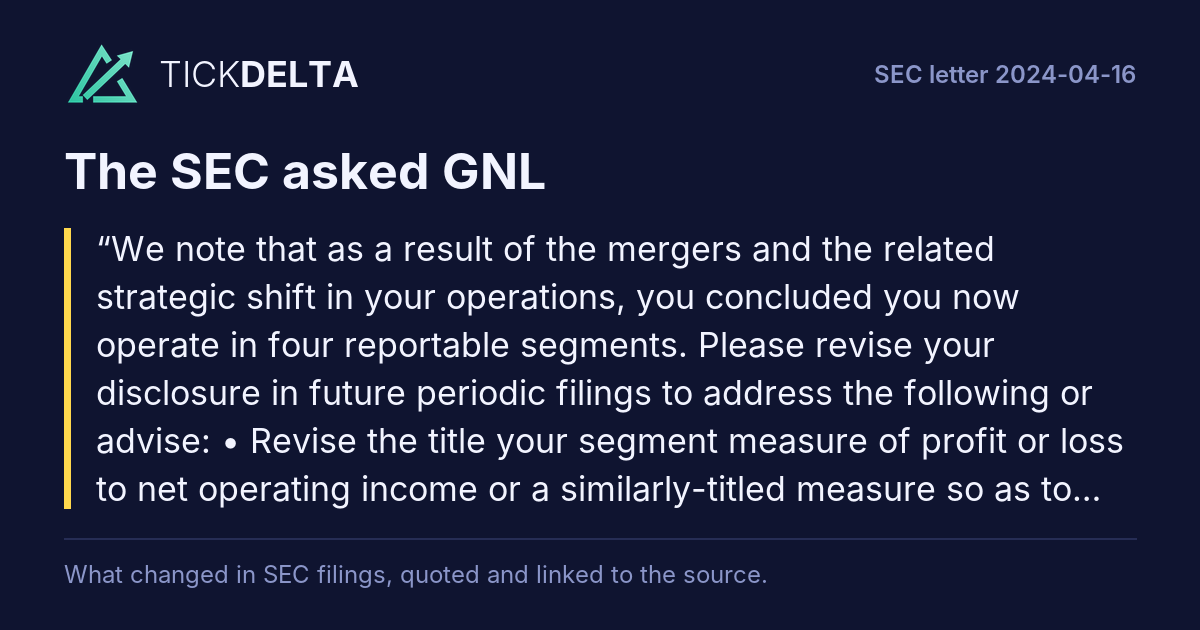
We note that as a result of the mergers and the related strategic shift in your operations, you concluded you now operate in four reportable segments. Please revise your disclosure in future periodic filings to address the following or advise: • Revise the title your segment measure of profit or loss to net operating income or a similarly-titled measure so as to better reflect both the revenue and property operating
Rest of the question

expense components of your segment measure; and • We note you reconcile your segment measure of profit or loss to Net loss attributable to common stockholders, and not Net (loss) income before income tax. In future filings, revise your reconciliation to reconcile your segment measure to Net (loss) income before income tax; refer to ASC 280-10-50-30b.

GNL answered
The Company acknowledges the Staff’s comment and advises the

Staff that it will make the requested revisions to the Company’s disclosure in the Company’s Form 10-Q for the quarter ended

March 31, 2024 and in future filings with the Commission.
Read in the reply
In its next report

First report after the company's reply of Apr 26, 2024: 10-Q filed May 8, 2024 ↗, against the 10-Q filed Nov 7, 2023 ↗.

Tickdelta does not hold the text of both reports, so they are not compared here.

Also in this review: closing letter, 2024-04-30

Global Net Lease, Inc. · PREC14A filed by Blackwells Capital LLC et al. · Filed December 1, 2022 · File No. 001-37390

2022-12-12 to 2023-03-30 · 11 questions · 3 letters from the SEC, 0 from the company
No closing letter
Legal and contingencies
SEC letter of Dec 12, 2022 ↗ no reply letter on EDGAR (the company may have answered in an amended filing)
Reasons for the Solicitation, page 5
SEC asked (1)
Footnote 16 on page 7 appears to provide an incorrect citation. Please revise or advise.
GNL answered

No reply letter found.

Proposal 1: Election of Nominees, page 8
SEC asked (2)
The meaning of the final sentence of the third paragraph on page 8, which begins "Neither of Mr. Lozier nor Mr. O'Toole...," is unclear. Please revise or advise.
GNL answered

No reply letter found.

Proposal 2: Bylaw Repeal Proposal, page 11
SEC asked (3)
Please disclose the text of Amendment No. 2 to the Bylaws and/or a reference to where shareholders can find such text.
GNL answered

No reply letter found.

Proposal 5: Director Resignation Policy Proposal, page 14
SEC asked (4)
We note that the resolution seeks a voting standard tied to "the affirmative vote of the holders of a majority of the voting power of the Company’s outstanding capital stock entitled to vote thereon." Such standard appears to call for a majority of shares outstanding, rather than a majority of votes cast.
Rest of the question

Related disclosure indicates that such a standard would be "in line with best corporate governance practices." Please confirm that the standard sought is in fact tied to a majority of shares outstanding, and if so, please disclose, if true, that such a standard exceeds the majority-of-votes-cast standard more typical of U.S. public companies.

GNL answered

No reply letter found.

Schedule I, page I-1
SEC asked (5)
On page I-2, we note the reference to "Related Real Estate Fund III, L.P." Please disclose who this entity is and its relationship to Related Fund Management, LLC. The phrase "[a]s of the date of this Notice" is also unclear. Please revise to clarify.
GNL answered

No reply letter found.

SEC letter of Mar 30, 2023 ↗ no reply letter on EDGAR (the company may have answered in an amended filing)
After reviewing your response to these comments, we may have additional comments. General
SEC asked (1)
Please outline briefly the rights of appraisal or similar rights of dissenters with respect to any matter to be acted upon at the meeting and indicate any statutory procedure required to be followed by dissenting security holders in order to perfect such rights. See Item 3 of Schedule 14A.
GNL answered

No reply letter found.

After reviewing your response to these comments, we may have additional comments. General
SEC asked (2)
We note references in the proxy statement and form of proxy to "Rule 14(a)-4(c)." Please correct such references to "Rule 14a-4(c)."
GNL answered

No reply letter found.

Stockholder Proposals for the 2024 Annual Meeting, page 41
SEC asked (3)
Please correct the typo in the penultimate sentence on page 41.
GNL answered

No reply letter found.

SEC letter of Mar 30, 2023 ↗ no reply letter on EDGAR (the company may have answered in an amended filing)
General
SEC asked (1)
Please provide updated disclosure on the status of all litigation concerning the validity of the nominations to elect the Blackwells Nominees and the submission of the Blackwells Proposals.
GNL answered

No reply letter found.

General
SEC asked (2)
Please disclose clearly the risks shareholders face of not having their votes counted if they vote via your proxy card. Relatedly, please disclose what will occur with respect to proxies you receive with votes for the Company's nominees or votes on the Company's auditor ratification proposal in the event you do not proceed with your solicitation or if your nominations are deemed invalid by a court of competent
Rest of the question

jurisdiction.

GNL answered

No reply letter found.

General
SEC asked (3)
Please revise the proxy card so as clearly to disclose how you will treat proxies voted "FOR" fewer than two director nominees. See Rule 14a-19(e)(7).
GNL answered

No reply letter found.

Form S-4

2016-10-17 to 2017-01-26 · 11 questions · 1 letter from the SEC, 3 from the company
No closing letter
Liquidity and cashAcquisitionsIncome taxes
General
SEC asked (1)
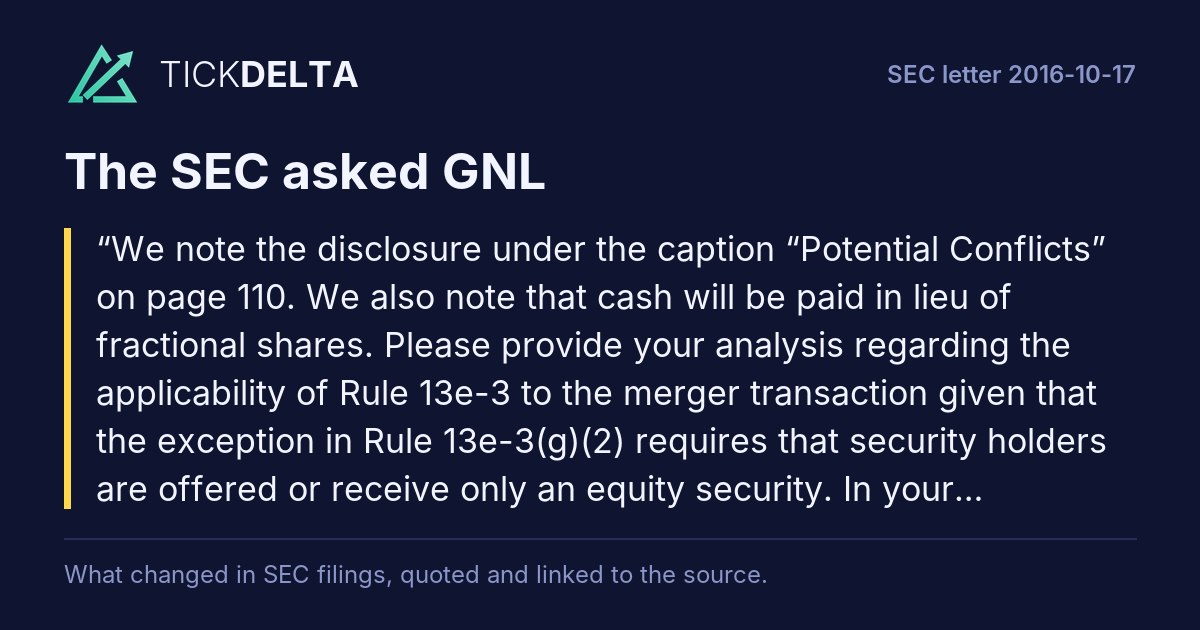
We note the disclosure under the caption “Potential Conflicts” on page 110. We also note that cash will be paid in lieu of fractional shares. Please provide your analysis regarding the applicability of Rule 13e-3 to the merger transaction given that the exception in Rule 13e-3(g)(2) requires that security holders are offered or receive only an equity security.
Rest of the question

In your response, please address: (i) the number of Global II security holders who, giving effect to the merger consideration, would be subject to cash disposition of fractional interests; (ii) the estimated aggregate amount of cash payable to dispose of fractional interests; and (iii) the number of Global II security holders, if any, who would be effectively cashed out after giving effect to the cash disposition of fractional interests. Also, revise your disclosure to describe how the amount of cash to be paid will be calculated and whether or not there is a maximum amount of cash that will be paid in lieu of fractional shares.

GNL answered
As requested by the staff, we have revised the disclosure on page

1 to state that the amount of cash to be paid for fractional interests will equal the product of (i) the fractional part of a share of GNL common stock due to a Global II security holder, multiplied by (ii) the per share closing price of the GNL common stock on the closing date of the merger transaction.

As an illustrative example, please assume that a Global II security holder owns one share of Global II common stock and the closing price of GNL common stock on the closing date is equal to $7.75 per share, which was the
Rest of the answer

closing price on October 19, 2016. Based on the exchange ratio of 2.27, the security holder will receive two shares of GNL common stock and $2.09 in cash. The amount of cash is equal to the product of (i) the fractional interest of

0.27, multiplied by (ii) the per share price of $7.75.

For the reasons set forth below, we do not believe that Rule 13e-3 applies to the merger transaction between GNL and Global II.

The Exception in Rule 13e-3(g)(2) Should Apply to the Merger

Transaction

Below is the information requested by the staff with respect to the cash payment for fractional shares:

· At October 19 2016 there were approximately 6,322 Global II security holders. We expect that a substantial majority, and even perhaps all, of these holders may be subject to cash disposition of fractional interests. The exact number of holders depends on the number of Global II shares a holder owns and, after giving effect to the exchange ratio of 2.27, the number of GNL shares such holder is due to receive.

· Based on (i) the closing price of GNL common stock of $7.75 per share on October 19, 2016 and (ii) 12,512,087 shares of outstanding Global II common stock on October 19, 2016, the estimated maximum aggregate amount of cash payable to dispose of fractional interests is

$17,588. GNL has not imposed a cap on the amount of cash that will be paid in lieu of fractional shares, and the aforementioned formula reflects the amount of cash that would be paid, but the amount of cash is not likely to be materially in excess of this estimate.

· No Global II security holders will be effectively cashed out after giving effect to the cash disposition of fractional interests because every Global II security holder holds at least one share of Global II common stock and, based on an exchange ratio of 2.27, will receive at least two shares of GNL common stock.

As indicated by the numbers above, the cash that will be paid to dispose of fractional interests represents a de minimis amount of the total merger consideration valued at approximately

$222.3 million.1 Except for cash payments for fractional interests, all of the merger consideration will consist of GNL common stock, a class of security that satisfies the conditions in Rule 13e-3(g)(2)(i)-(iii).

In adopting Rule 13e-3, the Commission stated that transactions covered by the exception in paragraph (g)(2) are “outside the purpose of Rule 13e-3 since all holders of that class of security are on an equal footing and are permitted to maintain an equivalent or enhanced equity interest.”2 We do not believe that the presence of a de minimis amount of cash paid for fractional interests contravenes this purpose. All Global II security holders will continue to be security holders of GNL. GNL common stock represents at least an equivalent equity interest, and likely an enhanced equity interest to these security holders because it is listed on a national securities exchange, whereas

Global II common stock is not. Global II security holders who are due fractional interests will receive a cash amount equal to the closing market price of GNL common stock on the closing date for their fractional interests, which is clearly an equivalent value to the fractional interests they are due. Both affiliated and unaffiliated Global II security holders will receive cash for their fractional interests, so there is no disparate treatment between the two groups. In viewing the transaction in its totality, Global II security holders are afforded equal treatment both among themselves and in their receipt of GNL common stock, which is at least an equivalent equity interest as Global II common stock. The payment of a de minimis amount of cash for fractional interest to Global II security holders, when all Global II security holders will continue as GNL security holders , does not undermine the purposes behind the exemption. The fractional interests could have been determined by eliminating the fractional interests or rounding the fractional interest up to the nearest whole number, and payment of cash for the fractional interest should not change the result.

Based on (i) the closing price of GNL common stock of $7.75 per share on October 19, 2016 and (ii) 12,512,087 shares of outstanding

Global II common stock on October 19,2016.

Release 34-16075 (August 2, 1979).

The staff has previously granted no-action relief for reliance on

Rule 13e-3(g)(2) on facts involving the payment of cash in lieu fractional shares to the target’s security holders.3

In each of the cited no-action letters, the incoming request referenced the payment of cash in lieu of fractional shares to the target’s security holders. While the discussion relating to the availability of the exception did not focus on the presence of this cash payment, the staff did grant relief from Rule 13e-3 on the basis of the exception contained in paragraph (g)(2).

No Affiliates of Global II are Engaged in the Merger Transaction

For Rule 13e-3 to apply to the merger transaction, an affiliate of Global II must be engaged in the merger transaction. For the reasons set forth below, we do not believe that this requirement is satisfied.

GNL and Global II are not affiliates

A person is an affiliate of Global II if it directly or indirectly controls, is controlled by or is under common control with Global II. Control means direct or indirect possession of the power to direct or cause the direction of the management and policies of a person. GNL does not directly or indirectly own any voting securities of Global II, and vice versa. Additionally, GNL does not directly or indirectly have any contractual arrangements that permit it to direct the management and policies of Global II, and vice versa. As a result, GNL neither controls nor is controlled by Global II. Accordingly, the only way that GNL and Global II can be affiliates is if they are deemed to be under common control.

As the staff notes, GNL and Global II share several relationships, which are disclosed in “Potential Conflicts” on pages 18 and 111. While we believe that these relationships may be material information for investors in making an investment decision and have therefore disclosed them, we do not believe that these relationships, individually or in the aggregate, cause GNL and Global II to be under common control.

GNL has a board of directors consisting of four people. Three of these directors, constituting a majority, are independent pursuant to the listing standards of the New York Stock Exchange. Similarly,

Global II has a board of directors consisting of three people, and a majority of the board (or two directors) are independent pursuant to the criteria set forth in Global II’s charter. The board of each of GNL and Global II has ultimate control over each entity, including the ability to elect and remove officers for each entity. GNL and Global II do not have any directors in common. Furthermore, the independent directors of GNL have no relationships that enable them to exert control over Global II, and vice versa. Accordingly,

GNL and Global II are not under common control due to the fact that no person or governance body has the direct or indirect power to cause the direction of the management and policies of both entities. Rather, GNL and Global II operate independently of each other under the ultimate supervision of their respective boards.

See, e.g., Canadian Pacific Limited (June 26, 1996), Standard Shares, Incorporated (April 28, 1989) and Swanton

Corporation (November 26, 1984).

As disclosed in “Potential Conflicts,” Messrs. Bowman and Salvemini serve as Chief Executive Officer and Chief Financial Officer, respectively to each of GNL and Global II. We do not believe that the presence of overlapping officers causes GNL and Global II to be under common control. Each of Messrs. Bowman and

Salvemini is an employee of the respective advisor to GNL and Global II, or its affiliate, and each respective board GNL or Global

II, as the case may be, can terminate either person’s position as an officer at any time. Additionally, decisions by Messrs.

Bowman and Salvemini that would affect the management and policies of both GNL and Global II are subject to board oversight and approval. Furthermore, each of Messrs. Bowman and Salvemini beneficially owns less than one percent of each of GNL and Global II.

Accordingly, Messrs. Bowman and Salvemini do not cause GNL and Global II to be under common control because they cannot, individually or together, direct the management and policies of both GNL and Global II through their positions (in light of the board oversight) or share ownership.

Also as disclosed in “Potential Conflicts,” the advisor to each of GNL and Global II is ultimately controlled by AR Global, the sponsor to GNL and Global II. We do not believe that having the same sponsor or advisors controlled by the same sponsor causes GNL and Global II to be under common control for two reasons.

First, AR Global beneficially owns less than one percent of each of GNL and Global II. This low percentage supports the conclusion that AR Global cannot direct the management and policies of both entities through its share ownership. Second, while an AR Global-affiliated advisor manages the day-to-day operations of each of GNL and Global II, each advisor’s actions are subject to the supervision and direction of each entity’s board This board oversight supports the conclusion that AR Global cannot direct the management and policies of both entities through its indirect contractual arrangements.

While one director of the board of each of GNL and Global II is an affiliate of AR Global, we do not believe that the presence of this one director on each board changes the foregoing conclusion that GNL and Global II are not under common control. The one AR Global-affiliated director is the lone member of each board who is not independent and he cannot effect board action by himself.

Messrs. Bowman and Salvemini are not affiliates engaged in the merger transaction

As the Chief Executive Officer and Chief Financial Officer of Global

II, Messrs. Bowman and Salvemini, respectively, may be deemed affiliates of Global II. The merger transaction was negotiated by special committees of independent directors of each of GNL and Global II and not by the executive officers. For Rule 13e-3 to apply to the merger transaction based on Messrs. Bowman and Salvemini’s affiliate status, they would need to be engaged in the merger transaction. Based on the staff’s guidance in Section 201.05 of the Compliance and Disclosure Interpretations, we do not believe that Messrs. Bowman and Salvemini are engaged in the merger transaction.

The staff highlighted three important factors to analyze the issue:

(i) senior management’s ownership of the surviving entity; (ii) whether senior management would occupy any board seats of the surviving entity; and (iii) whether senior management would otherwise be in a position to control the surviving entity.

Applying these factors, each of Messrs. Bowman and Salvemini currently beneficially owns, and will continue to beneficially own after the merger transaction, less than 0.1% percent of GNL (or the surviving entity after the merger transaction) . Furthermore, Messrs. Bowman and Salvemini currently are not GNL directors and will not become directors of the surviving entity. There will be no change in their employment arrangements as a result of the merger. When analyzing the facts in their totality, the control exercised by the surviving entity board, combined with Messrs. Bowman and Salvemini’s small ownership of the surviving entity, leads to the conclusion that Messrs. Bowman and Salvemini did not engage in the merger transaction.
Read in the reply
General
SEC asked (2)
We note your disclosure on pages 79-84 that UBS presented different versions of a “related party analysis” to the GNL Special Committee. Please provide us with copies of these materials.
GNL answered
We advise the Staff that copies of these materials will be submitted supplementally pursuant to Rule 418.
Read in the reply
The Merger · Background of the Merger, page 71
SEC asked (3)
We note your disclosure on page 74 that the Global II Special Committee discussed with BMO strategic alternatives other than the merger with GNL, including the prospects of continuing as a stand-alone entity and alternative transactions involving other potential acquirers.
Rest of the question

Please provide additional disclosure regarding the strategic alternatives that were considered and why the merger was pursued instead of such alternatives.

GNL answered
We advise the Staff that we have revised the disclosure on page 75 to provide additional disclosure regarding the strategic alternatives considered by the Global II Special

Committee and its decision to enter into the merger agreement with GNL.
Read in the reply
Opinion of the GNL Special Committee’s Financial Advisor · Discounted Cash Flow Analyses, page 96
SEC asked (4)
We note the reference to financial forecasts and estimates relating to the pro forma combined company prepared by GNL Management. Please revise the disclosure in your registration statement to provide additional disclosure about these financial forecasts and estimates.
GNL answered
We advise the Staff that we have corrected the disclosure on page

97 to clarify that in connection with UBS’s pro forma combined company analysis, UBS utilized financial forecasts and estimates relating to GNL prepared by GNL Management, financial forecasts and estimates relating to Global II prepared by Global II Management, certain estimates of synergies that were provided by GNL Management, certain estimates of transaction costs that were provided by GNL management and certain terms of the merger.
Rest of the answer

We have revised the disclosure on page 109 to include the estimate of transaction costs provided by GNL management.

Read in the reply
Miscellaneous, page 97
SEC asked (5)
We note your disclosure that GNL agreed to pay UBS an aggregate fee of $4.0 million for its financial advisory services in connection with the mergers, a portion of which was payable in connection with the delivery of UBS’ opinion and the remainder of which is contingent upon consummation of the merger.
Rest of the question

Please revise your disclosure to state what portion of the $4.0 million fee is contingent upon consummation of the merger.

GNL answered
We advise the Staff that the disclosure on page 98 has been revised to disclose that $1,000,000 was payable to UBS upon the delivery of the fairness opinion and $3,000,000 will be payable upon closing of the merger.
Read in the reply
Miscellaneous, page 97
SEC asked (6)
We note that your disclosure regarding the material relationships between UBS and GNL does not provide a narrative and quantitative description of the fees paid or to be paid to UBS and its affiliates by GNL and its affiliates. Please revise to provide such disclosures or provide us with an analysis as to why such disclosure is not required.
GNL answered
We advise the Staff that we have revised the disclosure on pages 98-99 to include a narrative and quantitative description of the aggregate consideration paid to UBS since January 1,

2012 in connection with engagements to provide investment banking services to GNL and affiliates of

GNL and Global II and their related entities unrelated to the mergers.
Read in the reply
Opinion of the Global II Special Committee’s Financial Advisor · Miscellaneous, page 105
SEC asked (7)
We note that your disclosure regarding the material relationships between BMO and Global II does not provide a narrative and quantitative description of the fees paid or to be paid to BMO and its affiliates by Global II and its affiliates. Please revise to provide such disclosures or provide us with an analysis as to why such disclosure is not required.
GNL answered
We advise the Staff that the disclosure regarding the material relationships between BMO and Global II on pages 106-107 has been revised to provide a narrative and quantitative description of the fees paid or to be paid to BMO and its affiliates by Global II, GNL or their respective related parties unrelated to the mergers.
Read in the reply
Notes To Unaudited Pro Forma Consolidated Financial Statements · Note 2. Adjustments to Unaudited Pro Forma Consolidated Balance Sheet, pages F-1-10 to F-1-
SEC asked (8)
We note your adjustment disclosures include a discussion related to customer relationship intangible assets. Based on the purchase price allocation table included on page F-1-9, it is not clear that any adjustment amount relates to customer relationship intangible assets. Please advise.
GNL answered
We advise the Staff that the adjustment disclosure on page F-1-10 has been revised to disclose that no customer relationship intangibles were identified in connection with its purchase price allocation process.

3. Adjustments to Unaudited Pro Forma Consolidated Statements of Operations, page F-115
Read in the reply
Note 3. Adjustments to Unaudited Pro Forma Consolidated Statements of Operations, page F-1-
SEC asked (9)
Please tell us why adjustment (GG) to eliminate merger transaction costs has resulted in a negative expense total for the six months ended June 30, 2016.
GNL answered
We advise the Staff that during the six months ended June 30,

2016, GNL recorded adjustments to its acquisition closing costs accrued at the date of acquisition for certain European properties, that resulted in a reduction to our original amounts recorded. These adjustments were predominantly a result of property transfer tax estimates paid at the transaction date and charged to expense in prior periods that were subsequently recovered through refunds from the taxing authorities due to changes in rulings, statutes or tax rates (i.e., a change in estimate).
Read in the reply
Annex C – Opinion of the Global II Special Committee’s Financial Advisor, page C-1
SEC asked (10)
We note the limitation on reliance by shareholders in the fourth full paragraph on page C3 of the opinion, which states that BMO’s opinion has been “prepared at the request of the Special Committee and is solely for the benefit and use of the Special Committee and the Board of Directors of the Company in the evaluation of the fairness, from a financial point of view, to Global II’s common stockholders of the
Rest of the question

Exchange Ratio.” (Emphasis added) Because it is inconsistent with the disclosures relating to the opinion, the limitation should be deleted. Alternatively, disclose the basis for BMO’s belief that shareholders cannot rely upon the opinion to support any claims against BMO arising under applicable state law (e.g., the inclusion of an express disclaimer in BMO’s engagement letter with Global II). Describe any applicable state-law authority regarding the availability of such a potential defense. In the absence of applicable state-law authority, disclose that the availability of such a defense will be resolved by a court of competent jurisdiction. Also disclose that resolution of the question of the availability of such a defense will have no effect on the rights and responsibilities of the board of directors under applicable state law. Further disclose that the availability of such a statelaw defense to BMO would have no effect on the rights and responsibilities of either BMO or the board of directors under the federal securities laws.

GNL answered
We advise the Staff that the disclosure on page C-3 of the opinion of the Global II Special Committee’s Financial Advisor has been revised to delete the word “solely”, thereby removing the limitation and eliminating the inconsistency with the disclosures related to the opinion.
Read in the reply
Exhibit Index, page II-6
SEC asked (11)
We note on page B-3 that UBS Securities LLC, in delivering its fairness opinion, assumed that the transaction will not adversely affect your status or operations as a real estate investment trust for U.S. federal income tax purposes. Please confirm that you will file an opinion of counsel regarding your qualification as a real estate investment trust for U.S.
Rest of the question

federal income tax purposes or provide us with a detailed analysis as to why such opinion is not required. Please see Item 601(b)(8) of Regulation S-K and Staff Legal Bulletin No. 19.

GNL answered
We advise the Staff that an opinion of Proskauer Rose LLP has been filed as Exhibit 8.1 to the Amendment, which includes an opinion that GNL’s proposed method of operation, including the consummation of the Merger, will enable it to continue to meet the requirements for qualification and taxation as a REIT under the Code.
Read in the reply

Also in this review: company letter, Nov 4, 2016, company letter, Jan 26, 2017

Form 8-K

2016-09-28 to 2017-01-27 · 4 questions · 2 letters from the SEC, 1 from the company
Review closed 2017-01-27
Non-GAAP measuresLiquidity and cash
FORM 8-K FILED ON AUGUST 8, 2016 · Exhibit 99.1
SEC asked (1)
Please explain to us the rationale for adjusting for unrealized gains and losses on foreign currency transactions in arriving at AFFO.
GNL answered
The Company invests in real estate properties in foreign countries and as a result, exposes the rental income, property related expenses and interest expense associated with these properties to fluctuations in foreign exchange rates. The Company utilizes foreign currency derivatives, including currency forward contracts and cross currency swap agreements, to manage this exposure.
Rest of the answer

These derivative contracts are not designated as hedges under qualifying hedge relationships, and as a result, changes in the fair value relating to future contractual settlements along with current contractual settlements relating to current period operations are recorded directly to net income (loss).

The Company adjusts AFFO to eliminate the impact of the unrealized changes in fair value of these foreign currency derivative contracts as the unrealized mark to market adjustment on the unsettled derivative contracts relates to currency exposure on future period operations that may or may not be ultimately realized in future periods. Accordingly, we believe that the unrealized mark to market adjustment on such contracts are not a measure of our operating performance and should be excluded in determining AFFO. The Company believes the performance of these derivative contracts occurs upon the settlement of such contracts, which reflects the direct impact on earnings related to the aforementioned revenue and expenses associated with these investments, and accordingly, are included for AFFO purposes.

Read in the reply
FORM 8-K FILED ON AUGUST 8, 2016 · Exhibit 99.1
SEC asked (2)
On page 12 you explain that excluding non-cash income and expense items from AFFO provides useful information regarding income and expense items which have no cash impact and do not provide liquidity to the company or require capital resources of the company. This strongly implies that AFFO is a liquidity measure. Please explain to us why you believe it is appropriate to present this measure on a per share basis.
Rest of the question

See Question 102.05 of the updated Non-GAAP Compliance and Disclosure Interpretations issued on May 17, 2016.

GNL answered
We acknowledge the Staff’s comment. Our overall explanation of the reasons for using AFFO focused on our view that AFFO is an important measure of the Company’s operating performance that assists investors in assessing the sustainability of our ongoing operating performance. The language referred to by the Staff that could imply that AFFO is also a liquidity measure should not have been included as part of the description of AFFO, as the

Company does not use AFFO as a liquidity measure.
Rest of the answer

Accordingly, in the future, the Company proposes to use the following language to describe AFFO, which eliminates the references to “no cash impact and do not provide liquidity to the company or require capital resources of the company” and “cash flows impact the liquidity and capital resources available to distribute to investors”:

We exclude certain income or expense items from AFFO that we consider more reflective of investing activities, other non-cash income and expense items and the income and expense effects of other activities that are not a fundamental attribute of our business plan. These items include early extinguishment of debt and unrealized gains and losses, which may not ultimately be realized, such as gains or losses on derivative instruments, gains and losses on foreign currency transactions, and gains and losses on investments. In addition, by excluding non-cash income and expense items such as amortization of above-market and below-market leases intangibles, amortization of deferred financing costs, straight-line rent and equity-based compensation from AFFO, we believe we provide useful information regarding income and expense items which have a direct impact on our ongoing operating performance. We also include the realized gains or losses on foreign currency exchange contracts for AFFO as such items are part of our ongoing operations and affect the current operating performance of the Company. By providing AFFO, we believe we are presenting useful information that assists investors and analysts to better assess the sustainability of our ongoing operating performance without the impacts of transactions that are not related to the ongoing profitability of our portfolio of properties. We also believe that AFFO is a recognized measure of sustainable operating performance by the REIT industry. Further, we believe AFFO is useful in comparing the sustainability of our operating performance with the sustainability of the operating performance of other real estate companies. However, AFFO is not indicative of cash available to fund ongoing cash needs, including the ability to make cash distributions. Investors are cautioned that AFFO should only be used to assess the sustainability of our operating performance excluding these activities, as it excludes certain costs that have a negative effect on our operating performance during the periods in which these costs are incurred.

In calculating AFFO, we exclude certain expenses, which under GAAP are characterized as operating expenses in determining operating net income. All paid and accrued merger, acquisition and transaction related fees and certain other expenses negatively impact our operating performance during the period in which expenses are incurred or properties are acquired will also have negative effects on returns to investors, but are not reflective of our on-going performance. AFFO that excludes such costs and expenses would only be comparable to companies that did not have such activities. Further, under GAAP, certain contemplated non-cash fair value and other non-cash adjustments are considered operating non-cash adjustments to net income. In addition, as discussed above, we view gains and losses from fair value adjustments as items which are unrealized and may not ultimately be realized and not reflective of ongoing operations and are therefore typically adjusted for when assessing operating performance. Excluding income and expense items detailed above from our calculation of AFFO provides information consistent with management's analysis of the operating performance of the Company. Additionally, fair value adjustments, which are based on the impact of current market fluctuations and underlying assessments of general market conditions, but can also result from operational factors such as rental and occupancy rates, may not be directly related or attributable to our current operating performance. By excluding such changes that may reflect anticipated and unrealized gains or losses, we believe AFFO provides useful supplemental information.

Read in the reply
FORM 8-K FILED ON AUGUST 8, 2016 · Exhibit 99.1
SEC asked (3)
In your next earnings release, please provide a substantive and concise discussion of why Cash NOI is useful to investors. Please provide us with your proposed changes in your response letter.
GNL answered
We propose adding the following definition to materials in which we use Cash NOI:

Cash net operating income, or Cash NOI, is a non-GAAP financial measure that is intended to reflect the performance of our properties. We define Cash NOI as net operating income (which is separately defined herein) excluding amortization of above/below market lease intangibles and straight-line adjustments that are included in GAAP lease revenues.
Rest of the answer

We believe that Cash NOI is a helpful measure that both investors and management can use to evaluate the current financial performance of our properties and it allows for comparison of our operating performance between periods and to other REITs. Cash NOI should not be considered as an alternative to net income, as an indication of our financial performance, or to cash flows as a measure of liquidity or our ability to fund all needs. The method by which we calculate and present Cash NOI may not be directly comparable to the way other REITs present Cash NOI.

*************

In connection with the Company’s response to the September

28th Letter, the Company acknowledges that:

· The Company is responsible for the adequacy and accuracy of the disclosure in the filing;

· Staff comments or changes to disclosure in response to Staff comments do not foreclose the Commission from taking any action with respect to the filing; and

· It may not assert Staff comments as a defense in any proceeding initiated by the Commission or any person under the federal securities laws of the United States.

Read in the reply
SEC letter of Jan 12, 2017 ↗ no reply letter on EDGAR
FORM 8-K FILED ON AUGUST 8, 2016 · Exhibit 99.1
SEC asked
We have considered your response to comment two. Given the characteristics of the adjustments made to arrive at adjusted funds from operations (AFFO) and the correlation between the presented AFFO amounts to cash flow from operations, it appears AFFO can be used as a liquidity measure.
Rest of the question

Pursuant to Question 102.05 of the updated Non-GAAP Compliance and Disclosure Interpretations issued on May 17, 2016, please revise future filings to exclude presentation of AFFO on a per share basis.

GNL answered

No reply letter found.

Also in this review: closing letter, 2017-01-27

Form 10-K for the fiscal year ended December 31, 2015

2016-06-24 to 2016-07-11 · 1 question · 1 letter from the SEC, 1 from the company
Review closed 2016-07-11
Derivatives and hedging
Financial Statements · Note 8 – Derivatives and Hedging Activities, page F-27
SEC asked
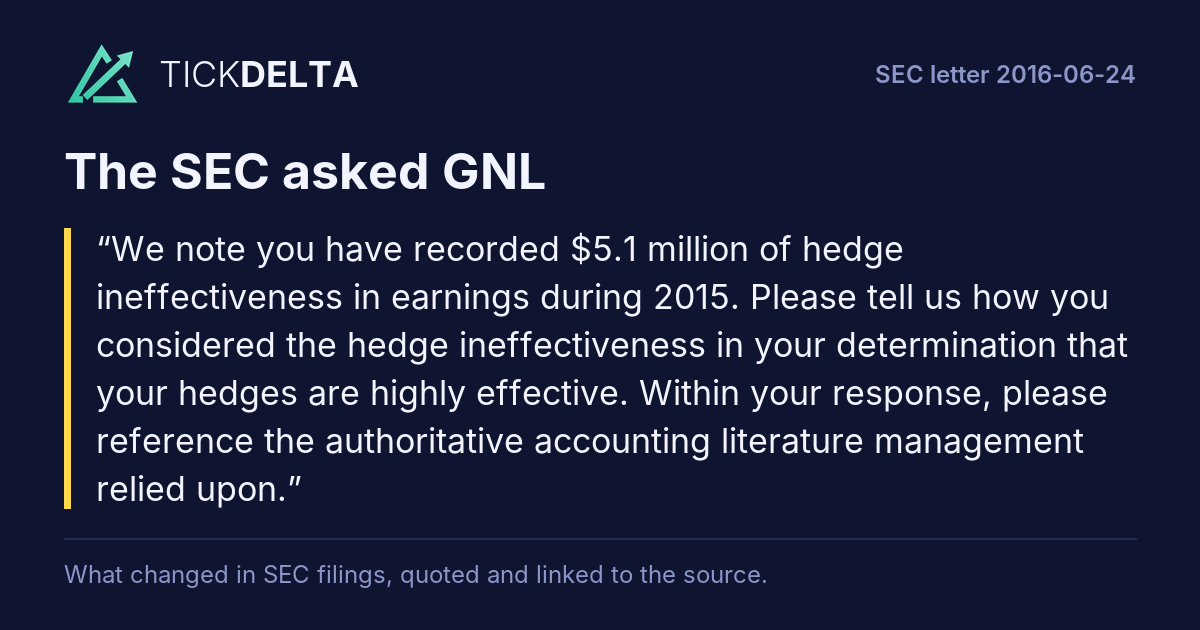
We note you have recorded $5.1 million of hedge ineffectiveness in earnings during 2015. Please tell us how you considered the hedge ineffectiveness in your determination that your hedges are highly effective. Within your response, please reference the authoritative accounting literature management relied upon.
GNL answered
The Company has investments in consolidated entities whose functional currencies are British Pound Sterling (“GBP”) and Euro (“EUR”), which differs from that of the Company which is the US Dollar (“USD”). As part of its risk management program, the Company uses non-derivative financial instruments to hedge its exposure to both GBP-USD and EUR-USD exchange rates.
Rest of the answer

These non-derivative financial instruments have generally included

GBP and EUR denominated debt (foreign currency denominated draws on our line of credit) issued and outstanding with third parties

(the “Hedging Instruments”) to protect the value of its net investments in GBP and EUR subsidiaries against changes in the GBP-USD and EUR-USD exchange rates.

Using the strategy described above (as documented in our hedge memos), on the designation date and at the beginning of each quarterly period thereafter, the entire notional amount of each Hedging

Instrument is designated against a corresponding amount of the Company’s GBP and EUR subsidiaries’ net investment balances until the entire notional amount of each Hedging Instrument has been designated. If the Company’s net investment balance is greater than the total notional amount of Hedging Instruments designated as net investment hedges, then the entire notional amount of the designated Hedging Instruments will continue to be accounted for as net investment hedges. In the event the total net investment balance in each currency is less than the total amount drawn on the Hedging Instruments in each currency designated herein, the excess portion of the Hedging Instruments are de-designated. For any amounts drawn but not designated as Hedging Instruments, the notional amount is re-measured each reporting period with any related re-measurement gains/losses recognized in the Company’s current period earnings in accordance with ASC 830.

Accordingly, pursuant to paragraphs 815-35-35-12 to 815-35-35-15, there will be no ineffectiveness recognized in earnings if the notional amount of the designated portion of the Hedging Instruments

(in whole or in part) matches the respective net investment balance designated as hedged items and the Hedging Instruments are denominated in the functional currency of the net investment (i.e., GBP and EUR).

The Company’s disclosure on Page F-30 was intended to disclose that there was an excess/undesignated portion of the foreign draws but was inconsistent with our hedge documentation.

While the total amounts reflected in the income statement were correct and the amounts of the excess foreign draws were disclosed properly (Page F-30), the Company’s income statement caption for these and the related disclosure indicated that the whole amounts of foreign draws were so designated and the income statement impact was for ineffectiveness in a hedge relationship rather than for impact of currency exchange rates on the undesignated portions of these excess foreign currency draws. The Company will clarify this in future filings.

In connection with the Company’s response to the June

24th Letter, the Company acknowledges that:

· The Company is responsible for the adequacy and accuracy of the disclosure in the filing;

· Staff comments or changes to disclosure in response to Staff comments do not foreclose the Commission from taking any action with respect to the filing; and

· It may not assert Staff comments as a defense in any proceeding initiated by the Commission or any person under the federal securities laws of the United States.

Read in the reply
In its next report

First report after the company's reply of Jul 7, 2016: 10-Q filed Aug 8, 2016 ↗, against the 10-Q filed May 6, 2016 ↗.

Tickdelta does not hold the text of both reports, so they are not compared here.

Also in this review: closing letter, 2016-07-11

Schedule TO-I

2015-06-08 to 2015-06-18 · 4 questions · 1 letter from the SEC, 1 from the company
No closing letter
Liquidity and cash
Exhibit (a)(i) - Offer to Purchase · Withdrawal Rights, page 4
SEC asked (1)
We believe the reference to June 29, 2015 as the date by which “back end withdrawal rights” arise may be a typographical error. Please revise consistent with the requirements of Rule 13e-4(f)(2)(ii).
GNL answered
The Company acknowledges the Staff’s comment. Please see the Amendment to the Offer to Purchase, which corrects the deadline date for withdrawal.
Read in the reply
Conditions of the Offer, page 21
SEC asked (2)
Refer to the disclosure on page 24 in this section. Provide additional details such that shareholders can understand the parameters of the “REIT condition” referenced here. For example, explain what may cause you to fail to qualify for taxation as a REIT under the Code, such that you would not be obligated to complete the Offer.
GNL answered
The Company believes that this condition is typical for tender offers by REIT’s, and the Company does not believe that its tender offer poses any unique risks to its REIT qualification. Nevertheless, the Company has revised the disclosure to clarify that, under applicable federal income tax law, the Company could fail to qualify for taxation as a REIT under the Code if certain stockholder ownership requirements were violated or the tender offer resulted in a preferential dividend.

The Company must distribute annually to its stockholders at least 90% of its REIT taxable income (which does not
Rest of the answer

equal net income as calculated in accordance with generally accepted accounting principles in the United States of America), determined without regard to the deduction for dividends paid and excluding net capital gain. In order for distributions to be counted as satisfying the annual distribution requirements for

REITs, and to provide the Company with a REIT-level tax deduction, the distributions must not be “preferential dividends.” A dividend is not a preferential dividend if the distribution is pro rata among all outstanding shares of stock within a particular class, and in accordance with the preferences among different classes of stock as set forth in the

Company’s organizational documents. If the receipt of cash by a stockholder in exchange for shares pursuant to the

Offer is treated as a distribution to the stockholder with respect to the stockholder’s shares, see Section 14 of the

Offer to Purchase, such distribution will be treated as ordinary dividend income to the stockholder to the extent of such stockholder’s ratable share of the Company’s current and accumulated earnings and profits (to the extent not designated as capital gain dividends or qualified dividend income) as determined under U.S. federal income tax principles and would likely be treated as a preferential dividend and not count toward the Company meeting the annual distribution requirement. Such preferential dividend could taint a regular dividend distribution by the Company, if the

Internal Revenue Service were to treat the payment of cash by the Company to tendering stockholders as part of a regular dividend distribution by the Company, which could impact its ability to qualify as a REIT. The Company intends to separate the payment to tendering shareholders and its next regular dividend distribution so as to minimize any risk of there being a preferential dividend issue with its regularly scheduled dividend distribution.

Read in the reply
Source and Amount of Funds, page 25
SEC asked (3)
We note that the Offer is conditioned on the Credit Facility Condition being satisfied. In this section, you state that you expect to use cash totaling approximately $25 million and expect to borrow about $100 million under the Company’s existing revolving loan Credit Facility.
Rest of the question

On page 26 of the Offer to Purchase, you state that available borrowings under the Credit Facility are based on a pool of eligible unencumbered real estate assets and that the unused borrowing capacity as of March 31, 2015 was $71.6 million. Please advise how you will borrow the necessary $100 million needed to fund the Offer. We may have additional comments.

GNL answered
We have updated the disclosure regarding the Company’s

Credit Facility. This updated disclosure addresses the Staff’s comments. On June 16, 2015 we completed $46.9 million in mortgage financings with respect to certain European properties, the proceeds of which are being used to reduce our outstanding balance under our Credit Facility.
Read in the reply
Miscellaneous
SEC asked (4)
We note the disclosure here that the Offer is “neither being made to, not will tenders be accepted from or on behalf of, stockholders in any jurisdiction in which the making of the Offer or acceptance thereof would not be in compliance with the laws of such jurisdiction.” Please note that the all-holders provision in Exchange Act Rule 13e-4(f)(8) applies equally to U.S. holders as well as non-U.S. holders.
Rest of the question

Refer to the interpretive guidance in section II.G.1 of SEC Release 33-8957. While an offer need not be made into certain countries where doing so would be illegal, you may not refuse to accept tenders from holders in certain jurisdictions. Please revise or advise. Closing Information Please amend the filing in response to the above comment. We may have further comments upon receipt of your additional filing(s); therefore, please allow adequate time for further staff review. You should furnish a response letter with the amendment keying your responses to our comment letter and providing any supplemental information we have requested. Please transmit the letter via EDGAR under the label “CORRESP.” In the event that you believe that compliance with the above comment is inappropriate, provide a basis for such belief to the staff in the response letter.

GNL answered
to the Staff’s comment, the Company advises the Staff that it is referring only to excluding stockholders located in a U.S. state pursuant to Rule 13e-4(f)(9)(ii) of the Securities

Exchange Act of 1934, as amended. The Company has revised the disclosure in accordance with the Staff’s comment.

Please see the Amendment to the Offer to Purchase.

The Company acknowledges that:

· It is responsible for the adequacy and accuracy of the disclosure in the filing;

· Staff comments or changes to disclosure in response to Staff comments do not foreclose the Commission from taking any action with
Rest of the answer

respect to the filing; and

· It may not assert Staff comments as a defense in any proceeding initiated by the Commission or any person under the federal securities laws of the United States.

Read in the reply

Letters without questions

Other letters

UPLOAD and CORRESP
3 other letters: notices that a filing will not be reviewed, requests to declare a registration effective, and the like

From the SEC's correspondence on EDGAR: staff letters (form UPLOAD) and company letters (form CORRESP), 25 letters filed since 2015-06-09. Questions and answers are matched by their numbers; topics come from words in each question. The reports are compared word for word (same form, before the first SEC letter against the first report after the company's reply). No AI.

Sources

The SEC's correspondence on EDGAR: staff letters (form UPLOAD) and company letters (form CORRESP), matched question by question. No AI.

Also

Filings: the letters in the filing list.

Work with it

Excel workbook · CSV. Google Sheet that stays up to date: paste =IMPORTDATA("https://tickdelta.com/company/GNL/export.csv") into a cell.

Next in Owners and insiders:Insider trades
Esc

Type a ticker such as AAPL, a name, an investor such as Buffett, or a topic such as tariffs. ↑ ↓ to move, Enter to open.