Global Net Lease, Inc. GNL
New risk paragraphs, branching off last year
Each branch is a paragraph in Risk Factors with nothing like it in the 10-K filed Feb 27, 2025. A box jumps to the paragraph as filed, below.
Paragraphs with nothing like them in last year's 10-K
10 paragraphs in Risk Factors of the 10-K filed Feb 25, 2026 with nothing like them in the 10-K filed Feb 27, 2025. Quoted exactly. Paragraphs that were only edited are under 10-K change.
•The majority of our properties are occupied by single tenants and single-tenant leases involve significant risks of tenant default and tenant vacancies, which could materially and adversely affect us.
Lock-out provisions typically include terms that provide strong financial disincentives for borrowers to prepay their outstanding loan balance and exist in order to protect the yield expectations of lenders, including by requiring a yield
Growing public concern about climate change and investor expectations have resulted in the increased focus of local, state, regional, national and international regulatory bodies on greenhouse gas (“GHG”) emissions and climate change issues in recent years.
However, the Environmental Protection Agency (“EPA”) under the Trump Administration has made efforts to repeal or otherwise modify regulation of GHG emissions at the federal level, including issuing a proposal to revoke the EPA’s GHG “Endangerment Finding,” which underpins the majority of the EPA's GHG regulations. Separately, various states and groups of states have adopted or are considering adopting legislation, regulations or other regulatory initiatives that are focused on such areas as GHG cap and trade programs, carbon taxes, reporting and tracking programs, disclosure of climate risk management, and restriction of emissions. We cannot predict whether such efforts will ultimately be successful or what effects they may have on our business or results of operations.
At the international level, there exists the United Nations-sponsored “Paris Agreement,” which requires nations to submit non-binding GHG emissions reduction goals every five years after 2020, though in January 2025, the U.S. submitted notification to the United Nations that it intends to withdraw from the Paris Agreement regarding climate change, with the withdrawal effective January 27, 2026. Additionally, various agreements and commitments have been made at the annual conference of the parties to eliminate certain fossil fuel subsidies, phase out fossil fuels in energy systems, and pursue further action on non-carbon dioxide GHGs, though none have been legally binding. The Trump Administration has undertaken efforts to decrease the United States’ participation in such initiatives, including the withdrawal of the United States from the Paris Agreement and all other agreements made under the United Nations Framework Convention on Climate Change, and has sought other legislative and regulatory changes related to climate change. Notwithstanding the United States' withdrawal from the Paris Agreement, various state and local governments remain committed to the Paris Agreement.
We may be adversely impacted by inflation on the leases that do not contain indexed escalation provisions, or those leases which have escalations at rates which do not exceed or approximate current inflation rates. However, our net leases require the
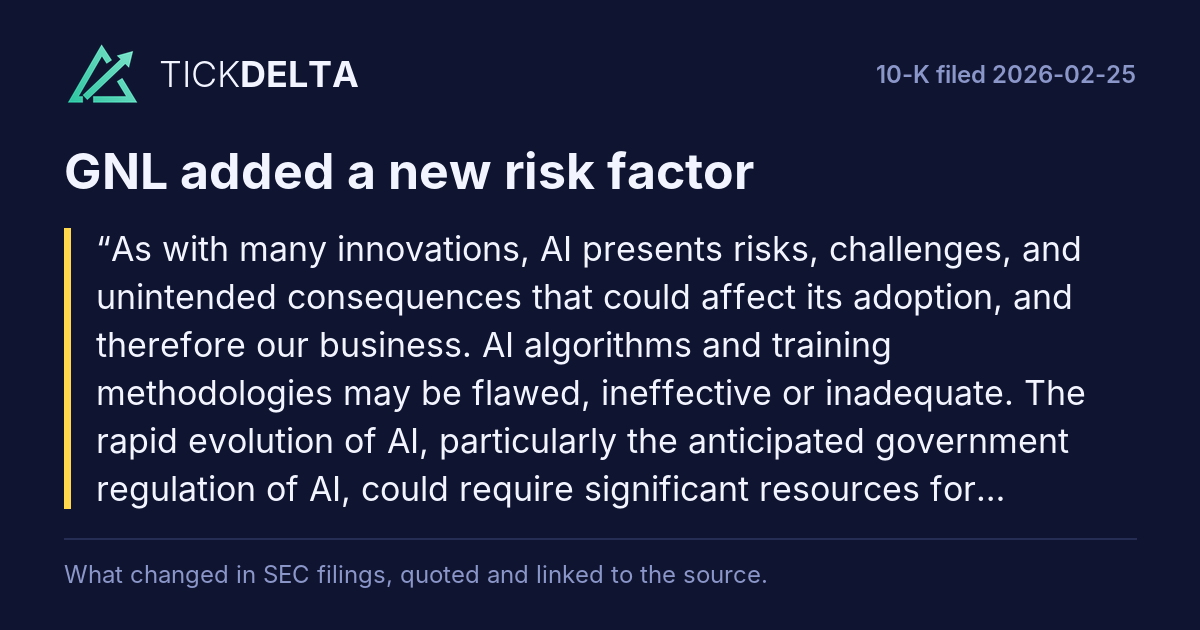
As with many innovations, AI presents risks, challenges, and unintended consequences that could affect its adoption, and therefore our business. AI algorithms and training methodologies may be flawed, ineffective or inadequate. The rapid evolution of AI, particularly the anticipated government regulation of AI, could require significant resources for compliance, whether in the development, testing or maintenance of such systems or software. AI development or deployment practices by us or third-party providers could increase vulnerability to cybersecurity risks and require additional resources to implement heightened cybersecurity measures to protect the security of our data. These deficiencies and other failures of any potential AI systems could subject us to competitive harm, regulatory action, legal liability, and brand or reputational harm.
Show the other 1
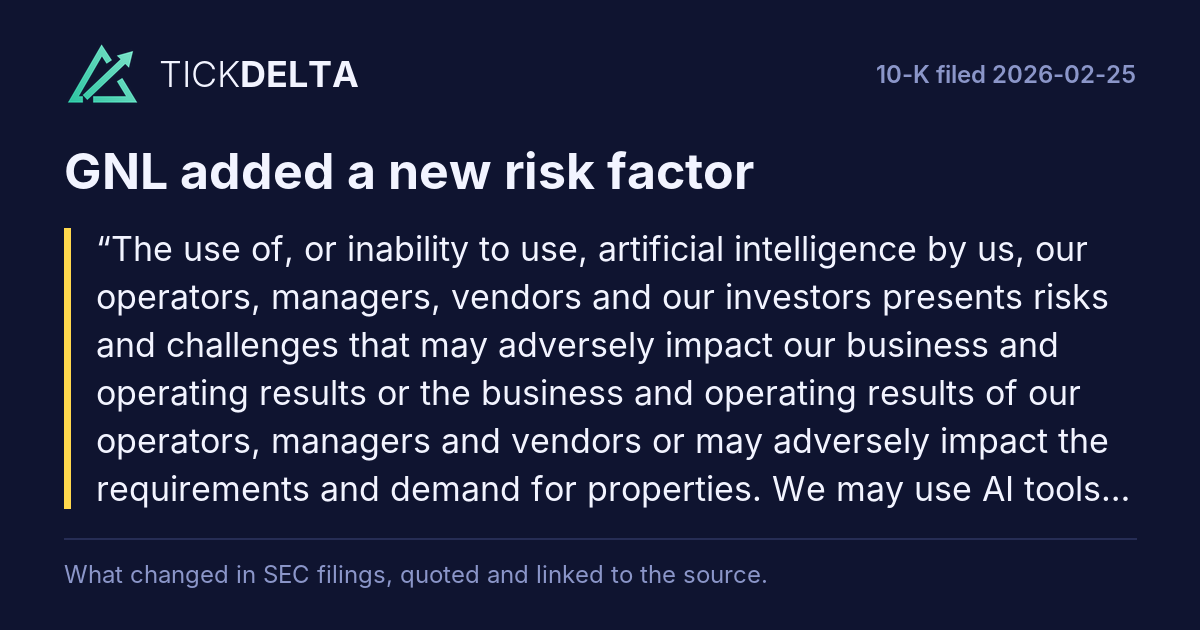
The use of, or inability to use, artificial intelligence by us, our operators, managers, vendors and our investors presents risks and challenges that may adversely impact our business and operating results or the business and operating results of our operators, managers and vendors or may adversely impact the requirements and demand for properties.
We may use AI tools in our operations. If our peers use AI tools to optimize operations and we fail to utilize AI tools in a comparable manner, we may be competitively disadvantaged. However, while AI tools may facilitate optimization and operational efficiencies, they also have the potential for inaccuracy, bias, infringement or misappropriation of intellectual property, and risks related to data privacy and cybersecurity. The use of AI tools may introduce errors or inadequacies that are not easily detectable, including deficiencies, inaccuracies or biases in the data used for AI training, or in the content, analyses or recommendations generated by AI applications. The results of such errors or inadequacies may adversely affect our business, financial condition and results of operations. The legal requirements relating to AI continue to evolve and remain uncertain, including how legal developments could impact our business and ability to enforce our proprietary rights or protect against infringement of those rights. Cybersecurity threat actors may utilize AI tools to automate and enhance cybersecurity attacks against us. We utilize software and platforms designed to detect such cybersecurity threats, including AI-based tools, but these threats could become more sophisticated and harder to detect, contain and mitigate, which may pose significant risks to our data security and systems. Such cybersecurity attacks, if successful, could lead to data breaches, loss of confidential or sensitive information, and financial or reputational harm.
Our vendors may use AI tools in their products or services without our knowledge, and the providers of these tools may not meet the evolving regulatory or industry standards for privacy and data protection. Consequently, this may inhibit our or our vendors’ ability to uphold an appropriate level of service and data privacy. If we, our vendors, or other third parties with which we conduct business experience an actual or perceived breach of privacy or security incident due to the use of AI, we may be adversely impacted, lose valuable intellectual property or confidential information and incur harm to our reputation and the public perception of the effectiveness of our security measures. In addition, investors, analysts and other market participants may use AI tools to process, summarize or interpret our financial information or other data about us. The use of AI tools in financial and market analysis may introduce risks similar to those described above, including an inaccurate interpretation of our financial or operational performance or market trends or conditions, which in turn could result in inaccurate conclusions or investment recommendations
Paragraphs in the 10-Q filed Nov 4, 2026 that were not in the one before
New in the latest 10-Q
25 paragraphs in the 10-Q filed Nov 4, 2026 with nothing like them in the 10-Q filed Aug 5, 2026 (at least half the words must differ; new numbers alone do not count). Quoted exactly, grouped by the item heading above them. This is text that changed, not a judgement of how serious it is.
Financial statements and notes
For additional information on the Merger, including the fair value of the consideration paid and the purchase price allocation to the assets and liabilities acquired (see Note 4 - Real Estate Investments, Net).
Read in the 10-Q
The noncontrolling interests as of September 30, 2026 represent the portion of the equity in the OP that is not owned by the Company, which resulted from the issuance of OP Units as a portion of the consideration in the Merger. Noncontrolling interests are presented as a separate component of equity on the consolidated balance sheets and the related share of net income or loss is presented as net income or loss attributable to noncontrolling interests in the consolidated statements of operations and comprehensive loss. Noncontrolling interests are allocated a share of net income or loss based on their share of equity ownership. For additional information on the Merger, see No t e 1 - Organization and Note 4 - Real Estate Investments, Net.
Read in the 10-Q
The Company acquired 41 properties during the three and nine months ended September 30, 2026, of which 40 were acquired in the Merger, which is being accounted for as a business combination. The remaining property was acquired from a separate seller and is being accounted for as an asset acquisition. Transaction costs related to the Merger totaled approximately $ 12.5 million and are recorded in the merger, transaction and other costs line item in the consolidated statement of operations.
Read in the 10-Q
The following table presents the fair value of the consideration transferred to effect the Merger:
Read in the 10-Q
Fair Value Calculation Common Stock or OP Units Price Used to Calculate Fair Value Fair Value of Consideration Transferred (In thousands) Consideration Type Fair value of Common Stock issued to holders of Modiv Class C Common Stock 20,387,710 $8.99 (1) $ 183,286 Common Stock Fair value of OP Units issued to holders of Modiv Class C OP Units 4,914,528 $8.99 (1) 44,182 OP Units Total equity consideration 227,468 Cash consideration paid (2) 316,514 Cash Total consideration transferred $ 543,982
Read in the 10-Q
Show the other 20
(1) Represents the closing price of GNL’s Common Stock on the Modiv Acquisition Date.
Read in the 10-Q
(2) Includes cash used to repay the Modiv Mortgage Notes Payable, the Modiv Term Loan, the Modiv Preferred Stock and cash paid in lieu of Common Stock and OP Units.
Read in the 10-Q
The following table presents the allocation of the assets acquired and liabilities assumed during the nine months ended September 30, 2026:
Read in the 10-Q
(1) Represents the provisional allocation of the consideration transferred to the assets acquired and liabilities assumed in the Merger. The Merger is accounted for under the acquisition method for business combinations pursuant to GAAP, with the Company as the accounting acquirer of Modiv. The consideration transferred by the Company in the Merger establishes a new accounting basis for the assets acquired, liabilities assumed and any noncontrolling interests, measured at their respective fair value as of the Modiv Acquisition Date. To the extent the fair value of the consideration paid were to exceed the fair value of the net assets acquired, any such excess would represent goodwill. No goodwill was recognized in the provisional allocation. Adjustments to the estimated fair values of identifiable assets acquired and liabilities assumed in the Merger, as well as adjustments to the consideration paid, may result in the recognition of goodwill and may impact depreciation, amortization and accretion based on the revised fair values of assets acquired and liabilities assumed.
Read in the 10-Q
The following table presents information for Modiv that is included in the Company’s consolidated statements of operations from the Modiv Acquisition Date through the Company’s three and nine months ended September 30, 2026:
Read in the 10-Q
The following table presents unaudited supplemental pro forma information as if the Merger had occurred on January 1, 2025 for the three and nine months ended September 30, 2026 and 2025. The unaudited supplemental pro forma financial information is not necessarily indicative of what the actual results of operations of the Company would have been assuming the Merger had taken place on January 1, 2025, nor is it indicative of the results of operations for future periods.
Read in the 10-Q
In connection with the Merger (as previously disclosed in Note 4 - Real Estate Investments, Net), during the quarter ended September 30, 2026 the Company issued 20,387,710 shares of Common Stock and 4,914,528 OP Units.
Read in the 10-Q
The PSU Performance Period for the 2023 PSUs began on October 1, 2023 and ended on September 30, 2026 (the “2023 PSU Measurement Date”). The Company issued Common Stock for the vested 2023 PSUs during the fourth quarter of 2026 after the review and approval by the Compensation Committee of the Board of the level of each of the performance goals that were achieved as of the 2023 PSU Measurement Date.
Read in the 10-Q
The holders of the 2023 PSUs are entitled to the payment of a dividend equivalent on each earned 2023 PSU for the aggregate dividends paid during the PSU Performance Period for the 2023 PSUs, which the Company paid in the fourth quarter of 2026. Accordingly, the Company accrued $ 1.1 million, as of September 30, 2026, for the payment of the dividend equivalent based on the 2023 PSUs that were earned and converted into Common Stock.
Read in the 10-Q
Loss from continuing operations attributable to noncontrolling interests 717 — 717 —
Read in the 10-Q
(1) Prior period amounts in the Industrial & Distribution segment and Office segment reflect the reclassification of three tenants from the Office segment to the Industrial & Distribution segment to conform to the current year presentation based on a re-evaluation of the property type.
Read in the 10-Q
(1) Prior period amounts in the Industrial & Distribution segment and Office segment reflect the reclassification of three tenants from the Office segment to the Industrial & Distribution segment to conform to the current year presentation based on a re-evaluation of the property type.
Read in the 10-Q
(2) Prior period amounts in the Industrial & Distribution segment and Office segment reflect the reclassification of three tenants from the Office segment to the Industrial & Distribution segment to conform to the current year presentation based on a re-evaluation of the property type.
Read in the 10-Q
Subsequent to September 30, 2026, the Company purchased 2,213,685 shares of its Common Stock under its Share Repurchase Program for $ 18.2 million.
Read in the 10-Q
(1) Prior period amounts in the Industrial & Distribution segment and Office segment reflect the reclassification of three tenants from the Office segment to the Industrial & Distribution segment to conform to the current year presentation based on a re-evaluation of the property type.
Read in the 10-Q
(1) Prior period amounts in the Industrial & Distribution segment and Office segment reflect the reclassification of three tenants from the Office segment to the Industrial & Distribution segment to conform to the current year presentation based on a re-evaluation of the property type.
Read in the 10-Q
(1) Prior period amounts in the Industrial & Distribution segment and Office segment reflect the reclassification of three tenants from the Office segment to the Industrial & Distribution segment to conform to the current year presentation based on a re-evaluation of the property type.
Read in the 10-Q
(1) Prior period amounts in the Industrial & Distribution segment and Office segment reflect the reclassification of three tenants from the Office segment to the Industrial & Distribution segment to conform to the current year presentation based on a re-evaluation of the property type.
Read in the 10-Q
do. Consequently, our presentation of FFO, Core FFO and AFFO may not be comparable to other similarly-titled measures presented by other REITs.
Read in the 10-Q
Three Months Ended September 30, Nine Months Ended September 30, (In thousands) 2026 2025 2026 2025 ─────────────────────────────────────────────────────────────────────────────────────────────────────────────────────────────────────────────────────────────────────────────────────────────────────────────────────────────────────────────────────────────── Net loss attributable to common stockholders (in accordance with GAAP) $ (67,129) $ (71,051) $ (90,593) $ (306,445) Impairment charges 58,188 55,433 72,998 125,560 Depreciation and amortization 43,557 44,780 126,681 146,750 Loss (gain) on dispositions of real estate investments 1,614 5,797 (29,515) 5,938 Discontinued operations FFO adjustments (2,226) (1,214) (3,547) 80,503 Proportionate share of adjustments for noncontrolling interest to arrive at FFO (1,222) — (1,222) — FFO (as defined by NAREIT) attributable to common stockholders 32,782 33,745 74,802 52,306 Merger, transaction and other costs 5,334 1,623 16,282 5,204 Loss on extinguishment and modification of debt 206 4,121 13,824 8,887 Discontinued operations Core FFO adjustments — — — 15,181 Proportionate share of adjustments for noncontrolling interest to arrive at Core FFO (67) — (67) — Core FFO attributable to common stockholders 38,255 39,489 104,841 81,578 Non-cash equity-based compensation 3,820 3,059 11,804 9,490 Non-cash portion of interest expense 2,283 2,681 6,814 7,666 Amortization related to above- and below- market lease intangibles and right-of-use assets, net 1,123 1,147 3,317 2,539 Straight-line rent (1,082) 3,433 (1,384) (4,761) Unrealized (gains) losses on undesignated foreign currency advances and other hedge ineffectiveness (2,560) (31) (4,376) 12,644 Eliminate unrealized (gains) losses on foreign currency transactions (1) (654) (3,421) (4,230) 7,060 Amortization of discounts on mortgages and senior notes 7,758 8,640 25,484 37,209 Goodwill impairment (2) — — — 7,134 Eliminate (gains) losses related to multi-tenant disposition receivable (3) (208) (1,834) (3,783) 11,932 Forfeited disposition deposit (4) (300) — (454) — Proportionate share of adjustments for noncontrolling interest to arrive at AFFO (123) — (123) — AFFO attributable to common stockholders $ 48,312 $ 53,163 $ 137,910 $ 172,491 Summary FFO (as defined by NAREIT) attributable to common stockholders $ 32,782 $ 33,745 $ 74,802 $ 52,306 Core FFO attributable to common stockholders $ 38,255 $ 39,489 $ 104,841 $ 81,578 AFFO attributable to common stockholders $ 48,312 $ 53,163 $ 137,910 $ 172,491
Read in the 10-Q
The 10-Q's risk factors against the 10-K
Item 1A of the 10-Q filed Nov 4, 2026 against Item 1A of the 10-K filed Feb 25, 2026.
A 10-Q repeats only the risks that changed, so a 10-K paragraph that is missing from it is not counted as removed.
Added is a paragraph with nothing like it in the 10-K, Reworded a sentence that is in both with several words changed,
Quiet changes a sentence in both where one to four words changed and one is a hedge or a modal
(cut words struck through, new words highlighted).
Text on the page, not a score; each links to the filing at sec.gov.
What the 10-Q itself says about its risk factors:Except as set forth in Part II Item 1A of 1) the Quarterly Report on Form 10-Q filed with the SEC on May 6, 2026 and 2) the Quarterly Report on Form 10-Q filed with the SEC on August 5, 2026, there have been no material changes to the risk factors set forth in the Annual Report on Form 10-K for the year ended December 31, 2025, and we direct you to those risk factors.
Read in the 10-Q
1 paragraph in the 10-Q's Item 1A, and none of them adds, rewords or quietly edits a paragraph of the 10-K's.
Phrases used for the first time
Two-word phrases in Risk Factors of the 10-K filed Feb 25, 2026 that are in none of the 1 earlier 10-Ks stored, back to Feb 27, 2025
Where each one is used
- paris agreement: At the international level, there exists the United Nations-sponsored “Paris Agreement,” which requires nations to submit non-binding GHG emissions reduction goals every five years after 2020, though in January 2025, the U.S. submitted notification to the United Nations that it intends to withdraw from the Paris...
- least one: As noted herein, our debt agreements, including the indentures governing the 4.50% Senior Notes and the 3.75% Senior Notes (collectively, our “Senior Notes”) as well as our credit agreement with BMO Bank N.A. (“BMO”), as agent, and the other lender parties thereto (the “Credit Agreement”), which consists of our...
- investment-grade rating: As noted herein, our debt agreements, including the indentures governing the 4.50% Senior Notes and the 3.75% Senior Notes (collectively, our “Senior Notes”) as well as our credit agreement with BMO Bank N.A. (“BMO”), as agent, and the other lender parties thereto (the “Credit Agreement”), which consists of our...
- investment-grade bbb: As noted herein, our debt agreements, including the indentures governing the 4.50% Senior Notes and the 3.75% Senior Notes (collectively, our “Senior Notes”) as well as our credit agreement with BMO Bank N.A. (“BMO”), as agent, and the other lender parties thereto (the “Credit Agreement”), which consists of our...
- fitch ratings: As noted herein, our debt agreements, including the indentures governing the 4.50% Senior Notes and the 3.75% Senior Notes (collectively, our “Senior Notes”) as well as our credit agreement with BMO Bank N.A. (“BMO”), as agent, and the other lender parties thereto (the “Credit Agreement”), which consists of our...
- trump administration: However, the Environmental Protection Agency (“EPA”) under the Trump Administration has made efforts to repeal or otherwise modify regulation of GHG emissions at the federal level, including issuing a proposal to revoke the EPA’s GHG “Endangerment Finding,” which underpins the majority of the EPA's GHG regulations....
- united nations: At the international level, there exists the United Nations-sponsored “Paris Agreement,” which requires nations to submit non-binding GHG emissions reduction goals every five years after 2020, though in January 2025, the U.S. submitted notification to the United Nations that it intends to withdraw from the Paris...
- presents risks: As with many innovations, AI presents risks, challenges, and unintended consequences that could affect its adoption, and therefore our business. AI algorithms and training methodologies may be flawed, ineffective or inadequate. The rapid evolution of AI, particularly the anticipated government regulation of AI,...
Used at least twice, small words left out. Counted, not picked: a phrase can be new because the company renamed something.
What was taken out
13 paragraphs of last year's Risk Factors with nothing like them now. The longest are quoted.
Sources
Item 1A of each 10-K and 10-Q on EDGAR, quoted exactly. Each paragraph links to the filing at sec.gov.
Also
10-K change: what was reworded or cut, section by section.
Work with it
Excel workbook · CSV. Google Sheet that stays up to date: paste =IMPORTDATA("https://tickdelta.com/company/GNL/export.csv") into a cell.