Form 10-K for the Fiscal Year Ended December 31, 2017
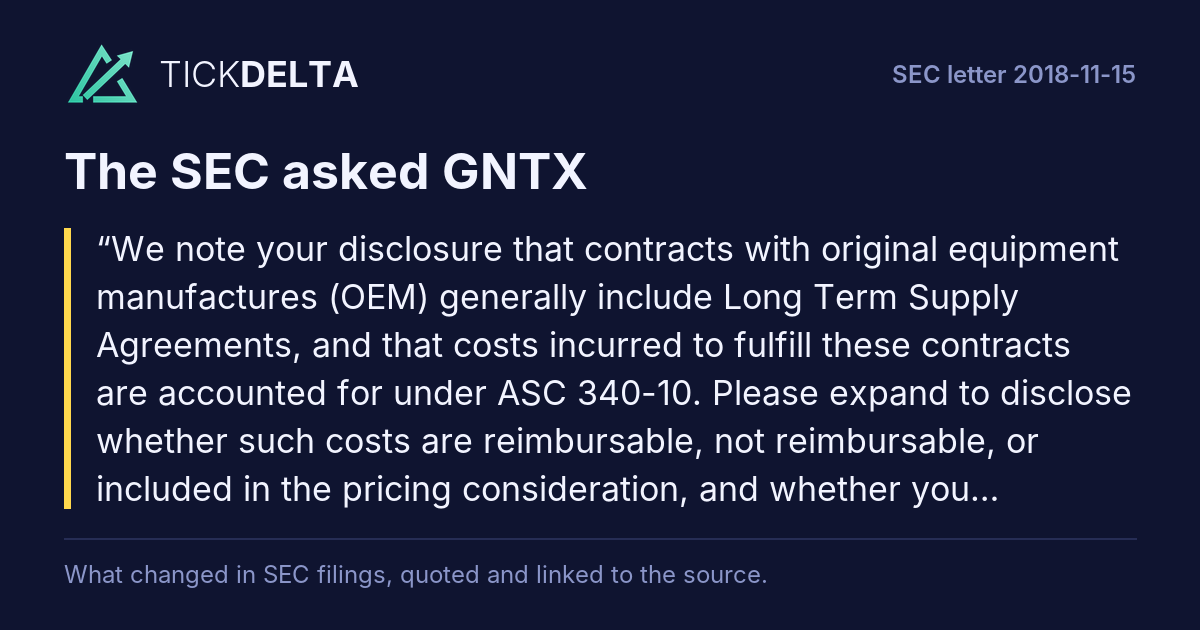
We note your disclosure that contracts with original equipment manufactures (OEM) generally include Long Term Supply Agreements, and that costs incurred to fulfill these contracts are accounted for under ASC 340-10. Please expand to disclose whether such costs are reimbursable, not reimbursable, or included in the pricing consideration, and whether you expense or capitalize such costs.Rest of the question
Also disclose the amount of such contract costs, if material and where it is classified in the financial statements. Reference is made to ASC 340-10-S99-3.
For certain contracts with OEMs, the Company itself incurs the costs associated with the pre-production activities necessary to fulfill such contracts. The Company does not generally include the pre-production activities in our pricing consideration for such contracts. In addition, the Company does not typically enter into pre-production tooling arrangements unless customer-owned tooling costs are recovered through guaranteed reimbursement provisions upon production approval.Read in the reply
Generally, pre-production tooling costs are incurred by the Company and handled in the contract arrangement with theRest of the answer
customer for reimbursement under one of the following methods:
(1) Gentex incurs pre-production tooling costs and does not receive reimbursement from the customer. In these circumstances, Gentex retains title to the tooling and accounts for such costs as a component of "Property, plant and equipment, net" line item of the Consolidated Balance Sheets.
(2) Gentex initially incurs pre-production tooling costs and receives reimbursement from the customer typically through lump-sum payments once production approval has been received, or in some cases through piece price reimbursements over the course of the production of the parts.
For pre-production tooling costs incurred where the Company receives reimbursement from the customer, the costs are tracked, and the amount due from the customer is recorded to the "Prepaid expenses and other" line item of the Consolidated Balance Sheets. Reimbursements from the customer are then recorded when received as a reduction to the "Prepaid expenses and other" line item. The amount due from the customer included in the "Prepaid expenses and other" Consolidated Balance Sheets financial statement line item related to reimbursable pre-production and reimbursable tooling costs were approximately $1.8 million or 0.07% of total assets and $6.7 million or 0.29% of total assets as of December 31, 2017 and December 31, 2016, respectively, and, therefore, the Company deemed these amounts to be immaterial for disclosure purposes. The same is the case for the quarter ended September 30, 2018, as such associated amounts were approximately $6.6 million or 0.32% of total assets.
Additionally, as noted above, Company owned tooling is recorded in the “Property, plant and equipment, net” line item on the Consolidated Balance Sheets. Such associated amounts, net of depreciation, were approximately $9.3 million or 0.4% of total assets and $7.7 million or 0.3% of total assets as of December 31, 2017 and December 31, 2016, respectively, and, therefore, the Company also deemed these amounts to be immaterial for disclosure purposes. The same is the case for the quarter ended September 30, 2018, as such associated amounts, net of depreciation, were approximately $8.5 million or 0.4% of total assets.
Any reimbursement in excess of cost for tooling (or any net loss as a result of costs incurred by the Company exceeding reimbursement) is recorded in the “Cost of Goods Sold” line item of the Consolidated Statements of Income as gain/loss on reimbursable projects. Any reimbursement in excess of cost for of development costs incurred by the Company (or any net loss as a result of development costs incurred by the Company exceeding reimbursement) are netted against the "Engineering, research and development" expense line item of the Consolidated Statements of Income as a gain/loss on reimbursable projects.
Cost of Goods Sold (COGS)
Pre-production Activities (net)
% of COGS
FY 2016
$1,010,472,512
$7,059,333
0.70%
FY 2017
$1,100,344,312
$7,856,350
0.71%
FY 2018 Q3 YTD
$862,231,819
$6,559,238
0.76%
Net pre-production costs and reimbursements for the current fiscal year and two previous fiscal years represented less than 0.5% of our Net Sales and less than 0.8% of our Cost of Goods Sold, and, as such, the Company deemed these amounts to be immaterial for disclosure purposes.
The Company is aware of, will continue to consider, and will include the relevant disclosures specified in ASC 340-10-S99-3 in our future filings if the amounts of such costs become material.
First report after the company's reply of Dec 11, 2018: 10-K filed Feb 22, 2019 ↗, against the 10-K filed Feb 21, 2018 ↗.
Tickdelta does not hold the text of both reports, so they are not compared here.
We note your disclosure that the company does not generate revenue from arrangements with multiple deliverables. Please explain to us how you identify the performance obligation(s) in contracts that include Long Term Supply Agreements.
The Company's arrangements with customers typically involve various governing documents (Master Purchase Agreements, Terms and Conditions Agreements, etc.) which do not reach the level of a performance obligation until the Company receives either a purchase order and/or a customer release for a specific number of parts at a specified price, at which point the collective group of such documents represent an enforceable contract. While the long-term supply arrangements generally range from three to five years, customers make absolutely no commitments to volumes.Read in the replyRest of the answer
In addition, customers can, and regularly do, change pricing and specifications prior to or even during production. Revenue is recognized when control of the parts produced are transferred to the customer according to the terms of the contract, which is usually when the parts are shipped or delivered to the customer’s premises. The Company has also determined that any shipping and handling should be accounted for as a fulfillment activity, and, therefore, not considered to be a separate performance obligation.
The Company respectfully submits that the foregoing is sufficiently responsive to the Staff's comments and demonstrates that there is no need to revise any existing disclosure. Should you have additional comments or require additional information, please feel free to contact me by telephone at (616) 772-1590 x4412 or by email at [email protected].
First report after the company's reply of Dec 11, 2018: 10-K filed Feb 22, 2019 ↗, against the 10-K filed Feb 21, 2018 ↗.
Tickdelta does not hold the text of both reports, so they are not compared here.
Also in this review: request for more time, Nov 21, 2018, closing letter, 2018-12-13