Screener / SEC EDGAR /CIK 0001672013 /10-K filed Feb 27, 2026, compared with Feb 27, 2025 /Numbers from the XBRL of the 10-Ks
NYSE Consumer discretionary · Sporting & Athletic Goods

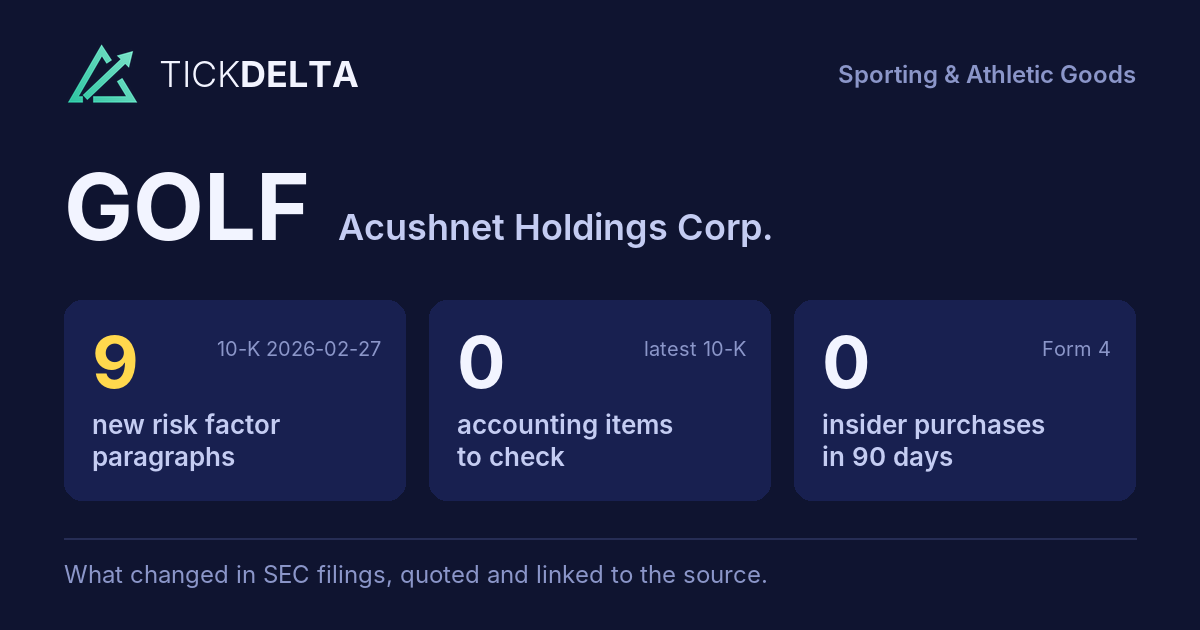
Acushnet Holdings Corp. GOLF

Compare with peers Embed
SEC comment letters, last 20 years

3 reviews of GOLF's filings by SEC staff

UPLOAD and CORRESP
Reviews 3 latest letter Dec 3, 2020
Questions asked 11 each answered in the company's own letter
No closing letter 1 reviews without a letter saying the staff completed it

When the SEC's staff reviews a filing, it writes to the company with numbered questions, and the company answers each one in a letter. SEC publishes the exchange once the review is over, at least 20 business days later. A question is not an accusation; most reviews end with the company adding detail to its next filing.

How the reviews went

Every review on EDGAR, from the first staff letter to the letter that closes it

  1. 1. Staff letters 7 UPLOAD
  2. 2. Questions in them 11 numbered comments
  3. 3. Company replies 8 CORRESP
  4. 4. Reviews closed 2 of 3 closing letter

Half the closed reviews took 32 days or less from the first letter to the closing letter.

Form 10-K for the Year Ended December 31, 2019

2020-12-03 to 2020-12-22 · 1 question · 1 letter from the SEC, 1 from the company
Review closed 2020-12-22
Controls
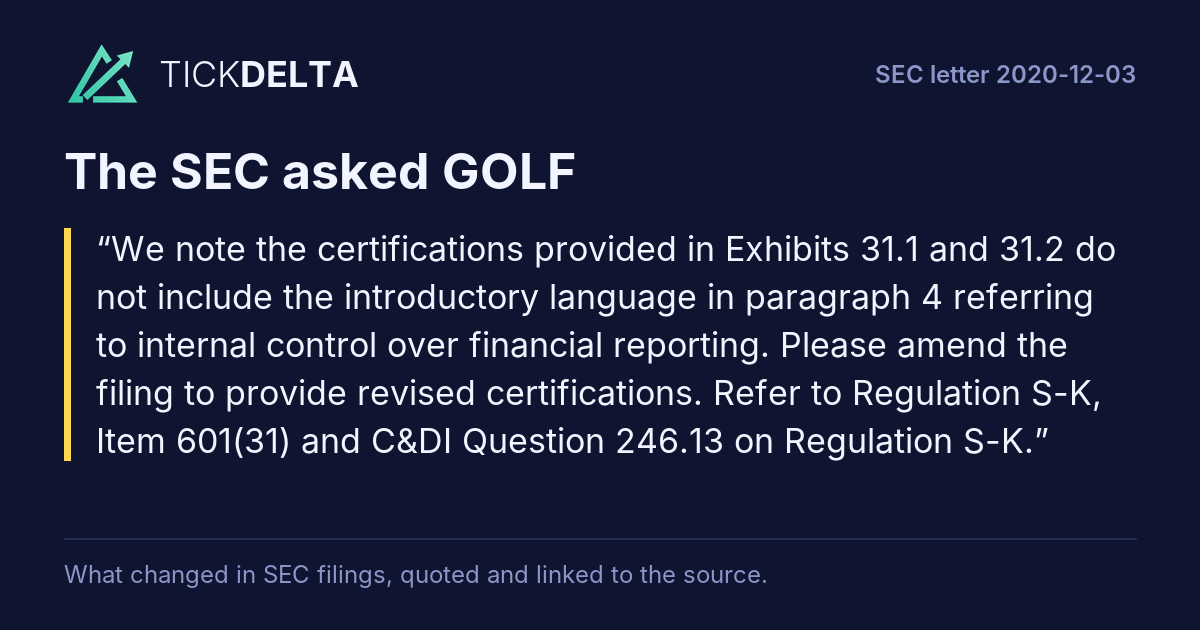
SEC asked
We note the certifications provided in Exhibits 31.1 and 31.2 do not include the introductory language in paragraph 4 referring to internal control over financial reporting. Please amend the filing to provide revised certifications. Refer to Regulation S-K, Item 601(31) and C&DI Question 246.13 on Regulation S-K.
GOLF answered
The Company acknowledges to the Staff that it inadvertently omitted the referenced introductory language in paragraph 4 from the certifications filed as Exhibits 31.1 and 31.2 to the Form 10-K. The Company will file on the date hereof an amendment to the Form 10-K to provide the revised certifications.
Read in the reply

Also in this review: closing letter, 2020-12-22

Form 10-K for the Year Ended December 31, 2017

2018-06-14 to 2018-07-16 · 2 questions · 2 letters from the SEC, 2 from the company
Review closed 2018-07-16
Revenue
Year Ended December 31, 2016 Compared to the Year Ended December 31, 2015 · Net Sales, page 62
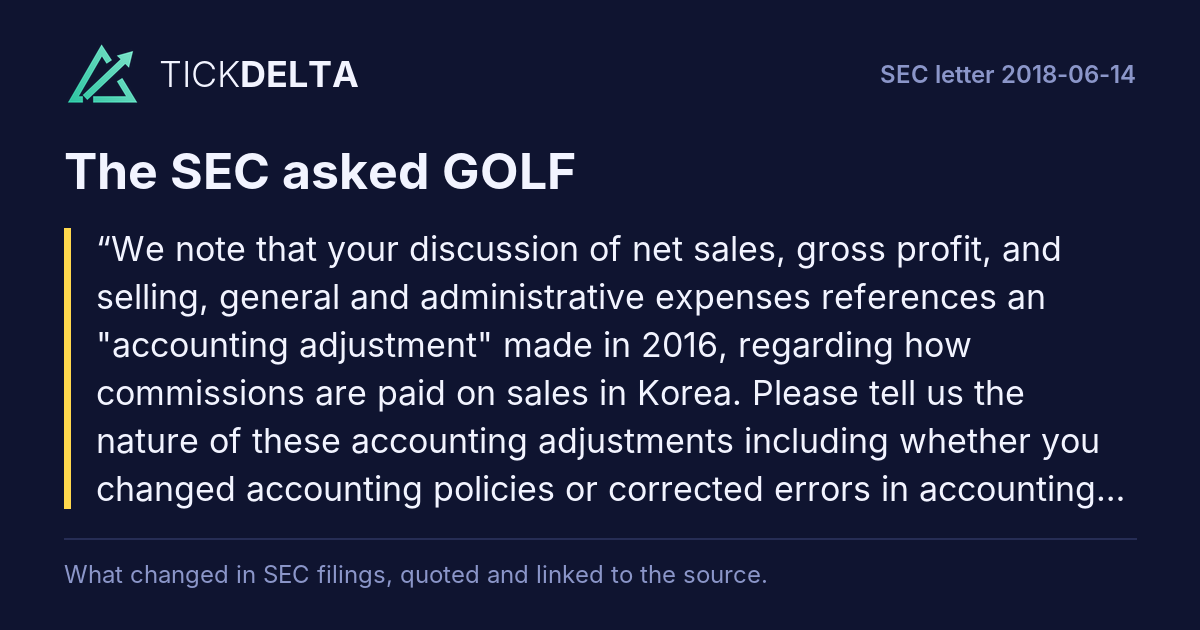
SEC asked
We note that your discussion of net sales, gross profit, and selling, general and administrative expenses references an "accounting adjustment" made in 2016, regarding how commissions are paid on sales in Korea. Please tell us the nature of these accounting adjustments including whether you changed accounting policies or corrected errors in accounting in accordance with ASC 250.
GOLF answered
The accounting adjustment referenced in the Management Discussion and Analysis and Results of Operations for the year ended December 31, 2016 compared to the year ended December 31, 2015 in Form 10-K for the year ended December 31, 2017 was the correction of an error in the classification of commissions paid on certain retail sales in Korea in accordance with ASC 250, Accounting Changes and Error Corrections.
Rest of the answer

The error was identified by Management during the three months ended December 31, 2016.

The adjustments related to agreements that the Company has with certain retail stores in Korea in which certain products are sold on consignment terms, which include a set commission rate earned by the retail stores. The Company historically deemed Acushnet to be the agent in the sale transaction and recorded revenue net of the commission amount. During the three months ended December 31, 2016, Management reassessed the terms of the arrangements and concluded that Acushnet is the principal in the sale transaction and revenue should be recorded on a gross basis, with the related commission recorded in selling, general and administrative expense.

In accordance with Staff Accounting Bulletin (SAB) No. 99, Materiality, and SAB No. 108, Considering the Effects of Prior Year Misstatements when Quantifying Misstatements in Current Year Financial Statements, the Company assessed the materiality of the adjustments and concluded these items were not material to any previously issued annual or interim financial statements. However, to facilitate comparisons among periods, the Company revised its previously issued first, second and third quarter 2016 unaudited consolidated financial information in Footnote 22 on page F-45 of Form 10-K for the year ended December 31, 2016. The Company did not revise periods prior to the three months ended March 31, 2016 as the impact was not material to the periods presented.

Read in the reply
In its next report

First report after the company's reply of Jun 25, 2018: 10-Q filed Aug 2, 2018 ↗, against the 10-Q filed May 3, 2018 ↗.

Tickdelta does not hold the text of both reports, so they are not compared here.

Year Ended December 31, 2016 Compared to the Year Ended December 31, 2015 · Net Sales, page 62
SEC asked
We note from your response to prior comment 1 that the accounting adjustments concerning your gross versus net revenue presentation in 2016 were not material. Please tell us the amount of the adjustments to your 2016 net sales and gross profit.
Rest of the question

In this regard, it appears that the revised amounts for income from operations and net loss for the 3rd quarter of 2016 are materially different from the amounts included in your Form 10-Q for the quarter ended September 30, 2016. Please advise. In addition, your response should fully explain the nature of the reassessment that caused you to change your accounting, why you previously used net accounting, and the factors that led to your decision to switch to gross accounting. Also, note that under Item 302(A)(2) of Regulation S-K, when amounts presented as unaudited quarterly data, such as in Note 22, are revised from those previously included in Form 10-Qs, the amounts should be reconciled and an explanation given in the notes to the financial statements. We may have further comment upon receipt of your response.

GOLF answered
We respectfully submit that the amount of the adjustments to our 2016 net sales and gross profit, the materiality of the revisions to our income from operations and net loss for the third quarter of 2016 and the disclosures required under Item 302(A)(2) of Regulation S-K were previously disclosed in our Form 10-K for the year ended December 31, 2016 in Footnote 22 on page F-45.
Rest of the answer

That disclosure included the following:

The Company has revised its previously issued first, second and third quarter of 2016 unaudited consolidated financial information to correct for immaterial adjustments related to the treatment of commissions paid on certain retail sales in Korea and the timing of revenue recognition on shipments of trial golf clubs.

The revision related to the treatment of commissions paid on certain retail sales in Korea resulted in an increase in net sales and a corresponding increase in selling, general and administrative expense of $2.0 million in the first quarter of 2016, an increase in net sales and a corresponding increase in selling, general and administrative expense of $4.7 million in the second quarter of 2016 and an increase in net sales and a corresponding increase in selling, general and administrative expense of $3.9 million in the third quarter of 2016.

The revision related to the timing of revenue recognition on shipments of trial golf clubs resulted in a decrease in net sales of $4.8 million, a decrease in cost of goods sold of $3.3 million, a decrease in gross profit of $1.5 million, a decrease in income tax expense of $0.5 million and a decrease in net income of $1.0 million in the first quarter of 2016; a decrease in net sales of $1.6 million, a decrease in cost of goods sold of $1.1 million, a decrease in gross profit of $0.5 million, a decrease in income tax expense of $0.2 million and a decrease in net income of $0.3 million in the second quarter of 2016; and an increase in net sales of $3.0 million, an increase in cost of goods sold of $2.0 million, an increase in gross profit of $1.0 million, an increase in income tax expense of $0.3 million and an increase in net income of $0.7 million in the third quarter of 2016.

In accordance with Staff Accounting Bulletin (SAB) No. 99, Materiality, and SAB No. 108, Considering the Effects of Prior Year Misstatements when Quantifying Misstatements in Current Year Financial Statements, the Company assessed the materiality of the adjustments and concluded these items were not material to any previously issued annual or interim financial statements. However, to facilitate comparisons among periods, the Company has decided to revise its previously issued first, second and third quarter 2016 unaudited consolidated financial information presented within this footnote for the adjustments and those revisions will be reflected in the Company’s future filings.

In Form 10-Q for the quarterly period ended September 30, 2016, the Company originally reported Income from operations of $8.6 million and a Net loss of $5.0 million. In Form 10-K for the year ended December 31, 2016, the Company revised these amounts to Income from operations of $9.6 million and a Net loss of $4.4 million, an increase in Income from operations of $1.0 million and a decrease in Net loss of $0.6 million.

In response to the Staff’s question regarding the reassessment of the retail arrangements in Korea, the Company reviewed its retail arrangements in Korea during 2016 and reassessed its gross versus net reporting analysis in accordance with the guidance then in effect, ASC 605 - Revenue Recognition - Principal Agent Considerations. Based on this reassessment, the Company concluded that based upon local business practices that it is the principal in these sale transactions and that revenue should be recorded on a gross basis, rather than net, with the offset for related commissions recorded in selling, general and administrative expense. The Company had initially determined that it was the agent in these transactions based on the terms of the contracts and recorded the revenue on a net basis.

Read in the reply
In its next report

First report after the company's reply of Jul 10, 2018: 10-Q filed Aug 2, 2018 ↗, against the 10-Q filed May 3, 2018 ↗.

Tickdelta does not hold the text of both reports, so they are not compared here.

Also in this review: closing letter, 2018-07-16

Form S-1

2016-07-18 to 2016-10-25 · 8 questions · 4 letters from the SEC, 5 from the company
No closing letter
Non-GAAP measuresLiquidity and cashResults discussion (MD&A)Critical estimatesRisk factorsLegal and contingenciesChinaExecutive payLeasesControlsDerivatives and hedgingDebtAcquisitions
Prospectus Summary, page 1 · Strong Financial Performance, page 7
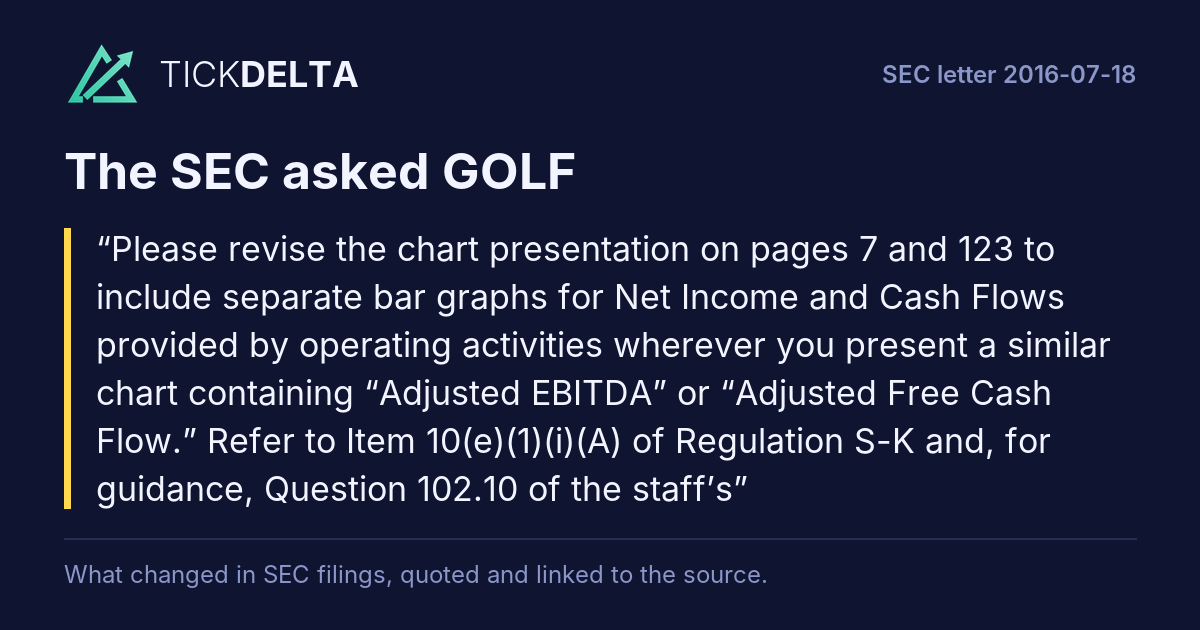
SEC asked (1)
Please revise the chart presentation on pages 7 and 123 to include separate bar graphs for Net Income and Cash Flows provided by operating activities wherever you present a similar chart containing “Adjusted EBITDA” or “Adjusted Free Cash Flow.” Refer to Item 10(e)(1)(i)(A) of Regulation S-K and, for guidance, Question 102.10 of the staff’s
GOLF answered
to the Staff’s comment, the Company has revised its disclosure on pages 7 and 128 of Amendment No. 1 accordingly.
Read in the reply
“Compliance and Disclosure Interpretations on Non-GAAP Financial Measures.” · Corporate Information, page 11
SEC asked (2)
We note that you discuss the levels of ownership by Fila Korea Ltd. and Mirae Assets Global Investments immediately prior to the closing of this offering and after giving effect to certain conversions and exercises of your securities. Please also provide the levels of ownership taking into account the closing of this offering.
Rest of the question

Balance Sheet Data, page 19 3 We note that you define working capital as current assets less current liabilities, excluding the current portion of long-term debt and EAR liability. Please note that working capital is defined by FASB ASC 210-10-20 as ``the excess of current assets over current liabilities.´´ Please revise the description of the measure presented to avoid any potential confusion. 4. We note the amount included in total long-term debt, net of discount including current portion and capital lease obligations in your balance sheet data table on pages 19 and 71. Please add a footnote to the table to disclose how the components of this balance agree to the amounts on your balance sheets or to the respective debt and financing arrangement footnotes. Other Financial Data, page 20 5. Reference is made to your presentation of the non-GAAP financial measure, Adjusted EBITDA. You indicate in footnote (1) that you present the measure in a manner consistent with your new credit agreement where it is used at the Acushnet Company level for purposes of calculating covenant compliance under your new credit agreement. In this regard, please tell us if the covenant is a material term of your new credit agreement. As part of your response, please define how the measure and covenant are calculated in the agreement, including the amount or limit required for compliance with the covenant. To the extent material to an investor’s understanding of your financial condition and/or liquidity, please tell us what consideration you have given to disclosing such information within the liquidity section of MD&A. For further guidance, refer to Question 102.09 of the staff’s “Compliance and Disclosure Interpretations on Non- GAAP Financial Measures.” 6. We note you also disclose in footnote (1) that Adjusted EBITDA is used on a consolidated basis as a supplemental measure in assessing your operating performance, and that you believe it is helpful to investors, securities analysts and other interested parties as a measure of our comparative operating performance from period to period. We note similar disclosure in footnote (2) with respect to Adjusted Net Income. Please be advised that we do not consider your current statements disclosing the usefulness of such non-GAAP financial measures to fully comply with the requirements of Item 10(e)(1)(i) of Regulation S-K. Disclosures required by Item 10(e)(1)(i)(C)-(D) of Regulation S-K should be specific to each non-GAAP financial measure explaining the reason(s) why management believes the measures are useful rather than generic statements. Please revise your non-GAAP disclosures surrounding Adjusted EBITDA and Adjusted Net Income, accordingly. 7. We note your presentation of the non-GAAP liquidity measure adjusted free cash flow, which you define as cash flows provided by (used in) operating activities less capital expenditures plus interest expense on your convertible notes and your 7.5% bonds due 2021. Please note Item 10(e)(1)(ii)(A) of Regulation S-K prohibits the exclusion of charges that require cash settlement from non-GAAP liquidity measures. Please revise your presentation accordingly to comply with guidance noted above. Risk Factors, page 25 Risks Related to Our Business and Industry, page 25 8. We note your disclosure on page 84 that you consolidate the accounts of your FootJoy golf shoe joint venture, which is a variable interest entity that is 40% owned by you. Please tell us what consideration you have given to including a risk factor addressing potential risks related to this entity and its structure. We may be subject to litigation and other regulatory proceedings, page 45 9. Please discuss here and in your Legal Proceedings section the dispute between Acushnet Company and Beam with respect to approximately $16.6 million of value-added tax trade receivables. Capitalization, page 60 10. Total capitalization amounts on an actual and pro forma basis do not foot. It appears that common stock warrant liability of $24,763 is not included in the total capitalization balance on either an actual and pro forma basis. Please advise or revise accordingly. Selected Consolidated Financial Data, page 66 11. Reference is made to your combined presentation of the fiscal 2011 predecessor and successor periods on page 68. We note your disclosure in footnote (1) that the combined results represent a mathematical addition of the predecessor and successor periods and you have included the information to facilitate a comparison with your other years. However, it is not appropriate to combine the results of the predecessor and successor periods for purposes of such presentation because the historical results are on different basis of accounting and thus, not comparable. In this regard, please revise to remove the combined 2011 predecessor and successor period in the table. Furthermore, to the extent combined information for the 2011 predecessor and successor periods has been presented elsewhere in the filing, please remove such information accordingly. Management’s Discussion and Analysis, page 73 Overview, page 73 12. We note that you discuss the non-GAAP measure, Adjusted EBITDA margin, on page 74 and define it as Adjusted EBITDA divided by net sales. You indicate on page 80 Adjusted EBITDA margin is one of your key performance measures for which you use to measure and evaluate your business, and you include the measure in the table on page 85 for each of the years presented. In this regard, please revise your filing to comply with the disclosures required by Item 10(e)(1)(i) of Regulation S-K, including a reconciliation of the non-GAAP measure to the most directly comparable GAAP measure. Your reason(s) for why management believes the measure is useful to investors should be an explanation rather than a statement of its purpose. The table on page 85 should also be revised to include a presentation, with equal or greater prominence, of the most directly comparable GAAP measure. Results of Operations, page 86 13. We note your discussion and presentation of net sales on a constant currency basis. Please tell us your consideration for a similar disclosure as it relates to your cost of sales, gross profit, SG&A, and research and development. Please advise or revise your discussion for all comparative periods accordingly. 14. Your discussion of the results of operations frequently does not quantify sources of material changes. Please also note that prefacing a reference to the source or sources of changes with the word "primarily" obscures the ability of the reader to identify the material sources of the change. In addition, where a material change is attributed to two or more factors, including any offsetting factors, the contribution of each identified factor should be described in quantified terms. Please revise to quantify the impact of each material factor that you discuss to provide your readers with better insight into the underlying reasons behind the changes in your results. Refer to Item 303(a) of Regulation S-K, Section III.D of Release No. 33-6835 and Section III.B of Release No. 33-8350 which can be found on the SEC Website. Year Ended December 31, 2015 Compared to the Year Ended December 31, 2014 Other (Income) Expense, Net, page 93 15. Please disclose and explain to us the underlying reasons for the change in the fair value measurement of the common stock warrant during the year ended December 31, 2015 that resulted in a recognized loss of $28.4 million. Seasonality, Cyclicality and Quarterly Results, page 100 16. Please revise the quarterly chart presentation to include the comparable GAAP financial measure to “Adjusted EBITDA by Quarter”. Refer to Item 10(e)(1)(i)(A) of Regulation S-K and, for guidance, Question 102.10 of the staff’s “Compliance and Disclosure Interpretations on Non-GAAP Financial Measures.” Liquidity and Capital Resources, page 102 Indebtedness, page 104 17. We note your disclosure on page 105 that “[o]n the initial funding date, we expect to use the proceeds of the new term loan A facility and borrowings under the new revolving credit facility to repay all amounts outstanding under our secured floating rate notes, our former senior revolving credit facility, and certain of our former working credit facilities and to pay fees and expenses related to the foregoing.” Please revise to quantify these amounts outstanding. In the event you have any remaining balances on your old credit facilities, please disclose them here. Quantitative and Qualitative Disclosures about Market Risk Interest Rate Risk, page 114 18. We note you are exposed to interest rate risk under your various credit facilities which accrues interest at variable rates and that you do not engage in any interest rate hedging activity and have no intention to do so in the foreseeable future. Considering the amount of debt you have outstanding that is at a variable interest rate, please revise your disclosure in Item 7A to provide quantitative information regarding your interest rate risk in accordance with one of the three disclosure alternatives set forth in Item 305 of Regulation S-K. Internal Control Over Financial Reporting, page 116 19. We note your disclosure on page 51 that in connection with the audit of your consolidated financial statements for the years ended December 31, 2013, 2014 and 2015, you and your independent registered public accounting firm identified material weaknesses in internal control over financial reporting. Please disclose this here. Business, page 117 Our History and Evolution, page 118 20. Please revise this section to include details concerning your more recent history, including the sale from Beam Suntory, Inc. to Fila Korea Ltd. and Mirae Assets Global Investments. Our Products, page 127 21. Please ensure that the discussion in this section is balanced. In this regard, we note that graphical charts appear to be presented only for products in which you are an industry leader. Titleist Golf Balls, page 128 22. Please provide a definition for the phrase on page 129 “top grade wholesale golf ball market.” Manufacturing Excellence, page 141 23. We note the disclosure here regarding your joint venture related to the manufacture of FootJoy golf shoes in Fuzhou, China. Please revise to disclose that the counter-party to this agreement is a variable interest entity, and summarize the material terms of this arrangement. Please also file this agreement as an exhibit. Management, page 156 Executive Officers and Directors, page 156 24. Please confirm that there are no family relationships between any of your directors, executive officers, or persons nominated or chosen to become a directors or executive officers. Executive Compensation, page 161 25. Please tell us why the EAR awards are not reflected in the Summary Compensation table on page 174. Certain Relationships and Related Party Transactions, page 199 26. For each of the transactions in this section, please disclose the information required by Item 404(a)(1) of Regulation S-K. Consolidated Balance Sheet, page F-3 27. Reference is made to the captions for Series A redeemable convertible preferred stock and Common stock on the face of the consolidated balance sheet. It appears that certain pro forma information has been included in the line item captions. Series A redeemable convertible preferred stock includes “no shares issued or outstanding” and Common stock reflects “7,887,591 shares issued and outstanding.” Please advise or revise to correct the discrepancy. Consolidated Statements of Redeemable Convertible Preferred Stock and Equity, page F-7 28. Please reconcile the amount relating to the exercise of stock options of $2,752 per the consolidated statements of redeemable convertible preferred stock and equity to the amount reflected as proceeds from exercise of stock options of $nil on the statements of cash flows under cash flows from financing activities for the year ended December 31, 2015. Notes to Consolidated Financial Statements 2. Summary of Significant Accounting Policies Variable Interest Entities, page F-9 29. Please tell us if the terms of your VIE arrangement with Acushnet Lionscore Limited could require you to provide financial support to the VIE, including events or circumstances that could expose you to a loss. If so, please tell us what consideration was given to the disclosure required by ASC 810-10-50-14c.

GOLF answered
to the Staff’s comment, the Company has revised its disclosure on pages 11 and 12 of Amendment No. 1 to indicate that the Financial Investors will be selling their shares of common stock in the Company on a pro rata basis. The Company will revise its disclosure in the “Principal and Selling Stockholders” section of the Registration Statement in a future amendment to indicate the exact number of shares to be sold by the selling stockholders in this offering and the levels of ownership taking into account the closing of this offering.
Read in the reply
Business, page 122 · Our Products, page 132
SEC asked (1)
We note your response to our prior comment 21. Please place in context your disclosure on page 131 regarding your initiatives to increase penetration in the golf gear and wear categories and your disclosure on pages 141-42 regarding your positioning in these categories by providing information, to the extent available, regarding your consumer market share and principal competitors in the following categories: golf
Rest of the question

gear; worldwide net sales of outerwear; general golf apparel; men’s general golf apparel; and U.S. women’s golf apparel.

GOLF answered
to the Staff’s comment, the Company has revised its disclosure on pages 147 and 150 through 152. The Company advises the Staff that (i) while the Company has presented market share and competitor information for golf bags on page 147, the Company’s share of net sales and competitor information in the Titleist Golf Gear business for the headwear, travel gear, and head covers and other golf gear categories is not available, (ii) market share information for sales of the Company’s golf outerwear category has been presented for the United States because worldwide market share information for this
Rest of the answer

category is not available, and (iii) market share information has been presented for the men’s general golf apparel category and women’s golf apparel category for the United States because worldwide market share information for the general golf apparel category is not available.

Read in the reply
General
SEC asked (2)
You state in your response to our prior comment 11 the purpose of the 2011 combined data is to facilitate comparison of the combined results with the other years presented and assert that the impact of the acquisition is not meaningful for that purpose.
Rest of the question

However, the combined data is not materially comparable in several respects and an assertion that it is not meaningful does not appear to comply with the disclosure requirement in Instruction 2 to Item 301 of Regulation S-K. Please expand your disclosure to address comparability in more detail. Your revised disclosure should include a discussion of the material differences due to purchase accounting. In addition, consider whether the combined data represents a collection of non-GAAP measures since the combination is not reflected in your GAAP financial statements. If this data is within the scope of the non-GAAP rules, consider the guidance in Question 102.09 of the Non-GAAP Financial Measures C&DIs regarding full income statement presentations.

GOLF answered
to the Staff’s comment, the Company has revised its disclosure on pages 6, 7, 77 through 84, 136 and 137 to address comparability between the predecessor and successor periods in the year ended December 31, 2011, including a discussion of the material differences due to purchase accounting, and to reduce the prominence of the presentation of the combined results of operations for the year ended December 31, 2011.
Read in the reply
General
SEC asked (3)
Please update your financial statements as required by Rule 3-12 of Regulation S-X.
GOLF answered
The Company has updated its financial statements in Amendment No. 2 as required by Rule 3-12 of Regulation S-X.
Read in the reply
Capitalization, page 68
SEC asked (1)
We note your total capitalization balances on an actual, pro forma and pro forma as adjusted basis are the same and do not appear to foot correctly. Please revise accordingly.
GOLF answered
to the Staff’s comment, the Company has revised its disclosure on page 70 of Amendment No. 3 and has revised the formatting of the table on page 71 of Amendment No. 3 to clarify the line items which add up to total capitalization.
Read in the reply
Critical Accounting Policies and Estimates, page 121 · Share-Based Compensation, page 127
SEC asked (2)
We note upon the filing of your registration statement you changed your methodology for valuing the share-based compensation awards to prospectively account for them at fair value using a fair value pricing model, such as Black-Scholes.
Rest of the question

We also note that you evaluated the impact of the change in valuation methods in the six months ended June 30, 2016 as a cumulative effect of a change in accounting principle and determined that there was no impact on the consolidated financial statements. In this regard, please tell us in more detail about the basis of your conclusion as it relates to your liability classified awards (i.e. EARS). Specifically, explain why the change in valuation methods did not have an effect on your consolidated financial statements at June 30, 2016. In a related matter, please clarify your disclosures in the Summary Consolidated Financial Data, Selected Financial Data and MD&A that you have changed your methodology for valuing the EARS from intrinsic value method to a fair value pricing model. Your current disclosures continue to state that the liability is re-measured to intrinsic value at each reporting period based upon your common stock equivalent value. Also, please clarify within your critical accounting policy and elsewhere, as appropriate, to specify how the settlement amount of the EAR awards will be determined as well as the form of settlement required. If the terms of the EAR awards provide you the option to settle some portion of the EAR awards in stock rather than cash, please provide us with an analysis of the effect of this option on your accounting for the EAR awards, with specific citation to authoritative literature, and consider the need to include clarifying disclosure in your filing.

GOLF answered
to the first part of the Staff’s comment, the Company respectfully submits that the value of the EARs is based on the common stock equivalent (as defined in the EAR Plan) value, as discussed on page 189 under “Executive Compensation—Compensation Discussion and Analysis—Analysis of Long-Term Incentives (LTIP and EAR)—Payout of the EARs” in Amendment No. 3 and Note 17—Equity Incentive Compensation to the Company’s audited consolidated financial statements.
Rest of the answer

The CSE value is defined as the highest of (1) an enterprise value (as defined in the EAR Plan) generally based on the Company’s Plan Adjusted EBITDA for fiscal 2015, (2) an enterprise value (as defined in the EAR Plan) generally based on the Company’s Plan Adjusted EBITDA for fiscal 2016 and (3) if an IPO has occurred, a value based on the average per share closing price of the publicly traded common stock for the first full three trading days following the pricing of common stock in the IPO. For the years ended December 31, 2013, 2014 and 2015, the Company valued the EARs using the intrinsic value method. Upon the filing of the registration statement, the Company prospectively changed its methodology for valuing the EARs to a fair value pricing model as required by ASC 718. This change in accounting did not impact the calculation of enterprise value under either clause (1) or (2) above but it did impact the calculation of average per share closing price under clause (3). However, as the calculation under clause (3) was lower than the calculation under clause (2) under either accounting methodology, the change in valuation methods did not have an effect on the Company’s consolidated financial statements at June 30, 2016.

In response to the second part of the Staff’s comment, the Company has revised its disclosure on pages 22, 24, 26, 81, 84, 85, 100, 117 and 130 of Amendment No. 3 accordingly.

In response to the third part of the Staff’s comment, the Company respectfully submits that subsequent to its initial public offering, the Company will have the option to settle up to 50% of its outstanding EARs using its common stock. However, because it is currently the Company’s intention to settle the entire amounts due under the EARs in cash, the Company accounts for all outstanding EARs as a liability pursuant to ASC 718-10-25-15. In response to the Staff’s comment, the Company has revised its disclosure on pages 97 and 130 of Amendment No. 3 accordingly.

Read in the reply
Critical Accounting Policies and Estimates · Share-Based Compensation, page 130
SEC asked
We note from your response to our prior comment number 2 that your CSE calculation under clause (3) was lower than clause (2) under the intrinsic or fair value methods. As a result, the change in valuation method did not have an effect on your consolidated financial statements at June 30, 2016.
Rest of the question

In this regard, please tell us the CSE values calculated under each clause at June 30, 2016 and explain to us in further detail why the CSE value under clause (3) was lower than clause (2). As part of your response, please provide your calculations and the significant assumptions used in determining CSE values under clause (2) and (3).

GOLF answered
The Company respectfully submits that the payout value of the EARs is based on the positive excess of (i) the common stock equivalent (as defined in the EAR Plan) value (the “CSE Value”) on the date of the applicable payout event, less (ii) the Grant Date Value (as defined in the EAR Plan).

The CSE Value is defined in accordance with the EAR Plan as the highest of (1) an amount calculated by using a formula based on certain financial metrics of Acushnet Company as of and for the year ended December 31, 2015, (2) an amount calculated by using a formula based on certain financial metrics of
Rest of the answer

Acushnet Company as of and for the year ended December 31, 2016 and (3) if an IPO has occurred, an amount calculated based on the average per share closing price of the publicly traded common stock for the first full three trading days following the pricing of common stock in the IPO. The Grant Date Value is $100.00 per EAR.

Under ASC 718, the Company was required to calculate the estimated payout value of its outstanding EARs for purposes of determining the fair value of such EARs and the related liability and compensation expense. Therefore, to estimate the payout value of the EARs, the Company applied the definition of CSE Value set forth in the EAR Plan. As further explained below, the estimated payout value of each EAR calculated under clauses (1) and (2) of such definition is significantly higher than the estimated payout value calculated under clause (3) of such definition because such estimated payout value under clauses (1) and (2) is determined using a specified formula based on certain financial metrics. Because the estimated payout value was highest using clause (2) of the CSE Value definition set forth in the EAR Plan, the Company used such value for purposes of determining the fair value of such EARs and the related liability and compensation expense.

To explain in further detail, the Company respectfully submits that the estimated payout values using each clause of the CSE Value definition set forth the EAR Plan are calculated as follows:

Clause (1) — The Amount Based on 2015 Financial Metrics

The CSE Value under clause (1) is calculated in accordance with the EAR Plan using the following formula:

(i) Plan Adjusted EBITDA for 2015 of $210.4 million (which amount is disclosed on page 185 of Amendment No. 3 to the Company’s Registration Statement on Form S-1), multiplied by 10.8, minus

(ii) all outstanding indebtedness of Acushnet Company and its subsidiaries as of December 31, 2015 of $444.2 million, plus

(iii) cash and cash equivalents of the Company and its subsidiaries as of December 31, 2015 of $51.4 million and the cumulative interest, dividends and fees paid on or in respect of the Convertible Preferred Stock, the Convertible Notes and the 7.5% bonds due 2021, and any other interest, dividends, distribution or fees paid to the Company’s stockholders over the period beginning on March 31, 2011 and ending on December 31, 2015 of $200.1 million, divided by

(iv) the number of shares of the Company’s common stock outstanding on an as converted, fully diluted basis as of December 31, 2015 of 8,232,622 shares.

This formula resulted in an estimated CSE Value for each EAR of $252.83 and therefore an estimated payout value for each EAR of $152.83 (which equals the estimated CSE Value of $252.83 minus the Grant Date Value of $100.00).

Clause (2) — The Amount Based on 2016 Financial Metrics

The CSE Value under clause (2) is calculated in accordance with the EAR Plan using the following formula:

(i) Plan Adjusted EBITDA for 2016 multiplied by 10.8,

(ii) outstanding indebtedness of the Company and its subsidiaries as of December 31, 2016,

(iii) cash and cash equivalents of the Company and its subsidiaries as of December 31, 2016 and the cumulative interest, dividends and fees paid on or in respect of the Convertible Preferred Stock, the Convertible Notes and the 7.5% bonds due 2021, and any other interest, dividends, distribution or fees paid to the Company’s stockholders over the period beginning on March 31, 2011 and ending on December 31, 2016,

(iv) the number of shares of the Company’s common stock outstanding on an as converted, fully diluted basis as of December 31, 2016.

Because fiscal 2016 is not yet complete, the Company used forecasted amounts for the above financial metrics when calculating the estimated CSE Value in accordance with clause (2) for accounting purposes. Such forecasted amounts are based on the Company’s internal budget and forecast as of and for the year ended December 31, 2016 and therefore such amounts are not disclosed herein or in the Company’s Registration Statement on Form S-1.

This formula resulted in an estimated CSE Value for each EAR of $274.26 and therefore an estimated payout value for each EAR of $174.26 (which is the estimated CSE Value of $274.26 minus the Grant Date Value of $100.00).

Clause (3) — The Amount Based on Average Per Share Closing Price

Because an IPO has not yet occurred, the CSE Value calculated in accordance with the EAR Plan under clause (3) would be zero. However, under ASC 718, the Company is required to estimate the payout value under clause (3) using a fair value pricing model. Applying a Black-Scholes valuation, a standard fair value pricing model, the Company calculated the estimated payout value using the following inputs:

The Company used a stock price of $184.02, which was based on the fair value of the Company’s common stock using the most recently available third-party valuation (which is the same as the fair value used by the Company to determine the fair value of the awards approved by the Company’s board of directors on June 15, 2016, as described on page 134 of the Registration Statement on Form S-1).

The Company used an exercise price of $100.00 (which is the Grant Date Value of the EARs).

The Company used a time to maturity of 0.3 years as the anticipated IPO date at the time of calculation was approximately four months after June 30, 2016.

The Company used an annual risk-free interest rate of 0.26%, which was interpolated from the Constant Maturity Treasury Rate as of June 30, 2016 as published by the United States Department of the Treasury, with the maturity matching the anticipated IPO date.

The Company used an annualized volatility of 35%, which was based on the equity volatilities of a peer group of publicly-traded companies, based on 6-month historical weekly stock price returns for such peer group.

Using the inputs described above, the Black-Scholes calculation resulted in an estimated payout value for each EAR of $84.10.

The Company respectfully notes that the estimated CSE Values and estimated payout values discussed above were determined using the number of CSEs and Grant Date Value prior to the Company’s 9-to-1 stock split it expects to effectuate prior to the launch of its offering.

We have attached as Exhibit A to this letter a marked version of page 133 of the Registration Statement showing revisions the Company expects to include in an amendment to its Registration Statement on Form S-1 and the preliminary prospectus for the offering in response to the Staff’s comment.

Recent Developments

We have attached as Exhibit B to this letter a draft of the “Summary—Recent Developments” section that presents a range of the Company’s estimated net sales, net income (loss) attributable to Acushnet Holdings Corp. and Adjusted EBITDA (including a reconciliation of the mid-point of the estimated range for net income (loss) attributable to Acushnet Holdings Corp. to the mid-point of the estimated range for Adjusted EBITDA) for the three months ended September 30, 2016, compared to the Company’s net sales, net income (loss) attributable to Acushnet Holdings Corp. and Adjusted EBITDA for the three months ended September 30, 2015. The Company expects to provide this information to potential investors by including it in the preliminary prospectus for the offering.
Read in the reply

Also in this review: company letter, Oct 25, 2016

Letters without questions

Other letters

UPLOAD and CORRESP
3 other letters: notices that a filing will not be reviewed, requests to declare a registration effective, and the like
  • Nov 13, 2017 · GOLF: letter to the SEC · Acushnet Holdings Corp. (the “Company”) · Registration Statement on Form S-1 (File No....
  • Nov 9, 2017 · GOLF: letter to the SEC · Acceleration Request for Acushnet Holdings Corp. · Registration Statement on Form S-1...
  • Oct 27, 2017 · SEC: letter · Acushnet Holdings Corp. · Draft Registration Statement on Form S-1 · Submitted October...

From the SEC's correspondence on EDGAR: staff letters (form UPLOAD) and company letters (form CORRESP), 20 letters filed since 2016-07-19. Questions and answers are matched by their numbers; topics come from words in each question. The reports are compared word for word (same form, before the first SEC letter against the first report after the company's reply). No AI.

Sources

The SEC's correspondence on EDGAR: staff letters (form UPLOAD) and company letters (form CORRESP), matched question by question. No AI.

Also

Filings: the letters in the filing list.

Work with it

Excel workbook · CSV. Google Sheet that stays up to date: paste =IMPORTDATA("https://tickdelta.com/company/GOLF/export.csv") into a cell.

Next in Owners and insiders:Insider trades
Esc

Type a ticker such as AAPL, a name, an investor such as Buffett, or a topic such as tariffs. ↑ ↓ to move, Enter to open.