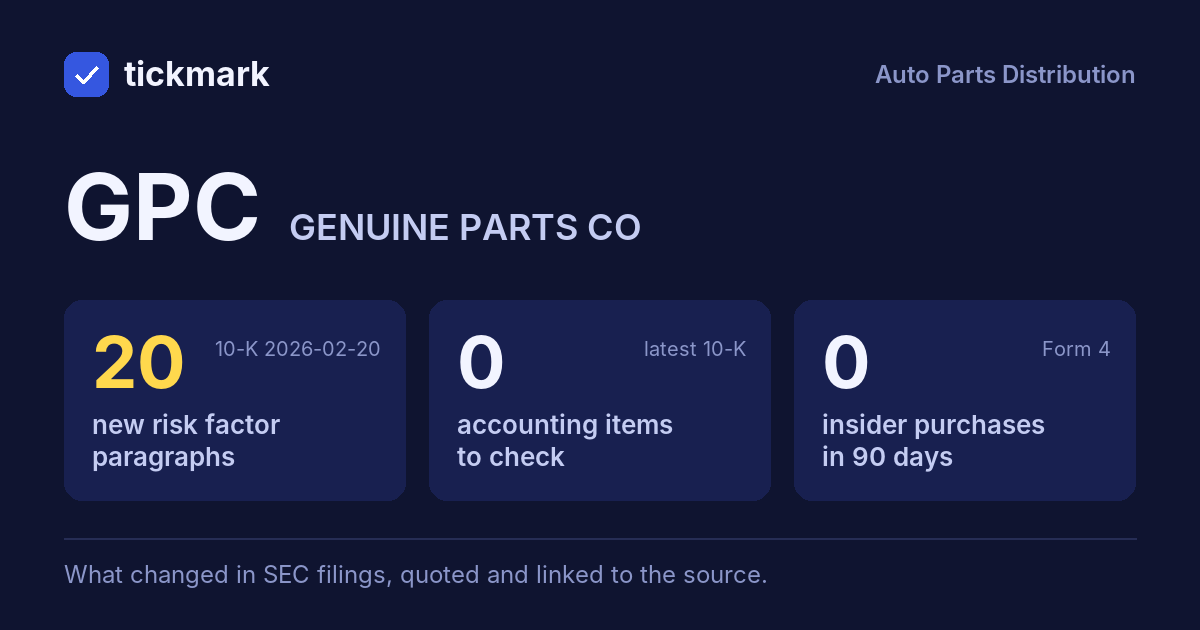
10-K 0000040987-26-000003 (2026-02-20) vs 10-K 0000040987-25-000026 (2025-02-21)
| Section | Compared text | Words now | Changed |
|---|
| Risk Factors | Item 1A | 7,306 |
19.3% |
| MD&A | Item 7 | 7,011 |
46.1% |
| Legal Proceedings | Item 3, via Note 16 – Commitments and Contingencies | 744 |
6.2% |
| Accounting Policies | Item 8, Note 1 – Summary of Significant Accounting Policies | 4,829 |
13.8% |
The redline: what was cut and what was added
In each section, the paragraph that changed most, marked against last year's 10-K:
cut words struck through, new words highlighted and underlined.
Risk Factors 214 words changed in this paragraph; it is 30% similar to last year's version.
Our business is global, so and changes to existing international trade agreements, blocking of foreign trade, increased protectionism, or imposition of tariffs on foreign goods could could, among other things, weaken consumer confidence, negatively impact employment rates in industries on which we are dependent, result in decreased revenues and/or increases higher cost of goods sold and lower gross profit and margins, cause supply chain delays or disruptions or diminishing returns on capital investments, including with respect to our ongoing distribution center optimization initiative, and deter customers in pricing, either our Industrial segment from pursuing facilities and automation projects, all of which could have an adverse impact on our business, results of operations, financial condition and cash flows in future periods. For instance, the United States imposed Section 232 tariffs on many imported products of steel and aluminum in March 2018 and expanded the tariffs to additional derivative products of steel and aluminum effective February 8, 2020. The United States imposed Section 301 tariffs on most imported products from China starting in July 2018. Although the United States and China reached a Phase One trade deal in January 2020, there was no Phase Two trade deal implemented and most of the tariffs imposed remain in place. Uncertainty persists in the trade relationship between the two countries that impacts the global trade landscape, and as of February 2025, new tariffs were enacted that significantly increase tariffs on foreign imports into the United States. The effects of these changes, including responsive actions from foreign governments, could also have significant impacts on our financial results.
Source: Item 1A, 10-K 0000040987-26-000003 vs Item 1A, 10-K 0000040987-25-000026
MD&A 190 words changed in this paragraph; it is 34% similar to last year's version.
SG&A expenses increased $476 $508 million, or 7.7%, 7.6%, from 2023. Approximately 50% 2024. The growth in SG&A expenses was largely attributable to elevated operating expenses linked to acquisitions of the approximately $225 million and a $103 million increase in our asbestos-related product liability due to adverse trends in claim counts and costs. The remaining increase was driven by personnel expense inflationary wage pressures, rising healthcare costs and 10% by higher rent expense, reflecting inflationary pressures on annual wage increases and lease renewals and higher operating costs expense due to acquisitions, primarily from the addition of more U.S. automotive stores. Additionally, 10% of the increase was attributable lease renewals. We also continue to our make investments in technology as we continue to enhance our supply chain and digital capabilities to as we improve the customer experience, increase automation in distribution centers, and modernize payment platforms. The remainder of the increase was attributable to other SG&A categories, as we incurred higher operating costs from acquired businesses, and we continued to invest in our supply chain to optimize product assortment and positioning, which helps reduce distribution costs. Partially offsetting these increases was approximately $175 million of cost savings associated with our global restructuring program, which was designed to better align our assets and cost structure to the increase were $43 million in real estate sale gains, primarily from sale-leaseback transactions to enhance our financial operational flexibility on properties we continue to use in our ongoing operations. current economic environment.
Source: Item 7, 10-K 0000040987-26-000003 vs Item 7, 10-K 0000040987-25-000026
Accounting Policies 83 words changed in this paragraph; it is 41% similar to last year's version.
We formally document relationships between hedging instruments and hedged items, as well as the risk management objective and strategy for undertaking various hedge transactions. This process includes linking cash flow hedges to specific forecasted transactions or variability of cash flow to be paid. We also formally assess, both at the hedge’s inception and on an ongoing basis, whether the designated derivative and non-derivative instruments that are used in hedging transactions are highly effective in offsetting changes in the cash flows of the hedged items. When a designated instrument is determined not to be highly effective as a hedge or the underlying hedged transaction is no longer probable, hedge accounting is discontinued prospectively.
Source: Item 8, Note 1 – Summary of Significant Accounting Policies, 10-K 0000040987-26-000003 vs Item 8, Note 1 – Summary of Significant Accounting Policies, 10-K 0000040987-25-000026
Legal Proceedings 44 words changed in this paragraph; it is 86% similar to last year's version.
As a result of our comprehensive legal review, including our evaluation of recent claim activity trends and our updated actuarial analysis, we increased the liability by $57 $107 million in 2024. 2025. This change in estimate resulted from new information related to our estimated number of future claims, the estimated cost of resolving claims, as well as the impacts of discount rate changes. We have 2,768 3,274 pending asbestos lawsuits as of December 31, 2024. 2025. The amount accrued for pending and future claims was $317 million as of December 31, 2025, which represented our best estimate of the liability within our calculated range of $258 million to $397 million, discounted using a discount rate of 4.18%. The amount accrued for pending and future claims was $256 million as of December 31, 2024, which represented our best estimate of the liability within our calculated range of $219 million to $313 million, discounted using a discount rate of 4.58%. The amount accrued for pending Our undiscounted product liability was $398 million and future claims was $244 $336 million as of December 31, 2023, which represented our best estimate of the liability within our calculated range of $196 million to $277 million, discounted using a discount rate of 3.88%. Our undiscounted product liability was $336 million and $308 million as of December 31, 2024 2025 and December 31, 2023, 2024, respectively.
Source: Item 3, via Note 16 – Commitments and Contingencies, 10-K 0000040987-26-000003 vs Item 3, via Note 16 – Commitments and Contingencies, 10-K 0000040987-25-000026
Every change, by type
Sentences and paragraphs of GPC's Risk Factors and MD&A, 10-K 2026-02-20 against 10-K 2025-02-21.
Each links to the text at sec.gov.
Quiet changes are sentences kept from last year with one to four words changed, at least one of them a hedge, a modal or a qualifier
(may, could, will, not, significant, material…). A year or date rolling forward is not counted.
The full word list
adverse, adversely, all, although, anticipate, anticipates, any, approximately, believe, believes, can, cannot, certain, could, expect, expects, generally, however, if, intend, intends, largely, likely, many, material, materially, may, might, most, must, never, no, not, possible, primarily, probable, should, significant, significantly, some, substantial, substantially, unlikely, will, would
AddedRisk Factors
With respect to our North America Automotive and International Automotive segments, the primary factors are:
Read it in 10-K 2026-02-20 at sec.gov ↗
AddedRisk Factors
Our results of operations, revenue, and supply chain could be materially affected as a result of a bankruptcy, insolvency or other credit failures of a significant customer or vendor.
Read it in 10-K 2026-02-20 at sec.gov ↗
AddedRisk Factors
Our operations depend on relationships with various customers and vendors, and we may be exposed to risks if any customer or vendor declares bankruptcy, becomes insolvent, or otherwise fails to meet its financial or contractual obligations. For example, in September 2025, one of the key vendors for our North America Automotive segment filed for Chapter 11 bankruptcy. In the event a key customer or vendor files for bankruptcy or ceases operations, we may face significant disruptions including, but not limited to, delays in our supply chain, inability to source replacement goods at comparable costs, increased operating expenses, and such events may negatively impact our ability to collect outstanding receivables or ability to generate future sales and cash flow. Credit and financial difficulties of our customers and vendors may also lead to a reduction in sales, price reductions, increased returns of our products, and could adversely affect our brand, revenue, operating results, and financial condition.
Read it in 10-K 2026-02-20 at sec.gov ↗
AddedRisk Factors
commerce solutions our retail and business customers desire, differentiate ourselves from our competitors' e-commerce solutions or adapt to new or enhanced e-commerce tools, we may lose existing customers and fail to attract new ones. Our business, financial condition, results of operations and cash flows may be materially and adversely affected as a result.
Read it in 10-K 2026-02-20 at sec.gov ↗
AddedRisk Factors
The proposed separation of our Automotive and Industrial businesses may not be completed on the terms or timeline currently contemplated, if at all, and there is no guarantee that the separation, if completed, will achieve the intended financial, strategic and operational benefits.
Read it in 10-K 2026-02-20 at sec.gov ↗
AddedRisk Factors
On February 17, 2026, following a comprehensive strategic and operational review by our Board of Directors and management team, we announced our intention to separate the Company into two independent, publicly traded companies: Global Automotive and Global Industrial. The proposed separation is intended to be tax-free for U.S. federal income tax purposes for the Company’s shareholders and is expected to be completed in the first quarter of 2027. Completion of the proposed separation is subject to, among other things, the final approval of our Board of Directors, receipt of requisite regulatory clearances and compliance with applicable SEC requirements.
Read it in 10-K 2026-02-20 at sec.gov ↗
AddedRisk Factors
The proposed separation is complex in nature, and unanticipated changes or developments could delay or prevent the completion of the separation or cause the separation to occur on terms or conditions that are different or less favorable than expected. Whether or not we complete the separation, we may face significant challenges in connection with the transaction, including, without limitation:
Read it in 10-K 2026-02-20 at sec.gov ↗
AddedRisk Factors
•our ability to maintain operational, commercial, data and information technology, intellectual property, human resources, finance, legal, sales, and marketing continuity where necessary between the two companies;
Read it in 10-K 2026-02-20 at sec.gov ↗
AddedRisk Factors
•the risk that, if the Internal Revenue Service determines that certain steps of the proposed separation do not qualify for tax-free treatment for U.S. federal income tax purposes, the Company and its shareholders could incur significant tax liabilities;
Read it in 10-K 2026-02-20 at sec.gov ↗
AddedRisk Factors
•costs and expenses related to the proposed separation are expected to be significant, including costs related to commercial and operational dis-synergies, restructuring and other transaction expenses, expenses related to establishing stand-alone operational, commercial, personnel, and digital and technology infrastructure and accounting, tax, legal, and other professional services expenses, any of which may be higher than initially expected;
Read it in 10-K 2026-02-20 at sec.gov ↗
AddedRisk Factors
•retaining existing business and operational relationships, including with customers, suppliers, employees, and other counterparties;
Read it in 10-K 2026-02-20 at sec.gov ↗
AddedRisk Factors
•failing to successfully promote retention, as well as motivate and maintain efficient and effective labor and employee relations;
Read it in 10-K 2026-02-20 at sec.gov ↗
RemovedRisk Factors
readily, more successfully utilize developing technology, including data analytics, artificial intelligence, and machine
Read it in 10-K 2025-02-21 at sec.gov ↗
RemovedRisk Factors
Despite our implementation of various security measures, our IT systems and operations could be subject to damage or interruption from computer viruses, natural disasters, unauthorized physical or electronic access, power outages, telecommunications failure, computer system or network failures, wire transfer failure, employee error/malfeasance, cyber-attacks, security breaches, and other similar disruptions. For example, the CrowdStrike outage that occurred in July 2024 negatively impacted our operations and financial results in the third quarter of 2024. In addition, the IT systems of businesses that we have acquired or may acquire could present issues that we were not
Read it in 10-K 2025-02-21 at sec.gov ↗
RemovedRisk Factors
negatively impact how our brand is perceived by our employees and customers and have material adverse effects on our business and future results.
Read it in 10-K 2025-02-21 at sec.gov ↗
RemovedRisk Factors
Our business is global, so changes to existing international trade agreements, blocking of foreign trade, increased protectionism, or imposition of tariffs on foreign goods could result in decreased revenues and/or increases in pricing, either of which could have an adverse impact on our business, results of operations, financial condition and cash flows in future periods. For instance, the United States imposed Section 232 tariffs on many imported products of steel and aluminum in March 2018 and expanded the tariffs to additional derivative products of steel and aluminum effective February 8, 2020. The United States imposed Section 301 tariffs on most imported products from China starting in July 2018. Although the United States and China reached a Phase One trade deal in January 2020, there was no Phase Two trade deal implemented and most of the tariffs imposed remain in place. Uncertainty persists in the trade relationship between the two countries that impacts the global trade landscape, and as of February 2025, new tariffs were enacted that significantly increase tariffs on foreign imports into the United States. The effects of these changes, including responsive actions from foreign governments, could also have significant impacts on our financial results.
Read it in 10-K 2025-02-21 at sec.gov ↗
RewordedRisk Factors
These broad market, geopolitical and industry factors among others may harm the market price of our common stock, regardless of our operating performance and growth outlook, and the value of your investment may decline.
Read it in 10-K 2026-02-20 at sec.gov ↗
RewordedRisk Factors
Our business, financial condition, results of operations and cash flows have been and may in the future be adversely affected by uncertain global economic conditions, including inflation or deflation, domestic outputs, geopolitical uncertainty and unrest, employment rates and wages, including increases in minimum wage, changes in tax policies, changes in energy costs, instability in credit markets, declining consumer and business confidence, fluctuating commodity prices, elevated interest rates for prolonged periods, monetary policies, volatile exchange rates, changes in fiscal and regulatory priorities as a result of under the outcome of the 2024 U.S. current presidential election, administration, and other challenges that could affect the global economy.
Read it in 10-K 2026-02-20 at sec.gov ↗
RewordedRisk Factors
Specifically, instability in the geopolitical environment in many parts of the world (including as a result of the conflict between Russia and Ukraine, the conflict and unrest in the Middle East, and China-Taiwan relations) recent developments in relations between the U.S. and Venezuela) and other disruptions may continue to put pressure on global economic conditions and supply chains.
Read it in 10-K 2026-02-20 at sec.gov ↗
RewordedRisk Factors
Changes in automotive technology (including the adoption of electric vehicles or the use of artificial intelligence) intelligence and machine learning) and compliance with any new or more stringent laws or regulations, or stricter interpretations of existing laws, could require additional compliance costs and other expenditures by us or our suppliers all of which could adversely impact the demand for our products and our business, financial condition, results of operations or cash flows.
Read it in 10-K 2026-02-20 at sec.gov ↗
RewordedRisk Factors
Furthermore, financial or operational difficulties at a particular supplier could cause that supplier to increase the cost, or decrease the quality, of the products we purchase. purchase or prevent that supplier from operating.
Read it in 10-K 2026-02-20 at sec.gov ↗
RewordedRisk Factors
A serious prolonged disruption of our information systems for any of the above reasons could materially impair fundamental business processes (including the timely reporting of financial information) and increase expenses, decrease sales or otherwise impact earnings and cash flows.
Read it in 10-K 2026-02-20 at sec.gov ↗
RewordedRisk Factors
Changes in legislation or government regulations or policies, particularly those relating to taxation international trade and international trade, taxation, could have a significant impact on our results of operations.
Read it in 10-K 2026-02-20 at sec.gov ↗
RewordedRisk Factors
Effective internal controls are necessary for us to provide reliable and accurate financial statements statements, safeguard our assets and to effectively prevent fraud.
Read it in 10-K 2026-02-20 at sec.gov ↗
RewordedRisk Factors
For example, regulations that impose extensive mandatory requirements related to GHG continue to be considered by or have been issued by policy makers in both the federal and certain state governments in the U.S., by the European Union, and by national governments in Canada, the U.K., Australia and elsewhere.
Read it in 10-K 2026-02-20 at sec.gov ↗
AddedMD&A
In the fourth quarter of 2025, we disaggregated our automotive aftermarket business into two reportable segments. There were no changes to our Industrial segment. We believe this expanded segmentation will provide our investors with additional information to better understand our performance. Concurrent with the change in reportable segments, we revised our prior period financial information to be consistent with the current period presentation. There was no impact on consolidated net sales, total operating expenses, net income or diluted EPS as a result of these changes. Refer to the Segment Data Footnote in the Notes to Consolidated Financial Statements for additional information.
Read it in 10-K 2026-02-20 at sec.gov ↗
AddedMD&A
Our results in 2025 reflect continued headwinds in global market conditions, persistent cost inflation, changes in tariffs and global trade regulations and costs associated with investments in our technology and supply chain capabilities to drive growth.
Read it in 10-K 2026-02-20 at sec.gov ↗
AddedMD&A
Net income totaled $66 million, down 92.7% compared to the prior year period. Our results include discrete charges for our pension settlement of $742 million, credit losses from the bankruptcy of First Brands Group of $151 million, and asbestos-related product liability remeasurement of $103 million. Our lower net income was also driven by lower pension income and higher SG&A expenses from inflationary pressures on salaries, healthcare costs, freight, and rent, as well as planned investments in technology to modernize our systems and digital platforms. These technology investments, along with enhancements to our supply chain capabilities, also contributed to higher depreciation and interest from additional borrowings year over year. These costs were partially offset by increased cost savings of approximately $175 million associated with our global restructuring program, which was designed to better align our assets and cost structure to the current economic environment.
Read it in 10-K 2026-02-20 at sec.gov ↗
AddedMD&A
We continue to monitor the global trade environment, including the tariffs on merchandise inventories sourced directly or indirectly from several countries, such as China, Canada, and Mexico and their impact on our operations. During 2025, tariffs drove higher prices to our customers and cost inflation that impacted our gross margin and SG&A expenses. We managed these challenges through strategic pricing and sourcing initiatives, leveraging global
Read it in 10-K 2026-02-20 at sec.gov ↗
AddedMD&A
supplier relationships and technology tools. While the ongoing economic volatility continues to add uncertainty to our operating environment, we expect our balanced portfolio and global diversification will help mitigate potential disruptions. See Part I, Item 1A. Risk Factors for further discussion regarding tariff-related risks.
Read it in 10-K 2026-02-20 at sec.gov ↗
AddedMD&A
In 2025, we completed over 50 strategic acquisitions resulting in over 250 additional locations globally. The majority of our completed transactions were in our North America Automotive business, primarily through the acquisition of independent NAPA stores in the U.S. In addition, we made a strategic acquisition of Benson Auto Parts, expanding our store footprint in our key Canadian markets and providing a diversified product offering to better serve our customers in Ontario and Quebec.
Read it in 10-K 2026-02-20 at sec.gov ↗
AddedMD&A
Depreciation and amortization increased $130 million in 2025 compared to 2024, as a result of the ongoing enhancements to our technology platforms, such as proprietary digital tools that improve customer experience and operational transparency, as well as supply chain initiatives designed to increase efficiency and service levels. These targeted investments are critical components of our strategy to strengthen our competitive position, support customer needs amid evolving market conditions, and drive long-term value creation. Additionally, approximately $40 million of the increase is attributable to a nonrecurring adjustment related to asset retirement obligations.
Read it in 10-K 2026-02-20 at sec.gov ↗
AddedMD&A
The $855 million increase primarily reflects a $742 million pension charge related to the settlement of our U.S. qualified defined benefit plan. Additionally, increased investments led to higher borrowings, contributing to a $67 million increase in net interest expense in 2025. At the same time, a shift to a more conservative investment
Read it in 10-K 2026-02-20 at sec.gov ↗
AddedMD&A
strategy in the months leading up to the settlement of our U.S. pension plan resulted in a $47 million decrease in other non-operating income.
Read it in 10-K 2026-02-20 at sec.gov ↗
AddedMD&A
The effective tax rate for year ended December 31, 2025 considers the enactment of One Big Beautiful Bill Act ("OBBBA") on July 4, 2025, which did not have a material impact to income tax expense.
Read it in 10-K 2026-02-20 at sec.gov ↗
AddedMD&A
The year over year declines in these metrics are primarily due to lower pension income and the settlement of our U.S. qualified defined benefit plan, discrete charges resulting from First Brand's bankruptcy, adverse asbestos claims trends, higher expenses from ongoing investments, persistent cost inflation and higher interest expense. This was partially offset by gross margin expansion and benefits from our global restructuring program and cost actions. Each of these items is explained more fully above.
Read it in 10-K 2026-02-20 at sec.gov ↗
AddedMD&A
North America Automotive EBITDA decreased $43 million, or 6.1%, from 2024, and EBITDA margin decreased 70 basis points to 7.1% from 7.8% in 2024, driven by the following factors.
Read it in 10-K 2026-02-20 at sec.gov ↗
RemovedMD&A
excludes amounts reflected in Corporate EBITDA, net interest expense, depreciation and amortization and other unallocated costs. Segment EBITDA as a percentage of Segment Net Sales is referred to as Segment EBITDA margin.
Read it in 10-K 2025-02-21 at sec.gov ↗
RemovedMD&A
In 2024, our net sales of $23.5 billion increased 1.7% year-over-year. Our sales growth was driven primarily by acquisitions in our Automotive segment and two additional selling days. Sales growth was partially offset by the negative impact of weak market conditions in both segments, as persistent high interest rates and economic uncertainty led to lower customer demand which resulted in flat Automotive comparable sales and declines in Industrial comparable sales in 2024. Economic activity in the U.S. manufacturing sector, measured by the Purchasing Mangers' Index ("PMI"), contracted through most of 2024, negatively impacting purchases from our Industrial customers.
Read it in 10-K 2025-02-21 at sec.gov ↗
RemovedMD&A
In 2024, net income totaled $904 million, down 31.3%, driven by costs associated with our global restructuring program, which was designed to better align our assets and cost structure to the current economic environment. During the year, we incurred $221 million in restructuring and other costs under this program, and a charge of $62 million to cost of goods sold to write down certain existing inventory associated with a new global rebranding and relaunch of a key tool and equipment offering.
Read it in 10-K 2025-02-21 at sec.gov ↗
RemovedMD&A
Our earnings in 2024 were also negatively impacted by higher SG&A costs, which were driven by increases in personnel and rent costs due to inflationary pressure and planned investments in technology to modernize our systems and digital platforms. The investments we are making in technology, as well as new supply chain capabilities, are driving higher year-over-year depreciation and interest expense. These costs were partially offset by improved gross margin due to the benefits from acquired businesses and ongoing initiatives around pricing and sourcing and from our global restructuring program.
Read it in 10-K 2025-02-21 at sec.gov ↗
RemovedMD&A
Our consolidated net sales increase of 1.7% includes a 2.6% benefit from acquisitions, which was partially offset by a 0.8% comparable sales decrease as described in the following segment discussions.
Read it in 10-K 2025-02-21 at sec.gov ↗
RemovedMD&A
Net sales for Automotive were $14.8 billion in 2024, a 3.7% increase from 2023, driven by acquisitions, particularly in our U.S. Automotive business. In 2024, we completed strategic acquisitions of more than 500 stores in the U.S., mostly from our independent owners, including the acquisition of our two largest, Motor Parts & Equipment Corporation ("MPEC") and Walker Automotive Supply, Inc. ("Walker"). These store acquisitions were in strategic markets and enable us to capture commercial benefits, leverage synergies and further drive revenue growth.
Read it in 10-K 2025-02-21 at sec.gov ↗
RemovedMD&A
Our comparable sales decreased as we experienced softness in industrial production and an ongoing moderation in demand in many customer end markets. We continued to experience an adverse macro-economic environment when compared to 2023, as persistently high interest rates and economic uncertainty led customers to delay discretionary capital expenditures. Economic activity in the U.S. manufacturing sector, measured by PMI, remained contractionary through most of 2024.
Read it in 10-K 2025-02-21 at sec.gov ↗
RemovedMD&A
We are implementing a strategic realignment of our global tools and equipment inventory strategy. This strategy targets a new generation of installers by reducing our global product offerings to two primary tiers and launching a new global branding initiative in 2025, which we expect to enhance market penetration across all regions.
Read it in 10-K 2025-02-21 at sec.gov ↗
RemovedMD&A
As part of this initiative, we have elected to liquidate certain otherwise marketable tools and equipment inventory in 2025 to accelerate the realization of the program benefits, thereby improving operational efficiency and enhancing the projected financial outcomes. By streamlining our product range in this key category, we enhance warehouse space for new inventory and enable our sales force to focus on the new strategy, facilitating earlier market capture. Accordingly, we have recognized a $62 million non-cash charge reflected in cost of goods sold to write down the inventory to its market value, assuming liquidation.
Read it in 10-K 2025-02-21 at sec.gov ↗
RemovedMD&A
SG&A as a percentage of sales increased to 28.3% in 2024 from 26.7% in 2023. The 160 basis point increase was primarily driven by approximately 80 basis points from inflationary pressures on certain operating expenses, 40 basis points from increased operating expenses from acquisitions and 25 basis points from fixed cost deleverage. Comparable sales were flat for Automotive and down for Industrial, which drove fixed cost deleveraging.
Read it in 10-K 2025-02-21 at sec.gov ↗
RemovedMD&A
In 2025, we are expanding our restructuring initiatives and expect to incur additional restructuring and other costs in the range of $150 to $180 million. These global restructuring initiatives are expected to generate approximately $100 to $125 million in savings for 2025. The estimated charges that we expect to incur are subject to a number of assumptions, and actual amounts may differ materially from such estimates. We may also incur additional charges not currently contemplated due to unanticipated events that may occur, including in connection with the implementation of these initiatives. We expect to substantially complete the initiative by the end of 2025.
Read it in 10-K 2025-02-21 at sec.gov ↗
RemovedMD&A
When fully annualized in 2026, we expect that our 2024 and 2025 restructuring efforts and cost actions will deliver approximately $200 million of cost savings.
Read it in 10-K 2025-02-21 at sec.gov ↗
RewordedMD&A
An accounting policy is deemed to be considered critical if it requires an accounting estimate to be made involves making estimates based on assumptions about uncertain matters that are uncertain at the time the estimate is made made, and if using different estimates that reasonably could have been used, reasonable estimates, or changes in the accounting those estimates that are reasonably likely to occur periodically, over time, could materially have a material impact on the consolidated financial statements.
Read it in 10-K 2026-02-20 at sec.gov ↗
RewordedMD&A
Restructuring and other costs (1) 1.82 1.58 — Acquisition and integration related costs and other (2) 0.10 0.24 — Inventory rebranding strategic initiative (3) — 0.44 Asbestos-related product liability (4) 0.74 — Pension settlement (5) 5.33 — First Brands credit loss allowance (6) 1.08 — Retirement obligation and other (7) 0.22 — Total adjustments 9.29 2.26 — Tax impact of adjustments (4) (8) (2.39) (0.57) — Adjusted diluted EPS $ 7.37 $ 8.16 $ 9.33 Weighted average common shares outstanding - assuming dilution 139,250 139,670 141,034
Read it in 10-K 2026-02-20 at sec.gov ↗
RewordedMD&A
Restructuring and other costs (1) 253,961 221,007 — Acquisition and integration related costs and other (2) 14,035 33,126 — Inventory rebranding strategic initiative (3) — 61,596 Asbestos-related product liability (4) 103,352 — Pension settlement (5) 741,967 — First Brands credit loss allowance (6) 150,500 — Retirement obligation and other (7) 30,111 — Total adjustments 1,293,926 315,729 — Tax impact of adjustments (4) (8) (333,450) (79,964) — Adjusted net income $ 1,026,421 $ 1,139,841 $ 1,316,524
Read it in 10-K 2026-02-20 at sec.gov ↗
RewordedMD&A
Operating expenses increased partly due While acquisitions contributed to acquisitions, however the rise in expenses, the decline in EBITDA and EBITDA margin declines largely were was mainly driven by persistent cost inflation, primarily in wages personnel costs, healthcare costs and rent, in our existing businesses. rent.
Read it in 10-K 2026-02-20 at sec.gov ↗
RewordedMD&A
This was partially offset by Gross profit improved partly because a charge of $62 million charge to write down certain existing inventory associated with a new global rebranding and relaunch of a key tool and equipment offering. did not recur in 2025.
Read it in 10-K 2026-02-20 at sec.gov ↗
RewordedMD&A
Industrial segment sales declined $126 increased by $204 million or 1.4%, 2.3%, primarily driven by a decline of 2.1% 1.5% increase in comparable sales due to contractionary market conditions and partially offset by 0.8% benefit coupled with a 1.2% contribution from acquisitions.
Read it in 10-K 2026-02-20 at sec.gov ↗
RewordedMD&A
Gross profit increased $275 million $282 million, or 4.9% and 8.2%, with gross margin improved 50 expanding 170 basis points points, primarily due to our strategic acquisitions in our U.S. business, including MPEC pricing, sourcing initiatives and Walker. acquisitions.
Read it in 10-K 2026-02-20 at sec.gov ↗
RewordedMD&A
Gross margin increased to 36.8% from 36.3% from 35.9% in 2023, 2024, a 40 50 basis point improvement, which was primarily driven by the benefit of acquired businesses. our strategic pricing and sourcing initiatives and acquisitions.
Read it in 10-K 2026-02-20 at sec.gov ↗
RewordedMD&A
We In 2025, we incurred a $62 million inventory charge, described above, and $221 $254 million of restructuring and other costs related to the initiative, which includes $91 million of severance costs. initiative.
Read it in 10-K 2026-02-20 at sec.gov ↗
RewordedMD&A
This mission focus drives our strategic financial objectives: outpacing market objectives which are growing revenue growth, in excess of the market, improving operating margins, maintaining a healthy balance sheet, generating strong balance sheet and cash flows, and allocating capital effectively.
Read it in 10-K 2026-02-20 at sec.gov ↗
RewordedMD&A
In 2024, our comparable sales were flat due We continue to be affected by softer consumer demand, as macro-economic headwinds such as high interest rates and persistent cost inflation continued to impact customer buying behavior. our customers, particularly in Europe.
Read it in 10-K 2026-02-20 at sec.gov ↗
RewordedMD&A
Additionally, 10% of the increase was attributable We also continue to our make investments in technology as we continue to enhance our supply chain and digital capabilities to as we improve the customer experience, increase automation in distribution centers, and modernize payment platforms.
Read it in 10-K 2026-02-20 at sec.gov ↗