GPCGenuine Parts Company
Incorporated in the State of Georgia in 1928, Genuine Parts Company is a leading global service provider of automotive and industrial replacement parts and value-added solutions. 10-K, Item 1
- Employees
- 65,000
- Headquarters
- Atlanta, GA
- CEO
- William P. Stengel II
- Next results
- around Feb 16, 2027
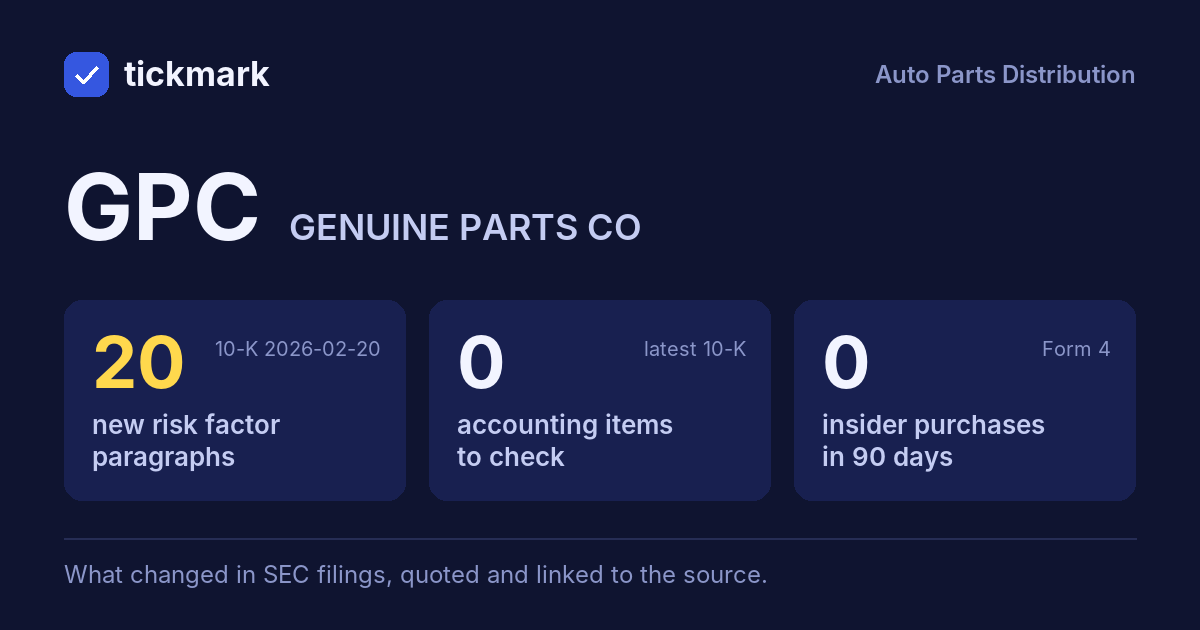
What the 10-K filed 2026-02-20 says about risks that are not on the face of the balance sheet, from the notes to the financial statements, Legal Proceedings and the MD&A (and, for big customers and key suppliers, Business and Risk Factors). Tickdelta picks sentences with specifics (amounts, accruals, covenant ratios) and quotes them as filed. New marks a sentence with nothing like it in the 10-K filed 2025-02-21.
Big customers
Customers the company names as a large share of revenue or receivables (it must name any worth 10% of revenue).
No specific sentence about this in the 10-K.
Key suppliers
Parts or manufacturing that depend on one or a few suppliers.
No specific sentence about this in the 10-K.
Lawsuits and legal claims
Pending cases, settlements and what the company has set aside for them.
“We accrue for potential losses related to legal disputes, litigation, asbestos liability, and regulatory matters when it is probable (the future event or events are likely to occur) that we have incurred a loss and the amount of the loss can be reasonably estimated.”
Read it in the 10-K ↗
“We review recent and historical claims data, including, (i) the number of pending claims filed, (ii) the nature and mix of those claims (e.g., disease type, plaintiff type, geography), (iii) the costs to resolve pending claims, and (iv) trends in filing rates and in costs to resolve claims (collectively, the “Claims Data”).”
Read it in the 10-K ↗
Guarantees and indemnities
Promises to pay someone else's debts or losses if they cannot.
“Our maximum exposure to loss as a result of our involvement with these independents is generally equal to the total borrowings subject to our guarantee.”
Read it in the 10-K ↗
“At December 31, 2025, the total borrowings of the independents subject to guarantee by the company were approximately $530 million, down 7.7% from $575 million at December 31, 2024.”
Read it in the 10-K ↗
“Our maximum exposure to loss as a result of our involvement with these independents is generally equal to the total borrowings subject to our guarantees.”
Read it in the 10-K ↗
“At December 31, 2025, the total borrowings of the independents subject to guarantee by us were approximately $530 million.”
Read it in the 10-K ↗
“We have recognized certain assets and liabilities amounting to $32 million and $41 million for the guarantees related to the independents’ borrowings at December 31, 2025 and 2024, respectively.”
Read it in the 10-K ↗
Debt covenants
Conditions in loan agreements that, if broken, can make debt due early.
“Approximately $1.3 billion of this debt includes unsecured Senior Notes which contain covenants related to a maximum debt to EBITDA ratio and certain limitations on additional borrowings.”
Read it in the 10-K ↗
“At December 31, 2025, we were in compliance with the covenants under our outstanding unsecured Senior Notes, as well as our covenants under the Syndicated Facility Agreement, dated as of October 30, 2020, as amended (the "Unsecured Revolving Credit Facility").”
Read it in the 10-K ↗
“Any failure to comply with our debt covenants or restrictions could result in a default under our financing arrangements or require us to obtain waivers from our lenders for failure to comply with these restrictions.”
Read it in the 10-K ↗
“Certain borrowings require us to comply with a financial covenant with respect to a maximum debt to EBITDA ratio.”
Read it in the 10-K ↗
“At December 31, 2025, we were in compliance with all such covenants.”
Read it in the 10-K ↗
Commitments off the balance sheet
Contracts the company must pay for later: purchase obligations, take-or-pay deals.
No specific sentence about this in the 10-K.
Sentences are chosen by their words, not read by AI, so some can be off topic. Always check the filing. Open the 10-K ↗
Work on GPC in a spreadsheet:
Excel workbook (a sheet per section, ten years by column, charts, links to the filings) ·
CSV.
For a Google Sheet that stays up to date, paste =IMPORTDATA("https://tickdelta.com/company/GPC/export.csv") into a cell.