tickdelta
Sign in

Tickdelta is free for now. Sign up and get Pro free

← Screener

GPCGenuine Parts Company

Consumer discretionary · Auto Parts Distribution · NYSE
Compare with peers → Embed

When the SEC's staff reviews a filing, it writes to the company with numbered questions, and the company answers each one in a letter. SEC publishes the exchange once the review is over, at least 20 business days later. Below: what the staff asked GPC, and the company's answer to each question, quoted from the letters. A question is not an accusation; most reviews end with the company adding detail to its next filing.

Form 10-K

2024-10-03 to 2024-11-18 · 3 questions · 1 letter from the SEC, 2 from the company
Review closed 2024-11-18
SegmentsResults discussion (MD&A)Non-GAAP measuresLiquidity and cashAcquisitions
Consolidated Results of Operations · Non-GAAP Financial Measures, page 24
SEC asked (1)
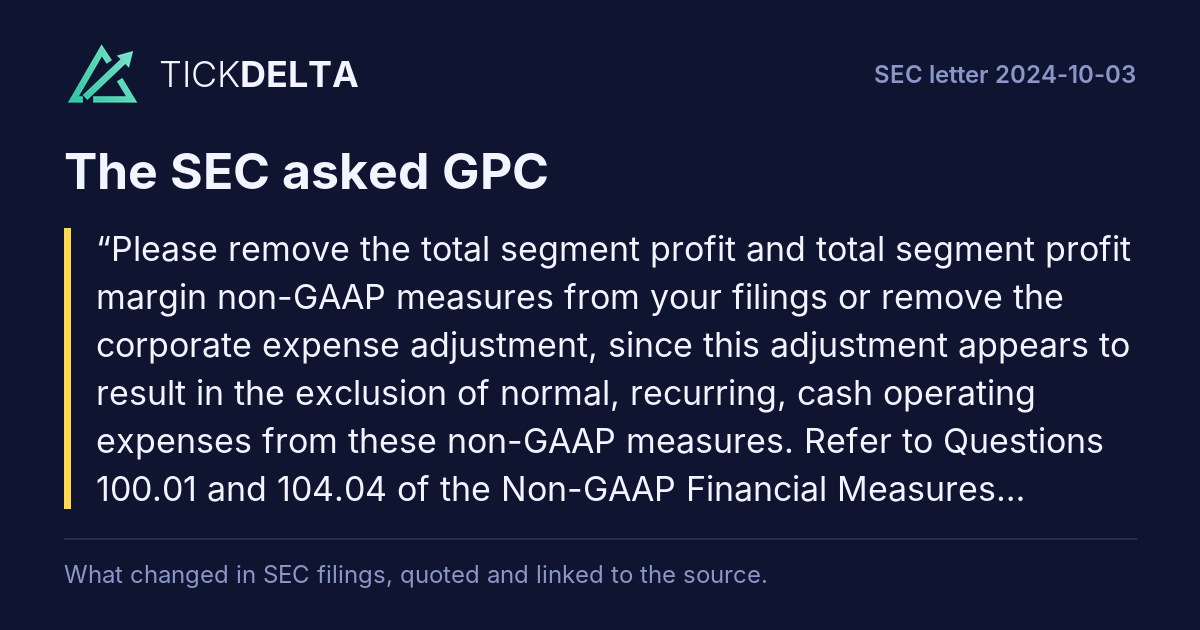
Please remove the total segment profit and total segment profit margin non-GAAP measures from your filings or remove the corporate expense adjustment, since this adjustment appears to result in the exclusion of normal, recurring, cash operating expenses from these non-GAAP measures. Refer to Questions 100.01 and 104.04 of the Non-GAAP Financial Measures Compliance and Disclosure Interpretations.
GPC answered
In future filings, we will no longer present total segment profit or total segment profit margin. Read in the reply ↗
In its next report

First report after the company's reply of 2024-10-30: 10-K filed 2025-02-21 ↗, against the 10-K filed 2024-02-22 ↗.

Tickdelta does not hold the text of both reports, so they are not compared here.
Consolidated Financial Statements · Consolidated Statements of Cash Flows, page 41
SEC asked (2)
Please revise the other assets and liabilities line item to present changes in other assets separately from other liabilities and further breakout any material components. Also, present acquisitions separately from other investing activities and further breakout any material components. Refer to ASC 230-10-45-7 and 45-29.
GPC answered
In future filings, we will present changes in other assets separately from changes in other liabilities and further breakout any material components. We will also present acquisitions of businesses separately from other investing activities and further breakout any material components. We will include this disclosure in our upcoming year end Form 10-K. Read in the reply ↗
In its next report

First report after the company's reply of 2024-10-30: 10-K filed 2025-02-21 ↗, against the 10-K filed 2024-02-22 ↗.

Tickdelta does not hold the text of both reports, so they are not compared here.

Note 2. Segment Data, page 48
SEC asked (3)
Please disclose in greater detail the types of amounts included in the corporate expense line item of your segment reconciliation. Refer to ASC 280-10-50-31. Also, revise your management's discussion and analysis section to discuss with quantification the business reasons for material changes between periods in (a) each segment's profit and (b) any material reconciling items of the segment reconciliation in Note 2,
Rest of the question

such as corporate expense. In circumstances where there are more than one business reason for the change, such as in your Industrial segment discussion on page 24, please quantify the incremental impact of each individual business reason discussed on the overall change in the line item. Refer to Item 303 of Regulation S-K and SEC Release No. 33-8350.

GPC answered
In future filings, we will enhance our disclosure to provide further description of the nature of the corporate expense line item within our segment reconciliation in accordance with ASC 280-10-50-31.

An example of the disclosure we will include in future filings is provided as follows:

Corporate expense includes the costs of our corporate headquarters functions and certain other activities that provide broad-based support to our business units.
Rest of the answer

These costs primarily consist of salaries and benefits associated with executive leadership, human resources, technology, cybersecurity, legal, corporate finance, and internal audit personnel. Corporate expense also includes costs and fees arising from product liability claims, cash management activities and certain other programs that are managed centrally.

In addition, in future filings, our Management's Discussion and Analysis (MD&A) section will include a quantitative discussion of the business reasons for material changes between periods in each segment’s profit, along with any significant reconciling items, including corporate expense. When multiple business reasons contribute to a material change, we will quantify the incremental impact of the individual factors on the overall change in the line item, in accordance with Item 303 of Regulation S-K and SEC Release No. 33-8350.

We will include these additional disclosures in our upcoming year end Form 10-K.

Read in the reply ↗
In its next report

First report after the company's reply of 2024-10-30: 10-K filed 2025-02-21 ↗, against the 10-K filed 2024-02-22 ↗.

Tickdelta does not hold the text of both reports, so they are not compared here.

Also in this review: request for more time, 2024-10-09, company letter, 2024-11-05, closing letter, 2024-11-18
Form 10-K

2023-08-03 to 2023-08-21 · 3 questions · 1 letter from the SEC, 1 from the company
Review closed 2023-08-21
Non-GAAP measuresSegmentsResults discussion (MD&A)Income taxes
Operations · Consolidated Results of Operations, page 19
SEC asked (1)
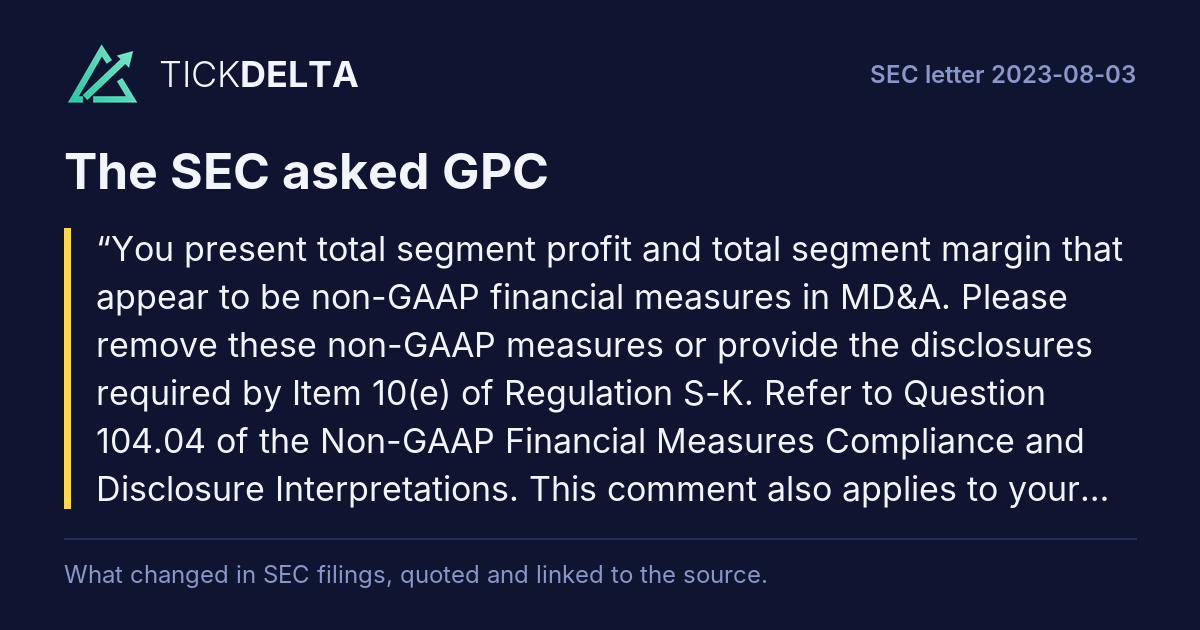
You present total segment profit and total segment margin that appear to be non-GAAP financial measures in MD&A. Please remove these non-GAAP measures or provide the disclosures required by Item 10(e) of Regulation S-K. Refer to Question 104.04 of the Non-GAAP Financial Measures Compliance and Disclosure Interpretations. This comment also applies to your Forms 10-Q filed in fiscal year 2023.
GPC answered
We respectfully acknowledge the Staff’s comments. As part of our ongoing effort to increase our transparency with investors about the financial measures we believe are important for evaluating our business performance, we added total segment profit and total segment margin to MD&A in the Form 10-K for the year ended December 31, 2022 and to subsequent Forms 10-Q filed in fiscal year 2023.

In response to the Staff’s comment, we further reviewed the guidance in Question 104.04 of the Non-GAAP Financial Measures Compliance and Disclosure Interpretations and in future filings, we will provide
Rest of the answer

the disclosures required by Item 10(e) of Regulation S-K within MD&A, including a reconciliation of total segment profit and total segment margin to their nearest GAAP measures. We will provide the disclosures required, including this reconciliation, beginning with our upcoming third quarter Form 10-Q.

An example of the reconciliation we will include in future filings is provided below.

Year Ended December 31,

(in thousands)

Read in the reply ↗
In its next report

First report after the company's reply of 2023-08-14: 10-Q filed 2023-10-19 ↗, against the 10-Q filed 2023-07-20 ↗.

Tickdelta does not hold the text of both reports, so they are not compared here.

Non-GAAP Financial Measures, page 22
SEC asked (2)
You record a tax impact of adjustments representing 2.7% of the total adjustments made in determining adjusted net income as compared to the GAAP effective tax rate of 24.8% in fiscal year 2022. Please expand your disclosure to clarify how you determined the tax effect of non-GAAP adjustments in calculating the adjusted net income and adjusted diluted EPS in each reporting period presented.
Rest of the question

Refer to Question 102.11 of the Non- GAAP Financial Measures Compliance and Disclosure Interpretations.

GPC answered
As background, we respectfully advise the Staff that the approach we use to determine the tax effect of non-GAAP adjustments considers the tax laws and statutory income tax rates applicable in the tax jurisdictions of the underlying non-GAAP adjustments, including any related valuation allowances.

In future filings, we will expand our disclosures to provide additional details about how the income tax impacts of the adjustments are calculated, consistent with the guidance at Question 102.11 of the Non-GAAP Financial Measures Compliance and Disclosure Interpretation.
Rest of the answer

We will include these additional disclosures in our upcoming third quarter Form 10-Q.

An example of our enhanced disclosure that we will include in future filings within our Non-GAAP Financial Measures section of MD&A is provided below.

We determine the tax effect of non-GAAP adjustments by considering the tax laws and statutory income tax rates applicable in the tax jurisdictions of the underlying non-GAAP adjustments, including any related valuation allowances. For the year ended December 31, 2022, we applied the statutory income tax rates to the taxable portion of all of our adjustments, which resulted in a tax impact of $137,000. A portion of our transaction costs included in our non-GAAP adjustments for the year ended December 31, 2022 were not deductible for income tax purposes; therefore, no statutory income tax rate was applied to such costs.

Read in the reply ↗
In its next report

First report after the company's reply of 2023-08-14: 10-Q filed 2023-10-19 ↗, against the 10-Q filed 2023-07-20 ↗.

Tickdelta does not hold the text of both reports, so they are not compared here.

Consolidated Balance Sheet, page 36
SEC asked (3)
Please state separately, in your balance sheet or in a note thereto, any elements of prepaid expenses and other current assets in excess of five percent of your total current assets. Refer to Rule 5-02(8) of Regulation S-X. In addition, please separately state any elements of other current liabilities in excess of five percent of your total current liabilities. Refer to Rule 5-02(20) of Regulation S-X.
GPC answered
We respectfully acknowledge the Staff’s comments. Our balance sheet line item for prepaid expenses and other current assets consists primarily of amounts due from vendors, prepaid expenses, income taxes and other miscellaneous receivables. Our balance sheet line item other current liabilities consists primarily of current lease obligations, allowances for sales returns expected within the next year, accrued compensation, accrued income and other taxes, and other accruals for expenses incurred.

Each reporting period, we evaluate the presentation requirements for these line items and consider
Rest of the answer

any components that exceed the threshold set forth in Rule 5-02(8) and Rule 5-02(20) of Regulation S-X. With respect to the amounts due from vendors, which is included in the line item prepaid expenses and other current assets, these balances totaled $585 million and $529 million as of December 31, 2022 and 2021, respectively. Amounts due to us from vendors primarily relate to consideration under various volume rebate and cost reimbursement programs and do not specifically relate to a single vendor or a single vendor consideration program. These amounts fluctuate from period to period based on our purchases of inventory from our vendors, which is tied to our sales to our customers, and has been below the five percent threshold in certain recent quarterly reporting periods. We perform a qualitative and quantitative analysis on these balances each reporting period, including consideration of key trends and users of the financial statements, and while these balances exceeded the five percent threshold as of December 31, 2022 and 2021, we concluded the disclosure of amounts due from vendors was not material for the periods presented.

There were no other elements of either prepaid expenses and other current assets or other current liabilities that exceed the five percent threshold in any of the balance sheet periods presented.

In response to the Staff’s comment, we further reviewed the guidance and in future filings, we will disclose amounts due from vendors and any other components that exceed the threshold set forth in Rule 5-02(8) and Rule 5-02(20) of Regulation S-X on the face of the balance sheets or related notes to the financial statements, beginning with our third quarter Form 10-Q.

Read in the reply ↗
In its next report

First report after the company's reply of 2023-08-14: 10-Q filed 2023-10-19 ↗, against the 10-Q filed 2023-07-20 ↗.

Tickdelta does not hold the text of both reports, so they are not compared here.

Also in this review: closing letter, 2023-08-21

From the SEC's correspondence on EDGAR: staff letters (form UPLOAD) and company letters (form CORRESP), 11 letters filed since 2019-07-29. Questions and answers are matched by their numbers; topics come from words in each question. The reports are compared word for word (same form, before the first SEC letter against the first report after the company's reply). No AI.

Next in Owners and insiders Insider trades →

Work on GPC in a spreadsheet: Excel workbook (a sheet per section, ten years by column, charts, links to the filings) · CSV. For a Google Sheet that stays up to date, paste =IMPORTDATA("https://tickdelta.com/company/GPC/export.csv") into a cell.