Graphic Packaging Holding Co GPK
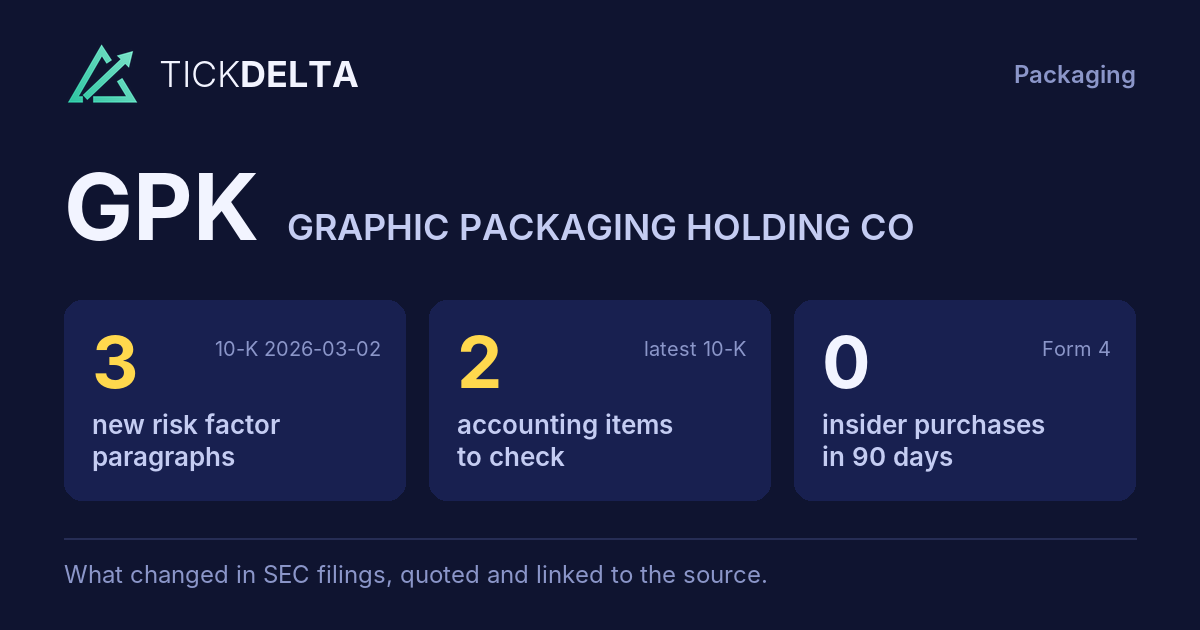
New risk paragraphs, branching off last year
Each branch is a paragraph in Risk Factors with nothing like it in the 10-K filed Feb 12, 2025. A box jumps to the paragraph as filed, below.
Paragraphs with nothing like them in last year's 10-K
3 paragraphs in Risk Factors of the 10-K filed Mar 2, 2026 with nothing like them in the 10-K filed Feb 12, 2025. Quoted exactly. Paragraphs that were only edited are under 10-K change.
Additionally, the Company may fail to identify, prioritize or effectively execute digital and/or artificial intelligence ("AI") transformation initiatives across its operations or may fail to capitalize on opportunities arising from increasing demand for smart products. Inadequate implementation of digital and data programs, or failure to identify or prioritize emerging digital and/or AI initiatives, could place the Company at a competitive disadvantage with respect to speed to market, smart product offerings, manufacturing capacity and service levels. Any such deficiencies could have a material adverse effect on our business, financial condition, results of operations or future prospects.
The Company may decide to close or sell certain facilities or businesses to optimize its portfolio of operations. Such actions could result in disruptions to operations, customer service issues, reduced revenue or unanticipated costs. Any delay, difficulty, or failure in executing such changes could adversely affect the Company’s financial condition and business performance.
The Company had goodwill of $2,065 million as of December 31, 2025. The Company evaluates goodwill for impairment annually, as well as whenever events or changes in circumstances suggest that the fair value of a reporting unit may no longer exceed its carrying amount. In determining fair value, management considers a number of factors in developing our forecasts of future cash flows, including but not limited to, projections of revenues and EBITDA margins, changes in working capital, capital expenditures and discount rates, and market data and analysis, including EBITDA exit multiples. Fair value determinations are sensitive to changes in the factors described above. There are inherent uncertainties related to these factors and judgments used to estimate the reporting unit fair value and the related analysis of potential goodwill impairment. Additionally, the assumptions used could also be adversely impacted by the other risks discussed in Item 1A. Risk Factors and thus could result in future goodwill impairment charges, which could adversely affect our results of operations, financial condition, and the trading price of our shares.
Paragraphs in the 10-Q filed Nov 3, 2026 that were not in the one before
New in the latest 10-Q
14 paragraphs in the 10-Q filed Nov 3, 2026 with nothing like them in the 10-Q filed Aug 4, 2026 (at least half the words must differ; new numbers alone do not count). Quoted exactly, grouped by the item heading above them. This is text that changed, not a judgement of how serious it is.
Financial statements and notes
During the third quarter of 2026, the Company consolidated certain floors of its headquarters facility, resulting in an impairment charge of $ 14 million within Corporate and Other, which is included in the table above for the three and nine months ended September 30, 2026.
Read in the 10-Q
(a) Includes $ 100 million of October 2026 Green Bonds subject to mandatory tender on October 1, 2026. The bonds were successfully remarketed on October 1, 2026, extending the next mandatory purchase date to October 1, 2031. Refer to additional discussion below.
Read in the 10-Q
On October 1, 2026, the Company completed the successful remarketing of its $ 100 million aggregate principal amount of senior unsecured tax-exempt green bonds, which were originally issued on September 29, 2021, and were subject to a mandatory tender for purchase on October 1, 2026 (the "October 2026 Green Bonds"). The coupon on the Green Bonds was reset from the initial fixed rate of 4.00 % per annum to a new fixed rate of 4.35 % per annum, effective October 1, 2026. The October 2026 Green Bonds will mature on October 1, 2061, and are subject to a mandatory purchase by the Company on October 1, 2031, at a redemption price equal to 100 % of the principal amount plus accrued and unpaid interest.
Read in the 10-Q
Compliance with the Consolidated Total Leverage Ratio and Consolidated Interest Expense Ratio covenants in future periods requires the Company to meet certain planned financial performance improvement and debt reduction targets.
Read in the 10-Q
During the third quarter of 2026, the Company consolidated certain floors of its headquarters facility, resulting in an impairment charge of $ 14 million within Corporate and Other, which is included in the table below for the three and nine months ended September 30, 2026.
Read in the 10-Q
Show the other 9
Principal and interest payments under the term loan facilities and the revolving credit facilities, together with principal and interest payments on the Company's 4.00% 2021 Green Bonds due 2026, 5.00% 2025 Green Bonds due 2030, 5.00% June 2026 Green Bonds due 2030, 5.00% September 2026 Green Bonds due 2030, 4.75% Senior Notes due 2027, 3.50% Senior Notes due 2028, 3.50% Senior Notes due 2029, 2.625% Senior Notes due 2029, 3.75% Senior Notes due 2030 and 6.375% Senior Notes due 2032 (the "Notes"),
Read in the 10-Q
Compliance with the Consolidated Total Leverage Ratio and Consolidated Interest Expense Ratio covenants in future periods requires the Company to meet certain planned financial performance improvement and debt reduction targets.
Read in the 10-Q
Controls and procedures
Remediation of Previously Identified Material Weakness in Internal Control over Financial Reporting
Read in the 10-Q
During the second quarter of 2026, management, with oversight of the Audit Committee and Board of Directors, implemented measures to appropriately enhance its controls and procedures related to the delegation of authority for certain capital projects and transparency with the Board of Directors related to certain capital expenditures and annual Board-approved capital expenditure limits. The enhanced controls and procedures strengthen Board-level approval, monitoring, escalation, and documentation requirements over capital expenditures and align with the remediation objectives disclosed in Item 9A of the 2025 Form 10-K.
Read in the 10-Q
As part of its remediation efforts, management designed and implemented the following controls:
Read in the 10-Q
• The Board of Directors approved delegation of authority was updated to clearly define Board-level and management approval thresholds and governance requirements for capital expenditures, supported by a new formal policy;
Read in the 10-Q
• Board-level capital expenditure governance activities were separated and formalized into two distinct controls related to (1) the approval of the annual capital expenditure plan and (2) the approval of certain capital projects by the Board of Directors in accordance with the Board-defined approval thresholds in the updated delegation of authority;
Read in the 10-Q
• On a quarterly basis, management performs separate but complementary reviews of capital expenditures to ensure (1) complete, accurate, and timely communication of capital expenditure information to the Board and (2) required escalation and documented Board approval before approved annual funding levels or project authorization limits are exceeded.
Read in the 10-Q
Other information
Amendment 2 also modifies the debt incurrence provisions by (i) replacing the existing secured debt incremental basket with an unlimited basket, subject to a 3.50x Senior Secured Leverage test and (ii) eliminating future inside maturity debt capacity. The Company requested the amendment as a risk mitigation measure due to the current dynamic macro environment. The foregoing description of Amendment 2 does not purport to be complete and is qualified in its entirety by reference to the full text of Amendment 2 which is filed as Exhibit 10.2 to this Quarterly Report on Form 10-Q and is incorporated herein by reference.
Read in the 10-Q
The 10-Q's risk factors against the 10-K
Item 1A of the 10-Q filed Nov 3, 2026 against Item 1A of the 10-K filed Mar 2, 2026.
A 10-Q repeats only the risks that changed, so a 10-K paragraph that is missing from it is not counted as removed.
Added is a paragraph with nothing like it in the 10-K, Reworded a sentence that is in both with several words changed,
Quiet changes a sentence in both where one to four words changed and one is a hedge or a modal
(cut words struck through, new words highlighted).
Text on the page, not a score; each links to the filing at sec.gov.
What the 10-Q itself says about its risk factors:There have been no material changes from the risk factors previously disclosed in the Company's 2025 Annual Report on Form 10-K for the year ended December 31, 2025.
Read in the 10-Q
1 paragraph in the 10-Q's Item 1A, and none of them adds, rewords or quietly edits a paragraph of the 10-K's.
Phrases used for the first time
Two-word phrases in Risk Factors of the 10-K filed Mar 2, 2026 that are in none of the 1 earlier 10-Ks stored, back to Feb 12, 2025
Where each one is used
- fair value: The Company had goodwill of $2,065 million as of December 31, 2025. The Company evaluates goodwill for impairment annually, as well as whenever events or changes in circumstances suggest that the fair value of a reporting unit may no longer exceed its carrying amount. In determining fair value, management considers...
- artificial intelligence: The Company has been, and likely will continue to be, subject to computer hacking, acts of vandalism or theft, malware, ransomware, computer viruses or other malicious codes, phishing, malicious use of artificial intelligence for sophisticated attacks, employee error or malfeasance or other cyber-attack. To date,...
- reporting unit: The Company had goodwill of $2,065 million as of December 31, 2025. The Company evaluates goodwill for impairment annually, as well as whenever events or changes in circumstances suggest that the fair value of a reporting unit may no longer exceed its carrying amount. In determining fair value, management considers...
- goodwill impairment: The Company had goodwill of $2,065 million as of December 31, 2025. The Company evaluates goodwill for impairment annually, as well as whenever events or changes in circumstances suggest that the fair value of a reporting unit may no longer exceed its carrying amount. In determining fair value, management considers...
Used at least twice, small words left out. Counted, not picked: a phrase can be new because the company renamed something.
Sources
Item 1A of each 10-K and 10-Q on EDGAR, quoted exactly. Each paragraph links to the filing at sec.gov.
Also
10-K change: what was reworded or cut, section by section.
Work with it
Excel workbook · CSV. Google Sheet that stays up to date: paste =IMPORTDATA("https://tickdelta.com/company/GPK/export.csv") into a cell.