Screener / SEC EDGAR /CIK 0001373670 /10-K filed Feb 25, 2026, compared with Feb 26, 2025 /Numbers from the XBRL of the 10-Ks
NYSE Consumer discretionary · Homebuilders

Green Brick Partners, Inc. GRBK

Compare with peers Embed
SEC comment letters, last 20 years

6 reviews of GRBK's filings by SEC staff

UPLOAD and CORRESP
Reviews 6 latest letter Aug 31, 2017
Questions asked 182 each answered in the company's own letter
No closing letter 3 reviews without a letter saying the staff completed it

When the SEC's staff reviews a filing, it writes to the company with numbered questions, and the company answers each one in a letter. SEC publishes the exchange once the review is over, at least 20 business days later. A question is not an accusation; most reviews end with the company adding detail to its next filing.

How the reviews went

Every review on EDGAR, from the first staff letter to the letter that closes it

  1. 1. Staff letters 17 UPLOAD
  2. 2. Questions in them 182 numbered comments
  3. 3. Company replies 14 CORRESP
  4. 4. Reviews closed 3 of 6 closing letter

Half the closed reviews took 51 days or less from the first letter to the closing letter.

Form 10-K for the Year Ended December 31, 2016

2017-08-31 to 2018-02-15 · 5 questions · 3 letters from the SEC, 3 from the company
Review closed 2018-02-15
RevenueChinaCritical estimatesSegments
Financial Statements
SEC asked (1)
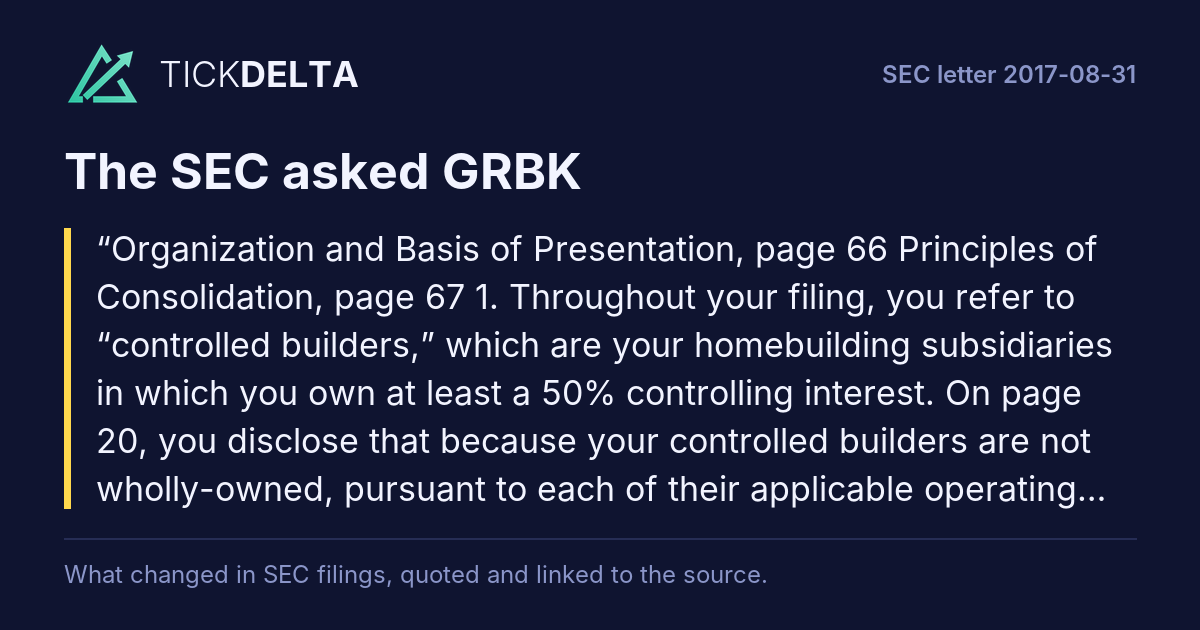
Organization and Basis of Presentation, page 66 Principles of Consolidation, page 67 1. Throughout your filing, you refer to “controlled builders,” which are your homebuilding subsidiaries in which you own at least a 50% controlling interest.
Rest of the question

On page 20, you disclose that because your controlled builders are not wholly-owned, pursuant to each of their applicable operating agreements, you share decision-making authority with the other members of your controlled builders regarding certain major decisions of your controlled builders. In addition on page 3, your table appears to suggest that all of your home sales revenue and lot sales revenue were generated by your controlled builders. Given that you have a 50% interest and share decision making authority with other members of your controlled builders, please tell us how you determine that you have a controlling interest in these controlled builders. Please enhance your accounting policy as well as your critical accounting policy to specifically address how you account for your controlled builders in your financial statements. Please provide a comprehensive analysis of how you determined that you control these entities. Please cite the accounting literature used to support your conclusion.

GRBK answered
Pursuant to ASC 810, Consolidation, we consolidate our controlled builders under the voting interest entity model. We prepared our consolidation analysis using the flowcharts under ASC 810-10-05-6. When determining which of the two consolidation models to apply, we first considered the scope exceptions in paragraphs ASC 810-10-15-12 and 15-17, which we did not meet. While each controlled builder is deemed to be a “business,” we provide more than half of their financial support through our first lien construction loans.
Rest of the answer

Pursuant to paragraphs ASC 810-10-55-16 through 55-41, we concluded that through our right to receive the expected residual returns and obligation to absorb the expected losses we have a variable interest in our controlled builders. In accordance with ASC 810-10-15-14, our controlled builders are not variable interest entities due to the following factors: we have sufficient equity investment at risk in each controlled builder, we have characteristics of controlling financial interests in each controlled builder (ability to make decisions about the controlled builders activities through voting rights, and the right to receive the expected residual returns and the obligation to absorb the expected losses of the controlled builders), and each controlled builder is not structured with disproportionate voting rights where substantially all of the activities are conducted on behalf of the member with disproportionately few voting rights. Therefore, we applied the voting interest entity model in ASC 810-10 to each controlled builder. Per ASC 810-10-05, “Under the voting interest entity model, for legal entities other than limited partnerships, the usual condition for a controlling financial interest is ownership by one reporting entity, directly or indirectly, of more than 50 percent of the outstanding voting shares of another entity.”

We have determined that we exercise control over the operations of each controlled builder under the voting interest entity model, because in addition to owning a 50% equity interest, we also hold a 51% voting percentage interests, and have the ability to appoint two of the three managers of each controlled builder’s board of managers. The board of managers of each controlled builder has the full and exclusive right, power and authority to manage the affairs of the controlled builder and makes all decisions without requiring any consent or approval by the members for routine decisions (including the designation of the officers that manage the day to day operations, etc.). Only certain extraordinary decisions (such as assigning rights in the controlled builder, engaging in any act that would make it impossible to carry on the ordinary/primary business, etc.) require the unanimous approval of all members. As a result, we consolidate our controlled builders' results of operations and financial condition into our financial statements.

In future filings, we will enhance our accounting policy and critical accounting policy to specifically address how we account for our controlled builders in our consolidated financial statements in a form substantially as follows:

The Company evaluated its wholly-owned subsidiaries and controlled builders under ASC Topic 810, Consolidation (“ASC 810”) and concluded that the controlled builders are not variable interest entities. The Company accounts for its controlled builders under the voting interest entity model in accordance with ASC 810. Under the voting interest entity model, the usual condition for a controlling financial interest is ownership by one reporting entity, directly or indirectly, of more than 50 percent of the outstanding voting shares of another entity. The Company owns a 50 percent controlling interest and 51 percent of the voting percentage interests in each controlled builder. In addition, the Company holds two of the three board seats in each controlled builder and is able to exercise control over the operations of the controlled builder. Given that the Company directly or indirectly has an interest of more than 50 percent and can exercise control over the operations through the voting of its board seats, the operations of its controlled builders have been consolidated and noncontrolling interests are stated separately in the consolidated financial statements. All intercompany balances and transactions have been eliminated in consolidation. Generally, the Company forms subsidiaries for each selling community and or homebuilding project in which it invests. As of December 31, 20XX, we had XX direct or indirect subsidiaries.

Read in the reply
In its next report

First report after the company's reply of Sep 14, 2017: 10-Q filed Nov 6, 2017 ↗, against the 10-Q filed Aug 7, 2017 ↗.

Tickdelta does not hold the text of both reports, so they are not compared here.

Financial Statements
SEC asked (2)
Significant Accounting Policies, page 67 Revenue Recognition, page 72 2. Please revise your revenue recognition policy to provide the following:  Please revise your disclosure to specifically address each type of revenue recognized and the accounting method used to account for each specific type of revenue.
Rest of the question

Accordingly, please specifically address how you account for sale of residential units, sale of land and lots, title and settlement services, and the generation of revenue through first lien construction loans to your controlled builders, as applicable;  With regards to your sale of residential units, please specifically address how you account for sales incentives, including but not limited to cash discounts, incentives on options and option upgrades and seller-paid financing or closing costs; and  Please also address how you account for rebates from vendors, if applicable.

GRBK answered
In future filings, we will enhance our revenue recognition policy to provide disclosure on each type of revenue recognized and the accounting method used to account for each type, along with how we account for sales incentives and rebates from vendors in our consolidated financial statements in a form substantially as follows:

Revenue Recognition

Sales of residential units and Sale of land and lots: In accordance with ASC 360-20, Real Estate Sales, we recognize revenue from sales of residential units, land and lots when a sale is consummated.
Rest of the answer

Consummation occurs when the following criteria are met: (a) the parties are bound by the terms of the contract; (b) all net consideration has been exchanged; (c) any permanent financing for which the seller is responsible has been arranged; (d) continuing investment is adequate to demonstrate a commitment to pay for the home, land or lot; and (e) all conditions precedent to closing have been performed. Typically, these criteria are met at closing, at which time we recognize revenue under the full accrual method, which allows full recognition of the gain on the sale of the home, land or lot.

We recognize sales incentives, such as cash discounts and incentives on options and option upgrades as a reduction of sales revenue at the time the home is closed and revenue is recognized. We record seller-paid financing and other closing costs within cost of sales of residential units at the time the home is closed and revenue is recognized. From time to time, we receive vendor rebates for certain materials that are utilized in our construction of homes. Pursuant to ASC 605-50-S99-1, we recognize these rebates as a reduction of cost of sales of residential units at the later of (a) the home closing (when revenue is recognized), or (b) when such amounts are reasonably estimable.

We also serve as the general contractor for certain custom homes where the customers, and not our company, own the underlying land and improvements. We recognize revenue for these mechanics lien contracts on the percentage of completion method, where progress toward completion is measured by relating the actual cost of work performed to date to the current estimated total cost of the respective contracts. During the years ended December 31, 20XX, 20XX and 20XX, we recognized revenue of $X.X million, $X.X million and $X.X million, respectively, and incurred costs of $X.X million, $X.X million and $X.X million, respectively, associated with mechanics lien contracts, which is presented on a net basis in other income, net in the consolidated statements of income.

We recognize amounts earned from third parties for title and settlement services as home closings occur, and funds are received, however, given that these amounts are immaterial, we do not believe that incremental disclosures related to our title and settlement services is necessary. During the years ended December 31, 20XX, 20XX and 20XX, we earned $X.X million, $X.X million and $X.X million of such fees, which are included in other income, net in our consolidated statements of income.

With regards to the Staff’s question regarding the generation of revenue through first lien construction loans with our controlled builders, our activity with our controlled builders is eliminated in consolidation, in accordance with ASC 810. In response to your comment, we will revise our Revenues disclosure in Management’s Discussion and Analysis of Financial Condition and Results of Operations on page 36 as follows.

Revenues

We primarily generate revenue through (a) the sale of lots from our land development segment to public builders and large private builders, and (b) the closing and delivery of homes through our builder operations segment. We recognize revenue on homes and lots when completed and title to, and possession of, the property have been transferred to the purchaser.

All customer deposits are treated as liabilities. We also serve as the general contractor for certain custom homes where the customers, and not our company, own the underlying land and improvements. We recognize revenue for these contracts on the percentage of completion method.

Read in the reply
In its next report

First report after the company's reply of Sep 14, 2017: 10-Q filed Nov 6, 2017 ↗, against the 10-Q filed Aug 7, 2017 ↗.

Tickdelta does not hold the text of both reports, so they are not compared here.

Segment Information, page 74
SEC asked (3)
You disclose that Builder operations consist of three operating segments: Texas, Georgia, and corporate and other. In addition, the operations of the your controlled builders were aggregated into the builder operations reporting segment because they have similar (1) economic characteristics; (2) housing products; (3) class of homebuyer; (4) regulatory environments; and (5) methods used to construct and sell homes.
Rest of the question

Please demonstrate to us how you determined that the aggregation of your three operating segments (including the operations of your controlled builders) into one reportable segment is appropriate and complies with ASC 280-10-50-11.

GRBK answered
ASC 280, Segment Reporting, recognizes that separate reporting of internal operating segments is not necessary if the characteristics from segment to segment are so similar that they can reasonably be expected to have the same future prospects. The determination of whether two or more operating segments are similar is dependent on the individual facts and circumstances and is subject to a high degree of judgment.
Rest of the answer

We determined that the aggregation of our Texas, Georgia and Corporate and Other operating segments into one reportable segment, Builder Operations, is appropriate after assessing the considerations described in ASC 280-10-50-11 as follows:

Similar Economic Characteristics. Except for its reference to similar long-term average gross margins, ASC 280 does not specify which measures should be considered when an enterprise is assessing the “historical and expected future financial performance.” Therefore, we also assessed other standard homebuilding industry performance measures such as average sales price of homes delivered, and average sales price of homes in backlog.

The gross margins of our operating segments vary somewhat based on several factors, including the stage of market development, level of competition, and the amount of development risk that each operating segment bears. From 2014 through 2016, our controlled builders in Texas and Georgia have experienced similar gross margins and we expect similar results to exist going forward. During the aforementioned time frame, the average gross margin for our controlled builders in Texas was 24% compared to 25% for our controlled builder in Georgia. During the six months ended June 30, 2017, our controlled builders in Texas and Georgia have experienced gross margins of 25% and 22%, respectively, which we expect to trend accordingly through the end of 2017. The difference in the margins between our controlled builders is due to timing, due to significant growth in some controlled builders. While the gross margins of our controlled builders may vary somewhat from time to time, our expectation is that our controlled builders would moderate to a comparable long-term average gross margin given the similarities in their business models.

For the year ended December 31, 2016, the average selling price per home delivered was approximately $450,000 and $466,000 in Texas and Georgia, respectively. For the six months ended June 30, 2017, the average selling price per home delivered was approximately $493,000 and $507,000 in Texas and Georgia, respectively. For the year ended December 31, 2016 the average sales price of homes in backlog was approximately $402,000 and $477,000 in Texas and Georgia, respectively. For the six months ended June 30, 2017, the average sales price of homes in backlog was approximately $493,000 and $507,000 in Texas and Georgia, respectively.

Competition in the homebuilding industry is intense, and there are relatively low barriers to entry into our business. Homebuilders compete for, among other things, homebuyers, desirable land parcels, financing, raw materials and skilled labor. The homebuilding competitive environment, and operating and financial risks in Texas and Georgia are relatively similar. We have one controlled builder in Georgia. While our controlled builders in Texas offer several products (i.e. townhomes, single-family homes, and luxury homes), we concluded that they have similar competitive, operating and financial risks. The 2017 expected average adjusted operating margin from homebuilding attributable to Green Brick Partners, Inc. (adjusted for eliminations) for our Texas controlled builders were similar except for one builder whom individually does not meet the quantitative disclosure thresholds in ASC 280.

While there are comparable economic characteristics across the internal operating segments for our controlled builders, these characteristics are not comparable to Green Brick Title, LLC (“Title”).

The Nature of the Products and Services. Although ASC 280 does not define what is meant by the “nature” of products and services, SFAS No. 14 employed a similar concept and stated “…related products and services have similar purposes or end uses. Thus, they may be expected to have similar rates of profitability, similar degrees of risk, and similar opportunities for growth.” Our controlled builders construct townhomes, and single-family and luxury homes (product) within master designed communities which have similar purposes and end uses (home to live in). Additionally, our controlled builders in Texas often sell homes alongside each other in communities that we have developed. Title provides the services required for a potential homebuyer to close on a home and for our land business to close on lots sold to our controlled builders. As such, the nature of the products and services for our title operations are not similar to our homebuilding operations.

The Nature of the Production Processes. Our controlled builders have similar production processes to build and construct communities. The service provided by Title to close on the sale of a house or land are different than the processes to build houses.

The Type or Class of Customer for Their Products and Services. Our controlled builders core markets are in the high growth U.S. metropolitan areas of Dallas, Texas and Atlanta, Georgia. Per the November 2016 US Census Bureau News Release, Atlanta and Dallas-Fort Worth-Arlington were two of the nation’s 12 largest metropolitan statistical areas, with the fastest rate of job growth in Dallas-FortWorth-Arlington at 3.3%, followed by Atlanta at 2.6%. Dallas and Georgia are also similar with median household income of $61,644 and $60,219, respectively. Our controlled builders have similar types and classes of customers which include individual homeowners (generally not first time home buyers). Title’s customers are homebuyers of our controlled builders and our land business when we sell land and lots.

The Methods Used to Distribute Their Products or Provide Their Services. Each controlled builder has its own sales force, but operates in a similar fashion to distribute their products through similar marketing and sales methods. Our controlled builders use their websites and signages to market and promote their products (houses). Title provides its service through its connection with our controlled builders and our land business.

The Nature of the Regulatory Environment. Our developments are subject to numerous local, state, federal and other statutes, ordinances, rules and regulations concerning zoning, development, building design, construction and similar matters that impose restrictive zoning and density requirements, the result of which is to limit the number of homes that can be built within the boundaries of a particular area. We are also subject to a variety of local, state, federal and other statutes, ordinances, rules and regulations concerning the environment. The local and state rules and regulations vary, but are generally similar, between Texas and Georgia. Title is also subject to numerous Texas and federal rules and regulations.

Our controlled builders have nearly identical building practices, product mixes, customer demographics and marketing plans, which supports our analysis that they should be aggregated into one reportable segment. Additionally, combining builders with similar economic characteristics, albeit in separate geographies, is consistent with industry practice including the disclosures of other publicly-traded homebuilders.

While Title’s operations are not economically similar to either the Builder Operations or Land Development segments, it did not meet the quantitative thresholds to be separately reported and disclosed. Accordingly, Title’s results are included within our Builder Operations segment within “Corporate and Other”.

As a result of the foregoing, we respectfully submit to the Staff that the aggregation of our controlled builders Texas and Georgia operations, and title operations into one reportable segment is appropriate and complies with ASC 280-10-50-11. The segment disclosure presents our Texas, Georgia and Corporate and Other operating segments separately under the Builder Operations reportable segment.

If you have any further questions, need any additional information or wish to discuss this letter in greater detail, please contact me at (813) 220-5855 or Alice Hsu of Akin Gump Strauss Hauer & Feld LLP at (212) 872-1053.

Read in the reply
In its next report

First report after the company's reply of Sep 14, 2017: 10-Q filed Nov 6, 2017 ↗, against the 10-Q filed Aug 7, 2017 ↗.

Tickdelta does not hold the text of both reports, so they are not compared here.

Financial Statements
SEC asked
Organization and Basis of Presentation, page 66 Principles of Consolidation, page 67 1. We note your response to prior comment one. You indicate that your controlled builders are not variable interest entities due to the fact that you have (a) sufficient equity investment at risk in each controlled builder, (b) characteristics of controlling interest in each controlled builders, and (c) each controlled builder is
Rest of the question

not structured with disproportionate voting rights where substantially all of the activities are conducted on behalf of the member with disproportionately few voting rights. Given that you provide more than half of the financial support of your controlled builders through your first lien construction loans, please provide us with a more robust analysis of how you determined that your controlled builders are not variable interest entities. Please specifically address how you determined that each of your controlled builders have sufficient equity to finance their activities without additional subordinated financial support pursuant to ASC 810-10-25-45 through 25-47. Please also enhance your discussion of how you determined that you have characteristics of a controlling financial interest including but not limited to the specific responsibilities of your board of managers to approve budgets and allocate resources and your specific rights to absorb expected losses and receive expected residual returns. If you conclude that your controlled builders are variable interest entities, please provide your comprehensive analysis of how you applied the Variable Interest Model.

GRBK answered
Per ASC 810-10-15-17(d), a legal entity that is deemed to be a business need not be evaluated by the reporting entity to determine if the legal entity is a variable interest entity (“VIE”) unless certain conditions exists, including if the reporting entity provides more than half of the total subordinated debt or other forms of subordinated financial support to the legal entity.
Rest of the answer

Each controlled builder is deemed to be a business; however, since we participated significantly in the design of each controlled builder, our controlled builders do not meet the “business” scope exception.

Per ASC 810-10-15-14, a legal entity shall be subject to consolidation as a VIE if, by design, condition (a) or (b) below is present:

(a) The total equity investment at risk is not sufficient to permit the legal entity to finance its activities without additional subordinated financial support.

Pursuant to ASC 810-10-25-45, we performed a qualitative assessment to determine whether the equity investment at risk at the inception of each controlled builder was sufficient. Our controlled builders were designed such that we would finance their purchases of land, from us, at an unlevered internal rate of return of at least 20% (which is consistent with our return on land sales to third-party homebuilders) and provide construction financing at an approximate 13.8% interest rate. These first lien loans are secured and unsubordinated, which we believe is consistent with most of our public homebuilders peer group (i.e. Hovnanian Enterprises, Inc., Lennar Corporation, MI Homes, Inc., Standard Pacific Corp., Toll Brothers, Inc., and KB Home) mortgages and notes payables. Our controlled builders were formed for us to provide the financing while the other members provide their local relationships with land sellers, brokers and investors to pursue the purchase of additional land parcels in the applicable local market. The initial capital contribution for each controlled builder was $0.2 million or less, which accounted for less than 1% of the total assets of each controlled builder. While the equity investment at risk was less than 10% of our controlled builders’ total assets, our controlled builders would have been able to obtain commercial financing on customary terms without additional subordinated financial support. During 2011 through 2013, the years that our controlled builders were formed, we noted that our public homebuilders peer group had outstanding mortgage and notes payable related to land and construction with interest rates ranging from 3% to 10%, with most of the rates in the range of 6% to 10%. We would expect the public homebuilders to obtain lower interest rates due to their size and long-standing credit history. During 2011 through 2013, the homebuilding industry and mortgage loan market were coming out of a downturn, as such there were more risks involved for banks lending money to newly formed homebuilding companies. As such, our private controlled builders would have been subjected to higher interest rates on their land and construction loans compared to public homebuilders. Therefore, the interest rate we charge to our controlled builders was reasonable at the time they were designed. We concluded that this condition (a) does not exist, since at the time of formation, our controlled builders would have been able to obtain unsubordinated financing, even if at higher interest rates than public homebuilders.

(b) The holders of the equity investment at risk lack the power to direct the activities of a legal entity that most significantly impact the entity’s economic performance, lack the obligation to absorb expected losses of the legal entity, or lack the right to receive the expected residual returns of the legal entity.

The board of managers of each of our controlled builders, who are appointed by the holders of the equity investment at risk, have the power to direct the activities that significantly impact our controlled builders’ economic performance. Pursuant to our agreement with each controlled builder, we have the ability to appoint two of the three managers of each controlled builder’s board of managers. The exclusive authority to manage, control and operate the controlled builder is vested collectively in the individuals appointed to the board of managers. The action of a majority of the board of managers present at a meeting constitutes a quorum to transact business, so long as one of our managers is present. If any action is taken without a meeting, a written consent describing the action must be signed by the majority of the board of managers, as long as one of our managers consent. As such, no action can be approved by the board of managers without the approval from at least one individual we have appointed at each controlled builder. Each year, our controlled builders submit an annual budget and plan which is approved by the board of managers. The annual budget and plan cannot be approved without our input and final approval. In addition, pursuant to our typical controlled builder agreements, profits and losses are allocated pro rata based on each member’s ownership interest. While we have a 51% voting right, we have the obligation to absorb 50% of the expected losses and the right to receive 50% of the expected residual returns of each controlled builder. Our controlled builders’ activities are not conducted on behalf of any one member. As such, we concluded that this condition (b) does not exist.

Based on the analysis above that neither condition (a) nor (b) are present, we concluded that our controlled builders are not VIEs. Therefore, we applied the voting interest entity model in ASC 810-10 to each controlled builder. Our analysis under the voting interest entity model was explained in our response dated September 14, 2017, and under that model, we concluded that we should consolidate our controlled builders’ results of operations and financial condition into our financial statements.

Alternatively, if it was determined that the equity investment at risk is not sufficient to permit our controlled builders to finance their activities without additional subordinated financial support, we would continue to analyze whether we should consolidate our controlled builders under the VIE model pursuant to ASC-810. Regarding that analysis, we have the power to direct the activities of our controlled builders that most significantly impact their economic performance, and the obligation to absorb losses and the right to receive benefits that could potentially be significant to our controlled builders. The agreements with our controlled builders do not include kick-out rights or substantive rights; thus, we would conclude that we should consolidate our controlled builders as the primary beneficiary under the VIE model.

If you have any further questions, need any additional information or wish to discuss this letter in greater detail, please contact me at (813) 220-5855 or Alice Hsu of Akin Gump Strauss Hauer & Feld LLP at (212) 872-1053.

Read in the reply
In its next report

First report after the company's reply of Nov 13, 2017: 10-K filed Mar 12, 2018 ↗, against the 10-K filed Mar 13, 2017 ↗.

Tickdelta does not hold the text of both reports, so they are not compared here.
Financial Statements
SEC asked
Organization and Basis of Presentation, page 66 Principles of Consolidation, page 67 1. We note your response to prior comment one. Given that you provide more than half of the financial support of your controlled builders through your first lien construction loans, it is still not clear how you determined that your controlled builders are not variable interest entities.
Rest of the question

Please provide the following information:  You indicated that the initial capital contribution for each controlled builder was $0.2 million or less, which accounted for less than 1% of the total assets of each controlled builder. Please tell us how you determined that the controlled builders would have been able to obtain commercial financing on customary terms without additional subordinated financial support. Please provide a more comprehensive analysis including quantitative and/or qualitative factors considered;  Given size and credit history of your controller builders, please tell us how you determined that the interest rate charged to your controlled builders was reasonable. Please provide support that is consistent with similar size builders as your controlled builders, rather than public companies, as these companies are not comparable to your controlled builders. Please specifically tell us whether your controlled builders have enough equity to induce lenders or other investors to provide the funds necessary at “market terms” for your controlled builders to conduct their activities;  Given that the homebuilding industry was coming out of a downturn, please tell us how you determined that companies with similar risk profiles as your controlled builders were extended credit from lending institutions; and  If you conclude that your controlled builders are variable interest entities, please provide a comprehensive analysis of how you applied the Variable Interest Model and provide your proposed disclosures.

GRBK answered
We have reviewed the Staff's comment from its January 8, 2018 letter and we note that the first three bullet points relate to criteria to determine whether each of our controlled builders is a variable interest entity (“VIE”). As noted in the first three bullet points, at formation, the initial capital contribution for each controlled builder was less than 1% of the total assets of each controlled builder, our controlled builders were small private homebuilders with a lack of credit history, and there was a downturn in the homebuilding industry.
Rest of the answer

After further analysis, we have determined that our controlled builders are VIEs and accordingly have provided the requested comprehensive analysis of how we evaluated and applied the Variable Interest Model and our proposed disclosures.

Variable Interest Model

In summary, pursuant to ASC 810, Consolidation, we will continue to consolidate our controlled builders; however, we will now disclose that the consolidation is based upon application of the Variable Interest Model instead of the Voting Model. We prepared our consolidation analysis using the flowcharts under ASC 810-10-05-6. When determining which of the two consolidation models to apply, we first considered the scope exceptions in paragraphs ASC 810-10-15-12 and 15-17, which we determined we did not meet. While each of our controlled builders is deemed to be a “business,” our controlled builders were designed such that we would finance their purchases of land, from us, and we would provide construction financing through first lien loans that are secured and unsubordinated. Pursuant to paragraphs ASC 810-10-55-16 through 55-41, we concluded that, through our 50% equity interest and associated right to receive the expected residual returns and our obligation to absorb the expected losses of our controlled builders, we have a variable interest in each controlled builder.

Per ASC 810-10-15-14, a legal entity shall be subject to consolidation as a VIE if, by design, (a) the total equity investment at risk is not sufficient to permit the legal entity to finance its activities without additional subordinated financial support, or (b) the holders of the equity investment at risk lack the power to direct the activities of a legal entity that most significantly impact the entity’s economic performance, lack the obligation to absorb expected losses of the legal entity, or lack the right to receive the expected residual returns of the legal entity.

We initially concluded that our controlled builders would have been able to obtain unsubordinated financing, even if at higher interest rates than public homebuilders as discussed in our previous response dated November 13, 2018. However, as stated above, after further analysis, we have determined that our controlled builders are VIEs and we have now applied the Variable Interest Model. Pursuant to ASC 810-10-25-45, we performed a qualitative assessment to determine whether the equity investment at risk at the inception of each controlled builder was sufficient. Our controlled builders were formed under the operating premise that we would provide the financing while the builders provide their home building construction, selling and operating expertise. The initial capital contribution for each controlled builder was less than 1% of the total assets of each controlled builder. Given that the equity investment at risk at inception was less than 10% of each of our controlled builder’s total assets, our controlled builders would not have been able to obtain commercial financing on customary terms without additional subordinated financial support. As such, the equity investment at risk at the time of our investment in our controlled builders was not sufficient to permit them to finance their activities without additional subordinated financial support.

The board of managers of each of our controlled builders, who are appointed by the holders of the equity investment at risk, have the power to direct the activities that significantly impact each of our controlled builder’s economic performance because the board of managers has the exclusive authority to manage, control and operate the controlled builder. Pursuant to our agreements with each controlled builder, we have and exercise the right to appoint two of the three managers of each controlled builder’s board of managers. The two managers we appoint are not subject to the approval of the other members of our controlled builders, but the removal or replacement of a manager appointed by the other members of our controlled builders is subject to our approval. The other members of our controlled builders do not have any veto rights. A majority of the board of managers present at a meeting constitutes a quorum to transact business, so long as one of the managers appointed by us is present. If any action is taken without a meeting, a written consent describing the action must be signed by the majority of the board of managers, as long as one of the managers appointed by us consents. As such, no action can be approved by the board of managers without the approval from at least one individual we have appointed at each controlled builder. Furthermore, each year, our controlled builders submit an annual budget and plan which must be approved by the board of managers. The annual budget and plan cannot be approved without our input and final approval. Accordingly, we have the power to direct the activities that significantly impact the controlled builders’ economic performance. Unanimous consent of the board of managers is required for a member to transfer its membership interest. However, we have the right to transfer all or part of our interests in our controlled builders to any entity which is controlled directly or indirectly by us without approval from the board of managers. In addition, pursuant to all of our controlled builder agreements, profits and losses are allocated pro rata based on each member’s ownership interest. While we have a 51% voting right in the case of each controlled builder, we have the obligation to absorb 50% of the expected losses and the right to receive 50% of the expected residual returns of each controlled builder. Our controlled builders’ activities are not conducted on behalf of any one member. As such, we have concluded that the members of the equity investment at risk do not lack (i) the power to direct the activities of the controlled builders that most significantly impact the controlled builders’ economic performance, (ii) the obligation to absorb expected losses of the controlled builders, or (iii) the right to receive the expected residual returns of the controlled builders.

While we have the obligation to absorb 50% of the expected losses and the right to receive 50% of the expected benefits of the controlled builders, the equity investment at risk was not sufficient to permit the legal entity to finance its activities without additional subordinated financial support. Therefore, we have now concluded that each of our controlled builders is a VIE and we have further evaluated each controlled builder for consolidation under the Variable Interest Model.

Once a reporting entity concludes that it has a variable interest in a VIE, the first condition under the Variable Interest Model is to evaluate whether the reporting entity is the primary beneficiary. The primary beneficiary is the party that has (a) the power to direct the activities of a VIE that most significantly impact the VIE’s economic performance, and (b) the obligation to absorb losses of the VIE and the right to receive benefits from the VIE that could potentially be significant to the VIE pursuant to ASC 810-10-25-38A through 25-38J and ASC 810-10-25-42. As noted above, we have the ability to control the activities of each controlled builder that most significantly impact the controlled builder’s economic performance. Such activities include, but are not limited to, involvement in the day to day capital decisions, the ability to approve and modify the budget and plan, the ability to control financing decisions, the ability to replace the president and other officers of the building company, and the ability to acquire additional land or dispose of land. In addition, we have the obligation to absorb 50% of the expected losses and the right to receive 50% of the expected residual returns of each controlled builder. Per ASC 810-10-25-38C, the determination of whether an entity has the power to direct the activities of the VIE that most significantly impact the VIE’s economic performance should not be affected by the existence of kick-out or participating rights unless a single reporting entity has the unilateral ability to exercise those rights. None of the members under the controlled builder agreements have the unilateral ability to exercise kick-out or participating rights. Therefore, we concluded that we are the primary beneficiary of each controlled builder.

Based on the further analysis above, we have concluded that our controlled builders are VIEs of which we are the primary beneficiary. This change in position from consolidation under the Voting Model to the Variable Interest Model does not have a material impact on our current or prior years consolidated financial statements as we have always consolidated our controlled builders.

Proposed Disclosures

In future filings, we will update our principles of consolidation and critical accounting policies to specifically address how we account for our controlled builders in our consolidated financial statements in a form substantially as follows:

Principles of Consolidation

The Company evaluated its wholly-owned subsidiaries and controlled builders under ASC Topic 810, Consolidation (“ASC 810”) and concluded that each controlled builder is a variable interest entity (“VIE”). The Company owns a 50 percent interest and has 51 percent of the voting interest in each controlled builder. In addition, the Company appoints two of the three board managers of each controlled builder and is able to exercise control over the operations of each controlled builder. The Company accounts for its controlled builders under the variable interest model and is the primary beneficiary of each controlled builder in accordance with ASC 810 (see Note 2). All intercompany balances and transactions have been eliminated in consolidation.

The Company uses the equity method of accounting for its investment in an unconsolidated entity over which it exercises significant influence but does not have a controlling interest. Under the equity method, the Company’s share of the unconsolidated entity’s earnings or loss, if any, is included in the consolidated statements of income.

Generally, the Company forms subsidiaries for each selling community and or homebuilding project in which it invests.

Variable Interest Entities and Noncontrolling Interests

The Company accounts for VIEs in accordance with ASC 810. In accordance with ASC 810, an entity is a VIE when: (a) the equity investment at risk in the entity is not sufficient to permit the entity to finance its activities without additional subordinated financial support provided by other parties, including the equity holders; (b) the entity’s equity holders as a group either (i) lack the direct or indirect ability to make decisions about the entity, (ii) are not obligated to absorb expected losses of the entity or (iii) do not have the right to receive expected residual returns of the entity; or (c) the entity’s equity holders have voting rights that are not proportionate to their economic interests, and the activities of the entity involve or are conducted on behalf of the equity holder with disproportionately few voting rights. If an entity is deemed to be a VIE pursuant to ASC 810, the enterprise that has both (i) the power to direct the activities of a VIE that most significantly impacts the entity’s economic performance and (ii) the obligation to absorb the expected losses of the entity or right to receive benefits from the entity that could be potentially significant to the VIE is considered the primary beneficiary and must consolidate the VIE. In accordance with ASC 810, the Company performs ongoing reassessments of whether it is the primary beneficiary of a VIE.

The Company owns 50% equity interests in several controlled builders, deemed to be VIEs under ASC 810 for which the Company is considered the primary beneficiary. Our controlled builders are engaged in all aspects of the homebuilding process in residential neighborhoods and master planned communities in premium locations in the Dallas and Atlanta markets. We sell finished lots or option lots from third-party developers to our controlled builders for their homebuilding operations and provide them with construction financing and strategic planning. The board of managers of each of the controlled builders has the power to direct the activities that significantly impact the controlled builder’s economic performance. Pursuant to the Company’s agreements with each controlled builder, it has the ability to appoint two of the three managers of each controlled builder’s board of managers. A majority of the board of managers constitutes a quorum to transact business. No action can be approved by the board of managers without the approval from at least one individual whom the Company has appointed at each controlled builder. The Company has the ability to control the activities of each controlled builder that most significantly impact the controlled builder’s economic performance. Such activities include, but are not limited to, involvement in the day to day capital and operating decisions, the ability to determine the budget and plan, the ability to control financing decisions, and the ability to acquire additional land or dispose of land. In addition, the Company has the right to receive the expected residual returns and obligation to absorb the expected losses of each controlled builder through the pro rata profits and losses it is allocated based on its ownership interest. Therefore, the financial statements of the controlled builders are consolidated in the Company’s consolidated financial statements following the variable interest model. The noncontrolling interests attributable to the 50% minority interests owned by our controlled builders are included as noncontrolling interests in the Company’s consolidated financial statements.

Our controlled builders creditors have no recourse against us. The assets of two of our consolidated controlled builders can only be used to settle obligations of those controlled builders. The assets of our VIEs that can be used only to settle obligations of the VIEs as of December 31, 2017 totaled $X.X million, of which $X.X million was cash and $X.X million was inventory. The assets of our VIEs that can be used only to settle obligations of the VIEs as of December 31, 2016 totaled $X.X million, of which $X.X million was cash and $X.X million was inventory.

If you have any further questions, need any additional information or wish to discuss this letter in greater detail, please contact me at (813) 220-5855 or Alice Hsu of Akin Gump Strauss Hauer & Feld LLP at (212) 872-1053.

Read in the reply
In its next report

First report after the company's reply of Jan 23, 2018: 10-K filed Mar 12, 2018 ↗, against the 10-K filed Mar 13, 2017 ↗.

Tickdelta does not hold the text of both reports, so they are not compared here.

Also in this review: closing letter, 2018-02-15
Form S-1

2014-08-12 to 2014-09-10 · 42 questions · 2 letters from the SEC, 2 from the company
No closing letter
AcquisitionsSegmentsResults discussion (MD&A)Liquidity and cashInventoryDebtGoodwill and impairmentIncome taxesCritical estimatesRevenueChina
Form S-1 filed on July 16, 2014 · General
SEC asked (1)
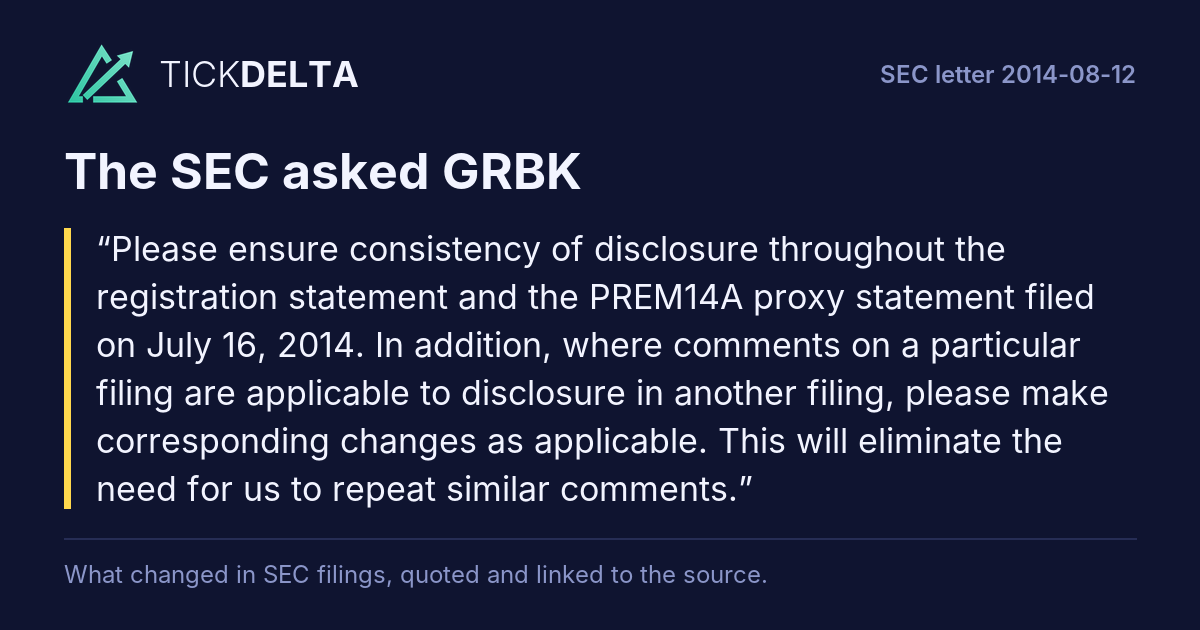
Please ensure consistency of disclosure throughout the registration statement and the PREM14A proxy statement filed on July 16, 2014. In addition, where comments on a particular filing are applicable to disclosure in another filing, please make corresponding changes as applicable. This will eliminate the need for us to repeat similar comments.
GRBK answered
The Company has revised the Registration

Statement and Preliminary Proxy Statement to ensure consistency of disclosure throughout. In addition, where comments on the Registration

Statement are applicable to disclosure in the Preliminary Proxy Statement (or vice-versa), the Company has made corresponding changes as applicable.
Read in the reply
Form S-1 filed on July 16, 2014 · General
SEC asked (2)
We note that you have omitted certain information throughout the prospectus, such as the number of subscription rights, the record date, and the expiration date of the rights offering. Please tell us when you intend to provide this information.
Rest of the question

If you do not intend to include this information in a pre-effective amendment to the registration statement, please advise us as to the basis for omitting this information from the prospectus at the time the registration statement is declared effective.

GRBK answered
Statement to include the number of subscription rights, the record date and the expiration date of the rights offering. The Company intends to file a pre-effective amendment to the Registration Statement containing certain other related information that has been omitted.
Read in the reply
Prospectus Cover Page
SEC asked (3)
Please state the maximum number of shares of common stock issuable upon exercise of the rights, i.e., the number of shares you are offering pursuant to Item 501(b)(2) of Regulation S-K.
GRBK answered
The Company has revised the prospectus cover page to state the maximum number of shares of common stock issuable upon exercise of the rights.
Read in the reply
Prospectus Cover Page
SEC asked (4)
Please disclose here that if you do not consummate the acquisition on or prior to November 4, 2014, your common stock could be delisted from the Nasdaq Capital Market.
GRBK answered
page to disclose that if the Company does not consummate the acquisition on or prior to November 4, 2014, its common stock could
Read in the reply
Voting Agreement, pages 3 and 120
SEC asked (5)
We note your disclosure on page 3 that Greenlight has agreed to exchange all of its LLC Units for shares of common stock at the Closing. Please clarify whether this is part of the voting agreement, as similar disclosure does not appear in the discussion of the Voting Agreement on page 120.
GRBK answered
The Company has clarified on page

110 that Greenlight’s agreement to exchange all of its LLC Units for shares of common stock at the Closing is part of the Voting Agreement.
Read in the reply
Summary of the Rights Offering, page 6
SEC asked (6)
We note your disclosure on page 6 that “[t]he rights price will represent a significant discount to the market price of our common stock at the time of determination.” We also note similar disclosure on page 129. Please revise here and on page 129 to provide more detail about how the board determined the rights price and whether this was the price necessary to obtain a backstop commitment.
GRBK answered
The Company has revised the disclosure on pages 5 and 115 to provide more detail about how the board determined the rights price, including the impact of the rights price on the Company’s ability to obtain backstop commitments.
Read in the reply
Dilution, page 44
SEC asked (7)
You disclose that net tangible book value per share represents the amount of your total tangible assets, less the amount of your tangible liabilities, divided by the aggregate number of shares of common stock and class B common stock outstanding (net of shares held in treasury). You also disclosed that your pro forma net tangible book value as of March 31, 2014 would have been $138,958,000, or $4.42 per share.
Rest of the question

Please revise your disclosure to comprehensively explain how you derived your pro forma net tangible book value and pro forma net tangible book value per share as of March 31, 2014. Please also consider presenting this information in a table that clearly discloses your dilution.

GRBK answered
page 38 to comprehensively explain how it derived its pro forma net tangible book value and pro forma net tangible book value per share as of June 30, 2014. The Company has presented this information in a table that clearly discloses its accretion.

Unaudited Pro Forma Combined Financial Information, page

Notes, page 51

1. Basis of Presentation, page 51
Read in the reply
Notes, page 51 · 1, Basis of Presentation, page 51
SEC asked (8)
You indicate that the unaudited pro forma combined financial information is presented after giving effect to the consummation of the acquisition. Please revise your footnote to disclose how you accounted for the acquisition of JBGL in your pro forma combined financial information. 2. Pro Forma Adjustment, page 51
GRBK answered
The Company has revised the footnote on page 44 to disclose how it accounted for the acquisition of JBGL in its pro forma combined financial information.

2. Pro Forma Adjustment, page 51
Read in the reply
Notes, page 51 · 1, Basis of Presentation, page 51
SEC asked (9)
With regards to Note (b), you indicate that based on both current and projected operating income of the combined entity, it is more likely than not that the deferred tax asset will be realized in future periods and therefore the valuation allowance against the deferred tax asset has was eliminated.
Rest of the question

Given that the projected operating income of the combined entity appears to be a management expectation, please tell us how you determined that this adjustment was factually supportable. Please advise or revise your disclosure accordingly. You may consider including this information in a footnote to the pro forma

GRBK answered
page 45 to disclose how it determined that the adjustment relating to the deferred tax asset is factually supportable.
Read in the reply
JBGL Management’s Discussion and Analysis of Financial Condition…, page 58 · Results of Operations, page 60
SEC asked (10)
Please enhance your MD&A to include the following:  Please revise your consolidated and segment disclosures to more fully address the reasons for changes in the number of home delivered and average sales prices during each period presented.
Rest of the question

For example, on page 65, you indicate that the increase in the average sales prices was the result of changes to the mix of typical homes delivered and local market appreciation of homes. However, you have not provided any insight into the mix of homes delivered in your markets as compared to prior years or any indication of how much market appreciation was in your markets compared to prior periods;  Please more fully disclose and discuss the impact of sales incentives and cancellations, by segment, during each period presented. It is not sufficient enough to say that the increase in cancellation rates were the results of market conditions. For example, on page 67, you indicate that the increase in cancellation rates from 8.4% in 2012 to 14.8% in 2013 was the result of general market activity does not explain why cancellation rates increase significantly from 2012 to 2013; and  Please enhance your disclosure to quantify the business reasons for the changes between periods in the significant line items of your statements of income. In circumstances where there is more than one business reason for the change, please attempt to quantify the incremental impact of each individual business reason discussed on the overall change in the line item. For example, on page 68, you indicate that the increase in new home deliveries was primarily attributable to the increase in net new home orders, which resulted from favorable housing market conditions and the addition of the operations of a second builder for the entire 2013 period. However, it is unclear how much of the change was due to the operations of the second builder.

GRBK answered
JBGL has revised the disclosure throughout its MD&A section to more fully address the reasons for changes in the number of homes delivered and average sales prices during each period presented, more fully disclose and discuss the impact of sales incentives and cancellations, by segment, during each period presented and quantify the business reasons for the changes between periods in the significant line items of its statements of income, among other enhancements. Please refer to the revised disclosure on pages 53 through 73.
Read in the reply
JBGL Management’s Discussion and Analysis of Financial Condition…, page 58 · Results of Operations, page 60
SEC asked (11)
We also note disclosure on page 72 that the cost of home sales for the year ended December 31, 2012 for the builder operation segment increased primarily due to the 420% increase in the number of homes delivered, which was primarily the result of the addition of one builder in 2012 and a full year results for another builder added in July 2011.
Rest of the question

However, it is unclear how much of the change was due to the operations of either of these newly acquired builders. We also note that you do not attribute any of the increase in new homes delivered and home sales revenues to the addition of the builder in 2012 under “New Homes Delivered and Home Sales revenue” on page 71. Please revise accordingly.

GRBK answered
JBGL has revised the disclosure on page

66 to clearly state how much of the increase in the cost of home sales for the year ended December 31, 2012 for its builder operations segment was due to the operations of newly acquired builders and has revised the disclosure on page 63 to add discussion of the newly acquired builder.
Read in the reply
Lots Owned and Controlled, page 67
SEC asked (12)
Please revise your table on page 67 to include separate columns for lots owned and for lots controlled. Please make similar revisions to the table on page 74 discussing lots owned and controlled as of periods ended December 31. Please also briefly explain, as you have done on page 90, that “controlled” lots are lots you have a contractual right to acquire, but do not own.
GRBK answered
JBGL has revised the tables on pages

62 and 67 to include separate information for lots owned and lots controlled. JBGL has also revised the disclosure on pages

62 and 67 to explain that controlled lots are lots that JBGL has as contractual right to acquire but does not own.
Read in the reply
Liquidity and Capital Resources Overview, page 74 · Cash Flows, page 75
SEC asked (13)
In your discussions of operating cash flows for all periods presented, you have indicated that the change was primarily the result of an increase in net income and/or changes in inventory without further discussion of your working capital components.
Rest of the question

Please expand this disclosure to also discuss the underlying reasons for changes that impacted cash flows, with specific discussions of working capital components such as accounts receivables, inventory, earnest money deposits, accounts payable, accrued expenses and customer and builder deposits. Please revise your disclosure for all periods presented. See Section IV.B of the SEC Interpretive Release No. 33-8350.

GRBK answered
JBGL has expanded its discussion on cash flows for all periods on pages 69 and 70 to discuss the underlying reasons for changes that impacted cash flows.
Read in the reply
Covenant Compliance, page 75
SEC asked (14)
Please revise your disclosures to indicate whether you were in compliance with your debt covenants for all periods presented, not just the most recent period. Also, if you believe non-compliance is reasonably possible, please disclose actual and required ratios/amounts.
GRBK answered
69 to indicate that it was in compliance with its debt covenants for all periods presented. We also respectfully advise the

Staff that JBGL management does not believe that non-compliance with its debt covenants is reasonably possible and as a result disclosure regarding actual and required ratios/amounts has not been added to the Registration Statement Amendment No. 1.
Read in the reply
Significant Accounting Policies, page 79 · Impairment of Real Estate Inventories, page 80
SEC asked (15)
Please expand your critical accounting policy to provide additional insight regarding your impairment analysis under ASC 360 for each inventory category. Please revise your disclosures to address the following:  You indicate that you evaluate residential lots and homes held for sale for impairment when indicators of potential impairment are present.
Rest of the question

Please disclose whether you evaluate your inventory at the community level or the individual residential lot or home level;  You also disclose that indicators of impairment include, but are not limited to, decreases in local housing market values and or actual or undiscounted projected losses. Please address how frequently you evaluate for these types of events and circumstances. Please also clarify how you determine which residential lots or homes held for sale should be tested for impairment and when they should be tested for impairment; and  Please disclose how you determine estimated future cash flows and fair values of your inventory. If applicable, please discuss the significant estimates and assumptions you used to determine estimated future cash flows and fair values, including but not limited to projected home sales price, absorption rates, timing and amounts of estimated future cash flows, and discount rates. Please discuss how sensitive your fair value estimates are to each significant assumption and address whether certain estimates and assumptions are more subjective than others. Please also disclose the extent to which your projections assume an improvement in market conditions, if applicable.

GRBK answered
JBGL has revised the disclosure on pages 72 and 73 to provide additional information regarding its impairment analysis in the requested areas.
Read in the reply
Business of JBGL, page 81 · Overview of JBGL, page 81
SEC asked (16)
Please clarify what you mean by “prime locations in the DFW and Atlanta markets.” [emphasis added].
GRBK answered
JBGL has revised the disclosure on pages

2, 53 and 74 to clarify the meaning of prime locations.
Read in the reply
Business of JBGL, page 81 · Overview of JBGL, page 81
SEC asked (17)
Please explain the basis for your statement that “JBGL operates as a leading land developer . . .” and provide supplemental support or characterize such disclosure as management’s belief or opinion [emphasis added].
GRBK answered
2, 53 and 74 to state that it is JBGL management’s belief that it operates as a leading land developer.

Owned and Controlled Lots, page 89; Acquisition Process,
Read in the reply
Owned and Controlled Lots, page 89; Acquisition Process, page 90
SEC asked (18)
We note that your controlled lots are those that you have a contractual right to acquire but do not currently own. Please elaborate on the usual material terms of your rights to acquire lots. For example, how long do you have to exercise your right to acquire, and how is the price determined? Have you paid for the rights to acquire the lots, and is that amount applied to the purchase price?
Rest of the question

Also, as requested in our comment above, please distinguish your owned lots from your controlled lots in the table on page 90.

GRBK answered
82 to describe the usual material terms of its rights to acquire lots and to distinguish between JBGL’s owned and controlled lots.
Read in the reply
The Rights Offering, page 128 · Registration Rights, page 136
SEC asked (19)
Please disclose any potential cash penalties under the registration rights agreement, if applicable. Please also disclose any additional penalties that could result from delays in registering your common stock. Refer to FASB ASC 825-20-50-1.
GRBK answered
The Company acknowledges the Staff’s comment and advises the Staff that there are no potential cash penalties under the registration rights agreement and no additional penalties that could result from delays in registering its common stock.
Read in the reply
Description of Capital Stock, page 144
SEC asked (20)
Please include a description of the material terms of the rights, including all of the information required by Item 202(c) of Regulation S-K, either in this section or another appropriately titled section. For example, you should clarify whether Delaware or New York law governs the rights. We note that your legality opinion is limited to New York law and the DGCL.
GRBK answered
The Company has revised the disclosure on pages 133 and 134 to include a description of the material terms of the rights, including all of the information required by Item 202(c) of Regulation S-K. The Company has clarified that the Delaware General Corporation Law governs the rights.

Security Ownership of Certain Beneficial Owners and Management,
Read in the reply
Security Ownership of Certain Beneficial Owners and Management, page 157
SEC asked (21)
Please identify the natural person(s) that hold voting or dispositive power over the shares held by Third Point Funds.
GRBK answered
page 141 to identify the natural person that, according to a Schedule 13D/A filed with the Commission on July 18, 2014, holds voting or dispositive power over the shares held by Third Point Funds.
Read in the reply
Financial Statements
SEC asked (22)
Please note the updating requirements of Rule 8-08 of Regulation S-X, as applicable.
GRBK answered
comment and has updated the Registration Statement and Preliminary Proxy Statement.
Read in the reply
Combined and Consolidated Statements of Cash Flows, page F-43
SEC asked (23)
Please revise your statements of cash flows here and on page F-59 to begin with “net income” rather than “net income attributable to both your controlling and non-controlling interests. Refer to ASC 230-10-45-2 and 45-28. 1.Organization and Summary of Significant Accounting Policies, page F-44
GRBK answered
JBGL has revised its statements of cash flows on both page F-46 and F-62 to begin with “net income”.

1. Organization and Summary of Significant Accounting
Read in the reply
Earnest Money Deposits, page F-46
SEC asked (24)
You disclosed that in the ordinary course of business, you enter into land option agreements in order to procure land for the construction of homes in the future. Please tell us what consideration you gave to whether these option agreements represent VIEs pursuant to ASC 810. Please also explain to us how you determined you are not the primary beneficiary of any VIE from which you have acquired land rights.
Rest of the question

On page F-52 you disclosed that there were 910 and 196 lots under option as of December 31, 2013 and 2012 with a total exercise price of approximately $62 million and $8 million. Please disclose, here and on page F-52, the time periods over which these potential payments are required to be paid, to exercise your land rights.

GRBK answered
F-48 and F-54 to include the time periods over which potential payments to exercise land rights may be made.

In connection with the preparation of its financial statements, JBGL management evaluated whether each of its land option agreements represented a variable interest entity

(“VIE”), whether JBGL was the primary beneficiary of such VIE and whether any VIE required consolidation based on all information available to the Company for these entities.

Pursuant to ASC 810-10-25, whether a VIE must be consolidated rests on whether JBGL is the primary beneficiary of the applicable VIE, i.e.,
Rest of the answer

whether JBGL has a controlling financial interest in such VIE. JBGL performed a qualitative assessment of each VIE from which it holds a land option in order to determine whether JBGL holds a controlling financial interest in such VIE. In performing its analysis, JBGL determined that it was not the primary beneficiary of any VIE because JBGL did not have the power to direct the activities of any VIE that most significantly affected such VIE’s economic performance, and JBGL has no obligation to absorb such VIE’s losses or the right to receive benefits from such VIE that could be significant to such VIE. JBGL’s maximum exposure to loss related to these VIEs is generally limited to its deposits and pre-acquisition costs under the applicable land option agreements. Furthermore,

JBGL determined that it does not have any implicit financial responsibility to ensure that any of the applicable VIEs operate as designed, as JBGL does not have any powers or in practice is not controlling or directing operations or any other significant activities of such VIEs. As a result of the foregoing, JBGL respectfully submits to the Staff that no VIEs required consolidation into JBGL’s financial statements at December 31, 2012, December 31, 2013 or June 30, 2014.

Read in the reply
Segment Information, page F-49
SEC asked (25)
You disclosed that your operations are organized into two reportable segments: Builder Operations and Land Development. You indicate that Builder Operations consist of two operating segments: Texas and Georgia. You also disclosed that you considered similar economics and other characteristics to determine most appropriate reportable segments.
Rest of the question

Please demonstrate to us how you determined that the aggregation of your two operating segments of Texas and Georgia into one reportable segment is appropriate and complies with ASC 280-10-50-11. 2. Acquisitions, page F-49

GRBK answered
Pursuant to ASC 280-10-50-11, two or more operating segments may be aggregated into a single reporting segment if aggregation is consistent with the objective and basic principles of ASC 280-10-50-11, if the segments have similar economic characteristics, and if the segments are similar in all of the following areas: (a) the nature of the products and services, (b) the nature of the production processes, (c) the type or class of customer for their products and services and (d) the methods used to distribute their products or provide their services.

In connection with the preparation of
Rest of the answer

JBGL’s financial statements, JBGL management evaluated the two operating segments within its Builder Operations segment and determined that they met the aggregation criteria of ASC 280-10-50-11. Specifically, JBGL’s Texas and Georgia operating segments have experienced nearly identical margins from 2012 through June 30, 2014 and JBGL management expects similar conditions to persist going forward. Additionally, JBGL management determined that the Texas and Georgia segments (i) offer similar products and services since they both offer townhouses, single family and luxury homes, (ii) have similar production processes as each builds and constructs communities offering the products described in clause (i) above, (iii) have similar customer bases and (iv) use similar marketing and sales methods to distribute their products. As a result of the foregoing, we respectfully submit to the Staff that the aggregation of JBGL’s Texas and Georgia operating segments into one reportable segment is appropriate and complies with ASC 280-10-50-11.

2. Acquisitions, page F-49

Read in the reply
Segment Information, page F-49
SEC asked (26)
You disclosed that you purchased fifty one percent voting control and fifty percent of the equity of The Providence Group of Georgia, LLC in 2011 and CB JENI Homes of DFW LLC in 2012. Please provide the following:  Please revise your disclosure to indicate that the transactions were accounted for using the acquisition method of accounting rather than the purchase method of accounting.
Rest of the question

Refer to ASC 805-10-05-4;  You indicate that all assets acquired and liabilities assumed were acquired at their estimated fair value. Please help us understand how you allocated your purchase price including but not limited to how you recognized your identifiable assets and liabilities and any non-controlling interest pursuant to ASC 805-20. Please specifically address how you measured your non-controlling interest in The Providence Group of Georgia, LLC and CB JENI Homes of DFW LLC. Refer to ASC 805-20-30-1 and 30-7; and  Please also tell us what consideration you gave to ASC 805-30 in determining whether there was any goodwill as a result of your transaction. In this regard, please also revise your disclosures to comply with ASC 805-30-50-1 including but not limited to the disclosures required in 50-1(d) through 50-1(f), as applicable.

GRBK answered
F-52 to indicate that the transactions involving the purchase of fifty one percent voting control and fifty percent of the equity of The Providence Group of Georgia, LLC (“TPG”) in 2011 and CB JENI Homes of DFW LLC (“CB JENI”) in 2012 were accounted for using the acquisition method of accounting.

Pursuant to ASC 805-20, JBGL’s process for recording each acquisition consisted of the following: (a) identifying all assets acquired and liabilities assumed (“net assets”) from the accounting records of each acquiree, (b) a determination of whether to record any intangible assets, (c) an assessment
Rest of the answer

of the non-controlling interest and (d) a determination of whether to recognize goodwill.

With respect to the on balance sheet net assets acquired from each acquiree, they were recorded at their historical carrying value as an approximation of fair value.

The underlying TPG lots were acquired, on average, six months prior to the effective date of the acquisition, and when CB JENI was acquired in April 2012, it had been in business for only three years, was only building in two communities and had minimal activity. At the time of each respective acquisition, banks were actively trying to compress their balance sheets and were not making loans to builders. Market participants were not willing to structure lending or capital deals with builders. There was also uncertainty that the acquired homes under construction would be sold at values in excess of cost because of issues in connection with potential home buyers’ ability to obtain appraisals equal to the proposed sales price, which was necessary in order to obtain financing. TPG and CB JENI also were obligated under certain construction loan arrangements, pursuant to which interest rate increases would become effective if such loans were not paid off within a certain period of time. In addition to the foregoing, most of the homes owned by TPG and CB JENI were under construction and there was uncertainty as to whether the community in which these homes were located would be complete and JBGL anticipated the need to provide significant additional capital to each entity in order to allow them to complete the acquired work in progress.

For these reasons, JBGL did not write up the value of the net assets acquired. Likewise, as a result of the proximity upon which the underlying assets were acquired, JBGL did not feel impairment of the acquired net assets was warranted. As a result of the foregoing evaluation of both market conditions and the analysis of properties and communities, JBGL recorded the tangible net assets acquired at their historical carrying value as an approximation of fair value.

With respect to intangible assets, due to the inherent nature of each acquisition, JBGL determined that there were no identifiable intangible assets to recognize. An explanation of the potential intangibles analyzed in connection with each acquisition is as follows:

Brand name: At the time of acquisition,

TPG was nearing insolvency and upon consummation of the transaction with JBGL rebranded itself. CB JENI was three years old and had no market presence as it was building in only two communities. As such, no value was ascribed to either brand name in the applicable acquisition. In each case, the current brand was determined to be more likely a detriment than an asset. The ability of each acquired company to recapitalize and effectively market “under new management” was needed to ensure prospective buyer confidence in community completion.

Technological/Artistic: Neither acquired builder possessed a process that allowed it to build houses more efficiently and differentiate itself within the homebuilding industry to warrant recognition. Neither owned any patents that were acquired by JBGL. In addition, neither builder provides a product so unique that further evaluation was warranted.

Contractual intangibles:

(i) Each builder relied on relationships with a variety of subcontractors.

As each business was a going concern at the time and there was no inherent special business relationship of value at the time of acquisition, these relationships were ascribed no value.

(ii) JBGL did not acquire a significant backlog or prospect list from either builder containing homes to be built where the expected return on them warranted asset recognition.

With respect to the non-controlling interests in TPG and CB JENI, the initial non-controlling interest in each entity was determined by JBGL to be zero due to the structuring of each respective acquisition agreement and the fact that there were no adjustments to historical carrying values in either acquisition.

In each acquisition, the transaction involved the creation of a newly formed entity where net assets were not acquired for cash but via a loan from JGBL to each new subsidiary that was to be paid back out of future profits, if any. JBGL also anticipated the need to provide additional capital to each entity in order to resurrect these builders, allow them to complete the acquired work in progress and maintain operations. As such, JBGL determined that the day-one equity of each standalone entity post-acquisition was zero.

With respect to goodwill, JBGL management applied ASC 805-30 in determining whether to record goodwill for each acquisition. JBGL management’s analysis determined that the appropriate fair value for the net assets acquired were their respective carrying values and, because it was also determined that there were no intangible assets to recognize, there is no goodwill to allocate to either transaction.

Read in the reply
Financial Statements – March 31, 2014 · Condensed Combined and Consolidated Balance Sheets, page F-56
SEC asked (27)
We note that you have included a pro forma balance sheet as of March 31, 2014 on the face of your balance sheet. Please tell us what this pro forma balance sheet represents. Please tell us how you determined that it was appropriate to include this pro forma balance sheet.
GRBK answered
Pursuant to guidance set forth in Section

3430.2 of the SEC Division of Corporation Finance Financial Reporting Manual (the “Manual”), if the terms of

JBGL’s outstanding members equity will change subsequent to the date of the latest balance sheet and the change will result in a material reduction to the permanent equity, the financial statements included in a subsequent SEC filing should include a pro forma balance sheet presented alongside the historical balance sheet giving effect to the change in capitalization.

As described in the Combined and Consolidated

Financial Statements of
Rest of the answer

JBGL, on June 10, 2014, JBGL entered into a definitive transaction agreement with BioFuel, which provides that, subject to certain terms and conditions, JBGL will receive $275 million, payable in cash and shares of BioFuel’s common stock. It has been determined by the facts and circumstances of the transaction that JBGL will be the accounting acquirer (rather than BioFuel) and therefore JBGL’s assets will be recorded at their historical cost.

In conjunction with that transaction, $150 million of debt will be issued (by Greenlight, collectively, one of the owners of JBGL) as part of the buyout. This will permanently reduce the equity of the post-transaction combined company by $150 million, which will be converted into debt. The pro forma balance sheet presented as of June 30, 2014 increases notes payable by $150 million and reduces member’s equity by the corresponding amount to comply with FRM 3430.2.

As a result of the $150 million of debt expected to be incurred in connection with the Acquistion, JBGL’s member’s equity will be permanently reduced by $150 million when the Acquisition closes. The pro forma balance sheet presented as of June 30, 2014 increases notes payable by $150 million and reduces member’s equity by the corresponding amount to comply with the guidance set forth in Section 3430 of the Manual. As a result of the foregoing, JBGL respectfully submits to the Staff that the inclusion of the pro forma balance sheet as of June 30, 2014 to reflect this reduction is appropriate.

Read in the reply
Exhibit 5.1 – Form of Opinion of Cravath, Swaine & Moore LLP regarding validity of securities being issued
SEC asked (28)
Since counsel is opining that the rights are valid and binding obligations under the law of the jurisdiction governing these rights, if the rights are governed by Delaware law, please have counsel revise its opinion to include all relevant Delaware state laws in addition to the Delaware General Corporation Law. For guidance please refer to Section II.B.1.f of Staff Legal Bulletin No.19 (CF) dated October 14, 2011.
GRBK answered
The Company and its counsel, Cravath, Swaine

& Moore LLP, respectfully submit that counsel’s opinion, as currently drafted, includes all relevant Delaware state laws.

The rights will be issued pursuant to authority granted to Delaware corporations under Section 157 of the Delaware General Corporation Law (“DGCL”), which governs the validity and the enforceability of the rights.
Rest of the answer

Section 157(a) specifically authorizes a Delaware corporation, subject to any provisions in its certificate of incorporation, to “create and issue … rights or options entitling the holders thereof to acquire from the corporation any shares of its capital stock of any class or classes, such rights or options to be evidenced by or in such instrument or instruments as shall be approved by the board of directors.” Section 157(b) of the DGCL further provides that the terms of rights issued in accordance with Section 157 shall be set forth in either the corporation’s certificate of incorporation or a resolution adopted by the board of directors and, in either case, set forth in or incorporated in the instrument evidencing the rights.

The rights will be issued pursuant to subscription certificates (the form of which is filed with Registration Statement Amendment No. 1 as Exhibit 4.4) and will not be issued pursuant to a rights agreement or other contract. Each subscription certificate will evidence the terms of the rights established by a resolution of the board of directors of the Company, but will not create any separate rights of holders of such certificate (in the same manner that a common stock certificate evidences, but does not create separate, rights of a stockholder). Thus, a stockholder’s right to purchase additional shares of the Company’s common stock is created by the statutory provisions of Section 157 of the DGCL and the specific board resolutions adopted thereunder, and not pursuant to a separate agreement entered into between, or on behalf of, the parties. Further, the rights will represent a unilateral offer made by the Company, pursuant to the board resolutions adopted pursuant to Section 157 of the DGCL, that does not require consideration or acceptance from the recipient in order to make the rights binding and enforceable against the Company. This distinguishes the rights from other contractual obligations, such as debt securities or warrants, where there is consideration exchanged for the securities and a separate binding agreement is entered into between, or on behalf of, the parties.

For the foregoing reasons, we respectfully submit that counsel’s opinion includes all relevant Delaware state laws. We note that, as it relates to counsel’s opinion, the DGCL includes the statutory provisions and all applicable reported judicial decisions interpreting these laws.

Read in the reply
Exhibit 8.1 – Form of Opinion of Cravath, Swaine & Moore LLP regarding certain tax matters
SEC asked (29)
The tax opinion must express a firm conclusion for each material federal income tax consequence deriving from investing in your securities. We note disclosure on page 162 that “[i]t is the opinion of our counsel, Cravath, Swaine & Moore LLP, that the receipt of the subscription rights in connection with the rights offering should be treated, under Section 305(a) of the Code, as a nontaxable distribution . .
Rest of the question

.” [emphasis added]. Please explain in detail why the relevant party cannot give a “will” opinion by describing the degree of uncertainty and the related risks to the investors.

GRBK answered
The Company has revised its disclosure on pages 145 and 147 of Registration Statement Amendment No. 1 in response to the Staff’s comment. The authorities governing transactions such as the rights offering are complex and do not speak directly to the consequences of certain aspects of the rights offering, including, for example, the effects of the over-subscription privilege, the private placement, the Additional

Equity Investment and the Backstop Commitments.
Rest of the answer

The lack of specific authorities that speak to such consequences prevents the Company’s counsel, Cravath, Swaine & Moore LLP, from providing a “will” opinion with respect to the U.S. federal income tax treatment of the receipt of the subscription rights in the rights offering.

Preliminary Proxy Statement on Schedule 14A filed July 16,

Read in the reply
Preliminary Proxy Statement on Schedule 14A filed July 16, 2014 · The Transactions, page 85
SEC asked (30)
We note discussion on page 85 that the company’s board “reviewed potential opportunities. . . ,” disclosure on page 86 regarding “. . . alternatives that had previously been explored or discussed by the Company” and further reference on page 87 to “the Special Committee’s concurrent exploration of alternatives. . .
Rest of the question

.” Please expand your disclosure to briefly discuss what other alternatives were considered and why such alternatives were not pursued.

GRBK answered
The Company has expanded the disclosure on pages 91 and 93 to discuss the other alternatives considered and why such alternatives were not pursued.
Read in the reply
Preliminary Proxy Statement on Schedule 14A filed July 16, 2014 · The Transactions, page 85
SEC asked (31)
We note disclosure on page 87 that “Duff & Phelps informed members of the Special Committee that Duff & Phelps, LLC would not be able to render an opinion with respect to the fairness, taken individually, of the material economic terms of the financing . . . .” Please clarify the reason(s) for Duff & Phelps’ inability to render an opinion with respect to the financing contemplated by the debt commitment letter.
GRBK answered

No numbered answer found in the reply. Read the reply ↗

Preliminary Proxy Statement on Schedule 14A filed July 16, 2014 · The Transactions, page 85
SEC asked (32)
We note reference on page 87 to Ms. Blake reaching “out to David Einhorn directly about the terms and structure of the debt.” Other than discussing a lower “interest rate payable in the first year of the loan . . . ,” please discuss what other material terms of the debt financing Ms. Blake attempted to discuss with Mr. Einhorn.
Rest of the question

In this regard, we also note that the Special Committee considered it a countervailing factor that Greenlight was only willing to decrease the interest rate on the term loan by 1% for the first year. It is unclear what other terms the Special Committee sought.

GRBK answered
page 94 to clarify the items discussed with Mr. Einhorn.
Read in the reply
Preliminary Proxy Statement on Schedule 14A filed July 16, 2014 · The Transactions, page 85
SEC asked (33)
Please elaborate on the Special Committee’s discussion as to the appropriateness of receiving an opinion from Duff & Phelps as to the fairness of the Purchase Price to be paid in the JBGL Proposal, taking into account the material economic terms contemplated by the draft Debt Commitment Letter.
Rest of the question

Please explain the effect of this opinion on shareholders versus a separate opinion, which Duff & Phelps was not able to render, as to the economic terms contemplated by the Debt Commitment Letter. Please clarify, as appears to be the case, that the Special Committee did conclude that the opinion that Duff & Phelps was prepared to give was appropriate, and disclose the reasons why the Special Committee made this conclusion.

GRBK answered
The expanded disclosure on page 94 also discusses the effect of this opinion on shareholders versus a separate opinion.
Read in the reply
Opinion of Duff & Phelps, LLC
SEC asked (34)
Please provide us with copies of the board books and any other materials prepared by Duff & Phelps, LLC.
GRBK answered
The following are the materials prepared by Duff & Phelps, LLC that have been delivered to the Special Committee in connection with its consideration of the JBGL Proposal.

The third presentation listed below also was presented to the board of directors of the Company. These materials are being separately delivered to the Staff on a supplemental basis by Greenberg Traurig, LLP, counsel to Duff & Phelps Securities, LLC and Duff

& Phelps, LLC, together with a request for confidential treatment under the Freedom of Information Act:

· Presentation for the Special Committee of the Board of
Rest of the answer

Directors of BioFuel Energy Corp. dated May 30, 2014;

· Presentation for the Special Committee of the Board of Directors of BioFuel Energy Corp. dated June 4, 2014; and

· Presentation for the Special Committee of the Board of Directors of BioFuel Energy Corp. dated June 10, 2014.

Read in the reply
Opinion of Duff & Phelps, LLC
SEC asked (35)
Please revise your discussion of the Opinion of Duff & Phelps, LLC to state that Duff & Phelps, LLC has consented to the use of the opinion in your filing. Alternatively, please remove the language in the fairness opinion to the effect that “[t]his opinion is furnished for the use and benefit of the Special Committee . . .
Rest of the question

and is not intended to, and does not, confer any rights or remedies upon any other person, and is not intended to be used, and may not be used, by any other person or for any other purpose. . . .”

GRBK answered
The Company has revised the discussion of the opinion of Duff & Phelps, LLC on page 102 to state that Duff & Phelps, LLC has consented to the use of the opinion in the Preliminary Proxy Statement.
Read in the reply
Proposal 10 – Election of Directors, page 162
SEC asked (36)
With respect to your directors prior to the consummation of the transaction as well as post consummation, briefly discuss the specific experience, qualifications, attributes or skills that led to the conclusion that each person should serve as a director, in light of your current and proposed business and structure. Please refer to Item 401(e)(1) of Regulation S-K for guidance.
GRBK answered
The Company and JBGL have revised the disclosure on pages 171 through 174 to briefly discuss the specific experience, qualifications, attributes or skills that led to the conclusion that each person should serve as a director (both prior to and after the consummation of the transaction), in light of the Company’s current and proposed business and structure.
Read in the reply
Unaudited Pro Forma Combined Financial Information, page 40 · Notes, page 44
SEC asked (2)
Pro Forma Adjustment, page 44 1. We note your response to comment nine where you conclude that it is more likely than not that the deferred tax asset will be realized in the future because 1) there is no limitation on the amount of operating losses that can be utilized in any given year under Section 382 of the Code, 2) the net operating losses do not begin to expire until 2029 and
GRBK answered
1. We note your response to comment nine where you conclude that it is more likely than not that the deferred tax asset will be realized in the future because 1) there is no limitation on the amount of operating losses that can be utilized in any given year under Section 382 of the Code, 2) the net operating losses do not begin to expire until 2029 and 3) management expectation, based on 2013 and year-to-date 2014 taxable income results, is that JBGL should generate sufficient taxable income.
Rest of the answer

Given that your assumptions appear to be based on management’s expectations, we continue to believe that your adjustment is not factually supportable. Please revise your disclosure accordingly. You may consider including this information in a footnote to the pro forma financial information.

The Company has revised its disclosure to remove the deferred tax asset line item from the Pro Forma Combined Balance Sheet. The Company has included information relating to the deferred tax asset in the new footnote number three to the pro forma financial information on page 46.

JBGL Management’s Discussion and Analysis of Financial

Condition…, page 53

Liquidity and Capital Resources Overview, page 67

Cash Flows, page 69

2. We note your response to comment 13 and request that you please expand your disclosure to also discuss the underlying reasons for changes that impacted cash flows, with specific discussions of working capital components such as accounts receivables, inventory, earnest money deposits, accounts payable, accrued expenses and customer and builder deposits. Your current disclosure only lists the increase or decrease in working capital components but does not provide any insight into the reasons for the changes in working capital components. Please revise your disclosure for all periods presented. See Section IV.B of the SEC Interpretive Release No.

33-8350.

JBGL has revised the disclosure on pages 69-70 to discuss the underlying reasons for changes that impacted cash flows for all periods presented. JBGL has only addressed the underlying reasons for changes that had a meaningful impact on cash flows.

Read in the reply
Unaudited Pro Forma Combined Financial Information, page 40 · Notes, page 44
SEC asked (3)
management expectation, based on 2013 and year-to-date 2014 taxable income results, is that JBGL should generate sufficient taxable income. Given that your assumptions appear to be based on management’s expectations, we continue to believe that your adjustment is not factually supportable. Please revise your disclosure accordingly.
Rest of the question

You may consider including this information in a footnote to the pro forma financial information. JBGL Management’s Discussion and Analysis of Financial Condition…, page 53 Liquidity and Capital Resources Overview, page 67 Cash Flows, page 69 2. We note your response to comment 13 and request that you please expand your disclosure to also discuss the underlying reasons for changes that impacted cash flows, with specific discussions of working capital components such as accounts receivables, inventory, earnest money deposits, accounts payable, accrued expenses and customer and builder deposits. Your current disclosure only lists the increase or decrease in working capital components but does not provide any insight into the reasons for the changes in working capital components. Please revise your disclosure for all periods presented. See Section IV.B of the SEC Interpretive Release No. 33-8350. Significant Accounting Policies, page 71 Impairment of Real Estate Inventories, page 72 3. We note your response to comment 15 where you indicate that if the undiscounted cash flows are less than the assets carrying value, the asset is deemed impaired and will be written down to fair value. Please revise your disclosures to provide sufficient information to enable a reader to understand what method you apply in estimating the fair value of your inventory. If you apply more than one method in estimating the fair value of your inventory, please tell us how the results of your multiple methods are weighted to determine the applicable fair value. If applicable, please also discuss the significant estimates and assumptions you used to determine fair values, including but not limited to projected home sales price, absorption rates, timing and amounts of estimated future cash flows, and discount rates. Please discuss how sensitive your fair value estimates are to each significant assumption and address whether certain estimates and assumptions are more subjective than others. Financial Statements 1.Organization and Summary of Significant Accounting Policies, page F-47

GRBK answered
JBGL has revised the disclosure on pages 73-74 to describe the method it applies to estimate the fair value of its inventory and to discuss the significant estimates and assumptions it uses to determine fair value. We note that JBGL utilizes a discounted cash flow model to determine fair value, and as a result a discussion regarding multiple methods and weightings of each method is not applicable to JBGL and has not been included in the revised disclosure.
Rest of the answer

With respect to the assumptions used by JBGL in estimating fair value, as each community in which JBGL invests is unique, assumptions made by JBGL during an impairment analysis will vary and many of them are interdependent. As a result, in lieu of quantifying sensitivities, which is not practicable, JBGL has described the interdependencies of its various assumptions.

Financial Statements

1. Organization and Summary of Significant Accounting Policies, page F-47

Read in the reply
Earnest Money Deposits, page F-48
SEC asked (4)
We note your response to comment 24 and request that you please provide the following:  Please revise your disclosures to include your accounting policy for evaluating your land option agreements. Please enhance your disclosures to include your methodology for determining whether you are the primary beneficiary including the significant judgments and assumptions you made.
Rest of the question

Please also consider the disclosure requirements of ASC 810-10-50-4 through 50-5;  Please tell us what consideration you gave to including your accounting for your land option agreements as a critical accounting policy within MD&A; and  You disclose that your option agreements in place at December 31, 2013 and 2012 provide for potential land purchase payments in each year through 2017. Please revise your disclosure to show the potential land purchase payments for each year through 2017.

GRBK answered
JBGL has revised its financial statements as of December 31, 2013 and 2012 to incorporate its accounting policy for land option agreements and the revised disclosure includes a description of the methodology that JBGL utilizes for determining whether or not it is the primary beneficiary. Please see pages F-48-49 and F-66-67.
Rest of the answer

With respect to the disclosure requirements of ASC 810-10-50-4 through 50-5, JBGL respectfully advises the Staff that JBGL does not hold a significant variable interest in any VIE and, therefore, the disclosure requirements are not applicable.

· Please tell us what consideration you gave to including your accounting for your land option agreements as a critical accounting policy within MD&A; and

JBGL has revised its critical accounting disclosure section on page 74 to describe the accounting for land option agreements. As JBGL has included its accounting policy over land option agreements within its critical accounting policy section, JBGL has also revised its financial statements as of June 30, 2014 and included this revised disclosure on page F-48-49 and F-66-67.

· You disclose that your option agreements in place at December 31, 2013 and 2012 provide for potential land purchase payments in each year through 2017. Please revise your disclosure to show the potential land purchase payments for each year through 2017.

JBGL has added a table to

Note #7 of the December 31, 2013 and 2012 financial statements on page F-55 to disclose what the potential land purchase payments are, as of December 31, 2013, for each year through 2017.

Read in the reply
Segment Information, page F-52
SEC asked (5)
We note your response to comment 25 where you indicate that your Texas and Georgia operating segments have similar economic characteristics. You also indicate that JBGL’s Texas and Georgia operating segments have experienced nearly identical margins from 2012 through June 30, 2014 and JBGL management expects similar conditions to continue going forward.
Rest of the question

Please provide the following:  A comprehensive qualitative analysis of how you determined that your two operating segments should be aggregated into one reportable segment pursuant to ASC 280-1050-11; and  Provide us with your key financial measures (including sales, gross margin and operating margin) used in your quantitative analysis for each of the last two fiscal years, the most recent interim periods, and each subsequent year and interim period for which you have budgeting information. Please provide this information for Texas and Georgia. Please ensure that you show the dollar amount and percentage changes from period to period in your key financial measures. 2. Acquisitions, page F-52

GRBK answered
JBGL commenced operations in 2009 when it formed JBGL Capital; JBGL Capital is JBGL’s land development segment. In 2010, to capitalize on an opportunity based upon the prevailing market conditions at that time, a second company, JBGL Builder Finance (“Builder

Finance”), was formed to finance builders in the construction of homes. Builder Finance was formed under a separate legal structure and obtained capital commitments that were separate and distinct from JBGL Capital. Builder Finance eventually evolved into the builder operations segment as it subsequently acquired builders directly.
Rest of the answer

As JBGL, including its chief operating decision maker, has historically operated and evaluated its performance as two separate and distinct lines of business (distinct management (i.e. segment managers), metrics, reporting, etc.) it chose to disclose two reportable segments.

Builder Finance has two separate and distinct markets in which it operates: the Atlanta area (“Georgia”) and the Dallas Fort-Worth (“DFW”) area

(“Texas”). Within Builder Finance, performance is assessed separately for each. In addition, pursuant to ASC

280-10-50-12, Georgia and Texas each meet the quantitative thresholds for separate reporting and are disclosed separately. However, pursuant to ASC 280-10-50-11, two or more operating segments may be aggregated into a single reportable segment if aggregation is consistent with the objective and basic principles of ASC 280-10-50-11. This can be done if the segments have similar economic characteristics, and if the segments are similar in all of the following areas:

(a) the nature of the products and services

(b) the nature of the production processes

(c) the type or class of customer for their products and services

(d) the methods used to distribute their products or provide their services

In connection with the preparation of its financial statements, JBGL evaluated the two operating segments within its Builder Operations line of business and determined that they met the aggregation criteria of ASC 280-10-50-11 based on the list above. Specifically, JBGL’s Texas and Georgia operating segments satisfy each respective requirement above as follows:

The nature of the products and services

The builders in Texas and Georgia both offer diversified products with townhouses, single-family and luxury homes. For the six months ending June 30, 2014 the average selling price per home was approximately $350,000 and $363,000 in Texas and Georgia, respectively. JBGL’s Texas and

Georgia operating segments have experienced nearly identical gross margins from 2012 through June 30, 2014 and JBGL expects similar results to persist going forward. During the aforementioned timeframe, gross margins in Texas were 25.4% compared to

25.6% in Georgia. We also refer the Staff to the additional commentary included within the requested quantitative analysis below.

The nature of the production processes

Builder Finance is a conglomeration of builders within either the Atlanta or DFW metropolitan areas. Each of the builders constructs properties within master designed communities and offers a consistent product. Although Georgia is currently larger, since Texas began operations in

2012, the per community data for both Georgia and Texas is similar. From 2012 through June 30, 2014, Texas has had an average of 9 selling communities that have each delivered an average of 39 new homes compared to an average of 16 selling communities in Georgia that have each delivered an average of 43 new homes. We also refer the Staff to the additional commentary included within the requested quantitative analysis below.

The type or class of customer for their products and services

The demographic characteristics of the DFW and Atlanta markets are very similar. Per the US Census Bureau, from July 1, 2012 to July 1, 2013, DFW and Atlanta are both in the top 10 fastest growing metropolitan areas (DFW #3 and Atlanta #7). In addition, median household income within the communities JBGL is building in Texas and Georgia are also similar with median household income of $92,600 in Texas and $91,900 in Georgia.

The methods used to distribute their products or provide their services

Each of the builders within Builder

Finance use similar means to distribute and market their products. The communities they build have models prospective customers can view prior to a purchase. Additionally, in each market real estate agents facilitate the selling process and the closing process is consistent across both markets.

· Provide us with your key financial measures (including sales, gross margin and operating margin) used in your quantitative analysis for each of the last two fiscal years, the most recent interim periods, and each subsequent year and interim period for which you have budgeting information. Please provide this information for Texas and Georgia. Please ensure that you show the dollar amount and percentage changes from period to period in your key financial measures.

JBGL has attached 3 exhibits for the Staff’s review.

Exhibit 1 - Per your request, we have presented operations metrics for both Texas and Georgia, including home sales revenue, average selling price per home delivered, gross margins and operating margins, together with an explanation of results. This table begins in

2012 as Georgia began midway through 2011 and Texas midway through 2012.

Exhibit 2 - Expands upon the gross margin calculation for each segment.

Exhibit 3 - Provides additional supporting evidence and presents information regarding orders, backlog, deliveries and community data for both Texas and Georgia.

We refer the Staff to the additional commentary included within the requested quantitative analysis.

In summary, presently Georgia, in terms of size, is larger and more established than Texas but at the community level selling prices, gross margins and deliveries per selling community are very similar. Going forward, JBGL expects growth within Texas to reach a point where revenue, operating margins and deliveries will be equivalent between the two geographies. These facts combined with nearly identical building practices, product mixes, customer demographics and marketing plans further support

JBGL’s analysis that Texas and Georgia should be aggregated into one reportable segment.

Finally, combining builders with similar economic characteristics, albeit in separate geographies, is consistent with industry practice including the disclosures of other publicly traded home builders.

As a result of the foregoing, we respectfully submit to the Staff that the aggregation of Texas and Georgia operations into one reportable segment is appropriate and complies with ASC 280-10-50-11.

2. Acquisitions, page F-52

Read in the reply
Segment Information, page F-52
SEC asked (6)
We note your response to comment 26 and request that you please provide the following:  You indicated that the balance sheet net assets were recorded at their historical carrying value as an approximation of fair value. Please tell us how you determined that the historical carrying value of your assets is an approximation of fair value.
Rest of the question

Please tell us how you determined that the historical carrying value is the price that would be received to sell these assets or paid to transfer a liability in an orderly transaction between market participants at the measurement date;  You listed several reasons why you did not write-up the value of the net assets acquired. Please tell us how you considered these same reasons in determining whether the carrying value of the net assets was not the fair value of the net assets. Please also tell us what consideration you gave to using appraisals to determine the fair value of the inventory acquired in your acquisitions;  You indicate that with respect to the non-controlling interest in TPG and CB JENI, the initial non-controlling interest in each entity was determined to be zero. Given that your net assets had value on the date of the acquisition, please tell us how you determined that the non-controlling interest in these net assets were zero. Please also tell us what valuation technique you used to determine that the fair value of the noncontrolling interest was zero. Refer to ASC 805-20-30-7;  You indicate that JBGL management’s analysis determined that the appropriate value for the net assets acquired were their respective carrying values and because it was also determined that there were no intangible assets to recognize, there is no goodwill to allocate to either transaction. Given that goodwill is the excess of the cost of an acquired entity over the net of the amounts assigned to the assets acquired and liabilities assumed, please tell us how you determined that since there were no intangible assets, there would be no goodwill; and  Please disclose the purchase price of each acquisition and tell us how this purchase price was determined. Please tell us what consideration you gave to ASC 805-3030-7 and 30-8 in measuring the consideration transferred in your business combinations.

GRBK answered
In connection with each acquisition, JBGL management determined that the historical carrying value of the assets of the acquired company was an approximation of fair value based upon the analyses set forth below.

1. First, in each case in the time frame between the purchase of the land assets by the acquired companies and the acquisition of such entities by JBGL, the assets did not significantly appreciate since the purchases occurred generally less than 6 months before the acquisition date.
Rest of the answer

In the short period of time between the acquisition of the applicable land assets and the transactions with JBGL, there were minimal contracts entered into with respect to sale of land or houses and no significant improvements or additional entitlements were made on the land.

2. Second, approximately 50% of the work-in-progress (“WIP”) on the projects of the acquired companies was supplied post-acquisition, which was known within one year of the acquisitions and few of the homes in WIP has specific non-cancellable sales contracts with buyers. JBGL believes that a market participant would not pay an amount in addition to the cost of WIP for homes that were less than 50% complete and generally did not have sales contracts in place. As a result, in accordance with industry practice, JBGL management determined not to write up the value of these assets as a result of a significant amount of the WIP being added in order to complete these projects.

3. Third, we note that JBGL was the majority lender to each of the acquired companies at the time of acquisition and as a result had extensive knowledge of both the assets and liabilities of the acquired companies. Additionally, the assets of the acquired companies were comprised almost entirely of land and WIP, which made the fair value analysis a straightforward exercise. Furthermore, JBGL management’s expertise in the industry, the fact that JBGL was actively acquiring lots for its land development segment in each applicable market and geographic area in which the acquired companies participated aided the fair market analysis since JBGL was a market participant.

4. Finally, the gross profit on the acquired assets was not material to JBGL, and the net income to the controlling interest attributable to the acquired builders through the time the majority of the acquired assets were disposed of was not significant, further demonstrating that these assets and liabilities were fairly valued.

· You listed several reasons why you did not write-up the value of the net assets acquired. Please tell us how you considered these same reasons in determining whether the carrying value of the net assets was not the fair value of the net assets. Please also tell us what consideration you gave to using appraisals to determine the fair value of the inventory acquired in your acquisitions;

We refer you to the analyses set forth in response to the first bullet of the Staff’s comment above, which we believe also applies to this comment. Based upon JBGL’s internal analysis as described in the response to the first bullet of the Staff’s comment, the impact to the balance sheet and income statement of the acquisitions one year after the acquisition as assets were sold in the ordinary course of business, JBGL’s extensive knowledge of the assets and liabilities of the acquired companies as a result of its position as a lender to such companies and its knowledge of the applicable markets, JBGL determined that in each case an appraisal was not necessary to determine the fair value of the inventory acquired as part of its acquisitions.

· You indicate that with respect to the non-controlling interest in TPG and CB JENI, the initial non-controlling interest in each entity was determined to be zero. Given that your net assets had value on the date of the acquisition, please tell us how you determined that the non-controlling interest in these net assets were zero. Please also tell us what valuation technique you used to determine that the fair value of the non-controlling interest was zero. Refer to ASC 805-20-30-7;

With respect to each JBGL acquisition, an amount equal to the net assets of the acquired company (total assets acquired less total liabilities acquired) was paid in cash to the owners of each acquired company at the time of closing. In addition, JBGL expected to finance additional debt to each acquired company in order to fund operations. As each transaction involved a competitive selling process in which each side had direct knowledge of market rates, the net asset amounts were paid in cash and there were no additional intangible assets or goodwill, the non-controlling interest in each case was determined to initially be zero. Additional disclosure has been added to the JBGL financial statements on page F-53 to make these aspects of the acquisitions more clear.

· You indicate that JBGL management’s analysis determined that the appropriate value for the net assets acquired were their respective carrying values and because it was also determined that there were no intangible assets to recognize, there is no goodwill to allocate to either transaction. Given that goodwill is the excess of the cost of an acquired entity over the net of the amounts assigned to the assets acquired and liabilities assumed, please tell us how you determined that since there were no intangible assets, there would be no goodwill; and

With respect to each acquisition, JBGL conducted a separate analysis with respect to intangible assets and goodwill and determined that there were neither intangible assets nor goodwill in connection with either acquisition. JBGL considered the value of other possible intangibles such as brand names, technological/artistic and other contractual intangibles (collectively

“Intangibles”). JBGL determined that these Intangibles were not material to the transactions since, amongst other reasons, the acquired builders were struggling with their liquidity in the marketplace and the true value of their properties were solely based upon their tangible assets acquired.

· Please disclose the purchase price of each acquisition and tell us how this purchase price was determined. Please tell us what consideration you gave to ASC 805-30-30-7 and 30-8 in measuring the consideration transferred in your business combinations.

JBGL has added disclosure on page

F-53 regarding the purchase price of each acquisition.

JBGL management considered both ASC 805-30-30-7 and 30-8 in measuring the consideration transferred for each acquisition. With respect to ASC

805-30-30-7, virtually all of the assets of the acquired companies at the time of acquisition were recently acquired land and other WIP, and recent liabilities. There was little or no cash, other subsidiaries of the acquired companies, contingent considerations, common or preferred equity (other than the net asset price that was paid at acquisition) or warrants or similar instruments. With respect to ASC 805-30-30-8, as detailed above, JBGL management determined that the historical carrying value of all assets and liabilities approximated their respective fair value (which matched the acquisition cost), which therefore led to no goodwill being created. In addition, there were no acquired assets or liabilities that were not on the acquired companies’ balance sheet (such as identifiable intangible assets or goodwill). As a result, JBGL respectfully advises the Staff that it believes that its measurements of the consideration transferred in its business combinations are in accordance with ASC 805-30-30-7 and 30-8.

Read in the reply
The Transactions, page 91 · Reasons to Enter into the Transactions, page 96
SEC asked (7)
We note your disclosure on page 97 that the Special Committee considered, among other things, “the fact that the Company’s only material assets as of March 31, 2014 were $10.1 million in cash and cash equivalents and NOLs in the amount of $179.0 million,” and that in considering other potential transactions, the Special Committee considered “. . .
Rest of the question

the impact on the Company’s NOLs in connection with pursuing such a transaction. . . .” We note discussion in the proxy statement and in the company’s prospectus regarding the potential impact of Internal Revenue Code Section 382 and the company’s NOLs. Please revise your disclosure to further discuss all other material tax consequences, including any other provisions relating to the unavailability of any anticipated tax benefits or deductions under Section 382 or any other section of the Internal Revenue Code. Refer to Item 14(b)(4) of Schedule 14A and Item 1004(a)(2)(vii) of the Regulation M-A.

GRBK answered
The Company respectfully submits that the proxy statement and prospectus, as currently drafted, satisfy the requirements under Item 14(b)(4) of Schedule 14A and Item 1004(a)(2)(vii) of Regulation M-A to disclose “the federal income tax consequences of the transaction, if material”. Although the Company does not expect that Section 382 of the Internal Revenue Code will result in a material federal income tax consequence with respect to the transaction, the Company included a discussion regarding Section 382 in the proxy statement and prospectus in the Risk Factors in the section entitled “Risk
Rest of the answer

Related to Our Tax Asset, Indebtedness and Organizational Structure”, and referred to

Section 382 in the sections describing Proposal 7 (Approval of Amendment of the Charter to Preserve Certain Tax Benefits) and Proposal

9 (Approval of 382 Rights Agreement). The Company respectfully advises the Staff that we do not believe that any other section of the Internal Revenue Code presents a material federal income tax consequence with respect to the transaction.

Read in the reply

Form 10-K for the Year Ended December 31, 2011

2012-07-23 to 2012-08-03 · 5 questions · 1 letter from the SEC, 1 from the company
Review closed 2012-08-03
Liquidity and cashInventoryReserves and insuranceDebtControls
General
SEC asked (1)
Where a comment below requests additional disclosures or other revisions to be made, please show us in your supplemental response what the revisions will look like. These revisions should be included in your future filings.
GRBK answered
For any comments below that require additional disclosures or other revisions to be made, examples of such additional disclosures or other revisions to be made in future filings are included in the Company’s response.

telephone:
Read in the reply
Liquidity and Capital Resources, page 39 · Cash Provided By Operating Activities, page 39
SEC asked (2)
Net cash provided by operating activities was $23.6 million for the year ended December 31, 2011, compared to $12.9 million for the year ended December 31, 2010. You indicate that the higher amount of cash provided by operating activities was primarily comprised of a net loss of $10.4 million which was offset by working capital sources of $2.8 million and noncash charges of $31.2 million, which were primarily
Rest of the question

depreciation and amortization. You indicate that working capital sources were related to a decrease in accounts receivables which was partially offset by an increase in inventory and a decrease in accounts payable. Please expand this disclosure to discuss the underlying reasons for changes in your working capital components, with specific discussions for accounts receivables, inventories, accounts payable and other assets and liabilities, as applicable. Please revise your disclosure for all periods presented. See Section IV.B of the SEC Interpretive Release No. 33-8350.

GRBK answered
In future filings, the Company will expand its disclosures to discuss the underlying reasons for changes in working capital components. We will include a statement(s) in the form of the following: “The decrease in accounts receivable was primarily a result of the price we received for our primary product, ethanol, being less in December 2011 versus December 2010. The increase in inventories was primarily a result of carrying a higher corn inventory balance at December 31, 2011 versus December 31, 2010.
Rest of the answer

The decrease in accounts payable was primarily a result of a lower corn payable balance at December 31, 2011 versus December 31, 2010, resulting from increased cash flow which was used to pay down the corn payable balance at December 31, 2011.”

Read in the reply
In its next report

First report after the company's reply of Aug 2, 2012: 10-Q filed Aug 10, 2012 ↗, against the 10-Q filed May 11, 2012 ↗.

Tickdelta does not hold the text of both reports, so they are not compared here.

Senior Debt Facility, page 40
SEC asked (3)
You disclose that your collateral accounts have various provisions, including historical and prospective debt service coverage ratios and debt service reserve requirements. You also disclose that the terms of the Senior Debt Facility also include covenants that impose certain limitations. Please disclose whether you were in compliance with your debt covenants for all periods presented.
Rest of the question

In addition, please disclose the specific terms of your material debt covenants, along with any required ratios/amounts. See Sections I.D and IV.C of the SEC Interpretive Release No. 33-8350 and Compliance and Disclosures Interpretation 102.09 which is available on our website at http://www.sec.gov/divisions/corpfin/guidance/nongaapinterp.htm.

GRBK answered
The Company advises the Staff that noncompliance with either the Historical Debt Service Coverage Ratio or the Prospective Debt Service Coverage Ratio does not trigger any Event of Default or give rise to any acceleration of any debt payments under our Senior Debt Facility. Noncompliance with either the

Historical Debt Service Coverage Ratio or the Prospective Debt Service Coverage Ratio would, however, limit the ability of the

Operating Subsidiaries to distribute excess cash to the Parent Company under its Collateral Account Agreement with the Collateral

Trustee under the Senior Debt
Rest of the answer

Facility.

In future filings, we will expand the disclosure to include the following statements: “Noncompliance with the historical and prospective debt service coverage ratios does not trigger any event of default or give rise to the acceleration of any debt payments under our Senior Debt Facility. The compliance thresholds associated with these ratios do, however, inhibit the ability of the Operating Subsidiaries to distribute excess cash to the LLC under the Collateral Account Agreement with the collateral trustee under the Senior Debt Facility, but they do not have any impact on the Company’s ability to undertake additional debt or equity financing or its financial condition or liquidity.”

Read in the reply
In its next report

First report after the company's reply of Aug 2, 2012: 10-Q filed Aug 10, 2012 ↗, against the 10-Q filed May 11, 2012 ↗.

Tickdelta does not hold the text of both reports, so they are not compared here.

Item 9A. Controls and Procedures, page 46
SEC asked (4)
Disclosure controls and procedures are defined in Rule 15d-15(e) of the Securities Exchange Act of 1934 and not Rule 15d-15(c). Internal control over financial reporting is defined in Rule 15d-15(f) of the Securities Exchange Act of 1934 and not Rule 15d-15(e). Please revise your disclosures on page 46 accordingly.
GRBK answered
In future filings the Company will revise its disclosures to reference the correct Rules concerning disclosure controls and procedures and internal control over financial reporting.
Read in the reply
In its next report

First report after the company's reply of Aug 2, 2012: 10-Q filed Aug 10, 2012 ↗, against the 10-Q filed May 11, 2012 ↗.

Tickdelta does not hold the text of both reports, so they are not compared here.

Item 9A. Controls and Procedures, page 46
SEC asked (5)
Please address the above comments in your interim filings as well, as applicable.
GRBK answered
The Company will incorporate any and all additional disclosures as discussed in the Company’s responses above into its future interim filings as well.

* * * *

In connection with responding to your comments, we acknowledge that:

· The Company is responsible for the adequacy and accuracy of the disclosure in the filing;

· Staff comments or changes to the disclosure in response to Staff comments do not foreclose the Commission from taking any action with respect to the filing; and

· The Company may not assert Staff comments as a defense in any proceeding initiated by the Commission or any
Rest of the answer

person under the federal securities laws of the United States.

Read in the reply
In its next report

First report after the company's reply of Aug 2, 2012: 10-Q filed Aug 10, 2012 ↗, against the 10-Q filed May 11, 2012 ↗.

Tickdelta does not hold the text of both reports, so they are not compared here.

Also in this review: closing letter, 2012-08-03

Form S-1

2010-11-08 to 2010-12-16 · 41 questions · 4 letters from the SEC, 2 from the company
No closing letter
Income taxesRisk factorsResults discussion (MD&A)
SEC letter of Nov 8, 2010 ↗ no reply letter on EDGAR (the company may have answered in an amended filing)
General
SEC asked (1)
We note that you have entered into a rights offering letter agreement, pursuant to which Greenlight Capital and a number of its affiliates, together with Third Point Loan LLC have agreed, among other things, to exercise their subscription rights in connection with this rights offering in full. We also note the terms of the voting agreement.
Rest of the question

It appears that the Backstop Parties have already made their investment decision with respect to their subscription rights. To the extent that this agreement represents an investment decision, the offering is deemed to have commenced privately and must be completed privately. Please provide a legal analysis addressing why you believe it is appropriate to register the subscription rights and the underlying securities on this Form S-1 at this time.

GRBK answered

No reply letter found.

General
SEC asked (2)
Please provide us with the legal basis pursuant to which you may registered all of the securities underlying the depositary shares, including the shares of common stock issuable upon conversion of the Series A Non-Voting Convertible Preferred Stock.
Rest of the question

Please ensure to discuss why the contemplated stockholders’ vote would not constitute a new investment decision to whether or not accept a different security in exchange for their existing security. In addition, we note that the common stock being registered may not be authorized at the time of effectiveness. For additional guidance please see Rule 145(a)(1) under the Securities Act and CDI #139.01 of Securities Act Sections Compliance and Disclosure Interpretations found in the Commission’s website at http://www.sec.gov/divisions/corpfin/guidance/securitiesactrules-interps.htm.

GRBK answered

No reply letter found.

General
SEC asked (3)
We note that you have omitted certain information throughout the prospectus, such as the number of subscription rights, the record date, and the expiration date of the rights offering. If you do not intend to include this information in a pre-effective amendment to the registration statement, please advise us as to the basis for omitting this information from the prospectus at the time the registration statement is
Rest of the question

declared effective.

GRBK answered

No reply letter found.

General
SEC asked (4)
We note that you have experienced net losses during the last three fiscal years. Please revise the registration statement to provide dilution disclosure in accordance with Item 506 of Regulation S-K, or otherwise, advise us of the basis for omitting such disclosure.
GRBK answered

No reply letter found.

General
SEC asked (5)
We note that you have yet to file a number of exhibits, including the opinion of legal counsel. Please file these exhibits as soon as possible so that we will have sufficient time to review them. We may have comments on these materials.
GRBK answered

No reply letter found.

Cover Page of Registration Statement
SEC asked (6)
We note that the rights offering may be conducted for a period of more than 30 days (see “Requirements to Effect Rights Offering” disclosure on page 58). Please revise to check the Rule 415 box on the cover page and to provide the relevant undertakings required by Item 512(a) of Regulation S-K.
GRBK answered

No reply letter found.

Prospectus Cover Page
SEC asked (7)
Please revise the cover page to remove information that is not required by Item 501(b) of Regulation S-K or otherwise key to an investment decision.
GRBK answered

No reply letter found.

Prospectus Cover Page
SEC asked (8)
Please include the pricing information calculated pursuant to the “Rights Price” discussion on page 53 of the registration statement, as well as disclose the percentage of discount that this price represents to your current market price. In addition, please disclose the total amount of the offering. See Item 501(b)(3) of Regulation S-K.
GRBK answered

No reply letter found.

Table of Contents, page v
SEC asked (9)
We note that immediately following the Table of Contents you state that “You should not assume that the information contained in this prospectus is accurate as of any date other than the date on the front of this prospectus regardless of its time of delivery.” This statement does not appear to be consistent with your disclosure obligations.
Rest of the question

Please revise to clarify that the prospectus will be updated to the extent required by law and acknowledge that you are responsible for updating the prospectus to contain all material information. Please also comply with this comment with respect to the second sentence of the fourth paragraph on page 46.

GRBK answered

No reply letter found.

Related Agreements and Transactions, page 5 · Bridge Loan Agreement, page 5
SEC asked (10)
Please revise your disclosures to provide a materially complete description of the terms of the bridge loan agreement, to include among other things, the applicable interest rates. In this regard, we note your “Bridge Loan Agreement” disclosure in the Form 8-K filed with the Commission on September 27, 2010.
GRBK answered

No reply letter found.

Voting Agreements, page 5
SEC asked (11)
Please disclose the percentage of your equity subject to the voting agreement.
GRBK answered

No reply letter found.

Voting Agreements, page 5
SEC asked (12)
In the last paragraph of your disclosure you state that if the stockholder approval is not obtained, then no shares of common stock will be available for distribution by the depositary to the holders of the depositary shares. In an appropriate section of the filing, please discuss the impact that failure to obtain the requisite shareholder approval may have on the holders of depositary shares.
Rest of the question

Please expand your “Holders of the depositary shares will only be entitled to receive shares of common stock if and when our stockholders approve the authorization and issuance of common stock…” risk factor on page 28 to provide a comprehensive discussion of all the risks deriving from failure to obtain shareholder approval.

GRBK answered

No reply letter found.

Summary of the Rights Offering, page 8
SEC asked (13)
Please revise the first sentence of the introductory paragraph to clarify that this section summarizes the material terms of the various transactions.
GRBK answered

No reply letter found.

Shares Outstanding After Completion of this Rights Offering, page 14
SEC asked (14)
Please disclose the number of shares outstanding assuming conversion of the preferred stock. Please also comply with this comment on page 62.
GRBK answered

No reply letter found.

Material U.S. Federal Income Tax Consequences, page 19
SEC asked (15)
We note that no tax opinion has been listed as an exhibit pursuant to Item 601(b)(8) of Regulation S-K. Considering the tax-free nature of the receipt or exercise of the subscription rights in the rights offering, and the requirements of Item 601(b)(8), please tell us why an opinion of counsel regarding this material tax matter is not required to be provided.
GRBK answered

No reply letter found.

Risk Factors, page 22
SEC asked (16)
Please remove the last sentence of the introductory paragraph. Risks Related to the Rights Offering, page 22 Your equity interest in us may be diluted as a result of this rights offering and the LLC’s concurrent private placement, page 22
GRBK answered

No reply letter found.

Risk Factors, page 22
SEC asked (17)
Please revise your disclosure in the second paragraph to quantify the Rights Price discount to market price.
GRBK answered

No reply letter found.

Use of Proceeds, page 47
SEC asked (18)
Please revise the first paragraph to disclose the amount for each proposed use.
GRBK answered

No reply letter found.

The Rights Offering, page 53 · Reasons for the Rights Offering, page 64
SEC asked (19)
Please expand your disclosure here to provide more detailed background information resulting on the board’s decision to undertake the rights offering, as well as the role that the Backstop Parties played in the process. Please also include a discussion regarding the negotiation of the material terms of the rights offering letter agreement.
Rest of the question

In this regard, please ensure to discuss the main reasons behind the parties’ decision to structure the rights offering through the issuance of depositary shares, preferred convertible stock and common stock.

GRBK answered

No reply letter found.

The Rights Offering, page 53 · Reasons for the Rights Offering, page 64
SEC asked (20)
Please explain in greater detail the role of Piper Jaffray in advising the committee.
GRBK answered

No reply letter found.

Description of Capital Stock, page 70
SEC asked (21)
Please revise the introductory paragraph to clarify that this section summarizes the material terms of the securities.
GRBK answered

No reply letter found.

Series A Non-Voting Convertible Preferred Stock, page 71
SEC asked (22)
We note your disclosure in the introductory paragraph. We note similar disclosure in the introductory paragraph under the “Description of the Depositary Shares” discussion on page 74. Please note that the filing of the certificate of designation and the form of the deposit agreement as exhibits to the registration statement should take place prior to its effectiveness.
Rest of the question

We may have comments following the review of these documents.

GRBK answered

No reply letter found.

Series A Non-Voting Convertible Preferred Stock, page 71
SEC asked (23)
We note the statement in the introductory paragraph that the summary “is subject to, and qualified in its entirety by reference to, the provisions of the certificate of designations.” Please be advised that you may not qualify your disclosure by reference to the contract or other document, as it is inconsistent with Rule 411 of Regulation C. Please revise accordingly.
Rest of the question

Please also comply with this comment in the introductory paragraph under “Description of the Depositary Shares” on page 74 and in the last paragraph under “Incorporation by Reference” on page 91.

GRBK answered

No reply letter found.

Incorporation by Reference, page 91
SEC asked (24)
We note disclosure in the last paragraph stating that the description of the agreements contained in the prospectus or information incorporated by reference therein “do not purport to be complete and are subject to, or qualified in their entirety by reference to, the definitive agreements.” Please revise to clarify that the descriptions in the prospectus summarize the material terms of the agreements.
GRBK answered

No reply letter found.

Part II – Information Not Required in Prospectus, page II-1 · Undertakings, page II-9
SEC asked (25)
Please remove the Regulation S-K Item 512(i) undertakings, as they are not applicable to your offering.
GRBK answered

No reply letter found.

Exhibit 10.3 – Credit Agreement
SEC asked (26)
We note that other than Annexes A and B, you have not filed any of the exhibits and the schedules to the Credit Agreement dated September 25, 2006. Please file a complete copy of this agreement with your next amendment, and ensure that in the future you file all material agreements in complete form. Refer to Item 601(b)(10) of Regulation S-K.
GRBK answered

No reply letter found.

Exhibit 10.32 - Letter Agreement dated as of September 23, 2010
SEC asked (27)
Please indicate in the exhibit index that with respect to this agreement, material has been omitted pursuant to a request for confidential treatment and that the material has been separately filed with the Commission. Refer to Part II.D.5 of Staff Legal Bulletin 1 (February 28, 1997).
Rest of the question

Please note that comments regarding your confidential treatment request will be sent under separate cover and we will not be in a position to consider a request for acceleration of effectiveness of the registration statement until we resolve all issues concerning the confidential treatment request.

GRBK answered

No reply letter found.

SEC letter of Nov 29, 2010 ↗ no reply letter on EDGAR (the company may have answered in an amended filing)
General
SEC asked (1)
We note that in response to comment one in our letter dated November 8, 2010, you have included disclosures indicating that the offering to the backstop parties will be completed privately and have removed from registration the subscription rights and the respective underlying securities that the backstop parties have agreed to purchase pursuant to the rights offering letter agreement.
Rest of the question

However, you have not provided any legal basis explaining why the registered offering to the rest of company’s existing stockholders may be bifurcated and not integrated with the private offering to the backstop parties, nor have you addressed the backstop commitments. Please provide us with your detailed legal analysis as to why you believe it is appropriate to register the subscription rights and the underlying securities to be purchased by these stockholders on this Form S-1. For further guidance please see Securities Act Release No. 8828 (August 3, 2007) and

GRBK answered

No reply letter found.

Part II – Information Not Required in Prospectus, page II-1 · Undertakings, page II-9
SEC asked (2)
Please provide the undertaking required by Item 512(a)(5)(ii) of Regulation S-K.
GRBK answered

No reply letter found.

Exhibit 5.1 – Opinion of Cravath, Swaine & Moore LLP regarding validity of the securities being issued
SEC asked (3)
We note that counsel qualifies its opinion with respect to the preferred stock in paragraph 2 by assuming the filing of the certificate of designations. Please advise us as to why the certificate cannot be filed prior to effectiveness of the registration statement.
GRBK answered

No reply letter found.

Exhibit 5.1 – Opinion of Cravath, Swaine & Moore LLP regarding validity of the securities being issued
SEC asked (4)
Please have counsel revise the opinion set forth in paragraph 3 to also opine that the depositary shares entitle their holders to the rights specified in the deposit agreement.
GRBK answered

No reply letter found.

Exhibit 5.1 – Opinion of Cravath, Swaine & Moore LLP regarding validity of the securities being issued
SEC asked (5)
Please have counsel revise the opinion set forth in paragraph 4 to remove the assumptions in clauses (i) and (ii). Please be advised that we will not object if counsel assumes that the common stock will be issued upon conversion of the preferred in accordance with the terms of the preferred stock, as set forth in the certificate of designations.
GRBK answered

No reply letter found.

Exhibit 5.1 – Opinion of Cravath, Swaine & Moore LLP regarding validity of the securities being issued
SEC asked (6)
Please have counsel confirm to us that it concurs with our understanding that its reference to the General Corporation Law of the State of Delaware includes the statutory provisions and any reported judicial decisions interpreting these laws. Please have counsel file this confirmation as correspondence on EDGAR as part of your response.
GRBK answered

No reply letter found.

Exhibit 8.1 – Opinion of Cravath, Swaine & Moore LLP regarding certain tax matters
SEC asked (7)
We note the statement in the penultimate paragraph that counsel’s opinion is qualified by disclosure in the prospectus. As counsel is providing a long-form opinion, counsel must include all qualifications in its opinion. Please revise accordingly.
GRBK answered

No reply letter found.

Exhibit 8.1 – Opinion of Cravath, Swaine & Moore LLP regarding certain tax matters
SEC asked (8)
The tax opinion must express a firm conclusion for each material federal income tax consequence deriving from investing in your securities. We note that counsel’s opinion in the penultimate paragraph is subject to uncertainty. Please have your counsel explain in detail why it cannot give a “will” opinion by describing the degree of uncertainty and the related risks to the investors.
GRBK answered

No reply letter found.

Exhibit 8.1 – Opinion of Cravath, Swaine & Moore LLP regarding certain tax matters
SEC asked (9)
To the extent necessary, please revise the proxy disclosures to make them consistent with your disclosures in the Form S-1 as amended.
GRBK answered

No reply letter found.

General
SEC asked (1)
We note your response to comment one in our letter dated November 29, 2010. Please be advised that we are still reviewing your response and may have additional comments upon the completion of our review.
GRBK answered
The Company acknowledges the Staff’s comment, and notes that it has responded to comment 1 of the Comment Letter dated December 10, 2010 below.
Read in the reply
Material U.S. Federal Income Tax Consequences, page 87
SEC asked (2)
We note the disclosure in the second introductory paragraph. Please revise to specifically identify each opinion of counsel.
GRBK answered
The Company has revised its disclosure under the caption “Material U.S. Federal Income Tax Consequences” on pages 87–90 of Amendment No. 3 to specifically identify each opinion of
Read in the reply
Supplemental Draft Exhibit 5.1
SEC asked (3)
We note your response to comment 3 in our letter dated November 29, 2010. Counsel may not qualify its opinion in this matter. Please have counsel revise its opinion to remove this qualification.
GRBK answered
The Company’s counsel, Cravath, Swaine

& Moore LLP, has revised its opinion in response to the Staff’s comment. The Company has filed the revised opinion as Exhibit 5.1 to the Registration Statement in Amendment No. 3.
Read in the reply
Supplemental Draft Exhibit 8.1
SEC asked (4)
Please revise the penultimate paragraph to clearly state that the discussion of the U.S. federal income tax consequences contained in the prospectus is counsel’s opinion. It is not appropriate to state that the discussion in the prospectus is “accurate in all material respects.”
GRBK answered
II. Comment Letter dated

December 10, 2010

Please revise the prospectus cover page and elsewhere in the filing, as appropriate, to (i) prominently disclose that the rights offering to the backstop parties, including the backstop commitment, will be conducted on a private basis, (ii) revise all disclosures suggesting that they may participate “in this rights offering” to indicate otherwise (e.g., see disclosures on pages 16 and 59); and

(iii) adjust the number of shares of Series A Non-Voting Convertible

Preferred Stock subject to registration to reflect the downward adjustment in the
Rest of the answer

number of subscription rights being registered, or otherwise tell us why all two million shares should be registered.

The Company has revised the Calculation of Registration Fee table, prospectus cover page and pages 9, 12, 16, 21, 54,

55, 57, 59, 64 and II-3 in Amendment No. 3 in response to the Staff’s comment.

Read in the reply
General
SEC asked
Please revise the prospectus cover page and elsewhere in the filing, as appropriate, to (i) prominently disclose that the rights offering to the backstop parties, including the backstop commitment, will be conducted on a private basis, (ii) revise all disclosures suggesting that they may participate “in this rights offering” to indicate otherwise (e.g., see disclosures on pages 16 and 59); and (iii) adjust the
Rest of the question

number of shares of Series A Non-Voting Convertible Preferred Stock subject to registration to reflect the downward adjustment in the number of subscription rights being registered, or otherwise tell us why all two million shares should be registered.

GRBK answered
Pursuant to Rule 461 promulgated under the Securities Act of 1933, as amended (the “Securities Act”),

BioFuel Energy Corp. (the “Company”) hereby requests that the effective date of the above referenced Registration Statement

(the “Registration

Statement”) be accelerated so that the Registration Statement, as then amended, becomes effective under the Securities Act by 11:00 a.m., eastern time, on December 17, 2010, or as soon thereafter as practicable.

The

Company hereby affirms that it is aware of its obligations under the Securities

Act.
Rest of the answer

In connection with the foregoing request, the Company further acknowledges that:

· should the staff (the “Staff”) of the

Securities and Exchange Commission (the “Commission”), acting pursuant to delegated authority, declare the filing effective, it does not foreclose the Commission from taking any action with respect to the filing;

the action of the Commission or the Staff, acting pursuant to delegated authority, in declaring the filing effective, does not relieve the Company from its full responsibility for the adequacy and accuracy of the disclosure in the filing; and

Company may not assert Staff comments and the declaration of effectiveness as a defense in any proceeding initiated by the Commission or any person under the federal securities laws of the United

States.

* * *

It would be appreciated if, as soon as the Registration Statement is declared effective, you would so inform the Company’s counsel, Craig F. Arcella at (212) 474-1024 or

D. Scott Bennett at (212) 474-1132, and then send written confirmation to the addressees listed on the cover of the Registration Statement.

Read in the reply

Form 10-K for the year ended December 31, 2008

2009-12-09 to 2010-01-29 · 12 questions · 2 letters from the SEC, 2 from the company
Review closed 2010-01-29
Liquidity and cashResults discussion (MD&A)Non-GAAP measuresDebtGoodwill and impairmentCritical estimatesRevenueControlsReserves and insurance
FORM 10-K FOR THE YEAR ENDED DECEMBER 31, 2008 · General
SEC asked (1)
Where a comment below requests additional disclosures or other revisions to be made, please show us in your supplemental response what the revisions will look like. These revisions should be included in your future filings.
GRBK answered
For any comments below that require additional disclosures or other revisions to be made, examples of such additional disclosures or other revisions to be made in future filings are included in the Company’s response.

Summary of Critical

Accounting Policies and Significant Estimates

Recoverability of Property,
Read in the reply
Summary of Critical Accounting Policies and Significant Estimates · Recoverability of Property, Plant and Equipment, page 55
SEC asked (2)
Please expand your disclosures regarding your impairment considerations pursuant to SFAS 144. Please specifically address the following: • Please disclose how you group assets for purposes of considering whether an impairment exists.
Rest of the question

Refer to paragraph 4 of SFAS 144; • Please disclose how you determine when these assets should be tested for impairment, including what types of events and circumstances indicate impairment, and how frequently you evaluate for these types of events and circumstances; • To the extent that any of these assets or asset groups have expected undiscounted future cash flows that are not substantially in excess of the carrying values and to the extent that an impairment of these asset amounts, in the aggregate or individually, could materially impact your operating results or total shareholders’ equity, please provide the following disclosures related to those assets or asset groups: o The percentage by which the undiscounted cash flows exceed the carrying value; o The carrying value of these assets; o A description of the assumptions that drive the undiscounted cash flows; o A discussion of the uncertainty associated with the key assumptions. For example, to the extent that you have included assumptions in your projected cash flow model that materially deviate from your historical results, please include a discussion of these assumptions; and o A discussion of any potential events and/or circumstances that could have a negative effect on the undiscounted cash flows. Please refer to Item 303 of Regulation S-K and Sections 216 and 501.14 of the Financial Reporting Codification for guidance.

GRBK answered
The

Company has two groups of assets: its ethanol facility in Fairmont, MN and its ethanol facility in Wood River, NE. The Company evaluates each asset group separately when considering whether an impairment exists.

future filings, the Company will expand its disclosure to include a statement in the form of the following: “The Company has two asset groups, its ethanol facility in Fairmont, MN and its ethanol facility in Wood River, NE, which are evaluated separately when considering whether an impairment exists.” disclose how you determine when these assets should be tested for impairment,
Rest of the answer

including what types of events and circumstances indicate impairment, and how frequently you evaluate these types of events and circumstances;

Response:

Company evaluates on a quarterly basis whether or not there exists events or circumstances which would warrant impairment testing of its long-lived assets. In evaluating whether impairment testing should be performed, the Company considers several factors including projected production volumes at its facilities and the crush spread (as described above).

Supplementally, due to poor crush spreads at December 31, 2008 and general difficulties in the industry, the Company performed an impairment evaluation to determine whether the future cash flows of its two asset groups exceeded their current carrying values. The evaluation concluded that the future cash flows exceeded the carrying value by approximately $135 million for its Fairmont facility and by approximately $207 million for its Wood River facility.

pg.

the form of the following: “The Company evaluates on a quarterly basis whether or not there exist events or circumstances that would warrant impairment testing of its long-lived assets. In evaluating whether impairment testing should be performed, the Company considers several factors including projected production volumes at its facilities, projected ethanol and distillers grain prices that we expect to receive, and projected corn and natural gas costs we expect to incur. In the ethanol industry operating margins, and consequently undiscounted future cash flows, are primarily driven by commodity prices, in particular the price of corn, our principal production input, and the price of ethanol, our principal production output. The difference in pricing between these two commodities is known as the “crush spread”. In the event that the crush spread is sufficiently depressed to result in negative operating cash flow at its facilities, the Company will evaluate whether or not an impairment has occurred.”

To the extent that any of these assets or asset groups have expected undiscounted future cash flows that are not substantially in excess of the carrying values and to the extent that an impairment of these asset amounts, in the aggregate or individually, could materially impact your operating results or total shareholders’ equity, please provide the following disclosures related to those assets or asset groups:

o percentage by which the undiscounted cash flows exceed the carrying value;

carrying value of these assets;

A description of the assumptions that drive the undiscounted cash flows;

discussion of the uncertainty associated with the key assumptions. For example, to the extent that you have included assumptions in your projected cash flow model that materially deviate from your historical results, please include a discussion of these assumptions;

and discussion of any potential events and/or circumstances that could have a negative effect on the undiscounted cash flows.

refer to Item 303 of Regulation S-K and Sections 216 and 501.14 of the Financial

Reporting Codification for guidance.

Response:

As noted above, none of the asset groups have expected undiscounted future cash flows that are not substantially in excess of the carrying values and therefore additional disclosures would not be appropriate at this time. To the extent impairment testing in the future results in asset groups having expected undiscounted future cash flows that are not in excess of the carrying values, the Company will provide the additional disclosures as required.

Read in the reply
In its next report

First report after the company's reply of Dec 22, 2009: 10-K filed Mar 30, 2010 ↗, against the 10-K filed Mar 30, 2009 ↗.

Tickdelta does not hold the text of both reports, so they are not compared here.

Notes to the Financial Statements · Revenue Recognition, page F-8
SEC asked (3)
In accordance with agreements with Cargill, Inc. for the marketing and sale of ethanol and related products, commissions, freight, and shipping and handling charges are deducted from the gross sales price at the time revenue is recognized. Please tell us if you record these freight, shipping and handling charges as a reduction of revenue.
Rest of the question

If so, please tell us how you determined it was appropriate to treat these as a reduction of the gross sales price in recording revenue. Please also address the following: • Please tell us whether the customers receive invoices with your name on them or with Cargill, Inc.’s name; • Please tell us whether the customer thinks that they are buying from you or Cargill, Inc.; • Please tell us whether the shipping and handling costs are presented separately on the invoice sent to customers; and • Please tell us the amount of freight, shipping and handling costs deducted from revenues for each of the 2 years ended December 31, 2008 as well as the nine months ended September 30, 2009.

GRBK answered
Company sells 100% of its ethanol and distillers grain products to Cargill, Inc.

under the terms of marketing agreements whereby Cargill has agreed to purchase all ethanol and distillers grain produced at the Fairmont, MN and Wood River, NE plants through September 2016. The Company has no customers other than Cargill. Cargill in turn resells the ethanol (as part of an undifferentiated marketing pool) and distillers grain to its various customers. The Company records as revenue the amount payable by

Cargill based on the terms of our agreements.
Rest of the answer

Under the terms of the ethanol agreements with Cargill, the plants participate in an ethanol marketing pool where all parties who sell product to Cargill receive the same net price. That price is the average delivered price per gallon received by the marketing pool from Cargill’s customers, less average transportation and storage charges incurred by Cargill, and less a commission. Under the distillers grain agreements, the plants receive the current market price of distillers grain at the time of sale less a commission. Therefore, the commissions, freight, shipping and handling costs referred to in the Company’s revenue recognition policy are not costs of the Company, but rather are inputs used under this pricing methodology to determine the amount the Company will receive from Cargill for product sales. The transportation costs and commissions are withheld by Cargill at the time of payment of our invoices.

future filings, the Company will clarify the Revenue Recognition footnote by eliminating the disclosure of the amounts of commissions incurred, and will clarify the language regarding how the sales price is derived and revenue is recognized in the form of the following: “Revenue is recognized when risk of loss and title transfers upon delivery of ethanol and distillers grain to

Cargill. In accordance with our agreements with Cargill, the Company records its revenues based on the amounts payable by Cargill to us at the time of our sales of ethanol and distillers grain to them. The amount payable by

Cargill for ethanol is equal to the average delivered price per gallon received storage charges incurred by Cargill, and less a commission. The amount payable by Cargill for distillers grain is equal to the market price of distillers grain at the time of sale less a commission.” tell us whether the customers receive invoices with your name on them or with Cargill, Inc.’s name:

Response:

Company’s sole customer is Cargill, Inc. and Cargill receives invoices from us with our name on it. We presume the customers to whom Cargill resells these products receive invoices with Cargill’s name on them, as we do not issue invoices to such customers.

tell us whether the customer thinks that they are buying from you or

Cargill, Inc.;

Response:

Company’s customer, Cargill, Inc., clearly knows that they are buying from the

Company. It is our understanding that the customers to whom Cargill resells these products know that they are buying from Cargill, and in no cases are we identified as a supplier or otherwise involved in the subsequent resale from Cargill to its customers.

tell us whether the shipping and handling costs are presented separately on the invoice sent to customers;

Response:

do not charge the Company’s customer, Cargill, Inc., shipping and handling costs. Invoices that we send to Cargill separately present shipping and handling charges that are withheld by Cargill in connection with the transportation and handling of the Company’s products, and such amounts are deducted from the

Company’s revenue as described above.

tell us the amount of freight, shipping and handling costs deducted+ from revenues for each of the 2 years ended December 31, 2008 as well as the nine months ended September 30,

2009.

Response:

amount of commissions, and the amount of freight, shipping and handling, deducted from revenues for the years ended December 31, 2008 and 2007 as well as the nine months ended September 30, 2009 were as follows:

F,

S & H

Commissions

Year

Ended December 31 2007

$0.0 million1

Ended December 31, 2008

$18.2 million2

$2.9

Nine months Ended September 30, 2009

$36.6 million

$4.5

1There were no operations in 2007 as the plants were still under construction.

2Production began in June 2008 at both plants.

the Company’s Form 10-K for the year ended December 31, 2008, and in our Form

10-Q filings in 2009, our disclosure reflected only the amount of commissions netted against our revenue. In future filings, the

Company will eliminate this disclosure for all periods presented, as the commissions, freight, shipping and handling amounts are not costs incurred by the Company, but rather are inputs used under the pricing methodology to determine the amount the Company collects from Cargill for product sales.

Read in the reply
In its next report

First report after the company's reply of Dec 22, 2009: 10-K filed Mar 30, 2010 ↗, against the 10-K filed Mar 30, 2009 ↗.

Tickdelta does not hold the text of both reports, so they are not compared here.

Note 6. Long-Term Debt, page F-17
SEC asked (4)
Please disclose the specific terms of any material debt covenants in your debt agreements with any required ratios. In this regard, your disclosures indicate that your Senior Debt Facility contains debt covenants. Please disclose the actual ratios as of each reporting date for any material debt covenants for which it is reasonably likely that you will not be able to meet such covenants.
Rest of the question

Please also consider showing the specific computations used to arrive at the actual ratios with corresponding reconciliations to US GAAP amounts. See Sections I.D and IV.C of the SEC Interpretive Release No. 33-8350 and Question 10 of our FAQ Regarding the Use of Non-GAAP Financial Measures dated June 13, 2003.

GRBK answered
As of December

31, 2008, the Company had only one financial covenant ratio that was applicable under its Senior Debt Facility. That ratio was “the Ratio of Debt to

Total Project Costs”. Under the terms of the Senior Debt Facility, the Ratio of Debt to Total Project Costs could not be greater than 0.60:1.00 after any borrowings under the construction loan facility were drawn. The Ratio of Debt to Total Project Costs was 0.52:1.00 and

0.56:1.00 at December 31, 2008 and September 30, 2009, respectively.
Rest of the answer

Failure to comply with the Ratio of Debt to Total

Project Costs covenant would prohibit additional construction loan borrowings, but would not trigger an event of default.

Under the Senior Debt Facility, upon conversion of the construction loans to term loans, which occurred on September 29, 2009, two additional financial covenant ratios became applicable. These ratios are 1) the Historical Debt

Service Coverage Ratio and 2) the Prospective Debt Service Coverage

Ratio. Both of these ratios are calculated on a calendar quarterly basis. Noncompliance with either of these ratios does not trigger an event of default, but would restrict the ability of our Operating Subsidiaries, which are the borrowers under the Senior Debt Facility, to distribute cash to the parent Company. Under the terms of separate Management Services

Agreements between our Operating Subsidiaries and the parent Company, the

Operating Subsidiaries pay a monthly management fee to the parent Company to cover salaries, rent and other operating expenses of the parent Company, which payments are unaffected by the coverage ratios. As a result, the

Company does not consider these debt covenants to be material.

addition, in order to clarify our disclosures in this regard, we intend to substitute the current description contained in our financial statement footnotes and MD&A with the following:

“While we have borrowed substantial amounts under our Senior Debt facility, additional borrowings remain subject to the satisfaction of a number of additional conditions precedent, including continuing compliance with the various covenants described below, and payment of principal and interest when due. The

Senior Debt is secured by a first priority lien on all right, title and interest in and to the Wood River and Fairmont plants and any accounts receivable or property associated with those plants. The Company has established collateral deposit accounts maintained by an agent of the banks, into which our revenues are deposited. These funds are then allocated into various sweep accounts held by the collateral agent, with the remaining cash, if any, to be distributed to the Company each month. The sweep accounts have various provisions, including historical and prospective debt service coverage ratios and debt service reserve requirements, which determine whether, and the amount of, cash that can be made available to the Company each month. The terms of the Senior Debt also include covenants that impose certain limitations on, among other things, the ability of the Operating Subsidiaries to incur additional debt, grant liens or encumbrances, declare or pay dividends or distributions, conduct asset sales or other dispositions, merge or consolidate, conduct transactions with affiliates and amend, modify or change the scope of the Wood River and Fairmont construction projects, the project agreements or the budgets relating to them. The terms of the Senior Debt also contain customary events of default including failure to meet payment obligations, failure to pay financial obligations, failure of the LLC to remain solvent and failure to obtain or maintain required governmental approvals.”

Read in the reply
In its next report

First report after the company's reply of Dec 22, 2009: 10-K filed Mar 30, 2010 ↗, against the 10-K filed Mar 30, 2009 ↗.

Tickdelta does not hold the text of both reports, so they are not compared here.

Item 9A. Controls and Procedures · Internal Control Over Financial Reporting, page 61
SEC asked (5)
It is not clear based on your current disclosures whether there were any changes in internal control over financial reporting made during the quarter ended December 31, 2008 that materially affected, or are reasonably likely to materially affect, your internal control over financial reporting. If there were no changes, please consider disclosing that fact. Refer to Item 308(c) of Regulation S-K.
GRBK answered
There were changes in internal control over financial reporting made throughout 2008 and during the quarter ended December 31, 2008, as the Company began commercial operations and assessed the best way to achieve its desired level of internal control. In subsequent filings our disclosures have been more clear regarding whether changes in internal control over financial reporting have occurred, see, for example, page 37 of our Form 10-Q for the quarter ended September 30, 2009, where under Item 4 we indicated no changes were made during the quarter.
Rest of the answer

We will continue to disclose with this clarity in future

Read in the reply
In its next report

First report after the company's reply of Dec 22, 2009: 10-K filed Mar 30, 2010 ↗, against the 10-K filed Mar 30, 2009 ↗.

Tickdelta does not hold the text of both reports, so they are not compared here.

FORM 10-Q FOR THE PERIOD ENDED SEPTEMBER 30, 2009
SEC asked (6)
Please address the above comments in your interim filings as well.
GRBK answered
Company will incorporate any and all additional disclosures as discussed in the

Company’s responses above into its future interim filings as well.
Read in the reply
Consolidated Statements of Stockholders’ Equity, page 5
SEC asked (7)
Please separately present the amount of comprehensive loss attributable to the BioFuel Energy Corp. common shareholders and noncontrolling interests. Refer to ASC 810-10-50-1A. Please also tell us what consideration you gave to ASC 810-1045-24 regarding your treatment of any accumulated other comprehensive income amounts associated with noncontrolling interests acquired.
GRBK answered
future filings the Company will add to its existing policy footnote on

Comprehensive Income (Loss) (see page 12 of the September 30, 2009 Form 10-Q) a table that will separately present the amount of comprehensive income (loss) attributable to the BioFuel Energy Corp. common shareholders and non-controlling interests.
Rest of the answer

Following is an example of the table that will be included in the footnote:

Net income (loss) attributable to BioFuel Energy Corp.

$ x,xxx

Unrealized gain (loss) on derivatives

Comprehensive income (loss) income (loss) attributable to noncontrolling interest

Accumulated other comprehensive income (loss) includes amounts related to the Company’s interest rate swaps that are settled monthly. During the nine months ended September 30, 2009, conversion of LLC units to common shares resulted in approximately $150,000 of accumulated other comprehensive income (loss) that was transferred out of non-controlling interest to additional paid in capital. This amount has not been separately presented in the statement of stockholders’ equity included in our Form 10-Q filings during

2009. In our Form 10-K for the year ending December 31, 2009, we will separately present this amount including any additional conversions that may occur prior to December 31, 2009.

Read in the reply
In its next report

First report after the company's reply of Dec 22, 2009: 10-K filed Mar 30, 2010 ↗, against the 10-K filed Mar 30, 2009 ↗.

Tickdelta does not hold the text of both reports, so they are not compared here.

Liquidity and Capital Resources, page 29
SEC asked (8)
The audit opinion for your financial statements for the year ended December 31, 2008 stated that the consideration of the factors discussed in Note 1 to these financial statements raised substantial doubt about your ability to continue as a going concern.
Rest of the question

In your Form 10-K for the year ended December 31, 2008, you discussed the impact of operating losses on your current liquidity position and your concern about not being able to generate sufficient cash flow to make principal and interest payments when they become due. You also discussed the initiation of a company-wide business restructuring plan to reduce costs as well as other various alternatives you were exploring to address your liquidity issues. Given that it appears you continue to have liquidity concerns, please also provide a comprehensive discussion in your interim financial statements to discuss your current liquidity position, the sufficiency of your liquidity and capital resources to meet your expected uses of cash, the impact of any plans that were implemented to address liquidity issues, and any new plans that you may have to address these issues. * * * * Please respond to these comments with in 10 business days, or tell us when you will provide us with a response. Please provide us with a supplemental response letter that keys your responses to our comments and provides any requested supplemental information. Detailed letters greatly facilitate our review. Please file your supplemental response on EDGAR as a correspondence file. Please understand that we may have additional comments after reviewing your responses to our comments.

GRBK answered
discussed in the “Background Information” section of this response letter, the

Company’s liquidity position depends substantially on the “crush spread,” which determines whether the Company will generate sufficient cash flow to fund our operations and meet our debt service requirements. As noted, the crush spread has shown continued improvement throughout 2009. As of

September 30, 2009, the crush spread was sufficient to fund our operations and service our debt. Since September 30, 2009 the crush spread has continued to improve, further diminishing liquidity concerns.
Rest of the answer

However, if commodity prices worsen and the crush spread narrows resulting in contracting liquidity, the Company will provide a comprehensive discussion in the Liquidity and Capital Resources section of our filings as to our liquidity position, expected uses of cash and the sufficiency of cash, and any plans to address any liquidity issues.

Company undertook cost-cutting initiatives in the first half of 2009, including headcount reductions among corporate staff and securing improved pricing and payment terms from certain vendors. The most important of these were certain pricing and payment concessions from Cargill which, as the Company’s corn supplier, represents by far the Company’s largest expenditure. Although the Company entered into certain amendments to its corn supply and other agreements with Cargill, because of the Company’s improving liquidity we chose not to implement all of the extended terms and other concessions. In the event that the crush spread narrows and the

Company’s liquidity deteriorates, we may choose to take advantage of some or all of these improved terms to enhance our liquidity.

* * connection with responding to your comments, we acknowledge that:

Company is responsible for the adequacy and accuracy of the disclosure in the filing;

Staff comments or changes to the disclosure in response to Staff comments do not foreclose the Commission from taking any action with respect to the filing; and

Company may not assert Staff comments as a defense in any proceeding initiated by the Commission or any person under the federal securities laws of the United States.

Read in the reply
In its next report

First report after the company's reply of Dec 22, 2009: 10-K filed Mar 30, 2010 ↗, against the 10-K filed Mar 30, 2009 ↗.

Tickdelta does not hold the text of both reports, so they are not compared here.

FORM 10-K FOR THE YEAR ENDED DECEMBER 31, 2008 · General
SEC asked (1)
Where a comment below requests additional disclosures or other revisions to be made, please show us in your supplemental response what the revisions will look like. These revisions should be included in your future filings.
GRBK answered

No numbered answer found in the reply. Read the reply ↗

Notes to the Financial Statements · Note 6. Long-Term Debt, page F-17
SEC asked (2)
We note your response to prior comment 4. Your response indicates that you have determined that the debt covenants are not material to the parent company given that noncompliance with the ratios under the Senior Debt Facility would only restrict the ability of the operating subsidiaries to distribute cash to the parent company but would not restrict their ability to pay the parent company a monthly management fee.
Rest of the question

It is not clear how you determined that the debt covenants associated with the Senior Debt Facility would not be material to you on a consolidated basis. For example, it appears that the prohibition of additional borrowings under this facility, which would appear to occur upon noncompliance of these covenants, could have a significant impact on a consolidated basis. In a similar manner, it would appear that the acceleration of any debt payments could also have a significant impact on a consolidated basis. Please further advise. In this regard, we continue to believe that you should disclose the specific terms of any material debt covenants in your debt agreements with any required ratios. Please disclose the actual ratios as of each reporting date for any material debt covenants for which it is reasonably likely that you will not be able to meet such covenants. Please also consider showing the specific computations used to arrive at the actual ratios with corresponding reconciliations to US GAAP amounts. See Sections I.D and IV.C of the SEC Interpretive Release No. 33-8350 and Question 10 of our FAQ Regarding the Use of Non-GAAP Financial Measures dated June 13, 2003. Your response discusses sweep accounts which include various provisions, including historical and prospective debt service coverage ratios and debt service reserve requirements, which determine whether, and the amount of, cash that can be made available to you each month. Please tell us what consideration you gave to providing additional disclosures regarding these provisions, including the extent to which noncompliance with these provisions could limit the amount of cash made available to you.

GRBK answered
For any comments below that require additional disclosures or other revisions to be made, examples of such additional disclosures or other revisions to be made in future filings are included in the Company’s response.
Read in the reply
In its next report

First report after the company's reply of Jan 20, 2010: 10-K filed Mar 30, 2010 ↗, against the 10-K filed Mar 30, 2009 ↗.

Tickdelta does not hold the text of both reports, so they are not compared here.

FORM 10-Q FOR THE PERIOD ENDED SEPTEMBER 30, 2009
SEC asked (3)
Please address the above comments in your interim filings as well.
GRBK answered
By way of background, we have included as an Exhibit the legal entity structure of the Company to assist in our response. This Exhibit details which entities are parties to the Senior Debt Facility and in general the amount of each entity’s operating revenues and expenses.

Our

Senior Debt Facility is comprised of Term Loans, DSRA (“Debt Service Reserve

Account”) Loans and Working Capital Loans.
Rest of the answer

The only ratio that restricts additional borrowings is the “Ratio of Debt to Total Project Costs,” which was previously applicable to the Construction Loans that were converted into Term Loans on September 29, 2009. This ratio is not applicable to our Term Loans, as we can no longer make additional borrowings under that facility. The Term Loans are amortizing loans with quarterly principal payments of $3.2 million. This ratio is not applicable to our DSRA Loan availability as this ratio is not a condition to any

DSRA Loan borrowings. This ratio is applicable to borrowings under our Working Capital Loan facility, as we must certify to our lenders when borrowing under our Working Capital Loan facility that the Ratio of Debt to

Total Project Costs is less than .60:1.00. This ratio at September

30, 2009 was .56:1.00, comprised of Debt (as defined) of $206.0 million and

Total Project Costs of $368.3 million. It is not reasonably likely that this ratio will increase in the future, in that: (a) Working Capital

Loans are not included as Debt (as defined); (b) we are severely restricted in our ability to incur additional Debt (as defined) under the terms of the Senior

Debt Facility; and (c) the amount of Total Project Costs is a fixed number that will not change. Therefore, we expect that this ratio will be met in the future, even as we borrow additional amounts under our Working

Capital Loan facility.

In a similar manner, it would appear that the acceleration of any debt payments could also have a significant impact on a consolidated basis. Please further advise. In this regard, we continue to believe that you should disclose the specific terms of any material debt covenants in your debt agreements with any required ratios. Please disclose the actual ratios as of each reporting date for any material debt covenants for which it is reasonably likely that you will not be able to meet such covenants. Please also consider showing the specific computations used to arrive at the actual ratios with corresponding reconciliations to US

GAAP amounts. See Sections I.D. and IV.C. of the SEC Interpretive

Release No. 33-8350 and Question 10 of our FAQ Regarding the Use of Non-GAAP

Financial Measures dated June 13, 2003.

Response:

The

Company has three ratios associated with its Senior Debt Facility as follows:

Ratio of Debt to Total Project

Costs

Historical

Debt Service Ratio

Prospective

Noncompliance with any of these three ratios does not trigger any Event of Default or give rise to acceleration of any debt payments under our Senior Debt

Facility. Acceleration of debt payments could only arise from certain events of default such as nonpayment of principal and/or interest when due, failure to pay financial obligations, failure of the Operating Subsidiaries to remain solvent, and failure to obtain or maintain required governmental approvals. These potential events of default have been disclosed in prior filings. The effect of noncompliance with the Ratio of Debt to

Total Projects Costs is discussed above. Noncompliance with the

Historical Debt Service Ratio and the Prospective Debt Service Ratio would limit the ability of the Operating Subsidiaries to distribute cash up to the Parent

Company as discussed further below.

Your response discussed sweep accounts which include various provisions, including historical and prospective debt service coverage ratios and debt service reserve requirements, which determine whether, and the amount of, cash that can be made available to you each month. Please tell us what consideration you gave to providing additional disclosures regarding these provisions, including the extent to which noncompliance with these provisions could limit the amount of cash made available to you.

Response:

As noted in the attached Exhibit, all of the Company’s revenues and virtually all of its costs reside at the Operating Subsidiary level. The sweep accounts, which are collateral accounts under the Senior Debt Facility, control our access to the cash accounts at the Operating Subsidiary level, and, barring an Event of

Default under the Senior Debt Facility, allow use of this cash on a daily basis to pay operating expenses, fund capital expenditures, and fund debt service payments. The Historical Debt Service Ratio and the Prospective Debt

Service Ratio do not impact the Operating Subsidiaries ability to pay operating expenses, fund capital expenditures, or fund debt service payments on a daily basis. Noncompliance with these ratios merely restricts the ability of the Operating Subsidiaries to distribute cash out of these cash collateral accounts to the Parent Company. Since funding of the operations of the Parent Company are provided for under its separate Management Services

Agreements with the Operating Subsidiaries, which payments are unaffected by the terms of the Senior Credit Facility (including the ratios thereunder), noncompliance with these ratios has no impact on the operations of the Parent

Company.

In future filings, we will provide more descriptive disclosures regarding the operation of the cash collateral accounts and the funding of the operations of the Parent Company under the Management Services Agreements as follows: “The

Operating Subsidiaries have established collateral deposit accounts maintained by an agent of the banks, into which our revenues are deposited. These funds are then allocated into various sweep accounts held by the collateral agent, including accounts that provide funds for the operating expenses of the Operating Subsidiaries. The collateral accounts have various provisions, including historical and prospective debt service coverage ratios and debt service reserve requirements, which determine whether, and the amount of, cash that can be made available to the Parent

Company from the collateral accounts each month. The terms of the Senior Debt also include covenants that impose certain limitations on, among other things, the ability of the Operating Subsidiaries to incur additional debt, grant liens or encumbrances, declare or pay dividends or distributions, conduct asset sales or other dispositions, merge or consolidate, conduct transactions with affiliates and amend, modify or change the scope of the Wood River and Fairmont construction projects, the project agreements or the budgets relating to them. The terms of the Senior Debt also contain customary events of default including failure to meet payment obligations, failure to pay financial obligations, failure of the Operating Subsidiaries to remain solvent and failure to obtain or maintain required governmental approvals.

Under the terms of separate Management Services Agreements between our Operating

Subsidiaries and the Parent Company, the Operating Subsidiaries pay a monthly management fee of $834,000 to the Parent Company to cover salaries, rent and other operating expenses of the Parent Company, which payments are unaffected by the terms of the Senior Debt Facility or the collateral accounts.”

Read in the reply
MD&A · Liquidity and Capital Resources, page 29
SEC asked (4)
We note your response to prior comment 8. In light of the audit opinion for your financial statements for the year ended December 31, 2008 stating that there was substantial doubt about your ability to continue as a going concern and the liquidity concerns that you raised in the Form 10-K for the year ended December 31, 2008 as well as in the Form 10-Q for the period ended September 30, 2009, we continue to believe
Rest of the question

that you should continue to provide a comprehensive discussion in your interim financial statements to discuss your current liquidity position, the sufficiency of your liquidity and capital resources to meet your expected uses of cash, the impact of any plans that were implemented to address liquidity issues, and any new plans that you may have to address these issues. This could include a discussion of the impact of cost-cutting initiatives on your liquidity and capital resources. * * * * Please respond to these comments with in 10 business days, or tell us when you will provide us with a response. Please provide us with a supplemental response letter that keys your responses to our comments and provides any requested supplemental information. Detailed letters greatly facilitate our review. Please file your supplemental response on EDGAR as a correspondence file. Please understand that we may have additional comments after reviewing your responses to our comments.

GRBK answered
Company will incorporate any and all additional disclosures as discussed in the

Company’s responses above into its future interim filings as well.
Read in the reply
In its next report

First report after the company's reply of Jan 20, 2010: 10-K filed Mar 30, 2010 ↗, against the 10-K filed Mar 30, 2009 ↗.

Tickdelta does not hold the text of both reports, so they are not compared here.

Also in this review: closing letter, 2010-01-29

Form S-1

2007-01-04 to 2007-05-10 · 77 questions · 5 letters from the SEC, 4 from the company
No closing letter
Executive payRisk factorsResults discussion (MD&A)Liquidity and cashDebtLegal and contingenciesControlsLeasesCritical estimates
SEC letter of Jan 4, 2007 ↗ no reply letter on EDGAR (the company may have answered in an amended filing)
General
SEC asked (1)
Please include all information that is not subject to Rule 430A in the next amendment, including a bona fide estimate of the range of the maximum offering price for the shares and the maximum number of shares offered. This information must be included on the prospectus cover page, as well as in the body of the prospectus. See instruction 1(A) to Item 501(b)(3) of Regulation S-K.
Rest of the question

We will need adequate time to review this information once it is provided. You must file this amendment prior to circulating the prospectus.

GRBK answered

No reply letter found.

General
SEC asked (2)
All exhibits are subject to our review. Accordingly, please file or submit all of your exhibits with your next amendment, or as soon as possible. Please note that we may have comments on the legal opinion and other exhibits once they are filed. Understand that we will need adequate time to review these materials before accelerating effectiveness.
GRBK answered

No reply letter found.

General
SEC asked (3)
Prior to the effectiveness of the registration statement, please arrange to have the NASD call us or provide us with a letter indicating that the NASD has cleared the filing.
GRBK answered

No reply letter found.

General
SEC asked (4)
Please do not use smaller type in tables, footnotes and charts as you do on pages 30, 46, 80, 82, and 83, for example.
GRBK answered

No reply letter found.

Industry and Market Data, page ii
SEC asked (5)
Please revise the last three sentences of this section to eliminate the implication that you are not responsible for the accuracy of the information you elect to include in your prospectus.
GRBK answered

No reply letter found.

Summary, page 1
SEC asked (6)
Disclosure on pages 1-4 of the prospectus summary repeats information contained on pages 54 -57 of the Business section of the prospectus. Please shorten the prospectus summary. For example, if you want to highlight key aspects of your business strategy, please do so in a short bullet-point list. See instruction to Item 503(a) of Regulation S-K.
GRBK answered

No reply letter found.

Summary, page 1
SEC asked (7)
Please balance your disclosure in this section with the risks you disclose in the Risk Factors section. We note your boilerplate list of risks on page 5; however, this list does not adequately balance your marketing language.
Rest of the question

For example, you frequently discuss your relationship with Cargill and the associated benefits of that relationship without balancing this disclosure with the rights Cargill has to terminate its relationship with the company and prevent competitors from acquiring shares of the company. Also disclose that you have waived any claim of conflict of interest against Cargill and that Cargill has similar arrangements with other third party ethanol producers.

GRBK answered

No reply letter found.

Overview, page 1
SEC asked (8)
Please disclose in the first paragraph that you are a development stage company.
GRBK answered

No reply letter found.

Overview, page 1
SEC asked (9)
Please disclose the anticipated completion date for each of the ethanol plants listed in the table.
GRBK answered

No reply letter found.

Overview, page 1
SEC asked (10)
Please describe your intention to incur up to $340 million in debt as part of your strategy and disclose when you plan to incur this debt.
GRBK answered

No reply letter found.

Organizational Structure, page 5
SEC asked (11)
Disclose whether you will be a “controlled company” within the meaning of the Nasdaq rules and, as a result, will not be subject to all of the Nasdaq corporate governance requirements.
GRBK answered

No reply letter found.

Organizational Structure, page 5
SEC asked (12)
Please identify the historical LLC equity investors. Also clarify the relationship between the “historical LLC equity investors” and the “historical equity investors.”
GRBK answered

No reply letter found.

Organizational Structure, page 5
SEC asked (13)
Please explain what “no economic rights” means when you refer to the class B shareholders.
GRBK answered

No reply letter found.

Organizational Structure, page 5
SEC asked (14)
Please disclose that the units directly held by the historical equity investors may also be exchanged for common shares and the effect on the public shareholders.
GRBK answered

No reply letter found.

Organizational Structure, page 5
SEC asked (15)
Describe the tax receivables agreement and the effect on the shareholders.
GRBK answered

No reply letter found.

Organizational Structure, page 5
SEC asked (16)
Please clarify whether future distributions by the LLC will flow to the public shareholders in the same manner as to the historical equity investors through their proportionate membership interest in the LLC or whether they are subject to different allocations, such as pursuant to the tax receivable agreement.
GRBK answered

No reply letter found.

Risk Factors, page 9 · We may not be able to implement our strategy as planned or at all, page 9
SEC asked (17)
Please define “EPC” agreements.
GRBK answered

No reply letter found.

We will be dependent on our commercial relationship with Cargill . . ., page 12
SEC asked (18)
Please describe in plain English how Cargill can terminate its marketing and supply agreements if provisional acceptance under your EPC contracts does not occur by December 31, 2009.
GRBK answered

No reply letter found.

We will be dependent on our commercial relationship with Cargill . . ., page 12
SEC asked (19)
Please describe any agreements or procedures by which you will ensure that no prohibited party acquires 30% or more of your common stock. Also identify these prohibited parties.
GRBK answered

No reply letter found.

We will be dependent on our commercial relationship with Cargill . . ., page 12
SEC asked (20)
We note your disclosure on page 19 that Cargill has entered into similar arrangements with other ethanol producers. Please briefly describe, in the paragraph relating to conflict of interests and in greater detail in the Business section, the arrangements Cargill has with other third party ethanol producers, such as those in its common marketing pool.
Rest of the question

Disclose the effect that the waiver of conflict of interests may have on the company as a result of these other arrangements.

GRBK answered

No reply letter found.

We expect to incur a significant amount of indebtedness . . ., page 14
SEC asked (21)
It appears that you are including multiple risks under this subheading. The risks relating to the related party transactions with Greenlight Capital, Inc. and Third Point LLC should stand alone under its own explanatory subheading. Please revise accordingly.
GRBK answered

No reply letter found.

Our only material asset after completion of this offering will be . . ., page 23
SEC asked (22)
Please disclose in this risk factor and on page 34 the distribution restrictions in your operating, debt and tax receivables agreements.
GRBK answered

No reply letter found.

If BioFuel Energy Corp. were deemed an “investment company” . . ., page 23
SEC asked (23)
Please describe the circumstances under which the company would cease participation in the management of the LLC.
GRBK answered

No reply letter found.

Our historical equity investors, including some of our officers and directors . . ., page 25
SEC asked (24)
Since the affiliates of Greenlight Capital and Third Point are controlled by your directors, include the shares held by these entities and their affiliates in the calculation of voting power attributable to your officers and directors. Make similar changes on page 80.
GRBK answered

No reply letter found.

The requirements of being a pubic company . . ., page 27
SEC asked (25)
Quantify the costs of being a pubic company.
GRBK answered

No reply letter found.

Our auditors have identified material weaknesses . . ., page 26
SEC asked (26)
Please clarify the status of the material weaknesses and their components disclosed here. Please also more fully describe your remediation process. Please disclose whether or not the company has remediated the material weaknesses. If the material weaknesses have not been remediated, please disclose more fully when and how the company expects to do so.
Rest of the question

Please explain in detail the steps you have taken (or plan to take) and procedures you implemented (or plan to implement) to correct the material weaknesses you identified.

GRBK answered

No reply letter found.

Recapitalization, page 29
SEC asked (27)
You disclose that you will amend and restate the limited liability company agreement to replace the various classes of existing LLC membership interests with a single class of membership interests. Please tell us how the ratios of exchange were determined. Are there any preferential ratios? If so, why and how are they going to be accounted for?
GRBK answered

No reply letter found.

Use of Proceeds, page 33
SEC asked (28)
Please quantify and state the amount of net proceeds you anticipate using for each of the purposes listed. For example, disclose how much of the proceeds will be used to repay outstanding indebtedness under your subordinated loan agreement and how much of the proceeds will be used to fund the equity portion of the cost to construct your third, fourth and fifth ethanol plants.
GRBK answered

No reply letter found.

Use of Proceeds, page 33
SEC asked (29)
If a material amount of other funds are necessary to construct the third, fourth and fifth ethanol plants, state the amounts and sources of such other funds needed for each plant. See Instruction 3 to Item 504 of Regulation S-K.
GRBK answered

No reply letter found.

Dilution, page 36
SEC asked (30)
Revise the dilution table to include the shares underlying options that officers, directors and affiliates have the right to acquire, including securities granted under the 2006 equity incentive plan.
GRBK answered

No reply letter found.

Dilution, page 36
SEC asked (31)
Please also provide dilution information assuming the underwriters exercise the over allotment option.
GRBK answered

No reply letter found.

Selected Financial Data, page 38
SEC asked (32)
Please present your net loss per share data within your selected financial data. See Item 301 of Regulation S-K.
GRBK answered

No reply letter found.

Management’s Discussion and Analysis of Financial Condition and Results of · Operations, page 39
SEC asked (33)
Please disclose the following information for each of your construction projects: • The costs incurred during to date for the project; • The anticipated completion dates; • The risks and uncertainties associated with completing development on schedule, and the consequences to operations, financial position and liquidity if the project is not completed timely; and • The period in which material net cash inflows from
Rest of the question

significant projects are expected to commence. To the extent that information reque sted above is not known or estimable, disclose that fact and th e reason why it is not known.

GRBK answered

No reply letter found.

Liquidity and Capital Resources, page 42
SEC asked (34)
Please revise your liquidity section to discuss the changes in your operating, investing, and financing cash flows as depicted in your statement of cash flows. Your discussion should focus on the primary drivers of and other material factors necessary to an understanding of your cash flows and the indicative value of historical cash flows. Please refer to the SEC Interpretive Release No. 33-8350.
GRBK answered

No reply letter found.

Liquidity and Capital Resources, page 42
SEC asked (35)
Please disclose whether you have sufficient cash or other means to fund your operations for the next twelve months without the offering. Clearly disclose if you are dependent upon the offering proceeds.
GRBK answered

No reply letter found.

Contractual Obligations, page 45
SEC asked (36)
You disclose in note (3) to the table that there are minimum charges payable under your ethanol and distillers grain marketing agreements that cannot be currently estimated. Please disclose why you are unable to estimate the minimum charges payable.
GRBK answered

No reply letter found.

Business, page 54
SEC asked (37)
Please disclose the material terms of all the Cargill agreements, including the various elements of products and services to be delivered by each party, the contract period, payment terms and amounts, obligations of the parties, events and circumstances that trigger milestone payments, and termination provisions.
GRBK answered

No reply letter found.

Business, page 54
SEC asked (38)
Please explain the relationship among Cargill, the other third party ethanol producers it is affiliated with, and your company. For example, disclose whether Cargill has the same agreements and ownership interest in these other third party ethanol producers and what effect that has on your competition.
GRBK answered

No reply letter found.

Business, page 54
SEC asked (39)
Please disclose whether you have any licenses or intellectual property.
GRBK answered

No reply letter found.

Business, page 54
SEC asked (40)
We note that Delta-T Corporation is providing the technology for the Wood River and Fairmont Plants. Please file any agreements and describe all material terms related to your relationship with Delta-T.
GRBK answered

No reply letter found.

BioFuel Energy, LLC limited liability agreement, page 81
SEC asked (41)
Please explain in greater detail the terms and the purpose for the delivery of the shares under to the agreement.
GRBK answered

No reply letter found.

Certain relationships and related party transactions, page 82 · Transactions with Cargill, page 83
SEC asked (42)
Please file the limited liability company agreement of Cargill Biofuels Investments, LLC, which reflects the prohibited party provision.
GRBK answered

No reply letter found.

Transactions with TIC, page 84
SEC asked (43)
Please describe the material terms of the EPC contracts, including the payment terms.
GRBK answered

No reply letter found.

Transactions regarding BioFuel Solutions Delaware, page 84
SEC asked (44)
Please describe these transactions in greater detail and explain the relationships among the entities you mention and your officers and directors.
GRBK answered

No reply letter found.

Amended BioFuel Energy, LLC limited liability company agreement, page 86
SEC asked (45)
Please remove the statement in the last sentence of the first paragraph that the description is qualified by reference to the limited liability company agreement, as it is inconsistent with Rule 411 of Regulation C.
GRBK answered

No reply letter found.

Amended BioFuel Energy, LLC limited liability company agreement, page 86
SEC asked (46)
Please describe the material provisions of the LLC agreement in greater detail.
GRBK answered

No reply letter found.

Description of capital stock, page 91
SEC asked (47)
Please also include a description of the LLC units since you are dependent upon distributions from the LLC to make distributions and pay for taxes and other expenses.
GRBK answered

No reply letter found.

BioFuel Energy Corp. Financial Statements
SEC asked (48)
Please note that you should give retroactive effect for any expected stock split to your financial statements and disclosures throughout the filing. Please advise or
GRBK answered

No reply letter found.

Consolidated Balance Sheet, page F-3
SEC asked (49)
Please disclose in a footnote the dollar amount of your accounts payable, as of each balance sheet date, that relates to property, plant and equipment.
GRBK answered

No reply letter found.

Note 2 - Summary of Significant Accounting Policies, page F-7
SEC asked (50)
Please disclose the range of useful lives for each category of property, plant and equipment you have presented. See paragraph 13 of APB 22.
GRBK answered

No reply letter found.

Recent Accounting Pronouncements, page F-8
SEC asked (51)
You disclose that SAB 108 is effective as of December 31, 2006. Since your registration statement did not go effective on or before November 15, 2006, SAB 108 is already effective for you and you would be required to restate prior year(s) financial statements that are materially misstated in accordance with paragraph 25 of SFAS 154. See note (6) of SAB 108. Please revise your disclosure accordingly.
GRBK answered

No reply letter found.

Note 7 – Share Based Payments, page F-11
SEC asked (52)
Please show us how you computed the fair values of each equity issuance and the call option on Energy LLC’s value. In doing so, please also provide us with more detailed information as to how the lack of marketability discounts were determined. Please discuss all examples that you considered in deriving your lack of marketability discounts.
Rest of the question

Refer to the speech given by Todd Hardiman, Associate Chief Accountant, at the 2004 Thirty-Second AICPA National Conference on Current SEC and PCAOB Developments on December 6, 2004.

GRBK answered

No reply letter found.

Note 7 – Share Based Payments, page F-11
SEC asked (53)
Please tell us what consideration you gave to identifying and filing a consent from the person who performed the independent valuation of your Class M, C and D Units. Rule 436(b) of Regulation C requests that you either identify the consultant and include a consent, or revise your disclosure to eliminate the reference to the consultant. Please advise or revise.
GRBK answered

No reply letter found.

Note 9 – Commitments and Contingencies, page F-13
SEC asked (54)
Please disclose how you account for (a) step rent provisions and escalation clauses and (b) capital improvement funding and other lease concessions, which may be present in your leases. Paragraph 5.n. of SFAS 13, as amended by SFAS 29, discusses how lease payments that depend on an existing index or rate, such as the consumer price index or the prime interest rate, should also be included in your minimum lease
Rest of the question

payments. If, as we assume, they are taken into account in computing your minimum lease payments and the minimum lease payments are recognized on a straight-line basis over the minimum lease term, the note should so state. If our assumption is incorrect, please tell us how your accounting complies with SFAS 13 and FTB 88-1.

GRBK answered

No reply letter found.

Note 10 – Related Party Transaction, page F-14
SEC asked (55)
In regards to your advisory agreement with one of your founders discussed here and on page 83, please tell us the nature of work being performed by this individual. Please provide an estimate as to the monthly commitment, in terms of hours, that the individual provides to you.
Rest of the question

Also, please tell us if any minimum commitment of hours is included in the advisory agreement, and if so, how you are enforcing this requirement.

GRBK answered

No reply letter found.

Exhibits
SEC asked (56)
Please file all the exhibits required by Item 601 of Regulation S-K, including the option agreements to purchase land for your third and fourth plants and the Sevin advisory agreement. As appropriate, please amend your regist ration statement in response to these comments. You may wish to provide us with marked copies of the amendment to expedite our review.
Rest of the question

Please furnish a cover letter with your amendment that keys your responses to our comments and provides any requested information. Detailed cover letters greatly facilitate our review. Please understand that we may have additional comments after reviewing your amendment and responses to our comments. We urge all persons who are responsible for the accuracy and adequacy of the disclosure in the filing to be certain that the filing includes all information required under the Securities Act of 1933 and that they have provided all information investors require for an informed investment decision. Since the company and its management are in possession of all facts relating to a company’s disclosure, they are responsible for the accuracy and adequacy of the disclosures they have made. Notwithstanding our comments, in the event the company requests acceleration of the effective date of the pending registration statement, it should furnish a letter, at the time of such request, acknowledging that: • should the Commission or the staff, acting pursuant to delegated authority, declare the filing effective, it does not foreclose the Commission from taking any action with respect to the filing; • the action of the Commission or the staff, acting pursuant to delegated authority, in declaring the filing effective, does not relieve the company from its full responsibility for the adequacy and accuracy of the disclosure in the filing; and • the company may not assert staff comments and the declaration of effectiveness as a defense in any proceeding initiated by the Commission or any person under the federal securities laws of the United States. In addition, please be advi sed that the Division of Enforcement has access to all information you provide to the staff of the Division of Corporation Finance in connection with our review of your filing or in response to our comments on your filing. We will consider a written request for acceleration of the effective date of the registration statement as confirmation of the fact that those requesting acceleration are aware of their respective responsibilities under the Securities Act of 1933 and the Securities Exchange Act of 1934 as they relate to the proposed public offering of the securities specified in the above registration statement. We will act on the request and, pursuant to delegated authority, grant acceleration of the effective date. We direct your attention to Rules 460 and 461 regarding requesting acceleration of a registration statement. Please allow adequate time after the filing of any amendment for further review before submitting a request for acceleration. Please provide this request at least two business days in advance of the requested effective date.

GRBK answered

No reply letter found.

SEC letter of Feb 7, 2007 ↗ no reply letter on EDGAR (the company may have answered in an amended filing)
General
SEC asked (1)
Comments regarding your confidential treatment request will be sent under separate cover. Please note that we will not be in a position to consider a request for acceleration of effectiveness of the registration statement until we resolve all issues concerning the confidential treatment request.
GRBK answered

No reply letter found.

Recapitalization, page 31
SEC asked (2)
We have reviewed your response to comment 27 in our letter dated January 4, 2007. It is unclear whether there are any preferential ratios and if so, how are they going to be accounted for. Please advise.
GRBK answered

No reply letter found.

Description of capital stock, page 91
SEC asked (3)
We note your response to comment 47 in our letter dated January 4, 2007. Please include a detailed description of the BioFuel Energy, LLC operating agreement. We note that you intend to file the agreement as an exhibit in a subsequent amendment.
GRBK answered

No reply letter found.

Recapitalization, page 32
SEC asked (1)
We have reviewed your response to comment 2 in our letter dated February 7, 2007. Paragraph 13 of EITF 98-5 states that, for a security that becomes convertible only upon the occurrence of a future event outside the control of the holder, any contingent beneficial conversion feature should be measured at the commitment date but not recognized in earnings until the contingency is resolved.
Rest of the question

• Please clarify for us when the commitment dates are for each different class of equity being converted into one class of equity. Paragraph 16 of EITF 00-27 defines the commitment date as the date in which a binding, legally enforceable agreement with an unrelated party specifies all significant terms and includes a disincentive for nonperformance that is sufficiently large to make performance probable. If, subsequent to the initial commitment dates, there were any changes to the agreement to exchange existing classes of equity for one class of equity, please tell us if you have recognized new commitment dates and if not, why not. See paragraphs 8-12 of EITF 00-27. • Please provide us with your analysis as to whether there are any beneficial conversion features associated with your preferential ratios of exchange. You state that the dollar amount of liquidation preference for each holder will be determined by the pricing of the IPO. Please provide an estimate of the IPO price in your analysis. See cases 2 to 4 of EITF 98-5.

GRBK answered
As noted above, a response to this comment will be provided in a separate response letter.

MANAGEMENT, PAGE 78

-------------------
Read in the reply
Management, page 78
SEC asked (2)
Registration statements, including pre-effective and post-effective amendments filed on or after December 15, 2006, that are required to include Items 402 and 404 of Regulation S-K disclosures for fiscal years ending on or after December 15, 2006, must comply with the requirements adopted by the Commission and published in Release No. 33-8732A. Please revise.
Rest of the question

For guidance, you may wish to refer to our compliance and disclosure interpretations and our transition questions and answers on executive compensation and related person disclosure, both of which are available in the Division of Corporation Finance’s section under “SEC Divisions” on the Commission’s website at www.sec.gov.

GRBK answered
The Company acknowledges the Staff's comment and will revise the disclosure accordingly in Amendment No. 3 to the Registration Statement. In the interim, as discussed with the Staff, we have attached as Exhibit A to this letter a draft of the Company's proposed "Compensation Discussion and

Analysis" that the Company intends to include in Amendment No. 3 to the

Registration Statement upon its filing.
Rest of the answer

If the Staff has any questions or comments upon review of the proposed CD&A disclosure provided supplementally herewith, please provide them to the undersigned and the

Company will address those comments in Amendment No. 3 to the Registration

Statement.

Read in the reply
General
SEC asked (1)
You disclose on page 41 that you anticipate a stock split to effect the recapitalization, which will be determined based on the final offering price. Please note that you should give retroactive effect for any expected stock split to your financial statements and disclosures throughout the filing. Please advise or revise accordingly.
GRBK answered
We acknowledge the Staff's comment and have revised the disclosure on pages ii, 8, 39 and F-32 of the prospectus to describe the anticipated stock split and to provide the related sensitivity analysis. We confirm that once the actual stock split has been determined based upon the actual initial public offering price of the Company's common stock, we will update the disclosures in the prospectus accordingly to give retroactive effect to the stock split in the Company's financial statements and disclosures throughout the prospectus.

CAPITALIZATION, PAGE 37

-----------------------
Read in the reply
Capitalization, page 37
SEC asked (2)
Please revise your disclosure to disclose the amount of the intrinsic value of the beneficial conversion feature, and state that the beneficial conversion feature is then limited to $4.6 million, which is the amount of proceeds received.
GRBK answered
We acknowledge the Staff's comment and have revised the disclosure in

Amendment No. 4 to the Registration Statement accordingly. (See pages

38-39).
Read in the reply
Capitalization, page 37
SEC asked (3)
You indicate here that your ownership interest in the LLC will be 28% and you indicate on page 34 that it is 44%. Please revise your disclosures here and elsewhere throughout the filing so they are consistent.
GRBK answered
Amendment No. 4 to the Registration Statement accordingly. (See pages 35 and 38).
Read in the reply
SEC letter of May 10, 2007 ↗ no reply letter on EDGAR (the company may have answered in an amended filing)
Selected Financial Data, page 42
SEC asked (1)
We have reviewed your response to comment 1 in our letter dated May 8, 2007. Please enhance your disclosure regarding the anticipated stock split so that it is similar to the disclosures presented on page 39.
GRBK answered

No reply letter found.

Summary of Critical Accounting Policies, page 53 · Share-based Compensation, page 53
SEC asked (2)
Please tell us what consideration you gave to identifying as an expert, and filing a consent from, the independent valuation firm who performed the valuation of your Class M, C and D Units. Rule 436(b) of Regulation C requests that you either identify the consultant and include a consent, or revise your disclosure to eliminate the reference to the consultant. Please advise or revise.
GRBK answered

No reply letter found.

Compensation discussion and analysis, page 84
SEC asked (3)
Please discuss your Chairman’s and CEO’s role in the compensation-setting process, if any, and clearly state who made the compensation decisions you refer to throughout your CD&A. We note your disclosure on page 87. However, it is not clear what you mean by your statement that the board and the compensation committee “generally seek input from” Mr. Edelman and Mr. Pearce.
GRBK answered

No reply letter found.

Compensation discussion and analysis, page 84
SEC asked (4)
Please clarify how the determinations were made for the 2006 and 2007 LLC unit distributions to the executive officers. Also explain who made these determinations.
GRBK answered

No reply letter found.

Compensation discussion and analysis, page 84
SEC asked (5)
Refer to the last paragraph of Section II.B in Release No. 37-8732A, which states that a principal executive officer’s compensation should be discussed separately where the policy or decisions for that executive officer are materially different.
Rest of the question

Please revise your CD&A to discuss in more detail your executive officers’ compensation, as certain amounts listed in your Summary Compensation Table appear to be based on policies or decisions that are materially different from the policies or decisions for your other executive officers.

GRBK answered

No reply letter found.

Elements of our compensation program, page 84
SEC asked (6)
You state you determined compensation “based on a number of factors including . . . .” Please delete the term “including” and describe all the factors you considered. Since you refer to the amount of compensation paid by other similarly situated companies, please include the benchmarking information set forth in Item 402(b)(2)(xiv) of Regulation S-K.
GRBK answered

No reply letter found.

Base Salary, page 84
SEC asked (7)
We note your disclosure that your base salaries will be reviewed annually and adjusted to reflect individual roles and performance as well as company performance. Please revise to explain how you apply the five factors listed under the elements section to determine the compensation amounts.
GRBK answered

No reply letter found.

Base Salary, page 84
SEC asked (8)
Please analyze how individual roles and performance factored in to the compensation amounts you disclose.
GRBK answered

No reply letter found.

Base Salary, page 84
SEC asked (9)
With regard to company performance, we note that you have not disclosed any specific items of corporate performance that are evaluated or target levels of corporate performance. Please disclose the items of corporate performance that are measured and the target levels.
Rest of the question

If you believe that disclosure of the target levels would cause you competitive harm, using the standard you would use if requesting confidential treatment, please discuss this supplementally. In that case, note that you must still include disclosure that explains how difficult it will be for the executive or how likely it will be to achieve the undisclosed target levels. We may have additional comments on whether you have met the standards for treating the information confidentially. Please see instruction 4 to Item 402(b) of Regulation S-K.

GRBK answered

No reply letter found.

Cash incentive bonuses, page 85
SEC asked (10)
Please elaborate on how you determined the target bonuses upon completion of the Wood River and Fairmont Plants. If you have set specific goals, please revise to describe them.
GRBK answered

No reply letter found.

Cash incentive bonuses, page 85
SEC asked (11)
Since you are a developmental stage company, please disclose how you expect to fund the cash incentive bonuses.
GRBK answered

No reply letter found.

Equity incentive compensation, page 86
SEC asked (12)
Please disclose if there are targets that must be met for the options granted to executive officers.
GRBK answered

No reply letter found.

Role of executives in executive compensation decisions, page 87
SEC asked (13)
Throughout this section you use the word “generally.” Please revise to explain more clearly the role of the board and/or compensation committee in these compensation decisions.
GRBK answered

No reply letter found.

Also in this review: company letter, Apr 16, 2007, company letter, Apr 23, 2007

Letters without questions

Other letters

UPLOAD and CORRESP
13 other letters: notices that a filing will not be reviewed, requests to declare a registration effective, and the like

From the SEC's correspondence on EDGAR: staff letters (form UPLOAD) and company letters (form CORRESP), 47 letters filed since 2007-01-04. Questions and answers are matched by their numbers; topics come from words in each question. The reports are compared word for word (same form, before the first SEC letter against the first report after the company's reply). No AI.

Sources

The SEC's correspondence on EDGAR: staff letters (form UPLOAD) and company letters (form CORRESP), matched question by question. No AI.

Also

Filings: the letters in the filing list.

Work with it

Excel workbook · CSV. Google Sheet that stays up to date: paste =IMPORTDATA("https://tickdelta.com/company/GRBK/export.csv") into a cell.

Next in Owners and insiders:Insider trades
Esc

Type a ticker such as AAPL, a name, an investor such as Buffett, or a topic such as tariffs. ↑ ↓ to move, Enter to open.