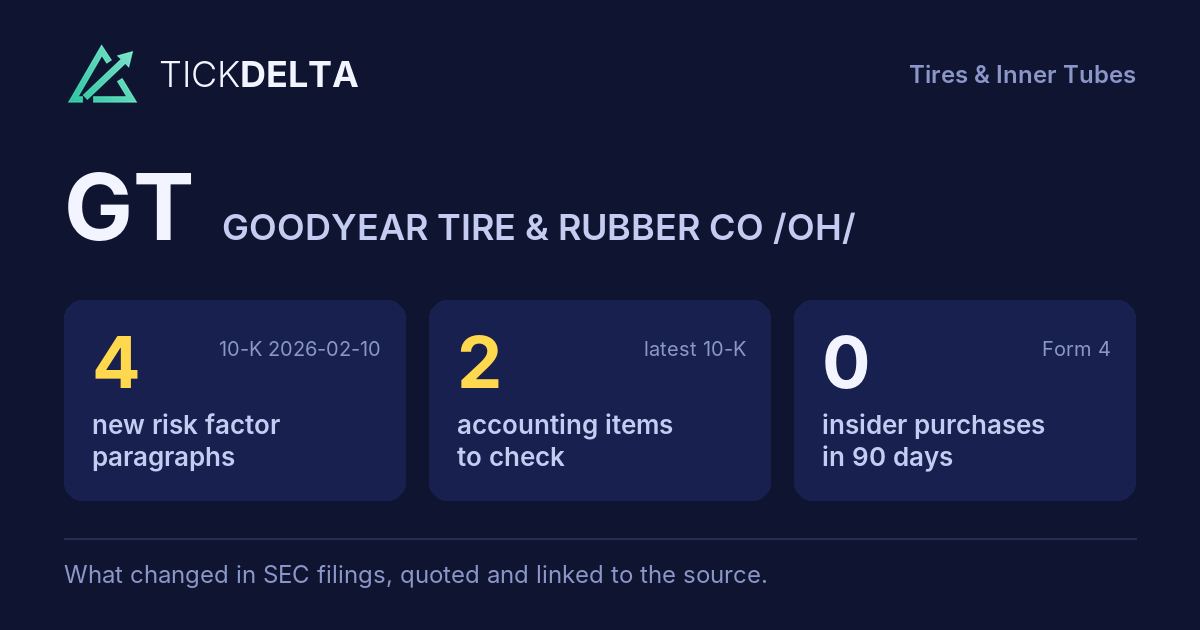
Screener / SEC EDGAR /CIK 0000042582 /10-K filed Feb 10, 2026, compared with Feb 14, 2025 /Numbers from the XBRL of the 10-Ks
Nasdaq Materials · Tires & Inner Tubes

Goodyear Tire & Rubber Co GT

Compare with peers Embed
SEC comment letters, last 20 years

3 reviews of GT's filings by SEC staff

UPLOAD and CORRESP
Reviews 3 latest letter Sep 10, 2025
Questions asked 4 each answered in the company's own letter
No closing letter 0 reviews without a letter saying the staff completed it

When the SEC's staff reviews a filing, it writes to the company with numbered questions, and the company answers each one in a letter. SEC publishes the exchange once the review is over, at least 20 business days later. A question is not an accusation; most reviews end with the company adding detail to its next filing.

How the reviews went

Every review on EDGAR, from the first staff letter to the letter that closes it

  1. 1. Staff letters 4 UPLOAD
  2. 2. Questions in them 4 numbered comments
  3. 3. Company replies 5 CORRESP
  4. 4. Reviews closed 3 of 3 closing letter

Half the closed reviews took 19 days or less from the first letter to the closing letter.

Form 10-K

2025-09-10 to 2025-09-29 · 1 question · 1 letter from the SEC, 1 from the company
Review closed 2025-09-29
Controls
Notes to Consolidated Financial Statements · Note 16. Revision of Previously Issued Financial Statements, page 33
SEC asked
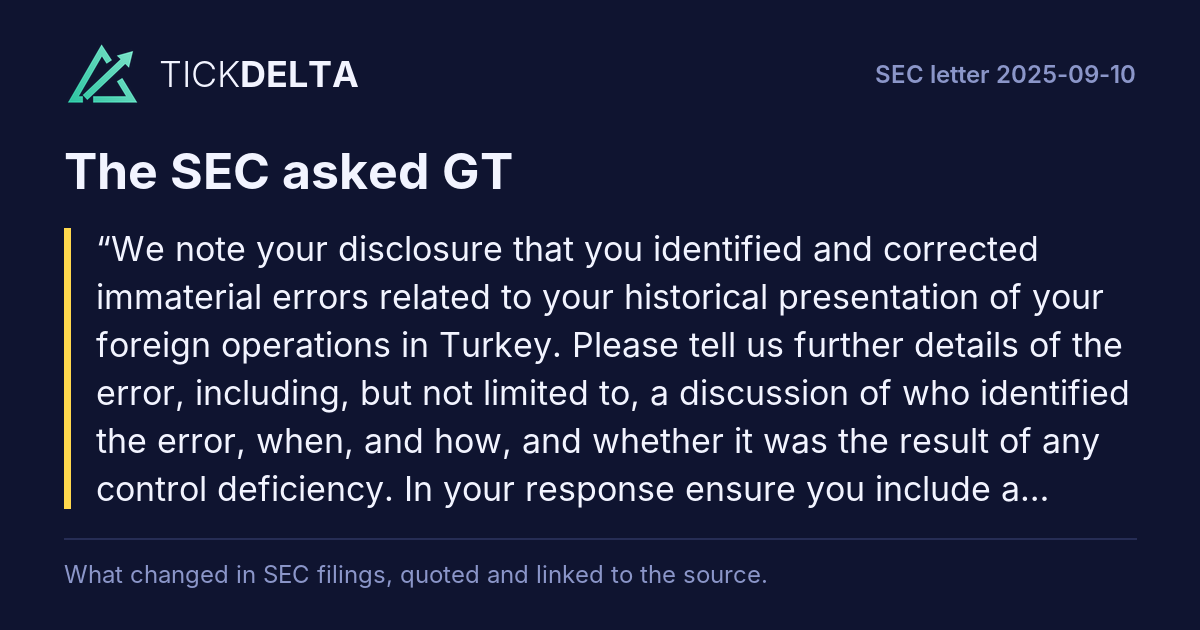
We note your disclosure that you identified and corrected immaterial errors related to your historical presentation of your foreign operations in Turkey. Please tell us further details of the error, including, but not limited to, a discussion of who identified the error, when, and how, and whether it was the result of any control deficiency.
Rest of the question

In your response ensure you include a thorough discussion and description of the control deficiency to the extent one was identified, the Company's evaluation of whether it was a control deficiency, significant deficiency, or material weakness, and any remediation plans. To the extent the Company concluded there was not a control deficiency, tell us why.

GT answered
In preparing the consolidated financial statements as of and for the three and six months ended June 30, 2025, we identified immaterial errors in our previously issued financial statements related to our historical computation of currency remeasurement of our operations in Turkey, which was designated as a highly inflationary economy beginning April 1, 2022. Our Turkey operations represented approximately 2% of consolidated total revenues and less than 1% of consolidated total assets in each of the years ended December 31, 2024, 2023 and 2022.
Rest of the answer

During the second quarter of 2022, as a result of Turkey’s designation as a highly inflationary economy, we implemented a process to remeasure the results of operations and balance sheet of our operations in Turkey into our parent company reporting currency (i.e., the U.S. dollar or USD), with remeasurement gains and losses recognized in earnings to reflect the impact of currency translation on our financial results. This remeasurement process included a manual process to remeasure the accounts for inventory and accounts payable because of system architecture complexities and our operations in Turkey making purchases using multiple currencies, primarily Turkish lira, euro and USD.

During the second quarter of 2025, management identified the error through our controls over our quarter-end financial statement close procedures. We determined that the error in the manual process to record the impact of Turkey hyperinflationary accounting was isolated to the inventory and accounts payable financial statement line items in Turkey, which were manually calculated as described above.

For the error identified, we analyzed the root cause of the control deficiency that led to the error and evaluated the severity of the control deficiency, both individually and in the aggregate, based on the SEC’s Guidance Regarding Management’s Report on Internal Control Over Financial Reporting Under Section 13(a) or 15(d) of the

Securities Exchange Act of 1934.

We determined the control deficiency that led to the error is a design deficiency due to the lack of an effectively designed control in Turkey to verify that the expected translated balance from Turkish lira to USD agreed to the manually calculated translated balance recorded in the general ledger. In evaluating the severity of the deficiency, we assessed the potential magnitude of the potential misstatement that could result from the deficiency and whether there is a reasonable possibility that the Company’s Internal Control over Financial Reporting (ICFR) will fail to prevent or detect a misstatement of a financial statement amount or disclosure that would be material to the consolidated financial statements. Specifically, we considered the following when evaluating the severity of the deficiency, including assessing the magnitude of the potential misstatement that could result from the deficiency:

•

The deficiency relates to the lack of an effectively designed control around hyperinflationary accounting that is specific to Turkey. We operate in two hyperinflationary countries, Turkey and Argentina, and we have separate processes, controls and enterprise resource planning (“ERP”) systems to account for our operations in each such country.

Specifically, Turkey hyperinflationary accounting includes a manual process and Argentina hyperinflationary accounting is calculated systematically within a separate ERP system. Therefore, the deficiency is not pervasive in nature and does not, and cannot, impact transactions outside of Turkey.

The manual calculation relating to Turkey hyperinflation only impacts the inventory and accounts payable accounts, further confining the potential misstatement that could result from the deficiency to those two accounts in Turkey.

We considered whether the potential misstatement that could result from the deficiency could be larger than the actual error that occurred. We concluded it is not reasonably possible that the potential misstatement could be larger than the actual error that occurred given the size of our operations in Turkey, as noted above, and the significant volatility in exchange rates for the Turkish lira during 2022 and 2023. During 2022 and throughout 2023, the economic environment in Turkey changed significantly as energy prices in Europe increased as a result of the Russia-Ukraine conflict. At this time, there was an increase in exchange rate volatility which resulted in a significant devaluation of the Turkish lira against the USD during 2022 and 2023. When considering the historical volatility in the Turkish lira against the USD prior to 2022, as well as the volatility in 2024 and for the first six months of 2025, and the size of the Turkey inventory and account payable accounts, we concluded it is not reasonably possible that the potential misstatement resulting from the deficiency could be larger than the actual error that occurred, which management determined was not material to the consolidated financial statements in any previously issued annual or interim financial statements.

The deficiency relates to the design of a specific control activity that only operates in Turkey and is not indicative of a broader deficiency related to the period-end financial reporting process or a deficiency in one of the other components of the Committee of Sponsoring Organizations of the Treadway Commission framework, such as the control environment or risk assessment.

Given the underlying root causes, and considering the impacted accounts and business processes, there are no other control deficiencies that warrant aggregation with this design deficiency.

There are no other indicators that the deficiency represents a material weakness (e.g., identification of fraud on the part of senior management, ineffective oversight by the Company’s Audit Committee, or restatement of previously issued financial statements to reflect the correction of a material misstatement).

Based on the aforementioned considerations, the magnitude of the potential misstatement that is at least reasonably possible is not material to either the interim or annual financial statements. Therefore, we concluded the control deficiency was a significant deficiency but did not rise to the level of a material weakness, either individually or in the aggregate, and that our ICFR remained effective.

As part of our normal quarterly disclosure process, the Audit Committee was informed of management’s findings and our conclusions prior to the issuance of our earnings release and the filing of our Form

10-Q for the second quarter of 2025.

We implemented a remediation plan which includes a redesigned balance sheet remeasurement control to calculate translated Turkey balances and agree them to the USD general ledger. We will continue to perform this control as long as Turkey is classified as a highly inflationary economy.

Read in the reply
In its next report

First report after the company's reply of Sep 23, 2025: 10-Q filed Nov 4, 2025 ↗, against the 10-Q filed Aug 8, 2025 ↗.

Tickdelta does not hold the text of both reports, so they are not compared here.
Also in this review: closing letter, 2025-09-29
Form 10-K for the Fiscal Year Ended December 31, 2022

2023-09-19 to 2023-11-17 · 2 questions · 2 letters from the SEC, 3 from the company
Review closed 2023-11-17
Results discussion (MD&A)Goodwill and impairmentAcquisitionsCritical estimatesLiquidity and cashIncome taxes
Notes to Consolidated Financial Statements, page 7
SEC asked
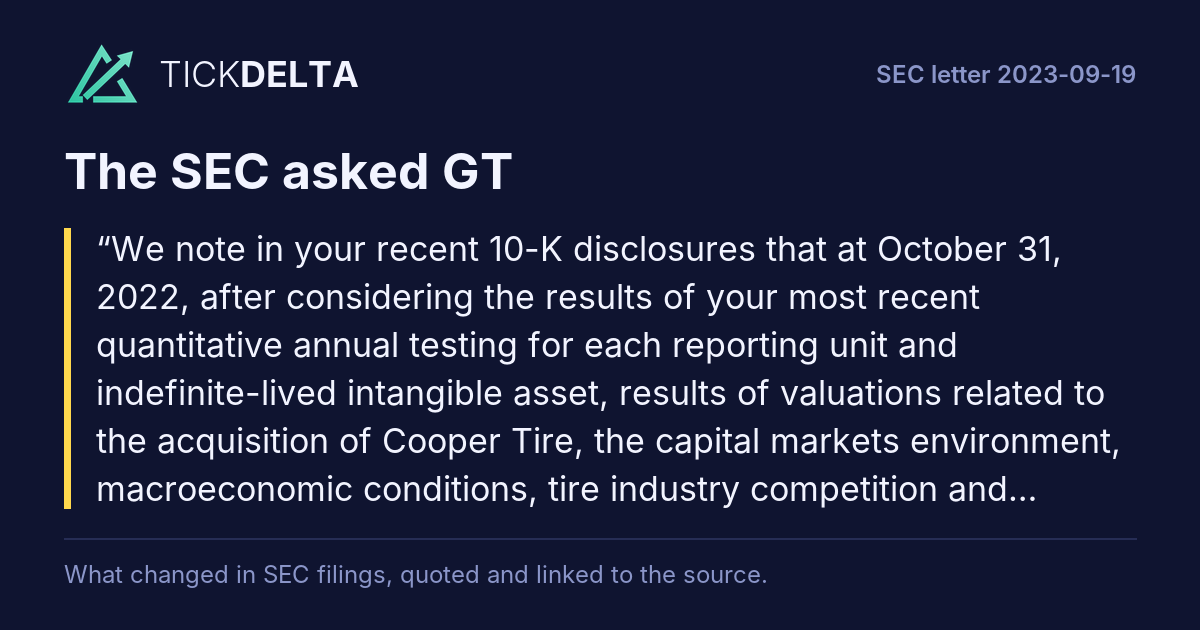
We note in your recent 10-K disclosures that at October 31, 2022, after considering the results of your most recent quantitative annual testing for each reporting unit and indefinite-lived intangible asset, results of valuations related to the acquisition of Cooper Tire, the capital markets environment, macroeconomic conditions, tire industry competition and trends, our results of operations, and other factors, you
Rest of the question

concluded that it was not more likely than not that the fair values of your reporting units or indefinite-lived intangible assets were less than their respective carrying values and, therefore, did not perform a quantitative analysis. We further note in your 10-Q for the period ended June 30, 2023, we note that your results of operations during the second and first six months of 2023 reflected a difficult macroeconomic environment including a softening industry demand, lower volumes, inflationary impacts as well as other factors and that your net book value currently exceeds your market capitalization. However, we noted no revisions to your disclosures related to goodwill under critical accounting estimates in MD&A in subsequent quarterly filings that address these factors. Please revise future filings to address if and how these factors impacted your determination to test goodwill for impairment as of an interim date and, if not, explain why not. Please also revise future filings to explain if and how you consider market capitalization in determining the estimated fair values of reporting units. Refer to ASC 350-20-353C, ASC 350-20-35-22 to 24, and ASC 350-20-35-30.

GT answered
The Company will update its disclosure of “Critical Accounting Policies – Goodwill and Intangible Assets” in Management’s

Discussion and Analysis of Financial Condition and Results of Operations in its Form 10-Q for the quarterly period ending September 30, 2023 and in subsequent periodic filings, if appropriate, as follows:

“CRITICAL ACCOUNTING POLICIES

Goodwill and

Intangible Assets. Goodwill and indefinite-lived intangible assets are tested for impairment annually or more frequently if an indicator of impairment is present.
Rest of the answer

Intangible assets with finite useful lives are amortized over their useful lives, and reviewed for impairment whenever events or circumstances warrant such a review. Goodwill and intangible assets would be written down to fair value if considered impaired. Goodwill and Intangible Assets totaled [$1,018] million and [$983] million, respectively, at [June 30, 2023].

Goodwill and intangible assets with indefinite useful lives are not amortized but are assessed for impairment annually on October 31st with the option to perform a qualitative assessment to determine whether further impairment testing is necessary or to perform a quantitative assessment by comparing the fair value of the reporting unit or indefinite-lived intangible asset to its carrying value. In addition to the annual assessment, impairment evaluation is considered during interim quarters when events occur or circumstances change that would more likely than not reduce the fair value of the asset below its carrying value. During our annual impairment assessment and in subsequent interim quarters, we review events that occur or circumstances that change, including the macroeconomic environment, our business performance and our market capitalization, to determine if a quantitative impairment assessment is necessary. We review our business performance and the macroeconomic environment against our recent expectations and evaluate book value compared to market capitalization, including fluctuations in our stock price, to determine if this could be an indicator of potential impairment. Consideration is given as to whether a fluctuation in our stock price is a result of current market conditions, an event that is expected to continue to affect us, and our historical price volatility. We also consider these factors compared to the results of our most recent quantitative goodwill impairment assessment.

Under the qualitative assessment, we assess whether it is more likely than not (defined as a likelihood of more than 50%) that the fair value of our goodwill or indefinite-lived intangible assets is less than the respective carrying values. If it is more likely than not that an impairment exists, then a quantitative impairment assessment is performed. If under the quantitative assessment the fair value is less than the carrying value, an impairment loss will be recorded for the difference between the carrying value and the fair value. Under the quantitative assessment, we estimate the fair value of goodwill using the discounted cash flows of a reporting unit and using discounted cash flows following a relief-from-royalty method for indefinite-lived intangible assets. Forecasts of future cash flows are based on our best estimate of future net sales and operating expenses, based primarily on pricing, raw material costs, market share and general economic conditions. Cash flows are discounted using our weighted average cost of capital.

At [June 30, 2023], after evaluating macroeconomic conditions, our market capitalization and our results of operations, we concluded that it was not more likely than not that the fair values of our goodwill or indefinite-lived intangible assets were less than their respective carrying values and, therefore, did not have any impairment.”

Read in the reply
Notes to Consolidated Financial Statements, page 7
SEC asked
We note your response and your conclusion that at June 30, 2023, after evaluating macroeconomic conditions, your market capitalization and your results of operations, that it was not more likely than not that the fair values of our goodwill or indefinite-lived intangible assets were less than their respective carrying values and, therefore, you did not have any impairment.
Rest of the question

We also noted, to some extent, deterioration in your operating results (i.e., decreasing income before income taxes) and cash flows from operations between the interim and annual reporting periods. Please refer to Item 303(b)(3) of Regulation S-K and expand your disclosures in future filings to address the following: • provide a more detailed description of the key assumptions you used to estimate fair value, including how the key assumptions were determined; • discuss the degree of uncertainty associated with the key assumptions, including material changes in the key assumptions during the periods presented; • describe the potential events and/or changes in circumstances that could result in additional impairment charges; and • disclose the percentage by which your estimated fair value exceeds your carrying value as of the date of your most recent impairment test.

GT answered
Tire & Rubber Company (the “Company”) hereby advises the staff (the “Staff”) of the Securities and Exchange Commission (the “Commission”) that the Company has received the Staff’s letter dated

October 6, 2023 (the “Comment Letter”), with respect to the above-referenced filings. The Comment Letter requests that the Company respond within ten (10) business days from the date thereof or advise the Staff of when the

Company will provide a response.
Rest of the answer

As discussed with you, the Company respectfully requests an extension until November 7, 2023 to respond to the Comment Letter in order to complete our evaluation of goodwill and intangible assets for the third quarter of 2023. Should you have any questions, please call me at 330-796-4141 or Margaret Snyder at

330-796-0228. Thank you very much for your courtesy and cooperation in this matter.

Read in the reply

Also in this review: company letter, Nov 7, 2023, closing letter, 2023-11-17

Form 10-K

2018-11-20 to 2018-12-07 · 1 question · 1 letter from the SEC, 1 from the company
Review closed 2018-12-07
Income taxesCritical estimates
Critical Accounting Policies · Deferred Tax Asset Valuation Allowance and Uncertain Income Tax Positions, page 34
SEC asked
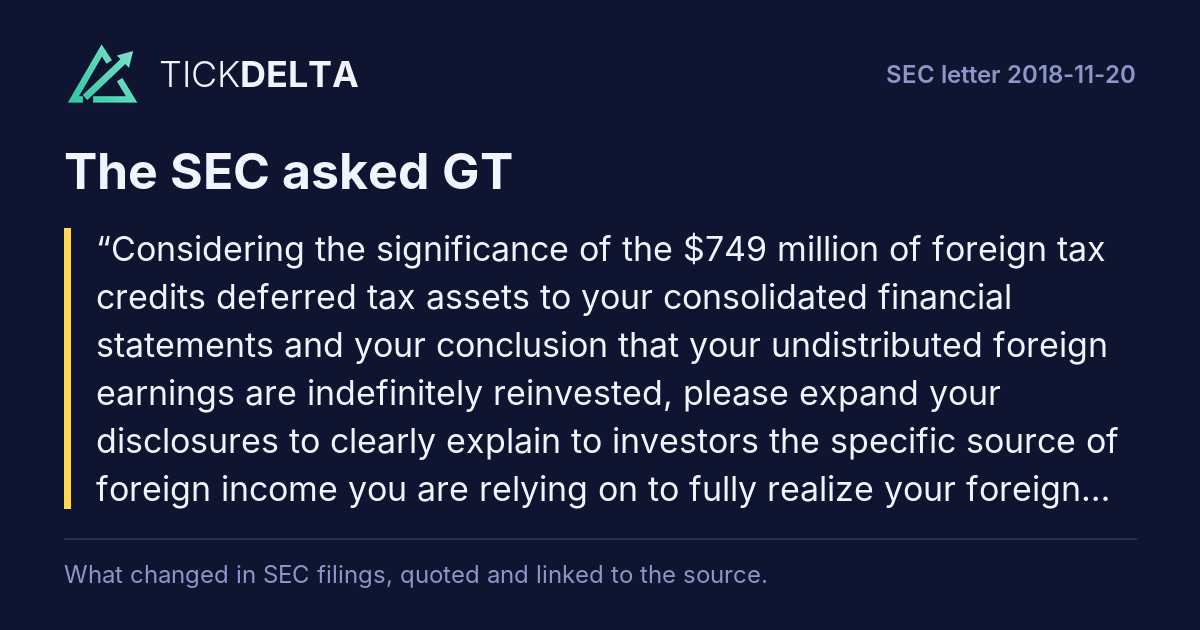
Considering the significance of the $749 million of foreign tax credits deferred tax assets to your consolidated financial statements and your conclusion that your undistributed foreign earnings are indefinitely reinvested, please expand your disclosures to clearly explain to investors the specific source of foreign income you are relying on to fully realize your foreign tax credits deferred tax assets.
Rest of the question

Please refer to comment 4 in our letter dated December 22, 2016, and comment 2 in our letter dated February 3, 2017, along with your corresponding letters dated January 9, 2017, and February 7, 2017, respectively.

GT answered
For many years prior to 2015, the Company incurred losses in the U.S. for tax purposes that offset our income from foreign sources and, as a result, created a build-up of foreign tax credits (“FTCs”), including U.S. losses in 2013 and 2014 primarily due to deducting approximately

$2 billion of pension contributions related to the funding of our salaried and hourly U.S. pension plans. In 2015 through 2017, we generated U.S. taxable income, excluding dividends, of approximately $1.2 billion and our current forecasts have U.S. profitability continuing for the foreseeable future.
Rest of the answer

Due to this improvement in domestic profitability since 2014, we utilized all of our U.S. federal net operating losses as of December 31, 2016 and began utilizing our FTC deferred tax assets at that time.

The Tax Cuts and Jobs Act (the “Tax Act”) enacted into law in the U.S. on December 22, 2017 included provisions that favorably impacted the Company’s ability to utilize its FTCs before they expire, such as permitting 100% (50% under prior law) of our domestic profitability to be re-characterized as foreign source income to the extent domestic losses have offset foreign source income in prior years. As disclosed in Note 6, Income Taxes (at page 74) of the Company’s Form 10-K for the fiscal year ended December 31, 2017, the Company had approximately $1 billion of undistributed earnings of foreign subsidiaries that are indefinitely reinvested in property, plant and equipment and working capital and, as such, are not available for repatriation. The Company also has undistributed earnings of foreign subsidiaries that are not indefinitely reinvested. During 2018, the Company repatriated some of these undistributed earnings primarily by intercompany dividends from its foreign subsidiaries, including from subsidiaries in Singapore and Japan during the second quarter of 2018, and may take similar actions in the future. These actions typically lower U.S. interest expense, for example by reducing intercompany loans, and, thus, increase U.S. profitability which can then be re-recharacterized as foreign source income.

On the other hand, the Tax Act also reduced the corporate income tax rate in the U.S. from 35% to 21%, which may negatively impact our ability to fully utilize our FTCs before they expire as there will be a corresponding decrease in U.S. tax to offset with the FTCs.

The Company will expand its disclosures to clearly identify the sources of income it is relying on to realize its FTC deferred tax assets, including the amount of undistributed earnings of foreign subsidiaries that are available for repatriation, in its Form 10-K for the fiscal year ended December 31, 2018 and, to the extent FTCs remain material to the Company, in other future filings.

In the Critical Accounting Policies section of MD&A, when discussing deferred tax asset valuation allowances and uncertain income tax positions, the following disclosures will be added:

“Our net deferred tax assets include approximately $xxx million of foreign tax credits generated primarily from the receipt of foreign dividends. Our earnings and projections along with three significant sources of foreign source income provide us sufficient positive evidence to avoid setting up a valuation allowance against these credits while also considering the negative evidence of their limited carryforward periods. Those sources of foreign source income are (1) 100% of our domestic profitability can be re-characterized as foreign source income under current U.S. tax law to the extent domestic losses have offset foreign source income in prior years, (2) annual net foreign source income, exclusive of dividends, primarily from royalties and (3) if necessary, we can enact tax planning strategies, including the ability to capitalize research and development costs annually, accelerate income on cross border sales of inventory or raw materials to our subsidiaries and reduce U.S. interest expense by, for example, reducing intercompany loans through repatriating undistributed earnings of foreign subsidiaries that are not indefinitely reinvested, all of which would increase our domestic profitability. There is a risk that future foreign source income will not be sufficient to fully utilize these foreign tax credits, however, we believe that it is more likely than not that the sources of foreign taxable income noted above will allow us to fully utilize our foreign tax credits prior to their various expiration dates.”

In the Notes to Consolidated Financial Statements, when discussing Income Taxes, the following disclosures will be added (additions are indicated by underline):

“We have undistributed earnings of foreign subsidiaries totaling approximately

$xxx million, including approximately $xxx million for which no provision for withholding tax is required because such earnings have been or will be reinvested in property, plant and equipment and working capital. A withholding tax charge of approximately $xxx million (net of foreign tax credits) would be required if these earnings were to be distributed.”

As part of our normal process, we are completing our annual operating plan for 2019 and forecasts of profitability for 2019 and beyond. We expect to finalize our annual operating plan and forecasts before we file our Form

10-K for the fiscal year ended December 31, 2018. Concurrently, we will reassess the realizability of our FTCs, considering our forecasts of future profitability and relevant macroeconomic information available, including raw material prices and currency exchange rates, which possess a high degree of volatility and can significantly impact our profitability. If we determine that we need to establish a valuation allowance in the fourth quarter of

2018 against any of our FTCs, the proposed additional disclosures noted above, as well as other relevant disclosures, will be updated accordingly.

Read in the reply
In its next report

First report after the company's reply of Dec 6, 2018: 10-K filed Feb 8, 2019 ↗, against the 10-K filed Feb 8, 2018 ↗.

Tickdelta does not hold the text of both reports, so they are not compared here.

Also in this review: closing letter, 2018-12-07

Letters without questions

Other letters

UPLOAD and CORRESP
4 other letters: notices that a filing will not be reviewed, requests to declare a registration effective, and the like
  • Mar 28, 2022 · GT: letter to the SEC · The Goodyear Tire & Rubber Company · Registration Statement on Form S-4 · File No. 333-263635
  • Mar 23, 2022 · SEC: will not review the filing · Goodyear Tire & Rubber Co. · Registration Statement on Form S-4 · Filed March 17, 2022...
  • Mar 30, 2021 · GT: letter to the SEC · The Goodyear Tire & Rubber Company · Registration Statement on Form S-4 · File No. 333-254482
  • Mar 22, 2021 · SEC: will not review the filing · Goodyear Tire & Rubber Co /OH/ · Registration Statement on Form S-4 · Filed March 19,...

From the SEC's correspondence on EDGAR: staff letters (form UPLOAD) and company letters (form CORRESP), 16 letters filed since 2018-11-20. Questions and answers are matched by their numbers; topics come from words in each question. The reports are compared word for word (same form, before the first SEC letter against the first report after the company's reply). No AI.

Sources

The SEC's correspondence on EDGAR: staff letters (form UPLOAD) and company letters (form CORRESP), matched question by question. No AI.

Also

Filings: the letters in the filing list.

Work with it

Excel workbook · CSV. Google Sheet that stays up to date: paste =IMPORTDATA("https://tickdelta.com/company/GT/export.csv") into a cell.

Next in Owners and insiders:Insider trades
Esc

Type a ticker such as AAPL, a name, an investor such as Buffett, or a topic such as tariffs. ↑ ↓ to move, Enter to open.