Paragraphs with nothing like them in last year's 10-K
Quoted exactly
6 paragraphs in Risk Factors of the 10-K filed Feb 12, 2026
with nothing like them in the 10-K filed Feb 25, 2025. Quoted exactly.
Paragraphs that were only edited are under 10-K change.
In addition, existing and potential competitors in our industry may be able to offer more flexible pricing models that better align with the actual usage and realized value obtained by customers, including pay-as-you-go models or other bespoke pricing packages, that may be more desirable for small and mid-market customers who are more likely to be affected by budget constraints. Further, as AI-powered agents become more sophisticated, individual users may become substantially more productive, enabling customers to achieve similar outcomes with fewer seats accessing our platform. This AI-driven seat compression could result in customers reducing seat counts at renewal, negatively impacting our revenue even as they derive equal or greater value from our products and services.
In addition, the rapid advancement and widespread adoption of LLMs and generative AI technologies could result in new competitors in our industry. Prominent LLM providers and other leading generative AI companies, are developing increasingly sophisticated AI capabilities, and such technologies may incorporate business contact information, company intelligence and market insights directly into their models or make such data readily accessible through AI-enabled tools at substantially lower costs than our products and services, or even at no incremental cost to their end users. These LLM providers may aggregate and synthesize publicly available data sources, licensed datasets, or user-contributed information to generate business intelligence that overlaps with or competes directly with our products and services. As LLM capabilities improve, the quality, accuracy, and comprehensiveness of the business data they provide may approach or match levels that customers find acceptable for their go-to-market activities.
In addition, in order to maintain our market-leading position in AI-driven go-to-market products and services, we have invested, and will continue to invest, in the AI-capabilities of our workforce. As a result of this strategy, we have made substantial capital investments and have committed significant resources, including engineering personnel, to build AI-capabilities and scale the infrastructure required to enable our workforce to utilize and integrate such capabilities into their workflows. However, despite our substantial investments in the AI-capabilities of our workforce, we may not realize an expected return if the products our teams develop do not generate sufficient customer demand or incremental revenue to justify the costs, or if the productivity improvements from our AI-capabilities do not offset the costs of building and maintaining AI-capable teams.
In addition, in recent years, customer behavior and traffic acquisition dynamics have shifted, and may continue to shift, due to the increasing adoption of AI-powered search experiences and LLM models that provide responses without directing users to third-party websites, which could reduce click-through rates and materially diminish the value of traditional SEO strategies. If we are unable to ensure that our products and services, as well as our website and brand, continue to be visible and utilized by AI-powered search experiences and LLM models, or if we are unable to address and capitalize on online traffic dynamics resulting from AIO strategies, we may experience reduced inbound lead volume, higher customer acquisition costs, and greater reliance on more expensive marketing channels that may be less efficient or scalable. Any sustained decline in inbound demand could adversely affect our pipeline, customer acquisition costs, and revenue growth.
If a major search engine or LLM model changes its algorithms or results in a manner that negatively affects our website’s search engine ranking or AIO placement, respectively, or if competitive dynamics impact the costs or effectiveness of SEO and/or AIO, marketing efforts relating to SEO and/or AIO strategies, or other traffic-generating arrangements in a negative manner, our business and financial performance would be adversely affected.
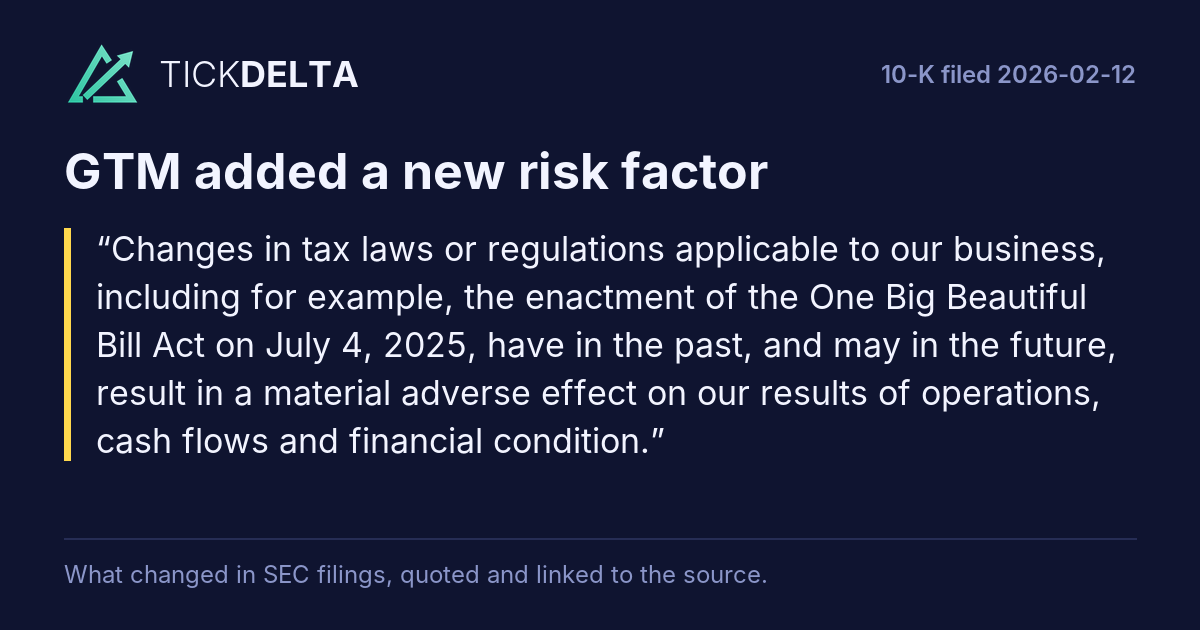
Changes in tax laws or regulations applicable to our business, including for example, the enactment of the One Big Beautiful Bill Act on July 4, 2025, have in the past, and may in the future, result in a material adverse effect on our results of operations, cash flows and financial condition.
Paragraphs in the 10-Q filed Nov 4, 2026 that were not in the one before
New in the latest 10-Q
14 paragraphs in the 10-Q filed Nov 4, 2026 with nothing like
them in the 10-Q filed Aug 5, 2026 (at least half the words must differ; new numbers alone do not count).
Quoted exactly, grouped by the item heading above them. This is text that changed, not a judgement of how serious it is.
Financial statements and notes
Reclassification of realized loss (gain) on settlement of cash flow hedges 0.4 (6.3) (0.7) (17.0)
Read in the 10-Qopen_in_new
Compensation expense related to the Company’s 2020 Employee Stock Purchase Plan (the “ESPP”) is equity-classified and measured at the estimated fair value of the purchase rights on the grant date, which is the first day of each twenty-four month offering period, using the Black-Scholes option pricing model. Compensation cost is recognized on a graded-vesting basis over the requisite service period of each six-month purchase period within the twenty-four month offering period.
Read in the 10-Qopen_in_new
On October 30, 2026, a second group of investment trusts and funds, including Harbor Capital Appreciation Fund and other Harbor Capital funds, filed a non-class complaint in the United States District Court for the Western District of Washington. The complaint asserts similar claims and allegations as those in the securities class action case described above. The Company intends to vigorously defend against this lawsuit.
Read in the 10-Qopen_in_new
The initial offering period began on September 1, 2026. The fair value of the ESPP purchase rights was estimated using the Black-Scholes option pricing model with the following assumptions for the three and nine months ended September 30, 2026:
Read in the 10-Qopen_in_new
Volatility 64.4% - 86.5% Expected term 0.5 - 2.0 years Risk-free rate 4.0% - 4.4% Expected dividend yield —% Weighted-average grant-date fair value per unit $1.88
Read in the 10-Qopen_in_new
Show the other 9
We estimate the future stock price volatility based on the historical volatility of the Company’s common stock price with a lookback period commensurate with the expected term of the ESPP purchase period. The expected term for the ESPP purchase rights is based on the duration of the respective purchase period. The risk-free rate is the implied yield available on U.S. Treasury zero-coupon bonds issued with a remaining term equal to the expected term. The Company has not declared, nor do we expect to declare, dividends.
Read in the 10-Qopen_in_new
The Company withheld $ 0.2 million worth of ESPP contributions for the three and nine months ended September 30, 2026 on behalf of participating employees through payroll deductions, included in Accrued expenses and other current liabilities on our Consolidated Balance Sheets as of September 30, 2026. No shares of Common Stock were purchased under the ESPP for the three and nine months ended September 30, 2026. The Company recognized $ 0.2 million of equity-based compensation expense related to the ESPP for the three and nine months ended September 30, 2026.
Read in the 10-Qopen_in_new
On October 16, 2026, ZoomInfo entered into a memorandum of understanding of terms with plaintiffs to settle the 2024 Securities Litigation. Refer to Note 9 - Commitments and Contingencies for further information.
Read in the 10-Qopen_in_new
The decrease was primarily attributable to lower subscription revenue, partially offset by an increase in usage-based revenue.
Read in the 10-Qopen_in_new
Provision for income taxes was lower for the three months ended September 30, 2026 primarily due to lower income before taxes.
Read in the 10-Qopen_in_new
(3) Represents the non-operating cost components associated with the Company’s restructuring and transaction-related activities. For the three and nine months ended September 30, 2026, this expense relates to foreign exchange remeasurement gains and losses for the Israel entity due to the 2026 Restructuring Program.
Read in the 10-Qopen_in_new
Net cash provided by operating activities was $249.4 million for the nine months ended September 30, 2026, compared to $321.9 million for the prior year period. The decrease was primarily due to higher cash payments for restructuring and transaction-related expenses, primarily related to the 2026 Restructuring Program and lease restructuring activity, higher cash interest payments, and higher litigation-related payments, partially offset by net refunds of income taxes in the current period compared to income taxes paid in the prior year period.
Read in the 10-Qopen_in_new
Other information
Except as described in the immediately following paragraph, during the Company’s fiscal quarter ended September 30, 2026, none of the Company’s directors or officers (as defined in Rule 16a-1(f) under the Exchange Act) adopted or terminated a trading arrangement intended to satisfy the affirmative conditions of Rule 10b5-1(c) of the Exchange Act (such arrangement, a “Rule 10b5-1 trading arrangement”).
Read in the 10-Qopen_in_new
On September 1, 2026, James Roth, Chief Revenue Officer, adopted a Rule 10b5-1 trading arrangement. The duration of the Rule 10b5-1 trading arrangement commences on January 1, 2027, and ends on December 31, 2027. The Rule 10b5-1 trading arrangement provides for the sale of a portion of the net shares acquired by Mr. Roth (net of shares withheld to cover the recipient’s tax liability in connection with vesting) resulting from the vesting of up to 305,029 previously granted restricted stock units. The volume of sales will be determined, in part, based on pricing triggers outlined in the Rule 10b5-1 trading arrangement, with a maximum potential sale under the plan of up to 60% of the vested shares from such awards during the term of the plan. Mr. Roth’s Rule 10b5-1 trading arrangement was entered into during an open insider trading window and is intended to satisfy the affirmative defense of Rule 10b5-1(c) under the Exchange Act and the Company’s policies regarding insider transactions.
Read in the 10-Qopen_in_new
The 10-Q's risk factors against the 10-K
Item 1A of the 10-Q filed Nov 4, 2026 against Item 1A of the 10-K filed Feb 12, 2026.
A 10-Q repeats only the risks that changed, so a 10-K paragraph that is missing from it is not counted as removed.
Added is a paragraph with nothing like it in the 10-K, Reworded a sentence that is in both with several words changed,
Quiet changes a sentence in both where one to four words changed and one is a hedge or a modal
(cut words struck through, new words highlighted).
Text on the page, not a score; each links to the filing at sec.gov.
Reworded10-Q Nov 4, 2026 vs 10-K Feb 12, 2026
Although it is not possible to predict or identify all such risks and uncertainties, they may include, but are not limited to, the factors discussed below. under “Risk Factors” in Part I, Item 1A of our 2025 Form 10-K.
Read it in the 10-Q at sec.govopen_in_newThe 10-K sentenceopen_in_new
Reworded10-Q Nov 4, 2026 vs 10-K Feb 12, 2026
We are subject to various risks that could have a material adverse effect impact on our business, financial condition, position, results of operations, operations or cash flows.
Read it in the 10-Q at sec.govopen_in_newThe 10-K sentenceopen_in_new
Phrases used for the first time
Two-word phrases in Risk Factors of the 10-K filed Feb 12, 2026 that are in none of the 1 earlier 10-Ks stored, back to Feb 25, 2025
llm providers ×3executive order ×3held holdco ×3holdco units ×3units immediately ×3immediately prior ×3uncertain geopolitical ×2october gaza ×2gaza peace ×2peace plan ×2capital investments ×2ai-powered search ×2search experiences ×2llm models ×2aio strategies ×2customer acquisition ×2
Where each one is used
- llm providers: We experience competition from other companies and technologies that allow businesses to gather and aggregate sales, marketing, recruiting, and other data, and we may in the future face competition from prominent large-language-model (LLM) providers and generative AI companies, and any of their competing products...
- executive order: Domestically, as members of the Republican Party now control both the White House and Congress, the national landscape has shifted. It is unclear whether members of Congress will have enough votes to pass a Federal privacy law and while AI remains a major topic of discussion in Congress, members of the Republican...
- held holdco: In connection with the IPO, we entered into two tax receivable agreements. We entered into (i) the Exchange Tax Receivable Agreement with certain of our Pre-IPO Owners of equity units of ZoomInfo Holdings and (ii) the Reorganization Tax Receivable Agreement with the Pre-IPO Blocker Holders. These tax receivable...
- holdco units: In connection with the IPO, we entered into two tax receivable agreements. We entered into (i) the Exchange Tax Receivable Agreement with certain of our Pre-IPO Owners of equity units of ZoomInfo Holdings and (ii) the Reorganization Tax Receivable Agreement with the Pre-IPO Blocker Holders. These tax receivable...
- units immediately: In connection with the IPO, we entered into two tax receivable agreements. We entered into (i) the Exchange Tax Receivable Agreement with certain of our Pre-IPO Owners of equity units of ZoomInfo Holdings and (ii) the Reorganization Tax Receivable Agreement with the Pre-IPO Blocker Holders. These tax receivable...
- immediately prior: In connection with the IPO, we entered into two tax receivable agreements. We entered into (i) the Exchange Tax Receivable Agreement with certain of our Pre-IPO Owners of equity units of ZoomInfo Holdings and (ii) the Reorganization Tax Receivable Agreement with the Pre-IPO Blocker Holders. These tax receivable...
- uncertain geopolitical: These risks could be exacerbated by weak macroeconomic and uncertain geopolitical conditions (including due to global pandemics or such as those related to the Russia-Ukraine war, and the conflict between Israel and Hamas, including after giving effect to the October 2025 Gaza Peace Plan, as well as related and...
- october gaza: These risks could be exacerbated by weak macroeconomic and uncertain geopolitical conditions (including due to global pandemics or such as those related to the Russia-Ukraine war, and the conflict between Israel and Hamas, including after giving effect to the October 2025 Gaza Peace Plan, as well as related and...
The 10-K at sec.govopen_in_new
Used at least twice, small words left out. Counted, not picked: a phrase can be new because the company renamed something.
Sources
Item 1A of each 10-K and 10-Q on EDGAR, quoted exactly. Each paragraph links to the filing at sec.gov.
Also
10-K change: what was reworded or cut, section by section.
Work with it
Excel workbook · CSV. Google Sheet that stays up to date: paste =IMPORTDATA("https://tickdelta.com/company/GTM/export.csv") into a cell.