Screener / SEC EDGAR /CIK 0000861459 /10-K filed Feb 13, 2026, compared with Feb 14, 2025 /Numbers from the XBRL of the 10-Ks
NYSE Industrials · Engineering & Construction

Granite Construction Inc GVA

Compare with peers Embed
SEC comment letters, last 20 years

6 reviews of GVA's filings by SEC staff

UPLOAD and CORRESP
Reviews 6 latest letter Apr 9, 2018
Questions asked 48 each answered in the company's own letter
No closing letter 1 reviews without a letter saying the staff completed it

When the SEC's staff reviews a filing, it writes to the company with numbered questions, and the company answers each one in a letter. SEC publishes the exchange once the review is over, at least 20 business days later. A question is not an accusation; most reviews end with the company adding detail to its next filing.

How the reviews went

Every review on EDGAR, from the first staff letter to the letter that closes it

  1. 1. Staff letters 8 UPLOAD
  2. 2. Questions in them 48 numbered comments
  3. 3. Company replies 8 CORRESP
  4. 4. Reviews closed 5 of 6 closing letter

Half the closed reviews took 25 days or less from the first letter to the closing letter.

Form S-4

2018-04-09 to 2018-04-30 · 28 questions · 2 letters from the SEC, 2 from the company
No closing letter
DebtAcquisitionsLiquidity and cashGoodwill and impairmentRisk factorsIncome taxes
General
SEC asked (1)
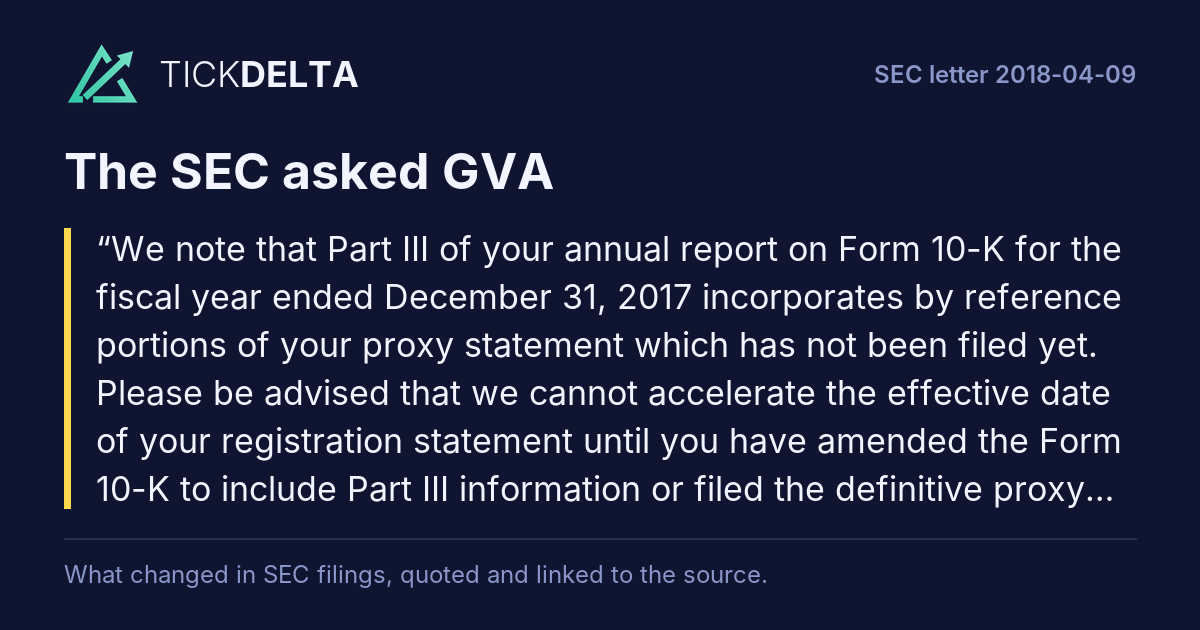
We note that Part III of your annual report on Form 10-K for the fiscal year ended December 31, 2017 incorporates by reference portions of your proxy statement which has not been filed yet. Please be advised that we cannot accelerate the effective date of your registration statement until you have amended the Form 10-K to include Part III information or filed the definitive proxy statement.
Rest of the question

Please refer to Compliance and Disclosure Interpretations, Securities Act Forms Question 123.01.

GVA answered
The

Company acknowledges the Staff’s comment and confirms that its definitive proxy statement on Schedule 14A was filed on April 13, 2018, prior to the filing of Amendment No. 1. The Company advises the Staff that Layne Christensen

Company (“Layne”) filed its Form 10-K on April 10, 2018 and expects to file its Form 10-K/A, including Part III disclosure, on or about

April 19, 2018.
Read in the reply
Prospectus Cover Page
SEC asked (2)
The prospectus cover page should comprise a joint letter to shareholders that includes the title and amount of securities to be offered by Granite Construction Incorporated. Refer to Item 501(b)(1) and (2) of Regulation S-K. Please revise.
GVA answered
The Company acknowledges the Staff’s comment and has revised the prospectus cover page to comply with Item 501(b)(1) and (2) of Regulation S-K.
Read in the reply
Summary, page 8
SEC asked (3)
Please disclose in this section that following consummation of the merger, Layne stockholders will own approximately 12% of the combined company.
GVA answered
The Company acknowledges the Staff’s comment and has revised page 9 to include a statement that, upon completion of the merger, stockholders of Layne will own approximately 12% of the outstanding shares of the Company’s common stock on a fully diluted basis (excluding any shares that may subsequently be issued in connection with any conversion of Layne’s 8.0% convertible notes into shares of the Company’s common stock following the merger).
Read in the reply
Risk Factors, page 22
SEC asked (4)
You disclose on page F-37 of Granite’s Form 10-K for the fiscal year ended December 31, 2017, that at closing you will assume Layne’s $24.5 million of letters of credit, or issue new letters of credit. Your state that these additional debt obligations assumed at closing would exceed the amount of indebtedness currently permitted under your existing credit facility and private placement notes and you intend to seek
Rest of the question

consents or waivers from your existing lenders with respect to this additional indebtedness. Please revise your filing to discuss this matter, status of any waivers or consents received and negative consequences, if any, to the merger or your financial statements if you do not receive waivers from your lenders.

GVA answered
The Company acknowledges the Staff’s comment and has revised pages 32 and 33 of Amendment No. 1 to address the Staff’s comment.
Read in the reply
Unaudited Pro Forma Condensed Combined Financial Information, page 38
SEC asked (5)
You disclose that you have not completed the detailed valuation work necessary to arrive at the required estimates of the fair value of the Layne assets to be acquired and the liabilities to be assumed and the related allocation of purchase price, nor identified all adjustments necessary to conform Layne’s accounting policies to Granite’s accounting policies.
Rest of the question

Please tell us when you expect to have the above completed. Please revise your filing to identify specific income statement and balance sheet line items that you anticipate will be impacted once you complete your purchase price allocation. Further tell us how you currently determined the estimated goodwill amounts in Note 3 to your pro forma financial information.

GVA answered
The Company acknowledges the Staff’s comment and advises the Staff that it is in the process of performing the detailed valuation work in order to estimate the fair value of the Layne assets to be acquired and liabilities to be assumed as well as all adjustments necessary to conform Layne’s current accounting policies to those of Granite. The Company expects to complete the preliminary purchase price allocation in the quarter in which the merger with Layne is completed.

The

Company has undertaken a preliminary valuation of Layne’s assets and liabilities using industry benchmarks.
Rest of the answer

The preliminary valuation will be updated by a detailed preliminary valuation upon the completion of the merger. For the purposes of pro forma financial information included in Amendment No. 1, estimated goodwill was determined by calculating the aggregate dollar value of shares of Granite’s common stock to be issued in the merger (i.e., the number of shares of

Granite’s common stock expected to be issued in the merger multiplied by the price of Granite’s common stock as of April 10, 2018), less the estimated net value of Layne’s assets and liabilities determined in the preliminary valuation.

The Company has also revised page 39 of Amendment No. 1 to disclose that the amount of goodwill that will be recorded in connection with the merger will depend on the market price of Granite common stock on the date of completion of the merger. As a result of recent market volatility, the amount of goodwill that is ultimately recorded may vary significantly from the estimated goodwill on the pro forma balance sheet.

The Company has also revised page 39 to include the income statement and balance sheet line items that will be impacted upon completion of the purchase price allocation.

Read in the reply
Adjustments to the Pro Forma Balance Sheet, page 42 · Pro forma Adjustment (c), page 42
SEC asked (6)
You disclose that the estimate of net deferred tax assets and liabilities balance includes the release of the valuation allowance associated with federal net operating loss carryforwards and other federal deferred tax assets that were fully reserved within Layne’s historical financial statements.
Rest of the question

In this regard, we note your valuation allowance of $158 million at 1/31/17 and your release in adjustment (c) of $45 million. Tell us how you determined the amount of the valuation allowance to release. Further, we note your disclosure that you believe it is more likely than not that federal net operating loss carryforwards and other federal deferred tax assets will be realized. Please tell us and revise your filing to discuss the significant assumptions used to determine that realization of the deferred tax assets is more likely than not, including the amount of taxable income you will be required to generate and the time period during which it will be required to be generated. Alternatively, please disclose that the income tax benefit related to the reduction of the valuation allowance is not included in the pro forma income statement.

GVA answered
The Company acknowledges the Staff’s comment and has revised page 45 of Amendment No. 1 to include the assumptions used to determine that the realization of federal deferred tax assets is more likely than not and update the amount of release for Layne’s federal operating loss carryforwards to $150.2 million as of January 31, 2018. The Company currently believes that it will have sufficient taxable income to utilize Layne’s federal net operating loss carryforwards prior to expiration. The Company had taxable income in eight of the last 10 fiscal years.
Rest of the answer

Layne’s federal gross net operating loss carryforwards as of January 31, 2018 were $150.2 million and expire between 2034 and 2038. As such, the Company will have up to 20 years to generate the taxable income required to realize the full amount of Layne’s federal net operating loss carryforwards of $150.2 million.

The Company has also revised page 45 of

Amendment No. 1 to clarify that the income tax benefit related to the reduction of the valuation allowance is not included in the pro forma income statement.

Read in the reply
Pro forma Adjustment (e), page 43
SEC asked (7)
Please further explain the nature of the $40.4 million and $3.5 million adjustments to debt. Your note indicates a fair value adjustment. Please tell us how you determined the amount of the adjustment. Please confirm if these adjustments include any amounts related to the conversion of 8% debt or pay out of the 4.25% debt.
GVA answered
The Company acknowledges the Staff’s comment and has revised page 41 of Amendment No. 1 to update the pro forma financial information as of and for the period ended January 31, 2018 and using the market price of Granite common stock on April 10, 2018. The revised adjustments for Layne’s 8.0% convertible notes and Layne’s 4.25% convertible notes are

$30.2 million and $2.8 million, respectively. Layne’s 8.0% convertible notes have an “as converted” value that exceeds the principal amount of the notes, which approximates fair value.
Rest of the answer

The $30.2 million reflects the adjustment to fair value of Layne’s 8.0% convertible notes based upon the market price of Granite’s shares issuable upon conversion of Layne’s 8.0% convertible notes. Layne’s 4.25% convertible notes reflect an adjustment of

$2.8 million to record the 4.25% convertible notes at estimated fair value based on estimated market value. The Company advises the Staff that the conversion rate of Layne’s 4.25% convertible notes would result in a value less than the

$1,000 principal amount of each note.

Read in the reply
Pro forma Adjustment (g), page 43
SEC asked (8)
We note your adjustment of $34.6 million that relates to the payout of the Layne Stock Options, Layne RSUs and Layne PSUs. Please tell us how you calculated this adjustment, providing the number of shares or options issuable, the amount of Layne Equity Award Consideration and exercise prices assumed.
GVA answered
The Company acknowledges the Staff’s comment and has revised page 41 to update the adjustment to Cash and cash equivalents based on the market price of Granite common stock on April 10, 2018. The revised total amount that Granite expects to pay to holders of Layne’s stock options, Layne’s restricted stock units and

Layne’s performance stock units is $32.5 million.
Rest of the answer

The table below provides the Company’s calculation:

Layne Stock Options

Layne RSUs

Layne PSUs

Total

Outstanding as of March 9, 2018

446,988

514,441

1,443,362

Exchange ratio

0.27

Granite common stock price as of April 10, 2018

$

56.13

Weighted average exercise price

8.73

Cash to be paid

2,872,055

7,796,405

21,874,295

32,542,756

The aggregate dollar value of the Layne stock options was calculated by multiplying (1) the product of the assumed price of Granite common stock and the merger exchange ratio, less the weighted average exercise price by (2) the number of Layne’s outstanding stock options.

Read in the reply
Pro forma Adjustment (k), page 44
SEC asked (9)
Please confirm whether you have included the cash payout for the 4.25% convertible debt and conversion of the 8% convertible debt in both your pro forma balance sheet and pro forma income statement. In this regard, it appears as if you have not included the impact to the balance sheet (e.g.
Rest of the question

reduction of debt and cash for 4.25% settlement) however, you have included the converted outstanding shares in the pro forma EPS. It is unclear if these notes will remain outstanding or converted. Further explain how you arrived at the 2.3 million shares in your diluted pro forma EPS calculation for the 8% convertible notes.

GVA answered
The Company acknowledges the Staff’s comment and confirms that it has not included the repayment of Layne’s 4.25% convertible notes and conversion of Layne’s 8.0% convertible notes in either of the pro forma balance sheet or pro forma income statement. The merger does not accelerate the maturity date of either Layne’s 8.0% convertible notes or Layne’s 4.25% convertible notes.
Rest of the answer

As a result, those notes will remain outstanding following the merger.

The pro forma income statement for the fiscal year ended

December 31, 2017 gives effect to the merger as if it had been completed on January 1, 2017, the beginning of the earliest period presented. The pro forma balance sheet as of December 31, 2017 gives effect to the merger as if it had been completed on December 31, 2017. As of December 31, 2017, both Layne’s 4.25% convertible notes and Layne’s 8.0% convertible notes were outstanding.

The Company calculated the number of shares issuable upon conversion of Layne’s 8.0% convertible notes by multiplying the total number of shares of Layne’s common stock issuable upon conversion of the 8.0% convertible notes times the number of shares of the Company’s common stock issuable for each outstanding share of Layne’s common stock in the merger.

Each $1,000 principal amount of Layne’s 8.0% convertible notes is currently convertible into 85.4701 shares of Layne’s common stock. Upon the merger, each $1,000 principal amount of Layne’s 8.0% convertible notes will be convertible into 23.0769 shares of Granite’s common stock. Following the merger, the $99,898,000 principal amount of Layne’s 8.0% convertible notes will be convertible into approximately 2,305,000 shares of Granite’s common stock.

Upon further review, the Company has excluded the shares of its common stock issuable upon conversion of Layne’s 4.25% convertible notes and Layne’s 8.0% convertible notes as the interest expense, when added back to net income in applying the “if converted” method, would result in the issuance of Granite Stock being anti-dilutive to Granite’s pro forma, diluted EPS.

Read in the reply
The Merger, page 60 · Background of the Merger, page 60
SEC asked (10)
Please revise your disclosure to discuss in more detail the circumstances that led Granite to identify Layne as a potential acquisition candidate.
GVA answered
The Company acknowledges the Staff’s comment and has revised page 63 of Amendment No. 1 in response to the Staff’s comment.
Read in the reply
The Merger, page 60 · Background of the Merger, page 60
SEC asked (11)
Please revise your disclosure to discuss the strategic options related to Layne’s water resources division that were discussed with Greentech on August 31, 2017.
GVA answered
The Company advises the Staff that Layne has revised page 65 of Amendment No. 1 to discuss the strategic options.
Read in the reply
The Merger, page 60 · Background of the Merger, page 60
SEC asked (12)
Please disclose how the members of Layne’s special committee were chosen.
GVA answered
The

Company advises the Staff that Layne has revised page 69 of Amendment No. 1 to discuss how the members of Layne’s special committee were chosen.
Read in the reply
The Merger, page 60 · Background of the Merger, page 60
SEC asked (13)
Please provide more detail regarding the “most significant open issues” that were discussed on February 5, 2018.
GVA answered
The Company acknowledges the Staff’s comment and has revised page 72 of Amendment No. 1 to include further details of the most significant open legal issues discussed by the Company’s board of directors on February 5, 2018.
Read in the reply
The Merger, page 60 · Background of the Merger, page 60
SEC asked (14)
We note your disclosure that throughout February 12 and February 13, 2018, Granite and Layne continued to negotiate the merger agreement. Please expand your disclosure to discuss any material changes to the terms of the merger agreement that resulted from such negotiations.
GVA answered
The Company acknowledges the Staff’s comment and has revised page 74 of Amendment No. 1 to include details of the material changes to the terms of the merger agreement that resulted pursuant to the negotiations on February 12 and 13, 2018.
Read in the reply
The Merger, page 60 · Background of the Merger, page 60
SEC asked (15)
Please revise your disclosure to specify the material updates to the draft merger agreement that the Layne Board discussed on February 13, 2018.
GVA answered
The Company advises the Staff that Layne has revised page 75 of Amendment No. 1 to disclose the material updates discussed by

Layne’s board of directors.
Read in the reply
Layne Board Recommendation and Its Reasons for the Merger, page 71
SEC asked (16)
Please revise the first bullet to provide specifics regarding the board’s knowledge of Layne’s business, operations, financial condition, etc. that led the board to conclude the merger was in the best interests of Layne’s stockholders.
GVA answered
The Company advises the Staff that Layne has revised pages 77 and 78 of

Amendment No. 1 to provide specifics regarding Layne’s board of directors’ knowledge of Layne’s business, operations, financial condition, etc. that led the board of directors to conclude the merger was in the best interests of

Layne’s stockholders.
Read in the reply
Layne Board Recommendation and Its Reasons for the Merger, page 71
SEC asked (17)
Please revise the fifth bullet to discuss the “strategic alternatives” considered by the board.
GVA answered
The Company advises the Staff that Layne has revised pages 62 through 68 and 77 of Amendment No. 1 to discuss and provide more information regarding the strategic alternatives evaluated by Layne, its board of directors and advisors.
Read in the reply
Layne Board Recommendation and Its Reasons for the Merger, page 71
SEC asked (18)
Please revise your disclosure to discuss the “restrictions of the conduct of Layne’s business” referenced on page 73 that Layne’s board considered a negative factor concerning the Merger.
GVA answered
The Company advises the Staff that Layne has revised pages 79 and 80 of Amendment No. 1 to discuss restrictions on the conduct of Layne’s business that Layne’s board of directors considered a negative factor concerning the merger.
Read in the reply
Layne Board Recommendation and Its Reasons for the Merger, page 71
SEC asked (19)
Please detail the “potential benefits” referenced on page 73 that Layne’s stockholders could be foregoing by approving the Merger.
GVA answered
The Company advises the Staff that Layne has revised page 80 of Amendment No. 1 to detail the potential benefits that Layne’s stockholders could be forgoing by approving the merger.
Read in the reply
Opinion of Layne Christiansen Company’s Financial Advisor, page 74
SEC asked (20)
Please provide us supplementally with copies of any board books or similar materials provided by Greentech to the Layne Christiansen Company board in connection with its analysis and opinion.
GVA answered
The Company acknowledges the Staff’s comment and advises the Staff that the Company has been advised by Layne that the presentation materials prepared by Greentech Capital Advisors, LLC (“Greentech”) and shared with Layne’s board of directors in connection with the analysis and preparation of its fairness presentation on February 13, 2018 are being provided to the Staff under separate cover by Mintz Law Firm, LLC, counsel for Greentech, on a confidential and supplemental basis pursuant to Rule 418 of the Securities Act and Rule 12b-4 of the Exchange Act.

Layne has been advised by Greentech
Rest of the answer

that, in accordance with such Rules, it has requested that these materials be returned promptly following completion of the Staff’s review thereof, and that by separate letter, counsel for Greentech also has requested confidential treatment of these materials pursuant to the provisions of 17 C.F.R. § 200.83.

Read in the reply
Discounted Cash Flow Analyses, page 77
SEC asked (21)
Please disclose how the discount range of 10.3% to 12.3% was chosen.
GVA answered
The Company advises the Staff that Layne has revised page 84 of Amendment No. 1 to address the Staff’s comment.
Read in the reply
Selected Publicly Traded Companies Analyses, page 78
SEC asked (22)
Please disclose whether any companies meeting the selection criteria were excluded from the analyses.
GVA answered
The Company advises the Staff that Layne has revised page 85 of Amendment No. 1 to address the Staff’s comment.
Read in the reply
Selected Precedent Transaction Analyses, page 80
SEC asked (23)
Please disclose whether any transactions meeting the selection criteria were excluded from the analyses.
GVA answered
The Company advises the Staff that Layne has revised page 87 of Amendment No. 1 to address the Staff’s comment.
Read in the reply
Miscellaneous, page 82
SEC asked (24)
Please revise to discuss the “numerous assumptions” with respect to industry performance, business and economic conditions that were made by Greentech.
GVA answered
The Company advises the Staff that Layne has revised page 89 of Amendment No. 1 to address the Staff’s comment.
Read in the reply
Unaudited Pro Forma Condensed Combined Financial Information, page 39 · General
SEC asked (1)
In response to comment nine you state that you did not include the repayment of Layne’s 4.25% convertible notes and conversion of Layne’s 8.0% convertible notes in your pro forma financial statements. You state that the merger does not accelerate the maturity date of either Layne’s 8.0% convertible notes or Layne’s 4.25% convertible notes, as a result, those notes will remain outstanding following the merger.
Rest of the question

We also note page A58 of the merger agreement only discusses a change in settlement to a cash settlement for the 4.25% convertible notes. However, we note on page 21 of Layne’s Form 10-K for the fiscal year ended January 31, 2018 that if the 4.25% Convertible Notes have not been redeemed, repurchased, otherwise retired, discharged in accordance with their terms or converted into Layne’s common stock, or effectively discharged, in each case on or prior to August 15, 2018 or the scheduled maturity date of the 4.25% Convertible Notes has not been extended to a date that is after October 15, 2019, then the 8.0% Convertible Notes will mature on August 15, 2018. On page 38 of your amended Form S-4 you present the 4.25% Convertible Notes with a maturity date of November 15, 2018, which appears would accelerate the maturity of the 8.0% notes to August 2018. Please tell us why you have not presented the 8.0% convertible notes as a current liability in your pro forma financial statements. In this regard, please explain how the disclosure in the Layne 10-K for the year ended January 31, 2018, relates or impacts the treatment of these convertible instruments as part of the merger. Please revise your disclosure if necessary to explain how these terms are related and why the 8% convertible notes were not classified as a current liability.

GVA answered
The Company acknowledges the Staff’s comment and advises the Staff that for purposes of the pro forma financial statements it has reclassified the Layne Christensen Company (“Layne”) 8.0% convertible notes from a non-current to a current liability. The Company previously presented Layne’s 8.0% convertible notes as a non-current liability because, under the terms of the indenture governing the notes, the Company has control over whether to accelerate the maturity to August 15, 2018 or wait until

May 1, 2019, the original maturity date. As more fully described on page 47 of Amendment No.
Rest of the answer

2, if all of Layne’s outstanding 4.25% convertible notes have not been retired prior to August 15, 2018 and if the maturity date for Layne’s

4.25% convertible notes has not been extended to a date after October 15, 2019, then maturity of Layne’s 8.0% convertible notes will accelerate to August 15, 2018. The Company currently intends to redeem Layne’s 4.25% convertible notes on the original maturity date of November 15, 2018; therefore, the maturity of Layne’s 8.0% convertible notes will be accelerated to August 15, 2018.

The Company has revised pages 21, 41 and 47 of Amendment No. 2 to update the disclosure based on the reclassification.

Read in the reply
Adjustments to the Pro Forma Balance Sheet, page 44 · Pro form adjustment (b), page 44
SEC asked (2)
Please provide the preliminary purchase price allocation required by ASC 805-20-50-1. Please refer to ASC 805-10-55-41 for additional guidance. In this regard, you state in your response to comment five from our letter dated April 9, 2018, that you have undertaken a preliminary evaluation, included pro forma adjustments to fair value Layne’s debt and investments in affiliates and were able to calculate goodwill by
Rest of the question

subtracting the “estimated net value of Layne’s assets and liabilities.”

GVA answered
The Company acknowledges the Staff’s comment and has revised page 44 of Amendment No. 2 to include the preliminary purchase price allocation in response to the Staff’s comment.
Read in the reply
Pro forma Adjustment (e), page 45
SEC asked (3)
We have read your response to comment seven. Please revise your filing to discuss how you determined the adjustment amount for debt. Refer to Rule 11-02(b)(6) of Regulation S-X.
GVA answered
The Company acknowledges the Staff’s comment and has revised page

45 of Amendment No. 2 to provide details of the assumptions used for the pro forma adjustments to Layne’s debt.
Read in the reply
Pro forma Adjustment (g), page 46
SEC asked (4)
We have read your response to comment eight. It is unclear how you arrived at 446,988 stock options outstanding at March 9, 2018. We note Layne disclosed 659,086 outstanding at January 31, 2018, in their Form 10-K for the year ended January 31, 2018.
GVA answered
The Company acknowledges the Staff’s comment and advises the Staff that it only included Layne’s stock options with exercise prices that do not exceed the per share merger consideration based on the market price of the Company’s common stock as of

April 10, 2018.

The Company has revised page 46 of Amendment No. 2 to provide the rationale for excluding Layne’s stock options with exercise prices that do not exceed the per share merger consideration.
Read in the reply

Form 10-K for the Fiscal Year Ended December 31, 2016

2017-06-08 to 2017-06-27 · 1 question · 1 letter from the SEC, 1 from the company
Review closed 2017-06-27
Results discussion (MD&A)Liquidity and cash
Liquidity and Capital Resources, page 34
SEC asked
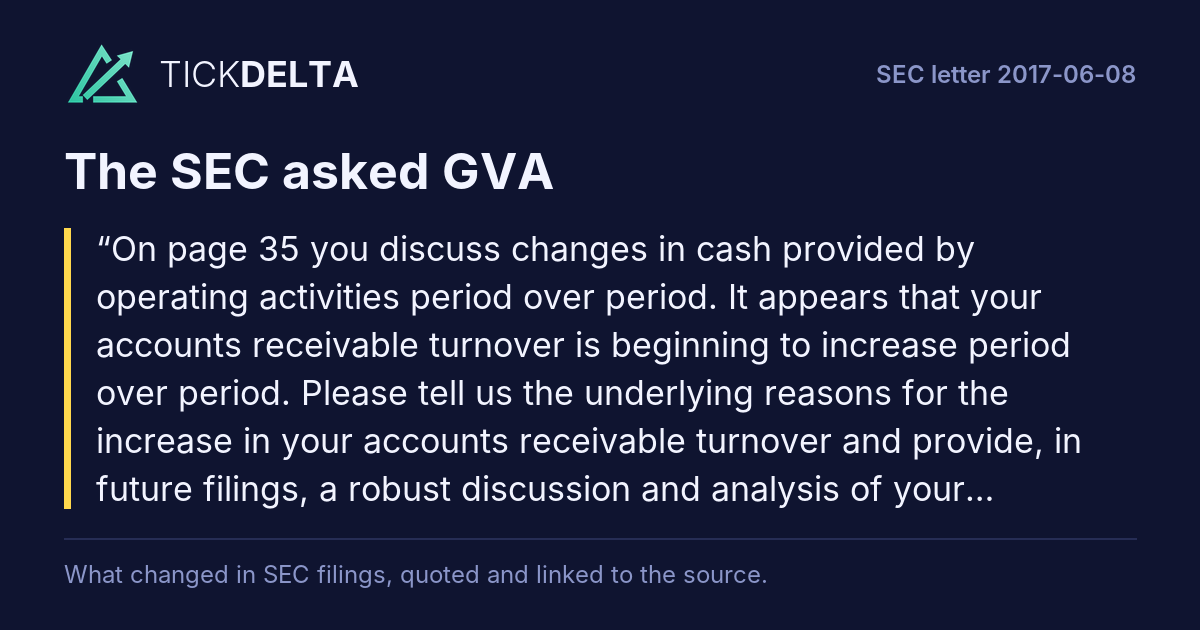
On page 35 you discuss changes in cash provided by operating activities period over period. It appears that your accounts receivable turnover is beginning to increase period over period. Please tell us the underlying reasons for the increase in your accounts receivable turnover and provide, in future filings, a robust discussion and analysis of your operating cash flows that addresses material changes in these cash
Rest of the question

flows including the key drivers of changes in your working capital accounts. Also, revise your discussion of your cash flows from operating, investing and financing activities to include a discussion of these cash flows for all periods that are presented in your consolidated statements of cash flows. Refer to Item 303 of Regulation S-K and FRC 501.13b.1 for additional guidance.

GVA answered
We acknowledge the Staff’s comment. We note for the Staff that our accounts receivable turnover decreased to 5.5 in 2016 from 6.6 in 2015 primarily due to an increase in accounts receivable from customers in the private sector, which are typically slower paying than customers in the public sector. We calculated the accounts receivable turnover ratios by dividing total revenue, less Granite’s interest in revenue related to unconsolidated construction joint ventures, for the years ended December 31, 2016 and 2015, respectively, by the average of accounts receivable, net plus costs and estimated
Rest of the answer

earnings in excess of billings less billings in excess of costs and estimated earnings as of December 31, 2016 and 2015, respectively. Please note that we manage our combined accounts receivable, net, costs and estimated earnings in excess of billings and billings in excess of costs and estimated earnings balances, our primary working capital assets, using day’s sales outstanding, rather than accounts receivable turnover.

In future filings, beginning with our Quarterly Report on Form 10-Q for the quarter ending June 30, 2017, we will address material changes in our operating cash flows including the key drivers of changes in our working capital accounts in a format similar to the following, which is based on operating cash flows for the year ended December 31, 2016:

We manage our combined accounts receivable, net, costs and estimated earnings in excess of billings and billings in excess of costs and estimated earnings balances, our primary working capital assets, using day’s sales outstanding (“DSO”). We calculate DSO by dividing the end of the period accounts receivable, net plus costs and estimated earnings in excess of billings less billings in excess of costs and estimated earnings by total revenue, less Granite’s interest in revenue related to unconsolidated construction joint ventures, for the current quarter multiplied by 90 days. DSO increased 8 days to 67 days as of December 31, 2016 from 59 days at December 31, 2015.

We manage our accounts payable and accrued expenses and other current liabilities balances, our primary working capital liabilities, using day’s payables outstanding (“DPO”). We calculate DPO by dividing the end of the period accounts payable plus accrued expenses and other current liabilities by total cost of revenue less Granite’s interest in cost of revenue related to unconsolidated construction joint ventures for the current quarter multiplied by 90 days. DPO decreased 1 day to 84 days as of December 31, 2016 from 85 days at December 31, 2015.

Cash provided by operating activities of $73.1 million during 2016 increased $6.2 million when compared to 2015. The increase was primarily due to a $5.5 million increase in net income after adjusting for non-cash items and a $23.5 million increase in net distributions from unconsolidated joint ventures partially offset by a $22.8 million decrease in cash from working capital. The decrease in cash from working capital was due to a $41.8 million increase in cash used by working capital assets partially offset by an $18.9 million increase in cash provided by working capital liabilities. The increase in cash used by working capital assets was primarily due to a decrease in cash from accounts receivable from an increase in revenue volume, an increase in DSO due to an increase in contracts with customers in the private sector, which are typically slower paying than customers in the public sector and the timing of new consolidated projects in our Large Project Construction segment. The increase in cash provided by working capital liabilities was primarily due to an increase in cost of revenue volume from new consolidated construction joint ventures year over year.

In future filings we will revise our discussion of cash flows from operating, investing and financing activities to include a discussion for all periods that are presented in our consolidated statements of cash flows.

Read in the reply
In its next report

First report after the company's reply of Jun 21, 2017: 10-Q filed Aug 1, 2017 ↗, against the 10-Q filed May 2, 2017 ↗.

Tickdelta does not hold the text of both reports, so they are not compared here.

Also in this review: closing letter, 2017-06-27

Form 10-K

2015-05-15 to 2015-06-04 · 2 questions · 1 letter from the SEC, 1 from the company
Review closed 2015-06-04
Legal and contingenciesGoodwill and impairment
Form 10-K for the Fiscal Year Ended December 31, 2014 · Goodwill, page 25
SEC asked (1)
We note that as of December 31, 2014 you had 4 reporting units for goodwill impairment testing, compared to 5 reporting units used for 2013 testing. It appears that California Group Construction is no longer a reporting unit for purposes of goodwill impairment testing.
Rest of the question

Please tell us why California Group Construction is no longer a reporting unit and how you considered ASC 350-20-35-45 and ASC 350-20-35-46 when reorganizing your reporting structure. 19. Legal Proceedings, page F-40

GVA answered
We acknowledge the Staff’s comment and note for the Staff that the California Group Construction reporting unit continues to be a reporting unit for purposes of goodwill impairment testing. During 2014, an impairment test was performed on all five reporting units consistent with 2013. However, the goodwill balance for the California Group Construction reporting unit was approximately $0.9 million, which is considered immaterial for disclosure purposes.
Rest of the answer

In addition, the results of our 2014 annual goodwill impairment tests, performed in accordance with ASC 350, indicated that the estimated fair value of the California Group Construction reporting unit exceeded its net book value by more than 200%. Considering these factors, we removed the disclosure of the California Group Construction reporting group in the 2014 Form 10-K based on its immateriality.

In light of the Staff’s comment, in our Annual Report on Form 10-K for the year ending December 31, 2015, we will include a disclosure consistent with the following:

As of December 31, 2015, we had four reporting units in which material goodwill was recorded as follows:

•Kenny Group Construction

•Kenny Group Large Project Construction

•Northwest Group Construction

•Northwest Group Construction Materials

The most significant goodwill balances reside in the reporting units associated with the Kenny Group.

19. Legal Proceedings, page F-40

Read in the reply
Investigation Related to Grand Avenue Project Disadvantaged Business Enterprise (“DBE”) · Issues:, page F-40
SEC asked (2)
In our comment letter dated April 21, 2014, in comment 2 we requested that you disclose the amount or range of reasonably possible losses in addition to the amount accrued or disclose that the amount cannot be estimated related to the DBE Issues. In your response letter dated May 1, 2014, you agreed to provide such disclosure in your future filings.
Rest of the question

However, in your current disclosure you state that you believe that it is reasonably possible that you may incur liability that is in excess of your accrual. However, you did not disclose the amount or range of reasonably possible losses in addition to the amount accrued or a statement that the amount cannot be estimated. Please revise your disclosure to comply with ASC 450-20-50.

GVA answered
We acknowledge the Staff’s comment. We note for the Staff that subsequent to our response letter dated May 1, 2014, we revised our disclosure related to the DBE matter in our Quarterly Reports on Form 10-Q for the periods ended March 31, 2014 and June 30, 2014 as follows:

Granite believes that the incurrence of some form of penalty or sanction is probable, and has therefore recorded what it believes to be the most likely amount of liability it may incur in its condensed consolidated balance sheet as of March 31, 2014 [and June 30, 2014].
Rest of the answer

Granite believes that it is reasonably possible that it may incur liability in relation to this matter that is in excess of such accrual; however, it is not possible to reasonably estimate the amount or range of any such excess. The resolution of the matters under investigation could have direct or indirect consequences that could have a material adverse effect on our financial position, results of operations and/or liquidity.

We note for the Staff that in these Quarterly Reports on Form 10-Q, we disclosed that it was not possible to reasonably estimate the amount, or range of amounts, in excess of the probable loss recorded.

Subsequently, based on developments in the DBE matter, we updated the disclosure in our Quarterly Report on Form 10-Q for the period ended September 30, 2014 and in our 2014 Form 10-K to include the aggregate range of reasonably possible amounts with regard to both reasonably possible matters for which no accrual has been recorded, as well as reasonably possible amounts in excess of accrued losses for probable matters, the most significant probable matter being the DBE investigation. Specifically, we included the following in the Legal Proceedings footnote in our 2014 Form 10-K:

The aggregate range of possible loss related to matters considered reasonably possible was zero to approximately $4.0 million as of December 31, 2014.

The disclosures in our Quarterly Reports on Form 10-Q for the periods ended March 31, 2014, June 30, 2014 and September 30, 2014 and in our 2014 Form 10-K were based on our best estimate at the time of each filing; therefore, we believe we complied with our commitment in our response letter dated May 1, 2014.

In light of the Staff’s comment, in our remaining 2015 Quarterly Reports on Form 10-Q and Annual Report on Form 10-K for the year ending December 31, 2015, we will include a disclosure consistent with the following:

The aggregate range of possible loss related to (i) matters considered reasonably possible, and (ii) reasonably possible amounts in excess of accrued losses recorded for probable loss contingencies, was zero to approximately $4.0 million as of [June 30, 2015, September 30, 2015, December 31, 2015].

In connection with our response to the Staff’s comments, we acknowledge that:

• the company is responsible for the adequacy and accuracy of the disclosure in the filing;

Staff comments or changes to disclosure in response to Staff comments do not foreclose the Commission from taking any action with respect to the filing; and the company may not assert Staff comments as a defense in any proceeding initiated by the Commission or any person under the federal securities laws of the United States.

Read in the reply
In its next report

First report after the company's reply of May 28, 2015: 10-Q filed Jul 30, 2015 ↗, against the 10-Q filed May 5, 2015 ↗.

Tickdelta does not hold the text of both reports, so they are not compared here.

Also in this review: closing letter, 2015-06-04

Form 10-K

2014-04-21 to 2014-05-16 · 3 questions · 1 letter from the SEC, 1 from the company
Review closed 2014-05-16
Legal and contingencies
Note 6 – Construction and Line Item Joint Ventures, page F-24 · Unconsolidated Construction Joint Ventures, page F-25
SEC asked (1)
In your summary financial information related to unconsolidated construction joint ventures, in future filings please include total net income along with Granite’s interest for the years presented. Refer to Article 1-02(bb)(1)(ii) of Regulation S-X.
GVA answered
We acknowledge the Staff’s comment and will include total net income along with Granite’s interest therein for all periods presented. Language consistent with the following has been included in our Quarterly Report on Form 10-Q for the quarter ended March 31, 2014:

During the three months ended March 31, 2014 and 2013, the net income of unconsolidated construction joint ventures was $51.0 million and $66.0 million, respectively, of which our share was $2.6 million and $17.0 million, respectively.
Read in the reply
In its next report

First report after the company's reply of May 1, 2014: 10-Q filed Aug 1, 2014 ↗, against the 10-Q filed Nov 4, 2013 ↗.

Tickdelta does not hold the text of both reports, so they are not compared here.

Note 19 – Legal Proceedings, page F-44
SEC asked (2)
You state there is a possible likelihood of liability for amounts related to DBE Issues in excess of your accrual and the resolution of the matters may have a material adverse effect. In future filings, please disclose the amount or range of reasonably possible losses in addition to the amount accrued or disclose that the amount cannot be estimated. Refer to ASC 450-20-50.
GVA answered
We acknowledge the Staff’s comment and will modify future filings. We note for the Staff that developments in the referenced DBE matter have occurred since the filing of the 2013 10-K. Information regarding these developments has been included in the Legal Proceedings footnote in our Form 10-Q for the quarter ended March 31, 2014, and will be consistent with the following:

Investigation Related to Grand Avenue Project Disadvantaged Business Enterprise (“DBE”) Issues: On March 6, 2009, the U.S.
Rest of the answer

Department of Transportation, Office of Inspector General served upon our wholly-owned subsidiary, Granite Construction Northeast, Inc. (“Granite Northeast”), a United States District Court, Eastern District of New York Grand Jury subpoena to produce documents. The subpoena sought all documents pertaining to the use of a DBE firm (the “Subcontractor”), and the Subcontractor’s use of a non-DBE subcontractor/consultant, on the Grand Avenue Bus Depot and Central Maintenance Facility for the Borough of Queens Project (the “Grand Avenue Project”), a Granite Northeast project, that began in 2004 and was substantially complete in 2008. The subpoena also sought any documents regarding the use of the Subcontractor as a DBE on any other projects and any other documents related to the Subcontractor or to the subcontractor/consultant. Granite Northeast produced the requested documents, together with other requested information. Subsequently, Granite Northeast was informed by the Department of Justice (“DOJ”) that it is a subject of an investigation, along with others, and that the DOJ believes that Granite Northeast’s claim of DBE credit for the Subcontractor was improper. In addition to the documents produced in response to the Grand Jury subpoena, Granite Northeast has provided requested information to the DOJ, along with other federal and state agencies (the “Agencies”) concerning other DBE entities for which Granite Northeast has historically claimed DBE credit. The Agencies have informed Granite Northeast that they believe that the claimed DBE credit taken for some of those other DBE entities was improper. Granite Northeast has met several times since January 2013 with Assistant United States Attorneys and the Agencies’ representatives to discuss the status of the government’s criminal investigation of the Grand Avenue Project participants, including Granite Northeast, and for Granite Northeast and the Agencies to discuss their respective positions on, and potential resolution of, the issues raised in the investigation. As a result of this investigation, Granite Northeast is subject to potential civil, criminal, and/or administrative penalties or sanctions, as well as certain costs related to future DBE compliance activities. Granite believes that the incurrence of some form of penalty or sanction is probable, and has therefore recorded what it believes to be the most likely amount of liability it may incur in its condensed consolidated balance sheet as of March 31, 2014. Granite believes that it is reasonably possible that it may incur liability in relation to this matter that is in excess of such accrual; however, it is not possible to reasonably estimate the amount or range of any such excess. The resolution of the matters under investigation could have direct or indirect consequences that could have a material adverse effect on our financial position, results of operations and/or liquidity.

Read in the reply
In its next report

First report after the company's reply of May 1, 2014: 10-Q filed Aug 1, 2014 ↗, against the 10-Q filed Nov 4, 2013 ↗.

Tickdelta does not hold the text of both reports, so they are not compared here.

Signatures
SEC asked (3)
Please confirm that in future filings your principal financial officer and principal accounting officer or controller will sign in their individual capacities. Refer to General Instruction D(2)(a) of Form 10-K.
GVA answered
We acknowledge the Staff’s comment and note that Ms. Laurel J. Krzeminski, Senior Vice President and Chief Financial Officer, is our principal financial officer and principal accounting officer. We confirm that in future filings

Ms. Krzeminski will sign in her individual capacity in the ‘Signatures’ section of the Form 10-K.

In connection with our response to the Staff’s comments, we acknowledge that:

• the company is responsible for the adequacy and accuracy of the disclosure in the filing;

Staff comments or changes to disclosure in response to Staff comments do not foreclose the
Rest of the answer

Commission from taking any action with respect to the filing; and the company may not assert Staff comments as a defense in any proceeding initiated by the Commission or any person under the federal securities laws of the United States.

Read in the reply

Also in this review: closing letter, 2014-05-16

Form 10-K for the Year ended December 31, 2012

2013-04-25 to 2013-05-28 · 8 questions · 1 letter from the SEC, 1 from the company
Review closed 2013-05-28
RevenueResults discussion (MD&A)Liquidity and cashDebtSegments
General
SEC asked (1)
Where a comment below requests additional disclosures or other revisions to be made, please show us in your supplemental response what the revisions will look like. These revisions should be included in your future filings.
GVA answered
We acknowledge the Staff’s comment and will present revisions in our responses and in future filings, as applicable.
Read in the reply
Liquidity and Capital Resources, page 37 · Cash Flows, page 37
SEC asked (2)
Please revise your disclosure to provide a more robust discussion of changes in operating, investing and financing cash flows for each of the periods presented. For example, please expand your explanation to address the specific items within working capital that affected operating cash flows.
Rest of the question

Your revised discussions should not only quantify the impact of the line item(s) which contributed most to the changes but should also provide detailed explanations of the reasons for the fluctuations.

GVA answered
We acknowledge the Staff’s comment and will expand our discussion of changes in cash flows in future fillings to provide additional explanation to financial statement readers regarding the changes and reasons for such changes for all periods presented. Language consistent with the following will be included in our Quarterly Report on Form 10-Q for the first quarter of 2013.

Cash flows from operating activities result primarily from our earnings or losses, and are also impacted by changes in operating assets and liabilities which consist primarily of working capital balances.
Rest of the answer

As a large heavy civil contractor and construction materials producer, our operating cash flows are subject to the seasonality of our business and the cycles associated with winning, performing and closing projects, including the timing related to funding construction joint ventures and the resolution of uncertainties inherent in the complex nature of the work that we perform.

Cash used in operating activities of $54.7 million for the three months ended March 31, 2013 represents a $31.8 million increase from the amount of cash used in operating activities during the same period in 2012. The increase was partially attributable to the increase in our net loss in the three month period in 2013 to $19.8 million, as compared to the loss of $8.7 million experienced in the same period in 2012. In addition, we funded net contributions of $14.4 million in equity in construction joint ventures during the three months ended March 31, 2013, as opposed to receiving net distributions from construction joint ventures of $11.4 million during the same period in 2012.

Cash provided by investing activities for the three months ended March 31, 2013 remained relatively unchanged compared to the same period in 2012. The changes in our marketable securities transactions during the three months ended March 31, 2013 when compared to 2012 were a result of our cash management activities that are generally based on the Company’s cash flow requirements and/or as investments mature. There were no unusual investing activities related to our cash management practices during the first quarter of 2013.

Cash used in financing activities for the three months ended March 31, 2013 decreased $1.3 million compared to the same period in 2012. The decrease was primary driven by a $2.5 million decrease in long-term debt principal payments associated with our real estate entities as we progress on the Enterprise Improvement Plan (“EIP”).

Read in the reply
In its next report

First report after the company's reply of May 9, 2013: 10-Q filed Aug 2, 2013 ↗, against the 10-Q filed Nov 7, 2012 ↗.

Tickdelta does not hold the text of both reports, so they are not compared here.

Covenants and Events of Default, page 40
SEC asked (3)
We note that subsequent to December 31, 2012, one of your consolidated real estate entities was in default under a debt agreement and is currently in discussions with the lender to revise the terms of the defaulted debt agreement.
Rest of the question

Please enhance your disclosure to explain why the entity did not make the payment and further discuss the impact if your consolidated real estate entity is not able to revise the terms of the defaulted debt agreement. Please also tell us what consideration you gave as to whether the failure to make a timely payment affects the classification of the related debt as current or noncurrent.

GVA answered
We note for the Staff that as a component of our EIP, as announced in 2010, we are in the process of orderly divesting of our real estate investment business through the negotiation of the sale of certain real property assets at acceptable prices. During the first quarter of 2013 we were involved in the negotiation of a debt agreement associated with one of the entities holding properties subject to the divestiture plan. Terms and conditions associated with this negotiation process were the subject of significant debate between our partners, our lenders and us.
Rest of the answer

The negotiations extended past the due date (March 1, 2013) of a required payment under the debt agreement, resulting in the default. The default was cured on March 29, 2013 when the payment was made and an amended agreement was reached.

This situation had no bearing on the debt and credit agreements associated with our ongoing business. The debt agreement associated with this real estate development project is collateralized by the underlying assets of that entity, mainly the real property assets. The lender has recourse only to the development entity’s assets, and Granite Land Company has no obligation to continue to fund the operation or debt service of the development entity.

The event of default had no impact on the classification of the debt associated with this project. All debt associated with this consolidated joint venture was classified as current in our consolidated financial statements.

Language consistent with the following will be included in our Quarterly Report on Form 10-Q for the first quarter of 2013:

On March 1, 2013, one of our consolidated real estate entities was in default on a debt agreement as a result of its failure to make a required payment as we continued to negotiate the terms and conditions of an extension agreement with the lender subsequent to March 1, 2013. We reached an agreement and the default was cured on March 29, 2013. This event had no affect on our senior notes or borrowings, or our borrowing ability under our Credit Agreement loan.

Read in the reply
In its next report

First report after the company's reply of May 9, 2013: 10-Q filed Aug 2, 2013 ↗, against the 10-Q filed Nov 7, 2012 ↗.

Tickdelta does not hold the text of both reports, so they are not compared here.

Note 1. Summary of Significant Accounting Policies, page F-7 · Revenue Recognition – Construction Contracts, page F-8
SEC asked (4)
Please enhance your disclosure to clarify how you account for pre-contract costs.
GVA answered
We acknowledge the Staff’s comment and will modify our Summary of Significant Accounting Policies footnote to include our policy on accounting for pre-contract costs beginning with our Annual Report on Form 10-K for the year ended December 31, 2013. The disclosure will include language consistent with “Pre-contract costs are expensed as incurred.”
Read in the reply
In its next report

First report after the company's reply of May 9, 2013: 10-Q filed Aug 2, 2013 ↗, against the 10-Q filed Nov 7, 2012 ↗.

Tickdelta does not hold the text of both reports, so they are not compared here.

Note 1. Summary of Significant Accounting Policies, page F-7 · Revenue Recognition – Construction Contracts, page F-8
SEC asked (5)
Please disclose as of each balance sheet date the amounts of progress payments netted against contract costs, as well as the amounts of advances that are on account of work in progress. Refer to Rule 5-02.6(d)(iii) of Regulation S-X and ASC 910-20-50-1b, as well as ASC 910- 405-50-2.
GVA answered
We acknowledge the Staff’s comment and will modify future filings to include a reconciliation of our costs and estimated earnings in excess of billings and billings in excess of costs and estimated earnings, as applicable.
Read in the reply
In its next report

First report after the company's reply of May 9, 2013: 10-Q filed Aug 2, 2013 ↗, against the 10-Q filed Nov 7, 2012 ↗.

Tickdelta does not hold the text of both reports, so they are not compared here.

Note 4. Fair Value Measurement, page F-16
SEC asked (6)
Please enhance your disclosure to present a reconciliation of the beginning and ending balances for fair value measurements using significant unobservable inputs (Level 3) in accordance with ASC 820-10-50-2(c).
GVA answered
We note for the Staff that the Senior notes payable and Credit Agreement loan categorized as Level 3 are not measured at fair value in the statement of financial position; rather, the fair values of these liabilities are required to be disclosed in the notes to the financial statements, in accordance with ASC 820-10-50-2(e). ASC 820-10-50-2(e) does not require a reconciliation of the beginning and ending Level 3 balances for items disclosed, but not measured, at fair value.
Rest of the answer

Beginning with our Quarterly Report on Form 10-Q for the three months ended March 31, 2013, we will modify future filings to clarify this.

Read in the reply
In its next report

First report after the company's reply of May 9, 2013: 10-Q filed Aug 2, 2013 ↗, against the 10-Q filed Nov 7, 2012 ↗.

Tickdelta does not hold the text of both reports, so they are not compared here.

Note 20. Business Segment Information, page F-41
SEC asked (7)
You include disclosure on pages 5 and F-18 regarding customers who represent more than ten percent of your revenues. Please also disclose the identity of the segment(s) that reports the revenues derived from your customers who represent more than ten percent of your revenues for each period presented. See ASC 280-10-50-42.
GVA answered
We acknowledge the Staff’s comment and we will modify our disclosure consistent with the following beginning with our Annual Report on Form 10-K for the year ending December 31, 2013 (additional items underlined):

Revenue earned by Construction and Large Project Construction from federal, state and local government agencies was approximately $1.7 billion (80.6% of our total revenue) in 2012, $1.7 billion (83.8% of our total revenue) in 2011 and $1.5 billion (83.3% of our total revenue) in 2010.

During the years ended December 31, 2012 and 2011, our largest volume customer was the California
Rest of the answer

Department of Transportation (“Caltrans”). Revenue from Caltrans represented $272.9 million (13.1% of total revenue) in 2012, of which $268.9 million (27.3% of segment revenue) was in our Construction segment and $4.0 million (0.5% of segment revenue) was in the Large Project Construction segment. Revenue from Caltrans represented $264.9 million (13.2% of total revenue) in 2011, of which $241.1 million (23.1% of segment revenue) was in the Construction segment and 23.8 million (3.3% of segment revenue) was in the Large Project Construction segment. In 2010, Caltrans revenue represented $175.0 million of (9.9% of our total revenue) and the Maryland State Highway Administration represented $181.0 million (10.3% of our total revenue), of which $160.3 million (17.0% of segment revenue) was in the Construction segment and $195.7 million (33.5% of segment revenue) was in the Large Project Construction segment.

At December 31, 2012 and 2011, no customer had a receivable balance in excess of 10% of our total net receivables.

Read in the reply
In its next report

First report after the company's reply of May 9, 2013: 10-Q filed Aug 2, 2013 ↗, against the 10-Q filed Nov 7, 2012 ↗.

Tickdelta does not hold the text of both reports, so they are not compared here.

Signatures
SEC asked (8)
Please confirm whether your Chief Accounting Officer or Controller has signed the Form 10- K in that capacity. Additionally, in future filings, please ensure your Chief Accounting Officer or Controller identify that he or she has signed the Form 10-K in that capacity. Refer to General Instruction D to Form 10-K.
GVA answered
I, Laurel J. Krzeminski, Senior Vice President and Chief Financial Officer (Principal Accounting Officer and Principal Financial Officer), have signed the Form 10-K in the capacity of principal accounting officer. We will ensure that future filings will be signed in accordance with General Instruction D to Form 10-K.

In connection with our response to the Staff’s comments, we acknowledge that:

• the company is responsible for the adequacy and accuracy of the disclosure in the filing;

staff comments or changes to disclosure in response to staff comments do not foreclose the Commission from
Rest of the answer

taking any action with respect to the filing; and the company may not assert staff comments as a defense in any proceeding initiated by the Commission or any person under the federal securities laws of the United States.

Read in the reply

Also in this review: request for more time, Apr 29, 2013, closing letter, 2013-05-28

Form 10-K for the Fiscal Year Ended December 31, 2011

2012-05-30 to 2012-07-26 · 6 questions · 2 letters from the SEC, 2 from the company
Review closed 2012-07-26
ChinaRevenueLiquidity and cash
Consolidated Construction Joint Ventures, page F-21
SEC asked (1)
You disclose the assets and liabilities for the consolidated construction joint ventures but not the revenue or operating cash flow amounts. In future filings please provide such amounts so that an investor can assess the impact of the joint ventures to your financial performance and cash flows. Refer to ASC 810-10-50-8.d for guidance.
GVA answered
We acknowledge the Staff’s comment and will modify our disclosure in future filings to include revenue and operating cash flow amounts.
Read in the reply
In its next report

First report after the company's reply of Jun 11, 2012: 10-Q filed Aug 3, 2012 ↗, against the 10-Q filed May 8, 2012 ↗.

Tickdelta does not hold the text of both reports, so they are not compared here.

Consolidated Construction Joint Ventures, page F-21
SEC asked (2)
In future filings please separately present on the face of the statement of financial position assets of your consolidated variable interest entities (VIE) that can be used only to settle obligations of the consolidated VIE and liabilities of your consolidated VIE for which creditors (or beneficial interest holders) do not have recourse to the general credit of the primary beneficiary. Refer to ASC 810-10-45-25.
GVA answered
We acknowledge the Staff’s comment and will modify our statement of financial position in future filings to parenthetically present the referenced assets and liabilities related to our consolidated construction joint ventures, as applicable.
Read in the reply
In its next report

First report after the company's reply of Jun 11, 2012: 10-Q filed Aug 3, 2012 ↗, against the 10-Q filed May 8, 2012 ↗.

Tickdelta does not hold the text of both reports, so they are not compared here.

Unconsolidated Construction Joint Ventures, page F-21
SEC asked (3)
For variable interest entities that you hold a significant variable interest in but are not the primary beneficiary, in future filings please provide the disclosures of ASC 810-10-50-4.
GVA answered
We acknowledge the Staff’s comment and will provide the referenced disclosures in future filings to the extent that they are applicable. We provide the following explanations to specific excerpts from ASC 810-10-50-4 (excerpts show in italics):

Paragraph a - The carrying amounts and classification of the assets and liabilities in the reporting entity’s statement of financial position that relate to the reporting entity’s variable interest in the VIE.

We note for the Staff that assets and liabilities of construction variable interest entities that we hold a significant variable interest in
Rest of the answer

but we are not the primary beneficiary (“unconsolidated construction joint ventures”) are disclosed on page F-22 of the 2011 10-K.

Paragraph b - The reporting entity’s maximum exposure to loss as a result of its involvement with the VIE, including how the maximum exposure is determined and the significant sources of the reporting entity’s exposure to the VIE. If the reporting entity’s maximum exposure to loss as a result of its involvement with the VIE cannot be quantified, that fact shall be disclosed.

With respect to the Staff’s request, we are unable to quantify our maximum exposure on the underlying arrangements and contracts due to the uncertainties associated with the nature of our work. In future filings, we will amend our disclosures to explicitly state this fact.

Paragraph c - A tabular comparison of the carrying amounts of the assets and liabilities, as required by (a) above, and the reporting entity’s maximum exposure to loss, as required by (b) above. A reporting entity shall provide qualitative and quantitative information to allow financial statement users to understand the differences between the two amounts. That discussion shall include, but is not limited to, the terms of arrangements, giving consideration to both explicit arrangements and implicit variable interests, that could require the reporting entity to provide financial support (for example, liquidity arrangements and obligations to purchase assets) to the VIE, including events or circumstances that could expose the reporting entity to a loss.

We note for the Staff that the carrying amounts of assets and liabilities are included in tabular format as referenced above and that the requirements of ASC 810-10-50-4.b are not determinable for unconsolidated construction joint ventures and, therefore, the quantitative disclosures are not applicable. We also note that, as disclosed on page F-20 of our 2011 10-K, qualitative differences between the carrying amount of the assets and liabilities and the maximum exposure to a loss include the failure of a partner to contribute additional funds to the venture in the event the project incurs a loss or additional costs that we could incur should a partner fail to provide the services and resources that it had committed to provide in the joint venture agreement.

Paragraph d - Information about any liquidity arrangements, guarantees, and/or other commitments by third parties that may affect the fair value or risk of the reporting entity’s variable interest in the VIE is encouraged.

We note for the Staff that our unconsolidated construction joint ventures have no third party liquidity arrangements, or other commitments that would have this effect. However, due to the joint and several nature of our construction joint venture arrangements, we and the remaining joint venture partners are responsible for (i.e. guarantee) performance of the outstanding work if one of our joint venture partners fails to perform, as disclosed on page F-20 of our 2011 10-K. Further discussion of the performance guarantees is included in Note 18 on page F-38 of our 2011 10-K.

Paragraph e - If applicable, significant factors considered and judgments made in determining that the power to direct the activities of a VIE that most significantly impact the VIE’s economic performance is shared in accordance with the guidance in paragraph 810-10-25-38D.

We note for the Staff that as of December 31, 2011, we had one unconsolidated VIE for which we determined the power to direct the activities of the VIE that most significantly impact its financial performance was shared. We will modify our disclosure in future filings to include the significant factors and judgments made in such determination.

Read in the reply
In its next report

First report after the company's reply of Jun 11, 2012: 10-Q filed Aug 3, 2012 ↗, against the 10-Q filed May 8, 2012 ↗.

Tickdelta does not hold the text of both reports, so they are not compared here.

Form 10-Q for the Quarter Ended March 31, 2012 · Selling, General and Administrative Expenses, page 34
SEC asked (4)
We note you recorded $1.3 million for non-qualified deferred compensation earnings in SG&A. Please tell us the nature and components of this amount. Please also explain how you measured the gain of $1.2 million related to your company owned life insurance and your policy for recognizing gains/losses associated with the life insurance.
Rest of the question

Please explain material reductions in your deferred compensation liability, the business purpose and utilization of the company owned life insurance and how this insurance funds the rabbi trust.

GVA answered
The $1.3 million expense in SG&A during the first quarter of 2012 for non-qualified deferred compensation represents increases in the fair market value of our Non-Qualified Deferred Compensation Plan (“NQDC Plan”) liability. A select group of our highly compensated employees participate in the NQDC Plan, which provides those employees the opportunity to defer payment of certain compensation as defined in the NQDC Plan document. The NQDC Plan allows participants to choose from a menu of notional investment options that are determined by Granite.
Rest of the answer

Each period, the deferred compensation liability account is adjusted to fair market value based on the value of the participant notional investments and the result is included in SG&A expense.

The $1.2 million gain on company owned life insurance that was included in other income during the first quarter of 2012 related to the period change in the cash surrender value of the policy’s underlying mutual fund investments. In October 2008, a Rabbi Trust was established to fund our NQDC Plan obligations. The assets held by the Rabbi Trust are substantially in the form of company owned life insurance. The life insurance policy cash values are invested in mutual funds that substantially mirror the NQDC participant notional investment choices and the Rabbi Trust is the owner of the cash surrender value.

For purposes of recognizing gains/losses associated with the life insurance, our policy is to record gains and losses on the change in cash surrender value in other income/expense as required by ASC 325-30, Investments - Other - Investments in Insurance Contracts.

Reductions in our deferred compensation liability primarily result from decreases in the fair value of the NQDC participant notional investments and/or distributions in accordance with the NQDC Plan.

In connection with our response to the Staff’s comments, we acknowledge that:

• the Company is responsible for the adequacy and accuracy of the disclosure in its filings;

Staff comments or changes to disclosure in response to Staff comments do not foreclose the Commission from taking any action with respect to the filing; and the Company may not assert Staff comments as a defense in any proceeding initiated by the Commission or any person under the federal securities laws of the United States.

Read in the reply
In its next report

First report after the company's reply of Jun 11, 2012: 10-Q filed Aug 3, 2012 ↗, against the 10-Q filed May 8, 2012 ↗.

Tickdelta does not hold the text of both reports, so they are not compared here.

Selling, General and Administrative Expenses, page 34
SEC asked (1)
We have read your response to comment 4 from our letter dated May 30, 2012. Please tell us the type of deferred compensation arrangement you have pursuant to ASC 710-1035-1 (i.e. Plan A, B, C or D) so that we may assess your accounting.
GVA answered
Our deferred compensation arrangement falls under Plan D pursuant to ASC 710-10-35-1. The Plan allows participants to choose from a menu of notional investment options that include non-employer securities, i.e. mutual funds.
Read in the reply
In its next report

First report after the company's reply of Jul 10, 2012: 10-Q filed Aug 3, 2012 ↗, against the 10-Q filed May 8, 2012 ↗.

Tickdelta does not hold the text of both reports, so they are not compared here.

Selling, General and Administrative Expenses, page 34
SEC asked (2)
You disclose on page F-31 that assets held by the Rabbi Trust at December 31, 2011 were substantially in the form of company owned life insurance. Please explain the factors you considered in deciding to invest Plan assets in company owned life insurance, rather than investing directly in the mutual fund investment options selected by the Plan participants.
Rest of the question

Please also clarify whether you are the beneficiary of the company-owned life insurance and whether any Plan assets are comprised of your stock.

GVA answered
Numerous factors were considered in funding the obligations under the deferred compensation plan. Ultimately, the company chose to invest the assets in company owned life insurance rather than investing directly in mutual funds for a variety of reasons including:

•

Favorable tax treatment of company owned life insurance

Insurance cash values can be used to pay benefits under the plan

Changes in asset values are closely synchronized with changes in participant liabilities

Insurance proceeds can be used to offset the cost of future benefit liabilities b.

Please also clarify whether you
Rest of the answer

are the beneficiary of the company-owned life insurance

Response:

The beneficiary of the company owned life insurance is a trust known as “Granite Construction Incorporated Rabbi Trust.” Wilmington Trust Company is the trustee and administers the terms of the trust in accordance with the trust agreement. Upon the death of a participant the trust agreement requires the participant’s annual salary to be paid to a survivor of their choice. The remaining insurance proceeds are available to settle future participant liabilities.

c.

and whether any Plan assets are comprised of your stock.

Response:

Plan assets within the trust are not comprised of Granite stock. The Plan assets are comprised of company owned life insurance which contains underlying investments that are mutual funds.

Read in the reply
In its next report

First report after the company's reply of Jul 10, 2012: 10-Q filed Aug 3, 2012 ↗, against the 10-Q filed May 8, 2012 ↗.

Tickdelta does not hold the text of both reports, so they are not compared here.

Also in this review: closing letter, 2012-07-26

SEC enforcement releases naming GVA

Litigation releases and accounting and auditing enforcement releases (AAER) · sec.gov

1

A release is listed only when SEC's list names GRANITE CONSTRUCTION INC (or a name it had before) among those the action is against. The page does not say what the release found: open it on sec.gov. A release against a person at the company, or one that names the company under another spelling, is not matched, so this list can be shorter than SEC's.

Letters without questions

Other letters

UPLOAD and CORRESP
1 other letter: notices that a filing will not be reviewed, requests to declare a registration effective, and the like

From the SEC's correspondence on EDGAR: staff letters (form UPLOAD) and company letters (form CORRESP), 23 letters filed since 2012-05-30. Questions and answers are matched by their numbers; topics come from words in each question. The reports are compared word for word (same form, before the first SEC letter against the first report after the company's reply). No AI.

Sources

The SEC's correspondence on EDGAR: staff letters (form UPLOAD) and company letters (form CORRESP), matched question by question. No AI.

Also

Filings: the letters in the filing list.

Work with it

Excel workbook · CSV. Google Sheet that stays up to date: paste =IMPORTDATA("https://tickdelta.com/company/GVA/export.csv") into a cell.

Next in Owners and insiders:Insider trades
Esc

Type a ticker such as AAPL, a name, an investor such as Buffett, or a topic such as tariffs. ↑ ↓ to move, Enter to open.