Form 10-K for the Fiscal Year ended December 31, 2024
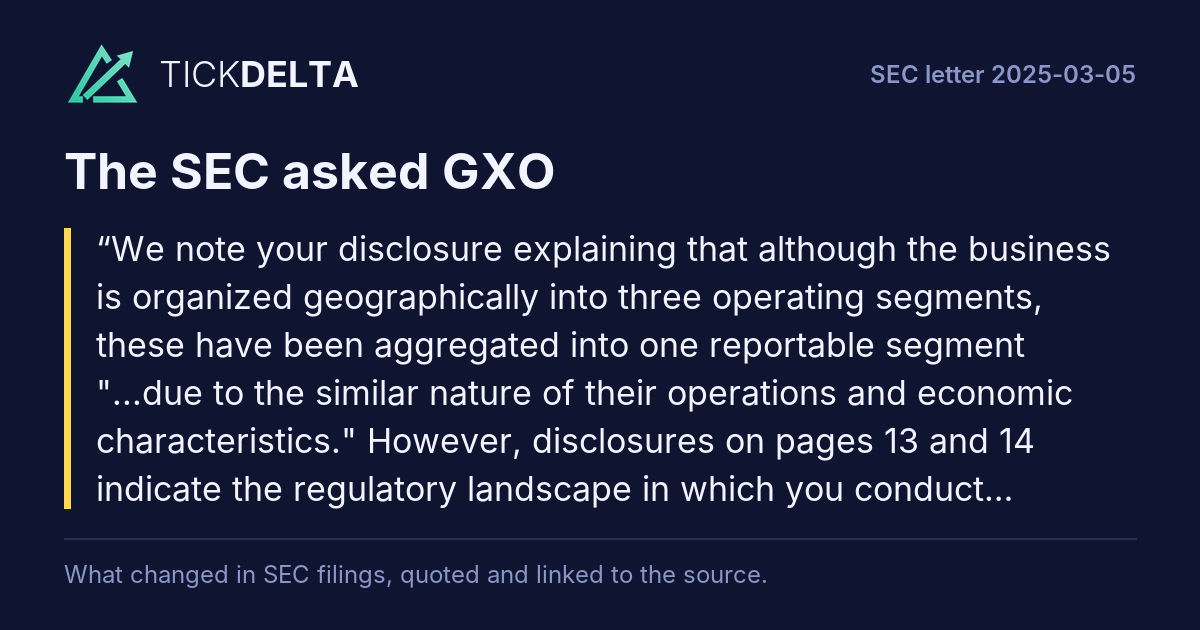
We note your disclosure explaining that although the business is organized geographically into three operating segments, these have been aggregated into one reportable segment "...due to the similar nature of their operations and economic characteristics." However, disclosures on pages 13 and 14 indicate the regulatory landscape in which you conduct operations is "constantly evolving and subject to significantRest of the question
change" which could require changes to your operating practices that would influence demand, or require that you incur significant additional costs that could adversely affect your results of operations. Please explain to us how you considered differences in the regulatory landscapes of each geographically differentiated segment, including the liklihood of change and susceptibility of operations to significant change in these regulatory environments, relative to the aggregation criteria in FASB ASC 280-10-50-11(e), and explain how you view the aggregation result as being consistent with the objectives set forth in FASB ASC 280-10-10-1, if this is your view. Please also address the disclosure requirements in FASB ASC 280-10-50-21(b) and 29(f), regarding the types of products and services from which reportable segments derive revenue, and how the CODM uses the Adjusted EBITDA segment measure in assessing segment performance and deciding how to allocate resources.
The Company respectfully acknowledges the Staff’s comments and provides these additional details. As it relates to ASC 280-10-50-11(e), we believe the regulatory environments of our three operating segments are sufficiently similar to support aggregation into a single reportable segment. The Company does not consider the countries in which its operating segments engage in business activities to be “heavily regulated,” such as banking, insurance, or public utilities.Read in the replyRest of the answer
The regulatory environments applicable to the Company’s operating segments essentially focus on protecting people, warehoused goods and the environment. This focus is primarily in the setup of our logistics hubs, the installation and maintenance of safety equipment, and the use of specific operational and safety processes. In addition, the training, operational and safety processes are substantially similar across regions. While the Company acknowledges that the regulatory landscape is subject to continuous evolution and may vary at a jurisdictional level, the core regulatory frameworks governing our operations do not materially differentiate between our three operating segments and do not result in significant differences in the nature of our operations or underlying costs of compliance. Also, although our risk factors discuss the potential risk that these regulatory factors could change in the future, at this time we are not aware of any potential changes in the regulatory landscape where we conduct operations that may require changes to our operating practices, influence demand, or require that we incur significant additional costs.
The Company believes that its aggregation of operating segments is consistent with the objectives and principles of segment reporting in ASC 280-10-10-1. The three operating segments have similar types of business activities and economic environments which supports aggregation consistent with ASC 280 and a disaggregation of geographic information would not provide users with additional information about the Company’s performance, cash flow prospects or the Company’s consolidated operations.
As it relates to the disclosure requirements in FASB ASC 280-10-50-21(b) regarding the types of products and services from which reportable segments derive revenue, the three operating segments provide the same services of managing customers’ warehouses and distribution centers in their respective geographies. The services provided—inventory management, order fulfillment, and supply chain optimization—do not differ by region. The following disclosure was included within Footnote 1 of our Form 10-K: The Company provides its customers with high-value-added warehousing and distribution, order fulfillment, e-commerce, reverse logistics and other supply chain services differentiated by its ability to deliver technology-enabled, customized solutions at scale.
In future filings, the Company will include the following underlined additional disclosure on how the chief operating decision maker (“CODM”) uses the Adjusted EBITDA segment measure in assessing segment performance and deciding how to allocate resources per the disclosure requirements in FASB ASC 280-10-50-29(f). The Company’s CODM uses Adjusted EBITDA to communicate performance targets to the segment managers, allocate resources to the segments, and to monitor segment performance. Additionally, the CODM considers the performance of this measure against planned and forecasted amounts to make investing and resource allocation decisions. The actual results are used in assessing performance of the Company and in establishing management’s compensation.
First report after the company's reply of Mar 18, 2025: 10-Q filed May 8, 2025 ↗, against the 10-Q filed Nov 5, 2024 ↗.
Tickdelta does not hold the text of both reports, so they are not compared here.
We note that your tax expense reconciliation includes a "Return to Provision" adjustment of ($12) million for 2024. Please expand your disclosure to explain how you determined the amount and to clarify the nature of the adjustment and whether it represents a change in estimate or a correction of an error, in your view. We note that your tax expense reconciliation, which begins with tax based on the U.S.Rest of the question
federal statutory tax rate of 21%, reflects "Foreign rate differential" adjustments having the effect of lowering your income tax expense by $11 million in 2024, $14 million in 2023, and $10 million in 2022. However, given your disclosures on page 44, indicating that 68% of revenues for 2024 were generated in the United Kingdom, Netherlands, France, Spain, and Italy, 4. where the corporate tax rates are about 25%, it appears that you should expand your disclosures in MD&A to discuss the primary taxing jurisdictions in which foreign earnings are derived, the corresponding statutory rates and any tax holidays, along with the factors that reduced your effective tax rate over the last three years. Please clarify how the adjustments reconcile with the higher corporate tax rates, describe any material changes in the corporate tax rates or the mix of income among jurisdictions that have impacted your effective tax rate, and your expectations regarding similar adjustments in future periods.
The Company respectfully acknowledges the Staff’s comments and provides these additional details. Return to Provision (“RTP”) adjustments are calculated each year by affiliates in each jurisdiction following the filing of income tax returns. The $12 million RTP adjustment for 2024 consists of $8 million of benefit from United Kingdom (“U.K.”) RTP adjustments and $4 million of benefit from United States (“U.S.”) RTP adjustments, all of which represent changes in estimates and are detailed as follows:Read in the reply
The U.K. RTP amount primarily relates to the Company having amended a U.K.Rest of the answer
corporate income tax return for one of its U.K. affiliates resulting in a benefit of approximately $8 million in 2024 as the information needed to determine the deductibility of certain asset expenditures became available during 2024. The Company was not able to ascertain the full extent of qualifying capital allowances for U.K. tax purposes at the time of the initial filing of the tax return as further analysis of these capital allowances needed to be performed by our tax advisors.
The U.S. RTP amount primarily relates to the Company making certain elections with its U.S. corporate income tax return to change the tax year-end of its foreign affiliates for U.S. tax purposes from November 30 to December 31 for consistency with the new OECD Country-by-Country Reporting rules and to better align with local statutory filings. These elections were not anticipated to be made at the time of preparing the initial provision. This resulted in a reduction of the Company’s Global Intangible Low-Taxed Income (“GILTI”) for a benefit of approximately $2 million. The remaining benefit from the U.S. RTP adjustments was attributable to various state and local jurisdictions, and the completion of the purchase price allocation related to an acquisition.
First report after the company's reply of Mar 18, 2025: 10-Q filed May 8, 2025 ↗, against the 10-Q filed Nov 5, 2024 ↗.
Tickdelta does not hold the text of both reports, so they are not compared here.
Also in this review: closing letter, 2025-03-31