Form 10-K
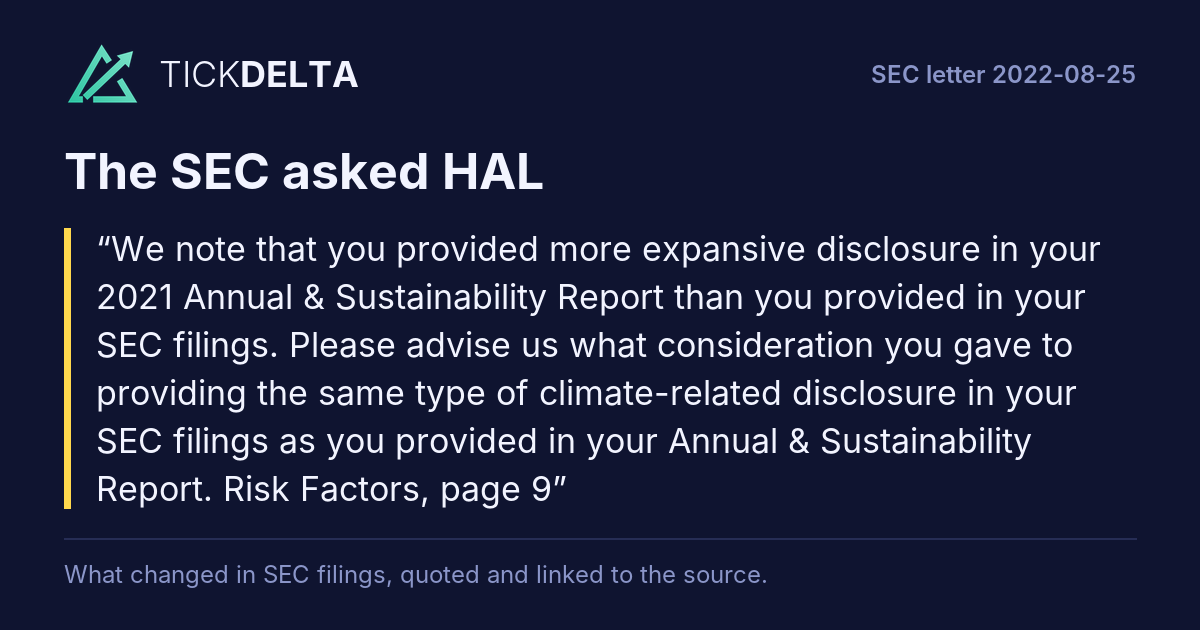
We note that you provided more expansive disclosure in your 2021 Annual & Sustainability Report than you provided in your SEC filings. Please advise us what consideration you gave to providing the same type of climate-related disclosure in your SEC filings as you provided in your Annual & Sustainability Report. Risk Factors, page 9
The disclosures in our 2021 Form 10-K and other Commission filings vary in scope to the disclosures in our 2021 Annual & Sustainability Report (the “ASR”) due to the different legal requirements, the varying purposes of the documents, investor expectations as to our 2021 Form 10-K (and other Commission filings), and stakeholder expectations as to the ASR.
We prepare the disclosures in our Commission filings, including climate-related matters, with reference to (i) Regulation S-K, (ii) the Commission’s general disclosure principle set forth in Rule 12b-20 of the Securities Exchange Act ofRead in the reply ↗Rest of the answer
1934, as amended, providing that, in addition to the disclosures expressly required to be included in Commission filings, registrants shall disclose such further material information, if any, as may be necessary to make the required disclosures not misleading and (iii) the Commission’s guidance. As such, our Commission filings provide disclosures regarding a particular event, transaction, trend, uncertainty, risk, impact, or other matter if it is material to, or is reasonably likely to have a material impact on, our business, financial condition, or results of operations, taking into account the size, scope, and nature of our business.
In contrast, our ASR covers matters that we believe are of interest to various stakeholders, even when we do not believe such matters could reasonably be expected to be material to an investor. These disclosures are not limited to, and go beyond, the disclosure requirements of Regulation S-K and the Commission’s general disclosure principle set forth in Rule 12b-20 of the Securities Exchange Act of 1934, as amended. Our ASR is intended to provide a broad range of information to stakeholders, many of whom are not investors, that may be relevant to their particular interests or concerns. In addition, although most of these climate-related and other ESG matters are not (and have historically not been) material to, or reasonably expected to be material to, our business, financial condition, or results of operations, we believe that such matters are of interest to some of our stakeholders, which is why we have chosen to voluntarily disclose these matters. The contents of our ASR are informed by, among other things, our shareholder outreach and engagement program, the feedback we receive from those shareholders and our other stakeholders, such as our employees and customers, the Task Force on Climate-Related Financial Disclosures, as well as our review of similar disclosures of other public companies, including our peers.
First report after the company's reply of 2022-09-09: 10-Q filed 2022-10-26 ↗, against the 10-Q filed 2022-07-22 ↗.
Tickdelta does not hold the text of both reports, so they are not compared here.
Disclose the material effects of transition risks related to climate change that may affect your business, financial condition, and results of operations, such as credit risks or technological changes.
The
Risk Factors section of our 2021 Form 10-K identifies a number of ways in which severe weather conditions, changing technology, and reductions in capital spending by our customers could materially impact our business, financial condition, or results of operations. We also face other risks, such as changing or softening demand, customer retention, attracting new customers and satisfying customer demands, and diminished demand for, or availability of, our services and products.Read in the reply ↗Rest of the answer
However, we believe that climate change transition considerations are not the only source of these types of risks and, given the nature of our operations and the actions we are proactively taking to reduce greenhouse gas emissions and promote sustainability in our operations, are not more significant than other factors that give rise to these types of risks. With respect to future Commission filings, we will continue to assess whether risks attributable to climate change related developments present unique risks that are material to our business, financial condition, or results of operations.
In addition, as disclosed on page 22 of our 2021 Form 10-K, we set a goal in 2021 to achieve a 40% reduction in Scope 1 and 2 greenhouse gas emissions by 2035 from the 2018 baseline. Over this fourteen-year period, we will continue to use innovation and technology in our services and products that improve energy efficiency to achieve our goal. We believe that the biggest risk that we face in connection with our emissions reduction goal is the risk that we will be unable to innovate in a timely, cost-efficient manner, or at all, which may materially and adversely affect our business, financial condition, results of operations, or cash flows if our customers turn to other suppliers for these services and products. This risk, which is not unique to climate change, is described in our 2021 Form 10-K on page 10 under the caption “Risk Factors – Industry Environment Related” in the risk factor entitled “If we are not able to design, develop and produce commercially competitive products and to implement commercially competitive services in a timely manner in response to changes in the market, customer requirements, competitive pressures, and technology trends, our business and consolidated results of operations could be materially and adversely affected, and the value of our intellectual property may be reduced.”
We do not otherwise anticipate that any material credit risks or technological changes would arise from our emissions reduction goal and other risks listed above, although we will continue to evaluate that judgment as policy and regulatory changes and market trends evolve.
First report after the company's reply of 2022-09-09: 10-Q filed 2022-10-26 ↗, against the 10-Q filed 2022-07-22 ↗.
Tickdelta does not hold the text of both reports, so they are not compared here.
Disclose any material litigation risks related to climate change and explain the potential impact to the company.
We are not, and have not been, a party to any pending legal proceedings related to climate change that require disclosure under Item 103 of Regulation S-K, and we have no indications that there will be climate change related litigation involving the Company in the future. Therefore, we concluded it was not necessary to disclose potential litigation risk related to climate change in our 2021 Form 10-K, and do not anticipate such disclosure in our future Commission filings at this time.Read in the reply ↗Rest of the answer
Nonetheless, as we evaluate our risk-factor disclosures in our future Commission filings, we will adjust them as necessary to reflect the potential for future litigation risks, changes in regulations, and risks of noncompliance with rules and regulations related to climate change.
First report after the company's reply of 2022-09-09: 10-Q filed 2022-10-26 ↗, against the 10-Q filed 2022-07-22 ↗.
Tickdelta does not hold the text of both reports, so they are not compared here.
We note your goal to reduce your carbon footprint and the environmental impact of your operations on page 22 of your Form 10-K. Please revise your disclosure to identify any material past and/or future capital expenditures for climate-related projects.Rest of the question
Provide quantitative information for each of the periods for which financial statements are presented in your Form 10-K and for any future periods as part of your response.
As we strive to develop innovative new services and products, we aim to address a myriad of challenges facing our customers and the energy industry at large, including, among others, personnel shortages, safety, and cost efficiencies. Environmental considerations, including energy efficiency, climate-related considerations, and sustainability matters, are also considered in planning our capital expenditures.Read in the reply ↗Rest of the answer
However, we have not historically undertaken projects, or consequently made material capital expenditures, during the periods reported in our 2021 Form
10-K solely for climate-related reasons.
Our ongoing focus on efficient and reliable operations may lead to environmental and other benefits, including lessening the impact of our customers’ operations on the environment and lowering operating costs. For example, our NeoCem™ cement system reduces the amount of Portland cement that would otherwise be required in a wellbore isolation barrier. This cement system is not only more cost efficient for our customer than the traditional alternative, but also reduces the customer’s carbon footprint because of the air pollutants associated with the manufacturing and transportation of Portland cement. Another example of innovation that has resulted in a similar mix of benefits to our customers is our BaraHib™ Gold high-performance water-based drilling mud. This mud eliminates the need for containment, transportation, and treatment of oily cuttings onshore and has a longer run life than typical water-based fluids, resulting in significant cost savings to the customer. BaraHib™ Gold also contains fewer industrially produced materials, making it more sustainable for our customers. We also offer all-electric fracturing capabilities using our second-generation Zeus™ electric pumping unit, ExpressBlend™ electric blending system, eWinch™ electric wireline unit, and an electric Tech Command Center. All of this equipment can be run on electric power that is, either generated using natural gas or supplied by way of the electricity grid. This suite of tools decreases fuel costs for the customer, reduces noise significantly, reduces the footprint of operations, decreases non-productive time, and lowers emissions for both us and the customer.
In addition to these services and products, we are focused on using our existing technologies in renewable energy applications, which allows us to have a positive environmental impact without incurring significant innovation costs.
As disclosed in our Commission filings, we set a goal in 2021 to achieve a 40% reduction in Scope 1 and 2 greenhouse gas emissions by 2035 from the 2018 baseline. We are refining action plans to achieve this goal, and we may incur climate-related capital expenditures for projects in connection with such actions. For the periods covered by our 2021 Form
10-K, we did not incur any material capital expenditures solely for climate-related projects. To the extent any capital expenditures for climate-related projects in the future are material, we will provide appropriate disclosure (in accordance with applicable legal requirements) in our future Commission filings.
First report after the company's reply of 2022-09-09: 10-Q filed 2022-10-26 ↗, against the 10-Q filed 2022-07-22 ↗.
Tickdelta does not hold the text of both reports, so they are not compared here.
To the extent material, please discuss the indirect consequences of climate-related regulation or business trends as they relate to your services and products, such as the following: • decreased demand for goods or services that produce significant greenhouse gas emissions or are related to carbon-based energy sources; • increased demand for goods or services that result in lower emissions than competing products; •Rest of the question
increased competition to develop innovative new products that result in lower emissions (e.g., low-carbon solutions); and • any anticipated reputational risks resulting from your operations or products that produce material greenhouse gas emissions.
In preparing our 2021 Form 10-K, we considered the indirect consequences of climate-related regulation and business trends on our business, financial condition, and results of operations and describe in our Form 10-K the types of impacts that climate-related regulation and business trends could potentially have on them in the future.Read in the reply ↗Rest of the answer
For example, we disclosed on page 14 of the 2021 Form 10-K under the caption “Risk Factors – Laws and
Regulations Related” in the risk factor entitled “Existing or future laws, regulations, treaties, or international agreements related to greenhouse gases, climate change, and alternative energy sources could have a negative impact on our business and may result in additional compliance obligations that could have a material adverse effect on our business, consolidated results of operations, and consolidated financial condition,” that we are closely following developments in relation to the United States formally re-joining the Paris Agreement, though we noted that at the time of preparing the 2021 Form 10-K we could not predict how or when our business would be impacted as a result of any such developments. In addition, we disclosed on page 9 of the 2021 Form 10-K under the caption “Risk Factors – Industry
Environment Related” in the risk factor entitled “Trends in oil and natural gas prices affect the level of exploration, development, and production activity of our customers and the demand for our services and products, which could have a material adverse effect on our business, consolidated results of operations, and consolidated financial condition,” that an increased emphasis on decarbonization, including government initiatives to promote the use of renewable energy sources and public sentiment around alternatives to oil and gas, could affect the price of oil and natural gas and, as a result, demand for our services and goods. Fundamentally, however, oil and natural gas are global commodities, the prices of which are subject to large fluctuations in response to relatively minor changes in related supply and demand, market uncertainty, and a variety of other economic and political factors, including, among others: the ability or willingness of the
Organization of Petroleum Exporting Countries to set and maintain oil production levels; the cost of, and constraints associated with, producing and delivering oil and natural gas; and weather conditions, natural disasters, and health or similar issues, such as pandemics or epidemics. We determined in preparing our Form 10-K that the consequences of climate-related regulation and business trends, including those listed in the Staff’s comment 5, did not have a material impact on our business, financial condition, or results of operations.
As described on page 22 of our 2021 Form 10-K, we pursue strategic initiatives around advancing cleaner, affordable energy, and using innovation and technology to reduce the environmental impact of producing oil and gas. We are continuing to develop and deploy low-carbon solutions to help oil and gas operators lower their current emissions profiles while also using our existing technologies in renewable energy applications. Although these actions are important to us, they have not been associated with material impacts related to the items listed in the Staff’s comment 5. We will continue to evaluate these initiatives and our other efforts toward achieving our public sustainability and emissions goals, together with the impacts of climate-related regulation or business trends, in preparing our future periodic reports, and will provide additional disclosure in future filings if those matters become or are reasonably expected to become material.
First report after the company's reply of 2022-09-09: 10-Q filed 2022-10-26 ↗, against the 10-Q filed 2022-07-22 ↗.
Tickdelta does not hold the text of both reports, so they are not compared here.
We note your disclosure on page 10 of your Form 10-K regarding the effect of global climate change on weather conditions. If material, please revise your disclosure to include the following: • quantification of material weather-related damages to your property or operations; • potential for indirect weather-related impacts that have affected or may affect your major customers or suppliers; and • any weather-relatedRest of the question
impacts on the cost or availability of insurance. Your response should include quantitative information for each of the periods covered by your Form 10-K.
should include quantitative information for each of the periods covered by your Form
10-K.
Response: Halliburton has experienced weather events such as hurricanes, tornadoes, hailstorms, flooding, and winter snow/ice storms in certain markets that impacted our operations. Each of these weather events has been local in nature and has affected only a subset of our markets. We have not sustained any weather-related events in the past three fiscal years that have had a material impact on our financial condition.Read in the reply ↗Rest of the answer
For example, in the year ended December 31, 2021, we sustained damage from Hurricane Ida at Port Fourchon in Golden Meadow,
Louisiana, with an estimated loss of approximately $[***] on a gross claim basis and approximately $[***] after insurance recoveries. For the year ended December 31, 2020, we sustained damage from Hurricane Laura at our Westlake and Cameron, Louisiana locations, with an estimated loss of approximately $[***] on a gross claim basis and approximately $[***] after insurance recoveries. For the year ended December 31, 2019, we did not experience an extreme weather event that resulted in a reportable insurance claim for damage to our property or operations. Weather impacts typically result in temporary delays, such as short-term closures in the affected markets, with no long-term sustained impact. In addition, because the nature and timing of extreme weather events (such as increased frequency, duration and severity) are uncertain, it is not possible for us to estimate reliably the future financial risk to our operations caused by these potential physical risks.
We do not believe that weather-related impacts have affected our major customers or suppliers other than temporary delays in production that were limited to the affected markets or individual communities. Because weather-related disruptions are typically local in nature, we do not believe that a weather event is likely to impact the global supply chain in a material way.
We maintain property insurance coverage against weather-related risks in accordance with what we believe are customary industry practices and in amounts and at costs that we believe to be prudent and commercially practicable. We annually review our insurance coverage and no insurance provider has declined to renew property insurance coverage in any of the policy periods covered by our
2021 Form 10-K due to our loss history (weather-related or otherwise). Specifically, for the policy periods corresponding to the years covered by our Form 10-K, our property insurance premiums were: (i) for 2019, approximately $[***], (ii) for 2020, approximately $[***], and (iii) for 2021, approximately $[***]. In addition, our base deductible has been $[***] per occurrence over this period. We expect that our insurance premiums will continue to align with the market in future years.
First report after the company's reply of 2022-09-09: 10-Q filed 2022-10-26 ↗, against the 10-Q filed 2022-07-22 ↗.
Tickdelta does not hold the text of both reports, so they are not compared here.
We note your disclosures on pages 13 and 14 of your Form 10-K regarding compliance with environmental laws and regulations. Please tell us about and quantify compliance costs related to climate change for each of the periods for which financial statements are presented in your Form 10-K and whether increased amounts are expected to be incurred in future periods.
Although we incur costs related to compliance with government regulations and other regulatory requirements, we have not to date incurred any direct or indirect compliance costs related to climate change. For example, and as noted in our 2021 Form 10-K on pages 13-14, we incur compliance costs associated with regulatory requirements concerning, among others, the containment and disposal of hazardous substances, oilfield waste, and other waste materials, but we view these costs as health, safety, and environmental compliance costs rather than climate-related or climate-focused costs.Read in the reply ↗Rest of the answer
Although we expect that our compliance costs related to climate change will increase in the future due to increased climate regulation, we are unable to quantify such compliance costs with any reasonable degree of precision at this time. To the extent that we incur increased compliance costs related to climate change that are material and separately quantifiable in future years, we will provide appropriate disclosure (in accordance with applicable legal requirements) regarding such increased costs in our future Commission filings.
First report after the company's reply of 2022-09-09: 10-Q filed 2022-10-26 ↗, against the 10-Q filed 2022-07-22 ↗.
Tickdelta does not hold the text of both reports, so they are not compared here.
If material, provide disclosure about your purchase or sale of carbon credits or offsets and any material effects on your business, financial condition, or results of operations. Please ensure you provide quantitative information with your response for each of the periods covered by your Form 10-K and for any future periods.
In fiscal year 2021 (and in prior fiscal years), Halliburton did not purchase or sell any carbon credits or offsets. Currently, Halliburton has not included amounts for the purchase or sale of carbon credits or offsets in its 2022 annual budget and does not presently anticipate doing so in future periods.Read in the reply ↗Rest of the answer
To the extent in any future fiscal year or fiscal quarter thereof our purchases or sales of carbon credits or offsets are material to our business, financial condition, or results of operations, we will provide appropriate disclosure in accordance with applicable legal requirements regarding such transactions.
First report after the company's reply of 2022-09-09: 10-Q filed 2022-10-26 ↗, against the 10-Q filed 2022-07-22 ↗.
Tickdelta does not hold the text of both reports, so they are not compared here.
We note your response to prior comment 2 states that climate change transition considerations are not the only source of technology transition risks and are not more significant than other factors that give rise to these types of risks.Rest of the question
In that regard, your response indicates that climate change technology transition risks are mitigated by your emissions reduction goal and that technology risks related to such goal are not unique to climate change. Please explain with greater specificity how you assessed climate change technology transition risks and credit risks as opposed to other risks for purposes of disclosure in your SEC filings.
The Company has disclosure controls and procedures to proactively monitor and respond to potential risks to our business and industry, which we then evaluate in relation to the Company’s disclosure in our Commission filings. As noted in our Initial Response Letter, we believe that one of the significant risks that we face in energy transition is that we will be unable to innovate in a timely, cost-efficient manner, or at all.Read in the reply ↗Rest of the answer
The overall risk related to innovation in our business is described in our 2021 Form 10-K on page 10 under the caption “Risk Factors
– Industry Environment Related” in the risk factor entitled “If we are not able to design, develop and produce commercially competitive products and to implement commercially competitive services in a timely manner in response to changes in the market, customer requirements, competitive pressures, and technology trends, our business and consolidated results of operations could be materially and adversely affected, and the value of our intellectual property may be reduced.” In order to make it more clear that climate change and energy transition are included in these factors (e.g., customer requirements, competitive pressures and technology trends), we propose modifying this risk factor in our future
Form 10-K filings (beginning with our Form 10-K for the Fiscal Year ended December 31, 2022 that will be filed with the Commission via the
Commission’s EDGAR system in February 2023 (the “2022 Form 10-K”)) by adding the underlined text as follows (subject to final internal review and revision):
If we are not able to design, develop and produce commercially competitive products and to implement commercially competitive services in a timely manner in response to changes in the market, customer requirements, competitive pressures, developments associated with climate change concerns and energy transition, and technology trends, our business and consolidated results of operations could be materially and adversely affected, and the value of our intellectual property may be reduced.
The market for our services and products is characterized by continual technological developments to provide better and more reliable performance and services. If we are not able to design, develop, and produce commercially competitive products and to implement commercially competitive services in a timely manner in response to changes in the market, customer requirements, competitive pressures, developments associated with climate change concerns and energy transition, and technology trends, our business and consolidated results of operations could be materially and adversely affected, and the value of our intellectual property may be reduced. Likewise, if our proprietary technologies, equipment, facilities, or work processes become obsolete, we may no longer be competitive, and our business and consolidated results of operations could be materially and adversely affected.
As noted in our Initial Response Letter, we do not anticipate that any material credit risks would arise from the energy transition, although we will continue to evaluate that judgment as policy and regulatory changes and market trends evolve. For the period covered by the 2021 Form 10-K, we did not encounter any issues accessing capital. In April of 2022, we refinanced our revolving credit facility and maintained the $3.5 billion capacity for five years under substantially the same terms and conditions as the previous facility. Though we monitor developments in relation to capital providers reducing exposure to companies associated with the oil and gas industry as a result of climate change concerns and energy transition, we do not believe it is likely that those concerns will have a significant impact on our ability to access capital for the foreseeable future. Nonetheless, as we evaluate our risk-factor disclosures in our future Commission filings, we will adjust them as appropriate to reflect the potential for future credit risks to the Company related to climate change and energy transition.
First report after the company's reply of 2022-10-04: 10-Q filed 2022-10-26 ↗, against the 10-Q filed 2022-07-22 ↗.
Tickdelta does not hold the text of both reports, so they are not compared here.
We note your response to prior comment 5. However, it does not appear that you have addressed the specific elements of our prior comment or explained the basis for your conclusion regarding materiality. Please explain in greater detail how you considered providing disclosure regarding the following indirect consequences of climate-related regulations or business trends: • decreased demand for goods or services thatRest of the question
produce significant greenhouse gas emissions or are related to carbon-based energy sources; • increased demand for goods or services that result in lower emissions than competing products; • increased competition to develop innovative new products that result in lower emissions; and • any anticipated reputational risks resulting from your operations or products that produce material greenhouse gas emissions.
In response to the Staff’s request for additional detail as to our consideration of the factors listed in the comment above, we would note the following for each:
As noted in our Initial Response Letter, we describe on page 9 of the 2021 Form 10-K under the caption “Risk Factors – Industry Environment Related” in the risk factor entitled “Trends in oil and natural gas prices affect the level of exploration, development, and production activity of our customers and the demand for our services and products, which could have a material adverse effect on our business, consolidated results ofRead in the reply ↗Rest of the answer
operations, and consolidated financial condition,” that an increased emphasis on decarbonization, including government initiatives to promote the use of renewable energy sources and public sentiment around alternatives to oil and gas, could affect the price of oil and natural gas and, as a result, demand for our services and goods. We considered these potential developments in light of global projected population growth trends and the challenges in developing other sources of affordable, efficient, and reliable energy, and on balance believe that the need for oil and gas exploration and development and, as a result, demand for our services and goods, will continue for the foreseeable future. As a result, following deliberation of these considerations within our Disclosure Committee framework, we determined in preparing our 2021 Form 10-K that the indirect consequences of climate-related regulation and business trends did not have a material impact on our business, financial condition, or results of operations. We continue to monitor these factors and will update our risk factor disclosure in future Commission filings as appropriate if circumstances change.
As discussed earlier in this response to comment #2, we expect that the need for oil and gas exploration and development and, as a result, our services, will continue for the foreseeable future. We also believe that the potential increased demand for products and services that result in lower emissions than competing products creates opportunity for
Halliburton. We continue to evaluate the transition opportunities related to our low-carbon products and services solutions, including those discussed in our Initial Response Letter. For example, we discussed in our Initial Response Letter, our NeoCem™ cement system and our all-electric fracturing capabilities. If demand for products such as NeoCem™ and services such as all-electric fracturing increases, we are well-positioned to meet our customers’ needs.
We determined in preparing our 2021 Form 10-K that the indirect consequences of climate-related regulation and business trends, including an increased demand for products or services that result in lower emissions than our competing products and services, did not have a material impact on our business, financial condition, or results of operations.
As discussed in response to comment #1, we acknowledge that one of the significant risks that we face in energy transition generally is the risk that we will be unable to innovate technologically in a timely, cost-efficient manner, or at all. Although this risk was disclosed in our 2021 Form 10-K, as noted in our response to comment #1, we will modify our disclosure beginning in our 2022 Form 10-K to note that it is also an energy transition-related risk for the Company.
We closely monitor public perception of the Company and its reputation and, in that regard, note that some of our stakeholders are interested in learning more about our ESG-related goals and progress. Our Annual & Sustainability Report is published in part to address this interest. As noted on page 22 of our 2021 Form 10-K, we pursue strategic initiatives around advancing cleaner, affordable energy, and using innovation and technology to reduce the environmental impact of producing oil and gas. We strive to be good stewards in our industry, and we believe that our stakeholders value our leadership in this regard. While we believe our 2021 Form 10-K risk factors and disclosure were complete and accurate, we do acknowledge risks related to ESG initiatives and disclosures, could increase over time. Our reputational risks may continue to evolve, and we will update our risk factors if our material risks change.
First report after the company's reply of 2022-10-04: 10-Q filed 2022-10-26 ↗, against the 10-Q filed 2022-07-22 ↗.
Tickdelta does not hold the text of both reports, so they are not compared here.
We note your response to prior comment 6 states that you do not believe that a weather event is likely to impact the global supply chain in a material way. Please tell us how you considered the possible consequences to you from weather-related disruptions to your customers and suppliers as part of your risk factor titled "Constraints in the supply of, prices for and availability of transportation of raw materialsRest of the question
can have a material adverse effect on our business and consolidated results of operations" on page 11 of your Form 10-K and your risk factor titled "If we lose one or more of our significant customers or if our customers delay paying or fail to pay a significant amount of our outstanding receivables, it could have a material adverse effect on our business, consolidated results of operations, and consolidated financial condition" on page 17 of your Form 10-K. Please contact Michael Purcell at 202-551-5351 or Karina Dorin at 202-551-3763 with any questions.
As discussed in our Initial Response Letter, we do not believe that weather-related impacts have affected our major customers or suppliers other than temporary delays in production that were limited to the affected markets or individual communities. When we experience supply constraints, they are typically demand driven and associated with increases in activity by our customers. We closely monitor the Company’s supply chain and note that none of our major suppliers have experienced a material weather-related disruption or weather-related supply chain constraint.Read in the reply ↗Rest of the answer
We believe that, due to our diversified supply chain and broad distribution of major customers and suppliers, any weather-related disruption in our supply chain would not materially disrupt our operations. In addition, due to the fact that the nature and timing of weather events are uncertain, it is not possible for us to estimate reliably the future financial risk to our major customers or suppliers caused by these potential physical risks.
With respect to the second risk factor referenced in the Staff’s comment, payment delays or failures to pay by significant customers can arise in a number of circumstances, typically during cyclical downturns in the oil and gas industry or when a customer is facing liquidity issues that may be attributable to poor operating performance. As we evaluate our risk-factor disclosures in our future Commission filings, we will adjust them as necessary in light of the circumstances to reflect the potential for future supply chain impacts and customer impacts related to weather events.
First report after the company's reply of 2022-10-04: 10-Q filed 2022-10-26 ↗, against the 10-Q filed 2022-07-22 ↗.
Tickdelta does not hold the text of both reports, so they are not compared here.
We note your response to prior comment 2 states that you monitor public perception of the Company and its reputation and that some of your stakeholders are interested in learning more about your ESG-related goals. However, your response does not address any anticipated reputational risks resulting from your operations or products that produce greenhouse gas emissions.Rest of the question
Please tell us what consideration you gave to including disclosure regarding any anticipated climate-related reputational risks, including those that relate to being a provider of products and services to the energy industry.
As discussed in response to prior comment 2 in our Response Letter, we monitor our reputation, whether positive or negative, by engaging with our broad stakeholder base that includes, among others, investors, customers, suppliers and employees. Informed by that engagement, we consider how our reputation, and any changes to sentiment about our reputation, whether related to our work in the oil and gas business or otherwise, may impact our business, financial results, results of operations and access to capital.Read in the reply ↗Rest of the answer
We have addressed in our Risk Factors how public sentiment and investor perceptions about the oil and gas industry change and may negatively impact the oil and gas industry and us. In addition, our sustainability and climate reporting helps reduce the likelihood of experiencing reputational risks as compared to other companies that may not provide as much information as often as we do. For example, we believe that our stakeholder base has responded favorably to our goal to achieve a 40% reduction in Scope 1 and 2 greenhouse gas emissions by 2035 from the 2018 baseline.
In consideration of the above factors, during the periods covered by the 2021 Form 10-K, we determined that the climate-related reputational risks associated with our role as a provider of products and services to the energy industry did not have a material impact on the Company’s financial condition or results of operations. We acknowledge that our reputational risks may evolve, and we will continue to monitor these risks and update our risk factors if our material risks change.
First report after the company's reply of 2022-10-28: 10-K filed 2023-02-07 ↗, against the 10-K filed 2022-02-04 ↗.
Tickdelta does not hold the text of both reports, so they are not compared here.
Also in this review: closing letter, 2022-11-02