Paragraph 171 · 49% changed
Every version of it
Screener
/
SEC EDGAR
/CIK 0001159036
/10-K filed Feb 17, 2026, compared with Feb 18, 2025
/Numbers from the XBRL of the 10-Ks
Nasdaq
Health care · Biotechnology
Halozyme Therapeutics, Inc. HALO
The 10-K against last year's
121 changes: 41 added, 20 removed, 60 reworded
10-K Feb 17, 2026 vs Feb 18, 2025
Risk Factors
7.4%
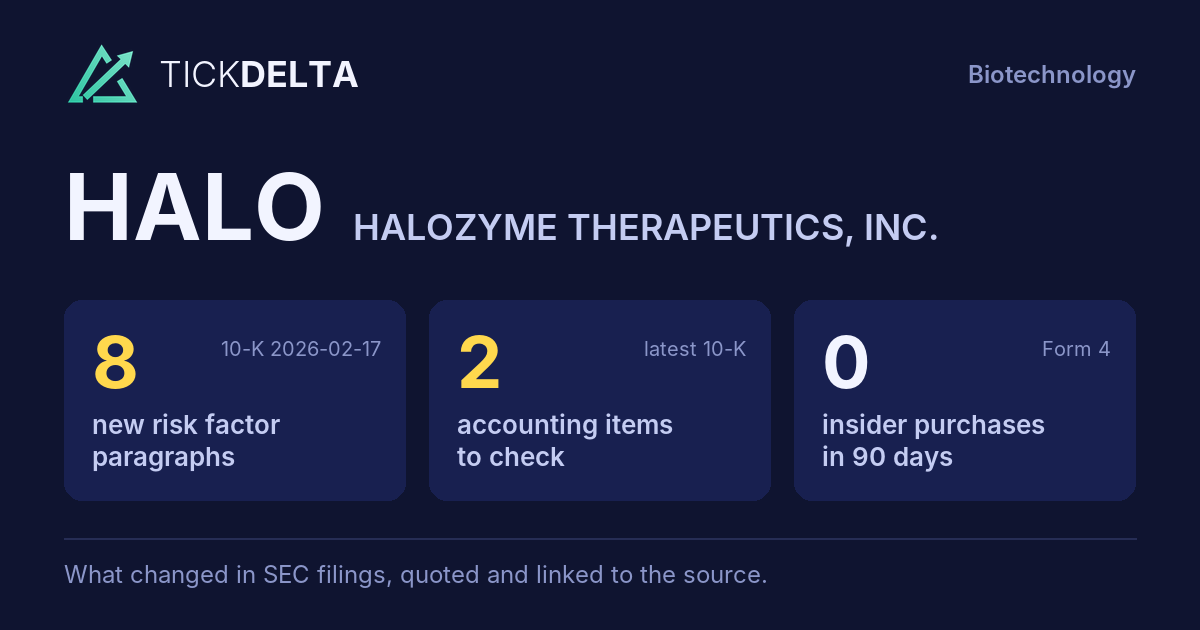
of the text changed · 15,969 words now · 8 new paragraphs, 1 gone
MD&A
41.1%
of the text changed · 9,111 words now · 33 new paragraphs, 19 gone
Legal Proceedings
4.8%
of the text changed · 309 words now
Accounting Policies
12.0%
of the text changed · 8,712 words now
10-K 0001159036-26-000024 (Feb 17, 2026) vs 10-K 0001159036-25-000010 (Feb 18, 2025)
Every paragraph, and how much of it changed
One bar per paragraph, in the order of the 10-K. Height and colour show the share of its words not in the closest paragraph a year earlier; the tallest bars are new paragraphs.
Risk Factors
188 paragraphs · 8 new · 21 reworded · 1 gone · 10-K Feb 17, 2026 against Feb 18, 2025
New paragraph
Reworded (5% of its words or more)
Same or nearly
Paragraph 170 · 48% changed
Every version of it
The federal administration and/or agencies, such as the Centers for Medicare & Medicaid Services, or CMS, Services (“CMS”), have announced a number of demonstration projects, recommendations and proposals to implement various elements described in the drug pricing blueprint. CMS, the federal agency responsible for administering Medicare and overseeing state Medicaid programs and Health Insurance Marketplaces, has substantial power to implement policy changes or demonstration projects that can quickly and significantly affect how drugs, including our partners’ products, are covered and reimbursed. For example, In May 2025, an Executive Order was issued calling on pharmaceutical manufacturers to voluntarily reduce the prices of medicines in November 2020, former President Trump announced the interim final rule U.S. The Executive Order directs the Secretary of the Department of Health and Human Services (“HHS”) to implement the communicate Most Favored Nations drug pricing model seeking (“MFN”) price targets to tie Medicare payment rates to an international index price. This final rule was subsequently rescinded by CMS. Additionally, a number of Congressional committees have also held hearings and evaluated proposed legislation on drug pricing and payment policy which may affect our business. For example, in July 2019, the Senate Finance Committee advanced a bill that in part would penalize pharmaceutical manufacturers for increasing drug list to bring prices covered by Medicare Part B and Part D, faster than in line with comparably developed nations. The Executive Order further provides that if such actions do not lower the rate costs of inflation, and cap out-of-pocket expenses for Medicare Part D beneficiaries. Several pharmaceuticals, the Secretary of the HHS shall pursue other proposals have been introduced that, if enacted and implemented, could affect access to and sales of our and our partners’ products, allow actions, including proposing a rulemaking that imposes MFN pricing in the federal government to engage in price negotiations on certain drugs, and allow importation of prescription medication from Canada or other countries. For example, in August 2022, “The Inflation Reduction Act of 2022” was enacted which will, among other things, allow and require the federal government to negotiate prices for some drugs covered under Medicare Part B and Part D, require drug companies to pay rebates to Medicare if prices rise faster than inflation for drugs used by Medicare beneficiaries and cap out-of-pocket spending for individuals enrolled in Medicare Part D. U.S.
Paragraph 132 · 41% changed
Every version of it
Paragraph 52 · 38% changed
Every version of it
Paragraph 162 · 26% changed
Every version of it
Patent protection in general, including for protein-based products is based on evolving complex legal principles and factual questions, which introduce uncertainties as to patentability, patent scope, validity and enforcement. In recent years, there have been significant changes in patent law, including the legal standards that govern the patentability and scope of biotechnology patents. Recent court decisions have made it more difficult to obtain patents, by making it more difficult to satisfy the patentable subject matter requirements, disclosure and enablement requirements, and the non-obviousness requirement; decreasing the availability of injunctions against infringers; and increasing the likelihood of challenging the validity of a patent through a declaratory judgment action. Taken together, these decisions could make it more difficult and costly for us to obtain, license and enforce our patents. In addition, patents may be challenged through post-grant opposition proceedings and be subject to a prior user defense to infringement. There also have been, and continue to be, policy discussions concerning the scope of patent protection, including for biotechnology inventions. Social and political opposition to biotechnology patents may lead to narrower patent protection within the biotechnology industry. Judicial and legislative changes introduce significant uncertainty in the patent law landscape and may potentially negatively impact our ability to procure, maintain and enforce patents to provide exclusivity for our products and may allow others to use our discoveries to develop and commercialize competitive products, which could impair our business.
Paragraph 42 · 21% changed
Every version of it
In particular, regulatory requirements applicable to pharmaceutical products make the substitution of suppliers and manufacturers costly and time consuming. We have minimal internal manufacturing capabilities and are, and expect to be in the future, substantially dependent on contract manufacturers and suppliers for the manufacture of our products and for their active and other ingredients. The disqualification of these manufacturers and suppliers through their failure to comply with regulatory requirements could negatively impact our business because the delays and costs in obtaining and qualifying alternate suppliers (if such alternative suppliers are available, which we cannot assure) could delay our or our partners’ clinical trials or otherwise
Paragraph 51 · 18% changed
Every version of it
Public health crises such as pandemics or similar outbreaks could adversely impact our business and results of operations by, among other things, disrupting the development of our and our partnered product candidates and commercialization of our and our partnered approved products, causing disruptions in the operations of our third-party contract manufacturing organizations upon whom we rely for the production and supply of our proprietary products, including Hylenex and the bulk rHuPH20 we supply to our partners, and causing other disruptions to our operations.
Paragraph 43 · 18% changed
Every version of it
requirements could negatively impact our business because the delays and costs in obtaining and qualifying alternate suppliers (if such alternative suppliers are available, which we cannot assure) could delay our or our partners’ clinical trials or otherwise inhibit our or partners’ ability to bring approved products to market, which would have a material adverse effect on our business and financial condition. Likewise, if we, our partners and our respective contractors, suppliers and vendors involved in sales and promotion of our products do not comply with applicable laws and regulations, for example off-label or false or misleading promotion, this could materially harm our business and financial condition.
Paragraph 171 · 49% changed
Every version of it
10-K Feb 18, 2025The federal administration and/or agencies, such as the Centers for Medicare & Medicaid Services, or CMS, have announced a number of demonstration projects, recommendations and proposals to implement various elements described in the drug pricing blueprint. CMS, the federal agency responsible for administering Medicare and overseeing state Medicaid programs and Health Insurance Marketplaces, has substantial power to implement policy changes or demonstration projects that can quickly and significantly affect how drugs, including our products, are covered and reimbursed. For example, in November 2020, former President Trump announced the interim final rule to implement the Most Favored Nations drug pricing model seeking to tie Medicare payment rates to an international index price. This final rule was subsequently rescinded by CMS. Additionally, a number of Congressional committees have also held hearings and evaluated proposed legislation on drug pricing and payment policy which may affect our business. For example, in July 2019, the Senate Finance Committee advanced a bill that in part would penalize pharmaceutical manufacturers for increasing drug list prices covered by Medicare Part B and Part D, faster than the rate of inflation, and cap out-of-pocket expenses for Medicare Part D beneficiaries. Several other proposals have been introduced that, if enacted and implemented, could affect access to and sales of our and our partners’ products, allow the federal government to engage in price negotiations on certain drugs, and allow importation of prescription medication from Canada or other countries. For example, in August 2022, “The Inflation Reduction Act of 2022” was enacted which will, among other things, allow and require the federal government to negotiate prices for some drugs covered under Medicare Part B and Part D, require drug companies to pay rebates to Medicare if prices rise faster than inflation for drugs used by Medicare beneficiaries and cap out-of-pocket spending for individuals enrolled in Medicare Part D.
10-K Feb 17, 2026
Additionally, a number of Congressional committees have also held hearings and evaluated proposed legislation on drug pricing and payment policy which may affect our business. Legislative proposals have been introduced that, if enacted and implemented, could affect access to and revenue from our partners’ products, allow the federal government to engage in price negotiations on certain drugs, and allow importation of prescription medication from Canada or other countries. For example, in August 2022, The Inflation Reduction Act of 2022 (the “IRA”) was enacted which will, among other things, allow and require the federal government to negotiate prices for some drugs covered under Medicare Part B and Part D, require drug companies to pay rebates to Medicare if prices rise faster than inflation for drugs used by Medicare beneficiaries and cap out-of-pocket spending for individuals enrolled in Medicare Part D. In May 2025, CMS issued draft guidance for 2028 price controls under the IRA that creates uncertainty as to whether combination therapies, such as our partners’ ENHANZE products, will be protected from IRA price negotiations for thirteen years following approval of the combination therapy. In September 2025, following a review of comments submitted in response to the draft guidance, CMS issued final guidance for 2028 price controls under the IRA, indicating that due to the complexity and scope of this issue, CMS believes additional time is necessary to develop objective policy criteria if CMS were to finalize such a policy, and thus did not make a change to the fixed combination drug policy. CMS indicated it intends to continue to consider the appropriate policy to implement in rulemaking beginning in initial price applicability year 2029. For initial price applicability year 2028, CMS will maintain its approach to fixed combination drugs which states that if a drug is a fixed combination drug with two or more active moieties / active ingredients, the distinct combination of active moieties / active ingredients will be considered as one active moiety / active ingredient for the purpose of identifying potential qualifying single source drugs. A product containing only one (but not all) of the active moieties / active ingredients that is offered by the same New Drug Application / Biologics License Application holder will not be aggregated with the formulations of the fixed combination drug and will be considered a separate potential qualifying single source drug. Section 30.1 of this final guidance details how CMS intends to treat fixed combination drugs and gives an example to illustrate the application.
Paragraph 170 · 48% changed
Every version of it
10-K Feb 18, 2025
The federal administration and/or agencies, such as the Centers for Medicare & Medicaid Services, or CMS, have announced a number of demonstration projects, recommendations and proposals to implement various elements described in the drug pricing blueprint. CMS, the federal agency responsible for administering Medicare and overseeing state Medicaid programs and Health Insurance Marketplaces, has substantial power to implement policy changes or demonstration projects that can quickly and significantly affect how drugs, including our products, are covered and reimbursed. For example, in November 2020, former President Trump announced the interim final rule to implement the Most Favored Nations drug pricing model seeking to tie Medicare payment rates to an international index price. This final rule was subsequently rescinded by CMS. Additionally, a number of Congressional committees have also held hearings and evaluated proposed legislation on drug pricing and payment policy which may affect our business. For example, in July 2019, the Senate Finance Committee advanced a bill that in part would penalize pharmaceutical manufacturers for increasing drug list prices covered by Medicare Part B and Part D, faster than the rate of inflation, and cap out-of-pocket expenses for Medicare Part D beneficiaries. Several other proposals have been introduced that, if enacted and implemented, could affect access to and sales of our and our partners’ products, allow the federal government to engage in price negotiations on certain drugs, and allow importation of prescription medication from Canada or other countries. For example, in August 2022, “The Inflation Reduction Act of 2022” was enacted which will, among other things, allow and require the federal government to negotiate prices for some drugs covered under Medicare Part B and Part D, require drug companies to pay rebates to Medicare if prices rise faster than inflation for drugs used by Medicare beneficiaries and cap out-of-pocket spending for individuals enrolled in Medicare Part D.
10-K Feb 17, 2026
The federal administration and/or agencies, such as the Centers for Medicare & Medicaid Services (“CMS”), have announced a number of demonstration projects, recommendations and proposals to implement various elements described in the drug pricing blueprint. CMS, the federal agency responsible for administering Medicare and overseeing state Medicaid programs and Health Insurance Marketplaces, has substantial power to implement policy changes or demonstration projects that can quickly and significantly affect how drugs, including our partners’ products, are covered and reimbursed. In May 2025, an Executive Order was issued calling on pharmaceutical manufacturers to voluntarily reduce the prices of medicines in the U.S. The Executive Order directs the Secretary of the Department of Health and Human Services (“HHS”) to communicate Most Favored Nations (“MFN”) price targets to pharmaceutical manufacturers to bring prices in line with comparably developed nations. The Executive Order further provides that if such actions do not lower the costs of pharmaceuticals, the Secretary of the HHS shall pursue other actions, including proposing a rulemaking that imposes MFN pricing in the U.S.
Paragraph 132 · 41% changed
Every version of it
10-K Feb 18, 2025Extensive industry regulation has had, and will continue to have, a significant impact on our business. All pharmaceutical and medical device companies, including ours, are subject to extensive, complex, costly and evolving regulation by the health regulatory agencies including the FDA (and with respect to controlled drug substances, the U.S. Drug Enforcement Administration (“DEA”)) and equivalent foreign regulatory agencies and state and local/regional government agencies. The Federal Food, Drug and Cosmetic Act, the Controlled Substances Act and other domestic and foreign statutes and regulations govern or influence the testing, manufacturing, packaging, labeling, storing, recordkeeping, safety, approval, advertising, promotion, sale and distribution of our products and our partners’ products and product candidates. We are dependent on receiving FDA and other governmental approvals, including regulatory approvals in jurisdictions outside the United States, prior to manufacturing, marketing and shipping our products. Consequently, there is always a risk that the FDA or other applicable governmental authorities, including those outside the United States, will not approve our or our partners’ products or may impose onerous, costly and time-consuming requirements such as additional clinical or animal testing. Regulatory authorities may require that our partners change our studies or conduct additional studies, which may significantly delay or make continued pursuit of approval commercially unattractive to our partners. For example, the approval of the HYQVIA Biologics License Application was delayed by the FDA until we and our partner provided additional preclinical data sufficient to address concerns regarding non-neutralizing antibodies to rHuPH20 that were detected in the registration trial. Although these antibodies have not been associated with any known adverse clinical effects, and the HYQVIA Biologics License Application was ultimately approved by the FDA, the FDA or other foreign regulatory agency may, at any time, halt our and our partners’ development and commercialization activities due to safety concerns. In addition, even if our proprietary or partnered products are approved, regulatory agencies may also take post-approval action limiting or revoking our or our partners’ ability to sell these products. Any of these regulatory actions may adversely affect the economic benefit we may derive from our proprietary or our partnered products and therefore harm our financial condition.
10-K Feb 17, 2026
to address concerns regarding non-neutralizing antibodies to rHuPH20 that were detected in the registration trial. Although these antibodies have not been associated with any known adverse clinical effects, and the HYQVIA Biologics License Application was ultimately approved by the FDA, the FDA or other foreign regulatory agency may, at any time, halt our and our partners’ development and commercialization activities due to safety concerns. In addition, even if our proprietary or partnered products are approved, regulatory agencies may also take post-approval action limiting or revoking our or our partners’ ability to sell these products. Any of these regulatory actions may adversely affect the economic benefit we may derive from our proprietary or our partnered products and therefore harm our financial condition.
Paragraph 52 · 38% changed
Every version of it
10-K Feb 18, 2025Public health crises such as pandemics or similar outbreaks could adversely impact our business and results of operations by, among other things, disrupting the development of our and our partnered product candidates and commercialization of our and our partnered approved products, causing disruptions in the operations of our third-party contract manufacturing organizations upon whom we rely for the production and supply of our proprietary products, including Hylenex and the bulk rHuPH20 we supply to our partners, and causing other disruptions to our operations.
10-K Feb 17, 2026
organizations upon whom we rely for the production and supply of our proprietary products, including Hylenex and the bulk rHuPH20 we supply to our partners, and causing other disruptions to our operations.
Paragraph 162 · 26% changed
Every version of it
10-K Feb 18, 2025
Patent protection in general, including for protein-based products is based on evolving complex legal principles and factual questions, which introduce uncertainties as to patentability, patent scope, validity and enforcement. In recent years, there have been significant changes in patent law, including the legal standards that govern the patentability and scope of biotechnology patents. Recent court decisions have made it more difficult to obtain patents, by making it more difficult to satisfy the patentable subject matter requirements, disclosure and enablement requirements, and the non-obviousness requirement; decreasing the availability of injunctions against infringers; and increasing the likelihood of challenging the validity of a patent through a declaratory judgment action. Taken together, these decisions could make it more difficult and
10-K Feb 17, 2026
Patent protection in general, including for protein-based products is based on evolving complex legal principles and factual questions, which introduce uncertainties as to patentability, patent scope, validity and enforcement. In recent years, there have been significant changes in patent law, including the legal standards that govern the patentability and scope of biotechnology patents. Recent court decisions have made it more difficult to obtain patents, by making it more difficult to satisfy the patentable subject matter requirements, disclosure and enablement requirements, and the non-obviousness requirement; decreasing the availability of injunctions against infringers; and increasing the likelihood of challenging the validity of a patent through a declaratory judgment action. Taken together, these decisions could make it more difficult and costly for us to obtain, license and enforce our patents. In addition, patents may be challenged through post-grant opposition proceedings and be subject to a prior user defense to infringement. There also have been, and continue to be, policy discussions concerning the scope of patent protection, including for biotechnology inventions. Social and political opposition to biotechnology patents may lead to narrower patent protection within the biotechnology industry. Judicial and legislative changes introduce significant uncertainty in the patent law landscape and may potentially negatively impact our ability to procure, maintain and enforce patents to provide exclusivity for our products and may allow others to use our discoveries to develop and commercialize competitive products, which could impair our business.
Paragraph 42 · 21% changed
Every version of it
10-K Feb 18, 2025
In particular, regulatory requirements applicable to pharmaceutical products make the substitution of suppliers and manufacturers costly and time consuming. We have minimal internal manufacturing capabilities and are, and expect to be in the future, substantially dependent on contract manufacturers and suppliers for the manufacture of our products and for their active and other ingredients. The disqualification of these manufacturers and suppliers through their failure to comply with regulatory requirements could negatively impact our business because the delays and costs in obtaining and qualifying alternate suppliers (if such alternative suppliers are available, which we cannot assure) could delay our or our partners’ clinical trials or otherwise
10-K Feb 17, 2026
In particular, regulatory requirements applicable to pharmaceutical products make the substitution of suppliers and manufacturers costly and time consuming. We have minimal internal manufacturing capabilities and are, and expect to be in the future, substantially dependent on contract manufacturers and suppliers for the manufacture of our products and for their active and other ingredients. The disqualification of these manufacturers and suppliers through their failure to comply with regulatory
Paragraph 51 · 18% changed
Every version of it
10-K Feb 18, 2025
Public health crises such as pandemics or similar outbreaks could adversely impact our business and results of operations by, among other things, disrupting the development of our and our partnered product candidates and commercialization of our and our partnered approved products, causing disruptions in the operations of our third-party contract manufacturing organizations upon whom we rely for the production and supply of our proprietary products, including Hylenex and the bulk rHuPH20 we supply to our partners, and causing other disruptions to our operations.
10-K Feb 17, 2026
Public health crises such as pandemics or similar outbreaks could adversely impact our business and results of operations by, among other things, disrupting the development of our and our partnered product candidates and commercialization of our and our partnered approved products, causing disruptions in the operations of our third-party contract manufacturing
Paragraph 43 · 18% changed
Every version of it
10-K Feb 18, 2025
inhibit our or partners’ ability to bring approved products to market, which would have a material adverse effect on our business and financial condition. Likewise, if we, our partners and our respective contractors, suppliers and vendors involved in sales and promotion of our products do not comply with applicable laws and regulations, for example off-label or false or misleading promotion, this could materially harm our business and financial condition.
10-K Feb 17, 2026
requirements could negatively impact our business because the delays and costs in obtaining and qualifying alternate suppliers (if such alternative suppliers are available, which we cannot assure) could delay our or our partners’ clinical trials or otherwise inhibit our or partners’ ability to bring approved products to market, which would have a material adverse effect on our business and financial condition. Likewise, if we, our partners and our respective contractors, suppliers and vendors involved in sales and promotion of our products do not comply with applicable laws and regulations, for example off-label or false or misleading promotion, this could materially harm our business and financial condition.
MD&A
124 paragraphs · 33 new · 56 reworded · 19 gone · 10-K Feb 17, 2026 against Feb 18, 2025
New paragraph
Reworded (5% of its words or more)
Same or nearly
Paragraph 15 · 50% changed
•In March 2024, ViiV May 2025, argenx initiated a Phase 1 study of VH4524184 with ENHANZE to evaluate the safety, tolerability, and pharmacokinetic measures in healthy adults. ARGX-213 with ENHANZE.
Paragraph 120 · 49% changed
Paragraph 41 · 49% changed
The increase in royalties was primarily driven by continued sales uptake of ENHANZE partner products that have launched since 2020, predominantly VYVGART Hytrulo by argenx, DARZALEX SC by Janssen and Phesgo by Roche in all geographies, and the prior year launch of Vyvgart Hytrulo geographies. This growth was partially diluted by argenx. We expect royalty revenue to further grow as a result of anticipated increasing partner product sales of DARZALEX SC and Phesgo, and sales of recently launched earlier-launched ENHANZE partner products, VYVGART Hytrulo, TECENTRIQ SC, OCREVUS SC products that are later in their life cycle and Opdivo Qvantig. We expect experiencing modest price erosion to continue on earlier launched ENHANZE partner products, erosion, such as Herceptin and MabThera. MabThera by Roche.
Paragraph 119 · 47% changed
Paragraph 16 · 46% changed
•In January 2024, Takeda April 2025, argenx received FDA and European Commission approval of VYVGART Hytrulo prefilled syringe for HYQVIA self-injection for the treatment of adult patients with generalized myasthenia gravis who are anti-acetylcholine receptor antibody positive and adult patients with chronic inflammatory demyelinating polyneuropathy.
Paragraph 18 · 42% changed
•In May 2024, December 2025, Janssen announced the submission of a marketing authorization application to the European Medicines Agency for the SC formulation of FDA approved RYBREVANT (amivantamab) with ENHANZE FASPRO (amivantamab and hyaluronidase-lpuj) for the treatment of patients with epidermal growth factor receptor-mutated non-small cell lung cancer, and in June 2024, Janssen announced the submission of a Biologics License Application to the FDA for amivantamab SC co-formulated with ENHANZE also for epidermal growth factor receptor-mutated locally advanced or metastatic non-small cell lung cancer.
Paragraph 38 · 42% changed
•In June 2024, 2025, we completed initiated the third $250 million ASR initiated in November share repurchase tranche under the $750 million approved program from February 2024. As of 2023, resulting in a total December 31, 2025, $92.3 million has been used to repurchase of 6.5 approximately 1.7 million shares at a price of $38.35 per share which concluded our December 2021 share repurchase program resulting in a total of 19.1 million shares repurchased over the three-year period at an average price of $52.89 per share of $39.31. share.
Paragraph 87 · 42% changed
The 2028 2031 Convertible Notes pay will not bear regular interest semi-annually in arrears on February 15th and August 15th the principal amount of each year at an annual rate of 1.00%. the 2031 Convertible Notes will not accrete. The 2028 2031 Convertible Notes are general unsecured obligations and rank senior in right of payment to all indebtedness that is expressly subordinated in right of payment to the 2028 Convertible Notes, rank equally in right of payment
Paragraph 15 · 50% changed
10-K Feb 18, 2025
•In March 2024, ViiV initiated a Phase 1 study of VH4524184 with ENHANZE to evaluate the safety, tolerability, and pharmacokinetic measures in healthy adults.
10-K Feb 17, 2026
•In May 2025, argenx initiated a Phase 1 study to evaluate ARGX-213 with ENHANZE.
Paragraph 120 · 49% changed
10-K Feb 18, 2025Revenue Recognition Methodology Judgment and Uncertainties Effect if Actual Results Differ From Assumptions For collaborative agreements, we are entitled to receive event-based payments subject to the collaboration partner’s achievement of specified development and regulatory milestones. We recognize revenue when it is deemed probable that these milestones will be achieved, which could be in a period prior to its actual occurrence. At the end of each reporting period, we re-evaluate the probability of achievement of such milestones, and if necessary, adjust our estimate of the overall transaction price. Revenue is recognized when we determine it is probable a milestone will be achieved. This assessment is based on our past experience with our collaboration partners, market insight and partner communication. A revenue reversal will be required in the event it is determined that achievement of a milestone, previously deemed probable, will not occur. This reversal may be material. Royalty revenue is recognized in the period the underlying sales occur, but we do not receive final royalty reports from our collaboration partners until after we complete our financial statements for a prior quarter. Therefore, we recognize revenue based on estimates of the royalty earned, which are based on preliminary reports provided by our collaboration partners. The amount of royalty revenue recognized for the quarter is estimated using our knowledge of past royalty payments, market insight and an estimate made by our collaboration partners provided in a preliminary report. A final royalty report and associated royalty payment is received approximately 60 days after quarter-end. If necessary, a true-up is recorded at that time if there is a difference from the initial estimated royalty revenue recorded. To date, the true-up entries have not been material. For collaborative arrangements, when necessary, we perform an allocation of the upfront amount based on relative standalone selling prices (“SSP”) of licenses for individual targets. We determine The inputs used in the valuation model to determine SSP are based on estimates utilizing market data, information provided by our collaboration partners and data from historical transactions. Differences in the allocation of the transaction price between delivered and undelivered performance obligations can impact the timing of revenue recognition but do not change the total revenue recognized under any agreement. license SSP using an income-based valuation approach utilizing risk-adjusted discounted cash flow projections of the estimated return a licensor would receive where applicable, or an alternative valuation method as indicative value from historical transactions. Goodwill and Intangibles Methodology Judgment and Uncertainties Effect if Actual Results Differ From Assumptions Goodwill and in-process research and development are not amortized; however, they are reviewed for impairment at least annually. We test for potential impairment of goodwill and other intangible assets that have indefinite useful lives annually in the second fiscal quarter or whenever indicators of impairment arise. In the year of acquisition, significant estimates and assumptions are used to estimate the fair value of the intangible assets. Subsequent to the initial recognition, we monitor these assets for impairment indicators. A change in any of the estimates or assumptions used may result an impairment charge in our consolidated statement of income.
10-K Feb 17, 2026
Royalty revenue is recognized in the period the underlying sales occur, but we do not receive final royalty reports from our collaboration partners until after we complete our financial statements for a prior quarter. Therefore, we recognize revenue based on estimates of the royalty earned, which are based on preliminary reports provided by our collaboration partners. The amount of royalty revenue recognized for the quarter is estimated using our knowledge of past royalty payments, market insight and an estimate made by our collaboration partners provided in a preliminary report. A final royalty report and associated royalty payment is received approximately 60 days after quarter-end. If necessary, a true-up is recorded at that time if there is a difference from the initial estimated royalty revenue recorded. To date, the true-up entries have not been material.
Paragraph 41 · 49% changed
10-K Feb 18, 2025
The increase in royalties was primarily driven by continued sales uptake of DARZALEX SC by Janssen and Phesgo by Roche in all geographies, and the prior year launch of Vyvgart Hytrulo by argenx. We expect royalty revenue to further grow as a result of anticipated increasing partner product sales of DARZALEX SC and Phesgo, and sales of recently launched ENHANZE partner products, VYVGART Hytrulo, TECENTRIQ SC, OCREVUS SC and Opdivo Qvantig. We expect modest price erosion to continue on earlier launched ENHANZE partner products, Herceptin and MabThera.
10-K Feb 17, 2026
The increase in royalties was primarily driven by continued sales uptake of ENHANZE partner products that have launched since 2020, predominantly VYVGART Hytrulo by argenx, DARZALEX SC by Janssen and Phesgo by Roche in all geographies. This growth was partially diluted by earlier-launched ENHANZE partner products that are later in their life cycle and experiencing modest price erosion, such as Herceptin and MabThera by Roche.
Paragraph 119 · 47% changed
10-K Feb 18, 2025Revenue Recognition Methodology Judgment and Uncertainties Effect if Actual Results Differ From Assumptions For collaborative agreements, we are entitled to receive event-based payments subject to the collaboration partner’s achievement of specified development and regulatory milestones. We recognize revenue when it is deemed probable that these milestones will be achieved, which could be in a period prior to its actual occurrence. At the end of each reporting period, we re-evaluate the probability of achievement of such milestones, and if necessary, adjust our estimate of the overall transaction price. Revenue is recognized when we determine it is probable a milestone will be achieved. This assessment is based on our past experience with our collaboration partners, market insight and partner communication. A revenue reversal will be required in the event it is determined that achievement of a milestone, previously deemed probable, will not occur. This reversal may be material. Royalty revenue is recognized in the period the underlying sales occur, but we do not receive final royalty reports from our collaboration partners until after we complete our financial statements for a prior quarter. Therefore, we recognize revenue based on estimates of the royalty earned, which are based on preliminary reports provided by our collaboration partners. The amount of royalty revenue recognized for the quarter is estimated using our knowledge of past royalty payments, market insight and an estimate made by our collaboration partners provided in a preliminary report. A final royalty report and associated royalty payment is received approximately 60 days after quarter-end. If necessary, a true-up is recorded at that time if there is a difference from the initial estimated royalty revenue recorded. To date, the true-up entries have not been material. For collaborative arrangements, when necessary, we perform an allocation of the upfront amount based on relative standalone selling prices (“SSP”) of licenses for individual targets. We determine The inputs used in the valuation model to determine SSP are based on estimates utilizing market data, information provided by our collaboration partners and data from historical transactions. Differences in the allocation of the transaction price between delivered and undelivered performance obligations can impact the timing of revenue recognition but do not change the total revenue recognized under any agreement. license SSP using an income-based valuation approach utilizing risk-adjusted discounted cash flow projections of the estimated return a licensor would receive where applicable, or an alternative valuation method as indicative value from historical transactions. Goodwill and Intangibles Methodology Judgment and Uncertainties Effect if Actual Results Differ From Assumptions Goodwill and in-process research and development are not amortized; however, they are reviewed for impairment at least annually. We test for potential impairment of goodwill and other intangible assets that have indefinite useful lives annually in the second fiscal quarter or whenever indicators of impairment arise. In the year of acquisition, significant estimates and assumptions are used to estimate the fair value of the intangible assets. Subsequent to the initial recognition, we monitor these assets for impairment indicators. A change in any of the estimates or assumptions used may result an impairment charge in our consolidated statement of income.
10-K Feb 17, 2026
For collaborative agreements, we are entitled to receive event-based payments subject to the collaboration partner’s achievement of specified development and regulatory milestones. We recognize revenue when it is deemed probable that these milestones will be achieved, which could be in a period prior to its actual occurrence. At the end of each reporting period, we re-evaluate the probability of achievement of such milestones, and if necessary, adjust our estimate of the overall transaction price. Revenue is recognized when we determine it is probable a milestone will be achieved. This assessment is based on our past experience with our collaboration partners, market insight and partner communication. A revenue reversal will be required in the event it is determined that achievement of a milestone, previously deemed probable, will not occur. This reversal may be material.
Paragraph 16 · 46% changed
10-K Feb 18, 2025
•In January 2024, Takeda received FDA and European Commission approval for HYQVIA for the treatment of chronic inflammatory demyelinating polyneuropathy.
10-K Feb 17, 2026
•In April 2025, argenx received FDA approval of VYVGART Hytrulo prefilled syringe for self-injection for the treatment of adult patients with generalized myasthenia gravis who are anti-acetylcholine receptor antibody positive and adult patients with chronic inflammatory demyelinating polyneuropathy.
Paragraph 18 · 42% changed
10-K Feb 18, 2025
•In May 2024, Janssen announced the submission of a marketing authorization application to the European Medicines Agency for the SC formulation of RYBREVANT (amivantamab) with ENHANZE for the treatment of patients with epidermal growth factor receptor-mutated non-small cell lung cancer, and in June 2024, Janssen announced the submission of a Biologics License Application to the FDA for amivantamab SC co-formulated with ENHANZE also for epidermal growth factor receptor-mutated non-small cell lung cancer.
10-K Feb 17, 2026
•In December 2025, Janssen announced the FDA approved RYBREVANT FASPRO (amivantamab and hyaluronidase-lpuj) for the treatment of patients with epidermal growth factor receptor-mutated locally advanced or metastatic non-small cell lung cancer.
Paragraph 38 · 42% changed
10-K Feb 18, 2025
•In June 2024, we completed the $250 million ASR initiated in November of 2023, resulting in a total repurchase of 6.5 million shares at a price of $38.35 per share which concluded our December 2021 share repurchase program resulting in a total of 19.1 million shares repurchased over the three-year period at an average price per share of $39.31.
10-K Feb 17, 2026
•In June 2025, we initiated the third $250 million share repurchase tranche under the $750 million approved program from February 2024. As of December 31, 2025, $92.3 million has been used to repurchase approximately 1.7 million shares at an average price of $52.89 per share.
Paragraph 87 · 42% changed
10-K Feb 18, 2025
The 2028 Convertible Notes pay interest semi-annually in arrears on February 15th and August 15th of each year at an annual rate of 1.00%. The 2028 Convertible Notes are general unsecured obligations and rank senior in right of payment to all indebtedness that is expressly subordinated in right of payment to the 2028 Convertible Notes, rank equally in right of payment
10-K Feb 17, 2026
The 2031 Convertible Notes will not bear regular interest and the principal amount of the 2031 Convertible Notes will not accrete. The 2031 Convertible Notes are general unsecured obligations and rank senior in right of payment to all indebtedness
A paragraph is matched with the one last year that shares the most of its words; under half in common makes it new. The paragraphs shown are the 8 reworded the most in each section.
The paragraph that changed most in each section
The redline
Marked against last year's 10-K: cut words struck through, new words highlighted.
MD&A381 words changed in this paragraph; it is 41% similar to last year's version.
Source: Item 7, 10-K 0001159036-26-000024 vs Item 7, 10-K 0001159036-25-000010
Risk Factors297 words changed in this paragraph; it is 38% similar to last year's version.
The federal administration and/or agencies, such as the Centers for Medicare & Medicaid Services, or CMS, Services (“CMS”), have announced a number of demonstration projects, recommendations and proposals to implement various elements described in the drug pricing blueprint. CMS, the federal agency responsible for administering Medicare and overseeing state Medicaid programs and Health Insurance Marketplaces, has substantial power to implement policy changes or demonstration projects that can quickly and significantly affect how drugs, including our partners’ products, are covered and reimbursed. For example, In May 2025, an Executive Order was issued calling on pharmaceutical manufacturers to voluntarily reduce the prices of medicines in November 2020, former President Trump announced the interim final rule U.S. The Executive Order directs the Secretary of the Department of Health and Human Services (“HHS”) to implement the communicate Most Favored Nations drug pricing model seeking (“MFN”) price targets to tie Medicare payment rates to an international index price. This final rule was subsequently rescinded by CMS. Additionally, a number of Congressional committees have also held hearings and evaluated proposed legislation on drug pricing and payment policy which may affect our business. For example, in July 2019, the Senate Finance Committee advanced a bill that in part would penalize pharmaceutical manufacturers for increasing drug list to bring prices covered by Medicare Part B and Part D, faster than in line with comparably developed nations. The Executive Order further provides that if such actions do not lower the rate costs of inflation, and cap out-of-pocket expenses for Medicare Part D beneficiaries. Several pharmaceuticals, the Secretary of the HHS shall pursue other proposals have been introduced that, if enacted and implemented, could affect access to and sales of our and our partners’ products, allow actions, including proposing a rulemaking that imposes MFN pricing in the federal government to engage in price negotiations on certain drugs, and allow importation of prescription medication from Canada or other countries. For example, in August 2022, “The Inflation Reduction Act of 2022” was enacted which will, among other things, allow and require the federal government to negotiate prices for some drugs covered under Medicare Part B and Part D, require drug companies to pay rebates to Medicare if prices rise faster than inflation for drugs used by Medicare beneficiaries and cap out-of-pocket spending for individuals enrolled in Medicare Part D. U.S.
Source: Item 1A, 10-K 0001159036-26-000024 vs Item 1A, 10-K 0001159036-25-000010
Accounting Policies174 words changed in this paragraph; it is 42% similar to last year's version.
In November 2023, September 2025, the Financial Accounting Standards Board (“FASB”) issued Accounting Standards Update (“ASU”) 2023-07, Segment Reporting (Topic 280): 2025-06, Intangibles–Goodwill and Other Internal-Use Software (Subtopic 350-40): Targeted Improvements to Reportable Segment Disclosures. the Accounting for Internal-Use Software The new guidance is intended includes amendments to improve annual clarify and interim reportable segment disclosure requirements regardless of number of reporting units, primarily through enhanced disclosures of significant expenses. The amendment requires public entities modernize the accounting for costs related to disclose significant segment expenses that are regularly provided internal-use software, including removing all references to the CODM project stages and included within each reported measure of segment profit and loss. clarifying thresholds used to begin capitalizing internal-use software development costs. Annual periods beginning after December 15, 2023 2027 (our 2024 2028 Form 10-K), and interim reporting periods within fiscal years beginning after December 15, 2024 those annual reporting periods (our Q1 2025 2027 Form 10-Q) - – Early adoption is permitted, including adoption in an interim period. permitted. Prospective, Retrospective or Modified Transition Approach We early adopted the new guidance in the interim period ended September 30, 2025, on January 1, 2024. a prospective basis. The adoption resulted in expanded disclosures within our notes to the consolidated financial statements for our Annual Report on the Form 10-K and our future Form 10-Qs. There was no other did not have a material impact on our consolidated financial statements. statements or financial statement disclosures.
Source: 10-K text, Note 2 – Summary of Significant Accounting Policies, 10-K 0001159036-26-000024 vs 10-K text, Note 2 – Summary of Significant Accounting Policies, 10-K 0001159036-25-000010
Legal Proceedings16 words changed in this paragraph; it is 95% similar to last year's version.
From time to time, we may be involved in disputes, including litigation, relating to claims arising out of operations in the normal course of our business. Any of these claims could subject us to costly legal expenses and, while we generally believe that we have adequate insurance to cover many different types of liabilities, our insurance carriers may deny coverage or our policy limits may be inadequate to fully satisfy any damage awards or settlements. If this were to happen, the payment of any such awards could have a material adverse effect on our consolidated results statements of operations income and financial position. balance sheets. Additionally, any such claims, whether or not successful, could damage our reputation and business. We currently are not a party to any legal proceedings, the adverse outcome of which, in our opinion, individually or in the aggregate, would have a material adverse effect on our consolidated results statements of operations income or financial position. balance sheets.
Source: Item 3, via Note 11 – Commitments and Contingencies, 10-K 0001159036-26-000024 vs Item 3, via Note 12 – Commitments and Contingencies, 10-K 0001159036-25-000010
Sentences and paragraphs added, removed or reworded
Every change, by type
Sentences and paragraphs of HALO's Risk Factors and MD&A, 10-K Feb 17, 2026 against 10-K Feb 18, 2025. Each links to the text at sec.gov.
Quiet changes are sentences kept from last year with one to four words changed, at least one of them a hedge, a modal or a qualifier (may, could, will, not, significant, material…). A year or date rolling forward is not counted.
The full word list
adverse, adversely, all, although, anticipate, anticipates, any, approximately, believe, believes, can, cannot, certain, could, expect, expects, generally, however, if, intend, intends, largely, likely, many, material, materially, may, might, most, must, never, no, not, possible, primarily, probable, should, significant, significantly, some, substantial, substantially, unlikely, will, would
AddedRisk Factors
•a regulatory agency reviewing our or our partners’ products may not have adequate staffing to conduct its review in a timely manner;
Read it in 10-K Feb 17, 2026 at sec.gov
AddedRisk Factors
Workforce reduction at federal agencies and changes in U.S. trade policy, including tariffs and potential countermeasures by trading partners, could delay regulatory approval and increase our or our partners’ costs, disrupt global supply chains and have a material adverse impact on our business, financial condition, and results of operations.
Read it in 10-K Feb 17, 2026 at sec.gov
AddedRisk Factors
The current federal government administration has increased, and has indicated a willingness to continue to increase, the use of tariffs by the U.S. to accomplish certain policy goals. Such tariffs and any countermeasures by the U.S.’ trading partners could increase the cost of raw materials, components and finished goods necessary for our or our partners’ operations, disrupt global supply chains, create additional operational challenges and cause widespread uncertainty in the financial markets. Further, it is possible the administration’s trade policy changes directly impacting the biopharmaceutical industry and related uncertainty about such policy changes could increase volatility in the market valuation of companies in the healthcare industry. Because of these dynamics, we cannot predict the impact of any future changes to international trading relationships or the ultimate impact recently adopted tariff policies will have on our business. Such changes in tariffs and trade regulations could have a material adverse effect on our financial condition, results of operations and cash flows. Additionally, recent widespread reductions in workforce at federal health agencies, including the FDA, could have a negative impact on the speed with which our products or devices and our partners’ products are reviewed and approved for commercialization.
Read it in 10-K Feb 17, 2026 at sec.gov
AddedRisk Factors
our reputation and the reputation of our products, adversely affecting our ability to market our products successfully. In addition, defending a product liability lawsuit is expensive and can divert the attention of our key employees from operating our business. Such claims can also impact our ability to initiate or complete clinical trials.
Read it in 10-K Feb 17, 2026 at sec.gov
AddedRisk Factors
will be subject to additional FDA and constituent part reporting requirements. Compliance with these requirements will require additional effort and monetary expenditure.
Read it in 10-K Feb 17, 2026 at sec.gov
AddedRisk Factors
We may be required to initiate or defend against legal proceedings related to our intellectual property rights which may be time-consuming and result in substantial litigation expense. For example, in April 2025 we filed a patent infringement lawsuit against Merck Sharp & Dohme Corp. (“Merck”) in the U.S. District Court in New Jersey alleging that Merck is using Halozyme’s patented MDASE™ subcutaneous drug delivery technology to develop Subcutaneous (“SC”) Keytruda. We are seeking damages and injunctive relief to stop Merck’s infringement of Halozyme’s MDASE™ intellectual property. Patent infringement litigation can be costly, take a long period of time to resolve and involves uncertainties beyond our control. We can offer no assurance as to developments related to the patent infringement litigation, the outcome of the litigation or any remedies that could be awarded in connection with the litigation.
Read it in 10-K Feb 17, 2026 at sec.gov
AddedRisk Factors
giving rise to such liability could also form the basis for private civil litigation by third-party payers or other persons allegedly harmed by such conduct.
Read it in 10-K Feb 17, 2026 at sec.gov
AddedRisk Factors
Additionally, artificial intelligence (“AI”) based software is increasingly being used in the biopharmaceutical industry including by companies with which we compete. We are increasing the use of AI tools and technology and intend to integrate AI more broadly in our operations with the goal of increasing operational efficiencies, improve cycle times and improve decision-making, thus strengthening our ability to compete. The integration of third-party AI technology with our operations relies on certain safeguards implemented by the third-party developers of the underlying AI technology including those related to security and the accuracy, bias and other variables of the data, and these safeguards may not be sufficient to mitigate the risks associated with the use of AI. Furthermore, the use of AI based software may result in cybersecurity incidents and lead to the inadvertent release of personal information or other confidential proprietary information, which may impact our ability to realize the benefit of our intellectual property. Governments have passed laws and are likely to pass additional laws regulating the use of generative AI. Our use of this technology could result in compliance costs, regulatory investigations and actions, and lawsuits. If we are unable to use generative AI due to any of the risks associated with such use, it could make our business less efficient and result in competitive disadvantages.
Read it in 10-K Feb 17, 2026 at sec.gov
Show the other 48
RemovedRisk Factors
RewordedRisk Factors
The aggregate amount of our consolidated indebtedness, net of debt discount, as of December 31, 2024 2025 was $1,505.8 $2,142.6 million, which includes $805.0 $209.6 million in aggregate principal amount of the 2027 Convertible Notes and $720.0 Notes, $470.0 million in aggregate principal of the 2028 Convertible Notes, $750.0 million in aggregate principal of the 2031 Convertible Notes and $750.0 million in aggregate principal of the 2032 Convertible Notes, net of unamortized debt discount of $7.5 $1.1 million, $5.6 million, $15.1 million and $11.7 million $15.2 million, for the 2027 Convertible Notes and Notes, 2028 Convertible Notes, 2031 Convertible Notes and 2032 Convertible Notes, respectively.
Read it in 10-K Feb 17, 2026 at sec.gov
RewordedRisk Factors
Public health crises such as pandemics or similar outbreaks could adversely impact our business and results of operations by, among other things, disrupting the development of our and our partnered product candidates and commercialization of our and our partnered approved products, causing disruptions in the operations of our third-party contract manufacturing organizations upon whom we rely for the production and supply of our proprietary products, including Hylenex and the bulk rHuPH20 we supply to our partners, and causing other disruptions to our operations.
Read it in 10-K Feb 17, 2026 at sec.gov
RewordedRisk Factors
For example, in May 2022, we acquired Antares (in May 2022), Elektrofi (in November 2025), and Surf Bio (in December 2025), as a means to grow and diversify the sources of our revenues.
Read it in 10-K Feb 17, 2026 at sec.gov
RewordedRisk Factors
The 2022 Credit Agreement also includes financial covenants requiring us to maintain, measured as of the end of each fiscal quarter, a maximum consolidated net leverage ratio of 4.75 4.50 to 1.00 initially, which declines to 4.00 to 1.00 over the term of the loan facility, initially and a minimum consolidated interest coverage ratio of 3.00 to 1.00.
Read it in 10-K Feb 17, 2026 at sec.gov
RewordedRisk Factors
For example, the approval of the HYQVIA Biologics License Application was delayed by the FDA until we and our partner provided additional preclinical data sufficient to address concerns regarding non-neutralizing antibodies to rHuPH20 that were detected in the registration trial.
Read it in 10-K Feb 17, 2026 at sec.gov
RewordedRisk Factors
In order to augment and extend our revenue, we acquired Antares in (in May 2022 2022), Elektrofi (in November 2025), and Surf Bio (in December 2025) and we may decide to acquire additional businesses, products and technologies or pursue other corporate transactions and make investments which we believe are important to the future of our business.
Read it in 10-K Feb 17, 2026 at sec.gov
RewordedRisk Factors
Taken together, these decisions could make it more difficult and costly for us to obtain, license and enforce our patents.
Read it in 10-K Feb 17, 2026 at sec.gov
RewordedRisk Factors
RewordedRisk Factors
There can be no assurance that our investment in Antares these acquisitions or any such future investment of resources in new technologies will ultimately result in additional approved proprietary or partnered products or commercial success of new therapeutic applications of our technology.
Read it in 10-K Feb 17, 2026 at sec.gov
RewordedRisk Factors
For example, in August 2022, “The The Inflation Reduction Act of 2022” 2022 (the “IRA”) was enacted which will, among other things, allow and require the federal government to negotiate prices for some drugs covered under Medicare Part B and Part D, require drug companies to pay rebates to Medicare if prices rise faster than inflation for drugs used by Medicare beneficiaries and cap out-of-pocket spending for individuals enrolled in Medicare Part D.
Read it in 10-K Feb 17, 2026 at sec.gov
RewordedRisk Factors
The federal administration and/or agencies, such as the Centers for Medicare & Medicaid Services, or CMS, Services (“CMS”), have announced a number of demonstration projects, recommendations and proposals to implement various elements described in the drug pricing blueprint.
Read it in 10-K Feb 17, 2026 at sec.gov
AddedMD&A
Through our recent acquisition of Elektrofi, Inc. (“Elektrofi”), subsequently renamed Halozyme Hypercon, Inc. (“Hypercon”), we have Hypercon collaboration and license agreements with Janssen, Lilly, and argenx. In addition to receiving upfront license fees from our Hypercon collaborations, we are entitled to receive event and sales-based milestone payments and royalties from commercial sales for approved partner products go-formulated with Hypercon.
Read it in 10-K Feb 17, 2026 at sec.gov
AddedMD&A
•In December 2025, Roche nominated a new undisclosed non-exclusive target to be studied using ENHANZE.
Read it in 10-K Feb 17, 2026 at sec.gov
AddedMD&A
•In April 2025, Roche received a positive opinion from the European Medicines Agency’s Committee for Medicinal Products for Human Use recommending an update to the European Union (“EU”) label for Phesgo for human epidermal growth factor receptor 2-positive breast cancer. Administration of Phesgo outside of a clinical setting (such as in a person’s home) by a healthcare professional will be possible, once safely established in a clinical setting.
Read it in 10-K Feb 17, 2026 at sec.gov
AddedMD&A
•In the fourth quarter of 2025, the ongoing argenx ARGX-121 Phase 1 program was expanded to include an SC-arm evaluating ARGX-121 with ENHANZE in healthy adults.
Read it in 10-K Feb 17, 2026 at sec.gov
AddedMD&A
•In June 2025, argenx announced European Commission approval of VYVGART SC with ENHANZE for the treatment of adult patients with progressive or relapsing active chronic inflammatory demyelinating polyneuropathy after prior treatment with corticosteroids or immunoglobulins. VYVGART SC injection is available as a vial or prefilled syringe and can be administered by a patient, caregiver, or healthcare professional.
Read it in 10-K Feb 17, 2026 at sec.gov
AddedMD&A
•In December 2025, Janssen received approval from the National Medical Products Administration in China for RYBREVANT FASPRO for the first-line treatment of adult patients with advanced non-small cell lung cancer.
Read it in 10-K Feb 17, 2026 at sec.gov
AddedMD&A
•In December 2025, we and Takeda entered into a new global collaboration and exclusive license agreement which provides Takeda with access to ENHANZE for use with vedolizumab, marketed globally as ENTYVIO®, for the treatment of adults with moderately to severely active Crohns’ disease or ulcerative colitis, which are the two main forms of inflammatory bowel disease.
Read it in 10-K Feb 17, 2026 at sec.gov
AddedMD&A
•In March 2025, Takeda announced Health Canada expanded the marketing authorization for HYQVIA to include chronic inflammatory demyelinating polyneuropathy as a maintenance therapy after stabilization with intravenous immunoglobulin to prevent relapse of neuromuscular disability and impairment in adults.
Read it in 10-K Feb 17, 2026 at sec.gov
AddedMD&A
•In May 2025, BMS received European Commission approval of Opdivo SC, the SC formulation of Opdivo (nivolumab) developed with ENHANZE, for use across multiple adult solid tumors.
Read it in 10-K Feb 17, 2026 at sec.gov
AddedMD&A
•In March 2025, Acumen announced top-line results from a Phase 1 study of sabirnetug (ACU193) with ENHANZE comparing the pharmacokinetics between SC and IV administrations in healthy volunteers that demonstrated weekly SC administration of sabirnetug was well-tolerated with systematic exposure supporting further clinical development.
Read it in 10-K Feb 17, 2026 at sec.gov
AddedMD&A
•In December 2025, we entered into a commercial license and supply agreement with Viatris under which we license and supply an auto-injector product for self-administered SC selatogrel for the treatment of acute myocardial infarction in adult patients.
Read it in 10-K Feb 17, 2026 at sec.gov
AddedMD&A
•In November 2025, we and Merus entered into a non-exclusive global collaboration and license agreement that provides Merus access to ENHANZE technology for a single target. Merus intends to explore development and potential commercialization of SC administration of petosemtamab, an epidermal growth factor receptor and leucine-rich repeat-containing G-protein coupled receptor 5 bispecific antibody, for the treatment of head and neck cancer.
Read it in 10-K Feb 17, 2026 at sec.gov
RemovedMD&A
RemovedMD&A
RemovedMD&A
RemovedMD&A
RemovedMD&A
RemovedMD&A
RemovedMD&A
RemovedMD&A
RemovedMD&A
RemovedMD&A
RemovedMD&A
RemovedMD&A
RewordedMD&A
The decrease in net cash used in financing activities was primarily due to $1.5 billion cash received from the 2031 and 2032 Convertible Notes offering, partially offset by cash paid on the induced conversion of the 2027 and 2028 Convertible Notes of $1.0 billion, including a decrease premium and inducement expense, an increase in share repurchase of common stock by $152.4 of $92.4 million and $13.5 million in cash paid on the conversion of our 2024 Convertible Notes in the prior year, partially offset by an increase a decrease in net proceeds from the issuance of common stock under our equity incentive plan.
Read it in 10-K Feb 17, 2026 at sec.gov
RewordedMD&A
The increase in product sales, net was primarily due to increased sales of bulk rHuPH20 driven by partner demand as well as contributions from our proprietary products product XYOSTED driven by continued market penetration, partially offset by lower sales of bulk rHuPH20 driven by the lower cost of the product which is passed on to partners and the timing of partner demand, and device partnered products driven by the timing of partner demand. product sales.
Read it in 10-K Feb 17, 2026 at sec.gov
RewordedMD&A
Year Ended December 31, Increase / (Decrease) 2025 2024 2023 Dollar Percentage Upfront license and target nomination fees $ 18,471 $ 27,000 $ 2,000 $ 25,000 1,250% (8,529) (32)% Event-based development milestones, and regulatory milestones and other fees 47,000 72,500 69,000 3,500 5 % (25,500) (35)% Sales-based milestones 70,000 30,000 — 30,000 100 % 40,000 133% Device licensing and development revenue 16,856 11,341 9,534 1,807 19 % 5,515 49% Total revenues under collaborative agreements $ 152,327 $ 140,841 $ 80,534 $ 60,307 75 % 11,486 8%
Read it in 10-K Feb 17, 2026 at sec.gov
RewordedMD&A
In May 2022, we entered into a credit agreement, which was subsequently amended (i) in August 2022 (the “Amendment”), “First Amendment”), (ii) in March 2023 (the “Second Amendment”) and (iii) in November 2025 (the “Third Amendment”) with Bank of America, N.A., as Administrative Agent, Swing Line Lender and an L/C Issuer, and the other lenders and L/C Issuers party thereto (the credit agreement as amended by the First Amendment, the Second Amendment and the Third Amendment, the “2022 Credit Agreement”), evidencing a credit facility (the “2022 Facility”) that provides originally provided for (i) a $575 million revolving credit facility (the “Revolving Credit Facility”) and (ii) a $250 million term loan facility (the “Term Facility”).
Read it in 10-K Feb 17, 2026 at sec.gov
RewordedMD&A
We expect royalty revenue to grow further grow as a result of anticipated increasing partner product sales of DARZALEX SC SC, Phesgo and Phesgo, and sales of recently launched ENHANZE partner products, VYVGART Hytrulo, TECENTRIQ SC, OCREVUS SC and Opdivo Qvantig. the largest drivers of our royalty revenues.
Read it in 10-K Feb 17, 2026 at sec.gov
RewordedMD&A
Year Ended December 31, (in thousands) 2025 2024 2023 Change Net cash provided by operating activities $ 651,558 $ 479,064 $ 388,571 $ 90,493 172,494 Net cash used in investing activities (545,813) (262,723) (96,909) (165,814) (283,090) Net cash used in by financing activities (85,174) (218,861) (407,987) 189,126 133,687 Net decrease increase (decrease) in cash, cash equivalents and restricted cash $ 20,571 $ (2,520) $ (116,325) $ 113,805 23,091
Read it in 10-K Feb 17, 2026 at sec.gov
RewordedMD&A
The increase in royalties was primarily driven by continued sales uptake of ENHANZE partner products that have launched since 2020, predominantly VYVGART Hytrulo by argenx, DARZALEX SC by Janssen and Phesgo by Roche in all geographies, and the prior year launch of Vyvgart Hytrulo by argenx. geographies.
Read it in 10-K Feb 17, 2026 at sec.gov
RewordedMD&A
The increase in research and development expense was primarily due to the acquisition of Elektrofi and Surf Bio, partially offset by lower compensation expense driven by resource optimization, labor allocation initiatives, and timing of planned investments in ENHANZE related to the development of our new high-yield rHuPH20 manufacturing processes. process.
Read it in 10-K Feb 17, 2026 at sec.gov
RewordedMD&A
The decrease increase in cost of sales was primarily due to lower bulk rHuPH20 an increase in product sales and device sales, partially offset by higher proprietary product sales. labor allocation initiatives.
Read it in 10-K Feb 17, 2026 at sec.gov
RewordedMD&A
The increase in net cash used in investing activities was primarily due to $1.0 billion spent to acquire Elektrofi and Surf Bio, partially offset by an increase in net purchases sales and maturities of marketable securities, partially offset by securities and a decrease in capital spend for property and equipment.
Read it in 10-K Feb 17, 2026 at sec.gov
RewordedMD&A
The 2028 2031 Convertible Notes are general unsecured obligations and rank senior in right of payment to all indebtedness that is expressly subordinated in right of payment to the 2028 Convertible Notes, rank equally in right of payment
Read it in 10-K Feb 17, 2026 at sec.gov
RewordedMD&A
(2) during the five consecutive business days immediately after any five consecutive trading day period (such five consecutive trading day period, the “measurement period”) in which the trading price per $1,000 principal amount of notes for each trading day of the measurement
Read it in 10-K Feb 17, 2026 at sec.gov
Sources
The two latest 10-Ks on EDGAR, section by section. Each change links to the text at sec.gov.
Also
New risk factors: paragraphs with nothing like them last year, quoted in full.
Work with it
Excel workbook · CSV. Google Sheet that stays up to date: paste =IMPORTDATA("https://tickdelta.com/company/HALO/export.csv") into a cell.