tickdelta
Sign in

Tickdelta is free for now. Sign up and get Pro free

← Screener

HASHasbro

Consumer discretionary · Toys · Nasdaq
Compare with peers → Embed
SEC comment letters, last 20 years

5 reviews of HAS's filings by SEC staff

UPLOAD and CORRESP
ReviewsRead ↓
5
latest letter 2025-07-23
Questions asked
44
each answered in the company's own letter
No closing letter
0
reviews without a letter saying the staff completed it

When the SEC's staff reviews a filing, it writes to the company with numbered questions, and the company answers each one in a letter. SEC publishes the exchange once the review is over, at least 20 business days later. A question is not an accusation; most reviews end with the company adding detail to its next filing.

Form 10-K for the Fiscal Year Ended December 29, 2024

2025-07-23 to 2025-09-09 · 2 questions · 1 letter from the SEC, 1 from the company
Review closed 2025-09-09
Results discussion (MD&A)RevenueSegmentsLiquidity and cashGoodwill and impairmentIncome taxesCritical estimates
Operations · Segment Results, page 36
SEC asked (1)
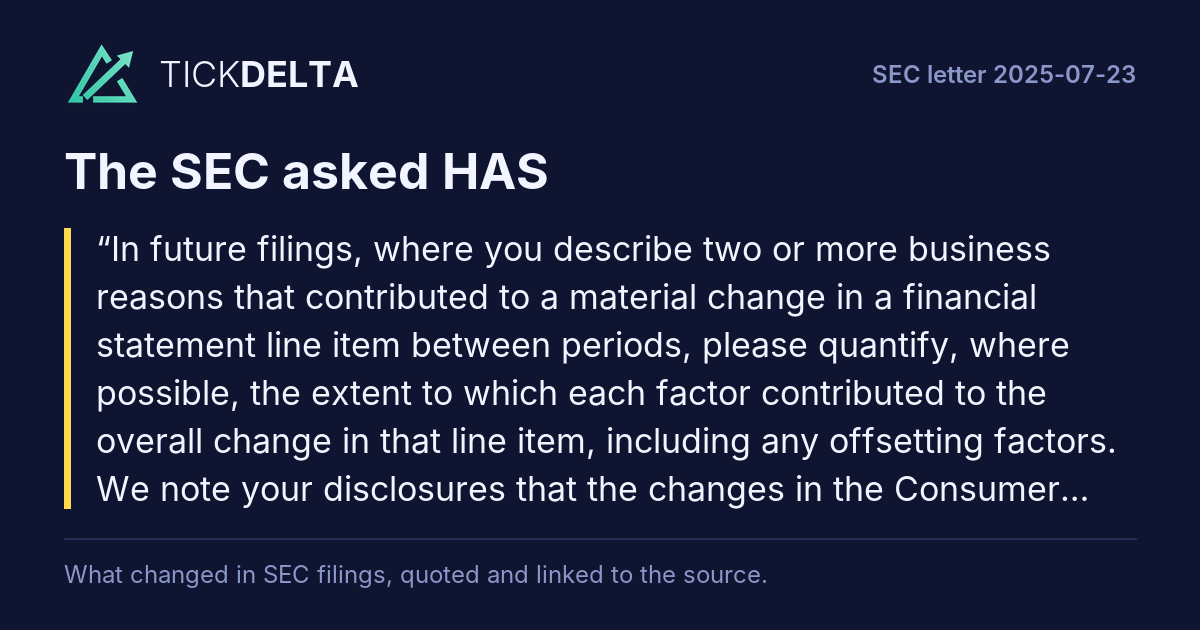
In future filings, where you describe two or more business reasons that contributed to a material change in a financial statement line item between periods, please quantify, where possible, the extent to which each factor contributed to the overall change in that line item, including any offsetting factors.
Rest of the question

We note your disclosures that the changes in the Consumer Products and Wizards of the Coast and Digital Gaming segments' net revenues and operating profit (loss) were due to various factors. To the extent possible, quantify the impact of each contributing factor in dollars and/or percentage, expand on the reasons driving these changes, and provide greater transparency into the material components and potential variability of your segment net revenues and segment operating profit (loss).

HAS answered
We acknowledge the Staff’s comment. In its future filings, the Company will quantify the known incremental impact of individual business reasons for the overall change in line items, to the extent practicable and possible. The Company will also quantify the impact of the contributing factors for changes in net revenues and operating profit (loss) in the Consumer Products and Wizards of the Coast and Digital Gaming segments, expand on the reasons for these changes and provide further clarity into the material components and potential variability of our net revenues and segment operating profit
Rest of the answer

(loss), in each case to the extent practicable and possible.

Read in the reply ↗
In its next report

First report after the company's reply of 2025-09-04: 10-Q filed 2025-11-05 ↗, against the 10-Q filed 2025-05-06 ↗.

Tickdelta does not hold the text of both reports, so they are not compared here.
Liquidity and Capital Resources · Cash Flow, page 41
SEC asked (2)
Please provide a more robust analysis and discussion of changes in operating cash flows in future filings. In doing so, explain the underlying reasons and implications of material changes between periods to provide investors with an understanding of trends and variability in cash flows.
Rest of the question

Also provide an analysis of any known trends and uncertainties that will result in or that are reasonably likely to result in a material increase or decrease in your liquidity. Ensure your discussion and analysis is not merely a recitation of changes evident from the financial statements. Refer to Item 303(a) of Regulation S-K and Section IV.B of SEC Release No. 33-8350. Notes to Consolidated Financial Statements (7) Goodwill and Intangible Assets , page 65 You disclosed in your fiscal 2022 Form 10-K that you performed a qualitative goodwill impairment assessment during the fourth quarter with respect to each of your reporting units and concluded it was not necessary to perform a quantitative goodwill impairment test for any reporting unit. During fiscal 2023, we note that you impaired approximately $1.2 billion of goodwill and $65 million of intangible assets related to your Film and TV reporting unit. We further note that you recorded a $539 million loss on sale of the eOne Film and TV business during fiscal 2023. Please ensure future filings include robust disclosures regarding the possibility and potential of material future impairments. In doing so, disclose whether any of your reporting units is at risk of impairment. Please note that a reporting unit is at risk of impairment if it has a fair value that is not substantially in excess of carrying value. If no reporting units are at risk based on your most recent impairment test, or if material goodwill is allocated to a reporting unit that is at risk but you believe a material impairment charge is unlikely, please disclose this to your readers. For any reporting units with estimated fair values that do not substantially exceed their carrying values, please provide the following disclosures in order for investors to better assess the sensitivity of your goodwill to future impairment: 3. • The percentage by which fair value exceeded carrying value as of the date of the most recent test; • The amount of goodwill allocated to the reporting unit; • A description of the methods and key assumptions used and how the key assumptions were determined; • A discussion of the degree of uncertainty associated with the key assumptions. The discussion regarding uncertainty should provide specifics to the extent possible (e.g., the valuation model assumes recovery from a business downturn within a defined period of time); and • A description of potential events and/or changes in circumstances that could reasonably be expected to negatively affect the key assumptions. (12) Income Taxes, page 72 4. We note your disclosure on page 74 regarding the impact of the Swiss Federal Act on Tax Reform and AHV Financing ("TRAF"), noting that you recorded a deferred tax asset of $135.6 million during fiscal year 2023 related to tax intangibles that will be amortized over time. Please address the following comments: • Considering the TRAF was approved during 2019 and effective as of January 1, 2020, please tell us why the deferred tax assets were not recorded until fiscal year 2023. Clarify how you determined the enactment date and explain how your treatment complies with ASC 740-10-25-47 and ASC 740-10-45-15. Summarize for us the specific provisions of the TRAF that impacted you and the nature of your "grandfathering" discussions with Swiss tax authorities. • Clarify the meaning of your disclosure that "[t]his treatment began to apply starting in 2021." We note you previously disclosed in your fiscal year 2021 and 2022 Forms 10-K that the "enacted changes in Swiss federal and cantonal tax, including cantonal transitional provisions adopted in 2021, were not material to the Company’s financial statements."

HAS answered
We acknowledge the Staff’s comment and will include additional disclosure in future filings to address the comment to the extent practicable.

Notes to Consolidated Financial Statements

(7) Goodwill and Intangible Assets, page 65 Read in the reply ↗
In its next report

First report after the company's reply of 2025-09-04: 10-Q filed 2025-11-05 ↗, against the 10-Q filed 2025-05-06 ↗.

Tickdelta does not hold the text of both reports, so they are not compared here.

Also in this review: closing letter, 2025-09-09
Form 10-K for the Fiscal Year Ended December 25, 2022

2023-05-30 to 2023-08-31 · 10 questions · 3 letters from the SEC, 3 from the company
Review closed 2023-08-31
Results discussion (MD&A)SegmentsNon-GAAP measuresRevenueIncome taxesRussia and UkraineLiquidity and cash
After reviewing your response to these comments, we may have additional comments. Exhibit 99.1
SEC asked (1)
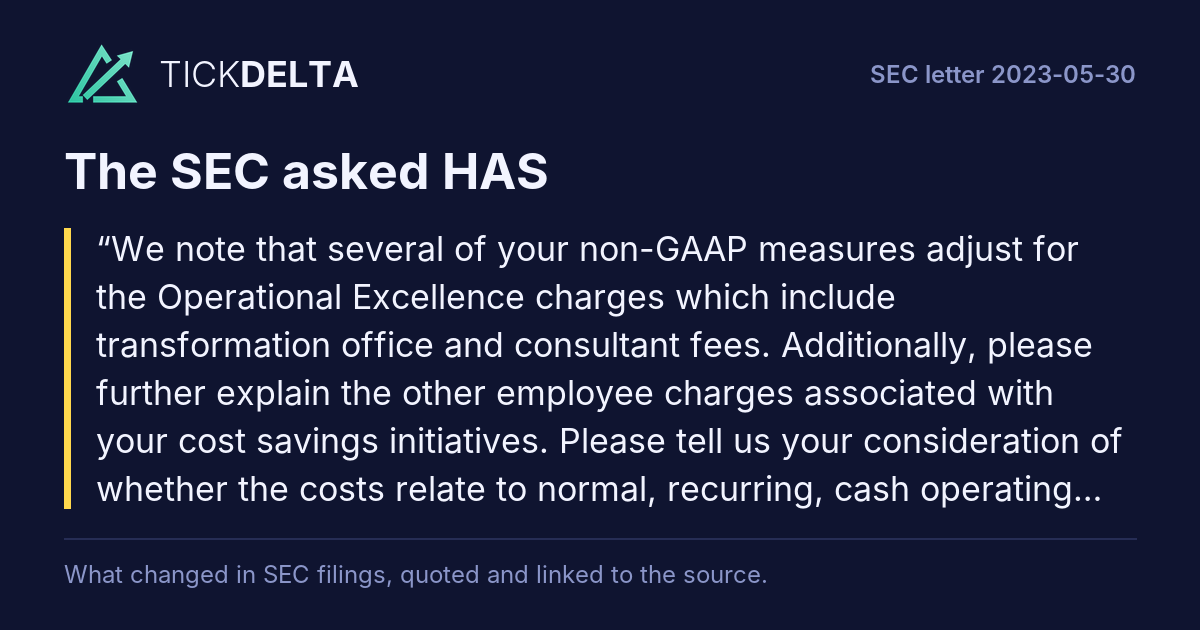
We note that several of your non-GAAP measures adjust for the Operational Excellence charges which include transformation office and consultant fees. Additionally, please further explain the other employee charges associated with your cost savings initiatives. Please tell us your consideration of whether the costs relate to normal, recurring, cash operating expenses of the Company.
Rest of the question

The comment also applies to the earnings release furnished on April 27, 2023 and other public disclosures, such as investor presentations. Refer to Question 100.01 of the Staff's Compliance and Disclosure Interpretations on Non-GAAP Financial Measures.

HAS answered
We acknowledge the Staff’s comment and respectfully note that we have considered the guidance set forth in Question 100.01 of the Compliance and Disclosure Interpretations on Non-GAAP Financial Measures. The employee charges associated with the cost savings initiatives relate to severance charges and other non-recurring employee charges relating to our transformation efforts, such as outplacement services and garden leave in accordance with the applicable local country requirements. We consider these expenses to be non-recurring in nature.
Rest of the answer

As a result, we believe it is appropriate to exclude them from our GAAP financial measures to provide investors with a clear view of the Company’s operational performance.

The transformation office and third-party consultant fees are temporary costs to support the transformational efforts of the Company and are neither related to the current operations of the Company nor revenue generating activities. Additionally, the Company believes the reconciliation excluding these costs is helpful to users of the financial information as it assists with the comparability of the Company’s operating performance from period-to-period and provides a more accurate view of operating results.

In accordance with Question 100.01 of the Compliance and Disclosure Interpretations on Non-GAAP Financial Measures, the Company believes it is appropriate to exclude the items described above from our GAAP financial measures as they do not represent normal, recurring cash operating expenses necessary to operate the Company’s business and therefore are appropriate items as part of our presentation of adjusted measures.

Read in the reply ↗
In its next report

First report after the company's reply of 2023-06-28: 10-Q filed 2023-08-04 ↗, against the 10-Q filed 2023-05-03 ↗.

Tickdelta does not hold the text of both reports, so they are not compared here.

After reviewing your response to these comments, we may have additional comments. Exhibit 99.1
SEC asked (2)
We note your reconciliations of the non-GAAP measure, adjusted EBITDA for Consumer Products, Wizards of the Coast and Digital Gaming, and Entertainment, use operating profit as the starting point for reconciling the respective adjusted EBITDA. Please refer to Question 103.02 of the Staff's Compliance and Disclosure Interpretation on Non-GAAP Financial Measures and modify your reconciliations accordingly.
Rest of the question

The comment also applies to the earnings release furnished on April 27, 2023 and other public disclosures, such as investor presentations.

HAS answered
We acknowledge the Staff’s comment and respectfully note that we provide a reconciliation of adjusted EBITDA for the total Company with the most directly comparable GAAP measure for reconciling adjusted EBITDA being net earnings in accordance with Question 103.02 of the Compliance and Disclosure Interpretations on Non-GAAP Financial Measures.

As referenced below in question number 6, the Company measures segment performance at the operating profit level which is a GAAP financial measure in accordance with ASC 280 and accordingly the Company reconciles EBITDA of the Consumer Products, Wizards
Rest of the answer

of the Coast and Digital Gaming, and Entertainment segments to segment operating profit. Net income is not calculated or reviewed at the segment level. The reconciliation was intended to be supplemental to the total Company measure and to provide transparency to the users of the financial information. The adjustments disclosed within the Company’s reconciliation at the segment level were limited to those adjustments included in Operating Profit. Considering the Staff’s comment and upon further review of the Staff’s guidance, in future filings, we will remove the EBITDA reconciliations at the segment level in accordance with Question 103.02 of the Staff’s Compliance and Disclosure Interpretation on Non-GAAP Financial Measures.

Read in the reply ↗
In its next report

First report after the company's reply of 2023-06-28: 10-Q filed 2023-08-04 ↗, against the 10-Q filed 2023-05-03 ↗.

Tickdelta does not hold the text of both reports, so they are not compared here.

After reviewing your response to these comments, we may have additional comments. Exhibit 99.1
SEC asked (3)
We note that several of your non-GAAP measures adjust for the amortization of acquired intangible assets. Please revise to disclose that while the expense is excluded, the revenue of the acquired company is reflected in the measure and that those assets contribute to revenue generation.
Rest of the question

The comment also applies to the earnings release furnished on April 27, 2023 and other public disclosures, such as investor presentations.

HAS answered
To comply with the Staff’s comments, the Company will revise our disclosure in future filings to state clearly that amortization of acquired intangibles is excluded from the related non-GAAP financial measure, but revenue generated from these assets is not excluded from the related non-GAAP financial measure.

Item 7. Management's Discussion and Analysis of Financial Condition and Results of Operations Other Information, page 59 Read in the reply ↗
In its next report

First report after the company's reply of 2023-06-28: 10-Q filed 2023-08-04 ↗, against the 10-Q filed 2023-05-03 ↗.

Tickdelta does not hold the text of both reports, so they are not compared here.

Item 7. Management's Discussion and Analysis of Financial Condition and Results of Operations · Other Information, page 59
SEC asked (4)
We note your disclosure that the Company paused all shipments and new content distribution into Russia, and the impact to the Company's operating results includes a loss of revenue and operating profit. Please quantify and disclose the decreases in revenue and operating profit, if material. (19) Restructuring Actions, page 117
HAS answered
We acknowledge the Staff’s comment and respectfully advise that we do not consider the loss of revenue and operating profit to be material or to otherwise warrant disclosure. In 2021, Russia contributed approximately $115M in revenue and $8M in operating profit (approximately 2% of each of net revenue and operating profit for the Company). The Company does not consider these amounts to be material for purposes of our financial statements and further, we do not believe that such information would be considered material by investors.

(19) Restructuring Actions, page 117 Read in the reply ↗
In its next report

First report after the company's reply of 2023-06-28: 10-Q filed 2023-08-04 ↗, against the 10-Q filed 2023-05-03 ↗.

Tickdelta does not hold the text of both reports, so they are not compared here.

Item 7. Management's Discussion and Analysis of Financial Condition and Results of Operations · Other Information, page 59
SEC asked (5)
We note your disclosures regarding Blueprint 2.0 and Operational Excellence Charges on page 78 and the Restructuring Actions on page 117. Please expand your note disclosure regarding the restructuring actions to provide the expected completion date, the total amount expected to be incurred for each major type of cost associated with the activity, and the required segment disclosures as applicable.
Rest of the question

Refer to ASC 420-10-50-1 and SAB Topic 5.P.4, or tell us why you believe these disclosures are not required. Additionally, tell us your consideration for disclosure of your expected cash requirements in the discussion of your liquidity and capital resources. Refer to Item 303(b)(1) of Regulation S-K. Notes to Consolidated Financial Statements (21) Segment Reporting, page 120

HAS answered
We acknowledge the Staff’s comment and will revise our disclosure in future filings to reflect the comment. The Company would like to clarify that the restructuring actions relate to a single segment, Corporate & Other, as disclosed in Note 19 of the Form 10-K for the period ended December 25, 2022.

Notes to Consolidated Financial Statements

(21) Segment Reporting, page 120 Read in the reply ↗
In its next report

First report after the company's reply of 2023-06-28: 10-Q filed 2023-08-04 ↗, against the 10-Q filed 2023-05-03 ↗.

Tickdelta does not hold the text of both reports, so they are not compared here.

Item 7. Management's Discussion and Analysis of Financial Condition and Results of Operations · Other Information, page 59
SEC asked (6)
We note your disclosure that your segment performance is measured at the operating profit level. We also note your information by segment and reconciliations. Please expand your reconciliation to separately quantify and describe the nature of each significant reconciling item. Refer to ASC 280-10-50-31.
HAS answered
We acknowledge the Staff’s comment and confirm segment performance is measured at the operating profit level. The Company includes footnotes to the referenced tables to provide supplemental information to the users of the financial statements, including process information that may not be significant to the results of the segment. For example, the Company discloses within footnote (b) of the Information by segment table that differences within the elimination of inter-company income statement and balance sheet transactions are eliminated within Corporate and Other.
Rest of the answer

These eliminations were not significant to the segment results. In future filings we will adjust our disclosure to further quantify any significant reconciling items.

Exhibits 31.1 Certification of the Interim Chief Executive Officer Pursuant to Rule 13a-14(a) under the Securities Exchange Act of 1934, page X-31

Read in the reply ↗
In its next report

First report after the company's reply of 2023-06-28: 10-Q filed 2023-08-04 ↗, against the 10-Q filed 2023-05-03 ↗.

Tickdelta does not hold the text of both reports, so they are not compared here.

Exhibits 31.1 Certification of the Interim Chief Executive Officer Pursuant to Rule 13a-14(a) · under the Securities Exchange Act of 1934, page X-31
SEC asked (7)
We note that paragraph 1 of Exhibit 31.1, certification of your Principal Executive Officer, refers to the “quarterly report on Form 10-K.” Please revise to refer to the appropriate periodic report. The comment also applies to Exhibit 31.2, certification of your Principal Financial Officer that refers to the “quarterly report on Form 10-K”.
Rest of the question

In closing, we remind you that the company and its management are responsible for the accuracy and adequacy of their disclosures, notwithstanding any review, comments, action or absence of action by the staff.

HAS answered
The Company acknowledges the Staff's comment. There was a typographical error in Exhibit 31.1 and Exhibit 31.2 solely in the certification copies prepared with conformed signatures for filing on EDGAR, which inadvertently referred to the annual report on Form 10-K as a quarterly report, which clearly it is not. Copies of the signed certifications that the Principal Executive Officer and the Principal Financial Officer signed on February 22, 2023 are submitted with this response.
Rest of the answer

We do not believe that such typographical error would cause confusion to an investor, and we respectfully request that the Staff consider the signed certifications as sufficient response to this question.

Read in the reply ↗
In its next report

First report after the company's reply of 2023-06-28: 10-Q filed 2023-08-04 ↗, against the 10-Q filed 2023-05-03 ↗.

Tickdelta does not hold the text of both reports, so they are not compared here.

Response Letter Dated June 28, 2023 · Company Response to Staff Comment 1
SEC asked (1)
We note your response to comment 1 and that your adjustment for the Operational Excellence program includes transformation office and third-party consultant fees that are temporary costs to support transformational efforts.
Rest of the question

Please further quantify and describe the specific costs for this portion as these efforts appear to be a normal part of managing your growth and business and part of your multi-year Blueprint 2.0 strategy. Company Response to Staff Comment 6

HAS answered
1027 Newport Avenue | Pawtucket, RI 02861 | 800-242-7276 | hasbro.com July 26, 2023 VIA EDGAR Division of Corporation Finance Office of Manufacturing U.S. Securities and Exchange Commission Washington, D.C. 20549 Attention: Stephany Yang Melissa Gilmore Re: HASBRO, INC. Form 10-K for the Fiscal Year Ended December 25, 2022 Form 8-K Furnished February 16, 2023 Response Dated June 28, 2023 File No. 001-06682 Dear Ms. Yang and Ms. Gilmore: This letter is submitted on behalf of Hasbro, Inc.
Rest of the letter

(the “Company”), in response to the comments that you have provided on behalf of the staff of the Division of Corporation Finance (the “Staff”) of the Securities and Exchange Commission (the “SEC”) in your letter dated July 12, 2023 responding to our comment response letter dated June 28, 2023. For your convenience, we have set forth the original comments from your letter in bold and italicized typeface to which we are responding. Response Letter Dated June 28, 2023 Company Response to Staff Comment 1 1. Staff Comment: We note your response to comment 1 and that your adjustment for the Operational Excellence program includes transformation office and third-party consultant fees that are temporary costs to support transformational efforts. Please further quantify and describe the specific costs for this portion as these efforts appear to be a normal part of managing your growth and business and part of your multi-year Blueprint 2.0 strategy. Company Response: We acknowledge the Staff’s comment and respectfully note that the formation of a transformation office and third-party consultant fees are not a normal part of managing the growth and business. For the year-ended December 25, 2022, the Company incurred $12.3 million of transformation office and consultant fees. Of this total, $11.9 million relates to third-party consulting fees. The consultants were engaged to assist the Company in performing a comprehensive review of the Company’s operations and developing a transformation plan designed to support the organization in identifying, realizing, and capturing savings through the identification of organizational initiatives intended to create efficiencies and improve business processes and operations. The consultants assisted in providing benchmark data and are supporting the Company with the design of an improved operating model and supply chain function. We expect this consulting assistance to conclude in 2023 in line with the planning stages of the final components of the transformation plan. We consider these costs to be non-recurring in nature and as a result, believe it is appropriate to exclude them from our GAAP financial measures to provide investors with a clear view of the Company’s operational performance. For the Staff’s understanding, the identified initiatives are implemented by employees of the Company. These recuring expenses are included in the operating income statement and are not a component of the exclusion from the GAAP financial measures as the Company believes these costs represent a normal component of its operations. Company Response to Staff Comment 6 2. Staff Comment: We note your response to comment 6. Please revise to clearly explain the nature of the significant amounts included in the "Corporate and Other" line item of operating profit(loss). In addition, ASC 280-10-50-30b) requires a reconciliation of the total of the reportable segments’ measures of profit or loss to the public entity's consolidated income before income taxes. We note Corporate and Other does not appear to qualify as a reportable segment, and operating profit (loss) is not reconciled to the consolidated earnings before income taxes. Please revise your reconciliation to comply with this guidance. Company Response: To comply with the Staff’s comments, the Company will revise our disclosure in future filings to include a reconciliation of reportable segments to the Company’s consolidated earnings before income taxes. Additionally, in future filings, the Company will expand the disclosure included in Note 21, Segment Reporting, to include the nature of significant amounts included in Corporate and Other for individually significant items. For the twelve-month period ended December 25, 2022, these charges primarily related to an intangible asset impairment charge of $281.0 million and severance charges associated with restructuring actions of $94.1million as disclosed in Note 6, Goodwill and Intangible Assets and Note 19, Restructuring Actions, respectively. If you have any questions or desire further information regarding the Company’s responses, please contact me at (401) 727-5500. Sincerely, /s/ Gina Goetter Gina Goetter Executive Vice President and Chief Financial Officer

One letter for all the questions, without numbered answers. Read the reply ↗
In its next report

First report after the company's reply of 2023-07-26: 10-Q filed 2023-08-04 ↗, against the 10-Q filed 2023-05-03 ↗.

Tickdelta does not hold the text of both reports, so they are not compared here.

Response Letter Dated June 28, 2023 · Company Response to Staff Comment 1
SEC asked (2)
We note your response to comment 6. Please revise to clearly explain the nature of the significant amounts included in the "Corporate and Other" line item of operating profit (loss). In addition, ASC 280-10-50-30b) requires a reconciliation of the total of the reportable segments’ measures of profit or loss to the public entity's consolidated income before income taxes.
Rest of the question

We note Corporate and Other does not appear to qualify as a reportable segment, and operating profit (loss) is not reconciled to the consolidated earnings before income taxes. Please revise your reconciliation to comply with this guidance.

HAS answered

See the reply above.

In its next report

First report after the company's reply of 2023-07-26: 10-Q filed 2023-08-04 ↗, against the 10-Q filed 2023-05-03 ↗.

Tickdelta does not hold the text of both reports, so they are not compared here.

Form 10-Q for the Period Ended July 2, 2023
SEC asked
Segment Reporting 1. We note your response to comment 2 and revised reconciliation of operating profit (loss) to earnings (loss) before income taxes in Note 13 of the Form 10-Q for the quarter ended July 2, 2023. Please revise your reconciliation to present the total of the reportable segments' operating profit (loss) excluding Corporate and Other in future filings. Refer to ASC 280-10-50-30b) and ASC 280-10-55-49.
HAS answered
We acknowledge the Staff’s comment and will revise the disclosure in future filings. Read in the reply ↗
In its next report

First report after the company's reply of 2023-08-31: 10-Q filed 2023-11-01 ↗, against the 10-Q filed 2023-05-03 ↗.

Tickdelta does not hold the text of both reports, so they are not compared here.

Also in this review: closing letter, 2023-08-31

Form 10-K

2022-04-15 to 2022-11-15 · 27 questions · 7 letters from the SEC, 5 from the company
Review closed 2022-11-15
Results discussion (MD&A)ClimateRisk factorsRevenueLegal and contingencies
SEC letter of 2022-04-15 ↗ no reply letter on EDGAR
SEC asked (1)
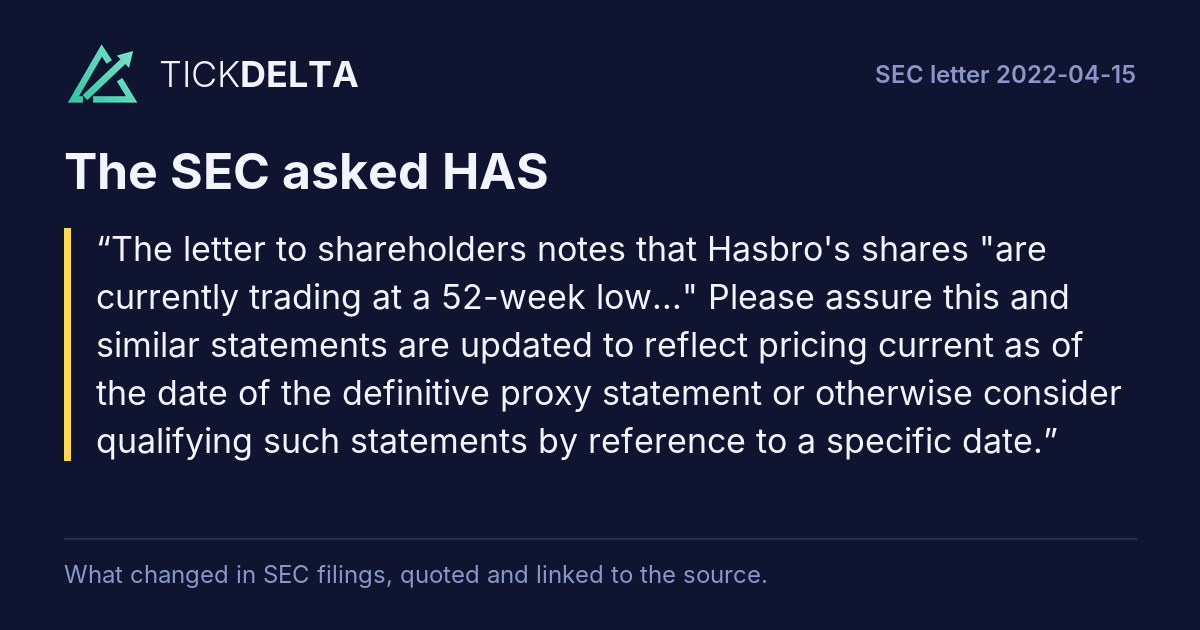
The letter to shareholders notes that Hasbro's shares "are currently trading at a 52-week low..." Please assure this and similar statements are updated to reflect pricing current as of the date of the definitive proxy statement or otherwise consider qualifying such statements by reference to a specific date.
HAS answered

No reply letter found.

Background of the Solicitation, page 5
SEC asked (2)
In the bulleted paragraph describing the March 25, 2022 advisor discussion, disclosure indicates that “Olshan reiterated that Alta Fox would not agree to a settlement that did not include (i) at least one of the Nominees being appointed to the Board, or (ii) the formation of a capital allocation committee of the Board” (emphasis added).
Rest of the question

It is our understanding that Alta Fox Group was unwilling to agree to a settlement unless both requests were satisfied. Please advise or revise.

HAS answered

No reply letter found.

In its next report

First report after the SEC's letter of 2022-04-15: 10-Q filed 2022-04-27 ↗, against the 10-Q filed 2021-10-27 ↗.

Tickdelta does not hold the text of both reports, so they are not compared here.

We Are Concerned That The Current Board Lacks Relevant Experience..., page 12
SEC asked (3)
Disclosure in this section states that "[e]ach of the current independent directors were nominated when Alan Hassenfeld was Chairman of the Company’s Executive Committee, leading us to conclude that they lack the objectivity necessary to properly evaluate the Company's historical performance and strategy." It is our understanding that board members Elizabeth Hamren and Blake Jorgensen were not nominated during the
Rest of the question

relevant period. Please revise or advise.

HAS answered

No reply letter found.

In its next report

First report after the SEC's letter of 2022-04-15: 10-Q filed 2022-04-27 ↗, against the 10-Q filed 2021-10-27 ↗.

Tickdelta does not hold the text of both reports, so they are not compared here.

Certain Additional Information Regarding the Company, page 26
SEC asked (4)
Please advise us when the Alta Fox Group anticipates distributing the proxy statement. Given that reliance on Exchange Act Rule 14a-5(c) is impermissible at any time before the registrant distributes its proxy statement, the Alta Fox Group will accept all legal risk in connection with distributing the initial definitive proxy statement without all required disclosures and should undertake to subsequently provide any
Rest of the question

omitted information in a supplement in order to mitigate that risk.

HAS answered

No reply letter found.

In its next report

First report after the SEC's letter of 2022-04-15: 10-Q filed 2022-04-27 ↗, against the 10-Q filed 2021-10-27 ↗.

Tickdelta does not hold the text of both reports, so they are not compared here.

General
SEC asked (5)
Each statement or assertion of opinion or belief must be clearly characterized as such, and a reasonable factual basis must exist for such opinion or belief. Support for any such opinions or beliefs should be self-evident, disclosed in the soliciting materials or otherwise provided to the staff on a supplemental basis with a view toward disclosure.
Rest of the question

Some examples of opinions presented as fact that should be recharacterized and/or supported include the following: • "We believe that this group of leaders has not just failed Hasbro’s shareholders for many years, but acted irrationally when recently given an opportunity to surround first-time Chief Executive Officer Chris Cocks with a credibly refreshed, truly independent Board at the outset of his tenure." (page 10) • "It seems that the current Board has attempted to use COVID-19 as a cover for recent shortcomings and long-term lapses." (page 11) • "...consumers clearly have little appetite for [G.I. Joe Intellectual Property]" (page 12) • "...Board compensation is well in excess of both peers and even other companies that are many multiples of Hasbro’s size." (page 12) • "Several directors' history of underperformance and wrongdoing at other companies, which we have discovered during our diligence, provide us with concerns regarding their ability to create value at Hasbro." (page 12) • "We believe that the Company has a history of making decisions that prioritized the Hassenfeld family’s objectives over the interests of shareholders." (page 12) We remind you that the filing persons are responsible for the accuracy and adequacy of their disclosures, notwithstanding any review, comments, action or absence of action by the staff. Please direct any questions to Perry Hindin at 202-551-3444.

HAS answered

No reply letter found.

SEC letter of 2022-05-27 ↗ no reply letter on EDGAR
After reviewing your response to these comments, we may have additional comments. General
SEC asked (1)
The soliciting material includes the statement that “Hasbro’s deceptive analysis also fails to mention that the only reason management earned a substantial performance equity payout in FY21 was because of drastic cuts to cumulative performance targets taken in FY21.
Rest of the question

Specifically, in FY21 Hasbro’s Board lowered management’s 3-year revenue target by 8%, cumulative EPS target by 18%, and ROIC margin by 80 basis points from the prior year” (emphasis added). It is our understanding that Hasbro’s Board took no action in FY21 to cut or lower these performance targets, which were set in the first quarter of FY19 and have remained unchanged since then. Please advise or revise. To the extent you are not able to provide support for such statement, and given the impact such statement may have on an investor’s voting decision with respect to both Proposals 1 and 2, please file and disseminate appropriate corrective disclosure acknowledging that Hasbro’s Board did not cut the FY19-FY21 performance targets at any point after they were set in FY19.

HAS answered

No reply letter found.

In its next report

First report after the SEC's letter of 2022-05-27: 10-Q filed 2022-07-26 ↗, against the 10-Q filed 2021-10-27 ↗.

Tickdelta does not hold the text of both reports, so they are not compared here.

After reviewing your response to these comments, we may have additional comments. General
SEC asked (2)
The soliciting material also includes the statements that “Hasbro’s shareholders underperformed the S&P 500 by >500% since refusing to be acquired by Mattel in 1996” and “Hasbro’s shareholders underperformed the S&P 500 by nearly 300% following Hasbro’s refusal of Provide Equity Partners” (emphasis added).
Rest of the question

Please supplementally provide support for such statements, including the measurement dates used to calculate these figures, and to the extent you make such statements in future soliciting materials, please include the specific measurement dates used.

HAS answered

No reply letter found.

In its next report

First report after the SEC's letter of 2022-05-27: 10-Q filed 2022-07-26 ↗, against the 10-Q filed 2021-10-27 ↗.

Tickdelta does not hold the text of both reports, so they are not compared here.

After reviewing your response to these comments, we may have additional comments. General
SEC asked (1)
We note that you provided more expansive disclosure in your 2020 Corporate Social Responsibility Data Update (“CSR Report”) than you provided in your SEC filings. Please advise us what consideration you gave to providing the same type of climaterelated disclosure in your SEC filings as you provided in your CSR Report. Risk Factors, page 28
HAS answered
Our approach to public reporting on environmental, social and governance issues is tailored to the different needs and reporting requirements of the wide range of stakeholders interested in the sustainability of Hasbro. Our investors are a key audience for SEC filings and particular disclosure rules and materiality standards apply to those filings, whereas our annual CSR reports and updates are developed to suit a potentially wider range of stakeholders and other interested parties, including consumers, customers, existing and prospective employees, non-governmental organizations, media,
Rest of the answer

suppliers, partners and others, and those reports may disclose matters even if they are not material to our business and financial condition.

Our most recent CSR report and update build upon several years of CSR report disclosures and are prepared in alignment with the Global Reporting Initiative (GRI) 2016 Standards and the

Sustainability Accounting Standards Board (SASB) Toys & Sporting Goods and Media & Entertainment industry standards. As it currently stands, GRI and SASB have different disclosure requirements and audiences as compared to current SEC rules.

In contrast to the reporting standards used for our CSR report and updates, the current SEC disclosure requirements are primarily focused on providing material information to investors. As such, we approach how and what we disclose in our CSR report and updates, and our SEC filings differently. Our CSR reports and updates tend to include a wider range of disclosures as they aim to respond to a wider audience by providing disclosure even when we do not expect those matters to have a material impact on our business. For example, our latest 10-K included an overview of our governance and key achievements and progress in 2021 across our strategic ESG focus areas: climate and sustainability, ethical sourcing and human rights, philanthropy, and diversity, equity and inclusion. In contrast, our most recent CSR update included more granular data such as key performance indicators and regional breakdown over a 5-year timeframe across direct and indirect greenhouse-gas emissions, energy, water and waste consumption, as well as our approach to human capital management, purpose, community volunteerism, philanthropy and more.

We will continue to evaluate whether to include additional climate-related information in connection with future SEC filings, and such information will be included when required or we otherwise determine such disclosure to be appropriate for our shareholders when assessing the financial performance of the Company and risks to our business.

Read in the reply ↗
In its next report

First report after the company's reply of 2022-07-15: 10-Q filed 2022-07-26 ↗, against the 10-Q filed 2021-10-27 ↗.

Tickdelta does not hold the text of both reports, so they are not compared here.

After reviewing your response to these comments, we may have additional comments. General
SEC asked (2)
Disclose the material effects of transition risks related to climate change that may affect your business, financial condition, and results of operations, such as policy and regulatory changes that could impose operational and compliance burdens, market trends that may alter business opportunities, credit risks, or technological changes.
HAS answered
We reviewed the applicable disclosure standards while preparing our Form 10-K, as we do in connection with the preparation of each filing we make with the SEC, and concluded that transition risks related to climate change are not expected to materially affect our business, financial condition, or results of operations.
Rest of the answer

As materiality is assessed in connection with each filing, we will disclose transition risks related to climate change that may affect our business, financial condition, or results of operations if they become material to the Company and such disclosure is required or we otherwise determine such disclosure to be appropriate.

Our standard procedures for preparing our annual report on Form 10-K and quarterly reports on Form 10-Q include a process to identify and consider risks, including any climate-related risks, that may affect our business, financial condition, and results of operations, and then assess the materiality of those risks. This process includes reviewing risks identified through our enterprise risk management (ERM) assessment, reviewing information provided by our business functions, a discussion and analysis of the foregoing among our disclosure committee, our Chief Executive Officer and our Chief Financial Officer, and a discussion with members and committees of our Board of Directors responsible for overseeing our SEC filings. This process is designed to identify our significant risks, which are then evaluated for possible disclosure in light of an assessment of their materiality and the applicable disclosure requirements, including the SEC's Guidance Regarding Disclosure Related to Climate Change, Interpretive Release No. 33-9106 (February 8, 2010). To date, transition risks related to climate change have not had a material impact on our business and have not been among our material risks.

In addition to our ERM assessment process described above, as part of the new Hasbro Climate Action Plan being developed in 2022, we intend to incorporate the recommendation of the Task Force on Climate-Related Financial Disclosures (TCFD) in evaluating and addressing the risk of climate change on our business going forward. As part of the TCFD framework, we plan to perform a Climate Scenario Analysis with the intention of further identifying and assessing the impacts that climate-related transition risks and opportunities may have on our organization in the future. During this process, we plan to further identify and quantify market, reputation, technology, regulatory, and legal transition risks that may impact our business, in line with the TCFD recommendations. For example, these risks could include carbon pricing, market demand for low-carbon products, and regulatory reporting requirements.

We expect to work with an external consultant to assess our exposure and vulnerability to these potential future risks, with the aim of assessing potential financial impacts under different climate scenarios, in line with TCFD’s recommendations. Transition risks could have a variety of potential financial impacts such as increased energy costs or increased compliance costs for climate-related reporting requirements. If identified, we intend to disclose material transition risks and impacts in future filings in line with our standard procedures. Our analysis to date, however, has not identified material effects of transition risks related to climate change that may affect our business, financial condition, and results of operations.

Read in the reply ↗
In its next report

First report after the company's reply of 2022-07-15: 10-Q filed 2022-07-26 ↗, against the 10-Q filed 2021-10-27 ↗.

Tickdelta does not hold the text of both reports, so they are not compared here.

After reviewing your response to these comments, we may have additional comments. General
SEC asked (3)
Disclose any material litigation risks related to climate change and explain the potential impact to the company.
HAS answered
As we do with every filing, we reviewed the applicable disclosure standards and applied them to an analysis of our business while preparing our Form 10-K. In doing so, we concluded that we do not have any material litigation risks related to climate change at this time. To date, we have not experienced any threatened or actual climate change-related litigation, and we have no indication that our industry, or other participants in the industry, have been or are susceptible to significant litigation related to climate change.
Rest of the answer

As materiality is assessed in connection with each filing, we will disclose litigation risks related to climate change and the potential impact to the Company if in the future we consider that they have become material to the Company and such disclosure is required or we otherwise determine such disclosure to be appropriate.

By way of further background, we regularly review pending and threatened litigation and government proceedings in connection with our SEC filings, including with our disclosure committee. Additionally, we regularly monitor trends and material risks to our business, including potential litigation risks. As part of our regular review, we have concluded that the risk of climate change related litigation is not currently a material risk that warrants disclosure in the Risk Factors section of our periodic reports.

Read in the reply ↗
In its next report

First report after the company's reply of 2022-07-15: 10-Q filed 2022-07-26 ↗, against the 10-Q filed 2021-10-27 ↗.

Tickdelta does not hold the text of both reports, so they are not compared here.

Management's Discussion and Analysis of Financial Condition and Results of Operations , page
SEC asked (4)
We note your disclosure that you are subject to various United States federal, state, local and international requirements relating to the environment. Please revise your disclosure to discuss material pending or existing climate change-related legislation, regulations, and international accords and describe any material effect on your business, financial condition, and results of operations.
HAS answered
Hasbro is closely monitoring relevant legislation and regulations that could have a material impact on our business. This includes requirements regarding environmental, climate and sustainability topics. Relevant legislative initiatives such as the EU Taxonomy Regulation, the Corporate Sustainability Reporting Directive or the Sustainable Corporate Governance Directive will impact reporting requirements and certain parts of companies’ business plans to reflect on long-term sustainable interests of the corporation, its workers, customers, and shareholders for the future.
Rest of the answer

However, at this stage these legislative initiatives are still in progress, and we are closely following the developments to address new requirements as and if they come into fruition.

Other requirements related to the environment are already enforced or underway. Common requirements include mandatory Extended Producer Responsibility (EPR) schemes. These already exist in a number of EU countries, such as in the UK via their Plastic Packaging Tax (effective since April 2022) or in India throughout their new EPR regulation (effective as of July 2022). Other Asian countries like Vietnam, Indonesia or the Philippines are also discussing such measures. Such EPR requirements usually include reporting of imported plastic and fees or taxes based on imported quantities of plastic packaging. With our plastic-free packaging initiative which started in 2019, we are well underway to ensure new Hasbro packaging is virtually plastic-free, therefore preempting many of the reporting requirements and potential fees or taxes in the various countries. To date there has been no material impact to our business from any of these requirements, and we do not currently anticipate a material impact to our business, factoring in the ongoing measures we are taking to reflect changes and anticipated changes in legislation and regulations.

The upcoming EPR scheme for certain packaging materials and products in France goes further than other such measures. It mandates to include waste sorting instructions for the consumer not only on packaging, but also for certain products. Some sectors have also been mandated to organize the collection and recycling of their products at the end of their lifespan. The EPR scheme will come into effect in January 2023. We are prepared to comply with the mandatory labeling of sorting instructions, and we are also a member of the newly founded organization, Eco-Mobilier, which will organize the French waste collection scheme for toys. As of 2023, fees for the scheme will be paid based on volumes shipped to the French market.

At this time, we do not believe any of the foregoing or other pending requirements are material to the business. As materiality is assessed in connection with each filing, we will disclose any requirements that have or are expected to have a material effect on our business, financial condition and results of operation in future filings.

Read in the reply ↗
In its next report

First report after the company's reply of 2022-07-15: 10-Q filed 2022-07-26 ↗, against the 10-Q filed 2021-10-27 ↗.

Tickdelta does not hold the text of both reports, so they are not compared here.

Management's Discussion and Analysis of Financial Condition and Results of Operations , page
SEC asked (5)
We note that you devote significant resources and expenditures to help achieve your sustainability goals. Tell us how you considered providing disclosure regarding past and future capital expenditures for climate-related projects related to these goals. Include quantitative information for the periods covered by your Form 10-K and for future periods as part of your response.
HAS answered
We have a dedicated team of employees under the leadership of our Global Purpose Organization that focuses on sustainability. Currently we have approximately 8 employees who spend the majority of their time working on sustainability initiatives. In 2021, 2020 and 2019 we estimate we spent approximately $2M, $1.75M, and $1.5M, respectively, in pursuing our sustainability goals. These amounts, while not insignificant, are not material from a financial statement or investor perspective and approximate 0.1% of our Selling, Distribution and Administration (“SD&A”) expense.
Rest of the answer

As materiality is assessed in connection with each filing, we will disclose in the future any increased costs related to climate change if they become material to the Company and such disclosure is required or we otherwise determine such disclosure to be appropriate.

Read in the reply ↗
In its next report

First report after the company's reply of 2022-07-15: 10-Q filed 2022-07-26 ↗, against the 10-Q filed 2021-10-27 ↗.

Tickdelta does not hold the text of both reports, so they are not compared here.

Management's Discussion and Analysis of Financial Condition and Results of Operations , page
SEC asked (6)
To the extent material, discuss the indirect consequences of climate-related regulation or business trends, such as the following: • decreased demand for goods that produce significant greenhouse gas emission or are related to carbon-based energy sources; • increased demand for goods that result in lower emissions than competing products; • increased competition to develop innovative new products that result in
Rest of the question

lower emissions; • increased demand for generation and transmission of energy from alternative energy sources; and • any anticipated reputational risk resulting from operations or products that product material greenhouse gas emissions.

HAS answered
We reviewed the applicable disclosure standards while preparing our Form 10-K and concluded that indirect consequences of climate-related regulation or business trends have not materially affected our business, financial condition, or results of operations and are not currently expected to do so in the future.
Rest of the answer

As materiality is assessed in connection with each filing, we will disclose indirect consequences of climate-related regulation or business trends if they become material to the Company and such disclosure is required or we otherwise determine such disclosure to be appropriate.

We determined that the indirect consequences of climate-related regulation or business trends have not materially affected our business, financial condition, or results of operations by (i) reviewing historical and current total sales data and for our various product categories, and (ii) reviewing consumer and customer feedback, interviews, engagement surveys, and market research (collectively "consumer insights"), to determine what trends may be connected to climate-related matters. While the collective interaction of a broad array of macroeconomic, competitive, and consumer behavioral factors make sales trend analysis difficult, we have not identified any trends suggesting that the indirect consequences of climate-related regulation or business trends have materially affected our business. This evaluation of current and future regulations and consumer trends will be incorporated into our TCFD risk assessment process described above, in the response to Question 2.

A large part of our success is dependent on our ability to make trend-right decisions that resonate with consumers and our customers. We do this by continuing to reevaluate our products to ensure relevancy with consumers and our customers, using historical sales information as well as consumer, customer and market insights and engagement surveys. Customer and consumer preferences regarding the environmental impact of products is one of many factors we consider when designing our products. As consumer insights indicate that some customers want products that have a lower environmental impact or are otherwise sustainably produced, we have been able to meet, and anticipate continuing to be able to meet, these consumer preferences by working with our broad array of vendors and suppliers to offer an assortment that meets the needs of our customers and consumers.

For example, we have set a goal to eliminate virtually all plastic from single use packaging for new products by the end of 2022. We are on target to meet that goal as described in our SEC filings. We have also set a goal to make Potato Head brand products with plant-based or renewable materials by the end of 2024 and transitioning all other existing toys and games to recycled or renewable materials by 2033. As described in our Risk Factors section of our 10-K, if we were to fall short in achieving these goals, as the staff notes in Question 5 above, we could incur significant expenses in pursuing these goals and we could face reputational damage. While expenses could be significant, we do not believe they would be material as described in our response to Question 5 above.

Read in the reply ↗
In its next report

First report after the company's reply of 2022-07-15: 10-Q filed 2022-07-26 ↗, against the 10-Q filed 2021-10-27 ↗.

Tickdelta does not hold the text of both reports, so they are not compared here.

Management's Discussion and Analysis of Financial Condition and Results of Operations , page
SEC asked (7)
We note your disclosure that the risks of climate change include severe weather events. Please discuss the physical effects of climate change on your operations and results, such as weather-related impacts on the cost and availability of insurance and weather-related damages to your property or operations.
Rest of the question

As applicable, include quantitative information with your response for each of the periods covered by your Form 10-K and explain whether increased amounts are expected in future periods. Please also discuss the potential for indirect weather-related impacts that have affected or may affect your major customers or suppliers.

HAS answered
We reviewed the applicable disclosure standards while preparing our Form 10-K and concluded that significant physical effects of climate change on our operations and results have not and are not expected to materially affect our business, financial condition, or results of operations. As materiality is assessed in connection with each filing, we will disclose significant physical effects of climate change on our operations and results if they become material to the Company and such disclosure is required or we otherwise determine such disclosure to be appropriate.

Weather-related damages to
Rest of the answer

our property and business represented less than 0.1% of our total SD&A expenses in each of fiscal years 2021, 2020, and 2019. Due to these historical trends and the geographically dispersed composition of our business, we do not expect an increase in weather-related property losses to a degree that is material to the Company.

We have not experienced any material impacts to our insurance costs or to the availability of insurance due to weather-related factors. Specifically, our total property insurance premiums approximated 0.2% of our total SD&A expenses in each of fiscal years 2021, 2020, and 2019. Based on our understanding of the property insurance market, and our expectations for future premiums relative to our total SD&A expenses, we do not expect weather-related factors to affect our ability to obtain property insurance coverage or to increase the cost of property insurance coverage to a degree that is material to the Company.

As described in our response to Question 2 above, while we have historically included a climate risk assessment in our ERM process, we intend to add and incorporate the recommendation of the TCFD to address the risk of climate change on Hasbro’s business. As part of the TCFD framework, we plan to perform a Climate Scenario Analysis with the intention of further identifying and assessing the potential impacts that climate-related physical risks and opportunities may have on our organization in the future. During this process, we plan to analyze and further consider acute and chronic physical risks that may impact our business, in line with TCFD recommendations. For example, these risks could include heatwaves, extreme precipitation, and water stress in our operations and supply chain. But to date those risks and impacts have not been material and are not anticipated to be material to our business.

We plan to work with an external consultant to assess and further analyze our exposure and vulnerability to these risks, with the aim of assessing potential financial impacts under different climate scenarios, in line with TCFD’s recommendations. Physical risks could have a variety of potential financial impacts such as increased including maintenance and repair costs or increased costs or reduced access to weather insurance. If identified, we intend to disclose material physical risks and impacts in future filings.

We note your disclosure on pages 25 and 70 about programs and costs related to compliance with environmental requirements. Tell us about and quantify any compliance costs related to climate change for each of the last three fiscal years and explain whether increased amounts are expected to be incurred in future periods.

Company Response:

We reviewed the applicable disclosure standards while preparing our Form 10-K and concluded that compliance costs related to climate change have not and are not expected to materially affect our business, capital expenditures, competitive position, financial condition, or results of operations. As materiality is assessed in connection with each filing, we will disclose any increased compliance costs related to climate change if they become material to the Company and such disclosure is required or we otherwise determine such disclosure to be appropriate.

The climate change related compliance costs applicable to our business for the last three fiscal years are limited to the operation of our office facilities, as Hasbro does not own or operate any manufacturing activities. We consider the very minimal costs associated with the maintenance and repair of our office’s HVAC systems (such as boilers and air conditioners) as a cost of maintaining our operations that would be incurred irrespective of the inspection and reporting compliance obligations. To date, these compliance costs have been immaterial and approximate less than 0.1% of our total SD&A expenses. Further, we do not expect them to materially increase in the future.

Read in the reply ↗
In its next report

First report after the company's reply of 2022-07-15: 10-Q filed 2022-07-26 ↗, against the 10-Q filed 2021-10-27 ↗.

Tickdelta does not hold the text of both reports, so they are not compared here.

Management's Discussion and Analysis of Financial Condition and Results of Operations , page
SEC asked (8)
We note your disclosure on pages 25 and 70 about programs and costs related to compliance with environmental requirements. Tell us about and quantify any compliance costs related to climate change for each of the last three fiscal years and explain whether increased amounts are expected to be incurred in future periods.
HAS answered
In fiscal years 2021, 2020 and 2019, we purchased $18K, $16K, and $15K of offsets, respectively, to match our Scope 1 emissions and Scope 3 employee travel. We also purchased carbon offsets to address the small percentage of Scope 2 emissions where renewable energy credits were not available. We reviewed the applicable disclosure standards while preparing our Form 10-K and concluded that our purchases of carbon credits or offsets have not and are not expected to materially affect our business, financial condition, or results of operations, and we have budgeted amounts in future period
Rest of the answer

consistent with amounts incurred in prior periods. As materiality is assessed in connection with each filing, we will disclose our purchases of carbon credits or offsets if they become material to the Company and such disclosure is required or we otherwise determine such disclosure to be appropriate.

Read in the reply ↗
In its next report

First report after the company's reply of 2022-07-15: 10-Q filed 2022-07-26 ↗, against the 10-Q filed 2021-10-27 ↗.

Tickdelta does not hold the text of both reports, so they are not compared here.

Management's Discussion and Analysis of Financial Condition and Results of Operations , page
SEC asked (9)
We note disclosure in your Form 10-K and CSR Report regarding the use of carbon offsets. Please provide us with quantitative information regarding your purchases or any sales of carbon credits or offsets for each of the last three fiscal years and amounts budgeted for future periods.
Rest of the question

Provide your analysis as to the materiality of the effects those purchases or sales have had on your business, financial condition, and results of operations.

HAS answered

No numbered answer found in the reply. Read the reply ↗

In its next report

First report after the company's reply of 2022-07-15: 10-Q filed 2022-07-26 ↗, against the 10-Q filed 2021-10-27 ↗.

Tickdelta does not hold the text of both reports, so they are not compared here.

Risk Factors, page 28
SEC asked (1)
We note your response to prior comment two regarding transition risks related to climate change. Please clearly describe the specific transition risks you have considered, including those identified in our comment, and provide additional detail regarding their material effects, such as those mentioned in your response (i.e., increased energy costs, increased compliance costs for climate-related reporting
Rest of the question

requirements, etc.), along with support for your determination of materiality for purposes of disclosure.

HAS answered
As noted in our Prior Response Letter, our standard procedures for preparing our annual report on Form 10-K and quarterly reports on Form 10-Q includes a process to identify and consider risks, including any climate-related risks, that may affect our business, financial condition, and results of operations, and then assess the materiality of those risks.
Rest of the answer

This process includes reviewing risks identified through our enterprise risk management (ERM) assessment, reviewing information provided by our business functions, a discussion and analysis of the foregoing among our disclosure committee, our Chief Executive Officer and our Chief Financial Officer, and a discussion with members and committees of our Board of Directors responsible for overseeing our SEC filings. This process is designed to identify our significant risks, which are then evaluated for possible disclosure in light of an assessment of their materiality and the applicable disclosure requirements, including the SEC's Guidance Regarding Disclosure Related to Climate Change, Interpretive Release No. 33-9106 (February 8, 2010). In determining the materiality of information in this regard, the Company refers to the well-established materiality standard accepted by the Commission: information is material if there is a “substantial likelihood that the disclosure of the omitted fact would have been viewed by the reasonable investor as having significantly altered the ‘total mix’ of information made available.”1The foregoing is referred to herein as our “Disclosure Framework”.

While we have considered potential transition-related risks, such as the possibility for increased energy costs and increased regulatory compliance costs for climate-change reporting requirements, to date, climate change transition risks have not been deemed material under our Disclosure Framework, have not had a material impact on our business and are not among our significant and material risks. We believe including disclosure about transition risks related to climate change at this time would be premature, general in nature, applicable to companies in our industry and not specific to Hasbro, and purely speculative, all of which would be contrary to the Commission’s guidance on risk factor disclosure.

While our Disclosure Framework has not identified transition risks related to climate change as material risks to our business to date, as noted in our Prior Response Letter, we are continuing to enhance our efforts around climate change to do our part to help protect the planet and strengthen our business. We are currently developing a Climate Action Plan. As part of this plan, we intend to incorporate the recommendations of the Task Force on Climate Related Financial Disclosures (TCFD) in evaluating and addressing the potential risks of climate change on our business going forward. As part of the TCFD framework, we plan to perform a climate scenario analysis with the goal of further identifying and assessing the impacts that climate-related physical and transition risks and opportunities may have on our organization in the future. During this process, we plan to further consider and quantify potential transition risks, such as market, reputational, technological, regulatory, and legal risks, that may impact our business, in line with the TCFD recommendations. If identified, we intend to disclose material transition risks and potential impact in future filings in line with our Disclosure Framework.

Management's Discussion and Analysis of Financial Condition and Results of Operations, page 44

2.[We] note your response to prior comment four. Please provide us with additional information explaining how you considered providing disclosure regarding the Extended Producer Responsibility (EPR) schemes described in your response, including in the context of measures you are taking to change your packaging.

_________________________________________

1Basic Inc. v. Levinson, 485 U.S. 224 (1988) and TSC Industries, Inc. v. Northway, Inc., 426 U.S. 438 (1976).

Company Response:

Extended Producer Responsibility (EPR) schemes exist in several countries in which Hasbro currently operates. While EPR schemes vary by country, most requirements include reporting of imported plastic and fees or taxes based on imported quantities of plastic packaging. EPR taxes or fees have been part of Hasbro’s operational costs for several years and have not been material. Further, we do not anticipate upcoming or newly instated plastic packaging taxes to have a material financial impact on our business. For example, through the UK’s Plastic Packaging Tax (effective since April 2022), we anticipate the annual tax for Hasbro for 2022 to be less than $10,000. We anticipate the taxes related to plastic packaging will further decline over the next several years as we continue to phase out single-use plastic in our new product packaging (as discussed in our Prior Response Letter).

3.We note your response to prior comment five and reissue in part. Please provide quantitative information for any known future capital expenditures for climate-related projects.

Company Response:

To clarify our Prior Response Letter, the expenditures identified in prior comment five are all related to operating costs and are not material. At this time, we do not have any current or known future capital expenditures for climate-related capital projects. To the extent the Company has material capital expenditure plans in the future that are directly attributable to climate-related projects, we plan to disclose those expenditures consistent with the requirements of Item 303 of Regulation S-K and our Disclosure Framework generally.

4.Your response to prior comment six states that you reviewed historical and current sales data and consumer insights to determine what trends may be connected to climate-related matters. Please further address the following:

•Tell us more about the trends you identified that may be connected to climate-related matters in the context of the individual items noted in our prior comment (i.e., explain how you determined whether changes in demand or competition for your products are due to climate-related factors).

oAs noted in our Prior Response Letter, we have not identified any trends suggesting that the indirect consequences of climate-related regulation or business trends have materially affected or will materially affect our business. While initial insights from some of our consumers indicate a preference for sustainable products, we have not seen any correlating trends that indicate that sustainability is the primary driver for purchase conversion. That said, we recognize consumer priorities may change in the future and we will continue to monitor and analyze customer shopping behaviors. As noted in the Prior Response Letter, as part of Hasbro’s sustainability journey, we have set product and packaging goals to reduce the use of single-use plastic and minimize our greenhouse gas (GHG) emissions.

•Tell us how you considered providing disclosure regarding demand from customers who want products that have a lower environmental impact or are otherwise sustainably produced.

oAs noted above, while some consumers have indicated a preference for more sustainable products, these consumers, together with our overall consumer base, are not demanding sustainably produced or lower environmental impact products. Nevertheless, we have embarked on strategic sustainable packaging and product initiatives as part of our commitment to sustainability; however, they have not had, and are not anticipated to have, a material financial impact on our business at this time. Under our Disclosure Framework, we do not believe any trend or other disclosure regarding demand from customers for products that are sustainably produced or otherwise have a lower environmental impact is necessary at this time.

•Clarify whether and how the packaging and product goals described in your response are related to changes in demand and competition for goods that result in lower greenhouse gas emissions, are not derived from carbon-based sources, and/or are produced using alternative energy sources.

oOur packaging and product goals were set in an effort to limit Hasbro’s environmental impact, reduce greenhouse gas (GHG) emissions and minimize single-use plastic packaging in support of our mission to be a leader in ESG and as part of our ongoing sustainability journey. See our responses above for further information.

•Tell us how you considered providing disclosure regarding reputational risks other than potential reputational damage if you fall short in achieving your sustainability goals, for instance in relation to emissions from the manufacturing activities that produce your products.

oAs a Purpose-driven company, we work diligently to create value for and build trust with our stakeholders. A key component of our Climate Action Plan (as referenced in response number one above) is focused on managing potential climate risk and building resilience for Hasbro. At this time, we do not foresee any other potential climate-related reputational risks. Our climate risk analysis, happening later this year, will include an evaluation of potential climate-related reputational risks to our business. This analysis will be guided by the TCFD framework. If identified, we intend to disclose any material reputational risk and potential impact in future filings in line with our Disclosure Framework.

5.We note your response to prior comment seven and reissue in part. Please discuss the potential for indirect weather-related impacts that have affected or may affect your major customers or suppliers, including your manufacturers.

Company Response:

We have not identified any direct or indirect weather-related damages or impacts to our property or business in the each of the fiscal years 2021, 2020, and 2019.

At this time we are not seeing weather-related events adversely affecting our business or the business of our major customers or suppliers, including our manufacturers, We recognize, however, that future weather-related events including increased storms, flooding, temperatures, droughts and other natural disasters could impact the business of Hasbro, our major customers or suppliers, including our manufacturers. In order to systematically evaluate the potential for all different types of weather events to impact our business, we are adopting the TCFD framework for climate risk analysis. As previously mentioned, in accordance with TCFD, we are on track to perform a Climate Scenario Analysis with the intention of identifying and assessing the potential impact of climate-related physical risks and opportunities on our business and supply chain. As materiality is assessed in connection with each filing, we will disclose significant physical effects of climate change on our operations and results if they become material to Hasbro and such disclosure is required or we otherwise determine such disclosure to be appropriate under our Disclosure Framework.

6.Your response to prior comment nine indicates that you purchased carbon offsets to address the small percentage of Scope 2 emissions where renewable energy credits were not available. Please provide us with quantitative information regarding your purchases of renewable energy credits for each of the last three fiscal years and amounts budgeted for future periods. Provide your analysis as to the materiality of the effects these purchases have had on your business, financial condition, and results of operations.

Company Response:

Hasbro has set a goal of 100% renewable electricity for our global owned and operated facilities. Hasbro meets this goal by purchasing Renewable Energy Certificates (RECs) in countries where they are available, each of which represent one MWh of renewable electricity generated on the same grid as our electricity consumption. Currently there are three markets where RECs are not available. These three markets represent less than 1% of our total electricity consumption globally. Through FY 2021, we purchased carbon offsets to account for these three markets. In all other markets we purchase RECs to cover greater than 100% of our electricity consumption.

In fiscal years 2021, 2020 and 2019, we purchased $100K, $45K, and $30K for RECs, respectively. These amounts are insignificant and are not material to our business, financial condition or results of operation. We expect future REC expenditures to be similar, or slightly higher than those incurred in 2021, due to increased demand for these products. In addition, Hasbro will be transitioning away from carbon offset purchases in line with our Science-Based Targets being set by early next year.

Read in the reply ↗
In its next report

First report after the company's reply of 2022-08-22: 10-Q filed 2022-10-26 ↗, against the 10-Q filed 2021-10-27 ↗.

Tickdelta does not hold the text of both reports, so they are not compared here.

Management's Discussion and Analysis of Financial Condition and Results of Operations , page
SEC asked (2)
Your note your response to prior comment four. Please provide us with additional information explaining how you considered providing disclosure regarding the Extended Producer Responsibility (EPR) schemes described in your response, including in the context of measures you are taking to change your packaging.
HAS answered

No numbered answer found in the reply. Read the reply ↗

In its next report

First report after the company's reply of 2022-08-22: 10-Q filed 2022-10-26 ↗, against the 10-Q filed 2021-10-27 ↗.

Tickdelta does not hold the text of both reports, so they are not compared here.

Management's Discussion and Analysis of Financial Condition and Results of Operations , page
SEC asked (3)
We note your response to prior comment five and reissue in part. Please provide quantitative information for any known future capital expenditures for climate-related projects.
HAS answered

No numbered answer found in the reply. Read the reply ↗

In its next report

First report after the company's reply of 2022-08-22: 10-Q filed 2022-10-26 ↗, against the 10-Q filed 2021-10-27 ↗.

Tickdelta does not hold the text of both reports, so they are not compared here.

Management's Discussion and Analysis of Financial Condition and Results of Operations , page
SEC asked (4)
Your response to prior comment six states that you reviewed historical and current sales data and consumer insights to determine what trends may be connected to climate-related matters. Please further address the following: • Tell us more about the trends you identified that may be connected to climate-related matters in the context of the individual items noted in our prior comment (i.e., explain how you determined
Rest of the question

whether changes in demand or competition for your products are due to climate-related factors). • Tell us how you considered providing disclosure regarding demand from customers who want products that have a lower environmental impact or are otherwise sustainably produced. • Clarify whether and how the packaging and product goals described in your response are related to changes in demand and competition for goods that result in lower greenhouse gas emissions, are not derived from carbon-based sources, and/or are produced using alternative energy sources. • Tell us how you considered providing disclosure regarding reputational risks other than potential reputational damage if you fall short in achieving your sustainability goals, for instance in relation to emissions from the manufacturing activities that produce your products.

HAS answered

No numbered answer found in the reply. Read the reply ↗

In its next report

First report after the company's reply of 2022-08-22: 10-Q filed 2022-10-26 ↗, against the 10-Q filed 2021-10-27 ↗.

Tickdelta does not hold the text of both reports, so they are not compared here.

Management's Discussion and Analysis of Financial Condition and Results of Operations , page
SEC asked (5)
We note your response to prior comment seven and reissue in part. Please discuss the potential for indirect weather-related impacts that have affected or may affect your major customers or suppliers, including your manufacturers.
HAS answered

No numbered answer found in the reply. Read the reply ↗

In its next report

First report after the company's reply of 2022-08-22: 10-Q filed 2022-10-26 ↗, against the 10-Q filed 2021-10-27 ↗.

Tickdelta does not hold the text of both reports, so they are not compared here.

Management's Discussion and Analysis of Financial Condition and Results of Operations , page
SEC asked (6)
Your response to prior comment nine indicates that you purchased carbon offsets to address the small percentage of Scope 2 emissions where renewable energy credits were not available. Please provide us with quantitative information regarding your purchases of renewable energy credits for each of the last three fiscal years and amounts budgeted for future periods.
Rest of the question

Provide your analysis as to the materiality of the effects these purchases have had on your business, financial condition, and results of operations. Please contact Erin Donahue at 202-551-6063 or Jennifer Angelini at 202-551-3047 with any questions.

HAS answered

No numbered answer found in the reply. Read the reply ↗

In its next report

First report after the company's reply of 2022-08-22: 10-Q filed 2022-10-26 ↗, against the 10-Q filed 2021-10-27 ↗.

Tickdelta does not hold the text of both reports, so they are not compared here.

Risk Factors, page 28
SEC asked (1)
Your response to prior comment one states that transition risks related to climate change are not among your significant and material risks, but that you plan to further consider and quantify potential transition risks.
Rest of the question

As disclosure in your Form 10-K states that you recognize the impact your business can have on the environment and are working to reduce your footprint and that you devote significant resources and expenditures to help achieve your sustainability goals, further explain how you considered providing disclosure regarding the effects of transition risks relevant to the action you are taking on climate. Please reference the specific transition risks that may affect your business, financial condition, and results of operations and other factors you have considered in your response.

HAS answered
At Hasbro, we regularly monitor pending and existing climate-related regulations as well as consumer insights on preferences with respect to our products. As noted in our prior responses, energy and compliance costs relating to climate-related regulations have not been material to date, and we have not seen trends indicating that sustainability is a primary driver for consumer purchase conversion.
Rest of the answer

That said, we care deeply about protecting the planet, which has led to us proactively pursuing innovative ways to reduce our environmental impact, such as with our efforts in producing sustainable packaging. Our environmental efforts, which started well over two decades ago and were not taken in response to any specific identified transition risks, have continually evolved from our initial focus of designing and eliminating excess materials in our packaging, to use of more recyclable and recycled materials, to using plant-based plastic for packaging elements and finally to our ambitious goal of eliminating virtually all single-use plastic from new product packaging. While these efforts take time and effort, as noted in our prior responses, the costs associated with these efforts have not had a material impact on our business.

As noted in our Prior Response Letter, we plan to incorporate the recommendations of the Task Force on Climate Related Financial Disclosure (TCFD) in evaluating and addressing any potential risks of climate change on our business going forward. If we do identify any market, reputational, technological, regulatory, and legal risks in line with the TCFD recommendations, we will disclose such risks if they become material to Hasbro and such disclosure is required or we otherwise determine such disclosure to be appropriate under our Disclosure Framework.

Read in the reply ↗
In its next report

First report after the company's reply of 2022-09-19: 10-Q filed 2022-10-26 ↗, against the 10-Q filed 2021-10-27 ↗.

Tickdelta does not hold the text of both reports, so they are not compared here.

Management's Discussion and Analysis of Financial Condition and Results of Operations, page
SEC asked (2)
Your response to prior comment five states "that future weather-related events including increased storms, flooding, temperatures, droughts and other natural disasters could impact the business of Hasbro, our major customers or suppliers, including our manufacturers." Tell us how you considered providing disclosure regarding the possible indirect financial and operational impacts to you from disruptions to the
Rest of the question

operations of your customers or suppliers from severe weather.

HAS answered
As noted in our Prior Response Letter, we have not identified any direct or indirect weather-related damages or impacts to our property or business in each of the fiscal years 2021, 2020, and 2019. If we were to have experienced supply delays or shortages or other unusual increases in costs, we would have reviewed the underlying cause of those delays, shortages or increases, and if such cause was due to severe weather and was otherwise material to our business, we would disclose it in accordance with our Disclosure Framework.

To clarify our Prior Response Letter and as noted above, we will
Rest of the answer

be adopting the TCFD framework for climate risk analysis, which will enable us to systematically evaluate the potential for all different types of weather events that may directly or indirectly impact our business in the future. As materiality is assessed in connection with each filing, we will disclose indirect financial and operational impacts to us from disruptions to the operations of our customers or suppliers from severe weather if they become material to Hasbro and such disclosure is required or we otherwise determine such disclosure to be appropriate under our Disclosure Framework.

Read in the reply ↗
In its next report

First report after the company's reply of 2022-09-19: 10-Q filed 2022-10-26 ↗, against the 10-Q filed 2021-10-27 ↗.

Tickdelta does not hold the text of both reports, so they are not compared here.

Risk Factors, page 28
SEC asked (1)
We note from your response to comment one that the costs associated with your environmental efforts have not had a material impact on your business. This appears somewhat incongruous with disclosure on page 42 of your Form 10-K that indicates you "devote significant resources and expenditures to help achieve" your sustainability goals. Please revise or explain your basis for this disclosure.
HAS answered
When we use terms in our public disclosures we strive to be as precise as possible to aid our investors in understanding our business. As we indicated in our prior July 15th, 2022 response letter to the SEC, in 2021, 2020 and 2019 we estimate we spent approximately $2M, $1.75M, and $1.5M, respectively, in pursuing our sustainability goals. We refer to those amounts as “significant” in certain places in our disclosures, but we do not consider them material.
Rest of the answer

For us the terms significant and material are substantially different.

Materiality is a higher standard and we make that judgment based on the definition that information is material if there is a substantial likelihood that a reasonable investor would consider it important in deciding how to make an investment decision. The amounts we cite in the paragraph above, while not insignificant, are not in our judgement material from a financial statement or investor perspective, as they approximate only 0.1% of our Selling, Distribution and Administration (“SD&A”) expense in any given year.

We do not consider the terms material and significant as equivalent in our disclosures, and we do not use them interchangeably. We also note that much of our spending on sustainability initiatives is actually recouped through associated savings, thereby further decreasing the impact to our business from such spending. For example, while implementing our initiatives to reduce plastic packaging involved some costs, which are captured in the figures above, the savings from using less plastic offsets most, if not all, of that spending.

Read in the reply ↗
In its next report

First report after the company's reply of 2022-10-21: 10-Q filed 2022-10-26 ↗, against the 10-Q filed 2021-10-27 ↗.

Tickdelta does not hold the text of both reports, so they are not compared here.

Management's Discussion and Analysis of Financial Condition and Results of Operation, page
SEC asked (2)
We note your response to prior comment two and reissue it. Tell us how you considered providing disclosure regarding the possible indirect financial and operational impacts to you from disruptions to the operations of your customers or suppliers from severe weather.
HAS answered
In Securities and Exchange Commission Release No. 33-9106 (2010), Commission Guidance Regarding Disclosure Related to Climate Change, in discussing how public companies may be indirectly impacted by climate change, the Staff noted that “Companies that may not be directly affected by such developments could nonetheless be indirectly affected by changing prices for goods or services provided by companies that are directly affected and that seek to reflect some or all of their changes in costs of goods in the prices they charge.
Rest of the answer

For example, if a supplier’s costs increase, that could have a significant impact on its customers if those costs are passed through, resulting in higher prices for customers.” We have found that release and its guidance helpful in developing our analysis and approach to evaluating potential risks from severe weather and other elements of climate risk over the past several years.

We are a global branded play and entertainment company that directly, and through our licensees, develops, markets and sells both physical products, and entertainment (including in the form of digital games, television, motion pictures and other streaming content). In looking at the potential impact of climate change and severe weather, we consider broadly both the potential impact to the supply of our products and entertainment, as well as to the demand for our products and entertainment.

On the supply side, we ask ourselves, is it reasonably likely that severe weather or other climate effects may impact:

Our ability to develop, manufacture, obtain and/or transport physical products to markets;

The ability of our licensees to develop, manufacture, obtain and/or transport physical products to markets;

Our ability to develop, produce and/or distribute digital gaming and/or other entertainment content;

The ability of our licensees to develop, produce and/or distribute digital gaming and/or other entertainment content; or

The prices of physical products and/or digital gaming or other entertainment content and thereby negatively impact consumer demand.

On the demand side, we ask is it reasonably likely that severe weather or other climate effects may impact:

Our customers’ ability to sell and deliver physical products and/or entertainment to consumers;

Ultimate consumers’ ability to purchase those products and/or entertainment services; or

The demand for such products and/or entertainment in another manner, including, but not limited to, through price increases that reduce retail customer or consumer demand.

In each of those cases, unless we can conclude that the event is not reasonably likely to have any impact on us, we also ask what the impact on our business would be, including in terms of lost sales, increased costs, lost profits, lost market share, delays, and/or other impacts. We then disclose and discuss in our public filings trends and events that we conclude are reasonably likely to have a material effect on our business, results of operations or financial condition.

Unfortunately, the world has experienced a significant number of destructive climate and weather events in recent history, and those actual events have provided real-world experience for us and our business, including for our licensees, manufacturers, suppliers, and customers, which we consider in our future looking risk analysis.

The manufacturing of our products, and those of our licensees, is done in many separate vendor locations across the globe, including in the People’s Republic of China, Vietnam, India, the United States and in other countries. In evaluating the potential impact of severe weather and climate change, we consider the impact of recent major climate-related events and the nature of our distributed global supply and distribution chain.

The largest single geographic source of physical products for us continues to be the People’s Republic of China, so looking at the actual impact of major severe weather events on China and our sourcing business as it relates to China is an element of our analysis of the potential risk. Recently parts of China have suffered from major floods in each of 2017, 2020, 2021 and 2022. In each of those years the floods impacted hundreds of thousands of people in China and caused millions of dollars of damage. However, we did not experience any significant issues directly or indirectly in obtaining product supply, or through increases in product costs, from those events. That was the case notwithstanding the scope of the flooding and the substantial number of people impacted. Much of this is due to a vendor network composed of many different vendors in many different locations, and in many different countries, such that even if a vendor or multiple vendors were impacted, we have the ability to obtain product from alternate sources, within China or elsewhere in the world.

Similarly, development and production of our entertainment is distributed globally, with the largest amount of activity occurring in the United States, Canada and in the United Kingdom, albeit in many different locations within those countries. To date, no weather or climate-related events have had significant impact on our development, production and distribution of entertainment content.

This is in contrast to the novel coronavirus (COVID-19), which as we discussed in our Annual Reports on 10-K for each of fiscal 2020 and fiscal 2021, did have a substantial adverse impact on our business as it impacted the development, production and distribution of both physical products and entertainment, as well as our customers’ and consumers’ ability to obtain those products in the short term, in the vast majority of the world within roughly the same period of time.

We have not seen, nor do we reasonably expect to see, weather events that would have that scale of impact to our business given our global distribution of supply and the nature of the products and entertainment we produce and sell.

On the demand side, there unfortunately are also no shortages of severe weather events negatively impacting parts of our major consumer markets. Those can take the forms of hurricanes, floods, and many other types of natural disasters. The largest single market for our goods and services is the United States. Hurricane Ian, which struck the west coast of Florida and other parts of the United States in 2022 was one of the most destructive storms in Florida’s history, and it is reported to have been the deadliest for that state since 1935. The loss of life and property was monumental and tragic, impacting thousands of people across the southern and eastern United

States. Stores and consumers in the areas hit hardest by Ian were profoundly impacted and many remain so to this date. However, that event did not materially, or even significantly, impact our overall business, given the spread of our retail customers and ultimate consumers across the full span of the United States and throughout the world. Due to the global nature of our business, the vast majority of our retail customers, and ultimate consumers, are not impacted even when a number of severe weather or other climate-related events or crises occur in a short period of time.

We do see risks to our business that we consider appropriate for inclusion in our public filings with the SEC, and those risks are disclosed and discussed. But our careful analysis of severe weather and other climate-related risks to date, including potential indirect consequences of such risks, supported by our real-life experience and that of our suppliers, manufacturers, customers and licensees with such events, has led to a conclusion that those risks are not reasonably likely to have a material impact on our business, results of operations or financial condition at this time. However, we continue to review and analyze these risks regularly and to revisit our disclosure obligations in light of the most recent facts and experiences at any given time.

Read in the reply ↗
In its next report

First report after the company's reply of 2022-10-21: 10-Q filed 2022-10-26 ↗, against the 10-Q filed 2021-10-27 ↗.

Tickdelta does not hold the text of both reports, so they are not compared here.

Risk Factors, page 28
SEC asked
Your response to prior comment one does not appear to explain the basis for the disclosure that you "devote significant resources and expenditures to help achieve" your sustainability goals. Accordingly, please revise your disclosure to define the meaning of "significant" in this context.
HAS answered
As we indicated in our prior July 15th, 2022 response letter to the SEC, in 2021, 2020 and 2019 we estimate we spent approximately $2M, $1.75M, and $1.5M, respectively, in pursuing our sustainability goals. We consider those amounts to be significant and they are consistent with how we have used that term historically in this context.

However, we understand your comment that without providing more clarity as to what we consider “significant” in this context, or how we define “significant”, an investor could interpret significant to mean an amount greater or less than what we actually spent.
Rest of the answer

On our call with you we discussed ways to make this disclosure more precise in future filings. One potential approach to offering more detail is to disclose the actual dollar amount spent on pursuing our sustainability goals in a given year in the public filing, when we are referring to those initiatives. Another potential approach is to provide additional clarity as to how we define the term “significant” in this context, either in terms of dollar amounts or ranges, or in some other terms that help quantify the level of expenditures involved.

We agree with the staff that in our future public filings with the SEC, when we refer to efforts to achieve our sustainability goals, if we are providing color as to the magnitude of spending or other resource allocation on those initiatives, rather than referring to such expenditures as “significant”, we will provide additional color as to the level of spending involved, either through disclosure of the dollar amount spent, or by otherwise more precisely defining or sizing the adjectives we use to refer to those efforts.

Read in the reply ↗
In its next report

First report after the company's reply of 2022-11-08: 10-K filed 2023-02-22 ↗, against the 10-K filed 2022-02-23 ↗.

Tickdelta does not hold the text of both reports, so they are not compared here.

Also in this review: request for more time, 2022-08-04, closing letter, 2022-11-15

Form 10-K for the period ended December 29, 2019

2020-09-28 to 2020-10-13 · 2 questions · 1 letter from the SEC, 1 from the company
Review closed 2020-10-13
RevenueResults discussion (MD&A)
Management's Discussion and Analysis · Results of Operations, page 38
SEC asked (1)
We note your chart disclosing the change in net revenues by brand portfolio for each year in the three years ended December 29, 2019. In the accompanying discussion of the variances, by portfolio, you identify component product brands and discuss the general impact they had on the growth, or decline, in net reveunes but do not otherwise quantify their impact.
Rest of the question

In future filings, please revise your disclosures to quantify the reasons for the change in order for an investor to discern the relative contribution of each of the multiple components cited to the total change. The impacts of material variances in identified components that offset each other should be separately disclosed, quantified, and discussed rather than netting them. Please provide us with examples of your intended disclosures based on current financial results. Refer to FR-72 for additional guidance.

HAS answered
Within total net revenues, Hasbro discloses the performance of its portfolio of brands by major branded product lines and market categories in order for investors to understand our business as a whole. For 2019, these portfolios comprised: Franchise Brands; Partner Brands; Hasbro Gaming; and Emerging Brands. Hasbro has historically disclosed its revenues in these portfolios, as each of the portfolios represent different components of our business that give our investors an understanding of how our owned brands and licensed brands are performing.
Rest of the answer

Hasbro’s discussion of revenues quantifies the year-over-year changes in each of these portfolios and provides analysis of the material reasons for the changes, such as theatrical releases of movies in one particular year versus another. In addition, within these brand disclosures, the Company also discusses any known trends or events that are driving the results of the brand performance, complying with the requirements of FR-72. The Company would also like to note its operating results disclosure in its Segment Results discussion, which adds further clarity to the performance of the brands by segment.

The Company has not historically disclosed the contribution of each individual brand as we have over 200 active brands in our overall portfolio and the individual brand performances are not material to the overall understanding of our business. Further, the hit-driven nature of the toy and game industry makes sales of certain brands more popular than others at different times, and it is not always possible to identify outside trends or factors, such as a movie release, that are the material drivers contributing to the change in sales, other than consumer demand at any particular time.

To comply with the Staff’s comments, the Company will in future filings focus its disclosure on the brands that had a more meaningful contribution to our results and ensure that the brands are discussed in order of magnitude of the impact. The Company will continue to discuss the significant drivers behind brand performance where known events or trends drove the results.

Below is an example of the enhanced disclosure we intend to include using our Franchise Brand discussion from the Company’s Form 10-Q for the period ended June 30, 2020:

FRANCHISE BRANDS: Net revenues in the Franchise Brands portfolio decreased 35% in the second quarter of 2020 compared to the second quarter of 2019. Declines in MAGIC: THE GATHERING and NERF revenues drove the majority of the decline in Franchise Brands revenues, while PLAY-DOH and TRANSFORMERS revenues also contributed to the overall decline. As discussed in the Segment Results below, much of this decline was driven by reduced consumer purchasing, delays in supply chains and other disruptions to the business as a result of the impact of the COVID-19 pandemic. For MAGIC: THE GATHERING, differences in release cadence compared to the prior year also drove the decline.

Read in the reply ↗
In its next report

First report after the company's reply of 2020-10-13: 10-Q filed 2020-11-04 ↗, against the 10-Q filed 2020-07-30 ↗.

Tickdelta does not hold the text of both reports, so they are not compared here.

Notes to Consolidated Financial Statements · Revenue Recognition, page 72
SEC asked (2)
You disclose the launch of MAGIC: THE GATHERING ARENA, a free-to-play online adaptation of the MAGIC: THE GATHERING card game, late in the third quarter of 2019. In your revenue recognition policy, you disclose that "end users make inapplication purchases of virtual currencies, via the Company’s platform providers, with such purchased virtual currencies to be used in the games.
Rest of the question

The Company records revenues from in-application purchases based on either the usage patterns of the players or the player’s estimated life." In addition, you disclose that digital game revenues are recognized within six months of purchase. To help us better understand your disclosure please address the following: • Describe your policy for refunds related to in-game purchases. • Can virtual currency expire if unused? • Can virtual currency be transferred or otherwise sold by the customer? • Describe what a 'usage pattern' is and how that pattern is used to determine the timing of revenue recognition. • For player accounts that have un-recognized deferred revenue, what is your policy for recognizing the related revenue in cases where the account appears to be inactive? • Clarify how you determine whether you are the principal or the agent in the arrangements with the third-party platform providers, given it appears that you recognize some revenue on a gross basis and some on a net basis. In your response, tell us the amounts of revenue recognized on a gross basis and on a net basis for the periods presented. • You have disclosed that revenues are recognized within six months. Tell us how this timing aligns with the player's estimated life. If the estimated player's life is longer than six months, tell us what impact that has, if any, on the timing of revenue recognition.

HAS answered
The referenced disclosure in the 2019 10-K regarding Hasbro’s revenue recognition policy for digital gaming revenues covers two businesses at Hasbro. The first is our Wizards of the Coast business, which created and hosts the digital games MAGIC: THE GATHERING ARENA (“Arena”) and MAGIC: THE GATHERING ONLINE. The revenues for these digital games accounted for approximately 80% of the digital gaming revenues reported in 2019, with Arena comprising approximately 70% of the total. MAGIC: THE GATHERING ONLINE is the predecessor game to Arena.
Rest of the answer

The remaining 2019 digital game revenues were generated by our Backflip business, which created and distributed several digital games. The Company made the decision to close its Backflip business in 2019, and therefore, the policy for this business is no longer relevant to the Company. As such, we focus our responses below as they relate to our policy for recognizing revenues for Arena. In addition, the Company would like to clarify that Arena was launched in the third quarter of 2018.

For Arena, a player cannot obtain any refunds for purchasing Virtual Currency or Virtual Items, except as expressly permitted by Wizards of the Coast.

Wizards occasionally makes an exception to this policy and in rare instances provides refunds for purchases. The total refunds provided in 2019 were approximately $97,000.

For Arena, the Virtual Currency has no expiration.

For Arena, the Virtual Currency cannot be sold or transferred.

Arena recognizes revenue based on the usage pattern of the player or the estimated play-life depending on the nature of the game item purchased in exchange for virtual currency. Players are able to exchange virtual currency for entrance into events, for which revenue is recognized in the month in which the event occurs, consistent with the usage pattern of the virtual currency. Players are also able to exchange virtual currency for incremental ‘booster packs’ of cards. The player continues to benefit from the incremental cards throughout their play-life, and therefore, Arena uses the player’s estimated play-life when determining the timing of revenue recognition.

•For player accounts that have un-recognized deferred revenue, what is your policy for recognizing the related revenue in cases where the account appears to be inactive?

As it relates to deferred revenue on inactive accounts, the Company has a policy of not recognizing any unused currency on inactive accounts since the launch of the game. In 2019, Arena was still in its early life-cycle and at that time, the Company did not have established patterns as it relates to inactive accounts. As such, the Company made the decision to not recognize the related revenues on the inactive deferred revenue accounts until further analysis could be made. Currently, inactive accounts continue to represent an immaterial amount of our deferred revenue balance. Based on current data, approximately $2.5 million of deferred revenue is related to inactive accounts on Arena.

Given the immaterial nature of the deferred revenue associated with inactive accounts, the Company is still evaluating the data to determine the prospective recognition pattern.

•Clarify how you determine whether you are the principal or the agent in the arrangements with the third-party platform providers, given it appears that you recognize some revenue on a gross basis and some on a net basis. In your response, tell us the amounts of revenue recognized on a gross basis and on a net basis for the periods presented.

Arena recognizes all revenues on a gross basis. Wizards of the Coast hosts the Arena game on its own platform and therefore does not use a 3rd party platform provider. Without a 3rd party platform provider, Wizards of the Coast is the only party responsible for fulfilling the promise under the contract to the customer. Wizards of the Coast also sets all pricing for in-app purchases. As a result, Wizards of the Coast is the principal in these arrangements.

Total revenue recorded through arrangements with third-party platform providers is recorded net and was not material, accounting for less than $1 million of revenue in 2019.

•You have disclosed that revenues are recognized within six months. Tell us how this timing aligns with the player's estimated life. If the estimated player's life is longer than six months, tell us what impact that has, if any, on the timing of revenue recognition.

The estimated play-life of an Arena player is calculated using the median player life of all paying players. That calculation is computed quarterly and as of December 29, 2019 was 149 days. For Arena’s deferred revenues relating to durables, our deferral period is over a period of 5 months. If the estimated player life in future quarterly calculations exceeded 5 months, the deferral period would increase to align with that new calculation.

Read in the reply ↗
In its next report

First report after the company's reply of 2020-10-13: 10-Q filed 2020-11-04 ↗, against the 10-Q filed 2020-07-30 ↗.

Tickdelta does not hold the text of both reports, so they are not compared here.

Also in this review: closing letter, 2020-10-13

Form 10-K for the Fiscal Year Ended December 30, 2018

2019-05-09 to 2019-05-30 · 3 questions · 1 letter from the SEC, 1 from the company
Review closed 2019-05-30
Revenue
SEC asked (1)
During the fiscal years ended December 30, 2018 and December 31, 2017, the quarterly data shows significant fluctuations in operating results between the quarters. Specifically, there are large variations in revenues, operating profit, and net earnings (loss) for all quarters.
Rest of the question

Please revise to add a discussion of any unusual or infrequently occurring items during each quarter, which may have contributed to the significant fluctuations in operating results. Refer to Item 302(a)(3) of Regulation S-K.

HAS answered
The Company acknowledges the Staff’s comment. The Company respectfully notes that disclosure of unusual or infrequently occurring items has been made throughout the Form 10-K for the fiscal year ended December 30,

2018 (“Form 10-K”) including the Notes to the consolidated financial statements. These items include:

·

Bad debt charges, royalty expense and inventory obsolescence and other costs related to the Toys “R” Us bankruptcy and liquidation, as disclosed in Note 2.
Rest of the answer

Revenue Recognition and in Item 7, Management’s Discussion and

Analysis of Financial Condition and Results of Operations (page 33);

Goodwill and intangible asset impairment charges, as disclosed in

Note 1. Summary of Significant Accounting Policies, Note 5. Goodwill and

Intangibles, Item 1, Business (page 4), Item 1A, Risk Factors (pages 24 and 27) and Item 7, Management’s Discussion and

Analysis of Financial Condition and Results of Operations (page 32);

The impact of tax reform, as disclosed in Note 11. Income Taxes and Item 7, Management’s Discussion and Analysis of Financial Condition and

Results of Operations (page 33); and

Restructuring charges, as disclosed in Note 19. Restructuring

Actions, Item 1, Business (page 4), Item 1A, Risk Factors (Page 23) and Item 7,

Management’s Discussion and Analysis of Financial Condition and Results of

Operations (page 32).

In future filings, to the extent appropriate, the Company will undertake to include such disclosures to the “quarterly data” Note in the annual consolidated financial statements. By way of example, using our Form 10-K for the fiscal year ended

December 30, 2018 as a model, in future filings, if appropriate, we intend to include footnotes related to Net earnings (loss) to the quarterly data table such as the following:

(22) Quarterly Financial Data (Unaudited)

Quarter

First

Second

Third

Fourth

Full Year

2018

Net revenues

$

716,341

904,458

1,569,686

1,389,161

4,579,646

Operating profit

(loss)

(80,419)

87,588

313,336

10,547

331,052

Earnings

(loss)before income taxes

(88,388)

68,124

295,794

(5,128)

270,402

Net earnings (loss)

(a)

(112,492)

60,299

263,861

8,766

220,434

Per common share

Basic

(0.90)

0.48

2.08

0.07

1.75

Diluted

2.06

1.74

Market price

High

103.39

93.00

109.60

107.57

Low

83.56

79.00

91.70

76.84

Cash dividends declared

0.63

2.52

2017

849,663

972,506

1,791,502

1,596,111

5,209,782

78,343

99,984

360,944

271,088

810,359

Earnings before income taxes

70,837

86,886

349,841

278,586

786,150

(b)

68,599

67,723

265,583

(5,298)

396,607

0.55

0.54

2.12

(0.04)

3.17

0.53

2.09

3.12

101.08

113.49

116.20

99.17

77.20

94.76

91.57

87.92

0.57

2.28

Net earnings (loss) for the 2018 quarters include the impact of the following items:

In the first quarter of 2018, Toys"R"Us announced a liquidation of its U.S. operations, as well as other retail impacts around the globe. As a result, the Company recognized incremental bad debt expense on outstanding Toys"R"Us receivables, royalty expense, inventory obsolescence as well as other related costs of $70.4 million ($61.4 million after-tax). In the fourth quarter of 2018, the Company made adjustments to the charges previously recorded based on its final settlement with Toys"R"Us, resulting in a benefit of $10.0 million ($8.5 million after-tax).

In the first quarter of 2018, the Company incurred $17.3 million

($15.7 million after-tax) of severance charges, primarily outside the U.S., related to actions associated with a new go-to-market strategy designed to be more omni-channel and e-commerce focused. Additionally, in the fourth quarter of

2018, the Company recorded an additional $72.0 million ($62.2 million after-tax) of severance charges.

In the fourth quarter of 2018, the Company incurred a goodwill impairment charge related to its Backflip business of $86.3 million, as well as impairments of certain definite-lived intangible assets totaling $31.3 million.

These charges totaled $96.9 million on an after-tax basis.

Throughout 2018, the Company made adjustments to provisional U.S.

Tax Reform amounts recorded in the fourth quarter of 2017 based on additional regulations issued, amounting to charges of $47.8 million the first quarter of

2018, a benefit of $17.3 million in the third quarter of 2018 and charges of

$10.2 million the fourth quarter of 2018.

Net earnings (loss) for the fourth quarter of 2017 included the impact of the following items:

In accordance with the Tax Act, the Company recorded a provisional tax expense of $316.4 million, the period in which the legislation was enacted.

Read in the reply ↗
SEC asked (2)
Additionally, tell us if you considered separately stating such material expenses separately on the face of the income statement. Please refer to Rule 5-03(b)(3) and (6) of Regulation S-X.
HAS answered
The Company acknowledges the Staff’s comment and notes that the

Company did not believe it was necessary to state the charges indicated above separately on the face of the consolidated statement of operations. In making the determination that such presentation was not required, the Company considered that total bad debt expense of $49.0 million, goodwill and intangible asset impairment expense of $117.6 million and restructuring expense of $89.3 million were recorded in Selling, distribution and administration expense.
Rest of the answer

These expenses represented 3.8%, 9.1% and 6.9%, respectively, of

Selling, distribution and administration expense, or 1.1%, 2.8% and 2.1% of total operating expenses. Given the materiality of such expenses and the related percent of the line items presented on the face of the consolidated statement of operations, the Company determined that disclosure in the notes to the consolidated financial statements and elsewhere in the 10-K was appropriate.

Read in the reply ↗
SEC asked (3)
Please tell us the significance of the reference to the accountant’s report in note 22 given that we note no reference to quarterly data in the report on page 53. In this regard, it appears you should revise to remove the reference "see accompanying accountants' report" since the footnote is marked unaudited.
HAS answered
Company inadvertently referred to the accountant’s report based on misinterpretation of disclosure guidance. The Company will update future filings to remove this reference. Read in the reply ↗
In its next report

First report after the company's reply of 2019-05-22: 10-Q filed 2019-07-31 ↗, against the 10-Q filed 2019-05-01 ↗.

Tickdelta does not hold the text of both reports, so they are not compared here.

Also in this review: closing letter, 2019-05-30

From the SEC's correspondence on EDGAR: staff letters (form UPLOAD) and company letters (form CORRESP), 37 letters filed since 2018-07-17. Questions and answers are matched by their numbers; topics come from words in each question. The reports are compared word for word (same form, before the first SEC letter against the first report after the company's reply). No AI.

Next in Owners and insiders Insider trades →