Screener / SEC EDGAR /CIK 0001561894 /10-K filed Feb 13, 2026, compared with Feb 14, 2025 /Numbers from the XBRL of the 10-Ks
NYSE Financials · Investors

HA Sustainable Infrastructure Capital, Inc. HASI

Compare with peers Embed
The 10-K against last year's

191 changes: 23 added, 13 removed, 147 reworded, 8 quiet changes

10-K Feb 13, 2026 vs Feb 14, 2025

10-K 0001561894-26-000007 (Feb 13, 2026) vs 10-K 0001561894-25-000007 (Feb 14, 2025)

Every paragraph, and how much of it changed

One bar per paragraph, in the order of the 10-K. Height and colour show the share of its words not in the closest paragraph a year earlier; the tallest bars are new paragraphs.

Risk Factors

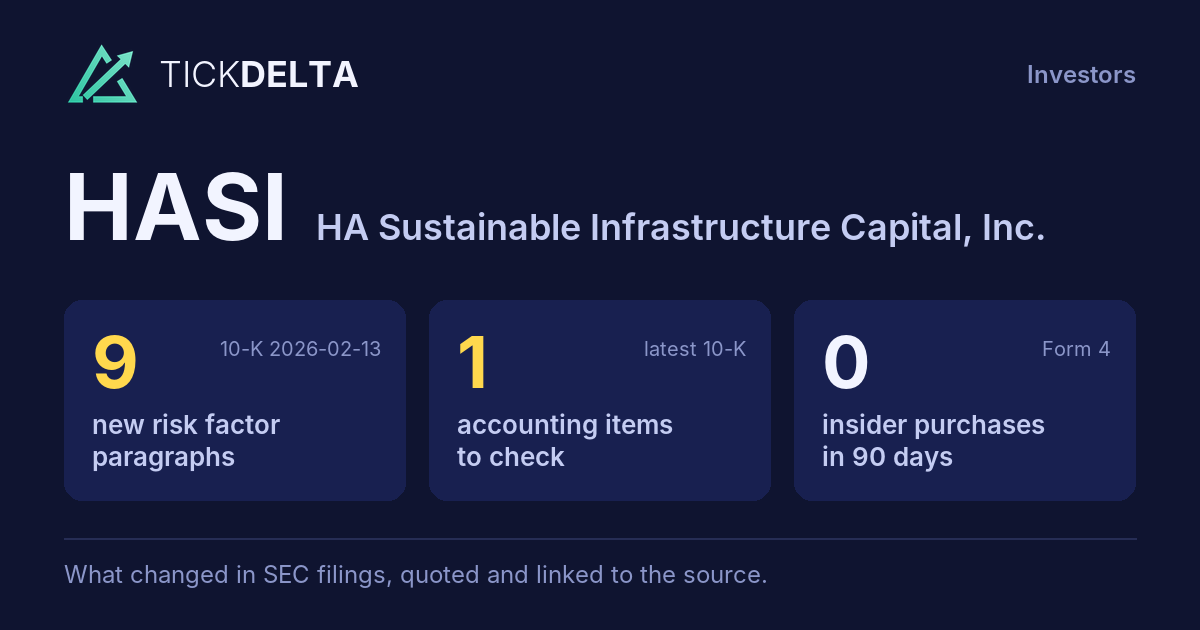
199 paragraphs · 9 new · 62 reworded · 2 gone · 10-K Feb 13, 2026 against Feb 14, 2025
New paragraph Reworded (5% of its words or more) Same or nearly
Paragraph 25 · 43% changed Every version of it
The projects we invest in are subject to substantial regulation by U.S. federal, state and local governmental agencies. For example, many projects require government permits, licenses, concessions, leases or contracts. Government entities, due to the wide-ranging scope of their authority, have significant leverage in setting their contractual and regulatory relationships with third parties. In addition, government permits, licenses, concessions, leases and contracts are generally very complex, which may result in periods of non-compliance, or disputes over interpretation or enforceability. If the projects in which we invest fail to obtain or comply with applicable regulations, permits, or contractual obligations, they could be prevented from being constructed or subjected to monetary penalties or loss of operational rights, which could negatively impact project operating results and the returns on our assets. In addition, government counterparties also may have the discretion to change or increase regulation of project operations, or implement laws or regulations affecting project operations, separate from any contractual rights they may have. These actions could adversely impact the efficient and profitable operation of the projects in which we invest.
Paragraph 166 · 42% changed Every version of it
We typically retain the residual value associated with a securitization. We have also established special purpose entities through which we hold only a partial or subordinate interest or a residual value after taking into account our non-recourse debt facilities or a right to participate in the profits of such entity once it achieves a predefined threshold. As a holder of the residual value or other such interests, we are more exposed to losses on the underlying collateral because the interest we retain in the securitization vehicle or other entity would be subordinate to the more senior notes or interests issued to investors and we would, therefore, absorb all of the losses, up to the value of our interests, sustained with respect to the underlying assets before the owners of the notes or other interests experience any losses. In addition, the inability to securitize our Portfolio or assets within our Portfolio could hurt adversely affect our performance and our ability to grow our business.
Paragraph 44 · 39% changed Every version of it
In addition, many of the project’s end-customers are large entities with wide ranging activities. A climate related event in a non-related part of the business could have a material adverse impact on the financial strength of such end-customer and their ability to honor their contractual obligations which could negatively impact on revenue and the cash flow of the project and our business.
Paragraph 138 · 36% changed Every version of it
A cyber incident is considered to be any adverse event that threatens the confidentiality, integrity or availability of our information resources. These incidents may be an intentional attack or an unintentional event and could involve gaining unauthorized access to our information systems for purposes of misappropriating assets, stealing confidential information, corrupting data or causing operational disruption. The risk of a security breach or disruption, particularly through cyber-attacks or cyber intrusions, including by computer hackers, nation-state affiliated actors, and cyber terrorists, has generally increased as the number, intensity and sophistication of attempted attacks and intrusions from around the world have increased, and will likely continue to increase in the future. The result of these incidents could include disrupted operations, misstated or unreliable financial data, disrupted market price of our common stock, misappropriation of assets, liability for stolen assets or information, increased cybersecurity protection and insurance cost, regulatory enforcement, litigation and damage to our relationships. These risks require continuous and likely increasing attention and other resources from us to, among other actions, identify and quantify these risks, upgrade and expand our technologies, systems and processes to adequately address them and provide periodic training for our employees to assist them in detecting phishing, malware and other schemes. Such attention diverts time and other resources from other activities and there is no assurance that our efforts will be effective. Additionally, the cost of maintaining such systems and processes, procedures and internal controls may increase from its current level. Potential sources for disruption, damage or failure of our information technology systems include, without limitation, computer viruses, security breaches, human error, cyber- attacks, natural disasters and defects in design. Additionally, due to the size and nature of our company, we rely on third-party service providers for many aspects of our business. The networks and systems that our third-party vendors have established or use may not be effective. As our reliance on technology has increased, so have the risks posed to both our information systems and those provided by third-party service providers. Our processes, procedures and internal controls that are designed to mitigate cybersecurity risks and cyber intrusions do not guarantee that a cyber incident will not occur or that our financial results, operations or confidential information will not be negatively impacted by such an incident.
Paragraph 7 · 36% changed Every version of it
There has been a nationwide increase in distributed generation which has prompted discussions among policy makers and regulators regarding ways to both better integrate distributed energy resources into the electric grid and how to compensate distributed generators. Many states have a regulatory policy known as net energy metering, or net metering. Net metering typically allows some project customers to interconnect their on-site solar or other renewable energy systems to the utility grid and offset their utility electricity purchases by receiving a bill credit at the utility’s retail rate for the amount of energy in excess of their electric usage that is generated by their renewable energy system and is exported to the grid. At the end of the billing period, the customer simply pays for the net energy used or receives a credit at the retail rate if more energy is produced than consumed. Net metering policies are under review or have been limited or amended in a number of states. The ability and willingness of customers to pay for renewable energy systems that benefit from net metering rules may be reduced if net metering rules are eliminated or their benefits reduced, which may also impact our returns on such systems.
Paragraph 55 · 31% changed Every version of it
We provide a range of product investment structures, including various types of debt and equity securities, senior and subordinated loans, real property leases, mezzanine debt, preferred equity and common equity. Our projects may have, or may be permitted to incur, other liabilities or equity preferences that rank equally with, or senior to, our positions or investments in such projects or businesses, as the case may be, including with respect to grants of collateral. By their terms, such instruments may entitle the holders to receive payment of interest, principal payments or other distributions on or before the dates on which we are entitled to receive payments with respect to the instruments in which we invest. Also, in the event of insolvency, liquidation, dissolution, reorganization or bankruptcy of an entity in which we have invested, holders of instruments ranking senior to our investment in that project or business would typically be entitled to receive payment in full before we receive any distribution. After repaying such senior stakeholders, such project may not have any remaining assets to use for repaying its obligation to us. In the case of securities ranking equally with instruments we hold, we would have to share on an equal basis any distributions with other stakeholders holding such instruments in the event of an insolvency, liquidation, dissolution, reorganization or bankruptcy of the relevant project.
Paragraph 142 · 28% changed Every version of it
We generate substantially all of our revenue from operations in the United States. We have begun to expand and may seek to expand our investments outside of the United States in the future. These operations will be subject to a variety of risks that we do not face in the United States, including risk from changes in foreign country regulations, infrastructure, legal systems and markets. Other risks include possible difficulty in repatriating overseas earnings and fluctuations in foreign currencies.
Paragraph 87 · 26% changed Every version of it
Under various U.S. federal, state and local laws, an owner or operator of real estate or a project may become liable for the costs of removal of certain hazardous substances released from the project or any underlying real property. These laws often impose liability without regard to whether the owner or operator knew of, or was responsible for, the release of such hazardous substances. We acquire real property rights, make investments in projects that own real property, have collateral consisting of real property and in the course of our business, we may take title to a project or its underlying real estate assets relating to one of our debt financings. In these cases, we could be subject to environmental liabilities with respect to these assets.

MD&A

141 paragraphs · 14 new · 99 reworded · 11 gone · 10-K Feb 13, 2026 against Feb 14, 2025
New paragraph Reworded (5% of its words or more) Same or nearly
Paragraph 94 · 47% changed
(1) Included Represents return of capital distributions from our equity method investments included in Other in the cash provided by (used in) investing activities section of our statement of cash flows. flows which is incremental to any equity method investment distributions found in net cash provided by operating activities.
Paragraph 96 · 46% changed
For the year ended December 31, 2025 2024 2023 2022 (in thousands) Net Components of adjusted cash provided by operating activities flow from operations plus other portfolio collections: Cash collected from our Portfolio $ 5,852 1,199,907 $ 99,689 891,250 $ 230 Changes in receivables held-for-sale 29,273 (51,538) 62,953 Equity method investment distributions received 39,142 30,140 110,064 Proceeds 442,322 Cash collected from sales of equity method investments 9,472 — 1,700 Principal collections from receivables 600,652 197,784 125,976 Proceeds from sales of receivables 171,991 7,634 5,047 Proceeds from sales of land 115,767 — 4,550 Principal collections from investments (1) 47 3,805 171 Proceeds from the sale of a previously consolidated VIE assets (1) 5,478 — — Proceeds from sales of investments 33,389 325,051 34,034 Cash used for compensation and securitization assets 5,390 — 7,020 benefit expenses and general and administrative expenses (89,088) (85,519) (78,681) Interest paid (2) (227,867) (172,679) (138,418) Management fees and retained interest income and origination fees and other income 50,170 33,044 26,506 Principal payments on non-recourse debt (7,136) (72,989) (21,606) (30,581) Other (151) (8,083) 1,751 Adjusted cash flow Cash from operations and other portfolio collections Operations plus Other Portfolio Collections $ 959,224 $ 910,075 $ 265,908 $ 287,130 Less: Dividends (192,269) (159,786) (132,198) Cash Available for Reinvestment $ 717,806 $ 106,122 $ 154,932
Paragraph 117 · 46% changed
(1) Our unused capacity under The maturity profile of our recourse debt obligations is shown in the unsecured revolving credit facility is $1,341 million, however we have voluntarily reduced such capacity by the $100 table below. Amounts exclude $226 million principal amount of the standalone commercial paper notes outstanding to serve Standalone Commercial Paper Notes which mature in 2026, as a we have reserved capacity under our credit enhancement to those standalone commercial paper notes. facility for such amounts as described above.
Paragraph 9 · 42% changed
•Data centers. Spurred in part by unprecedented investment in artificial intelligence, data center power demand is expected to grow substantially, substantially. Data center share of total U.S. power demand is expected to increase from less than 4% approximately 5% of total U.S. power demand in 2024 2025 to more than 11% 12% by 2030, or approximately 400 TWh, according to McKinsey, which estimates such demands would necessitate approximately 55 with 124 GW of new generation AI capacity added on a cumulative basis between 2025 and require approximately $500 billion of capital investment 2030, resulting in overall U.S. data center energy infrastructure, excluding transmission and distribution investment as well as the investments demand increasing from 224 terawatt-hours in computer equipment within 2025 to 606 terawatt-hours in 2030. McKinsey expects that capital expenditures on data centers. Data centers represent approximately 30-40% of the total increase in U.S. electricity demand of more than 1,000 TWh that McKinsey estimates between 2024 and 2030. center
Paragraph 134 · 42% changed
Net cash provided by operating financing activities for the year ended December 31, 2024 2025 was $94 $483 million lower higher than the year ended December 31, 2023. 2024. Net income credit facility and commercial paper activity was $53 $501 million higher than in the prior year. We had higher net long-term borrowing inflows of $62 million in the current period, which was year. These amounts were partially offset by higher $95 million net negative adjustments decrease in cash provided to net income of $147 million when compared to the prior period. (received from) hedge counterparties.
Paragraph 124 · 42% changed
(2)Fixed-rate debt includes the impact of our interest rate swaps and collars derivatives on debt that is otherwise floating. Debt excludes securitizations that are not consolidated on our balance sheet. Since the borrowing rate associated with our junior subordinated notes is fixed for the first five years until which time we have the option to redeem them, we have included those notes as fixed-rate debt.
Paragraph 55 · 40% changed
•Interest and rental income and securitization asset income increased by $63 $20 million due to a larger receivable and debt securities portfolio and a larger securitization assets balance. Rental income decreased as a result of the deconsolidation of certain special purpose entities which held such land assets as a result of amendments to terms of the non-recourse debt held by higher average interest rate on those special purpose entities. assets. See the table above for information on our average receivables, investment, debt securities, and land real estate balance and average yield on those assets. Gain on sale of assets increased decreased by $12 $15 million primarily due to a larger smaller volume of assets being securitized. Management fees and retained interest income increased by $8 million primarily due to increased fee-generating managed assets. Origination fee and other income increased by $4 million due to fees earned from originating assets on behalf of co-investments structures that we manage.
Paragraph 81 · 40% changed
Years Ended December 31, 2025 2024 2023 2022 (in thousands) Interest and rental income $ Per 286,363 $ Per 265,887 $ Per Share Share Share (dollars in thousands, except per share amounts) Net 229,045 Management fees and retained interest income attributable to controlling stockholders 33,621 26,054 19,259 Interest expense (292,404) (242,364) (171,008) GAAP-based net investment income (loss) (1) $ 200,037 $1.62 $ 148,836 $1.42 $ 41,502 $0.47 Adjustments: Reverse GAAP 27,580 49,577 77,296 Adjusted income from equity method investments (247,878) (140,974) (31,291) Equity method investments earnings (2) 327,481 239,032 156,757 131,762 adjustment (2) Elimination of proportionate share of fees earned from co-investment structures (3) (2,144) — — Equity-based expenses 25,608 19,782 20,101 Non-cash provision for loss on receivables (4) 1,059 11,832 12,798 Loss (gain) on debt modification or extinguishment (3) 11,171 953 — — Amortization of real estate intangibles 11 180 2,473 3,129 Non-cash provision (benefit) for income taxes 70,198 31,621 7,381 Current year earnings attributable to non-controlling interest 3,591 1,921 409 Elimination of proportionate share of ongoing asset management fees earned from co-investment structures (4) (4,288) (590) — Adjusted earnings Recurring Net Investment Income $ 290,636 $2.45 361,955 $ 232,248 $2.23 289,152 $ 185,791 $2.08 Shares for adjusted earnings per share (5) 118,648,176 104,319,803 89,355,907 236,526

A paragraph is matched with the one last year that shares the most of its words; under half in common makes it new. The paragraphs shown are the 8 reworded the most in each section.

The paragraph that changed most in each section

The redline

Marked against last year's 10-K: cut words struck through, new words highlighted.

Risk Factors270 words changed in this paragraph; it is 30% similar to last year's version.
We conduct our businesses primarily through our subsidiaries and our operations so that we comply with the 40% test. The securities issued by any wholly-owned or majority-owned subsidiaries that we hold or may form in the future that are exempted from the definition of “investment company” based on Section 3(c)(1) or 3(c)(7) of the 1940 Act, together with any other investment securities we may own, may not have a value in excess of 40% of the value of our total assets on a non-consolidated basis. Certain of our subsidiaries rely on or will rely on an exemption from registration as an investment company under the 1940 Act pursuant to Section 3(c)(5)(C) of the 1940 Act, which is available for entities which are not primarily engaged in issuing redeemable securities, face-amount certificates of the installment type or periodic payment plan certificates and which are primarily engaged in the business of purchasing or otherwise acquiring mortgages and other liens on and interests in real estate. This exemption generally requires that at least 55% of such subsidiaries’ portfolios must be comprised of qualifying assets and at least 80% of each of their portfolios must be comprised of qualifying assets and real estate-related assets under the 1940 Act. Consistent with guidance published by the SEC staff, we intend to treat as qualifying assets for this purpose loans secured by projects for which the original principal amount of the loan did not exceed 100% of the value of the underlying real property portion of the collateral when the loan was made. We intend to treat as real estate-related assets non-controlling equity interests in joint ventures that own projects whose assets are primarily real property. In general, with regard to our subsidiaries relying on Section 3(c)(5)(C), we rely on other guidance published by the SEC or its staff or on our analyses of guidance published with respect to other types of assets to determine which assets are qualifying real estate assets and real estate-related assets.

Source: Item 1A, 10-K 0001561894-26-000007 vs Item 1A, 10-K 0001561894-25-000007

Accounting Policies243 words changed in this paragraph; it is 39% similar to last year's version.
We compute earnings per share of common stock in accordance with ASC 260, Earnings Per Share. Basic earnings per share is calculated by dividing net income attributable to controlling stockholders (after consideration of the earnings allocated to unvested grants, if applicable) by the weighted-average number of shares of common stock outstanding during the period excluding the weighted average number of unvested grants, if applicable (“participating securities” as defined in Note 12 to our financial statements in this Form 10-K). Diluted earnings per share is calculated by dividing net income attributable to controlling stockholders (after consideration of the earnings allocated to unvested grants, if applicable) by the weighted-average number of shares of common stock outstanding during the period plus other potential common stock instruments if they are dilutive. Other potentially dilutive common stock instruments include our unvested restricted stock, other equity-based awards, and Convertible Notes. The restricted stock and other equity-based awards are included if they are dilutive using the treasury stock method. The treasury stock method assumes that theoretical proceeds received for future service provided is used to purchase shares of treasury stock at the average market price per share of common stock, which is deducted from the total shares of potential common stock included in the calculation. When unvested grants are dilutive, the earnings allocated to these dilutive unvested grants are not deducted from the net income attributable to controlling stockholders when calculating diluted earnings per share. The Convertible Notes are included if they are dilutive using the if-converted method, which removes interest expense related to the Convertible Notes from the net income attributable to controlling stockholders and includes the weighted average shares of potential common stock over the period issuable upon conversion or exchange of the note. No adjustment is made for shares of potential common stock that are anti-dilutive during a period. Our capped call transactions are anti-dilutive and therefore their impact will be excluded from earnings per share.

Source: Item 8, Note 2 – Summary of Significant Accounting Policies, 10-K 0001561894-26-000007 vs Item 8, Note 2 – Summary of Significant Accounting Policies, 10-K 0001561894-25-000007

MD&A221 words changed in this paragraph; it is 49% similar to last year's version.
Under GAAP, we account for these equity method investments utilizing the HLBV method. Under this method, we recognize income or loss based on the change in the amount each partner would receive, typically based on the negotiated profit and loss allocation, receive if the assets were liquidated at book value, after adjusting for any distributions or contributions made during such quarter. The HLBV allocations amount received in a liquidation is typically based on the negotiated profit and loss allocation, which may differ from the allocation of income or loss may be impacted by distributable cash in any given period. The amount allocated to a tax equity investor during the receipt hypothetical liquidation is typically reduced over time as tax attributes are allocated to them and they achieve portions of tax attributes, as their preferred return. Accordingly, tax equity investors are allocated losses in proportion to the as they receive tax benefits received, benefits, while the sponsors of the project and other investors subordinate to tax equity are allocated gains of a similar amount. The Tax equity investors can generally elect either investment tax credit available for election in solar projects is a one-time credit realized in the quarter when the project is considered operational for tax purposes and is fully allocated under HLBV in that quarter (subject to an impairment test), while the credits or production tax credits, which are each recognized over different time periods. This results in different HLBV income profiles despite the fact that cash allocations are typically not directly impacted by such a tax credit required for wind projects and electable for solar projects is a ten-year credit and thus is allocated under HLBV over a ten year period. election. In addition, the agreed upon allocations of the project’s cash flows may differ materially from the profit and loss allocation used for the HLBV calculations in a given period. We also consider the impact of any OTTI in determining our income from equity method investments.

Source: Item 7, 10-K 0001561894-26-000007 vs Item 7, 10-K 0001561894-25-000007

Legal Proceedings18 words changed in this paragraph; it is 94% similar to last year's version.
We have made guarantees a guarantee related to the financing of four of our joint venture entities that own debt securities of energy efficiency projects. We received $73 $88 million of the proceeds of this financing arrangement, and in turn have guaranteed the obligations of the entity related to this financing, which includes collateral posting requirements as well as repayment of the financing at maturity in May 2025. August 2026. As of December 31, 2024, 2025, our maximum obligation under this guarantee is approximately $87 $104 million. We believe the likelihood of having to perform under the guarantee is remote, have recorded no liability associated with this guarantee, and presently have not been required to post collateral for this guarantee as the assets of the joint venture entities are enough to support the financing obligation. We have executed a separate agreement with our joint venture partner pursuant to which it is liable for repayment to us of 15% of this guarantee obligation. obligation repayable to us.

Source: Item 3, via Note 9 – Commitments and Contingencies, 10-K 0001561894-26-000007 vs Item 3, via Note 9 – Commitments and Contingencies, 10-K 0001561894-25-000007

Sentences and paragraphs added, removed or reworded

Every change, by type

Sentences and paragraphs of HASI's Risk Factors and MD&A, 10-K Feb 13, 2026 against 10-K Feb 14, 2025. Each links to the text at sec.gov.

Quiet changes are sentences kept from last year with one to four words changed, at least one of them a hedge, a modal or a qualifier (may, could, will, not, significant, material…). A year or date rolling forward is not counted.

The full word list

adverse, adversely, all, although, anticipate, anticipates, any, approximately, believe, believes, can, cannot, certain, could, expect, expects, generally, however, if, intend, intends, largely, likely, many, material, materially, may, might, most, must, never, no, not, possible, primarily, probable, should, significant, significantly, some, substantial, substantially, unlikely, will, would

AddedRisk Factors
cash flow could have a material adverse effect on the repayment of and return on our investment and our business, financial condition, results of operations and cash flows. While the projects maintain insurance, obtain warranties from vendors and obligate contractors to meet certain performance levels, the proceeds of such insurance, warranties or performance guarantees may not cover the lost revenues, increased expenses or liquidated damages payments should the project experience any equipment breakdowns, insurance claims or non-performance by contractors or vendors.
Read it in 10-K Feb 13, 2026 at sec.gov
AddedRisk Factors
The use of artificial intelligence, machine learning technology and other quantitative analysis tools and models, developed by us or third-party service providers (collectively, "AI") as well as the increasing adoption of AI throughout society may expose us to new and unpredictable competitive, operational, legal and regulatory risks. We may not be able to anticipate, mitigate, or effectively manage all of the potential risks or impacts associated with our and third parties’ use of AI. These risks could disrupt, among other things, our business models, investment strategies, operational processes, and our ability to identify and hire employees. In addition, our competitors may more efficiently develop or implement AI-based technologies to identify and assess potential investments, address investor demands or improve operations. If we are unable to advance our AI capabilities as quickly or as effectively as our competitors, we may be at a competitive disadvantage.
Read it in 10-K Feb 13, 2026 at sec.gov
AddedRisk Factors
We may use AI to inform certain of our decisions or to manage our business. If we, or third parties whose services we rely on, use data in connection with the development or deployment of AI that is incomplete, inadequate or biased – or if the data contains inaccuracies or errors that result in flawed algorithms and models – the performance of our investments and operations could suffer.
Read it in 10-K Feb 13, 2026 at sec.gov
AddedRisk Factors
Our personnel or the personnel of our service providers could, without our knowledge, improperly utilize AI while carrying out their responsibilities. AI may be misused or misappropriated by our employees or third-party providers engaged by us. For example, by inputting confidential information into AI applications, resulting in such information becoming accessible by others, including our competitors. If we do not have sufficient rights to use the data or other material used with, or relied upon by, an AI application, we may incur liability through the alleged violation of applicable laws and regulations, intellectual property, data privacy, or other rights, or contractual obligations. Further, we may not be able to control how third-party AI applications that we choose to use are developed or maintained, or how data we input is used or disclosed, even where we have sought contractual protections with respect to these matters. The misuse or misappropriation of our data, deficiencies in the practices associated with data collection, training and data analytics, as well as difficulties validating data, could have an adverse impact on our reputation and could subject us to legal and regulatory investigations or actions.
Read it in 10-K Feb 13, 2026 at sec.gov
AddedRisk Factors
Regulators are also increasing scrutiny regarding AI and adopting regulations that may impact our use of the technology, including regulations regarding the use of “big data,” diligence of data sets and oversight of data vendors. The use of AI by us or others may require compliance with legal or regulatory frameworks that are not fully developed or tested, and we may face litigation and regulatory actions related to our use of AI. Existing laws and regulations may be interpreted in new ways, which would affect the way we use AI. These and other regulatory or legal developments could limit our ability to gain insights into and manage our business or otherwise have a materially adverse impact on us.
Read it in 10-K Feb 13, 2026 at sec.gov
AddedRisk Factors
We conduct our businesses primarily through our subsidiaries and our operations so that we comply with the 40% test. The securities issued by any wholly-owned or majority-owned subsidiaries that we hold or may form in the future that are exempted from the definition of “investment company” based on Section 3(c)(1) or 3(c)(7) of the 1940 Act, together with any
Read it in 10-K Feb 13, 2026 at sec.gov
AddedRisk Factors
We and our subsidiaries may be able to incur substantially more indebtedness, which may increase the risks to our financial condition and results of operations created by our indebtedness.
Read it in 10-K Feb 13, 2026 at sec.gov
Show the other 58
AddedRisk Factors
We and our subsidiaries may be able to incur substantial additional indebtedness in the future, which may increase the risks created by our current indebtedness. The terms of the agreements governing our indebtedness provide our subsidiaries with the flexibility to incur a substantial amount of indebtedness in the future, which indebtedness may be secured or unsecured.
Read it in 10-K Feb 13, 2026 at sec.gov
RemovedRisk Factors
Major public health issues and related disruptions in the U.S. and global economy and financial markets could adversely impact or disrupt our financial condition and results of operations.
Read it in 10-K Feb 14, 2025 at sec.gov
RemovedRisk Factors
In recent years, the outbreaks of a number of diseases, including COVID-19, avian influenza, H1N1, and other viruses have resulted in and increased the risk of a pandemic or major public health issues. We believe that our ability to operate, our level of business activity and the profitability of our business, as well as the values of, and the cash flows from, the assets we own could in the future be impacted by another pandemic or other major public health issue. While we have implemented risk management and contingency plans and taken preventive measures and other precautions, no predictions of specific scenarios can be made with certainty and such measures may not adequately predict the impact on our business from such events.
Read it in 10-K Feb 14, 2025 at sec.gov
RewordedRisk Factors
Net metering typically allows some project customers to interconnect their on-site solar or other renewable energy systems to the utility grid and offset their utility electricity purchases by receiving a bill credit at the utility’s retail rate for the amount of energy in excess of their electric usage that is generated by their renewable energy system and is exported to the grid.
Read it in 10-K Feb 13, 2026 at sec.gov
RewordedRisk Factors
A failure to failure, whether real or perception of a failure perceived, to disclose metrics and set goals that are rigorous enough or in an acceptable format, a failure to appropriately select and manage selection of our goals, a failure to or perception of a failure to make appropriate disclosures, stockholder perception of a failure to prioritize the “correct” sustainability and governance goals, or an unfavorable sustainability and governance-related rating by a third party, could negatively impact our reputation and our business.
Read it in 10-K Feb 13, 2026 at sec.gov
RewordedRisk Factors
Certain data we utilize in our CarbonCount or similar metric calculations is prepared by third parties or receives limited assurance from and/or verification by third parties and may undergo a less rigorous review process than assurance sought in connection with more traditional audits and such review process may not identify errors and may not protect us from potential liability under the securities laws. parties.
Read it in 10-K Feb 13, 2026 at sec.gov
RewordedRisk Factors
Certain data we utilize in our CarbonCount or similar Accordingly, such metric calculations is prepared by third parties or receives limited assurance from and/or verification by third parties and may undergo a less rigorous review process than assurance sought in connection with more traditional audits and such any related review process processes may not identify errors and may not or protect us from potential liability under the securities laws.
Read it in 10-K Feb 13, 2026 at sec.gov
RewordedRisk Factors
While the SEC has yet to provide additional information on its position relating to these exemptions and timing of any future changes to the exemptions remain unknown, any Any additional guidance from the SEC or its staff from this process or in other circumstances could provide additional flexibility to us, or it could further inhibit our ability to pursue the strategies we have chosen.
Read it in 10-K Feb 13, 2026 at sec.gov
RewordedRisk Factors
As a holder of the residual value or other such interests, we are more exposed to losses on the underlying collateral because the interest we retain in the securitization vehicle or other entity would be subordinate to the more senior notes or interests issued to investors and we would, therefore, absorb all of the losses, up to the value of our interests, sustained with respect to the underlying assets before the owners of the notes or other interests experience any losses.
Read it in 10-K Feb 13, 2026 at sec.gov
RewordedRisk Factors
Any extended interruption in a project’s construction or operation, a project’s inability to operate its assets efficiently, manage capital expenditures and costs or generate earnings and cash flow could have a material adverse effect on the repayment of and return on our investment and our business, financial condition, results of operations and cash flows.
Read it in 10-K Feb 13, 2026 at sec.gov
RewordedRisk Factors
We, We or our projects, projects may choose not to pursue, or fail to qualify for for, hedge accounting treatment relating to derivative and hedging transactions for a number of reasons, including if we, we or our projects, projects (1) use instruments that do not meet the Accounting Standards Codification (“ASC”) Topic 815 definition of a derivative, we, or our projects, (2) fail to satisfy ASC Topic 815 hedge documentation and hedge effectiveness assessment requirements or (3) the hedge relationship is not highly effective.
Read it in 10-K Feb 13, 2026 at sec.gov
RewordedRisk Factors
To the extent that we, or another project owner, we become liable for the removal costs, our investment, or the ability results of the owner to make payments to us, operation and financial condition may be negatively impacted. adversely affected.
Read it in 10-K Feb 13, 2026 at sec.gov
RewordedRisk Factors
Effective January 1, 2024, we revoked our REIT election and starting in 2024 since then we were have been taxed as a C corporation, and as a result, in 2024 and going forward, we were no longer subject to this requirement. corporation.
Read it in 10-K Feb 13, 2026 at sec.gov
RewordedRisk Factors
These fees could increase our customers’ cost to use energy efficiency and renewable energy systems not supplied by the utility and make them less desirable, thereby harming our business, prospects, financial condition and results of operations.
Read it in 10-K Feb 13, 2026 at sec.gov
RewordedRisk Factors
Our ability to originate new assets could be adversely affected if one or more of the ESCOs or other origination sources with whom we have relationships are suspended or debarred or fail to win new, or renew existing, contracts.
Read it in 10-K Feb 13, 2026 at sec.gov
Quiet changesRisk Factors
Some Accordingly, some of our project companies are structured as joint ventures, partnerships, securitizations, and syndications, and we also at times invest in project companies through co-investment structures.
Read it in 10-K Feb 13, 2026 at sec.gov
Quiet changesRisk Factors
Our failure to manage these risks successfully could harm our any future international projects, reduce our international income or increase our costs, thus adversely affecting our business, financial condition and operating results.
Read it in 10-K Feb 13, 2026 at sec.gov
Quiet changesRisk Factors
Certain financing agreements also contain cross-default provisions, so such that if a default occurs under any one agreement, the lenders under our certain other agreements could also declare a default.
Read it in 10-K Feb 13, 2026 at sec.gov
Quiet changesRisk Factors
A default will would also significantly limit our financing alternatives such that we will would be unable to pursue our leverage strategy, which could curtail the returns on our assets.
Read it in 10-K Feb 13, 2026 at sec.gov
AddedMD&A
Finally, as most of the sustainable infrastructure assets we invest in are energy projects, energy—and in particular electricity—prices can also impact the pricing and returns we generate on our investments. After rising more than 5% in 2025, average U.S. retail electricity prices have increased by 29% between 2020 and 2025 and are forecasted to rise a further 4% between 2025 and 2027, according to the Energy Information Administration. Similarly, wholesale electricity capacity prices have risen considerably in key markets such as PJM where capacity prices reached a new record for the third auction in a row at $333 per MW-day in December 2025, and MISO where the average annualized clearing price of approximately $215 per MW-day at the most recent auction in April 2025 increased more than ten times compared to the prior year’s. The increase in electricity prices is a result of the recent growth in U.S. electricity demand and, in our view, underscores the need for an increase in electricity generation capacity across the country. Not only can higher electricity prices impact the pricing and returns of new investments, but we believe they can also increase the value of our existing project investments. For more detail on the impact of energy prices, see “Item 7A. Quantitative and Qualitative Disclosures about Market Risk—Commodity Price Risk.”
Read it in 10-K Feb 13, 2026 at sec.gov
AddedMD&A
We earn origination fees when co-investment structures we manage fund investments that we have sourced on their behalf, and we also earn ongoing management fees based on the assets held within these structures. We may charge advisory, retainer or other fees to third parties, including through our broker dealer subsidiary.
Read it in 10-K Feb 13, 2026 at sec.gov
AddedMD&A
•Compensation and benefits increased by $11 million as a result of an increase in our employee headcount and compensation. General and administrative decreased by $2 million as legal fees related to our conversion to a Delaware corporation in the prior year did not recur.
Read it in 10-K Feb 13, 2026 at sec.gov
AddedMD&A
•Income tax expense increased by $15 million primarily driven by a remeasurement of state deferred taxes and adjustments related to changes in estimates made in calculating the Company’s income tax expense.
Read it in 10-K Feb 13, 2026 at sec.gov
AddedMD&A
supplement to the income (loss) from equity method investments as determined under GAAP that helps investors understand the economic performance of these investments where HLBV income can differ substantially from the economic returns in any one period.
Read it in 10-K Feb 13, 2026 at sec.gov
AddedMD&A
(1)GAAP-based net investment income (loss) as reported in previous periods was not defined to include Management fees and retained interest income. It has been included here in comparative periods to reflect the new definition.
Read it in 10-K Feb 13, 2026 at sec.gov
AddedMD&A
(2)Represents assets in our co-investment structures which are not attributable to our co-investors, and therefore are not fee-generating. Such assets are attributable to us but were financed with debt issued by the co-investment structure and therefore are not reflected in the carrying value of the equity method investment we hold in the structure.
Read it in 10-K Feb 13, 2026 at sec.gov
AddedMD&A
Adjusted Return on Equity is a measure of the economic performance of our invested equity capital. Adjusted Return on Equity is calculated as our adjusted earnings divided by our average stockholder’s equity for the period. The direct comparable GAAP measure is GAAP-based return on equity, which we have presented below. Adjusted Return on Equity differs from GAAP-based return on equity in that the numerator of the calculation contains those adjustments described in the Adjusted Earnings section above. We believe that Adjusted Return on Equity gives investors an understanding into our performance after considering the effects of financial leverage. Our management uses it in this way and we believe that our investors use it in a similar fashion, and as such, we believe that its disclosure is useful to our investors.
Read it in 10-K Feb 13, 2026 at sec.gov
AddedMD&A
(1) For 2025, we changed the methodology for our calculation of Average Stockholders’ Equity to be calculated as the average of the Stockholders’ Equity at the end of the preceding year and as of the end each of the year’s four quarters. We have recast prior periods to conform with this calculation methodology.
Read it in 10-K Feb 13, 2026 at sec.gov
AddedMD&A
During the year ended December 31, 2025, we increased the available capacity available under our unsecured revolving credit facility to $1.825 billion, adding five additional banks. We issued $600 million principal amount of senior notes due 2031 and $400 million principal amount of senior notes due 2035, and used the proceeds of the notes issuances to complete a cash tender offer to repurchase $400 million and $300 million of senior notes due 2026 and 2027, respectively. We issued $500 million principal amount of 2056 junior subordinated notes, which credit rating agencies consider to be partly equity under their rating methodologies, and therefore reduces our reliance on equity issuances to maintain our credit ratings. We repaid $220 million of Convertible Notes with existing liquidity, and issued $237 million in equity through our at-the-market equity program.
Read it in 10-K Feb 13, 2026 at sec.gov
AddedMD&A
In November 2025, we entered into an agreement that provides for a delayed-draw term loan facility in an aggregate principal amount of up to $250 million, available to be drawn during the period from March 16, 2026 through the earlier of June 15, 2026 or the date when the full principal amount is drawn. Drawn loans, if any, mature on June 15, 2028. The facility has a commitment fee during the availability period, and bears interest at a rate of SOFR or alternative base rate plus applicable margins based on our current credit rating. The current applicable margins are 1.650% for SOFR-based loans and 0.650% for alternative base rate-based loans.
Read it in 10-K Feb 13, 2026 at sec.gov
RemovedMD&A
Finally, with most of our investments and assets serving the energy markets, energy–and in particular–electricity prices also can impact the pricing and rates of returns of our investments. According to the EIA, the average annual Henry Hub natural gas price for 2024 was $2.21/MMBtu, a decrease of 16% from 2023 and 68% from 2022, the largest two year decline on record. The EIA cites robust natural gas production and limited growth in natural gas consumption as key contributors to the sharp decrease in price compared to prior years. The EIA’s outlook for 2025 and 2026 is for the average price of natural gas to increase, to an average of $3.10 per MMBtu in 2025, and $4.00 per MMBtu in 2026. While we typically invest in projects which sell power at prices which have been prenegotiated under power purchase agreements, lower natural gas prices, may negatively impact, renewable energy projects that sell wholesale power on a “merchant” basis at spot market prices, as wholesale electricity prices are closely tied to wholesale natural gas prices in many parts of the United States. For more detail on commodity price impacts, see “Item 7A. Quantitative and Qualitative Disclosures about Market Risk-Commodity Price Risk”.
Read it in 10-K Feb 14, 2025 at sec.gov
RemovedMD&A
We also generate fee income for syndications where we arrange financings that are held by other investors or if we sell existing transactions to other investors. In these transactions, unless we decide to hold a portion of the economic interest of the transaction on our balance sheet, we have no exposure to risks related to ownership of those financings. We may charge advisory, retainer or other fees, including through our broker dealer subsidiary and for our management services provided to co-investment structures.
Read it in 10-K Feb 14, 2025 at sec.gov
RemovedMD&A
volume of assets being securitized. Other income increased by $8 million due to fees earned from asset management activities, including $5 million of fees earned related to our temporary role as service provider to special purpose vehicles in which we have invested that were previously sponsored by SunPower Corporation. In 2025, these services will be provided by an equity method investee we have formed with the replacement investor in those special purpose vehicles.
Read it in 10-K Feb 14, 2025 at sec.gov
RemovedMD&A
•Compensation and benefits increased by $17 million as a result of an increase in our employee headcount and compensation. General and administrative increased by $2 million due to additional investment in corporate infrastructure. Included in compensation and benefits and general and administrative expenses for 2024 are $6 million of costs related to our temporary role as service provider to special purpose vehicles in which we have invested previously sponsored by SunPower Corporation. In 2025, these services will be provided by an equity method investee we have formed with the replacement investor in those special purpose vehicles.
Read it in 10-K Feb 14, 2025 at sec.gov
RemovedMD&A
In addition to diversity of gender and ethnic background, we also value diversity of thought, with 54% of our leadership team and 70% of our Board possessing degrees outside the fields of business or economics, including in science and engineering, liberal and fine arts, and law.
Read it in 10-K Feb 14, 2025 at sec.gov
RemovedMD&A
During the year ended December 31, 2024, we increased the available capacity available under our unsecured revolving credit facility to $1.35 billion, and extended the maturity of the facility to April 2028. We also extended the maturity of our unsecured term loan facility to April 2027, and used borrowings from the unsecured revolving credit facility to partially prepay our unsecured term loan facility by $275 million. We also increased the available capacity under our credit-enhanced green commercial paper notes program to $125 million, and extended the term of the facility to April 2026. We established a senior secured credit facility, designed to warehouse qualifying climate solutions assets until they achieve key technical milestones, at which point we may consider them for sale to large institutional investors under our established securitization programs. The capacity of this senior secured credit facility is $100 million, subject to the amount of pledged collateral. In December of 2024, we launched a stand-alone commercial paper notes program, whereby we can issue commercial paper notes up to the lesser of the amount of available capacity currently existing under our unsecured credit facility or $1 billion.
Read it in 10-K Feb 14, 2025 at sec.gov
RemovedMD&A
During the year ended December 31, 2024, we issued an additional $200 million principal amount of 2027 Senior Unsecured Notes for proceeds of $204 million, and issued $94 million of non-recourse debt secured by equity method investments. We also issued $1 billion of senior unsecured notes due 2034, and used $400 million of the net proceeds from such offering to redeem our 6.00% Senior Notes due 2025, and the remainder to temporarily repay a portion of the outstanding borrowings under our unsecured revolving credit facility. We also issued $204 million in equity during 2024.
Read it in 10-K Feb 14, 2025 at sec.gov
RewordedMD&A
Years Ended December 31, 2025 2024 2023 2022 (dollars in millions) Portfolio, excluding equity method investments Interest income, receivables $260 $203 $132 Average balance of receivables $3,086 $2,424 $1,650 Average interest rate of receivables 8.4% 8.4% 8.0% Interest income, investments $1 $1 $1 Average balance of investments $12 $12 $13 Average interest rate of investments 6.1% 4.9% 4.4% Rental and rental income $2 $21 $26 Average balance of from receivables, debt securities, and real estate $25 $286 $357 Average yield on real estate 8.5% 7.4% 7.3% $ 283 $263 $225 Average balance of receivables, investments, debt securities, and real estate $ 3,283 $3,123 $2,722 $2,021 Average yield from receivables, investments, debt securities, and real estate 8.6 % 8.4% 8.3% 7.9% Debt Interest expense, including the impact of cash flow hedges expense (1) $ 281 $241 $171 $116 Average balance of debt $ 4,810 $4,273 $3,437 $2,688 Average cost of debt 5.8 % 5.6% 5.0% 4.3%
Read it in 10-K Feb 13, 2026 at sec.gov
RewordedMD&A
However, The application of the HLBV method described above results in GAAP income or loss in any one period that is often significantly different from the economic returns achieved from the investment in any one period as a result of the application of the HLBV method, including the impact of tax allocations, the high levels of depreciation and other non-cash expenses that are common to renewable energy projects and the differences between the agreed upon profit and loss and the cash flow allocations, the distributions and thus the economic returns (i.e. return on capital) achieved from the investment are often significantly different from the income or loss that is allocated to us under the HLBV method in any one period. allocations.
Read it in 10-K Feb 13, 2026 at sec.gov
RewordedMD&A
Reverse GAAP income from equity method investments (300,667) (247,878) (140,974) (31,291) Equity Adjusted income from equity method investments earnings (2) 327,481 239,032 156,757 131,762 adjustment (2) Elimination of proportionate share of up-front origination fees earned from co-investment structures (3) (2,144) (6,844) (1,554) — Elimination of proportionate share of ongoing asset management fees earned from co-investment structures (4) (4,288) (590) — Equity-based expenses 29,885 25,608 19,782 20,101 Non-cash provision Provision for loss on receivables (4) (5) 12,145 1,059 11,832 12,798 Loss (gain) on debt modification or extinguishment (6) 11,171 953 — — Amortization of intangibles 11 180 2,473 3,129 Non-cash provision (benefit) for income taxes 85,247 70,198 31,621 7,381 Current year earnings attributable to non-controlling interest 3,689 3,591 1,921 409 Adjusted earnings Earnings $ 342,377 $2.70 $ 290,636 $2.45 $ 232,248 $2.23 $ 185,791 $2.08 Shares for adjusted earnings Adjusted Earnings per share (5) (7) 126,639,114 118,648,176 104,319,803 89,355,907
Read it in 10-K Feb 13, 2026 at sec.gov
RewordedMD&A
For the year ended December 31, 2025 2024 2023 2022 (in thousands) Net cash provided by operating activities $ 167,317 $ 5,852 $ 99,689 $ 230 Changes in receivables held-for-sale 23,759 29,273 (51,538) 62,953 Equity method investment distributions received (1) 59,416 39,142 30,140 110,064 Proceeds from sales of equity method investments — 9,472 — 1,700 Principal collections from receivables 705,675 600,652 197,784 125,976 Proceeds from sales of receivables 8,344 171,991 7,634 5,047 Proceeds from sales of land — 115,767 — 4,550 Principal collections from investments (1) debt securities (2) 1,849 47 3,805 171 Proceeds from the sale of a previously consolidated VIE (1) (2) — 5,478 — — Proceeds from sales of investments debt securities and retained interests in securitization assets trusts — 5,390 — 7,020 Principal payments on non-recourse debt (7,136) (72,989) (21,606) (30,581) Adjusted cash flow Cash from operations and other portfolio collections Operations plus Other Portfolio Collections $ 959,224 $ 910,075 $ 265,908 $ 287,130 Less:
Read it in 10-K Feb 13, 2026 at sec.gov
RewordedMD&A
Other than our We have retained interests in securitization assets trusts (including any outstanding servicer advances) of approximately $263 $310 million as of December 31, 2024, 2025, that may be at risk in the event of defaults or prepayments in our securitization trusts and certain limited guarantees as discussed below, and except as disclosed in Note 9 to our audited financial statements in this Form 10-K, we have not guaranteed any obligations of non-consolidated entities or entered into any commitment or intent to provide additional funding to any such entities. below.
Read it in 10-K Feb 13, 2026 at sec.gov
RewordedMD&A
Other than our investments, the residual those assets in securitized financial assets, and derivatives that listed above which are carried at fair value on our balance sheet at fair value as of December 31, 2024, sheet, the carrying value of our remaining assets and liabilities are calculated as of a particular point in time, which is largely typically determined at the time such assets and liabilities were added to our balance sheet using a cost basis approach in accordance with GAAP, adjusted for income or loss recognized on and cash collected from such assets.
Read it in 10-K Feb 13, 2026 at sec.gov
RewordedMD&A
As of December 31, 2025 2024 2023 (dollars in millions) Equity method investments $ 4,116 $ 3,612 $ 2,966 Receivables, net of allowance 3,280 2,896 3,074 Receivables held-for-sale 114 76 35 Real estate 3 111 Investments 7 7 and debt securities 76 10 GAAP-based Portfolio 7,586 6,594 6,193 Other investors’ share of assets Assets held in securitization trusts 7,220 6,809 6,060 Other investors’ share of Fee-generating assets held in co-investment structures (1) 951 300 Non-fee generating assets held in co-investment structures (2) 314 — Managed assets Assets $ 16,071 $ 13,703 $ 12,253
Read it in 10-K Feb 13, 2026 at sec.gov
RewordedMD&A
As we We consolidate assets on our balance sheet, securitize assets off-balance sheet, and manage asset assets in which we coinvest with other parties, certain receivables and other assets are not reflected on our balance sheet where we may have a residual interest in the performance of the investment, such as a retained interest in cash flows. parties via equity method investments.
Read it in 10-K Feb 13, 2026 at sec.gov
RewordedMD&A
We believe this equity method investment adjustment to our GAAP net income (loss) in calculating our adjusted earnings Adjusted Earnings measure is an important supplement to the income (loss) from equity method investments as determined under GAAP for an investor to understand the economic performance of these investments where HLBV income can differ substantially from the economic returns in any one period.
Read it in 10-K Feb 13, 2026 at sec.gov
RewordedMD&A
Finally, this expected growth in U.S. electricity demand combined with the increase in climate events and disasters, as discussed above, is also leading to greater attention to and prioritization of improving the resilience and reliability of the grid, while Simultaneously, greater geopolitical conflict and uncertainty along with volatility in fossil fuel prices is leading to growing prioritization of national energy security.
Read it in 10-K Feb 13, 2026 at sec.gov
RewordedMD&A
In 2024, According to ClimateCentral, a policy-neutral 501(c)(3) nonprofit, in 2025 there were 27 23 confirmed climate disaster events in the United States with losses exceeding $1 billion that in aggregate accounted for total damage of approximately $183 billion, according to National Centers for Environmental Information, including Hurricane Helene at a cost of approximately $79 billion and Hurricane Milton at approximately $34 $115 billion.
Read it in 10-K Feb 13, 2026 at sec.gov
RewordedMD&A
Allowance for loss on receivables (50) (62) Receivables, net of allowance 2,896 3,280 Fixed-rate investments, debt securities, interest rates less than 5.00% per annum 7 6 2033 to 2047 Fixed-rate debt securities, interest rates from 8.01% to 9.49% per annum 3 2055 Fixed-rate debt securities, interest rates 9.50% or greater per annum 64 2055 Total receivables and investments debt securities $ 2,903 3,353
Read it in 10-K Feb 13, 2026 at sec.gov

Sources

The two latest 10-Ks on EDGAR, section by section. Each change links to the text at sec.gov.

Also

New risk factors: paragraphs with nothing like them last year, quoted in full.

Work with it

Excel workbook · CSV. Google Sheet that stays up to date: paste =IMPORTDATA("https://tickdelta.com/company/HASI/export.csv") into a cell.

Next:Related parties
Esc

Type a ticker such as AAPL, a name, an investor such as Buffett, or a topic such as tariffs. ↑ ↓ to move, Enter to open.