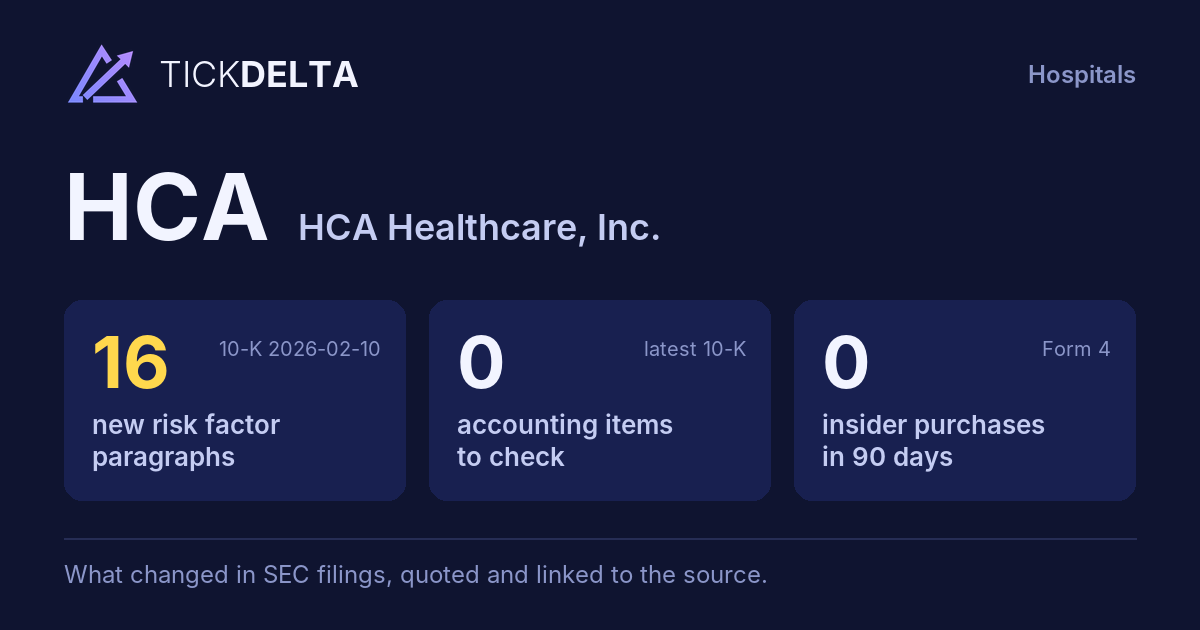
10-K 0001193125-26-044769 (2026-02-10) vs 10-K 0000950170-25-020134 (2025-02-14)
| Section | Compared text | Words now | Changed |
|---|
| Risk Factors | Item 1A | 15,772 |
21.5% |
| MD&A | Item 7 | 9,668 |
13.5% |
| Legal Proceedings | Item 3, via Note 10 – CONTINGENCIES | 354 |
0.0% |
| Accounting Policies | 10-K text, Note 2 – Internal Control Over Financial Reporting | 2,219 |
12.8% |
The redline: what was cut and what was added
In each section, the paragraph that changed most, marked against last year's 10-K:
cut words struck through, new words highlighted and underlined.
Risk Factors 357 words changed in this paragraph; it is 33% similar to last year's version.
In addition, the Medicare and Medicaid programs are subject to change as a result of legislation and administrative actions. For example, some members of Congress have proposed changes intended to accelerate the shift from traditional Medicare to Medicare Advantage. Legislation and administrative actions at the federal level may also impact funding for, or the structure of, the Medicaid program and may shape administration of the Medicaid program at the state level. For example, the FBA includes significant health care policy reforms that are expected to result in Medicaid spending reductions and changes in administration of state Medicaid programs. Among other changes, the law limits eligibility for Medicaid by imposing work or community engagement requirements for adults under age 65 in Medicaid expansion states, including states with waiver-based expansions, subject to limited exceptions. The law also makes significant changes to Medicaid financing mechanisms, including restrictions intended to reduce the federal matching funds received by state Medicaid programs, with greater restrictions in states that have expanded Medicaid. It is difficult to predict the ultimate effects of the FBA, as it is a complex law that mandates various changes over time and we expect additional rulemaking and guidance from federal agencies regarding implementation. However, reductions in federal matching funds and increased state obligations and administrative burden could result in state limitations on Medicaid eligibility or coverage, among other effects, particularly if states are unable to offset reductions in federal funding. Some states have trigger laws that would end their Medicaid expansion or require other changes if the federal funding match rate is reduced. reduced or similar funding restrictions are imposed for Medicaid expansion. Although most of these trigger laws are not directly implicated by the FBA, some states may nonetheless consider or make changes to Medicaid expansion programs due to related budgetary pressures. In addition to implementing changes mandated through legislation, CMS may make changes to Medicaid payment models and may impose new restrictions or grant states additional flexibility in the administration of state Medicaid programs, including by allowing additional states to condition Medicaid enrollment on work or other community engagement or permitting other eligibility restrictions. programs. Other health reform initiatives and proposals at the federal and state levels include those focused on price transparency and out-of-network charges, which may impact prices, our relationships with patients, payers or ancillary providers (such as anesthesiologists, radiologists and pathologists) and our competitive position, and site-neutral payment policies, which may reduce the reimbursement we receive. Some states are considering or have imposed rate-setting measures, including limits on hospital rates. Other industry participants, such as private payers and large employer groups and their affiliates, may also introduce financial or delivery system reforms.
Source: Item 1A, 10-K 0001193125-26-044769 vs Item 1A, 10-K 0000950170-25-020134
MD&A 235 words changed in this paragraph; it is 52% similar to last year's version.
Cash provided by operating activities totaled $12.636 billion in 2025 compared to $10.514 billion in 2024 compared to and $9.431 billion in 2023 2023. The $2.122 billion increase in cash provided by operating activities for 2025, compared to 2024, was related primarily to the combined impact of a $1.319 billion increase in net income, excluding gains on sales of facilities and $8.522 billion depreciation and amortization, positive changes in 2022. working capital of $524 million and a decline in income taxes paid of $104 million. The $1.083 billion increase in cash provided by operating activities for 2024, compared to 2023, was related primarily to an increase in net income of $542 million, excluding losses and gains on sales of facilities, and a positive change in working capital items of $351 million, mainly from a decline in inventories and other assets. The decrease in inventories during 2024 was the result of a targeted effort by our supply chain management to manage and reduce the inventory levels carried in our facilities. The $909 million increase in cash provided by operating activities for 2023, compared to 2022, was related primarily to a positive change in working capital items of $695 million, mainly from an increase in accounts payable and accrued expenses, and an increase in net income of $275 million, excluding losses and gains on sales of facilities and losses on retirement of debt. Cash payments for interest and income taxes increased $504 $165 million for 2024 2025 compared to 2023. Working 2024. We had negative working capital totaled of $567 million at December 31, 2025 and positive working capital of $1.237 billion at December 31, 2024 and $2.272 billion at December 31, 2023. 2024. The decline in working capital is primarily due to the $2.274 billion increase in long-term debt due within one year, offset by an increase decline of $998 $893 million in cash and cash equivalents and an increase in current liabilities of $793 million in accounts receivable. $1.173 billion, including $2.207 billion of outstanding commercial paper notes (short-term borrowings). We have the ability to refinance our outstanding commercial paper notes with our senior unsecured credit facility on a long-term basis. Excluding the impact of our outstanding commercial paper notes, our working capital at December 31, 2025 would have been $1.640 billion.
Source: Item 7, 10-K 0001193125-26-044769 vs Item 7, 10-K 0000950170-25-020134
Accounting Policies 14 words changed in this paragraph; it is 94% similar to last year's version.
We have a Code of Conduct which is applicable to all our directors, officers and employees (the “Code of Conduct”). The Code of Conduct is available on the Ethics and Compliance and Governance Documents pages page within the Governance section of our investor relations website at www.hcahealthcare.com. investor.hcahealthcare.com. To the extent required pursuant to applicable SEC regulations, we intend to post amendments to or waivers from our Code of Conduct (to the extent applicable to our chief executive officer, principal financial officer or principal accounting officer) at this location on our website or report the same on a Current Report on Form 8-K. Our Code of Conduct is available free of charge upon request to our Investor Relations Department, HCA Healthcare, Inc., One Park Plaza, Nashville, TN 37203.
Source: 10-K text, Note 2 – Internal Control Over Financial Reporting, 10-K 0001193125-26-044769 vs 10-K text, Note 2 – Internal Control Over Financial Reporting, 10-K 0000950170-25-020134
Every change, by type
Sentences and paragraphs of HCA's Risk Factors and MD&A, 10-K 2026-02-10 against 10-K 2025-02-14.
Each links to the text at sec.gov.
Quiet changes are sentences kept from last year with one to four words changed, at least one of them a hedge, a modal or a qualifier
(may, could, will, not, significant, material…). A year or date rolling forward is not counted.
The full word list
adverse, adversely, all, although, anticipate, anticipates, any, approximately, believe, believes, can, cannot, certain, could, expect, expects, generally, however, if, intend, intends, largely, likely, many, material, materially, may, might, most, must, never, no, not, possible, primarily, probable, should, significant, significantly, some, substantial, substantially, unlikely, will, would
AddedRisk Factors
indebtedness. In a scenario where the repayment of borrowings is accelerated, there can be no assurance there will be sufficient assets to repay our senior unsecured credit facility and our other indebtedness.
Read it in 10-K 2026-02-10 at sec.gov ↗
AddedRisk Factors
Our operations could be impaired by a failure in or breach of our information systems or those of third parties on whose systems our business relies.
Read it in 10-K 2026-02-10 at sec.gov ↗
AddedRisk Factors
We have taken precautionary measures designed to prevent problems that could affect our information systems. Nevertheless, there can be no assurance that our business continuity, technology change and information security response plans will effectively mitigate our operational risks. We or our vendors and other third parties upon whom
Read it in 10-K 2026-02-10 at sec.gov ↗
AddedRisk Factors
comply with applicable AI laws and regulations could result in investigations or legal proceedings, which could result in significant legal costs and potential liability.
Read it in 10-K 2026-02-10 at sec.gov ↗
AddedRisk Factors
Failure to effectively manage change associated with our technology, resiliency and other initiatives, including with respect to the implementation of a new EHR platform, may adversely affect our business, services and results of operations.
Read it in 10-K 2026-02-10 at sec.gov ↗
AddedRisk Factors
We utilize multiple integrated software and hardware operating systems across our operations, including in our hospitals. Although we continually monitor these systems and strive to design our policies, programs and processes to preserve or manage these systems, such processes may not be effective and are subject to weaknesses and failures, including human error, data limitations, process delays, system outages, cybersecurity incidents or failed controls. Failure to effectively preserve or manage data accurately, timely and completely may adversely affect its quality and reliability and impair our ability to manage business needs, the provision of care, strategic decision-making and operations. We employ change management methodologies to plan, test and execute system upgrades and improvements. However, we cannot guarantee that our systems will operate as designed or that the implementation of new systems or upgrades will not be subject to excessive costs or disruptions to our operations or business.
Read it in 10-K 2026-02-10 at sec.gov ↗
AddedRisk Factors
We are implementing a new EHR platform across our facilities, which is complex and time-intensive. Significant internal and external resources have been, and will continue to be, required for successful implementation, including resources to train colleagues. Complexity or delay in implementation may require substantial additional time and expense and divert management’s attention from other strategic priorities, which, in turn, could adversely affect our business, results of operations or financial condition. While we have taken steps intended to mitigate implementation risks, including staged deployments in certain facilities, there is no guarantee these mitigation efforts will be effective.
Read it in 10-K 2026-02-10 at sec.gov ↗
AddedRisk Factors
Further, we are executing financial resiliency initiatives designed to generate efficiencies and cost reductions that we expect will offset in part the adverse effects on our business from recent health care policy reforms, including the expiration of the enhanced premium tax credits and changes resulting from the FBA. Our ability to realize the benefits from these financial resiliency initiatives is subject to known and unknown risks and uncertainties, and failure to realize the expected benefits may have an adverse effect on our business and results of operations.
Read it in 10-K 2026-02-10 at sec.gov ↗
AddedRisk Factors
The health care industry is heavily regulated. Federal agencies oversee, regulate and otherwise affect many aspects of our business, including through Medicare and Medicaid policies, policies affecting the size of the uninsured population, and enforcement and interpretation of fraud and abuse laws. Several executive orders have been issued
Read it in 10-K 2026-02-10 at sec.gov ↗
AddedRisk Factors
rate-setting measures, including limits on hospital rates. Other industry participants, such as private payers and large employer groups and their affiliates, may also introduce financial or delivery system reforms.
Read it in 10-K 2026-02-10 at sec.gov ↗
AddedRisk Factors
Legislation and administrative actions at the federal and state levels may also impact the funding for, or structure or administration of, the Medicaid program, including through changes to Medicaid supplemental payments and SDP arrangements. For example, the FBA includes significant health care policy reforms that are expected to result in Medicaid spending reductions and changes in administration of state Medicaid programs. Among other changes, the law makes significant changes to Medicaid financing mechanisms, including restrictions intended to reduce the federal matching funds received by state Medicaid programs, such as limitations on provider tax arrangements and SDP arrangements. The FBA requires HHS to revise regulations governing SDP arrangements to cap total payment rates paid by Medicaid managed care organizations for specified services, tying caps to Medicare payment rates instead of average commercial rates, a change that we anticipate will impact payment rates in many states in which we operate, including Texas. It is difficult to anticipate the ultimate effects of the FBA, as it is a complex law that mandates various changes over time and, in many cases, the details of implementation are not yet clear. Further, CMS administrators may make other changes to Medicaid payment models and may impose new restrictions or grant states additional
Read it in 10-K 2026-02-10 at sec.gov ↗
AddedRisk Factors
flexibilities in the administration of state Medicaid programs. For example, structural and other changes to Medicaid supplemental payment programs and SDP arrangements, both of which are subject to CMS approval, could result in our revenues from such payments being reduced or eliminated. Among other measures, states may divert funding for SDP arrangements from other payment programs or direct payments to a specific subset of providers, and we may not satisfy applicable criteria.
Read it in 10-K 2026-02-10 at sec.gov ↗
RemovedRisk Factors
•pay dividends on, repurchase or make distributions in respect of our capital stock or make other restricted payments;
Read it in 10-K 2025-02-14 at sec.gov ↗
RemovedRisk Factors
Under our asset-based revolving credit facility, borrowing availability is subject to a borrowing base of 85% of eligible accounts receivable less customary reserves, with any reduction in the borrowing base that results in the borrowing base falling below the amount committed by the lenders thereunder commensurately reducing our ability to access this facility as a source of liquidity. In addition, under the asset-based revolving credit facility, when (and for as long as) the combined availability under our asset-based revolving credit facility and the revolving facility under our senior secured cash flow credit facility is less than a specified amount for a certain period of time or, if a payment or bankruptcy event of default has occurred and is continuing, funds deposited into any of our depository accounts will be transferred on a daily basis into a blocked account with the administrative agent and applied to prepay loans under the asset-based revolving credit facility and to collateralize letters of credit issued thereunder.
Read it in 10-K 2025-02-14 at sec.gov ↗
RemovedRisk Factors
systems, we could be subject to penalties that may have an adverse effect on our financial condition and results of operations.
Read it in 10-K 2025-02-14 at sec.gov ↗
RemovedRisk Factors
We may not be adequately reimbursed by third-party payers for services involving new technology.
Read it in 10-K 2025-02-14 at sec.gov ↗
RemovedRisk Factors
As health care technology continues to advance, the price of purchasing new technology has significantly increased for providers. Some payers have not adapted their payment systems to adequately cover the cost of new technology used to treat patients. If reimbursement from third-party payers for services involving new technology does not sufficiently cover our purchasing costs, we may be unable to acquire new technology. Even without sufficient third-party reimbursement, we may acquire or utilize new technology in order to treat our patients. In either case, our results of operations and financial position could be adversely affected.
Read it in 10-K 2025-02-14 at sec.gov ↗
RemovedRisk Factors
As a front-line provider of health care services, we are subject to the health and economic effects of public health conditions.
Read it in 10-K 2025-02-14 at sec.gov ↗
RemovedRisk Factors
If a pandemic, epidemic, outbreak of an infectious disease or other public health crisis were to occur in an area in which we operate, our operations could be adversely affected. Such a crisis could diminish the public trust in health care
Read it in 10-K 2025-02-14 at sec.gov ↗
RemovedRisk Factors
In addition, the Medicare and Medicaid programs are subject to change, including as a result of changes from the 2024 federal election. For example, some members of Congress have proposed changes intended to accelerate the shift from traditional Medicare to Medicare Advantage, repealing the Affordable Care Act or eliminating some of its consumer protections. The outcome of the 2024 federal election increases regulatory uncertainty. Changes in governmental administration, including changes in agency structures and staffing, such as reduction or elimination of personnel and agencies, may result in changes to established rulemaking conventions and timelines, including for regularly issued reimbursement rules, among other effects. Legislation and administrative actions at the federal level may also impact funding for, or the structure of, the Medicaid program and may shape administration of the Medicaid program at the state level. Changes to the federal funding formula for Medicaid could significantly impact states that expanded Medicaid under the Affordable Care Act, especially if federal contributions for Medicaid expansion populations decrease and states are unable to offset the reductions. Further, some states have trigger laws that would end their Medicaid expansion or
Read it in 10-K 2025-02-14 at sec.gov ↗
RemovedRisk Factors
care programs, and/or impose additional taxes on hospitals to help finance or expand the states’ Medicaid systems. Periods of economic weakness may increase the budgetary pressures on many states, and these budgetary pressures may result in decreased spending, or decreased spending growth, for Medicaid programs and the Children’s Health Insurance Program in many states. Further, we may be impacted by developments at the federal and state levels related to Medicaid supplemental payments, which are state payments that are separate from fee-for-service base payments, and SDP arrangements, which allow states to direct certain Medicaid managed plan expenditures. Structural and other changes to these programs could result in such payments being reduced or eliminated, for example if funding for SDP arrangements is diverted from other payment programs, and if we do not satisfy applicable criteria when payments are directed to a specific subset of providers. Further, legislation and administrative actions at the federal level may impact the funding for, or structure of, the Medicaid program, and may shape the administration of the Medicaid program at the state level. Changes to the federal funding formula for Medicaid could have a particularly significant impact on coverage and reimbursement in states that expanded Medicaid under the Affordable Care Act, as states might not be able to offset decreases in federal funding for expansion populations. In addition, CMS administrators may make changes to Medicaid payment models and may grant states additional flexibility in the administration of state Medicaid programs, including by allowing states to impose eligibility restrictions such as work and community engagement requirements.
Read it in 10-K 2025-02-14 at sec.gov ↗
RemovedRisk Factors
increase in climate-related events that result in material losses we may be unable to obtain similar levels of property insurance coverage in the future.
Read it in 10-K 2025-02-14 at sec.gov ↗
RemovedRisk Factors
In addition, changes in consumer preferences and legislation and regulatory requirements regarding sustainability matters, including those associated with the transition to a low-carbon economy, may increase costs associated with compliance, the operation of our facilities and supplies. Sustainability-related laws and regulations, including those limiting greenhouse gas emissions and energy inputs may also increase in coming years, which may adversely impact us through increased compliance costs for us and our suppliers and vendors. Our stakeholders may have differing expectations regarding sustainability matters, and certain stakeholders may not be satisfied or agree with our efforts which may result in reputational harm. Additionally, the varied timing of sustainability-related laws and regulations and disparate regulatory approaches in various jurisdictions could complicate our compliance efforts. Our response to changing global weather patterns, our related strategies, policies, objectives, commitments and disclosure, our ability to achieve our climate-related and other sustainability objectives and commitments (which are subject to risks and uncertainties, many of which are outside of our control) and/or any perception that our response is ineffective or inefficient, or conversely, not in the best interests of the Company could result in reputational harm as a result of negative public sentiment, regulatory scrutiny, litigation and reduced investor and stakeholder confidence.
Read it in 10-K 2025-02-14 at sec.gov ↗
RemovedRisk Factors
In the post-acute care space, home health agencies participate in the nationwide HHVBP Model. Under the model, home health agencies receive increases or reductions to their Medicare fee-for-service payments of up to 5%, based on performance against specific quality measures relative to the performance of other home health providers. Data collected in each performance year affects Medicare payments two years later.
Read it in 10-K 2025-02-14 at sec.gov ↗
RewordedRisk Factors
While we obtain consent from these individuals strive to send text messages, adhere to strict policies and procedures that comply with the TCPA and similar state laws, the Federal Communications Commission, the agency that implements and enforces the TCPA, or other federal or state regulatory authorities or private litigants may disagree with our interpretation of such laws, and may claim that the notices and disclosures we provide, form of consents we obtain or our SMS texting practices are not adequate or violate applicable law. law, all which may subject us to penalties and other consequences for
Read it in 10-K 2026-02-10 at sec.gov ↗
RewordedRisk Factors
In addition, our Our hospitals and other facilities facilities, including those in Florida, Texas and other coastal states states, are located in regions that have been, and may be in the future be, impacted by hurricanes. hurricanes, extreme weather events or other natural disasters, the intensity or frequency of which could be affected by changing global weather patterns.
Read it in 10-K 2026-02-10 at sec.gov ↗
RewordedRisk Factors
In addition to implementing changes mandated through legislation, CMS may make changes to Medicaid payment models and may impose new restrictions or grant states additional flexibility in the administration of state Medicaid programs, including by allowing additional states to condition Medicaid enrollment on work or other community engagement or permitting other eligibility restrictions. programs.
Read it in 10-K 2026-02-10 at sec.gov ↗
RewordedRisk Factors
Upon the occurrence A breach of an event of this or any other covenant could result in a default under these our senior secured unsecured credit facilities, facility, upon which the lenders thereunder could elect to declare all amounts outstanding under the senior secured credit facilities to be immediately due and payable and terminate all commitments to extend further credit, which would also result in an event of default under a significant portion of our other outstanding indebtedness.
Read it in 10-K 2026-02-10 at sec.gov ↗
RewordedRisk Factors
CMS has signaled its intent to support value-based initiatives in the Medicaid context. context, such as through its May 2024 final rule revising SDP arrangement requirements, which reduced state burdens to help states use SDP arrangements to implement value-based initiatives.
Read it in 10-K 2026-02-10 at sec.gov ↗
RewordedRisk Factors
In addition, any failure or perceived failure by us or our third-party providers to comply with applicable AI laws and regulations could result in investigations or legal proceedings, which could result in significant legal costs and potential liability.
Read it in 10-K 2026-02-10 at sec.gov ↗
RewordedRisk Factors
Additionally, our operations may be impacted by expansion of in-home acute care models, and our inpatient volumes may decline if various inpatient hospital procedures become eligible for reimbursement by Medicare when performed in outpatient settings. models.
Read it in 10-K 2026-02-10 at sec.gov ↗
RewordedRisk Factors
In addition, the Utah’s AIPA requires that physicians, nurses and other regulated health care providers disclose when an individual is interacting with generative AI while receiving in a “high-risk” manner, including the regulated service. collection of health data or the provision of medical advice or services.
Read it in 10-K 2026-02-10 at sec.gov ↗
RewordedRisk Factors
The In addition, the end of the continuous enrollment requirement, also part of COVID-19 relief legislation, and the resumption of redeterminations for Medicaid enrollees in 2023 resulted in significant coverage disruptions and dis-enrollments of Medicaid enrollees, and the number of individuals enrolled in Medicaid declined in 2024 2025 in comparison to 2023. 2024.
Read it in 10-K 2026-02-10 at sec.gov ↗
RewordedRisk Factors
While the effects of these These decisions will become apparent over the coming months and years, we anticipate an may also increase in legal challenges to health care regulations and agency guidance and decisions, including, but not limited to, those issued by HHS and its agencies, including CMS, the FDA and the OIG.
Read it in 10-K 2026-02-10 at sec.gov ↗
RewordedRisk Factors
For example, the ARPA temporarily enhanced premium tax credits available for purchasing coverage through the Exchanges that were established by lowering premiums and raising income eligibility thresholds. COVID-19 relief legislation expired at the end of 2025.
Read it in 10-K 2026-02-10 at sec.gov ↗
RewordedRisk Factors
For example, the ARPA COVID-19 relief legislation temporarily enhanced the premium tax credits available for purchasing coverage through the Exchanges by lowering premiums and raising income eligibility thresholds. thresholds, but these enhanced premium tax credits expired at the end of 2025.
Read it in 10-K 2026-02-10 at sec.gov ↗
Quiet changesRisk Factors
As However, as cyber threats continue to evolve, along with their increased volume and sophistication, we may be required to expend significant additional resources to continue to modify or enhance our protective measures or to investigate and remediate any cybersecurity vulnerabilities or incidents, and such measures may decrease the efficiency of our operations.
Read it in 10-K 2026-02-10 at sec.gov ↗
Quiet changesRisk Factors
In addition, some instances, private third-party payers are also transitioning toward alternative payment models or implementing other value-based care strategies.
Read it in 10-K 2026-02-10 at sec.gov ↗
AddedMD&A
Advance Our Digital and Artificial Intelligence Capabilities. We are investing in digital, data, and artificial intelligence capabilities to improve clinical quality, enhance the experience of our patients and colleagues, and drive operational efficiency at scale. We are focused on developing and deploying secure, enterprise-grade digital and AI-enabled solutions that support clinical decision-making, streamline workflows, reduce administrative burden, and improve the coordination of care. Our strategy emphasizes the use of standardized data platforms, advanced analytics, and responsible AI practices to enable scalable innovation across clinical, operational, and administrative functions, while maintaining appropriate governance, privacy, and security controls. We believe these investments will help us improve patient outcomes, address workforce challenges, enhance efficiencies, and strengthen our ability to deliver high-quality, cost-effective care over the long term. However, our ability to realize these expected benefits is subject to known and unknown risks and uncertainties.
Read it in 10-K 2026-02-10 at sec.gov ↗
AddedMD&A
We receive a significant portion of our revenues from government health programs, principally Medicare and Medicaid, which are highly regulated and subject to frequent and substantial changes. Some states make additional payments to providers through the Medicaid program that are separate from base payments. These payments may be in the form of payments, such as upper payment limit payments, that are intended to address the difference between Medicaid fee-for-service payments and Medicare reimbursement rates, or payments under other programs that vary by state under waivers authorized by Section 1115 of the Social Security Act. In addition, many states have implemented state directed payment (“SDP”) arrangements to direct certain Medicaid managed care plan expenditures. These payments are generally authorized by the Centers for Medicare & Medicaid Services (“CMS”) and subject to periodic extension or reapproval. Most states in which we receive payment have adopted statewide or local provider taxes to fund the non-federal share of Medicaid programs. SDP arrangements and other additional payments supplement Medicaid base rates, which combined are generally insufficient to cover the cost of care provided to Medicaid beneficiaries after accounting for the costs of financing the non-federal share of Medicaid payments, such as the state or local provider taxes levied.
Read it in 10-K 2026-02-10 at sec.gov ↗
AddedMD&A
We are aware these payment programs are currently being reviewed by certain government agencies, and some states requested modifications of their existing supplemental payment programs during the annual renewal process with CMS. It is possible these reviews and requests will result in the restructuring of such supplemental payment programs and could result in the payment programs being reduced or eliminated. Further, the FBA makes significant changes to Medicaid financing mechanisms, including limitations on provider taxes and SDP arrangements. However, the FBA grandfathers certain SDP arrangements, including those for which an application form was submitted to CMS prior to July 4, 2025, for the rating period occurring within 180 days of July 4, 2025, and those that received approval or made a good faith effort to receive approval from CMS prior to May 1, 2025. Certain states in which we operate have submitted application forms to CMS for approval where the grandfathered payments we receive could be impacted, and in some instances, increased. Beginning with the rating period on or after January 1, 2028, grandfathered payments will be reduced by 10 percentage points annually until they reach the allowable payment limits. Some states have received approval of grandfathered applications, but we are unable to predict the timing or extent of any additional approvals by CMS and the resulting recognition of the related revenues. Excluding the expected impact of any additional approvals, we expect revenues from SDP arrangements to decline in 2026 compared to 2025. We also expect certain administrative reforms relating to the Exchanges and the expiration of the enhanced premium tax credits at the end of 2025 to adversely affect our results of operations in 2026, offset in part by our ongoing resiliency efforts.
Read it in 10-K 2026-02-10 at sec.gov ↗
AddedMD&A
During 2025, we entered into a new credit agreement that provides for $8.000 billion of senior unsecured revolving credit commitments with a term of five years (“senior unsecured credit facility”). Borrowings under the senior unsecured credit facility bear interest at a rate equal to the Secured Overnight Financing Rate plus 1.125% (plus, until October 23, 2025, a 0.10% credit spread adjustment, as the unsecured credit facility was amended on that date to remove the credit spread adjustment). We terminated our $4.500 billion senior secured asset-based revolving credit facility, our $3.500 billion senior secured revolving cash flow credit facility and our senior secured term loan facility of $1.238 billion. Finance leases and other secured debt totaled $1.021 billion at December 31, 2025.
Read it in 10-K 2026-02-10 at sec.gov ↗
AddedMD&A
During 2025, we established a commercial paper program under which we may issue unsecured commercial paper notes from time to time up to a maximum aggregate face or principal amount of $4.000 billion outstanding at any time. Amounts available under the program may be borrowed, repaid and reborrowed from time to time. The maturities of the commercial paper notes borrowings may vary, but will not exceed 397 days from the date of issue, and the proceeds from the program will be used for general corporate purposes. In connection with the commercial paper program, we intend to maintain a minimum available borrowing capacity under our $8.000 billion senior unsecured credit facility equal to the aggregate amount outstanding under the commercial paper program. At December 31, 2025, we had $2.207 billion of commercial paper outstanding, and there were no borrowings outstanding under our senior unsecured credit facility.
Read it in 10-K 2026-02-10 at sec.gov ↗
RemovedMD&A
We receive a significant portion of our revenues from government health programs, principally Medicare and Medicaid, which are highly regulated and subject to frequent and substantial changes. Some state Medicaid programs use, or have applied to use, waivers granted by CMS to implement Medicaid expansion, impose different eligibility or enrollment restrictions, or otherwise implement programs that vary from federal standards. We receive supplemental payments in several states. These supplemental payment programs are regularly reviewed by certain government agencies and some states have made requests to CMS to replace their existing supplemental payment programs. In May 2024, CMS issued a final rule related to Medicaid managed care programs that addresses access, financing and quality within these programs. This final rule addresses aspects of state directed program arrangements with new and updated requirements to ensure a more consistent and transparent approach for participating states. The various elements of the rule take effect between issuance and early 2028. It is possible that these developments, reviews and requests will result in the restructuring of or other significant changes to supplemental payment programs and could result in the payment programs being reduced or eliminated. Because deliberations about these programs are ongoing, we are unable to estimate the financial impact the program structure modifications and other program changes, if any, may have on our results of operations.
Read it in 10-K 2025-02-14 at sec.gov ↗
RemovedMD&A
HCA Inc., a direct wholly-owned subsidiary of HCA Healthcare, Inc., is the primary obligor under a substantial portion of our indebtedness, including our senior secured credit facilities and senior notes. The senior secured credit facilities are fully and unconditionally guaranteed on a senior secured basis by substantially all existing and future, direct and indirect, 100% owned material domestic subsidiaries that are “Unrestricted Subsidiaries” under our Indenture dated December 16, 1993 (except for certain special purpose subsidiaries that only guarantee and pledge their assets under our senior secured asset-based revolving credit facility). During 2022, the conditions in the senior secured indentures to permit the permanent release of the subsidiary guarantees and all collateral securing the senior secured notes were met. The subsidiary guarantees and collateral securing our senior secured credit facilities were not affected. Following this release of the subsidiary guarantees and collateral securing the senior secured notes, summarized financial information for HCA Healthcare, Inc., HCA Inc. and the subsidiary guarantors, and information about the subsidiary guarantees and affiliates whose securities were pledged as collateral are no longer required to be presented.
Read it in 10-K 2025-02-14 at sec.gov ↗
RewordedMD&A
These factors include, but are not limited to, (1) changes in or related to general economic or business conditions nationally and regionally in our markets, including inflation and economic and business conditions (and the impact thereof on of trade policies, including changes in, or the economy, financial markets and banking industry); imposition of, tariffs and/or trade barriers; changes in revenues due to resulting from declining patient volumes; changes in payer mix (including increases in uninsured and underinsured patients); potential increased expenses related to labor, pharmaceuticals, supply chain or other expenditures; workforce disruptions; supply and pharmaceutical shortages and disruptions (including as a result of tariffs or geopolitical disruptions); and the impact of potential federal government shutdowns shutdowns, holds on or cancellations of congressionally authorized spending and interruptions in appropriation or the distribution of governmental funds, (2) the impact of current and future health care public policy developments and the implementation of new, and possible changes to other existing, federal, state or local laws and regulations affecting the health care industry, including, but not limited to, including the expiration at the end of 2025 of enhanced premium tax credits (“EPTCs”) for eligible individuals eligible to purchase purchasing insurance coverage through federal and state-based health insurance marketplaces, changes in the structure and administration of, and funding for, federal and state agencies and programs, and effects of the 2025 Federal Budget Act (the “FBA”), (3) the impact of our significant indebtedness and the ability to refinance such indebtedness on acceptable terms, (4) the effects related to the implementation of sequestration spending reductions required under the Budget Control Act of 2011, related legislation extending these reductions, and the potential for future deficit or other spending reduction legislation that may alter these current spending reductions, which include cuts to Medicare payments, or create impose additional spending reductions, (5) the ability to achieve operating and financial targets, develop and execute resiliency plans to offset to the extent possible impacts from the FBA, the expiration of EPTCs and tariffs, attain expected levels of patient volumes and revenues, and control the costs of providing services, (6) possible reductions or other changes in Medicare, Medicaid and other state programs, including Medicaid supplemental payment programs, Medicaid waiver programs or and state directed payments, that payment arrangements, any of which may negatively impact reimbursements to health care providers and insurers and the size of the uninsured or underinsured population, (7) the results of our efforts to use technology and resilience initiatives, including artificial intelligence and machine learning, to drive efficiencies, better outcomes and an enhanced patient experience, (8) increases in the amount and risk of collectability of uninsured accounts and deductibles and copayment amounts for insured accounts, (8) (9) personnel-related capacity constraints, increases in wages and the ability to attract, utilize and retain qualified management and other personnel, including affiliated physicians, nurses and medical and technical support personnel, (9) (10) the highly competitive nature of the health care business, (10) (11) changes in service mix, revenue mix and surgical service volumes, including potential declines in the population covered under third-party payer agreements, the ability to enter into and renew third-party payer provider agreements on acceptable terms and the impact of consumer-driven health plans and physician utilization trends and practices, (11) (12) the efforts of health insurers, health care providers, large employer groups and others to contain health care costs, (12) (13) the outcome of our continuing efforts to monitor, maintain and comply with appropriate laws, regulations, policies and procedures, (13) (14) the availability and terms of capital to fund the expansion of our business and improvements to our existing facilities, (14) (15) changes in accounting practices, (15) (16) the emergence of and effects related to pandemics, epidemics and outbreaks of infectious diseases or other public health crises, (16) (17) future divestitures which may result in charges and possible impairments of long-lived assets, (17) (18) changes in business strategy or development plans, (18) (19) delays in receiving payments for services provided, (19) (20) the outcome of pending and any future tax audits, disputes and litigation associated with our tax positions, (20) (21) the impact of known and unknown government investigations, litigation and other claims that may be made against us, (21) (22) the impact of actual and potential cybersecurity incidents or security breaches involving us or our vendors and other third parties, (22) (23) our ongoing ability to demonstrate meaningful use of certified electronic health record technology and the impact of interoperability requirements, (23) (24) the impact of natural disasters, such as hurricanes and floods, including Hurricanes Milton and Helene, physical risks from changing global weather patterns or similar events beyond our control on our assets and activities and the communities we serve, (24) (25) changes in U.S. federal, state, or foreign tax laws, interpretations of tax laws including interpretive guidance that may be issued by taxing authorities, other standard setting bodies or judicial decisions, (25) (26) changes to, and the results timing and amount of our efforts to use technology future approvals (if any) of, state Medicaid directed and resilience initiatives, including AI supplemental payments and machine learning, to drive efficiencies, better outcomes and an enhanced patient experience, and (26) (27) other risk factors described in this annual report on Form 10-K.
Read it in 10-K 2026-02-10 at sec.gov ↗
RewordedMD&A
In addition to cash flows from operations, available sources of capital include amounts available under our senior secured unsecured credit facilities ($7.986 facility ($5.779 billion and $5.664 billion available as of December 31, 2025 and January 31, 2026, respectively, after giving effect to all issued and outstanding letters of credit and our intention to maintain a minimum available borrowing capacity equal to the aggregate amount outstanding under the commercial paper program ($2.207 billion and $2.322 billion as of both December 31, 2024 2025 and January 31, 2025) 2026, respectively) and anticipated access to public and private debt and equity markets.
Read it in 10-K 2026-02-10 at sec.gov ↗
RewordedMD&A
During 2024, 2025, we issued $4.500 $5.250 billion aggregate principal amount of senior notes comprised of (i) $1.000 billion $700 million aggregate principal amount of 5.450% 5.000% senior notes due 2031 (the “Existing 2031 Notes”), 2028, (ii) $1.300 billion $300 million aggregate principal amount of 5.600% floating rate senior notes due 2034, 2028, (iii) $750 million aggregate principal amount of 5.250% senior notes due 2030, (iv) $750 million aggregate principal amount of 5.500% senior notes due 2032, (v) $1.500 billion aggregate principal amount of 6.000% 5.750% senior notes due 2054 2035 and (iv) $700 million (vi) $1.250 billion aggregate principal amount of 6.100% 6.200% senior notes due 2064. 2055.
Read it in 10-K 2026-02-10 at sec.gov ↗
RewordedMD&A
During 2024, 2025, we also issued $4.500 $3.250 billion aggregate principal amount of senior notes comprised of (i) $500 million aggregate principal amount of 4.300% senior notes due 2030, (ii) $1.000 billion aggregate principal amount of 5.450% 4.600% senior notes due 2031 (the “Existing 2031 Notes”), (ii) $1.300 2032, (iii) $1.000 billion aggregate principal amount of 5.600% 4.900% senior notes due 2034, (iii) $1.500 billion aggregate principal amount of 6.000% senior notes due 2054 2035 and (iv) $700 $750 million aggregate principal amount of 6.100% 5.700% senior notes due 2064. 2055.
Read it in 10-K 2026-02-10 at sec.gov ↗
RewordedMD&A
The increase in cash flows from operating activities was related primarily to an the combined impact of a $1.319 billion increase in net income of $542 million, income, excluding losses and gains on sales of facilities, facilities and a depreciation and amortization, positive change changes in working capital items of $351 million, mainly from $524 million and a decline in inventories and other assets. income taxes paid of $104 million.
Read it in 10-K 2026-02-10 at sec.gov ↗
RewordedMD&A
Same facility revenues increased 6.6% for the year ended December 31, 2025 compared to the year ended December 31, 2024 and increased 7.9% for the year ended December 31, 2024 compared to the year ended December 31, 2023 and increased 7.6% for the year ended December 31, 2023 compared to the year ended December 31, 2022. 2023.
Read it in 10-K 2026-02-10 at sec.gov ↗
RewordedMD&A
The decline in working capital is primarily due to the $2.274 billion increase in long-term debt due within one year, offset by an increase decline of $998 $893 million in cash and cash equivalents and an increase in current liabilities of $793 million in accounts receivable. $1.173 billion, including $2.207 billion of outstanding commercial paper notes (short-term borrowings).
Read it in 10-K 2026-02-10 at sec.gov ↗
RewordedMD&A
Cash flows from sales of hospitals and health care entities increased to were $269 million of net proceeds for 2025, $328 million of net proceeds for 2024 from and $193 million of net proceeds for 2023, and was $1.237 billion in 2022 primarily related to proceeds from our sales of other health care entities. 2023.
Read it in 10-K 2026-02-10 at sec.gov ↗
RewordedMD&A
Net income attributable to HCA Healthcare, Inc. totaled $6.784 billion, or $28.33 per diluted share, for 2025, compared to $5.760 billion, or $22.00 per diluted share, for 2024, compared to $5.242 billion, or $18.97 per diluted share, for 2023. 2024.
Read it in 10-K 2026-02-10 at sec.gov ↗
RewordedMD&A
Net income attributable to HCA Healthcare, Inc. totaled $6.784 billion, or $28.33 per diluted share, for 2025, compared to $5.760 billion, or $22.00 per diluted share, for 2024, compared to $5.242 billion, or $18.97 per diluted share, for 2023. 2024.
Read it in 10-K 2026-02-10 at sec.gov ↗
RewordedMD&A
During 2024, 2025, the Internal Revenue Service (“IRS”) completed concluded its examination of our 2016, 2017 the Company’s 2022 and 2018 2023 income tax returns, returns resolving all federal income tax matters for those years, and the 2020 federal statute of limitations expired. years.
Read it in 10-K 2026-02-10 at sec.gov ↗
RewordedMD&A
The estimated reserve ranges, net of amounts receivable under reinsurance contracts, were $1.883 billion to $2.251 billion at December 31, 2025 and $1.855 billion to $2.221 billion at December 31, 2024 and $1.863 billion to $2.230 billion at December 31, 2023. 2024.
Read it in 10-K 2026-02-10 at sec.gov ↗