Paragraph 123 · 39% changed
Every version of it
Screener
/
SEC EDGAR
/CIK 0001400810
/10-K filed Feb 26, 2026, compared with Feb 28, 2025
/Numbers from the XBRL of the 10-Ks
NYSE, OTC
Financials · Property & Casualty Insurance
HCI Group, Inc. HCI
The 10-K against last year's
130 changes: 57 added, 40 removed, 33 reworded
10-K Feb 26, 2026 vs Feb 28, 2025
Risk Factors
8.1%
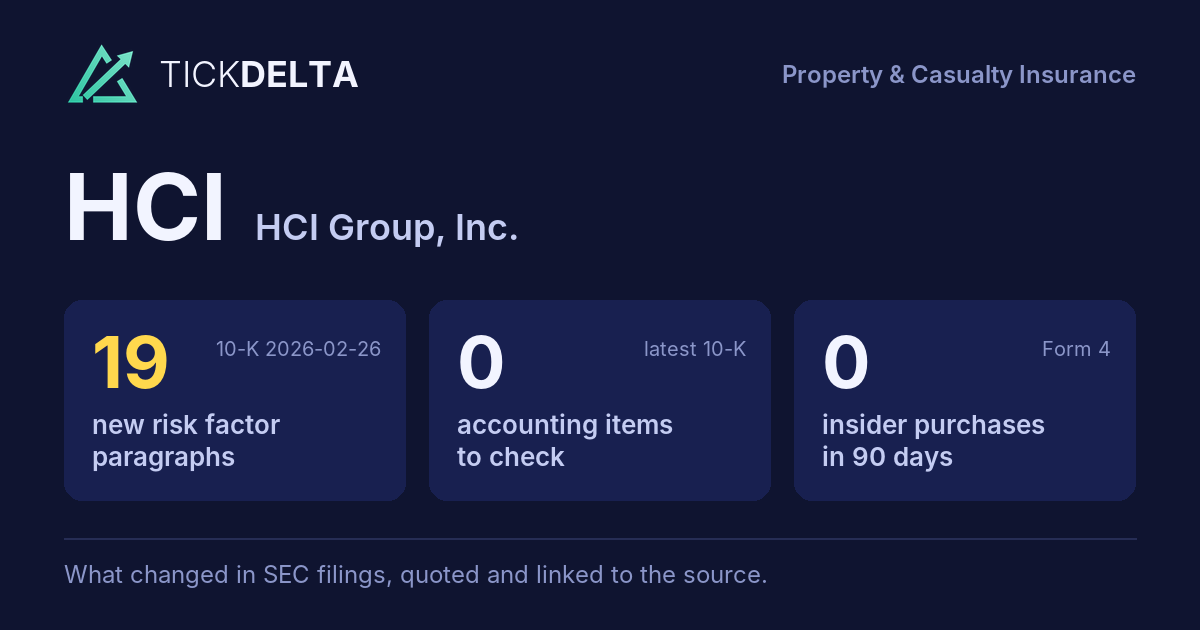
of the text changed · 8,124 words now · 19 new paragraphs, 1 gone
MD&A
66.2%
of the text changed · 5,791 words now · 38 new paragraphs, 39 gone
10-K 0001193125-26-076743 (Feb 26, 2026) vs 10-K 0000950170-25-029999 (Feb 28, 2025) Not compared: Legal Proceedings, Accounting Policies.
Every paragraph, and how much of it changed
One bar per paragraph, in the order of the 10-K. Height and colour show the share of its words not in the closest paragraph a year earlier; the tallest bars are new paragraphs.
Risk Factors
129 paragraphs · 19 new · 16 reworded · 1 gone · 10-K Feb 26, 2026 against Feb 28, 2025
New paragraph
Reworded (5% of its words or more)
Same or nearly
Paragraph 102 · 24% changed
Every version of it
All states regulate insurance holding company systems. State statutes and administrative rules generally require each insurance company in the holding company group to register with the department of insurance in its state of domicile and to furnish information concerning the operations of the companies within the holding company system that may materially affect the operations, management or financial condition of the insurers within the group. As part of its registration, each insurance company must identify material agreements, relationships and transactions with affiliates, including without limitation, loans, investments, asset transfers, transactions outside of the ordinary course of business, certain management, service, and cost sharing agreements, reinsurance transactions, dividends, and consolidated tax allocation agreements.
Paragraph 122 · 18% changed
Every version of it
We rely on service providers and vendors to provide certain technology, systems and services that we use in connection with various functions of our business, including PCI DSS (Payment Card Industry Data Security Standard) compliant credit card processing, and we may entrust them with confidential information. The information systems of our third-party service providers and vendors are also vulnerable to an increasing threat of continually evolving cybersecurity risks. Unauthorized parties may attempt to gain access to these systems or our information through fraud or other means of deceiving our associates, third-party service providers or vendors. Hardware, software or applications we obtain from third parties may contain defects in design or manufacture or other problems that could unexpectedly compromise information security. The methods used to obtain unauthorized access, disable or degrade service or sabotage systems are also constantly changing and evolving and may be difficult to anticipate or detect for long periods of time. Ever-evolving threats mean our third-party service providers and vendors must continually evaluate and adapt their own respective systems and processes, and there is no assurance that they will be adequate to safeguard against all data security breaches or misuses of data. Any future significant compromise or breach of our data security via a third-party service provider or vendor could result in additional significant costs, lost revenues, fines, lawsuits, and damage to our reputation. We have acquired a cybersecurity insurance policy to help mitigate any financial impact that may incur with a breach along with the assistance for legal and/or media requirements during that time.
Paragraph 121 · 18% changed
Every version of it
Noncompliance with any privacy or security laws and regulations, or any security breach, cyber-attack or cybersecurity breach, and any incident involving the misappropriation, loss or other unauthorized disclosure or use of, or access to, sensitive or confidential member information, could require us to expend significant capital and other resources to continue to modify or enhance our protective measures and to remediate any damage caused by such breaches. In addition, this could result in interruptions to our operations and damage to our reputation, and misappropriation of confidential information could also result in regulatory enforcement actions, material fines and penalties, litigation or other liability or actions which could have a material adverse effect on our business, cash flows, financial condition and results of operations. As the regulatory environment related to information security, data collection and use, and privacy becomes increasingly rigorous, with new and constantly changing requirements applicable to our business, compliance with those requirements could also result in additional costs.
Paragraph 127 · 17% changed
Every version of it
There is an constant emerging scientific consensus science on climate change, which change. Climate change may affect the frequency and severity of storms, floods and other weather events, and negatively affect our business, results of operations, and/or financial condition.
Paragraph 110 · 15% changed
Every version of it
The FLOIR and regulators in other jurisdictions where we may become licensed and offer insurance products conduct periodic examinations of the affairs of insurance companies and require the filing of annual and other reports relating to financial condition, holding company issues and other matters. These regulatory requirements may adversely affect or inhibit our ability to achieve some or all of our business objectives. These regulatory authorities also conduct periodic examinations into insurers’ business practices. These reviews may reveal deficiencies in our insurance operations or non-compliance with regulatory requirements.
Paragraph 65 · 9% changed
Every version of it
Although we aim to provide adequate and appropriate coverage under each of our policies, customers could purchase policies that prove to be inadequate or inappropriate. If such customers were to bring a claim or claims alleging that we failed in our responsibilities to provide them with the type or amount of coverage that they sought to purchase, we could be found liable for amounts significantly in excess of the policy limit, resulting in an adverse effect on our business, results of operations and financial condition. While we maintain errors and omissions insurance coverage to protect us against such liability, such coverage may be insufficient or inadequate.
Paragraph 71 · 8% changed
Every version of it
Our foreign operations in India expose us to additional risks, which could negatively impact our business, operating results, and financial condition.
Paragraph 123 · 39% changed
Every version of it
10-K Feb 28, 2025We rely on service providers and vendors to provide certain technology, systems and services that we use in connection with various functions of our business, including PCI DSS (Payment Card Industry Data Security Standard) compliant credit card processing, and we may entrust them with confidential information. The information systems of our third-party service providers and vendors are also vulnerable to an increasing threat of continually evolving cybersecurity risks. Unauthorized parties may attempt to gain access to these systems or our information through fraud or other means of deceiving our associates, third-party service providers or vendors. Hardware, software or applications we obtain from third parties may contain defects in design or manufacture or other problems that could unexpectedly compromise information security. The methods used to obtain unauthorized access, disable or degrade service or sabotage systems are also constantly changing and evolving and may be difficult to anticipate or detect for long periods of time. Ever-evolving threats mean our third-party service providers and vendors must continually evaluate and adapt their own respective systems and processes, and there is no assurance that they will be adequate to safeguard against all data security breaches or misuses of data. Any future significant compromise or breach of our data security via a third-party service provider or vendor could result in additional significant costs, lost revenues, fines, lawsuits, and damage to our reputation. We have acquired a cybersecurity insurance policy to help mitigate any financial impact that may incur with a breach along with the assistance for legal and/or media requirements during that time.
10-K Feb 26, 2026
processes, and there is no assurance that they will be adequate to safeguard against all data security breaches or misuses of data. Any future significant compromise or breach of our data security via a third-party service provider or vendor could result in additional significant costs, lost revenues, fines, lawsuits, and damage to our reputation. We have acquired a cybersecurity insurance policy to help mitigate any financial impact that may incur with a breach along with the assistance for legal and/or media requirements during that time.
Paragraph 102 · 24% changed
Every version of it
10-K Feb 28, 2025
or financial condition of the insurers within the group. As part of its registration, each insurance company must identify material agreements, relationships and transactions with affiliates, including without limitation, loans, investments, asset transfers, transactions outside of the ordinary course of business, certain management, service, and cost sharing agreements, reinsurance transactions, dividends, and consolidated tax allocation agreements.
10-K Feb 26, 2026
All states regulate insurance holding company systems. State statutes and administrative rules generally require each insurance company in the holding company group to register with the department of insurance in its state of domicile and to furnish information concerning the operations of the companies within the holding company system that may materially affect the operations, management or financial condition of the insurers within the group. As part of its registration, each insurance company must identify material agreements, relationships and transactions with affiliates, including without limitation, loans, investments, asset transfers, transactions outside of the ordinary course of business, certain management, service, and cost sharing agreements, reinsurance transactions, dividends, and consolidated tax allocation agreements.
Paragraph 122 · 18% changed
Every version of it
10-K Feb 28, 2025
We rely on service providers and vendors to provide certain technology, systems and services that we use in connection with various functions of our business, including PCI DSS (Payment Card Industry Data Security Standard) compliant credit card processing, and we may entrust them with confidential information. The information systems of our third-party service providers and vendors are also vulnerable to an increasing threat of continually evolving cybersecurity risks. Unauthorized parties may attempt to gain access to these systems or our information through fraud or other means of deceiving our associates, third-party service providers or vendors. Hardware, software or applications we obtain from third parties may contain defects in design or manufacture or other problems that could unexpectedly compromise information security. The methods used to obtain unauthorized access, disable or degrade service or sabotage systems are also constantly changing and evolving and may be difficult to anticipate or detect for long periods of time. Ever-evolving threats mean our third-party service providers and vendors must continually evaluate and adapt their own respective systems and processes, and there is no assurance that they will be adequate to safeguard against all data security breaches or misuses of data. Any future significant compromise or breach of our data security via a third-party service provider or vendor could result in additional significant costs, lost revenues, fines, lawsuits, and damage to our reputation. We have acquired a cybersecurity insurance policy to help mitigate any financial impact that may incur with a breach along with the assistance for legal and/or media requirements during that time.
10-K Feb 26, 2026
We rely on service providers and vendors to provide certain technology, systems and services that we use in connection with various functions of our business, including PCI DSS (Payment Card Industry Data Security Standard) compliant credit card processing, and we may entrust them with confidential information. The information systems of our third-party service providers and vendors are also vulnerable to an increasing threat of continually evolving cybersecurity risks. Unauthorized parties may attempt to gain access to these systems or our information through fraud or other means of deceiving our associates, third-party service providers or vendors. Hardware, software or applications we obtain from third parties may contain defects in design or manufacture or other problems that could unexpectedly compromise information security. The methods used to obtain unauthorized access, disable or degrade service or sabotage systems are also constantly changing and evolving and may be difficult to anticipate or detect for long periods of time. Ever-evolving threats mean our third-party service providers and vendors must continually evaluate and adapt their own respective systems and
Paragraph 121 · 18% changed
Every version of it
10-K Feb 28, 2025
measures and to remediate any damage caused by such breaches. In addition, this could result in interruptions to our operations and damage to our reputation, and misappropriation of confidential information could also result in regulatory enforcement actions, material fines and penalties, litigation or other liability or actions which could have a material adverse effect on our business, cash flows, financial condition and results of operations. As the regulatory environment related to information security, data collection and use, and privacy becomes increasingly rigorous, with new and constantly changing requirements applicable to our business, compliance with those requirements could also result in additional costs.
10-K Feb 26, 2026
Noncompliance with any privacy or security laws and regulations, or any security breach, cyber-attack or cybersecurity breach, and any incident involving the misappropriation, loss or other unauthorized disclosure or use of, or access to, sensitive or confidential member information, could require us to expend significant capital and other resources to continue to modify or enhance our protective measures and to remediate any damage caused by such breaches. In addition, this could result in interruptions to our operations and damage to our reputation, and misappropriation of confidential information could also result in regulatory enforcement actions, material fines and penalties, litigation or other liability or actions which could have a material adverse effect on our business, cash flows, financial condition and results of operations. As the regulatory environment related to information security, data collection and use, and privacy becomes increasingly rigorous, with new and constantly changing requirements applicable to our business, compliance with those requirements could also result in additional costs.
Paragraph 127 · 17% changed
Every version of it
10-K Feb 28, 2025
There is an emerging scientific consensus on climate change, which may affect the frequency and severity of storms, floods and other weather events, and negatively affect our business, results of operations, and/or financial condition.
10-K Feb 26, 2026
There is constant emerging science on climate change. Climate change may affect the frequency and severity of storms, and other weather events, and negatively affect our business, results of operations, and/or financial condition.
Paragraph 110 · 15% changed
Every version of it
10-K Feb 28, 2025
The FLOIR and regulators in other jurisdictions where we may become licensed and offer insurance products conduct periodic examinations of the affairs of insurance companies and require the filing of annual and other reports relating to financial condition, holding company issues and other matters. These regulatory requirements may adversely affect or inhibit our ability to achieve some or
10-K Feb 26, 2026
The FLOIR and regulators in other jurisdictions where we may become licensed and offer insurance products conduct periodic examinations of the affairs of insurance companies and require the filing of annual and other reports relating to financial condition, holding company issues and other matters. These regulatory requirements may adversely affect or inhibit our ability to achieve some or all of our business objectives. These regulatory authorities also conduct periodic examinations into insurers’ business practices. These reviews may reveal deficiencies in our insurance operations or non-compliance with regulatory requirements.
Paragraph 65 · 9% changed
Every version of it
10-K Feb 28, 2025
Although we aim to provide adequate and appropriate coverage under each of our policies, customers could purchase policies that prove to be inadequate or inappropriate. If such customers were to bring a claim or claims alleging that we failed in our responsibilities to provide them with the type or amount of coverage that they sought to purchase, we could be found liable for amounts significantly in excess of the policy limit, resulting in an adverse effect on our business, results of operations and financial condition.
10-K Feb 26, 2026
Although we aim to provide adequate and appropriate coverage under each of our policies, customers could purchase policies that prove to be inadequate or inappropriate. If such customers were to bring a claim or claims alleging that we failed in our responsibilities to provide them with the type or amount of coverage that they sought to purchase, we could be found liable for amounts significantly in excess of the policy limit, resulting in an adverse effect on our business, results of operations and financial condition. While we maintain errors and omissions insurance coverage to protect us against such liability, such coverage may be insufficient or inadequate.
Paragraph 71 · 8% changed
Every version of it
10-K Feb 28, 2025
Our operations in India expose us to additional risks, which could negatively impact our business, operating results, and financial condition.
10-K Feb 26, 2026
Our foreign operations expose us to additional risks, which could negatively impact our business, operating results, and financial condition.
MD&A
77 paragraphs · 38 new · 35 reworded · 39 gone · 10-K Feb 26, 2026 against Feb 28, 2025
New paragraph
Reworded (5% of its words or more)
Same or nearly
Paragraph 20 · 49% changed
Paragraph 72 · 49% changed
Paragraph 29 · 48% changed
Paragraph 2 · 47% changed
The following discussion and analysis should be read in conjunction with our consolidated financial statements and the related notes thereto included elsewhere in this Annual Report on Form 10-K. This section is intended to (i) provide material information relevant to the assessment of our results of operations and cash flows; (ii) enhance the understanding of our financial condition, changes in financial condition, and results of operations; and (iii) discuss material events and uncertainties known to management that are reasonably likely to cause reported financial information not to be necessarily indicative of future performance or of future financial condition.
Paragraph 41 · 46% changed
As of December 31, 2024, 2025, we had unexpired capital commitments for limited partnerships an outstanding balance of $36.0 million and had an available borrowing capacity of $114.0 million under the Revolving Credit Facility. As of December 31, 2025, we were in which we hold interests. Such commitments are not recognized in the consolidated financial statements but are compliance with all required covenants. Refer to be disclosed in the notes to the consolidated financial statements. See Note 25 -- “Commitments and Contingencies” 10 “Revolving Credit Facility” to our consolidated financial statements under Item 8 of this Annual Report on Form 10-K.
Paragraph 28 · 44% changed
Paragraph 23 · 44% changed
Gross Premiums Earned on increased primarily due to a consolidated basis for higher volume of policies in force as a result of the years ended December 31, 2024 and 2023 were approximately $1,083,220,000 and $765,512,000, respectively. The $317,708,000 increase in 2024 was primarily attributable to the addition of policies assumed from Citizens as well as premium rate increases. Gross during the fourth quarter of 2024, the first quarter of 2025, and the fourth quarter of 2025. During 2025, gross premiums earned were $1,145.8 million from insurance operations were $1,036,129,000 in 2024 compared with $765,512,000 in 2023. Gross Insurance Operations and $95.6 million from Reciprocal Exchange Operations. During 2024, gross premiums earned were $1,036.1 million from reciprocal exchange operations were $51,207,000 in 2024 as opposed to $0 in 2023. Insurance Operations and $51.2 million from Reciprocal Exchange Operations.
Paragraph 25 · 43% changed
Paragraph 20 · 49% changed
10-K Feb 28, 2025The combined ratio (total of all expenses excluding interest expense in relation to net premiums earned) is the measure of overall underwriting profitability before other income. Our combined ratio for the year ended December 31, 2023 was 85.0% compared with 120.8% for the year ended December 31, 2022. The decrease was primarily attributable to the decrease in losses and loss adjustment expenses, the decrease in policy acquisition, underwriting and personnel expenses, and the increase in net premiums earned.
10-K Feb 26, 2026
Net combined ratio is defined as total expenses excluding interest expense in relation to net premiums earned. The net combined ratio represents the combination of the net loss ratio and net expense ratio. We use the net combined ratio as a metric to measure and monitor our overall profitability.
Paragraph 72 · 49% changed
10-K Feb 28, 2025Stock-Based Compensation. We account for stock-based compensation awards under our stockholder-approved incentive plans in accordance with the fair value recognition provisions of U.S. GAAP, which require the measurement, and recognition of compensation for all stock-based awards made to employees, non-employee directors, and third-party award recipients including stock options, restricted stock and warrant issuances based on estimated fair values. For restricted stock with service-based vesting conditions, fair value is determined by the market price of the stock on the grant date. Compensation expense is then recognized ratably over the requisite or derived service period of the award. Restricted stock awards with market-based vesting conditions require the use of a Monte Carlo simulation model with the assistance of a third-party valuation specialist to estimate the fair value and derived service period of the award. We then recognize the compensation expense ratably over this derived service period. Determining the appropriate fair value model and calculating the fair value of stock-based awards at the grant date requires considerable judgment, including estimating stock price volatility and derived service periods. We develop our estimates based on historical data and market information. We primarily use the Black-Scholes option-pricing model, which requires the following variables for input to calculate the fair value of each stock award on the option grant date: 1) expected volatility of our stock price, 2) the risk-free interest rate, 3) expected term of each award, 4) expected dividends, and 5) an expected forfeiture rate. For stock-based awards granted by non-public subsidiaries, we determine the fair value with the assistance of an independent valuation specialist who may use different valuation methods such as a Monte Carlo simulation model and a binomial distribution model. Inputs such as an estimated stock price of our private subsidiary and expected price volatility used in these valuation methods are derived mathematically from a data analysis of many public peer companies with similar characteristics.
10-K Feb 26, 2026
For stock-based awards granted by a non-public subsidiary, an independent valuation specialist will assist in determining the fair value of the underlying stock price of the subsidiary using different valuation methods such as a Monte Carlo simulation model and a binomial distribution model. Inputs such as an estimated stock price of our private subsidiary and expected price volatility used in these valuation methods are derived mathematically from a data analysis of many public peer companies with similar characteristics.
Paragraph 29 · 48% changed
10-K Feb 28, 2025Our consolidated Losses and Loss Adjustment Expenses amounted to approximately $374,708,000 and $254,579,000 for the years ended December 31, 2024 and 2023, respectively. The increase was attributable to net losses of $78,157,000 from Hurricane Milton, $43,000,000 from Hurricane Helene, $6,500,000 from Hurricane Debby, and losses attributable to a greater number of policies in force. The increase was offset by less prior period development in 2024 compared to 2023. Excluding the impact of the hurricanes in 2024, overall losses and loss adjustment expenses decreased when compared to 2023. See “Reserves for Losses and Loss Adjustment Expenses” under “Critical Accounting Policies and Estimates.”
10-K Feb 26, 2026
Losses and Loss Adjustment Expenses decreased as 2025 did not have any losses from catastrophic events while 2024 included net losses of $78.2 million from Hurricane Milton, $43.0 million from Hurricane Helene, and $6.5 million from Hurricane Debby. In addition, while we have a higher volume of policies in force, we have experienced a reduction in claim and litigation frequency over the comparative periods during 2025. The gross loss ratio for 2025 was 19.6% compared to 34.6% for 2024. See “Reserves for Losses and Loss Adjustment Expenses” under “Critical Accounting Policies and Estimates.”
Paragraph 2 · 47% changed
10-K Feb 28, 2025
The following discussion should be read in conjunction with our consolidated financial statements and related notes included elsewhere in this Annual Report on Form 10-K.
10-K Feb 26, 2026
The following discussion and analysis should be read in conjunction with our consolidated financial statements and the related notes thereto included elsewhere in this Annual Report on Form 10-K. This section is intended to (i) provide material information relevant to the assessment of our results of operations and cash flows; (ii) enhance the understanding of our financial condition, changes in financial condition, and results of operations; and (iii) discuss material events and uncertainties known to management that are reasonably likely to cause reported financial information not to be necessarily indicative of future performance or of future financial condition.
Paragraph 41 · 46% changed
10-K Feb 28, 2025
As of December 31, 2024, we had unexpired capital commitments for limited partnerships in which we hold interests. Such commitments are not recognized in the consolidated financial statements but are required to be disclosed in the notes to the consolidated financial statements. See Note 25 -- “Commitments and Contingencies” to our consolidated financial statements under Item 8 of this Annual Report on Form 10-K.
10-K Feb 26, 2026
As of December 31, 2025, we had an outstanding balance of $36.0 million and had an available borrowing capacity of $114.0 million under the Revolving Credit Facility. As of December 31, 2025, we were in compliance with all required covenants. Refer to Note 10 “Revolving Credit Facility” to our consolidated financial statements under Item 8 of this Annual Report on Form 10-K.
Paragraph 28 · 44% changed
10-K Feb 28, 2025Net Premiums Written for the years ended December 31, 2023 and 2022 totaled approximately $628,995,000 and $464,875,000, respectively. The $164,120,000 increase in 2023 resulted primarily from an increase in gross premiums written from the assumption of Citizens insurance policies of approximately $143,087,000, offset by an increase in premiums ceded. We had approximately 247,000 policies in force at December 31, 2023 as compared with approximately 210,400 policies in force at December 31, 2022.
10-K Feb 26, 2026
The increase in net premiums written is primarily due to a higher volume of policies in force as described above. We had approximately 313,400 policies in force as of December 31, 2025 compared to approximately 271,300 policies in force as of December 31, 2024.
Paragraph 23 · 44% changed
10-K Feb 28, 2025
Gross Premiums Earned on a consolidated basis for the years ended December 31, 2024 and 2023 were approximately $1,083,220,000 and $765,512,000, respectively. The $317,708,000 increase in 2024 was primarily attributable to the policies assumed from Citizens as well as premium rate increases. Gross premiums earned from insurance operations were $1,036,129,000 in 2024 compared with $765,512,000 in 2023. Gross premiums earned from reciprocal exchange operations were $51,207,000 in 2024 as opposed to $0 in 2023.
10-K Feb 26, 2026
Gross Premiums Earned increased primarily due to a higher volume of policies in force as a result of the addition of policies assumed from Citizens during the fourth quarter of 2024, the first quarter of 2025, and the fourth quarter of 2025. During 2025, gross premiums earned were $1,145.8 million from Insurance Operations and $95.6 million from Reciprocal Exchange Operations. During 2024, gross premiums earned were $1,036.1 million from Insurance Operations and $51.2 million from Reciprocal Exchange Operations.
Paragraph 25 · 43% changed
10-K Feb 28, 2025Premiums Ceded for the years ended December 31, 2024 and 2023 were approximately $405,659,000 and $269,627,000, respectively, representing 37.5% and 35.2%, respectively, of gross premiums earned. Our premiums ceded represent costs of reinsurance to cover losses from catastrophes that exceed the retention levels defined by our catastrophe excess of loss reinsurance contracts or to assume a proportional share of losses defined in a quota share agreement. The rates we pay for reinsurance are based primarily on policy exposures reflected in gross premiums earned. The $136,032,000 increase was attributable to higher reinsurance costs for the 2024-2025 contract year, increased coverage due to growth in the number of policies in force and total insured value, and the reversal of previously accrued benefits as described in Note 14 -- “Reinsurance” to our consolidated financial statements under Item 8 of this Annual Report on Form 10-K. See “Economic Impact of Reinsurance Contracts with Retrospective Provisions” under “Critical Accounting Policies and Estimates.”
10-K Feb 26, 2026
Our premiums ceded represent costs of reinsurance (i) to cover losses from catastrophes that exceed the retention levels defined by our catastrophe excess of loss reinsurance contracts, (ii) to provide additional loss coverage on a high-value individual risk basis through facultative reinsurance, or (iii) to assume a proportional share of losses as defined in a quota share agreement. The rates we pay for reinsurance are based primarily on policy exposures reflected in gross premiums earned. Under contracts in effect prior to June 1, 2025, reinsurance costs could be adjusted by retrospective provisions under reinsurance contracts. There were no adjustments to premiums ceded related to retrospective provisions during 2025 as opposed to an increase of $44.3 million during 2024.
A paragraph is matched with the one last year that shares the most of its words; under half in common makes it new. The paragraphs shown are the 8 reworded the most in each section.
The paragraph that changed most in each section
The redline
Marked against last year's 10-K: cut words struck through, new words highlighted.
MD&A271 words changed in this paragraph; it is 31% similar to last year's version.
Source: Item 7, 10-K 0001193125-26-076743 vs Item 7, 10-K 0000950170-25-029999
Risk Factors85 words changed in this paragraph; it is 80% similar to last year's version.
We rely on service providers and vendors to provide certain technology, systems and services that we use in connection with various functions of our business, including PCI DSS (Payment Card Industry Data Security Standard) compliant credit card processing, and we may entrust them with confidential information. The information systems of our third-party service providers and vendors are also vulnerable to an increasing threat of continually evolving cybersecurity risks. Unauthorized parties may attempt to gain access to these systems or our information through fraud or other means of deceiving our associates, third-party service providers or vendors. Hardware, software or applications we obtain from third parties may contain defects in design or manufacture or other problems that could unexpectedly compromise information security. The methods used to obtain unauthorized access, disable or degrade service or sabotage systems are also constantly changing and evolving and may be difficult to anticipate or detect for long periods of time. Ever-evolving threats mean our third-party service providers and vendors must continually evaluate and adapt their own respective systems and processes, and there is no assurance that they will be adequate to safeguard against all data security breaches or misuses of data. Any future significant compromise or breach of our data security via a third-party service provider or vendor could result in additional significant costs, lost revenues, fines, lawsuits, and damage to our reputation. We have acquired a cybersecurity insurance policy to help mitigate any financial impact that may incur with a breach along with the assistance for legal and/or media requirements during that time.
Source: Item 1A, 10-K 0001193125-26-076743 vs Item 1A, 10-K 0000950170-25-029999
Sentences and paragraphs added, removed or reworded
Every change, by type
Sentences and paragraphs of HCI's Risk Factors and MD&A, 10-K Feb 26, 2026 against 10-K Feb 28, 2025. Each links to the text at sec.gov.
Quiet changes are sentences kept from last year with one to four words changed, at least one of them a hedge, a modal or a qualifier (may, could, will, not, significant, material…). A year or date rolling forward is not counted.
The full word list
adverse, adversely, all, although, anticipate, anticipates, any, approximately, believe, believes, can, cannot, certain, could, expect, expects, generally, however, if, intend, intends, largely, likely, many, material, materially, may, might, most, must, never, no, not, possible, primarily, probable, should, significant, significantly, some, substantial, substantially, unlikely, will, would
AddedRisk Factors
Our interests may conflict with the interests of Exzeo and the interests of Exzeo’s other stockholders. Certain conflicts of interest between Exzeo and us could be resolved in a manner unfavorable to us.
Read it in 10-K Feb 26, 2026 at sec.gov
AddedRisk Factors
Various conflicts of interest between us and Exzeo could arise. Our interests as Exzeo’s controlling stockholder may differ from Exzeo’s interests or those of its other stockholders. Additionally, ownership interests of our CEO and chairman of our board of directors, Paresh Patel, in our common stock and in the stock of Exzeo, or his service as a director and officer of both companies, could create or appear to create potential conflicts of interest when he is faced with decisions relating to us or business. These decisions could include:
Read it in 10-K Feb 26, 2026 at sec.gov
AddedRisk Factors
•the impact that operating decisions for our business may have on Exzeo’s Consolidated Financial Statements;
Read it in 10-K Feb 26, 2026 at sec.gov
AddedRisk Factors
•future, potential commercial arrangements between Exzeo and us (or our affiliates) or between Exzeo and third parties;
Read it in 10-K Feb 26, 2026 at sec.gov
AddedRisk Factors
Furthermore, disputes may arise between Exzeo and us (or our affiliates) relating to our past, ongoing or future relationships and commercial arrangements and these potential conflicts of interest may make it more difficult for us to favorably resolve such disputes, including those related to:
Read it in 10-K Feb 26, 2026 at sec.gov
AddedRisk Factors
•the nature, quality, and pricing of services Exzeo agrees to provide to us (and/or our affiliates);
Read it in 10-K Feb 26, 2026 at sec.gov
AddedRisk Factors
•sales or other disposals by us of all or a portion of our ownership interest in Exzeo; and
Read it in 10-K Feb 26, 2026 at sec.gov
AddedRisk Factors
We may not be able to resolve any potential conflicts, and even if we do, the resolution may be less favorable to us than if we were dealing with an unaffiliated party.
Read it in 10-K Feb 26, 2026 at sec.gov
Show the other 47
AddedRisk Factors
We may not achieve some or all of the anticipated benefits of Exzeo being a standalone public company, which could negatively impact our business, financial condition and results of operation.
Read it in 10-K Feb 26, 2026 at sec.gov
AddedRisk Factors
•We may not be able to achieve all of the anticipated strategic and financial benefits expected as a result of Exzeo being a standalone public company, or such benefits may be delayed or not occur at all. These anticipated benefits include the following:
Read it in 10-K Feb 26, 2026 at sec.gov
AddedRisk Factors
•allowing investors to evaluate the distinct merits, performance and future prospects of the Exzeo business, independent of our other businesses;
Read it in 10-K Feb 26, 2026 at sec.gov
AddedRisk Factors
•enhancing Exzeo’s ability to focus on its own operating priorities, strategies and specific market dynamics;
Read it in 10-K Feb 26, 2026 at sec.gov
RemovedRisk Factors
RewordedRisk Factors
Our operations are highly dependent on the efforts of our senior executive officers, particularly our chief executive officer, Chief Executive Officer, Paresh Patel, as well as our chief financial officer, Chief Operating Officer, Karin Coleman, our Chief Financial Officer, Mark Harmsworth, and the President president of our Real Estate Division, real estate division, Anthony Saravanos.
Read it in 10-K Feb 26, 2026 at sec.gov
RewordedRisk Factors
Ever-evolving threats mean our third-party service providers and vendors must continually evaluate and adapt their own respective systems and processes, and there is no assurance that they will be adequate to safeguard against all data security breaches or misuses of data.
Read it in 10-K Feb 26, 2026 at sec.gov
RewordedRisk Factors
Our foreign operations, in countries such as India operations and Bermuda, expose us to additional risks including income tax risks, currency exchange rate fluctuations and risks related to other challenges caused by distance, language, and compliance with Indian foreign labor laws and other complex foreign and U.S. laws and regulations that apply to our India foreign operations.
Read it in 10-K Feb 26, 2026 at sec.gov
RewordedRisk Factors
RewordedRisk Factors
Best rating, which we do not none of our insurance subsidiaries currently have.
Read it in 10-K Feb 26, 2026 at sec.gov
RewordedRisk Factors
These regulatory requirements may adversely affect or inhibit our ability to achieve some or all of our business objectives.
Read it in 10-K Feb 26, 2026 at sec.gov
AddedMD&A
Included below are year-over-year comparisons between 2025 and 2024. For information on year-over-year comparisons between 2024 and 2023, refer to Item 7 “Management’s Discussion and Analysis of Financial Condition and Results of Operations” in the 2024 Annual Report on Form 10-K, which was filed with the SEC on February 28, 2025.
Read it in 10-K Feb 26, 2026 at sec.gov
AddedMD&A
The following discussion and analysis contains forward-looking statements about our business, operations, and financial performance based on current plans and estimates involving risks, uncertainties, and assumptions, which could differ materially from actual results. Factors that could cause such differences are discussed in the sections of this Annual Report titled Item 1A “Risk Factors” and “Cautionary Note Regarding Forward-Looking Statements.”
Read it in 10-K Feb 26, 2026 at sec.gov
AddedMD&A
We are primarily engaged in the property and casualty insurance business. We provide various homeowners’ property and casualty insurance products for properties located in the State of Florida, which is our primary market, as well as in other states in the northeast and southeast regions of the U.S.
Read it in 10-K Feb 26, 2026 at sec.gov
AddedMD&A
Our insurance operations are supported by other insurance-related subsidiaries within the consolidated group. Exzeo provides turn-key insurance technology and operations solutions based on a proprietary platform of purpose-built software and data analytics applications that are specifically designed for the property and casualty insurance ecosystem. We utilize Exzeo's internally developed software technologies to identify profitable underwriting opportunities, drive efficiency in claim processing and settlements, and streamline operations across our insurance operations and other insurance-related businesses.
Read it in 10-K Feb 26, 2026 at sec.gov
AddedMD&A
We also provide AIF services for reciprocal insurance exchanges owned by their policyholders. Although we do not have any equity interest in the reciprocal insurance exchanges, we are required to consolidate them as their primary beneficiary. In addition, we have a commercial real estate group that is primarily engaged in the business of developing and operating commercial properties for investment purposes or for our own use.
Read it in 10-K Feb 26, 2026 at sec.gov
AddedMD&A
We identify our segments based on the manner in which our Chief Executive Officer, who is the chief operating decision maker, evaluates performance and makes decisions regarding the allocation of resources. We have five reportable segments: Insurance Operations, Exzeo, Reciprocal Exchange Operations, Real Estate, and Corporate and Other. Due to their economic characteristics, our property and casualty insurance division and reinsurance operations, excluding the insurance operations under Reciprocal Exchange Operations, are grouped together into one reportable segment under Insurance Operations. The Exzeo segment includes insurance technology and operations solutions for property and casualty insurance carriers. The Reciprocal Exchange Operations segment represents the insurance operations of consolidated reciprocal insurance exchanges that are owned by their policyholders. The Real Estate segment relates to our commercial real estate group that is primarily engaged in the business of developing and operating commercial properties for investment purposes or for our own use. The Corporate and Other segment represents the activities of the holding companies and any other operations that do not meet the quantitative and qualitative thresholds for a reportable segment. The determination of segments may change over time due to changes in operational emphasis, revenue, and results of operations. Refer to Note 15 “Segment Information” to the consolidated financial statements included in this Annual Report on Form 10-K for additional information.
Read it in 10-K Feb 26, 2026 at sec.gov
AddedMD&A
All financial information presented in this section has been prepared in U.S. dollars in accordance with accounting principles generally accepted in the United States of America (“U.S. GAAP”) and includes the accounts of HCI Group, Inc. and its subsidiaries and consolidated VIEs. All intercompany transactions have been eliminated.
Read it in 10-K Feb 26, 2026 at sec.gov
AddedMD&A
Our insurance business has grown both organically and through strategic policy assumptions, which have been a key driver of our expansion. We have participated in legislatively mandated take-out programs, designed to reduce the state’s risk exposure by transitioning policies from Citizens, a Florida state supported insurer, to private insurers. We selectively pursue additional assumption opportunities with Citizens when they align with our risk appetite and growth strategy. We also assume policies from other insurance companies in Florida and/or any other state in which we operate.
Read it in 10-K Feb 26, 2026 at sec.gov
AddedMD&A
The nature of our business is to cover losses that may arise from, among other things, hurricanes and other catastrophic events such as tornadoes, floods and winter storms. The occurrence of any such catastrophes could have a significant adverse effect on our business, results of operations, and financial condition. To mitigate the risk associated with catastrophic events, we purchase reinsurance from other large insurance companies. Even without catastrophic events, we may incur losses and loss adjustment expenses that deviate substantially from our estimates and that may exceed our reserves, in which case our net income and capital would decrease. Our operating and growth strategies may also be impacted by regulation of our business by the State of Florida and other states in which we operate. For example, insurance regulators must approve our policy forms and premium rates as well as monitor our compliance with financial and regulatory requirements.
Read it in 10-K Feb 26, 2026 at sec.gov
AddedMD&A
The table below shows the number of policies and annualized gross premiums assumed from Citizens during the periods presented:
Read it in 10-K Feb 26, 2026 at sec.gov
AddedMD&A
During 2025, approximately 33,000 policies with annualized premiums of $115.9 million assumed relate to Tailrow, which commenced operations during 2025. During 2024, approximately 700 policies with annualized premiums of $81.7 million assumed relate to CORE, which commenced operations during 2024. Both CORE and Tailrow represent consolidated reciprocal insurance exchanges that are ultimately owned by their policyholders. Accordingly, all of the net income associated with CORE and Tailrow is included in net income attributable to noncontrolling interests.
Read it in 10-K Feb 26, 2026 at sec.gov
AddedMD&A
On November 6, 2025, Exzeo closed its initial public offering, issuing 8,000,000 shares of common stock at a price of $21.00 per share for gross proceeds of $168.0 million. Underwriting and offering costs totaled $13.2 million and were recorded as a reduction of the proceeds received. The net proceeds were allocated as $129.2 million to additional paid-in capital and $25.5 million to noncontrolling interest on the consolidated balance sheet with no recognition of a gain or loss on the consolidated statements of income. As of December 31, 2025, we owned approximately 82.5% of Exzeo's outstanding shares of common stock, inclusive of unvested restricted stock. Accordingly, Exzeo remains a consolidated, majority-owned, subsidiary of HCI Group, Inc. As the initial public offering diluted HCI's ownership of Exzeo, the amount of Exzeo's net income included in net income attributable to noncontrolling interests will increase in subsequent periods.
Read it in 10-K Feb 26, 2026 at sec.gov
RemovedMD&A
RemovedMD&A
RemovedMD&A
RemovedMD&A
RemovedMD&A
RemovedMD&A
RemovedMD&A
RemovedMD&A
RemovedMD&A
RemovedMD&A
RemovedMD&A
RemovedMD&A
RewordedMD&A
For stock-based awards granted by a non-public subsidiaries, we determine the fair value with the assistance of subsidiary, an independent valuation specialist who may use will assist in determining the fair value of the underlying stock price of the subsidiary using different valuation methods such as a Monte Carlo simulation model and a binomial distribution model.
Read it in 10-K Feb 26, 2026 at sec.gov
RewordedMD&A
The year-over-year increase of $9,284,000 was primarily attributable to lower payroll costs recoverable from reinsurers, an increase in stock-based and other incentive compensation expense, as well as an increase in employee health benefits, salaries and merit increases for non-executive employees effective in late February 2024. wages.
Read it in 10-K Feb 26, 2026 at sec.gov
RewordedMD&A
The decrease in our net expense ratio was decreased primarily attributable due to the increase in net premiums earned, partially offset by the increase in general and administrative personnel expenses and the increase in policy acquisition and other underwriting expenses and the increase in general and administrative personnel expenses.
Read it in 10-K Feb 26, 2026 at sec.gov
RewordedMD&A
Net cash used in investing activities of $260,110,000 $260.1 million was primarily due to the purchases of available-for-sale fixed-maturity and equity securities of $836,636,000, $836.6 million, the purchases of real estate investments of $16,066,000, $16.1 million, the purchases of property and equipment of $4,052,000, $4.1 million, and additional investments in limited partnership interests of $1,233,000, $1.2 million, offset by the proceeds from calls, repayments and maturities of available-for-sale fixed-maturity securities of $457,102,000, $457.1 million, the proceeds from sales of available-for-sale fixed-maturity and equity securities of $137,170,000, $137.2 million, and distributions received from limited partnership investments of $3,591,000. $3.6 million.
Read it in 10-K Feb 26, 2026 at sec.gov
RewordedMD&A
Net cash used in financing activities totaled $75,174,000, $75.2 million, which was primarily due to the redemption of redeemable noncontrolling interests of $100,000,000, $16,598,000 $100.0 million, $16.6 million of cash dividend payments, cash dividends paid to redeemable noncontrolling interests of $2,923,000, $1,037,000 $2.9 million, $1.0 million of net share repurchases, settlements, and repayments of long-term debt of $519,000, $0.5 million, offset by net borrowing under the line of credit agreement of $44,000,000 $44.0 million and net surplus contribution from noncontrolling interests of $2,949,000. $2.9 million.
Read it in 10-K Feb 26, 2026 at sec.gov
RewordedMD&A
RewordedMD&A
Our premiums ceded represent costs of reinsurance (i) to cover losses from catastrophes that exceed the retention levels defined by our catastrophe excess of loss reinsurance contracts contracts, (ii) to provide additional loss coverage on a high-value individual risk basis through facultative reinsurance, or (iii) to assume a proportional share of losses as defined in a quota share agreement.
Read it in 10-K Feb 26, 2026 at sec.gov
RewordedMD&A
RewordedMD&A
We believe our accounting policies and estimates specific to losses and loss adjustment expenses, reinsurance recoverable, reinsurance with retrospective provisions, deferred income taxes, stock-based compensation expense, and limited partnership investments, acquired intangible assets, warrants, and redeemable noncontrolling interest investments involve our most significant judgments and estimates material to our consolidated financial statements.
Read it in 10-K Feb 26, 2026 at sec.gov
RewordedMD&A
We had approximately 247,000 313,400 policies in force at as of December 31, 2023 as 2025 compared with to approximately 210,400 271,300 policies in force at as of December 31, 2022. 2024.
Read it in 10-K Feb 26, 2026 at sec.gov
RewordedMD&A
Policy Acquisition and Other Underwriting Expenses for the years ended December 31, 2024 and 2023 were approximately $99,402,000 and $90,822,000, respectively, and primarily reflect the amortization of deferred acquisition costs such as commissions payable to agents for production and renewal of policies and premium taxes.
Read it in 10-K Feb 26, 2026 at sec.gov
RewordedMD&A
Rather, loss and LAE reserves represent management’s best estimate of our company’s liability based on the application of actuarial techniques and other projection methodologies and taking into consideration other facts and circumstances known at the balance sheet date.
Read it in 10-K Feb 26, 2026 at sec.gov
Sources
The two latest 10-Ks on EDGAR, section by section. Each change links to the text at sec.gov.
Also
New risk factors: paragraphs with nothing like them last year, quoted in full.
Work with it
Excel workbook · CSV. Google Sheet that stays up to date: paste =IMPORTDATA("https://tickdelta.com/company/HCI/export.csv") into a cell.