Screener / SEC EDGAR /CIK 0000046619 /10-K filed Dec 22, 2025, compared with Dec 19, 2024 /Numbers from the XBRL of the 10-Ks
NYSE Industrials · Aircraft Engines

Heico Corp HEI

Compare with peers Embed
SEC comment letters, last 20 years

5 reviews of HEI's filings by SEC staff

UPLOAD and CORRESP
Reviews 5 latest letter May 7, 2024
Questions asked 12 each answered in the company's own letter
No closing letter 0 reviews without a letter saying the staff completed it

When the SEC's staff reviews a filing, it writes to the company with numbered questions, and the company answers each one in a letter. SEC publishes the exchange once the review is over, at least 20 business days later. A question is not an accusation; most reviews end with the company adding detail to its next filing.

How the reviews went

Every review on EDGAR, from the first staff letter to the letter that closes it

  1. 1. Staff letters 5 UPLOAD
  2. 2. Questions in them 12 numbered comments
  3. 3. Company replies 5 CORRESP
  4. 4. Reviews closed 5 of 5 closing letter

Half the closed reviews took 15 days or less from the first letter to the closing letter.

Form 10-K for the fiscal year ended October 31, 2023

2024-05-07 to 2024-05-22 · 3 questions · 1 letter from the SEC, 1 from the company
Review closed 2024-05-22
Critical estimatesResults discussion (MD&A)Goodwill and impairmentLiquidity and cashIncome taxesAcquisitionsInventoryReserves and insurance
Critical Accounting Estimates, page 44
SEC asked (1)
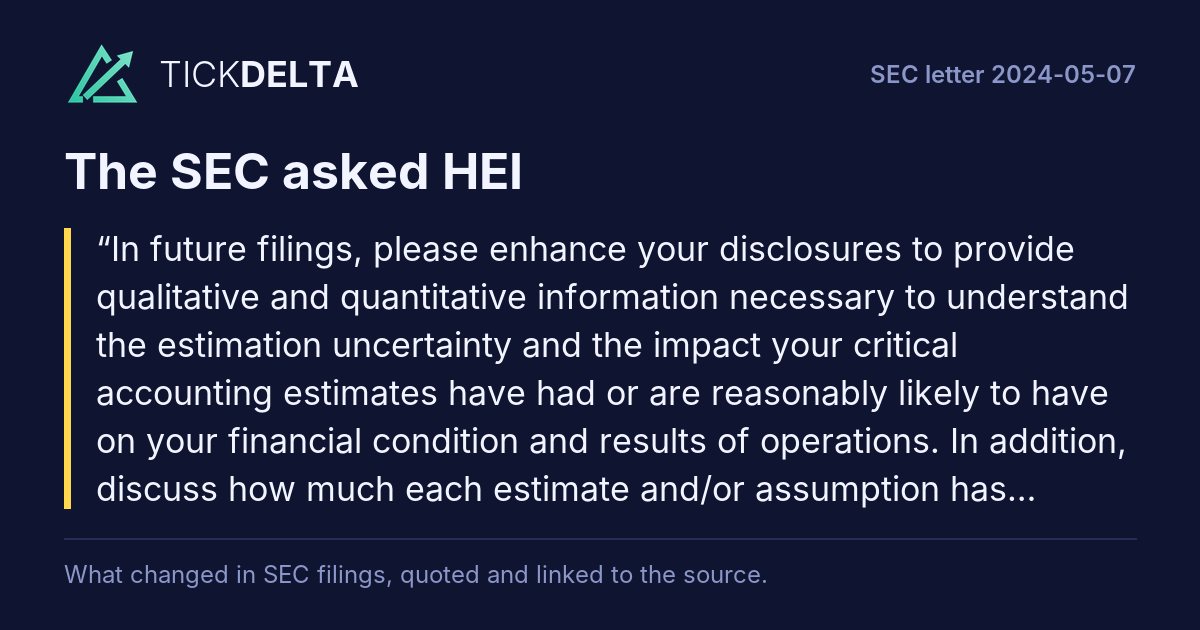
In future filings, please enhance your disclosures to provide qualitative and quantitative information necessary to understand the estimation uncertainty and the impact your critical accounting estimates have had or are reasonably likely to have on your financial condition and results of operations.
Rest of the question

In addition, discuss how much each estimate and/or assumption has changed over a relevant period and the sensitivity of reported amounts to the underlying methods, assumptions and estimates used. The disclosures should supplement, not duplicate, the description of accounting policies or other disclosures in the notes to the financial statements. Refer to Item 303(b)(3) of Regulation S-K and SEC Release No. 33-8350. Notes to Consolidated Financial Statements 4. Goodwill and Other Intangible Assets, page 85

HEI answered
#1

The Company acknowledges the Staff’s comment and will enhance its disclosures in future filings to provide the responsive qualitative and quantitative information, as and to the extent required or otherwise material. Based on its recent assessment, the Company no longer deems revenue recognition to be a critical accounting estimate and proposes to remove it from the Critical Accounting Estimates section in its future Form 10-K filings.
Rest of the answer

Historically, the majority of the Company’s revenue was recognized at a point-in-time and involved minimal estimates to determine when control had transferred. The Company now recognizes an even greater portion of its revenues at a point-in-time as a result of its two significant acquisitions in fiscal 2023. Additionally, the Company does not believe that the factors involving estimation uncertainty that are used when it recognizes revenue using an over-time recognition model for certain contracts are reasonably likely to have a material impact on the Company’s financial position or results of operations. This conclusion is supported by the fact that changes in estimates did not have a material effect on the Company’s net income from consolidated operations in fiscal 2023, 2022, and 2021.

As an example of how the Company intends to enhance its disclosures to better highlight the accounting areas where significant management judgment and estimation continue to be imperative, please see below the disclosure that will be provided in the Company’s future annual filings to address the requirements of Item 303(b)(3) of Regulation S-K and SEC Release No.

33-8350.

Critical Accounting Estimates

We believe that the following are our most critical accounting estimates, which require management to make judgments about matters that are inherently uncertain.

Assumptions utilized to determine fair value in connection with business combinations, contingent consideration arrangements and in goodwill and intangible assets impairment tests are highly judgmental. If there is a material change in such assumptions or if there is a material change in the conditions or circumstances influencing fair value, we could be required to recognize a material impairment charge. See Item 1A., Risk Factors, for a list of factors which may cause our actual results to differ materially from anticipated results.

Valuation of Inventory

Inventory is stated reported at the lower of cost or net realizable value, with cost being determined on using either the first-in, first-out method or the average cost basis. Losses, if any, Any losses are recognized fully entirely in the period when identified. of identification.

We periodically evaluate regularly assess the carrying value of inventory, giving consideration to considering factors such as its physical condition, sales patterns trends, and expected anticipated future demand in order to estimate the amount necessary to write down any provisions for slow-moving, obsolete, or damaged inventory. These estimates could vary significantly from actual amounts based upon future economic conditions, customer Our inventory levels, or competitive valuation reserves are established through analysis and estimates that consider many factors that were not foreseen or did not exist when the estimated write-downs were made.

In accordance with industry practice, all inventories are classified such as a current asset including portions with long production order levels, forecasted demand, market conditions, and expected product life cycles, some of which. Changes in business or economic conditions, consumer confidence, market dynamics, demand fluctuations, evolving technology, or inaccurate demand projections may not necessitate adjustments to these reserves. Should actual market conditions deviate from management's expectations, additional provisions for excess and obsolete inventory could be realized within one year required and may be material to our results of operations. Changes in estimates did not have a material effect on net income from consolidated operations in fiscal 2023, 2022 and 2021.

Business Combinations

We allocate the purchase price of acquired entities to the underlying tangible and identifiable intangible assets acquired and liabilities and any noncontrolling interests assumed based on their estimated fair values, with any excess recorded as goodwill. Determining the fair value of assets acquired and liabilities and noncontrolling interests assumed requires management’s judgment and often involves the use of significant estimates and assumptions, including assumptions with respect to. For example, the fair value of intangible assets acquired considers forecasts of future cash inflows and outflows, flows, revenue, earnings, royalty rates, discount rates, and asset lives and market multiples, among other items. We determine the fair values of intangible assets acquired generally in consultation with third-party valuation advisors.

As part of the agreement to acquire certain subsidiaries, we may be obligated to pay contingent consideration should the acquired entity meet certain earnings objectives subsequent to the date of acquisition. As of the acquisition date, contingent consideration is recorded at fair value as determined through the use of a probability-based scenario analysis approach. Under this method, a set of discrete potential future subsidiary earnings is determined using internal estimates based on various revenue growth rate assumptions for each scenario. A probability of likelihood is then assigned to each discrete potential future earnings estimate and the resultant contingent consideration is calculated and discounted using a weighted average discount rate reflecting the credit risk of HEICO. Subsequent to the acquisition date, the fair value of such contingent consideration is measured each reporting period and any changes are recorded to SG&A expenses within our Consolidated Statements of Operations. Changes in either the revenue growth rates, related earnings or the discount rate could result in a material change to the amount of contingent consideration accrued. As of October 31, 2023 and 2022, $71.1 million and $82.8 million of contingent consideration was accrued within our Consolidated Balance Sheets, respectively. During fiscal 2023, 2022 and 2021, such fair value measurement adjustments resulted in net (decreases) increases to SG&A expenses of ($.7) million, ($7.6) million and $1.2 million, respectively. For further information regarding our contingent consideration arrangements, see Note 8, Fair Value Measurements, of the Notes to Consolidated Financial Statements.

Valuation of Goodwill and Other Intangible Assets

We test goodwill for impairment annually as of October 31, or more frequently if events or changes in circumstances indicate that the carrying amount of goodwill may exceed its fair value. When testing goodwill for impairment, we have may perform a qualitative assessment as the option initial step for all or selected reporting units. We are also allowed to first assess bypass the qualitative analysis and perform a quantitative analysis if desired.

When performing the qualitative test, we consider factors including, but not limited to determine whether the existence of events or circumstances leads to a determination, macroeconomic conditions, industry conditions, the competitive environment, changes in the market for our products and services, regulatory and political developments, entity specific factors such as strategy and changes in key personnel, and overall financial performance. If, after completing this assessment, it is determined that it is morelikelythannot that the estimated fair value of a reporting unit is less than its carrying amount. If we elect to perform a qualitative assessment and determine that an impairment is more-likely-than-not value, we are then required to perform a quantitative impairment test, otherwise no further analysis is required. We also may elect not to perform a qualitative assessment and, instead, proceed directly to a quantitative impairment test. When performing the quantitative impairment test, we compare the fair value of each of our reporting units to its carrying value to determine potential impairment and an impairment loss is recognized in the amount by which the carrying value of a reporting unit’s goodwill exceeds its fair value. The fair values of our reporting units are determined using a weighted average of a market approach and an income approach. Under the market approach, fair values are estimated using published market multiples for comparable companies. We calculate fair values under the income approach The market approach estimates the value of reporting units by comparing to guideline public companies or guideline transactions. Various valuation multiples are calculated utilizing financial data of companies that are economically and operationally similar resulting in ranges of multiples. Judgmental adjustments are often necessary to ensure comparability. The selection of the appropriate multiple within a range requires judgement, considering various qualitative and quantitative factors. Changes in assumptions or estimates could materially affect the estimated fair value of our reporting units and the potential for impairment. The income approach estimates fair value by taking estimated future cash flows that are based on internal projections and other assumptions deemed reasonable by management and discounting them using an estimated weighted average cost of capital. Assumptions used in the analysis include estimated future revenues and expenses, the weighted average cost of working capital, capital expenditures, and other variables. The discount rate utilized for each reporting unit is indicative of the return an investor would expect to receive for investing in such a business. Based on the annual goodwill impairment test as of October 31, 2023, 2022 and 2021, we determined there was no impairment of our goodwill. The fair value of each of our reporting units calculated as part of our quantitative impairment test significantly exceeded its carrying value as of October 31, 2023.

We test each non-amortizing intangible asset (principally trade names) for impairment annually as of October 31, or more frequently if events or changes in circumstances indicate that the asset might be impaired. To derive the fair value of our trade names, we utilize an income approach, which relies upon management's assumptions of royalty rates, projected revenues and discount rates. We also test each amortizing intangible asset for impairment if events or circumstances indicate that the asset might be impaired. The test consists of determining whether the carrying value of such assets will be recovered through undiscounted expected future cash flows. If the total of the undiscounted future cash flows is less than the carrying amount of those assets, we recognize an impairment loss based on the excess of the carrying amount over the fair value of the assets. The determination of fair value requires us to make a number of estimates, assumptions and judgments of underlying factors such as projected revenues and related earnings as well as discount rates. Based on the intangible asset impairment tests conducted, we incurred an immaterial impairment loss in fiscal 2023 and did not recognize any impairment losses in fiscal 2022 and 2021.

Notes to Consolidated Financial Statements

4. Goodwill and Other Intangible Assets, page 85

Read in the reply
In its next report

First report after the company's reply of May 20, 2024: 10-Q filed May 30, 2024 ↗, against the 10-Q filed Feb 28, 2024 ↗.

Tickdelta does not hold the text of both reports, so they are not compared here.
Critical Accounting Estimates, page 44
SEC asked (2)
Please disclose the weighted-average amortization period for your intangible assets subject to amortization in total and by major intangible asset class. See ASC 350-30-501(a)(3).
HEI answered
#2

The Company respectfully acknowledges the Staff’s comment and, in response to the Staff's comment, the Company will disclose in future filings the weighted average amortization period for intangible assets subject to amortization in total and by major intangible asset class in the period of acquisition.
Rest of the answer

As an example, please see below the type of disclosure that will be disclosed in the Company’s future annual filings to address the requirements of ASC 350-30-501(a)(3).

As further disclosed in Note 2, Acquisitions, the following table summarizes the weighted average amortization period of the definite-lived intangible assets acquired in total and by major asset class in connection with the Company's fiscal 2023, 2022 and 2021 acquisitions (in years):

Year ended October 31,

Read in the reply
In its next report

First report after the company's reply of May 20, 2024: 10-Q filed May 30, 2024 ↗, against the 10-Q filed Feb 28, 2024 ↗.

Tickdelta does not hold the text of both reports, so they are not compared here.

Schedule II - Valuation and Qualifying Accounts, page 127
SEC asked (3)
We note that you partially attribute the increases in your allowance for doubtful accounts and inventory valuation reserves to "addition from acquisitions." Tell us how your accounting treatment complies with ASC 805-20-30-4, which indicates that acquirers shall not recognize a separate valuation allowance as of the acquisition date for assets acquired in a business combination that are measured at their
Rest of the question

acquisition-date fair values because the effects of uncertainty about future cash flows are included in the fair value measure. In doing so, tell us how you determined the acquisition-date fair values of accounts receivable and inventory acquired in business combinations. In closing, we remind you that the company and its management are responsible for the accuracy and adequacy of their disclosures, notwithstanding any review, comments, action or absence of action by the staff.

HEI answered
#3

The Company respectfully acknowledges the Staff’s comment and, in response to the Staff's comment, the Company notes that acquired Accounts Receivables and Inventory are recorded at fair value in its consolidated balance sheet in accordance with ASC 805. For acquired Accounts Receivable, the Company estimated their fair value by identifying the historical cost and evaluating their collectability.
Rest of the answer

This evaluation was based on factors such as prior experience, an appraisal of the customers’ ability to pay, the age of the outstanding receivables, and the economic conditions within and outside the aviation, defense, space, medical, telecommunications, and electronics industries. For acquired Inventory, the Company estimated its fair value by assessing the market value or replacement cost and adjusting for factors such as physical condition, sales patterns, and expected future demand. This process was used to estimate the necessary amount to write down any slow-moving, obsolete, or damaged inventory. For its internal records, the Company tracks acquired Accounts Receivable and Inventory balances on a gross basis to maintain the historical amounts to be collected in the case of Accounts Receivable and to track gross inventory balances as part of its existence controls and to monitor its location for potential future usage, which can be years later. Schedule II reflects these reserves on a gross basis based on the Company’s tracking of inventory for internal purposes. The Company will not include a separate valuation allowance as of the acquisition date for assets acquired in a business combination for prospective acquisitions in its Schedule II – Valuation and Qualifying accounts.

Read in the reply
In its next report

First report after the company's reply of May 20, 2024: 10-Q filed May 30, 2024 ↗, against the 10-Q filed Feb 28, 2024 ↗.

Tickdelta does not hold the text of both reports, so they are not compared here.

Also in this review: closing letter, 2024-05-22
Form 10-K for the period ended October 31, 2018

2019-10-16 to 2019-10-28 · 1 question · 1 letter from the SEC, 1 from the company
Review closed 2019-10-28
Results discussion (MD&A)Debt
Management's Discussion and Analysis of Financial Condition and Results of Operations · Contractual Obligations, page 48
SEC asked
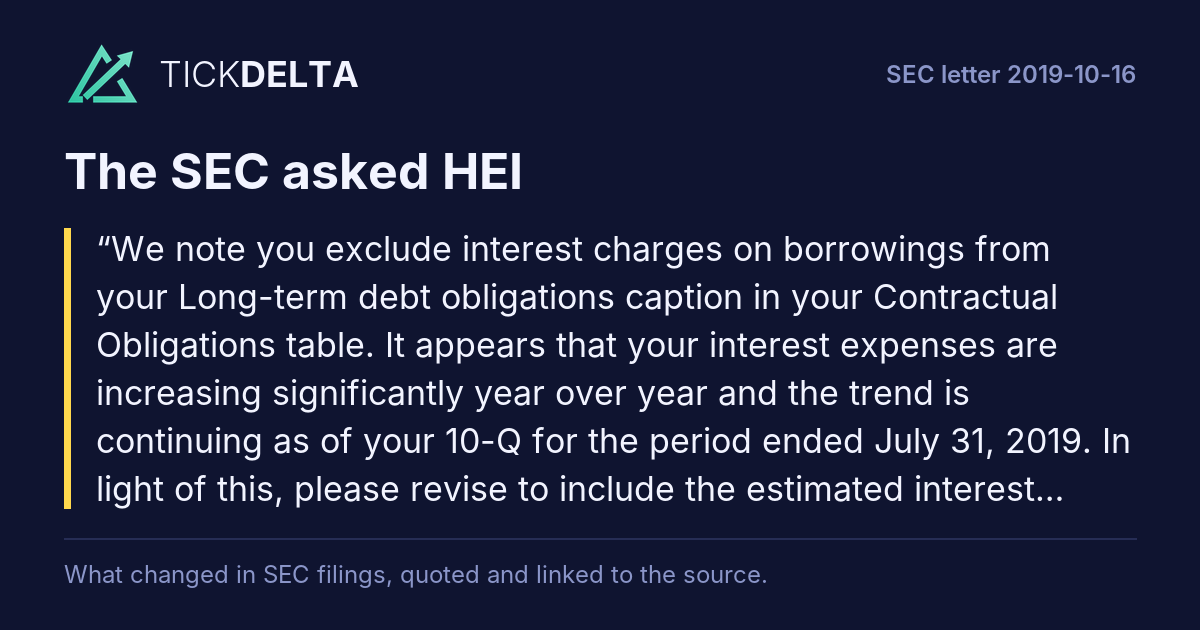
We note you exclude interest charges on borrowings from your Long-term debt obligations caption in your Contractual Obligations table. It appears that your interest expenses are increasing significantly year over year and the trend is continuing as of your 10-Q for the period ended July 31, 2019.
Rest of the question

In light of this, please revise to include the estimated interest expense either in the table of contractual obligations or in a footnote disclosure below the table. Amounts may be based upon factors available as of the balance sheet date and disclosure should also include descriptive language that the balances may fluctuate based on future events and assumptions. Refer to footnote 46 of SEC Interpretive Release 33-8350 dated December 19, 2003.

HEI answered
#1

As noted in footnote 46 of SEC Interpretive Release 33-8350, “the cash requirements for items such as interest, taxes or amounts to be funded to cover post-employment (including retirement) benefits may not be included in the tabular disclosure, but should be discussed if material.” On a prospective basis, the Company will provide the requested information in accordance with footnote 46 of SEC Interpretive Release 33-8350.
Rest of the answer

As an example, please see below for the type of disclosure that will be provided in the Company’s future annual filings.

Contractual Obligations

The following table summarizes our contractual obligations as of October 31, 2019 (in thousands):

Payments due by fiscal period

Total

2020

2021-2022

2023-2024

Thereafter

Long-term debt obligations (1)

$—

Capital lease obligations

—

Operating lease obligations

Purchase obligations

Other long-term liabilities

Total contractual obligations

(1) Includes approximately $0.0 million per year in estimated interest payments on our revolving credit facility until its maturity in fiscal 2023. The aforementioned estimate uses the October 31, 2019 interest rate of 0.0% and assumes the amount outstanding under our revolving credit facility as of October 31, 2019 of $000.0 million will remain outstanding until its maturity date in fiscal 2023. Actual interest payments may vary significantly based on future borrowings, repayments and interest rate fluctuations. See Note 5, Long-Term Debt, of the Notes to Consolidated Financial Statements and "Liquidity and Capital Resources," above for additional information regarding our long-term debt obligations.

Read in the reply
In its next report

First report after the company's reply of Oct 24, 2019: 10-K filed Dec 19, 2019 ↗, against the 10-K filed Dec 20, 2018 ↗.

Tickdelta does not hold the text of both reports, so they are not compared here.

Also in this review: closing letter, 2019-10-28

Form 10-K for the year ended October 31, 2015

2016-03-22 to 2016-04-06 · 2 questions · 1 letter from the SEC, 1 from the company
Review closed 2016-04-06
SegmentsRevenueNon-GAAP measures
Note 14. Operating Segments, page 99
SEC asked (1)
It appears from your disclosure in Note 14 that both the FSG and ETG segments manufacture and sell various types of products including engine and aircraft component replacement parts, specialty parts for aerospace and industrial OEMs, military aircraft parts, repairs and overhaul services, and various electronic, microwave and electrooptical equipment and components.
Rest of the question

Please revise to disclose revenues from your external customers for each product and service or each group of similar products and services in accordance with the guidance in ASC 280-10-50-40.

HEI answered
#1

In response to the Staff’s comment, the Company will provide the requested information in its future filings. Please see below for the type of disclosure that will be provided in the Company’s future filings to address the requirements of ASC 280-10-50-40.

The following table summarizes the Company’s net sales to external customers by product lines included in each operating segment for the last three fiscal years ended October 31 (in thousands):

2015

2014

2013

FSG

Aftermarket replacement parts (1)

$356,070

$327,416

$301,592

Repair and overhaul parts and services
Rest of the answer

(2)

258,952

253,717

220,940

Specialty products (3)

194,678

181,668

142,616

Total net sales

$809,700

$762,801

$665,148

ETG

Electronic component parts for defense, space and aerospace equipment (4)

$255,095

$243,130

$216,862

Electronic component parts for equipment in various other industries (5)

135,887

136,274

133,171

$390,982

$379,404

$350,033

Other, primarily corporate and intersegment

($12,034

)

($9,894

($6,424

Total consolidated net sales

$1,188,648

$1,132,311

$1,008,757

(1)

Includes various jet engine and aircraft component replacement parts.

(2)

Includes primarily the sale of parts consumed in various repair and overhaul services on selected jet engine and aircraft components, avionics, instruments, composites and flight surfaces of commercial and military aircraft.

(3)

Includes primarily the sale of specialty components to OEMs such as thermal insulation blankets, renewable /reusable insulation systems, advanced niche components, complex composite assemblies, and expanded foil mesh.

(4)

Includes various component parts such as electro-optical infrared simulation and test equipment, electro-optical laser products, electro-optical, microwave and other power equipment, high-speed interface products, power conversion products, underwater locator beacons, traveling wave tube amplifiers, microwave power modules, three-dimensional microelectronic and stacked memory products, RF and microwave amplifiers, transmitters and receivers, and high performance communications and electronic intercept receivers and tuners.

(5)

Includes various component parts such as electromagnetic and radio interference shielding, high voltage interconnection devices, high voltage advanced power electronics, harsh environment connectivity products, and custom molded cable assemblies.

Read in the reply
In its next report

First report after the company's reply of Apr 1, 2016: 10-Q filed May 27, 2016 ↗, against the 10-Q filed Feb 29, 2016 ↗.

Tickdelta does not hold the text of both reports, so they are not compared here.

Note 14. Operating Segments, page 99
SEC asked (2)
We note that in the first section of your press release furnished on Form 8-K, you disclose adjusted net income and adjusted operating income, both non-GAAP measures, without the disclosure of the most comparable GAAP measure.
Rest of the question

Please note that under Item 10(e)(1)(i)(A) when a non-GAAP financial measure is presented, the most directly comparable financial measure calculated in accordance with GAAP must be disclosed with equal or greater prominence. Please revise accordingly. See also Instruction 2 to Item 2.02 of Form 8-K.

HEI answered
#2

In response to the Staff’s comment, the Company will provide the requested information in its future filings. Please see the following type of enhanced disclosure that will be provided in future filings, to the extent that the Company provides non-GAAP information in the future, to address the requirements of Item 10(e)(1)(i)(A) of Regulation S-K.
Rest of the answer

The previous disclosure from the Form 8-K is repeated below with the enhanced disclosure underscored.

HEICO Corporation Reports 20% Growth in Adjusted Net Income (13% on a GAAP Basis) and Adjusted Diluted Earnings per Share of 49 Cents for the First Quarter of Fiscal 2016 (46 Cents on a GAAP Basis); Full Year Fiscal 2016 Net Sales and Net Income Growth Estimates Raised

1st Quarter Adjusted Net Income up 20% (13% on a GAAP Basis) on Net Sales Increase of 14% and Adjusted Operating Income Increase of 20% (13% on a GAAP Basis)

HOLLYWOOD, Fla. and MIAMI, Feb. 25, 2016 (GLOBE NEWSWIRE) -- HEICO CORPORATION (NYSE:HEI.A) (NYSE:HEI) today reported that adjusted net income increased 20% to $33.2 million ($31.3 million on a GAAP basis), or 49 cents per diluted share (46 cents on a GAAP basis), in the first quarter of fiscal 2016, up from $27.6 million, or 41 cents per diluted share, in the first quarter of fiscal 2015.

Adjusted operating income increased 20% (13% on a GAAP basis) to $55.8 million ($52.6 million on a GAAP basis) in the first quarter of fiscal 2016, up from $46.4 million in the first quarter of fiscal 2015. The Company's adjusted operating margin increased to 18.2% (17.2% on a GAAP basis) in the first quarter of fiscal 2016, up from 17.3% in the first quarter of fiscal 2015.

The adjusted results above exclude the impact of $3.2 million of pre-tax acquisition costs which the Company incurred in connection with a fiscal 2016 acquisition. These are one-time nonrecurring costs. There were no adjustments to the prior period results. A reconciliation between GAAP and Non-GAAP financial measures is provided at the end of this press release.

Net sales increased by 14% to $306.2 million in the first quarter of fiscal 2016, up from $268.2 million in the first quarter of fiscal 2015.

The undersigned on behalf of the Company, acknowledges that:

• the Company is responsible for the adequacy and accuracy of the disclosure in the filing;

Staff comments or changes to disclosure in response to Staff comments do not foreclose the Commission from taking any action with respect to the filing; and the Company may not assert Staff comments as a defense in any proceeding initiated by the Commission or any person under the federal securities laws of the United States.

Read in the reply
In its next report

First report after the company's reply of Apr 1, 2016: 10-Q filed May 27, 2016 ↗, against the 10-Q filed Feb 29, 2016 ↗.

Tickdelta does not hold the text of both reports, so they are not compared here.

Also in this review: closing letter, 2016-04-06

Form 10-K for the Fiscal Year Ended October 31, 2013

2014-05-06 to 2014-05-14 · 1 question · 1 letter from the SEC, 1 from the company
Review closed 2014-05-14
Income taxesAcquisitions
Financial Statements, page 48 · Notes to Consolidated Financial Statements, page 56
SEC asked
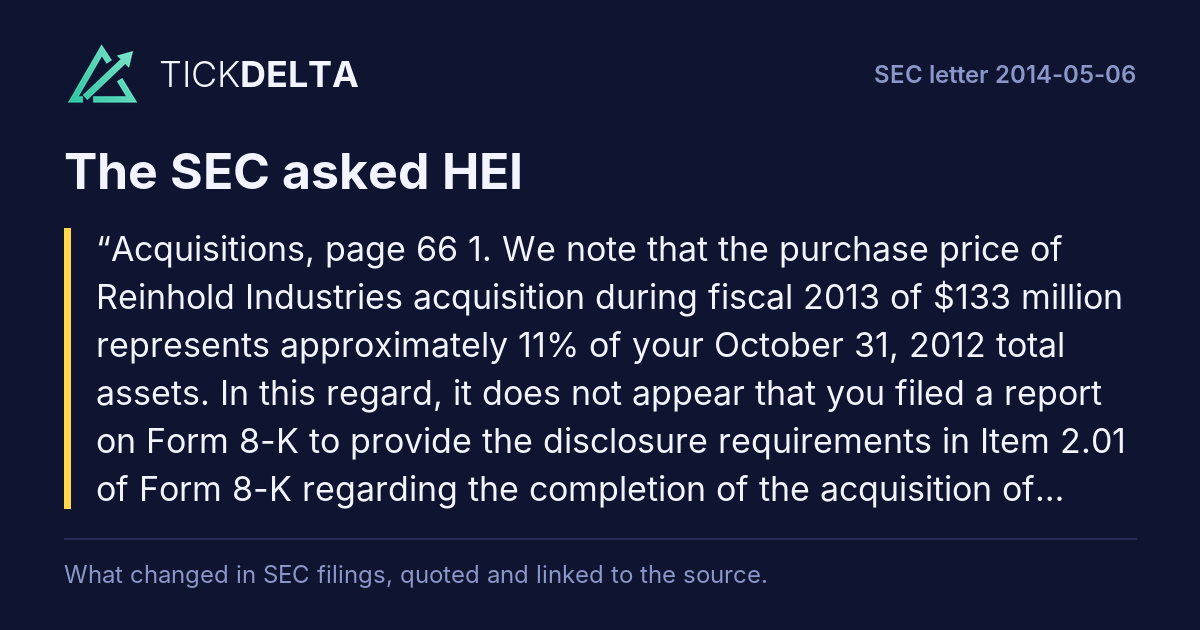
Acquisitions, page 66 1. We note that the purchase price of Reinhold Industries acquisition during fiscal 2013 of $133 million represents approximately 11% of your October 31, 2012 total assets. In this regard, it does not appear that you filed a report on Form 8-K to provide the disclosure requirements in Item 2.01 of Form 8-K regarding the completion of the acquisition of significant assets.
Rest of the question

Please advise, and if under the circumstances you were required to file a report on Form 8-K, but failed to do so, the report would not be considered to have been filed on a timely basis. Additionally, we would advise you to discuss and pre-clear with the Office of Chief Counsel in the Division of Corporation Finance any questions on your eligibility to use Securities Act Forms that are predicated on the current and timely filing of the company’s current and periodic reports. Refer to Instruction 4 of Item 2.01 in Form 8-K. 6. Income Taxes, page 80 2. Please revise your tax footnote to disclose the components of income before income tax expense (benefit) as either domestic or foreign. Refer to the Rule 4-08(h) of Regulation S-X.

HEI answered
#1

In accordance with the disclosure requirements set forth under Item 2.01 of Form 8-K, the Company notes that a Form 8-K is required to be filed when the acquisition or disposition of a significant amount of assets, otherwise than in the ordinary course of business, is completed. Instruction 4(ii) of Item 2.01 of Form 8-K states, “An acquisition or disposition shall be deemed to involve a significant amount of assets if it involved a business (see 17 CFR 210.11-01(d)) that is significant (see 17 CFR 210.11-01(b)).” Based upon review of the aforementioned Regulation S-X references and
Rest of the answer

Section 2040.1 of the Division of Corporation Finance Financial Reporting Manual (specifically page 83), the Company determined that for purposes of Instruction 4(ii) of Item 2.01, an acquisition of a business is significant if the significance tests pursuant to Rule 1-02(w) of Regulation S-X (i.e., the asset, income, or investment tests) meet the 20% level.

The Company evaluated its acquisition of Reinhold Industries ("Reinhold"), which was completed on May 31, 2013, under the previously mentioned standards and determined that Reinhold was an acquisition of a “business” as that term is defined in Rule 11-01(d). Specifically, Reinhold’s revenue-producing activity, physical facilities, employee base, market and distribution system, sales force, customer base, production rights, trade name, and operating rights substantially remained the same subsequent to its acquisition by the Company. In fact, the acquisition of Reinhold was structured as a merger in which Reinhold became a subsidiary of the Company. As such, the Company applied the 20% significance threshold pursuant to Rule 11-01(b) of Regulation S-X and noted the following results: asset test - 11.1%, investment test - 5.5% and income test - 6.3%.

The Company respectfully submits to the Staff that no Form 8-K was required to be filed as a result of the Company acquiring Reinhold. The Company’s conclusion that a Current Report on Form 8-K for the acquisition of the Reinhold “business” was based on the aforementioned analysis of significance.

6. Income Taxes, page 80

2. Please revise your tax footnote to disclose the components of income before income tax expense (benefit) as either domestic or foreign. Refer to the Rule 4-08(h) of Regulation S-X.

Company Response to Comment #2

In response to the Staff’s comment, the Company will provide the requested information in its future filings. As an example, please see below the type of disclosure that will be provided in the Company’s future annual filings, and when applicable in its interim filings, to address the requirements of Rule 4-08(h) of Regulation S-X.

The components of income before income taxes and noncontrolling interests are as follows (in thousands):

Year ended October 31,

2013

2012

2011

Domestic

$168,643

$157,189

$137,177

Foreign

12,118

3,986

1,176

Income before taxes and noncontrolling interests

$180,761

$161,175

$138,353

The undersigned on behalf of the Company, acknowledges that:

• the Company is responsible for the adequacy and accuracy of the disclosure in the filing;

staff comments or changes to disclosure in response to staff comments do not foreclose the Commission from taking any action with respect to the filing; and the Company may not assert staff comments as a defense in any proceeding initiated by the Commission or any person under the federal securities laws of the United States.

Read in the reply
In its next report

First report after the company's reply of May 8, 2014: 10-Q filed May 22, 2014 ↗, against the 10-Q filed Feb 27, 2014 ↗.

Tickdelta does not hold the text of both reports, so they are not compared here.

Also in this review: closing letter, 2014-05-14

Form 10-K for the Year Ended October 31, 2011

2012-01-30 to 2012-02-21 · 5 questions · 1 letter from the SEC, 1 from the company
Review closed 2012-02-21
AcquisitionsResults discussion (MD&A)SegmentsLiquidity and cashGoodwill and impairment
Management’s Discussion & Analysis · Results of Operations, page 29
SEC asked (1)
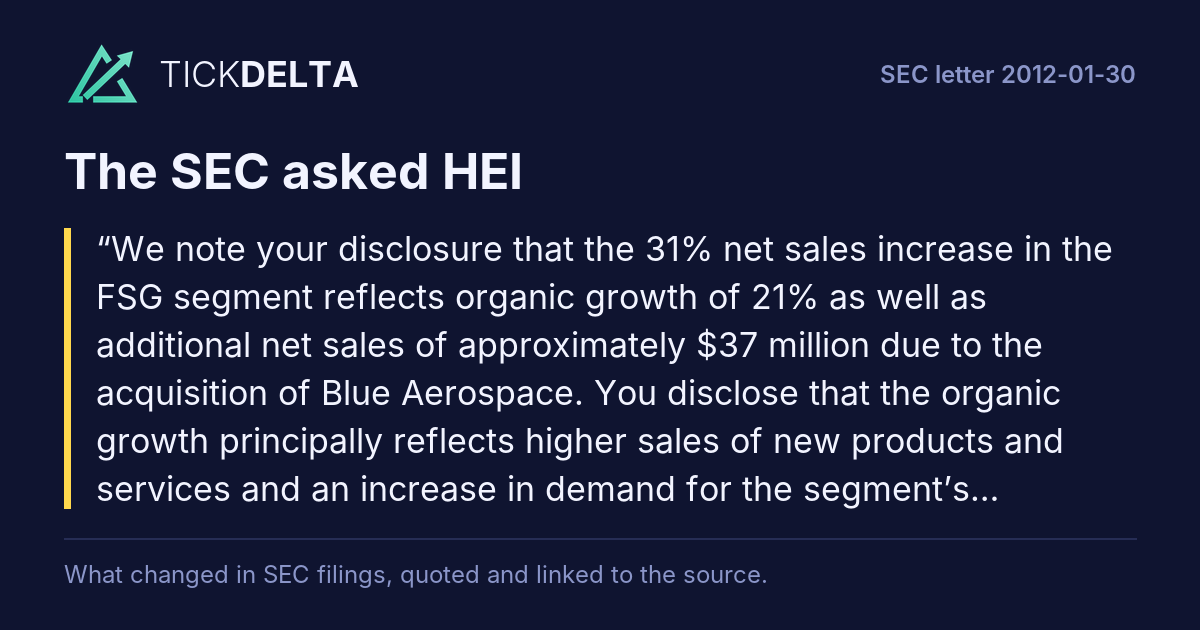
We note your disclosure that the 31% net sales increase in the FSG segment reflects organic growth of 21% as well as additional net sales of approximately $37 million due to the acquisition of Blue Aerospace. You disclose that the organic growth principally reflects higher sales of new products and services and an increase in demand for the segment’s aftermarket replacement parts and repair and overhaul services as
Rest of the question

a result of increased airline capacity and also reflects higher sales of and demand for the segment’s industrial products. In addition to quantification, please revise this discussion to ensure that each of the identified underlying cause of material increases or decreases is adequately analyzed. For example, for material increases or decreases due to changes in the mix of products sold, sales prices, productivity levels, etc., consider disclosing quantitative analysis of the number of units sold by product line along with its change in selling price, or other relevant measures, in the current period versus the prior period and address the reasons for any significant changes between the periods. In addition to indicating the product line that accounts for the decrease or increase in sales, please considering explain why you believe that decrease/increase occurred and your expectations for future sales. See Item 303 of Regulation SK.

HEI answered
#1

In response to the Staff’s comment, the Company will provide the requested information in its future filings. Please see the following type of enhanced discussion that will be provided in future filings, including the Company’s Form 10-Q for the period ended January 31, 2012 to be filed no later than March 12, 2012.
Rest of the answer

The previous disclosures from the Form 10-K are repeated below with the enhanced discussion underscored.

Comparison of Fiscal 2011 to Fiscal

2010

Net

Sales

Our net sales in fiscal 2011 increased by 24% to a record $764.9 million, as compared to net sales of $617.0 million in fiscal 2010. The increase in net sales reflects an increase of $127.2 million (a 31% increase) to a record $539.6 million in net sales within the FSG as well as an increase of $22.1 million (an 11% increase) to a record $227.8 million in net sales within the ETG. The net sales increase in the FSG reflects organic growth of approximately 21%, as well as additional net sales of approximately $37 million contributed by the first quarter of fiscal 2011 acquisition of Blue Aerospace. The organic growth principally reflects increased demand for certain of the FSG’s aerospace products and services attributed to new product offerings and increased airline capacity resulting in a $41.9 million increase in net sales within the FSG’s aftermarket replacement parts product lines and a $23.6 million increase in net sales within the FSG’s repair and overhaul services product lines. The increase in airline capacity is principally attributed to overall improved global economic conditions as compared to fiscal 2010. Although global financial conditions have improved during fiscal 2011, continued economic uncertainty may moderate net sales growth from capacity increases within our commercial aviation markets in fiscal 2012. Additionally, the FSG’s organic growth in fiscal 2011 reflects an increase of $24.4 million in net sales within our specialty product lines, primarily attributed to the sales of industrial products used in heavy-duty and off-road vehicles as a result of market penetration and increased demand. The net sales increase in the ETG principally reflects organic growth of approximately 10%. The organic growth in the ETG is primarily attributed to an increase in market penetration and demand for certain defense, aerospace and medical products, resulting in a $13.3 million, $5.5 million and $4.0 million increase in net sales from these product lines, respectively. Based on our current economic visibility, we expect stable demand for ETG’s products in fiscal 2012. Sales price changes were not a significant contributing factor to the FSG and ETG net sales growth in fiscal 2011.

and 2010 by market approximated 60% and 62%, respectively, from the commercial aviation industry, 24% and 23%, respectively, from the defense and space industries, and 16% and 15%, respectively, from other industrial markets including medical, electronics and telecommunications.

Read in the reply
In its next report

First report after the company's reply of Feb 10, 2012: 10-Q filed Mar 1, 2012 ↗, against the 10-Q filed Sep 1, 2011 ↗.

Tickdelta does not hold the text of both reports, so they are not compared here.

Management’s Discussion & Analysis · Results of Operations, page 29
SEC asked (2)
Please expand your discussion of cost of sales and selling, general, and administrative expenses to quantify and discuss significant changes in cost components within these broad categories, such as product costs, product development costs, marketing costs, depreciation and amortization, and any other significant components that would enable readers to understand your business better.
Rest of the question

For example, you state that gross profit was affected by higher margins in FSC due to efficiencies realized through higher sales volumes offset by lower margins in ETG due to changes in product mix, but you do not quantify these changes or provide the actual cost figures necessary to put these changes in proper context.

HEI answered
#2

In response to the Staff’s comment, the Company will provide the requested information in its future filings. Please see the following type of enhanced discussion that will be provided in future filings, including the Company’s Form 10-Q for the period ended January 31, 2012 to be filed no later than March 12, 2012.
Rest of the answer

The previous disclosures from the Form 10-K are repeated below with the enhanced discussion underscored.

Gross Profit and Operating Expenses

Our consolidated gross profit margin was 35.9% in fiscal 2011 as compared to 36.0% in fiscal 2010, principally reflecting a .7% increase in the FSG’s gross profit margin, partially offset by a .5% decrease in the ETG’s gross profit margin. The increase in the FSG’s gross profit margin principally reflects a .5% decrease in new product research and development expenses as a percentage of net sales. The FSG’s new product research and development spending increased from $11.8 million in fiscal 2010 to $12.9 million in fiscal 2011, but decreased as a percentage of net sales due to the aforementioned net sales increase. The higher sales of the

FSG’s aftermarket replacement parts, which generally have higher gross profit margins than the other FSG products lines, also contributed to an increase in the FSG’s gross profit margin . The decrease in the ETG’s gross profit margin is principally attributed to a $.4 million increase over the prior year in impairment charges related to the write down of certain intellectual property intangible assets to their estimated fair values and a .2% increase in new product research and development expenses as a percentage of net sales. The ETG’s new product research and development spending increased from $10.9 million in fiscal 2010 to $12.5 million in fiscal 2011. New product research and development expenses included within our consolidated cost of sales increased from approximately $22.7 million in fiscal 2010 to approximately $25.4 million in fiscal 2011, principally to further enhance growth opportunities and market penetration within both of our operating segments.

Selling, general and administrative

(“SG&A”) expenses were $136.0 million and $113.2 million in fiscal 2011 and 2010, respectively. The increase in SG&A expenses was mainly due to a $9.6 million increase in general and administrative (“G&A”) employment-related expenses and a $5.3 million increase in other G&A expenses as well as higher selling expenses of $7.9 million, each of which is associated with the growth in net sales discussed above and the acquired businesses, which accounted for $5.5 million of the aggregate SG&A expense increase. The increase in G&A employment-related expenses is inclusive of a $6.3 million increase in performance awards based on the improved consolidated operating results. The increase in other G&A expenses also reflects a $3.1 million increase over the prior year in impairment charges related to the write-down of certain customer relationships and trade name intangible assets to their estimated fair values, partially offset by a $1.2 million reduction in the value of contingent consideration related to a prior year acquisition. SG&A expenses as a percentage of net sales decreased from 18.3% in fiscal

2010 to 17.8% in fiscal 2011. The decrease as a percentage of net sales principally reflects the impact of higher net sales volumes on the fixed portion of SG&A expenses and controlled corporate spending relative to our net sales growth.

Operating Income

Operating income in fiscal

2011 increased by 27% to a record $138.4 million as compared to operating income of $109.2 million in fiscal 2010. The increase in operating income reflects a $27.1 million increase (a 40% increase) in operating income of the FSG to a record $95.0 million in fiscal 2011 from $67.9 million in fiscal 2010 and a $3.4 million increase (a 6% increase) to a record $59.5 million in operating income of the ETG in fiscal 2011, up from $56.1 million in fiscal 2010, partially offset by a $1.2 million increase in corporate expenses. The increase in operating income of the FSG principally reflects the previously mentioned increased sales volumes and favorable product mix and efficiencies realized from the overall increased sales volumes as well as the fiscal 2011 acquisition.

The increase in ETG’s operating income principally reflects the previously mentioned increased sales volumes.

As a percentage of net sales, our consolidated operating income increased to 18.1% in fiscal 2011 compared to 17.7% in fiscal 2010. The increase in consolidated operating income as a percentage of net sales principally reflects an increase in the FSG’s operating income as a percentage of net sales to 17.6% in fiscal 2011 from 16.5% in fiscal 2010, partially offset by a decrease in the ETG’s operating income as a percentage of net sales from 27.3% in fiscal 2010 to 26.1% in fiscal 2011. The increase in operating income as a percentage of net sales for the FSG reflects the higher sales volumes and improved gross profit margins as discussed above. The decrease in operating income as a percentage of net sales for the ETG principally reflects the aforementioned increase of $3.5 million over the prior year in impairment losses related to the write-down of certain intangible assets to their estimated fair values, partially offset by a $1.2 million reduction in the value of contingent consideration related to a prior year acquisition.

Read in the reply
In its next report

First report after the company's reply of Feb 10, 2012: 10-Q filed Mar 1, 2012 ↗, against the 10-Q filed Sep 1, 2011 ↗.

Tickdelta does not hold the text of both reports, so they are not compared here.

Liquidity and Capital Resources, page 34
SEC asked (3)
Please revise to disclose an estimate of the expected amount of capital expenditures for the next fiscal year.
HEI answered
#3

In response to the Staff’s comment, the Company will provide the requested information in its future filings. Please see below for the type of enhanced liquidity and capital resources discussion that will be provided in the Company’s future filings. The previous disclosures from the

Form 10-K are repeated below with the enhanced discussion underscored.

As of October 31,

2011

Cash and cash equivalents

$ 17,500,000

$ 6,543,000

Total debt (including current portion)

40,158,000

14,221,000

Shareholders’ equity

620,154,000

554,826,000

Total capitalization (debt plus
Rest of the answer

equity)

660,312,000

569,047,000

Total debt to total capitalization

6 %

2 %

In addition to cash and cash equivalents of $17.5 million, we had approximately $262 million of unused availability under the terms of our revolving credit facility as of October 31, 2011. Our principal uses of cash include acquisitions, capital expenditures, cash dividends and working capital needs. Capital expenditures in fiscal 2012 are anticipated to approximate $20 - $22 million.

We finance our activities primarily from our operating activities and financing activities, including borrowings under long-term credit agreements.

Read in the reply
In its next report

First report after the company's reply of Feb 10, 2012: 10-Q filed Mar 1, 2012 ↗, against the 10-Q filed Sep 1, 2011 ↗.

Tickdelta does not hold the text of both reports, so they are not compared here.

Notes to the Financial Statements · Note 2. Acquisitions, page 54
SEC asked (4)
We note your disclosure of the cash investing activities related to acquisitions, including contingent purchase price payments to previous owners of businesses acquired prior to fiscal 2010. In light of the fact that the total amount of acquisitions, net of cash acquired in fiscal 2011 is material to total assets as of October 31, 2010, we believe that all of the disclosures required by ASC 805 should be provided
Rest of the question

for, at a minimum, the aggregate of the acquisitions made during each period. For example, please provide a qualitative description of the factors that make up the goodwill recognized, such as expected synergies from combining operations of the acquiree and the acquirer, intangible assets that do not qualify for separate recognition, or other factors. See ASC 805-30-50-1. Also, please revise to disclose the contingent purchase price payments made to previous owners paid during each reporting period separately from the purchase price allocation of the acquisitions made during each period.

HEI answered
#4

In response to the Staff’s comment, the Company will provide the requested information in its future filings, including the Company’s Form 10-Q to be filed no later than March 12, 2012, when applicable. In accordance with ASC 805, the Company has considered all relevant disclosures pertaining to the fiscal 2011 acquisitions. Please note that the disclosure requirements of ASC 805-30-50-1.d and ASC 805-30-50-1.e were included within Note 4 to the Consolidated Financial Statements included in the Company’s Form 10-K.
Rest of the answer

Please see below for the type of disclosure, inclusive of a qualitative description of the factors that made up the goodwill recognized from our fiscal 2011 acquisitions and disclosure of contingent purchase price payments made to previous owners paid during each reporting period, that will be provided in the Company’s future filings when applicable. The previous Note 2 disclosures from the Form

10-K are repeated below with the additional disclosures underscored.

Note 2. ACQUISITIONS

In May 2009, the Company, through

HEICO Electronic, acquired 82.5% of the stock of VPT, Inc., a U.S. company that designs and provides power conversion products principally serving the defense, space and aviation industries. The remaining 17.5% continues to be owned by an existing

VPT shareholder which is also a supplier to the acquired company. During the first and second year following the acquisition,

VPT met certain earnings objectives which obligated the Company to pay additional purchase consideration of $1.3 million in both fiscal 2011 and 2010. In addition, subject to meeting certain earnings objectives during the third year following the acquisition, the Company may be obligated to pay additional purchase consideration of up to $10.1 million in fiscal 2012, which will be recorded as additional goodwill.

In October 2009, the Company, through HEICO Electronic, acquired the business, assets and certain liabilities of the Seacom division of privately-held Dukane

Corp. and formed a new subsidiary, Dukane Seacom, Inc. (“Seacom”). Seacom is a designer and manufacturer of underwater locator beacons used to locate aircraft cockpit voice recorders, flight data recorders, marine ship voyage recorders and various other devices which have been submerged under water. During the first year following the acquisition, Seacom met certain earnings objectives which obligated the Company to pay additional purchase consideration of $5.3 million in fiscal 2011. Based on the subsidiary’s earnings in the second year following the acquisition, the Company accrued $4.8 million of additional purchase consideration and increased goodwill as of October 31, 2011, which it expects to pay in fiscal 2012.

In February 2010, the Company, through HEICO Electronic, acquired substantially all of the assets and assumed certain liabilities of dB Control. dB Control produces high-power devices used in both defense and commercial applications.

In December 2010, the Company, through HEICO Aerospace, acquired 80.1% of the assets and assumed certain liabilities of Blue Aerospace LLC. Blue Aerospace is a supplier, distributor, and integrator of military aircraft parts and support services primarily to foreign military organizations allied with the United States. The remaining 19.9% interest continues to be owned by certain members of Blue Aerospace’s management team.

In September 2011, the Company, through HEICO Electronic, acquired all of the outstanding capital stock of 3D Plus SA (“3D”). 3D is a leading designer and manufacturer of three-dimensional microelectronic and stacked memory products used predominately in satellites and also utilized in medical equipment. Pursuant to the terms of the Stock Purchase Agreement (“SPA”), the purchase consideration for

3D shall reflect certain adjustments, which principally include any difference between 3D’s actual working capital as of the acquisition date and the amount estimated per the SPA. Accordingly, the Company has accrued approximately $6.2 million of additional purchase consideration and increased goodwill as of October 31, 2011, which it expects to pay in fiscal 2012.

As part of the purchase agreements associated with certain prior year acquisitions, the Company may be obligated to pay additional purchase consideration based on the acquired subsidiary meeting certain earnings objectives following the acquisition. For acquisitions consummated prior to fiscal 2010, the Company accrues an estimate of additional purchase consideration when the earnings objectives are met. During fiscal 2011, the Company, through HEICO Electronic, paid $6.6 million of such additional purchase consideration of which $4.1 million was accrued as of October 31, 2010. During fiscal 2010, the Company, through HEICO Electronic, paid $4.2 million of such additional purchase consideration of which $1.8 million was accrued as of October 31, 2009. During fiscal 2009, the Company, through HEICO

Electronic, paid $3.8 million of such additional purchase consideration of which $2.2 million was accrued as of October 31, 2008.

The amounts paid in fiscal 2011, 2010 and 2009 were based on a multiple of each applicable subsidiary’s earnings relative to target and were not contingent upon the former shareholders of the respective acquired entity remaining employed by the Company or providing future services to the Company. Accordingly, these amounts represent an additional cost of the respective entity recorded as additional goodwill. Information regarding additional contingent purchase consideration may be found in Note 16, Commitments and Contingencies.

The purchase price of each of the above referenced acquisitions was paid principally in cash using proceeds from the Company’s revolving credit facility and is not material or significant to the Company’s consolidated financial statements.

Cash investing activities related to acquisitions (excluding additional purchase consideration payments) is as follows:

Year ended October 31,

2009

Fair value of assets acquired:

Liabilities assumed

$ 32,263,000

$ 3,952,000

$ 3,881,000

Noncontrolling interests in consolidated subsidiaries

5,612,000

—

3,305,000

Less:

Goodwill

48,968,000

12,972,000

28,777,000

Identifiable intangible assets

40,187,000

15,400,000

21,562,000

Inventories

16,964,000

3,184,000

4,249,000

Accounts receivable

9,072,000

6,685,000

4,720,000

Property, plant and equipment

9,115,000

573,000

553,000

Other assets

1,640,000

24,000

3,299,000

Acquisitions, net of cash acquired

($ 88,071,000 )

($ 34,886,000 )

($ 55,974,000 )

The fiscal 2011 liabilities assumed is inclusive of the aforementioned 3D additional purchase consideration. The allocation of the purchase price of 3D to the tangible and identifiable intangible assets acquired and liabilities assumed in these consolidated financial statements is preliminary until the Company obtains final information regarding their fair values. However, the Company does not expect any adjustments to such allocation to be material to the Company’s consolidated financial statements. The primary items that generated the goodwill recognized were the premiums paid by the Company for the future earnings potential of the businesses acquired and the value of their assembled workforces that do not qualify for separate recognition, which, in the case of Blue Aerospace, benefit both the Company and the noncontrolling interest holders. Based on the factors comprising the goodwill recognized, the fair value of the noncontrolling interest in Blue Aerospace was determined based on the consideration of the purchase price paid by the Company for its 80.1% ownership interest.

The operating results of the

Company’s fiscal 2011 acquisitions were included in the Company’s results of operations from the effective acquisition dates. The amount of net sales and earnings of the 2011 acquisitions included in the Consolidated Statements of Operations is not material. Had the fiscal 2011 acquisitions been consummated as of the beginning of fiscal 2010, net sales on a pro forma basis for fiscal 2010 would have been approximately $679 million and net sales for fiscal 2011 as well as net income from consolidated operations, net income attributable to HEICO, and basic and diluted net income per share attributable to HEICO shareholders on a pro forma basis for fiscal 2011 and 2010 would not have been materially different than the reported amounts.

Read in the reply
In its next report

First report after the company's reply of Feb 10, 2012: 10-Q filed Mar 1, 2012 ↗, against the 10-Q filed Sep 1, 2011 ↗.

Tickdelta does not hold the text of both reports, so they are not compared here.

Notes to the Financial Statements · Note 2. Acquisitions, page 54
SEC asked (5)
We note that in December 2010 you acquired 80.1% of the assets and assumed certain liabilities of Blue Aerospace LLC. Please explain to us how you determined or calculated the fair value of the non-controlling interest acquired. As part of your response and revised disclosure, please tell us the valuation method used as well as all significant assumptions. See ASC 805-20-50-1(e).
HEI answered
#5

In response to the Staff’s be filed no later than March 12, 2012, when applicable. In accordance with ASC 805, the noncontrolling interest was recognized and measured at fair value as of the acquisition date. Pursuant to the guidance in ASC 820, the Company determined the noncontrolling interest associated with Blue Aerospace based on the consideration of the purchase price paid by the Company for its 80.1% ownership interest. Please note that Blue Aerospace was a private entity and the transaction occurred between a willing buyer and a willing seller.
Rest of the answer

As indicated in our response to Comment #4 above, the composition of the goodwill associated with Blue Aerospace consisted of factors considered by management to benefit both the controlling and noncontrolling interest holders. Additionally, management considered potential risk related to the noncontrolling interest holders and concluded that any significant risk was generally mitigated as such noncontrolling interest holders continue to function as senior management of the acquiree. Based on the aformentioned, the Company determined that use of the controlling interest value to approximate the fair value of the noncontrolling interest was reasonable. Please see below for the type of disclosure, inclusive of the valuation method used to determine the noncontrolling interest associated with our acquisition of Blue Aerospace LLC, that will be provided in the Company’s future filings when applicable. The previous relevant Note 2 disclosure from the Form 10-K is repeated below with the additional disclosure underscored.

assumed is inclusive of the aforementioned 3D additional purchase consideration. The allocation of the purchase price of 3D to the tangible and identifiable intangible assets acquired and liabilities assumed in these consolidated financial statements is preliminary until the Company obtains final information regarding their fair values. However, the Company does not expect any adjustments to such allocation to be material to the Company’s consolidated financial statements. The primary items that generated the goodwill recognized were the premiums paid by the Company for the future earnings potential of the businesses acquired and the value of their assembled workforces that do not qualify for separate recognition, which, in the case of Blue Aerospace, benefit both the Company and the noncontrolling interest holders. Based on the factors comprising the goodwill recognized and consideration of an insignificant control premium, the fair value of the noncontrolling interest in Blue Aerospace was determined based on the consideration of the purchase price paid by the Company for its 80.1% ownership interest.

The undersigned on behalf of the Company, acknowledges that:

· the Company is responsible for the adequacy and accuracy of the disclosure in the filing;

· staff comments or changes to disclosure in response to staff comments do not foreclose the Commission from taking any action with respect to the filing; and

· the Company may not assert staff comments as a defense in any proceeding initiated by the Commission or any person under the federal securities laws of the United States.

Read in the reply
In its next report

First report after the company's reply of Feb 10, 2012: 10-Q filed Mar 1, 2012 ↗, against the 10-Q filed Sep 1, 2011 ↗.

Tickdelta does not hold the text of both reports, so they are not compared here.

Also in this review: closing letter, 2012-02-21

From the SEC's correspondence on EDGAR: staff letters (form UPLOAD) and company letters (form CORRESP), 15 letters filed since 2012-01-30. Questions and answers are matched by their numbers; topics come from words in each question. The reports are compared word for word (same form, before the first SEC letter against the first report after the company's reply). No AI.

Sources

The SEC's correspondence on EDGAR: staff letters (form UPLOAD) and company letters (form CORRESP), matched question by question. No AI.

Also

Filings: the letters in the filing list.

Work with it

Excel workbook · CSV. Google Sheet that stays up to date: paste =IMPORTDATA("https://tickdelta.com/company/HEI/export.csv") into a cell.

Next in Owners and insiders:Insider trades
Esc

Type a ticker such as AAPL, a name, an investor such as Buffett, or a topic such as tariffs. ↑ ↓ to move, Enter to open.