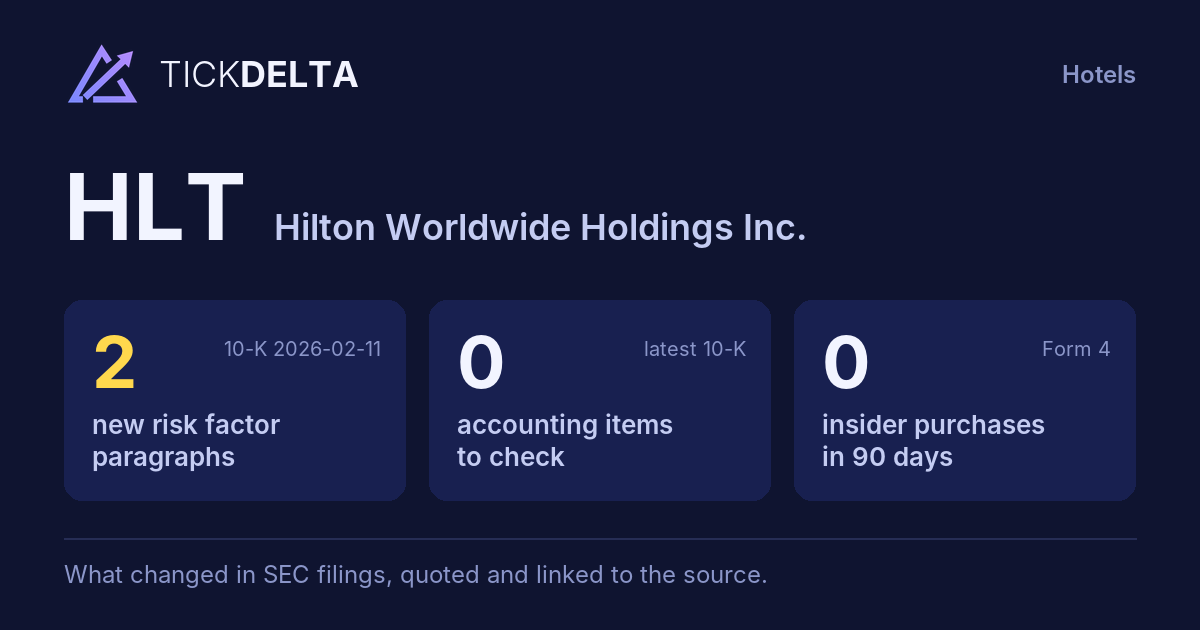
What the 10-K filed 2026-02-11 says about risks that are not on the face of the balance sheet, from the notes to the financial statements, Legal Proceedings and the MD&A (and, for big customers and key suppliers, Business and Risk Factors). Tickdelta picks sentences with specifics (amounts, accruals, covenant ratios) and quotes them as filed. New marks a sentence with nothing like it in the 10-K filed 2025-02-06.
Big customers
Customers the company names as a large share of revenue or receivables (it must name any worth 10% of revenue).
No specific sentence about this in the 10-K.
Key suppliers
Parts or manufacturing that depend on one or a few suppliers.
“From time to time, we may rely on a single or limited number of suppliers for the provision of various goods or services that we use in the operation of our business.”
Read it in the 10-K ↗
Lawsuits and legal claims
Pending cases, settlements and what the company has set aside for them.
“An estimated loss from a loss contingency is accrued as a charge to income if it is probable and the amount of the loss can be reasonably estimated.”
Read it in the 10-K ↗
“For all income tax positions, we first determine whether it is more likely than not that a tax position will be sustained upon examination, including resolution of any related appeals or litigation processes, based on the technical merits of each evaluated tax position and the amounts we would ultimately accept in a negotiated settlement with tax authorities.”
Read it in the 10-K ↗
“An estimated loss from a loss contingency is accrued as a charge to income if it is probable a loss has been incurred and the amount of the loss can be reasonably estimated.”
Read it in the 10-K ↗
Guarantees and indemnities
2 newPromises to pay someone else's debts or losses if they cannot.
New “The increase in net cash inflows during the period included an increase in cash inflows generated from franchise and licensing fees, discussed in "—Revenues." Additionally, there was a decrease in cash outflows of $77 million for debt guarantee payments that were made during the year ended December 31, 2024.”
Read it in the 10-K ↗
“As of December 31, 2025, we had performance guarantees with expirations ranging from 2026 to 2043 and possible cash outlays totaling $22 million.”
Read it in the 10-K ↗
New “During the year ended December 31, 2024, we recognized losses of $50 million in other non-operating loss, net in our consolidated statement of operations and paid $77 million for debt guarantees extended to certain hotels we manage.”
Read it in the 10-K ↗
“Our debt guarantees and loan commitments as of December 31, 2025 had expirations ranging from 2027 to 2035 and remaining possible cash outlays totaling $61 million.”
Read it in the 10-K ↗
Debt covenants
Conditions in loan agreements that, if broken, can make debt due early.
No specific sentence about this in the 10-K.
Commitments off the balance sheet
Contracts the company must pay for later: purchase obligations, take-or-pay deals.
“Total current assets (variable interest entities – $85 and $71) 2,996 3,272”
Read it in the 10-K ↗
“Total intangibles and other assets (variable interest entities – $341 and $100) 13,778 13,250”
Read it in the 10-K ↗
“Total current liabilities (variable interest entities – $47 and $51) 4,508 4,700”
Read it in the 10-K ↗
“Total liabilities (variable interest entities – $340 and $110) 22,120 20,211”
Read it in the 10-K ↗
Sentences are chosen by their words, not read by AI, so some can be off topic. Always check the filing. Open the 10-K ↗
Work on HLT in a spreadsheet:
Excel workbook (a sheet per section, ten years by column, charts, links to the filings) ·
CSV.
For a Google Sheet that stays up to date, paste =IMPORTDATA("https://tickdelta.com/company/HLT/export.csv") into a cell.