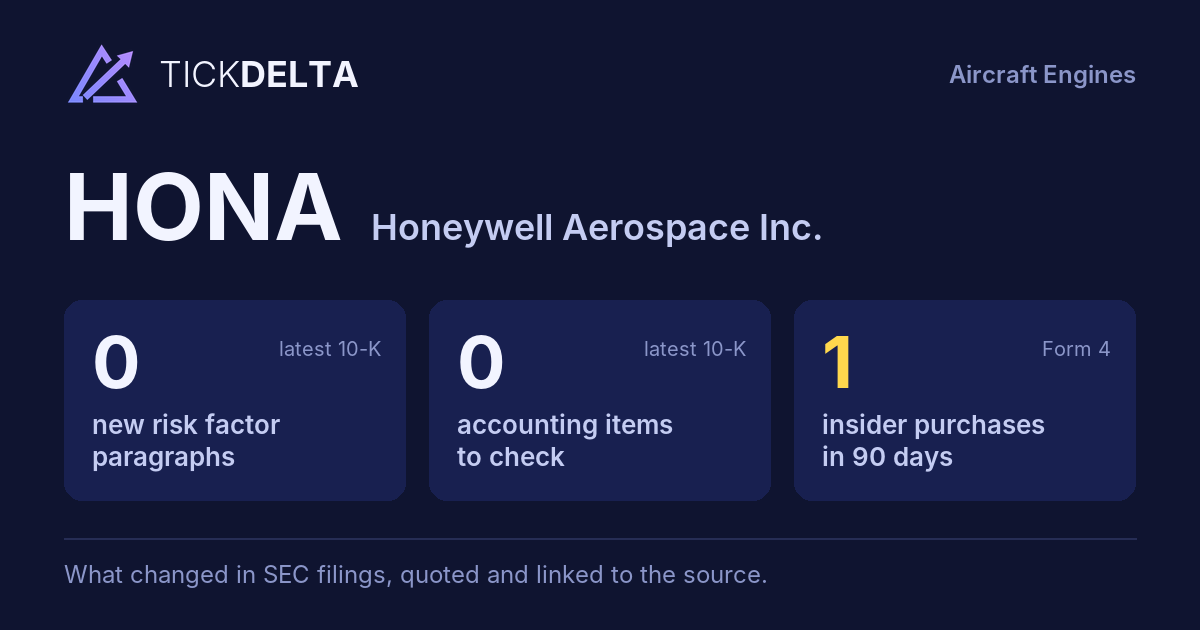
65 new in the latest 10-Q
Paragraphs with nothing like them in last year's 10-K
No new paragraphs in Risk Factors, or fewer than two 10-Ks to compare.
Paragraphs in the 10-Q filed Oct 28, 2026 that were not in the one before
65 paragraphs in the 10-Q filed Oct 28, 2026 with nothing like them in the 10-Q filed Aug 5, 2026 (at least half the words must differ; new numbers alone do not count). Quoted exactly, grouped by the item heading above them. This is text that changed, not a judgement of how serious it is.
10-Q
There were 317,031,836 shares of Common Stock outstanding as of September 26, 2026.
Read in the 10-Q ↗
Financial statements and notes
Common Stock Shares Amount Additional Paid-in Capital Net Parent Investment Accumulated Deficit Accumulated Other Comprehensive Loss Noncontrolling Interests Total Equity (Deficit) Balance as of June 28, 2025 — $ — $ — $ 10,113 $ — $ (228) $ 93 $ 9,978 Net income — — — 644 — — 10 654 Other comprehensive income — — — — — 1 — 1 Dividends to noncontrolling interests — — — — — — (6) (6) Net transfers to Parent — — — (610) — — — (610) Balance as of September 27, 2025 — $ — $ — $ 10,147 $ — $ (227) $ 97 $ 10,017 Balance as of June 27, 2026 — $ — $ — $ (5,487) $ — $ (210) $ 74 $ (5,623) Net income — — — — 726 — 11 737 Net transfers from (to) Parent — — — 2,960 — (579) — 2,381 Issuance of common stock in connection with Spin-off and reclassification of Net Parent investment 316.9 3 — 2,527 (2,530) — — — Issuance of common stock in connection with employee savings and stock plans 0.1 — 1 — — — — 1 Other comprehensive loss — — — — — (11) — (11) Dividends to noncontrolling interests — — — — — — (2) (2) Stock-based compensation expense — — 28 — — — — 28 Balance as of September 26, 2026 317.0 $ 3 $ 29 $ — $ (1,804) $ (800) $ 83 $ (2,489)
Read in the 10-Q ↗
Effective September 26, 2026, the Company began separately presenting Pension assets and Deferred tax liabilities on the Condensed Consolidated Balance Sheets, which were previously included within Other
Read in the 10-Q ↗
assets and Other liabilities, respectively. The Company also reclassified interest income from Other (income) expense, net to Interest expense (income), net on the Condensed Consolidated Statements of Operations. Prior period amounts have been reclassified to conform to the current year’s financial statement presentation.
Read in the 10-Q ↗
rights that may be addressed in separate agreements between the parties or their respective affiliates.
Read in the 10-Q ↗
Show the other 60
In connection with the Spin-off, in accordance with the Employee Matters Agreement, stock options and RSUs granted under Honeywell's equity compensation plans to employees of the Company and Honeywell were adjusted to reflect the impact of the Spin-off on these awards. To preserve the aggregate intrinsic value of Honeywell awards held prior to the Spin-off, the awards held by Aerospace employees were converted into equivalent awards under the Aerospace 2026 Plan.
Read in the 10-Q ↗
Certain executives and employees of Honeywell that held Honeywell stock options and RSUs received an adjusted award consisting of both an award denominated in Honeywell equity and an award denominated in Aerospace equity. These awards were adjusted in accordance with the basket method, resulting in participants retaining units of the existing Honeywell award while receiving additional units of an Aerospace award. Upon vesting, the Company is obligated to settle all of the outstanding awards denominated in Aerospace equity.
Read in the 10-Q ↗
Share counts for stock-based compensation discussed herein represent outstanding shares to be remitted by the Company to (i) its employees in connection with the Aerospace 2026 Plan adopted by the Company and (ii) employees of Honeywell that received awards denominated in the Company’s equity. The Company recognizes stock-based compensation expense related to unvested awards held by its employees.
Read in the 10-Q ↗
Stock-based compensation cost, which is recognized in Selling, general, and administrative expenses in the Condensed Consolidated Statements of Operations, is provided in the following table:
Read in the 10-Q ↗
The exercise price, term, and other conditions applicable to each option granted under the Aerospace 2026 Plan are determined by the Compensation Committee of the Board of Directors. The exercise price of stock options is set on the grant date and may not be less than the fair market value per share of the Company's stock on that date. The fair value is recognized as an expense over the employee’s requisite service period (generally the vesting period of the award). Options under the Aerospace 2026 Plan generally vest over either a three or four-year period and expire after 10 years. Forfeitures are estimated at the time of grant to recognize expense for those awards expected to vest and are based on historical forfeiture rates.
Read in the 10-Q ↗
The fair value of each option award is estimated on the date of grant using the Black-Scholes option-pricing model. The Company does not have sufficient historical information on which to base expected volatility. As such, our volatility assumption is based on the historical and implied volatility of similar public companies, which were identified considering factors such as industry, stage of life cycle, size, and financial leverage. Because the Company does not have sufficient historical option exercise experience upon which we can estimate the expected term we estimate the expected term using the average of the vesting period and the contractual period of the award. The risk-free rate for periods within the contractual life of the option is based on the U.S. treasury yield curve in effect at the time of grant.
Read in the 10-Q ↗
The following table sets forth the weighted average assumptions used in determining the fair value of stock options:
Read in the 10-Q ↗
Number of Weighted Average Weighted Average Remaining Contractual Term Aggregate Intrinsic Value
Read in the 10-Q ↗
1. On June 29, 2026, the Company began trading as an independent, publicly traded company under the stock symbol “HONA” on the Nasdaq. The options outstanding as of June 29, 2026 pertain to Honeywell equity-based awards issued by Honeywell in prior periods that were converted to Aerospace equity-based awards as part of the Spin-off. The conversion to Aerospace awards was considered a modification of the original award. Incremental fair value recognized was immaterial.
Read in the 10-Q ↗
As of September 26, 2026, there was $ 41 million of total unrecognized compensation cost related to non-vested stock option awards which is expected to be recognized over a weighted average period of 2.6 years.
Read in the 10-Q ↗
RSU awards entitle the holder to receive one share of common stock for each unit when the units vest. RSUs are issued to certain key employees and directors as compensation at fair market value at the date of grant. RSUs generally become fully vested over periods ranging from three to six years and are payable in Aerospace common stock upon vesting. Certain RSU awards are performance-based and awarded to eligible employees which entitle the grantee to receive shares of common stock if specified Company performance goals are achieved during the performance period and if the grantee remains employed through the vesting period.
Read in the 10-Q ↗
Number of Restricted Stock Units Weighted Average Grant Date Fair Value Per Share
Read in the 10-Q ↗
1. On June 29, 2026, the Company began trading as an independent, publicly traded company under the stock symbol “HONA” on the Nasdaq. The RSUs outstanding as of June 29, 2026 pertain to Honeywell equity-based awards issued by Honeywell in prior periods that were converted to Aerospace equity-based awards as part of the Spin-off. The conversion to Aerospace awards was considered a modification of the original award. Incremental fair value recognized was immaterial.
Read in the 10-Q ↗
As of September 26, 2026, there was approximately $109 million of total unrecognized compensation cost related to non-vested RSUs granted under the Company's stock plan which is expected to be recognized over a weighted average period of 2.4 years.
Read in the 10-Q ↗
On the Distribution Date, 316.9 million shares of the Company’s common stock were distributed to Honeywell shareholders as of the Record Date. This amount is utilized for the calculation of both basic and diluted earnings per share for all periods presented prior to the Distribution as there was no dilutive effect from equity securities as the Company had no stock-based compensation awards outstanding prior to the Distribution.
Read in the 10-Q ↗
The details of the earnings per share calculations for the three and nine months ended September 26, 2026 and September 27, 2025 are as follows (shares in millions):
Read in the 10-Q ↗
1. Outstanding stock awards not included in the computation of diluted earnings per share because their effect was antidilutive. Prior to the Spin-off, there was no dilutive effect from equity securities as the Company had no stock-based compensation awards outstanding prior to the Distribution.
Read in the 10-Q ↗
The Company also sponsors defined benefit pension plans which cover non-U.S. employees, in certain jurisdictions, principally Germany and Switzerland. The largest plans are closed to new participants. The non-U.S. pension plans are not material to the Company either individually or in the aggregate.
Read in the 10-Q ↗
The following tables summarize the balance sheet impact, including the benefit obligations, assets, and funded status associated with the Company's U.S. Plans:
Read in the 10-Q ↗
September 26, 2026 Change in benefit obligation: Benefit obligation on December 31, 2025 $ — ──────────────────────────────────────────────────────────────────────────────────────────────────── Transfer from Honeywell 6,213 Service cost 4 Interest cost 76 Benefits paid (116) Benefit obligation on September 26, 2026 6,177 Change in plan assets: Fair value of plan assets on December 31, 2025 — Transfer from Honeywell 9,015 Expected return on plan assets 157 Benefits paid (116) Employer contributions 4 Expected fair value of plan assets on September 26, 2026 9,060 Funded status of plans $ 2,883 Amounts recognized in Consolidated Balance Sheets consist of: Pension assets $ 3,022 Accrued pension liabilities—current(1) (18) Accrued pension liabilities—noncurrent(2) (121) Net amount recognized $ 2,883
Read in the 10-Q ↗
1. Included in Accrued liabilities in the Condensed Consolidated Balance Sheets.
Read in the 10-Q ↗
Amount recognized in Accumulated other comprehensive loss including the transfer from Honeywell, on a pre-tax basis, associated with the Company’s U.S. Plans as of September 26, 2026 are as follows:
Read in the 10-Q ↗
Net periodic benefit income for the Company's U.S. Plans includes the following components:
Read in the 10-Q ↗
Major actuarial assumptions used in determining the benefit obligations and net periodic benefit (income) cost for the Company's U.S. Plans are presented in the following table as weighted averages:
Read in the 10-Q ↗
September 26, 2026 ─────────────────────────────────────────────────────────────────────────────────────────────────────── Actuarial assumptions used to determine benefit obligations: Discount rate 5.50% Expected annual rate of compensation increase 3.25% Actuarial assumptions used to determine net periodic benefit (income) cost: Discount rate—benefit obligation 5.50% Discount rate—service cost 5.47% Discount rate—interest cost 5.16% Expected rate of return on plan assets 7.25% Expected annual rate of compensation increase 3.25%
Read in the 10-Q ↗
The discount rate for the Company's U.S. Plans reflects the current rate at which the associated liabilities could be settled at the measurement date, which was the date of Spin-off. To determine discount rates for the Company's U.S. Plans, the Company uses a modeling process that involves matching the expected cash outflows of the Company's benefit plans to a yield curve constructed from a portfolio of high-quality, fixed income debt instruments. The Company uses the single weighted average yield of this hypothetical portfolio as a discount rate benchmark. The Company utilizes a full yield curve approach in the estimation of the service and interest cost components of net periodic pension benefit (income) cost for the Company's U.S. Plans. This approach applies the specific spot rates along the yield curve used in the determination of the pension benefit obligation to their underlying projected cash flows and provides a more precise measurement of service and interest costs by improving the correlation between projected cash flows and their corresponding spot rates.
Read in the 10-Q ↗
The Company's asset return assumption is based on historical plan asset returns over varying long-term periods combined with current market conditions and broad asset mix considerations with a focus on long-term trends rather than short-term market conditions. The Company will review the expected rate of return on an annual basis and revise it as appropriate.
Read in the 10-Q ↗
The following amounts relate to the Company's U.S. Plans with accumulated benefit obligations exceeding the fair value of plan assets:
Read in the 10-Q ↗
The accumulated benefit obligation for the Company's U.S. defined benefit pension plans was $ 6.2 billion as of September 26, 2026.
Read in the 10-Q ↗
The Company's asset investment strategy for its U.S. Plans focuses on maintaining a diversified portfolio using various asset classes in order to achieve the Company's long-term investment objectives on a risk adjusted basis. The Company's long-term target allocations are as follows: 60 %- 80 % fixed income securities and cash, 10 %- 20 % public equity securities, and 0 %- 10 % real estate and private markets investments. Fixed income securities include corporate bonds of companies from diversified industries, mortgage-backed securities, and U.S. Treasuries. Equity securities include publicly traded stock of companies located inside the United States. Real estate investments include direct investments in commercial properties and investments in real estate funds. Private market investments include investments in private equity that follow several different strategies. The Company reviews its assets on a regular basis to ensure that the Company is
Read in the 10-Q ↗
within the targeted asset allocation ranges and, if necessary, asset balances are adjusted back within target allocations.
Read in the 10-Q ↗
In accordance with ASC Topic 820, Fair Value Measurement, certain investments that are measured at fair value using the net asset value (NAV) per share (or its equivalent) practical expedient have not been classified in the fair value hierarchy. The fair value amounts presented in the following tables are intended to permit reconciliation of the fair value hierarchy to the amounts presented for the total pension benefits plan assets.
Read in the 10-Q ↗
As of the Spin-off, the fair values of the Company's U.S. Plans’ assets transferred from Honeywell by asset category are as follows:
Read in the 10-Q ↗
Total Level 1 Level 2 Level 3 Equities: Honeywell Aerospace common stock $ 741 $ 741 $ — $ — Fixed income: Short term investments 338 3 335 — Government securities 1,521 — 1,521 — Corporate bonds 2,867 — 2,867 — Mortgage/Asset-backed securities 8 — 8 — Direct investments: Direct private investments 294 — — 294 Real estate properties 482 — — 482 Total $ 6,251 $ 744 $ 4,731 $ 776 Investments measured at NAV: Private equity funds 961 Total $ 7,212 Other items to reconcile to fair value of plan assets(1) 1,803 Total fair value of plan assets $ 9,015
Read in the 10-Q ↗
1. Other items to reconcile to fair value of plan assets represents a receivable from the Honeywell sponsored pension plan that is expected to transfer to the Honeywell Aerospace sponsored pension plan in 2027.
Read in the 10-Q ↗
The Company enters into futures contracts to gain exposure to certain markets. Sufficient cash or cash equivalents are held by the Company's pension plans to cover the notional value of the futures contracts. As of the Spin-off, the Company's U.S. plans had fixed income futures contracts with a total notional amount of $ 1.5 billion.
Read in the 10-Q ↗
Common stocks, real estate investment trusts, and short-term investments are valued at the closing price reported in the active market in which the individual securities are traded. Corporate bonds, mortgage/asset-backed securities, and government securities are valued either by using pricing models, bids provided by brokers or dealers, quoted prices of securities with similar characteristics, or discounted cash flows, and as such, include adjustments for certain risks that may not be observable such as credit and liquidity risks. Certain securities are held in collective trust funds which are valued using net asset values provided by the administrators of the funds. Investments in private equity, debt, real estate and hedge funds, and direct private investments are valued at estimated fair value based on quarterly financial information received from the investment advisor and/or general partner. Investments in real estate properties are valued on a quarterly basis using the income approach. Valuation estimates are periodically supplemented by third party appraisals.
Read in the 10-Q ↗
The Company's funding policy for qualified defined benefit pension plans is to contribute amounts at least sufficient to satisfy regulatory funding standards. The Company expects to make an immaterial amount of contributions for the Company’s U.S. plans in 2026.
Read in the 10-Q ↗
Benefit payments for the U.S. pension plans, including amounts to be paid from Company assets, and reflecting expected future service, as appropriate, are expected to be paid as follows:
Read in the 10-Q ↗
Paradigm Powerboats, Inc. and Turbine Marine Inc. v. Honeywell International Inc.
Read in the 10-Q ↗
In January 2023, Paradigm Powerboats, Inc. and Turbine Marine Inc. filed an action against Honeywell in the U.S. District Court for the District of Arizona. The Company assumed liability for this matter in connection with the Spin-off. The complaint alleges misappropriation of confidential information and trade secrets concerning proposed T-55 engine applications in the oil and gas industry, breach of a confidentiality agreement, and related claims. Plaintiffs seek compensatory, exemplary, and punitive damages; attorneys’ fees; and other relief. A jury trial was scheduled for November 3, 2026, though a short continuance may be granted. The Company disputes the claims and intends to defend them vigorously. The Company cannot presently reasonably estimate a possible loss or range of loss, if any.
Read in the 10-Q ↗
On September 22, 2026, a putative securities class action captioned Green v. Honeywell Aerospace Inc., et al. was filed in the United States District Court for the District of Arizona against the Company and its Chief
Read in the 10-Q ↗
Executive Officer and Chief Financial Officer. The complaint purports to be brought on behalf of purchasers of the Company’s common stock between June 29, 2026 and September 1, 2026 and alleges violations of Sections 10(b) and 20(a) of the Securities Exchange Act of 1934 and Rule 10b-5 relating to certain public statements concerning the Company’s supply chain, financial outlook, and a cybersecurity-related government matter. The complaint seeks unspecified damages, attorneys’ fees, and other relief. No lead plaintiff has been appointed, and no class has been certified. The action is at an early stage, and the Company cannot presently reasonably estimate a possible loss or range of loss, if any.
Read in the 10-Q ↗
On October 28, 2026, the Company announced that the Board of Directors declared a dividend of $ 0.40 per share of common stock outstanding, payable on December 4, 2026 to shareholders of record as of November 13, 2026.
Read in the 10-Q ↗
In connection with the Spin-off, we entered into the Separation and Distribution Agreement and certain other agreements with Honeywell, including the Transition Services Agreement, the Tax Matters Agreement, the
Read in the 10-Q ↗
Within Honeywell Aerospace, supply conditions remain varied, with certain suppliers continuing to experience constraints in skilled labor, manufacturing capacity, and sub-tier supply availability, as well as quality and delivery execution challenges. These conditions can limit suppliers’ ability to support production requirements and recover past-due deliveries, and contribute to lead-time uncertainty and cost pressures. We continue to address these challenges through direct engagement with critical suppliers, targeted supplier development and recovery plans, production-rate and capacity validation, improved demand and supply planning, long-term supply agreements, and selective inventory investments. Where feasible, we are also pursuing alternate-source qualification and design changes to improve supply resilience. The timing and effectiveness of these actions depend on supplier execution and applicable engineering, qualification, and customer approval requirements, which can limit our ability to transition supply in the near term. We have also announced the planned expansion of our manufacturing facilities in Tempe, Arizona. These measures are intended to improve supply continuity and support customer commitments while maintaining product quality and reliability; however, supply constraints and associated cost pressures may persist.
Read in the 10-Q ↗
The earnings per share of common stock - diluted for the nine months ended September 26, 2026 decreased $2.09 primarily due to incremental transaction costs ($1.14 after tax) related to the Spin-off, higher interest expense ($1.04 after tax) related to the $16.0 billion of senior unsecured notes issued in connection with the Spin-off, higher income tax expense ($0.35 after tax), and the expense associated with the Honeywell trademark license ($0.13 after tax), partially offset by lower environmental expenses ($0.72 after tax).
Read in the 10-Q ↗
On October 28, 2026, we announced that our Board of Directors declared a dividend of $0.40 per share of common stock outstanding, payable on December 4, 2026, to shareholders on record as of November 13, 2026. Future dividends, if any, will remain subject to approval and declaration by our Board of Directors.
Read in the 10-Q ↗
For periods prior to the Spin-off, certain employees of Honeywell Aerospace participated in U.S. pension plans sponsored by Honeywell. Following the Spin-off, we sponsor both funded and unfunded U.S. and non-U.S. defined benefit pension plans. For financial reporting purposes, net periodic pension (income) expense is calculated annually based upon various actuarial assumptions, including a discount rate for plan obligations and an expected long-term rate of return on plan assets. Changes in the discount rate and expected long-term rate of return on plan assets could materially affect the pension (income) expense amount. Pension (income) expense is comprised of service and interest cost, assumed return on plan assets, prior service amortization (Pension ongoing (income) expense), and potential mark-to-market adjustment (MTM Adjustment).
Read in the 10-Q ↗
The key assumptions used in developing our net periodic pension (income) expense for our U.S. plans included the following:
Read in the 10-Q ↗
The MTM Adjustment represents the recognition of net actuarial gains or losses in excess of 10% of the greater of the fair value of plan assets or the plans’ projected benefit obligation (the corridor). Net actuarial gains or losses occur when the actual experience differs from any of the various assumptions used to value our pension plans or when assumptions change. The primary factors contributing to actuarial gains or losses are changes in the discount rate used to value pension obligations as of the measurement date each year and the difference between expected and actual returns on plan assets. The mark-to-market accounting method results in the potential for volatile and difficult to forecast MTM Adjustments. There was no MTM adjustment in the three months ended September 26, 2026.
Read in the 10-Q ↗
We determine the expected long-term rate of return on plan assets utilizing historical plan asset returns over varying long-term periods combined with our expectations of future market conditions and asset mix considerations (see Note 15. P ension Plans of the Notes to the Condensed Consolidated Financial Statements for details on the actual various asset classes and targeted asset allocation percentages for our pension plans). We are using an expected rate of return on plan assets of 7.25% for 2026.
Read in the 10-Q ↗
The discount rate reflects the market rate on the measurement date for high-quality fixed income investments with maturities corresponding to our benefit obligations and is subject to change each year. The discount rate can be volatile from year to year as it is determined based upon prevailing interest rates as of the measurement date. We used a 5.50% discount rate to determine benefit obligations as of September 26, 2026.
Read in the 10-Q ↗
Changes in our expected rate of return on plan assets and discount rate resulting from economic events also affect future Pension ongoing (income) expense. The following table highlights the sensitivity of our U.S. pension obligations and ongoing (income) expense to changes in these assumptions, with all other assumptions remaining constant:
Read in the 10-Q ↗
Ongoing Expense ──────────────────────────────────────────────────────────────────────────────────────────────────────────────────────────────────────────── 0.25 percentage point decrease in discount rate Decrease $9 million Increase $112 million 0.25 percentage point increase in discount rate Increase $9 million Decrease $108 million 0.25 percentage point decrease in expected rate of return on assets Increase $5 million — 0.25 percentage point increase in expected rate of return on assets Decrease $5 million —
Read in the 10-Q ↗
Pension ongoing income for our world-wide pension plans is expected to be approximately $150 million in 2026. Also, if required, a MTM Adjustment will be recorded in the fourth quarter of 2026 in accordance with our pension accounting method. It is difficult to reliably forecast or predict whether there will be a MTM Adjustment in 2026, and if one is required, what the magnitude of such adjustment will be. MTM Adjustments are primarily driven by events and circumstances beyond our control such as changes in interest rates and the performance of the financial markets.
Read in the 10-Q ↗
Controls and procedures
Since our Spin-off from Honeywell on June 29, 2026, we have substantially completed the design and implementation of our internal controls over financial reporting. We will continue to test our internal controls over financial reporting and may from time to time make changes aimed at enhancing their effectiveness and to ensure that our controls and systems meet our needs as an independent, publicly traded company.
Read in the 10-Q ↗
Share sales and buybacks
Repurchases may be made through a variety of methods, which could include open market purchases, accelerated share repurchase transactions, negotiated block transactions, 10b5-1 plans, other transactions that may be structured through investment banking institutions or privately negotiated, or a combination of the foregoing. We presently expect to repurchase outstanding shares from time to time (i) to offset the dilutive impact of employee stock-based compensation plans, including option exercises, restricted stock unit vesting, and matching contributions under our savings plans, and (ii) to reduce share count via share repurchases as and when attractive opportunities arise. The amount and timing of future repurchases may vary depending on market conditions and the level of operating, financing, and other investing activities. No shares were repurchased pursuant to the share repurchase authorization during the three months ended September 26, 2026.
Read in the 10-Q ↗
Issuer Purchases of Equity Securities Period Total Number of Shares Purchased1 Average Price Paid per Share Total Number of Shares Purchased as Part of Publicly Announced Plans or Programs Approximate Dollar Value of Shares that May Yet be Purchased Under Our Share Repurchase Authorization (Dollars in Millions) June 28, 2026 - July 25, 2026 4,671 $ 234.20 — $ 3,500 July 26, 2026 - August 22, 2026 35,301 206.87 — 3,500 August 23, 2026 - September 26, 2026 356 157.91 — 3,500 Total 40,328 $ 207.43 — $ 3,500
Read in the 10-Q ↗
1. All shares reported in the table above were acquired in connection with employee equity award transactions, including shares withheld to satisfy statutory withholding tax obligations upon vesting of share-based awards.
Read in the 10-Q ↗