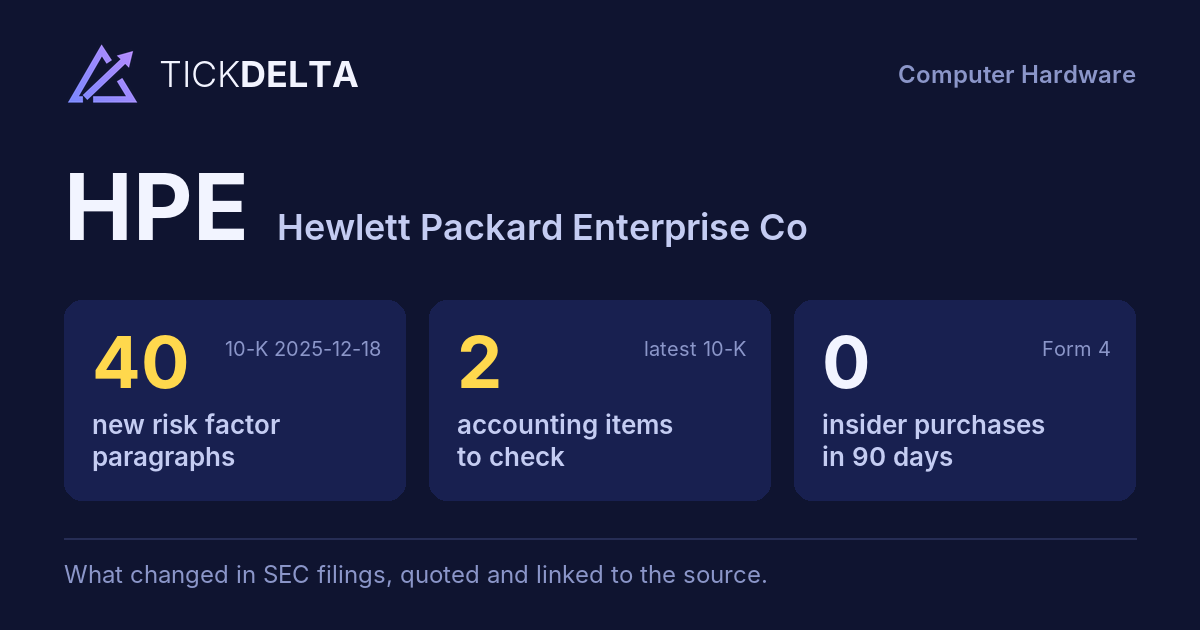
Sentences and paragraphs of HPE's Risk Factors and MD&A, 10-K 2025-12-18 against 10-K 2024-12-19.
Each links to the text at sec.gov.
Show the other 16
AddedRisk Factors
To successfully execute our strategy in a rapidly evolving market, we must maintain effective planning, forecasting, and management processes to enable us to continue to improve cost structures, align sales coverage with strategic goals, improve channel execution, and strengthen our capabilities in our areas of strategic focus, while continuing to pursue new product innovation in areas such as edge computing, hybrid cloud, AI, high performance computing, and networking. We must also make sufficient long-term investments in strategic growth areas to develop, obtain, and protect our intellectual property, and commit to transition significant research and development (“R&D”) and other resources before knowing whether our projections will align with customer demand for our solutions.
Read it in 10-K 2025-12-18 at sec.gov ↗
AddedRisk Factors
•Supply Chain Disruption. Any disruptions to our supply chain, significant increase in component costs or logistics costs, or shortages of critical components, could decrease our sales, earnings, and liquidity or otherwise adversely affect our business and result in increased costs. Disruptions could occur as a result of any number of events, including, but not limited to: an extended closure of, or any slowdown at our suppliers' plants or shipping delays; market shortages due to the surge in demand from other purchasers for critical components; increases in prices (including fuel prices and increases in prices due to inflation); the imposition of regulations, quotas, embargoes, or tariffs on components; labor stoppages; transportation delays, including due to labor strikes; third-party interference in the integrity of the products sourced through the supply chain; cyberattacks; the unavailability of raw materials; severe weather conditions and adverse effects of climate change, or natural disasters; geopolitical developments, war or terrorism; and disruptions in utilities and other services, some of which we have experienced. In addition, the development, licensing, or acquisition of new products in the future may increase the complexity of supply chain management. Failure to effectively manage the supply of components and products would adversely affect our business. Our ongoing efforts to geographically diversify and optimize the efficiency of our supply chain could cause supply disruptions and be more expensive, time-consuming, and resource-intensive than expected, and such impacts may be more pronounced as a result of increased tariffs between the U.S. and its trading partners. In this environment of heightened trade restrictions, we have experienced, and may continue to experience, cost increases from certain of our suppliers that result in price increases for some of our offerings and could subsequently limit demand for such offerings. If we are unable to pass on all or some of such cost increases to our customers, such increased prices may reduce our current margins and future margins. Furthermore, certain of our suppliers have discontinued conducting business with us or failed to perform under their contracts with us.
Read it in 10-K 2025-12-18 at sec.gov ↗
AddedRisk Factors
•Alternative Sources of Supply. The development of alternate sources for components is time-consuming, complex, and costly. For some components, such as customized components, alternative sources may not exist, we may not be able to locate alternative sources in a timely manner, or we may be unable to secure quantities of those components necessary to satisfy our production requirements. As a result, if an existing source of supply is unable to provide components in quantities sufficient to meet our requirements on a timely basis, we may not be able to deliver, or be delayed in delivering, products and services to our customers, which may affect present and future sales. If we are unable to buy components in quantities sufficient to meet our requirements on a timely basis, we will not be able to deliver products and services to our customers, which would seriously affect present and future sales, and would, in turn, adversely affect our business, financial condition, and results of operations.
Read it in 10-K 2025-12-18 at sec.gov ↗
AddedRisk Factors
In the ordinary course of business, we store sensitive data, including intellectual property, personal data, our proprietary business information and that of our employees, contractors, customers, vendors, partners, suppliers, and other third parties with whom we do business. In addition, we store sensitive data through cloud-based services that may be hosted by third parties and in data center infrastructure maintained by third parties. We have been, and expect to be, subject to cyberattacks and other attempted intrusions into our networks and systems by a wide range of actors, including, but not limited to, nation state actors, criminal enterprises, terrorist organizations, and other organizations or individuals, as well as errors, wrongful conduct or malfeasance by employees and third-party service providers, (collectively, “malicious parties”) who have at times been able to circumvent or bypass our cyber security measures. Geopolitical tensions or conflicts may also heighten the risk of such cyberattacks or exacerbate system vulnerabilities, considering our continued hybrid work environment and our globally dispersed operations, employees, contractors, suppliers, developers, partners, and other third parties.
Read it in 10-K 2025-12-18 at sec.gov ↗
AddedMD&A
Public Sector: We have a number of engagements with various public sector entities, including the U.S. federal government and its agencies, as direct or indirect customers of our IT services and hardware. Significant staffing and resource reductions at certain public sector entities create an uncertain environment and as a result, our financial results have been, and may continue to be, impacted in the near term.
Read it in 10-K 2025-12-18 at sec.gov ↗
AddedMD&A
The Internal Revenue Service (“IRS”) is conducting audits of our fiscal 2020 through 2022 U.S. federal income tax returns. In the second quarter of fiscal 2025, the IRS issued a Revenue Agent Report (“RAR”) regarding the audit of our fiscal
Read it in 10-K 2025-12-18 at sec.gov ↗
AddedMD&A
2017 through 2019 U.S. federal income tax returns, with which we agreed. The audit cycle for fiscal 2017 through 2019 is now considered effectively settled, resulting in a reduction of existing unrecognized tax benefits of approximately $340 million, which did not result in a material impact to our Consolidated Statement of Earnings and our Consolidated Balance Sheet. The resolution of the audit resulted in the release of tax reserves that were predominantly related either to adjustments to foreign tax credits that carried a full valuation allowance or to the timing of intercompany royalty revenue recognition, neither of which affected our effective tax rate.
Read it in 10-K 2025-12-18 at sec.gov ↗
AddedMD&A
On July 4, 2025, the U.S. government enacted the One Big Beautiful Bill Act (“OB3”) into law. OB3 introduces several changes to tax regulations, including the permanent restoration of 100% depreciation and the permanent restoration of immediate deductibility of costs associated with research and development activities performed in the United States. There was not a material impact of OB3 to our fiscal 2025 results, and we do not expect a material impact in fiscal 2026, but we will continue to evaluate the full impact of these changes on our future results.
Read it in 10-K 2025-12-18 at sec.gov ↗
AddedMD&A
Other Trends and Uncertainties: The impacts of geopolitical volatility (including the continued instability in the Middle East, the ongoing conflict in Ukraine, and the relationship between China and the U.S.) may impact our operations, financial performance, and ability to conduct business in some non-U.S. markets. We have, in the past, entered into contracts for the sale of certain products and services that reflect heavier-than-normal discounting due to competitive pressures, which have resulted in lower margins than expected, and we expect will continue to negatively impact our margins in the near term. We have been monitoring and seeking to mitigate these risks with adjustments to our manufacturing, supply chain, and distribution networks, as well as our pricing and discounting practices. We remain focused on executing our key strategic priorities, building long-term value creation for our stakeholders, and addressing our customers’ needs while continuing to make prudent decisions in response to the environment.
Read it in 10-K 2025-12-18 at sec.gov ↗
AddedMD&A
On July 2, 2025, we completed the Juniper Networks merger (the “Merger”). Under the terms of the Agreement and Plan of Merger, dated January 9, 2024, by and among Juniper Networks, HPE and Jasmine Acquisition Sub, Inc., a Delaware corporation and a wholly owned subsidiary of HPE (the “Merger Agreement”), HPE agreed to pay $40.00 per share of Juniper Networks common stock, issued and outstanding as of July 2, 2025, representing cash consideration of approximately $13.4 billion. The results of operations of Juniper Networks are included in the Consolidated Financial Statements commencing on July 2, 2025. See Note 10, “Acquisitions and Dispositions,” to the Consolidated Financial Statements for additional information.
Read it in 10-K 2025-12-18 at sec.gov ↗
AddedMD&A
On November 17, 2025, our subsidiary, H3C Holdings Limited (“H3C Holdings”), entered into (i) share purchase agreements with five counterparties, including Unisplendour International Technology Limited (“UNIS”), whereby such counterparties, in the aggregate, agreed to purchase 10% of the total issued share capital of H3C Technologies Co., Limited (“H3C”) for cash consideration of approximately $714 million and (ii) a side letter with UNIS, amending the Agreement on Subsequent Arrangements that was previously entered into on May 24, 2024, whereby, among other things, H3C Holdings and UNIS shall retain their put option and call option, respectively, relating to the remaining issued share capital of H3C held by H3C Holdings and have the right to exercise their respective option rights in respect of such shares up to three times, subject to the timing and terms as set forth therein. The agreement referenced in clause (ii) above revises the arrangements governing the sale of all of the remaining issued share capital of H3C held by us through H3C Holdings. On November 28, 2025, H3C Holdings entered into three additional share purchase agreements, including one with UNIS, whereby such counterparties, in the aggregate, agreed to purchase the remaining 9% of the total issued share capital of H3C for cash consideration of approximately $643 million. Such transactions and the transactions referenced in clause (i) remain subject to regulatory approvals.
Read it in 10-K 2025-12-18 at sec.gov ↗
AddedMD&A
On March 6, 2025, the Board of Directors approved a cost reduction program (the "Program") intended to reduce structural operating costs and continue advancing our ongoing commitment to profitable growth. The Program is expected to be
Read it in 10-K 2025-12-18 at sec.gov ↗
AddedMD&A
implemented through fiscal year 2026 and deliver gross savings of approximately $350 million by fiscal year 2027 through reductions in our workforce. The Program has since become a part of Catalyst, a set of broader company-wide actions to reduce costs and enhance efficiency throughout the Company.
Read it in 10-K 2025-12-18 at sec.gov ↗
AddedMD&A
The estimates of the duration of the Program, the charges and expenditures that we expect to incur in connection therewith, and the timing thereof are subject to a number of assumptions, including local law requirements in various jurisdictions, and actual amounts may differ materially from estimates. In addition, we may incur other charges or cash expenditures not currently contemplated due to unanticipated events that may occur, including in connection with the implementation of the Program. In connection with the Program, we incurred charges of $275 million in fiscal 2025.
Read it in 10-K 2025-12-18 at sec.gov ↗
AddedMD&A
In addition, the Company expects to achieve at least $600 million in cost savings from synergies by fiscal 2028, related to the integration of Juniper Networks. These synergies will require approximately $800 million of investment, primarily tied to headcount, supply chain optimization, and portfolio rationalization.
Read it in 10-K 2025-12-18 at sec.gov ↗
AddedMD&A
We account for acquired businesses using the acquisition method of accounting, which requires that once control is obtained, all the assets acquired and liabilities assumed are recorded at their respective fair values at the date of acquisition. The determination of fair values of identifiable assets and liabilities requires significant judgment in determining critical estimates and assumptions. Critical estimates in valuing intangible assets include the projected revenues, technology obsolescence rate, royalty rates, and discount rates for developed technology and IPR&D; the projected revenues, customer retention rate, forecasted growth in earnings before interest, taxes, depreciation & amortization, and discount rate for the customer contracts, customer lists and distribution agreements. Although the Company believes its estimates of fair value are reasonable, actual financial results could differ from those estimates due to the inherent uncertainty involved in making such estimates. Changes in assumptions concerning future financial results or other underlying assumptions could have a significant impact on the determination of the fair value of the intangible assets acquired. Third-party valuation specialists are utilized for certain estimates.
Read it in 10-K 2025-12-18 at sec.gov ↗