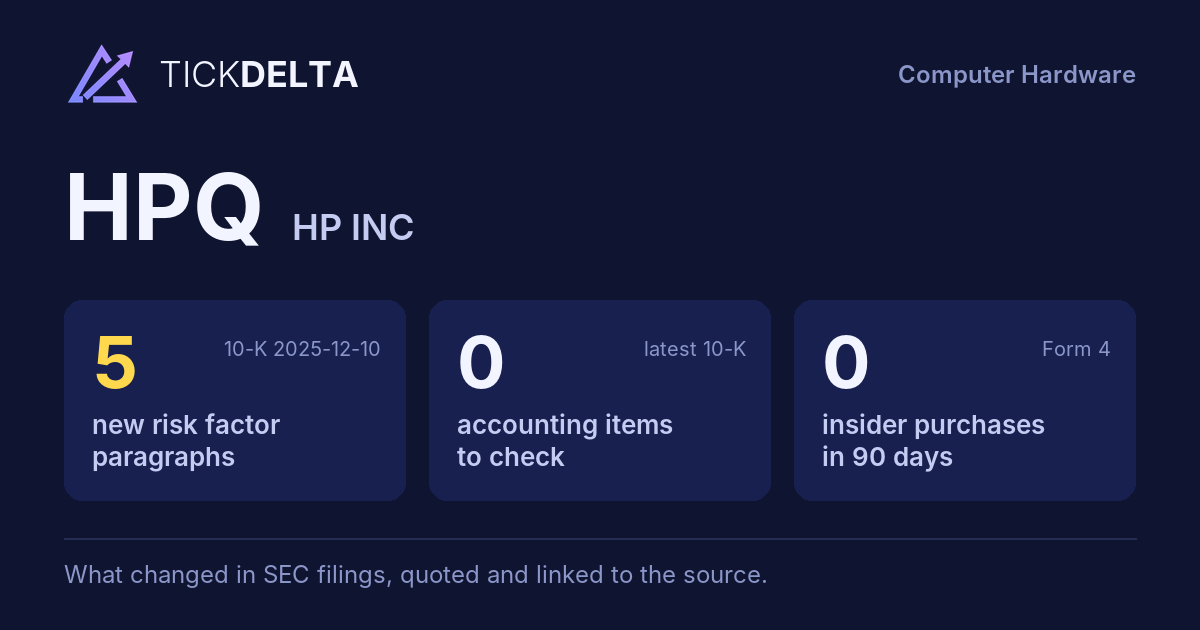
10-K 0000047217-25-000071 (2025-12-10) vs 10-K 0000047217-24-000080 (2024-12-13)
| Section | Compared text | Words now | Changed |
|---|
| Risk Factors | Item 1A | 14,510 |
11.5% |
| MD&A | Item 7 | 6,130 |
15.2% |
| Legal Proceedings | Item 3, via Note 14 – Litigation and Contingencies | 2,944 |
31.7% |
| Accounting Policies | Item 8, Note 1 – Summary of Significant Accounting Policies | 4,487 |
3.1% |
The redline: what was cut and what was added
In each section, the paragraph that changed most, marked against last year's 10-K:
cut words struck through, new words highlighted and underlined.
Legal Proceedings 196 words changed in this paragraph; it is 71% similar to last year's version.
Legal Proceedings re Authentication of Supplies. Since 2016, HP has from time to time been named in civil litigation, or been the subject of government investigations, involving supplies authentication protocols used in certain HP printers in multiple geographies, including but not limited to the United States, Italy, Israel, the Netherlands, Australia and New Zealand. The supplies authentication protocols are often referred to as Dynamic Security. The core allegations in these proceedings claim misleading or inadequate consumer notifications and permissions pertaining to the use of Dynamic Security, the installation of firmware updates, or the potential inability of cartridges with clone chips or circuitry to work in HP printers with Dynamic Security. Plaintiffs base or have based their claims on various legal theories, including but not limited to unfair competition, computer trespass, and similar statutory claims. Among other relief, Plaintiffs have sought or seek money damages and in certain cases have or may seek injunctive relief against the use or operation of Dynamic Security or relief requiring interoperability. If HP is not successful in its defense of these cases or investigations, it could be subject to damages, penalties, significant settlement demands, or injunctive relief that may be costly or may disrupt operations. Certain of these proceedings in the United States, Italy, the Netherlands, Israel, Australia and New Zealand have been resolved, have concluded, or have concluded subject only to HP’s pending appeal. Civil litigation filed by Digital Revolution B.V. (trading as 123Inkt) against HP Nederlands B.V., et al. (Netherlands) in March 2020, including its competition claim, remains pending. Both parties appealed, and the court of appeal issued a judgment on November 19, 2024, rejecting competition claims against HP and providing that use of Dynamic Security by HP is not unlawful. In addition, two putative class actions have been filed against HP in federal court in California, in December 2020, April 2022, and one in federal court in Illinois, in January 2024, arising out of the use of Dynamic Security firmware updates in HP Laserjet printers, in HP Inkjet printers, and in both, respectively. Plaintiffs in these cases seek compensatory damages, restitution, injunctive relief against alleged unfair and anticompetitive business practices, and other relief. In the April 2022 case, plaintiffs have filed a stipulation on October 30, 2024 to have the case dismissed with prejudice for their individual claims and without prejudice for the class claims. In the December 2020 case, the parties have finalized a settlement agreement, which plaintiffs submitted to the court on October 31, 2024 along with a motion seeking preliminary approval. The January 2024 case is in its early stages.
Source: Item 3, via Note 14 – Litigation and Contingencies, 10-K 0000047217-25-000071 vs Item 3, via Note 14 – Litigation and Contingencies, 10-K 0000047217-24-000080
Risk Factors 194 words changed in this paragraph; it is 50% similar to last year's version.
We face increasing attention from the investment community, special interest groups, customers, enforcement authorities and other stakeholders, who may have conflicting views, related to our positions, performance, and disclosures relating to environmental and societal related matters and we are subject to legal and regulatory requirements relating to such positions, performance, and disclosures, which continue to broaden and may be conflicting, both in terms of scope and geography. We have established environmental and publicly announced ESG societal goals, including our commitments to address climate change, human rights, and digital equity. These statements which reflect our current plans and aspirations and are not guarantees that we will be able to achieve them. Our failure to adequately update, accomplish or accurately track and report on these goals on a timely basis, or at all, or a decision to amend, retire, or stop reporting on certain goals, or positions we take or do not take on social issues could adversely affect our reputation, financial performance and growth, and expose us to increased scrutiny from the investment community, special interest groups, customers and enforcement authorities. In addition, there exists certain “anti-ESG” sentiment among some individuals Additionally, a failure to adequately meet regulatory expectations may result in the loss of business and government institutions, reputational impacts, and we periodically are, and in the future could become the target of litigation, investigations or other proceedings initiated by government authorities or private actors alleging that our activities related to environmental and societal matters are anti-competitive, discriminatory or otherwise unlawful. Moreover, efforts to meet evolving and increasingly divergent stakeholder expectations on environmental and societal and related matters may also face scrutiny, reputational risk, lawsuits or market access restrictions from these parties regarding place a strain on our ESG initiatives. employees and systems.
Source: Item 1A, 10-K 0000047217-25-000071 vs Item 1A, 10-K 0000047217-24-000080
MD&A 163 words changed in this paragraph; it is 44% similar to last year's version.
Since April 2025, new, substantial tariffs have been imposed on imports to the United States. We continue to evaluate and implement further mitigating actions, including potential supply chain resiliency movements and cost and pricing measures, as the tariff environment evolves. During fiscal year 2025, we experienced higher commodity and tariff costs, which were not fully mitigated by pricing and other actions enacted during the period. We anticipate commodity cost pressure to continue, including recent inflationary trends in memory and storage costs and potential supply constraints in our Personal Systems business. New or sustained changes to tariffs and commodity costs could result in increased supply chain challenges, cost volatility, and consumer and economic uncertainty which may have a significant adverse impact to our results of operations and cash flows to the extent our efforts do not fully mitigate these effects. We are also exposed to fluctuations in foreign currency exchange rates. We have a large global presence, with approximately 65% of our net revenue from outside the United States. As a result, our financial results can be, and particularly in recent periods have been, negatively impacted by fluctuations in foreign currency exchange rates. For a further discussion of trends, uncertainties and other factors that could impact our operating results, see the section entitled “Risk Factors” in Item 1A of Part I in this Annual Report on Form 10-K.
Source: Item 7, 10-K 0000047217-25-000071 vs Item 7, 10-K 0000047217-24-000080
Accounting Policies 55 words changed in this paragraph; it is 64% similar to last year's version.
In November 2023, the FASB issued guidance that updates reportable segment disclosure requirements primarily through enhanced disclosures about significant segment expenses and information used to assess segment performance on an annual and interim basis. HP is required to adopt adopted this guidance for its annual period ending October 31, 2025 and all interim periods thereafter. Early 2025. While the adoption is permitted. HP is currently evaluating the impact of this standard did not have a material impact on the Company’s Consolidated Financial Statements, the new guidance resulted in increased disclosures on its disclosures. reportable segments in Note 2 of the Notes to the Consolidated Financial Statements.
Source: Item 8, Note 1 – Summary of Significant Accounting Policies, 10-K 0000047217-25-000071 vs Item 8, Note 1 – Summary of Significant Accounting Policies, 10-K 0000047217-24-000080
Every change, by type
Sentences and paragraphs of HPQ's Risk Factors and MD&A, 10-K 2025-12-10 against 10-K 2024-12-13.
Each links to the text at sec.gov.
Quiet changes are sentences kept from last year with one to four words changed, at least one of them a hedge, a modal or a qualifier
(may, could, will, not, significant, material…). A year or date rolling forward is not counted.
The full word list
adverse, adversely, all, although, anticipate, anticipates, any, approximately, believe, believes, can, cannot, certain, could, expect, expects, generally, however, if, intend, intends, largely, likely, many, material, materially, may, might, most, must, never, no, not, possible, primarily, probable, should, significant, significantly, some, substantial, substantially, unlikely, will, would
AddedRisk Factors
with, or limits in allocation by, a single-source supplier, or any unilateral modification to the contractual terms under which we are supplied components by a single-source supplier could adversely affect our business and financial performance. An adverse litigation outcome, including an injunction in an IP litigation, against a single-source supplier, could also significantly impact our ability to make and sell products utilizing that supplier’s components.
Read it in 10-K 2025-12-10 at sec.gov ↗
AddedRisk Factors
•International trade restrictions. Restrictions on international trade, such as tariffs and other controls on imports or exports of goods, technology or data have and may continue to, materially adversely affect our supply chain. The impact has been particularly significant for the restrictive measures that apply to countries and regions where we have significant supply chain operations. Restrictive measures have and may continue to increase the cost of our products and the components and raw materials that go into them, and can require us to take various actions, including changing suppliers, restructuring business relationships and operations, and ceasing to offer and distribute affected products and services. Changing our business model and supply chain to comply with and seek to offset the impact of new or revised trade restrictions has been, and may continue to be, expensive, time-consuming and disruptive to our business, and may not be successful in offsetting or mitigating these impacts. The impact of changes we make in this regard will not be immediate, and, even if successful, we expect it will take time for any offsetting impacts to take full effect. Moreover, such restrictions can be announced with little or no advance notice, which can create additional uncertainty.
Read it in 10-K 2025-12-10 at sec.gov ↗
AddedRisk Factors
We rely upon patent, copyright, trademark, trade secret and other IP laws in the United States, similar laws in other countries, and agreements with our employees, customers, suppliers and other parties, to establish and maintain IP rights in the products and
Read it in 10-K 2025-12-10 at sec.gov ↗
AddedRisk Factors
Since April 2025, new, substantial tariffs have been imposed on imports to the United States. In response, several countries have imposed, or threatened to impose, reciprocal tariffs on imports from the United States and other retaliatory measures. As a result, during fiscal 2025, we experienced higher commodity and tariff costs, which were not fully mitigated by pricing and other actions enacted during the period. Should these or other proposed tariffs, including potential retaliatory actions imposed by other countries, be implemented and sustained for an extended period of time, as proposed, enacted or otherwise, they may have a significant adverse impact to our results of operations and cash flows to the extent our efforts do not fully mitigate the effects of such tariffs. There can be no assurance that we will be able to successfully offset or mitigate these impacts. Additionally, changing our business model and
Read it in 10-K 2025-12-10 at sec.gov ↗
AddedRisk Factors
supply chain to comply with and offset the impact of new or revised trade restrictions has in the past and could in the future be expensive, time-consuming and disruptive to our business.
Read it in 10-K 2025-12-10 at sec.gov ↗
RemovedRisk Factors
We have identified a material weakness in our internal control over financial reporting that could, if not remediated, result in material misstatements in our financial statements and cause us to fail to meet our reporting and financial obligations.
Read it in 10-K 2024-12-13 at sec.gov ↗
RemovedRisk Factors
As more fully disclosed in Item 9A, “Controls and Procedures,” under the supervision and with the participation of our management, including our principal executive officer and principal financial officer, we conducted an evaluation of the effectiveness of the design and operation of our disclosure controls and procedures and internal control over financial reporting. Based on that evaluation, we have concluded that our disclosure controls and procedures were not effective as of October 31, 2024 due to a material weakness in internal control over financial reporting. A material weakness is a deficiency, or a combination of deficiencies, in our internal control over financial reporting, such that there is a reasonable possibility that a material misstatement of the Company’s annual or interim financial statements will not be prevented or detected on a timely basis.
Read it in 10-K 2024-12-13 at sec.gov ↗
RemovedRisk Factors
We identified a material weakness in internal control over financial reporting that resulted from undue reliance on information generated from certain software solutions affecting various financial statement accounts without effectively designed and operating IT general controls, specifically around user access, change management and job schedule monitoring IT operations. This material weakness did not result in any material misstatement of our financial statements. While this material weakness did not result in a material misstatement of our financial statements, this control deficiency was not remediated as of October 31, 2024 and there is a reasonable possibility that it could have resulted in a material misstatement in the Company's annual or interim consolidated financial statements that would not be detected. Accordingly, we have determined that this control deficiency constituted a material weakness. While the Company’s management, under the oversight of the Audit Committee, has taken steps to implement our remediation plan as described more fully in Item 9A, “Controls and Procedures,” the material weakness will not be considered remediated until the enhanced controls operate for a sufficient period of time and management has concluded, through testing, that the related controls are effective. Furthermore, we can give no assurance that the measures we take will remediate the material weakness.
Read it in 10-K 2024-12-13 at sec.gov ↗
RemovedRisk Factors
We can give no assurance that additional material weaknesses will not arise in the future. Any failure to remediate the material weakness, or the development of new material weaknesses in our internal control over financial reporting, could result in material misstatements in our financial statements and cause us to fail to meet our reporting and financial obligations, which in turn could have a negative impact on our financial condition, results of operations or cash flows, restrict our ability to access the capital markets, require significant resources to correct the material weaknesses or deficiencies, subject us to fines, penalties or judgments, harm our reputation or otherwise cause a decline in investor confidence and cause a decline in the market price of our stock.
Read it in 10-K 2024-12-13 at sec.gov ↗
RemovedRisk Factors
also contain terms relating to new partner business models and tools creation that could raise issues for which laws or regulations are currently changing or emerging. This could affect us in ways that are not currently fully known or measurable.
Read it in 10-K 2024-12-13 at sec.gov ↗
RewordedRisk Factors
For example, we observed continued market uncertainty, cautious commercial spending on information technology hardware, lower discretionary consumer spending, a competitive pricing environment, variability in commodity costs, demand softness in Print and demand softness in certain geographic regions in Personal Systems, secular declines in demand for certain products or solutions, including printing products and solutions, inflationary pressures, the imposition of new or increased tariffs and other trade restrictions, and foreign currency fluctuations.
Read it in 10-K 2025-12-10 at sec.gov ↗
RewordedRisk Factors
For example, in fiscal year 2024 2025 we experienced continued demand softness in printing products and solutions challenges from changing customer behaviors and we believe we and others in our industry face continuing secular challenges related to, among other things, decreased demand for printing products and solutions as a result of increased digitization and digitization, hybrid work, and increasing competition from generic alternatives. alternatives and customer preferences shifting from traditional disposable ink cartridge printers to refillable big tank printers.
Read it in 10-K 2025-12-10 at sec.gov ↗
RewordedRisk Factors
Our efforts to mitigate the impact of these challenges, such as by seeking to increase our margin and market share share, particularly in big tank printers, and drive demand in software and subscription services and or other recurring-revenue based business models, offering higher profitability, may not be successful, and shifting to recurring-revenue based business may require us to forego upfront revenue. successful.
Read it in 10-K 2025-12-10 at sec.gov ↗
RewordedRisk Factors
We have undertaken and may undertake in the future restructuring and other plans in order to realign our cost structure structure, drive customer satisfaction, product innovation and to productivity through artificial intelligence, and achieve operating efficiencies that we expect to reduce costs, including the plan announced in November 2022. Fiscal 2023 Plan and our Fiscal 2026 Plan.
Read it in 10-K 2025-12-10 at sec.gov ↗
RewordedRisk Factors
Such extreme climate related events are driving changes in market dynamics, stakeholder expectations, and local, national and international climate change policies and regulations, which could result in disruptions to us, our suppliers, vendors, customers and logistics hubs and impact employees’ abilities to live in certain areas, commute or to work from home effectively.
Read it in 10-K 2025-12-10 at sec.gov ↗
RewordedRisk Factors
Any increased or unexpected costs or unanticipated delays in connection with the performance of these contracts, such as increased costs resulting from new or increased tariffs or other trade restrictions, which may increase as services become more customized, have in the past made, and could make in the future make, these agreements less profitable or unprofitable.
Read it in 10-K 2025-12-10 at sec.gov ↗
RewordedRisk Factors
Our processes and controls for reporting ESG environmental and societal matters across our operations and supply chain are evolving along with multiple disparate standards for identifying, measuring, and reporting ESG environmental and societal metrics, including ESG-related sustainability-related disclosures that are or may become required by the SEC, European and other regulators (including, but not limited to, the EU Corporate Sustainability Reporting Directive, the EU Corporate Sustainability Due Diligence Directive, Directive and the state of California’s new climate change disclosure requirements, and climate-change disclosure requirements from the SEC), requirements), and such standards may change over time, which could result in significant revisions to our current goals, reported progress in achieving such goals, or ability to achieve such goals in the future.
Read it in 10-K 2025-12-10 at sec.gov ↗
RewordedRisk Factors
Examples of such risks include the availability and cost of low- or non-carbon-based energy sources, the evolving regulatory requirements affecting product circularity, ESG environmental or societal standards or disclosures, the evolving consumer protection laws applicable to ESG matters, laws, the availability of materials and suppliers that can meet our sustainability, diversity environmental, societal and other ESG related goals and the availability of funds to invest in ESG environmental and societal initiatives in times where we are seeking to reduce costs.
Read it in 10-K 2025-12-10 at sec.gov ↗
RewordedRisk Factors
We also have experienced, and may experience in the future, gross margin declines in certain businesses, reflecting the effect of competitive pricing pressures and increases in component and manufacturing costs costs, resulting from market dynamics, especially increasing memory and storage costs and potential supply chain constraints in our Personal Systems business, and higher labor and material costs borne by our manufacturers and suppliers that we are unable to pass on to our customers.
Read it in 10-K 2025-12-10 at sec.gov ↗
RewordedRisk Factors
As these new laws, regulations, treaties treaties, executive orders, directives, enforcement priorities and similar initiatives and programs are adopted and implemented, we will be are required to comply or potentially face market access limitations or restrictions on our products entering certain jurisdictions or our ability to provide services within certain jurisdictions, sanctions or other penalties, including fines.
Read it in 10-K 2025-12-10 at sec.gov ↗
RewordedRisk Factors
Third-party suppliers may have limited financial resources to withstand challenging business conditions, particularly as a result of increased interest rates or rates, emerging market volatility, volatility or changes in global trade policies, or global pandemics or other public health crises, and our business could be negatively impacted if key suppliers are forced to cease or limit their operations.
Read it in 10-K 2025-12-10 at sec.gov ↗
RewordedRisk Factors
As a result, we may invest less in certain areas of our business than our competitors, and our competitors may have greater financial, technical and marketing resources available for their products and services, compared to the resources allocated to
Read it in 10-K 2025-12-10 at sec.gov ↗
Quiet changesRisk Factors
We could also face significant compliance and operational burdens and incur significant costs in our efforts to comply with or rectify non-compliance with these laws or regulations.
Read it in 10-K 2025-12-10 at sec.gov ↗
AddedMD&A
In November 2025, we announced our new plan to drive customer satisfaction, product innovation, and productivity through AI adoption and enablement (the “Fiscal 2026 Plan”). The Fiscal 2026 Plan is expected to run for three years through the end of fiscal year 2028. We expect to invest some of the savings into our growth areas and our people.
Read it in 10-K 2025-12-10 at sec.gov ↗
AddedMD&A
estimates to determine the expected variable consideration for such programs based on historical experience, expected consumer behavior and market conditions.
Read it in 10-K 2025-12-10 at sec.gov ↗
AddedMD&A
Amortization of intangible assets increased in fiscal year 2025 primarily due to impairment charges of $65 million related to acquired customer contracts, customer lists and distribution agreements within the Printing segment and $27 million of technology and patents within the Corporate Investments segment.
Read it in 10-K 2025-12-10 at sec.gov ↗
AddedMD&A
On July 4, 2025, the One Big Beautiful Bill Act (“OBBBA”) was enacted into law in the United States. This legislation introduces several measures, including the permanent extension of select provisions from the Tax Cuts and Jobs Act, revisions to the international tax framework, and the reinstatement of favorable tax treatment for certain business-related items. The OBBBA contains multiple effective dates, with key provisions beginning in our fiscal year 2026. Based on our assessment, we do not anticipate a material impact on our effective tax and cash tax rates.
Read it in 10-K 2025-12-10 at sec.gov ↗
RemovedMD&A
We have focused on growing our hybrid systems, gaming, workforce solutions, consumer subscriptions, industrial graphics and our 3D and personalization businesses at a rate faster than our core business with accretive margins in the longer term. We believe our ability to innovate will help us gain momentum in growth areas like hybrid systems and gaming, and we see significant opportunities to drive greater recurring revenues across Personal Systems and Printing. Our Workforce Solutions organization drives integration across our commercial services, software and security portfolio. We continue to build on strong portfolios like Instant Ink to grow our Consumer Subscription business. In Industrial Graphics, we are driving the shift from analog to digital in segments like labels and packaging. In 3D and Personalization, we are creating end-to-end solutions that we believe can capture more value with our differentiated technology.
Read it in 10-K 2024-12-13 at sec.gov ↗
RemovedMD&A
During fiscal year 2024, we experienced continued industry wide demand softness in Printing and a competitive pricing environment, particularly from our Japanese competitors benefiting from a favorable foreign currency environment. In Personal Systems, we faced a competitive pricing environment, variability in commodity costs, and demand softness in certain regions. We experienced gradual market recovery in Commercial PS resulting in overall PC unit growth in fiscal year 2024 and net revenue growth in Personal Systems in the second half of fiscal year 2024.
Read it in 10-K 2024-12-13 at sec.gov ↗
RemovedMD&A
Material changes in our estimates of cash, working capital and long-term investment requirements in the various jurisdictions in which we do business could impact how future earnings are repatriated to the United States, and our related future effective tax rate.
Read it in 10-K 2024-12-13 at sec.gov ↗
RemovedMD&A
Amortization of intangible assets decreased in fiscal year 2024 and relates to intangible assets resulting from acquisitions.
Read it in 10-K 2024-12-13 at sec.gov ↗
RemovedMD&A
In December 2021, the Organisation for Economic Co-operation and Development (the “OECD”) introduced model rules for a global minimum tax framework known as (“BEPS Pillar Two”). Numerous governments worldwide have enacted or are in the process of enacting legislation to implement this framework. Where applicable, these rules will take effect for us beginning in the fiscal year 2025 and we plan to treat the tax as a period cost. We do not anticipate a material impact on our effective tax rate or cash tax payments in these jurisdictions for fiscal year 2025. Our assessment for subsequent fiscal years may be influenced by additional legislative guidance and the enactment of further provisions within the BEPS Pillar Two framework.
Read it in 10-K 2024-12-13 at sec.gov ↗
RewordedMD&A
In fiscal year 2024, 2025, gross margin increased decreased by 0.7 1.5 percentage points, points primarily driven by products gross margin due to lower supply chain higher commodity and tariff costs, and cost savings, including Future Ready transformation savings, partially offset by competitive pricing in Printer hardware and Personal Systems, and mix shifts towards Personal Systems while services gross margin decreased. and unfavorable currency impacts, partially offset by disciplined pricing actions and cost savings including Future Ready transformation savings.
Read it in 10-K 2025-12-10 at sec.gov ↗
RewordedMD&A
Net cash used in financing investing activities increased by $0.2 $0.5 billion in for fiscal year 2024 2025 as compared to the prior-year period, primarily due to higher share repurchases investment in property, plant, equipment and purchased intangible of $2.0 $0.3 billion, partially offset by lower net debt repayment of $1.6 billion and collateral returned posted for derivative instruments of $0.2 billion in the prior-year period. $0.3 billion.
Read it in 10-K 2025-12-10 at sec.gov ↗
RewordedMD&A
This amount included $198 $273 million related to changes in uncertain tax positions, $80 million related to restructuring charges, $44 million related to changes in valuation allowances, $60 million related to restructuring charges, $14 $28 million related to the filing of tax returns in various jurisdictions, and $11 $22 million related to acquisition audit settlements in various jurisdictions, and $16 million related to litigation charges.
Read it in 10-K 2025-12-10 at sec.gov ↗
RewordedMD&A
Payments Due by Period Total Short-term Long-term In millions Principal payments on debt(1) $ 9,717 9,688 $ 1,406 831 $ 8,311 8,857 Interest payments on debt(2) 2,724 404 2,320 2,775 406 2,369 Purchase obligations(3) 1,366 896 470 1,085 509 576 Operating lease obligations 1,361 513 848 1,387 474 913 Finance lease obligations 31 13 18 Total(4)(5)(6) 35 16 19 Total $ 15,199 14,970 $ 3,232 2,236 $ 11,967 12,734
Read it in 10-K 2025-12-10 at sec.gov ↗
RewordedMD&A
Net cash provided by operating activities increased decreased by $0.2 $0.1 billion for fiscal year 2024 2025 primarily due to favorable working capital impacts, impacts and lower net earnings, partially offset by changes in receivables from contract manufacturers due to higher manufacturing activity and amounts collected and held on behalf of a third party for trade receivables previously sold. manufacturers.
Read it in 10-K 2025-12-10 at sec.gov ↗
RewordedMD&A
Net cash used in financing activities increased decreased by $0.2 $1.0 billion in fiscal year 2024 2025 compared to the prior-year period, primarily due to higher a $1.3 billion decrease in share repurchases of $2.0 billion, repurchases, partially offset by lower higher net debt repayment of $1.6 billion and collateral returned for derivative instruments of $0.2 billion in the prior-year period. billion.
Read it in 10-K 2025-12-10 at sec.gov ↗
RewordedMD&A
SG&A expense increased 5.6% 2.9% in fiscal year 2024, 2025, primarily due to higher litigation costs and go-to-market initiatives, costs, partially offset by disciplined lower variable compensation and the receipt of a new government grant in the current period as well as cost management savings including Future Ready transformation savings.
Read it in 10-K 2025-12-10 at sec.gov ↗
RewordedMD&A
Consumer PS net revenue decreased 2.4% driven increased 3.6% primarily due to by a 2.5% decrease 2.3% increase in ASPs and a 0.3% decrease 1.2% increase in units due to demand softness, especially in China. units.
Read it in 10-K 2025-12-10 at sec.gov ↗
RewordedMD&A
Operating expenses as a percentage of revenue increased decreased primarily due to higher lower variable compensation and litigation costs, go-to-market initiatives and continued investments in innovation, partially offset by disciplined charges as well as cost management savings including Future Ready transformation savings.
Read it in 10-K 2025-12-10 at sec.gov ↗
RewordedMD&A
These changes are due to the issuance of unsecured senior debt in April 2025, the repayment upon maturity of the Global Notes due June 2025 and the reclassification of the Global Notes due in June 2025 2026 to short-term.
Read it in 10-K 2025-12-10 at sec.gov ↗
RewordedMD&A
The effective tax rate differs from the U.S. federal statutory rate of 21% primarily due to impacts of changes decreases in valuation allowances and favorable uncertain tax rates associated with certain earnings from HP’s operations in lower-tax jurisdictions throughout the world. positions.
Read it in 10-K 2025-12-10 at sec.gov ↗
RewordedMD&A
We face global macroeconomic challenges such as ongoing geopolitical conflicts (including the military conflicts in Ukraine and the Middle East, and tensions in the Taiwan Strait and South China Sea), tensions, uncertainty in the markets, volatility in exchange rates, inflationary trends and evolving dynamics in the global trade environment.
Read it in 10-K 2025-12-10 at sec.gov ↗