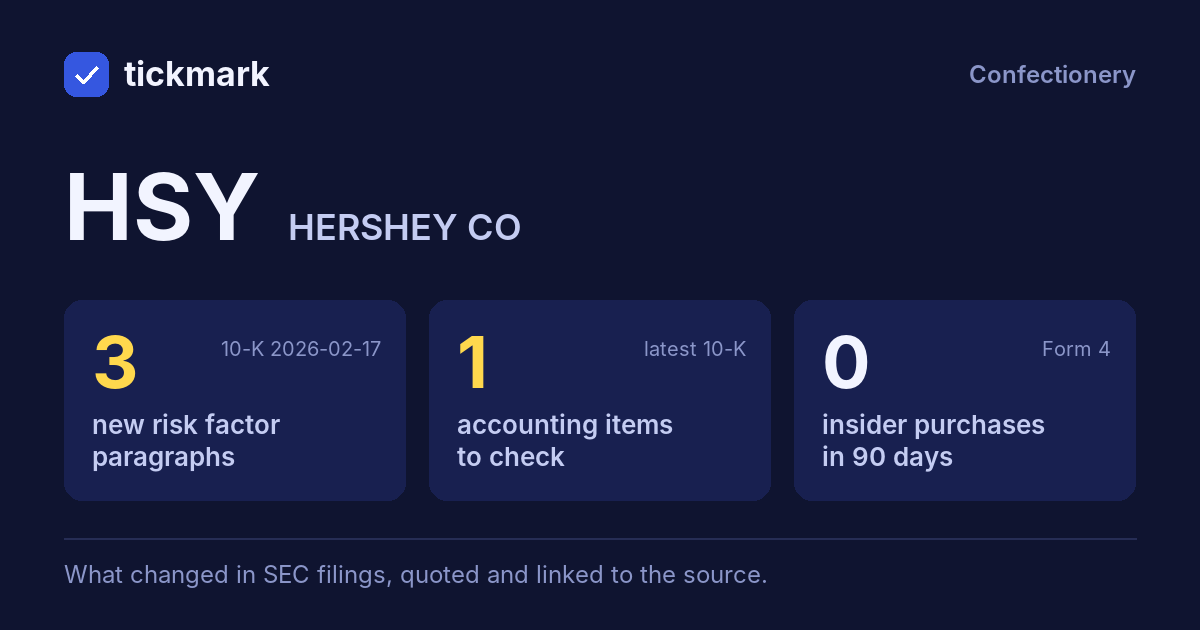
Marked against last year's 10-K:
cut words struck through, new words highlighted and underlined.
MD&A 164 words changed in this paragraph; it is 47% similar to last year's version.
Throughout 2024, U.S. 2025, we experienced net sales growth, positive changes in consumer behavior behavior, and price elasticity despite the persistent dynamic macro environment. However, increasing inflationary pressures, including ongoing price volatility for select commodities and higher manufacturing costs, continued to shift and evolve, as cost fatigue and labor markets restrict income growth and constrain consumer spending and purchasing patterns. As challenge the business. Despite a result, consumer behavior related to our products has shifted. As such, for strategic pricing action in the year ended December 31, 2024,we continued to experience a dynamic macroeconomic environment, including price volatility related to select commodities, resulting in corresponding incremental costs and gross margin pressures, and net sales and net income declines. Despite third quarter combined with other specific actions taken to mitigate these gross margin pressures, we our direct inputs continue to experience overall declines in consumer demands for our products, and higher prices for direct materials used to manufacture our products were, and continue to be, be the primary incremental cost to our business (see Consolidated Results of Operations included in this MD&A). We utilize many exchange traded commodities for our business that are subject to price volatility, specifically cocoa products, which experienced a continued to experience elevated market price increase of approximately 70% throughout 2024 prices compared to historical levels (see Item 7A - Quantitative and Qualitative Disclosures about Market Risk included in this Annual Report on Form 10-K).
Source: Item 7, 10-K 0001628280-26-008586 vs Item 7, 10-K 0000047111-25-000014
Risk Factors 143 words changed in this paragraph; it is 59% similar to last year's version.
Changes in U.S. and non-U.S. laws, regulations and policies and the manner in which they are interpreted or applied may alter our business environment. These negative impacts could result from changes in food and drug laws, laws related to advertising and marketing practices, accounting standards, taxation compliance and requirements, tariffs on U.S. imports and retaliatory tariffs in response, competition laws, employment laws, import/export requirements requirements, AI, and environmental laws, among others. For example, the European Union’s Deforestation Regulation (“EUDR”) will require the Company to conduct extensive diligence on seven commodities, including cocoa, palm oil and soy, as well as products derived from these commodities, such as chocolate, and the value chain, to ensure the goods do not result from recent deforestation, forest degradation, or breaches of local laws in order to sell such products in the European Union market or exported from it. The EUDR is scheduled to be effective in December 2025, following a one-year postponement. The EUDR, and other current or proposed regulations in markets in which we operate, are likely to increase our compliance costs, could depress sales in such markets if our products are not in compliance by applicable effective dates, and could result in fines and penalties or reputational harm if we do not fully comply. It is possible that we could become subject to additional liabilities in the future resulting from changes in laws and regulations that could result in an adverse effect on our financial condition and results of operations.
Source: Item 1A, 10-K 0001628280-26-008586 vs Item 1A, 10-K 0000047111-25-000014
Accounting Policies 67 words changed in this paragraph; it is 78% similar to last year's version.
In December 2023, the FASB Financial Accounting Standards Board (“FASB”) issued ASU Accounting Standards Update (“ASU”) No. 2023-09, Income Taxes (Topic 740): Improvements to Income Tax Disclosures. This ASU requires public business entities on an annual basis to disclose specific categories in a tabular rate reconciliation and provide additional information for reconciling items that meet a five percent quantitative threshold. Additionally, the ASU requires all entities to disclose the amount of income taxes paid disaggregated by federal, state, and foreign taxes, as well as individual jurisdictions where income taxes paid are equal to or greater than five percent of total income taxes paid. ASU 2023-09 is effective for annual periods beginning after December 15, 2024. Early adoption is permitted and the updated should be applied on a prospective basis, with a retrospective application permitted in the financial statements. We are currently evaluating the impact of the new standard on our consolidated financial statements and related disclosures. As a result, we intend to adopt adopted the provisions of this ASU in the fourth quarter of 2025. 2025 and applied the provisions on a prospective basis.
Source: Item 8, Note 1 – SUMMARY OF SIGNIFICANT ACCOUNTING POLICIES, 10-K 0001628280-26-008586 vs Item 8, Note 1 – SUMMARY OF SIGNIFICANT ACCOUNTING POLICIES, 10-K 0000047111-25-000014
Legal Proceedings 4 words changed in this paragraph; it is 98% similar to last year's version.
As of December 31, 2024, 2025, the Company employed approximately 18,540 17,550 full-time and 1,490 2,045 part-time employees worldwide. Collective bargaining agreements covered approximately 6,525 5,570 employees, or approximately 33% 28% of the Company’s employees worldwide. During 2025, 2026, agreements will be negotiated for certain employees at seven six facilities, none one of which are within the United States, comprising approximately 69% 76% of total employees under collective bargaining agreements. We currently expect that we will be able to renegotiate such agreements on satisfactory terms when they expire.
Source: Item 3, via Note 15 – COMMITMENTS AND CONTINGENCIES, 10-K 0001628280-26-008586 vs Item 3, via Note 15 – COMMITMENTS AND CONTINGENCIES, 10-K 0000047111-25-000014