
Added10-Q Oct 29, 2026 vs 10-K Feb 12, 2026
ITEM 2. UNREGISTERED SALES OF EQUITY SECURITIES, USE OF PROCEEDS, AND ISSUER PURCHASES OF EQUITY SECURITIES
Each branch is a paragraph in Risk Factors with nothing like it in the 10-K filed Feb 13, 2025. A box jumps to the paragraph as filed, below.
23 paragraphs in Risk Factors of the 10-K filed Feb 12, 2026 with nothing like them in the 10-K filed Feb 13, 2025. Quoted exactly. Paragraphs that were only edited are under 10-K change.
Any investment in a portfolio company carries the risk that the portfolio company will make a material misrepresentation or omission in connection with the investment. Such inaccuracy or incompleteness could adversely affect, among other things, the valuation of collateral underlying loans or other debt obligations, our ability to perfect or effectuate a lien on the collateral securing a loan or other debt obligation, the financial condition of the portfolio company or the business prospects of the portfolio company. We, as well as subsidiaries through which we may obtain indirect leveraged exposure to the underlying obligors or portfolio companies of underlying loans, will rely upon the accuracy and completeness of representations made by the underlying obligors or portfolio companies to the extent reasonable. However, there can be no guarantee that these representations are accurate or complete.
•Armis, Inc. is the leading agentless, enterprise-class device security platform designed to address the new threat landscape of unmanaged and IoT devices.
•ChenMed, LLC is a healthcare company that delivers value-based, primary care to seniors, focusing on prevention and personalized treatment.
•Tipalti Solutions Ltd. is a provider of an end-to-end accounts payable automation software platform for mid-market businesses and enterprises.
In periods of declining interest rates, our interest income and our net investment income could be reduced as the interest income earned on our floating rate debt investments declines and any new fixed rate debt may be issued at lower coupon rates. Additionally, in periods of declining interest rates, the rate of prepayments has historically tended to increase (as does price fluctuation) as borrowers are motivated to pay off debt and refinance at new lower rates. During such periods, we would expect reinvestment of the prepayment proceeds by us to generally be at lower rates of return than the return on the assets that were prepaid.
Our interests in any subsidiary that enters into a credit facility would be subordinated, and we may not receive cash on our equity interests from any such subsidiary.
We consolidate the financial statements of Hercules Funding IV LLC (“Hercules Funding IV”), our special purpose wholly owned subsidiary that is the borrower under the MUFG Bank Facility, in our consolidated financial statements and treat the indebtedness of such subsidiary as our leverage. Our interests in any wholly owned direct or indirect subsidiary of ours would be subordinated in priority of payment to every other obligation of any such subsidiary and would be subject to certain payment restrictions set forth in any credit facility, including the MUFG Bank Facility. We would receive cash distributions on our equity interests in any such subsidiary only if such subsidiary had made all required cash interest payments to the lenders and no default exists under any credit facility. We cannot assure you that distributions on the assets held by any such subsidiary would be sufficient to make any distributions to us or that such distributions would meet our expectations.
We would receive cash from any such subsidiary only to the extent that we would receive distributions on our equity interests in such subsidiary. Any such subsidiary would be able to make distributions on its equity interests only to the extent permitted by the payment priority provisions of the relevant credit facility. We expect that any credit facility would generally provide that payments on such interests may not be made on any payment date unless all amounts owing to the lenders and other secured parties are paid in full. In addition, if such subsidiary would not meet the borrowing base test set forth in any credit facility documents, a default would occur. In the event of a default under any credit facility documents, cash would be diverted from us to pay the lender and other secured parties until they would be paid in full. In the event that we would fail to receive cash from such subsidiary, we could be unable to make distributions to our stockholders in amounts sufficient to maintain our status as a RIC, or at all. We also could be forced to sell investments in portfolio companies at less than their fair value in order to continue making such distributions.
Our equity interests in any such subsidiary would rank behind all of the secured and unsecured creditors, known or unknown, of such subsidiary, including the lenders in any credit facility. Consequently, to the extent that the value of such subsidiary’s portfolio of loan investments would have been reduced as a result of conditions in the credit markets, defaulted loans, capital gains and losses on the underlying assets, prepayment or changes in interest rates, the return on our investment in such subsidiary could be reduced. Accordingly, our investment in such subsidiary may be subject to up to a complete loss.
Our ability to sell investments held by any subsidiary that enters into a credit facility would be limited.
The MUFG Bank Facility places significant restrictions on our ability, as servicer, to sell investments, and we expect that any credit facility we enter into in the future would include similar restrictions. As a result, there may be times or circumstances during which we would be unable to sell investments or take other actions that might be in our best interests.
allocating investment opportunities between us, the Adviser Funds and External Parties managed by the Adviser Subsidiary.
If we issue preferred stock or convertible debt securities, the NAV and market value of our common stock may become more volatile.
We cannot assure you that the issuance of preferred stock and/or additional convertible debt securities would result in a higher yield or return to the holders of our common stock. The issuance of preferred stock or additional convertible debt would likely cause the NAV of our common stock to become more volatile. If the dividend rate on the preferred stock, or the interest rate on the convertible debt securities, were to approach the net rate of return on our investment portfolio, the benefit of such leverage to the holders of our common stock would be reduced. If the dividend rate on the preferred stock, or the interest rate on the convertible debt securities, were to exceed the net rate of return on our portfolio, the use of leverage would result in a lower rate of return to the holders of common stock than if we had not issued the preferred stock or convertible debt securities. Any decline in the NAV of our investment would be borne entirely by the holders of our common stock. Therefore, if the market value of our portfolio were to decline, the leverage would result in a greater decrease in NAV to the holders of our common stock than if we were not leveraged through the issuance of preferred stock or debt securities. This decline in NAV would also tend to cause a greater decline in the market price, if any, for our common stock.
There is also a risk that, in the event of a sharp decline in the value of our net assets, we would be in danger of failing to maintain required asset coverage ratios, which may be required by the preferred stock or convertible debt, or our current investment income might not be sufficient to meet the dividend requirements on the preferred stock or the interest payments on the debt securities. In order to counteract such an event, we might need to liquidate investments in order to fund the redemption of some or all of the preferred stock or convertible debt. In addition, we would pay (and the holders of our common stock would bear) all costs and expenses relating to the issuance and ongoing maintenance of the preferred stock, debt securities, convertible debt, or any combination of these securities. Holders of preferred stock or convertible debt may have different interests than holders of common stock and may at times have disproportionate influence over our affairs.
Our stockholders may experience dilution upon the conversion of our 2028 Convertible Notes.
Our 2028 Convertible Notes, issued on March 10, 2025, are convertible into shares of our common stock beginning on March 1, 2028 or, under certain circumstances, earlier. Upon conversion of the 2028 Convertible Notes, we have the choice to pay or deliver, as the case may be, at our election, cash, shares of our common stock or a combination of cash and shares of our common stock, subject to an irrevocable settlement method election that may be made by us. The initial conversion price of the 2028 Convertible Notes is $21.48, subject to adjustment in certain circumstances. If we elect to deliver shares of common stock upon a conversion at the time our NAV per share exceeds the conversion price in effect at such time, our stockholders may incur dilution. In addition, our stockholders will experience dilution in their ownership percentage of common stock upon our issuance of common stock in connection with the conversion of the 2028 Convertible Notes and any distributions paid on our common stock will also be paid on shares issued in connection with such conversion after such issuance.
We may not be able to prepay the Notes upon a change in control or fundamental change.
In addition, the indenture governing the 2028 Convertible Notes provides holders of the 2028 Convertible Notes the right to require us to repurchase such notes upon the occurrence of a fundamental change (as defined therein), which could have a material adverse effect on our business, financial condition and results of operations.
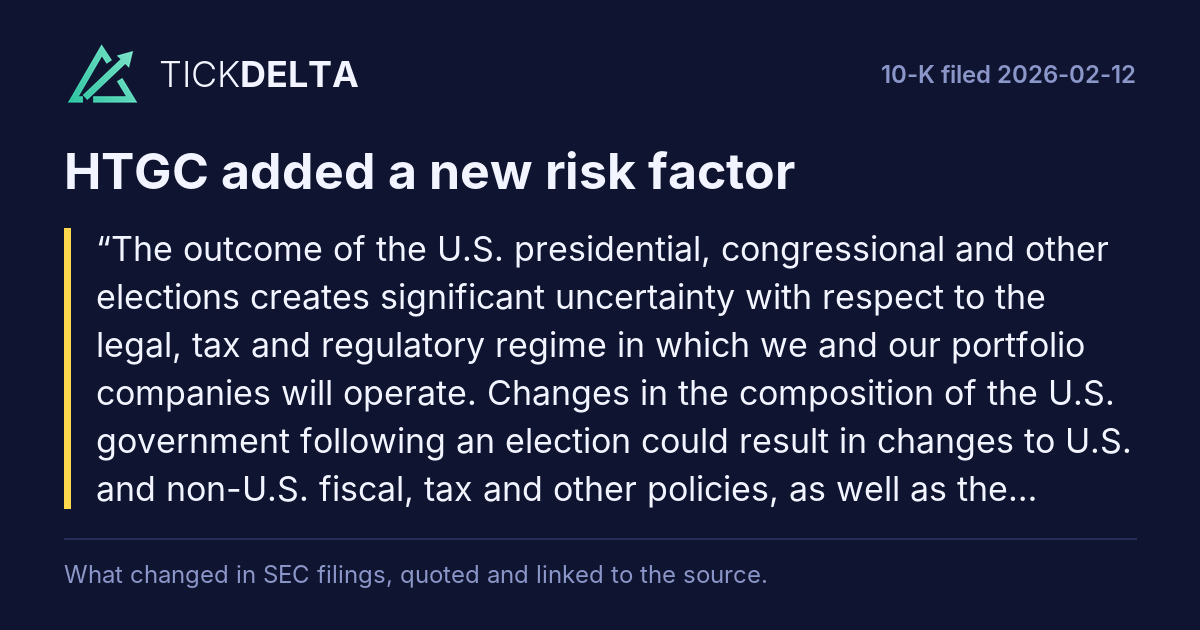
The outcome of the U.S. presidential, congressional and other elections creates significant uncertainty with respect to the legal, tax and regulatory regime in which we and our portfolio companies will operate.
Changes in the composition of the U.S. government following an election could result in changes to U.S. and non-U.S. fiscal, tax and other policies, as well as the global financial markets generally. Any significant changes in economic policy, the regulation of the asset management industry, international trade policy and/or tax law, among other things, could have a material adverse impact on us and our investments. General fluctuations in the market prices of securities and interest rates could affect our investment opportunities and the value of our investments. We could also be affected by difficult conditions in the capital markets and any overall weakening of the financial services industry. Ongoing disruptions in the global credit markets could affect issuers’ ability to pay debts and obligations on a timely basis. If defaults occur, we could lose both invested capital in, and anticipated profits from, any affected investments.
While the current U.S. administration has signaled a reduced emphasis on regulation, past U.S. administrations supported an enhanced regulatory agenda. Changes in regulation can impose greater costs on certain sectors, including financial services, or otherwise impact the competitive environment for obligors, which could adversely impact us and our clients.
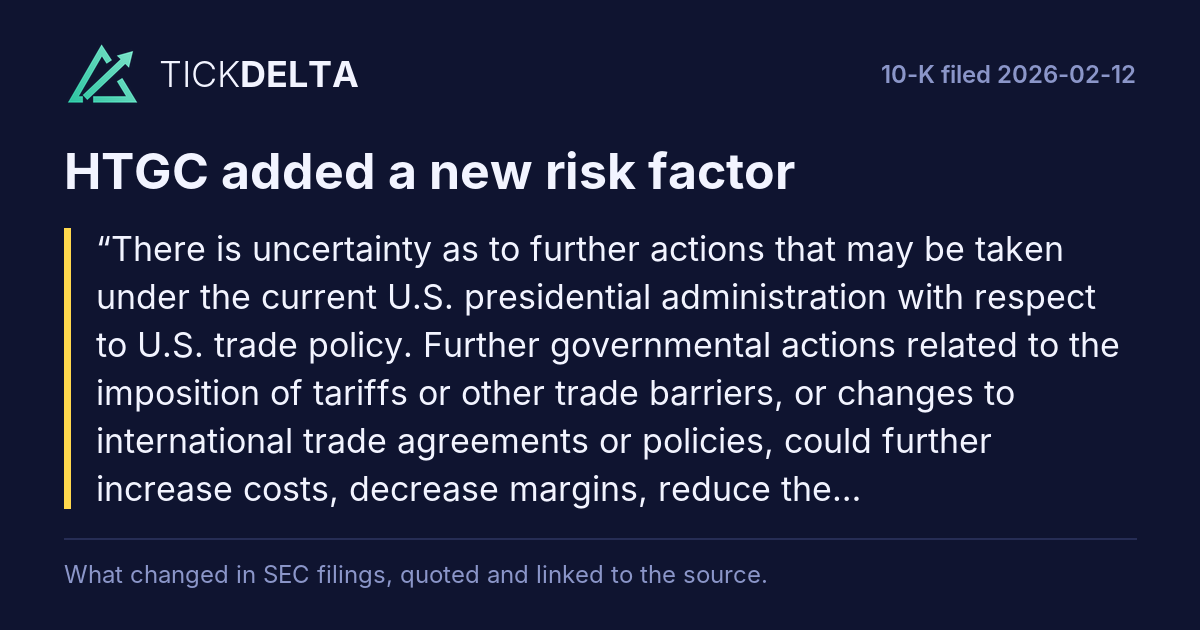
There is uncertainty as to further actions that may be taken under the current U.S. presidential administration with respect to U.S. trade policy. Further governmental actions related to the imposition of tariffs or other trade barriers, or changes to international trade agreements or policies, could further increase costs, decrease margins, reduce the competitiveness of products and services offered by current and future portfolio companies and adversely affect the revenues and profitability of companies whose businesses rely on goods imported from outside of the United States.
New in the latest 10-Q
16 paragraphs in the 10-Q filed Oct 29, 2026 with nothing like them in the 10-Q filed Jul 30, 2026 (at least half the words must differ; new numbers alone do not count). Quoted exactly, grouped by the item heading above them. This is text that changed, not a judgement of how serious it is.
(in thousands) For the Nine Months Ended September 30, 2026 2025 ────────────────────────────────────────────────────────────────────────────────────────────────────────────────────────────────────────────────────────────────────────────────────────────────────────────────────────────────── Cash flows provided by (used in) operating activities: Net increase in net assets resulting from operations $ 266,251 $ 248,909 Adjustments to reconcile net increase in net assets resulting from operations to net cash provided by (used in) operating activities: Purchases of investments(1) (1,426,637) (1,344,789) Fundings assigned to Adviser Funds(1) 2,500 — Principal and fee repayments received 994,985 678,999 Proceeds from the sale of debt investments 63,483 67,521 Proceeds from the sale of equity and warrant investments 27,240 6,130 Net change in unrealized (appreciation) depreciation 7,284 (55,214) Net realized (gain) loss (5,163) 60,929 Payments of derivative instruments (13) (1,551) Accretion of paid-in-kind interest (35,819) (41,583) Accretion of loan discounts (5,681) (5,408) Accretion of loan discounts on convertible notes 932 690 Loss on extinguishment of debt 2 120 Accretion of loan exit fees (30,481) (23,770) Change in loan income, net of collections 26,272 23,763 Unearned fees related to unfunded commitments (1,029) 524 Amortization of debt fees and issuance costs 8,060 6,242 Depreciation and amortization 251 254 Stock-based compensation and amortization of restricted stock grants(2) 12,204 11,061 Change in operating assets and liabilities: Interest receivable (1,648) (4,383) Other assets 2,602 5,662 Accrued liabilities (3,950) (4,299) Net cash provided by (used in) operating activities (98,355) (370,193) Cash flows provided by (used in) investing activities: Purchases of capital equipment (19) (56) Net cash provided by (used in) investing activities (19) (56) Cash flows provided by (used in) financing activities: Issuance of common stock 92,421 190,913 Offering expenses (1,201) (2,074) Retirement of employee shares, net (4,878) (5,469) Distributions paid (256,137) (243,056) Issuance of debt 1,866,562 1,664,362 Repayment of debt (1,598,568) (1,285,836) Debt issuance costs (7,973) (11,076) Fees paid for Credit Facilities (750) (3,445) Net cash provided by (used in) financing activities 89,476 304,319 Net increase (decrease) in cash, cash equivalents and restricted cash (8,898) (65,930) Cash, cash equivalents and restricted cash at beginning of period 59,454 116,421 Cash, cash equivalents and restricted cash at end of period $ 50,556 $ 50,491 Supplemental disclosures of cash flow information and non-cash investing and financing activities: Interest paid $ 85,519 $ 66,795 Income tax, including excise tax, paid $ 5,801 $ 6,346 Distributions reinvested $ 6,515 $ 6,799
Read in the 10-Q
Morphisec Information Security 2014 Ltd. Warrant 10/1/2024 Ordinary Shares 200,115 104 56 (5)(10)
Read in the 10-Q
(27)Effective September 30, 2026, the Company added the “Cybersecurity”, “Energy Technologies”, “Financial Technologies” and “Healthcare Technology & Digital Health” industry categories, which include investments previously classified within “Application Software”, “Consumer & Business Services”, “Healthcare Services, Other”, “Information Services”, “Sustainable and Renewable Technology” and “System Software”.
Read in the 10-Q
(28)In accordance with the 1940 Act, the Company is deemed to be an “affiliated person” of the portfolio company as the Company owns at least 5% but not more than 25% of the portfolio company’s outstanding voting securities and does not otherwise control.
Read in the 10-Q
(29)Denotes equipment financing secured by a first lien on the financed equipment. As of September 30, 2026, the aggregate cost and fair value of the equipment financings are $35.9 million and $37.4 million, respectively.
Read in the 10-Q
Coronet Cyber Security Ltd. Warrant 9/26/2024 Ordinary Shares 39,183 254 25 (27)(28)
Read in the 10-Q
(28)Effective September 30, 2026, the Company added the “Cybersecurity”, “Energy Technologies”, “Financial Technologies” and “Healthcare Technology & Digital Health” industry categories, which include investments previously classified within “Application Software”, “Consumer & Business Services”, “Healthcare Services, Other”, “Information Services”, “Sustainable and Renewable Technology” and “System Software”. Prior period amounts have been reclassified to conform to the current period presentation.
Read in the 10-Q
(1) Effective September 30, 2026, the Company added the “Cybersecurity”, “Energy Technologies”, “Financial Technologies” and “Healthcare Technology & Digital Health” industry categories, which include investments previously classified within “Application Software”, “Consumer & Business Services”, “Healthcare Services, Other”, “Information Services”, “Sustainable and Renewable Technology” and “System Software”. Prior period amounts have been reclassified to conform to the current period presentation.
Read in the 10-Q
Percentage of debt investments (at fair value), as of September 30, 2026 December 31, 2025 ────────────────────────────────────────────────────────────────────────────────────────────────────────────────────────────────────────────── Senior Secured First Lien All assets including intellectual property 77.1% 72.8% All assets with negative pledge on intellectual property 5.0% 9.5% “Last-out” with security interest in all of the assets 5.9% 7.0% Equipment-Only Lien 0.8% 0.0% Total senior secured first lien position 88.8% 89.3% Second lien 9.5% 9.1% Unsecured 1.7% 1.6% Total debt investments at fair value 100.0% 100.0%
Read in the 10-Q
(2) Cost of debt includes interest, amortization of debt issuance costs and discounts, and fees.
Read in the 10-Q
(in thousands) Maturity Date Interest Rate(1) September 30, 2026 December 31, 2025
Read in the 10-Q
In September 2026, the FASB issued Accounting Standards Update (“ASU”) 2026-03,“Fair Value Measurement (Topic 820): Investment Companies with Equity Securities Subject to Contractual Sale Restrictions,” which amends the guidance in ASC 820 to require investment companies within the scope of ASC 946 to consider the effect of contractual sale restrictions when measuring the fair value of equity securities and to provide additional disclosures regarding the amount of any related discount. ASU 2026-03 is effective for annual reporting periods beginning after December 15, 2027, and interim reporting periods within those annual reporting periods, with early adoption permitted. The Company is currently assessing the impact of this guidance; however, the Company does not expect the adoption of ASU 2026-03 to have a material impact on its consolidated financial statements and disclosures.
Read in the 10-Q
(1) Effective September 30, 2026, the Company added the “Cybersecurity”, “Energy Technologies”, “Financial Technologies” and “Healthcare Technology & Digital Health” industry categories, which include investments previously classified within “Application Software”, “Consumer & Business Services”, “Healthcare Services, Other”, “Information Services”, “Sustainable and Renewable Technology” and “System Software”. Prior period amounts have been reclassified to conform to the current period presentation.
Read in the 10-Q
months ended September 30, 2026 was primarily attributable to foreign exchange movements, including the reversal of previously recorded unrealized depreciation upon repayment of our Euro-denominated credit facility, while valuation changes on our portfolio investments were largely offset by reversals of unrealized depreciation upon realization events. The net unrealized depreciation for the nine months ended September 30, 2026 was primarily attributable to valuation decreases on our debt and equity investments and the reversal of previously recorded unrealized appreciation upon realization events, partially offset by foreign exchange movements.
Read in the 10-Q
$188.8 million net proceeds received during the nine months ended September 30, 2025. During the nine months ended September 30, 2026, we distributed dividends of $256.1 million compared to $243.1 million during the nine months ended September 30, 2025.
Read in the 10-Q
(2) Calculated using the weighted average principal outstanding under the Company’s floating rate Credit Facilities for the three months ended September 30, 2026.
Read in the 10-Q
Item 1A of the 10-Q filed Oct 29, 2026 against Item 1A of the 10-K filed Feb 12, 2026.
A 10-Q repeats only the risks that changed, so a 10-K paragraph that is missing from it is not counted as removed.
Added is a paragraph with nothing like it in the 10-K, Reworded a sentence that is in both with several words changed,
Quiet changes a sentence in both where one to four words changed and one is a hedge or a modal
(cut words struck through, new words highlighted).
Text on the page, not a score; each links to the filing at sec.gov.
What the 10-Q itself says about its risk factors:In addition to the risks discussed below, important risk factors that could cause results or events to differ from current expectations are described in Part I, Item 1A “Risk Factors” of the Company’s Annual Report on Form 10-K for the year ended December 31, 2025 filed with the SEC on February 12, 2026.
Read in the 10-Q
Two-word phrases in Risk Factors of the 10-K filed Feb 12, 2026 that are in none of the 1 earlier 10-Ks stored, back to Feb 13, 2025
Used at least twice, small words left out. Counted, not picked: a phrase can be new because the company renamed something.
10 paragraphs of last year's Risk Factors with nothing like them now. The longest are quoted.
Item 1A of each 10-K and 10-Q on EDGAR, quoted exactly. Each paragraph links to the filing at sec.gov.
10-K change: what was reworded or cut, section by section.
Excel workbook · CSV. Google Sheet that stays up to date: paste =IMPORTDATA("https://tickdelta.com/company/HTGC/export.csv") into a cell.