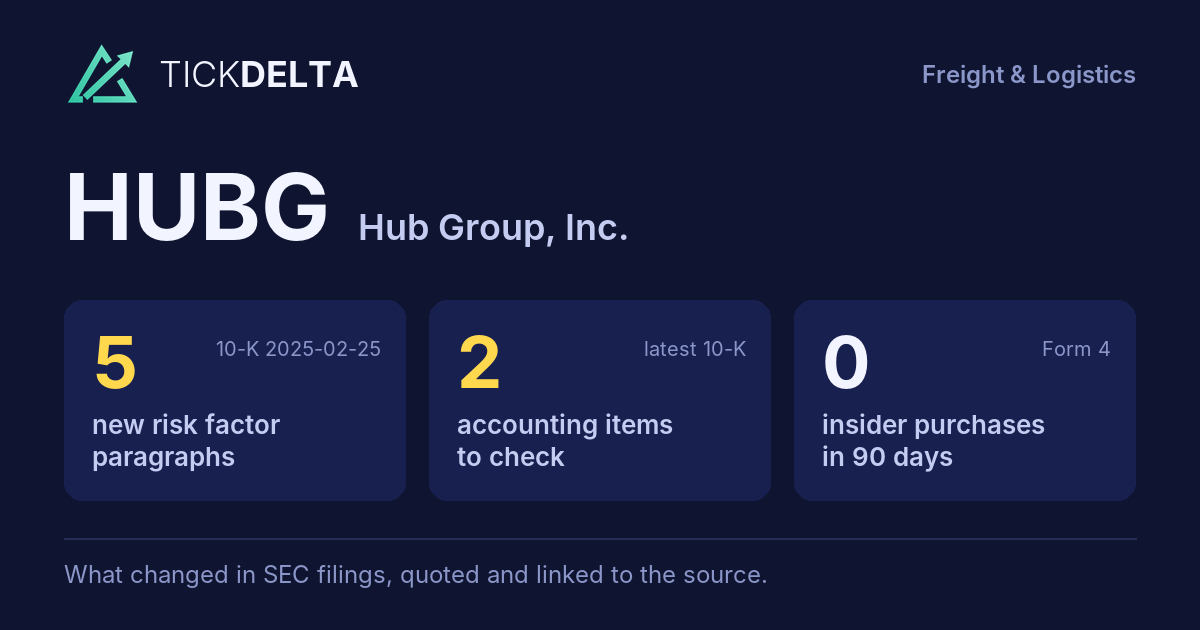
Screener / SEC EDGAR /CIK 0000940942 /10-K filed Feb 25, 2025, compared with Feb 27, 2024 /Numbers from the XBRL of the 10-Ks
Nasdaq Industrials · Freight & Logistics

Hub Group, Inc. HUBG

Compare with peers Embed
The 10-K against last year's

72 changes: 6 added, 7 removed, 59 reworded

10-K Feb 25, 2025 vs Feb 27, 2024

10-K 0000950170-25-026866 (Feb 25, 2025) vs 10-K 0000950170-24-021432 (Feb 27, 2024) Not compared: Legal Proceedings.

Every paragraph, and how much of it changed

One bar per paragraph, in the order of the 10-K. Height and colour show the share of its words not in the closest paragraph a year earlier; the tallest bars are new paragraphs.

Risk Factors

96 paragraphs · 5 new · 22 reworded · 4 gone · 10-K Feb 25, 2025 against Feb 27, 2024
New paragraph Reworded (5% of its words or more) Same or nearly
Paragraph 96 · 16% changed Every version of it
Our Class A Common Stock price may fluctuate significantly in the future, and these fluctuations may be unrelated related to our performance. We also cannot predict the effect our dual-class structure may have on the market prices of our Class A Common Stock. General market price declines or market volatility in the future could adversely affect the price of our Class A Common Stock, and the current market price of our Class A Common Stock may not be indicative of future market prices.
Paragraph 5 · 15% changed Every version of it
We depend on major railroads in North America for the intermodal services we provide. In many regions, rail service is provided by one or a limited number of railroads. We primarily rely on contractual relationships with two railroads to support our intermodal business. Consequently, a reduction in, or elimination of, rail service to a particular market is likely to materially adversely affect our ability to provide intermodal transportation services to some of our customers. Rate increases to our customers may reduce the attractiveness of intermodal transportation compared to truck or other transportation modes, which could cause a decrease in demand for our services. Further, our ability to continue to expand our intermodal transportation business is dependent upon the railroads’ ability to increase capacity for intermodal freight and provide consistent and reliable service. Our business has, at times, been adversely affected by situations impacting one or more railroads, including labor shortages, slowdowns or stoppages, adverse weather conditions, changes to rail operations, or other factors that hinder the railroads’ ability to provide reliable transportation services and these situations may occur again in the future. To date, our primary railroad providers have chosen to rely on us and other intermodal providers to market their intermodal services rather than fully developing their own marketing capabilities. If one or more of the major railroads reduced their dependence on us or decreased the capacity that they made available to us, including by servicing additional intermodal marketing companies, the volume of intermodal shipments we arrange would likely decline, which could have a material adverse effect on our results of operations and financial condition.
Paragraph 95 · 12% changed Every version of it
•geopolitical conditions such as acts or threats of terrorism, military conflicts, and the effects of pandemics (such as the coronavirus). pandemics.
Paragraph 52 · 8% changed Every version of it
There is substantial competition for qualified personnel in the transportation and logistics services industry. The loss of any member of our management team, or other key persons, or the inability to hire key persons, could have an adverse effect on us. We do not have written employment agreements with any of our executive officers and do not maintain key person insurance on any of our executive officers, although we do have restrictive covenant agreements with all of them. Many individuals in the industry are subject to non-competition agreements, reducing the immediate availability of some qualified candidates for job openings. A proposed rulemaking by the Federal Trade Commission (“FTC”), if it is made effective and withstands effective legal challenges, would prevent the use of non-competition agreements in most circumstances in the future. We cannot predict the impact this proposed rule, or of potential future rulemaking at the federal or state level, might have level on the recruiting and retention of management and other employees (or our ability to enforce post-termination restrictive covenants). If we lose key members of our senior management team or are unable to effect successful transitions from one executive to another as part of our succession plan, we may not be able to effectively manage our current operations or meet ongoing and future business challenges, and this could have a material adverse effect on our business, financial condition and results of operations.
Paragraph 67 · 7% changed Every version of it
We are also subject to certain federal and state environmental laws and regulations, including those of the U.S. Environmental Protection Agency (“EPA”) and the California Air Resources Board (“CARB”). We may become subject to enforcement actions, new or more restrictive regulations, or differing interpretations of existing regulations, which may increase the cost of providing transportation services or adversely affect our results of operations. In addition to EPA and state agency regulations on exhaust emissions with which we must comply, there is an increased legislative and regulatory focus on climate change, greenhouse gas (“GHG”) emissions and the impact of climate change that enhances the possibility of increased regulation of GHG emissions and potentially exposes us to significant new capital or operating expenditures, taxes, fees and other costs. Additionally, the State of California recently previously passed legislation and the SEC has proposed regulations regarding the disclosure of Scope 1, 2 and 3 GHG emissions. Compliance with these regulations could add material costs to our business, including securities and other potential litigation costs arising from our reporting of our GHG emissions, and could increase customer focus on our GHG direct and indirect emissions, which may affect the market for transportation and logistics services in ways that we cannot foresee. Such regulations, together with increased investor and stakeholder interest in climate change and other environmental topics may result in new regulations or customer, supplier or market requirements that could adversely impact our business, or certain stockholders may reduce their holdings of our stock. Limitations on the emission of GHGs, other environmental legislation, or customer GHG requirements could also have an adverse impact on our financial condition, results of operations and liquidity.
Paragraph 26 · 6% changed Every version of it
We also rely on the timely and free flow of goods through open and operational international shipping lanes and ports. Disruptions of these shipping lanes, such as the drought ongoing geopolitical issues impacting the Panama Canal and ongoing geopolitical conditions, including terrorist acts, impacting the Suez Canal, could create significant risks for our business or provide opportunities with changes to shipping patterns.
Paragraph 29 · 5% changed Every version of it
Currently, none of our employees are represented by a collective bargaining agreement. agreement in the United States. If in the future our employees decide to unionize, this would increase our operating costs and force us to alter the way we operate causing an adverse effect on our operating results.
Paragraph 54 · 5% changed Every version of it
We cannot guarantee that we will be able to execute acquisitions on commercially acceptable terms. Furthermore, the failure to successfully integrate an acquired business or assets, business, including implementing financial controls and measures measures, successfully managing any minority shareholders or achieving cross-selling objectives, could significantly impact our financial results. Although we believe we have adequate liquidity and capital resources to fund our operations internally, our inability to access the capital markets on favorable terms, or at all, to obtain adequate financing could adversely affect our ability to pursue growth through acquisitions. Financial results most likely to be negatively affected include revenue, gross margin, salaries and benefits, general and administrative expenses, depreciation and amortization, interest expense, net income and our debt level.

MD&A

73 paragraphs · 1 new · 33 reworded · 3 gone · 10-K Feb 25, 2025 against Feb 27, 2024
New paragraph Reworded (5% of its words or more) Same or nearly
Paragraph 18 · 50% changed
Logistics revenue decreased 14% to $1.8 billion primarily driven by lower revenue per load in our brokerage service line and lower managed transportation and final mile service line revenue, partially offset by an increase in fulfillment revenue. Brokerage volumes were flat compared to the prior year. Logistics operating income was 6% 4.6% of revenue in both 2023 and 2022. Operating income was $105 million as 2024 compared to $126 million last year, as lower 5.8% in 2023. Lower revenue was partially offset by lower purchased transportation costs and a change of business mix between our yield management initiatives. lines of business. Operating income was $83 million as compared to $105 million last year driven by lower yields in brokerage and we incurred approximately $13 million of incremental costs related to warehouse consolidation to provide better customer service, our network alignment initiative within consolidation and fulfillment.
Paragraph 23 · 42% changed
This decrease expense increase was due primarily due to $78 million less of incremental expense related to the decreased average company driver count, partially offset by FAFM acquisition on December 20, 2023 and the EASO transaction on October 23, 2024, as well as an $8 million increase in incentive compensation expense, a $4 expense of $8 million, partially offset by decreases in driver related expenses of $15 million increase in related to lower average driver headcount, lower office employee compensation due to higher headcount expense of $7 million and increased expenses resulting from the acquisitions lower restricted stock expense of TAGG and Choptank. $3 million.
Paragraph 17 · 41% changed
Logistics revenue decreased 14% to remained consistent at $1.8 billion primarily driven by lower revenue per load in our brokerage service line line, lower volumes in our brokerage business and lower revenue in our managed transportation and final mile service line revenue, partially offset by an increase in consolidation and fulfillment revenue. Brokerage volumes were flat compared to the prior year. Logistics operating income was 6% of revenue in both 2023 and 2022. Operating income was $105 million as compared to $126 million last year, as lower revenue services. This was partially offset by lower purchased transportation costs and growth in our yield management initiatives. final mile business due to the FAFM acquisition in late 2023.
Paragraph 4 · 34% changed
Beginning in the first quarter of 2023, we We concluded we have two reportable segments - Intermodal and Transportation Solutions, Solutions (“ITS”), and Logistics, which are based primarily on the services each segment provides. Results for the years ended December 31, 2022 and 2021 have been recast to conform with current year presentation.
Paragraph 25 · 34% changed
Depreciation and amortization expense increased decreased to $132 $141 million in 2022 2024 from $116 $144 million in 2021. 2023. This increase expense decrease was primarily due to increased container, tractor and warehouse equipment decreased container depreciation expense resulting from changes made in the third quarter of 2024 to the estimated useful lives of our containers as well as the decreased tractor depreciation expense resulting from a smaller tractor fleet in 2024. These decreases were partially offset by an increase in amortization expense of intangibles related to the acquisitions of TAGG in August of 2022 FAFM acquisition and Choptank in October 2021. the EASO transaction. This expense, as a percentage of revenue, decreased increased to 2.5% 3.6% in 2022 2024 from 2.8% 3.4% in 2021. 2023. Depreciation expense includes transportation equipment, technology investments, leasehold improvements, warehouse equipment, office equipment and building improvements. Amortization expense includes trade names, customer relationships, carrier network relationships, independent contractor relationships, developed technology and carrier and independent service provider relationships.
Paragraph 21 · 33% changed
Purchased transportation and warehousing costs declined as compared to prior year due to lower volumes, volumes in brokerage, and reductions in third party carrier costs and decreased use of third-party carriers for drayage in ITS. costs, partially offset by network alignment costs.
Paragraph 15 · 32% changed
Intermodal and Transportation Solutions (“ITS”) revenue decreased 25% 10% to $2.5 $2.2 billion primarily due to a 14% decrease in intermodal volume due to low transportation demand and an oversupply of truckload carrier capacity, a 14% decrease 15% decline in intermodal revenue per load (primarily due to lower price, prices, lower fuel prices surcharges, accessorial revenue and mix) mix), partially offset by a 5% increase in intermodal volumes and a 4% decline 1% growth in dedicated revenues due to lost customers partially offset by growth with existing and new customers. onboarded in late 2023.
Paragraph 16 · 32% changed
ITS operating income increased decreased to $349 $57 million, 11% 2.5% of revenue, as compared to $169 $107 million, 6% 4.3% of revenue in the prior year due to higher lower customer rates, as well as rates in intermodal, lower accessorial income and surcharge income, more normalized bonus expense for employees. These headwinds were partially offset by lower intermodal volume, higher drayage costs, costs and increased repositioning lower equipment costs.

A paragraph is matched with the one last year that shares the most of its words; under half in common makes it new. The paragraphs shown are the 8 reworded the most in each section.

The paragraph that changed most in each section

The redline

Marked against last year's 10-K: cut words struck through, new words highlighted.

Accounting Policies102 words changed in this paragraph; it is 45% similar to last year's version.
In November December 2023, the Financial Accounting Standards Board (“FASB”) FASB issued Accounting Standard Update (“ASU”) No. 2023-07, Segment Reporting ASU 2023-09, Income Taxes (Topic 280): 740): Improvements to Reportable Segment Disclosures, which requires retrospective disclosure of significant segment expenses Income Tax Disclosures ("ASU 2023-09"). ASU 2023-09 enhanced annual disclosures regarding the rate reconciliation and other segment items on an annual and interim basis. Additionally, it requires disclosure of the title and position of the Chief Operating Decision Maker (“CODM”). This income taxes paid information. For public business entities, ASU will be 2023-09 is effective for the Company’s fiscal December 31, 2024 year-end and interim annual periods beginning in fiscal 2025, with early adoption permitted. after December 15, 2024. We are assessing the impact of this guidance on our disclosures; it will not have an impact on our results of operations, cash flows flows, or financial condition.

Source: Item 8, Note 1 – Description of Business and Summary of Significant Accounting Policies, 10-K 0000950170-25-026866 vs Item 8, Note 1 – Description of Business and Summary of Significant Accounting Policies, 10-K 0000950170-24-021432

Risk Factors100 words changed in this paragraph; it is 77% similar to last year's version.
We depend on major railroads in North America for the intermodal services we provide. In many regions, rail service is provided by one or a limited number of railroads. We primarily rely on contractual relationships with two railroads to support our intermodal business. Consequently, a reduction in, or elimination of, rail service to a particular market is likely to materially adversely affect our ability to provide intermodal transportation services to some of our customers. Rate increases to our customers may reduce the attractiveness of intermodal transportation compared to truck or other transportation modes, which could cause a decrease in demand for our services. Further, our ability to continue to expand our intermodal transportation business is dependent upon the railroads’ ability to increase capacity for intermodal freight and provide consistent and reliable service. Our business has, at times, been adversely affected by situations impacting one or more railroads, including labor shortages, slowdowns or stoppages, adverse weather conditions, changes to rail operations, or other factors that hinder the railroads’ ability to provide reliable transportation services and these situations may occur again in the future. To date, our primary railroad providers have chosen to rely on us and other intermodal providers to market their intermodal services rather than fully developing their own marketing capabilities. If one or more of the major railroads reduced their dependence on us or decreased the capacity that they made available to us, including by servicing additional intermodal marketing companies, the volume of intermodal shipments we arrange would likely decline, which could have a material adverse effect on our results of operations and financial condition.

Source: Item 1A, 10-K 0000950170-25-026866 vs Item 1A, 10-K 0000950170-24-021432

MD&A97 words changed in this paragraph; it is 45% similar to last year's version.
The $96 million increase in Net cash used in financing activities for 2023 versus 2022 the year ended December 31, 2024 was primarily due to an increase in $201 million which includes cash used for the repayments of long-term debt of $107 million, purchase of treasury stock of $34 $68 million, an increase in dividends paid of $30 million, cash paid used for stock related to employee tendered for payments of withholding taxes of $11 million, finance lease payments of $2 million and a decrease in distribution to non-controlling interest holders of $1 million, partially offset by proceeds from the issuance of debt of $65 million, partially offset $18 million. Our debt balance decreased by a decrease $86 million during 2024. Debt incurred in 2024 was used to fund the repayments purchase of long-term debt of $5 million. transportation equipment.

Source: Item 7, 10-K 0000950170-25-026866 vs Item 7, 10-K 0000950170-24-021432

Sentences and paragraphs added, removed or reworded

Every change, by type

Sentences and paragraphs of HUBG's Risk Factors and MD&A, 10-K Feb 25, 2025 against 10-K Feb 27, 2024. Each links to the text at sec.gov.

Quiet changes are sentences kept from last year with one to four words changed, at least one of them a hedge, a modal or a qualifier (may, could, will, not, significant, material…). A year or date rolling forward is not counted.

The full word list

adverse, adversely, all, although, anticipate, anticipates, any, approximately, believe, believes, can, cannot, certain, could, expect, expects, generally, however, if, intend, intends, largely, likely, many, material, materially, may, might, most, must, never, no, not, possible, primarily, probable, should, significant, significantly, some, substantial, substantially, unlikely, will, would

AddedRisk Factors
•burdens of complying with a wide variety of international and US export, import, business procurement, transparency, and corruption laws, including the US Foreign Corrupt Practices Act;
Read it in 10-K Feb 25, 2025 at sec.gov
RemovedRisk Factors
Additionally, proposed and potential new legislation intended to encourage the adoption of alternative fuel technologies, including electric vehicles (“EVs”), as well as potential customer demand driven by similar legislation and market-driven expectations, could accelerate or expand our plans for a transition to EVs. The Company has piloted the use of EVs but has no immediate plans for a broad transition to EVs. The Company’s broader usage of EVs will depend on several factors including availability of EVs, access to charging infrastructure, consistent availability of electrical supply, and availability of tax or other incentives to mitigate the required capital expenditures for EV fleet purchases, charging, maintenance, replenishment and expansion. If legislative or market forces require the accelerated deployment of EVs before other cost and operational factors are adequately addressed, then such transition could have a material adverse effect on our operations and future profitability.
Read it in 10-K Feb 27, 2024 at sec.gov
RemovedRisk Factors
The Company is also subject to certain federal and state environmental laws and regulations, including those of the U.S. Environmental Protection Agency (“EPA”) and the California Air Resources Board (“CARB”). We may become subject to enforcement
Read it in 10-K Feb 27, 2024 at sec.gov
Show the other 29
RemovedRisk Factors
We have hired individuals, including Information Technology (“IT”) employees, from outside the United States. We have employee drivers and owner-operator drivers who are immigrants to the United States. We engage third-party consultants, including for various IT projects, who may utilize personnel from outside the United States. If immigration laws are changed or if new more restrictive government regulations are enacted or increased, our access to qualified and skilled personnel may be limited, the costs of doing business may increase and our operations may be disrupted.
Read it in 10-K Feb 27, 2024 at sec.gov
RewordedRisk Factors
Disruptions of these shipping lanes, such as the drought ongoing geopolitical issues impacting the Panama Canal and ongoing geopolitical conditions, including terrorist acts, impacting the Suez Canal, could create significant risks for our business or provide opportunities with changes to shipping patterns.
Read it in 10-K Feb 25, 2025 at sec.gov
RewordedRisk Factors
Strikes, work slowdowns, or labor shortages among railroad employees in either the United States, Canada or anywhere else that our customers’ freight travels by railroad Mexico would impact our operations.
Read it in 10-K Feb 25, 2025 at sec.gov
RewordedRisk Factors
We cannot predict the impact this proposed rule, or of potential future rulemaking at the federal or state level, might have level on the recruiting and retention of management and other employees (or our ability to enforce post-termination restrictive covenants).
Read it in 10-K Feb 25, 2025 at sec.gov
RewordedRisk Factors
Furthermore, the failure to successfully integrate an acquired business or assets, business, including implementing financial controls and measures measures, successfully managing any minority shareholders or achieving cross-selling objectives, could significantly impact our financial results.
Read it in 10-K Feb 25, 2025 at sec.gov
RewordedRisk Factors
The nature of our business exposes us to a variety of litigation risks related to a number of issues, including without limitation, accidents involving our trucks and employees, alleged violations of federal and state labor labor, employment and employment immigration laws, securities laws, environmental liability, privacy and other matters.
Read it in 10-K Feb 25, 2025 at sec.gov
RewordedRisk Factors
The United States government and foreign governments may take other actions that may impact the purchase and production of goods, including changes to certain trade agreements and imposing tariffs tariffs, quotas, or other regulations on certain goods shipped by our customers, that may increase costs for goods transported globally and reduce end-user demand for these products.
Read it in 10-K Feb 25, 2025 at sec.gov
RewordedRisk Factors
We are subject to a wide variety of U.S. federal, state and local laws, non-U.S. laws, regulations and government policies, including in the areas of employment, labor and employment (including immigration), privacy, cybersecurity, securities, anti-corruption, competition and trade, that may change in significant ways.
Read it in 10-K Feb 25, 2025 at sec.gov
RewordedRisk Factors
We provide services both domestically and to a lesser extent outside of the United States, States (including EASO in Mexico), which subjects our business to various additional risks, including:
Read it in 10-K Feb 25, 2025 at sec.gov
RewordedRisk Factors
If we suffer a substantial loss in excess of our self-insured limits, the loss and attendant expenses may be covered by traditional insurance and excess insurance the Company has we have in place, but if not covered or above such coverages, losses could harm our business, financial condition or results of operations.
Read it in 10-K Feb 25, 2025 at sec.gov
AddedMD&A
On October 23, 2024, we entered into an investment agreement with Corporación Interamericana de Logística, S.A. de C.V. and certain associated entities (commonly known as “EASO”), to acquire a controlling interest in EASO. The estimated fair value of total consideration transferred was approximately $55 million for a 51% equity stake in EASO.
Read it in 10-K Feb 25, 2025 at sec.gov
RemovedMD&A
Logistics revenue increased 29% to $2.1 billion primarily driven by the impact of a full year of revenue from Choptank (acquired in October 2021) and the partial year revenue contribution from TAGG (acquired in August 2022). We also experienced revenue growth at our Final Mile, Managed Transportation, Consolidation and legacy Brokerage businesses.
Read it in 10-K Feb 27, 2024 at sec.gov
RemovedMD&A
Logistics operating income was 6% of revenue in 2022 and 4% of revenue in 2021. Operating income was $126 million as compared to $69 million in 2021, driven by the acquisitions of Choptank and TAGG, as well as yield improvements and higher operating efficiencies across all of our businesses.
Read it in 10-K Feb 27, 2024 at sec.gov
RemovedMD&A
The increase in purchased transportation costs in 2022, as compared to 2021, was primarily due to increased rail costs, increased fuel costs, higher brokerage volume, higher third-party carrier costs, increased repositioning costs as well as increased business activity.
Read it in 10-K Feb 27, 2024 at sec.gov
RewordedMD&A
Intermodal and Transportation Solutions (“ITS”) revenue decreased 25% 10% to $2.5 $2.2 billion primarily due to a 14% decrease in intermodal volume due to low transportation demand and an oversupply of truckload carrier capacity, a 14% decrease 15% decline in intermodal revenue per load (primarily due to lower price, prices, lower fuel prices surcharges, accessorial revenue and mix) mix), partially offset by a 5% increase in intermodal volumes and a 4% decline 1% growth in dedicated revenues due to lost customers partially offset by growth with existing and new customers. onboarded in late 2023.
Read it in 10-K Feb 25, 2025 at sec.gov
RewordedMD&A
ITS operating income increased decreased to $349 $57 million, 11% 2.5% of revenue, as compared to $169 $107 million, 6% 4.3% of revenue in the prior year due to higher lower customer rates, as well as rates in intermodal, lower accessorial income and surcharge income, partially offset by lower intermodal volume, higher drayage costs, and increased repositioning costs. more normalized bonus expense for employees.
Read it in 10-K Feb 25, 2025 at sec.gov
RewordedMD&A
The $96 $53 million increase in cash used in financing activities for 2024 versus 2023 versus 2022 was primarily due to an increase in the purchase dividends paid of treasury stock $30 million, increases in repayments of $34 million, an increase in long-term debt, distributions to non-controlling interests and cash paid for stock related to employee withholding taxes of $2 $1 million each and a decrease in proceeds from the issuance of debt of $65 $96 million, partially offset by a decrease in the repayments purchase of long-term debt treasury stock of $5 $75 million.
Read it in 10-K Feb 25, 2025 at sec.gov
RewordedMD&A
Net cash used in financing activities for the year ended December 31, 2023 2024 was $148 $201 million which includes cash used for the repayments of long-term debt of $107 million, purchase of treasury stock of $144 $68 million, repayments dividends paid of long-term debt of $106 $30 million, cash used for stock tendered for payments of withholding taxes of $10 million and $11 million, finance lease payments of $2 million and a distribution to non-controlling interest holders of $1 million, partially offset by proceeds from the issuance of debt of $114 $18 million.
Read it in 10-K Feb 25, 2025 at sec.gov
RewordedMD&A
Logistics revenue decreased 14% to remained consistent at $1.8 billion primarily driven by lower revenue per load in our brokerage service line line, lower volumes in our brokerage business and lower revenue in our managed transportation and final mile service line revenue, partially offset by an increase in consolidation and fulfillment revenue. services.
Read it in 10-K Feb 25, 2025 at sec.gov
RewordedMD&A
Capital expenditures of $140 $51 million related primarily to tractors of $71 million, containers of $41 million, technology investments of $14 $19 million, tractor purchases of $16 million, warehouse equipment of $12 $9 million and leasehold improvements of $3 million. the remainder for other transportation equipment.
Read it in 10-K Feb 25, 2025 at sec.gov
RewordedMD&A
The $36 $228 million decrease in cash flow was primarily due to a decrease in net income of $189 million, partially offset by an increase in the change in assets and liabilities of $103 $150 million, a decrease in net income of $64 million and an increase a decrease in non-cash charges of $50 $14 million.
Read it in 10-K Feb 25, 2025 at sec.gov
RewordedMD&A
The expense increase change was partially offset driven by increased decreased interest income of $10 million in 2023 2024 primarily due to higher interest rates on our cash balance and higher lower average cash balances throughout the year.
Read it in 10-K Feb 25, 2025 at sec.gov
RewordedMD&A
The lower effective tax rate was higher in 2024 because there were significant refund claims made in 2023 resulted primarily from related to a change in state apportionment methodology. methodology that did not reoccur in 2024.
Read it in 10-K Feb 25, 2025 at sec.gov
RewordedMD&A
Purchased transportation and warehousing costs declined as compared to prior year due to lower volumes, volumes in brokerage, and reductions in third party carrier costs and decreased use of third-party carriers for drayage in ITS. costs, partially offset by network alignment costs.
Read it in 10-K Feb 25, 2025 at sec.gov
RewordedMD&A
Interest expense increased to $14 million in 2024 from $13 million in 2023 from $7 million in 2022 due primarily to driven by higher interest rates on our debt and higher debt, partially offset by lower average debt balances.
Read it in 10-K Feb 25, 2025 at sec.gov
RewordedMD&A
Headcount, which includes drivers, warehouse personnel and office employees, was 5,956, which includes 641 employees of FAFM, 6,471 as of December 31, 2023 and 5,921 as 2024, which included 477 employees of December 31, 2022. EASO.
Read it in 10-K Feb 25, 2025 at sec.gov

Sources

The two latest 10-Ks on EDGAR, section by section. Each change links to the text at sec.gov.

Also

New risk factors: paragraphs with nothing like them last year, quoted in full.

Work with it

Excel workbook · CSV. Google Sheet that stays up to date: paste =IMPORTDATA("https://tickdelta.com/company/HUBG/export.csv") into a cell.

Next:Related parties
Esc

Type a ticker such as AAPL, a name, an investor such as Buffett, or a topic such as tariffs. ↑ ↓ to move, Enter to open.